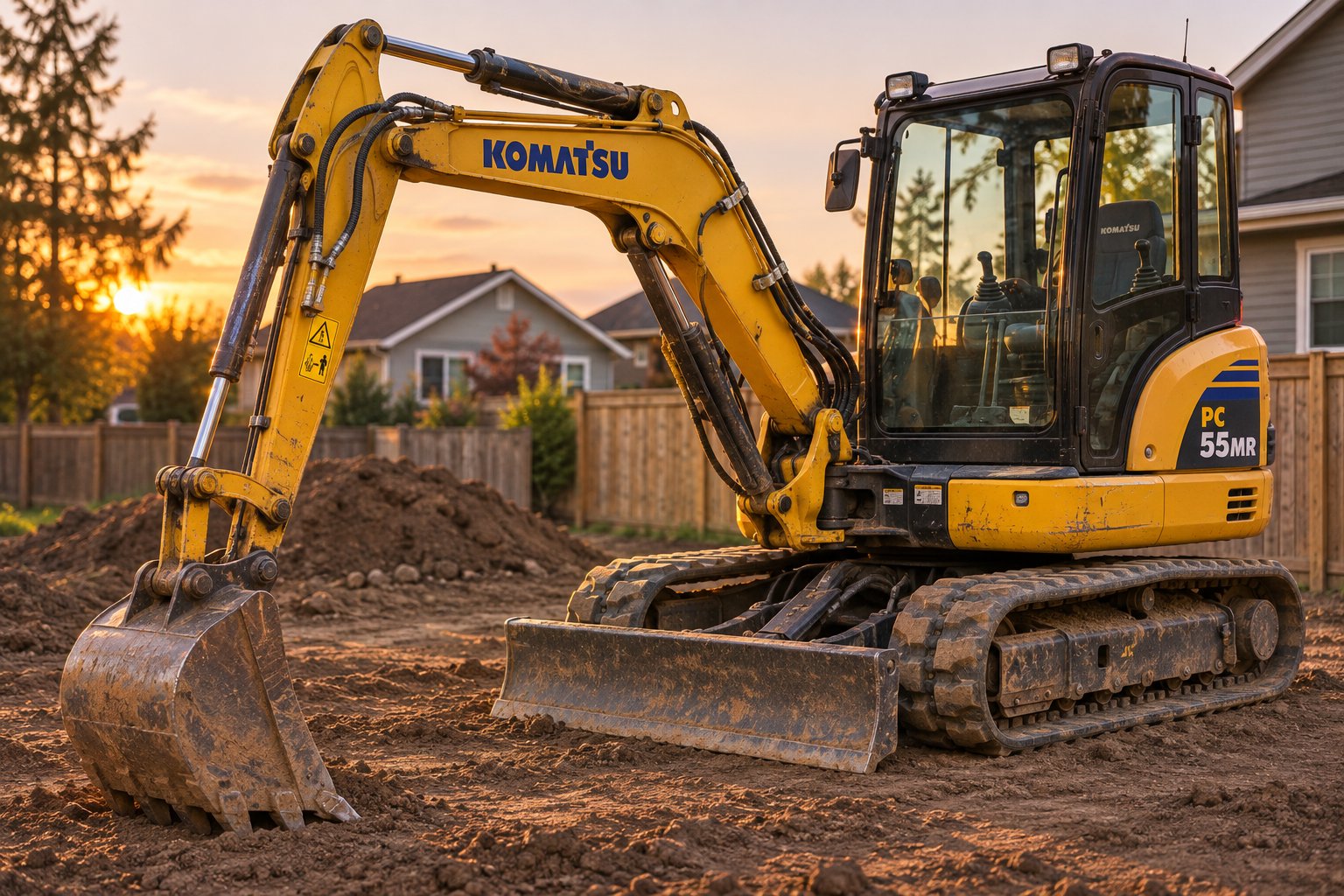


What a Zero Swing Excavator Actually Is
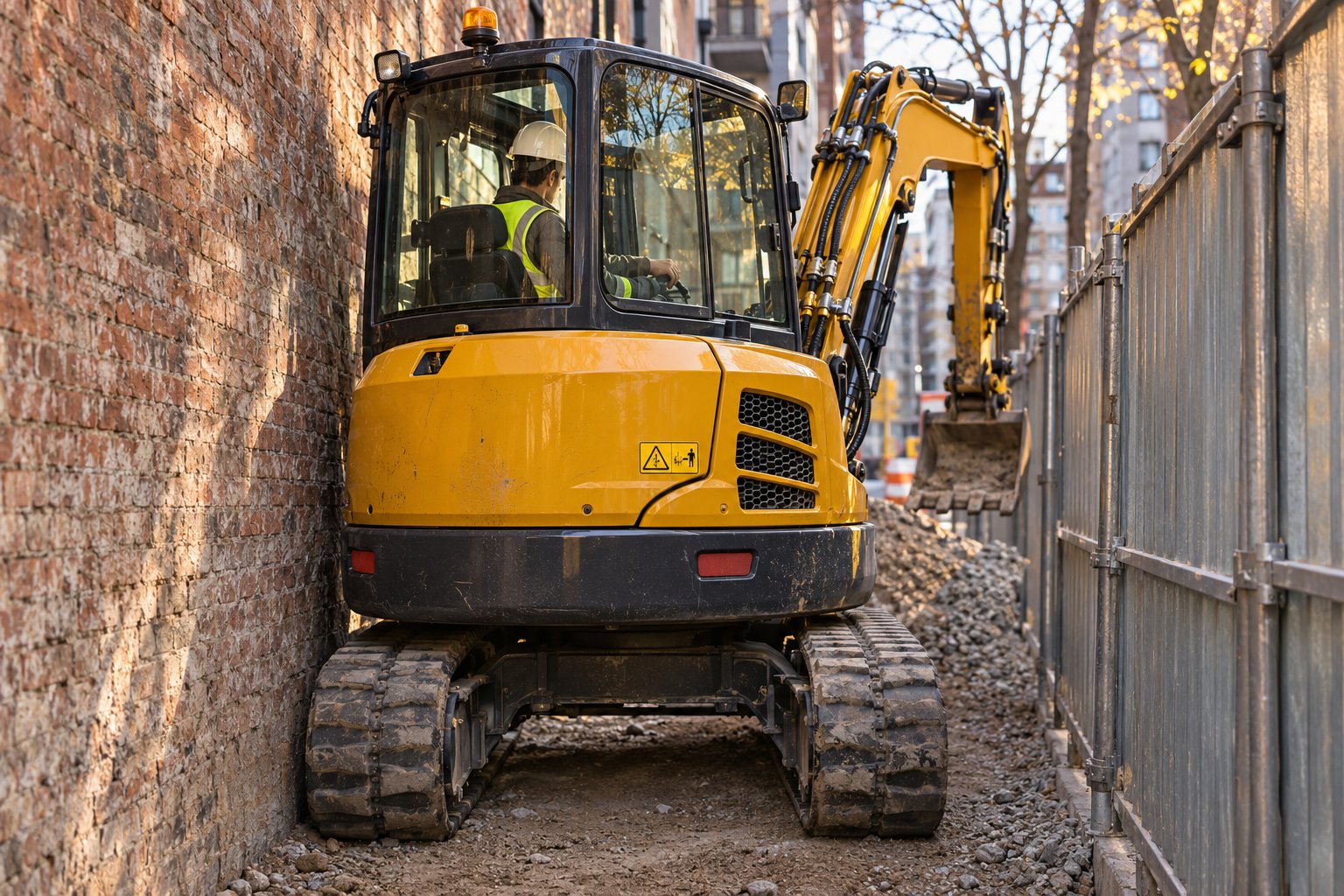
Imagine you're operating an excavator between a concrete retaining wall and a row of parked cars. Every time you rotate the cab, the back end of the machine swings outward like a closing gate. That overhang - the portion of the upper body that extends past the tracks during rotation - is called tail swing. On a standard machine, it can extend several feet beyond the undercarriage, turning every slew into a potential collision.
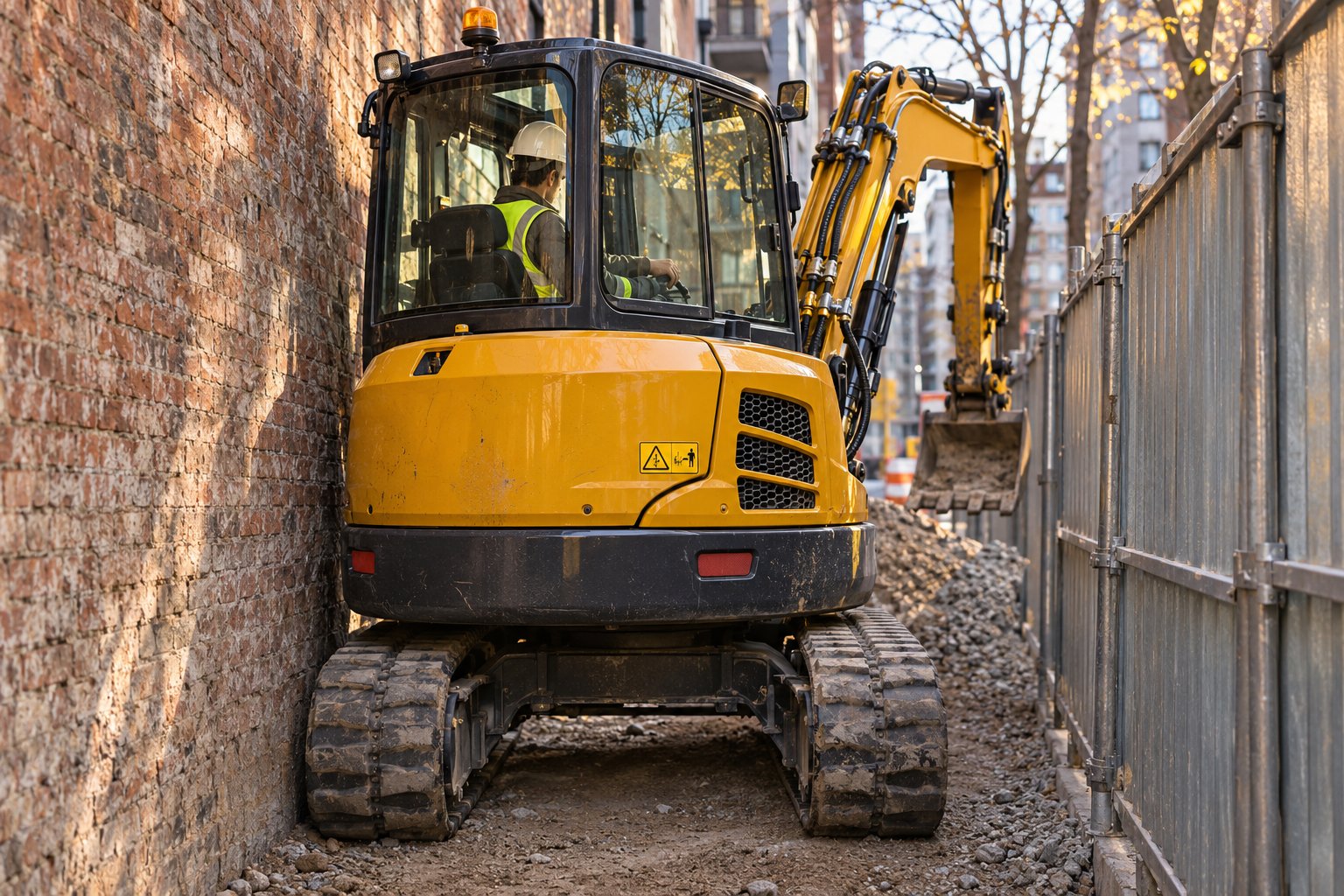
A zero swing excavator, also called a zero tail swing excavator, eliminates that risk entirely. Its counterweight and engine housing are engineered to sit inside a compact upper frame that stays within - or virtually within - the width of the tracks during a full 360-degree rotation. Nothing sticks out past the undercarriage footprint, no matter which direction the cab faces.
A zero tail swing excavator is a machine whose upper structure - including the counterweight and engine compartment - is designed so that no part of the rear housing extends beyond the track width at any point during full rotation.
What Zero Tail Swing Geometry Means in Practice
On a conventional excavator, the counterweight is deliberately positioned to overhang significantly beyond the tracks when the upper house rotates. That extra mass behind the cab provides leverage and stability for heavy digging and lifting. The trade-off? You need generous clearance behind the machine at all times, or that swinging counterweight will strike walls, fences, vehicles, or even workers standing too close.
A zero swing machine flips that equation. Engineers tuck the counterweight deeper into the upper frame and redesign the engine compartment to occupy a tighter footprint. The result is a rear pivot point that aligns with or falls inside the track width, so the tail cannot clip nearby obstacles. You'll notice the difference instantly on a crowded jobsite: operators can position the machine flush against a wall and rotate freely without repositioning or second-guessing clearance. For contractors shopping for a mini excavator for sale in this configuration, that geometry translates directly into faster cycle times and fewer damage claims.
Why the Zero Swing Concept Exists
This design did not appear by accident. Zero tail swing excavators hit the market in the 1990s, driven by a very practical set of problems. Cities were getting denser. Residential lots were shrinking. Utility contractors found themselves trenching inches from building foundations, and road crews needed machines that could work on shoulders without swinging into live traffic lanes. Every overhang incident meant property damage, injury risk, or an insurance headache - and conventional excavator excavators simply could not avoid those scenarios in confined spaces.
Manufacturers responded by repackaging the upper structure so the tail stayed inside the tracks. The concept started with smaller machines but quickly expanded. Today, you can find zero tail swing geometry across a broad range of weight classes - from sub-one-ton micro units all the way up to eight-ton-plus models. It is not exclusively a "mini escabeiro" feature, even though compact machines remain the most common application. Whether someone is researching how much does a mini excavator cost or evaluating a mid-size unit for municipal utility work, the zero swing option exists at nearly every tonnage bracket.
The engineering challenge, of course, is fitting all that mechanical hardware into a smaller envelope without sacrificing too much performance - and that balancing act is exactly where the differences between zero swing, reduced swing, and conventional machines start to matter.
Zero Swing vs Conventional vs Reduced Tail Swing
Three distinct tail-swing configurations exist on the market, and they are not interchangeable. Sellers sometimes blur the lines between them - labeling a reduced-tail-swing machine as "zero swing" or marketing a conventional model as "compact." When you're evaluating any excavator for sale, knowing exactly which category you're looking at prevents expensive mismatches between machine capability and jobsite reality.
Conventional Tail Swing Explained
A conventional excavator uses a large, heavy counterweight that extends significantly beyond the tracks whenever the upper house rotates. That extended mass is not a design flaw - it is the source of the machine's maximum digging force and lifting leverage. The farther the counterweight sits behind the pivot point, the more counterbalance it provides during deep digs, heavy bucket loads, and slope work.
The downside is clearance. On an open quarry or a sprawling earthmoving site, that overhang is irrelevant. But picture a 2 ton mini excavator with a conventional tail rotating inside a fenced backyard. The counterweight easily sweeps two or more feet past the tracks on each side, threatening fences, utility lines, and anything else within reach. Conventional machines deliver raw performance, but they demand room to swing.
Reduced Tail Swing vs True Zero Tail Swing
Reduced tail swing - sometimes called minimal or short tail swing - splits the difference. These machines shrink the counterweight overhang to just a few inches past the track edge. You'll gain meaningful clearance over a conventional model, but that small overhang still exists. In genuinely tight quarters - think operating a mini backhoe between a building foundation and a property fence - even a few inches of overhang can catch a wall or clip a parked vehicle.
True zero tail swing machines eliminate overhang entirely. The rear housing stays within the track width throughout a full 360-degree rotation, so there is physically nothing behind the cab that can strike an adjacent obstacle. When browsing mini excavators for sale, look carefully at the spec sheet rather than trusting marketing language alone - "compact radius" and "zero tail swing" do not always mean the same thing.
| Configuration | Tail Overhang | Typical Use Case | Trade-Offs |
|---|---|---|---|
| Conventional Tail Swing | Significant - extends well beyond track width | Open-site earthmoving, quarry loading, slope work | Maximum digging force and lift capacity; requires generous swing clearance |
| Reduced (Short) Tail Swing | Minimal - a few inches past tracks | Semi-confined sites, general contracting with moderate clearance | Better clearance than conventional; overhang still present in very tight spots |
| Zero Tail Swing | None - housing stays within track width | Urban trenching, indoor demolition, roadside utility work, fenced residential lots | Full rotation without obstruction risk; reduced counterweight mass may lower lift capacity |
Key Trade-Offs Buyers Should Understand
Zero tail swing geometry comes with real engineering compromises, and honest sellers will acknowledge them. Fitting the counterweight inside the track footprint means using less counterweight mass. The result, as industry sources note, is that zero swing models can have slightly reduced maximum lifting capacity and somewhat less stability on steep grades compared to conventional machines of equivalent tonnage.
Serviceability is the other consideration. Cramming the engine, hydraulic pumps, cooling system, and counterweight into a tighter upper frame leaves less room for a technician's hands. Routine tasks like filter changes or hose replacements can take longer, and heat management becomes more critical because airflow paths are shorter and more restricted. If you're comparing a small excavator with a conventional layout against a zero swing model of the same weight class, expect the conventional machine to be slightly easier to wrench on.
Neither configuration is universally superior. The right choice depends on where the machine will spend most of its hours - and that question leads directly to the specific jobsite conditions where zero swing designs genuinely earn their keep.
Where Zero Swing Excavators Outperform Standard Models
Specs on a data sheet tell part of the story. The rest plays out on the ground - literally - when an operator tries to rotate a conventional machine in a space that simply will not forgive an extra eighteen inches of overhang. Certain jobsite conditions turn the zero tail swing design from a nice-to-have into the only practical option.
Urban Construction and Indoor Demolition
Picture a utility crew trenching for a new water main along a downtown sidewalk. Existing building foundations sit three feet to the left, a row of street-side bollards lines the right, and pedestrian traffic flows behind a temporary barrier just past the machine's tail. A conventional excavator cannot rotate freely here without repositioning after nearly every cycle - or worse, clipping a wall that belongs to someone else's building.
A zero swing machine changes the math entirely. Because the upper body rotates within the track width, the operator can park flush against a foundation wall and slew through a full 360 degrees without striking anything behind the cab. That eliminates constant repositioning, reduces cycle times, and keeps the insurance adjuster out of the conversation.
Indoor demolition pushes the advantage even further. When a small excavator is working inside a warehouse or a commercial building shell, the walls themselves define the operating envelope. There is zero margin for tail overhang. Contractors running interior strip-outs routinely specify zero tail swing units because the alternative - a conventional machine that physically cannot rotate inside the structure - is not an alternative at all.
Residential Landscaping and Fenced Properties
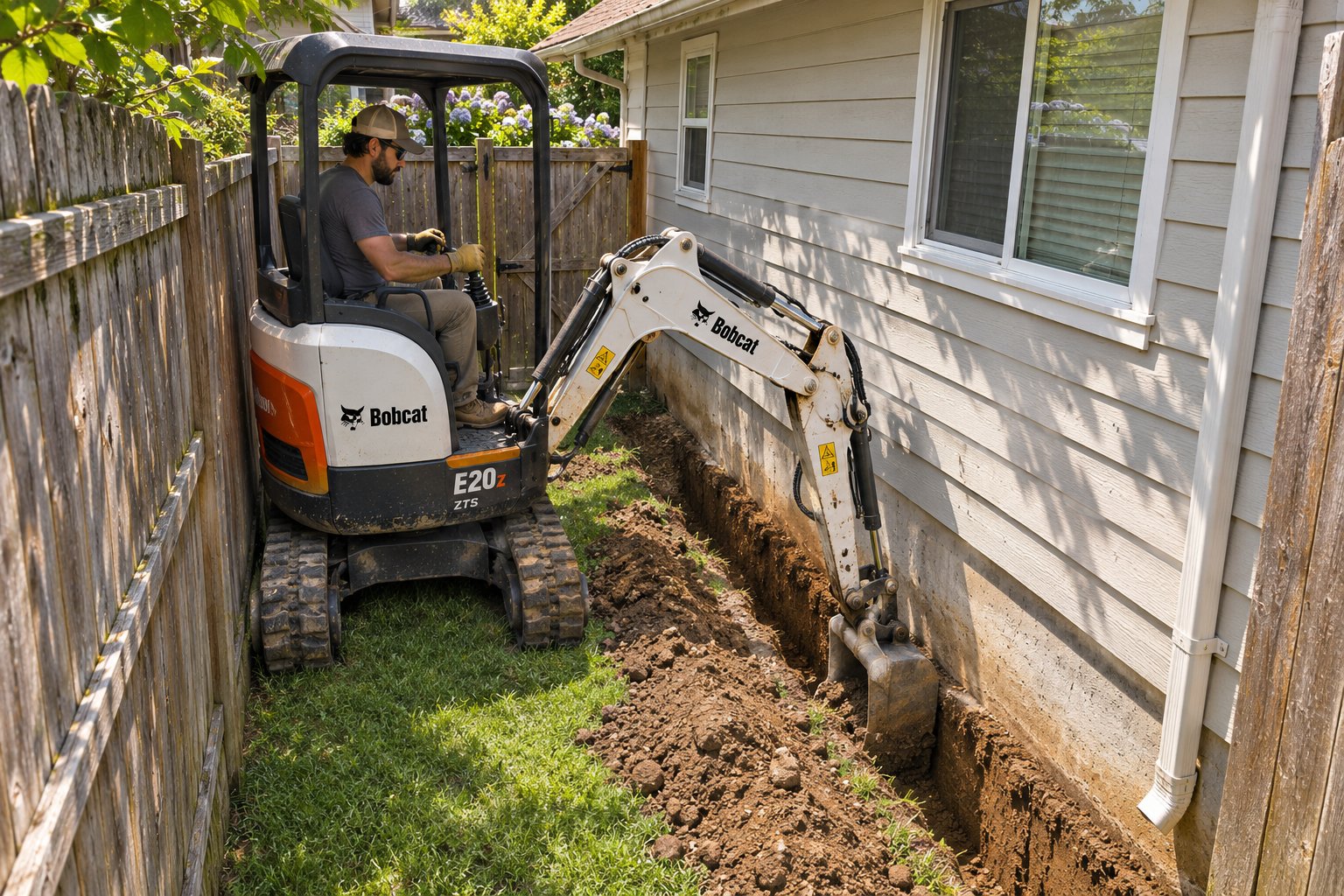
Residential work introduces a different kind of constraint: the homeowner's property. Imagine excavating a backyard pool between two houses spaced twelve feet apart, or grading a sloped lot behind a home where the only access is through a 36-inch fence gate. Anyone searching for a mini excavator for sale near me for this type of work will quickly realize that tail swing clearance matters as much as digging depth.
Fence lines are unforgiving reference points. A conventional tail sweeping past the tracks can shatter vinyl fence panels, bend aluminum posts, or gouge a neighbor's siding with a single careless rotation. Zero swing machines let the operator work right along the fence without babysitting the rear of the cab on every slew. Backyard pool excavation, French drain trenching between structures, and stump removal in tight landscaped areas all benefit from the same geometry: nothing extends beyond the tracks, so nothing can hit what is inches away.
For landscaping contractors who handle multiple residential jobs per week, the productivity gain compounds. Less time spent repositioning and less risk of property damage translates directly into faster job completion and fewer callbacks - a compelling reason why so many used mini excavator for sale listings in the residential-duty category feature zero tail swing models.
Roadside and Right-of-Way Work
Municipal utility crews and highway maintenance teams face a hazard that residential operators do not: live traffic. Shoulder work - repairing drainage culverts, installing guardrail posts, trenching for fiber-optic conduit - puts the machine just feet from vehicles traveling at highway speed. An overhanging counterweight that swings into the travel lane is not merely a property damage risk; it is a life-safety issue.
Zero tail swing machines keep the entire upper structure inside the track footprint, which means the machine can operate on a narrow shoulder without any part of its body crossing into the adjacent lane during rotation. Municipalities and utility contractors favor this configuration precisely because it reduces the required work zone width, minimizes lane closures, and keeps workers and motorists separated by a meaningful margin.
Right-of-way trenching along fence lines, pipeline corridors, and rail embankments follows the same logic. The operating corridor is fixed and narrow, obstacles border both sides, and the machine must rotate continuously without encroaching on anything outside its footprint.
Top Five Application Categories at a Glance
- Urban utility trenching - digging alongside foundations, sidewalks, and street infrastructure where swing clearance is measured in inches
- Indoor and structural demolition - operating inside buildings where walls define the absolute rotation limit
- Residential landscaping - pool excavation, grading, and drainage work in fenced yards and between closely spaced homes
- Roadside and highway shoulder work - culvert repair, guardrail installation, and conduit trenching adjacent to live traffic lanes
- Rail and pipeline right-of-way maintenance - narrow-corridor operations where encroachment beyond the work zone is prohibited
Each of these scenarios shares a common thread: the space around the machine is fixed, immovable, and unforgiving. A zero swing design does not add capability in these conditions - it unlocks capability that a conventional machine simply cannot deliver. The real question for buyers is whether their typical workload falls into one of these categories often enough to justify the configuration, and that answer depends heavily on the weight class and feature set that matches their projects.
Zero Swing Weight Classes and What Each Delivers
Knowing that a zero tail swing design fits your jobsite conditions is only half the equation. The other half is tonnage - and getting it wrong costs you either productivity or money, sometimes both. A 1 ton mini excavator handles a backyard utility trench beautifully, but ask it to dig a twelve-foot commercial footing and you'll be there all week. Conversely, hauling an eight-ton machine to a residential fence-line grading job burns fuel, demands a heavier trailer, and delivers power you'll never use.
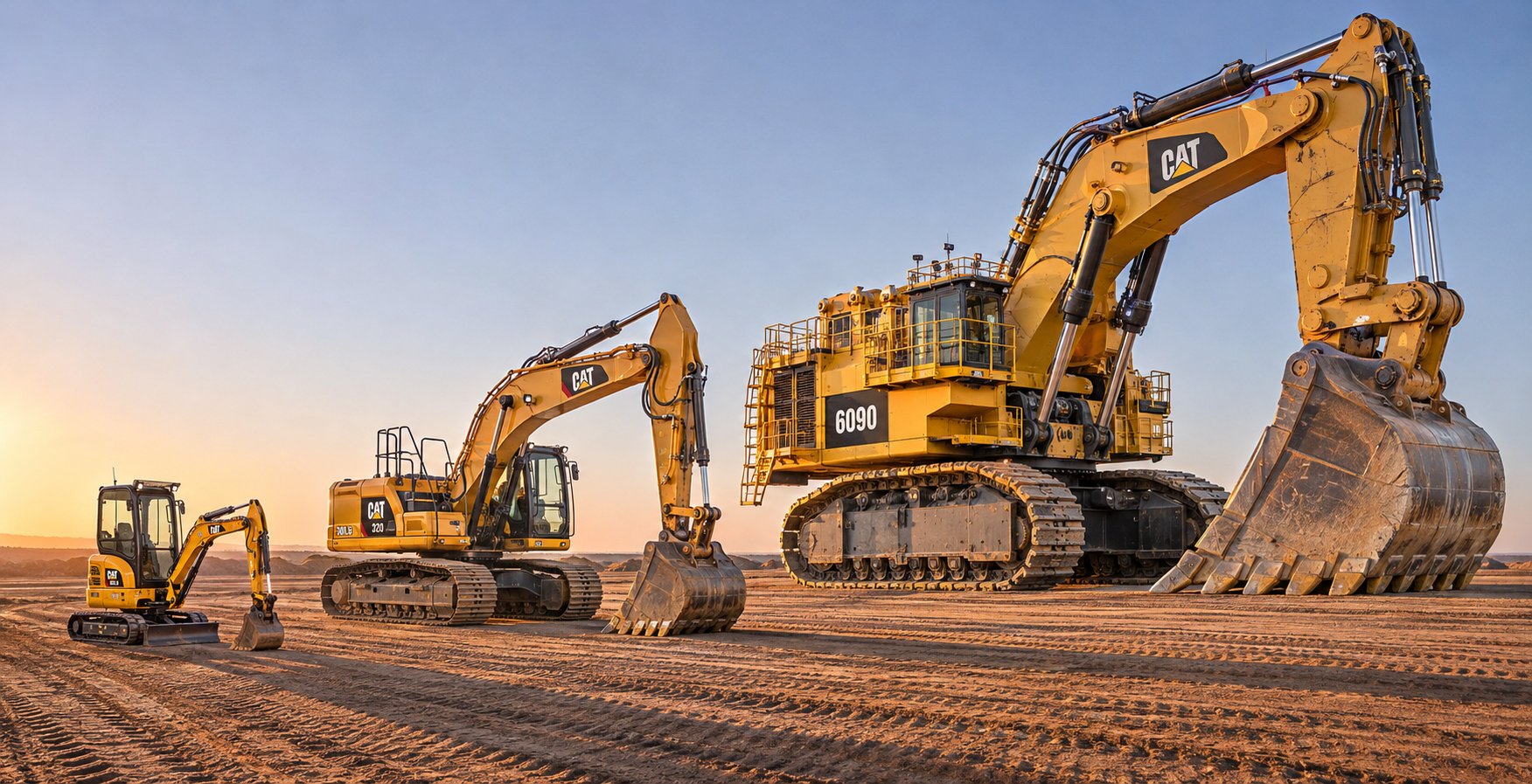
Zero swing excavators span a wider tonnage range than many buyers expect. Matching the right weight class to your actual project demands - not your biggest hypothetical job - is the fastest path to a smart purchase. Here is how the three primary brackets break down.
Under 2 Tons - Micro and Mini Zero Swing
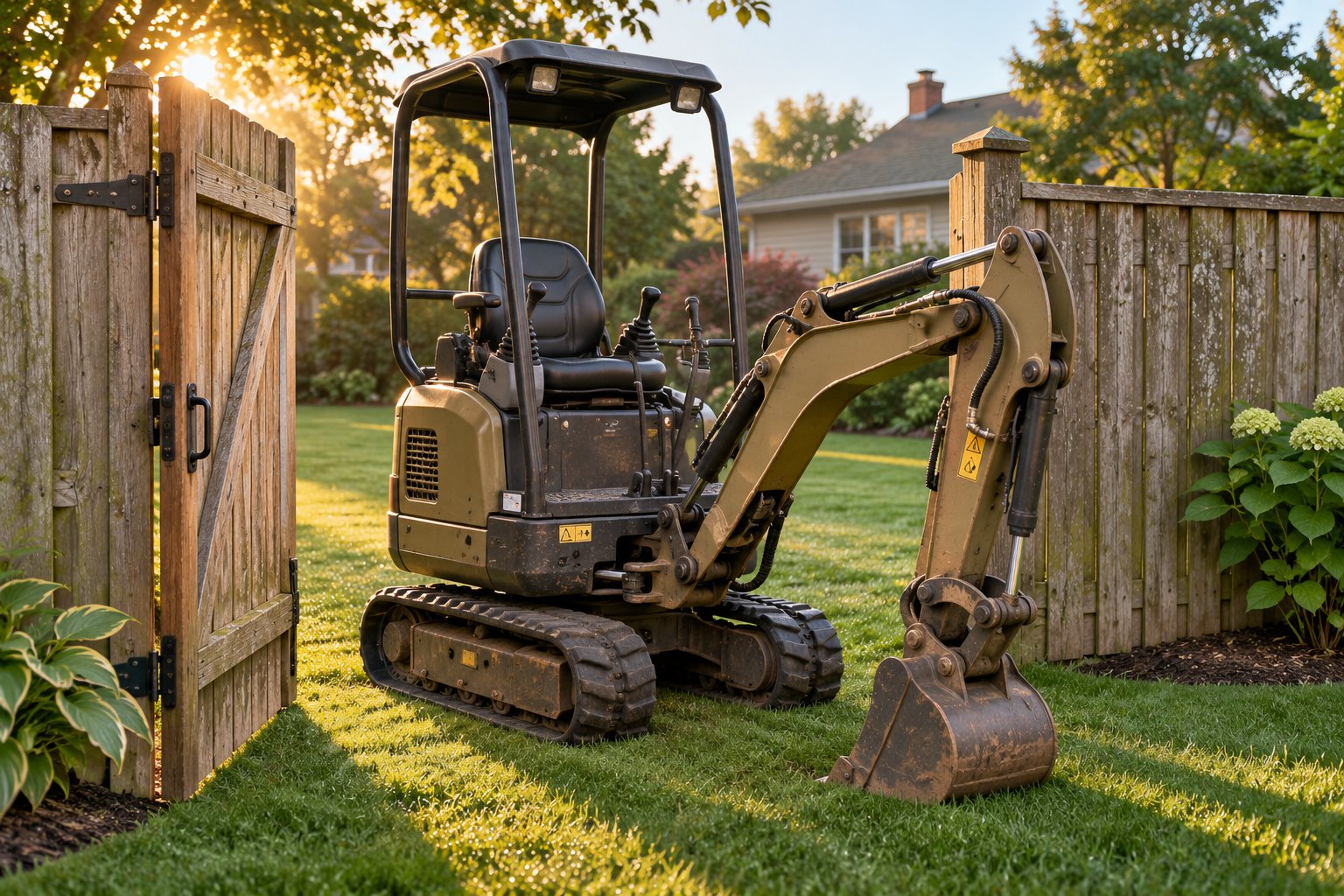
These are the access specialists. Machines in the sub-two-ton class are purpose-built for spaces that would defeat anything larger. Think interior demolition inside a commercial building, utility trenching along a narrow residential side yard, or plumbing excavation where the only way in is through a standard 36-inch gate. Many models in this bracket feature retractable undercarriages that hydraulically narrow the track width, letting them slip through doorways and fence openings that would stop a wider machine cold.
Typical dig depths range from about five to eight feet - enough for residential sewer lines, shallow utility runs, and landscape grading, but not deep enough for commercial foundations or infrastructure work that pushes past ten feet. Reach is similarly modest, usually topping out around eleven to thirteen feet at full extension.
The transport advantage, however, is enormous. A sub-two-ton machine rides comfortably on a standard single-axle trailer behind a half-ton pickup. No CDL, no overweight permits, no dispatching a heavy-haul rig just to move the excavator between residential jobs. For a small digging machine that needs to bounce between multiple sites in a single day, that portability is a genuine competitive edge.
The capability limit is equally real. These micro units are not production machines. Expect to move roughly three to five cubic yards per hour under ideal conditions. If your workload demands high-volume material handling or continuous heavy digging, stepping up a weight class is not optional - it is necessary.
2 to 5 Tons - The Versatile Mid-Range
If there is a sweet spot in the zero swing market, it lives right here. The two-to-five-ton bracket is where the broadest range of contractors - general builders, landscapers, utility installers, and rental fleets - find the best balance between compact dimensions and real digging performance.
Why does this class dominate? The numbers tell the story. Dig depths of roughly nine to thirteen feet cover the vast majority of residential and light commercial excavation tasks: foundation footings, water and sewer line installation, septic systems, swimming pool digs, and drainage work. Reach extends into the seventeen-to-nineteen-foot range on four-ton-class models, which is enough to load a standard dump truck without constant repositioning. Engine horsepower typically runs between 20 and 35 hp, providing sufficient hydraulic flow for breakers, augers, and grapples alongside standard bucket work.
These compact excavators hit a transport sweet spot too. A three-to-four-ton zero swing machine, with an operating weight between roughly 6,500 and 10,000 pounds, rides on a 12,000-pound-capacity trailer behind a three-quarter-ton truck. That keeps you under CDL thresholds in most states and avoids the expense of a dedicated heavy-haul setup.
The three-to-four-metric-ton segment in particular is the highest-volume sales class in the entire compact excavator market. Rental houses stock more machines in this bracket than any other size, which tells you exactly where real-world demand concentrates. For anyone browsing a used excavator for sale in the zero swing configuration, the two-to-five-ton range will offer the widest selection, the most competitive pricing, and the strongest resale values - simply because so many units exist in the market.
One consideration worth noting: as you approach the five-ton mark, attachment versatility expands significantly. Tiltrotators, hydraulic thumbs, larger breakers, and brush cutters all become viable options because the machine's auxiliary hydraulic flow can actually drive them efficiently. If your business model depends on running the excavator as a multi-tool carrier rather than a dedicated digger, leaning toward the upper end of this bracket pays dividends.
5 to 8+ Tons - Larger Zero Swing Machines
Many buyers do not realize that zero tail swing geometry extends well into the heavier weight classes. Machines in the five-to-eight-ton-plus range deliver breakout force, dig depth, and bucket capacity that rival conventional mid-size excavators - while still keeping the upper structure inside the track width during rotation.
Dig depths in this class push to fifteen feet and beyond, with reach extending past twenty-one feet on larger models. Engine horsepower climbs into the 40-to-65-hp range, driving hydraulic systems powerful enough for continuous breaker work, heavy grapple duty, and high-volume bucket cycling. For commercial site preparation, deep utility installation, pond excavation, and demolition projects that demand serious breakout force, these machines do work that smaller zero swing units simply cannot match.
The trade-off appears at the loading dock. A six-ton zero swing excavator with standard bucket pushes operating weight to roughly 13,000 to 15,000 pounds. Add the trailer and you are looking at a combined towing weight that exceeds the capacity of most light-duty pickups. Expect to need a one-ton truck at minimum, an 18,000-pound-plus trailer, and potentially a CDL depending on your state's gross vehicle weight rating thresholds. At eight tons and above, a heavy-duty diesel truck or a dedicated equipment trailer pulled by a semi becomes the practical reality.
Width is the other factor buyers overlook. Larger zero swing machines run 77 to 90-plus inches wide at the tracks. While the tail stays inside that width during rotation, the overall machine footprint is no longer "compact" in the way most people picture compact excavators. You still gain the critical advantage of zero overhang during slewing - invaluable for working alongside structures, traffic, or other equipment - but site access through narrow gates or residential pathways may require a different plan.
When does this class make sense? When the job demands both confined-space rotation and production-level output. Think commercial utility corridors running alongside occupied buildings, highway median work with live traffic on both sides, or large-scale landscaping projects where deep excavation meets tight property boundaries. The machine costs more to buy, more to transport, and more to maintain - but it also replaces repositioning, reduces cycle times, and opens up project types that smaller machines cannot handle efficiently.
Quick Reference: Zero Swing Weight Classes Compared
| Weight Class | Typical Dig Depth | Common Applications | Transport Requirements |
|---|---|---|---|
| Under 2 Tons | 5 - 8 ft | Interior demolition, residential utility trenching, landscape grading, plumbing excavation | Standard single-axle trailer; half-ton pickup truck; no CDL typically required |
| 2 - 5 Tons | 9 - 13 ft | Foundation footings, sewer/water line installation, pool excavation, rental fleet staple, general contracting | 10,000 - 14,000 lb capacity trailer; 3/4-ton to 1-ton truck; CDL not usually required |
| 5 - 8+ Tons | 12 - 16+ ft | Commercial site prep, deep utility corridors, pond/retention excavation, heavy demolition, highway shoulder work | 18,000 - 28,000+ lb capacity trailer; 1-ton diesel truck or semi; CDL often required |
Across all three brackets, the core principle holds: zero tail swing geometry lets you rotate freely without overhanging the tracks. What changes is how much digging power, depth, and attachment versatility you get within that constraint. Sizing correctly means honestly assessing the depth and volume your typical jobs require, then confirming that your transport setup can handle the machine you choose.
With the right weight class identified, the next logical step is knowing which manufacturers actually build dedicated zero swing models worth considering - and where their product lines differ in ways that affect your buying decision.
Popular Zero Swing Models by Manufacturer
Not every brand uses the same language to describe tail swing, and not every model marketed as "compact" actually qualifies as a true zero tail swing excavator. Some manufacturers label their machines "compact radius" or "minimal tail swing" when the rear housing still overhangs the tracks by several inches. Knowing which product families genuinely keep the tail inside the track width - and which ones merely reduce it - saves you from discovering the difference the hard way on a tight jobsite.
Japanese and American Zero Swing Series to Know
Several established manufacturers have built dedicated zero-swing product lines rather than offering it as an afterthought. If you are comparing used excavators for sale from premium brands, these are the series names to look for.
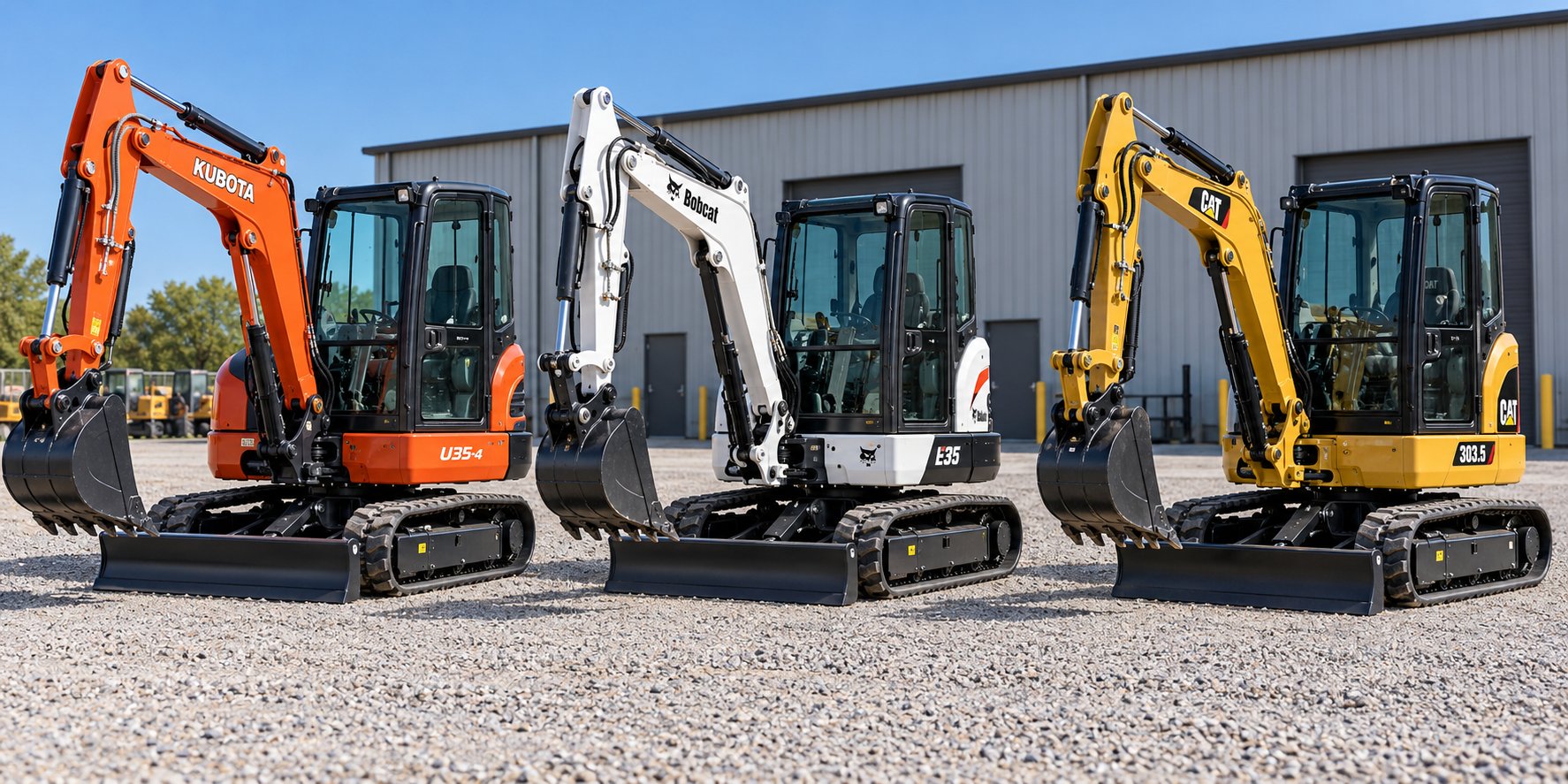
Yanmar's ViO series is arguably the most recognized zero-swing lineup on the market. Models like the ViO17-1E, ViO25-6B, ViO35-7, ViO50-6A, ViO55-6A, and ViO80-7 all carry Yanmar's "true zero" designation, meaning the upper structure stays entirely within the track width during full rotation. Yanmar's SV models - such as the SV40 and SV100-7 - use "near-zero" or "ultra-tight tail" language, which signals reduced but not eliminated overhang. The brand is widely associated with residential-scale reliability and fuel efficiency, and its engines also power machines built by other manufacturers, including certain XCMG, Takeuchi, and John Deere models.
Kubota's U-series targets the same tight-clearance market. The U17-5, U27-4, U35-4, and U55-5 all feature what Kubota calls "tight tail swing" or "zero" tail swing depending on the model. Kubota is known for dense dealer networks across North America, which makes parts sourcing and warranty service straightforward - a factor that directly influences excavator price at resale.
Bobcat's compact excavator line includes several zero and minimal tail swing options. The E20, E35, and E38 carry zero tail swing designations, while the E26 and E55 fall into Bobcat's "minimal" category - reduced but not fully eliminated overhang. Bobcat renamed and restructured several model numbers in recent years, so buyers looking at older listings should verify whether the model they are evaluating matches current specs.
Caterpillar's CR-designated compact excavators - the 301.7 CR, 302.7 CR, 303.5 CR, 305 CR, and 308 CR - use a "compact radius" design. This is not the same as true zero tail swing. Cat's own specs show overhang ranging from roughly four inches on the 305 CR to about twelve inches on the 308 CR. The CR line delivers reduced swing rather than zero swing, but CAT's unrivaled dealer network and parts availability make these machines a strong consideration for buyers who need fast service support above all else.
Takeuchi's TB-series includes reduced-swing models like the TB335R and TB280FR, identified by the "R" suffix. Most Takeuchi compact excavators, however, carry conventional tail swing. Takeuchi earns its reputation through build quality and engine performance - several models use Yanmar diesel engines - but buyers specifically seeking true zero swing will find fewer options in this lineup compared to Yanmar or Kubota.
Asian-Manufactured Alternatives and Global Brands
The zero-swing market has expanded well beyond Japanese and American brands. Chinese-headquartered manufacturers like XCMG and SANY now produce dedicated zero-swing models that compete on both price and capability, and their presence in the North American used equipment market is growing steadily.
One clarification worth making: equipment manufactured in China is not automatically a "Chinese brand" in the way many buyers assume. Several global manufacturers produce machines in Chinese facilities for export, using internationally sourced components and engines certified for the destination market. When evaluating any imported machine, the questions that matter are specific: Is the engine EPA-certified? Are replacement parts readily available through a domestic dealer or distributor? Does the warranty have enforceable terms backed by a local service network?
XCMG publishes its US brochures through XCMG North America and offers several compact models with zero or short tail swing designations, including the XE18U and XE35U. Their machines use Kubota and Yanmar diesel engines, which simplifies engine-side parts sourcing. SANY offers the SY26U, SY35U, and SY50U with zero tail swing, targeting budget-conscious buyers who want compact geometry without the premium-brand price tag. Both brands have invested in expanding parts supply and dealer infrastructure in North America, though coverage density still lags behind Kubota, Deere, and CAT in many regions.
Other names surface in the used market as well. Develon (formerly Doosan) offers zero-swing models like the DX17Z-7, DX27Z-7, DX35Z-7, and DX50Z-7. Wacker Neuson's EZ series - the EZ17, EZ26, EZ36, and EZ50 - are purpose-built zero tail swing machines. JCB fields the 35Z-I, 48Z-I, 50Z-I, 55Z-I, 85Z-2, and 90Z-2, all with zero swing geometry extending into the eight-ton-plus class. And Hyundai has expanded its zero-swing offerings with models like the HX35AZ, HX48AZ, and R80CR-9A.
For buyers weighing resale value, brand recognition still commands a measurable premium. Machines from Kubota, Yanmar, CAT, and Bobcat tend to hold value more consistently in the secondary market, partly because dealer support infrastructure is denser and partly because buyer familiarity reduces perceived risk. XCMG and SANY machines typically carry lower acquisition costs, which can offset thinner resale margins if the buyer plans to run the machine through its useful life rather than flip it. Industry comparisons between SANY and XCMG suggest that SANY currently holds a slight edge in resale demand globally, while XCMG appeals to buyers prioritizing upfront affordability and rugged simplicity.
Key Brands and Their Recognized Zero-Swing Model Series
- Yanmar - ViO series (ViO17-1E, ViO25-6B, ViO35-7, ViO50-6A, ViO55-6A, ViO80-7): true zero tail swing
- Kubota - U-series (U17-5, U27-4, U35-4, U55-5): zero or tight tail swing
- Bobcat - E20, E35, E38: zero tail swing; E26, E55: minimal tail swing
- Caterpillar - CR series (302.7 CR, 303.5 CR, 305 CR, 308 CR): compact radius (reduced, not zero)
- Takeuchi - TB335R, TB280FR: reduced tail swing ("R" suffix models)
- XCMG - XE18U, XE35U: zero swing; XE27U: short tail; XE55U: reduced swing
- SANY - SY26U, SY35U, SY50U: zero tail swing
- Develon - DX17Z-7, DX27Z-7, DX35Z-7, DX50Z-7: zero tail swing
- Wacker Neuson - EZ17, EZ26, EZ36, EZ50: zero tail swing
- JCB - 35Z-I, 48Z-I, 50Z-I, 55Z-I, 85Z-2, 90Z-2: zero tail swing
- Hyundai - HX35AZ, HX48AZ, R80CR-9A: zero tail swing
Every brand on this list brings a different balance of acquisition cost, parts accessibility, dealer density, and long-term resale trajectory. Picking the right one is less about loyalty and more about matching the support infrastructure to your operating reality - because a machine with the best specs on paper becomes a liability the moment a hydraulic hose blows and the nearest parts shelf is three states away. That kind of risk is especially sharp in the used market, where the original warranty may have expired and the next repair bill lands entirely on the buyer's shoulders.
How to Inspect a Used Zero Swing Excavator Before Buying
A fresh coat of paint and a pressure-washed engine bay can make any machine look like a bargain. The question is what's hiding underneath. When you find a small excavator for sale that checks the right boxes on paper - correct weight class, trusted brand, reasonable price - the physical inspection is where you separate a genuine deal from an expensive mistake. And zero tail swing machines carry a few inspection nuances that conventional excavators don't.
Whether you're evaluating a mini backhoe for sale at a local dealer or flying out to inspect a unit listed on an auction platform, this framework gives you a structured way to assess the machine's real condition before any money changes hands.
Slew Ring, Undercarriage, and Hydraulic Checks
Start with the slew bearing - the massive ring gear that lets the upper structure rotate on the undercarriage. Here is a simple field test: lift the bucket just off the ground so the tracks barely maintain contact, then have someone push the boom firmly side to side while you watch and listen. Any noticeable play, clunking, or grinding at the junction between the upper house and the undercarriage signals bearing wear. Swing bearing condition directly impacts both digging accuracy and operator safety, so do not skip this step.
Why does this matter more on a zero swing machine? These excavators spend their working lives in tight quarters. Operators rotate constantly in confined spaces, often reversing direction rapidly to cycle material between a trench and a truck just feet apart. That repetitive, close-quarter slewing loads the bearing differently than open-site work, and it can accelerate wear in ways that the hour meter alone won't reveal.
Move to the undercarriage next. The tracks, rollers, idlers, and sprockets account for roughly 20% of the machine's total value and nearly 50% of its lifetime maintenance costs. Check track sag by measuring the gap between the top of the track chain and the underside of the track frame - excessive sag means stretched or worn links. Look at the sprocket teeth: pointed, shark-fin-shaped teeth indicate heavy wear. Rollers and idlers should spin freely without grinding, and there should be no oil seeping from their seals. If the undercarriage needs a rebuild, you're looking at thousands of dollars that should be factored into your offer price.
Hydraulics come next. Walk the entire machine and inspect every cylinder rod for scoring, pitting, and chrome flaking. Even hairline scratches on a rod surface will chew through seals and cause weeping within weeks. Check hose fittings for dampness, and look beneath the machine for fresh puddles or staining on the belly pan. Slow or weak hydraulic action when cycling the boom, stick, or bucket is a red flag pointing toward pump wear or internal valve bypass. Finally, grab the bucket teeth and try to rock the stick and boom at each pin joint. Clunking or visible movement means the pins and bushings are worn - a repair that's straightforward but not cheap.
Hour Meter Verification and Engine Health
The hour meter is the first number every buyer looks at, and it's also the easiest number to manipulate. Dashboard replacements and meter rollbacks happen in the used equipment market, so you need to cross-reference what the screen displays with what the machine's physical condition tells you.
Here's the principle: a machine showing 2,500 hours should look, feel, and wear like a 2,500-hour machine. If the display reads low but the seat is worn flat, the joystick grips are smooth, the pedal rubber is thin, and the control levers have noticeable slop, those physical signs point to far more hours than the meter admits. Interior cabin wear is especially telling because dealers rarely replace minor components just to stage a low-hour appearance.
On newer machines equipped with OEM telematics, the Engine Control Unit stores cumulative running hours independently from the dashboard display. Brands like Caterpillar, Komatsu, and Kubota embed this data deep in the ECU, and even replacing the dashboard monitor or altering the display software won't erase the original ECU record. If the seller permits it, connecting a diagnostic tool to the machine's ECU is the most reliable way to confirm true operating hours.
For the engine itself, insist on a cold-start inspection. Arrive before the seller has warmed the machine up. A cold engine reveals problems that disappear once oil pressure stabilizes and components reach operating temperature. Watch the exhaust during cranking and the first thirty seconds of idle: hard starting, prolonged cranking, heavy black or white smoke, and unusual knocking all warrant further investigation. Blue-gray smoke at cold startup suggests oil is burning past worn rings or valve seals - a potential engine overhaul waiting to happen.
Pop the coolant reservoir cap once the engine is cool and look at the fluid. Milky or oily coolant suggests a head gasket breach or internal crack allowing oil and coolant to mix. Clean, properly colored coolant at the correct level is a simple but meaningful confidence signal. Anyone wondering how much is a mini excavator truly worth should factor engine health into that equation just as heavily as brand name or hour count.
Red Flags Specific to Zero Swing Machines
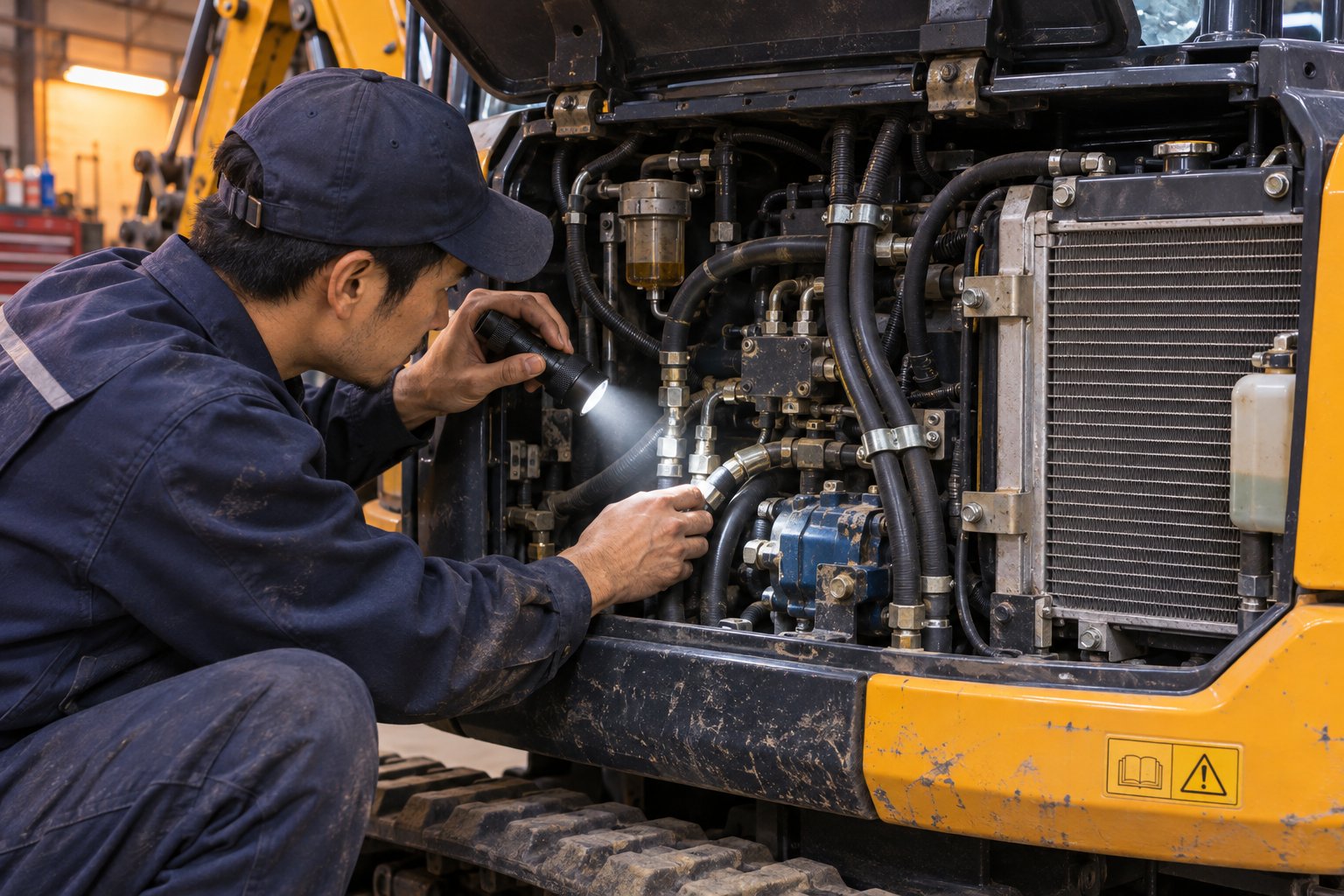
Every used excavator carries risk, but zero tail swing models introduce a handful of inspection points that conventional machines don't share. The root cause is packaging: fitting the engine, hydraulic pumps, cooling system, and counterweight inside a tighter upper frame creates heat management challenges that grow worse as the machine ages.
That compact engine compartment can mask overheating history if you don't know where to look. Clogged radiator fins are the single most common cause of overheating in mini excavators, and in a zero swing layout - where airflow paths are shorter and the engine sits closer to surrounding panels - heat buildup happens faster and persists longer. Chronic overheating leaves evidence: discolored or brittle coolant hoses, heat-cracked wiring insulation, warped or darkened plastic components near the exhaust manifold, and a radiator core with bent or corroded fins that compressed air alone won't fix.
Check the aftercooler and intercooler condition as well. On turbocharged models, a failing aftercooler raises intake temperatures and accelerates internal wear, but the symptom - gradual power loss - is subtle enough that a short test drive might not reveal it. Look for oil residue in the intake tract downstream of the turbo, which signals a turbo seal beginning to fail.
Sellers who refuse to allow a cold start, resist an independent inspection, or present a freshly pressure-washed engine bay without explanation deserve extra scrutiny. These are not automatic deal-breakers, but they are reasons to slow down and ask harder questions.
Quick-Reference Red Flag Checklist
- Slew bearing play or grinding - push-test the boom side to side with the bucket lifted; clunking or visible movement at the turntable joint indicates bearing wear
- Hour meter mismatch - low displayed hours paired with heavily worn seat, joysticks, pedals, or undercarriage components suggest meter tampering
- Hydraulic cylinder rod damage - scoring, pitting, or chrome loss on any rod surface will cause progressive seal failure
- Discolored or brittle hoses in the engine bay - heat-damaged hoses signal chronic overheating, especially critical in tight zero swing engine compartments
- Milky or contaminated coolant - indicates potential head gasket failure or internal cracking
- Fresh welds on structural members - grinding marks or new welds around the boom foot, stick tip, or cylinder mounts may conceal crack repairs
- Radiator core damage - badly bent, corroded, or clogged fins in a zero swing machine point to airflow restriction and overheating history
- Seller restrictions - refusal to permit a cold start, independent inspection, or ECU diagnostic read is a reason to proceed with extreme caution
A thorough inspection does not guarantee a perfect machine - it guarantees informed negotiation. Every deficiency you document before purchase becomes either a line item deducted from the asking price or a reason to walk away entirely. That clarity is especially valuable in a market where the question on every buyer's mind - whether they're scanning listings for an excavator for sell by a private party or browsing dealer inventory - is not just what the machine costs today, but what it will cost to keep running tomorrow.
Pricing Tiers and What Shapes the Cost
Inspection skills tell you whether a machine is worth buying. Pricing knowledge tells you whether the asking number makes sense. The used zero swing market spans a surprisingly wide range - from budget-tier imports with five-figure hour counts all the way to low-hour certified units that approach new-machine territory. Understanding what pushes a listing toward one end of that spectrum or the other prevents you from overpaying for a worn-out unit or walking past a genuinely good deal because the price seemed "too high."
What Drives Zero Swing Excavator Pricing
Five variables account for almost all the price variation you'll see when scanning listings for a diesel mini excavator or a larger zero-swing unit.
Brand reputation carries measurable weight in the resale market. A Kubota U35-4 or John Deere 35G with 2,500 hours commands a higher price than a lesser-known import at the same hour count - not because the iron is necessarily superior, but because denser dealer networks, easier parts sourcing, and stronger buyer confidence translate directly into demand. Used mini excavators from brands like Kubota, Caterpillar, and John Deere dominate the resale market precisely because their service ecosystems reduce the buyer's risk.
Machine hours function like mileage on a truck. A unit in the 1,500-to-3,500-hour window still has the majority of its service life ahead of it and sits in the highest-demand bracket for secondhand buyers. Push past 5,000 hours and the likelihood of major component overhauls - hydraulic pump rebuilds, undercarriage replacements, engine top-ends - climbs sharply, dragging the asking price down with it.
Age interacts with hours but isn't the same thing. A five-year-old machine with 1,800 hours has been lightly used. A three-year-old machine with 4,500 hours has been run hard. Buyers shopping for an excavator small for sale often fixate on one number or the other; smart buyers weigh both together.
Attachment packages shift value in both directions. A unit bundled with a hydraulic thumb, multiple bucket sizes, and a quick coupler is worth more than a bare machine - but only if those attachments are genuinely compatible and in serviceable condition. Overvalued attachment bundles are a common upselling tactic in private-party listings.
Geographic location creates price arbitrage that surprises first-time buyers. Markets with high construction density - the U.S. Northeast, Pacific Northwest, and Southeast - tend to show higher used prices because local demand outstrips supply. Rural markets and regions with lower construction activity often list identical machines for less, though transport costs can eat into that savings.
One more variable applies specifically to zero-swing machines: zero-tail-swing models typically carry a 5-15% price premium over conventional-tail-swing equivalents in the same weight class. That premium reflects the tighter engineering tolerances, more complex upper-frame packaging, and higher manufacturing cost baked into the design. When you see a mini excavator sale listing priced above a seemingly identical conventional model, the zero-swing configuration is often the reason.
Budget, Mid-Range, and Premium Tiers
Pricing falls into three rough brackets, each with a distinct risk-reward profile.
Budget tier generally covers high-hour machines - often 4,000 hours and above - from lesser-known brands or older units from premium manufacturers that have aged out of their prime service window. You'll find asking prices in the low-to-mid single-digit thousands for micro-class units and the low teens for three-to-five-ton machines at the bottom of this range. The trade-off is real: limited or nonexistent warranty coverage, potentially thin parts availability, and the possibility that a major component failure is not far off. Budget machines suit buyers who have in-house mechanical capability and can absorb downtime without losing a project.
Mid-range is where most serious contractors and small fleet operators shop. This bracket covers established-brand machines - Kubota, Bobcat, Deere, Takeuchi - in the two-to-five-year-old window with moderate hours. Typical used pricing in the 3.5-to-5-ton zero-swing class falls roughly between $28,000 and $52,000 depending on brand, hours, and condition. You're buying a machine that has already absorbed the steepest depreciation hit - new equipment loses 20-25% of its value in the first year alone - while still retaining 70-80% of its total useful life. The sweet spot for maximum value sits in this zone.
Premium tier includes low-hour certified pre-owned units, dealer-reconditioned machines, and new inventory. Prices for new zero-swing excavators in the three-to-five-ton class can push into the $60,000-$80,000-plus range depending on the brand and configuration. Low-hour CPO units from major brands often land in the upper $40,000s to $60,000s. What you get at this level is confidence: documented service history, remaining factory warranty or dealer-backed coverage, and the expectation that the machine will deliver years of reliable service before requiring significant capital maintenance.
Purchase price is only one line in the total cost of ownership equation. Parts availability, fuel efficiency, resale value retention, and the cost of unplanned downtime all factor into what a machine truly costs over its working life - and a cheaper acquisition price that leads to frequent breakdowns and hard-to-source parts can easily become the most expensive option.
That principle, echoed by equipment lifecycle analysts, applies at every tier. A budget-tier machine that requires a $6,000 undercarriage rebuild within six months is no longer a bargain. A premium unit that holds strong resale value and runs five years without a major repair may cost less per operating hour than anything else on the lot. The buyers who come out ahead are the ones who calculate forward - not just the check they write today, but the checks they'll write over the next three to five years of ownership.
Knowing what to pay is one piece of the puzzle. Knowing where to shop - and how different buying channels shift both price and risk - is the piece that determines whether you actually find the right machine at the right number.
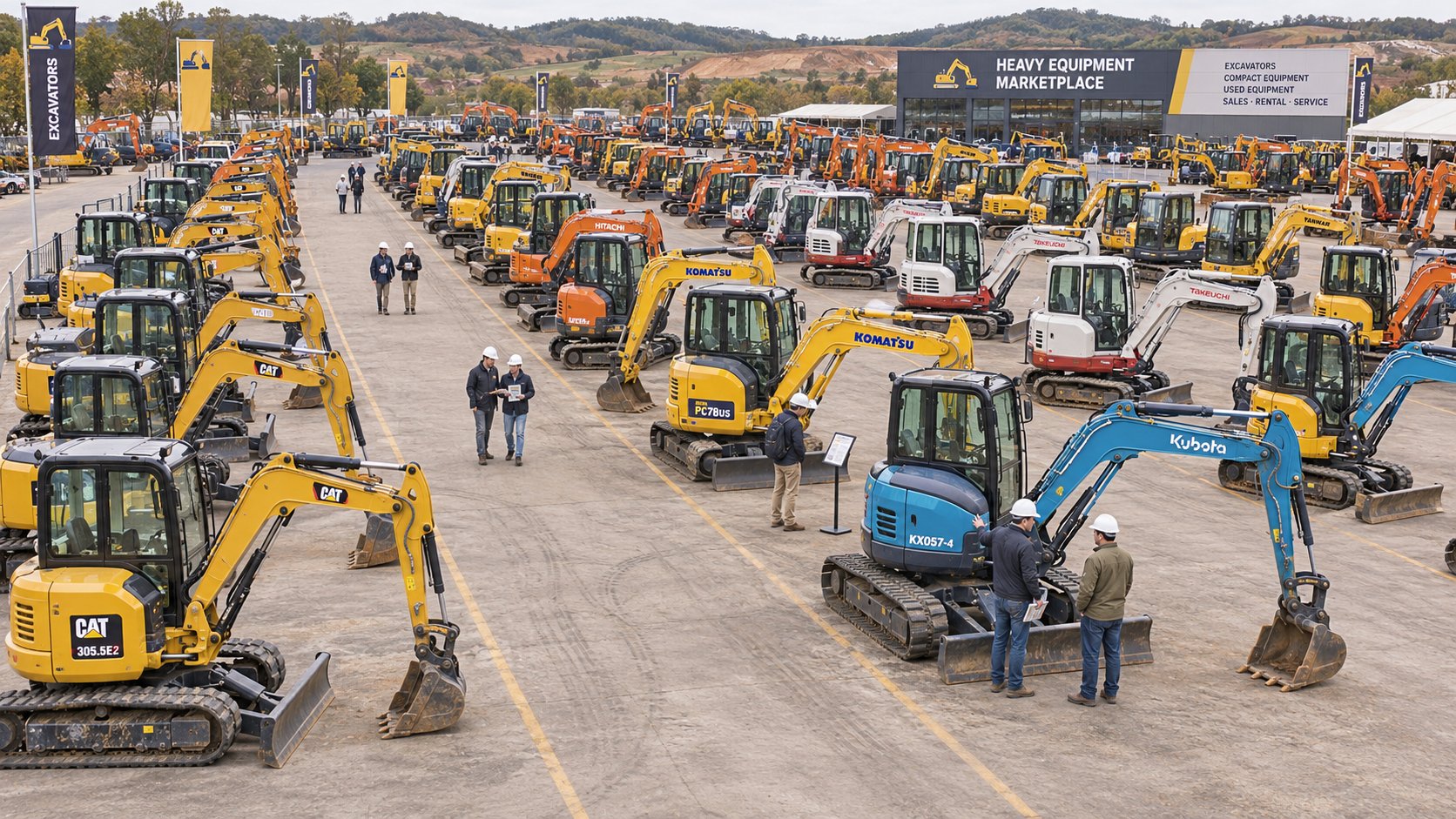
Where to Shop for Zero Swing Excavators for Sale
You've identified the right weight class, shortlisted specific models, and built an inspection checklist sharp enough to catch hidden problems. The remaining variable is where you actually buy. Different purchasing channels carry different risk profiles, pricing dynamics, and levels of buyer protection - and the channel that works perfectly for a fleet manager sourcing ten compact mini excavator units for a rental operation looks nothing like the one that suits a sole-proprietor landscaper hunting for a single used machine close to home.
Understanding each avenue's strengths and blind spots lets you match the buying process to your budget, timeline, and tolerance for uncertainty.
Auction Platforms and Online Marketplaces
Auctions remain one of the most popular channels for sourcing used heavy equipment, and for good reason: competitive bidding can push prices below retail dealer levels, and the sheer volume of inventory means you're likely to find specific makes and models that would take weeks to locate through private listings.
Ritchie Bros. and its online counterpart IronPlanet dominate the heavy-equipment auction space. Both platforms list zero swing and conventional excavators across every weight class, and registered users can view selling prices from the past 24 months to benchmark what similar machines have actually fetched - a powerful tool for setting realistic bidding limits. Aggregator sites like Machinio and Machinery Pete pull listings from multiple sources into a single searchable interface, making it easier to compare a mini used excavator in Texas against an identical model listed in Ohio without toggling between a dozen different websites.
The advantages are real, but so are the risks. Most auction sales are final, with machines sold as-is and limited - if any - warranty protection. Buyers' fees, transport costs, and potential export implications all add to the hammer price. Remote buyers face an additional challenge: you may be bidding on a machine you've never physically inspected. Some auction houses allow pre-sale inspections by your own mechanic, but not all do, and the window is often narrow. If you're searching for a used mini excavator for sale near me and plan to bid at auction, arranging an in-person or third-party inspection before the gavel falls is not optional - it's essential.
Peer-to-peer marketplaces like Facebook Marketplace, Craigslist, and equipment-specific classified boards offer the lowest transaction overhead. There are no buyer's premiums, and you deal directly with the seller. The trade-off is that you inherit the full burden of due diligence. Inconsistent serial numbers, freshly painted parts concealing welds, or sellers refusing in-person inspection are all warning signs that surface more frequently in unmoderated private listings than on curated platforms. Listings with "too good to be true" pricing deserve extra skepticism - bargain-priced machines that skip basic verification steps often carry hidden mechanical or legal liabilities.
Whether the listing says "mini escavator" or uses the proper model designation, always cross-reference the advertised specifications against the manufacturer's published spec sheet. A seller calling a reduced-tail-swing machine "zero swing" - intentionally or through ignorance - is a mistake you can catch in thirty seconds with a quick check on the OEM website.
Dealer Networks and Direct Specialist Sellers
Authorized dealer networks represent the most traditional buying channel and, for many buyers, the lowest-risk one. Dealers from brands like Kubota, Bobcat, Caterpillar, and Deere carry both new and certified pre-owned inventory, offer financing packages, and stand behind the machines with warranty or service agreements. The premium you pay over auction pricing buys documentation transparency, verified service histories, and a local point of contact if something goes wrong after delivery.
For buyers sourcing across multiple brands - or shopping for import-ready machines in bulk - specialist platforms that aggregate multi-brand used inventory simplify comparison shopping significantly. Rather than visiting six different dealer lots and cross-referencing specs manually, you browse a consolidated catalog, filter by configuration and weight class, and request quotes on specific units.
JIUHONG's used excavator collection operates on this model. The platform brings together compact and larger machines from multiple manufacturers, letting excavation contractors, equipment dealers, and import buyers compare listings side by side and request model-specific quotes for individual or bulk orders. For buyers evaluating several zero swing options across brands - or sourcing a mixed fleet that includes both compact and mid-size units - this kind of centralized catalog cuts research time and streamlines the quoting process. One important note: JIUHONG's excavator listings span the full size spectrum, not just minis, so buyers should confirm zero-tail-swing specifications for any selected machine before finalizing an order.
Regional independent dealers round out the channel mix. These smaller operations often specialize in specific brands or weight classes and may carry well-maintained trade-ins that never reach the national auction circuit. Building a relationship with a local independent dealer can surface off-market inventory and give you first-look access to machines before they hit public listings - a meaningful advantage when demand for popular zero swing models in the three-to-five-ton bracket outpaces supply.
Buying Channels Ranked by Buyer Type
- Import buyers and bulk fleet purchasers - Start with direct specialist platforms like JIUHONG's excavator collection that aggregate multi-brand inventory, support bulk quoting, and streamline export logistics for international orders.
- Equipment dealers restocking used inventory - Combine auction platforms (Ritchie Bros., IronPlanet) for volume sourcing with specialist aggregators for targeted model searches. Cross-reference auction sold-price data to validate acquisition costs.
- General contractors and rental fleet operators - Authorized brand dealers offer the strongest warranty and financing packages. Supplement with aggregator searches on Machinio or Machinery Pete to benchmark pricing across regions.
- Small contractors and owner-operators - Local independent dealers and regional classifieds provide accessible entry points. Inspect every machine in person and verify specifications against OEM data - even if the listing labels the unit a mini escavator with zero swing, confirm the tail-swing configuration before committing.
- Budget-conscious first-time buyers - Peer-to-peer marketplaces offer the lowest acquisition costs but demand the highest due diligence effort. Factor in the cost of a third-party inspection and potential transport to calculate true landed price.
Each channel trades off price against protection. Auctions deliver competitive pricing but shift inspection risk to the buyer. Dealers provide documentation and recourse but charge for that security. Specialist platforms bridge the gap by offering curated multi-brand selection with direct quoting - especially valuable for cross-border buyers who need specification clarity and logistics coordination baked into the purchasing process.
The channel you choose shapes the buying experience. The decision you make after choosing a channel - whether a zero swing excavator is genuinely the right configuration for your workload, or whether a conventional model would serve you better - shapes everything that comes after it.
Is a Zero Swing Excavator the Right Choice for You?
Every piece of this guide - the engineering explanation, the weight class breakdown, the brand survey, the inspection framework, the pricing tiers, the buying channels - funnels into a single question: does a zero tail swing configuration actually match the way you work? The honest answer is not always yes. Buying the wrong configuration wastes money just as surely as buying a worn-out machine, and the best deal on a zero swing excavator is still a bad purchase if your jobsite conditions favor a conventional model.
Here is how to settle the question before you spend a dollar.
Match Your Jobsite Conditions to Machine Configuration
Forget brand loyalty and pricing for a moment. The configuration decision should be driven almost entirely by the physical environment where the machine will log the majority of its hours. Ask yourself these questions honestly - the pattern of your answers draws a clear line toward or away from zero swing geometry.
Lean toward zero tail swing if:
- Most of your jobs place the machine within three to five feet of structures, fences, retaining walls, or other immovable objects during rotation
- You regularly work alongside live traffic lanes, active pedestrian zones, or other equipment operating in close proximity
- Interior demolition, backyard landscaping, or narrow utility corridors represent a significant share of your annual workload
- Property damage claims or liability exposure from tail-swing incidents have been a recurring concern on past projects
- Jobsite access points - gates, alleyways, building entries - restrict machine width and eliminate clearance for tail overhang
Lean toward conventional or reduced tail swing if:
- The majority of your work happens on open construction sites, agricultural land, or quarries where swing clearance is unlimited
- Maximum lift capacity and stability on grades are daily requirements rather than occasional needs
- You run heavy attachments - large breakers, grapples, tiltrotators - that demand the added counterweight leverage a conventional tail provides
- Deep excavation at or near the machine's maximum rated dig depth is routine, where every pound of counterbalance matters
- Your budget is tight and the 5-15% price premium on zero swing models shifts the purchase outside your target range
Many contractors fall somewhere in between - splitting hours between confined residential work and open commercial sites. If that describes your operation, consider which environment accounts for 60% or more of your annual schedule. That majority scenario should dictate the configuration. A zero swing machine handles open-site digging competently; it just sacrifices some lift capacity and counterweight stability you may not fully need. A conventional machine on a tight jobsite, however, creates risks and repositioning delays that cost real time and real money on every rotation.
For buyers sourcing a used small excavator for sale in the three-to-five-ton class - the highest-demand bracket - both configurations are widely available on the secondary market. You are not locked into zero swing simply because inventory is limited. The choice should reflect your work, not the market's supply.
Buying Confidence Checklist
You have read through every section of this guide. The following checklist compresses those lessons into a step-by-step action plan you can follow the moment you begin actively shopping. Each item builds on the section of the article where it was covered in detail - treat this as your pre-purchase playbook.
- Browse multi-brand platforms first to establish your baseline. Start with JIUHONG's excavator collection, where you can compare compact and larger machines from multiple manufacturers, filter by configuration, and request model-specific quotes for individual or bulk purchases. This gives you a pricing and availability snapshot across brands before you commit to a single dealer or auction listing.
- Define your weight class based on actual project requirements. Use the tonnage breakdown from earlier in this guide - under 2 tons for access-restricted micro work, 2 to 5 tons for the broadest versatility, 5 to 8+ tons for production-level output in confined commercial environments. Do not oversize the machine hoping to "grow into it" - transport costs and reduced maneuverability on smaller jobs will eat the savings.
- Shortlist specific models from manufacturers with proven zero-swing lineups. Reference the brand-by-brand model list earlier in this article. Verify that the model you're considering carries a genuine zero tail swing designation - not just "compact radius" or "reduced swing" - by checking the OEM spec sheet directly.
- Inspect thoroughly using the framework outlined in this guide. Test the slew bearing, check undercarriage components against displayed hours, insist on a cold start, and look for heat damage in the engine compartment. On any used small excavator for sale with a zero swing layout, pay special attention to cooling system condition and hose integrity inside that tight engine bay.
- Compare pricing across at least three channels. Cross-reference what you see on auction platforms, dealer lots, and aggregator sites. Use sold-price data from Ritchie Bros. or IronPlanet to benchmark fair market value rather than relying on asking prices alone.
- Request quotes from platforms that support multi-brand comparison. JIUHONG's excavator catalog lets you request model-specific pricing for zero swing units across brands - useful whether you are an independent contractor sourcing a single affordable mini excavator or an equipment dealer building a fleet of compact excavator for sale inventory. Confirm zero-tail-swing specifications directly with the seller for any machine you shortlist.
- Calculate total cost of ownership, not just purchase price. Factor in parts availability for the brand you're buying, projected maintenance costs based on current hour count and undercarriage condition, insurance, transport, and realistic resale value at the end of your intended ownership period. A mid-range machine with strong parts support often costs less over five years than a budget unit that starves you for replacement components.
- Verify all documentation before releasing payment. Serial and PIN plate photos, service records, hour meter confirmation via ECU diagnostic (where possible), and clear title or export paperwork should all be in hand before any balance payment clears. This applies whether you are buying locally or importing internationally.
The right zero swing excavator exists at every price point and in every weight class - from a sub-two-ton micro unit on a single-axle trailer to an eight-ton machine running continuous cycles on a commercial utility corridor. The market is deep, the model options are broad, and the buying channels give you more ways to source and compare than at any point in the equipment industry's history.
What separates a confident buyer from a hopeful one is preparation. You now understand the engineering behind zero tail swing geometry, the trade-offs it carries, the jobsite conditions where it delivers undeniable value, the brands and models worth shortlisting, the inspection steps that expose hidden problems, the pricing dynamics that determine fair value, and the purchasing channels that match your specific buying profile. That is not a sales pitch - it is a toolkit. Use it, and the right machine will find you faster than you expect.
Frequently Asked Questions About Zero Swing Excavators
1. What is the difference between zero tail swing and reduced tail swing on an excavator?
A zero tail swing excavator keeps its entire upper structure - counterweight, engine housing, and rear panels - within the track width during a full 360-degree rotation, so nothing overhangs the undercarriage at any point. A reduced (or short) tail swing machine shrinks that overhang to just a few inches past the track edge but does not eliminate it entirely. In genuinely tight work zones, even a few inches of overhang can clip walls, fences, or parked vehicles. When shopping for zero swing excavators for sale, always verify the manufacturer's spec sheet rather than relying on marketing labels like 'compact radius,' which may indicate reduced swing rather than true zero swing.
2. How much more does a zero tail swing excavator cost compared to a conventional model?
Zero tail swing excavators typically carry a 5-15% price premium over conventional-tail-swing machines in the same weight class. This premium reflects tighter engineering tolerances and more complex upper-frame packaging. In the popular 3.5-to-5-ton used market, established brands like Kubota, Bobcat, and Deere generally range from roughly $28,000 to $52,000 depending on hours, age, and condition. New zero swing models in that bracket can push into the $60,000-$80,000-plus range. Platforms like JIUHONG's excavator collection at jiuhong-machinery.com allow buyers to compare multi-brand pricing and request model-specific quotes to benchmark costs efficiently.
3. Which manufacturers make the best zero tail swing excavators?
Several manufacturers offer dedicated zero-swing product lines. Yanmar's ViO series is widely regarded as the benchmark for true zero tail swing across multiple tonnage classes. Kubota's U-series is popular for its dense dealer network and parts availability. Bobcat's E20, E35, and E38 carry zero tail swing designations. Develon (formerly Doosan), Wacker Neuson's EZ series, JCB's Z-series, and Hyundai also field proven zero-swing models. XCMG and SANY offer budget-friendly alternatives with Kubota or Yanmar engines. The best brand for any buyer depends on local dealer support, parts accessibility, and resale value priorities rather than a single universal ranking.
4. What size zero swing excavator do I need for residential work?
Most residential projects - backyard pool digs, French drain trenching, utility line installation, and landscape grading - fall within the capabilities of a 2-to-5-ton zero swing excavator. This bracket offers dig depths of roughly 9 to 13 feet, sufficient reach to load a standard dump truck, and transport simplicity on a 12,000-pound trailer behind a three-quarter-ton pickup without requiring a CDL. For extremely tight access through 36-inch gates or interior work, sub-2-ton micro excavators with retractable undercarriages handle spaces that defeat larger machines. Match the weight class to the actual dig depth and material volume your typical projects demand rather than oversizing for hypothetical future jobs.
5. How do I check if a used zero swing excavator has been well maintained?
Start with a slew bearing push-test: lift the bucket off the ground and push the boom side to side, listening for clunking or grinding that signals bearing wear. Inspect hydraulic cylinder rods for scoring or chrome loss, check undercarriage track sag and sprocket tooth shape, and cross-reference displayed hour meter readings against physical wear indicators like seat condition, joystick grip smoothness, and pedal rubber thickness. For zero swing machines specifically, examine the tight engine compartment for heat-damaged hoses, discolored wiring, and clogged radiator fins - signs of chronic overheating that the compact layout can mask. Always insist on a cold-start observation before the seller warms the machine, and request ECU diagnostic access to verify true cumulative hours.