

What Makes the Komatsu PC55 a Standout Compact Excavator
Imagine you're a landscaping contractor or utility installer scrolling through dozens of listings looking for a Komatsu PC55 for sale. Prices range wildly, model designations blur together, and no listing actually tells you whether the machine is worth its asking price. That knowledge gap is exactly what this guide is built to close.
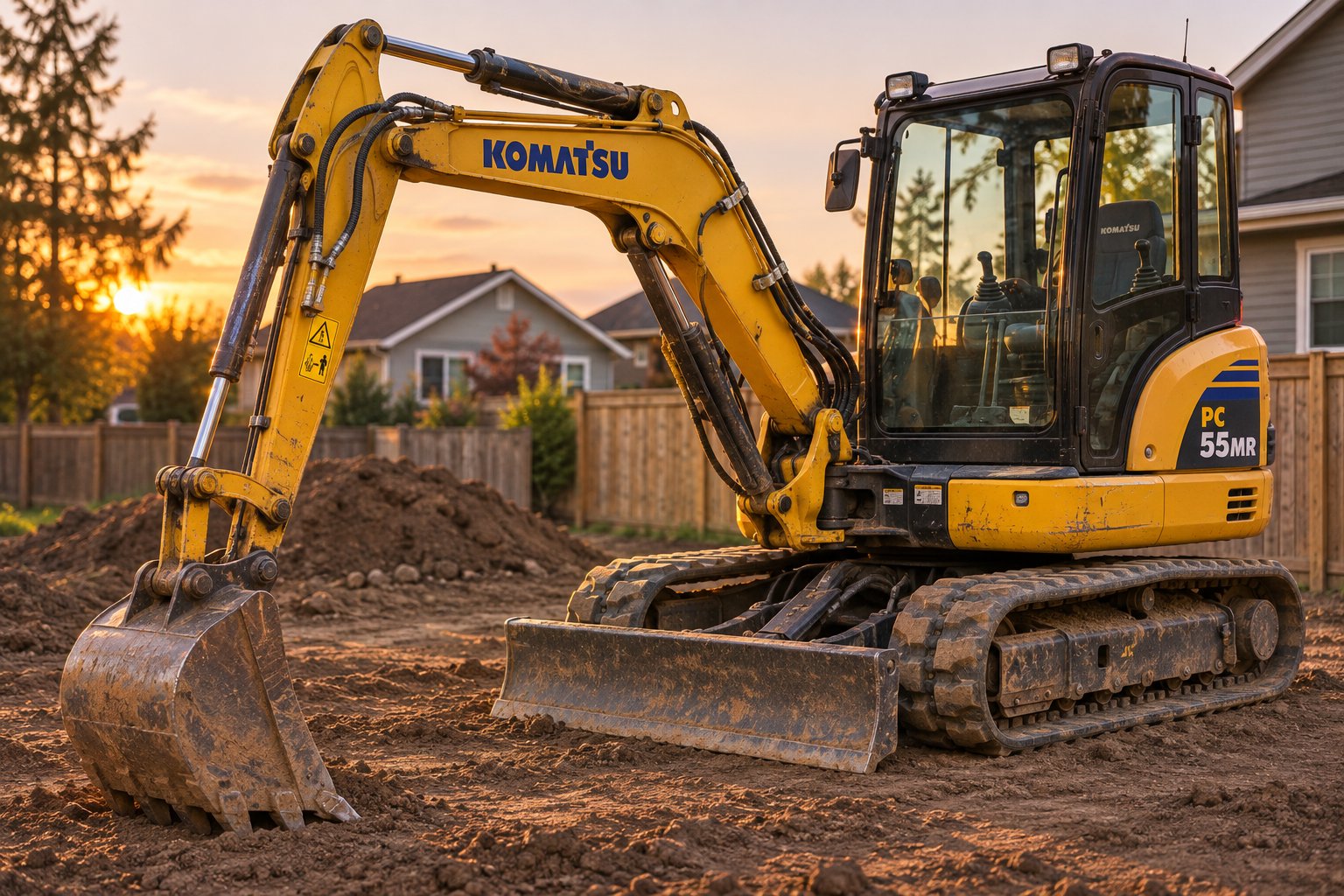
The PC55 is Komatsu's 5.5-ton compact excavator, and it occupies a sweet spot in the market that keeps demand consistently strong. It is large enough to handle serious trenching, grading, and foundation work, yet compact enough to maneuver through residential streets and tight commercial lots. For contractors who need genuine productivity without the transport headaches and ground-pressure concerns of a mid-size machine, this class of Komatsu excavator checks nearly every box.
The Komatsu PC55 at a Glance
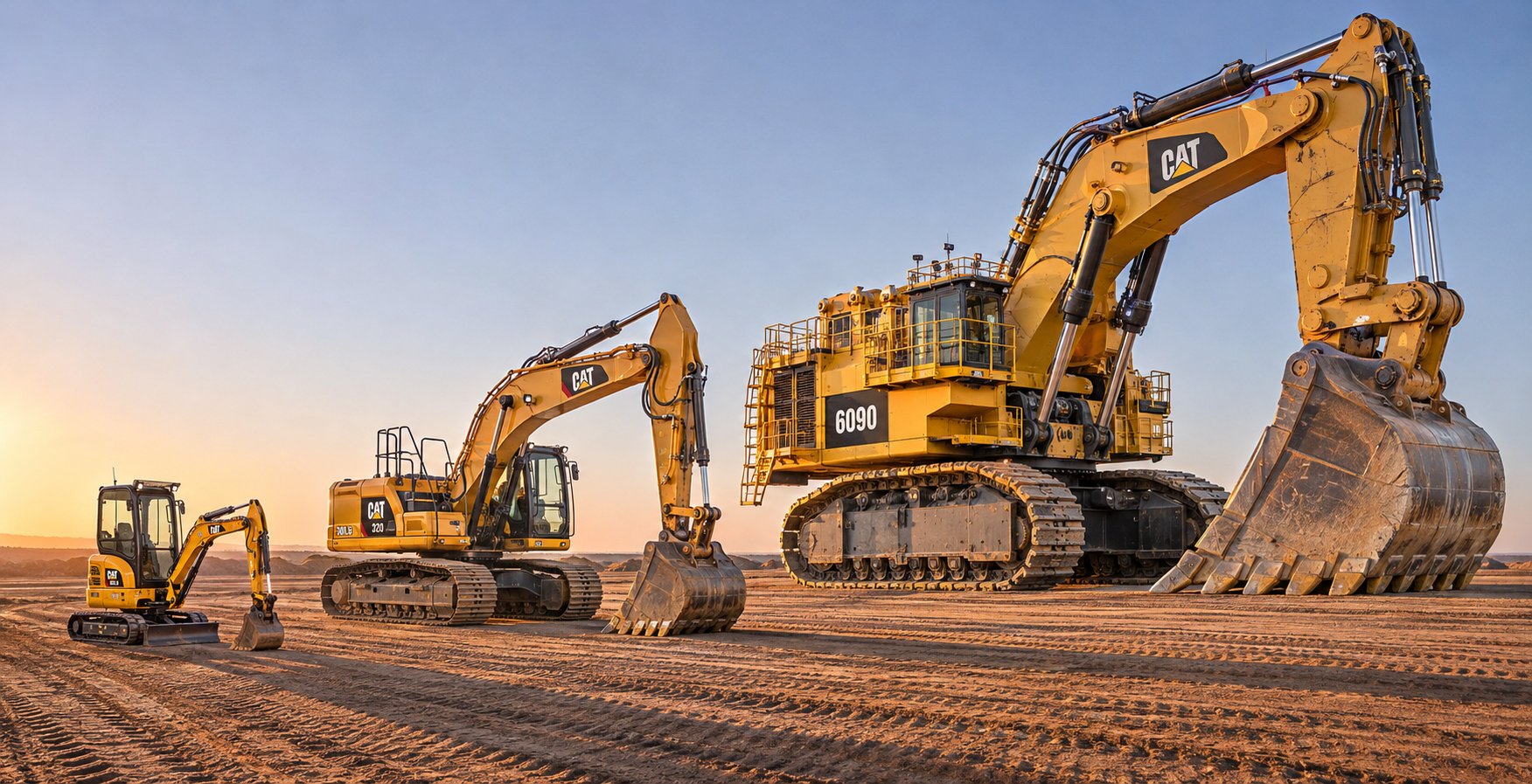
Within Komatsu's broader family of mini and compact excavators, the PC55 bridges a deliberate gap. Below it sit micro-excavators like the PC01 and lighter models such as the PC35MR-5, which are purpose-built for extreme-access or lighter-duty tasks. Above it, mid-size Komatsu excavators like the PC78US and larger platforms such as the PC88 and PC138 deliver greater dig depth and lifting power for heavier earthmoving. The PC55 lives right in between — offering an operating weight range of roughly 11,354 to 11,618 lbs depending on configuration, paired with 38 HP of net engine output, according to Komatsu's official specifications. That balance of weight and power makes it one of the most versatile units you'll find across used equipment marketplaces.
Why the MR Tight Tail Swing Design Matters
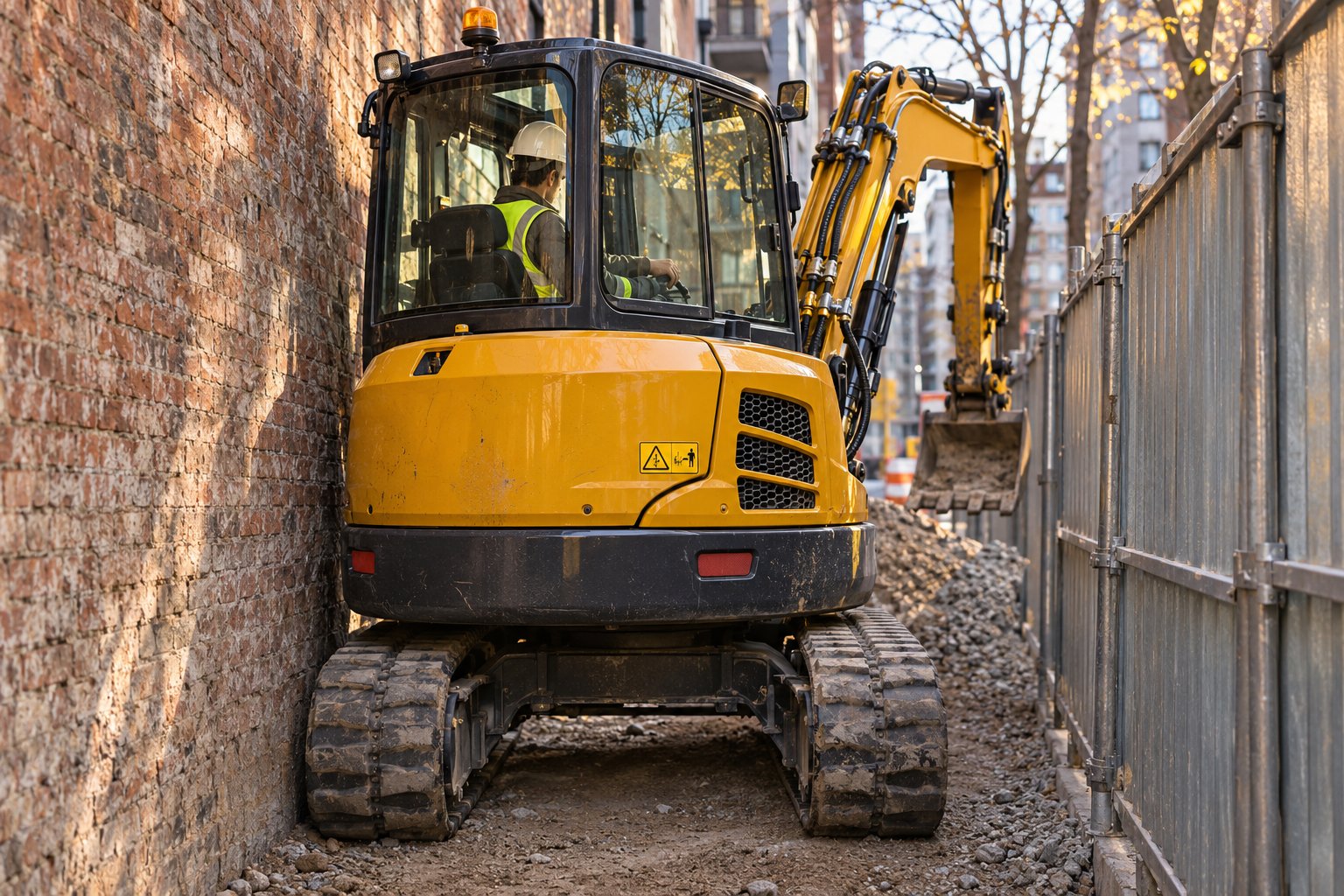
You'll notice that nearly every PC55 listing carries the "MR" designation. This stands for Minimum Radius, and it refers to a design principle that keeps the machine's counterweight inside the track footprint throughout the full 360-degree swing cycle. In practical terms, the upper structure rotates within its own track width rather than swinging out beyond the chassis.
Why does this matter so much? Picture digging a utility trench two feet from a homeowner's fence, or excavating alongside an active traffic lane. A conventional tail swing excavator extends its counterweight well beyond the tracks during rotation, creating a constant collision risk with structures, vehicles, or pedestrians. A zero or minimum-radius tail swing machine eliminates that hazard, allowing the operator to swing freely without repositioning or worrying about clearance on every cycle. For contractors working in established neighborhoods, congested urban corridors, or anywhere obstacles crowd the machine's perimeter, this capability is not a luxury — it is a productivity and safety requirement.
Tight tail swing is one of the most important selection criteria for contractors working near structures, fences, or traffic. It directly determines whether you can operate efficiently in confined spaces or spend half your day repositioning to avoid striking obstacles.
This single design feature is a core reason the PC55 holds its resale value so well and why used units move quickly when priced fairly. Yet understanding model designations is only the starting point — the PC55 has evolved through multiple generations, and each variant brings meaningfully different features, technology, and price expectations to the table.
PC55 Model Variants and Generational Differences Explained
Not every Komatsu PC55 for sale is the same machine. The model has spanned three distinct generations, and each one reflects a different era of emission standards, hydraulic technology, and operator-focused design. Mistaking a PC55MR-2 for a PC55MR-5 — or failing to understand why one commands double the asking price of the other — is one of the fastest ways to overpay or end up with a unit that doesn't meet your expectations.
Here's what separates each variant and why it matters to your buying decision.
PC55MR-2 – The Foundation Model
The PC55MR-2 represents the earliest generation you'll commonly encounter on the used market. Produced during an era when Tier 2 and early Tier 3 emission standards applied, this variant features simpler mechanical and hydraulic systems compared to its successors. That simplicity has trade-offs in both directions. On the positive side, the MR-2 is a straightforward machine to maintain for shops experienced with older Komatsu platforms. On the other hand, parts sourcing can require more effort, especially for emission-related components and certain hydraulic seals that have been superseded by newer part numbers.
You'll typically find the PC55MR-2 at the lower end of the used-market price spectrum. It appeals to buyers who prioritize a low acquisition cost and plan to handle routine maintenance in-house. If you're evaluating one of these units, pay close attention to cumulative machine hours and undercarriage condition — at this age, deferred maintenance can turn a bargain into a costly rebuild project.
PC55MR-3 – Mid-Generation Improvements
The PC55MR-3 brought meaningful upgrades in operator comfort, hydraulic performance, and emission compliance. Komatsu equipped this generation with the 4D88E-6 engine, producing approximately 38.2 HP at 2,400 RPM from a 134 cu in (2.19-liter) displacement. Hydraulic pump flow capacity reached 37.2 gal/min with a system relief valve pressure of 3,840 psi — numbers that translate into responsive cycle times and solid digging force for a 5.5-ton class machine.
Cab refinements on the MR-3 included improved seating, better control layout, and reduced noise levels compared to the MR-2. These are the kinds of differences you'll notice immediately during a test-sit, especially if you're comparing units side by side. Emission compliance moved into the Tier 3 range, aligning with the tighter standards that were phasing in at the time of production.
On the resale market, the PC55MR-3 hits a middle ground that attracts a wide range of buyers. It offers enough modern refinement to feel comfortable during full work days, and parts availability remains generally strong through Komatsu's dealer network. For buyers shopping used compact excavators alongside competing models like a John Deere 35G mini excavator for sale in a similar size class, the MR-3 often represents a compelling balance of capability and value.
PC55MR-5 – The Current-Generation Platform
The PC55MR-5 is Komatsu's latest evolution of the platform, and the leap in technology from the MR-3 is substantial. Introduced with a Tier 4 Final-compliant 4D88E-7 engine, this generation delivers up to 5% better fuel efficiency compared to its predecessor — without sacrificing productivity. A key advantage for operators: the Tier 4 Final aftertreatment system uses a Komatsu diesel particulate filter (KDPF) and does not require diesel exhaust fluid (DEF), eliminating the need to carry and refill a separate fluid.
Komatsu also integrated its KOMTRAX telematics system as standard equipment on the MR-5. This gives owners remote access to critical machine data — fuel level, operating hours, location, KDPF status, and maintenance alerts — directly from a web portal. For fleet managers or owner-operators who want visibility into machine health without being on-site, KOMTRAX is a genuine operational advantage.
Additional MR-5 highlights include enhanced working modes that let operators match engine speed and hydraulic pump delivery to the task at hand, a 3.5-inch high-resolution LCD monitor with Ecology Guidance for real-time fuel efficiency feedback, auto-idle shutdown to reduce unnecessary fuel burn, and a high-strength X-track frame designed to resist dirt and debris buildup. The cab is available as a ROPS and OPG Level 1 verified enclosure or canopy configuration, and a tilt-up cab design provides easy access to hydraulic components during servicing.
Because the MR-5 is the current production generation, used units command premium pricing — but they also come with the strongest parts support, the most advanced features, and the best long-term reliability outlook.
Generational Comparison at a Glance
The table below consolidates the key differences across all three variants. Use it as a quick reference when evaluating listings.
| Model Variant | Approximate Era | Emission Tier | Notable Features | Typical Used-Market Availability |
|---|---|---|---|---|
| PC55MR-2 | Early-to-mid 2000s | Tier 2 / Early Tier 3 | Simpler mechanical systems, proven hydraulic platform, lower acquisition cost | Moderate — declining as older units retire from service |
| PC55MR-3 | Late 2000s to early 2010s | Tier 3 | Improved cab comfort, 4D88E-6 engine (38.2 HP), enhanced hydraulic responsiveness (37.2 gal/min flow), reduced noise | Good — commonly listed on major equipment marketplaces |
| PC55MR-5 | Mid-2010s to present | Tier 4 Final | KOMTRAX telematics, 4D88E-7 engine (38 HP, no DEF required), KDPF aftertreatment, working modes, auto-idle shutdown, 3.5" LCD with Ecology Guidance, X-track frame | Strong — highest availability and dealer support |
Note: Specific production year ranges may vary by market. Confirm exact model year and serial number details against Komatsu dealer records or official brochure data before purchasing.
Knowing which generation you're looking at is the first filter for setting a realistic price expectation. But generation alone doesn't tell the full story — the technical specifications underneath each variant define what the machine can actually do on your jobsite, and that's where the real evaluation begins.
Full Technical Specifications for the Komatsu PC55
Most listing pages that show a Komatsu PC55 for sale provide little more than a year, an hour count, and a price. The actual performance data — the numbers that tell you whether this machine can handle your trench depths, your trailer limits, and your daily cycle demands — rarely appear. That's a problem when you're comparing units across dealers or trying to determine if a price is justified. Here's the full specification picture, drawn from Komatsu's official PC55MR-5 data, so you can evaluate any listing with confidence.
Engine and Hydraulic Performance
The current-generation PC55MR-5 runs a Komatsu 4D88E-7 engine — a naturally aspirated, water-cooled, four-cylinder diesel displacing 2.19 liters (134 cu in). Net output is 38 HP (28.3 kW) at 2,400 RPM. That may sound modest compared to mid-size excavators or even equipment like komatsu bulldozers for sale in the same dealer lot, but in the 5.5-ton compact class, it delivers precisely the power-to-weight ratio you need for responsive digging without excessive fuel burn.
The hydraulic system is where this machine truly earns its reputation. Komatsu's HydrauMind (Hydraulic Mechanical Intelligence New Design) architecture pairs a variable-displacement axial piston main pump with a fixed-displacement gear pump for swing and blade circuits. Combined maximum flow reaches 40.1 US gpm (153.3 L/min) for the main pumps and 16.6 gpm (63 L/min) for the swing pump. Implement circuit relief pressure sits at 3,844 psi (26.5 MPa), giving the PC55 a maximum digging force of 8,768 lbf (3,980 kgf). Those figures translate into fast, smooth cycle times and the ability to run hydraulic attachments — breakers, thumbs, or augers — without starving the primary circuits.
Two selectable working modes let operators match hydraulic delivery and engine speed to the task. Heavy trenching can use full power, while lighter grading or backfill work benefits from the economy mode that reduces fuel consumption and noise. Swing speed clocks in at 9 RPM, and maximum travel speed reaches 2.9 mph (4.6 kph) in high range — fast enough for repositioning across a jobsite without loading the machine back onto a trailer.
Dimensions and Transport Considerations
Contractors who move equipment between sites daily know that transport dimensions matter as much as digging specs. The PC55MR-5 rides on 16-inch (400 mm) rubber shoes — 39 per side — with an overall track width of approximately 1.96 meters (6 ft 5 in). Ground pressure ranges from just 4.12 to 4.27 psi depending on whether the machine is configured with a ROPS canopy or an enclosed cab, which means minimal turf damage on finished landscapes or soft ground.
Operating weight spans 11,354 lbs (5,150 kg) for the canopy configuration to 11,618 lbs (5,270 kg) with an enclosed cab. For transport, the machine tucks down to approximately 4.3 meters (14.1 ft) in length and 2.55 meters (8.4 ft) in height, fitting comfortably on a standard tag-along equipment trailer without requiring oversize permits. If you're searching for a "komatsu near me" listing and planning local pickup, these dimensions confirm you won't need specialized hauling arrangements.
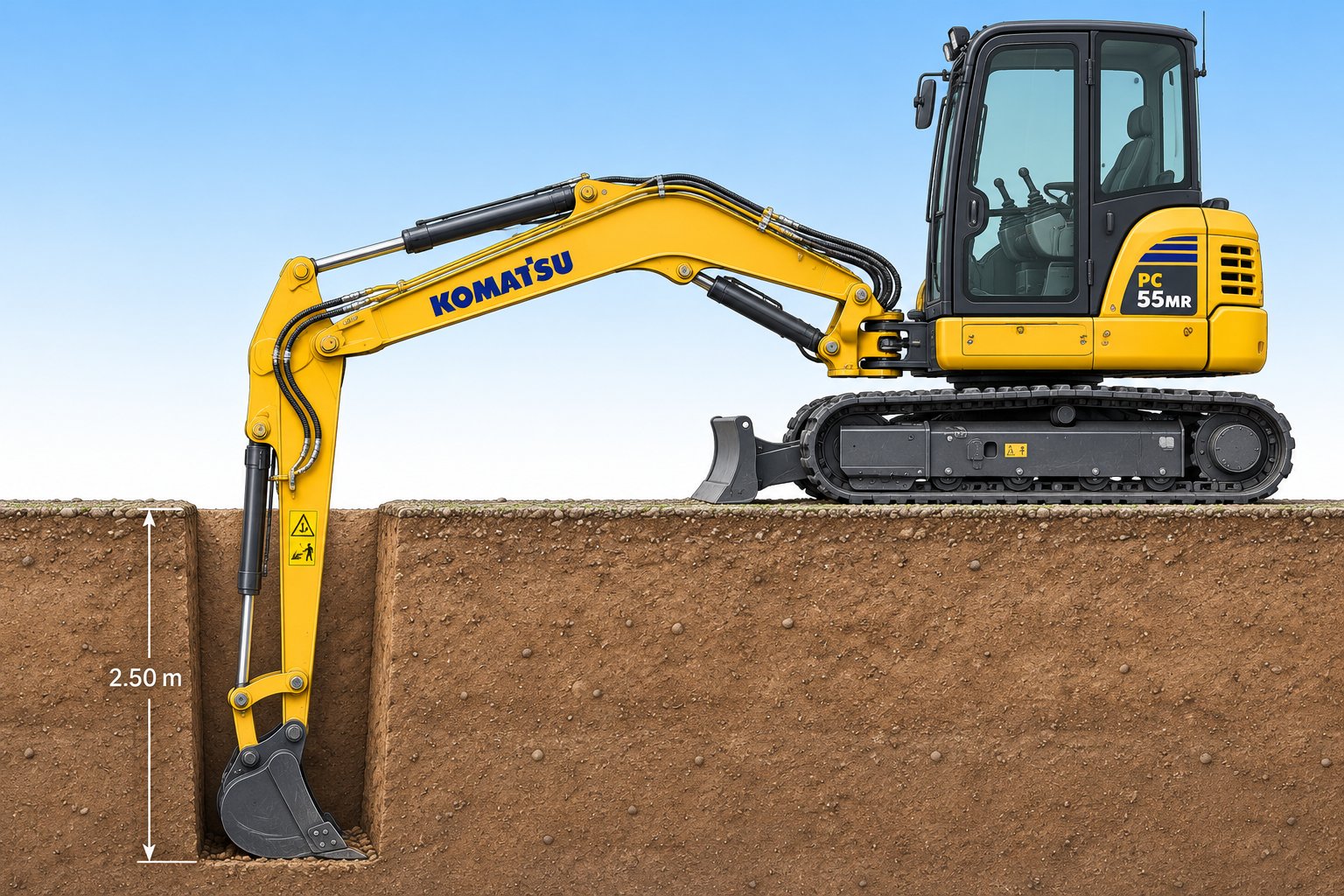
Dig depth on the PC55MR-5 reaches 4.13 meters (approximately 13.5 ft), and maximum horizontal reach extends to roughly 6 meters (19.7 ft) — figures that comfortably cover residential foundation trenches, utility line installations, and most landscaping excavation work. Bucket capacity ranges from 0.07 to 0.24 yd³ (0.055 to 0.18 m³), accommodating everything from narrow trenching buckets to wider grading and cleanup configurations.
The comprehensive specification table below organizes every critical number into a single reference. Whether you're cross-checking a listing description, planning attachment compatibility, or verifying that the PC55 fits your trailer and your project requirements, this is your go-to resource.
| Category | Specification | Value (Imperial) | Value (Metric) |
|---|---|---|---|
| Engine | Model | Komatsu 4D88E-7, 4-cylinder, naturally aspirated | |
| Displacement | 134 cu in | 2.19 L | |
| Net Horsepower | 38 HP @ 2,400 RPM | 28.3 kW @ 2,400 RPM | |
| Emission Tier | Tier 4 Final (KDPF, no DEF required) | ||
| Hydraulics | System Type | HydrauMind — variable displacement axial piston + fixed gear pump | |
| Main Pump Max Flow | 40.1 US gpm | 153.3 L/min | |
| Swing Pump Max Flow | 16.6 US gpm | 63 L/min | |
| Implement Relief Pressure | 3,844 psi | 26.5 MPa | |
| Swing Circuit Pressure | 3,133 psi | 21.6 MPa | |
| Performance | Max Dig Depth | ~13.5 ft | 4.13 m |
| Max Horizontal Reach | ~19.9 ft | ~6.07 m | |
| Max Digging Force | 8,768 lbf | 3,980 kgf | |
| Bucket Capacity | 0.07 - 0.24 yd³ | 0.055 - 0.18 m³ | |
| Swing Speed | 9 RPM | ||
| Max Travel Speed (High) | 2.9 mph | 4.6 kph | |
| Max Travel Speed (Low) | 1.6 mph | 2.6 kph | |
| Max Drawbar Pull | 9,436 lbs | 4,280 kgf | |
| Gradeability | 30° | ||
| Dimensions | Operating Weight (Canopy) | 11,354 lbs | 5,150 kg |
| Operating Weight (Cab) | 11,618 lbs | 5,270 kg | |
| Transport Length | ~14.1 ft | ~4.3 m | |
| Transport Width | ~6.4 ft | ~1.96 m | |
| Transport Height | ~8.4 ft | ~2.55 m | |
| Ground Pressure (Canopy) | 4.12 psi | 28.9 kPa | |
| Track Shoe Width | 16 in | 400 mm | |
| Capacities | Fuel Tank | 17.2 US gal | 65 L |
| Hydraulic Tank | 14.5 US gal | 55 L | |
| Boom Length | 9 ft 6 in | 2,900 mm | |
| Arm Length | 5 ft 5 in | 1,640 mm | |
Note: Values shown reflect the PC55MR-5 with standard equipment. Earlier variants (MR-2 and MR-3) share a similar dimensional envelope, though engine specifications, hydraulic flow rates, and emission compliance differ. Always verify exact specs against the serial number and model variant of the specific unit you're evaluating.
Specifications confirm what the machine is capable of on paper. The real question for most buyers, though, is whether those capabilities align with the actual jobs they need to perform — and whether a different size class might serve them better in certain scenarios.
Ideal Use Cases and Jobsite Applications for the PC55
A machine can have impressive specs on paper and still be the wrong choice for your project. Conversely, a Komatsu PC55 might be exactly the excavator that turns a two-day job into a one-day job — if it's matched to the right application. Before you commit to a purchase, you need an honest look at where this 5.5-ton compact excavator delivers its best return and where a different size class would serve you better.
Where the PC55 Excels on the Jobsite
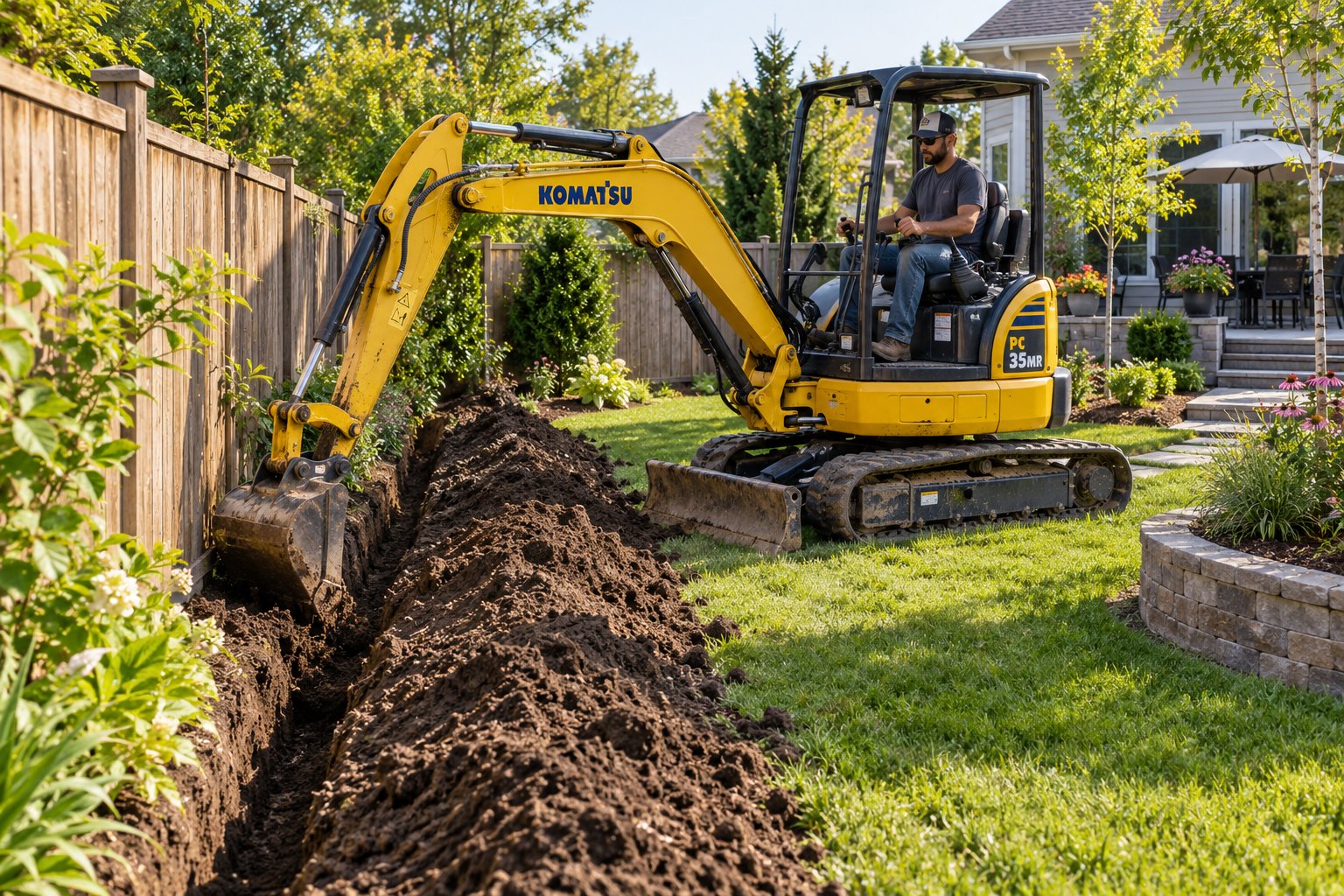
The PC55's combination of a 13.5-foot dig depth, tight tail swing, and sub-12,000-pound operating weight opens the door to a wide range of tasks that sit squarely in the sweet spot between what a micro-excavator can handle and what justifies hauling in a mid-size machine. Its MR design — keeping the counterweight inside the track width during rotation — is the feature that unlocks most of these applications. You can swing a full bucket next to a homeowner's vinyl fence, a parked car, or a building foundation without the constant anxiety of clipping something behind you.
Here are the application categories where this Komatsu mini excavator consistently proves its value:
- Landscaping and hardscaping: Installing retaining walls, grading yards, digging out garden beds, setting pavers, and placing boulders. The low ground pressure (just over 4 psi) minimizes damage to existing turf and finished driveways, a critical concern on residential properties where the homeowner is watching every track mark.
- Residential foundation excavation: Digging footings for additions, garages, and smaller new-construction homes. The 13.5-foot dig depth handles standard foundation depths comfortably, and the compact footprint lets the machine work between the house and property line without encroaching on neighboring lots.
- Utility trench work: Water lines, sewer laterals, fiber optic conduit, and gas service installations all fall within the PC55's comfort zone. The narrow trenching bucket options (down to 0.07 yd³) enable precise, clean cuts at the widths utility codes typically require, while the tight tail swing keeps the machine safely inside traffic control zones on roadside installations.
- Small commercial site preparation: Clearing and leveling pad sites for small retail buildings, storage facilities, or parking expansions. The PC55 handles topsoil stripping, rough grading, and light material loading efficiently enough that many contractors prefer it over renting a separate skid steer and excavator combination.
- Grading and finish work: Fine-tuning slopes for drainage, shaping swales, and preparing subgrade for concrete or asphalt pours. With the economy working mode dialed in, operators gain the slower, more deliberate hydraulic response that precision grading demands.
- Driveway and parking area work: Removing old pavement, excavating subbase material, and backfilling — all in spaces where a larger machine simply would not fit between curb lines, mailboxes, and landscaping.
- Pool excavation: Residential swimming pool dig-outs represent a growing use case. The machine's reach and depth capacity cover most standard pool dimensions, and the tight tail swing allows operation in fenced backyards with minimal clearance on all sides.
What ties all of these applications together is a common theme: confined access paired with a need for real digging performance. A compact excavator in this weight class bridges the gap between tool-carrier versatility and genuine earthmoving muscle. Add a hydraulic thumb, breaker, or auger attachment, and the PC55 transforms from a dedicated digger into a multi-revenue machine that earns its keep across different job types throughout the week.
When a Larger or Smaller Machine Is the Better Choice
Honesty matters more than enthusiasm when you're evaluating equipment — especially if you're searching for a Komatsu PC55 for sale and wondering whether it's the right fit for every project on your schedule. It won't be, and recognizing those limits upfront saves you from productivity bottlenecks and costly workarounds.
Go larger when the job demands it. Deep basement excavation — anything beyond 14 feet — pushes past the PC55's maximum dig depth and requires a mid-size excavator like the PC78US or a larger platform such as the PC138. Heavy rock removal, large-scale commercial earthmoving, and roadway cut-and-fill operations also call for machines in the 13,000- to 40,000-pound range, where greater bucket capacity, higher breakout force, and longer reach translate directly into faster cycle times and lower cost per cubic yard. If your typical project involves loading 20-ton haul trucks all day, the PC55 will do it — but a mid-size machine will do it in half the time.
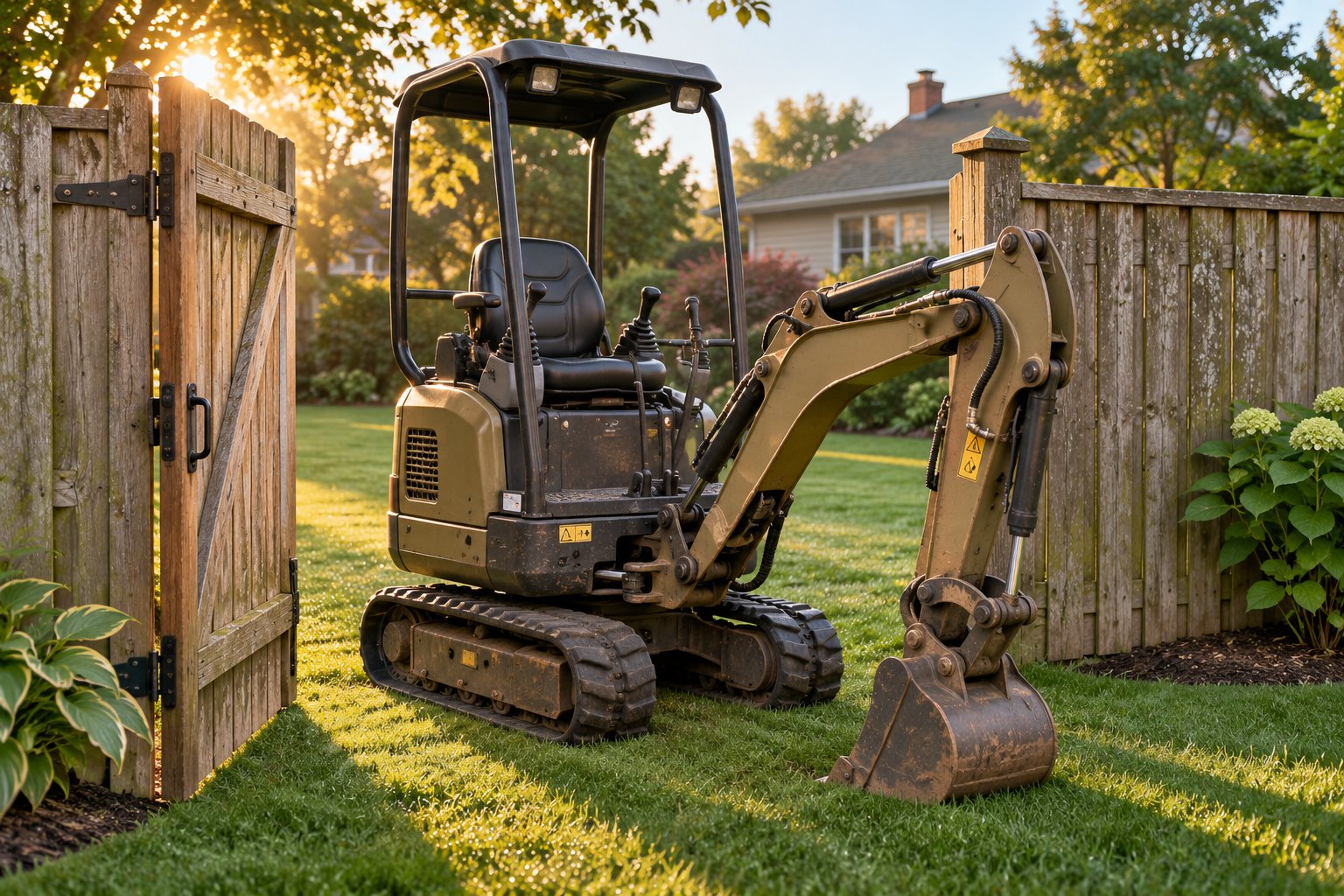
Go smaller when access is extreme. Interior demolition work, narrow backyard jobs accessible only through a 36-inch gate, or tasks inside existing structures are scenarios where even the PC55's compact profile is too large. Micro-excavators like the Komatsu PC01 or machines with retractable undercarriages that hydraulically narrow to squeeze through doorways and gates are purpose-built for these situations. Trying to force a 5.5-ton machine through an opening it barely fits is a recipe for property damage and lost time.
Consider alternative machine types for surface-only tasks. If your work involves primarily material handling, grading without excavation, or loading trucks from stockpiles, a komatsu wheel loader or even a compact track loader may deliver better cycle efficiency. Similarly, a skid steer with a grading attachment can outperform an excavator on flat, open finish-grading work where the 360-degree swing of an excavator provides no advantage.
The bottom line? The PC55 is a specialist in moderate-depth excavation within tight quarters. It does that job better than nearly anything else in its weight class. But if your project profile skews consistently toward deeper digs, heavier material, or extreme-access scenarios, matching the right machine to the task will always outperform trying to stretch one model beyond its design intent.
Validating that the PC55 fits your application is a critical step — but it's not the only comparison worth making. Within the 5-6 ton compact excavator class, several competing machines target the same buyers, and understanding how the PC55 stacks up against those rivals sharpens your negotiating position and confirms whether the Komatsu premium is justified for your specific needs.
How the PC55 Compares to Rival Mini Excavators
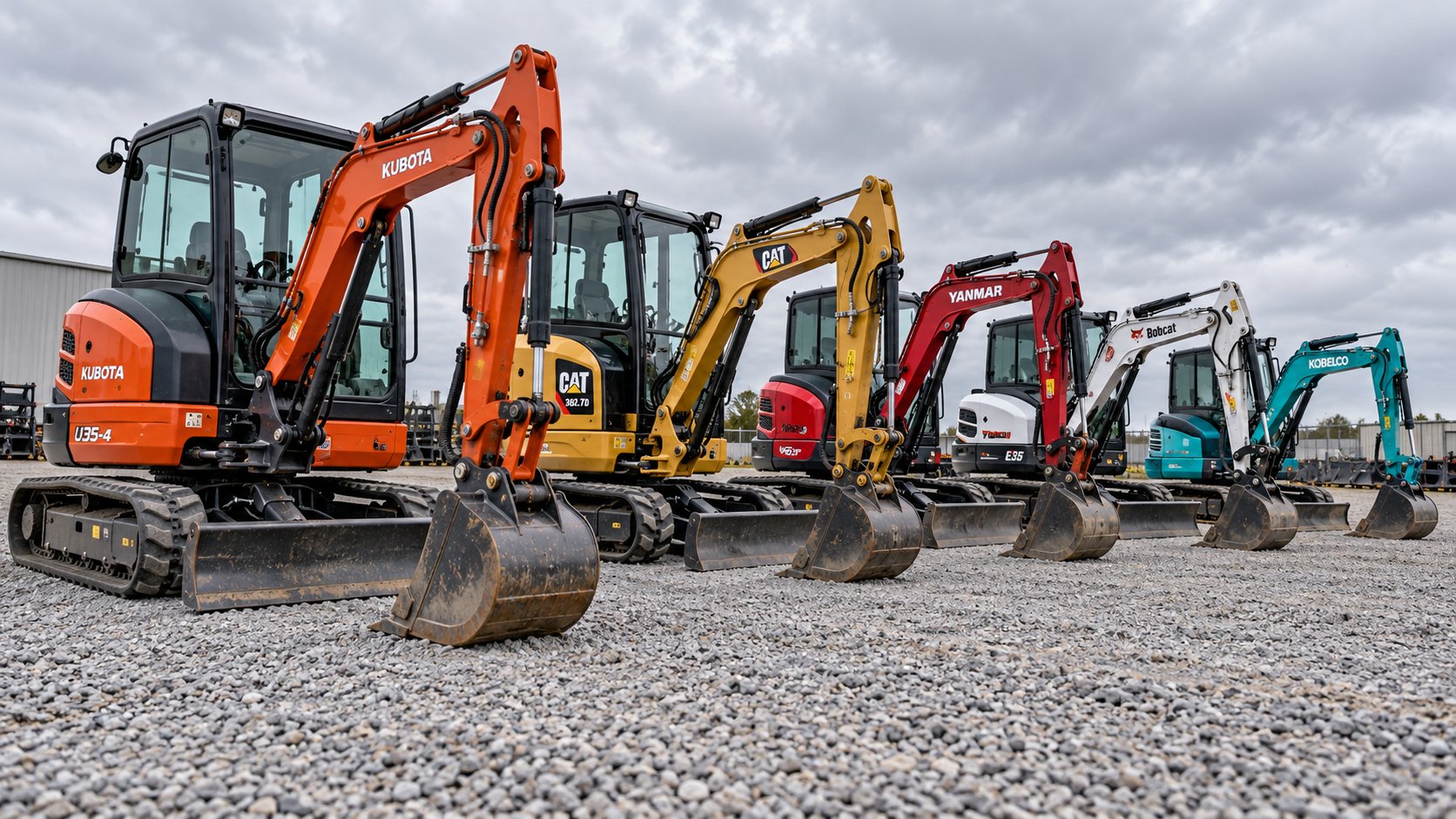
Komatsu doesn't build the PC55 in a vacuum. Every contractor shopping for a 5-6 ton compact excavator will cross paths with competing models from Caterpillar, Bobcat, Kubota, Takeuchi, KOBELCO, and others — often listed side by side on the same dealer lot or marketplace page. When you're evaluating a Komatsu PC55 for sale, knowing exactly how it measures up against these alternatives is the difference between paying a justified premium and overspending on brand loyalty alone.
The 5-6 ton class is one of the most competitive segments in the mini excavator market, and for good reason. These machines represent the highest-volume size class for residential, utility, and light commercial work. EDA sales data shows compact excavators account for more than one-fifth of all construction equipment sales, with the 5-ton class consistently producing several of the top-selling individual models in North America. That kind of demand means you have real options — and real leverage — when negotiating a purchase.
Key Competitors in the 5-6 Ton Class
Each machine in this segment brings a different engineering philosophy to the table. Some prioritize raw horsepower and zero tail swing geometry. Others focus on dig depth, frame stability, or aftermarket parts ecosystems. Here's how the most commonly cross-shopped models compare against the PC55MR-5 across the factors that actually influence daily productivity and long-term ownership satisfaction.
Caterpillar 305 CR — This is the number-one selling mini excavator in the United States by new financed units, and you'll find used examples everywhere. At 5 metric tons, it sits in the same weight neighborhood as the PC55 and features Cat's compact-radius ("CR") design, which reduces — but does not eliminate — tail overhang. The 305 CR offers Cat's exclusive Stick Steer system, letting operators toggle between traditional lever-and-pedal travel and joystick-only travel. Its dealer and parts network is arguably the largest in North America. Where it trades off against the Komatsu is in dig depth: the PC55MR-5's roughly 13.5-foot maximum exceeds what the 305 CR delivers, which matters for utility contractors regularly setting lines below four feet.
Bobcat E50 — Bobcat takes a fundamentally different approach with the E50's true zero tail swing design. At roughly 10,677 lbs, it's lighter than the PC55, yet its 49.8 HP engine delivers nearly 12 more horsepower than the Komatsu's 38 HP unit — a striking power-to-weight advantage. Bucket digging force is essentially a dead heat at approximately 8,977 lbf for the Bobcat versus 8,768 lbf for the Komatsu. The trade-off? The E50's dig depth tops out around 11.6 feet, roughly two feet shallower than the PC55. For grading, shallow backfill, and genuinely zero-clearance spaces where the counterweight cannot overhang the tracks at all, the E50 excels. For deeper utility work and jobs demanding that extra reach, the PC55 has a clear edge.
Kubota KX057-5 — Kubota's 5.6-metric-ton offering is the company's top-selling compact excavator and ranks as the No. 3 overall best-selling mini excavator in the U.S. It runs a 40.3-gross-horsepower Kubota engine and features load-sensing hydraulics with multifunction operation capability. Kubota's dealer network for compact equipment is extensive, particularly in agricultural and rural markets where the brand's tractor heritage creates deep customer loyalty. The KX057-5 offers a maximum dig depth of roughly 11 feet 2 inches — competitive but shallower than the PC55's reach.
Takeuchi TB260 — At 5.5 metric tons, the TB260 matches the PC55's weight class almost exactly and brings a conventional tail swing design with a long arm and integrated thumb mount as standard. Its dig depth of 12 feet 9.4 inches comes close to the PC55's, and its three auxiliary circuits enable running mowers, mulchers, plate compactors, and other powered attachments without aftermarket plumbing. The conventional tail swing means it's not ideal for true tight-quarters work against walls or fences, but it provides a more stable platform for heavy attachment use.
KOBELCO SK55SRX-7 — KOBELCO's 5.5-metric-ton entry features a short-rear-radius design (similar in concept to Komatsu's MR approach) and integrates an exclusive Flow Pump System that routes additional hydraulic flow from the swing and dozer pump to the boom, arm, or bucket circuit during digging. This gives the SK55SRX-7 faster cycle times than many competitors in sustained trenching operations. KOBELCO's iNDr cooling system — a noise-reducing, high-density mesh filter arrangement — also makes this one of the quieter machines in the class.
| Machine | Weight Class | Key Strengths | Potential Drawbacks | Resale Market Availability |
|---|---|---|---|---|
| Komatsu PC55MR-5 | ~5.2 tons (11,354-11,618 lbs) | Deepest dig depth in class (~13.5 ft); MR minimal tail swing; KOMTRAX telematics standard; no DEF required; strong global parts network | Lower HP (38) than some rivals; not true zero tail swing — slight counterweight overhang | Strong — widely listed across major marketplaces and Komatsu dealers |
| Cat 305 CR | ~5 metric tons | #1 selling mini excavator in U.S.; Stick Steer system; largest dealer/parts network; compact-radius design | Higher price premium on used market; shallower dig depth than PC55; CR design still has some overhang | Very strong — highest volume of used listings in this class |
| Bobcat E50 | ~4.9 tons (10,677 lbs) | True zero tail swing; 49.8 HP — best power-to-weight in class; lighter for easier trailering; strong digging force despite lower weight | Shallower dig depth (~11.6 ft); lighter frame may feel less planted with heavy attachments | Strong — Bobcat's compact excavator volume ensures steady used supply |
| Kubota KX057-5 | ~5.6 metric tons | #3 overall top-seller; load-sensing hydraulics; deep agricultural/rural dealer reach; strong resale value | Dig depth ~11 ft 2 in — shallowest of the group; less specialized for tight-quarters urban work | Strong — high new-unit volume feeds a healthy used pipeline |
| Takeuchi TB260 | ~5.5 metric tons | Long arm and integrated thumb mount standard; three auxiliary circuits; 12 ft 9 in dig depth; Takeuchi Fleet Management telematics included | Conventional tail swing — not suited for zero-clearance work; smaller dealer footprint than Cat or Kubota | Moderate — loyal following but lower sales volume than top-three brands |
| KOBELCO SK55SRX-7 | ~5.5 metric tons | Flow Pump System for faster cycle times; short rear radius; iNDr cooling for quiet operation; two work modes | Smaller North American dealer network; fewer used units available compared to Cat, Bobcat, or Kubota | Limited — lower new-unit volume means fewer used listings |
Why Buyers Choose the PC55 Over Alternatives
With this many capable machines targeting the same buyer, why does the Komatsu consistently hold its position? Three factors surface repeatedly in owner feedback and market data.
The MR tail swing design as a class differentiator. Not every competitor in this table offers a reduced or zero tail swing. The Takeuchi TB260 uses a conventional swing, and the Cat 305 CR's compact radius still allows more overhang than Komatsu's minimal-radius approach. For contractors whose bread-and-butter work involves trenching alongside structures, fences, or active roadways, the PC55's ability to swing within its track width — without the lighter frame and shallower dig depth of a true zero-swing machine like the E50 — hits a practical middle ground that no single competitor replicates exactly. You get tight-quarters capability and genuine dig depth in the same package.
Komatsu's durability reputation and parts availability. Komatsu builds its own engine, its own hydraulic system, and its own undercarriage components for the PC55 platform — vertical integration that simplifies parts ordering and quality control. The global dealer network ensures that filters, seals, hydraulic hoses, and undercarriage wear items are generally available without extended lead times, whether you're running the machine in Texas or upstate New York. For buyers who also browse komatsu dozer for sale listings or other Komatsu equipment, the familiarity of a single parts ecosystem across multiple machine types reduces operational friction considerably.
KOMTRAX telematics on the MR-5 generation. Fleet visibility is no longer a luxury reserved for large excavators. The PC55MR-5's standard KOMTRAX system delivers remote monitoring of fuel consumption, operating hours, location tracking, and maintenance alerts — data that directly supports resale value by documenting machine usage and care. Competitors like Takeuchi include their own telematics packages, and Cat offers similar connectivity through Product Link, but Komatsu's system has years of refinement behind it and integrates seamlessly with the broader Komatsu fleet management ecosystem.
Does all of this mean the PC55 is the objectively "best" machine in the class? Not necessarily. The Cat 305 CR dominates the sales charts for valid reasons — its dealer network depth and resale liquidity are hard to match. The Bobcat E50's true zero tail swing is a genuine advantage on the tightest residential lots. And Kubota's KX057-5 benefits from a brand loyalty among agricultural and rural contractors that translates into rock-solid resale values. Each competitor earns its market share by excelling in a specific dimension that matters deeply to a particular buyer profile.
Your job isn't to find the "best" machine in the abstract — it's to find the best machine for your specific mix of jobsite conditions, transport requirements, and long-term ownership plans. The comparison above gives you the framework to make that call with confidence.
Of course, picking the right model is only half the equation. Understanding what that model should actually cost — and what drives the enormous price differences between used PC55 listings — is where the real potential for saving or wasting money comes into focus.
Pricing Factors and Fair Market Value for Used PC55 Units
Search for a Komatsu PC55 for sale across major equipment marketplaces and you'll encounter a price spread that looks almost absurd at first glance. Listings range from roughly $9,000 for high-hour, older-generation units all the way up to $85,000 or more for late-model, low-hour MR-5 machines with full attachment packages. That's nearly a 10x difference for what, on the surface, appears to be the "same" excavator. It isn't — and understanding what accounts for that gap is the single most effective tool you have for spotting overpriced units before you sign.
Most listing pages show you a price and a photo. Almost none explain why a particular unit is priced where it is. That missing context is what separates informed buyers who negotiate from a position of strength and those who overpay because a number "felt about right."
What Drives Price Differences in Used PC55 Units
Every used Komatsu excavator for sale carries a price tag shaped by a specific combination of depreciation factors. Some of these are obvious — others are easy to overlook until they show up as unexpected repair bills after the purchase. Here are the primary variables that determine what any given PC55 is actually worth on the open market:
- Machine hours: This is the single most reliable indicator of remaining useful life. Most mini excavators are designed for 5,000 to 10,000 total operating hours before major component replacement becomes necessary. A PC55MR-5 with 1,068 hours — like examples listed in recent Purple Wave auctions — commands a premium because it still has the vast majority of its service life ahead. Cross that 5,000-hour threshold and you're entering territory where undercarriage rebuilds, hydraulic pump overhauls, and engine-related repairs start appearing on the maintenance horizon. Units above 6,000 hours, like some PC55MR-3 examples that have traded at auction, are priced accordingly — sometimes dramatically lower — because the buyer is inheriting those upcoming costs.
- Model generation and variant: As covered in the generational breakdown earlier, there is a substantial technology and compliance gap between the PC55MR-2, MR-3, and MR-5. A Tier 4 Final MR-5 with KOMTRAX telematics and a KDPF system holds value far better than a Tier 2 MR-2 with simpler controls and aging emission components. Buyers often underestimate how much the generation alone shifts the pricing floor and ceiling for otherwise similar machines.
- Overall condition and maintenance history: Two machines with identical hours can have wildly different values if one was fleet-maintained on strict 250-hour service intervals and the other was run by a rental house with minimal record-keeping. Documented maintenance histories — complete with oil analysis reports, filter change logs, and component rebuild records — add 10-15% to appraised value, according to industry appraisal guidance. Missing records, on the other hand, immediately raise questions about hidden wear and deferred service.
- Attachment packages included: A PC55 listed with a hydraulic thumb, quick coupler, and multiple bucket sizes carries a meaningfully higher price than a bare machine. Quality hydraulic thumbs alone add $3,000 to $6,000 in resale value, and quick couplers contribute another $2,000 to $4,000. When you see a listing that looks like a bargain, check whether it's stripped of attachments — because you'll spend thousands replacing what's missing.
- Geographic demand variation: Equipment values fluctuate by region. A PC55 listed in a booming construction market — think Sun Belt states with high residential and utility demand — will command a higher price than the same machine sitting in a slower market with fewer active buyers. Seasonal patterns also play a role: mini excavators typically sell faster and at higher prices in spring and summer, with winter listings sometimes requiring a 5-10% discount to move.
- Emission tier compliance: In regions with strict emission regulations — California being the most prominent example — a pre-Tier 4 machine may face operational restrictions or registration barriers that effectively reduce its usable market. This regulatory dynamic creates price distortions where the same machine is worth significantly less in one state than another, purely because of compliance requirements.
Understanding Fair Market Value Before You Buy
Knowing what drives pricing is the foundation. Translating that knowledge into a confident purchase decision requires a benchmarking process — one that goes beyond comparing sticker prices across a few listings.
Start by cross-referencing multiple marketplaces. Check MachineryTrader, Purple Wave auction results, Equipment Trader, and Machinio simultaneously for PC55 units with similar hours, generation, and condition. This comparison reveals the actual market range rather than the aspirational pricing of any single seller. When one listing sits 20% above the median for comparable machines, you either need to see a compelling justification — exceptional maintenance records, a premium attachment package, low hours — or you're looking at an overpriced unit.
Factor in transport costs to your region. A machine listed $4,000 below market average in a distant state may not be a deal once you add $2,500 to $5,000 in flatbed or lowboy transport fees. Conversely, a slightly higher-priced unit available locally for pickup can represent a better total value when transport savings offset the price difference.
Consider the total acquisition cost beyond the listed price. This is where many buyers misjudge their budget. You're not just buying a machine — you're buying a machine that may need new rubber tracks ($2,000-$4,000), a set of buckets if none are included ($500-$1,500 each), hydraulic hose replacements, or AC repair. A unit that looks like a steal at $28,000 can quickly become a $35,000 acquisition when those costs stack up.
The listed purchase price is only one component of the total cost of acquiring a used excavator. Transport, needed repairs, missing attachments, and delivery expenses can add 15-25% to the sticker price — and that adjusted number is the real figure your budget needs to accommodate.
Financing terms deserve the same scrutiny. When dealer financing is available, compare the total repayment amount — not just the monthly payment — against a cash purchase or independent equipment loan. A lower monthly payment stretched over a longer term with a higher interest rate can cost thousands more over the life of the loan. Some dealers offer promotional financing on certified used units that genuinely reduces cost; others structure terms that inflate the total expenditure well beyond fair market value. Run the math on total dollars paid before committing to any financing arrangement.
The pricing landscape for used PC55 units rewards preparation. Buyers who arrive at a negotiation armed with comparable sales data, a clear understanding of hour-count thresholds, and a realistic estimate of post-purchase costs consistently secure better deals than those who rely on gut feel or a single listing comparison. That preparation, however, is only as strong as your ability to physically verify a machine's actual condition — which is exactly why a structured pre-purchase inspection matters more than any price analysis alone.
Used Komatsu PC55 Pre-Purchase Inspection Checklist
A fair price means nothing if the machine hiding behind it needs $8,000 in repairs you didn't see coming. Whether you're looking at a PC 55 with 1,200 hours or a well-used unit approaching 5,000, the inspection process is what separates a smart acquisition from an expensive regret. Every listing photo is curated to sell — your job is to look past the paint and evaluate the components that actually cost real money to replace.
The checklist below follows a logical walk-around sequence you can take directly to the yard or auction lot. Plan for one to two hours if you're thorough, and bring a flashlight, tape measure, stopwatch, phone camera, and a rag for checking fluid condition. This same approach applies whether you're inspecting a compact excavator, a komatsu bulldozer for sale, or a komatsu front end loader — the underlying principles of mechanical evaluation don't change with machine type.
Undercarriage and Structural Integrity Checks
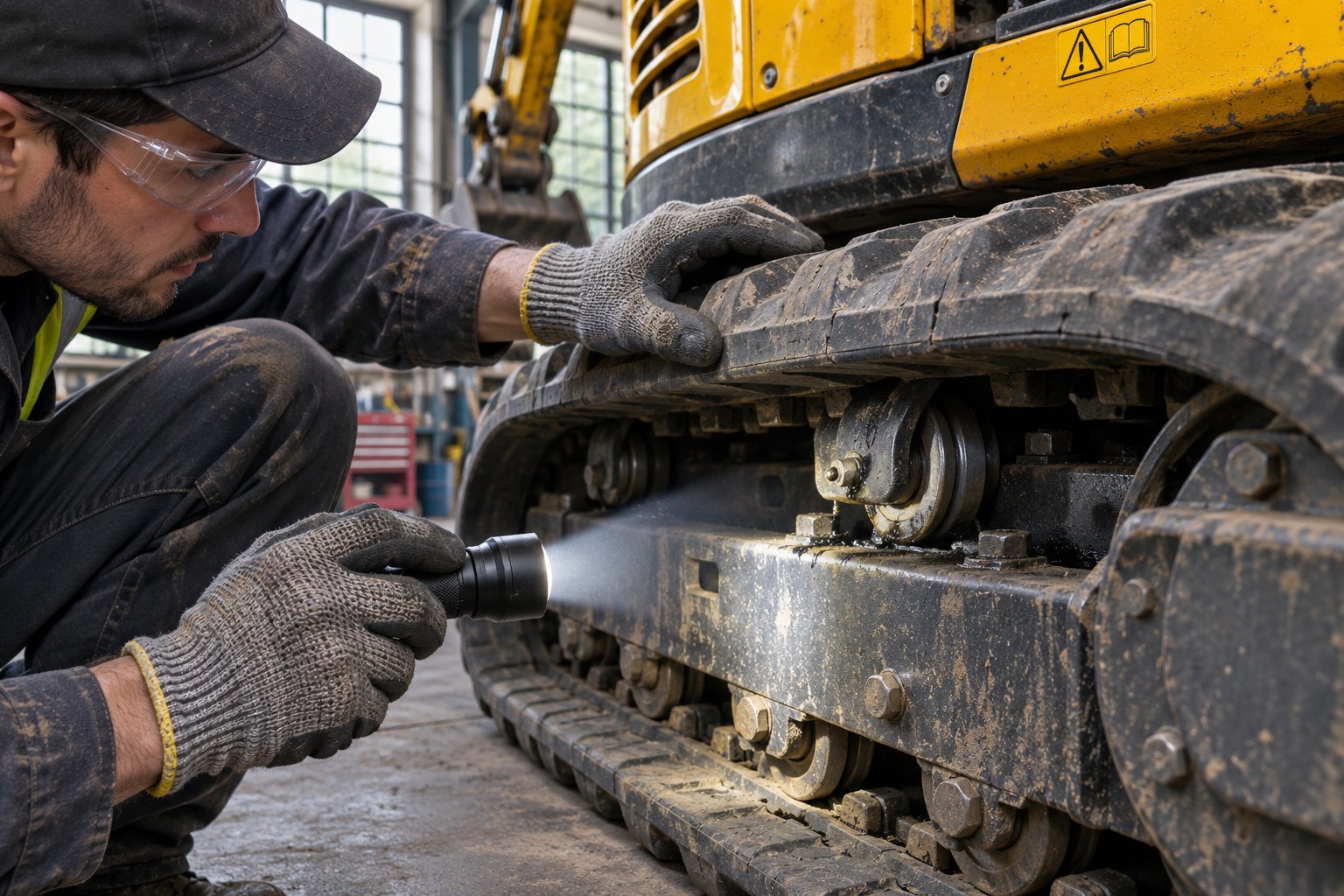
Start at the ground, because that's where the biggest repair bills live. On tracked excavators, the undercarriage accounts for roughly 50% of total lifetime maintenance cost. On a PC55, a full undercarriage replacement — tracks, rollers, sprockets, and idlers — can easily run $5,000 to $8,000 depending on whether you're replacing rubber or steel tracks and sourcing genuine Komatsu components.
Walk the full length of each track assembly and examine the following:
- Track shoe condition: Look for cracked, chunked, or heavily worn rubber pads (or steel grousers on steel-track configurations). Uneven wear across the shoe width indicates misalignment or a bent track frame.
- Rollers and idlers: Spin each roller by hand if possible. They should rotate smoothly without grinding, clicking, or visible oil seepage around the seals. Oil weeping from a roller housing means the seal has failed and the roller is running dry internally — replacement is imminent.
- Track tension: Proper tension shows a slight sag between the front idler and the first carrier roller. Tracks that hang excessively loose may indicate worn pins and bushings. Here's a subtle trick experienced inspectors watch for: if the track looks tight but the machine has fewer track links than the factory count, someone removed a link to compensate for internal stretch — a red flag that hides significant wear in the chain assembly.
- Sprocket teeth: Inspect the drive sprockets at the rear of each track. Teeth should have a rounded, symmetrical profile. Pointed or hooked teeth indicate advanced wear that accelerates chain degradation.
Beyond the undercarriage, inspect the main frame, boom, stick, and bucket linkage for structural integrity. Run your hand along every weld seam on the boom and stick, feeling for cracks, grinding marks, or patches where steel plate has been welded over a repair. According to industry appraisers, cracks in a machine's structure can reduce its value by approximately 20% — and on a mini excavator, re-welded boom cracks often indicate the machine was subjected to loads or leverage well beyond its rated capacity.
Check every pin and bushing connection point on the boom-to-stick and stick-to-bucket joints. Have someone operate the bucket curl while you watch the bushings closely. Visible movement or clunking sounds at these joints reveal under-greased, worn-out linkage components that signal a hard-use history.
Engine, Hydraulics, and Electrical Health Indicators
Request a cold start — this is non-negotiable. Arrive before the seller has warmed up the machine, because a cold engine reveals problems that a pre-warmed unit masks completely. Here's what to watch and listen for during that first key turn:
- Startup behavior: The engine should crank within a few seconds and settle into a steady idle without excessive stumbling. Prolonged cranking suggests weak glow plugs, a tired starter motor, or low compression.
- Exhaust smoke color: A brief puff of white or light gray smoke on cold start is normal for a diesel. Persistent blue smoke means the engine is burning oil — worn piston rings or valve seals are the usual culprits. Thick black smoke points to fuel delivery or air intake issues. Continuous white smoke after warm-up can indicate coolant entering the combustion chamber, which is a serious and expensive problem.
- Abnormal engine noises: Listen for knocking, ticking, or metallic rattling that persists beyond the first 30 seconds. These sounds often indicate bearing wear, injector problems, or timing issues that escalate into major repair bills.
With the engine warm, shift your focus to the hydraulic system. This is the heart of any excavator, and on the PC55, the HydrauMind system relies on a variable-displacement piston pump that must maintain consistent pressure and flow across all circuits.
Perform a cylinder drift test — the single most revealing hydraulic check you can do on-site. Raise the boom fully with a loaded bucket, then shut the engine off. Mark the cylinder rod position with a piece of tape or a wax pencil, then wait five minutes. Measure how far the boom has dropped. A small amount of drift is normal on any machine, but if the boom settles noticeably — more than an inch or two on a 5.5-ton class excavator — you're likely dealing with worn cylinder packing, bypassing control valves, or internal pump leakage. Cylinder reseals on the boom and stick typically cost around $2,500 per cylinder, and a hydraulic pump replacement is a five-figure repair.
Inspect every hydraulic hose visible from the engine compartment and along the boom and stick. Look for cracking, abrasion wear, bulging, or wet spots at fittings. Check the hydraulic fluid by pulling the dipstick or accessing the sight glass — clean hydraulic oil should be a clear amber color. Milky or foamy fluid indicates water contamination, which is one of the most universally recognized deal-killers in the used equipment world.
Don't skip the electrical system. Test all lights, gauges, the horn, and the monitor display. On a PC55MR-5, verify that the 3.5-inch LCD panel powers on correctly and displays KOMTRAX data without error codes. Check the battery terminals for corrosion, and inspect wiring runs behind panels for evidence of rodent damage or amateur splicing — both surprisingly common on machines that sat idle between owners.
Machine hours and what they signal: The hour meter reading only tells a useful story when paired with service records. As a general framework for compact excavators under 10 tons, units approaching 5,000 hours begin entering a zone where major maintenance items — undercarriage components, hydraulic pump service, potential turbo replacement on turbocharged variants — move from "future planning" to "near-term necessity." A PC55 with 3,000 well-documented hours is typically a far better investment than one with 1,500 hours and zero maintenance records. The records validate the hours; without them, you're guessing.
Documentation and Maintenance History Review
This is where many buyers get lazy — and where informed buyers gain their sharpest advantage. Before you negotiate a final price, request and verify three categories of documentation:
- Service records: Complete maintenance logs showing oil changes, filter replacements, hydraulic fluid service, and any component rebuilds or replacements. Fleet-maintained machines often come with dealer-stamped records at 250- or 500-hour intervals. These records are worth real money — industry appraisers note that documented maintenance history can add 10-15% to a machine's appraised value.
- Serial number verification: Confirm that the serial number on the machine's plate matches the documentation provided. Cross-reference it against manufacturer databases or third-party registries like the National Equipment Register (NER) to check for theft reports or title discrepancies. A tampered or unreadable serial plate is a walk-away signal.
- Clear title and ownership history: Verify that the seller has legal authority to transfer the machine. Request a bill of sale, registration documents, and — for financed equipment — a lien release confirming no outstanding loans against the unit.
If you're evaluating a machine you cannot visit in person — a common scenario for buyers shopping outside their local market — request detailed photo and video documentation covering every item on this checklist. Reputable sellers will provide walkaround videos, close-ups of cylinder rods and undercarriage components, and hour-meter screenshots without hesitation. Reluctance to provide visual evidence before a deposit tells you everything you need to know.
Here's the complete inspection sequence organized as a step-by-step walk-around you can follow on-site:
- Walk the full perimeter of the machine before anything is started — photograph the serial plate, hour meter, and overall condition from all four corners.
- Inspect the undercarriage: track shoes, rollers, idlers, sprockets, and track tension on both sides. Count the track links and compare to factory specs.
- Examine the main frame, swing frame, and blade for cracks, bends, re-welds, or heavy rust.
- Inspect the boom, stick, and bucket for structural cracks, weld repairs, and pin/bushing wear at every joint.
- Check all hydraulic hoses, fittings, and cylinder rods for leaks, cracking, abrasion, or scoring.
- Pull the hydraulic fluid dipstick — verify clear amber color with no milky contamination.
- Check engine oil color and level on the dipstick; look for coolant contamination or excessive carbon buildup.
- Request a cold start — observe cranking speed, exhaust smoke color, and idle stability for at least two full minutes.
- Perform the boom drift test: raise boom with load, shut off engine, mark cylinder rod, wait five minutes, measure drift.
- Operate all functions — boom, stick, bucket, swing left and right, travel forward and reverse — listening for unusual noises, hesitation, or uneven response.
- Test the electrical system: lights, gauges, monitor display, wiper, horn, and check battery connections.
- Review all documentation: service records, serial number verification, title, and ownership history.
A thorough pre-purchase inspection can prevent thousands of dollars in unexpected repair costs. The hour you spend walking around and testing a machine before signing is the highest-value hour in the entire buying process — it either confirms a sound investment or saves you from a costly mistake.
Following this checklist transforms you from a buyer reacting to listing photos into an evaluator who understands exactly what a machine is worth and what it will need. That knowledge positions you to negotiate fairly — or walk away confidently when the numbers don't add up. The next decision, equally important, is choosing where and how to buy — because the purchasing channel you select directly affects the level of assurance, warranty protection, and post-sale support you receive.
Where and How to Buy a Komatsu PC55
You've identified the right model variant, verified the specs against your project needs, benchmarked fair market pricing, and built a hands-on inspection checklist. All of that preparation leads to one decisive question: where do you actually make the purchase? The channel you choose shapes everything from warranty coverage and post-sale support to the final negotiated price — yet this is the step most buyers treat as an afterthought, defaulting to whichever listing popped up first in a search.
In reality, PC55 buyers have at least three distinct purchasing paths, each with a fundamentally different risk-reward profile. Choosing the right one depends on your budget flexibility, your appetite for due diligence, and whether you prioritize price savings or transaction certainty.
Authorized Komatsu Dealers and Certified Used Programs
The most risk-averse path to buying a used compact excavator runs through Komatsu's own authorized dealer network. Searching for a dealer through Komatsu's official locator surfaces distributors who carry pre-owned inventory alongside new equipment — and many of these dealers participate in Komatsu's Certified Used program.
What does "Certified Used" actually mean? According to KomatsuUsed.com, every certified machine must pass a rigorous 100+ point inspection covering mechanical, hydraulic, structural, and cosmetic standards. Certified units are typically less than six years old and carry fewer than 6,000 operating hours — placing them squarely in the sweet spot of remaining useful life. For buyers who want additional peace of mind, Komatsu's Advantage Warranty program extends powertrain coverage on eligible machines, adding a financial safety net against the most expensive surprise repairs.
The trade-off is straightforward: you'll pay more. Certified dealer pricing typically runs 10-18% above comparable units sold at auction or through private channels. That premium covers the inspection, any reconditioning work performed, documented service history, and — in many cases — a limited warranty. For contractors who cannot afford significant downtime or who lack the mechanical expertise to evaluate a machine independently, the premium is a rational cost of reducing risk. Think of it the way you'd think about buying a certified pre-owned truck versus a private-sale equivalent — you're paying for verification and a fallback if something goes wrong.
Pros
- Multi-point inspections and documented reconditioning reduce hidden-defect risk
- Advantage Warranty availability on eligible units protects against major component failure
- KOMTRAX data history typically available through the dealer, verifying actual hours and usage patterns
- Access to Komatsu's parts network and factory-trained service technicians for post-purchase support
- Financing options through manufacturer-affiliated lenders, sometimes at promotional rates
Cons
- Higher purchase price compared to auction or private-sale equivalents
- Smaller selection — certified inventory is limited to machines meeting strict age and hour criteria
- Geographic constraints if no Komatsu dealer near you carries PC55 units in stock
Third-Party Marketplaces and Online Equipment Platforms
For buyers willing to perform their own due diligence in exchange for broader selection and potentially lower prices, third-party equipment marketplaces represent the largest pool of available inventory. Platforms like MachineryTrader — which shows 74+ active PC55 listings at any given time — along with Machinio and Equipment Trader aggregate listings from hundreds of dealers and private sellers across the country. You'll find everything from late-model, low-hour MR-5 units to high-hour MR-2 machines at the bottom of the price range.
The strength of these platforms is simple: volume and price diversity. When you can compare 30 or 40 listings simultaneously, you develop an instinctive sense of where the market sits — and you can instantly spot the outlier priced $12,000 above comparable units. Search filters let you narrow by model variant, hour range, location, and price, making it efficient to build a shortlist of candidates worth investigating further.
The weakness is equally straightforward: these platforms are aggregators, not guarantors. A listing on MachineryTrader might come from a reputable multi-location dealer with a service department, or it might come from a one-truck broker who bought the machine sight-unseen at auction last week. The platform doesn't verify condition claims, and the buyer assumes full responsibility for inspection, title verification, and transport logistics.
Auction platforms like Ritchie Bros. and IronPlanet add a structured bidding environment. IronPlanet's IronClad Assurance program provides standardized third-party inspection reports covering 150+ checkpoints — a valuable transparency tool for remote buyers who can't physically walk around the machine before bidding. That said, auction purchases are typically final, and buyer protections beyond the inspection report are minimal. Winning a bid at $38,000 on a PC55 that needs $6,000 in undercarriage work means the real cost is $44,000 — and there's no warranty desk to call.
For buyers who have internalized the inspection checklist from the previous section and feel confident evaluating a machine's condition independently, marketplace and auction channels offer genuine savings. For those who prefer a guided transaction with built-in safeguards, the dealer route remains safer despite the higher sticker price.
International and Specialty Dealers
A third channel that many U.S. buyers overlook — but that experienced equipment purchasers know well — involves international and specialty dealers who focus specifically on quality-verified used Komatsu equipment. These suppliers source machines from well-maintained fleets, often in markets where Komatsu's compact excavator models see high turnover due to strict fleet replacement cycles.
One example is JIUHONG, an international dealer listing a used Komatsu PC55 as a 5.5-ton compact excavator suited for landscaping and excavation contractors. JIUHONG's listing allows buyers to review machine details and request a purchase quote directly — a useful option for contractors who want to compare international pricing against domestic marketplace listings before committing. The ability to get a direct quote without navigating an auction bidding process or dealer markup structure appeals to buyers who prefer straightforward price negotiation.
International sourcing introduces additional considerations that domestic purchases don't. Shipping logistics, import duties, and lead times vary depending on origin country and destination port. Currency exchange fluctuations can shift your effective price between the time you get a quote and the time you finalize payment. And while reputable international dealers provide detailed machine documentation and photo/video verification, you typically cannot conduct a walk-around inspection before the machine ships — making the quality of the seller's documentation and communication especially important.
The potential upside? Access to inventory that doesn't appear on domestic marketplaces, competitive pricing driven by different regional supply-demand dynamics, and — in some cases — machines from markets where operators tend to maintain equipment to higher standards due to fleet management culture. The key is verifying the dealer's reputation through references, transaction history, and the depth of documentation they're willing to provide before you send a deposit.
Comparing Your Purchasing Channels
The table below organizes the critical differences across all three channel types. Use it as a decision framework that matches your risk tolerance, timeline, and budget to the right source.
| Channel Type | Typical Inventory Size | Warranty / Inspection Programs | Price Range | Key Considerations |
|---|---|---|---|---|
| International / Specialty Dealers (e.g., JIUHONG) | Varies — curated selections of specific Komatsu models | Dealer-provided documentation and photo/video verification; warranty terms vary by supplier | Competitive — often below domestic dealer retail; request a direct quote for current pricing | Shipping logistics and lead times; import duties if applicable; verify dealer reputation and transaction references; direct quote negotiation simplifies pricing |
| Authorized Komatsu Dealers | Moderate — limited to dealer's own trade-in and certified inventory | 100+ point Certified Used inspection; Advantage Warranty on eligible units; KOMTRAX history access | $35,000 - $85,000+ (varies by generation and hours); premium pricing reflects inspection and warranty value | Highest assurance level; financing through Komatsu-affiliated lenders; limited selection if no local dealer stocks PC55 units |
| Third-Party Marketplaces (MachineryTrader, Machinio, Equipment Trader) | Large — 74+ active PC55 listings on MachineryTrader alone; aggregated from hundreds of sellers | None from platform; depends entirely on individual seller; IronPlanet offers IronClad Assurance reports on auction units | $9,000 - $80,000+ (widest range reflecting all generations and conditions) | Broadest selection and price diversity; buyer assumes full responsibility for inspection and title verification; mix of reputable dealers and unknown private sellers |
No single channel is universally superior. A contractor with a trusted Komatsu dealer relationship and a preference for warranty-backed equipment will rationally pay the certified premium. A budget-conscious buyer with strong mechanical evaluation skills may find the best value on a marketplace platform. And a buyer open to international sourcing — especially one comparing compact equipment options across multiple quotes — may discover competitive pricing through specialty dealers like JIUHONG that isn't visible on domestic platforms.
The smartest approach? Treat these channels as complementary rather than exclusive. Get a certified dealer quote to establish your ceiling, compare against marketplace listings to identify the market median, and request a quote from an international source to test whether supply-demand dynamics in other regions create a pricing advantage. That triangulation gives you the most complete picture of what a PC55 is actually worth — and the strongest negotiating position regardless of which channel you ultimately choose.
Selecting where to buy is the last major decision before you sign. But the financial picture doesn't end at the purchase price. The real cost of owning a compact excavator unfolds over months and years of operation — through fuel, filters, wear parts, and the inevitable larger repairs that every machine eventually demands. Understanding those ongoing costs is what separates buyers who calculate ROI from those who simply hope for the best.
Ownership Costs and Your Confident Next Steps
Buying a Komatsu PC55 is a financial event that lasts one day. Owning one is a financial commitment that stretches across thousands of operating hours, hundreds of grease fittings, and a predictable sequence of maintenance milestones that either protect your investment or quietly erode it. The contractors who get the best return from their compact excavators aren't necessarily the ones who paid the lowest purchase price — they're the ones who budgeted accurately for what comes after the signature.
For a 5.5-ton class machine like the PC55, operating cost benchmarks from industry data place hourly expenses in the $21 to $36 range for mid-size mini excavators when fuel, maintenance, wear parts, and repairs are combined. Over a five-year ownership window at 500 to 800 hours per year, those costs accumulate to a figure that often exceeds the original purchase price — a reality that catches first-time buyers off guard but is entirely manageable with proper planning.
Maintenance Intervals and Common Repair Costs
Komatsu designs the PC55 platform around a structured maintenance schedule that, when followed, keeps the machine productive and protects component longevity. The current-generation MR-5 benefits from Komatsu's standard Komatsu Care program, which includes complimentary factory-scheduled maintenance for the first three years or 2,000 hours on new machines — a significant cost offset during the early ownership period. Beyond that initial window, Komatsu offers extended programs like Komatsu Care Plus and Komatsu Care Advantage that provide continued maintenance coverage and repair protection up to 12,000 hours, all serviceable at any authorized U.S. distributor.
Whether you're covered under a care program or managing maintenance independently, here are the key recurring service items and their general intervals:
- Engine oil and filter change: Every 250 hours. Budget $150 to $250 at a dealer, or $50 to $80 if you handle it yourself. This is the single most frequent service and the easiest to perform in-house.
- Hydraulic oil and filter service: Every 1,000 hours. The most expensive routine maintenance item at $400 to $700 through a dealer. Skipping or delaying this interval is the fastest path to a $3,000 to $6,000 hydraulic pump failure — a correlation that maintenance cost data confirms repeatedly across brands.
- Air filter replacement: Every 500 hours, or more frequently in dusty conditions. Roughly $40 to $80 installed.
- Fuel filter replacement: Every 500 hours. Similar cost range as air filters — $35 to $70.
- Full grease service: Every 50 hours (or weekly during heavy use). Each service runs $30 to $50 at a shop, or $15 to $25 with a grease gun and genuine Komatsu-specified grease. Under-greasing pivot points on the boom, stick, and bucket linkage accelerates bushing wear exponentially — you'll feel it as looseness and clunking long before you see it on a repair invoice.
- KDPF (Komatsu Diesel Particulate Filter) regeneration: On MR-5 units, the KDPF system handles regeneration cycles automatically during normal operation. No DEF is required, which eliminates an ongoing consumable cost that owners of some competing Tier 4 Final machines must budget for.
- Rubber track replacement: Every 1,000 to 2,000 hours depending on terrain. Operating on concrete and asphalt dramatically shortens track life. A full set of tracks for the PC55 runs $2,000 to $4,000 installed — the single largest wear-item expense most owners will face.
- Undercarriage component overhaul (rollers, idlers, sprockets): Typically needed between 2,000 and 3,000 hours. Add $800 to $1,500 for rollers and idlers alone, on top of track costs if both are due simultaneously.
The larger-ticket items arrive at higher hour counts and represent the maintenance events that separate a well-planned budget from a financial surprise. Hydraulic pump rebuilds or replacements — the most expensive single repair on a compact excavator — typically surface between 3,000 and 5,000 hours and cost $3,000 to $6,000 depending on whether you rebuild the existing pump or install a new unit. Final drive seal repairs run $500 to $1,500 and are triggered by water contamination or extended use past recommended service intervals. Engine-related work, including injector replacement or a full rebuild, enters the picture above 5,000 hours and can range from $4,000 to $8,000.
Fuel consumption on the PC55 is moderate for its class. With a 17.2-gallon fuel tank and a naturally aspirated 38 HP engine, expect consumption of roughly 1.0 to 1.5 gallons per hour under typical working conditions — trenching, loading, and grading cycles. At $4.00 per gallon, that translates to $4 to $6 per operating hour in fuel cost alone. Over 500 annual hours, fuel runs approximately $2,000 to $3,000 per year. The MR-5's auto-idle shutdown and selectable working modes help reduce burn during lighter tasks and idle periods, and Komatsu's Ecology Guidance display on the 3.5-inch LCD provides real-time feedback that encourages fuel-efficient operating habits.
Genuine Komatsu parts availability matters more than many buyers realize at the point of purchase. Because Komatsu manufactures its own engine, hydraulic pumps, and undercarriage components for the PC55, sourcing OEM replacement parts through the authorized dealer network is generally straightforward — a meaningful advantage over machines that rely on third-party engine or hydraulic component suppliers where parts availability can be inconsistent. For owners running komatsu dozers or other Komatsu equipment alongside the PC55, the shared parts ecosystem simplifies inventory management and reduces the number of supplier relationships you need to maintain.
Making a Confident Purchase Decision
Every section of this guide has been building toward a single goal: equipping you with enough knowledge to evaluate any Komatsu PC55 listing — from any source, at any price — and determine within minutes whether it deserves your attention or your skepticism. Here's the complete decision framework, distilled into the sequence that experienced equipment buyers follow instinctively.
Understand the model line. Know whether you're looking at an MR-2, MR-3, or MR-5. Each generation carries different technology, emission compliance, and parts availability profiles that directly affect both purchase price and long-term operating cost. An MR-2 at $15,000 and an MR-5 at $65,000 are not the same investment — and neither is inherently better until you match the variant to your specific budget and operational requirements.
Evaluate the specs against your jobs. The PC55's 13.5-foot dig depth, 8,768 lbf of digging force, and MR tight tail swing serve a specific range of applications exceptionally well. If your typical projects align with those capabilities, the machine earns its keep. If they don't — if you consistently need deeper excavation or micro-excavator access — a different size class is the honest answer, regardless of how attractive a particular listing looks.
Inspect before you commit. The walk-around checklist covered in this guide transforms a listing photograph into a verified condition assessment. Cold-start the engine. Test for hydraulic drift. Count track links. Check every weld. Request service records. These steps take an hour and can save you thousands.
Benchmark pricing across multiple sources. Compare certified dealer quotes, marketplace listings, auction results, and international options to build a realistic picture of fair market value. A used PC55 listing from JIUHONG, for instance, gives you an additional data point from an international specialty dealer — request a quote to see how their pricing compares against domestic sources and factor in any shipping or logistics costs to arrive at a true total acquisition figure.
Budget for the full ownership cost. The purchase price is the entry ticket. Fuel, maintenance, wear parts, insurance, transport, and eventual major repairs are the ongoing admission fees. A machine that costs $45,000 to buy may cost $75,000 or more to own over five years at moderate utilization — and that's the number your business plan needs to account for.
Buyers ready to move from research to action have multiple starting points. Authorized Komatsu dealers offer certified inventory with warranty protection. Marketplace platforms like MachineryTrader provide the broadest selection for comparison shopping. And international dealers such as JIUHONG's Komatsu PC55 listing offer a direct-quote path for contractors exploring competitive pricing on a 5.5-ton excavator Komatsu built to handle exactly the kind of confined, productive work that drives demand for this platform.
An informed buyer who understands specifications, fair pricing, inspection fundamentals, and true ownership costs will consistently secure better value than one who shops on price alone. The best deal is never the lowest number on a listing — it is the machine that delivers the most productive hours per dollar invested over the life of your ownership.
Wherever you source your next PC55, take the knowledge from this guide with you. It is the most valuable tool you'll bring to any negotiation — and unlike the machine itself, it costs nothing to maintain.
Frequently Asked Questions About Buying a Komatsu PC55
1. How much does a used Komatsu PC55 cost?
Used Komatsu PC55 prices typically range from around $9,000 for high-hour, older-generation PC55MR-2 units up to $85,000 or more for late-model, low-hour PC55MR-5 machines with full attachment packages. The primary factors driving this wide spread include machine hours, model generation (MR-2 vs. MR-3 vs. MR-5), overall condition, documented maintenance history, included attachments, and regional demand. Buyers should benchmark pricing across multiple sources — authorized Komatsu dealers, marketplace platforms like MachineryTrader, and international specialty dealers such as JIUHONG (https://jiuhong-machinery.com/products/komatsu-pc55-excavator-3820/) — to establish a realistic fair market value before committing. Remember that transport costs, needed repairs, and missing attachments can add 15-25% on top of the listed sticker price.
2. What does MR mean on a Komatsu PC55 excavator?
MR stands for Minimum Radius, referring to Komatsu's tight tail swing design. On an MR-designated machine, the counterweight stays within the track footprint throughout the full 360-degree swing cycle. This means the upper structure rotates without extending beyond the chassis width, significantly reducing the risk of striking nearby structures, fences, vehicles, or pedestrians. This design makes the PC55MR particularly valuable for urban jobsites, utility corridor work, residential landscaping, and any application where the excavator must operate safely in confined spaces with minimal side clearance.
3. What is the difference between a Komatsu PC55MR-2, MR-3, and MR-5?
These designations represent three distinct generations of the PC55 platform. The PC55MR-2 is the earliest commonly available variant with simpler mechanical systems and Tier 2/early Tier 3 emissions, typically priced lowest on the used market. The PC55MR-3 introduced improved cab comfort, a 4D88E-6 engine producing 38.2 HP, enhanced hydraulic responsiveness at 37.2 gal/min flow, and Tier 3 emission compliance. The PC55MR-5 is the current generation featuring a Tier 4 Final 4D88E-7 engine that requires no DEF, KOMTRAX telematics as standard, selectable working modes, auto-idle shutdown, and a high-resolution LCD with Ecology Guidance. Parts availability and dealer support are strongest for the MR-5 and weakest for the MR-2.
4. How deep can a Komatsu PC55 dig?
The current-generation Komatsu PC55MR-5 offers a maximum dig depth of approximately 4.13 meters (13.5 feet), which is notably deeper than several key competitors in the 5-6 ton compact excavator class. For comparison, the Bobcat E50 reaches roughly 11.6 feet and the Kubota KX057-5 tops out around 11 feet 2 inches. This dig depth comfortably handles residential foundation footings, standard utility trench installations for water, sewer, and fiber optic lines, and most landscaping excavation projects. For excavation needs beyond 14 feet, contractors should consider stepping up to a mid-size machine like the Komatsu PC78US.
5. What should I inspect before buying a used Komatsu PC55?
A thorough pre-purchase inspection should follow a structured walk-around sequence. Start with the undercarriage — track shoes, rollers, idlers, sprockets, and track tension — since undercarriage components account for roughly 50% of lifetime maintenance cost. Check the main frame, boom, and stick for cracks or re-welds that indicate past overloading. Request a cold start to evaluate exhaust smoke color, cranking behavior, and idle stability. Perform a hydraulic cylinder drift test by raising the boom with a loaded bucket, shutting the engine off, and measuring how far it drops in five minutes. Inspect all hydraulic hoses for cracking or leaks, and verify the hydraulic fluid is clear amber with no milky contamination. Finally, review service records, verify the serial number against manufacturer databases, and confirm clear title before finalizing the deal.