

What Is a Mini Excavator and How Does It Work
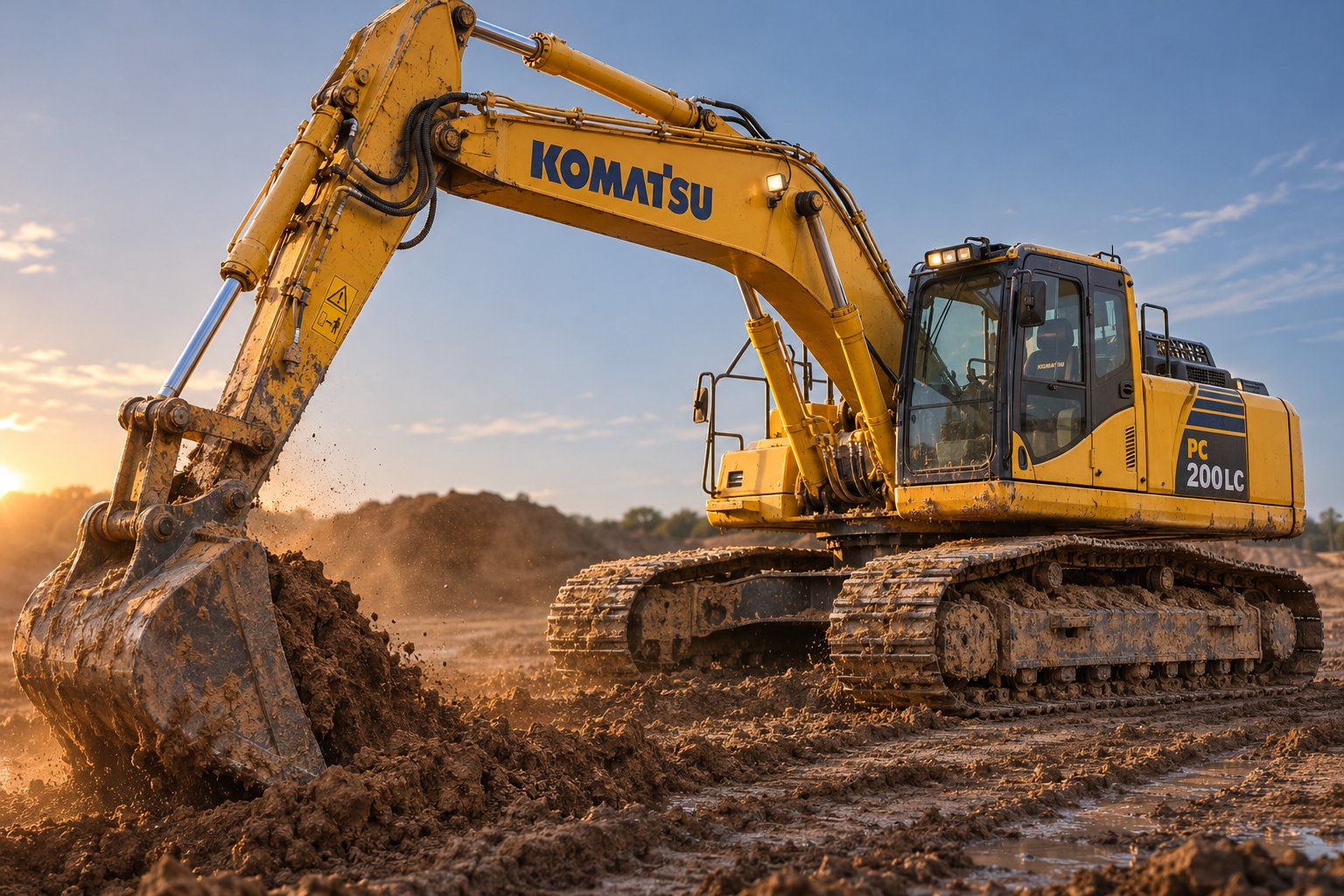
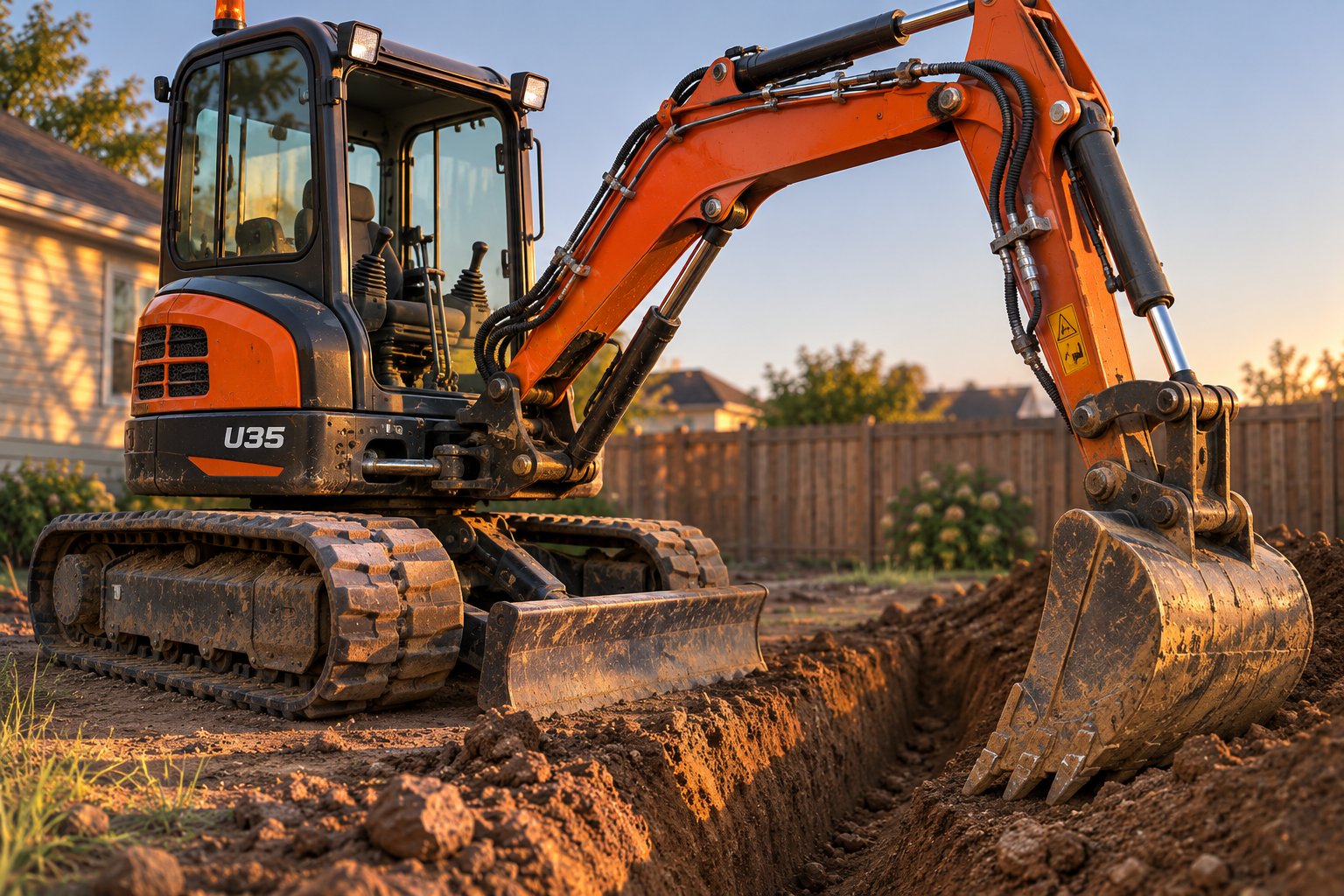
A mini excavator is a compact, track-mounted digging machine with an operating weight typically under 6 metric tons, featuring a hydraulic boom, arm, and bucket assembly on a 360-degree rotating house. These machines are engineered to deliver serious excavation power in tight spaces where full-size equipment simply cannot operate.
If you have ever watched a crew trench a water line through a narrow backyard or dig a pool just feet from a house wall, you have likely seen one of these compact workhorses in action. But how did they come to dominate so many jobsites? And what actually makes them tick under the hood?
Defining the Mini Excavator Category
The story starts in 1971, when Takeuchi founder Akio Takeuchi watched a friend dig foundation footers by hand with pickaxes and shovels. That labor-intensive process inspired him to build the world's first 360-degree full-turn compact excavator. Civil engineers and contractors quickly realized how much the machine boosted productivity, and by 1979, Takeuchi had opened a U.S. office to bring compact excavation to North America. Today, dozens of global manufacturers — including Caterpillar, Kubota, and Bobcat excavators — compete across a range of weight classes from sub-one-ton micro units to 8-ton mid-size models.
What defines the category? Three things stand out:
- Weight threshold: Most industry definitions cap a mini excavator at 6 metric tons of operating weight, though some stretch the boundary to 8 or even 10 tons.
- Track type: Rubber tracks are standard on lighter machines, protecting finished surfaces like driveways and lawns. Heavier models may offer steel tracks for rugged terrain.
- Cab vs. canopy: Smaller units often feature an open canopy with a ROPS (Roll-Over Protective Structure), while machines in the 3-to-8-ton range commonly include an enclosed cab with climate control for all-day operator comfort.
Core Components and Hydraulic Basics
Sounds complex? The hydraulic system driving every mini excavator is actually straightforward once you break it down. A diesel (or sometimes gasoline) engine powers a hydraulic pump. That pump pressurizes fluid and sends it through control valves to hydraulic cylinders mounted along the boom, arm, and bucket. When an operator pushes a joystick, pilot controls route fluid to the correct cylinder, extending or retracting it to produce precise motion — curling the bucket, raising the boom, or tucking the arm inward.
Beyond the boom-arm-bucket assembly, a few other components are critical. The undercarriage — tracks, rollers, idlers, and sprockets — carries the machine across the ground. A slew ring (also called a swing bearing) sits between the upper house and the undercarriage, allowing the cab and boom to rotate a full 360 degrees. And the counterweight at the rear of the upper structure balances the load at the bucket end, keeping the machine stable during digging and lifting. Bobcat weight specifications, for instance, are carefully calibrated across their lineup to optimize this balance between stability and compact dimensions.
Mini Excavator vs. Alternative Equipment
Before you start shopping for a mini excavator for sale, it helps to confirm this is the right equipment category for your project. Here is how these compact machines stack up against the most common alternatives:
- Mini excavator vs. backhoe loader: A backhoe loader is a wheeled, dual-purpose machine with a loader bucket on the front and an excavator arm on the rear. It excels at roading between jobsites and handling materials, but it has a larger footprint, higher ground pressure, and less digging precision in confined areas.
- Mini excavator vs. skid-steer loader with excavator attachment: A skid steer fitted with a digging attachment can handle light trenching, yet it lacks 360-degree rotation, independent boom articulation, and the dig depth a purpose-built compact excavator delivers. Where a skid steer shines is in material handling and grading — pair one with a mini excavator, and you cover most residential and light commercial tasks.
- Mini excavator vs. manual digging: Shovels and pickaxes cost almost nothing upfront, but the labor hours add up fast. A Bobcat mini excavator or similar compact machine can complete in one afternoon what a crew might spend days doing by hand — with far less physical strain and more consistent trench dimensions.
In short, if your project demands precise digging in a restricted footprint — think utility trenching beside a fence, footer excavation next to a foundation, or pool digging inches from a patio — a mini excavator is purpose-built for the job.
Choosing the right machine, however, depends heavily on size. The gap between a 1-ton micro unit and a 7-ton mid-size model is enormous in terms of dig depth, horsepower, and capability — differences that become clear when you look at each weight class side by side.
Mini Excavator Size Classes from Micro to Mid-Size
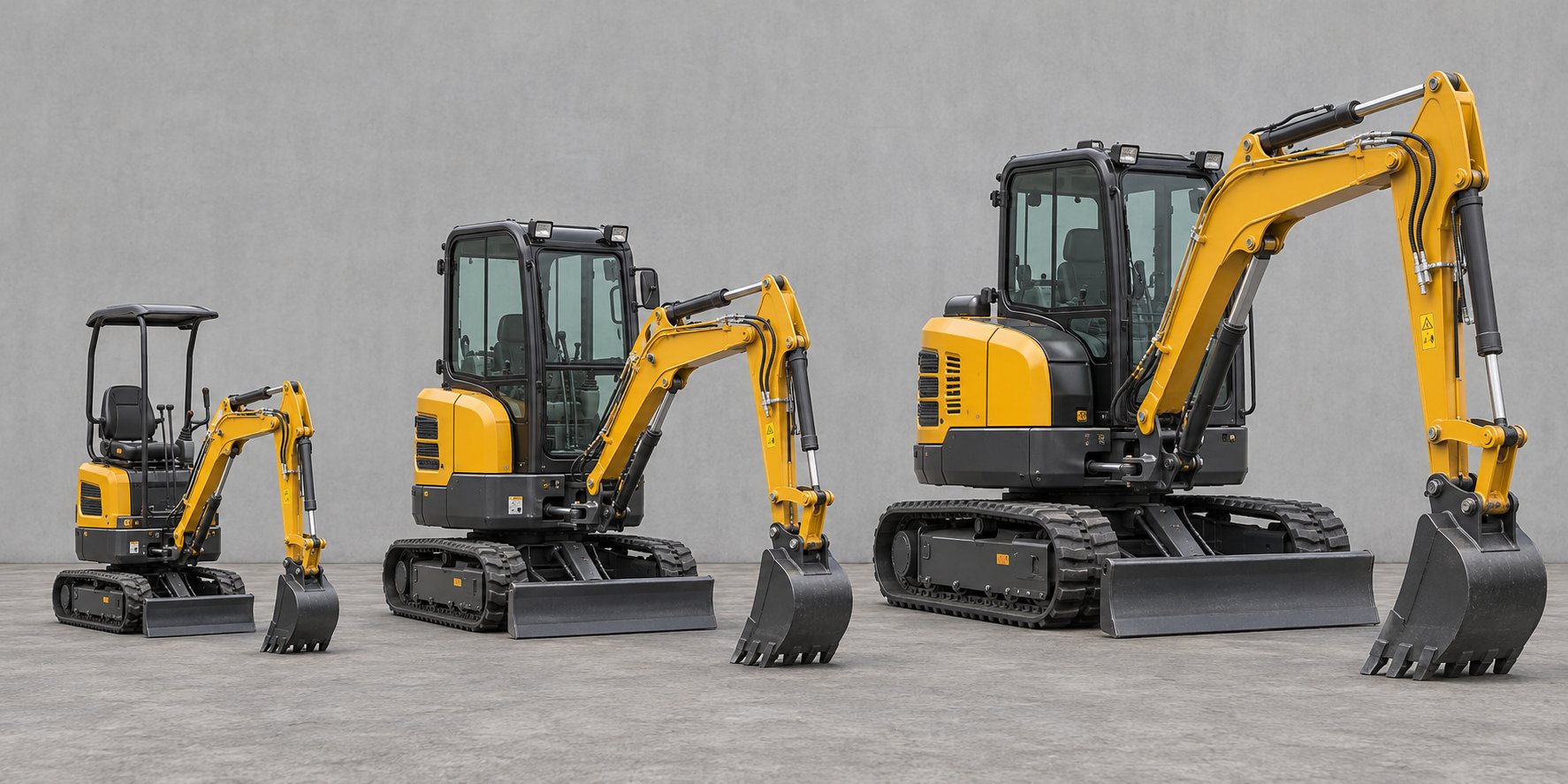
A 2,300-pound machine that slips through a garden gate and a 19,000-pound unit that trenches a city sewer line both carry the label "mini excavator." That is a staggering range, and picking the wrong weight class costs you twice — once on the machine itself and again in wasted hours when it is too small for the job or too heavy to trailer legally. Breaking the market into five weight classes makes the decision far more manageable.
Micro and 1-Ton Machines for Tight Access
Imagine you need to dig a drainage trench through a 28-inch-wide backyard gate, or demolish an interior concrete slab without tearing out the doorframe. That is where micro and 1-ton machines earn their keep. These are the smallest excavators in the lineup, typically weighing between roughly 2,000 and 4,500 pounds with engines producing 10 to 21 horsepower.
Dig depth in this class generally ranges from about 5 to 8 feet — enough for irrigation lines, shallow utility hookups, and small footings. Many models feature retractable undercarriages that hydraulically narrow to fit through standard doorways, which makes them favorites with landscapers, indoor demolition crews, and rental yards serving homeowner projects. The Yanmar SV08-1D, for example, narrows to just 27 inches, while the Kubota K008-5 comes in at roughly 2,025 pounds — light enough to haul on a single-axle trailer behind a half-ton pickup.
You will also find a growing number of electric models in this bracket. The Bobcat E10e delivers zero emissions and near-silent operation, ideal for enclosed spaces where diesel exhaust is a non-starter. Gasoline-powered micro units exist too, offering a lower purchase price at the expense of torque and longevity compared to their diesel counterparts.
The trade-off? Limited lift capacity and shallow dig depth mean these tiny machines are not suited for anything beyond light-duty residential and specialty work. When your project demands deeper trenches or heavier material handling, you need to step up.
The Versatile 2-to-4-Ton Sweet Spot
If there is a single class that dominates residential and light commercial work, it is the 2-to-4-ton range. Industry observers call the 3-to-4-metric-ton segment the "meat and potatoes" of the compact excavator market, and for good reason: these machines balance dig depth, transportability, horsepower, and price better than any other class.
Operating weights here span roughly 5,000 to 9,500 pounds. Horsepower typically falls between 20 and 40 hp, and maximum dig depths range from about 8 to 12 feet — deep enough for residential foundation footers, pool excavation, water and sewer line trenching, and driveway preparation. A 3 ton mini excavator in this bracket is often the go-to for utility contractors who need to trench 8 to 10 feet for water mains while still fitting the machine on a standard equipment trailer towed by a one-ton truck.
Popular model families here include the Bobcat E35 and E38, the Cat 303 CR and 303.5 CR, the Kubota U27-4 and KX040-5, the John Deere 35 P-Tier, and the Takeuchi TB240. Most of these models are available in zero or reduced tail swing configurations, which is a major selling point for crews working alongside fences, foundations, and retaining walls. Both cab and canopy options are common, and a growing number of tech features — grade control systems, telematics, and touchscreen displays — are filtering down into this class.
Prices for new machines in the 3-to-4-ton segment can range from roughly $35,000 to $80,000 depending on configuration, attachments, and technology packages. That wide spread reinforces the importance of comparing specifications across multiple brands rather than defaulting to a single name. If you are browsing small excavators for sale, this class offers the widest selection and the strongest resale values.
Mid-Size 4-to-8-Ton Mini Excavators
When projects push beyond what a 4-ton machine can handle — deeper utility corridors, heavier demolition, road work, or commercial site preparation — the 4-to-8-ton class steps in. Operating weights here range from roughly 9,500 to 20,000 pounds, horsepower climbs to between 40 and 70+ hp, and maximum dig depths stretch from about 11 to over 15 feet.
These are serious production machines. A cat mini excavator like the Cat 305 CR, for instance, weighs 12,688 pounds and delivers 45 horsepower with a maximum dig depth of 11 feet 3 inches in its standard-arm configuration. The cat 305 excavator is one of Caterpillar's most popular compact models, frequently appearing on utility and residential construction jobsites where operators need mid-range digging performance combined with a compact-radius design. At the upper end of this bracket, the Kubota KX080-5 pushes past 18,700 pounds with 66.6 hp and 15-plus feet of dig depth, approaching standard excavator territory.
A caterpillar mini excavator or similarly sized unit from Bobcat, Kubota, Takeuchi, or Yanmar in this weight class typically requires a heavy-duty tandem-axle trailer and a truck rated for the combined load. Transport logistics become a genuine planning consideration — the machine alone may exceed 10,000 pounds, which can trigger commercial licensing requirements depending on your state. It is a detail worth checking before you commit to a purchase.
Despite the larger footprint, many mid-size models still offer reduced or zero tail swing. Yanmar's ViO80-7, for example, maintains true zero tail swing at over 18,400 pounds, and JCB's 90Z-2 offers zero tail swing at nearly 19,600 pounds. These configurations let operators rotate freely in congested urban environments without striking walls, traffic barriers, or parked vehicles.
The table below consolidates the five weight classes with typical specification ranges drawn from current manufacturer data, giving you a quick reference to match machine size against your project requirements:
| Weight Class | Typical Operating Weight Range | Horsepower Range | Approx. Dig Depth | Common Tail Swing Type | Example Brands |
|---|---|---|---|---|---|
| Micro (Under 1 Ton) | 2,000 – 2,700 lbs | 10 – 13 hp | 5 – 6.5 ft | Zero / Reduced | Yanmar, Kubota, Bobcat (E10e), Takeuchi |
| 1 – 2 Ton | 3,500 – 4,500 lbs | 14 – 21 hp | 7 – 8.5 ft | Zero / Conventional | Cat (301.5), Bobcat (E20), Kubota (U17), XCMG, Yanmar |
| 2 – 4 Ton | 5,000 – 9,500 lbs | 20 – 40 hp | 8 – 12 ft | Zero / Reduced / Conventional | Bobcat (E35), Cat (303.5 CR), Kubota (KX040-5), John Deere, Takeuchi |
| 4 – 6 Ton | 9,500 – 13,500 lbs | 40 – 57 hp | 11 – 13.5 ft | Zero / Reduced / Conventional | Cat (305 CR), Bobcat (E55), Kubota (U55-5), Yanmar, SANY |
| 6 – 8 Ton | 13,500 – 20,000+ lbs | 53 – 74 hp | 13 – 15+ ft | Zero / Reduced / Conventional | Cat (308 CR), Kubota (KX080-5), JCB, Yanmar (ViO80-7), Takeuchi |
Keep in mind that the figures above represent general ranges. A mini bobcat or any specific model may fall slightly outside these bands depending on arm length, counterweight options, and whether the listed weight includes an operator. Always cross-reference the exact model's spec sheet before making a decision — especially for transport planning, where even a few hundred pounds can affect trailer and licensing requirements.
Matching the right weight class to your work is only half the equation. The physical dimensions of the machine — particularly how far the counterweight swings past the tracks during rotation — play an equally critical role when space is tight. That distinction between zero, minimal, and conventional tail swing shapes everything from jobsite safety to which models can even fit on your project.
Zero Tail Swing vs. Conventional Tail Swing Explained
Picture a mini excavator rotating next to a brick retaining wall. If the counterweight at the rear of the upper house swings past the edge of the tracks, it slams into that wall — and the repair bill lands on you. Tail swing is the distance the counterweight and upper structure extend beyond the track width during rotation, and understanding the three configurations can save you thousands in property damage, downtime, and mismatched machine purchases.
The three designs break down as follows:
- Conventional tail swing: The counterweight extends well beyond the track footprint when the upper house rotates. This provides maximum ballast for heavy digging and lifting but demands open clearance on all sides of the machine.
- Minimal (reduced) tail swing: The counterweight overhangs the tracks by only a few inches — enough to retain most of the stability benefit while shrinking the clearance envelope. Many manufacturers market this as "compact radius."
- Zero tail swing: The entire upper structure, including the counterweight and front corners, stays within or flush with the track width at every rotation angle. Yanmar, the pioneer of this technology, calls its design "True Zero Tail-Swing" because even conventional "zero-tail" models can overhang by up to 10% of crawler width.
The engineering trade-off is straightforward: zero-tail-swing machines sacrifice some counterweight mass and position to keep everything inside the track footprint. That reduced mass can lower maximum lifting capacity and affect stability on slopes, because the counterweight no longer extends far enough behind the tracks to provide maximum leverage. Conventional models, by contrast, use that extended counterweight to deliver more dig depth, greater reach, and stronger lift performance — advantages that matter on open sites where swing clearance is not a concern.
How Tail Swing Affects Jobsite Safety and Efficiency
Confined jobsites punish the wrong tail-swing choice. Imagine trenching a water line down a narrow urban alley, digging a pool just four feet from a house foundation, or demolishing an interior slab where a mini backhoe on a tractor simply will not fit. In each scenario, the operator needs to swing the upper house through a full rotation without repositioning the entire machine every few cycles.
A zero-tail-swing model — like the Bobcat E35 or a Yanmar ViO — lets you position the tracks tight against a fence line, property boundary, or traffic barrier and rotate freely. There is no counterweight creeping into the adjacent lane, clipping a parked car, or cracking a homeowner's retaining wall. That confidence translates directly into faster cycle times: less repositioning, fewer safety stops, and a smaller exclusion zone around the machine.
On the other hand, when you are working on open land-clearing jobs, loading trucks in staging areas, or running a long reach mini excavator along a riverbank, conventional tail swing is not a liability — it is an asset. The extra counterweight leverage lets you push deeper, lift heavier, and work more aggressively on slopes without approaching tipping thresholds. A long reach mini excavator with conventional swing, for example, benefits from the additional rear ballast to counterbalance the extended boom at maximum reach.
Choosing Between Zero and Conventional Tail Swing
There is no universally "better" configuration — only the right one for your typical work environment. Use the following criteria to guide your decision:
- Proximity to structures: If you routinely work within a few feet of buildings, walls, fences, or traffic barriers, zero tail swing dramatically reduces the risk of contact damage and safety incidents.
- Required lift capacity: Jobs that involve frequent heavy lifts — setting precast structures, handling large boulders, or working on steep grades — favor conventional machines with their greater counterweight leverage.
- Transport width: Zero-tail-swing models often have a narrower overall transport profile, which can simplify trailer loading and comply with road-width regulations more easily.
- Budget considerations: Compact-radius and zero-tail-swing models sometimes carry a modest price premium over conventional counterparts in the same weight class. Weigh that cost against potential savings from fewer damage claims and faster cycle times in tight spaces.
Always confirm zero-tail-swing specifications on the exact machine model and serial number you are evaluating. Designations vary between manufacturers, and mid-production-run specification changes are not uncommon — a model marketed as "zero tail swing" may still allow slight overhang depending on the generation or regional variant.
Tail swing configuration tells you how the machine behaves during rotation, but it is only one dimension of the specification sheet. Dig depth, breakout force, dump height, operating weight — these numbers define what the machine can actually accomplish in the ground and above it. Decoding those specs is where many first-time buyers get tripped up, and it is worth slowing down to understand exactly what each figure means before comparing models.
Key Specifications Every Buyer Should Understand
Spec sheets can feel like a foreign language. Rows of abbreviations, numbers measured in different units, and footnotes that change the meaning of everything above them — it is no wonder first-time buyers default to shopping by brand name or price tag alone. The problem? Two machines sitting side by side in a dealer lot can look nearly identical yet differ dramatically in what they can actually do. The numbers on the page tell that story, but only if you know how to read them.
Whether you are browsing a Bobcat mini excavator for sale at a local dealer or comparing a Bobcat E26 against a Kubota U27 online, the following specs are where you should focus your attention.
Digging Performance Specs Decoded
When contractors say a machine "digs deep," they are referencing a specific measurement: maximum dig depth. This is the farthest distance below grade level the bucket teeth can reach when the machine sits on flat ground with the arm fully extended. Sounds straightforward, right? Two nuances trip people up constantly.
First, published dig depth assumes ideal geometry — the boom, arm, and bucket are positioned at their theoretical maximum extension. In real trenching conditions, you are typically working at 85 to 90 percent of the stated maximum because the bucket loses curl angle as you approach full depth, reducing the force you can apply at the trench bottom. A machine rated to 10 feet of dig depth may only clean the bottom efficiently at around 8 to 9 feet.
Second, not every manufacturer measures from the same baseline. Some spec sheets reference the bottom of the tracks; others reference grade level with the blade lowered.
Always compare dig depth specs at the same reference points — manufacturers sometimes measure from different baselines, and a one-foot discrepancy might be a measurement difference rather than a real capability gap.
Reach at ground level tells you how far from the machine's center the bucket can extend horizontally along the surface. This matters when you are working over an embankment, cleaning out a pond edge, or reaching across a trench you cannot straddle with the tracks.
Breakout force is the digging power at the bucket teeth, measured in pounds-force (lbf) or kilonewtons (kN). You will typically see two figures on a spec sheet: bucket breakout force (generated by curling the bucket cylinder — what bites into the ground at the start of a dig cycle) and arm digging force (generated by pulling the arm back toward the machine — the primary dragging force during trenching). A 3.5-ton utility-class machine typically produces 5,000 to 7,000 lbf of bucket breakout force, which is enough to penetrate compacted clay and dense gravel. For context, loose sandy soil may require only 1,000 to 2,000 lbf, while soft rock or shale can demand 6,000 to 10,000+ lbf.
For tasks like footer trenching and utility installation, arm digging force is the number you feel most during the stroke. Bucket breakout force matters more when you need to punch through frost layers, root-packed earth, or broken concrete. Keep both figures in mind rather than fixating on one.
Lifting and Loading Specs That Matter
A mini excavator is not just a digging tool — it is also a lifting platform. Every time you pick up a boulder, set a concrete pipe section, or load material into a truck bed, the machine's rated lift capacity determines whether the job proceeds safely or the machine tips.
Lift capacity is published as a chart, not a single number. The rated load changes based on how far the bucket extends from the machine's center (the load radius) and how high the boom is raised. Lifting over the front of the tracks yields a higher figure than lifting over the side, because the tipping axis — the imaginary line the machine would pivot over if overloaded — runs along a wider base when the boom points forward. A small compact machine might safely lift 2,500 lbs over the front at a close radius but only 900 lbs over the side at full reach. Always plan lifts using the manufacturer's official capacity chart for the specific configuration you are operating, not the headline number in a brochure.
Dump height — how high the bucket can raise and tip material — is the specification nobody thinks about until they are standing next to a high-sided tri-axle dump truck. If your workflow involves loading trucks directly, the machine's dump clearance must exceed the truck bed wall height. High-sided dump trucks can have walls reaching 4 to 5 feet, and a smaller mini x that digs beautifully may still fall short when it is time to load spoil. Measure your trucks, then compare dump heights across the models you are evaluating.
Weight, Dimensions, and Ground Pressure
You will encounter two weight figures on most spec sheets: operating weight and shipping weight. Operating weight includes the machine, a standard bucket, a full fuel tank, hydraulic fluid, and sometimes the operator. Shipping weight strips away some of those items for transport. The distinction matters because operating weight is what your trailer carries to the jobsite, while shipping weight might be what the factory quotes for freight calculations. A few hundred pounds of difference can push you past a trailer's GVWR rating, so verify which figure you are comparing and what it includes. As one industry resource notes, manufacturers may calculate weight based on different standard configurations — a 12-inch bucket versus a 24-inch bucket, a half-tank of fuel versus a full one — so apples-to-apples comparison requires reading the fine print.
Overall width is often the spec that eliminates machines fastest. Many models offer retractable (telescoping) undercarriages that narrow by 8 to 12 inches for transit through tight gates, then expand for stable operation. Always check both the retracted and extended widths. A Bobcat E20 micro unit, for example, is designed for extreme access — its compact dimensions let it pass through standard doorways and narrow fence gates that lock out larger models.
Ground pressure, measured in PSI or kPa, indicates how much force the machine distributes per square inch of track contact area. Lower ground pressure means less surface damage. A well-designed micro excavator can achieve ground pressure lower than that of a standing adult — roughly 4 PSI or under versus the 8 to 12 PSI a human exerts while standing. That difference matters enormously on finished lawns, paver patios, and freshly poured concrete. Rubber tracks distribute weight more gently and protect hard surfaces; steel tracks provide superior traction in rocky or muddy conditions but will destroy pavement.
Finally, consider bucket capacity and sizing. The same machine often lists multiple bucket options — a 12-inch narrow bucket for utility trenching, a 24-inch general-purpose bucket for footings, and a 36-inch or wider cleanup bucket for grading. Bucket width should match the trench width your project requires, and bucket capacity should suit the material density you are moving. An oversized bucket in dense clay overloads the hydraulic system and slows cycles; an undersized bucket in loose soil wastes passes. Quick couplers let you swap between sizes in minutes, so think of buckets as tools in a toolbox rather than a one-size-fits-all decision.
Specifications tell you what a machine can do in controlled conditions. Matching those capabilities to the work you actually perform — the trenches you dig, the sites you grade, the structures you demolish — is where theory meets the real world and where the right size class becomes your most profitable decision.
Mini Excavator Applications Matched to Machine Size
A spec sheet full of impressive numbers means nothing if the machine ends up on the wrong job. A 1-ton micro unit on a commercial sewer project will struggle all day, and an 8-ton mid-size model in a backyard behind a 36-inch gate will never even reach the work area. The real value of understanding weight classes and specifications comes when you map them directly to the tasks you perform — letting the project dictate the machine rather than the other way around.
Before diving into specific industries, here are the five most common mini excavator applications ranked by frequency across all sectors:
- Utility trenching — water, sewer, gas, electrical, and fiber-optic line installation consistently accounts for the highest volume of compact excavator hours logged industry-wide.
- Foundation and footing excavation — residential and light commercial footer digging is a close second, driven by steady housing construction and renovation demand.
- Landscaping and grading — backyard regrading, drainage correction, and hardscape preparation keep 1-to-4-ton machines busy year-round in most markets.
- Demolition and site clearing — tearing out old concrete, removing small structures, and clearing brush represent a growing share of compact excavator work as urban infill projects increase.
- Agricultural and specialty work — pond construction, fence-line post installation, drainage tile placement, and land clearing round out the top five, particularly in rural and semi-rural regions.
Each of those applications demands a specific combination of dig depth, reach, lift capacity, and physical footprint. The sections below break down which weight classes serve each sector best — so you can match machine to mission with confidence.
Residential and Landscaping Applications
Residential work is where compact excavators truly shine, and it is also where the wrong size choice shows up fastest. A machine that is too heavy tears up a finished lawn; one that is too light turns a two-hour grading job into a full-day ordeal.
Backyard grading and drainage installation typically call for machines in the 1-to-3-ton range. These units offer enough bucket capacity to reshape soil contours and cut drainage swales while keeping ground pressure low enough to avoid permanent track ruts on turf. A micro excavator with a sub-3-foot retracted width can pass through standard 36-inch gates and doorways — a game changer for landlocked backyards with no side access. For landscapers running multiple residential jobs per week, models like the Bobcat E10 or the cat smallest units in the 1-ton bracket make tight-access work routine rather than exceptional.
Tree and stump removal requires a bit more muscle. A 2-to-3-ton machine equipped with a hydraulic thumb can wrap around a root ball, rock it free, and lift it onto a trailer without a second piece of equipment on site. Stump extraction, especially for mature hardwoods with deep taproots, often benefits from the added breakout force of a 3-to-4-ton unit paired with a ripper or heavy-duty digging bucket.
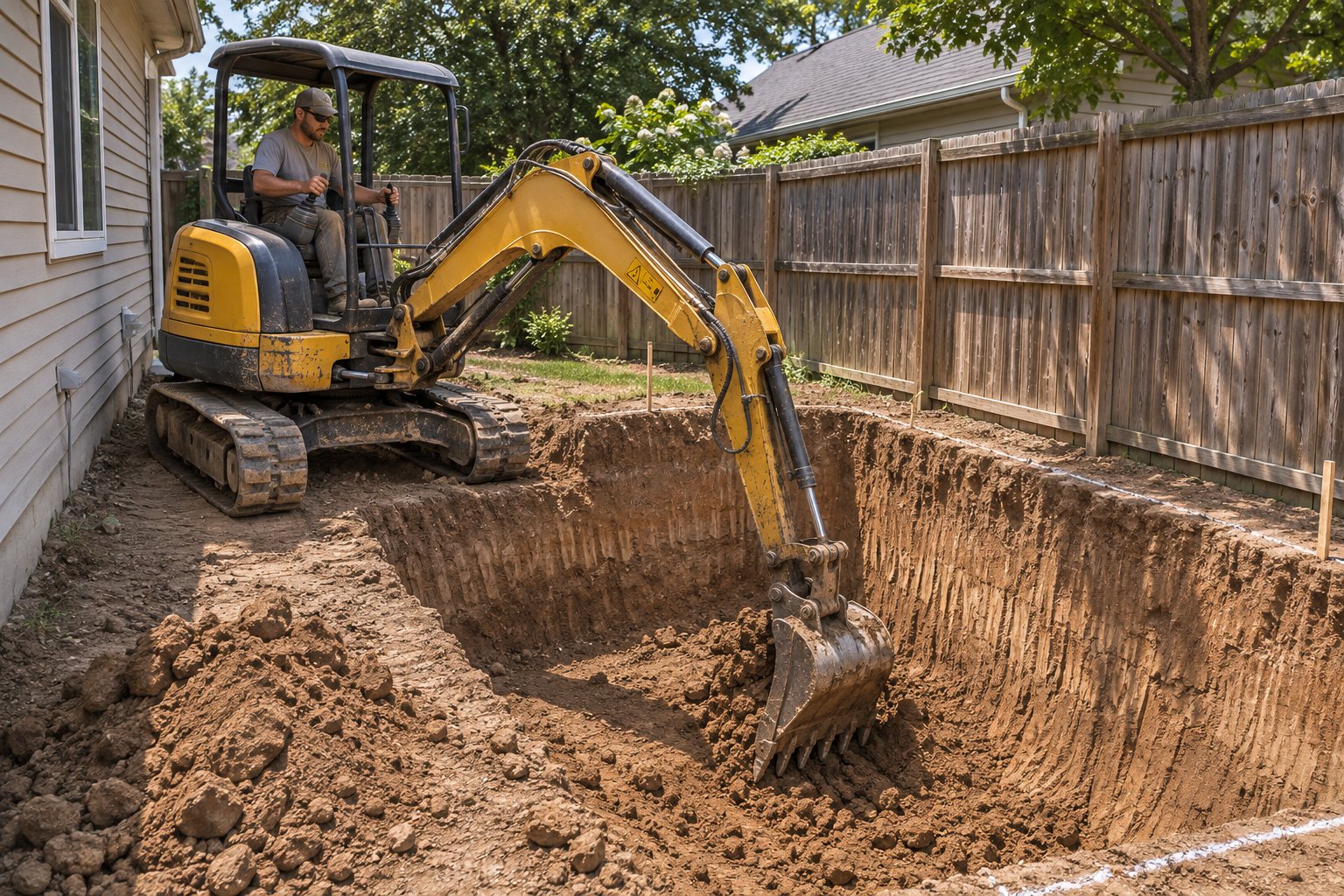
Pool excavation is one of the most demanding residential tasks. A typical in-ground pool shell requires moving 50 to 100 cubic yards of material, digging 6 to 8 feet deep, and often working just a few feet from a house foundation or patio. The 1-to-5-ton range covers most residential landscaping projects, but pool contractors generally favor the 3-to-4-ton sweet spot — enough dig depth and bucket capacity for production-level output, yet compact enough for zero-tail-swing operation beside structures.
Driveway preparation and foundation footer digging push toward the upper end of the residential range. Footer trenches for a single-family home typically run 2 to 4 feet wide and 3 to 6 feet deep depending on local frost-line codes, while driveway sub-base excavation can span the full width of a two-car driveway. A 3-to-4-ton machine handles both tasks comfortably, and the added horsepower pays off when you are loading spoil into a truck rather than stockpiling it on site.
Commercial and Utility Applications
Step onto a commercial jobsite and the demands shift. Trenches run deeper, spoil volumes climb, the workday is longer, and downtime costs real money. The 3-to-6-ton weight class dominates this territory because it delivers the production rates, dig depths, and attachment versatility that utility and commercial contractors depend on.
Utility trenching for water, sewer, gas, fiber-optic, and electrical lines is the bread and butter of compact excavation. Municipal water and sewer mains often sit 4 to 8 feet below grade, and in cold climates, frost lines can push water service trenches even deeper. A machine with 10-plus feet of dig depth — standard in the 3-to-5-ton class — covers the vast majority of utility installations while leaving a margin for uneven terrain and trench box clearance. The 305 cat excavator, for example, pairs an 11-foot-plus dig depth with a compact-radius design that lets operators work in traffic-restricted lanes and along sidewalks without constant repositioning.
Site preparation for small commercial buildings involves stripping topsoil, cutting grades, excavating footings, and loading trucks. These tasks reward machines with higher horsepower, larger bucket options, and the lift capacity to handle pipe sections, precast forms, and loaded pallets. A 5-to-6-ton unit — think the Bobcat E55 or a Kubota U55-5 — delivers production-level digging for commercial projects while still qualifying as a compact machine that can maneuver around congested staging areas.
Parking lot work and truck loading highlight the importance of dump height and cycle speed. When you are stripping asphalt, excavating storm-drain trenches, or cutting a detention basin and loading spoil into high-sided dump trucks, the machine needs both the reach to clear the truck wall and the bucket capacity to fill it efficiently. Contractors searching for a cat mini excavator for sale in the 5-to-6-ton bracket should pay close attention to dump height clearance and rated lift capacity over the side, since loading trucks parked beside the trench — rather than directly in front — is a common real-world scenario.
Agricultural and Specialty Uses
Farms, ranches, and specialty projects represent a rapidly growing segment for compact excavators. The versatility of these machines — especially when paired with the right attachments — makes them indispensable tools far beyond the construction site.
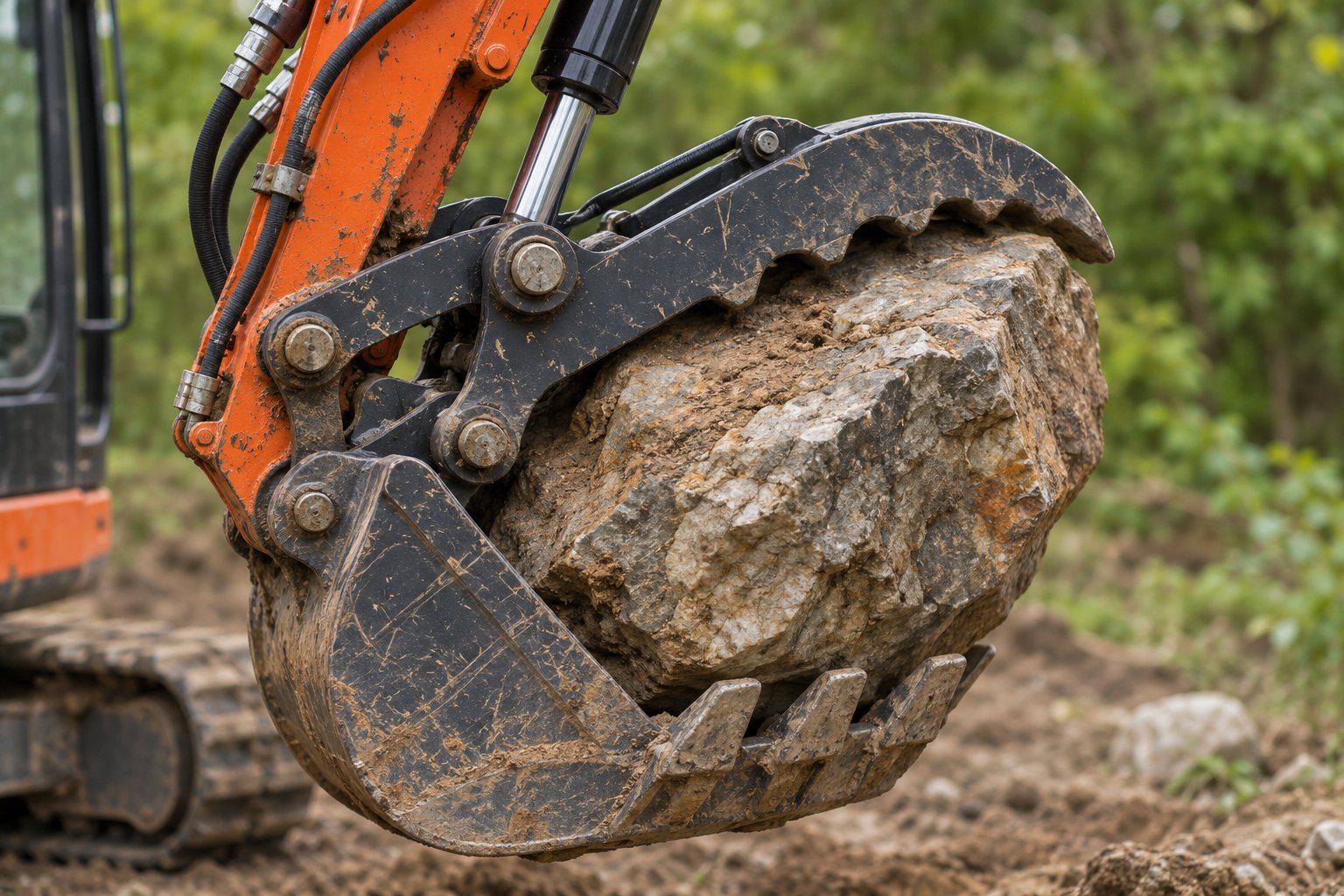
Land clearing is one of the most physically demanding agricultural applications. Ripping out old fence lines, toppling dead trees, pulling embedded boulders, and grubbing root mats all require a combination of breakout force, lift capacity, and reach. Machines in the 4-to-6-ton range handle most clearing work efficiently. Equipping the excavator bucket with a hydraulic thumb converts it into a debris grapple capable of picking up stumps, logs, and boulders with precision — eliminating the need for a second machine on many clearing projects.
Pond construction involves excavating large volumes of material to precise depth and bank-slope specifications. A 5-to-8-ton unit provides the dig depth and bucket capacity to shape pond basins, build berms from excavated material, and cut spillway channels. Operators who review the Bobcat E50 specs or similar mid-size models will notice that reach at ground level — not just dig depth — becomes a critical factor, because pond banks often slope gradually and require working well away from the machine's center.
Fence-line post-hole work is transformed by an auger attachment. Rather than hand-digging each post hole, a 2-to-4-ton excavator with a hydraulic auger drills consistent-diameter holes to exact depth in a fraction of the time. Augers are also useful for planting fence posts and poles, digging pier footings for agricultural structures, and even loosening extremely dense clay-rich soil.
Drainage tile installation calls for long, straight trenches at controlled grades — work that favors the 3-to-4-ton class for its balance of dig depth, trenching speed, and the ability to navigate across open fields without excessive soil compaction. Grade-control technology, now available on several compact models, can automate trench depth to within fractions of an inch, reducing re-work and improving drainage system performance.
Demolition of small structures — old barns, sheds, silos, and outbuildings — rounds out the agricultural application list. A hydraulic breaker handles concrete foundations, while a thumb-equipped bucket tears apart wood framing and sorts debris for disposal. The 3-to-6-ton range covers most small-structure demolition, with the specific choice depending on the structure's footprint and the amount of material that needs to be loaded and hauled away.
Across all of these applications, one principle holds true: task requirements like dig depth, reach, and lift capacity should drive machine selection — not brand loyalty alone. A contractor who only considers one manufacturer's lineup may miss a better-suited model from another brand at a more competitive price point. Comparing specifications across multiple manufacturers before committing is the most reliable path to getting the right machine for the work and the budget.
Of course, the machine itself is only the starting platform. The attachments you bolt onto that boom — buckets, thumbs, breakers, augers, and more — are what transform a single-purpose digger into a multi-tool workhorse capable of tackling every application on this list and dozens more.
Attachments That Multiply Mini Excavator Versatility
When people ask how much is a mini excavator really worth, the answer depends less on the base machine and more on what you hang off the end of its arm. A single compact excavator paired with four or five well-chosen attachments can replace a trailer full of single-purpose tools — breakers, post-hole diggers, compactors, and specialty buckets — collapsing equipment costs and eliminating the need for extra machines on site. That is the true ROI multiplier, and it is where smart buyers separate themselves from those who overpay for capability they never unlock.
Buckets, Thumbs, and Rippers
Every mini excavator ships with a standard digging bucket, but treating that bucket as the only option is like buying a cordless drill and never swapping the bit. Bucket sizing is defined by width and capacity: a narrow 12-inch trenching bucket cuts precise utility channels, a 24-inch general-purpose bucket handles footings and grading, and a wide 36-inch-plus ditching or cleanup bucket skims finished grades and moves loose material in fewer passes. Matching bucket width to trench specifications and bucket capacity to material density keeps cycle times short and prevents hydraulic overload in heavy clay or wet soil.
A hydraulic thumb is arguably the single highest-value addition you can make. Mounted opposite the bucket, it turns the digging assembly into a clamp capable of grabbing rocks, logs, stumps, demolition debris, and irregularly shaped objects that would otherwise roll right off a flat bucket. Demolition cleanup, rock placement along retaining walls, and brush sorting all become one-machine operations. A Bobcat excavator like the E32 or E35, for example, is commonly paired with a factory-compatible thumb for exactly these multi-task workflows.
For ground that refuses to yield to a standard bucket — frozen topsoil, compacted hardpan, or dense clay laced with cobble — a single-shank ripper does the pre-work. Dragged through resistant soil in a crosshatch pattern, the ripper fractures the material so subsequent bucket passes move it efficiently. It is a simple, unpowered attachment that can save hours on stubborn sites.
Breakers, Augers, and Specialty Tools
Powered attachments are where hydraulic compatibility becomes critical. Every powered tool requires a specific range of auxiliary hydraulic flow (measured in GPM) and operating pressure (PSI) from the machine's auxiliary circuit. Supply too little flow and the attachment stalls under load; supply too much and you generate excess heat that damages seals and motors. Always verify your machine's auxiliary output against the attachment manufacturer's specifications before purchasing.
Hydraulic breakers are the go-to for concrete and rock demolition. They convert hydraulic flow into rapid percussive strikes, pulverizing slabs, sidewalks, boulders, and old foundations. Even on a sub-2-ton machine like the Bobcat e1.0, a correctly sized breaker handles light concrete removal for residential renovations and patio tearouts — jobs that would otherwise require a rented standalone jackhammer and significantly more manual labor.
Augers drill uniform, vertical holes for fence posts, pier footings, deck supports, and tree planting. They demand higher hydraulic flow than most other attachments, so machines in the 2-ton-and-above range — often powered by reliable compact diesel engines like the Kubota D722 found in many sub-2-ton models — are better suited for sustained auger work in dense soil. Plate compactors vibrate and press backfill material to specified density directly from the boom, eliminating the need for a separate walk-behind unit. And tilt-rotator couplers add infinite rotation plus side-to-side tilt, letting operators position any attachment at virtually any angle — a productivity leap for precision grading and utility work.
The table below maps common attachment types to their typical hydraulic requirements and compatible machine classes:
| Attachment Type | Typical Application | Required Hydraulic Flow (GPM) | Compatible Weight Classes |
|---|---|---|---|
| Standard Digging Bucket | Trenching, footings, general excavation | N/A (uses main hydraulics) | All classes |
| Hydraulic Thumb | Debris handling, rock placement, demolition cleanup | 4 – 8 GPM | 1 ton and above |
| Single-Shank Ripper | Breaking compacted soil, frost, hardpan | N/A (mechanical, unpowered) | 1 ton and above |
| Hydraulic Breaker | Concrete demolition, rock breaking, frozen ground | 5 – 12 GPM | 1 – 8 ton |
| Auger | Post holes, pier footings, tree planting | 10 – 20 GPM | 2 – 8 ton |
| Plate Compactor | Trench backfill compaction, sub-base prep | 12 – 20+ GPM | 3 – 8 ton |
| Tilt-Rotator Coupler | Precision grading, angled trenching, utility work | 8 – 15 GPM | 3 – 8 ton |
Note that these flow ranges represent general industry guidelines. Auxiliary hydraulic flow and pressure must match attachment requirements exactly — always verify coupler compatibility and flow ratings with both the machine and attachment manufacturers before committing to a purchase.
Quick Couplers and Attachment Swaps
Switching between a digging bucket, a breaker, and an auger three times in a single workday sounds productive on paper — until each swap takes 15 to 20 minutes of climbing out of the cab, knocking out retaining pins, repositioning the attachment, and re-securing everything. Multiply that by several changes across a busy week and you have lost hours of billable work.
Manual (mechanical) quick couplers improve on the traditional pin-on system by standardizing the connection interface. The operator still leaves the cab to engage or release a locking mechanism, but the process drops to roughly five minutes per swap — a meaningful improvement for smaller machines where attachments are lighter and easier to handle.
Hydraulic quick couplers take it a step further. The operator never leaves the seat. A button or lever in the cab actuates hydraulic pins that lock and release the attachment, cutting swap time to under a minute. For busy contractors running a Bobcat excavator, Cat, or Kubota across mixed-task jobsites — digging a trench, breaking a slab, then compacting backfill in a single morning — a hydraulic coupler pays for itself in recovered productivity within weeks. The trade-off is higher upfront cost and added weight at the end of the arm, which slightly reduces net lift capacity. On machines under roughly 4,000 pounds, the hydraulic system may also lack the spare circuit capacity to operate the coupler without additional plumbing, making a manual coupler the more practical choice.
Whichever coupler type you choose, think of it as the gateway that unlocks the full attachment ecosystem. A machine with a quick coupler and three or four purpose-matched tools is not three machines — it is better, because it eliminates mobilization costs, trailer space, and the coordination headaches of running multiple units on a single site.
Attachments expand what a mini excavator can do, but they also add to the total investment equation. The power source under the hood — diesel, gasoline, or electric — shapes operating costs, maintenance schedules, and where you can legally run the machine, making it the next critical variable in the buying decision.
Engine Types and Power Sources for Small Excavators Compared
You have settled on the right weight class, confirmed tail swing configuration, decoded the spec sheet, and mapped attachments to your work — but one decision sits upstream of all of those and quietly shapes every operating dollar you will spend for years: what powers the machine. Diesel, gasoline, and electric drivetrains each bring a distinct mix of torque, fuel cost, noise, emissions, and maintenance demands to the table. Picking the wrong power source for your typical work environment is like buying the perfect bucket for the wrong machine — technically functional, practically painful.
Diesel Engines and the Industry Standard
Walk onto almost any jobsite and the compact excavator humming away in the trench runs on diesel. There is a reason for that dominance, and it starts with torque. Diesel engines produce peak torque at low RPM, which translates directly into strong breakout force and steady hydraulic pressure during sustained digging cycles — exactly the load profile a compact earth moving machine encounters hour after hour. Fuel efficiency reinforces the advantage: diesel packs roughly 10 to 15 percent more energy per gallon than gasoline, meaning longer runtime per tank and lower fuel cost per hour of operation.
Durability seals the deal. Diesel powerplants are built with heavier rotating assemblies, thicker cylinder walls, and direct injection systems designed for thousands of hours of continuous duty. Common engine suppliers like Kubota and Yanmar appear across dozens of brands — you will find a Kubota D722 in many sub-2-ton machines and Yanmar 3TNV-series engines powering compact excavators from Takeuchi, Wacker Neuson, and others. That cross-brand commonality means service parts are widely available, and most diesel mechanics already know these engines inside and out.
The trade-off? Emission compliance has added cost and complexity. Tier 4 Final (in the United States) and Stage V (in the European Union) standards require diesel particulate filters (DPF), diesel oxidation catalysts (DOC), and in some larger models, selective catalytic reduction (SCR) systems using diesel exhaust fluid (DEF). These aftertreatment components increase the purchase price of new machines by several thousand dollars, add periodic regeneration cycles that temporarily reduce available power, and introduce maintenance tasks — DPF cleaning, DEF refills, sensor replacement — that did not exist a decade ago. For a typical 3 tonne digger in the 20-to-40-hp range, the aftertreatment hardware is relatively simple compared to larger equipment, but it is still a line item worth budgeting for during ownership.
Gasoline Engines in Budget and Micro Models
Not every compact excavator drinks diesel. Some micro and sub-1-ton machines ship with gasoline engines — the Briggs & Stratton 25T2, for instance, produces 13.5 hp at 3,600 RPM and appears in several budget-oriented 1-ton models. Gasoline power offers a lower purchase price, simpler emission controls (no DPF or DEF), and easier cold-weather starting.
The downsides are real, though. Gasoline engines generate peak torque at higher RPM, which means less low-end pulling power for heavy digging compared to a similarly rated diesel. Fuel consumption per hour of loaded operation runs higher, and the engine's lighter construction — thinner cylinder walls, aluminum components — typically yields a shorter service life measured in total hours. If you are a homeowner tackling a one-time drainage project or a rental yard stocking entry-level machines for weekend DIY customers, a gasoline-powered micro unit delivers acceptable performance at a friendlier upfront cost. For daily commercial use, diesel's longevity and efficiency advantage widens quickly.
The Rise of Electric Mini Excavators
Imagine running a small excavator inside a hospital renovation, demolishing an interior slab in an underground parking garage, or trenching a utility line in a noise-restricted downtown district at 7 a.m. — all without a single whiff of exhaust or the drone of a diesel idling between cycles. That is the promise driving the electric segment, and manufacturers are delivering real machines to back it up.
Electric compact excavators replace the diesel engine with a lithium-ion battery pack and one or more electric motors that drive the hydraulic pumps. The operator experience is strikingly similar — same joysticks, same boom-arm-bucket motion — but the noise floor drops dramatically, vibration falls, and tailpipe emissions disappear entirely. Bobcat highlights zero exhaust fumes and near-silent operation as key differentiators for indoor, urban, and environmentally sensitive jobsites. Models like the Bobcat E10e (sub-1-ton class) and the recently announced New Holland E25X (2.5-metric-ton class, 5,445 lbs operating weight, 102-volt lithium-ion battery with 32.2 kWh capacity) demonstrate that electrification is climbing from micro machines into the productive heart of the 3 tonne digger range.
Current limitations keep electric models in a supporting role for most fleets rather than a wholesale diesel replacement. Runtime on a full charge typically spans four to eight hours depending on task intensity — enough for a moderate shift, but well short of the all-day, refuel-and-go capability of diesel. Charging adds downtime: the New Holland E25X, for example, takes roughly nine hours from zero to full on its standard 240-volt onboard charger, or about five hours to reach the 20-to-80-percent window. Fast-charging infrastructure on remote jobsites is still rare. And upfront purchase price remains higher than an equivalent diesel model, though lower maintenance costs — no engine oil changes, no DPF service, no coolant system — narrow the total-cost-of-ownership gap over time.
The table below puts all three power sources side by side across the criteria that matter most when choosing a compact excavator:
| Criteria | Diesel | Gasoline | Electric |
|---|---|---|---|
| Torque Output | High at low RPM — ideal for sustained digging | Moderate; peak torque at higher RPM | Instant torque from electric motor; smooth delivery |
| Fuel / Energy Cost | Moderate; strong energy density per gallon | Higher per-hour consumption than diesel | Lowest per-hour energy cost; grid electricity is cheaper than fuel |
| Noise Level | 70 – 85+ dBA typical; requires hearing protection | Similar to diesel; slightly higher at peak RPM | Significantly quieter; enables noise-restricted jobsite access |
| Emissions | Tier 4 Final / Stage V compliant; DPF and DEF required | Simpler emission controls; still produces exhaust | Zero tailpipe emissions; suitable for enclosed and indoor work |
| Indoor Use Suitability | Not recommended without ventilation systems | Not recommended without ventilation systems | Fully suitable — no exhaust, minimal heat output |
| Purchase Price Range | Moderate; emission hardware adds cost on newer models | Lowest upfront cost in micro/sub-1-ton class | Highest upfront cost; premium narrows with incentives |
| Maintenance Complexity | Moderate; oil, filters, coolant, DPF service | Moderate; oil, filters, spark plugs, shorter intervals | Lowest; no engine oil, no filters, no exhaust aftertreatment |
For most contractors running a mixed fleet, diesel remains the workhorse — proven, powerful, and supported by a deep service network. Gasoline fills a narrow niche at the lightest end of the market where price sensitivity outweighs longevity concerns. And electric is carving out a fast-growing lane wherever emissions, noise, or indoor access restrictions make combustion engines impractical. The smartest approach may be treating electric as a complementary tool for specific job types rather than an all-or-nothing replacement — at least until battery capacity, charging speed, and model availability catch up with diesel's all-day versatility.
Knowing which power source fits your operating environment is one piece of the cost puzzle. The bigger financial question — whether to rent that machine, buy it new, pick up a used unit, or structure a lease — shapes your bottom line far more than the sticker price alone. That calculation depends on utilization rates, project pipelines, and a few rules of thumb that separate profitable equipment decisions from expensive ones.
Rent vs. Buy a Mini Excavator and the Total Cost of Ownership
Engine type, weight class, and tail swing configuration all influence what you pay upfront — but how you acquire the machine determines what it costs you every month for years. A contractor who buys a small digging machine outright faces a very different financial picture than one who rents by the week or structures a five-year lease. Neither path is universally right. The winning strategy depends on how many days per year the machine actually works, the depth of your project pipeline, and how much capital you can commit without starving other parts of your business.
When Renting Makes the Most Financial Sense
Renting converts a five- or six-figure capital decision into a predictable operating expense — and for a surprising number of buyers, that math works out better than ownership.
Consider a landscaper who needs a 1 2 ton mini excavator for a handful of residential drainage jobs each spring. Rental rates for that class typically run $150 to $250 per day and $500 to $800 per week, meaning six weeks of scattered use across a full year might total $4,000 to $5,000 — a fraction of a new machine's purchase price. Add in the fact that you skip insurance premiums, storage, and year-round maintenance, and the case for renting strengthens further.
Rental wins in several clear scenarios:
- One-off or seasonal projects: If the machine sits idle four or more months a year, carrying costs erode any ownership advantage.
- Specialized sizes or attachments: Needing a micro unit for one indoor demolition job or an 8-ton machine for a single commercial dig rarely justifies a purchase.
- Testing before committing: A few weeks of real-world use reveals more about a machine's fit for your workflow than any spec sheet or demo video.
- Cash flow protection: During uncertain periods, rental preserves working capital and credit lines for payroll, materials, and emergencies.
Rental pricing follows a tiered structure — daily rates carry the highest per-day cost, weekly rates save 40 to 55 percent versus stacking daily rentals, and monthly contracts drop the effective daily rate even further. If your project crosses three days, book weekly. If it crosses three weeks, ask for the monthly rate. That single habit can trim hundreds off each rental cycle.
One detail renters consistently underestimate: add-ons. Delivery fees, damage waivers, attachment surcharges, fuel refill penalties, and environmental charges can push the final invoice 15 to 30 percent above the quoted base rate. Always request an all-in estimate before signing.
When Buying Outweighs Renting
Ownership starts making sense when utilization climbs. Industry guidance suggests that equipment running roughly 60 to 70 percent of available working days annually — around 150 to 180 days — crosses the threshold where ownership costs less per hour than ongoing rental. Below that band, rental usually wins once you factor in depreciation, insurance, maintenance, and storage.
A contractor running a small Bobcat or Cat mini excavators across a steady stream of utility and residential jobs five days a week is a textbook ownership candidate. High utilization spreads fixed costs over more productive hours, and every rental dollar you would have spent instead builds equity in an asset you can eventually resell or trade in.
The new-versus-used question adds another layer:
- Buying new delivers a full manufacturer warranty, the latest emission compliance (Tier 4 Final or Stage V), current technology packages, and dealer support. You also get the widest range of cat excavator sizes and configurations to match your exact needs. The trade-off is higher upfront cost and steeper first-year depreciation — heavy machinery can lose 20 to 30 percent of its value in the first year.
- Buying used lowers the acquisition cost, offers immediate availability without factory lead times, and slows the depreciation curve since the sharpest drop has already occurred. The risk shifts to unknown maintenance history, potential undercarriage wear, and the absence of warranty coverage on older units.
Beyond the sticker price, true ownership cost includes annual maintenance at roughly 5 to 10 percent of purchase price, insurance at 1 to 3 percent of value, storage, financing interest, and the opportunity cost of capital tied up in iron instead of working elsewhere in the business. Run those numbers honestly before you sign — most operators overestimate future utilization when the excitement of a new machine clouds the spreadsheet.
Leasing and Rent-to-Own Pathways
Not every acquisition fits neatly into a rent-or-buy binary. Leasing sits between the two: you commit to fixed monthly payments over a one-to-seven-year term, typically with lower upfront outlay than a purchase, and at the end you return the machine, upgrade, or buy it at a residual value.
Two lease structures dominate the equipment market. An operating lease functions like a long-term rental — payments are deductible as operating expenses, and the machine stays off your balance sheet in most cases. A finance (capital) lease behaves more like a loan — you may be able to depreciate the asset and potentially take advantage of Section 179 deductions, which allow qualifying businesses to write off up to $2,560,000 in equipment in the year it enters service. Rent-to-own programs split the difference further, applying a portion of each rental payment toward eventual purchase — an attractive path for contractors who want to test a 1 2 ton mini excavator or any other size class in daily production before committing fully.
Tax treatment varies significantly between these structures. Owned equipment can be depreciated; rental payments are expensed in the year incurred; lease deductions depend on the agreement's classification. The right choice hinges on your current taxable income, cash position, and long-term equipment plans — variables specific enough that a financial advisor's input is worth the consultation fee.
If your annual rental spend on a mini excavator exceeds roughly 25 to 30 percent of that machine's purchase price, ownership or a lease likely delivers better long-term value — consult a financial advisor to confirm the math for your specific tax situation.
Whether you decide to rent, buy new, lease, or land somewhere in between, the used-equipment market deserves its own close look. A well-sourced used machine can deliver 80 percent of a new unit's capability at 50 percent of the cost — but only if you know exactly what to inspect, where to shop, and which red flags should kill a deal on the spot.
How to Source and Evaluate a Used Mini Excavator
A used compact excavator priced $15,000 below a comparable new model looks like a bargain — until you discover the undercarriage needs $8,000 in track and roller replacements, the boom pins are wallowed out, and the hour meter has been rolled back. The difference between a smart used purchase and an expensive mistake comes down to a disciplined inspection process, reliable sourcing channels, and the willingness to walk away when the numbers do not add up.
Whether you are shopping for a diesel mini excavator to run daily on utility jobs or hunting for a mini Caterpillar to add to a growing fleet, the evaluation steps below apply to every brand, every weight class, and every seller type.
Critical Inspection Points for Used Mini Excavators
You do not need to be a certified mechanic to catch the most expensive problems. A structured walkthrough — ideally performed before the seller starts the machine — reveals the issues that drive repair costs into four- and five-figure territory. Follow this sequence, and budget roughly 45 minutes to do it right:
- Hour-meter reading and verification for tampering. The hour meter is the odometer of compact construction equipment. Cross-reference the displayed hours against maintenance logs, dealer service records, and any telematics history the seller can provide. Arrive before the machine is started so you can observe the cold reading — a warm engine and a conveniently round hour figure should raise immediate questions. Mismatched digits, a meter that looks newer than the machine, or gaps in the service timeline all suggest the reading may not tell the real story. Keep in mind that a properly maintained 5,000-hour machine may outperform a neglected 2,000-hour unit, so hours alone never tell the whole story — but falsified hours undermine every other data point in the negotiation.
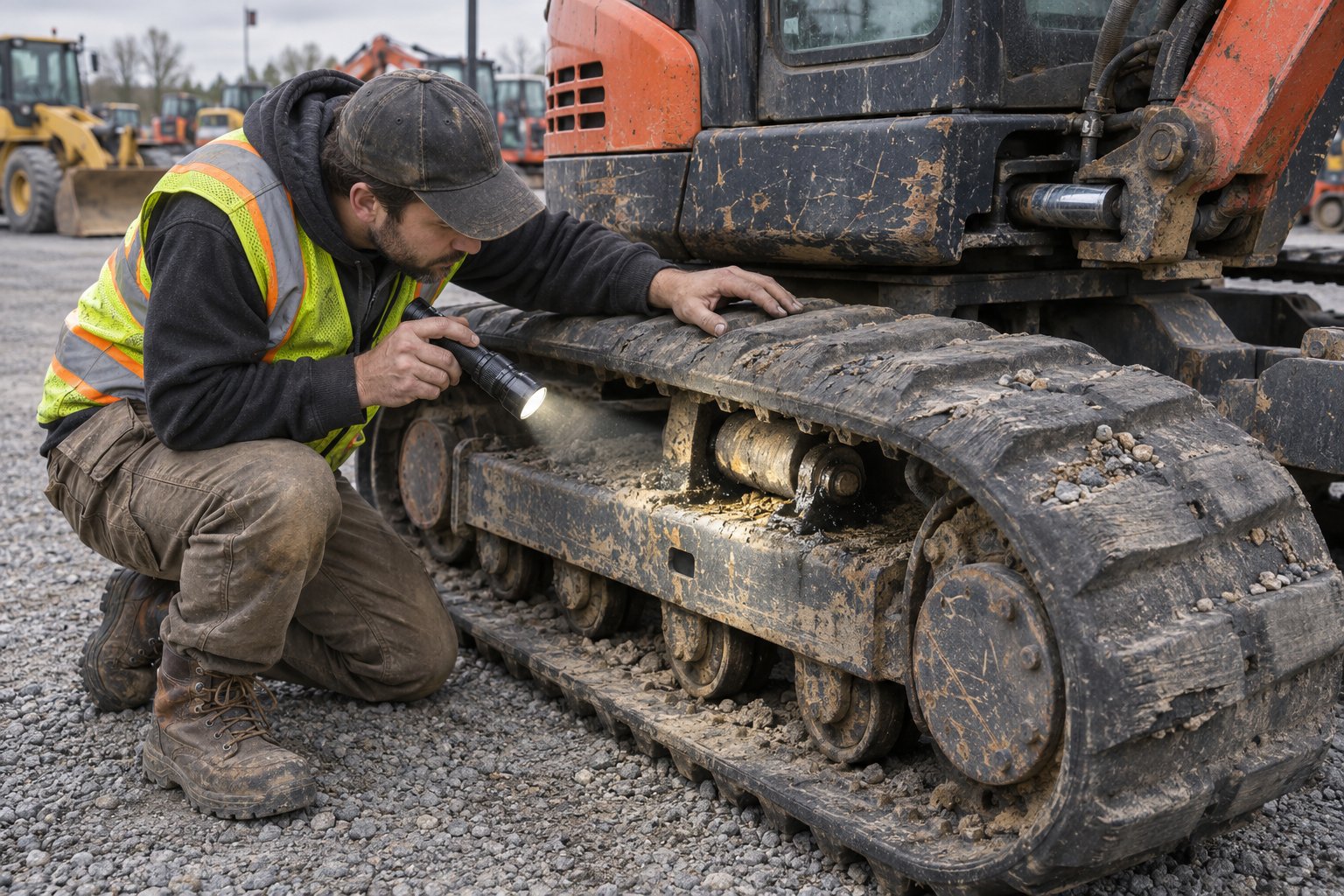
- Undercarriage condition — track pads, rollers, idlers, and sprockets. This is the single most expensive wear system on any compact excavator, and experienced contractors often prioritize undercarriage condition over cosmetic appearance because a full rebuild can rival the cost of the machine itself on smaller units. Walk both sides and look for uneven rubber-track wear, missing track chunks, seized bottom rollers, and sprocket teeth worn to sharp points. Measure track sag between the upper track run and the carrier roller — a gap larger than roughly 25 to 40 mm typically means the tracks need tensioning or replacement soon. Freshly tightened worn tracks or mismatched sides between left and right are red flags that the seller may be masking deeper wear.
- Hydraulic system health. Hydraulic repairs rank among the costliest maintenance items on any compact excavator. Cycle boom, stick, bucket, swing, and blade separately, then combine functions to stress the pump and valves simultaneously. Watch for cylinder drift (the boom slowly sinking when held in position), sluggish response, pump whine, chatter during multi-function operation, and visible oil seeping past cylinder rod seals. Bring a white rag — wipe it along hydraulic cylinders and around fittings to spot leaks immediately. Test auxiliary hydraulics with an attachment if possible, since auxiliary circuits often reveal problems the primary circuit hides.
- Structural integrity — boom, arm, and bucket pin bores. Grab each pin joint and check for play by rocking the bucket, arm, and boom side to side. Elongated pin bores create sloppy motion, reduce digging accuracy, and worsen rapidly under load. Run a magnet along structural panels to detect body filler that could be concealing cracks beneath the surface. Fresh welds, localized paint touch-ups, or mismatched paint sheen near the boom root or swing frame point to undocumented structural repairs — and those repairs may or may not have been done correctly.
- Engine condition — smoke color, oil analysis history, and coolant quality. A cold start tells you the most about engine health. Observe the exhaust the moment the key turns: a brief puff of white smoke on a cold morning is normal, but sustained blue smoke indicates oil consumption, and thick black smoke signals fueling problems or a clogged intake. Ask the seller for oil analysis records — a lab report showing metal particle counts, coolant contamination, or fuel dilution in the crankcase oil is one of the most objective health indicators available. Pull the coolant cap (when cold) and check for milky discoloration that suggests a head-gasket breach. On a diesel mini excavator, also inspect the DPF and aftertreatment system for warning lights or fault codes stored in the machine's onboard diagnostics.
- Cab controls and safety features. Cycle every control in the cab: joysticks, travel pedals, blade lever, auxiliary switches, and the instrument cluster. Verify that the ROPS (Roll-Over Protective Structure) is intact and carries its certification tag. Check seat-belt condition, horn function, backup alarm operation, and lighting. These items are inexpensive individually, but a cab full of deferred minor repairs hints at deferred major maintenance elsewhere on the machine.
Where to Find Reliable Used Mini Excavators
The sourcing channel you choose shapes the risk, price, and buyer protections you can expect. Each option has trade-offs worth understanding before you commit your time or your deposit.
Authorized dealer certified pre-owned (CPO) programs offer the lowest-risk path. Dealers typically perform multi-point inspections, recondition wear items, and back the machine with a limited warranty. The trade-off is price — CPO machines carry a premium over private-sale equivalents because the dealer has already invested in reconditioning and absorbs return risk. For buyers seeking a caterpillar mini excavator for sale with documented history, dealer CPO inventory is often the safest starting point.
Auctions — both live and online — deliver the widest variety of equipment at competitive prices, but they come with inherent uncertainty. Inspection windows are limited, return policies are rare, and bidding competition can push final prices above fair market value on popular models. Machines that appear visually clean may still hide hydraulic or engine issues beneath cosmetic repairs, so arriving early for the preview window and running through the inspection checklist above is essential.
Private sales occasionally produce the best value — a retiring contractor liquidating a well-maintained fleet, for instance — but they also carry the highest due-diligence burden. There is no dealer reputation on the line, no warranty implied, and verifying ownership history falls entirely on the buyer. Always confirm title status and serial-number authenticity before transferring funds.
Online equipment marketplaces that aggregate multi-brand listings have become increasingly popular because they let you compare inventory nationwide, review condition reports, and evaluate pricing trends from a single dashboard. Some platforms go further by offering direct-purchase options as an alternative to auction risk — buyers can browse specific models, request quotes, and negotiate directly with sellers rather than gambling in a bidding war.
For readers exploring used compact and larger excavators across multiple brands, JIUHONG's excavator collection brings together listings from various manufacturers, allowing excavation contractors, equipment dealers, and import buyers to browse available machines, compare models side by side, and request model-specific quotes for individual or bulk purchases. Worth noting: equipment exported from China is not necessarily manufactured by a Chinese brand — the collection includes machines from well-known global manufacturers, so you may find familiar names like a bobcat digger or a mini Caterpillar alongside other international brands.
Red Flags and Negotiation Leverage
Some findings during inspection are negotiating points. Others are deal-breakers. Knowing the difference protects you from inheriting someone else's most expensive problem.
Walk away immediately if you find:
- Frame cracks or undisclosed structural welds on the boom root, swing frame, or main chassis — these compromise the machine's rated load path and may not be repairable to OEM standards.
- Hydraulic contamination — metallic debris in the hydraulic fluid, a gritty feel when you rub fluid between your fingers, or a burnt smell all indicate internal component failure that has circulated damage throughout the system.
- Mismatched or altered serial numbers — any discrepancy between the machine's identification plate and the title or registration documents raises theft, title-washing, or parts-machine assembly concerns. If the serial number plate looks scratched, re-stamped, or poorly fitted, walk away until the seller provides a verifiable explanation.
Negotiate harder — but do not necessarily walk — when you find:
- Moderate undercarriage wear — price the replacement cost for excavator parts like tracks, rollers, and sprockets and deduct that from your offer.
- Minor hydraulic seepage at cylinder rod seals — a resealing job is a fraction of the cost of a full pump rebuild, so quantify the repair and use it as leverage.
- Missing or incomplete maintenance records — the absence of documentation increases your risk, and that risk deserves a price discount proportional to the uncertainty it creates.
On the flip side, certain attributes increase a machine's value and justify paying closer to — or even at — the asking price. Documented single-owner provenance, a complete dealer-stamped service history, low verified hours, and a recent undercarriage replacement all signal a machine that has been treated as an asset rather than a disposable tool. These units sell faster and hold resale value better, which is why sellers price them accordingly and why paying a modest premium often saves money over the ownership lifecycle.
Always confirm zero-tail-swing designations on the specific serial number you are evaluating — mid-production-run specification changes are not uncommon, and a model marketed as zero tail swing may have shipped in both conventional and zero-tail variants depending on the build date.
Buying used is not about finding the cheapest machine — it is about finding the best value. A disciplined inspection, the right sourcing channel, and the confidence to walk away from a bad deal will save you far more than any coupon code or auction steal. Invest the time upfront, and the machine will pay you back for years.
Mini Excavator FAQs
1. What size mini excavator do I need for residential work?
Most residential projects — backyard grading, drainage trenches, pool excavation, and foundation footers — are best handled by machines in the 1-to-4-ton range. A 1-ton micro unit fits through standard 36-inch gates for tight-access landscaping, while a 3-to-4-ton model delivers 8-to-12-foot dig depth for pool shells and utility hookups. Match the weight class to your required dig depth, the width of site access points, and whether you need to protect finished surfaces like lawns or pavers with low ground pressure.
2. How much does it cost to rent a mini excavator vs buying one?
Rental rates for compact excavators typically range from $150-$250 per day and $500-$800 per week, depending on the weight class and your region. Buying new in the popular 3-to-4-ton segment can cost $35,000 to $80,000. Industry guidance suggests ownership becomes more cost-effective when the machine runs 60-70% of available working days annually — roughly 150-180 days. Below that utilization threshold, renting or leasing usually delivers better value once you factor in depreciation, insurance, maintenance, and storage. Platforms like JIUHONG's excavator collection at jiuhong-machinery.com allow buyers to compare used models across brands and request quotes, potentially lowering the acquisition cost significantly.
3. What is the difference between zero tail swing and conventional tail swing on a mini excavator?
Zero tail swing means the entire upper structure — including the counterweight — stays within or flush with the track width at every rotation angle, letting operators dig safely next to walls, fences, and traffic barriers. Conventional tail swing allows the counterweight to extend well beyond the tracks, providing more ballast for heavier lifting and deeper digging but requiring open clearance on all sides. The trade-off is that zero-tail-swing models may sacrifice some maximum lift capacity. Choose zero tail swing for confined urban or residential sites and conventional swing for open jobsites where lift performance and stability are priorities.
4. What should I inspect when buying a used mini excavator?
Focus on six critical areas: (1) verify the hour meter against service records for signs of tampering, (2) inspect the undercarriage — tracks, rollers, idlers, and sprockets — since a full rebuild can rival the machine's purchase price, (3) test all hydraulic functions under load and check for cylinder drift and leaks, (4) rock each pin joint on the boom, arm, and bucket to detect excessive bore wear, (5) perform a cold engine start and observe exhaust smoke color, and (6) verify cab controls and ROPS certification. Walk away from frame cracks, hydraulic contamination, or mismatched serial numbers. Sourcing from dealer CPO programs or direct-purchase platforms reduces risk compared to auctions or private sales.
5. Are electric mini excavators worth it compared to diesel models?
Electric mini excavators excel in specific environments — indoor demolition, noise-restricted urban zones, enclosed spaces, and zero-emission mandates — where diesel exhaust and noise are deal-breakers. They offer zero tailpipe emissions, significantly lower noise levels, instant torque delivery, and reduced maintenance costs since there are no oil changes, filters, or exhaust aftertreatment to service. Current limitations include 4-to-8-hour battery runtime per charge, lengthy recharge times (5-9 hours depending on the charger), higher upfront purchase price, and limited model availability. For most mixed-use fleets, electric works best as a complementary tool for specific job types rather than a full diesel replacement — at least until battery and charging technology matures further.