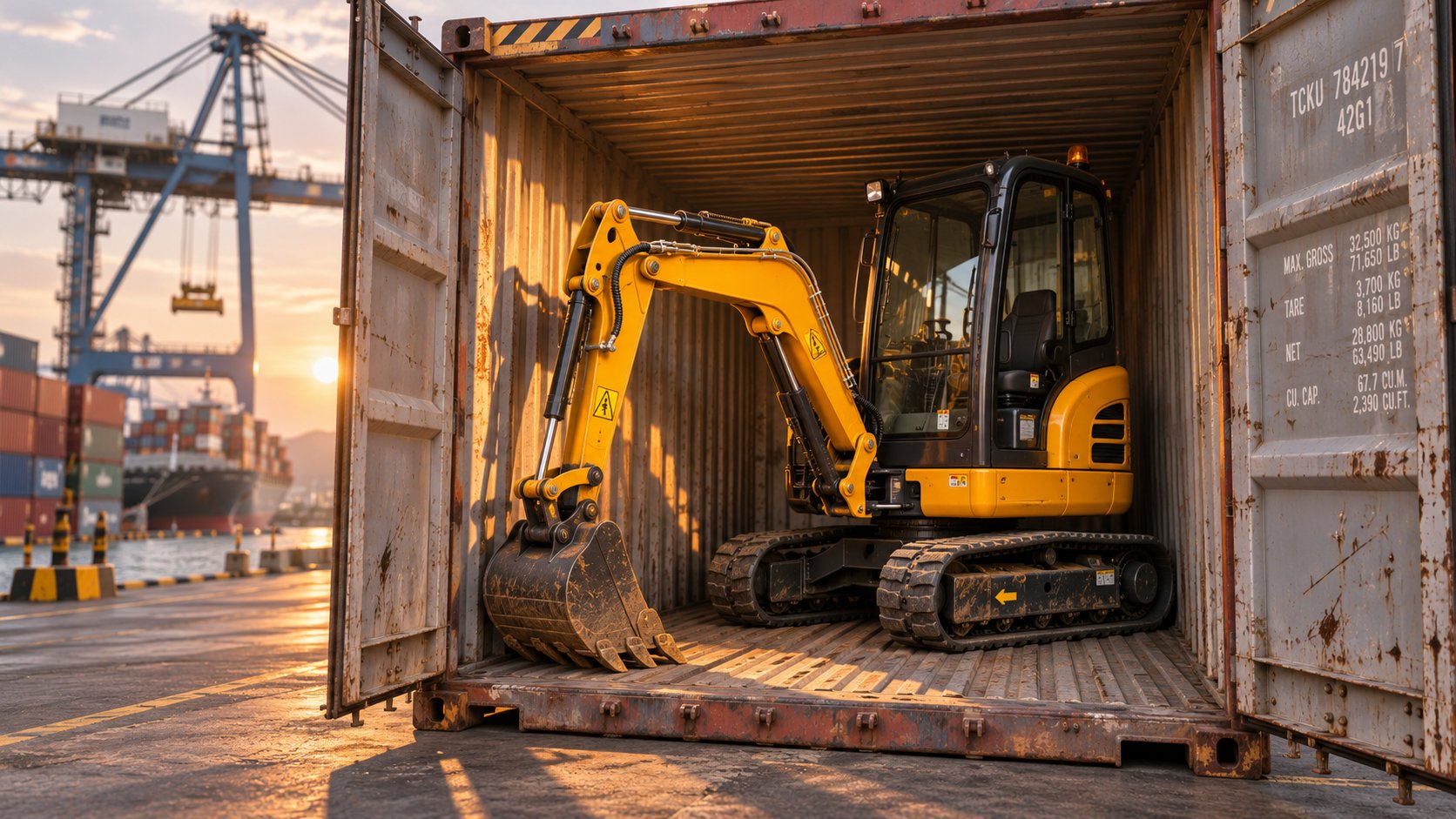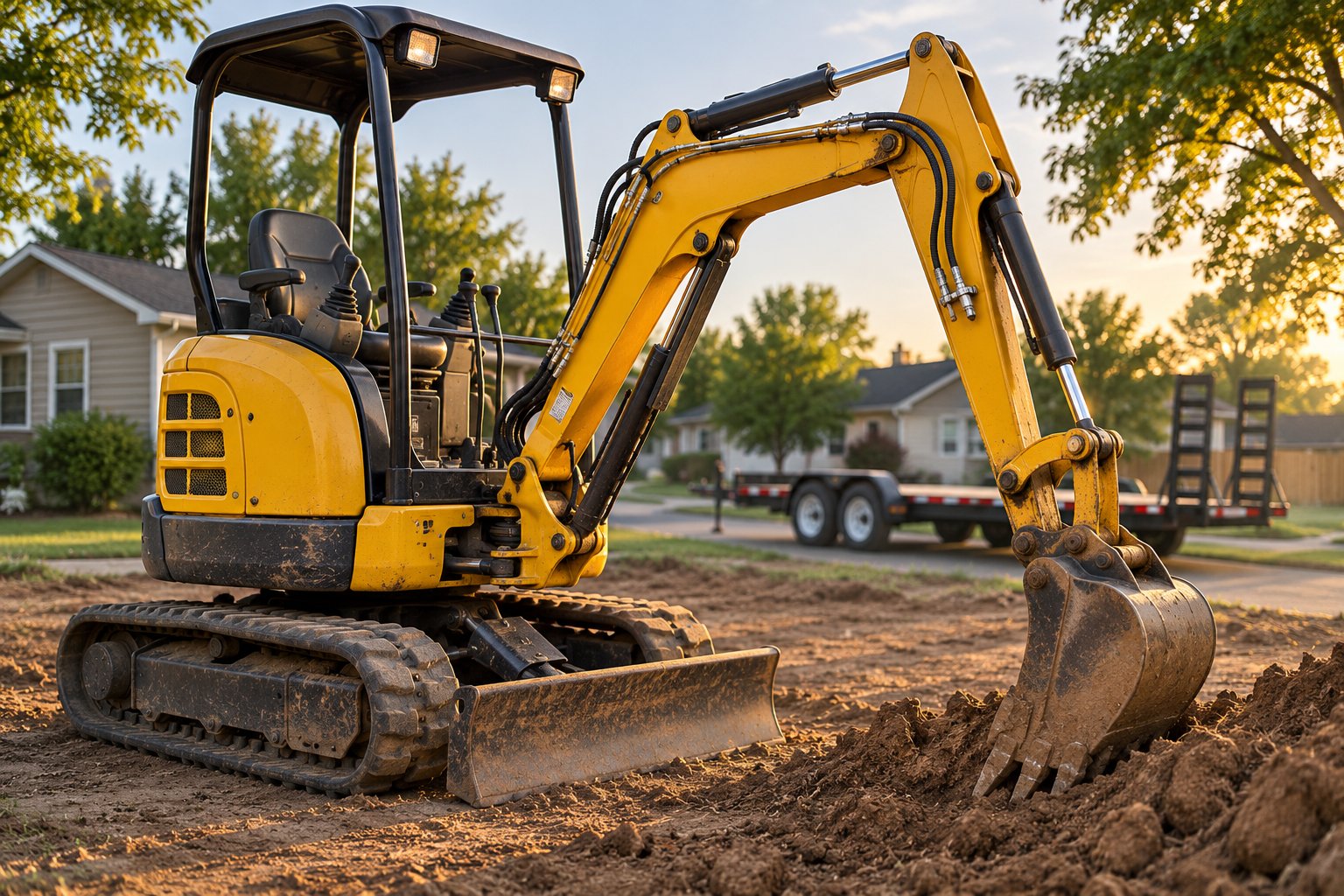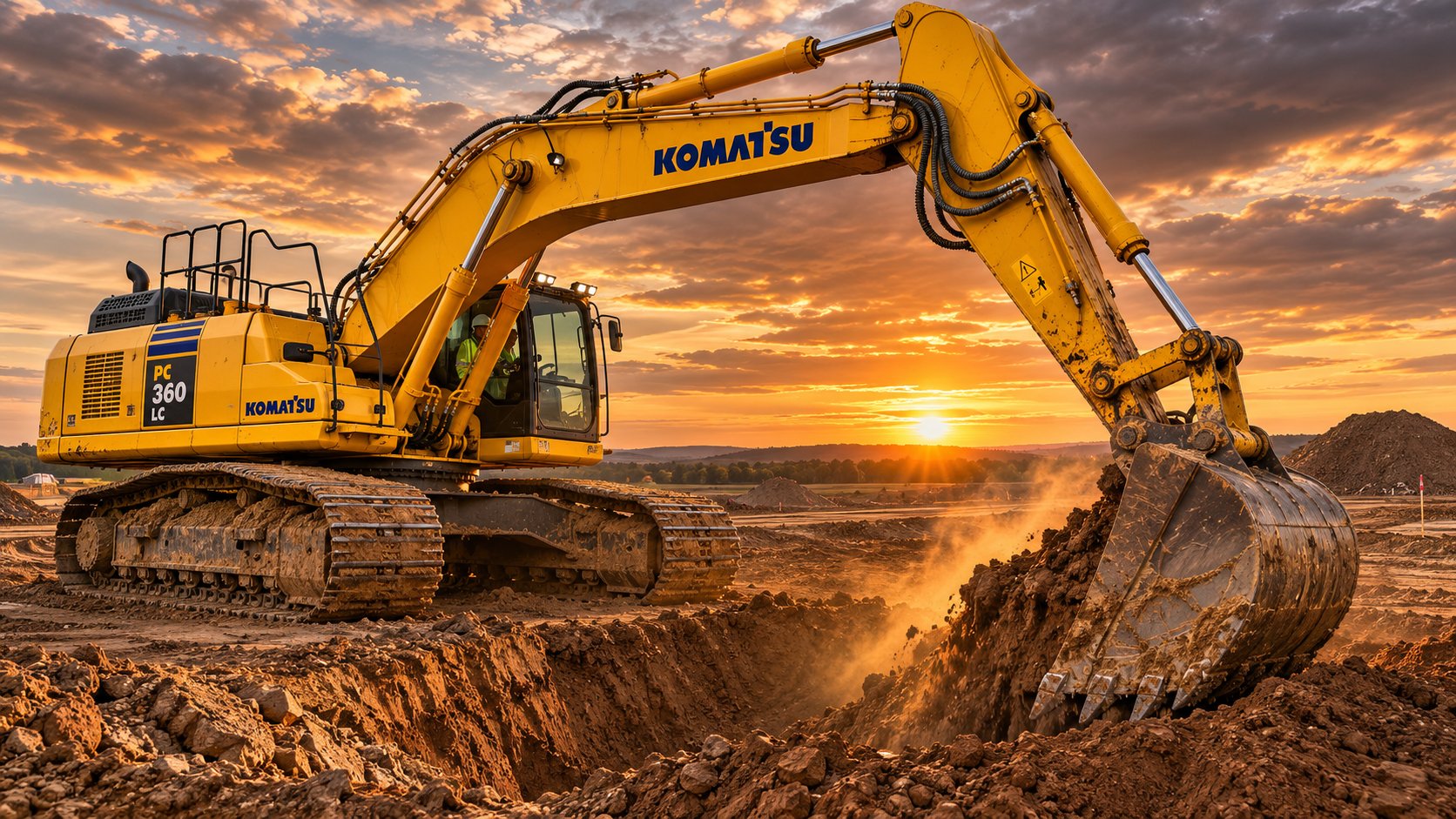


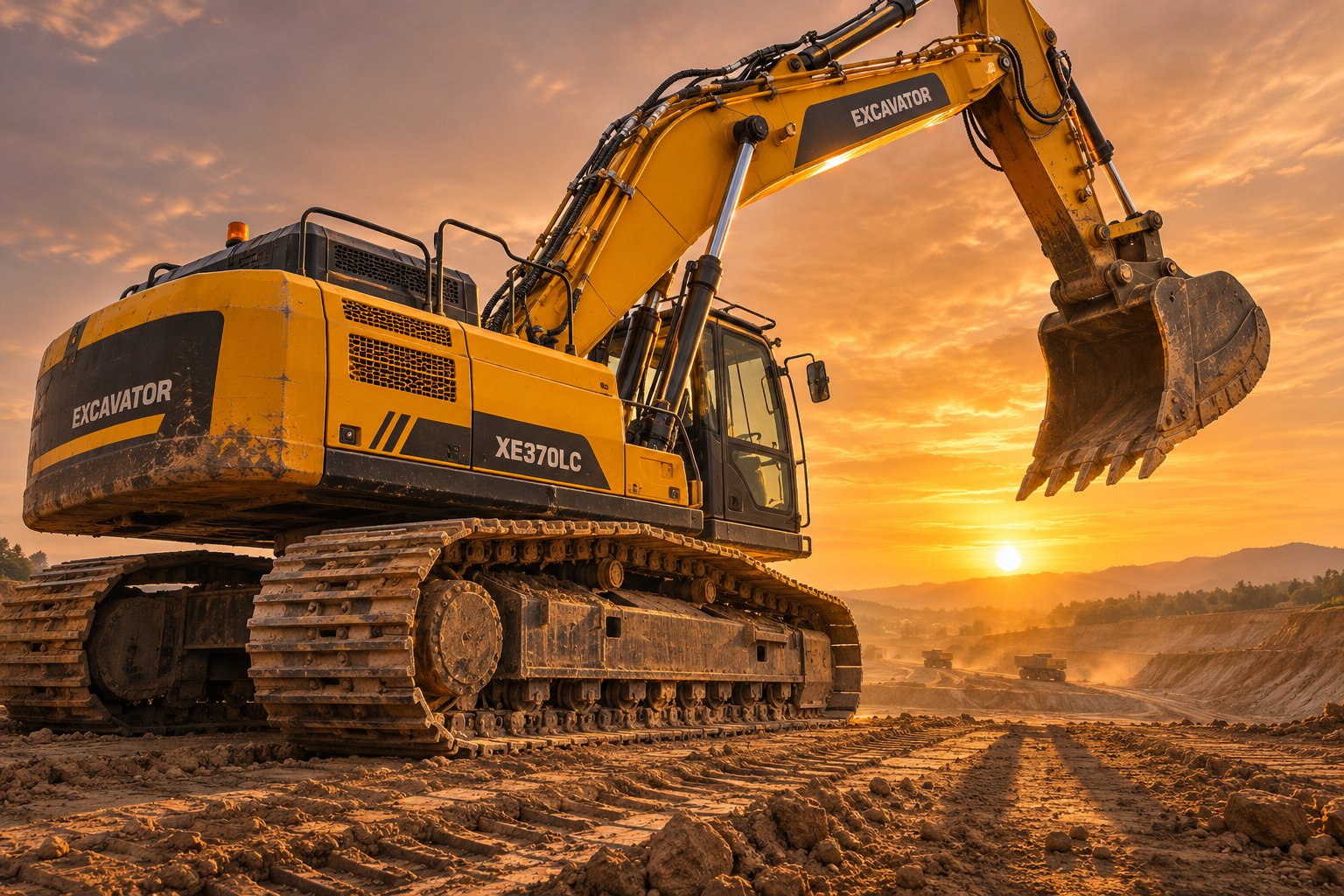
What Is an Excavator and Why Does It Matter
Excavator Definition in Plain Language
Picture a machine that can rip through hardpan, demolish a concrete slab, lower a sewer pipe into a trench, and mulch a thicket of brush — all in the same workday. That machine is an excavator.
An excavator is a heavy construction machine built around a boom, stick, and bucket assembly mounted on a rotating upper structure (called the house) that sits on either tracks or wheels. Hydraulic cylinders power each movement, giving the operator precise control over digging, lifting, swinging, and placing materials.
The word itself traces back to the Latin excavare, meaning "to hollow out" — a fitting origin for a machine designed to carve into the earth. You'll hear it called by several names depending on who you ask and where they work. Common synonyms include digger, track hoe, hydraulic digger, and simply "the ex." Wheeled versions even earn the nickname "rubber ducks" for how they bounce across pavement. Mini variants go by mini-digger or mini-hoe. Regardless of the label, every digger machine in this family shares the same fundamental anatomy: an undercarriage for mobility, an upper structure that rotates 360 degrees, and a front linkage that does the actual work.
Why the Excavator Is the Most Versatile Machine on a Jobsite
Digging is only the starting point. What truly sets the modern excavator apart is its hydraulic quick-coupler system — a mechanism that lets operators swap attachments in minutes, sometimes without ever leaving the cab. Bolt on a breaker, and you have a demolition tool. Click in an auger, and you are drilling post holes. Attach a grapple, and the excavator becomes a material handler that sorts debris or places riprap along a riverbank.
This adaptability is why a single excavator and its attachment library can replace an entire fleet of single-purpose machines. In the sections ahead, you'll find a complete breakdown of every major task these machines perform, the types and size classes available, the attachments that unlock each capability, and practical guidance for choosing the right setup for your project.
How Hydraulic Excavators Work
Every excavator — from a one-ton mini unit you might see listed as a Bobcat mini excavator for sale to a 90-ton mining-class giant — runs on the same core principle: a diesel engine converts fuel into mechanical energy, and a hydraulic system converts that mechanical energy into the precise, powerful movements you see on the jobsite. Understanding this chain is the fastest way to grasp why excavator excavators dominate so many different industries.
The Hydraulic System Behind Every Dig
Imagine squeezing a sealed tube of toothpaste. The pressure you apply at one end creates movement at the other. A hydraulic excavator works on the same idea, scaled up dramatically and controlled with surgical precision. The diesel engine spins one or more hydraulic pumps, which push oil through a network of hoses and valves at pressures that can exceed 5,000 PSI. That pressurized oil flows into cylinders and motors, producing the force that moves the boom, stick, bucket, and undercarriage.
Here is the power-transfer chain in its simplest form:
- Diesel engine — generates mechanical power by burning fuel.
- Hydraulic pump(s) — convert that mechanical rotation into pressurized oil flow.
- Control valves — direct oil to whichever function the operator selects.
- Cylinders and motors — turn hydraulic energy into straight-line push/pull (cylinders) or rotation (motors).
- Mechanical movement — the boom rises, the bucket curls, the house swings, or the tracks drive forward.
Two hydraulic properties govern everything the machine can do. Flow — the volume of oil moving through the circuit — determines how fast a cylinder extends or a motor spins. Pressure — the resistance that oil overcomes — determines how much force or torque the machine delivers. As HeavyEquipment.com explains, modern systems balance both dynamically, directing power where it is needed most during each phase of a digging cycle.
How Operators Control Boom, Stick, and Bucket
If you have ever wondered what is a trackhoe operator actually doing inside the cab, the answer is surprisingly intuitive. Two joysticks handle nearly every work function. Under the most common layout — the ISO control pattern — the left joystick governs stick in/out (push forward to extend, pull back to retract) and swing left/right. The right joystick handles boom up/down and bucket curl/dump. Push both joysticks diagonally, and you blend functions: raising the boom while curling the bucket, or swinging the house while drawing the stick inward.
Separate travel controls — typically foot pedals or hand levers — command the left and right tracks independently. Push both forward and the machine drives straight. Push only one side and it pivots. Reverse them and the excavator spins in place. Even a hydraulic excavator thumb, a popular clamp-style attachment, gets its own toggle or roller switch on the joystick so the operator can grip irregular objects without releasing the main controls.
The real takeaway here connects operating mechanics to purchasing and rental decisions. Because the hydraulic system's pressure and flow set hard limits on dig force, lift capacity, and cycle speed, spec-sheet numbers like maximum dig depth, reach at ground level, and bucket breakout force are not abstract figures — they are direct reflections of how much hydraulic muscle a machine carries. Matching those specs to your project's soil conditions, trench depths, and material weights is what separates a productive job from an underpowered struggle. The next logical question, then, is exactly which tasks all that hydraulic power can accomplish — and the answer covers far more ground than most people expect.
Every Major Task an Excavator Performs
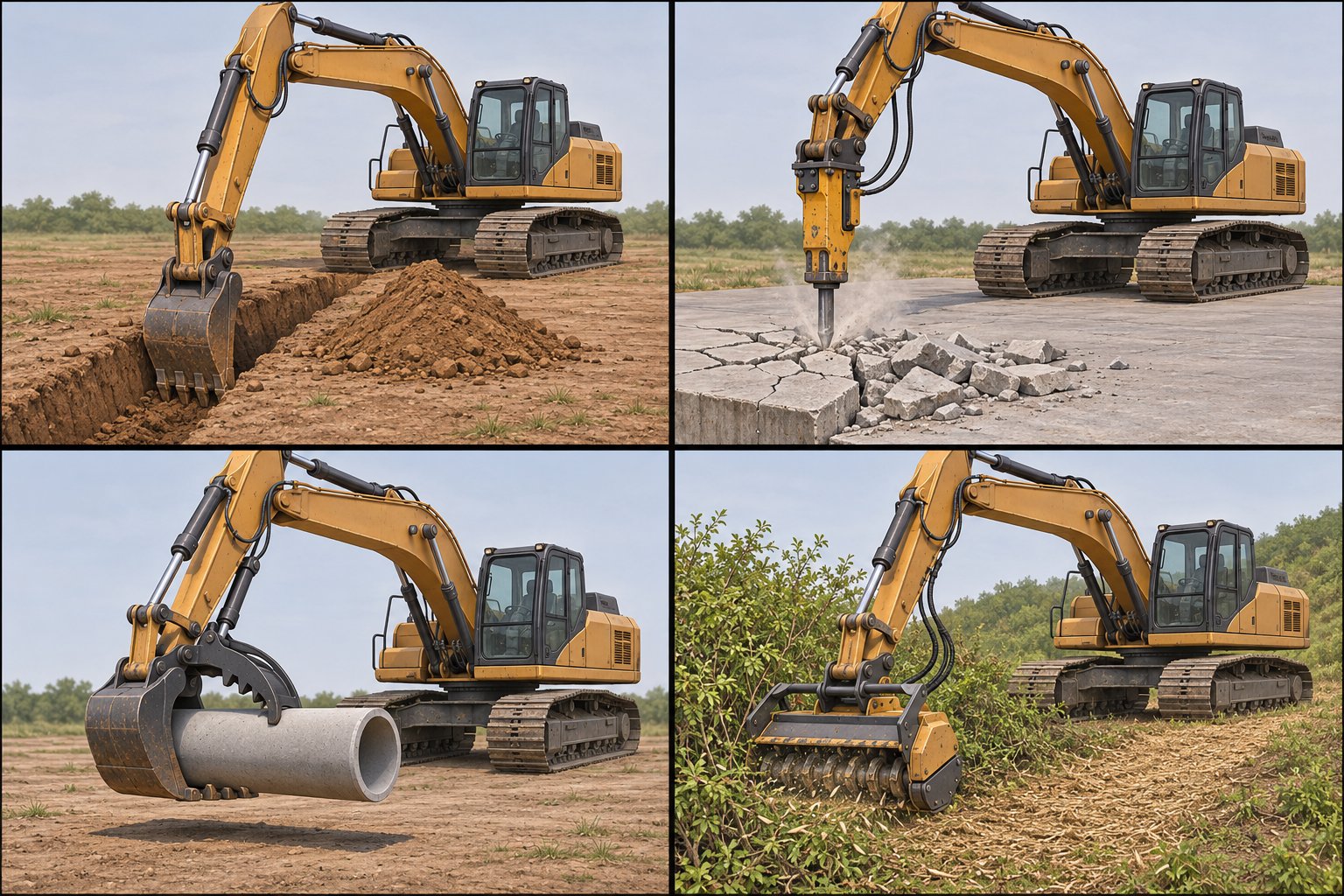
Hydraulic muscle means nothing without a job to do — and the modern excavator's job list is staggeringly long. Rather than dumping every application into a single bullet-point rundown, it helps to organize the work into five distinct categories. Each category calls for different size classes, different attachments, and different operator techniques. Whether you are pricing out how much does it cost to rent an excavator for a weekend trench or planning a months-long mass-excavation contract, this taxonomy puts every task in context.
Earthmoving and Excavation Tasks
This is the excavator's home turf — the reason the machine exists. Trenching for water, sewer, and electrical lines is the single most common daily task across residential and commercial jobsites. Foundation digging scales that same motion to wider, deeper cuts for footings and basements. Pond and pool excavation demands precise bowl-shaped profiles, often handled by a midi-class machine like the Cat 309 excavator paired with a standard digging bucket. At the opposite end of the spectrum, mass excavation on highway cuts or commercial pads can move thousands of cubic yards per shift using full-size crawlers in the 30-to-45-ton range.
Demolition and Structural Removal
Swap the digging bucket for a hydraulic breaker, and the excavator becomes a demolition powerhouse. Structural demolition — tearing down buildings floor by floor — typically requires a standard or large excavator fitted with a concrete pulverizer or shear. Concrete breaking on roads, bridge decks, and foundations relies on the rapid impact of a hydraulic hammer. Selective interior demolition, increasingly common in renovation projects, calls for compact machines — an e35 compact excavator, for instance — that can fit through standard doorways and work under low ceilings without sacrificing the breakout force needed to strip concrete floors or partition walls.
Material Handling, Grading, and Specialty Work
Beyond digging and demolishing, excavators handle an entire second career in material movement and finishing. Loading haul trucks with a high-capacity bucket is a bread-and-butter task in quarries and on grading sites. A rotating grapple lets operators sort recyclables at demolition yards or position pipe sections into open trenches with millimeter accuracy. For landscaping and grading, a tilt bucket smooths finish grades on building pads, while rippers and stump-removal attachments clear land fast.
Specialty applications push versatility even further. Auger attachments bore fence-post holes and pier footings. Compactor plates mounted on the stick consolidate trench backfill without needing a separate machine. Forestry mulchers — sometimes called flail mowers — chew through brush and small trees in land-clearing operations. And in waterway maintenance, long-reach configurations handle dredging duties that early-generation machines like the Koehring excavator once pioneered decades ago. Even the Spanish-language search term excavadora returns the same range of uses, proving that demand for this multi-tool platform is truly global.
The table below maps each category to its specific tasks, the excavator size class best suited for the work, and the attachment that makes it possible.
| Use Category | Specific Tasks | Typical Size Class | Key Attachment |
|---|---|---|---|
| Earthmoving & Excavation | Trenching, foundation digging, pond/pool excavation, mass excavation | Mini (1–6 t) through Standard (20–45 t) | Standard digging bucket, heavy-duty rock bucket |
| Demolition | Structural teardown, concrete breaking, selective interior demolition | Mini (1–6 t) for interiors; Standard to Large (20–80 t) for structures | Hydraulic breaker/hammer, concrete pulverizer, shear |
| Material Handling | Truck loading, recyclable sorting, pipe/utility placement | Midi (6–20 t) through Standard (20–45 t) | Hydraulic thumb, rotating grapple, sorting grab |
| Grading & Landscaping | Finish grading, slope shaping, stump removal, land clearing | Mini (1–6 t) through Midi (6–20 t) | Tilt/grading bucket, ripper, brush rake |
| Specialty & Utility Work | Boring/augering, compaction, forestry mulching, dredging | Mini (1–6 t) through Large (45+ t) | Auger, compactor plate, flail mower/mulcher, long-reach boom |
A single glance at this taxonomy reveals why the excavator sits at the center of nearly every heavy-equipment fleet. Yet the real depth of its reach becomes clearer when you zoom in on specific industries — each with its own combination of tasks, machine sizes, and operational demands.
Excavator Uses Across Major Industries
Different industries demand different things from the same machine. A landscaper carving out a backyard pool and a mining planner stripping overburden from a coal seam both reach for an excavator — yet the size, configuration, and attachments for mini excavator work versus large-scale extraction could not be more different. Walking through each sector individually reveals how deeply this single platform has embedded itself across the modern economy.
Construction, Mining, and Demolition Applications
Construction is where most people first encounter an excavator. Among all construction machines names you might see on a bid sheet — cranes, dozers, loaders, graders — the excavator consistently logs the most hours. Typical construction tasks include:
- Site preparation and bulk earthmoving for commercial pads
- Utility trenching for water, sewer, gas, and electrical lines
- Foundation excavation for footings, basements, and elevator pits
- Backfill compaction using plate-compactor attachments
Standard crawler excavators in the 20-to-35-ton range handle the majority of this work. Midi machines (6–20 t) step in when lot sizes shrink or underground utilities crowd the dig zone.
Mining pushes the scale to the opposite extreme. Open-pit operations rely on large excavators — often 45 tons and well above — to strip overburden, load haul trucks at bench faces, and maintain haul roads. The swing bearing excavator components on these machines endure punishing duty cycles, rotating thousands of times per shift under maximum payload. Key mining tasks include:
- Overburden removal to expose ore or mineral seams
- Bench loading into rigid-frame haul trucks
- Haul-road grading and drainage maintenance
- Stockpile management and material rehandling
Hydraulic shovels and large crawler excavators dominate here, sometimes paired with dragline excavators for surface stripping.
Demolition calls for specialized configurations. High-reach boom setups let operators dismantle multi-story structures from the top down, while standard machines at ground level pulverize concrete and sort rebar with shears and grapples. Common demolition tasks include:
- High-reach structural teardowns on buildings above three stories
- Concrete pulverizing and on-site crushing for recycled aggregate
- Rebar and scrap-metal sorting with rotating grapples
- Selective interior strip-outs using compact excavators
Machine sizes range from compact units under six tons for interior work to purpose-built 60-to-80-ton high-reach rigs.
Forestry, Agriculture, Utilities, and Residential Uses
Forestry and Agriculture prove that the digger vs excavator debate is largely semantic — farmers and loggers worldwide rely on the same hydraulic platform their urban counterparts do. The Spanish-speaking market even searches maquina excavadora for the identical equipment. Typical tasks include:
- Land clearing and brush removal with mulcher attachments
- Stump grinding and root-ball extraction
- Drainage ditching to manage water tables in crop fields
- Irrigation canal shaping and maintenance
Midi crawlers (8–15 t) fitted with forestry cabs and guarding packages handle most clearing work. Compact machines manage lighter agricultural ditching and fence-line prep.
Utilities and Pipeline work demands precision over raw power. Trench widths must match pipe diameters closely, and existing underground infrastructure sits inches away from the bucket edge. Core tasks include:
- Trench excavation for water mains, gas lines, and fiber-optic conduit
- Pipe laying and bedding placement using thumbs or pipe-layer attachments
- Manhole and vault installation requiring careful vertical lifts
- Bore-pit excavation for horizontal directional drilling operations
Standard 20-to-30-ton crawlers handle mainline pipeline spreads, while mini and midi units manage distribution-level utility installation in neighborhoods and streetscapes.
Landscaping and Residential projects are often the first time a homeowner sees an excavator up close. These jobs favor compact machines — zero-tail-swing minis that slip through backyard gates and leave minimal turf damage. Typical residential tasks include:
- Swimming-pool excavation and spoil removal
- Driveway and patio subgrade grading
- Retaining-wall footing preparation
- Tree planting, boulder placement, and creek-bed reshaping
Mini excavators under six tons dominate this space, though a homeowner renting one for the first time might not realize the same machine can accept a breaker, auger, or grapple — turning a single weekend rental into a multi-task workhorse.
Each industry leans on a different slice of the excavator size spectrum, yet every sector benefits from the same modular attachment system. That raises a practical question: how do all these size classes actually differ in capability, and which one fits your particular project? The answer lies in the weight-class breakdown and the configurations engineered for each range.
Types and Size Classes of Excavators Explained
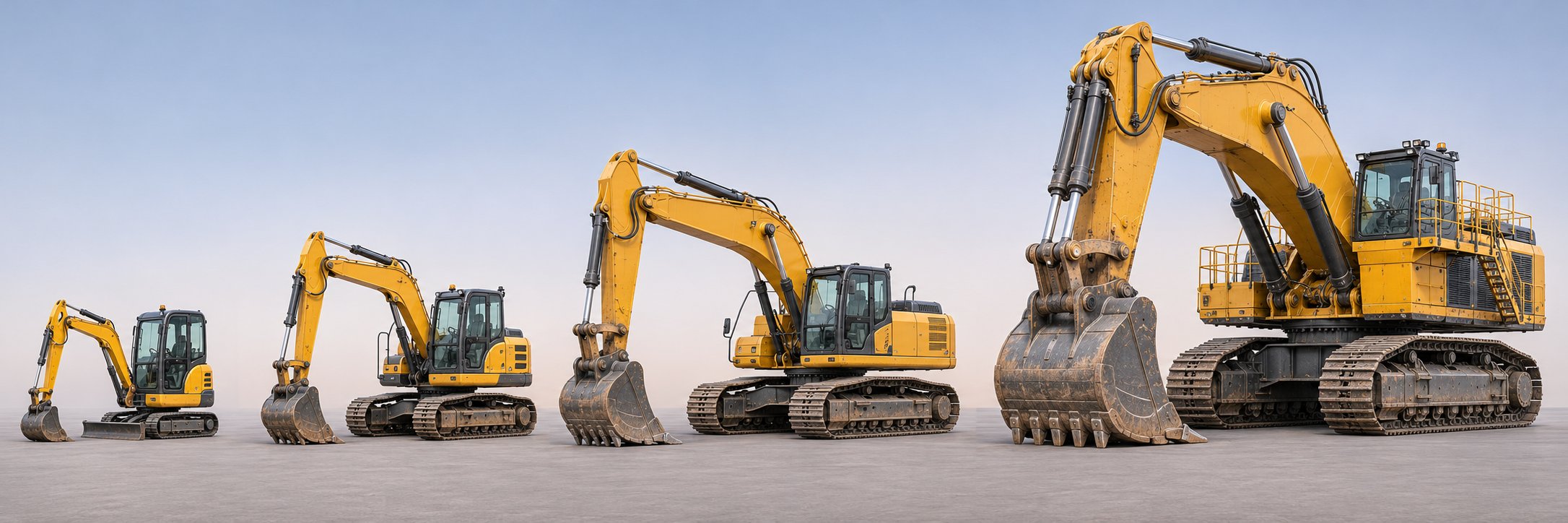
Excavators span a staggering weight range — from sub-one-ton micro units that squeeze through a garden gate to 800-plus-ton mining behemoths that fill haul trucks in a single pass. Knowing which weight class matches your project is the difference between efficient production and either an underpowered struggle or an expensive piece of overkill parked on your site. The four standard weight classes each occupy a distinct performance envelope, and the undercarriage and boom configurations within those classes refine the match even further.
Mini, Midi, Standard, and Large Weight Classes
Mini/Compact (under 6 metric tons) — These are the machines most homeowners and small contractors encounter first. A diesel mini excavator in the 1-to-5-ton range typically delivers dig depths between 1.5 and 4 meters, enough for residential footings, utility trenches, and pool shells. Zero-tail-swing designs keep the counterweight inside the track width so the house can rotate freely next to fences, walls, and parked vehicles. The narrowest models retract their undercarriage to roughly 700 mm — narrow enough to fit through a standard doorway, which makes them the only practical option for indoor demolition and basement excavation. Transport is straightforward: most compact machines ride on a standard equipment trailer without requiring oversize permits.
Midi (6–20 metric tons) — The midi class bridges the gap between compact convenience and full-size power. Dig depths climb to roughly 4 to 6 meters, and bucket breakout forces increase enough to handle tougher soils and light rock. Commercial site work, utility main installation, and mid-rise foundation excavation all fall squarely in midi territory. These hydraulic excavator models still fit on a standard lowboy trailer, although combined transport weights often push into permit-required territory in many states.
Standard/Full-Size (20–45 metric tons) — This is the workhorse class for heavy civil construction, road building, and quarry loading. Dig depths range from about 6 to 8 meters, and lift capacities allow efficient truck loading with heavier buckets. Transport always requires a lowboy trailer, pilot cars for wider loads, and route planning around bridge weight limits. Fuel consumption rises significantly, but so does production — a 30-ton crawler can move several hundred cubic yards per shift under favorable conditions.
Large (45+ metric tons) — Mining, mass excavation, and large-scale demolition demand machines at this end of the spectrum. Dig depths can exceed 9 meters, and bucket sizes grow to 4 cubic yards and beyond. Moving these machines between sites is a logistics project in itself, often requiring multi-axle lowboys, highway permits, and escort vehicles. Some of the largest units are assembled on-site and stay there for the duration of the project.
People sometimes misspell the term as "excevator" when searching online, yet they are looking for the same machine — and the size-class logic applies regardless of spelling. The table below maps each weight class to its practical performance window.
| Weight Class | Operating Weight | Typical Dig Depth | Common Project Types | Transport Requirements |
|---|---|---|---|---|
| Mini / Compact | Under 6 t | 1.5–4 m (5–13 ft) | Residential trenching, landscaping, indoor demolition, pool excavation | Standard equipment trailer; usually no oversize permits needed |
| Midi | 6–20 t | 4–6 m (13–20 ft) | Commercial site work, utility mains, mid-rise foundations | Lowboy trailer; permits may be required depending on combined weight |
| Standard / Full-Size | 20–45 t | 6–8 m (20–26 ft) | Heavy civil, road construction, quarry loading, pipeline spreads | Lowboy trailer with pilot cars; route planning for bridges and overpasses |
| Large | 45 t and above | 8–10+ m (26–33+ ft) | Mining, mass excavation, large-scale demolition | Multi-axle lowboy; highway permits and escorts; possible on-site assembly |
Crawler, Wheeled, and Specialty Configurations
Weight class tells you how much machine you need; undercarriage and boom configuration tell you what kind. The most common split is between crawler (tracked) and wheeled excavators. Crawlers — the classic hydraulic digger on steel or rubber tracks — deliver superior traction, lower ground pressure, and stable digging on soft or sloped terrain. The trade-off is that they cannot drive on public roads without damaging the surface, so every site move requires a trailer. Wheeled excavators mount the same upper structure on rubber-tired axles, enabling road travel at speeds up to 35 km/h between work locations. Urban utility crews favor them for exactly this reason — rolling a few blocks between valve boxes beats calling in a lowboy every time. Outrigger stabilizers extend before digging to compensate for the narrower stability footprint that tires provide compared to tracks.
Beyond that core split, several specialty variants handle jobs no standard configuration can reach. Long-reach excavators extend the boom and stick assembly to achieve horizontal reaches of 15 to 25 meters — ideal for river dredging, canal maintenance, and slope work where the machine cannot safely approach the dig face. High-reach demolition rigs invert that priority, stretching vertically to dismantle multi-story buildings from the top down. Dragline excavators, massive lattice-boom machines that cast and drag a suspended bucket, serve large-scale mining and land-reclamation projects where volume per hour matters more than precision. And suction (vacuum) excavators use pressurized water and a vacuum system to expose buried utilities without the strike risk of a mechanical bucket — a critical safety tool in congested urban infrastructure corridors.
Globally, whether a buyer searches "excavadoras" in Latin America or browses domestic dealer lots, the same classification framework applies: pick the weight class that matches your dig depth and production needs, then choose the undercarriage and boom configuration that suits your terrain and access constraints. With the right class and configuration selected, the next step is unlocking the excavator's full potential — and that happens at the end of the stick, where a single quick-coupler pin connects the machine to an ever-growing library of attachments.
Attachments That Multiply an Excavator's Versatility
Strip away every attachment, and an excavator is just a hydraulic arm on a rotating platform. Bolt one back on, and it becomes a digging machine. Bolt on a different one, and it becomes a demolition hammer, a drilling rig, or a forestry mower. The attachment ecosystem is what elevates the excavator from a single-purpose digger to the most flexible tool on any jobsite — and the mechanism that makes rapid swaps possible is the quick coupler.
A quick coupler sits between the end of the stick and the attachment itself, replacing the traditional system of manually driving pins through matching lugs. With a hydraulic quick coupler, the operator engages or releases a locking wedge from inside the cab, cycling through multiple tools in under a minute. A mechanical quick coupler achieves the same result with a spring-loaded latch that the operator releases using a pry bar at ground level — still far faster than hammering out two tight-fitting pins. Among all excavator types, from sub-one-ton micros to 80-ton demolition rigs, the quick coupler is the single component that turns the machine into a true multi-tool platform.
The catch? Not every attachment fits every machine. Compatibility depends on three mechanical dimensions — pin diameter, pin-to-pin distance, and stick width — plus two hydraulic specs: auxiliary flow (gallons per minute) and auxiliary pressure (PSI). A hydraulic breaker rated for 20 GPM will barely crawl on a mini excavator delivering 8 GPM, while an auger designed for a 2-ton machine could be destroyed by the flow of a 30-ton carrier. Verifying these numbers before you buy saves real money and real downtime.
Buckets, Breakers, and Augers
These three attachments handle the lion's share of daily excavator work worldwide. Think of them as the core toolkit — the attachments most operators reach for before anything else.
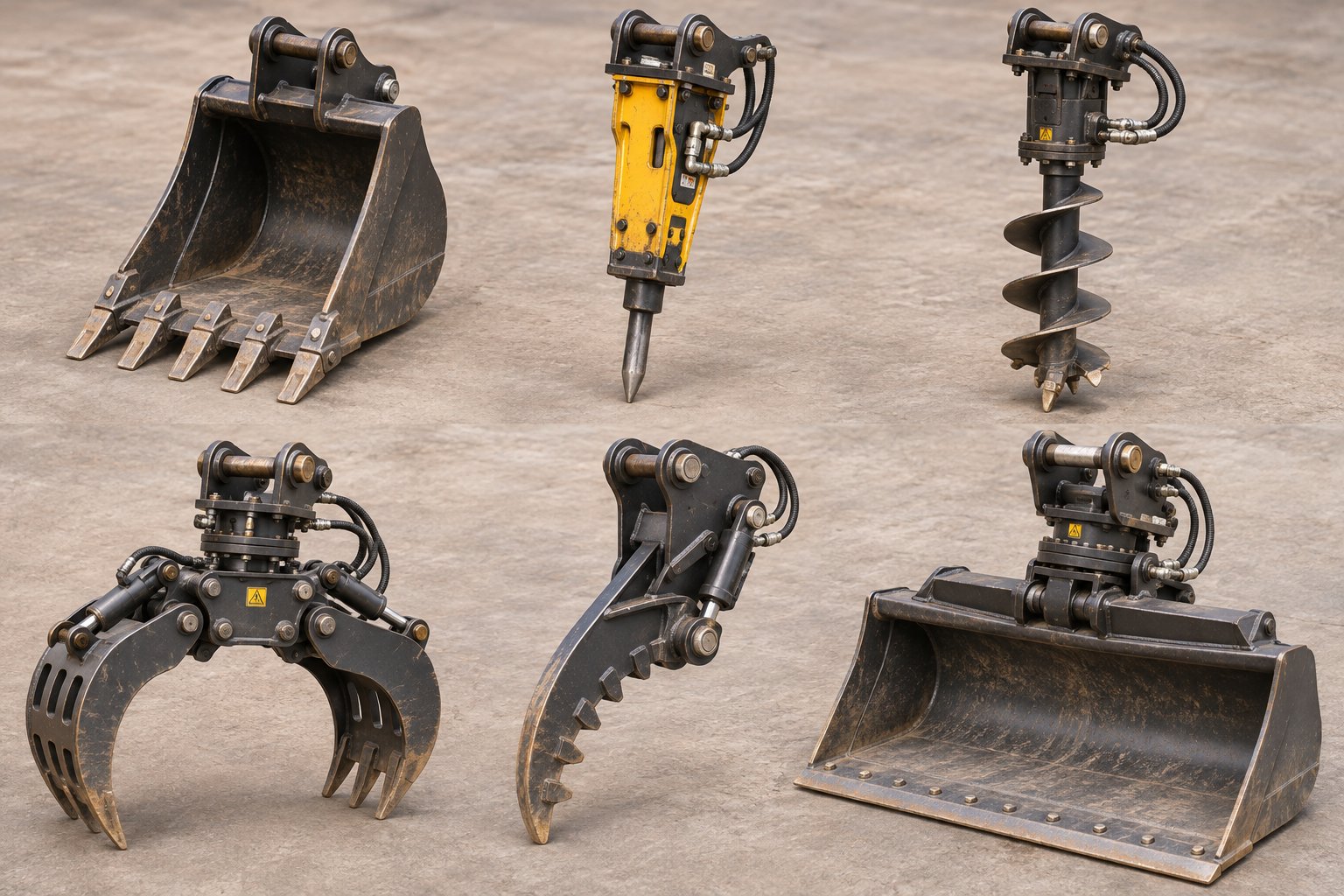
Standard digging bucket. This is the attachment that ships with almost every new excavator. Teeth along the cutting edge penetrate soil, and the curved shell retains loose material during the lift-and-swing cycle. Widths range from 200 mm (about 8 inches) on compact machines to well over 1,500 mm on full-size crawlers. Heavier-duty rock buckets add reinforced side plates and thicker wear strips for abrasive material. If you own an excavator, you already own at least one digging bucket.
Grading or tilt bucket. Imagine a digging bucket with no teeth and a flat, precision-ground cutting edge — that is your grading bucket. Tilt versions add a hydraulic cylinder that angles the bucket up to 45 degrees left or right, letting operators cut slopes and shape ditches without repositioning the machine. Landscapers, road crews, and site-prep contractors rely on tilt buckets for finish work that would otherwise require a motor grader.
Hydraulic breaker (hammer). A breaker delivers rapid, high-energy impacts through a chisel or moil point, fracturing concrete, asphalt, and rock. Compact breakers weighing a few hundred pounds pair with mini excavators for sidewalk removal. Large breakers exceeding 5,000 pounds mount on standard and large excavators for bridge-deck demolition and quarry face loosening. Breakers demand the highest auxiliary flow and pressure of any common attachment, so always cross-check the breaker's GPM requirements against your machine's auxiliary circuit specs.
Auger (drill). An auger couples a hydraulic motor to a helical flight bit that bores clean, round holes into soil or soft rock. Bit diameters start around 150 mm for fence-post holes and scale up past 900 mm for pier footings and sign-pole foundations. The auger motor needs a dedicated auxiliary circuit with controlled flow — too much GPM overspins the bit and churns the hole walls, while too little stalls in dense clay. Operators in fencing, solar-farm installation, and foundation work consider the auger one of the most important types of construction machines attachments in their rotation.
Thumbs, Grapples, Mowers, and More
Beyond the core three, a second tier of attachments unlocks tasks that no bucket, breaker, or auger can handle. These are the tools that turn a good excavator fleet into a great one.
Hydraulic thumb. A thumb is a curved steel clamp mounted opposite the bucket that presses inward, giving the excavator a gripping action similar to a human hand. Operators use it to grab boulders, broken concrete, tree stumps, and pipe sections — anything too awkward for a bucket alone. Mechanical thumbs are set manually and hold a fixed position; hydraulic thumbs adjust in real time from the cab, offering far more control. Virtually every heavy construction equipment type list includes the hydraulic thumb as essential for material handling and demolition.
Grapple (rotating and fixed). Where a thumb works with a bucket, a grapple replaces it entirely. Two or more opposing jaws open wide, clamp around a load, and lift. Fixed grapples suit log handling and demolition sorting. Rotating grapples add a hydraulic swivel that lets the operator spin the load 360 degrees — invaluable for placing pipe, sorting scrap metal, or positioning timber on a truck bed. Mid-range and standard excavators (10–40 t) see the heaviest grapple use, though compact grapples for machines under 6 tons are increasingly popular in landscaping and land-clearing work.
Ripper. A single heavy-duty tooth concentrates the excavator's full breakout force into one point, fracturing hardpan clay, frozen ground, soft rock, and compacted subgrade that a bucket cannot penetrate. Rippers are simple, inexpensive, and nearly indestructible — making them a staple for site-prep crews and agricultural contractors who regularly encounter tough soil layers.
Compactor plate. After backfilling a trench, the excavator can compact the fill in the same pass by swapping to a vibratory compactor plate that mounts on the stick. The plate vibrates at high frequency, consolidating granular soils without needing a separate walk-behind or ride-on compactor. Utility contractors who dig, lay, backfill, and compact with a single machine save an entire equipment mobilization.
Flail mower (mulcher). A drum studded with swinging steel flails spins at high RPM, shredding brush, saplings, and tall grass into mulch. Mounted on the excavator's boom, the mower reaches slopes, ditch banks, and roadside berms that a tractor-mounted mower cannot safely access. Forestry crews, municipal road departments, and solar-farm developers are the primary users. Flail mowers need substantial auxiliary flow — typically 15 GPM and above — so they pair best with midi and standard machines.
Brush rake. Heavy steel tines spaced a few inches apart let the operator windrow brush, roots, and rocks while sifting out reusable topsoil. Land-clearing and forestry operations use brush rakes to prepare sites after mulching or tree removal, and the same attachment doubles as a landscaping tool for final debris cleanup.
The table below maps all ten attachments — plus a few extras — to function, size compatibility, and the industries that use them most.
| Attachment | What It Does | Size Compatibility | Primary Industries / Tasks |
|---|---|---|---|
| Standard Digging Bucket | Excavates and loads soil, gravel, and loose material | All classes (under 1 t to 100+ t) | Construction, mining, utilities, landscaping |
| Grading / Tilt Bucket | Precision-grades surfaces; tilts for slope shaping | Mini through Standard (1–45 t) | Site prep, road building, landscaping |
| Hydraulic Breaker / Hammer | Fractures concrete, rock, and asphalt with rapid impacts | Mini through Large (1–80+ t) | Demolition, quarrying, road repair, utilities |
| Auger / Drill | Bores round holes for posts, piers, and footings | Mini through Midi (1–20 t) | Fencing, solar farms, foundation work, agriculture |
| Hydraulic Thumb | Clamps against bucket to grip irregular objects | Mini through Standard (1–45 t) | Material handling, demolition, forestry, utilities |
| Grapple (Rotating) | Opens, clamps, and rotates loads independently of the bucket | Midi through Large (6–80+ t) | Demolition sorting, scrap handling, log loading |
| Grapple (Fixed) | Opens and clamps loads without rotation | Mini through Standard (1–45 t) | Land clearing, brush handling, residential cleanup |
| Ripper | Single-point tooth fractures hard or frozen ground | Mini through Standard (1–45 t) | Site prep, agriculture, road subgrade work |
| Compactor Plate | Vibrates to consolidate trench backfill and subgrade | Mini through Midi (1–20 t) | Utility trenching, road base, landscaping |
| Flail Mower / Mulcher | Shreds brush, saplings, and grass into mulch | Midi through Standard (6–45 t) | Forestry, roadside maintenance, solar-farm clearing |
| Brush Rake | Windrows brush and debris while sifting out topsoil | Mini through Midi (1–20 t) | Land clearing, forestry, landscaping cleanup |
Before you commit to any attachment — whether it is a compact grapple for weekend land clearing or a heavy-duty breaker for a Doosan excavator on a highway demo job — run through this quick compatibility checklist:
- Pin diameter — measure with calipers; even a 5 mm mismatch causes dangerous play.
- Pin-to-pin (center-to-center) distance — must align with the coupler or stick mounting ears exactly.
- Stick width (dipper gap) — the attachment's ear spacing must seat flush against the stick or coupler.
- Auxiliary hydraulic flow (GPM) — confirm your machine's auxiliary circuit output falls within the attachment's operating range.
- Auxiliary hydraulic pressure (PSI) — verify maximum working pressure matches or exceeds the attachment's requirement.
- Coupler type — ensure the attachment's pin geometry is compatible with your existing quick coupler, if fitted.
- Weight rating — the attachment's total weight must fall within the excavator's approved lifting and operating limits.
Getting these seven checks right before placing an order prevents the costly scenario of driving two hours to pick up a "great deal" on a used bucket, only to discover it does not fit your machine. Wondering how much is an excavator attachment worth if it cannot connect to your carrier? Exactly zero — so verify first, buy second.
Attachments explain what an excavator can do, but they do not answer a closely related question: when should you choose an excavator over an entirely different machine? Backhoes, bulldozers, skid steers, and wheel loaders all share overlapping territory with the excavator, and knowing where each one wins — and loses — is the next piece of the equipment-selection puzzle.
Excavator vs Other Heavy Equipment
Knowing what excavator to use is only half the decision. The other half is knowing whether an excavator is even the right machine in the first place. Backhoes, dozers, skid steers, loaders, and trenchers all share overlapping duties — and each one outperforms the excavator in specific situations. A quick comparison of all five pairings puts the right tool on the right job every time.
Excavator vs Backhoe and Bulldozer
The backhoe looks like a smaller cousin of the excavator, and in many ways it is — a digging arm mounted on a tractor chassis with a front loader bucket. The key trade-off is swing arc versus dual-end utility. An excavator rotates a full 360 degrees and delivers significantly deeper dig depths, while a backhoe swings roughly 180 degrees but gives you a loader on the front end for backfilling and material handling without swapping attachments. For shallow utility work that also requires moving spoil piles, the backhoe earns its keep as a two-in-one machine. For serious trenching or foundation work — anything demanding the reach of a standard 20-ton-plus crawler — the excavator wins decisively.
Bulldozers occupy entirely different ground. A dozer excels at pushing high volumes of material across a grade, ripping compacted soil with its rear shank, and rough-grading pads and roads. It cannot dig below its own ground plane in any meaningful way. When a project calls for precision excavation, vertical cuts, or loading trucks from a pit, nothing replaces the excavator. When the task is bulk earthmoving across a wide, flat surface — think clearing a 10-acre building pad — a dozer pushes faster and cheaper than any bucket can swing.
Excavator vs Skid Steer, Wheel Loader, and Trencher
Skid steers are compact, agile, and lightning-fast on flat ground. Bobcat's own comparison frames it well: a skid steer is an all-rounder built for speed and versatility across material handling, grading, and loading, while a mini excavator is purpose-built for digging and trenching with reduced ground disturbance. If your day involves bouncing between grading, loading, and pushing tasks on a tight commercial lot, the skid steer is the better pick. If you need to trench beside an existing structure or dig footings in soft ground, the excavator's 360-degree swing, deeper reach, and lower ground pressure give it the edge — even with a modest 1 ton mini excavator rental.
Wheel loaders outmatch excavators in one specific arena: high-volume bucket loading at grade level. A loader drives into a stockpile, fills a 4-to-6-cubic-yard bucket, and dumps into a truck in seconds — a cycle that is difficult for even the largest cat excavator to match on flat ground. The excavator reclaims its advantage whenever the material sits below grade, in a pit, or on a bench face where the loader cannot safely descend. A machine like a Cat 340 — with an operating weight around 40 tons — loads trucks efficiently from cut faces and benches in ways a wheel loader simply cannot reach.
Trenchers — dedicated chain or rock-wheel machines — cut narrow, uniform slots at impressive speed in cooperative soil. For long runs of shallow irrigation line or low-voltage conduit in rock-free ground, a trencher finishes faster and leaves a cleaner cut. The moment depth increases, soil turns rocky, or the trench needs to vary in width, the excavator takes over. Rocky ground can stall a chain trencher entirely, while a mini excavator simply digs through.
| Machine Pair | Excavator Advantage | Alternative Advantage | Choose Excavator When... |
|---|---|---|---|
| Excavator vs Backhoe | 360° swing; deeper dig depth; larger bucket capacity | Front loader + rear digger on one machine; road-mobile on tires | Dig depth exceeds 3 m, or continuous excavation outweighs loader tasks |
| Excavator vs Bulldozer | Precision digging below grade; truck loading; vertical-wall trenching | High-volume pushing; rough grading large pads; ripping compacted subgrade | The work involves cutting, lifting, or placing material rather than pushing it |
| Excavator vs Skid Steer | Greater dig depth and reach; 360° rotation; lower ground pressure on tracks | Faster on flat surfaces; quick attachment changes; smaller footprint for grading and loading | Primary tasks are digging and trenching, or the ground is too soft for wheels |
| Excavator vs Wheel Loader | Digs below grade; places material precisely; works on benches and slopes | Faster stockpile loading; higher bucket volume at grade; greater travel speed | Material must be extracted from a pit, trench, or bench rather than scooped at surface level |
| Excavator vs Trencher | Variable trench widths; handles rock, roots, and mixed soil; multitask versatility | Faster narrow-trench production in uniform, rock-free soil; cleaner trench walls | Trench depth exceeds 1 m, soil contains rock or roots, or additional site work is needed |
No single machine covers every scenario — but the excavator comes closest. The real skill is recognizing the handful of situations where a different tool is genuinely faster or cheaper, and planning your fleet or rental strategy accordingly. That strategy itself involves several more variables — project scope, site access, transport logistics, and budget — all of which shape the decision between renting, buying new, or sourcing a quality used machine.
How to Choose the Right Excavator for Your Project
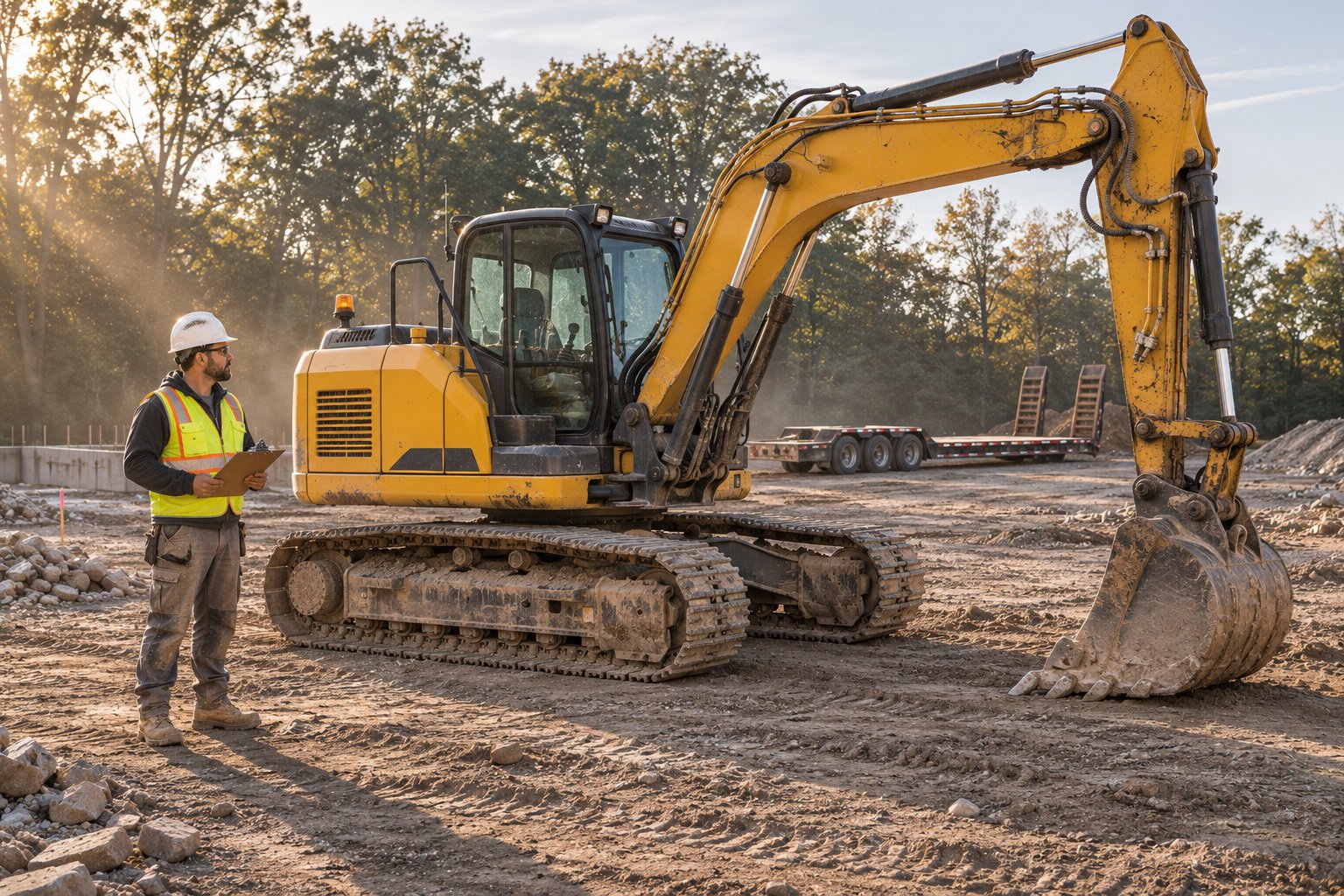
Knowing what is an excavator capable of matters only if you pick the right one for the work sitting in front of you. A three-ton mini on a highway mass-excavation job wastes everyone's time, and a big excavator parked on a cramped residential lot tears up turf, clips fences, and cannot even swing without striking the house. The selection process boils down to five practical variables — and getting them right before you sign a rental contract or purchase order saves thousands.
Matching Machine Size and Attachments to Your Project
Start with the dig. Every project has a required depth, a trench or cut width, and a material type. Those three numbers point you toward a weight class almost immediately. A backyard French drain at 600 mm deep needs a compact unit — something like a Bobcat E42 mini excavator — while a six-meter-deep sewer trunk line demands a 25-to-30-ton crawler. Once the weight class is set, walk through these additional filters:
- Site-access constraints — measure gate widths, overhead clearances (power lines, canopies), and confirm the ground can support the machine's bearing pressure. Soft lawns and saturated soils favor wider-track or rubber-track undercarriages that spread the load.
- Transport logistics — machines over roughly 4.5 metric tons typically require a dedicated trailer and may trigger oversize-load permit requirements depending on combined gross weight. Factor delivery and pickup costs into your budget.
- Attachment needs — list every task the machine must perform on site: trenching, breaking, grading, augering, material handling. Verify that the excavator's auxiliary hydraulic flow and pressure support each attachment you plan to use.
- Operator experience — a first-time renter stepping up from a power wheels excavator in the backyard to an actual cab is a very different user than a ten-year veteran. Compact machines with intuitive ISO controls and limited swing speed offer a safer learning curve.
- Cycle-time expectations — if the schedule is tight, undersizing the excavator extends duration and burns labor hours. Run a rough production estimate (cubic yards per hour) to confirm the machine can finish within your window.
Buy New, Buy Used, or Rent — Choosing the Right Path
The excavator excavator buyers face is not just which machine, but how to acquire it. Three pathways exist, and the right one hinges almost entirely on utilization rate — how many days per year the machine will actually work.
If your excavator will run fewer than 150 days a year, rent it. Between 150 and 200 days, a quality used machine usually delivers the lowest cost per hour. Above 200 days, buying new starts to pencil out — but only if your project pipeline is predictable enough to sustain that pace.
Renting converts a large capital outlay into a predictable operating expense. You pay only when the machine is earning, maintenance is typically included, and you avoid depreciation entirely. For short-term projects, seasonal work, or testing a new equipment category before committing, rental is the lowest-risk path. Industry guidance suggests that equipment used less than 60 to 70 percent of working days annually favors rental over ownership.
Buying new makes sense for core fleet machines with guaranteed, high-volume utilization. You get the latest technology, a full factory warranty, and maximum resale value down the road — but you also absorb 20 to 30 percent first-year depreciation and tie up significant capital.
Buying used offers a middle path that appeals to contractors scaling up, equipment dealers sourcing inventory for resale, and import buyers looking for proven machines at a fraction of new-equipment pricing. A pre-owned 20-ton excavator with 3,000 to 5,000 hours and documented service history can cost 40 to 60 percent less than new, and it has already absorbed the steepest depreciation curve. The key is sourcing from a reputable multi-brand inventory where you can compare specifications across weight classes and request model-specific quotes. JIUHONG's used excavator collection, for example, brings together compact through full-size machines from globally recognized manufacturers — not exclusively Chinese brands — letting buyers browse, compare, and request individual or bulk quotes from a single platform. That kind of consolidated inventory is especially valuable when you need to evaluate several size classes or brands side by side before committing.
Whichever path you choose, the underlying logic stays the same: match utilization to acquisition strategy, verify attachment compatibility before you commit, and never let the excitement of a good deal override the discipline of checking site access, transport requirements, and hydraulic specs. Get those fundamentals right, and the excavator you bring to the jobsite will earn its keep from day one.
Even with the selection process dialed in, a handful of persistent myths continue to steer first-time buyers and renters in the wrong direction — and clearing them up is the fastest way to make a confident, well-informed equipment decision.
Common Misconceptions About Excavators
Bad information travels fast — and in the excavator machine world, a few stubborn myths keep leading first-time buyers, renters, and project planners toward decisions they later regret. Some of these misunderstandings are harmless. Others cost real money, delay projects, or cause people to overlook a perfectly good solution sitting right in front of them. If you have read this far, you already know more than most. These five myth-busters lock in the details that separate confident equipment decisions from expensive guesswork.
Five Myths That Mislead First-Time Buyers
- Myth: Excavators only dig.
Reality: Digging is the headline act, but the attachment ecosystem rewrites the entire job description. Bolt on a hydraulic breaker, and the machine demolishes concrete. Swap in an auger, and it drills pier footings. Attach a flail mower, and it mulches brush on a steep slope no tractor can reach. Grapples, thumbs, compactor plates, rippers, and tilt buckets expand the excavator's role into material handling, grading, forestry, and compaction — all without a second machine on site. If you only think of a hoe excavator as something that digs holes, you are using about 20 percent of its capability. - Myth: Mini excavators are underpowered toys.
Reality: Modern compact machines deliver serious performance relative to their size. Bucket breakout force — the metric that determines how hard the bucket can bite into soil — scales impressively in the compact class. A well-designed 5-ton mini can produce nearly 50 kN of bucket breakout force, enough to crack compacted clay, pry stumps, and fracture light rock. Dig depths on sub-6-ton machines reach up to 4 meters, covering residential footings, utility trenches, and pool excavations with room to spare. Dismissing a compact excavator as a toy ignores the engineering that packs full-size hydraulic muscle into a chassis narrow enough to fit through a garden gate. - Myth: You always need a CDL to transport an excavator.
Reality: Transport regulations hinge on the combined gross vehicle weight rating of the tow vehicle, trailer, and machine — not on the excavator alone. Many mini excavators weigh under 4.5 metric tons and ride on standard equipment trailers that keep the total rig well below the 26,001-pound federal CDL threshold. A landscaper hauling a 3.5-ton compact excavator on a single-axle tilt trailer behind a one-ton pickup typically needs nothing more than a standard driver's license. Larger machines absolutely require commercial transport, permits, and sometimes pilot cars — but assuming every excavator demands a CDL stops people from exploring the compact class, where mini excavator rental rates often include delivery precisely because the machines are easy to move. - Myth: Excavators cannot work in water.
Reality: Amphibious excavators are purpose-built to float. They mount a standard hydraulic upper structure on pontoon-style undercarriages that distribute weight across a wide, buoyant footprint, allowing the machine to traverse marshes, shallow ponds, and saturated ground that would swallow a conventional crawler. Long-reach boom configurations extend horizontal reach to 15 meters or more, letting operators dredge canals, reshape shorelines, and remove sediment from retention ponds without ever sinking. Even standard crawlers work routinely in wet conditions — river-diversion trenches, dewatering pits, and stormwater-system installations all put excavators knee-deep in water every day. - Myth: All excavators exported from China are Chinese brands.
Reality: Global manufacturing does not respect neat geographic labels. Major equipment makers produce machines — and source used inventory — worldwide. A pre-owned excavator listed by a China-based dealer may carry badging from Hitachi, Volvo, Caterpillar, Komatsu, or Doosan. Searching for Hitachi excavator parts or checking the Volvo 220 excavator weight on a spec sheet confirms brands that originated in Japan, Sweden, and the United States, yet these machines circulate through international resale channels regardless of where the seller is located. Reputable multi-brand used-equipment dealers stock inventory from globally recognized manufacturers; the export origin tells you where the machine ships from, not who designed or built it.
The Bottom Line on Excavator Versatility
Every section of this guide circles back to a single idea: the excavator is the most adaptable piece of heavy equipment you can put on a jobsite. It digs, demolishes, handles material, grades surfaces, drills holes, mulches vegetation, and compacts backfill — often in the same shift. It scales from a one-ton micro that fits inside a building to a 200-ton mining shovel that fills haul trucks in one pass. And the quick-coupler attachment system means every new tool you bolt on writes another line into an already long resume.
Understanding the full range of tasks this machine performs, the size classes available, the attachments that unlock each capability, and the myths that cloud the buying process puts you in a position to choose with confidence. Whether you are a homeowner renting a compact unit for a weekend drainage project, a contractor scaling your fleet with a quality used machine, or an equipment dealer sourcing multi-brand inventory for resale — the excavator earns its place at the center of the plan. Match the weight class to the dig, verify attachment compatibility, pick the right acquisition path, and let the machine do what it was built to do: work.
Frequently Asked Questions About Excavator Uses
1. What are the most common tasks an excavator performs?
Excavators handle five broad task categories: earthmoving (trenching, foundation digging, mass excavation), demolition (concrete breaking, structural teardown), material handling (truck loading, pipe placement, sorting), grading and landscaping (finish grading, stump removal, land clearing), and specialty work (augering, compaction, forestry mulching, dredging). The hydraulic quick-coupler system lets operators swap between these roles in minutes by changing attachments, making a single excavator capable of replacing several single-purpose machines on the same jobsite.
2. What size excavator do I need for residential projects?
Most residential work — pool excavation, utility trenching, French drains, driveway grading, and retaining-wall prep — falls within the mini/compact class (under 6 metric tons). Zero-tail-swing models as narrow as 700 mm fit through standard garden gates and rotate freely next to fences and structures. These machines typically deliver dig depths between 1.5 and 4 meters, which covers footings, shallow utilities, and landscaping tasks. Transport is simple too: most compact excavators ride on a standard equipment trailer without oversize permits.
3. How is an excavator different from a backhoe?
The main differences are swing range and specialization. An excavator rotates a full 360 degrees on its upper structure and offers significantly deeper dig depths, making it superior for continuous trenching, foundation cuts, and loading from pits. A backhoe swings roughly 180 degrees but combines a rear-mounted digging arm with a front loader bucket, giving it dual-end versatility on a single road-mobile chassis. Choose an excavator when dig depth exceeds about 3 meters or when continuous excavation is the primary task; choose a backhoe when shallow digging and frequent material-moving duties share the workday.
4. Can mini excavators handle heavy-duty work?
Yes. Modern compact excavators pack impressive hydraulic performance into a small frame. A well-engineered 5-ton mini can generate close to 50 kN of bucket breakout force — enough to crack compacted clay, pry stumps, and fracture light rock. Paired with attachments like hydraulic breakers, augers, and grapples, mini excavators tackle indoor demolition, pier-footing drilling, and material handling that would seem beyond their size. The key is matching auxiliary hydraulic flow and pressure to the attachment's requirements so the machine operates within its designed performance envelope.
5. Should I rent or buy an excavator?
The decision depends on utilization rate. If the machine will work fewer than about 150 days per year, renting typically delivers the lowest total cost because maintenance is included and you avoid depreciation. Between 150 and 200 working days, a quality used excavator from a reputable multi-brand dealer often provides the best cost per hour. Above 200 days with a predictable project pipeline, buying new starts to make financial sense thanks to warranty coverage and latest technology. Platforms like JIUHONG's used excavator collection let buyers compare compact through full-size machines from globally recognized manufacturers, request quotes, and find a middle path between new-equipment pricing and rental limitations.