

What Counts as a Small Excavator and Why Definitions Vary
Search for a small excavator for sale and you will quickly discover a frustrating problem: nobody agrees on what "small" actually means. One dealer lists a 1,700 lb micro machine under the mini excavator label. Another slaps the same label on a 13,000 lb compact unit that barely fits on a standard equipment trailer. United Rentals defines the mini class as machines up to 20,000 pounds, while other industry sources cap it around 6.6 tons. There is no universal standard, and that inconsistency trips up buyers every single day.
So here is a straightforward way to think about it. A small excavator is any tracked excavator with an operating weight under roughly 6 tons (about 13,000 lb). Within that umbrella, three distinct sub-categories exist: micro, mini, and compact. Each serves a different purpose, fits a different trailer, and tackles a different scope of work.
Mini vs. Compact vs. Small — What the Labels Actually Mean
The table below breaks down these three sub-categories so you can cut through the inconsistent marketing language and focus on the numbers that matter.
| Sub-Category | Weight Range | Typical Dig Depth | Common Label in Listings | Best Suited For |
|---|---|---|---|---|
| Micro | Under 2,000 lb (under 1 ton) | 4–6 ft | "Mini excavator," "micro excavator" | Backyard projects, tight-access landscaping, interior demolition |
| Mini | 2,000–6,000 lb (1–3 tons) | 7–10 ft | "Mini excavator," "small excavator" | Trenching, grading, light demolition, residential utility work |
| Small / Compact | 6,000–13,000 lb (3–6 tons) | 10–15 ft | "Compact excavator," "mini excavator," "small excavator" | Pool installation, foundation digging, heavier utility trenching |
Notice the overlap in the "Common Label" column. A listing that says "mini excavator" could describe a machine from any of these three tiers. That is exactly why reading the operating weight matters more than trusting the headline. According to DOZR's spec guide, mini excavator operating weights range from about 2,000 lb all the way up to 22,000 lb across all major brands, which means even industry resources stretch the definition further than most buyers expect.
Why Classification Matters When Shopping for a Small Excavator
Imagine you need an excavator for residential drainage trenches that run about 5 feet deep. You find a deal on a 12,000 lb compact unit because the listing called it a "small excavator for sale." It handles the digging easily, but you also need a heavy-duty trailer and a truck rated to tow it. A half-ton pickup hauling dump trailers for sale at a local lot cannot safely move that machine. You could have accomplished the same trench with a 4,000 lb mini and towed it behind the truck you already own.
The reverse mistake is just as costly. A buyer picks up a sub-1-ton micro excavator expecting it to dig a pool basin, only to discover it maxes out at 6 feet of dig depth. The project stalls, and a second, larger machine has to be rented anyway.
This confusion is not limited to excavators. Buyers shopping for a skid steer, a front end loader, or even a Bobcat skid steer loader face similar labeling inconsistencies across resale platforms and rb auction listings. The lesson is the same regardless of machine type: always verify the operating weight and key specs instead of relying on category labels. Whether you are hauling equipment on Big Tex trailers or comparing machines in a dealer yard, the spec sheet is your most reliable guide.
Understanding where your needs fall within these weight classes is only the first step. Each tier brings its own capabilities, physical constraints, and trade-offs that directly shape what you can accomplish on a job site.
Choosing the Right Weight Class for Your Mini Excavator Project
Weight class is not just a number on a spec sheet. It dictates how deep the machine can dig, how wide a gate it can pass through, what trailer you need, and whether your truck can even tow it. Picking the wrong class means either struggling with a machine that cannot handle the job or paying to transport capacity you never use. Here is what each tier actually delivers on the ground.
Under 1 Ton — Micro Excavators for Tight Access
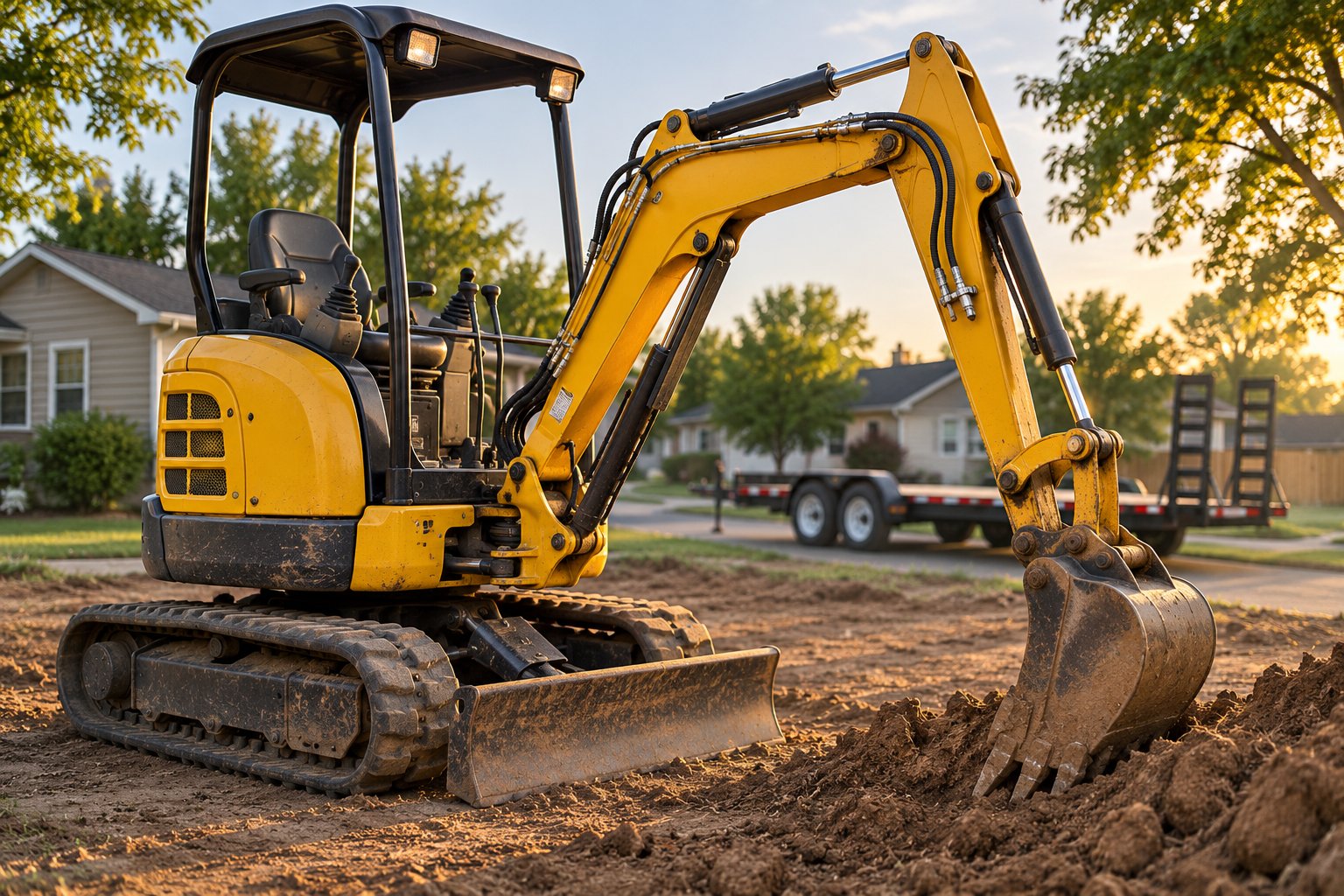
Picture a residential backyard with a 30-inch garden gate and a patio on one side. A full-size machine is out of the question, and even most mini excavators are too wide to squeeze through. This is where micro excavators shine. Machines in this class, like the Kubota K008-5 at 2,025 lb or the Yanmar SV08-1D at 2,438 lb, typically measure under 28 to 34 inches wide. That narrow profile lets them roll through standard fence gates that would block anything larger.
Dig depth in this range usually tops out around 4 to 6 feet. That is enough for shallow utility runs, small drainage trenches, and garden-bed excavation, but it will not reach the depth needed for most sewer lines or pool basins. Engine power typically sits between 10 and 13 horsepower, which handles soft to moderate soil but slows down in heavy clay or rocky ground.
Many micro excavators feature zero-tail-swing designs, meaning the upper body does not extend beyond the track width when the cab rotates. This is a significant advantage near fences, walls, and landscaping features because the operator can swing the boom without worrying about clipping structures behind the machine. However, buyers should confirm zero-tail-swing specs on the specific model they are considering, as not all compact machines offer this feature. Some units in the sub-1-ton class, such as the CAT 300.9D, use a conventional tailswing that extends slightly beyond the tracks.
Transport is refreshingly simple at this weight. A micro excavator can ride on a lightweight single-axle trailer behind a half-ton pickup, eliminating the need for a dedicated equipment hauler. If you already own a car hauler trailer rated for the load, it may work in a pinch, though a purpose-built equipment trailer with ramps is safer and more convenient.
1 to 3 Tons — The Versatile Mini Excavator Sweet Spot
Ask any owner-operator which size gets the most hours, and the answer is almost always a machine in the 1- to 3-ton range. This is the segment where versatility peaks. Dig depths typically reach 7 to 10 feet, engine power ranges from roughly 14 to 25 horsepower, and the machines weigh between 2,000 and 6,000 pounds. That combination handles trenching for water lines, grading residential lots, light demolition, and even stump grinder tasks when paired with the right attachment.
Width in this class varies more than in the micro tier. Smaller models like the Bobcat E19 measure around 39 inches, while heavier 3-ton units like the Kubota KX030-4 stretch to about 59 inches. That spread matters if you are working in a confined side yard versus an open commercial lot. The narrower machines still fit through most residential gates, while the wider models trade access for added stability and digging power.
For a small contractor running landscaping, drainage, or light utility work, a mini excavator in this range often replaces the need for a man lift, a skid steer, and manual labor on the same project. A single machine can trench a 200-foot drainage run in the morning, backfill and grade in the afternoon, and load debris into a truck before the end of the day. That kind of cycle efficiency is why this class dominates resale listings when buyers search for a small excavator for sale.
Transport stays manageable, too. According to AHM's trailer guide, machines in the 1- to 2-ton bracket ride comfortably on a 12-foot trailer behind most standard pickups. Units closer to 3 tons push into the 14-foot tandem-axle territory, but the overall towing weight still falls within the capability of a three-quarter-ton truck. You will not need a boom truck or a dedicated lowboy to move equipment in this segment.
3 to 6 Tons — Compact Excavators for Heavier Duty Work
When the job calls for deeper holes, bigger buckets, and more breakout force, the 3- to 6-ton compact class steps in. Dig depths here commonly reach 10 to 15 feet, which covers residential foundation excavation, deeper utility trenching, and commercial site prep. Bucket capacity increases alongside the frame, so each scoop moves more material and cycle times drop on bulk-earthmoving tasks.
Machines in this weight class, like the CAT 305 CR at 12,688 lb or the Kubota KX057-5 at 12,346 lb, deliver engine power in the 35 to 55 horsepower range. That extra muscle makes a noticeable difference when breaking through compacted gravel, cutting into clay subsoil, or powering hydraulic attachments like breakers and augers. If you have ever watched a stump grinder for sale demonstration and wondered whether an excavator could handle the same root mass with a ripper attachment, a 4- to 5-ton unit generally can.
The trade-off is transport logistics. Machines approaching 12,000 lb require a tandem-axle equipment trailer with a GVWR of at least 14,000 lb, and the tow vehicle needs to be a one-ton truck or larger. A standard car hauler trailer is not rated for this kind of load. Some operators invest in gooseneck or deckover trailers, and the cost of that hauling setup should be factored into the total purchase decision. For heavy-lift tasks beyond what a compact excavator can handle, equipment like a gantry crane enters the conversation, but for most residential and light commercial work, the 3- to 6-ton class is the practical ceiling.
Before committing to a weight class, run through these key decision factors to confirm the machine fits both the job and your logistics:
- Project scale: Single residential tasks favor 1- to 3-ton machines. Multi-phase commercial projects or deep excavation often require 3 to 6 tons.
- Site access width: Measure every gate, alley, and pathway the machine must pass through. Micro units under 28 inches clear most residential gates; compact models over 70 inches may need fence panels removed.
- Required dig depth: Match the machine's maximum dig depth to the deepest trench or excavation the project demands. Choosing a unit that just barely meets the depth requirement leaves no margin for slope adjustments or over-dig allowances.
- Transport logistics: Confirm that your trailer rating, tow vehicle capacity, and route clearances support the machine's operating weight. A 4,000 lb excavator and a 12,000 lb excavator require entirely different hauling setups.
Knowing which weight class fits your work is the foundation of a smart purchase. The next critical step is mapping that class to the specific applications you will tackle most often, because the right size on paper only matters if it matches the real demands of your job sites.
Matching Excavator Size to Common Job-Site Applications
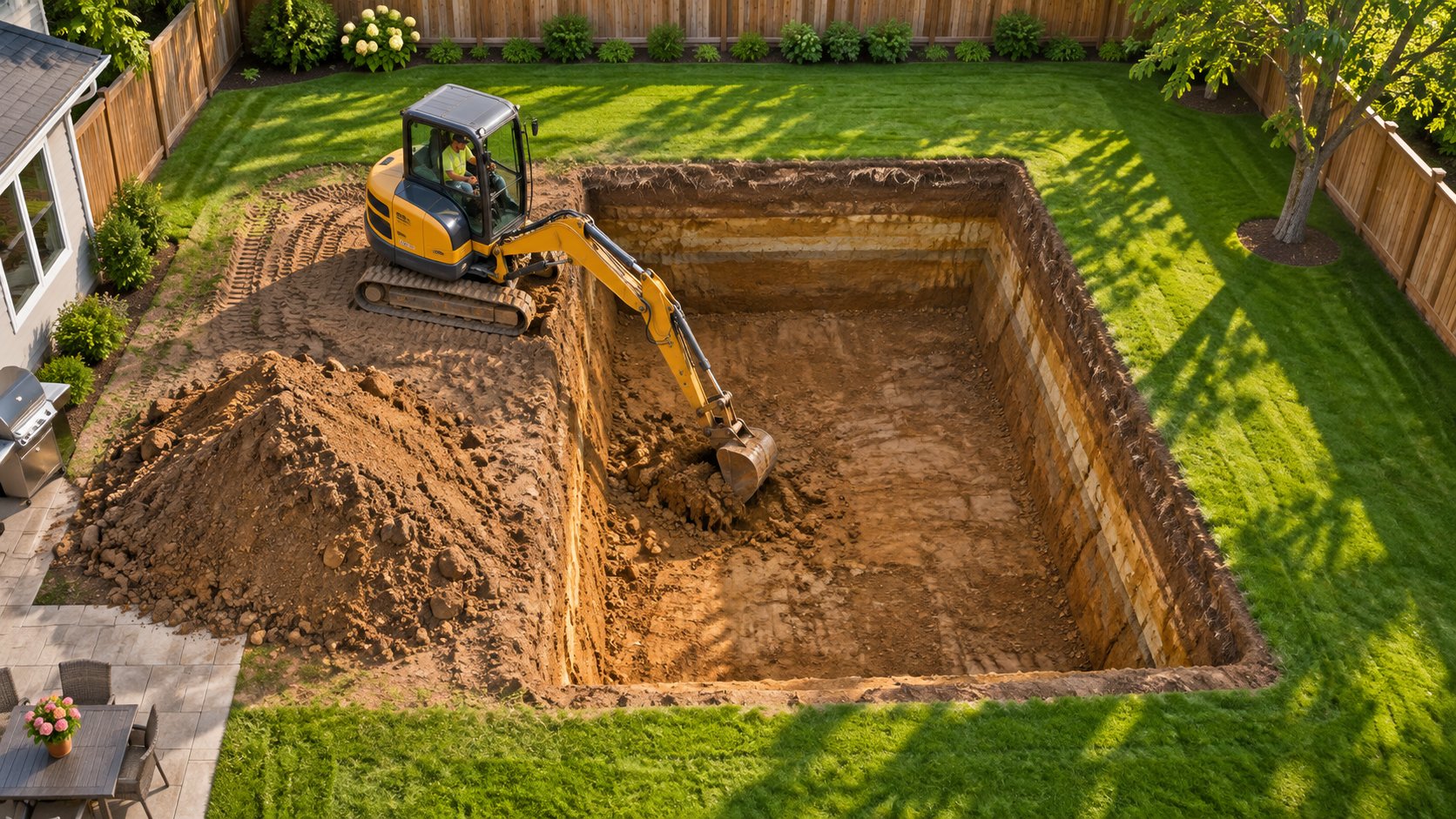
Weight classes and spec sheets tell you what a machine can do. Your job site tells you what it needs to do. The gap between those two realities is where most buying mistakes happen. A 5-ton compact excavator has impressive dig depth on paper, but if you are trenching shallow irrigation lines in a tight residential backyard, you are hauling a heavier trailer and burning more fuel for capacity you never touch. Flip the scenario: a sub-1-ton micro looks easy to transport, yet it stalls out the moment a pool excavation demands 10 feet of reach into a basin.
The fix is straightforward. Start with the application, then let the work dictate the weight class. Below are the three most common categories of projects buyers encounter when shopping for a small excavator for sale, along with specific guidance on which machines handle each task best.
Residential Landscaping and Pool Installation
Landscaping is the entry point for many first-time excavator owners, and it covers a surprisingly wide range of demands. Grading a sloped yard, cutting drainage swales, removing small trees, and trenching for irrigation systems all fall under the landscaping umbrella, yet the dig depth and bucket size each task requires can vary significantly.
For most residential landscaping work, a 1- to 3-ton mini excavator with a standard digging or grading bucket handles the job efficiently. Machines in this range typically reach 7 to 10 feet of dig depth, which is more than enough for drainage trenches, root ball extraction, and rough grading. A landscaping-focused buying guide from Boom & Bucket confirms that the 1- to 5-ton range is ideal for residential projects, citing compact maneuverability and lower operating costs as key advantages. Pairing a mini excavator with a Bobcat skid steer on the same site lets one machine dig while the other pushes, grades, and loads material, a combination that dramatically cuts labor hours.
Pool excavation is a different animal. Shaping an in-ground pool basin typically requires 8 to 12 feet of dig depth and enough reach to carve the walls without the machine falling into the hole. That pushes the requirement into the 3- to 5-ton compact class. These units deliver the bucket capacity to move large volumes of soil per cycle and the hydraulic power to shape clean, even walls. If the pool design includes a deep end exceeding 10 feet, confirm the machine's maximum dig depth covers that measurement with at least a foot of margin for final grading.
Utility Trenching and Foundation Work
Utility contractors live and die by trench depth. Water and sewer lines commonly run 4 to 6 feet below grade, and local codes often specify exact cover depths that leave no room for guesswork. A 2- to 3-ton mini excavator is the workhorse of this segment because it delivers the necessary dig depth, fits on residential streets and between buildings, and pairs well with narrow trenching buckets sized for pipe bedding.
Boom & Bucket's trenching guide notes that mini excavators between 3 and 8 tons are commonly used for utility installation, electrical conduit, and fiber optic trenching. For standard residential water-line and irrigation work, the lighter end of that range, around 2 to 3 tons, keeps transport simple while still reaching the required depth. Compact excavators also pair naturally with a plate compactor attachment or standalone unit used to consolidate backfill material over the pipe, a step that utility inspectors check closely before sign-off.
Foundation work raises the stakes. Digging footings for a residential build may call for trenches 3 to 4 feet wide and 4 to 8 feet deep, depending on frost-line requirements and soil bearing capacity. When the footprint of the foundation grows or the required depth exceeds 10 feet, the 4- to 6-ton class becomes necessary. These machines move more dirt per pass and handle rocky or compacted subsoil without bogging down. Contractors who also run a boom lift or other access equipment on the same site appreciate the compact footprint of a 5-ton unit compared to a full-size excavator, keeping the work zone manageable even on tight residential lots.
Farm and Rural Property Maintenance
Rural properties generate a steady stream of excavation tasks that rarely justify a full-size machine but absolutely demand more capability than a shovel. Fence-line clearing, drainage ditch maintenance, culvert installation, and stump removal are recurring chores on farms and homesteads, and they all map neatly onto the 1.5- to 3-ton mini excavator range.
Fence-row work, for instance, involves pulling old posts, grubbing out root systems along the line, and grading a clean path for new posts and wire. A 2-ton mini excavator with a hydraulic thumb can grab, twist, and extract old posts in seconds, work that takes a crew with hand tools significantly longer. Drainage ditch maintenance follows a similar pattern: the machine cleans silt and vegetation from existing channels, reshapes the banks, and installs or replaces culvert pipe. Newman Tractor's land-clearing guide highlights that a small mini excavator in the 1- to 2.5-ton class paired with a grapple bucket handles brush, logs, and root systems efficiently on rural properties without tearing up surrounding pasture the way heavier equipment might.
Stump removal is another classic farm application. Rather than renting a dedicated stump grinder, many property owners use the excavator's bucket and thumb to rock stumps free, then lever them out of the ground. Larger stumps with deep taproots may require a 3-ton unit for the extra breakout force. If you are comparing equipment at a Ritchie Brothers auction or browsing online listings, machines with a thumb pre-installed tend to command slightly higher prices but save the cost of retrofitting one later, a worthwhile trade-off for rural buyers who handle mixed tasks daily.
Even a lipher or similar material-handling tool can complement the excavator on a farm, but for most digging, grading, and clearing chores, the mini excavator remains the single most versatile machine in a rural fleet.
The table below maps six common applications to the excavator class that handles each one most efficiently. Use it as a quick-reference decision tool before you start browsing listings.
| Application | Recommended Weight Class | Minimum Dig Depth Needed | Key Attachment |
|---|---|---|---|
| Residential grading and drainage | 1 - 3 tons | 5 - 7 ft | Grading bucket |
| In-ground pool excavation | 3 - 5 tons | 8 - 12 ft | Standard digging bucket |
| Water/sewer utility trenching | 2 - 3 tons | 4 - 6 ft | Narrow trenching bucket |
| Residential foundation digging | 4 - 6 tons | 6 - 10 ft | Heavy-duty digging bucket |
| Fence-line clearing and post removal | 1.5 - 3 tons | 3 - 5 ft | Hydraulic thumb |
| Stump removal and ditch maintenance | 2 - 3 tons | 4 - 6 ft | Grapple bucket or ripper |
Matching the machine to the task protects you on both ends of the spectrum. An underpowered excavator turns a two-day job into a week of frustration. An oversized one drains your budget on transport, fuel, and capacity you never use. Whether you run a skid steer alongside the excavator on landscaping sites or operate as a solo owner on a rural homestead, the application should always drive the purchase, never the other way around.
Of course, knowing the right weight class is only half the equation. The spec sheet attached to every listing contains numbers like dig depth, reach, bucket capacity, and engine type that can look like a foreign language to first-time buyers. Translating those figures into real-world job performance is where the next layer of buying confidence comes from.
Key Specifications and Engine Types Decoded for Buyers
Every small excavator for sale comes with a spec sheet, and for first-time buyers, that document can feel like reading a parts manual in a language you half-understand. Numbers like "7'10" max dig depth" or "0.065 cu yd bucket capacity" look precise, but what do they actually mean for the trench you need to dig next Tuesday? And when one listing advertises a Kubota diesel while another touts a Briggs & Stratton gasoline engine, how do you weigh those differences against your budget and workload?
The answer is simpler than most spec sheets make it look. Three core measurements define what an excavator can accomplish on the ground, and the engine powering those movements determines how efficiently and for how long it does the work. Here is what each specification really tells you.
Dig Depth, Reach, and Bucket Capacity Explained
Dig depth is the single most critical number on any excavator listing. It measures the maximum vertical distance from ground level to the bottom of the bucket when the boom, arm, and bucket are fully extended downward. In practical terms, a machine with an 8-foot dig depth can handle standard residential utility trenches for water lines that typically run 4 to 6 feet deep, leaving comfortable margin for slope adjustments. That same machine, however, cannot reach a municipal sewer main buried at 12 feet. If your projects regularly require trenches deeper than the machine's rated dig depth, no amount of operator skill can compensate for the physical limitation.
Reach, sometimes listed as "maximum reach at ground level," tells you how far from the tracks the bucket can extend horizontally across the surface. Imagine you need to clean a drainage ditch but cannot position the excavator directly next to the edge because the bank is soft or the ground slopes away. A machine with 15 feet of reach lets you sit back on stable ground and still work the bottom of the ditch. A machine with only 10 feet of reach forces you to reposition closer, potentially onto unstable footing. As DOZR's excavator spec guide notes, max reach is vital for job sites where obstacles or obstructions prevent the machine from getting close to the dig area.
Bucket capacity measures the volume of material the bucket holds per scoop, typically expressed in cubic yards or cubic feet. A larger bucket moves more dirt per cycle, which reduces the number of passes needed to complete an excavation. On a pool dig that removes 40 cubic yards of soil, the difference between a 0.06 cu yd micro bucket and a 0.25 cu yd compact bucket is the difference between hundreds of extra scoops and a job that finishes hours sooner. Bucket capacity also ties directly to the machine's hydraulic power and frame weight. You cannot simply bolt a larger bucket onto a lighter machine and expect it to perform. The excavator's rated bucket size reflects the maximum it can fill and lift safely without tipping or overloading the hydraulic system.
Diesel vs. Gasoline Engines — Power, Fuel Cost, and Longevity
Browse enough listings and you will notice a clear split: most excavators above 1 ton run diesel engines from manufacturers like Kubota or Yanmar, while some sub-1-ton micro units use gasoline engines, including models powered by Briggs & Stratton or Honda. That divide is not arbitrary. Each engine type brings distinct advantages that align with different use cases.
Diesel engines generate more torque at lower RPMs, which translates directly into stronger digging force and steadier hydraulic pressure under load. They also consume less fuel per unit of work compared to gasoline engines, a difference that compounds over hundreds of operating hours. Kanoo Machinery's engine comparison highlights that diesel-powered mini excavators generally last longer because they operate at lower RPMs and experience less internal wear, making them a stronger long-term investment. On the maintenance side, diesel engines require regular fuel-filter replacement and occasional injector servicing, both of which are straightforward but slightly more involved than gasoline engine upkeep.
Gasoline engines are lighter, which keeps the overall machine weight down and makes transport even simpler. They also tend to cost less upfront, both for the machine itself and for basic repairs. Gasoline models start faster in cold weather and run quieter, a genuine advantage on residential job sites where noise complaints can shut down a project. The trade-off is durability: gasoline engines typically require more frequent spark-plug and carburetor attention, and they generally do not match the service-life hours of a comparable diesel. If you are buying a micro excavator for occasional backyard work or light landscaping, a gasoline-powered unit may deliver everything you need at a lower entry price. For contractors logging daily hours on trenching or grading jobs, diesel is almost always the better fit.
One detail that catches some buyers off guard: the machine welding machine-style precision of modern diesel injector systems means that using contaminated or incorrect fuel can cause expensive damage quickly. Always follow the manufacturer's fuel specifications, and if you are buying used, ask whether the previous owner maintained a clean fuel supply.
Operating Weight and Its Impact on Transport
Operating weight ties every other spec back to a real-world logistics question: how are you getting this machine to the job site? The answer shapes your budget in ways that many first-time buyers do not anticipate until they are standing in a trailer lot wondering which rig to buy.
Machines under 4,000 lb can typically ride on a standard single-axle equipment trailer towed by a half-ton pickup truck. That keeps transport costs minimal and means you can move the excavator yourself without hiring a hauling service. It is the same class of load you might tow alongside dump trailers or a flatbed truck carrying materials to the same site. At this weight, the towing setup is no more complex than what many homeowners already own.
Step up to the 4,000 to 8,000 lb range and you need a tandem-axle trailer rated accordingly, along with a three-quarter-ton or one-ton tow vehicle. This is still owner-towable for most contractors, but the trailer investment adds to total cost of ownership. According to SkidSteers.com's transport guide, a typical compact excavator weighing between 6,000 and 10,000 lb can ride on a standard flatbed trailer pulled by a capable pickup, as long as the trailer's gross vehicle weight rating accommodates the combined weight.
Units approaching 12,000 lb change the equation entirely. At that weight, you are looking at a heavy-duty tag-along or gooseneck trailer, and the tow vehicle must be rated for the combined load. Some buyers in this range opt for professional transport services, especially for longer moves. If you have ever browsed semi trucks for sale or priced out dedicated lowboy rentals, you know that heavy hauling is its own line item. The same principle applies here on a smaller scale. A buyer who stretches to afford a 12,000 lb compact excavator but does not budget for the trailer and tow vehicle to move it ends up with a machine that sits idle between jobs, or a recurring transport bill that erodes the value of the purchase.
Military-surplus flatbed vehicles like an LMTV occasionally appear in equipment forums as budget hauling options for mid-weight machines, but their highway speed limitations and maintenance quirks make them impractical for most civilian contractors. A properly rated commercial trailer matched to a capable pickup or medium-duty truck remains the most reliable solution.
For buyers also shopping adjacent equipment, the transport math applies equally whether you are evaluating a tractor for sale, a rubbish bin trucks listing, or a dump truck and trailer combination. The principle never changes: verify your tow vehicle's capacity, confirm the trailer's GVWR, and add those costs to the machine's purchase price before you commit.
Specs and engine types give you confidence that a machine can perform. The next question most buyers face is which brand built it, and whether that name on the hood affects reliability, parts availability, and what the excavator will be worth when it is time to sell.
Top Small Excavator Brands Compared for Buyers
Specs tell you what a machine can do. The brand behind those specs tells you how easy it will be to find parts, get warranty service, and recover your investment when it is time to sell. When you browse a mini excavator for sale, you will see the same handful of names dominating listing after listing. Some carry premium price tags. Others offer lower entry costs but thinner support networks. Understanding what each manufacturer brings to the table, and where each one falls short, is the difference between a smart purchase and an expensive lesson.
Kubota, Caterpillar, and Bobcat — The Big Three in Small Excavators
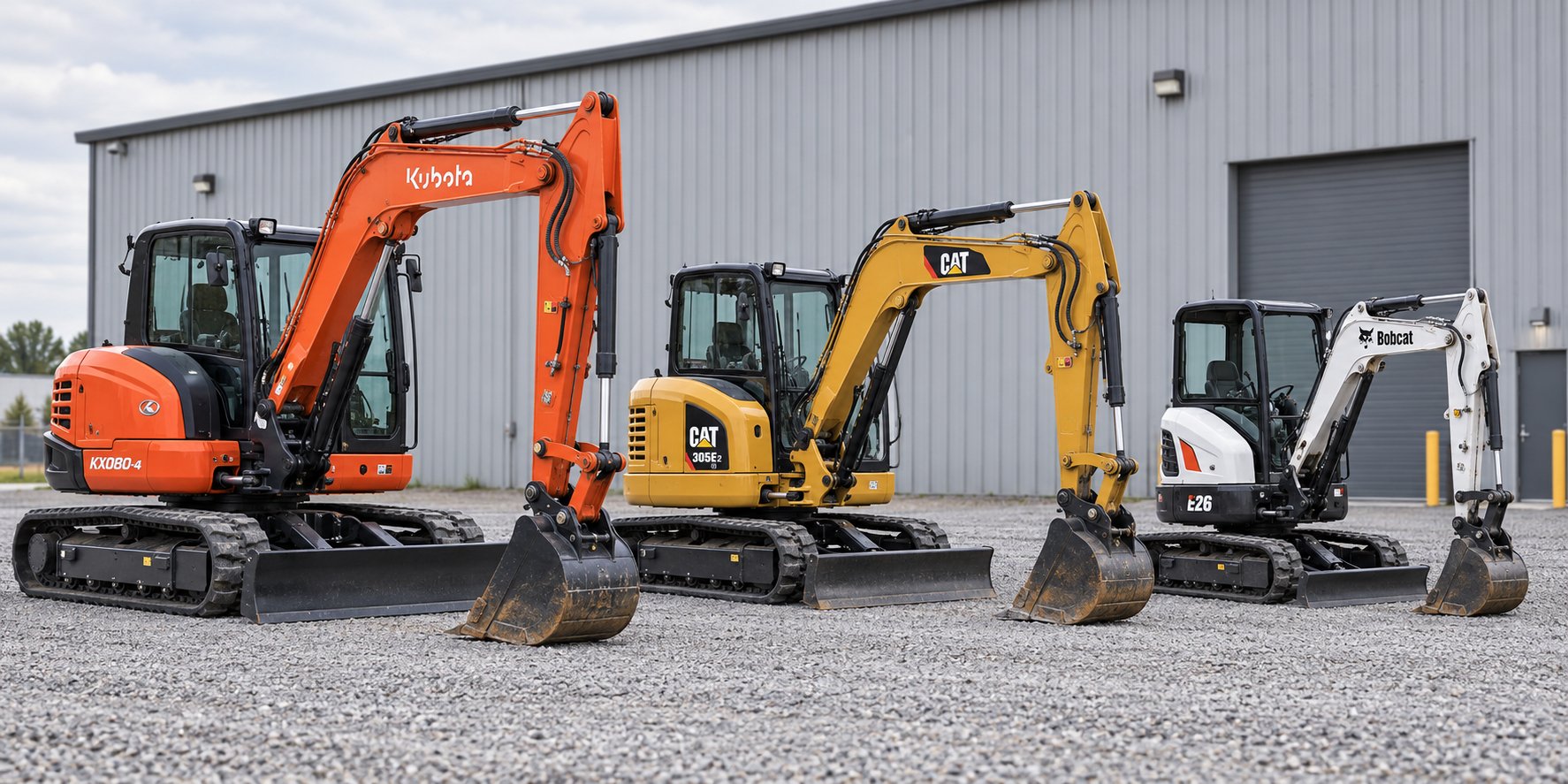
Kubota has built its reputation on reliable diesel engines that also power machines across unrelated industries, from tractors to generators. In the mini excavator class, Kubota offers 15 compact excavator models ranging from the 1-metric-ton K008-5 to the 8.5-metric-ton KX080-5. The company's KX057-5 ranks as its top seller and the No. 3 overall in new-financed U.S. sales, according to EDA data cited by Equipment World. Parts availability is a major strength. Because Kubota engines appear in everything from skid steers to agricultural equipment and even combine harvester power units, dealers and independent shops stock Kubota components widely. For buyers hunting used utility trailers for sale alongside a used excavator, Kubota's broad dealer footprint means you can often handle both purchases through the same network.
Caterpillar carries arguably the strongest brand recognition in heavy equipment, and that recognition translates into resale confidence. Cat's 5-metric-ton 305 CR holds the No. 1 position for new-financed mini excavator sales in the U.S., with the 306 CR at No. 5 and the 304 at No. 9. The company offers 23 models of mini excavators and backs them with a dealer support network that few competitors can match. Cat machines tend to command higher purchase prices, but that premium is partially offset by strong demand on the resale market. Features like the exclusive Cat Stick Steer system and the Cat Inspect app for digital machine monitoring add layers of technology that appeal to both owner-operators and fleet managers.
Bobcat pioneered compact equipment in the U.S. and remains synonymous with versatility. The company's attachment ecosystem is one of the deepest in the industry, with hydraulic quick-coupler systems that let operators swap between buckets, breakers, augers, and grapples with minimal downtime. Bobcat offers 12 diesel and two electric models, spanning 1.7 to nearly 10 metric tons. Its top seller, the E35i (now replaced by the E35), sits at No. 6 overall in EDA's financed-sales rankings. For contractors who already run Bobcat skid steers or compact track loaders, staying within the brand simplifies parts inventory and operator training across the fleet.
Takeuchi, Yanmar, John Deere, and Other Contenders
Takeuchi may not carry the household-name recognition of the big three, but professionals in the compact excavator world respect it deeply. The company offers 16 mini excavators from 1.2 to nearly 9 metric tons. Its top seller, the TB260, delivers 12 feet 9 inches of dig depth and comes standard with a long arm and integrated thumb mount. Three auxiliary circuits accommodate a wide range of attachments, from mowers to plate compactors. Takeuchi's engineering quality consistently earns praise in industry reviews, and Ritchie Bros. notes that the brand outperforms generic and lesser-known imports at resale.
Yanmar holds a unique position in the market. The company essentially created the compact excavator category back in 1972 with the YB600C, and it continues to manufacture engines used by competitors, including models inside Sany, XCMG, LiuGong, and Hitachi machines. Yanmar's own lineup spans 10 models from 1 to 9.8 metric tons, with the SV40 as its top seller. Its ViO series features true zero-tail-swing designs that professional operators value in tight residential work. Buyers who care about engine pedigree will find Yanmar diesel powerplants throughout the excavator excavators market, even in machines wearing other badges.
John Deere brings its legendary dealer network and financing infrastructure to the compact excavator segment. The company's 35 P-Tier ranks No. 2 in overall U.S. mini excavator sales, and the 50 P-Tier and 60 P-Tier occupy the No. 7 and No. 8 spots respectively. Deere offers eight models manufactured in collaboration with Wacker Neuson, featuring cabs with standard heat, air conditioning, and Bluetooth. For buyers who already maintain a relationship with their local John Deere dealer for tractors or other agricultural equipment, financing and service continuity make the brand an attractive choice.
Equipment exported from China is not necessarily manufactured by a Chinese brand. Global resale channels frequently list machines from Caterpillar, Komatsu, Hitachi, and other internationally recognized manufacturers that were originally sold in Asian or European markets. Brands like Sany and XCMG have also established U.S. dealer presences, with Sany operating a 272-acre manufacturing facility in Georgia. Just as trucktrading platforms aggregate vehicles from multiple origins, equipment resale sites mix domestic and international inventory that spans every major manufacturer.
How Brand Choice Affects Resale Value and Parts Access
A cheaper purchase price can become the most expensive decision you make if the brand lacks local dealer support. Imagine a hydraulic pump fails on a Tuesday morning. With a Kubota, Cat, or Bobcat, your dealer likely has the part on the shelf or can overnight it. With a less common brand, that same repair could mean days or even weeks of downtime while the component ships from overseas. For a contractor with jobs on the calendar, every idle day costs real money.
Resale strength follows a similar pattern. Ritchie Bros. reports that Kubota and Bobcat lead the pack for resale value in the sub-10,000-pound class because both brands dominate rental fleets and dealer inventories across North America, keeping buyer familiarity and parts confidence high. Caterpillar holds value well in the 5,000 to 8,000 pound range, though its higher initial purchase price narrows the resale-percentage gap compared to lower-cost brands. A well-maintained 3- to 4-year-old mini excavator with under 1,500 hours commonly retains 55 to 70 percent of its original value, a stronger depreciation curve than most compact equipment categories.
The table below offers an honest side-by-side look at the major brands you will encounter when searching for compact and mini excavator listings. Use it as a reference point, not a final verdict, because local market conditions and individual machine history always matter.
| Brand | Typical Weight Classes Available | Dealer Network Strength | Parts Availability | General Reputation |
|---|---|---|---|---|
| Kubota | 1 - 8.5 metric tons | Extensive (North America and global) | Excellent; engines used across multiple industries | Reliable, strong resale, broad model range |
| Caterpillar | 1 - 10 metric tons | Industry-leading dealer network | Excellent; deep aftermarket support | Premium brand, highest recognition, strong technology |
| Bobcat | 1.7 - 10 metric tons | Strong (widespread North American presence) | Excellent; large attachment ecosystem | Versatile, pioneer in compact equipment |
| John Deere | 1.7 - 9 metric tons | Extensive (especially in agricultural regions) | Very good; backed by Deere infrastructure | Strong financing options, trusted agricultural brand |
| Takeuchi | 1.2 - 9 metric tons | Moderate (growing dealer base) | Good; improving with market share growth | Respected engineering quality, strong among professionals |
| Yanmar | 1 - 9.8 metric tons | Moderate | Good; engines widely cross-compatible | Category pioneer, proven engine technology |
| Sany | 1.9 - 9.2 metric tons | Growing (U.S. manufacturing base) | Improving; expanding dealer parts inventory | Competitive pricing, expanding U.S. presence |
| Komatsu | 3 - 8.5 metric tons | Strong (global infrastructure) | Very good | Durable, fuel-efficient, narrower compact lineup |
Brand reputation gives you a starting point, but it does not replace hands-on evaluation. Even a top-tier manufacturer can produce a machine that has been neglected, abused, or poorly maintained by a previous owner. The badge on the hood is a signal, not a guarantee. What separates a confident buyer from a hopeful one is knowing exactly what to inspect, question, and verify before any money changes hands.
How to Inspect a Used Small Excavator Before Buying
A fresh coat of paint and a low hour meter reading might look reassuring, but neither one tells you what actually matters: the condition of the parts that cost the most to repair. Whether you are inspecting a compact excavator at a local dealer yard or evaluating photos from an online listing, the process follows the same logic. You are building a repair-cost estimate, not just forming a gut impression. Every worn component you identify becomes either a negotiation lever or a reason to walk away entirely.
This inspection framework applies equally whether you are shopping for a small excavator for sale, browsing dump trucks for sale, or evaluating tractors for sale at an equipment lot. The principles of mechanical due diligence are universal. Here is how to apply them to a used excavator so you buy with confidence instead of crossing your fingers.
Engine Hours, Service Records, and What They Reveal
Think of engine hours the way you think of odometer miles on a truck. They give you a rough snapshot of usage, but the number alone is dangerously incomplete without context. A 3,000-hour mini excavator that was greased daily, had its filters changed on schedule, and ran light landscaping work is a far better buy than a 1,200-hour unit that spent its life hammering concrete with no documented maintenance. As industry appraisers emphasize, service history trumps raw hours every time.
For mini and compact excavators under 10 tons, machines approaching 5,000 hours or more generally warrant closer scrutiny, not because they are automatically worn out, but because rubber tracks, pins, and bushings in this class tend to show wear earlier than on heavier steel-tracked units. A machine with 6,000 well-documented hours can absolutely outperform one with 2,000 mystery hours.
Request the full service records before you even schedule an in-person visit. Look for consistent oil changes, hydraulic fluid replacements, filter swaps, and any major component repairs. Patterns matter. Gaps in the records, or a seller who claims records were "lost," should raise immediate concern. Also verify that the hour meter has not been tampered with. The telltale signs include a brand-new meter housing on an otherwise aged machine, seat and pedal wear that looks inconsistent with the advertised hours, or floor-mat deterioration that suggests far more use than the meter shows. On newer machines, ask for an ECM (engine control module) hours pull from an authorized dealer. The electronic record is far harder to manipulate than a mechanical gauge, and a seller who refuses that check is waving a significant red flag.
Undercarriage, Tracks, and Hydraulic System Inspection
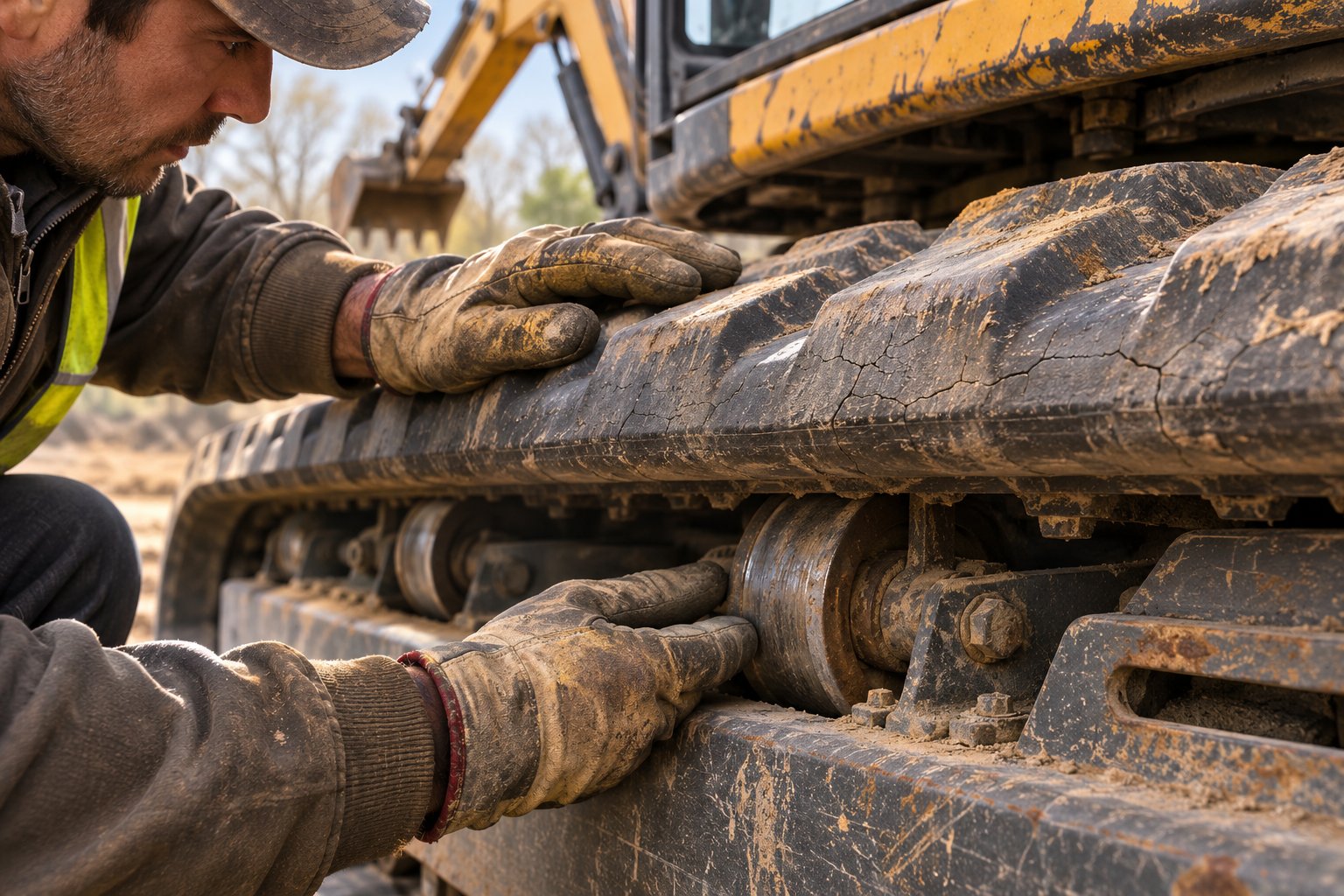
If you only inspect one system, make it the undercarriage. Undercarriage components can account for roughly half of a tracked excavator's total lifetime maintenance cost, and replacement on even a small machine runs into the thousands. A buyer who skips this step is essentially gambling with the single most expensive repair category on the equipment.
Start with the tracks themselves. On rubber-tracked minis, check for cracks, missing lugs, and uneven wear across the surface. On steel-tracked compact units, measure the grouser height, link wear, and sprocket tooth condition. Track tension matters too. Overly loose tracks can indicate internal pin and bushing stretch, while suspiciously tight tracks on a high-hour machine may mean the previous owner removed a link to disguise slack, a known trick that hides serious internal wear. Compare the link count to the manufacturer's specification if possible.
Move on to the rollers and idlers. Spin each roller by hand if the machine is safely supported and listen for grinding or roughness. Look for oil seeping from roller seals, which signals internal bearing failure. A dozer or excavator with leaking rollers is heading toward a full undercarriage rebuild, not just a minor seal replacement.
The hydraulic system deserves equal attention. Walk around the entire machine and inspect every hose, fitting, and cylinder for leaks. Small drips at a hose connection might cost a few dollars to fix. A weeping hydraulic pump, on the other hand, can signal a replacement that runs into the thousands. Examine the cylinder rods on the boom, arm, and bucket cylinders. You are looking for scoring, pitting, or chrome flaking on the rod surface. Any of those conditions means the seal is compromised or soon will be, and rod reconditioning or cylinder resealing is not cheap.
Perform a simple drift test: raise the boom with a loaded bucket, shut the engine off, and wait five minutes. A small amount of settling is normal. If the boom drops noticeably, the cylinders or control valves are bypassing internally. This single test reveals more about hydraulic health than any visual inspection alone. Also check the hydraulic fluid itself. Pull the dipstick or sight glass and look at the color. Clean fluid ranges from clear amber to light brown. Milky or foamy fluid indicates water contamination, a condition that can destroy pumps and valves rapidly. That milky appearance is a deal-killer on most machines, regardless of price.
Structural Integrity and Operational Testing
Hydraulics and undercarriage account for the biggest repair bills, but structural damage points to something worse: abuse. Inspect the entire length of the boom and arm, paying close attention to weld seams, plate joints, and the areas around pin bores. Cracks in these zones indicate the machine experienced forces beyond its design limits, whether from overloading the bucket, using the machine as a crane, or impact damage. Any spot where a reinforcement plate has been welded over an existing crack is a major red flag. According to appraisers cited by Equipment World, cracks in the boom or stick can reduce a machine's value by approximately 20 percent, and on small to midsize excavators, many experienced buyers walk away entirely rather than negotiate around structural repair.
Check the bucket for worn teeth, cracked cutting edges, and excessive floor wear. Inspect the pin connections at every pivot point by having someone in the cab apply and release bucket down-pressure while you watch each bushing for excessive play. Loose pins and bushings indicate a machine that was under-greased throughout its working life, and replacing them is labor-intensive.
The operational test separates a functioning machine from a failing one. Start the engine cold. Watch the exhaust: a brief puff of white smoke on startup is normal in cool weather, but persistent blue smoke means the engine is burning oil, and steady black smoke points to fuel delivery or air intake problems. Once the machine warms up, cycle every function methodically. Swing left and right through a full rotation, raise and lower the boom, curl and extend the arm, and open and close the bucket. Listen for grinding, knocking, or hesitation at any point in the range of motion. Jerky or uneven movement in any direction suggests a hydraulic issue or mechanical wear in that circuit. Travel the machine forward and backward in a straight line. If it pulls to one side, a track motor or pump is losing pressure.
Just as you would test-drive a pickup before purchasing, or operate a welding machine before committing to a shop tool, you need seat time in the excavator to feel how it responds. Even if you have rented compact equipment from a service like Sunbelt Rental and have a baseline for how a healthy machine should behave, every used unit has its own personality shaped by its maintenance history. Trust what your hands and ears tell you during the test.
Use the checklist below to make sure you cover every critical inspection point before committing to a purchase:
- Hour meter reading: Record the displayed hours and compare against wear indicators like seat, pedal, and floor condition.
- Service records: Request full maintenance documentation, including oil changes, filter replacements, hydraulic service, and major repairs.
- ECM hours verification: Ask for an electronic hours pull from an authorized dealer to confirm the mechanical meter has not been altered.
- Track condition: Check for cracks, missing lugs (rubber), grouser wear (steel), and proper link count.
- Track tension: Verify tension is within spec and no links have been removed to disguise slack.
- Rollers and idlers: Spin by hand, listen for grinding, and check for oil leaks at seals.
- Hydraulic hoses and fittings: Inspect every connection for leaks, cracking, abrasion, or bulging.
- Cylinder rods: Examine boom, arm, and bucket cylinder rods for scoring, pitting, or chrome damage.
- Hydraulic fluid condition: Check color and clarity. Milky or foamy fluid signals water contamination.
- Boom drift test: Raise the boom with load, shut off the engine, wait five minutes, and measure any drop.
- Boom and arm structure: Inspect all weld seams for cracks, reinforcement plates, or signs of re-welding.
- Pin and bushing play: Apply and release bucket pressure while observing each pivot point for excessive movement.
- Bucket condition: Check teeth sharpness, cutting edge wear, and floor thickness.
- Cold start exhaust: Watch for persistent blue, white, or black smoke after initial startup.
- Full function cycle: Operate swing, boom, arm, bucket, and travel in all directions. Listen for grinding, knocking, or hesitation.
- Straight-line tracking: Drive forward and reverse to confirm the machine does not pull to one side.
- Cab and controls: Verify gauges, warning lights, joystick responsiveness, and seat condition.
- Engine oil and coolant: Check dipstick for excessive blackening or metallic particles, and inspect coolant for oil contamination.
Questions to Ask the Seller: How many owners has this machine had? What type of work was it primarily used for? Are complete service and maintenance records available? Has the boom, arm, or undercarriage ever been repaired or welded? Has the hour meter ever been replaced or reset? Can you provide an ECM hours report from an authorized dealer? Are there any known mechanical issues, leaks, or warning codes? What attachments are included, and are they original to the machine? Is the machine sold as-is, or is any warranty or return period available?
A thorough inspection gives you the facts. However, facts about condition only become actionable when you can translate them into dollars. Knowing that the undercarriage is 60 percent worn or that the cylinders need resealing matters most when you can weigh those repair costs against the asking price, your ongoing ownership expenses, and the total budget you have set aside for the purchase. That financial layer is where many first-time buyers lose their footing, not because the numbers are complicated, but because the costs they forget to include add up faster than the ones on the sticker. Tow trucks for sale listings, equipment hauling fees, insurance premiums, and routine maintenance all factor into what a machine truly costs to own.
Pricing Guidance and Total Cost of Ownership
You have identified the right weight class, matched it to your applications, decoded the spec sheet, compared brands, and learned how to inspect a used machine. Every one of those steps protects you from buying the wrong excavator. This step protects you from paying the wrong price, or worse, budgeting only for the sticker and getting blindsided by the costs that come after.
Pricing a small excavator for sale is not like pricing a pickup truck, where a VIN lookup spits out a Kelley Blue Book estimate. Excavator values shift based on a mix of brand, model year, engine hours, attachment package, condition, and even geographic market demand. Two identical machines in different states can sell thousands of dollars apart simply because one sits in a region with more active contractors competing for used inventory.
Expected Price Ranges by Age, Condition, and Hours
The clearest window into real pricing comes from actual sale records rather than asking prices. Paramount Financial's 2026 pricing analysis pulled manufacturer list prices and auction results to build a picture that holds up to scrutiny. On the new side, Bobcat's published suggested list prices climb predictably with operating weight: the sub-3,000 lb E10 starts at $31,950, a mid-range E32 at about 7,400 lb lists for $60,131, and the 19,600 lb E88 reaches $141,406. Those figures cover base machines only. Freight, pre-delivery inspection, taxes, dealer fees, and attachments all sit on top.
Used machines tell a different story. Auction records for the Bobcat E35, one of the most commonly traded minis, showed 34 sales between January and October 2026 ranging from $10,000 for a 2016 unit to $54,000 for a near-new 2025 model. The critical detail? A 2019 E35 sold for $34,000 in October while a newer 2023 went for just $20,900 the same month. Hours and maintenance history flipped the expected age-based hierarchy completely.
That pattern holds across the market. Sub-1-ton micro excavators cost significantly less than 5-ton compact units at every age level. Machines with under 1,000 hours command a clear premium over those with 3,000 or more hours. And brand matters: a Kubota or Cat with documented service records will almost always outsell a lesser-known brand at the same weight and hour count. If you have ever compared used tractors for sale at a farm equipment lot, you have seen the same dynamic. Maintenance history and brand trust drive the premium, not the calendar year alone.
Total Cost of Ownership Beyond the Sticker Price
First-time buyers consistently underestimate what it costs to own the machine after they buy it. Gregory Poole Equipment Company defines total cost of ownership as the complete financial picture from the day you purchase a piece of equipment to the day you sell it, including every dollar spent operating, maintaining, and eventually disposing of it. That definition applies whether you are running a 2-ton mini on landscaping jobs or managing a fleet of semi trucks across state lines.
Here are the ongoing cost categories most buyers overlook:
- Transport and delivery: Getting the machine to your shop or first job site. A flatbed trailer rated for the load, fuel for the tow vehicle, and potentially a professional hauling service if the machine exceeds your towing capacity. Brands like Kaufman Trailers and similar manufacturers offer equipment-specific trailers, but even a used hauler adds thousands to your startup cost.
- Insurance: Equipment insurance covers theft, damage, and liability. Premiums vary by machine value, location, and coverage level, but skipping this line item is a gamble most contractors cannot afford.
- Routine maintenance: Engine oil, hydraulic fluid, fuel filters, air filters, and greasing every pivot point on manufacturer-recommended intervals. A billy goat brush cutter might only need seasonal upkeep, but an excavator logging weekly hours demands consistent, documented maintenance to hold its value.
- Track replacement: Rubber tracks on mini excavators typically last 1,000 to 2,000 hours depending on terrain. A replacement set for a 3-ton machine can run well over $1,000, and rocky or abrasive ground accelerates wear significantly.
- Fuel consumption: Diesel-powered minis are more efficient than gasoline models per hour of work, but fuel is still a recurring cost that compounds over every operating season.
- Attachment purchases: The base machine rarely ships with every bucket and tool you will need. Hydraulic thumbs, trenching buckets, breakers, and augers each carry their own price tag.
- Depreciation: Gregory Poole notes that hours of use, maintenance history, and market demand all influence how fast a machine loses value. Well-maintained equipment depreciates more slowly and recovers more at resale.
Add these categories together and the true cost of ownership can exceed the sticker price within the first few years. That is not a reason to avoid buying. It is a reason to budget honestly so the machine earns its keep from day one.
Financing, Leasing, and Budget Planning
Not every buyer writes a check for the full purchase price, and not every buyer should. Three primary paths exist for funding an excavator purchase, each with trade-offs worth understanding before you commit.
Purchasing outright eliminates monthly payments and interest charges. You own the machine free and clear, which simplifies resale later. The downside is obvious: it ties up a large block of cash that could fund other parts of your operation, from porta potty for sale purchases for a job site to payroll during a slow month.
Financing through a dealer or lender spreads the cost over a fixed term, typically two to seven years for heavy equipment. Crestmont Capital reports that equipment finance agreements commonly cover both new and used machines, with the equipment itself serving as collateral. Many specialized lenders approve applications within 24 to 48 hours and offer programs for credit scores starting in the high 500s. Some marketplaces and dealers also partner with agricultural or equipment-specific lenders who understand seasonal cash flow, a structure familiar to anyone who has financed farm tractors or other working assets.
Leasing for seasonal use keeps monthly payments lower than a purchase loan because you are covering the machine's depreciation during the lease term rather than its full value. A Fair Market Value lease lets you return the equipment at the end, purchase it at current market value, or renew. This option suits contractors whose workload fluctuates or who want to upgrade to newer models every few years without carrying long-term debt on aging iron.
Whichever path you choose, the budget math works the same way. Start with your total cost of ownership estimate, not just the machine price. Subtract what you can afford in monthly payments or upfront cash. The number left over is your realistic ceiling for the excavator itself. Buyers who reverse that order, picking the machine first and figuring out the money later, are the ones who end up stretched thin when the first track replacement or hydraulic repair bill arrives.
Pricing and ownership costs give you the financial framework. The final piece of the puzzle is where you actually buy the machine, because the channel you choose, whether it is a dealer, an auction house, or a direct online seller, shapes everything from warranty coverage to inspection access and negotiation leverage.
Where to Buy
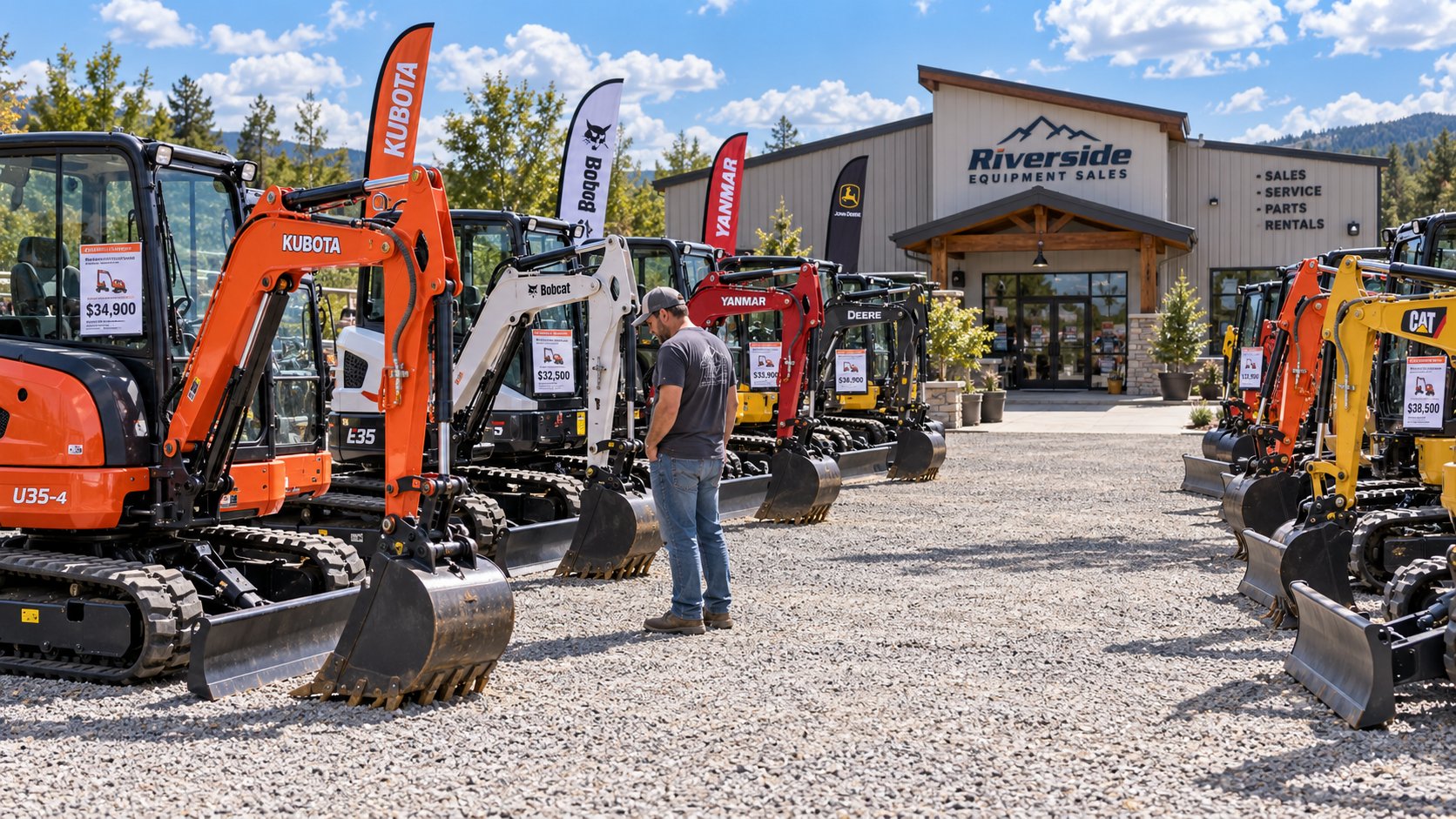
You know the weight class you need, the brand you trust, the specs that match your job sites, and the total budget you can commit. The remaining question is deceptively simple: where do you actually hand over the money? The buying channel you choose affects far more than convenience. It determines whether you get a warranty, how much inspection access you have, what fees land on top of the hammer price, and how much negotiation leverage you carry into the deal. Surprisingly, most guides that rank a small excavator for sale by price or brand never explain these trade-offs, leaving buyers to figure them out the hard way.
Three primary channels dominate the used equipment market: authorized dealers, auction houses, and direct online sellers. Each one serves a different buyer profile, and none of them is universally "best." The right choice depends on your risk tolerance, timeline, and whether you value post-sale support over upfront savings.
Equipment Dealers and Certified Pre-Owned Programs
Buying from an authorized dealer is the closest thing to a safety net in the used equipment world. Reputable dealerships typically inspect incoming machines, perform necessary repairs, and offer some form of warranty or certified pre-owned program before putting a unit on the lot. That process costs money, and the dealer passes it along. Expect to pay more than you would at auction or through a private seller, sometimes significantly more, but that premium buys tangible benefits.
The biggest advantage is transparency. A dealer who stakes their reputation on every sale has a financial incentive to disclose known issues, provide service records, and stand behind the machine after the transaction closes. Many dealerships also partner with equipment lenders, making it possible to finance the purchase, arrange delivery, and even bundle attachments into a single transaction. If you have ever bought a tow truck for sale through a commercial vehicle dealer, the experience is similar: higher sticker, lower risk, and a phone number to call when something goes wrong.
The trade-offs are real, though. Dealer inventories can be limited to a handful of brands they represent, which narrows your selection. A Kubota dealer may not carry Takeuchi or Yanmar units, even if those machines fit your needs better. Procurement also tends to move slower than other channels. Paperwork, financing approval, and pre-delivery inspection all add days or weeks to the timeline. For a contractor who needs a machine on a job site next Monday, that lag can be a dealbreaker.
Auction Houses and Their Limitations
Auctions attract buyers with the promise of competitive pricing, and that promise is often real. Platforms like Ritchie Bros. run unreserved public auctions where every item sells to the highest bidder with no minimum bids or reserve prices. The inventory is vast. On any given sale day, you might find a 2-ton mini excavator next to a skid steer for sale, a waste lorry, or a back hoe, all from different sellers and brands. That breadth gives buyers the ability to comparison-shop across equipment categories in a single session.
The risks, however, are significant enough that experienced contractors treat auctions with caution. Industry analysis from Hexco Global highlights several recurring pain points: most auction purchases are sold as-is with no warranty, machine history is often uncertain, and limited inspection windows make thorough evaluation difficult. Ritchie Bros. does allow in-person viewing up to two weeks before an auction, but the reality is that many bidders rely on photos, descriptions, and IronPlanet condition reports rather than hands-on testing. Buyer premiums, fees charged on top of the winning bid, further erode the savings that attracted you in the first place. Ritchie Bros. publishes its buyer fee schedule, and factoring that percentage into your maximum bid is essential to avoid overpaying.
There is also the emotional dynamic of bidding itself. Auction environments, whether live or online, create urgency that can push buyers past their planned ceiling. A machine that looked like a bargain at $18,000 suddenly sells for $26,000 after a bidding war, and the winner walks away wondering whether they actually won at all. If you have ever attended a sale of used tractors at a regional auction and watched prices climb past retail, you know exactly how this plays out.
For buyers who want competitive pricing without the as-is gamble, direct purchasing from established equipment sellers offers a middle path. Unlike auction-only platforms, direct sellers allow model-specific negotiation, extended inspection windows, and the ability to request detailed machine reports before committing. That combination of access and flexibility makes direct channels increasingly popular among contractors and equipment dealers who need to evaluate machines thoroughly before spending.
Online Marketplaces and International Sellers
Online platforms have fundamentally changed how buyers search for equipment. Marketplaces like Machinery Trader, Equipment Trader, IronPlanet, and My Little Salesman aggregate listings from dealers, private sellers, and auction houses into searchable databases where you can filter by brand, weight class, hours, price, and location. Instead of driving between three dealer lots and attending an auction, you compare dozens of machines from your phone during a lunch break. That efficiency is genuinely transformative, especially for buyers in rural areas who may not have a major equipment dealer within a reasonable drive.
International inventory adds another layer of opportunity. Equipment exported from China is not necessarily manufactured by a Chinese brand. Global resale channels routinely list machines from Caterpillar, Komatsu, Hitachi, and other internationally recognized manufacturers that were originally deployed in Asian, European, or Middle Eastern markets. A buyer searching for a mini escabeiro or browsing excavator listings from overseas may find well-maintained Kubota and Cat units priced below domestic market equivalents, though shipping logistics, import duties, and customs clearance add complexity that domestic purchases do not carry.
For excavation contractors, equipment dealers, and import buyers looking to compare multi-brand listings in one place, JIUHONG's used excavator collection functions as a direct-purchase marketplace. The platform brings together compact and larger machines from multiple brands, letting buyers request model-specific quotes for individual units or negotiate bulk purchases. That quote-request capability is a meaningful differentiator from auction-only platforms, where you either win the bid or lose the machine. JIUHONG's model allows buyers to evaluate options, compare across weight classes, and arrange purchases on their own timeline rather than an auctioneer's schedule.
Whether you are an owner-operator looking for a single 3-ton mini or a dealer building inventory across multiple size classes, the ability to compare, quote, and negotiate directly streamlines a process that auctions and classified listings leave fragmented. Buyers who have tried to source equipment across multiple channels simultaneously, perhaps tracking a wanted to buy car trailer listing on one site while monitoring excavator auctions on another, will appreciate the consolidation that a curated multi-brand marketplace provides.
The table below breaks down the four primary buying channels so you can match your priorities to the channel that serves them best.
| Buying Channel | Typical Warranty | Price Competitiveness | Inspection Access | Risk Level |
|---|---|---|---|---|
| Authorized Dealer | 6-12 month powertrain common; certified pre-owned programs available | Moderate to high (premium for inspection and support) | Full access; hands-on testing typically encouraged | Low |
| Auction (e.g., Ritchie Bros.) | Sold as-is; no warranty | High (competitive bidding can drive prices down, but buyer premiums apply) | Limited; viewing windows of 1-2 weeks before sale | High |
| Private Seller | Sold as-is; negotiable on a case-by-case basis | High (no dealer overhead or buyer premiums) | Varies; depends on seller cooperation | Medium to high |
| Direct Online Seller (e.g., JIUHONG) | Varies by seller; some offer limited warranty or return policies | Moderate to high (direct negotiation, no auction premiums) | Quote-request and detailed machine reports available before commitment | Low to medium |
No single channel wins on every metric. Dealers minimize risk but cost more. Auctions offer breadth and competitive pricing but strip away warranty protection and limit your inspection window. Private sellers can deliver the lowest price, but due diligence falls entirely on your shoulders. Direct online sellers like JIUHONG occupy a middle ground that combines multi-brand selection with the negotiation flexibility and inspection access that auctions lack.
The channel you choose sets the terms of the deal, but it does not close the deal. What happens after you commit, from arranging transport to securing warranty coverage to executing a clear action plan, determines whether the purchase actually works for your business. Those final logistics are where prepared buyers separate themselves from everyone else.
Transport, Warranties, and Your Prepared Buyer Action Plan
You have selected the weight class, vetted the brand, inspected the machine, calculated total ownership costs, and chosen a buying channel. Every one of those steps positions you ahead of the average buyer. Yet the deal is not truly done until the excavator sits on your property or job site in working condition, with clear terms governing what happens if something goes wrong. Transport logistics and warranty coverage are the two areas where even well-prepared buyers stumble, usually because they treat both as afterthoughts instead of negotiation points.
Transport and Delivery Planning by Machine Weight
How you move the machine depends entirely on what it weighs, and weight dictates both the equipment you need and the cost you will pay. A sub-2,000 lb micro excavator rides on a single-axle utility trailer behind a half-ton pickup. The same setup you might use for a mini skid steer for sale or a snow plow attachment fits this class comfortably. Transport costs stay minimal because you are handling it yourself with gear you likely already own.
Step into the 2,000 to 6,000 lb mini class and you need a tandem-axle equipment trailer rated at a minimum of 7,000 lb GVWR, along with a three-quarter-ton tow vehicle. A flatbed tow truck or a dedicated equipment hauler works well here. Most owner-operators in this range own their trailer and factor towing time into each job's schedule. If the machine is located more than a few hundred miles from your base, hiring a professional carrier may make more financial sense than burning a full day behind the wheel.
Compact excavators in the 6,000 to 13,000 lb range change the logistics equation entirely. These machines require a heavy-duty tag-along or gooseneck trailer and a one-ton tow vehicle at minimum. For long-distance moves, professional heavy-equipment transport is often the practical choice. A1 Auto Transport's current shipping data puts domestic mini excavator hauling at roughly $800 to $1,500 for moves under 200 miles, $2,000 to $3,500 for distances of 500 to 1,000 miles, and $5,000 to $6,500 for cross-country trips around 2,000 miles. Shorter moves cost more per mile because loading time and deadhead distance are spread over fewer billable miles.
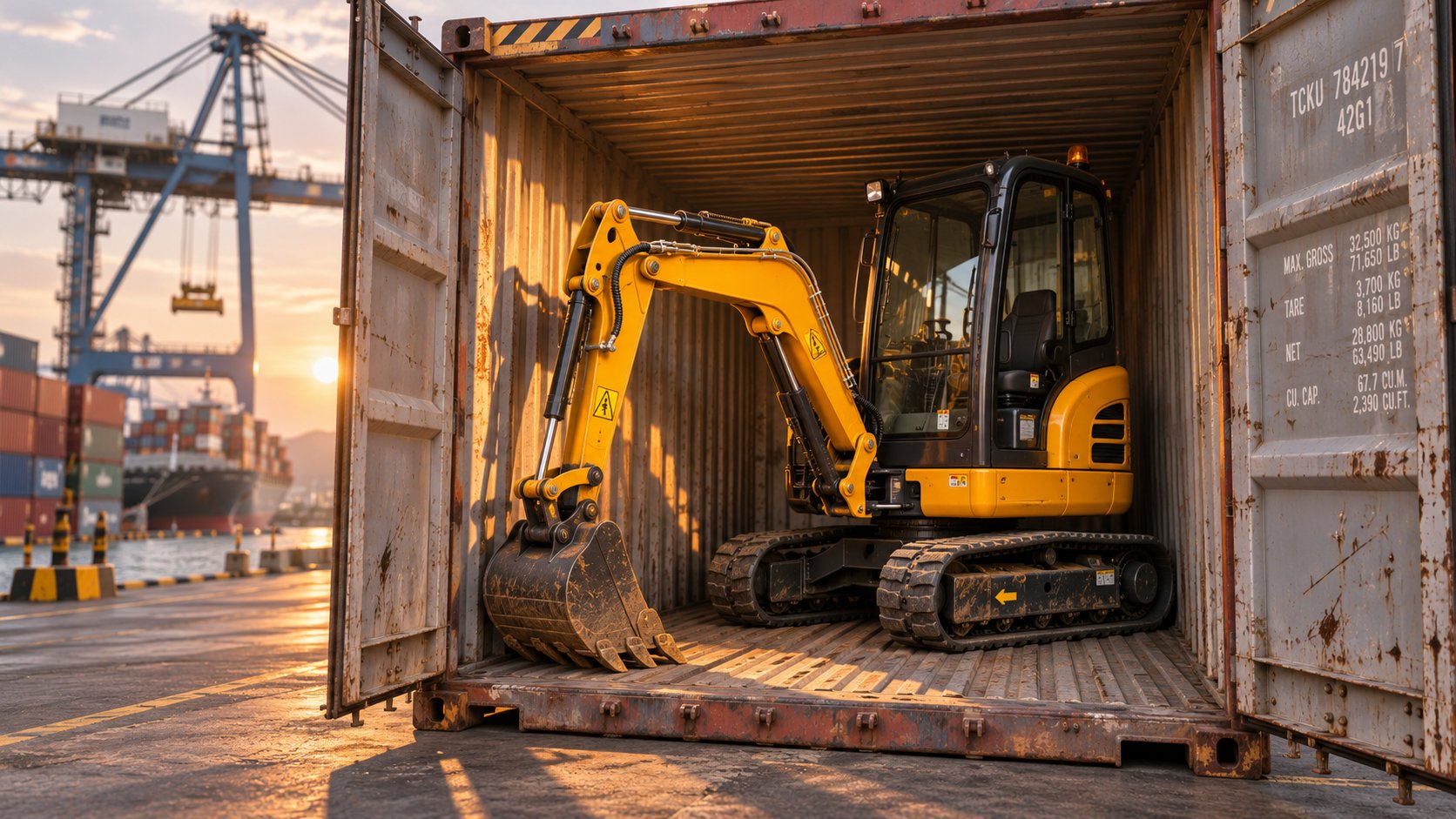
Buyers sourcing an excavator for sale from international sellers face additional layers of planning. Ocean freight, customs duties, port handling charges, and inland delivery from the destination port all add to the total. SECSUN's import guide details the documentation chain, including commercial invoices, packing lists, bills of lading, and certificates of origin, that must be prepared correctly to avoid customs delays. Machines exported from China may travel in standard containers if dimensions allow, on flat-rack containers for oversized units, or via roll-on/roll-off shipping for self-propelled equipment. Verify shipping logistics and customs requirements well before the purchase closes, because a machine stuck in port clearance costs you both money and downtime.
Whether the seller or buyer arranges shipping depends on the deal you negotiate. Dealers often include delivery within a certain radius or offer it as a paid add-on. Auction purchases almost always leave transport to the buyer, with strict pickup deadlines that incur storage fees if missed. Direct online sellers may coordinate shipping as part of the transaction or connect you with vetted carriers. Always confirm who handles transport, who pays for it, and what insurance covers the machine during transit before you finalize the sale.
Warranty Expectations and What to Negotiate
Warranty terms in the used excavator market range from comprehensive to nonexistent, and the variation tracks directly to the buying channel.
Authorized dealers offer the strongest coverage. A certified pre-owned Cat excavator or a Kubota backed by its dealer's inspection program may come with 6 to 12 months of powertrain warranty, covering the engine, hydraulic pump, and travel motors. Some dealers extend coverage further for an additional fee, essentially functioning like an extended service contract. That safety net has real value. A single hydraulic pump failure on a compact excavator can cost several thousand dollars, and warranty coverage turns that catastrophic expense into a phone call.
Private sellers and auction houses sit at the opposite end. Both channels sell equipment as-is in most cases. Ritchie Bros. explicitly states that items are sold as-is, where-is, and buyers assume all responsibility for machine condition after the sale. That policy applies whether you are bidding on a cat excavator, a vacuum lorry, or waste bin trucks. The absence of warranty is the trade-off for lower pricing, and it places the entire burden of due diligence squarely on your inspection process.
Online equipment sellers fall somewhere in between. Some include limited warranty or return policies that provide a window, typically 7 to 30 days, for the buyer to verify the machine matches the listing description. Others operate on an as-is model similar to auctions but offer detailed machine reports and photo documentation that reduce the information gap. When comparing platforms, ask directly about warranty terms, return conditions, and dispute resolution before you commit.
Regardless of the channel, treat warranty as a negotiation point rather than a fixed term. A seller who refuses to offer any coverage on a $30,000 machine may be willing to reduce the price by the estimated cost of a third-party equipment warranty, which typically runs $1,500 to $3,000 for a 12-month plan on a compact excavator. Even a 30-day powertrain guarantee gives you enough time to put the machine through real working conditions and identify problems that a one-hour inspection might miss. If the seller will not budge on price or warranty, that rigidity itself is information worth weighing.
Your Next Steps as a Prepared Buyer
Every chapter in this guide addressed a specific gap that trips up buyers who rely on instinct instead of process. The action plan below distills that entire journey into a sequence you can follow from first search to signed deal. Print it, bookmark it, or save it to your phone. It works whether you are buying your first 2-ton mini or adding a fifth compact excavator to a growing fleet.
- Define your project requirements and weight class. List every application the machine needs to handle. Match those tasks to the micro, mini, or compact tier using the application table from earlier in this guide. Confirm that your site access widths and dig depth requirements align with the class you select.
- Research brands and current pricing. Compare at least three brands within your weight class. Check recent auction results, dealer listings, and online marketplace prices to establish a realistic market range. Factor in brand-specific resale strength and local parts availability.
- Identify your preferred buying channel. Decide whether a dealer's warranty justifies the premium, whether auction pricing fits your risk tolerance, or whether a direct online seller gives you the inspection access and negotiation flexibility you need. Each channel serves a different buyer profile.
- Inspect or request detailed machine reports. Use the inspection checklist from this guide for in-person evaluations. For remote purchases, request high-resolution photos, service records, ECM hours verification, and a live video walkaround. Never skip this step regardless of how attractive the price looks.
- Negotiate price including transport and warranty. Build your offer around total cost of ownership, not just sticker price. Include delivery costs, warranty terms, and any attachments in the negotiation. A machine priced $2,000 below a competitor means nothing if transport eats the difference.
- Finalize the purchase with documentation in order. Secure a bill of sale, ownership verification, lien release if applicable, and written warranty terms. Confirm transport arrangements, insurance coverage during transit, and a delivery timeline before funds transfer.
Buyers ready to compare multi-brand used excavator listings can explore curated collections like JIUHONG's excavator inventory to request model-specific quotes and evaluate options for individual or bulk orders. The platform's direct-purchase model lets you move at your own pace, compare across weight classes, and negotiate terms that fit your operation, whether you are an owner-operator sourcing a single machine or a dealer stocking inventory across multiple categories.
A dump truck for sale listing might catch your eye on the same platform where you found the excavator. A skid steer might round out your fleet. The equipment market rewards buyers who do the homework before they spend the money, and if you have followed this guide from definitions through inspection through pricing and logistics, you are no longer the buyer who picks the wrong size. You are the one who knows exactly what to buy, what to pay, and where to find it.
Frequently Asked Questions About Buying a Small Excavator
1. What is the difference between a mini excavator and a small excavator?
In the resale market, 'small excavator' is an umbrella term covering three sub-categories: micro (under 1 ton), mini (1-3 tons), and compact (3-6 tons). Listings often use 'mini' and 'small' interchangeably, so always check the operating weight rather than relying on the label. A machine listed as a 'mini excavator' could weigh anywhere from 1,700 lb to over 13,000 lb depending on the seller's definition.
2. How many hours is too many on a used mini excavator?
There is no single cutoff, but machines approaching 5,000 hours or more deserve closer scrutiny because rubber tracks, pins, and bushings tend to show wear earlier on smaller units. However, maintenance history matters far more than raw hours. A 6,000-hour excavator with complete, consistent service records can be a better purchase than a 2,000-hour machine with no documentation. Always request service logs, verify the hour meter has not been tampered with, and ask for an ECM hours report from an authorized dealer.
3. What size trailer do I need to haul a small excavator?
Trailer requirements depend on the excavator's operating weight. Micro excavators under 2,000 lb fit on a single-axle utility trailer behind a half-ton pickup. Mini excavators between 2,000 and 6,000 lb need a tandem-axle trailer rated at 7,000 lb GVWR or higher and a three-quarter-ton tow vehicle. Compact excavators from 6,000 to 13,000 lb require a heavy-duty tag-along or gooseneck trailer and a one-ton truck. Always confirm your tow vehicle's capacity and the trailer's gross vehicle weight rating before transport.
4. Which small excavator brand holds the best resale value?
Kubota and Bobcat consistently lead resale value in the sub-10,000-pound class due to their dominance in rental fleets and widespread dealer networks across North America. Caterpillar also holds value well, particularly in the 5,000 to 8,000 lb range, though its higher initial purchase price narrows the percentage gap. A well-maintained mini excavator from a major brand with under 1,500 hours commonly retains 55 to 70 percent of its original value after three to four years. Local parts availability and dealer support strongly influence long-term value retention.
5. Is it better to buy a used excavator from a dealer, auction, or online marketplace?
Each channel has distinct trade-offs. Dealers offer inspected inventory, warranty coverage, and financing but charge higher prices. Auctions like Ritchie Bros. can deliver competitive pricing but sell machines as-is with limited inspection time and buyer premiums on top. Direct online sellers such as JIUHONG's used excavator collection at jiuhong-machinery.com provide a middle ground, allowing buyers to compare multi-brand listings, request model-specific quotes, and negotiate terms without auction pressure. The best choice depends on your risk tolerance, timeline, and whether post-sale support justifies a price premium.