

What a Mini Excavator from China Actually Means
Search for a mini excavator from China and you'll find page after page of product listings, price quotes, and "Buy Now" buttons. What you won't find is a straightforward explanation of what that phrase actually means — or why the machine sitting on a factory floor in Shandong province might contain a Japanese engine, German hydraulic seals, and a frame designed to someone else's specifications entirely. This guide exists to fill that gap. No sales pitch, no checkout cart — just a detailed, honest breakdown of costs, quality tiers, compliance hurdles, and buying channels so you can make an informed decision before wiring a single dollar overseas.
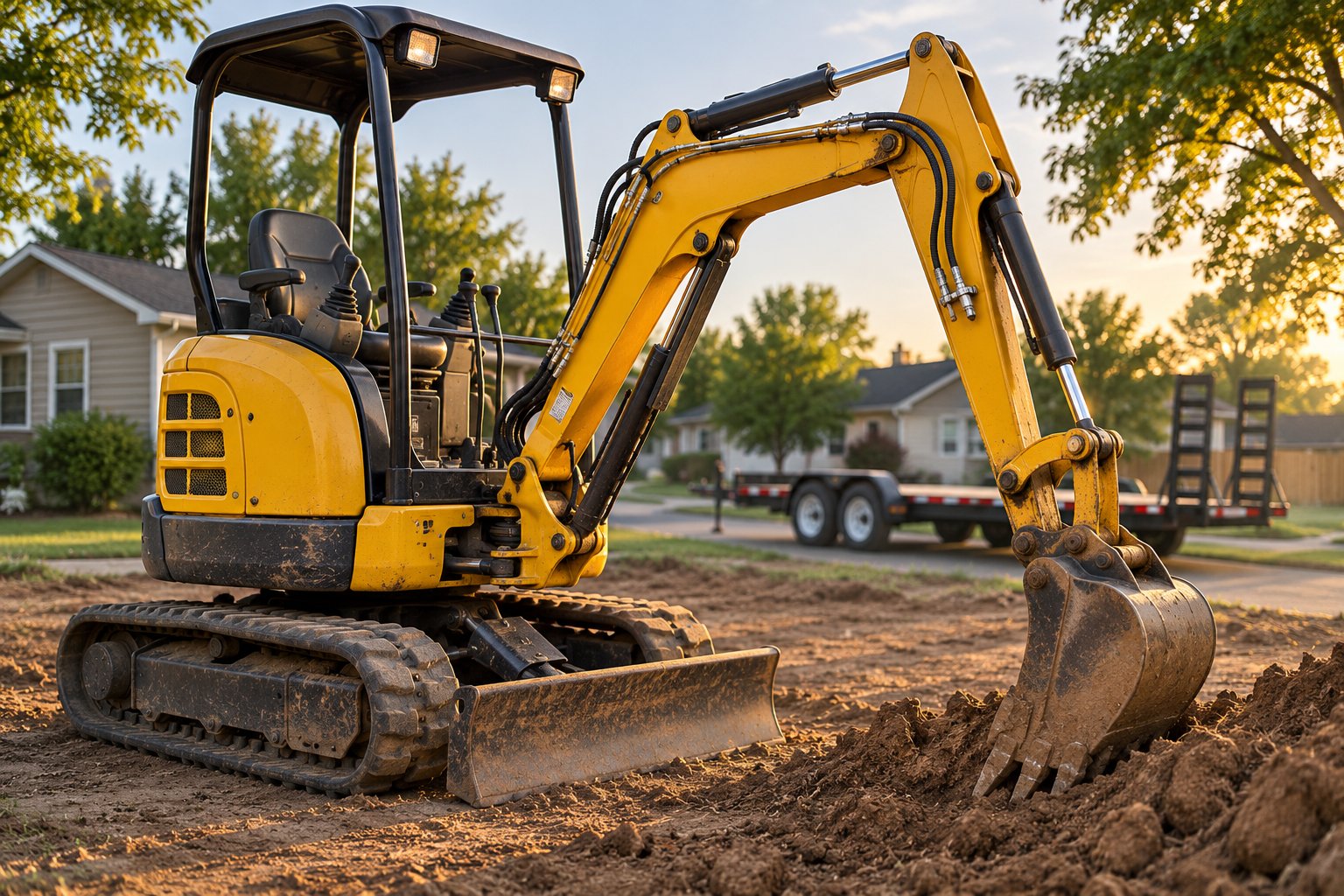
A mini excavator — also called a compact excavator, mini digger, or mini ex — is a tracked or wheeled hydraulic excavator with an operating weight typically under 6 metric tons (approximately 13,200 lbs). These machines feature a front blade, a boom-and-arm digging assembly, and are designed for tasks ranging from residential landscaping to light commercial excavation.
Defining the Mini Excavator Category
Mini excavators span a surprisingly wide performance range. According to spec data compiled by DOZR, operating weights across major brands run from roughly 2,000 pounds on the smallest micro units all the way up to around 22,000 pounds on the largest compact models — that's 1 to 11 tons. Within that spectrum, most industry professionals recognize three broad size classes: small (under 10,000 lbs), medium (10,000 to 18,000 lbs), and large (above 18,000 lbs).
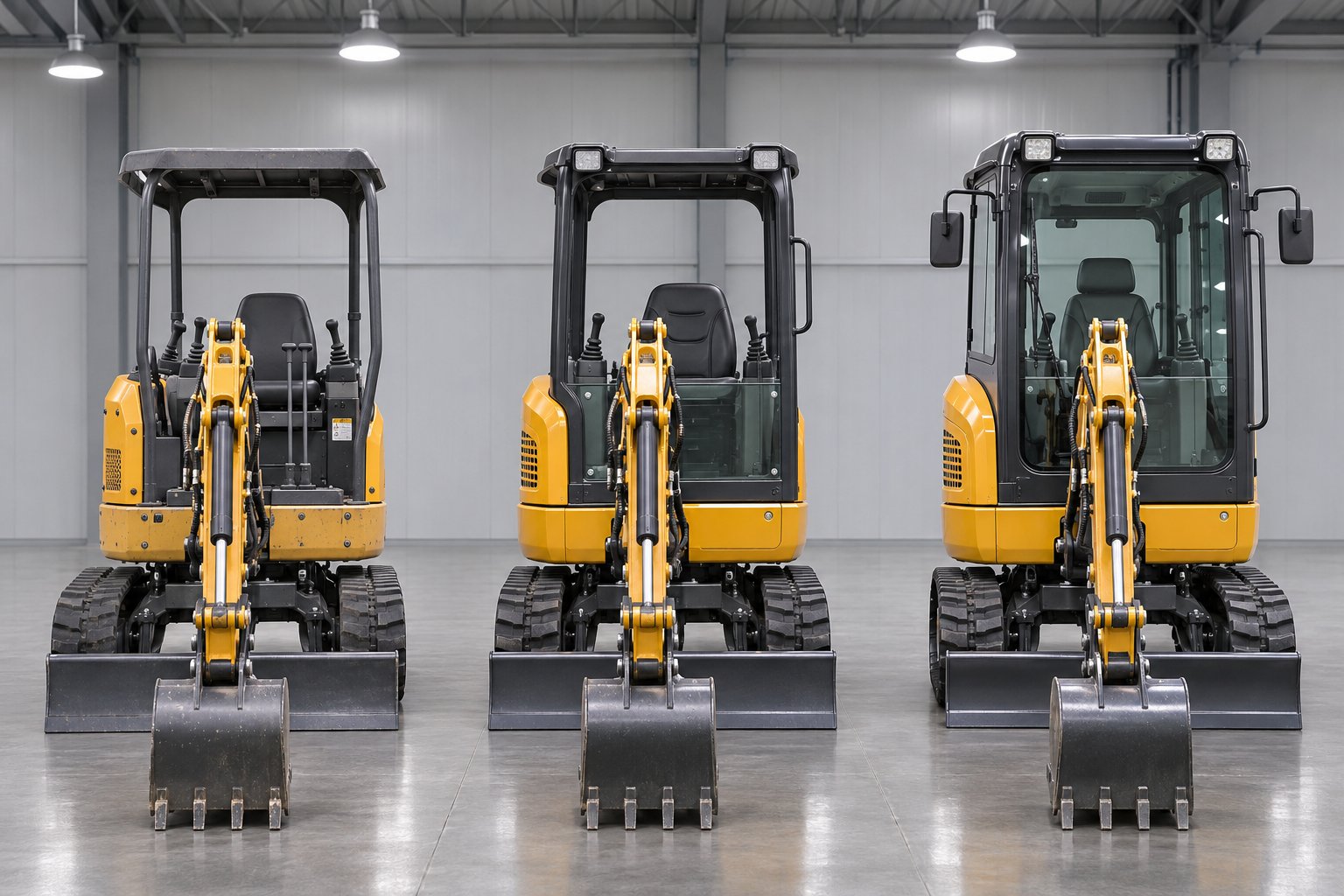
Configuration choices matter just as much as weight. You'll encounter canopy models — open-top units suited to warm climates and budget-conscious buyers — alongside fully enclosed cab versions with climate control. Track options split between rubber tracks, which are gentler on finished surfaces like driveways and sidewalks, and steel tracks built for rocky or abrasive terrain. Then there's the tail-swing question. As Compact Equipment details, buyers can choose between zero tail swing (the housing stays within the track width during rotation), reduced tail swing (minimal overhang), and conventional tail swing (greater rear extension that boosts lifting capacity but demands more clearance). Zero-tail-swing models dominate in tight residential settings, while conventional designs deliver stronger over-the-side lifting for heavier attachments.
Why 'From China' Does Not Always Mean 'Chinese Brand'
Here's the nuance most product pages skip entirely: "exported from China" and "designed by a Chinese company" are two very different things. China's compact equipment factories operate across a broad manufacturing spectrum. At one end, domestic brands engineer, build, and sell machines under their own names. At the other end, OEM and white-label factories produce machines to the exact specifications of Western or Japanese buyers — stamping someone else's logo on the boom before crating the unit for export.
Imagine a compact excavator rolling off a Jining assembly line fitted with a Yanmar diesel engine, Rexroth hydraulic components, and a control layout dictated by a European distributor. That machine ships from a Chinese port, clears customs as a Chinese import, and may even trigger Section 301 tariffs — yet the engineering DNA and critical components are international. This distinction reshapes the entire value conversation, because evaluating a machine purely by its country of export ignores the global supply chain powering it.
Understanding this layered reality is the first step. The more practical question — which factories sit at which quality tier, and how do you tell them apart — is where things get genuinely interesting.
How China Became a Global Mini Excavator Producer
Factory location, supply-chain depth, and manufacturing heritage shape the quality of every machine long before it reaches a shipping container. So where, exactly, are most of these compact excavators being built — and how did a region once associated with low-cost knockoffs evolve into a legitimate global production center?
Shandong Province and the Excavator Manufacturing Corridor
If you pulled up a map of China's compact construction equipment industry, one region would dominate the picture: Shandong province, specifically the corridor running through Jining, Linyi, and a handful of surrounding cities. This cluster isn't a coincidence — it's the result of decades of deliberate industrial policy, infrastructure investment, and organic supply-chain growth.
Jining alone hosts 25 percent of Shandong province's above-scale construction machinery enterprises, with a local component support rate reaching 60 percent. That density creates a self-reinforcing ecosystem: steel fabricators, hydraulic component shops, CNC machining houses, and engine assembly facilities all sit within trucking distance of one another. When a factory needs a custom hydraulic cylinder or a batch of track rollers, the supplier is often a short drive away rather than a cross-country shipment.
The clustering effect is powerful enough to attract major international players. Komatsu, for instance, is building its Global Intelligent Manufacturing Industry Base in the Jining High-tech Zone — a facility designed to be the company's sole Chinese production site for hydraulic excavators ranging from 6 to 50 metric tons. Komatsu sources roughly 50 percent of its product inputs locally, a clear signal that the regional supply chain meets the quality standards of one of the world's most established excavator brands.
Linyi and nearby cities add further depth to this corridor, with factories ranging from small-batch specialty producers to large-scale exporters shipping thousands of units annually. The geographic concentration means buyers researching a mini excavator from China are, statistically speaking, very likely evaluating a machine that was assembled — and largely sourced — within this Shandong manufacturing belt.
How Chinese Manufacturing Quality Has Evolved
Honesty matters here: early Chinese-made excavators earned their reputation for inconsistent quality. Through the 2000s, many factories reverse-engineered Japanese designs, substituted cheaper materials, and prioritized volume over refinement. Hydraulic systems leaked, welds cracked prematurely, and paint peeled within a single season. Buyers who took a chance on rock-bottom pricing often paid the difference in downtime and repairs.
That era, however, is not the current one. The trajectory has shifted substantially, driven by competitive pressure, export requirements, and direct partnerships with global brands. China's broader construction machinery market reflects this maturation — annual sales doubled from 0.78 million units in 2012 to 1.58 million units in 2023, with excavators claiming a 12 percent market share. That kind of sustained growth doesn't happen without meaningful improvements in product quality and buyer confidence.
Several key milestones mark the industry's evolution from budget clones to credible OEM production:
- Adoption of CNC machining and robotic welding — Replacing manual fabrication with computer-controlled precision dramatically improved frame consistency, joint strength, and dimensional accuracy across production runs.
- Integration of internationally sourced components — Mid-tier and premium factories began specifying Yanmar and Kubota engines, Kawasaki and Rexroth hydraulic pumps, and NOK or Hallite seals, giving exported machines the same core components found in branded Western equipment.
- ISO and CE certification compliance — Export-focused manufacturers pursued ISO 9001 quality management certification and CE marking for European markets, embedding quality-control protocols into daily production rather than treating them as afterthoughts.
- OEM and white-label partnerships with global brands — Factories that proved capable of meeting exacting specifications earned contracts to produce machines sold under established Western brand names — a validation process that raised internal quality benchmarks across entire production lines.
- Investment in zero-emission and advanced powertrain technology — By the end of 2024, nearly 200 zero-emission construction machinery models had been introduced in China, with manufacturers like XCMG, SANY, and LiuGong leading the push. This R&D investment signals an industry focused on forward-looking engineering, not just cost arbitrage.
Does this mean every factory in Shandong produces world-class machines? Absolutely not. The quality spectrum remains wide, and the gap between a top-tier OEM facility and a budget-focused assembler can be enormous. That variation is precisely why understanding the distinct manufacturing tiers — and knowing which questions to ask — becomes the most critical skill for any buyer evaluating compact equipment from this region.
Quality Tiers Among Chinese Mini Excavator Manufacturers
That wide quality spectrum mentioned above? It's not random. Chinese compact excavator factories fall into three recognizable tiers, each serving a different buyer profile with distinctly different engineering philosophies, component sourcing strategies, and price structures. Lumping them all together under a single "Chinese quality" label is like judging every American pickup truck by the cheapest fleet model on the lot — it misses the full picture entirely.
Understanding where a manufacturer sits within this hierarchy tells you more about the machine you'll receive than any glossy spec sheet ever could.
Budget and Entry-Level Chinese Brands
These are the machines you'll find populating marketplace listings at eye-catching prices. Budget-tier factories prioritize cost reduction at every stage — frames are functional but often lack the weld consistency of higher-tier producers, and hydraulic components tend to be sourced from smaller domestic suppliers with limited international track records.
The engine tells the story quickly. As Hongli Machinery's engineering team documents, domestic Chinese engines like Laidong, Changchai, and Xinchai are the standard configuration at this price point. These powerplants are workhorses in China's domestic construction market, built to Chinese national emission standards. The critical issue for US-bound buyers: neither the standard variants nor the Euro V equivalent versions carry EPA Tier 4 Final certification. That means they cannot legally be imported for operation in the United States.
Warranty coverage at this tier is typically minimal — sometimes as short as three to six months on major components, with limited or no after-sales infrastructure outside China. Buyers in Southeast Asia, Africa, and South America, where EPA compliance isn't required, can find genuine value here. For North American or European purchasers, however, the savings often evaporate once you factor in compliance gaps and parts availability challenges.
Mid-Tier OEMs with International Components
This is where the equation shifts meaningfully. Mid-tier Chinese manufacturers build their own frames and structural components but pair them with internationally sourced engines and hydraulic systems — a combination that bridges the cost gap between budget machines and fully branded Western equipment.
You'll find factories in this tier specifying Kubota D902 or D1105 engines for machines in the 1.5- to 2.5-ton range, or Yanmar 3TNV88 units for slightly larger models. These engines carry EPA Tier 4 Final certification, and in some cases dual EPA and EU Stage V compliance — meaning the machine arrives with the documentation needed for legal operation in the US and Europe.
Many mid-tier producers actively supply US-based resellers and equipment dealers who rebrand or distribute machines under their own names. The factory handles manufacturing and basic quality control; the reseller handles market-facing warranty, parts stocking, and customer support. If you've ever seen a compact excavator at a regional equipment dealer with an unfamiliar brand name but a recognizable Yanmar engine badge, you've likely encountered a mid-tier Chinese OEM product.
Certifications at this level typically include ISO 9001 quality management and CE marking for European markets. Warranty terms run longer — commonly 12 months or 1,000 hours on drivetrain and structural components — though enforcement still depends heavily on who sold you the machine and their domestic support capabilities.
Premium Chinese Manufacturers Supplying Global Brands
At the top of the pyramid sit factories with established OEM relationships, extensive export histories, and engineering teams capable of meeting the specifications dictated by major Western and Japanese equipment companies. Names like SANY, XCMG, Zoomlion, and LiuGong operate at this level — these are publicly traded companies with R&D budgets, global dealer networks, and machines competing directly against Kubota and Caterpillar on spec sheets.
Premium-tier manufacturers don't just bolt on better engines. They invest in proprietary hydraulic system design, advanced CNC fabrication, and quality-control protocols that satisfy the audit requirements of international OEM partners. Some factories at this level produce machines that Western brands sell under their own names — a relationship that only survives if production quality remains consistently high across thousands of units.
The trade-off is predictable: pricing at the premium tier narrows the gap with Japanese and Western alternatives. A mid-range XCMG or Sunward compact excavator, for example, might land in the US at a price that undercuts a comparable Kubota by several thousand dollars rather than the dramatic savings buyers expect from budget-tier imports.
Three Tiers at a Glance
| Factor | Budget Tier | Mid Tier | Premium Tier |
|---|---|---|---|
| Typical Price Range | Low | Low to Mid | Mid to High |
| Engine Sourcing | Chinese domestic (Changchai, Xinchai, Laidong) | International (Kubota, Yanmar, Perkins) | International or proprietary designs |
| EPA Tier 4 Compliance | Typically not available | Available on configured models | Standard on export models |
| Warranty Norms | 3-6 months, limited support | 12 months / 1,000 hrs via reseller | 12-24 months / 1,000-2,000 hrs with dealer backing |
| Certifications | Minimal or domestic only | ISO 9001, CE marking common | ISO, CE, EPA, plus OEM audit compliance |
| Target Buyer | Non-regulated markets, price-first buyers | US/EU buyers via resellers, small fleet operators | Contractors, rental fleets, government bidders |
Recognizing which tier a manufacturer occupies answers the "are Chinese mini excavators any good?" question with the nuance it deserves. The honest answer isn't yes or no — it's "which factory, and which configuration?" And once you've identified the right quality tier for your needs, the next decision becomes equally important: what size machine actually matches the work you're planning to do.
Choosing the Right Tonnage Class for Your Project
Picking the right quality tier only solves half the puzzle. A premium-tier factory building the wrong size machine for your jobsite still leaves you fighting the equipment all day — or paying to transport capacity you'll never use. Tonnage class determines what the excavator can realistically accomplish, how deep it digs, and what you'll need to haul it from site to site.
Most Chinese manufacturers offer multiple weight classes across their lineups, so the size decision and the sourcing decision happen in parallel. Here's how to think through tonnage based on where and how the machine will actually work.
1-Ton and 1.5-Ton Machines for Tight-Access Residential Work
Imagine squeezing through a 36-inch backyard gate with a full-size excavator. You can't — but a 1-ton micro unit fits with room to spare. These compact machines, typically weighing between 2,000 and 3,500 pounds, are purpose-built for confined spaces where maneuverability matters more than raw digging power.
Common applications include backyard landscaping, small trenching for irrigation lines, grading around patios, and interior demolition where the machine needs to pass through doorways. FieldFix's equipment sizing data lists dig depths of roughly 5 to 8 feet and maximum reach of 9 to 13 feet for this class — enough for residential utility work but not deep foundation excavation.
Zero-tail-swing configurations shine here, keeping the machine's housing within the track width during rotation so you can work inches from fences, walls, and landscaping without clipping anything behind you. A word of caution, though: not every 1-ton model from every manufacturer offers true zero-tail-swing. Always confirm this specification on the exact model you're evaluating rather than assuming it comes standard.
Transport is the easiest part. A half-ton pickup and a 6,000-pound-capacity trailer handle these machines comfortably, keeping mobilization costs low.
2-Ton and 3-Ton Models for Utility and Farm Applications
Step up to the 2- to 3-ton range and you'll hit what many contractors consider the sweet spot. Operating weights run from roughly 4,000 to 7,500 pounds, with dig depths reaching 9 to 10 feet and enough bucket force to handle compacted clay, root systems, and gravel beds that stall smaller machines.
This class covers a broad swath of everyday work: utility trenching for water and sewer lines, fence-line post hole excavation on farms, drainage ditch grading, septic system installation, and light demolition. Industry sizing comparisons confirm that a 2-ton machine offers the versatility many operators need without sacrificing transportability, while a 3-ton model adds enough lifting capacity and stability to handle hydraulic breakers and auger attachments confidently.
Transport requirements step up accordingly — you'll want a 10,000- to 12,000-pound-rated trailer and at least a three-quarter-ton truck. Still well within the range of standard contractor equipment, but worth verifying against your existing rig before committing to a purchase.
3.5-Ton and Above for Commercial Jobsites
When the work shifts from residential tasks to commercial-scale projects — foundation excavation, road shoulder grading, retention pond shaping, or large-scale landscape earthmoving — the 3.5-ton-and-up class delivers the production output to keep pace. Operating weights climb from roughly 8,000 pounds to well beyond 13,000 pounds at the 6-ton ceiling, with dig depths pushing past 12 feet and bucket widths wide enough for serious material movement.
The trade-off is transport complexity. Machines in the 5- to 6-ton range demand an 18,000-pound-capacity trailer and a one-ton truck at minimum. Factoring in a full fuel tank, mud, and attachments, you're potentially approaching combined weights that require careful GVWR calculations and possibly upgraded towing insurance. Ignoring these logistics can turn an affordable machine purchase into an expensive towing headache.
Tonnage-to-Application Quick Reference
| Tonnage Class | Recommended Use Cases | Typical Dig Depth Range | Transport Considerations |
|---|---|---|---|
| 1 - 1.5 Ton | Backyard landscaping, small trenching, interior demolition, grading around structures | 5 - 8 ft | Half-ton pickup + light trailer (6,000 lb capacity) |
| 2 - 3 Ton | Utility trenching, fence-line work, drainage, septic installs, light demolition | 7 - 10 ft | 3/4-ton truck + 10,000 - 12,000 lb trailer |
| 3.5 - 6 Ton | Foundation excavation, road shoulders, commercial landscaping, pond/basin work | 10 - 15 ft | 1-ton truck + 14,000 - 18,000 lb trailer; verify GVWR compliance |
Keep in mind that these ranges represent general guidelines drawn from published industry data, not guarantees for any individual model. Dig depths, reach measurements, and operating weights vary between manufacturers — and sometimes between model years from the same factory. Always cross-reference the manufacturer's own data sheet for the specific machine you're considering before making a buying decision.
With the right tonnage class identified, a less obvious but equally consequential variable comes into focus: the engine bolted inside the machine. That single component affects everything from daily reliability to whether you can legally operate the excavator in your state.
Engine Brands Inside Chinese Mini Excavators and Why They Matter
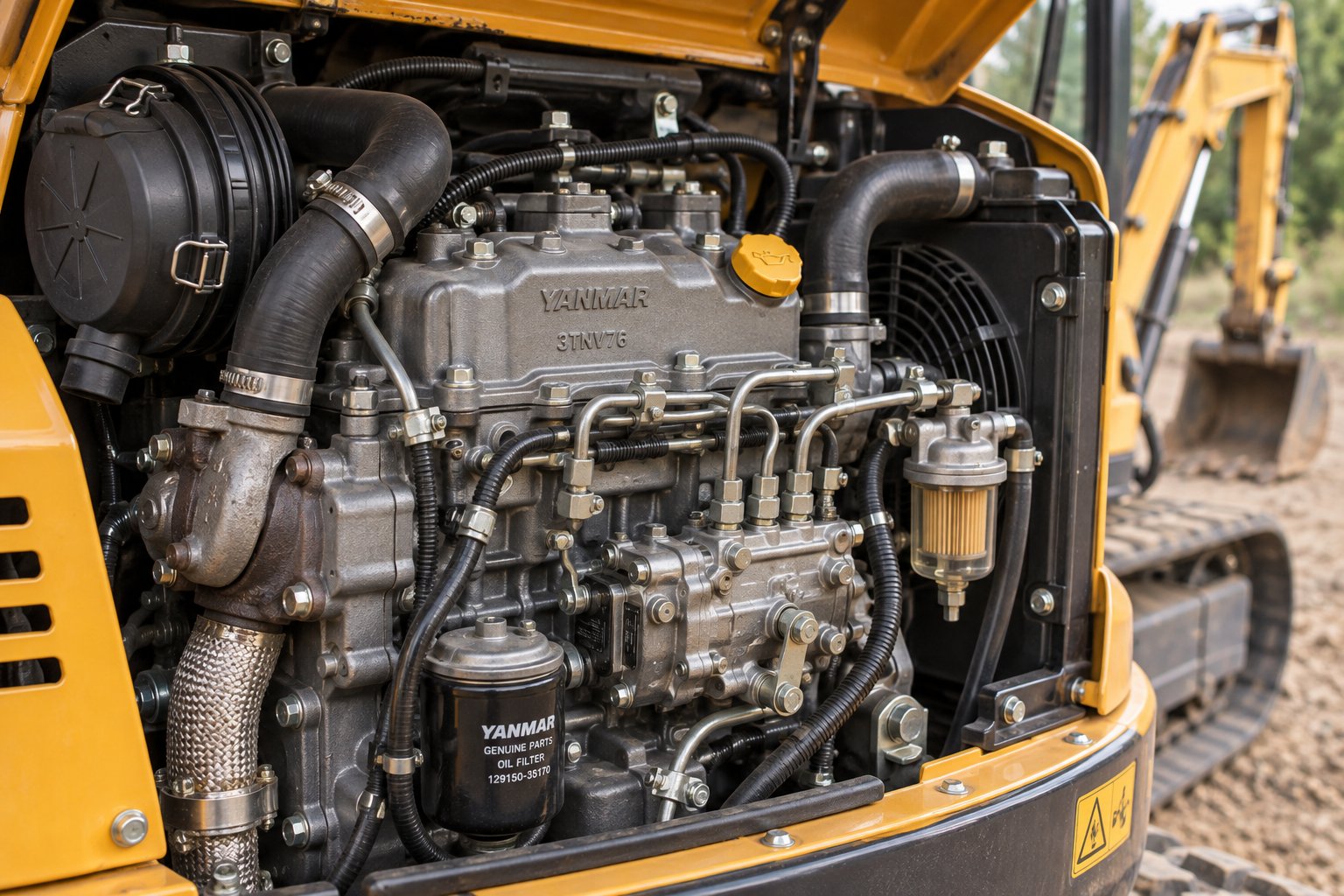
Pop the engine cover on two compact excavators shipped from the same Chinese port, and you might find entirely different powerplants staring back at you. One carries a Kubota D902 diesel — the same engine inside machines sold by established Western brands. The other runs a Changchai or Xinchai unit built for the Chinese domestic market. Both machines look similar from the outside, both ship from Shandong, and both show up on the same marketplace listing pages. Yet that engine choice alone determines whether you can legally operate the machine in the United States, how easily you'll source replacement parts, and what the excavator will be worth when you're ready to sell it.
No other single component carries this much downstream consequence. And no competing product page bothers to explain it.
Internationally Sourced Engines — Yanmar, Kubota, and Briggs and Stratton
Many mid-tier and premium Chinese excavator factories deliberately spec Japanese or Western diesel engines for their export models. The reasons are practical, not just cosmetic. Yanmar's 4TNV series and Kubota's D722, D902, and V2607 families are the workhorses of the global compact equipment industry — they power everything from Bobcat excavators to Takeuchi loaders. When a Chinese manufacturer installs a genuine Kubota D902 in a 2-ton machine destined for the US market, that engine carries EPA Tier 4 Final certification issued by Kubota itself, not the machine assembler.
Why does this matter so much? Think about what happens three years into ownership. A hydraulic hose bursts on a Tuesday morning, and you need the machine running by Thursday. With a Yanmar or Kubota engine, you're tapping into the same parts and service ecosystem that supports millions of units already operating across North America, Australia, and Europe. Your local Kubota dealer stocks filters, injectors, and gaskets. Independent diesel mechanics recognize the engine on sight. Online parts retailers like those found through auto parts databases carry the full complement of service items.
A Yanmar-powered machine exported from China has the same engine service ecosystem as a Yanmar-powered Bobcat. The frame came from a different factory — the engine did not. That distinction collapses the parts-availability argument that critics often level against Chinese-built equipment.
Briggs and Stratton's Vanguard diesel line occupies a smaller niche but shows up in some sub-2-ton machines configured for the North American market. Parts availability through Briggs' extensive US dealer network gives these engines a similar servicing advantage, though they're less common in the compact excavator space than their Japanese counterparts.
Chinese-Made Engines — Changchai, Xinchai, and Laidong
Budget-tier and many entry-level mid-range excavators ship with Chinese-manufactured diesel engines. Changchai, Xinchai, and Laidong are the names you'll encounter most frequently. These aren't obscure startups — they're established Chinese engine manufacturers producing millions of units annually for agricultural equipment, generators, and construction machinery throughout Asia, Africa, and South America.
Pros
The cost advantage is real. A machine equipped with a Changchai or Xinchai engine can price several thousand dollars below an otherwise identical unit fitted with a Kubota. For buyers operating in markets without strict emissions regulations — much of Southeast Asia, parts of South America, and many African nations — these engines deliver adequate performance at a fraction of the cost. Reliability has genuinely improved over the past decade, with modern Xinchai units featuring electronic fuel injection and tighter manufacturing tolerances than their predecessors.
Cons
The challenges emerge once the machine crosses into a regulated Western market. Overseas parts networks for these brands are thin to nonexistent in North America and Europe. When a Xinchai injector fails in rural Texas, you're not driving to a local dealer — you're ordering from China and waiting weeks for delivery. Finding a mechanic who has worked on the engine before? Even harder.
The compliance gap is the bigger issue. As Hongli Machinery's EPA compliance guide documents, standard Chinese domestic engines like Laidong, Changchai, and Xinchai do not carry EPA Tier 4 Final certification. Neither the standard variants nor the Euro V equivalent versions meet the US emissions threshold. Federal EPA regulations apply to engines sold or imported into the United States regardless of where the machine will be used — even on private land. A non-compliant engine that was never certified for US sale violates the Clean Air Act whether it's digging on a commercial jobsite or a backyard farm.
Why Engine Choice Affects Resale Value and Compliance
Engine brand connects directly to two concerns that first-time importers routinely underestimate: the ability to resell the machine domestically and meeting US emissions standards.
Resale value is straightforward market logic. A used compact excavator with a Yanmar or Kubota engine badge sells into the same buyer pool as used Bobcat, Takeuchi, and Kubota-branded machines. Dealers recognize the engine, service history is verifiable, and the next owner knows parts are a phone call away. A machine running a Changchai engine, by contrast, appeals to a drastically smaller buyer pool in North America. Many used equipment dealers won't list it at all because they can't support warranty claims or parts inquiries on an engine their mechanics have never serviced. The practical result? Steeper depreciation and longer time-to-sale.
Compliance is even more consequential. Any diesel engine operating in the US must meet EPA Tier 4 Final emissions standards, and California layers on additional CARB requirements that restrict operation of non-compliant off-road diesel equipment. A Tier 3 engine — let alone a non-tiered Chinese domestic unit — cannot be newly manufactured or imported into the US for sale. Machines that slip through without proper documentation face customs seizure, operational fines, and effectively zero legal resale value. The EPA certificate belongs to the engine manufacturer, not the machine OEM, so verifying compliance means checking the engine's own certification rather than trusting a label on the excavator's boom.
The FOB price difference between a Chinese-engine model and a Kubota-engine model might look like savings — until you factor in compliance risk, parts availability, and a resale market that won't touch non-certified equipment.
Before committing to any purchase, arm yourself with the right questions. Here's what every buyer should ask a seller — whether it's a factory, reseller, or marketplace vendor — about engine specifications:
- What is the exact engine make, model, and displacement installed in this machine?
- Does the engine carry EPA Tier 4 Final certification, and can you provide the EPA Certificate of Conformity number?
- Is the engine also CARB-compliant for operation in California?
- Does the machine require Diesel Exhaust Fluid (DEF), and if so, what is the DEF tank capacity?
- Where is the nearest authorized service center for this engine brand in my region?
- Are common wear parts — filters, injectors, gaskets, belts — available through domestic distributors or only via international order?
- What is the engine's emissions label information, and is the physical label affixed to the engine block as required by EPA regulations?
- Can you provide documentation showing the engine was manufactured within the current Tier 4 Final production window rather than being an older Tier 3 unit?
Any reputable seller will answer these questions without hesitation. Evasion, vague responses, or pressure to skip the compliance conversation? Those are signals worth paying attention to — and they lead directly into a broader set of red flags and buying-channel trade-offs that separate a smart purchase from an expensive lesson.
Factory Direct vs Reseller vs Marketplace
So you've identified the right tonnage class, confirmed the engine brand you want, and even know which quality tier matches your budget. The next fork in the road catches more first-time buyers off guard than any spec-sheet detail: where do you actually buy the machine? The purchasing channel you choose shapes everything from unit cost and delivery speed to warranty coverage and what happens when something goes wrong six months into ownership.
Three distinct channels dominate the market for compact excavators shipped from China, and each one trades certain advantages for very specific risks. No single channel is universally "best" — the right choice depends on your volume, risk tolerance, and how much of the import logistics you're willing to manage yourself.
Buying Factory-Direct from Chinese Manufacturers
Going straight to the source offers the lowest per-unit cost. You're cutting out every middleman — no dealer margin, no reseller markup, no marketplace commission layered on top of the factory quote. For bulk buyers, importers, or equipment dealers building inventory, factory-direct purchasing also unlocks customization options that downstream channels rarely offer. Want a specific engine and hydraulic pump combination? A custom paint scheme for your rental fleet? A non-standard boom length? The factory can configure to order because you're communicating directly with the people building the machine.
The trade-offs, however, are substantial. Industry sourcing guides highlight that factory-direct buyers take on responsibilities a domestic dealer would normally handle: arranging international freight, coordinating customs clearance, managing import paperwork, and navigating communication across time zones and language barriers. Production-to-delivery timelines for a built-to-order compact excavator can stretch from several weeks to a few months depending on factory backlog, component availability, and shipping routes.
Warranty enforcement presents the steepest challenge. If a hydraulic pump fails eight months after delivery, your recourse runs through international channels — emails to a factory team operating twelve hours ahead of you, potential language gaps around technical descriptions, and replacement parts shipped via ocean freight rather than overnight courier. For a contractor whose livelihood depends on machine uptime, that delay can cost more than the savings the factory-direct price delivered in the first place.
Purchasing Through a US-Based Reseller or Dealer
A US-based reseller occupies the middle ground between factory pricing and full-service domestic support. These businesses import machines in volume — often from mid-tier or premium Chinese OEMs — and sell from domestic inventory. The machine may already be sitting in a US warehouse, pre-inspected and ready to ship within days rather than months.
The advantages are immediate. Domestic warranty support means a phone call to a US-based team, not an overseas email chain. Machines sold through established resellers are often pre-configured for EPA compliance, sparing you the documentation headaches that trip up direct importers. And because these dealers stake their reputation on repeat business, they're incentivized to vet factory quality before the machine ever reaches their lot.
As a practical example, platforms like JIUHONG's excavator collection let buyers browse compact and larger machines from multiple brands in a single catalog, compare listings side by side, and request model-specific quotes for individual or bulk purchases. Rather than gambling on a marketplace listing with unverifiable photos, you're reviewing curated inventory from a platform designed for direct purchasing. Worth noting: JIUHONG's collection spans a broad range of excavator sizes and brands rather than focusing exclusively on mini excavators, so buyers should filter for the tonnage class and configuration that fits their project needs.
The downside? Higher unit pricing — sometimes meaningfully so. That markup covers the reseller's import costs, warehousing, inspection labor, warranty reserves, and domestic logistics. Brand selection can also be narrower than what you'd find sourcing factory-direct, since each reseller stocks only the manufacturers they've vetted and built relationships with.
Using B2B Marketplaces Like Alibaba or Made-in-China
Alibaba, Made-in-China, and similar B2B platforms offer the widest selection at the broadest price range. Thousands of suppliers list compact excavators, many with supplier verification badges and Trade Assurance icons that promise a layer of buyer protection. For a first-time buyer researching options, the sheer volume of listings can feel like an advantage — you can compare dozens of factories, request quotes within minutes, and filter by certification or region.
The reality is more complicated. As ChineseCheck's Trade Assurance analysis documents, those verification badges are payment protection mechanisms, not supplier quality certifications. A factory can carry Trade Assurance and still be a trading company misrepresenting itself as a manufacturer, or a newly registered entity with no export track record. Trade Assurance coverage caps vary widely between suppliers, and protection evaporates entirely if a seller convinces you to pay outside the platform — a common tactic offered under the guise of a small discount.
Dispute resolution exists on paper but plays out unevenly in practice. Quality claims depend entirely on how precisely your order contract was written. A vague specification like "good quality mini excavator" gives you almost no leverage if the delivered machine falls short of your expectations but technically matches the contract language. And the dispute window has strict time limits — miss it, and you absorb the loss regardless of merit.
For experienced importers who know exactly what to specify, how to structure contracts, and when to deploy third-party inspections, marketplace sourcing can work. For first-time buyers still learning the landscape, it introduces the highest concentration of variables with the least safety net.
Channel Comparison at a Glance
| Factor | Factory Direct | US-Based Reseller / Dealer | B2B Marketplace (Alibaba, etc.) |
|---|---|---|---|
| Unit Price | Lowest — no middleman markup | Moderate — includes import, inspection, and warranty costs | Variable — ranges from very low to mid, depending on supplier |
| Lead Time | Longest — production plus ocean freight plus customs | Shortest — often ships from US inventory within days | Medium to long — depends on whether machine is in stock or built to order |
| Warranty Support | Limited — managed internationally through the factory | Strongest — domestic support team, US-based parts | Uncertain — depends on individual supplier's willingness and capability |
| Customization | High — direct access to factory configuration options | Low to moderate — limited to what the reseller orders from their OEM partner | Moderate — some suppliers offer customization, but verifying execution is harder |
| Risk Level | Moderate — manageable with experience and due diligence | Lowest — pre-inspected inventory, domestic legal recourse | Highest — variable quality, limited recourse despite Trade Assurance branding |
| Best Suited For | Bulk importers, equipment dealers, experienced international buyers | Contractors, small fleet operators, first-time buyers | Experienced sourcing professionals with strong contract-writing skills |
Whichever channel you choose, one reality stays constant: the number on the quote or listing page is never the final number you'll pay. Between the FOB price a factory quotes and the moment a compact excavator rolls off a trailer onto your jobsite, a stack of additional costs — freight, duties, tariffs, inspections, and compliance paperwork — quietly accumulates. Understanding that full cost stack is the difference between a smart investment and a budget-busting surprise.
True Landed Cost
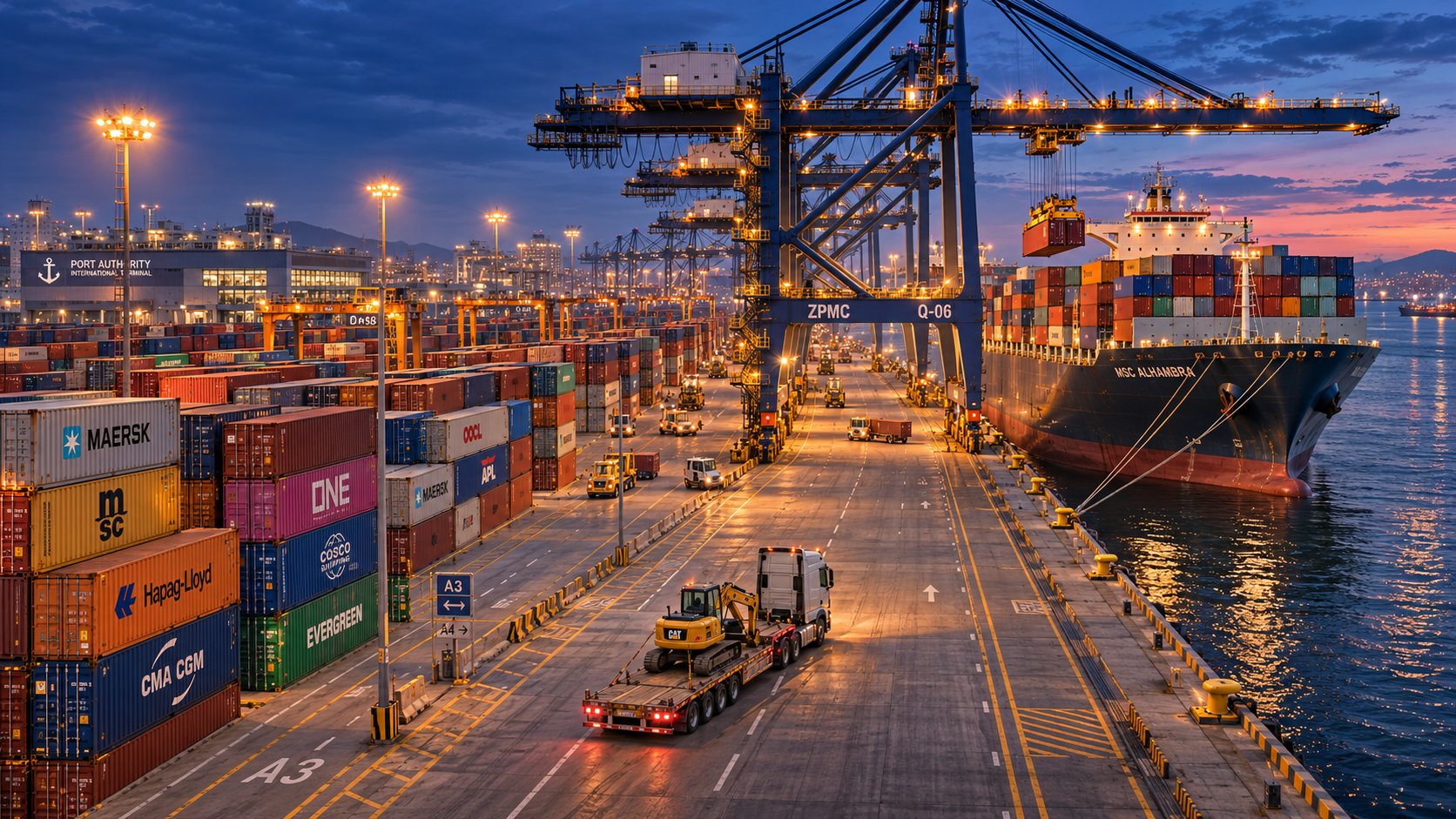
That FOB price on a factory quote or marketplace listing? It's the opening number in a much longer equation. Between the moment a Chinese manufacturer loads your compact excavator into a shipping container and the moment it rolls off a trailer at your jobsite, a stack of additional charges — some predictable, others genuinely surprising — adds up to a final figure that can exceed the quoted machine price by a significant margin.
One real-world example from a Florida contractor importing a 2.5-ton machine illustrates the pattern clearly. The supplier quoted CIF Miami at a total of $17,000. By the time terminal handling, customs clearance, import duties, drayage, and two days of demurrage charges landed on the invoice, the actual cost hit $19,116 — more than $2,100 in charges the buyer never budgeted for. That pattern, according to logistics specialists who handle these shipments routinely, repeats itself across thousands of equipment imports every month.
Understanding each cost layer before you commit to a purchase transforms the decision from a gamble into a calculable investment.
From FOB Price to Your Jobsite — The Full Cost Stack
Every dollar between the factory gate and your first dig falls into one of these cost categories. Walk through them sequentially, and you'll have a complete framework for requesting — and evaluating — itemized quotes from any seller or freight forwarder.
- Purchase price (FOB). The base machine cost at the Chinese port of departure. For a 2-ton compact excavator, dealer import data places FOB prices in the range of $9,500 to $13,000 per unit, depending on engine brand, configuration, and factory tier. Confirm exactly what's included — standard bucket, quick hitch, and spare parts kits are sometimes extras.
- Inland freight to the Chinese port. If the factory sits inland from the departure port, trucking the machine to Shanghai, Qingdao, or Ningbo adds cost. Some suppliers include this in their FOB quote; others quote EXW (ex-works) from the factory gate, leaving port delivery to you. Clarify the distinction upfront.
- Lashing, blocking, and cargo securing. A compact excavator weighing one to six tons must be professionally secured inside the container to prevent shifting during ocean transit. Freight specialists estimate materials and labor at $200 to $600 per container — an investment that prevents cargo damage claims costing far more.
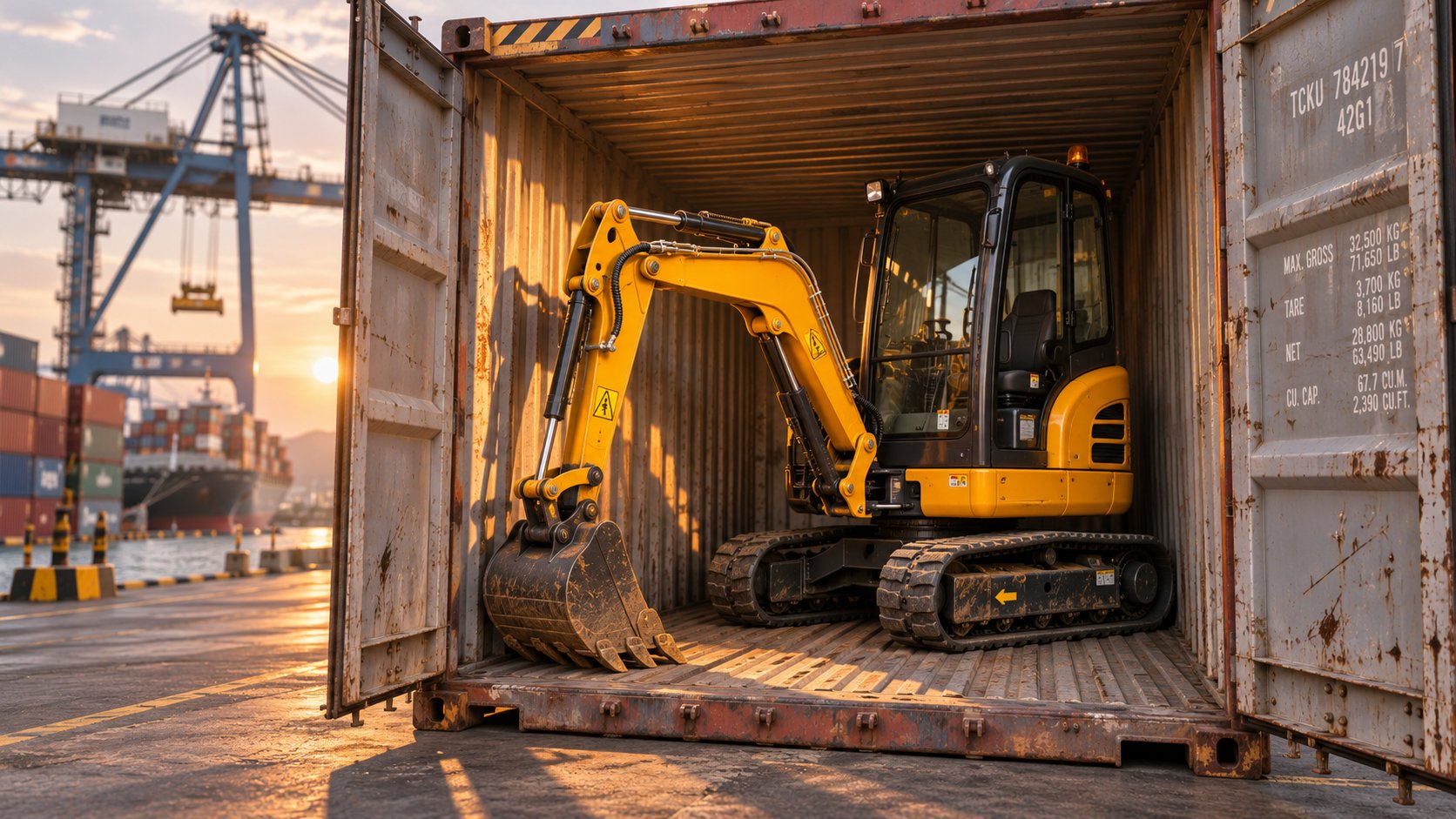
- Ocean freight. Container rates fluctuate with seasonal demand and fuel prices. Based on aggregated shipment data, a 40-foot high-cube container — which typically holds four to eight mini excavators — runs roughly $1,700 to $2,800 from China to the US West Coast and $2,700 to $3,400 to the East Coast. Dividing the total by the number of units in the container gives you the per-machine freight cost, which dealer-facing estimates place at $300 to $900 per unit in a six-machine load.
- Marine cargo insurance. Strongly recommended and relatively inexpensive — typically 0.3% to 0.5% of the declared cargo value, which translates to roughly $30 to $65 per machine for a standard compact excavator shipment.
- US customs duties (Column 1 duty). The base import duty applied to the machine's declared value under its Harmonized Tariff Schedule classification. Rates vary by specific HTS subheading — always confirm the applicable rate with a licensed customs broker before shipping.
- Section 301 tariffs on Chinese-origin machinery. This is where costs escalate sharply. Chinese goods fall under Section 301 tariff lists imposing an additional 25% on products covered by Lists 1 through 3, on top of the standard Column 1 duty. Since July 24, 2026, a separate 12.5% forced-labor duty under Section 301 also applies to most Chinese-origin goods. These duties stack — meaning you potentially pay the base duty, plus 25%, plus 12.5%, all calculated on the product's customs value. The combined tariff burden alone can add thousands of dollars per machine.
- Port handling, terminal charges, and drayage. Moving the container from vessel to terminal yard, processing documentation, and trucking it to your location generates multiple line items. Terminal handling runs $300 to $800 per container at US ports, documentation fees add $75 to $150, and inland drayage from port to your site ranges from $200 for a short local move to $1,000 or more for longer distances.
- Customs broker fees. Your broker handles entry filing, duty calculation, and document coordination. Expect $125 to $350 per entry, plus merchandise processing fees (typically 0.3464% of declared value) and harbor maintenance fees.
- Assembly, pre-delivery inspection, and first-year maintenance. Machines may arrive with certain components removed for shipping. Reassembly, fluid checks, a full functional test, and initial service supplies add an estimated $800 to $1,200 in dealer preparation costs per unit. First-year maintenance — filters, fluids, and wear items — should be budgeted from day one, especially if the engine brand requires international parts sourcing.
Adding these layers together, comprehensive dealer calculations for a 2-ton machine place the total landed cost at roughly $12,800 to $19,000 per unit before any dealer margin — and that estimate was assembled before the July 2026 forced-labor tariff added another 12.5%. The gap between the FOB quote and the true delivered cost is not a rounding error. It's a budget category unto itself.
Hidden Costs That Catch First-Time Importers
The line items above are predictable once you know to ask for them. The charges that genuinely blindside first-time buyers tend to be the ones nobody mentions until an invoice arrives.
Demurrage and detention. Your container arrives at port. Customs clearance takes longer than expected — maybe a document mismatch, maybe a random government inspection. Every day beyond your allotted free time (typically three to seven days), the shipping line charges demurrage. Major carriers assess $185 per day for standard containers at US and Canadian ports. Keep the container too long after picking it up, and detention charges kick in at the same daily rate. Four days of demurrage plus three days of detention? That's $1,295 you never saw coming.
EPA certification paperwork and potential re-engineering. If the machine arrives with an engine that lacks proper EPA Tier 4 Final documentation, you face a choice between expensive re-engineering — potentially swapping the entire engine — and a machine that cannot legally operate in the United States. The paperwork itself isn't free either; verifying and filing compliance documentation adds time and cost that factory-direct buyers rarely budget for.
CARB compliance for California buyers. California's Air Resources Board imposes additional restrictions beyond federal EPA standards. A machine that passes EPA Tier 4 Final nationally may still face CARB-specific registration requirements. Non-compliance means the machine can't operate in the state — period.
Replacement parts for Chinese-brand engines without a local dealer network. This cost doesn't appear on any import invoice, but it hits your wallet the first time something breaks. When a Changchai injector fails and the nearest parts source is a factory in Hefei, you're paying international shipping, enduring multi-week lead times, and absorbing machine downtime that a Kubota or Yanmar owner would resolve with a same-day parts counter visit. Over a machine's working life, these cumulative service delays can easily exceed the upfront savings of a cheaper engine.
Container exams and inspection holds. US Customs and Border Protection randomly selects containers for physical inspection. Exam fees range from $150 to $400, plus repositioning costs and — you guessed it — additional demurrage while the container sits waiting for its turn.
The FOB price on a Chinese mini excavator quote can represent as little as half the true landed cost once ocean freight, Section 301 tariffs, the forced-labor duty, port charges, customs fees, and first-year operating expenses are factored in. Any buyer who budgets based on the FOB number alone is building on a foundation that's missing a floor.
The cost picture becomes clearer with itemized quotes and tariff verification — but dollars aren't the only thing at stake. Regulatory compliance and seller legitimacy carry risks that no amount of budgeting can offset if you don't know what warning signs to watch for.
Compliance Rules and Red Flags Every Buyer Should Know
Dollars and cents dominate most import conversations — but regulatory exposure and outright fraud carry consequences that dwarf any line item on a shipping invoice. A machine that clears customs with a non-compliant engine creates a legal liability that follows the owner, not the seller. A wire transfer sent to a fictitious factory disappears permanently. Neither risk shows up in an FOB quote, and neither gets mentioned on the product pages competing for your attention right now.
This section exists to change that. Think of it as the due-diligence checklist you'd want a trusted advisor to hand you before you commit a single dollar to any compact excavator purchase from overseas.
EPA and CARB Engine Compliance for US Buyers
Every diesel engine sold or imported into the United States must meet federal emissions standards — no exceptions for private land, small operations, or machines "only used occasionally." The EPA's nonroad diesel engine regulations establish a tiered framework, and the current standard for newly manufactured engines is Tier 4 Final. These rules require advanced emission control technologies and apply to excavators and other construction equipment alongside farm tractors, forklifts, and utility generators.
Here's where many budget-tier mini excavator imports run into a wall. Machines equipped with Chinese domestic engines — Changchai, Xinchai, Laidong, and similar brands — typically carry Chinese national emission certifications or Euro V equivalent approvals. Neither of those satisfies EPA Tier 4 Final. The engine manufacturer, not the machine assembler, holds the EPA Certificate of Conformity. If the engine maker never applied for US certification, no amount of paperwork from the excavator factory can fix the gap.
The enforcement mechanism is straightforward. US Customs and Border Protection can detain equipment with non-compliant engines at the port of entry. Even if a machine slips through, operating it violates the Clean Air Act. Penalties apply to the importer and the operator — meaning you absorb the risk whether you bought the machine knowingly or were simply never told about the compliance gap.
California layers on additional restrictions through its Air Resources Board (CARB). CARB maintains its own off-road diesel equipment regulations that can be stricter than federal EPA rules. A machine that satisfies EPA Tier 4 Final nationally may still need to meet CARB-specific registration and fleet reporting requirements before it can legally operate anywhere in the state. Buyers in California — or buyers who might resell to California-based contractors down the line — need to verify CARB compliance separately from EPA status.
The practical takeaway? Request the EPA Certificate of Conformity number for the specific engine installed in the machine. Verify it against the EPA's published certification records under 40 CFR Part 1039. If the seller cannot produce this document or deflects the question, treat that as a disqualifying answer — not a negotiation point.
Red Flags That Signal a Risky Seller or Listing
Compliance gaps aren't always accidental. Some sellers deliberately obscure engine specifications, misrepresent certifications, or structure transactions to minimize your recourse. The Better Business Bureau investigated one fake equipment website tied to approximately $51,000 in reported losses in a single case — buyers wired money for machines that never arrived. That's an extreme example, but subtler forms of misrepresentation are far more common and harder to detect.
You don't need a forensic investigation to spot most warning signs. Run through this checklist before engaging with any seller, whether it's a factory in Jining, a marketplace listing on Alibaba, or a domestic reseller you found through a search ad:
- Pricing dramatically below market norms. A 2-ton compact excavator with a Kubota engine priced at half of what comparable machines sell for isn't a deal — it's a trap. Scammers use artificially low prices to trigger urgency and short-circuit your due diligence. If the gap between the listing price and market value can't be explained by the seller in concrete terms, walk away.
- Refusal to provide engine compliance documents. Any legitimate seller can produce the EPA Certificate of Conformity number, the engine's emissions label information, and documentation confirming Tier 4 Final status. Evasion on this point is not a minor oversight — it signals either a non-compliant machine or a seller who doesn't actually possess the equipment they're advertising.
- No verifiable factory address. A real manufacturer has a physical location that shows up on satellite imagery, appears in Chinese business registration databases, and can be visited by a third-party inspector. A seller who provides only a generic city name or refuses to share a factory address is hiding something fundamental.
- Stock photos instead of actual machine images. Legitimate sellers photograph the specific unit you're buying — serial number visible, factory floor in the background, real lighting conditions. Polished studio shots or images watermarked with a different company's logo indicate that the seller may not have the machine in hand.
- Pressure to pay via wire transfer without trade assurance. Wire transfers are nearly impossible to reverse once sent. A seller who insists on direct bank transfer while discouraging escrow, trade assurance, or any form of payment protection is structuring the deal to eliminate your recourse. As the BBB advises, caution with wire transfers is warranted precisely because recovery after fraud is extremely difficult.
- Vague or copy-pasted specifications. Generic descriptions like "strong power" or "high efficiency" without specific engine models, hydraulic flow rates, dig depth measurements, or operating weights suggest the seller is recycling marketing language rather than describing an actual machine. Legitimate spec sheets include measurable, verifiable numbers.
- No clear warranty terms. If the warranty is described only in generalities — "we guarantee quality" — rather than specifying coverage duration, component inclusions, claim procedures, and who bears shipping costs for replacement parts, the warranty effectively doesn't exist.
- Urgency tactics. "Another buyer is interested" or "this price expires today" are pressure phrases designed to prevent you from completing the checks on this list. A genuine deal survives your questions. A fraudulent one depends on you not asking them.
Protecting Yourself During the Transaction
Spotting red flags keeps you away from the worst sellers. Structuring the transaction properly protects you even when a seemingly legitimate deal encounters unexpected problems. These safeguards aren't optional extras — they're the minimum standard for any cross-border equipment purchase.
Use escrow or trade assurance — but on your terms. Escrow services hold your payment until you confirm the goods meet agreed specifications. Alibaba's Trade Assurance offers a version of this within its platform. The critical detail: choose the escrow provider yourself. Fake escrow sites are a documented scam tactic — a seller who insists on a specific escrow company they "always use" may be directing you to a fraudulent mirror site. Verify the escrow provider independently through their official website and customer service line before depositing funds.
Request live video walkarounds. A 10-minute video call showing the actual machine — engine running, hydraulic functions cycling, serial number plate visible — costs the seller nothing and tells you volumes. Ask the operator to demonstrate boom extension, bucket curl, slew rotation, and blade function. Request a close-up of the engine compartment showing the emissions label physically affixed to the block. Sellers who refuse this basic request are raising the same red flag as a used car dealer who won't let you start the engine before buying.
Hire a third-party inspection service. Independent inspection companies operate throughout China's manufacturing regions, including the Shandong excavator corridor. As NBNQC's inspection FAQ explains, a third-party inspector checks products against your agreed specifications, documents findings with photographs, and delivers an objective report — all for roughly $198 per man-day. For a machine costing $10,000 to $20,000, that inspection fee is negligible insurance against receiving equipment that doesn't match what you ordered. Pre-shipment inspection, where the inspector verifies the finished machine before it enters a container, is the most common and practical timing for equipment purchases.
Verify factory credentials through export records. Chinese customs data and trade databases allow you to check whether a factory has a genuine export history — how many shipments, to which countries, over what time period. A factory claiming ten years of US export experience but showing zero export records in trade databases is misrepresenting itself. Ask for references from previous international buyers and actually contact them. A five-minute phone call to a contractor who bought from the same factory last year is worth more than any marketing brochure.
Get everything in writing before money moves. A verbal promise about engine brand, warranty coverage, or included accessories means nothing once a container is on the water. Your purchase contract should specify the exact engine make and model, EPA certification status, warranty terms and claim procedures, included attachments and spare parts, delivery timeline, and remedies for non-conforming goods. Ambiguous language like "good quality" or "as discussed" gives you no leverage in a dispute. Precise, measurable terms — "Kubota D902-E4B engine, EPA Tier 4 Final certified, serial number to be provided prior to shipment" — give you a contractual foundation that holds up whether you're filing a Trade Assurance claim or consulting an attorney.
These protections don't guarantee a perfect outcome. No checklist eliminates risk entirely when you're buying heavy equipment across international borders. But they systematically close the gaps that scammers and careless sellers exploit — and they put you in a fundamentally stronger position than a buyer who evaluates a mini excavator from China based solely on the listing price and a product photo.
With compliance verified and transaction safeguards in place, the final question becomes the most consequential one: does a Chinese-manufactured compact excavator actually make sense compared to buying from an established brand — and under what circumstances does each option deliver better long-term value?
Chinese Mini Excavators vs Established Brands
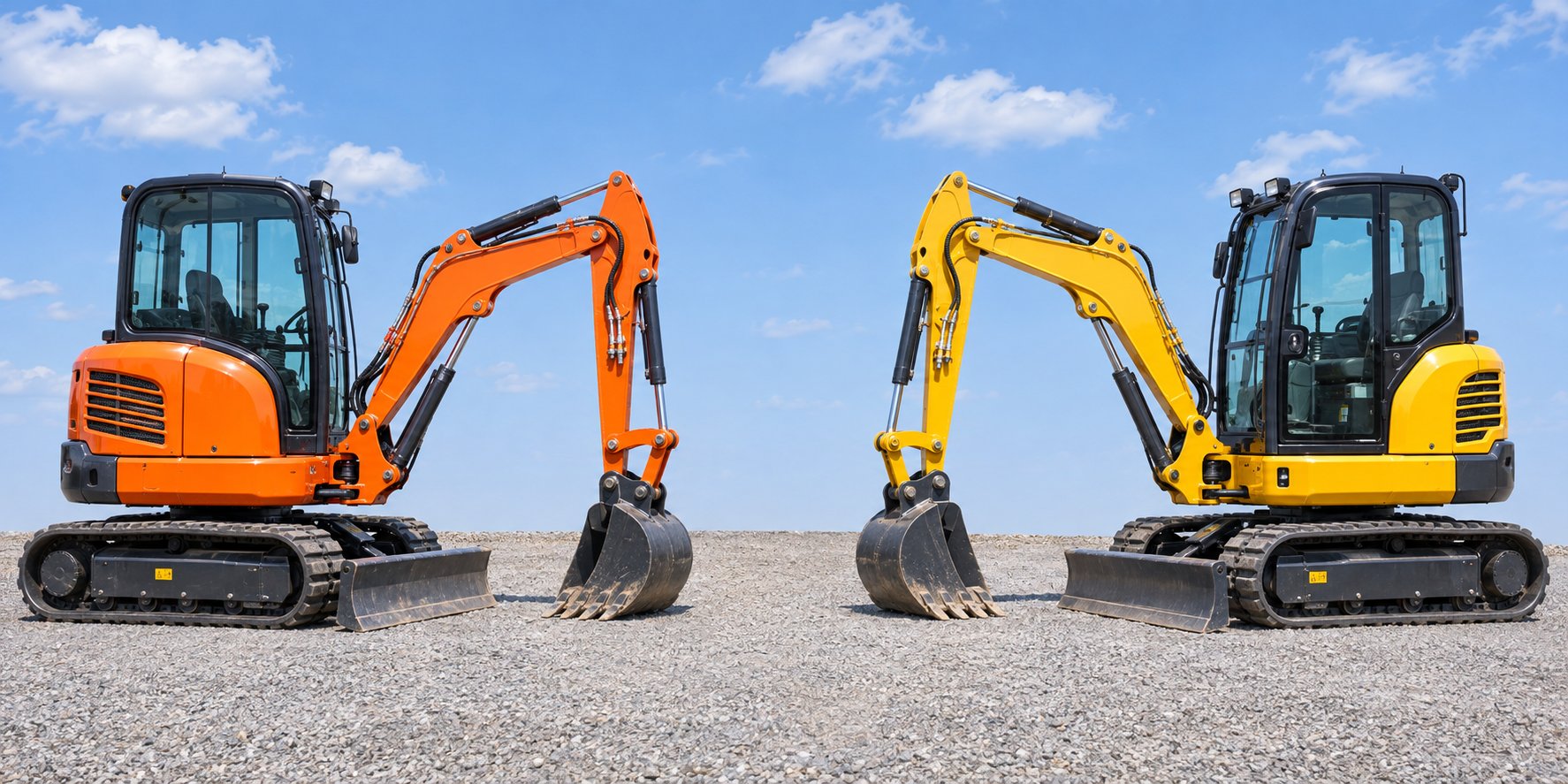
Compliance is checked, red flags are cataloged, and the transaction playbook is ready. The question that remains is deceptively simple: should you actually buy a compact excavator from a Chinese manufacturer, or does a Kubota, Caterpillar, Bobcat, or Yanmar still make more sense for your situation? The honest answer depends on which advantages matter most to your operation — and which trade-offs you can absorb.
Where Chinese Mini Excavators Compete Well
Upfront purchase price is the most visible advantage, but it's not the only one. Chinese manufacturers — particularly those in the mid and premium tiers — compete effectively on several fronts that established brands struggle to match.
First, the cost gap is structural, not promotional. A Chinese factory producing a 2-ton excavator with a Kubota engine and Eaton hydraulics operates at landed costs roughly 40 to 55 percent below Japanese equivalents in the same weight class. That's not a liquidation sale — it's the result of lower labor costs, regional supply-chain clustering in Shandong, and fewer distribution layers between factory and buyer.
Second, customization flexibility. Need a non-standard arm length, a specific hydraulic coupler configuration, or machines painted in your fleet colors? Most Chinese OEMs accommodate small-batch customization that major brands reserve for large-volume fleet orders. A contractor buying five units gets the same configurability that Caterpillar might offer a rental company ordering fifty.
Third, availability of basic configurations without the wait. During periods of high global demand — a pattern the industry saw repeatedly between 2022 and 2025 — Japanese manufacturers faced lead times stretching to 20 to 26 weeks on certain compact models. Chinese factories maintained delivery windows of four to ten weeks for standard configurations, giving buyers access to revenue-generating equipment months earlier.
Where Established Brands Still Hold the Advantage
Price and speed don't tell the whole story. Established Japanese and Western brands carry advantages that compound over the machine's working life — advantages a first-time buyer might undervalue and a seasoned fleet manager would never ignore.
Resale value is the clearest differentiator. A five-year-old Kubota KX033 or Bobcat E35 with documented service history sells into a deep, liquid resale market. Used equipment dealers know the machine, financiers will lend against it, and the next buyer trusts the brand implicitly. A Chinese-brand machine of the same age and condition faces a thinner buyer pool in North America, longer time-to-sale, and steeper depreciation — even if the underlying components are comparable.
Dealer and service networks provide a safety net that factory-direct imports simply cannot replicate. Caterpillar operates over 2,000 dealer locations worldwide. Kubota's North American network ensures parts availability within hours, not weeks. When a hydraulic pump fails on a Tuesday and you need the machine back on the jobsite by Thursday, that local dealer relationship is worth more than whatever you saved on the purchase price.
Proven long-term reliability track records are built across millions of operating hours and decades of field data. Well-maintained compact excavators from Kubota, Cat, and Yanmar routinely reach 8,000 to 12,000 hours before requiring major component overhaul. Chinese manufacturers are building that track record, but the data set is still years shorter and thinner in Western markets.
Financing options favor recognized brands. Equipment lenders base loan-to-value ratios on projected residual value and brand reputation. A new Bobcat qualifies for competitive financing through dealer programs; a Chinese-brand import may require cash payment or higher-interest commercial loans because the lender can't confidently project what the machine will be worth in three years.
A Side-by-Side Decision Framework
Rather than declaring a universal winner, use this framework to match each option against the factors that drive your specific buying decision. Ratings reflect general market consensus — individual models and manufacturers may outperform or underperform their category.
| Factor | Chinese Mini Excavators (Mid/Premium Tier) | Kubota | Caterpillar | Bobcat | Yanmar |
|---|---|---|---|---|---|
| Purchase Price Tier | Low to Mid | Mid to High | High | Mid to High | Mid to High |
| Parts Availability (North America) | Limited — depends on engine brand and reseller support | Excellent — extensive dealer network | Excellent — largest global dealer footprint | Very Good — strong dealer presence | Good — growing network, strong engine parts supply |
| Resale Value Retention | Low to Moderate — developing market presence | Strong — high demand in used market | Very Strong — premium residual values | Strong — recognized and trusted | Moderate to Strong — respected but smaller US footprint |
| Warranty Coverage Norms | 12-24 months; enforcement varies by channel | 24 months standard; dealer-backed | 24 months standard; full-service dealer support | 24 months standard; dealer-backed | 24 months standard; dealer-backed |
| Dealer Network Density (US) | Sparse — limited to select resellers | High — nationwide coverage | Highest — over 2,000 locations globally | High — strong North American presence | Moderate — growing but regionally concentrated |
| Build Quality Reputation | Variable — ranges from questionable to competitive depending on factory tier | Very High — decades of proven engineering | Very High — industry benchmark | High — consistent and well-documented | High — particularly respected for engine reliability |
The table reveals a consistent pattern: Chinese compact excavators win on upfront cost and purchasing flexibility, while established brands dominate in the ownership experience that follows — resale liquidity, service access, and the peace of mind that comes from a proven track record. Neither side holds every card.
For buyers whose projects demand the lowest possible capital outlay and who can manage their own parts sourcing and maintenance, a mid-tier or premium Chinese machine with an internationally sourced engine represents genuine value. For operations where machine downtime translates directly into lost revenue and where resale value matters at exit, the premium for an established brand pays for itself over the ownership cycle.
There's also a middle path worth exploring. Used compact excavators from established brands — Kubota, Cat, Bobcat, Yanmar — often land at price points competitive with new Chinese equipment while retaining the dealer support, parts ecosystem, and resale liquidity that branded machines carry. Buyers weighing both options can browse platforms like JIUHONG's excavator collection, which brings together compact and larger machines from multiple brands in one catalog, allowing side-by-side comparison and model-specific quotes for individual or bulk purchases. Comparing a used Kubota KX033 against a new Chinese 3.5-ton unit — same budget, different trade-offs — is exactly the kind of analysis that turns a good purchase decision into the right one.
Frequently Asked Questions About Buying a Mini Excavator From China
1. Are Chinese mini excavators any good?
Quality varies dramatically depending on the manufacturing tier. Budget-tier factories use domestic engines and minimal quality controls, producing machines best suited to unregulated markets. Mid-tier OEMs pair Chinese-built frames with internationally sourced Kubota or Yanmar engines and hold ISO 9001 certification, delivering machines that compete with entry-level branded equipment. Premium manufacturers like SANY and XCMG invest in proprietary hydraulic design, robotic welding, and export-grade compliance, producing units that global brands sometimes rebrand and sell under their own names. The key is identifying which factory tier you are dealing with rather than applying a blanket quality judgment to all Chinese-made machines.
2. Can I legally use a Chinese mini excavator in the United States?
Yes, but only if the installed diesel engine carries EPA Tier 4 Final certification. Many mid-tier and premium Chinese excavators ship with certified Kubota or Yanmar engines that fully satisfy US emissions requirements. However, budget models equipped with Chinese domestic engines from brands like Changchai, Xinchai, or Laidong typically lack EPA certification and cannot be legally imported or operated in the US. California buyers face additional CARB compliance rules. Always request the EPA Certificate of Conformity number for the specific engine before purchasing, and verify it against published EPA certification records.
3. How much does a mini excavator from China really cost after shipping and tariffs?
The true landed cost extends well beyond the FOB factory price. For a typical 2-ton compact excavator, FOB prices range from roughly $9,500 to $13,000, but ocean freight, marine insurance, US customs duties, Section 301 tariffs at 25%, the newer 12.5% forced-labor duty, port handling, drayage, customs broker fees, and pre-delivery inspection can push the total to $12,800 to $19,000 or more per unit. Unexpected charges like demurrage, container exam fees, and EPA documentation costs catch first-time importers off guard. Requesting fully itemized quotes that include every cost layer from factory to jobsite is essential before committing.
4. Should I buy factory direct from China or through a US-based reseller?
Each channel serves a different buyer profile. Factory-direct purchasing offers the lowest per-unit cost and maximum customization but requires you to manage international freight, customs clearance, and warranty claims across time zones. US-based resellers charge a markup but provide domestic warranty support, pre-inspected inventory, and faster delivery — often shipping from US warehouses within days. Platforms like JIUHONG's excavator collection at jiuhong-machinery.com let buyers compare machines from multiple brands and request model-specific quotes without marketplace uncertainty. B2B marketplaces like Alibaba offer wide selection but carry the highest risk for inexperienced importers due to variable quality and limited dispute resolution.
5. How do Chinese mini excavators compare to Kubota or Caterpillar in resale value?
Established brands like Kubota and Caterpillar retain significantly stronger resale values in North American markets. A five-year-old Kubota KX033 or Cat 303.5 with documented service history sells into a deep, liquid used-equipment market where dealers, financiers, and buyers trust the brand. Chinese-brand excavators face a thinner resale pool, longer time-to-sale, and steeper depreciation — even when equipped with the same Yanmar or Kubota engine found in branded machines. Buyers who prioritize long-term ownership economics may find that used excavators from established brands, available through curated platforms, offer a cost-effective middle ground between new Chinese equipment and new Western-brand pricing.