

Every Piece of Equipment Found on a Modern Construction Site
What equipment is used on a construction site? The answer spans hundreds of items across eight distinct categories: earthmoving machines, lifting and material-handling equipment, compaction and paving machines, concrete tools, site support infrastructure, hand tools and power tools, safety gear and PPE, and surveying and measurement instruments. Every successful project relies on the right combination of these tools working together in sequence, from the first survey stake to the final coat of paint.
What Counts as Construction Site Equipment
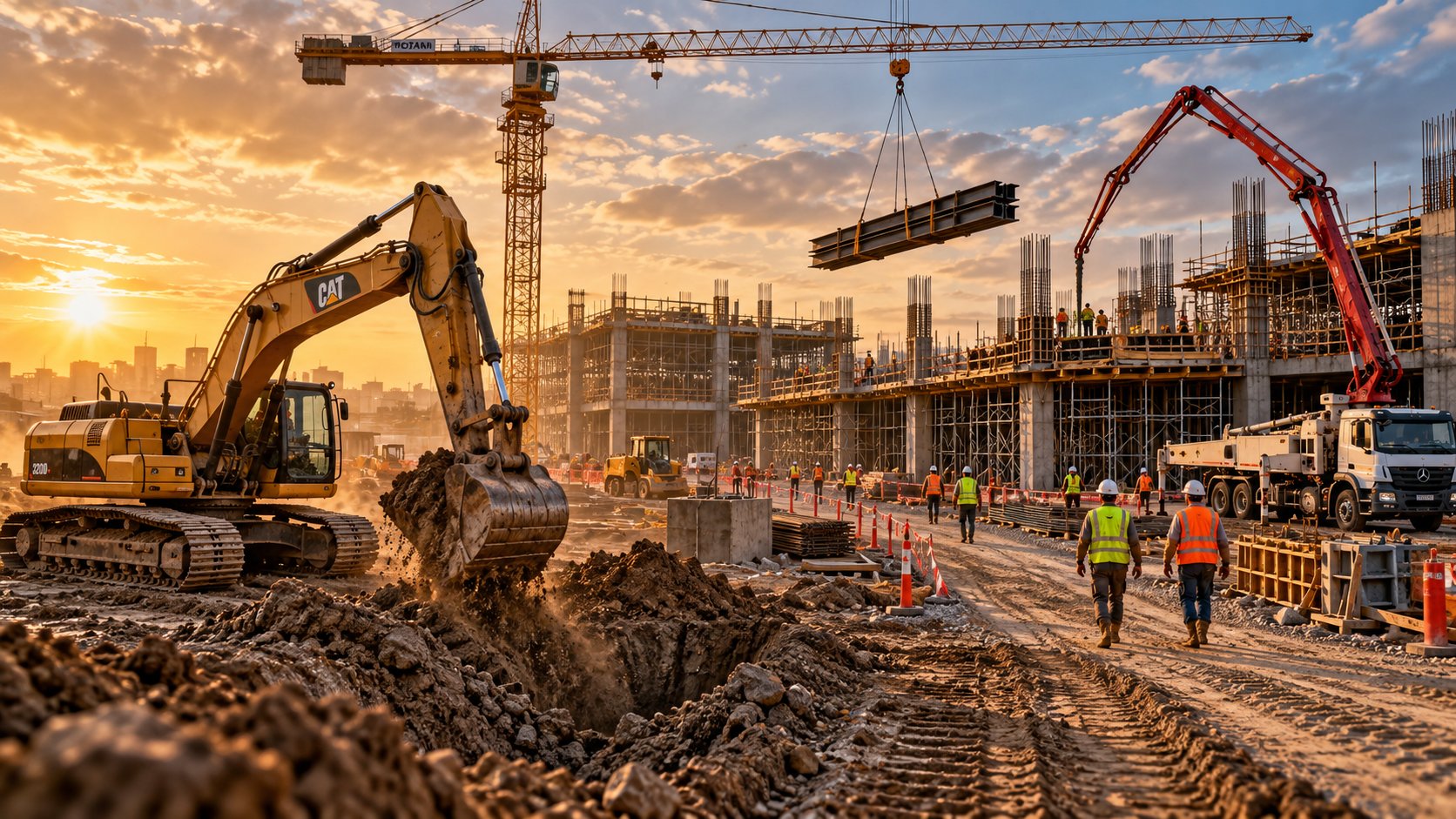
Imagine standing at the entrance of an active job site. You'll notice an 80-ton excavator carving out a foundation, a tower crane swinging steel beams overhead, and a construction equipment operator guiding a motor grader across a subgrade. Look closer, and you'll spot tape measures, chalk lines, hard hats, and cordless drills. All of it counts as construction site equipment.
The term covers any machine, tool, instrument, or protective device used to carry out physical work or ensure worker safety during construction. That includes everything from multi-million-dollar crawler cranes down to a five-dollar pair of safety glasses. Understanding what are the types of construction equipment, and how they relate to each other, helps contractors plan fleets, control budgets, and keep projects on schedule. For fleet managers, it drives smarter purchasing and rental decisions. For anyone entering the industry, it builds the foundational knowledge every role demands.
A Clear Way to Categorize Construction Equipment
Most equipment guides list machines randomly, which makes it hard to see how everything fits together. A category-based approach solves that problem. Here is the taxonomy this article follows:
- Earthmoving and Excavation - Excavators, bulldozers, loaders, and graders that dig, push, and shape raw ground.
- Lifting and Material Handling - Cranes, forklifts, and telehandlers that move materials vertically and horizontally.
- Compaction and Road Building - Rollers, plate compactors, pavers, and milling machines that create stable, finished surfaces.
- Concrete Equipment - Mixers, pumps, vibrators, and finishing tools that handle every stage of concrete placement.
- Site Support and Temporary Infrastructure - Generators, compressors, dewatering pumps, lighting, scaffolding, and mobile offices.
- Hand Tools and Power Tools - Hammers, levels, drills, saws, and grinders used for precision and finishing work.
- Safety and PPE - Hard hats, harnesses, high-visibility vests, and respiratory protection mandated by OSHA.
- Surveying and Measurement - Total stations, GPS receivers, laser levels, and aerial access platforms.
So what is considered heavy machinery within this framework? Generally, it refers to the large, engine-driven machines found in the first three categories, equipment heavy enough to require trailers for transport and trained operators for safe use. But a well-equipped site needs every category on this list, not just the big iron.
Each section ahead walks through one category in detail, explaining what each machine does, where it fits in a typical project workflow, and how equipment needs shift depending on whether you're building a single-family home or a highway interchange.
Earthmoving and Excavation Machines That Shape the Site
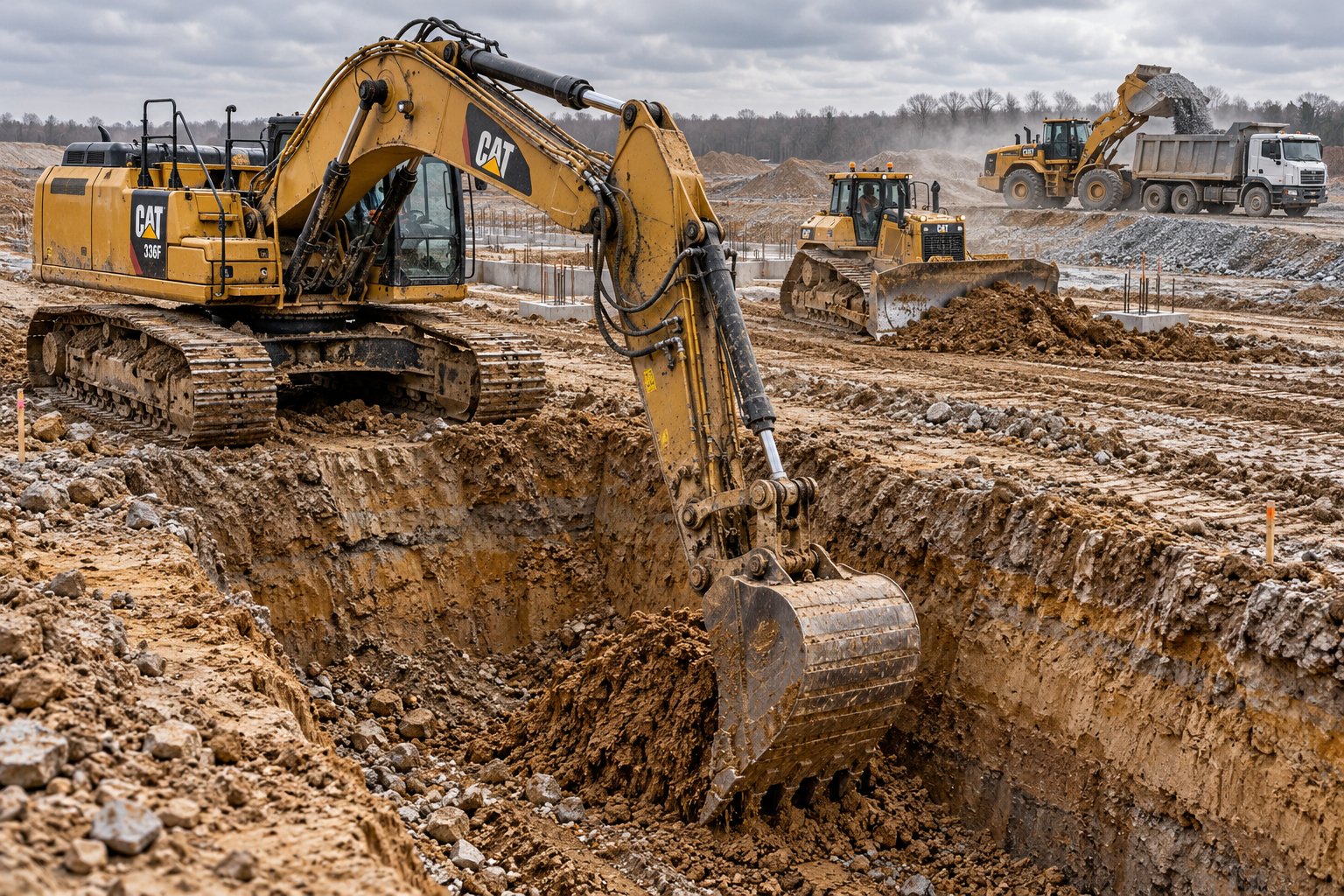
Earthmoving equipment represents the largest, most visible, and most capital-intensive of all heavy equipment categories on a construction project. These are the machines that physically reshape terrain, turning raw land into a buildable surface. The workflow follows a predictable sequence: surveyors mark layout points, bulldozers clear vegetation and strip topsoil, excavators dig foundations and trenches, motor graders fine-tune subgrade elevation, and loaders paired with dump trucks haul material on and off site. Each machine feeds the next, and a delay at any step stalls the entire chain.
Excavators, Bulldozers, and Loaders Explained
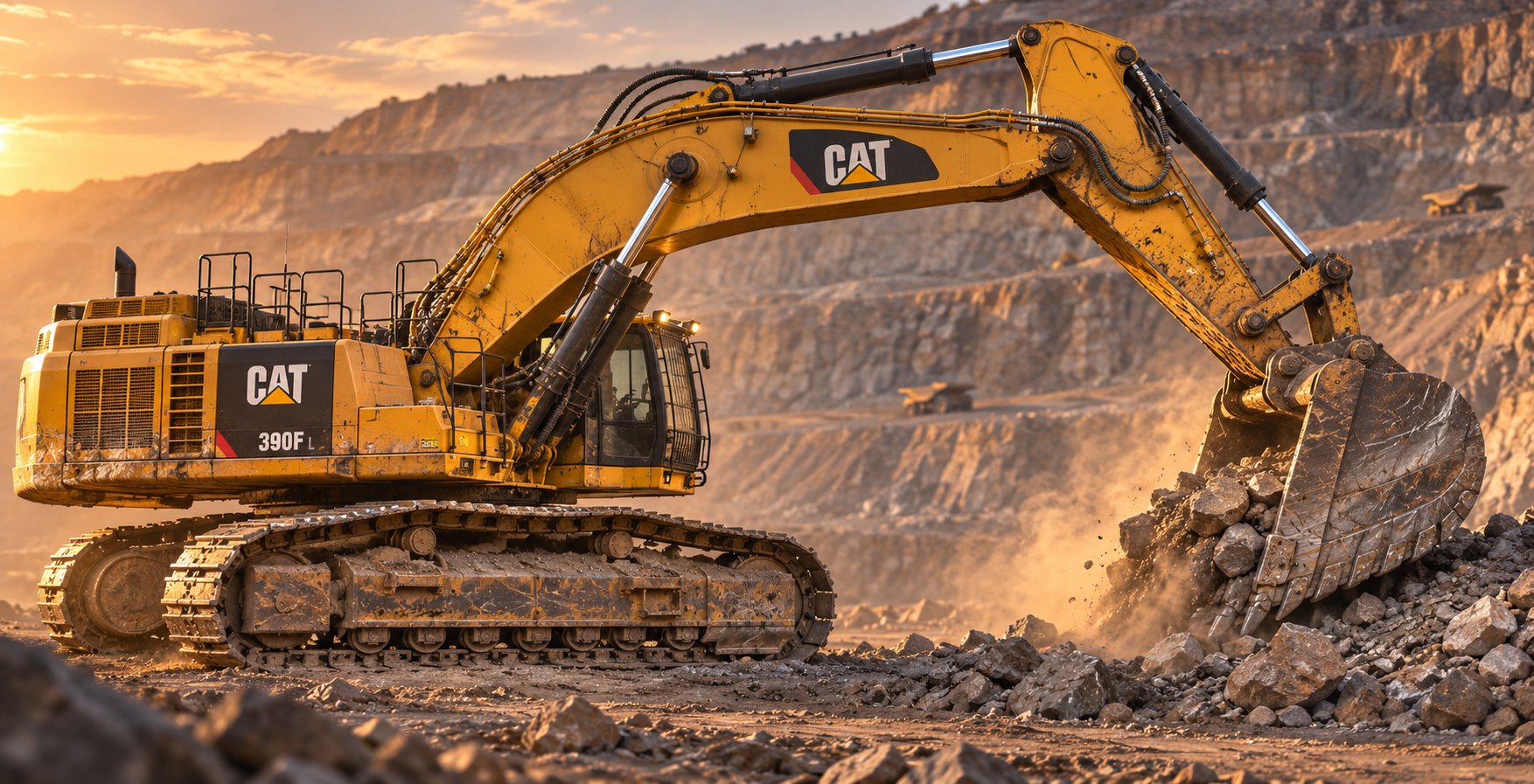
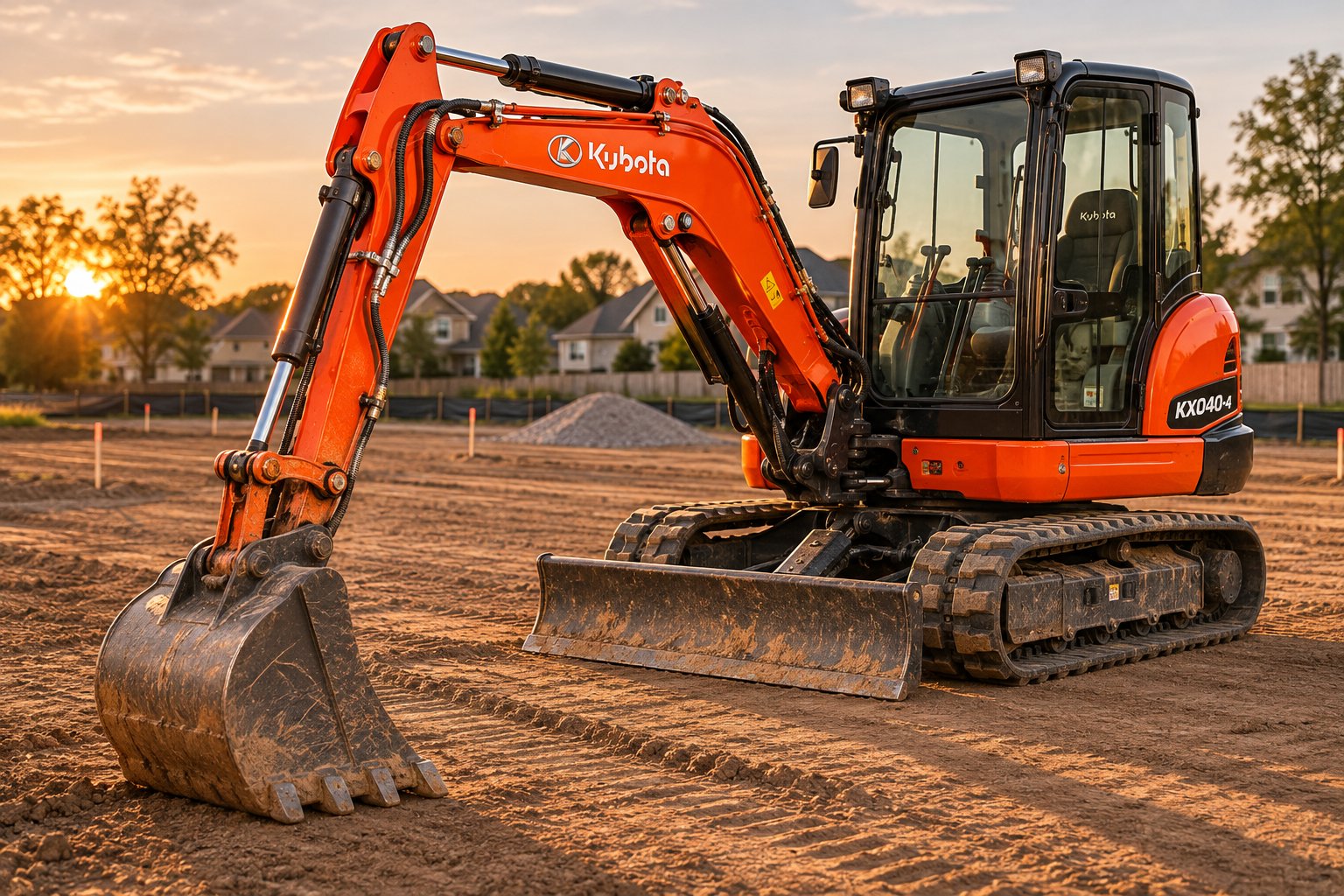
If you had to pick one machine that defines site preparation, it would be the excavator. Standard hydraulic excavators, typically ranging from 20 to 45 metric tons, handle trenching, foundation excavation, demolition, and material loading. Their 360-degree rotation lets operators dig, swing, and dump without repositioning the chassis. Mini-excavators, weighing under six or seven metric tons, fill a different niche: tight residential lots, utility installations, and interior demolition where a full-size machine simply won't fit. As industry guides note, excavators handle more tasks during site preparation than any other single machine type, making them the first heavy equipment mobilized and often the last to leave.
Bulldozers tackle the work excavators aren't built for: pushing large volumes of soil, stripping topsoil across open areas, and rough-grading surfaces. Their tracked undercarriage provides traction on soft or uneven ground where wheeled machines would struggle. Think of a bulldozer as the brute-force counterpart to the excavator's precision digging.
Wheel loaders and track loaders round out the core lineup. Wheel loaders scoop loose material, stockpile aggregate, and load dump trucks. Track loaders do the same work but offer better traction on muddy or unstable ground. On projects where material needs to travel more than about 50 meters, a loader-and-truck combination is typically more productive than an excavator working from a stationary position. Motor graders enter the picture last, using a long, adjustable blade to achieve the precise grade tolerances that drainage design and foundation engineering demand.
Earthmoving machines are typically the first heavy equipment mobilized to a job site after surveyors complete their work, and the sequence in which they operate directly determines how efficiently the entire project progresses.
All excavation work on U.S. job sites falls under OSHA's excavation standards (29 CFR 1926 Subpart P), which mandate protective systems for trenches deeper than five feet, daily soil inspections by a competent person, and safe means of egress for workers inside excavations. Ignoring these requirements puts lives at risk and invites costly project shutdowns.
Backhoe vs. Excavator and Other Commonly Confused Pairs
Among different types of construction vehicles, few pairs cause more confusion than the backhoe loader versus the excavator, and the skid-steer loader versus the compact track loader. They look similar at a glance, but their capabilities diverge sharply once you examine mobility, digging depth, and versatility.
| Feature | Backhoe Loader | Excavator | Skid-Steer Loader | Compact Track Loader |
|---|---|---|---|---|
| Mobility | Road-legal up to ~25 mph; rubber tires | Requires trailer transport; tracks or wheels | Rubber tires; tight zero-radius turn | Rubber tracks; tight zero-radius turn |
| Max Digging Depth | 12 - 16 ft (some models ~20 ft) | 20 - 40+ ft depending on size class | Limited; primarily a surface machine | Limited; primarily a surface machine |
| Rotation | ~200 degrees | Full 360 degrees | No cab rotation | No cab rotation |
| Versatility | Wide attachment range (forks, breakers, augers, plows) | Focused on digging; fewer attachment types | Highly versatile with dozens of attachments | Same versatility as skid steer |
| Best Project Fit | Spread-out, mixed-task sites; residential and light commercial | Heavy excavation, demolition, deep trenching | Tight-access sites with firm ground | Tight-access sites with soft or muddy ground |
The key takeaway? Backhoe loaders shine on spread-out job sites where a single operator needs to dig, load, and drive between tasks quickly. Excavators dominate when raw digging power, depth, and full-chassis rotation matter most. Skid-steer loaders and compact track loaders differ mainly in undercarriage: rubber tires roll faster on hard surfaces, while rubber tracks distribute weight across soft or finished ground without tearing it up.
Sourcing these machines involves three basic paths: renting for short-term or one-off needs, buying new for high-utilization fleets that benefit from warranty coverage, or purchasing used to reduce capital outlay on proven models. For the used-equipment route, suppliers like JIUHONG offer used excavators, loaders, bulldozers, and graders where contractors and fleet managers can compare machinery specifications and request purchase quotes. Rental houses and OEM dealer networks provide additional channels, so the best approach depends on your project pipeline and budget.
Understanding heavy equipment names and the distinctions between commonly confused construction equipment names saves real money. Ordering a backhoe when you need a full-size excavator, or renting a skid steer when the site calls for a compact track loader, creates productivity gaps that ripple across the entire schedule. With the earthwork done and the ground shaped to design grade, the next challenge shifts upward: moving steel, concrete, and materials to where they need to go.
Lifting and Material Handling Equipment for Every Project Scale
Steel beams, precast panels, HVAC units, bundles of lumber - none of these place themselves. The moment a site transitions from earthwork into structural framing, lifting and material-handling equipment takes center stage. These construction machines names you'll hear daily on any active job site - cranes, forklifts, telehandlers, hoists, and conveyors - exist to move loads vertically and horizontally with precision and speed. Within the broader heavy equipment classification system, this category carries some of the strictest regulatory requirements in the industry, largely because overhead loads create hazards that extend well beyond the operator's cab.
Crane Types and When Each Is Used
A crane is often the single most expensive piece of equipment on a construction project, and choosing the wrong type can stall an entire schedule. Cranes split into two families: static cranes that remain anchored in one position and mobile cranes that travel under their own power.
Tower cranes are the tall, fixed machines you'll notice dominating city skylines. A vertical mast supports a horizontal jib that rotates a full 360 degrees, with a trolley running along the jib to position the hook. Their stability makes them ideal for high-rise construction on tight urban footprints where a mobile crane would lack the reach or the room. Tower crane capacities typically range from around 6 to 60 tons, depending on configuration, and they come in several sub-types: hammerhead designs with a fixed horizontal jib, luffing-jib models whose jib raises and lowers for tighter rotation radii, and self-erecting units that trade lifting capacity for faster setup on shorter-duration projects.
Mobile cranes cover a wider range of ground conditions and project scales. Crawler cranes ride on tracked undercarriages, spreading their weight across soft or rough terrain. They handle the heaviest lifts - some models exceed 2,500 tons of capacity - but must be transported to the site disassembled since they aren't highway-legal. All-terrain cranes combine serious lifting power (often 88 to 800+ tons) with the ability to drive on public roads between job sites. Rough-terrain cranes, with large tires and all-wheel drive, suit confined single sites with uneven ground. Boom trucks and carry deck cranes fill the lighter end of the spectrum, handling quick-turnaround lifts, sign installation, and indoor material repositioning where larger machines can't operate.
Overhead gantry cranes straddle work areas on rail-mounted legs, making them standard in bridge construction, precast yards, and industrial facilities where loads travel along a fixed linear path.
Every crane operation on a U.S. construction site falls under OSHA's Cranes and Derricks standard (29 CFR 1926 Subpart CC). This regulation requires employers to ensure each operator is trained, certified or licensed, and evaluated before operating covered equipment. In practice, most operators hold certification through the NCCCO (National Commission for the Certification of Crane Operators) or an equivalent accredited testing organization. The certification process includes both written and practical examinations covering load chart interpretation, rigging, and hazard recognition - requirements that underscore just how seriously the industry treats overhead lift safety.
Forklifts, Telehandlers, and Material Hoists
Cranes dominate the heavy-lift conversation, but plenty of material-handling tasks don't call for a 50-ton boom. That's where forklifts, telehandlers, and hoists come in - smaller, more agile machines that keep materials flowing across the site without the setup complexity of a crane.
Forklifts used on construction sites differ significantly from the electric models humming through warehouse aisles. Rough-terrain forklifts feature pneumatic tires, four-wheel drive, and higher ground clearance to handle dirt, gravel, and uneven surfaces. Heavy-duty models can lift up to 60,000 pounds, while standard rough-terrain units typically handle 4,000 to 12,000 pounds. Electric warehouse forklifts, by contrast, run on cushion or rubber tires suited to finished floors, produce zero emissions for indoor air quality, and maneuver through narrow aisles that a rough-terrain model couldn't enter.
Telehandlers bridge the gap between forklifts and cranes. Picture a forklift with a telescoping boom that extends both upward and forward - that's the core concept. A telehandler's boom can reach vertical heights up to 56 feet and extend outward as far as 42 feet, allowing operators to place loads on upper floors, over obstacles, or deep into storage areas without repositioning the machine. Swap the forks for a bucket, grapple, or truss boom, and the same telehandler handles gravel transport, debris removal, or truss setting. That attachment versatility makes a telehandler one of the most cost-effective machines on a mixed-trade site.
Material hoists serve a different purpose entirely. On multi-story buildings where crane time is reserved for structural steel and heavy components, a rack-and-pinion hoist bolted to the building's exterior moves workers, tools, and lighter materials between floors continuously. Conveyors and chutes handle bulk materials like concrete, gravel, or demolition debris along fixed paths, reducing the need for repeated crane picks.
Here is a quick-reference summary of each machine type and where it fits:
- Tower Crane - Lifts heavy loads to significant heights; best for high-rise and long-duration urban projects.
- Mobile Crane (Crawler, All-Terrain, Rough-Terrain) - Repositions around a site or between sites; capacity ranges from 15 to 2,500+ tons depending on type.
- Boom Truck / Carry Deck Crane - Handles lighter, quick-turnaround lifts; ideal for utility work, sign installation, and tight indoor spaces.
- Rough-Terrain Forklift - Moves palletized and bulky materials across unpaved ground; typical capacity 4,000 - 12,000 lbs.
- Telehandler - Extends loads forward and upward with interchangeable attachments; suits mixed-trade sites needing reach and versatility.
- Material Hoist - Provides continuous vertical transport on multi-story buildings; frees crane capacity for structural lifts.
- Conveyor / Chute - Moves bulk materials along fixed paths; common in concrete placement and demolition debris removal.
What ties all of this machinery content together is regulation. Lifting equipment represents some of the most heavily regulated machines on any construction site because the consequences of failure - a dropped load, a collapsed boom, an overloaded outrigger - extend far beyond the operator. OSHA's crane standards, forklift training requirements under 29 CFR 1926.602, and site-specific lift plans all exist to manage that risk. Before any piece of equipment leaves the ground with a load, someone has already calculated the weight, verified the rigging, and confirmed the ground can support the forces involved.
Vertical and horizontal material movement keeps a project progressing upward and outward. But plenty of construction work happens at ground level too - particularly the compaction and paving operations that transform loose fill and aggregate into surfaces strong enough to support structures, traffic, and decades of use.
Compaction and Road Building Equipment That Ensure Durability
A foundation excavated to perfect depth, a trench backfilled to the correct elevation - none of it matters if the soil underneath isn't compacted to the density engineering specifications demand. Under-compacted ground settles unevenly over months or years, producing cracked slabs, shifting retaining walls, and sunken pavement that traces directly back to skipping or mismatching compaction equipment. Among the different types of heavy equipment on a job site, compaction machines rarely get the attention excavators and cranes do, yet they protect every structure built on top of them.
Rollers, Plate Compactors, and Rammers
Compaction equipment breaks down by scale and soil type, and selecting the wrong machine for a given material is one of the most common - and most costly - mistakes in site work.
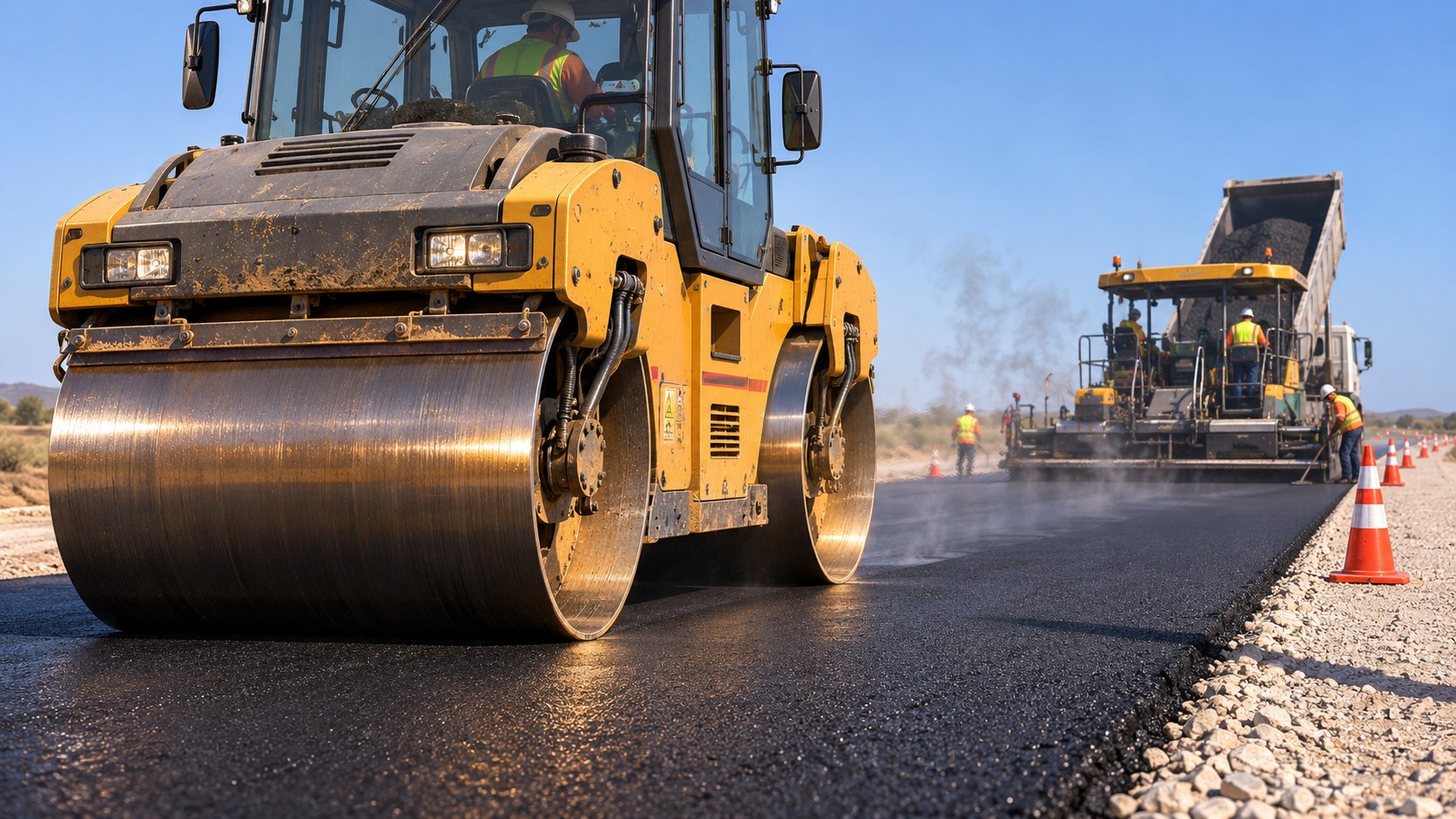
Vibratory rollers handle large-area compaction. Smooth drum rollers use static pressure combined with rapid vibration to settle granular materials like sand, gravel, and hot-mix asphalt. Single-drum models pair one steel drum with rear traction wheels for maneuverability, while double-drum (tandem) configurations compact with both front and rear drums for faster coverage on road surfaces. Padfoot rollers, also called sheepsfoot rollers, feature protruding pads that knead cohesive clay soils at depth - a construction of machine design that breaks down clay's bonded structure in ways a smooth drum simply cannot. Operators can add water or sand ballast to increase drum weight and compaction force on particularly stubborn material.
Pneumatic tire rollers sit between those two extremes. Multiple rubber tires compact materials evenly and handle soft soils or cold asphalt mixes where a steel drum would crack or displace the surface.
Plate compactors use a vibrating steel plate to densify granular soil in areas too tight for a ride-on roller - think sidewalk subgrades, small pads, and landscape retaining walls. Their compact footprint makes them practical for confined spaces, but as compaction specialists emphasize, vibration alone does not achieve proper density in clay-heavy ground. A plate compactor run over cohesive soil can look like it's doing the job while leaving the material meaningfully under-compacted beneath the surface.
Rammers (often called jumping jacks) solve that problem. They deliver a high-impact stomping motion rather than vibration, breaking down cohesive clay structure in trench backfill and other narrow spaces where even a plate compactor's footprint may be too wide. The fundamental rule is straightforward: vibration for granular soil, impact for cohesive soil. Getting this match wrong rarely creates an immediate visible problem - the consequences show up months later as settling foundations and cracked surfaces.
Pavers, Milling Machines, and Road Construction Gear
Road building involves a specific sequence where each piece of equipment feeds the next. Understanding the names of construction vehicles in this category, and the order they operate in, helps anyone planning infrastructure work avoid costly scheduling gaps.
The typical road construction sequence runs like this:
- Subgrade preparation - Motor graders shape the raw earth to design elevation and cross-slope. Sheepsfoot rollers compact the subgrade to specified density.
- Base course placement and compaction - Loaders and dump trucks deliver aggregate. Smooth-drum vibratory rollers compact the base layer in multiple passes.
- Asphalt paving - An asphalt paver receives hot-mix material from a dump truck or material transfer vehicle, spreads it evenly through a hopper and conveying system, and lays it at the specified thickness and width using an adjustable screed. Tracked and wheeled models are available depending on project conditions.
- Finish rolling - Tandem vibratory rollers make initial compaction passes while the asphalt is still hot, followed by pneumatic tire rollers that seal the surface and eliminate voids.
Cold milling machines enter the picture during road rehabilitation rather than new construction. Equipped with a rotating drum studded with carbide cutters, they strip damaged asphalt layers to a precise depth so new material can be placed on a clean, bonded surface. The milled asphalt debris can be recycled into new mixes, reducing disposal costs and raw material expense. Chip spreaders distribute aggregate across freshly applied asphalt binder for chip-seal surface treatments - a common preservation strategy on lower-traffic roads. Road reclaimers pulverize and remix existing pavement and base material in a single pass, turning a failed road section into a stabilized base ready for a new wearing course.
Among the broader types of heavy equipment used in construction, road-building machines stand out because their selection depends almost entirely on material type and layer position. The table below gives a quick-reference guide for matching compaction equipment to the right application:
| Equipment Type | Granular Soil (Sand, Gravel) | Cohesive Soil (Clay, Silt) | Asphalt | Confined Spaces (Trenches, Edges) |
|---|---|---|---|---|
| Smooth Drum Vibratory Roller | Excellent - primary choice | Poor - vibration doesn't compact clay effectively | Excellent - standard for initial and finish rolling | Not suitable - too large |
| Padfoot / Sheepsfoot Roller | Poor - pads churn granular material | Excellent - kneading action compacts at depth | Not used | Not suitable - too large |
| Pneumatic Tire Roller | Good - even compaction on soft mixes | Moderate - useful on mixed soils | Good - seals surface and removes voids | Not suitable - too large |
| Plate Compactor | Good - ideal for small pads and edges | Poor - vibration ineffective on clay | Limited - small patch repairs only | Good - fits walkways and narrow areas |
| Rammer (Jumping Jack) | Moderate - effective but slower coverage | Excellent - impact breaks down cohesive bonds | Not used | Excellent - designed for trench backfill |
This selection logic applies whether you're compacting a residential driveway or a highway interchange subgrade. The names of construction vehicles in this category may vary by region - what one crew calls a sheepsfoot, another calls a padfoot - but the soil-matching principle stays constant. Picking compaction and paving equipment based on actual material conditions rather than convenience or habit protects against the kind of delayed structural failures that no amount of rework can cheaply fix.
With the ground compacted and surfaces paved, a parallel workstream runs on nearly every project: placing concrete for foundations, slabs, walls, and structural elements. That process brings its own specialized equipment chain, from batch plants to finishing trowels.
Concrete Equipment From Mixing to Finishing
Most guides mention a concrete mixer truck and move on. In reality, concrete work involves an entire chain of specialized equipment - from the moment raw materials are batched to the final curing pass days later. Nearly every construction site that includes foundation, slab, or structural wall work depends on this chain, and a weak link at any step compromises the finished product's strength and durability. Among common building construction equipment names, concrete tools are some of the most misunderstood because many of them operate out of public view, inside forms or beneath finished surfaces.
Mixers, Pumps, and Concrete Transport
Getting concrete from the plant to the point of placement requires different equipment depending on pour volume, distance, and site access. Here are the primary options:
Transit mixers (the familiar rotating-drum trucks) are the workhorses of concrete delivery. A typical drum holds 8 to 12 cubic yards, and the rotation keeps the mix agitated during transit to prevent segregation. They're the default choice for most pours - residential foundations, commercial slabs, and infrastructure elements alike. Among the types of construction trucks you'll see on any active project, the transit mixer is one of the most recognizable.
Volumetric mixers take a different approach. Instead of carrying pre-mixed concrete, they store raw materials - cement, aggregate, water, and admixtures - in separate compartments and blend them on demand at the job site. This eliminates waste from over-ordering and allows mid-pour mix adjustments. They suit projects with unpredictable volumes or multiple small pours spread across a day, such as utility work or repair jobs.
Stationary batch plants serve large-scale projects where daily concrete demand justifies an on-site mixing operation. Highway interchanges, dam construction, and high-rise buildings with continuous pour schedules often set up dedicated plants to control quality and reduce reliance on external delivery schedules.
Once concrete arrives, it still needs to reach the formwork - and that's where pumps come in. Boom pumps are truck-mounted units with an articulating robotic arm that places concrete precisely at height or across obstacles. They deliver high output volumes, up to 150 cubic meters per hour or more, and can reach heights exceeding 60 meters. That makes them ideal for high-rise structures, large slab pours, and sites where the construction vehicle carrying fresh concrete can't get close enough to pour directly.
Line pumps (also called trailer pumps or stationary pumps) push concrete through flexible rubber hoses that can snake around corners, through buildings, and down narrow alleys. Their output is lower - typically 30 to 90 cubic meters per hour - but they fit tight-access residential and renovation sites where a boom truck has no room to set up outriggers. The choice between boom and line pump boils down to three factors: the volume of concrete required, physical access to the pour location, and project scale.
Finishing and Cutting Tools for Concrete Work
Placing concrete into forms is only half the job. What happens in the minutes and hours after placement determines whether the finished product meets structural and surface-quality standards.
Concrete vibrators are the first tools deployed after concrete enters the forms. Internal vibrators, also called needle or poker vibrators, consist of a vibrating head inserted directly into the fresh mix. The rapid vibration temporarily liquefies the concrete, allowing trapped air bubbles to rise to the surface while heavier aggregate particles settle into a denser arrangement. Without proper vibration, the hardened concrete develops honeycombing - surface voids that reduce compressive strength and allow moisture penetration. External (form) vibrators mount to the outside of formwork and transfer vibration through the forms themselves, making them the better choice for thin walls and precast sections where inserting a needle vibrator isn't practical.
Power trowels create smooth, hard-finished surfaces on slabs and floors. Walk-behind models handle smaller areas and edges, while ride-on power trowels cover large floor slabs at high speed. Operators make multiple passes as the concrete stiffens, progressively tilting the blades to achieve a dense, burnished surface. Screed machines level freshly placed concrete to the correct elevation - manual screeds work for small pours, while laser-guided screeds deliver the tight flatness tolerances warehouses and industrial floors demand.
Concrete saws cut control joints into hardened slabs to manage cracking, and they handle demolition cuts when existing concrete must be removed. Diamond-blade walk-behind saws are the most common type, though handheld cut-off saws manage smaller or overhead cuts. Rebar benders and cutters round out the category, shaping and sizing reinforcing steel on site to match structural drawings before concrete placement begins.
Field crews think about all of this equipment not as a catalog but as a workflow - each tool enters the process at a specific point, and skipping a step compromises every step that follows. Here is the standard concrete placement sequence with the equipment each stage requires:
- Batching - Stationary batch plant or ready-mix supplier produces the designed mix with verified proportions, slump, and temperature.
- Transport - Transit mixers or volumetric mixers deliver concrete to the site, maintaining agitation to prevent segregation during travel.
- Placement - Boom pumps, line pumps, or direct chute discharge move fresh concrete into formwork. Free-fall of more than 1.5 meters is not permitted without a chute to prevent segregation.
- Vibration - Internal (needle) vibrators consolidate the mix in columns, beams, and deep sections; external vibrators handle thin walls; surface vibrators compact shallow slabs.
- Screeding - Vibrating screeds or laser-guided screed machines strike off the surface to the design elevation, removing excess material and filling low spots.
- Finishing - Bull floats embed coarse aggregate below the surface, followed by power trowel passes that progressively harden and smooth the slab as the concrete sets.
- Curing - Curing compound sprayers or wet-curing systems (water ponding, soaker hoses, polyethylene sheeting) maintain moisture for a minimum of seven days to achieve design strength.
Every step in this sequence has a narrow timing window. Vibrate too late and the concrete has already begun to stiffen, trapping air permanently. Start troweling too early and you'll seal bleed water beneath the surface, creating delamination that peels away months later. The equipment itself isn't complicated - what separates a quality pour from a costly rework order is deploying each tool at precisely the right moment in the process.
Concrete placement, of course, doesn't happen in isolation. It depends on a web of behind-the-scenes support: generators powering vibrators and lighting, compressors driving pneumatic tools, dewatering pumps keeping excavations dry, and temporary structures holding everything in place. That supporting infrastructure is the silent backbone of every job site.
Site Support Equipment and Temporary Infrastructure
Strip away the excavators, cranes, and concrete pumps, and a construction site still can't function without the equipment nobody puts on a brochure cover. Generators supply the electricity that powers every tool on the job. Compressors drive the pneumatic nail guns and jackhammers. Dewatering pumps keep excavations from flooding overnight. Lighting towers make second shifts possible. Scaffolding and formwork give workers a place to stand and concrete a shape to fill. These types of construction equipment don't grab attention, but they determine whether a project runs smoothly or grinds to a halt waiting for something as basic as electrical power or dry ground.
If you've ever browsed an equipment guide and wondered why it skipped straight from cranes to hand tools, you've already noticed the gap. Site support infrastructure is the connective tissue between the machines that shape a project and the workers who build it. Treat it as an afterthought and you'll spend more time troubleshooting downtime than pouring concrete.
Generators, Compressors, and Temporary Power
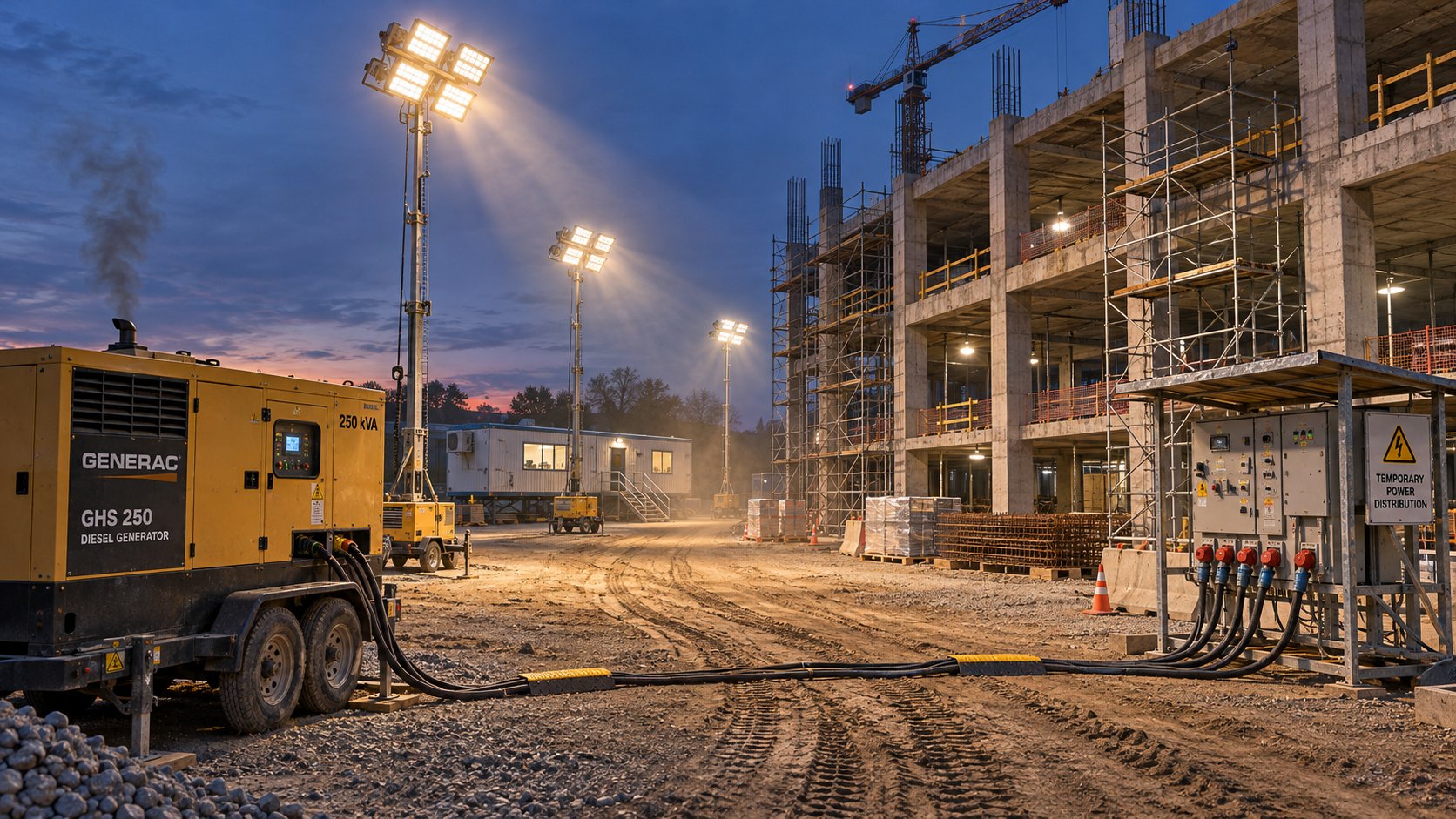
Every construction work machine on site - from a concrete vibrator to a welding rig - needs a reliable power source. Before the utility company connects permanent service, that source is almost always a portable diesel generator.
Sizing a generator correctly starts with listing every piece of equipment that could run simultaneously: circular saws, table saws, compressors, welders, battery chargers, site trailer HVAC, and lighting. Add up the total wattage, multiply by 1.25 for a safety margin, and you have your minimum power requirement. The practical range varies widely by project type - a small residential build may need only 15 to 40 kW, while a commercial project can easily hit 100 kW or more once you factor in temporary HVAC, welding circuits, and tower crane power.
A few sizing details catch contractors off guard. An air compressor rated at 1,500 running watts might surge to 4,500 watts on startup, tripping breakers on an undersized generator. A single 240-volt construction heater can pull 4,000 to 10,000 watts during cold-weather pours - three of them on a January morning will max out a 30 kW unit by themselves. The fix is accounting for startup surge currents and phased loads, not just steady-state draw.
Air compressors earn their spot as a distinct category of light duty equipment because so many construction tools depend on them. Pneumatic nail guns, framing nailers, jackhammers, sandblasters, and paint sprayers all run on compressed air. A two-horsepower portable compressor handles trim carpentry and light finishing, while a 185 CFM towable diesel compressor drives the jackhammers and rock drills found on highway construction equipment spreads and demolition sites. Matching compressor output (measured in cubic feet per minute) to the combined air demand of every tool connected to it prevents the pressure drops that leave nailers misfiring and breakers stalling mid-stroke.
Temporary electrical distribution ties everything together. Once a generator or utility feed is live, a NEMA 3R-rated (rainproof) distribution panel routes power through circuit breakers to spider boxes - portable power distribution units placed within 100 feet of every active work area. OSHA mandates GFCI (Ground Fault Circuit Interrupter) protection on all 120-volt, 15- and 20-amp receptacle outlets on construction sites, and extension cords must be three-wire, hard-usage rated types. Skipping GFCI protection is one of the top 10 most-cited OSHA electrical violations on construction sites - an easy problem to prevent and an expensive one to explain to an inspector.
Water Management, Lighting, and Site Facilities
Water is the other invisible enemy on a construction site. A foundation excavation that fills with groundwater overnight becomes a safety hazard by morning and an engineering problem by afternoon. Dewatering pumps solve this in two main forms: submersible pumps that sit inside the water and push it out through discharge hoses, and centrifugal (surface) pumps that sit at grade level and pull water up from below. Submersible models handle silt-laden water and deep sumps better, while centrifugal pumps offer higher flow rates for shallow, cleaner applications. On sites with a high water table, dewatering often runs continuously for weeks or months - making these pumps some of the most energy-hungry light duty equipment on the project.
Temporary lighting towers extend the productive workday and meet OSHA's minimum illumination requirements under 29 CFR 1926.56. The industry has largely shifted to LED tower lights, which use 50 to 70 percent less power than metal halide equivalents, produce full brightness instantly (no 15-minute warm-up), and last 50,000-plus hours. A single 400-watt LED tower light covers roughly 10,000 to 15,000 square feet, depending on mounting height and beam angle. For highway construction equipment operations and large commercial sites running night shifts, multiple towers positioned at the perimeter and aimed inward eliminate the dark spots and harsh shadows that create tripping and struck-by hazards.
Beyond power, water, and light, every occupied construction site needs basic facilities and temporary structures that keep operations running and workers safe. These items rarely appear in equipment guides, yet forgetting even one of them during site mobilization creates delays that ripple through the schedule. Use the following as a job-site planning checklist:
- Portable sanitation facilities - Restrooms and handwash stations sized for the peak workforce count; OSHA requires a minimum of one toilet for every 20 workers.
- Mobile office trailers - Climate-controlled spaces for project management, plan review, subcontractor meetings, and document storage.
- Site fencing and safety barriers - Perimeter hoarding to secure the site from public access, plus internal barriers around open excavations, floor edges, and hazardous zones.
- Scaffolding systems - Tube-and-clamp, frame, or system scaffolding that provides safe elevated access for masonry, facade work, MEP rough-in, and finishing trades on virtually every multi-story project.
- Formwork systems - Engineered panels, walers, and tie hardware that give poured concrete its shape; capacity ranges from simple residential wall forms to modular climbing systems on high-rise cores.
- Temporary shoring and bracing - Adjustable steel post shores, heavy-duty shoring frames, and lateral braces that support concrete slabs, beams, and walls during the vulnerable period before the structure reaches design strength. OSHA 29 CFR 1926.703 requires shoring to be designed by a qualified designer and inspected by a competent person before every concrete placement.
- Trash chutes and debris containers - Enclosed chutes on multi-story buildings channel demolition and waste material safely to ground-level dumpsters without exposing workers below to falling objects.
- Fuel storage and refueling stations - On-site diesel tanks (typically 500 gallons on larger projects) with secondary containment, locked caps, and daily level logging to prevent spills and theft.
- Temporary water supply - Hose connections or water trucks for dust suppression, concrete curing, equipment washdown, and fire protection.
Scaffolding, formwork, and shoring deserve special emphasis because they're present on nearly every multi-story project yet frequently get lumped under "miscellaneous." A commercial concrete building might have three or four floors of shoring in place simultaneously, with rental costs running $5 to $15 per shore per month and engineering fees of $3,000 to $15,000 depending on complexity. Formwork and scaffolding carry similar cost weight. These aren't accessories - they're structural systems in their own right, and underestimating them during planning is one of the fastest ways to blow a project budget.
What makes site support equipment tricky to plan is that the requirements shift as the project moves through phases. During earthwork, you might need only a small generator and a dewatering pump. By the time structural framing is underway, the site demands tower lighting, scaffolding on every elevation, shoring under fresh slabs, multiple compressors feeding pneumatic tools, and a generator large enough to run all of it simultaneously. Building a phase-by-phase equipment schedule - rather than a single static list - keeps costs aligned with actual needs instead of paying for idle machinery.
All of this infrastructure keeps the big machines productive and the site functional. But the tools workers actually hold in their hands every hour of every shift - the drills, saws, hammers, and the protective gear that goes with them - make up an entirely separate equipment category that deserves its own close look.
Hand Tools, Power Tools, and Safety Gear Workers Rely On
Ask someone to picture a construction site and they'll imagine excavators, cranes, and concrete trucks. Rarely does anyone think of a framing hammer, a cordless drill, or a pair of cut-resistant gloves. Yet hand tools and personal protective equipment are the most frequently touched items on any job site - picked up dozens of times a day by every worker on every trade. Among the heavy construction equipment types that dominate equipment guides, these smaller items get overlooked precisely because they're so ordinary. That's a mistake. A missing tape measure stalls a layout. A dull circular saw blade turns a clean cut into a safety hazard. And a hard hat left on the dashboard instead of on a worker's head can mean the difference between a close call and a catastrophe.
Essential Hand Tools and Portable Power Tools
Every carpenter, electrician, plumber, and laborer carries a core set of hand tools that hasn't changed much in decades - though the quality and ergonomics have improved dramatically. Alongside those manual staples, portable power tools multiply productivity by handling repetitive or high-force tasks in a fraction of the time. Think of hand tools as precision instruments and power tools as their force multipliers.
The table below splits both categories by primary use case, giving you a quick reference for stocking a crew's toolboxes or building a tool inventory for a new project:
| Category | Tool | Primary Use Case |
|---|---|---|
| Hand Tool | Claw Hammer | Driving and pulling nails in framing, formwork, and general carpentry |
| Hand Tool | Pry Bar / Flat Bar | Demolition, form stripping, and separating nailed assemblies |
| Hand Tool | Spirit Level | Checking horizontal and vertical alignment of structural members and finishes |
| Hand Tool | Tape Measure | Layout dimensions, material cutting marks, and field verification |
| Hand Tool | Chalk Line | Snapping long straight reference lines on floors, walls, and decks |
| Hand Tool | Plumb Bob | Establishing true vertical reference points for column and wall alignment |
| Hand Tool | Utility Knife | Cutting drywall, insulation, vapor barriers, and packaging |
| Hand Tool | Wrench and Socket Set | Tightening and loosening bolts on structural connections, mechanical equipment, and formwork hardware |
| Power Tool | Cordless Drill / Driver | Drilling holes and driving screws across virtually every trade |
| Power Tool | Circular Saw | Straight cuts in lumber, plywood, and composite decking |
| Power Tool | Reciprocating Saw | Demolition cuts through wood, metal, and drywall in tight spaces |
| Power Tool | Rotary Hammer | Drilling into concrete and masonry for anchors, rebar dowels, and conduit penetrations |
| Power Tool | Angle Grinder | Cutting and grinding metal, tile, and masonry surfaces |
| Power Tool | Impact Driver | High-torque fastening of lag bolts, structural screws, and long fasteners |
You'll notice a pattern: hand tools handle layout, measurement, and fine adjustment, while power tools take over whenever force, speed, or repetition enters the equation. A framing crew might swing a hammer for toenailing in awkward spots but reach for a pneumatic nail gun or cordless framing nailer for the other 95 percent of the fastening. Among the tools and equipment used for heavy equipment operator tasks, you'll also find specialty wrenches, torque multipliers, and grease guns that keep machines running between services - further proof that "small" tools support even the biggest iron on site.
Choosing between corded and cordless power tools comes down to runtime versus weight. Modern high-voltage cordless platforms (18V to 60V) handle the vast majority of construction tasks, but corded or pneumatic options still deliver sustained power for all-day concrete drilling or continuous nailing without battery swaps.
Personal Protective Equipment and Safety Gear
Every tool on that table becomes dangerous the moment a worker operates it without the right protective gear. Personal protective equipment isn't optional or situational on a U.S. construction site - it's legally mandated under OSHA's 29 CFR 1926 Subpart E, which requires employers to furnish and enforce the use of PPE wherever a risk of injury exists. The regulation covers everything from head protection to foot protection, and violations consistently rank among OSHA's most-cited standards year after year.
What makes PPE requirements nuanced is that they vary by task, not just by job site. A laborer moving lumber needs steel-toed boots, a hard hat, and gloves. A worker on a scissor lift six feet or higher needs a fall-arrest harness anchored to the platform. Someone running a concrete saw needs respiratory protection against silica dust, hearing protection against the blade noise, and eye protection against flying debris - all at the same time. Here's the essential gear and when it applies:
- Hard hats (Type I or Type II) - Required on any active site where overhead hazards, falling objects, or low-clearance structures exist. Helmets must meet ANSI Z89.1 standards for impact resistance and electrical insulation.
- High-visibility vests - Mandatory whenever workers operate near mobile equipment, vehicle traffic, or in low-light conditions. Reflective striping ensures workers remain visible to equipment operators and passing vehicles.
- Steel-toed boots - Puncture-resistant soles and toe caps protect against dropped materials and sharp debris. OSHA requires protective footwear that meets ANSI standards on virtually every construction site.
- Safety glasses and goggles - Needed during cutting, grinding, drilling, and any task generating airborne particles. Full-face shields add protection when working with chemicals or power tools that produce large debris.
- Hearing protection (earplugs or earmuffs) - Required at sustained noise exposures of 85 dB or above - a threshold easily crossed by jackhammers, concrete saws, impact wrenches, and even circular saws in enclosed spaces.
- Fall-protection harnesses - OSHA mandates fall protection for any work at heights of six feet or more in construction. Workers on aerial lifts, open-sided floors, leading edges, and scaffold platforms must wear full-body harnesses connected to anchorage points rated for 5,000 pounds per worker.
- Respiratory protection - Dust masks or fitted respirators are required during tasks that generate silica dust (concrete cutting, tuck-pointing), lead paint disturbance, or chemical fumes. Proper fit testing ensures no contaminated air enters around the seal.
- Cut-resistant gloves - Protect against lacerations when handling sheet metal, rebar, glass, and sharp-edged materials. Different cut-resistance ratings (ANSI A1 through A9) match glove selection to the severity of the hazard.
The critical point is layering. A single task can require three or four types of heavy machinery PPE simultaneously, and skipping one layer because it feels uncomfortable or slows the work down doesn't reduce the hazard - it just removes the barrier between the worker and the injury. As types of heavy machinery grow more powerful and job sites grow more complex, the PPE requirements layered on top of them only increase.
OSHA-mandated safety equipment is non-negotiable on every U.S. construction site. Employers must not only provide PPE at no cost to workers but also train each employee on when it's required, how to wear and adjust it, and how to recognize signs of wear that call for replacement. Different types of construction trucks and machines present different hazard profiles, so PPE selection should always start with a task-specific hazard assessment rather than a one-size-fits-all checklist.
Hand tools, power tools, and safety gear sit at the bottom of the equipment hierarchy by size but at the top by frequency of daily use. They're the common thread linking every trade, every task, and every worker on the project. Yet even before a single hammer swings or a hard hat gets strapped on, another category of equipment has already been at work establishing the spatial framework the entire build depends on - the surveying instruments and aerial access platforms that define where and how high everything goes.
Surveying Instruments and Aerial Access Platforms
Every construction machine name on this list - excavators, cranes, pavers, concrete pumps - depends on one thing before it can do useful work: knowing exactly where to operate. Dig a foundation trench 18 inches off its design position and the structural engineer's load paths don't align. Set a column anchor bolt half a degree out of plumb and the steel erector's connections won't fit. Surveying and measurement instruments are the very first pieces of equipment deployed on any construction site, yet they're among the least discussed. Alongside them, aerial access platforms give workers a safe way to reach elevated work areas throughout every phase of construction. Together, these two subcategories fill critical gaps that most equipment guides ignore entirely.
Surveying Instruments and Measurement Technology
Surveying equipment establishes the spatial framework for everything else on the job. Without accurate horizontal and vertical control, road building equipment grades to the wrong elevation, formwork gets set at incorrect dimensions, and utility trenches miss their target connections. The instruments range from centuries-old optical principles to satellite-based positioning systems, and most projects use several of them in combination.
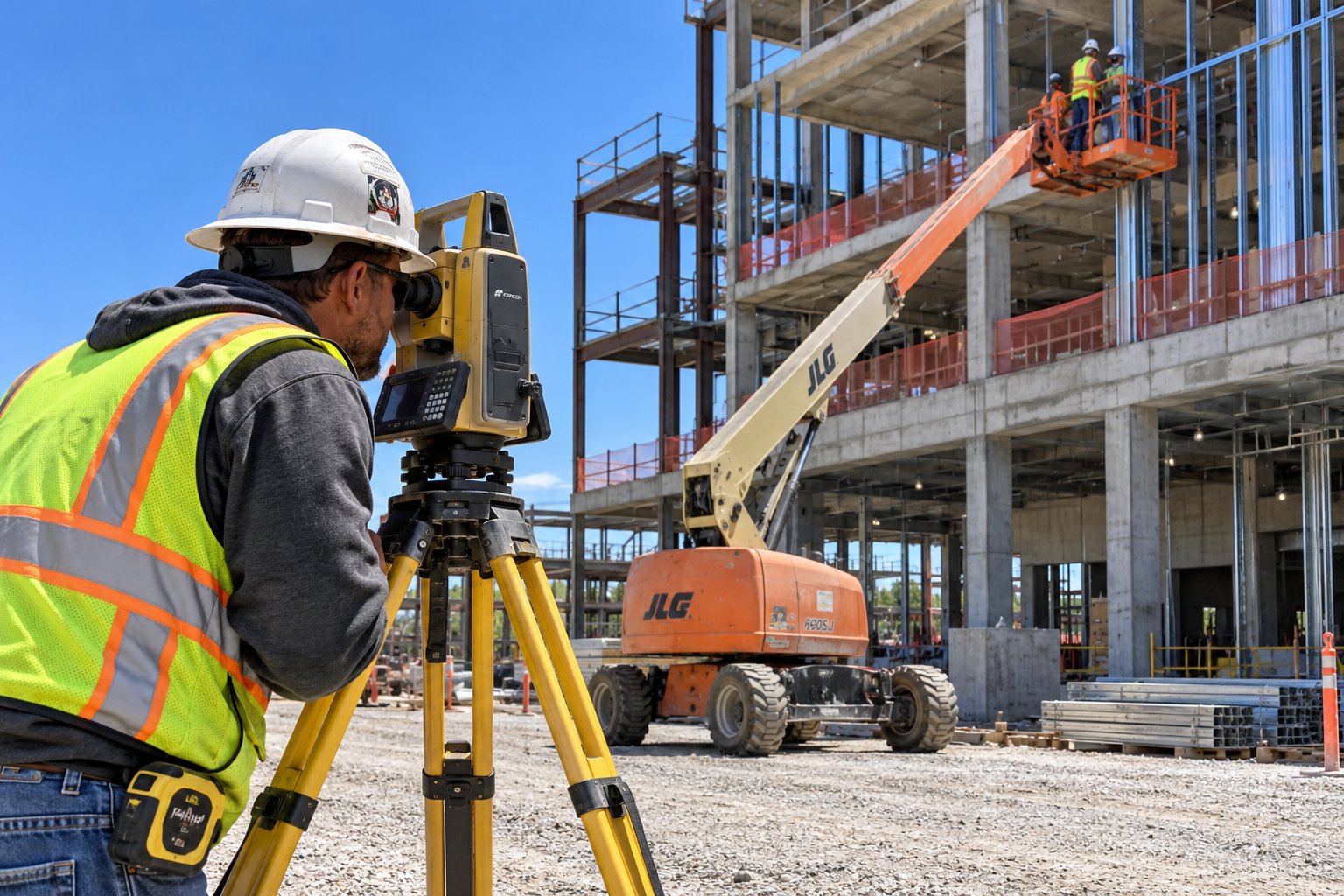
Total stations are the backbone of precise construction layout. A total station measures horizontal angles, vertical angles, and distances from a single instrument setup to a target prism or reflective surface, then calculates exact coordinates for each measured point. As surveying technology specialists explain, total stations excel in environments where satellite signals are blocked or unreliable - near buildings, under tree cover, beside high walls, and inside partially enclosed structures. That makes them ideal for building gridline layout, anchor bolt positioning, facade alignment, and any task requiring tight tolerances. Robotic total stations add motorized tracking and automatic target lock, allowing a single operator to control the instrument remotely from the prism pole - a workflow that cuts crew size and speeds up repetitive stakeout work significantly.
Automatic levels (also called dumpy levels or builder's levels) serve a narrower but equally important purpose: establishing consistent elevations across a site. A surveyor sets up the instrument, sights through the eyepiece to a graduated rod held at various points, and reads the rod intercept to calculate height differences. Automatic levels are simpler and less expensive than total stations, which makes them the go-to name of construction equipment for basic elevation checks during excavation, foundation forming, and drainage slope verification.
Laser levels come in two main types. Rotary laser levels spin a laser beam in a full 360-degree plane, projecting a visible reference line across an entire room or open area. They're standard for setting ceiling grids, checking floor flatness, and establishing grade stakes on residential sites. Line laser levels project one or two fixed lines - horizontal, vertical, or both - onto a surface, making them useful for interior finish work like tile layout, cabinet installation, and electrical rough-in. Neither replaces a total station for high-precision structural layout, but for speed and convenience on repetitive elevation tasks, laser levels are hard to beat.
GPS/GNSS receivers bring satellite positioning into the construction workflow. Professional RTK (Real-Time Kinematic) GNSS receivers calculate their position using signals from multiple satellite constellations, corrected by a base station or network service to achieve centimeter-level accuracy in real time. On open sites - highway corridors, large commercial pads, earthwork grading projects - GNSS is faster than a total station because the receiver doesn't need line of sight to a fixed instrument. A single operator walks or drives to each point, collects its coordinates, and moves on. GNSS also powers machine control systems, where a receiver mounted on an excavator or motor grader feeds real-time position data to the equipment's hydraulic system, automatically adjusting blade or bucket elevation to match the digital design surface. The result is faster grading, less material waste, and fewer passes with a survey crew checking stakes.
The choice between total station and GNSS isn't either/or. As field workflow comparisons show, many professional survey teams use both: GNSS for rapid control establishment and open-area data collection, and total stations for detailed layout near structures where satellite signals reflect off walls and steel. Forcing one instrument to handle every situation leads to wasted time or compromised accuracy.
Rounding out the measurement category, measuring wheels quickly estimate linear distances along roads, fence lines, and site perimeters where survey-grade precision isn't required. Digital distance meters (laser tape measures) calculate room dimensions, ceiling heights, and material lengths at the push of a button - replacing the two-person tape measure stretch for interior measurements and giving every tradesperson a fast way to verify dimensions before cutting.
Boom Lifts vs. Scissor Lifts and Other Aerial Access Platforms
Surveying tells crews where things go. Aerial access platforms get workers to the heights where installation actually happens. Exterior cladding, structural steel connections, mechanical ductwork, electrical runs, fireproofing, painting - all of these trades need stable, elevated work positions that ladders can't safely provide. The construction machine names in this subcategory sound similar, but the machines themselves differ dramatically in reach direction, platform size, and application.
Articulating boom lifts have multiple joints (knuckles) where the arm bends, allowing the platform to reach up and over obstacles like parapets, machinery, and structural members. Imagine needing to access the underside of an elevated highway deck while standing on the ground 40 feet below and 20 feet to the side - an articulating boom navigates around the intervening structure to position you exactly where you need to be. Platform heights range from roughly 30 to 150 feet depending on the model.
Telescopic (straight) boom lifts extend in a straight line from base to platform, delivering maximum vertical and horizontal reach without the ability to bend around obstacles. They're the right choice when the work surface is high and directly accessible - think exterior glass installation on a mid-rise building or bridge inspection along an open span. Straight booms reach platform heights from about 40 feet up to 185 feet or more, exceeding any other aerial platform type.
Scissor lifts move in only one direction: straight up. An accordion-style (pantograph) mechanism raises a wide, stable platform vertically from its base. That single-axis motion limits where a scissor lift can reach, but the tradeoff is a much larger platform - big enough for two or three workers plus tools and materials. Scissor lifts are the default choice for interior drywall finishing, painting, HVAC installation, and any task where the work area sits directly above the machine's footprint. Most models reach platform heights between 20 and 50 feet, with some rough-terrain units stretching to 70 feet.
Personnel hoists serve multi-story buildings during construction, carrying workers and light materials between floors via a rack-and-pinion drive system mounted to the building's exterior. They're slower than crane lifts but operate continuously throughout the workday, reducing elevator congestion and freeing crane capacity for heavy structural picks.
The comparison table below breaks down the key differences to help you match the right platform to your project's access requirements:
| Feature | Articulating Boom Lift | Telescopic (Straight) Boom Lift | Scissor Lift |
|---|---|---|---|
| Reach Type | Up, over, and around obstacles via multi-joint arm | Straight up and out for maximum linear reach | Vertical only - directly above the base |
| Max Platform Height Range | ~30 ft to 150 ft | ~40 ft to 185+ ft | ~20 ft to 70 ft |
| Horizontal Outreach | Moderate - arm bends limit maximum extension | Excellent - longest horizontal reach of any aerial lift | None - platform moves only vertically |
| Platform Capacity | 400 - 660 lbs (typically 1-2 workers) | 500 - 1,200 lbs (typically 1-2 workers) | 500 - 3,500 lbs (2-3+ workers plus materials) |
| Best-Use Scenarios | Reaching behind or over structural obstacles; facade work in congested areas; painting high ceilings from multiple angles | High-elevation work with clear, unobstructed access; exterior window installation; bridge and tower inspection | Interior finishing trades (drywall, HVAC, electrical); warehouse maintenance; any task directly above the machine |
| Available Power Types | Electric (indoor) and rough-terrain diesel (outdoor) | Electric (indoor) and rough-terrain diesel (outdoor) | Electric (indoor) and rough-terrain diesel (outdoor) |
Every aerial lift on a U.S. construction site falls under OSHA 29 CFR 1926.453, which requires that all aerial lifts conform to ANSI A92.2 design and construction standards. The regulation mandates that workers wear a body belt or full-body harness with a lanyard attached to the boom or basket whenever working from an extensible or articulating boom platform. Scissor lifts, because their platforms are enclosed by guardrails and move only vertically, typically require guardrail protection rather than personal fall-arrest systems - though specific employer policies and state regulations may add harness requirements.
Operator training is equally non-negotiable. OSHA requires that every worker who operates an aerial lift receive training on the specific type of equipment they'll use, covering load limits, platform controls, fall-protection procedures, and hazard recognition for overhead power lines, wind conditions, and uneven terrain. This training must be documented before the operator touches the controls - not picked up on the fly during the first shift.
Surveying instruments and aerial platforms share a trait that separates them from most other construction equipment: they define the boundaries of what a project can achieve. Survey tools set the spatial limits - where structures sit, how high they rise, and whether they meet design tolerances. Aerial platforms set the physical access limits - which work areas crews can safely reach and how much material they can carry there. Getting either one wrong doesn't just slow a project; it reshapes what's possible. The real question, then, isn't which individual machines you need - it's how to assemble the right combination of all these equipment categories to match your specific project type, scale, and budget.
How to Choose the Right Equipment for Your Construction Project
Knowing every construction equipment type on the market doesn't help much if you can't narrow the list to exactly what your next project demands. A residential bathroom renovation and a four-lane highway widening both fall under "construction," yet they share almost zero overlap in machinery. The missing step in most equipment guides is a decision framework - a practical way to match machines, tools, and support infrastructure to a specific project's scope, site conditions, and budget. That framework turns an encyclopedic reference into an actionable plan.
Matching Equipment to Project Type and Scale
Project type is the single strongest filter for equipment selection. A demolition contractor and a road builder both work with types of heavy construction machinery, but the specific machines they mobilize look nothing alike. Site access constraints, soil conditions, and schedule pressure add further nuance - a tight urban lot limits you to compact machines even if the scope calls for heavy production, while a wide-open rural pad lets you deploy full-size equipment for maximum efficiency.
The table below maps common construction equipment types to four representative project categories. Use it as a starting checklist, then adjust based on your site's unique variables:
| Equipment Category | Residential Renovation | Commercial Building | Road / Infrastructure | Demolition |
|---|---|---|---|---|
| Earthmoving | Mini-excavator, skid-steer loader | Standard excavator (20-45 ton), wheel loader, motor grader | Motor grader, large excavator, scraper | High-reach excavator, standard excavator with breaker attachment |
| Lifting / Material Handling | Telehandler or rough-terrain forklift (if multi-story) | Tower crane or mobile crane, telehandler, material hoist | Mobile crane for bridge elements, telehandler | Crane for selective dismantling (when applicable) |
| Compaction / Paving | Plate compactor, walk-behind roller | Vibratory roller, plate compactor, rammer | Tandem vibratory roller, padfoot roller, asphalt paver, cold milling machine | Minimal - limited to backfill compaction after removal |
| Concrete | Volumetric mixer or transit mixer, line pump, vibrator, walk-behind trowel | Transit mixer, boom pump, laser-guided screed, ride-on trowel | Batch plant (large projects), transit mixer, slip-form paver | Concrete crusher, concrete saw |
| Site Support | Small generator (7-15 kW), basic scaffolding, hand-carry lighting | Generator (50-100+ kW), air compressor, scaffolding, formwork, dewatering pumps, lighting towers, mobile office | Large generators, traffic management barriers, portable lighting towers, fuel storage | Dust suppression system (water truck or misting cannons), debris chutes, perimeter fencing |
| Surveying / Access | Laser level, tape measure, digital distance meter | Total station, GPS/GNSS, rotary laser level, scissor lifts, boom lifts | GPS/GNSS with machine control, total station, robotic total station | Laser level for demolition line marking, boom lift for selective removal at height |
| Hand Tools / PPE | Full hand-tool set, cordless drill, circular saw, hard hat, safety glasses, gloves | Full power-tool spread, rotary hammers, impact drivers, all PPE categories including fall-arrest harnesses | Specialty road works equipment hand tools, cut-resistant gloves, high-visibility vests, hearing protection | Reciprocating saws, pry bars, respiratory protection (silica/lead), full fall-protection system |
A few patterns stand out. Residential work leans heavily on compact excavation equipment and versatile tools that one or two operators can handle. Commercial projects scale up across every category, especially lifting, concrete, and site support. Road and infrastructure work concentrates spending on grading, compaction, and paving machines - the road works equipment that dominates this niche. Demolition introduces specialized attachments and safety systems, particularly dust suppression and respiratory protection, that other project types rarely need.
Soil conditions shift selections within a project type too. Sandy ground may let you skip the rammer and rely on a plate compactor for trench backfill. Heavy clay calls for sheepsfoot rollers and impact compaction regardless of whether you're building a strip mall or a subdivision. Timeline pressure pushes contractors toward larger, higher-production machines - a 30-ton excavator moves more material per hour than a mini, but it costs more to mobilize and needs more room to operate. Matching machine size to the actual volume of work, rather than defaulting to "bigger is better" or "smallest is cheapest," protects both your schedule and your budget.
Renting vs. Buying Used vs. Buying New
Identifying the right construction tools names and machine types is only half the equation. The other half is deciding how to source them. Three paths exist - renting, buying used, and buying new - and each suits a different combination of utilization rate, capital position, and maintenance capability.
Renting converts a large capital expenditure into a predictable operating expense. You pay only for the days or weeks you actually use the machine, and the rental company typically handles maintenance, major repairs, and transport. This makes renting the clear winner for short-term, one-off, or seasonal needs. As industry analysis shows, equipment used fewer than 150 to 180 days per year almost always costs less to rent than to own once you factor in depreciation, insurance, storage, and maintenance. Specialized machines like pavers, rollers, motor graders, and concrete crushers rarely justify purchase for a general contractor who needs them a handful of times each year.
Buying used suits contractors and fleet managers who need a machine repeatedly but want to avoid the steep first-year depreciation that comes with a new purchase. Heavy equipment types like excavators and loaders can lose 20 to 30 percent of their value in year one alone, so acquiring a well-maintained two- or three-year-old unit at a significant discount makes financial sense for firms with steady project pipelines. Suppliers such as JIUHONG allow contractors, fleet managers, and equipment dealers to browse used excavators, loaders, bulldozers, and graders, compare machine specifications side by side, and request purchase quotes - giving buyers a practical starting point when exploring the used-equipment route. Regional dealer networks, equipment auctions, and contractor-to-contractor sales provide additional channels, so shopping across multiple sources helps you benchmark pricing and machine condition before committing.
Buying new makes sense for high-utilization core machines - the excavator that runs 200-plus days a year, the skid steer that's on every job. New equipment comes with manufacturer warranties (typically one to five years on major components), the latest emissions and safety technology, and lower near-term maintenance costs. The tradeoff is higher upfront capital and faster depreciation. Financing and tax incentives like Section 179 deductions can offset some of that initial cost, but only if utilization stays high enough to justify the expense year after year.
Before signing a rental agreement or a purchase order, run through these factors to pressure-test your decision:
- Utilization rate - How many days per year will this machine actually work? Below 150 days generally favors renting; above 200 days favors ownership.
- Project pipeline - Do you have confirmed or highly probable future projects that need this machine? A single upcoming job isn't a pipeline - it's a rental.
- Maintenance capability - Do you have mechanics, a shop, and parts access to keep owned equipment running? Rental rates effectively include maintenance; ownership shifts that burden to you.
- Capital budget and cash flow - Tying up six figures in a machine limits flexibility. Renting preserves working capital for payroll, materials, and bonding capacity during uncertain periods.
- Resale value trajectory - Some heavy equipment types hold value better than others. Excavators and wheel loaders in good condition retain solid resale percentages, while highly specialized machines depreciate faster because the buyer pool is smaller.
- Local rental market - In areas with limited rental inventory, owning guarantees access during peak season when every contractor in the region is competing for the same machines.
The most successful fleets rarely commit to one strategy exclusively. A hybrid approach - owning core, high-utilization machines while renting everything else - consistently delivers the best balance of cost control and operational flexibility. Your core fleet might be as lean as one excavator and one skid steer; everything beyond that gets rented, purchased used when utilization data supports it, or subcontracted to a specialty operator who brings their own iron.
Ultimately, understanding what equipment is used on a construction site is the foundation. Knowing how to match types of heavy construction machinery, compact tools, safety gear, and site support infrastructure to a specific project type - and then sourcing each item through the most cost-effective channel - is what separates a well-run operation from one that bleeds money on idle assets or scrambles for last-minute rentals. Build your equipment plan the same way you build a structure: start with solid ground, add only what the design requires, and verify every decision against real data rather than assumptions.
Frequently Asked Questions About Construction Site Equipment
1. What are the main categories of equipment used on a construction site?
Construction site equipment falls into eight core categories: earthmoving and excavation machines (excavators, bulldozers, loaders), lifting and material-handling equipment (cranes, forklifts, telehandlers), compaction and road-building machines (rollers, pavers), concrete tools (mixers, pumps, vibrators, trowels), site support infrastructure (generators, compressors, dewatering pumps, scaffolding), hand tools and portable power tools, personal protective equipment and safety gear, and surveying and measurement instruments. Each category serves a distinct phase of the construction workflow, and most projects require equipment from all eight groups working in sequence.
2. What is the difference between a backhoe loader and an excavator?
A backhoe loader is a versatile, road-legal machine with rubber tires that can drive between tasks at up to 25 mph, offering about 200 degrees of swing and a maximum digging depth of 12 to 16 feet. An excavator is a dedicated digging machine with full 360-degree rotation and digging depths of 20 to 40-plus feet, but it requires trailer transport between sites. Backhoe loaders excel on spread-out, mixed-task residential and light commercial sites where operators switch between digging, loading, and driving. Excavators dominate when deep trenching, heavy demolition, or high-volume digging is the primary task.
3. Should I rent or buy construction equipment?
The decision depends on utilization rate, project pipeline, maintenance capability, and capital budget. Equipment used fewer than 150 days per year typically costs less to rent when factoring in depreciation, insurance, storage, and maintenance. Buying used suits contractors who need a machine repeatedly but want to avoid steep first-year depreciation - suppliers like JIUHONG (jiuhong-machinery.com/products/) let buyers compare used excavators, loaders, and bulldozers and request quotes. Buying new makes sense for core machines running 200-plus days annually where warranty coverage and the latest technology justify the higher upfront cost. Many successful fleets use a hybrid approach: owning high-utilization machines while renting everything else.
4. What safety equipment is required on a construction site?
OSHA mandates personal protective equipment under 29 CFR 1926 Subpart E for every U.S. construction site. Required PPE varies by task but commonly includes hard hats meeting ANSI Z89.1 standards, high-visibility vests near mobile equipment or traffic, steel-toed boots with puncture-resistant soles, safety glasses or goggles during cutting and grinding, hearing protection at noise levels above 85 dB, fall-arrest harnesses for work at six feet or higher, and respiratory protection during silica-generating tasks like concrete cutting. Employers must provide PPE at no cost, train workers on proper use, and enforce compliance through task-specific hazard assessments.
5. What surveying equipment is used before construction begins?
Surveying instruments are the first equipment deployed on any construction site, establishing the spatial framework for all subsequent work. Total stations measure precise angles and distances for building layout and anchor bolt positioning. GPS/GNSS receivers with RTK correction provide centimeter-level accuracy for open-area grading and machine control systems on excavators and motor graders. Automatic levels verify elevations during excavation and foundation forming. Rotary and line laser levels handle repetitive elevation tasks like ceiling grids and floor flatness checks. Most projects combine multiple instrument types - GNSS for speed on open ground and total stations for precision near structures where satellite signals are unreliable.