

Understanding Construction Site Hazards and Why They Matter
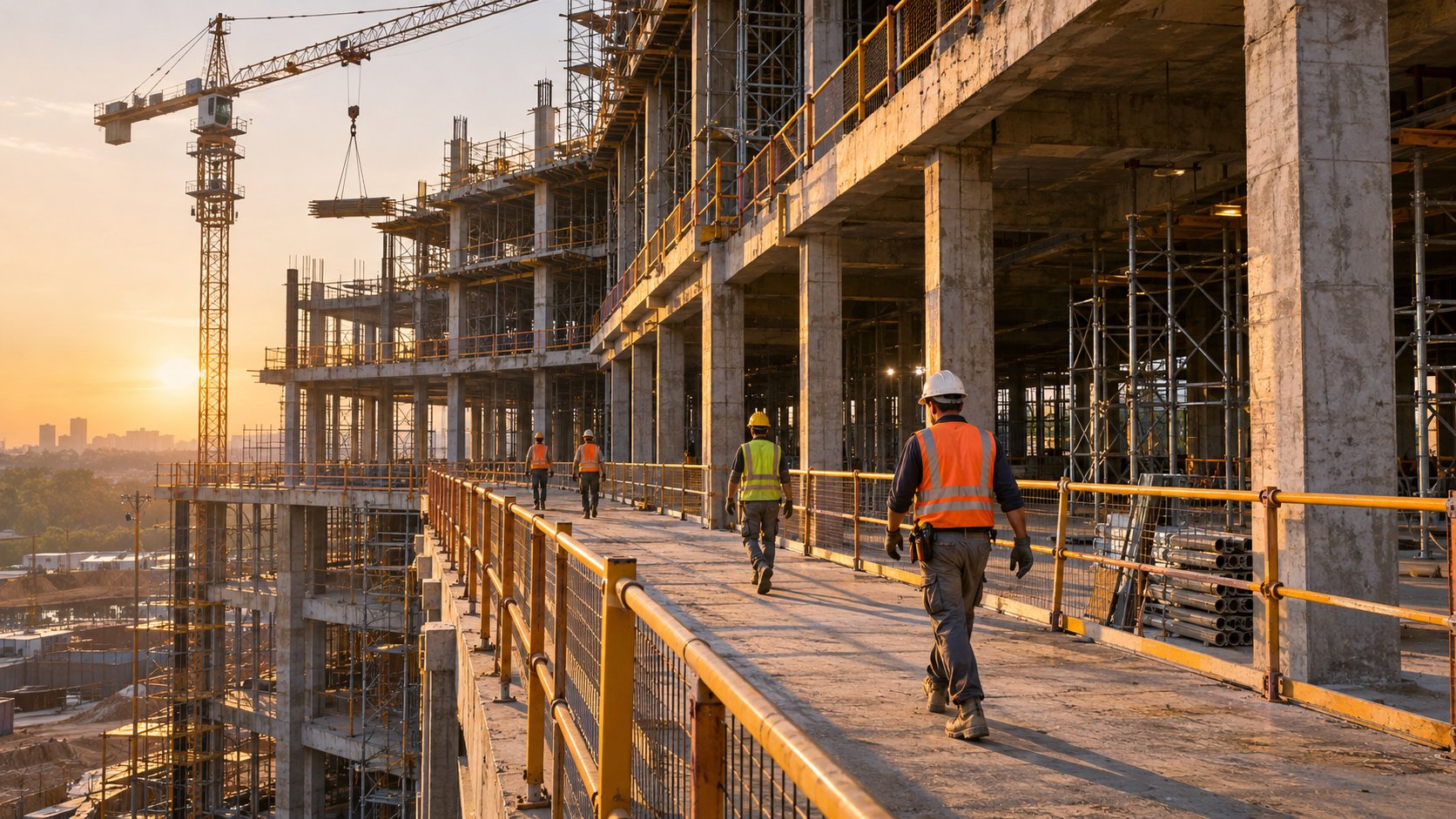
What are the common construction site hazards, and why do so many of them go unnoticed until someone gets hurt? A construction site hazard is any source, situation, or activity with the potential to cause injury, illness, property damage, or death. An unprotected roof edge, a frayed extension cord, airborne silica dust from concrete cutting - each one qualifies as a hazard the moment it exists on site, whether or not anyone has been harmed yet.
A construction site hazard is any condition, material, process, or piece of equipment on an active job site that has the potential to cause injury, illness, or death to workers or the public.
The scale of the problem is staggering. The Bureau of Labor Statistics reports that roughly one in five fatal workplace injuries in the United States occurs in construction, making it consistently one of the most dangerous industries in the country. OSHA's "Fatal Four" - falls, struck-by incidents, electrocutions, and caught-in or caught-between events - account for the majority of these deaths, yet every single one is preventable. Beyond fatalities, construction injuries cost the industry an estimated $11.5 billion annually, and over 130,000 workers miss more than one day of work each year because of on-the-job injuries.
Hazard Versus Risk and Why the Distinction Matters
Here is where most safety conversations fall short. People use "hazard" and "risk" interchangeably, but they describe two very different things. A hazard is the source of potential harm - imagine an open floor hole on the third story of a building under construction. That hole is the hazard. Risk, on the other hand, measures how likely someone is to be harmed by that hazard and how severe the outcome could be given the actual conditions on site.
Why does this matter in practice? Because the same hazard can carry vastly different levels of risk depending on the controls in place. That open floor hole protected by a compliant guardrail system and visible warning signage presents far less risk than the same hole left uncovered on a busy work deck during a night shift. Identifying the hazard tells you what can hurt someone; assessing the risk tells you what to control first. Separating these two steps prevents a dangerous mental shortcut - assuming that because a task feels routine, the underlying hazard has somehow disappeared.
Who This Guide Serves From Field Workers to Project Managers
This guide is built for everyone who steps onto or manages a construction workplace - laborers, foremen, superintendents, safety directors, project managers, and company owners alike. Rather than listing hazards in a generic rundown, the sections ahead map each major hazard category to its identification signs, the specific OSHA standards that govern it, actionable prevention protocols, and the hierarchy of controls that determines the right response. You will also find coverage of overlooked dangers like fatigue, ergonomic strain, and weather-related threats that rarely appear in standard construction safety resources but directly amplify the Fatal Four.
Every hazard discussed here shifts and evolves as a project moves through phases. A space that is safe during morning concrete pours can become a struck-by zone after an afternoon material delivery or an electrical exposure once temporary power is energized. That reality is exactly why hazard identification cannot be a one-time checkbox - and why the most lethal dangers on a job site are often the ones hiding in plain sight.
Falls from Heights and Elevated Work Dangers
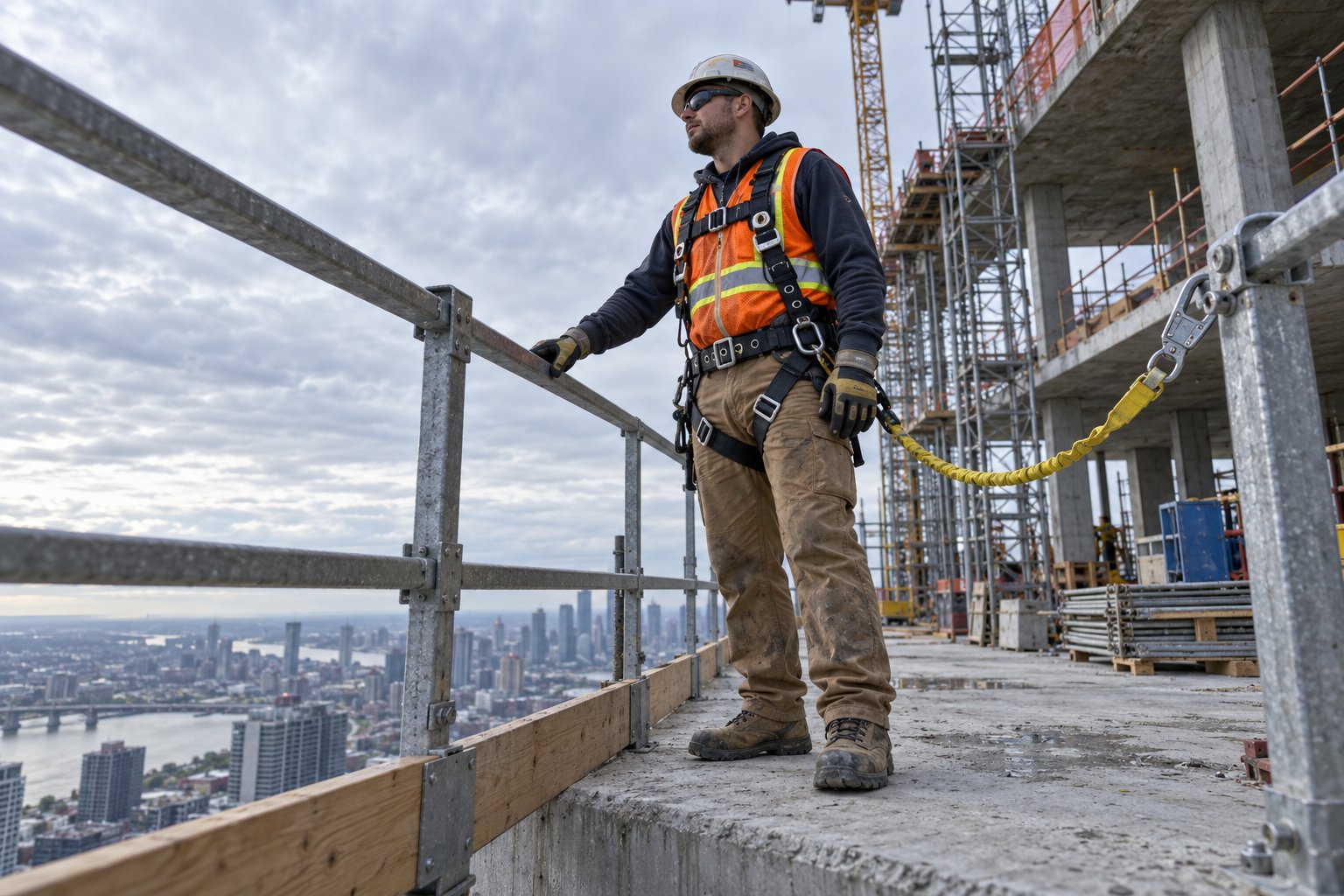
Falls kill more construction workers than any other single hazard category. Among the Fatal Four, they consistently account for the largest share of on-the-job fatalities - a pattern that has held for decades. What makes this statistic especially frustrating is that falls are almost always preventable. The root cause is rarely a freak accident. Instead, it is an unprotected edge that went unnoticed, a guardrail removed and never replaced, or a harness sitting in a worker's truck instead of clipped to an anchor point three stories up.
If you are evaluating what are the risks of working on a construction site, elevated work deserves the top spot on your list. Falls do not require extreme heights to cause catastrophic injury. A six-foot drop onto a concrete slab can fracture a spine. A ten-foot fall through an uncovered floor opening can be fatal. Understanding where these hazards appear - and how they shift as a project evolves - is the first step toward eliminating them.
Identifying Fall Hazards Across Project Phases
Fall hazards are not static. They migrate across a job site as work progresses, and a location that was safe last week can become deadly this week. During early structural phases, the greatest threats come from leading edges on elevated decks, open elevator shafts, and incomplete stairwells. Ironworkers connecting steel and concrete crews forming elevated slabs face constant exposure to unprotected sides and edges.
As the building envelope closes in, hazards shift to roof edges, skylight openings, and scaffold platforms used for exterior cladding or masonry work. Imagine a roofer stepping backward to inspect a membrane seam - one meter from an unguarded parapet edge. That scenario plays out daily on active sites. During the closeout phase, finishing trades working from ladders and aerial lifts introduce yet another set of fall exposures: painters on extension ladders reaching beyond the side rails, electricians on scissor lifts near open ceiling grids, and HVAC technicians accessing rooftop equipment with temporary ladder setups.
Conditions also change within a single shift. A floor hole covered and secured at 7 a.m. may be uncovered by another trade at 10 a.m. for pipe routing and left exposed through lunch. This is exactly why pre-task planning and routine inspections matter so much - fall hazards should be identified not just once, but continuously as materials move, covers shift, weather changes, and new work areas open up.
OSHA Subpart M and Fall Protection Compliance
In the United States, OSHA Subpart M (29 CFR 1926.500-503) establishes fall protection requirements for the construction industry. The core mandate is straightforward: any employee on a walking or working surface with an unprotected side or edge six feet or more above a lower level must be protected from falling. That protection can take the form of guardrail systems, safety net systems, or personal fall arrest systems.
Specific provisions adjust requirements based on the type of work. Leading-edge work, hoist areas, formwork and reinforcing steel, roofing on low-slope and steep-slope roofs, precast concrete erection, and residential construction each carry their own compliance requirements under Subpart M. For example, roofing work on low-slope roofs allows options like warning line systems or safety monitoring systems under certain conditions - options that do not apply to general elevated work on open decks.
For international readers, the UK's Work at Height Regulations 2005 follow a similar philosophy but frame compliance through a risk assessment obligation. Employers must avoid work at height wherever possible, use work equipment or other measures to prevent falls where height work cannot be avoided, and minimize the distance and consequences of a fall if prevention is not feasible. Regardless of jurisdiction, the regulatory intent is the same: plan before you go up, protect while you are up, and have a rescue plan if someone falls.
Prevention Protocols Beyond Basic PPE
"Wear a harness" is the most common piece of fall protection advice - and the least useful on its own. A harness sitting in a gang box protects no one. A harness worn but never connected to an anchor point is nothing more than uncomfortable clothing. Effective fall prevention requires a layered approach, matching the right protection method to the specific hazard and work environment.
Here are the primary fall protection methods and when each one applies:
- Guardrail systems: Physical barriers installed along unprotected edges, floor openings, and elevated platforms. Guardrails are the preferred first-line defense because they require no action from the worker - the barrier is simply there. They must include a top rail, mid rail, and toeboard, and be capable of withstanding a 200-pound force applied in any outward or downward direction at the top rail.
- Safety net systems: Nets installed below elevated work surfaces to catch a falling worker. Most effective for bridge construction, structural steel erection, and large open-span projects where guardrails and personal systems are impractical. Nets must be installed as close as feasible below the work surface - no more than 30 feet - and must be drop-tested or certified before use.
- Personal fall arrest systems (PFAS): A combination of a full-body harness, a connecting device such as a lanyard or self-retracting lifeline, and a certified anchorage point. PFAS are designed to stop a fall after it begins. Workers must inspect all components before each use, checking for frayed webbing, cracked D-rings, deployed shock absorbers, and corroded hardware. Equally critical is fall clearance - the total distance needed for the system to arrest a fall before the worker strikes a lower surface.
- Positioning device systems: Used when workers need both hands free at an elevated location, such as tying rebar on a column or connecting structural steel. These systems hold the worker in place rather than arresting a free fall, and they must be backed up by a separate fall arrest system.
- Controlled access zones: Designated areas near leading edges or other fall hazards where only authorized workers may enter under specific, controlled conditions. These zones use warning lines and are supervised by a trained monitor. They are not a substitute for physical protection but serve as an administrative layer where conventional systems are infeasible during certain operations like overhand bricklaying.
Each of these methods fits into a broader safety strategy. Guardrails eliminate exposure without relying on worker behavior. Safety nets catch failures passively. Personal fall arrest systems protect individuals when passive barriers are not practical. Positioning devices and controlled access zones fill narrow operational gaps. The critical mistake - and it is one of the most common fall protection failures on active sites - is defaulting to a harness and lanyard when a guardrail would have removed the hazard entirely.
Equipment alone does not close the loop, either. Rescue planning is a non-negotiable component of any fall protection program. If a worker falls and is suspended in a harness, suspension trauma can become life-threatening within minutes. Every site needs a documented rescue plan that identifies who will perform the rescue, what equipment they will use, and how quickly they can reach a suspended worker. Skipping this step turns a survivable fall into a fatal one.
Falls may top the fatality charts, but they rarely occur in isolation. A worker struck by a swinging load near an open edge, or caught between shifting equipment on a narrow platform, faces overlapping hazards that compound the danger far beyond a simple slip. Those intertwined threats - struck-by and caught-in or caught-between incidents - demand their own detailed examination.
Struck-By and Caught-In or Caught-Between Hazards
A falling hammer, a swinging excavator bucket, a trench wall that gives way without warning - these scenarios share something in common. They happen fast, they leave almost no time to react, and they kill or permanently disable workers every year across the construction industry. Struck-by and caught-in or caught-between incidents occupy the second and fourth positions in OSHA's Fatal Four, and together they represent a significant portion of construction fatalities. Data from the Center for Construction Research and Training shows that 65.5% of construction deaths between 2011 and 2021 were linked to the Fatal Four, with struck-by incidents alone accounting for roughly 17% of those fatalities.
What makes these two hazard categories particularly dangerous is how often they overlap, how quickly conditions change, and how easily the signs warning of the presence of construction hazards get buried under the pace of daily operations.
Struck-By Hazards and the Four Subcategories
A struck-by injury occurs when forcible contact between a worker and an object or piece of equipment produces the harm. OSHA breaks these incidents into four distinct subcategories, each with its own set of common scenarios and prevention strategies. Up to 75% of struck-by incidents involve vehicles or heavy equipment, but the remaining quarter - flying debris, falling tools, swinging loads - is no less lethal.
| Struck-By Subcategory | Example Scenarios | Relevant OSHA Standards | Primary Prevention Measures |
|---|---|---|---|
| Falling Objects | A wrench dropped from scaffolding, unsecured materials sliding off an elevated platform, debris dislodged during overhead demolition | 29 CFR 1926 Subpart E (PPE), Subpart L (Scaffolds), Subpart H (Materials Handling) | Tool lanyards, toe boards on scaffolds, debris nets, secured material stacking, hard hats for all personnel below elevated work |
| Flying Objects | Particles ejected from a concrete grinder, nail ricochets from a pneumatic nail gun, fragments from a cut-off saw | 29 CFR 1926 Subpart I (Tools - Hand and Power), Subpart E (PPE) | Machine guarding, safety goggles and face shields, tool inspection programs, maintaining safe standoff distances from cutting and grinding operations |
| Swinging Objects | A crane load swinging due to wind or sudden braking, a backhoe boom rotating into a worker's path, a suspended pipe section shifting during rigging | 29 CFR 1926 Subpart CC (Cranes and Derricks), Subpart O (Motor Vehicles and Mechanized Equipment) | Defined swing radius zones, spotter requirements, tag lines on suspended loads, operator-worker communication protocols, never positioning under a suspended load |
| Rolling Objects | An unsecured pipe rolling off a trailer, a dump truck reversing into a worker, a piece of equipment rolling on a slope due to improper parking | 29 CFR 1926.601 (Motor Vehicles), Subpart G (Signs, Signals, and Barricades), Subpart O | Wheel chocks, barricades around active vehicle zones, high-visibility clothing, audible backup alarms, flaggers and traffic control plans |
Notice a pattern? Many of these prevention measures are not complex or expensive. Securing a load, wearing a hard hat, establishing an exclusion zone around heavy equipment - these are fundamental building construction safety practices. The challenge is not knowledge. It is consistent execution across every shift, every task, every crew rotation.
Caught-In and Caught-Between Scenarios Including Trench Collapse
Caught-in and caught-between hazards occur when a worker is squeezed, compressed, pinched, or crushed between two or more objects - or pulled into unguarded machinery. Imagine a laborer clearing debris near a trench when the sidewall collapses inward. Within seconds, thousands of pounds of soil pin the worker against the opposite wall or bury them entirely. One cubic yard of soil can weigh more than 3,000 pounds. There is no pushing your way out.
The most deadly caught-in/between scenarios on construction sites include:
- Trench and excavation collapses: The leading cause of caught-in fatalities. Soil conditions change with weather, vibration from nearby equipment, and the duration the trench remains open. OSHA Subpart P (29 CFR 1926.650-652) requires protective systems for any trench five feet deep or more. These include sloping or benching the trench walls to a safe angle, installing hydraulic or timber shoring to brace the walls, or using trench shields (also called trench boxes) to protect the work zone.
- Unguarded machinery: Workers caught in rotating shafts, gears, pulleys, or conveyor belts on mixers, compactors, and drilling equipment. Missing machine guards and loose clothing are the most frequent contributing factors.
- Collapsing structures: Temporary support systems, partially demolished walls, and unstable formwork can shift or fail without warning, trapping workers beneath rubble or between structural elements.
- Equipment pinch points: A worker positioned between a backing vehicle and a fixed object like a concrete barrier, between a rotating boom and a structure wall, or between a lowering load and a receiving surface.
A critical but often overlooked distinction separates struck-by and caught-in injuries: if the harm comes purely from the impact, it is struck-by. If the worker is crushed or compressed after the initial contact, the incident is classified as caught-in or caught-between. On an active job site, that line blurs in real time - which brings up the next challenge.
Managing Overlapping Hazards in a Single Work Zone
Here is where building construction safety gets genuinely complex. Hazards rarely exist in isolation. Picture a routine excavation scenario: a backhoe is digging a utility trench while a crew works nearby preparing pipe sections. In that single work zone, you are looking at simultaneous exposure to struck-by hazards from the swinging bucket, caught-in hazards from potential trench collapse, rolling object risks from pipes staged on uneven ground, and equipment pinch points between the machine and the trench wall.
This multi-hazard overlap is exactly why pre-task planning matters so much. A Job Hazard Analysis for this scenario should not just list "excavation" as the hazard. It needs to break the task into individual steps - positioning the machine, excavating, spoil pile placement, worker entry into the trench, pipe installation - and identify the specific hazards present at each step.
Actionable prevention measures for overlapping hazard zones include:
- Exclusion zones and barricades: Physically separate foot traffic from equipment operating areas. No worker should be inside the swing radius of an excavator without direct communication with the operator and a designated spotter.
- Spotter requirements: Dedicated spotters must be assigned for all heavy equipment operations where the operator's line of sight is obstructed. Spotters use standardized hand signals or radio communication - never assume the operator can see you.
- Protective systems for every trench: Before anyone enters an excavation, a competent person must inspect the trench and confirm that sloping, shoring, or shielding is in place and appropriate for the soil classification. Inspections must be repeated after rain, vibration events, or any interruption in work.
- Material staging discipline: Spoil piles must be kept at least two feet from the trench edge. Pipes, fittings, and tools should be staged on level ground with chocks or cradles to prevent rolling.
- Crane and derrick compliance: For any lifting operations in or near excavations, OSHA Subpart CC governs crane setup, load ratings, operator qualifications, and signal person requirements. Ground conditions near a trench may not support the outrigger loads of a crane, creating a collapse risk for both the machine and the excavation.
Effective communication ties all of these measures together. Every worker in a multi-hazard zone needs to know what equipment is operating, where exclusion boundaries are, who the designated spotter is, and what the emergency response plan looks like if a trench collapses or a load breaks free. A five-minute pre-task briefing costs almost nothing. Skipping it can cost everything.
Struck-by and caught-in hazards draw most of their lethality from physical force - mass, momentum, and gravity. Yet some of the most dangerous exposures on a construction site involve no moving parts at all. Invisible and silent, electrical energy presents a category of hazard where a single moment of contact can be fatal, especially in the unfinished, wet, and conductive environments that define an active job site.
Electrical Hazards and Energized Work Environments
You cannot see it, smell it, or hear it - and that is precisely what makes electricity one of the most treacherous construction site hazards a worker can face. Contact with energized circuits, overhead power lines, or even a damaged extension cord can send lethal current through the body in a fraction of a second. Construction environments amplify this danger in ways that finished buildings do not. Standing water from recent rain, steel rebar protruding from fresh concrete, aluminum scaffolding frames, damp clothing after a morning of physical labor - every one of these conditions lowers electrical resistance and turns a survivable shock into a fatal electrocution.
Electrocution holds a permanent seat among OSHA's Fatal Four for good reason. Unlike a fall, which offers at least a brief visual warning - an unprotected edge, a missing guardrail - electrical hazards in construction site environments are frequently invisible until the moment of contact.
Common Electrical Hazard Scenarios on Active Sites
Picture a typical mid-construction job site. Temporary power panels feed strings of extension cords across wet floors. Overhead power lines pass within feet of a crane boom or aerial lift basket. Walls are open, exposing rough-wired junction boxes that may or may not be de-energized. Every one of these scenarios creates a path for current to reach a worker.
The most frequent electrical work site hazards on active construction projects include:
- Contact with overhead power lines: Cranes, concrete pump booms, ladders, scaffolding, and even hand-carried materials like long metal pipes can bridge the gap between a worker and an energized overhead line. These incidents are often immediately fatal because high-voltage transmission lines deliver massive current with no circuit breaker to interrupt it.
- Exposed wiring in partially completed structures: During rough-in phases, conductors may be temporarily energized for testing while walls remain open and accessible. Workers from other trades - plumbers, framers, drywall crews - may not realize a circuit is live.
- Improper use of extension cords and temporary wiring: Daisy-chained cords, missing ground prongs, cords run through doorways where they get pinched, and use of indoor-rated cords in wet outdoor environments all create shock and fire hazards.
- Lack of ground-fault protection: Without ground-fault circuit interrupters, a fault as small as five milliamps - far below the threshold you would feel as a mild tingle in dry conditions - can become lethal when a worker is standing in water or gripping a grounded metal surface.
- Energized demolition: Renovation and demolition projects carry the added risk of cutting into walls or ceilings that still contain live wiring from the original building's electrical system. Outdated wiring with degraded insulation makes this even more unpredictable.
Electrical hazards also shift dramatically depending on the project phase. During MEP rough-in, electricians are pulling wire, making connections, and testing circuits - often working inches from energized panels. During demolition of existing structures, every wall cavity is a potential encounter with live circuits that may not appear on outdated as-built drawings. Even during the closeout phase, finishing trades plugging power tools into newly energized receptacles face shock risks if circuits were not properly tested and labeled.
OSHA Subpart K Requirements and GFCI Compliance
OSHA Subpart K (29 CFR 1926.400-449) governs electrical safety standards for the construction industry. It covers everything from the approval and installation of electrical equipment to working clearances, guarding of live parts, and requirements for temporary wiring used during construction.
A few provisions carry particular weight on active job sites. Under 29 CFR 1926.403, all electrical conductors and equipment must be approved, and employers must ensure equipment is free from recognized hazards likely to cause death or serious physical harm. The standard also specifies minimum working clearances around electrical equipment - for example, at least three feet of clear working space in front of equipment operating at 0 to 600 volts, increasing with voltage and the configuration of exposed live parts as detailed in Table K-1.
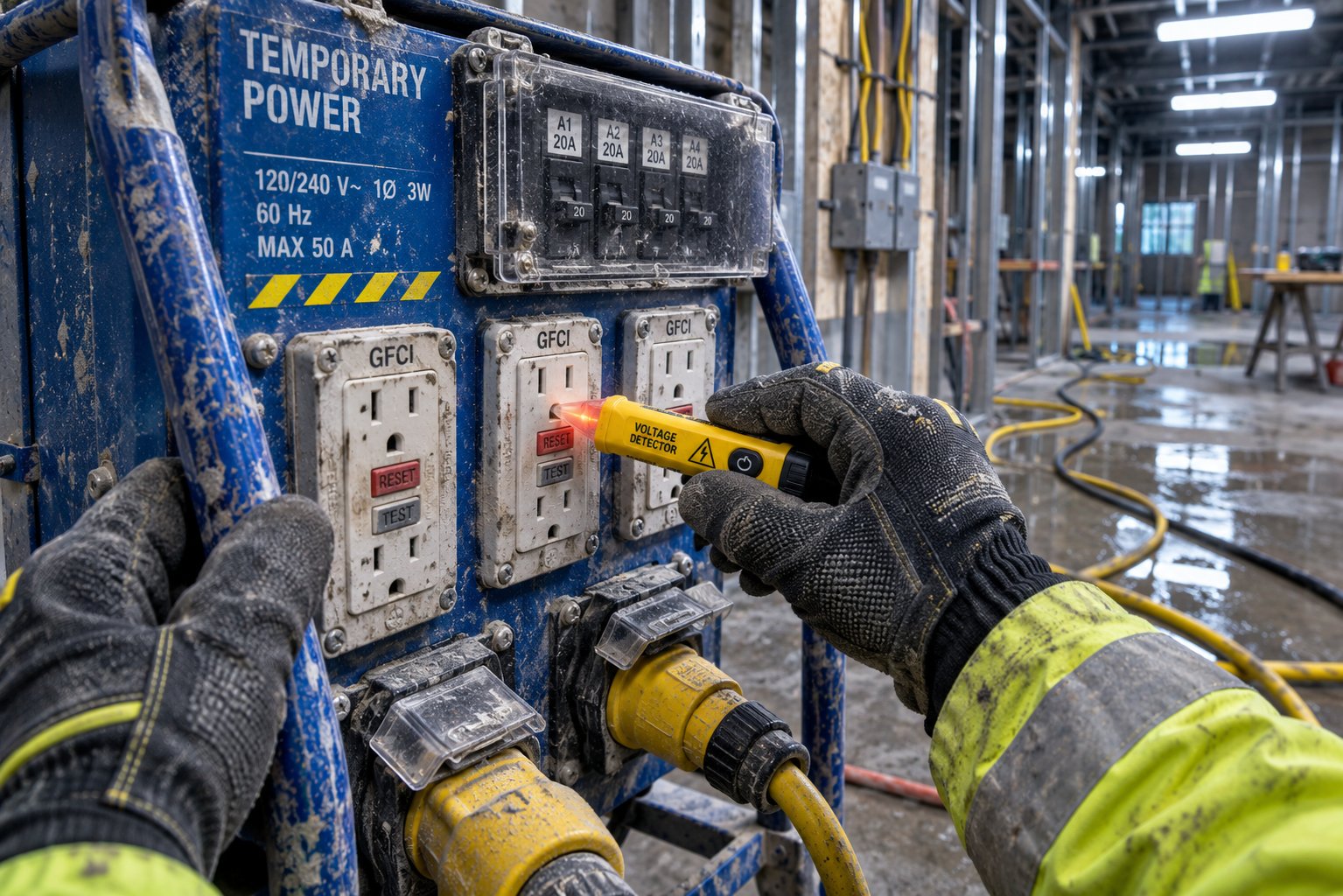
For temporary power on construction sites, OSHA requires one of two protective approaches: either all 120-volt, single-phase, 15- and 20-ampere receptacle outlets must be protected by approved GFCIs, or the employer must implement an assured equipment grounding conductor program. The GFCI route is far more common because it provides automatic, real-time protection - the device trips within milliseconds if it detects even a small current leak to ground. An assured grounding program, by contrast, demands rigorous documentation, daily visual inspections of all cord sets and receptacles, and periodic testing with calibrated instruments. Most contractors find GFCI protection simpler to manage and more reliable in the chaotic conditions of building construction hazards.
Lockout Tagout and Safe Work Practices Near Energized Sources
When workers service, maintain, or modify electrical equipment, the unexpected startup or release of stored energy can cause serious injury or death. Lockout/tagout (LOTO) procedures exist to prevent exactly that scenario. The process involves de-energizing the circuit, applying a physical lock to the disconnect switch so it cannot be re-energized, attaching a tag identifying who locked it out and why, and verifying - through testing with a calibrated voltage detector - that the circuit is truly dead before work begins.
Every worker performing the task must apply their own individual lock. This is not optional and not a formality. If three electricians are working on the same panel, three locks go on the disconnect. The circuit does not get re-energized until every lock is removed by the person who placed it. Shortcuts here - "just flipping the breaker" without a lock, relying on someone else to keep the switch off, or skipping the verification step - are the exact behaviors that produce electrocution fatalities on construction sites year after year.
Beyond LOTO, safe work practices near energized sources include maintaining minimum approach distances from overhead power lines. OSHA specifies that equipment and workers must stay at least 10 feet from power lines carrying up to 50 kV, with the distance increasing for higher voltages. For crane operations, a dedicated spotter should monitor boom proximity to overhead lines continuously. On the ground, barricades and warning signs should mark the boundary of the danger zone so that no worker accidentally carries a conductive object into the clearance envelope.
Daily site walkthroughs are your most practical tool for catching electrical hazards before they cause harm. Here is a checklist of critical inspection points:
- GFCI function: Test every GFCI device on site using the built-in test button. Replace any unit that does not trip and reset correctly.
- Extension cord condition: Inspect for cuts, fraying, exposed conductors, missing ground prongs, and signs of overheating. Remove damaged cords from service immediately.
- Temporary panel security: Confirm that temporary power panels are dry, properly covered, and accessible only to qualified persons. Verify that all breakers are labeled.
- Overhead line clearance: Before any crane, aerial lift, or tall equipment operates, identify all overhead power lines in the work area and confirm that minimum clearance distances are maintained.
- Lockout/tagout compliance: Verify that all de-energized circuits awaiting work have individual locks and tags applied. Confirm no unauthorized re-energization has occurred.
- Wet condition assessment: After rain or in areas with standing water, reassess all electrical connections, cord routing, and grounding. Wet conditions drastically reduce the current threshold for electrocution.
- Exposed wiring and open junction boxes: Walk the structure and flag any open boxes, hanging conductors, or circuits left exposed by other trades. Report and isolate them before work continues in the area.
Electrical hazards demand respect because they offer no second chances and almost no warning signs. A frayed cord in a puddle, a live wire behind drywall, a crane boom drifting toward a power line - each one is silent until the circuit completes through a human body. Yet electricity is only one of the invisible threats on a construction site. Airborne contaminants, toxic dust, and biological agents pose a different kind of danger - one that does not strike instantly but accumulates quietly over weeks, months, and years of exposure.
Chemical and Occupational Health Hazards in Construction
A steel beam falling from a crane grabs everyone's attention. A cloud of fine silica dust drifting off a concrete saw? Most workers barely notice it. That contrast explains why construction health hazards rooted in chemical and biological exposures are among the most underestimated dangers on any job site. These threats do not break bones on contact. Instead, they infiltrate lungs, bloodstreams, and organ systems over weeks, months, or years - producing cancers, chronic respiratory disease, neurological damage, and organ failure long after the worker has left the project.
Understanding these slow-acting construction hazards is just as critical as guarding against falls and struck-by incidents. The difference is that the harm is invisible during the exposure window, making prevention feel abstract until a diagnosis arrives years later.
Silica Dust, Asbestos, and Airborne Contaminants
Every time a worker cuts concrete, grinds mortar, drills into masonry, or demolishes a block wall, respirable crystalline silica particles launch into the air. These particles are far too small to see - roughly 100 times smaller than a grain of sand - yet they penetrate deep into the lungs and trigger irreversible scarring known as silicosis. Prolonged exposure also increases the risk of lung cancer, chronic obstructive pulmonary disease (COPD), and kidney disease.
OSHA's respirable crystalline silica standard (29 CFR 1926.1153) sets a permissible exposure limit (PEL) of 50 micrograms per cubic meter of air, averaged over an 8-hour shift. The standard provides two compliance paths. The first - and most practical for field crews - is Table 1, which lists 18 common construction tasks alongside the specific engineering controls, work practices, and respiratory protection required for each. For example, a handheld power saw must be equipped with an integrated water delivery system that continuously feeds water to the blade. When used outdoors for four hours or less per shift, no respirator is needed if the wet-cutting control is properly maintained. Exceed four hours, or move the same saw indoors, and a minimum APF 10 respirator becomes mandatory.
The second compliance path allows employers to measure actual employee exposure through air monitoring and limit it to the PEL using any combination of controls they choose. This approach demands laboratory analysis of air samples by methods specified in the standard's appendix, along with employee notification of results and ongoing medical surveillance. Most smaller contractors opt for Table 1 because it eliminates the need for exposure sampling - you simply follow the prescribed controls for each task.
Silica is only one airborne contaminant. Asbestos, still present in countless pre-1980 buildings, becomes a lethal hazard during renovation and demolition work. Disturbing asbestos-containing materials - pipe insulation, floor tiles, textured coatings, roofing felts - releases microscopic fibers that cause mesothelioma, asbestosis, and lung cancer. OSHA's asbestos standard for construction (29 CFR 1926.1101) requires exposure assessments before any work that might disturb suspect materials, along with strict controls that include wetting, HEPA-filtered local exhaust ventilation, sealed containment areas, and specialized worker training.
Lead exposure presents another serious but often overlooked threat, particularly on bridge rehabilitation, steel structure repainting, and renovation of older buildings with lead-based coatings. OSHA's lead in construction standard (29 CFR 1926.62) sets the PEL at 50 micrograms per cubic meter as an 8-hour TWA, with an action level of 30 µg/m³ that triggers exposure monitoring requirements. Certain high-exposure tasks - abrasive blasting of lead paint, torch burning of lead-coated structures, welding on lead-painted surfaces - carry interim protection requirements. Until the employer documents that exposure falls below specified thresholds, workers performing these tasks must be treated as if they are exposed above the PEL, with full respiratory protection, protective clothing, and biological monitoring in place.
Solvent and adhesive fumes round out the chemical hazard picture. Flooring adhesives, waterproofing coatings, epoxy systems, and paint thinners release volatile organic compounds (VOCs) that cause headaches, dizziness, and respiratory irritation in the short term, and liver damage, kidney damage, and central nervous system disorders with chronic exposure. Welding fumes - a complex mixture of metal oxides, gases, and particulates - pose their own category of risk, including manganism from manganese exposure, metal fume fever, and increased lung cancer risk.
| Chemical Hazard | Common Construction Sources | Health Effects | Applicable OSHA Standard | Primary Engineering Controls |
|---|---|---|---|---|
| Respirable Crystalline Silica | Concrete cutting, grinding, drilling, tuckpointing, demolition of masonry | Silicosis, lung cancer, COPD, kidney disease | 29 CFR 1926.1153 (PEL: 50 µg/m³) | Integrated water delivery systems for saws and drills, dust collection shrouds with 99%+ filter efficiency, HEPA-filtered vacuums for hole cleaning |
| Asbestos | Demolition/renovation of pre-1980 buildings, disturbing pipe insulation, floor tiles, roofing materials | Mesothelioma, asbestosis, lung cancer (latency period of 10-50 years) | 29 CFR 1926.1101 (PEL: 0.1 fiber/cc) | Wet methods to suppress fiber release, HEPA-filtered local exhaust ventilation, sealed negative-pressure containment enclosures |
| Lead | Abrasive blasting of lead paint, torch cutting lead-coated steel, renovation of older buildings | Neurological damage, kidney disease, reproductive harm, anemia | 29 CFR 1926.62 (PEL: 50 µg/m³) | HEPA-filtered local exhaust ventilation, wet scraping and chemical stripping instead of abrasive methods, enclosed blast containment |
| Solvents and VOCs | Adhesives, waterproofing coatings, epoxy systems, paint thinners, degreasing agents | CNS depression, liver and kidney damage, dermatitis, respiratory sensitization | 29 CFR 1926.55 (Gases, Vapors, Fumes - Table Z) | General and local exhaust ventilation, substitution with water-based or low-VOC products, enclosed application systems |
| Welding Fumes | Structural steel welding, pipe welding, cutting and brazing operations | Metal fume fever, manganism, lung cancer, respiratory irritation | 29 CFR 1926.353 (Ventilation for Welding) | Local exhaust ventilation positioned at the fume source, natural ventilation with minimum airflow rates, fume extraction torches |
Biological Hazards on Renovation and Demolition Sites
Chemical exposures get most of the regulatory attention, but biological hazards on construction sites are surprisingly common - and almost universally ignored in safety planning. Renovation and demolition projects are the primary hotspots.
Mold is the most frequent biological contaminant. Buildings that have experienced water damage, roof leaks, or prolonged vacancy often harbor extensive mold growth behind walls, above ceiling tiles, and within HVAC ductwork. When demolition crews tear into these materials, they release massive concentrations of mold spores into the air. The EPA's mold remediation guidance classifies contamination by area: less than 10 square feet requires minimum PPE including an N-95 respirator, gloves, and goggles. Areas between 10 and 100 square feet call for limited containment using a single layer of 6-mil polyethylene sheeting and half-face or full-face air purifying respirators equipped with P100 filters. Contamination exceeding 100 square feet demands full containment with double polyethylene barriers, a decontamination chamber, negative air pressure, and powered air purifying respirators (PAPRs).
Contaminated soil is another biological hazard that surfaces during excavation work - particularly on brownfield sites, former industrial properties, or land adjacent to agricultural operations. Workers trenching through soil containing sewage residue, chemical waste, or decomposing organic matter face exposure to bacteria, fungi, and parasites. Construction hazards at airports, industrial parks, and urban redevelopment zones often include contaminated ground conditions that require environmental assessments before earthwork begins.
Rural and agricultural construction introduces exposure to animal waste, bird droppings (a source of histoplasmosis-causing fungus), and rodent-contaminated insulation in older barn and silo renovations. These are not exotic risks - they are everyday realities on projects outside urban centers that rarely appear in standard safety toolbox talks.
Respiratory Protection Programs and Exposure Monitoring
Engineering controls should always be the first line of defense - wet cutting to suppress silica dust, local exhaust ventilation to capture welding fumes, containment systems for asbestos and mold. When those controls cannot reduce exposure below permissible limits, respiratory protection becomes mandatory. But handing a worker a respirator is not the same as protecting them.
A compliant respiratory protection program under OSHA's 29 CFR 1910.134 requires several interconnected elements. Workers must receive a medical evaluation confirming they are physically able to wear a respirator. Each worker must then be fit-tested with the specific make and model of respirator they will use on site - because a respirator that does not seal against the face provides a false sense of security and almost no actual protection. Fit testing must be repeated annually and whenever a worker's physical condition changes in ways that could affect the seal, such as significant weight change or dental work.
Beyond fit testing, the program must include training on how to properly don, doff, inspect, and maintain the respirator. Workers need to understand the limitations of their equipment - an N-95 filtering facepiece protects against particulates but offers zero protection against organic vapors from solvents or adhesives. Using the wrong respirator type for the exposure is functionally the same as wearing nothing at all.
Exposure monitoring ties the entire system together. For silica, employers following the alternative exposure assessment path under 29 CFR 1926.1153 must conduct air sampling representative of each worker's actual exposure, analyzed by an accredited laboratory using approved methods. For lead, 29 CFR 1926.62 requires initial exposure determinations and periodic monitoring whenever exposure reaches or exceeds the action level of 30 µg/m³. Biological monitoring adds another layer for lead: blood lead level testing must occur at least every two months for workers whose levels reach or exceed 40 µg/dl, and medical removal from lead exposure is triggered when blood lead hits 50 µg/dl.
For UK-based readers, the Control of Substances Hazardous to Health (COSHH) Regulations 2002 impose parallel obligations. Employers must assess the risks from hazardous substances, implement appropriate control measures, monitor workplace exposure where necessary, and provide health surveillance for workers exposed to substances linked to identifiable diseases. The principle mirrors OSHA's framework: identify the substance, quantify the exposure, control it at the source, protect the worker, and monitor the outcome.
Health surveillance and medical monitoring are not bureaucratic overhead - they are early warning systems. A blood lead level creeping toward 40 µg/dl signals that current controls are failing before irreversible neurological damage sets in. A spirometry test showing declining lung function in a concrete cutter flags silica exposure that engineering controls have not adequately addressed. These programs catch what daily walkthroughs cannot: the cumulative, invisible damage that separates a 30-year construction career from a disability claim at age 45.
Chemical and biological hazards operate on long timelines, eroding health gradually beneath the awareness threshold. Other hazards work the same way but target a different system entirely - not the lungs or bloodstream, but the mind and musculoskeletal structure. Fatigue, repetitive strain, extreme temperatures, and psychological stress are rarely tracked on incident logs, yet they quietly amplify every other risk on a construction site.
Frequently Overlooked Hazards Including Fatigue and Weather
A worker does not need to fall from a roof or contact a live wire to suffer a life-altering injury on a construction site. Sometimes the most damaging hazards are the ones that never appear on an incident report at all - chronic exhaustion from ten consecutive twelve-hour shifts, a shoulder that gradually locks up after months of overhead drilling, or a heat index that climbs past safe thresholds while a concrete crew pushes to finish a pour. These health hazards in construction operate below the radar of traditional safety programs, yet they are directly responsible for amplifying every high-profile danger discussed in earlier sections. A fatigued worker is slower to react near a leading edge. A dehydrated laborer loses coordination on a scaffold. A crew member battling chronic back pain takes shortcuts to avoid bending, skipping a proper lockout step or ignoring a trench inspection.
If the Fatal Four represent the sharp end of construction danger, fatigue, ergonomic strain, and weather extremes are the dull blade that makes every cut worse.
Mental Health and Fatigue as Hidden Safety Risks
Construction consistently ranks among the most physically and mentally demanding industries, yet mental health and fatigue are rarely treated as safety hazards in daily toolbox talks or Job Hazard Analyses. That gap is dangerous. Research published in the American Journal of Industrial Medicine identifies work-related fatigue as a significant occupational safety and health problem, noting that over 43% of workers are sleep-deprived and that fatigued worker productivity losses cost employers $1,200 to $3,100 per employee annually. In construction, where the consequences of impaired judgment include fatal falls and struck-by incidents, those numbers carry a weight that extends far beyond dollars.
Fatigue in construction does not always stem from a single long shift. It accumulates. Acute fatigue results from a short-term lack of sleep or intense physical and mental effort - imagine a framing crew working a fourteen-hour day to meet a concrete pour deadline. Workers experiencing acute fatigue show reduced reaction time, lower productivity, and a measurable increase in decision errors. When that pattern repeats across days or weeks without adequate recovery, it becomes chronic fatigue, which the same research links to digestive complaints, depression, and sustained performance deficits that dramatically increase accident risk.
Several factors make construction workers especially vulnerable:
- Extended and irregular working hours: Project deadlines, weather delays, and seasonal pushes routinely produce 50- to 70-hour work weeks. Extended daily hours limit recovery time and increase sleep debt across consecutive shifts.
- Physically demanding labor: Heavy lifting, repetitive motion, and sustained exertion accelerate physical fatigue even during standard-length shifts, compounding the effects of insufficient sleep.
- Schedule pressure and job insecurity: Workers - particularly temporary, immigrant, and younger crew members - may accept fatigue-inducing hours out of financial need or fear that refusing overtime could jeopardize their employment. Temporary workers have reported higher rates of fatigue compared to permanent employees, along with less control over their schedules.
- Overlapping vulnerability factors: A young worker balancing school and job commitments, an immigrant laborer working multiple positions, or an aging tradesperson whose sleep quality has declined with age - each of these profiles carries compounding fatigue risk. Roughly 40% of Hispanic immigrants working in construction work in firms with fewer than 10 employees, where fatigue management programs are least likely to exist.
Mental health deserves equal attention. Construction workers face elevated rates of depression, anxiety, and substance use disorders. The isolation of traveling job sites, the boom-and-bust cycle of project-based employment, and a culture that still discourages discussing emotional struggles all contribute. Depression impairs concentration and decision-making - the same cognitive functions that keep a worker alive on a leading edge or inside a trench. Treating mental health as separate from safety is a false distinction. A worker battling untreated depression is not just struggling personally; they are operating in a diminished state on a site where full alertness is the minimum requirement for survival.
Ergonomic Hazards and Musculoskeletal Disorders
When people think about what are the common construction site hazards, repetitive strain injuries and awkward postures rarely make the list. Yet musculoskeletal disorders (MSDs) account for a massive share of lost-workday injuries in the industry. Bricklayers bending thousands of times per shift, electricians working overhead with arms extended for hours, laborers hand-carrying heavy materials across uneven ground - these activities produce cumulative damage to joints, tendons, ligaments, and spinal discs that can end careers just as surely as a single traumatic event.
The primary ergonomic risk factors on construction sites include:
- Repetitive lifting and manual handling: Concrete blocks, bundles of rebar, sheets of plywood, and bags of mortar all require manual handling that loads the lower back and shoulders repeatedly throughout the day.
- Awkward and sustained postures: Overhead work, kneeling on hard surfaces for flooring installation, and working in confined spaces force the body into positions that accelerate joint degeneration and nerve compression.
- Vibration exposure from power tools: Jackhammers, concrete breakers, impact wrenches, and grinders transmit vibration energy directly into the hands and arms. According to the Defense Centers for Public Health, hand-arm vibration can cause vascular spasms and constriction of blood vessels in the fingers - a condition known as vibration-induced white finger or hand-arm vibration syndrome (HAVS). Symptoms include tingling, numbness, loss of grip strength, and pain intensified by cold exposure.
- Whole-body vibration (WBV): Equipment operators who spend hours on bulldozers, compactors, and haul trucks absorb continuous vibration transmitted through the seat and floor. Research links long-term, high-intensity WBV to increased health risk for the lumbar spine and connected nervous system segments.
Preventive actions for vibration hazards include limiting daily exposure duration, alternating between vibrating and non-vibrating tools, maintaining tools so they remain sharp and properly lubricated, and using vibration-damping gloves that comply with ANSI S3.40-2002 or ISO 10819 standards. For whole-body vibration, properly maintained suspension seats, limiting continuous operating time, and selecting equipment with effective vibration isolation systems all reduce cumulative spinal loading.
In the UK, the Provision and Use of Work Equipment Regulations 1998 (PUWER) require employers to ensure that work equipment is suitable for its intended use, properly maintained, and used only by trained personnel. PUWER intersects with ergonomic safety because poorly maintained or incorrectly specified tools and equipment amplify vibration, force, and repetitive strain exposures. A worn-out grinder that vibrates excessively or a drill with a failing damping mechanism is not just a maintenance issue - it is a direct ergonomic hazard that accelerates HAVS progression.
Construction JHA examples rarely include ergonomic risk factors in the task breakdown, which is precisely why MSDs continue to dominate workers' compensation claims. Adding a simple ergonomic screening step - does this task involve repetitive lifting, sustained awkward posture, or prolonged vibration exposure? - to every pre-task plan would flag risks that currently go unaddressed until the injury has already occurred.
Seasonal and Weather-Related Hazard Protocols
Construction does not stop when the weather turns hostile. Crews pour concrete in 100-degree heat, erect steel in freezing wind, and pour foundations while thunderstorms build on the horizon. Each season introduces a distinct set of environmental hazards that interact with and amplify every other risk category on site. A recent analysis in Occupational Health & Safety magazine notes that severe weather accounted for a record 21 billion-dollar disasters in 2025, with the average interval between billion-dollar disasters falling to just 10 days. For construction supervisors, weather is not a seasonal inconvenience - it is a daily hazard requiring the same rigor as fall protection or electrical safety.
| Season | Primary Hazards | Warning Signs | Required Safety Protocols |
|---|---|---|---|
| Summer | Heat stress, heat stroke, dehydration, UV/sun exposure, ozone irritation | Excessive sweating followed by cessation of sweating, confusion, dizziness, nausea, rapid pulse, flushed or hot skin, sunburn | Wet Bulb Globe Temperature (WBGT) monitoring, mandatory water-rest-shade cycles, acclimatization programs for new or returning workers (minimum 7-14 days), sunscreen and UV-protective clothing, adjusted shift schedules to avoid peak heat hours |
| Fall | Rapidly shifting temperatures, early frost creating slip hazards, reduced daylight hours, high winds during storm season | Frost on walking surfaces, condensation on metal platforms, shortened visibility windows, wind gusts exceeding equipment thresholds | Anti-slip treatments on walking surfaces, task lighting for early-dark conditions, daily weather briefings, wind-speed monitoring for crane and aerial lift operations |
| Winter | Cold stress, hypothermia, frostbite, ice-covered surfaces, snow loading on temporary structures | Numbness in extremities, uncontrollable shivering, slowed reflexes, reduced dexterity, slurred speech, visible ice on scaffolds and ladders | Insulated weather-appropriate gear, dry gloves, heated break shelters, mandatory warm-up breaks, monitoring for cold stress symptoms, hydration reminders (dehydration persists in cold weather), ensuring high-visibility vests are not buried under jackets |
| Spring | Lightning, sudden thunderstorms, saturated soil increasing trench collapse risk, flooding of excavations, wind variability | Darkening skies, distant thunder (lightning within 10 miles), standing water in excavations, soft or cracking trench walls after rain | 30-30 lightning rule (seek shelter if time between flash and thunder is 30 seconds or less, wait 30 minutes after last strike), halt crane operations when wind exceeds manufacturer thresholds (typically 20-25 mph for mobile cranes), competent person re-inspection of all trenches after any rainfall event |
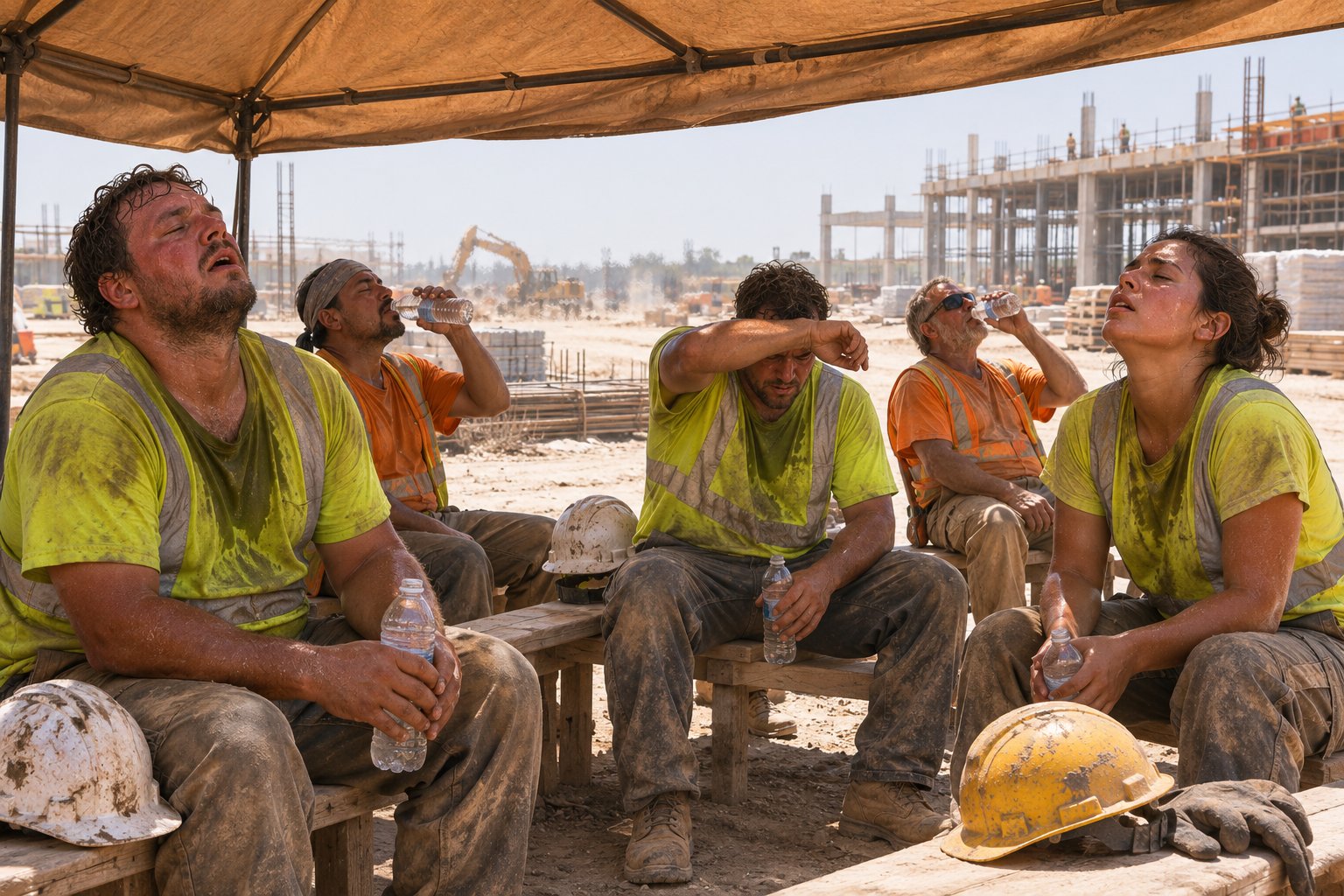
Heat stress deserves particular emphasis. WBGT monitoring goes beyond simply checking the air temperature - it accounts for humidity, wind speed, sun angle, and radiant heat from surrounding surfaces like fresh asphalt or concrete. A 90-degree day with high humidity and no wind can produce a WBGT reading that demands 15-minute rest breaks every hour. Without structured monitoring, supervisors default to subjective judgment - and by the time a worker shows visible signs of heat stroke, the condition may already be life-threatening.
Cold weather carries its own deceptive risks. The Bureau of Labor Statistics reports over 20,000 annual injuries from ice and snow, primarily slips, falls, and cold stress conditions. Cold exposure slows reflexes and reduces dexterity, which means routine tasks - climbing ladders, handling tools, connecting fall arrest hardware - become measurably more hazardous. Hypothermia can set in at temperatures well above freezing when wind, wet clothing, and fatigue combine. Workers often underestimate cold-weather dehydration because they do not feel thirsty, but fluid loss continues regardless of ambient temperature.
Wind speed thresholds govern some of the most critical operations on site. Most crane manufacturers specify maximum operating wind speeds between 20 and 25 miles per hour for mobile cranes, with tower cranes often rated for higher sustained winds but requiring shutdown during gusts that exceed rated limits. Elevated work on scaffolds and aerial lifts becomes increasingly dangerous as wind speeds rise - a gust that would barely register at ground level can destabilize a worker on an open platform at 60 feet. Lightning protocols require all outdoor work to cease when a storm moves within striking distance, and the 30-30 rule provides a simple field guideline: if the time between a lightning flash and thunder is 30 seconds or less, all workers must move to a grounded shelter immediately and remain there until 30 minutes after the last observed strike.
UV and sun exposure round out the seasonal picture as a genuine occupational health risk rather than a mere comfort issue. Construction workers receive significantly more cumulative UV radiation than indoor workers, increasing their risk of skin cancer, cataracts, and premature skin aging. Long-sleeved UV-protective clothing, wide-brim hard hat attachments, and sunscreen application should be treated as standard PPE - not optional personal choices.
These overlooked hazards - fatigue, ergonomic strain, and weather extremes - do not just cause their own injuries. They silently erode the margins of safety that keep the Fatal Four from claiming more lives. A well-rested, physically comfortable worker in manageable weather conditions is fundamentally more capable of following fall protection protocols, maintaining clearance from energized equipment, and staying alert near heavy machinery. Strip away any of those conditions, and the probability of a serious incident climbs in ways that no single piece of PPE can offset. That reality points toward a broader principle: effective hazard control is not about addressing each danger in isolation. It requires a systematic framework that prioritizes elimination at the source and treats personal protective equipment as the last resort, not the default answer.
Applying the Hierarchy of Controls to Every Hazard
Hand a construction worker a hard hat and a pair of safety glasses, and most people assume the job site hazards have been "handled." That assumption is the single most dangerous shortcut in the industry. Personal protective equipment sits at the bottom of every credible safety framework for a reason - it does nothing to remove the hazard itself. It simply places one last barrier between the worker and an injury that every higher-level control failed to prevent. The hierarchy of controls, developed by NIOSH, provides the systematic decision-making structure that transforms hazard management from reactive guesswork into a deliberate, prioritized process.
PPE should always be the last line of defense, not the first response. If your safety plan starts with what workers need to wear, it has already skipped the steps most likely to prevent the injury altogether.
The framework applies to every hazard category covered in this guide - falls, struck-by incidents, electrical exposure, chemical hazards in construction site environments, ergonomic strain, and weather extremes. The question is never simply "what PPE do we need?" The question is "can we eliminate this hazard entirely, and if not, what is the highest-level control that will reduce the risk to an acceptable level?"
The Five Tiers of Hazard Control Explained
Think of the hierarchy as an inverted pyramid. The controls at the top are the most effective because they remove or reduce the hazard at its source - independent of worker behavior. The controls at the bottom depend entirely on each individual doing the right thing, every time, without fail. Here is how each tier translates into real construction scenarios.
1. Elimination - Remove the hazard entirely. This is the gold standard. If the hazard does not exist, no one can be harmed by it. On a construction site, elimination often happens during the design and planning phase rather than during active fieldwork. Prefabricating wall panels, mechanical assemblies, or pipe racks at ground level and lifting them into place as completed units eliminates hours of work at height - and the fall exposure that comes with it. Designing a building with parapet walls instead of open roof edges eliminates the leading-edge hazard before a single worker sets foot on the roof. Scheduling material deliveries outside of active work hours eliminates pedestrian-vehicle interaction in congested areas.
As NIOSH notes, elimination and substitution are easiest to implement at the design or development stage of a work process. Retrofitting elimination into an existing operation is harder, which is exactly why the concept of Prevention through Design - integrating safety decisions into project planning before construction begins - carries so much weight.
2. Substitution - Replace the hazard with something less dangerous. When you cannot remove the hazard, you can sometimes swap it for a safer alternative. Replacing solvent-based adhesives and coatings with water-based formulations dramatically reduces VOC exposure and flammability risk. Using mechanical lifting devices instead of manual carrying substitutes machine power for human strain, reducing both musculoskeletal injury and dropped-load struck-by potential. Specifying silica-free abrasive blasting media instead of sand eliminates respirable crystalline silica at the source.
The key consideration with substitution is avoiding a trade-off that introduces new hazards. A water-based coating may eliminate solvent fumes but could create slip hazards on walking surfaces during application. A mechanical lift removes manual handling risk but introduces equipment pinch points and tip-over potential. Every substitution deserves its own brief risk assessment to confirm the new option genuinely reduces overall danger.
3. Engineering Controls - Physically isolate workers from the hazard. When the hazard cannot be eliminated or substituted, engineering controls put a physical barrier or system between the worker and the danger. These controls are highly effective because they function continuously without requiring worker action. Construction-specific examples include:
- Guardrail systems along unprotected edges and floor openings - the worker does not need to clip in, clip off, or remember anything. The barrier simply prevents the fall.
- Local exhaust ventilation positioned at the source of welding fumes or solvent vapors, capturing contaminants before they reach the breathing zone.
- Trench shoring and shielding systems that physically restrain soil walls from collapsing inward, protecting every worker inside the excavation regardless of their training or awareness level.
- Machine guarding on rotating equipment, conveyor systems, and power tools that prevents contact with moving parts.
- Water delivery systems integrated into concrete saws and grinders that suppress respirable silica dust at the point of generation.
Engineering controls often carry higher upfront costs than administrative measures or PPE. A permanent guardrail system costs more than a box of harnesses. A dust-collection shroud for a grinder costs more than a pack of N-95 respirators. The long-term math, however, consistently favors engineering controls - they protect every worker on site simultaneously, they do not depend on individual compliance, and they reduce ongoing costs associated with respirator fit-testing programs, PPE replacement, and the medical surveillance required when exposure controls rely on lower-tier methods.
4. Administrative Controls - Change the way people work. Administrative controls do not remove the hazard or place a physical barrier. Instead, they reduce exposure through policies, procedures, training, and work scheduling. In construction, common administrative controls include:
- Permit-to-work systems for high-risk tasks like confined space entry, hot work, and energized electrical work. The permit forces a documented risk assessment and approval process before the task begins.
- Shift rotation and exposure time limits to reduce cumulative exposure to noise, vibration, heat, or chemical hazards in construction site environments.
- Job Hazard Analysis (JHA) procedures that systematically break down each task, identify hazards at every step, and assign controls before work starts.
- Safety signage, barricades, and warning systems that alert workers to hazards in construction zones they are approaching.
- Training programs covering hazard recognition, equipment operation, emergency procedures, and safe work practices specific to each trade and project phase.
The limitation of administrative controls is their dependence on human behavior. A permit-to-work system only functions if supervisors enforce it and workers follow it. A JHA is only as good as the crew's commitment to executing the controls it prescribes. That is why administrative measures sit below engineering controls in the hierarchy - not because they lack value, but because their effectiveness fluctuates with compliance, fatigue, schedule pressure, and the dozens of other human factors explored in earlier sections.
5. Personal Protective Equipment (PPE) - The last line of defense. Hard hats, safety glasses, high-visibility vests, steel-toed boots, fall harnesses, respirators, hearing protection - PPE is the most visible element of construction safety and, paradoxically, the least effective tier of control. It does not eliminate, reduce, or isolate the hazard. It simply attempts to minimize the consequences when exposure occurs.
PPE fails for predictable reasons. A respirator that has not been fit-tested leaks contaminated air around the seal. A harness worn incorrectly distributes arrest forces in ways that cause internal injuries. Safety glasses left on a dashboard do nothing for the eyes. NIOSH emphasizes that employers should not rely on PPE alone to control hazards when other effective control options are available. When higher-level controls are unable to reduce exposure to safe levels, PPE becomes mandatory - but it should arrive at the end of the decision process, never the beginning.
How to Conduct a Job Hazard Analysis on Site
The hierarchy of controls gives you a decision framework. A Job Hazard Analysis gives you the process for applying that framework to every task on your project. A JHA is a systematic method of breaking a job into its component steps, identifying the specific hazards present at each step, rating the risk, and assigning controls - prioritized by the hierarchy - before any work begins.
NIOSH-funded research on pre-task planning in construction confirms what experienced safety professionals already know: most construction incidents could be prevented if hazards were proactively recognized and properly addressed before work started. The study, which interviewed 28 safety professionals and 104 workers and observed seven live pre-task planning sessions, found that effective pre-task planning must be based on workers' direct involvement and input - not a form filled out by a supervisor in the office trailer.
Here is a step-by-step JHA process that site supervisors and foremen can adapt for pre-task planning on any construction operation:
- Select the job or task. Prioritize tasks with a history of incidents, near-misses, or high inherent risk. A new scope of work, a piece of unfamiliar equipment arriving on site, or a task being performed under unusual conditions (night work, extreme weather, confined spaces) all warrant a JHA. You do not need to analyze every routine activity - focus on where the consequences of failure are severe.
- Break the task into sequential steps. Walk through the job from start to finish and list each discrete step in the order it will be performed. For an excavation task, this might include: mobilizing the excavator to the dig location, marking utility locations, setting up barricades and exclusion zones, excavating the trench, inspecting soil conditions and installing protective systems, lowering workers into the trench, installing pipe or utilities, backfilling, and demobilizing. Each step is a separate line on the JHA form.
- Identify hazards at each step. For every step, ask: what could go wrong? What energy sources are present? What materials could shift, fall, or release? Consider past incidents and near-misses on similar tasks. Consult safety data sheets for any chemicals involved. Involve the workers who will actually perform the task - they know the pinch points, the awkward reaches, and the moments when attention drifts because a step feels routine.
- Rate each hazard by severity and probability. Use a simple risk matrix. Severity ranges from minor (first aid) to catastrophic (fatality or permanent disability). Probability ranges from unlikely (has never occurred under these conditions) to almost certain (occurs regularly without controls). A hazard rated as high severity and high probability demands immediate, high-level controls. A low-severity, low-probability hazard may be adequately managed with administrative measures or PPE alone.
- Assign control measures using the hierarchy. For each identified hazard, start at the top of the hierarchy. Can this hazard be eliminated? If not, can a safer substitute be used? If not, what engineering control will isolate the worker from the hazard? Layer administrative controls and PPE beneath those higher-tier protections. Document the specific control for each hazard - not "use fall protection" but "install guardrail system along north edge of elevated deck per OSHA 1926.502(b)."
- Submit for review and approval. A competent person - typically the site safety manager or superintendent - reviews the completed JHA before work begins. They verify that the controls are site-specific, feasible, and aligned with project safety standards. For subcontractor-submitted JHAs, the general contractor's safety representative should confirm that proposed controls meet or exceed the project's safety requirements.
- Communicate and train. Every crew member performing the task must review the JHA and understand the controls assigned to each step. This is not a signature exercise - it is a conversation. Workers should confirm they have the required equipment, know the emergency procedures, and can identify the specific hazards at each step. Document the training with signatures.
- Review and update continuously. A JHA is a living document. Conditions change - weather shifts, adjacent trades introduce new hazards, equipment substitutions alter the risk profile. Review and update the JHA whenever conditions change, after any incident or near-miss, and at the start of each new phase of the task. The NIOSH pre-task planning research specifically emphasizes that effective planning must be regularly updated to reflect changing work conditions, and should provide a holistic view of the project including other trades' scopes operating nearby.
Building Pre-Task Safety Plans That Actually Work
A JHA sitting in a binder on the superintendent's desk protects no one. The real value emerges when the analysis translates into a daily pre-task plan that crews execute in the field. The difference between a JHA and a pre-task plan is timing and specificity. The JHA covers the general task and its hazards. The pre-task plan applies that analysis to today's specific conditions - this crew, this weather, this equipment, these adjacent operations.
Imagine a concrete cutting crew arriving on site Monday morning. Their JHA identifies silica dust, noise, electrical exposure from the wet saw's power supply, and slip hazards from water runoff as the primary hazards in construction for this task. The pre-task plan for Monday adds situational detail: overnight rain has left standing water near the temporary power panel, the adjacent steel crew will be operating a crane within 50 feet of the cutting area, and wind speeds are forecast to exceed 15 mph by midday - which will carry silica dust farther than the JHA's baseline assumptions accounted for.
Effective pre-task plans share several characteristics that separate them from paperwork exercises:
- Worker involvement in the discussion. The foreman does not simply read the plan aloud. Workers contribute observations about current site conditions, voice concerns, and confirm they understand the controls. This direct involvement is what the NIOSH research identifies as the single most important factor in effective pre-task planning.
- Specificity over generality. "Use appropriate PPE" is not a control measure - it is a placeholder. "Wear APF 10 respirator with P100 filters during cutting operations; switch to half-face OV/P100 respirator if cutting moves indoors" is actionable.
- Adjacent-trade awareness. Job site hazards do not respect trade boundaries. A pre-task plan that only considers the crew's own work ignores the crane operating overhead, the excavation opening 30 feet away, or the live electrical panel the next trade energized an hour ago. Coordination with other crews should be a standing agenda item.
- A clear stop-work authority. Every worker on the crew should know they have the authority - and the expectation - to stop work if conditions change or a hazard emerges that the plan did not anticipate. A pre-task plan that does not include stop-work criteria is incomplete.
- Documentation that feeds back into the JHA. When a pre-task plan identifies a new hazard or a control that proved ineffective, that information should update the master JHA. This feedback loop turns each day's fieldwork into a continuous improvement cycle for the next crew performing the same task.
The hierarchy of controls and the JHA process together form the backbone of proactive hazard management. They shift the safety conversation from "what do we do after someone gets hurt" to "what do we do so no one gets hurt in the first place." Every control discussed throughout this article - guardrails, trench shoring, GFCIs, wet-cutting systems, exposure monitoring - slots into one of the five tiers. Every hazard, from a leading edge to a chemical vapor to a fatigued worker on a hot afternoon, can be systematically analyzed and controlled through this framework.
Yet even the best-designed controls depend on the condition of the tools and machines that workers use to execute the plan. A guardrail only works if it is structurally sound. A dust-collection system only captures silica if the vacuum motor functions. And an excavator only operates safely if its hydraulics, guards, and rollover protection are intact - a reality that connects hazard control directly to equipment selection, inspection, and maintenance.
Equipment-Related Hazards and Safe Machinery Selection
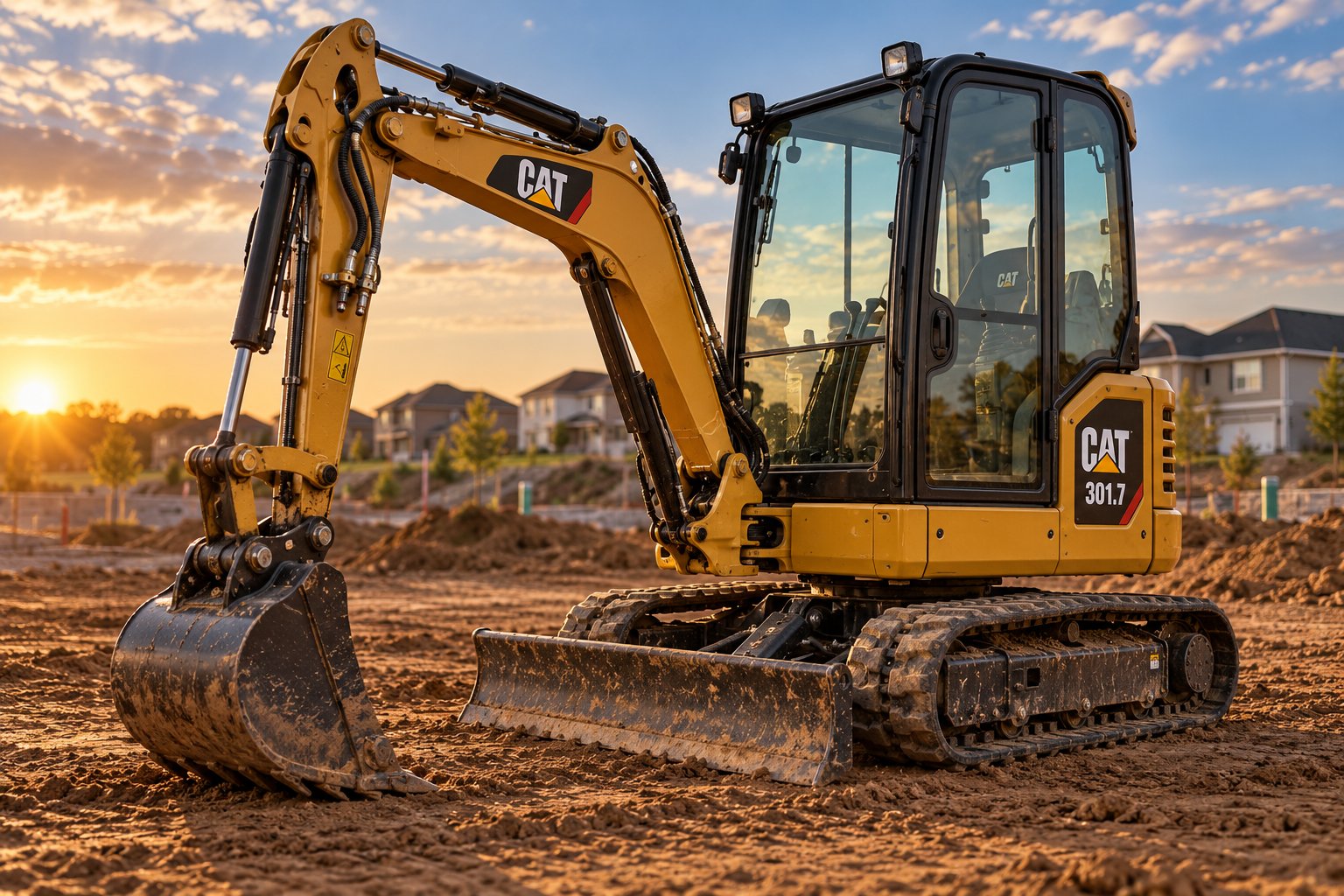
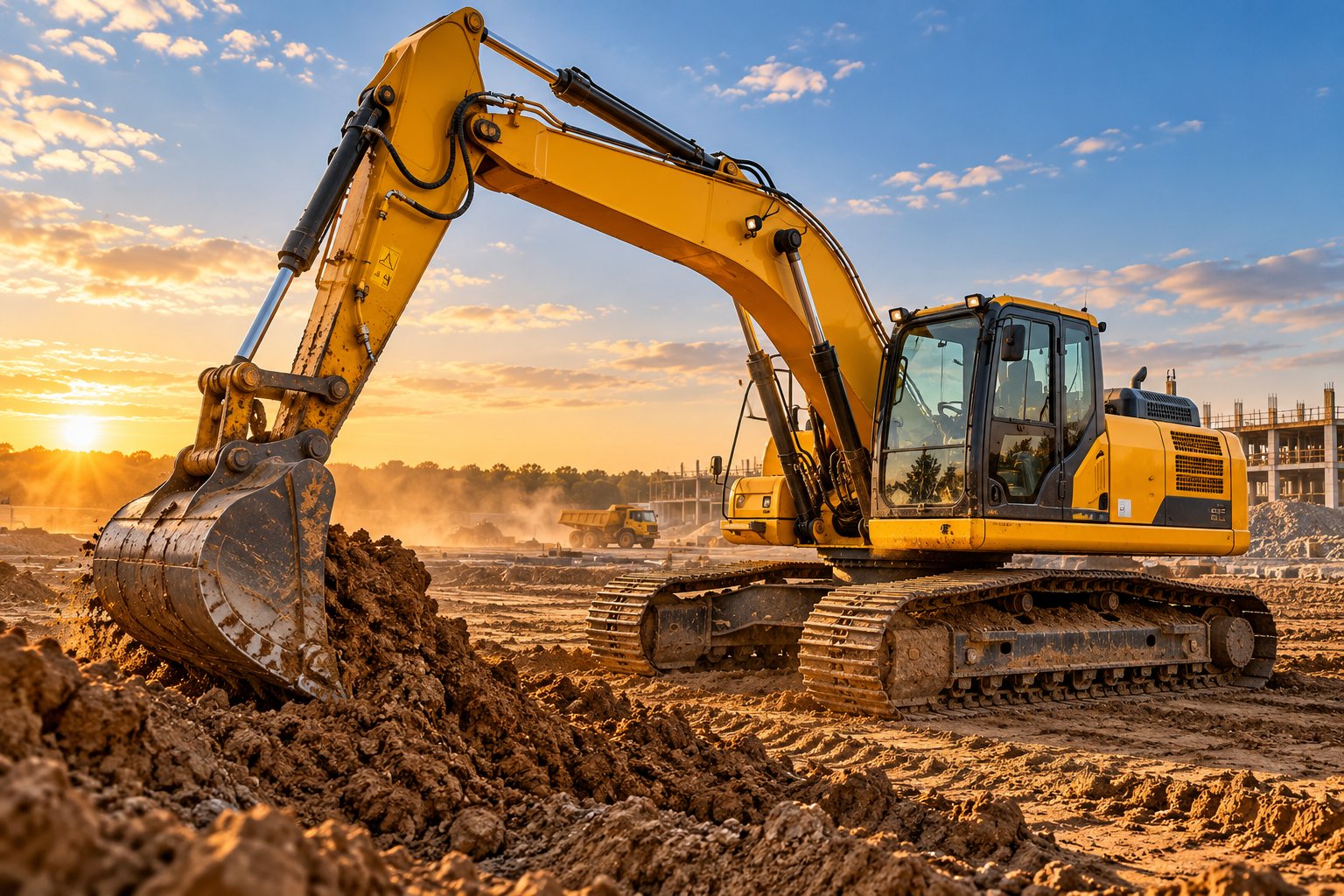
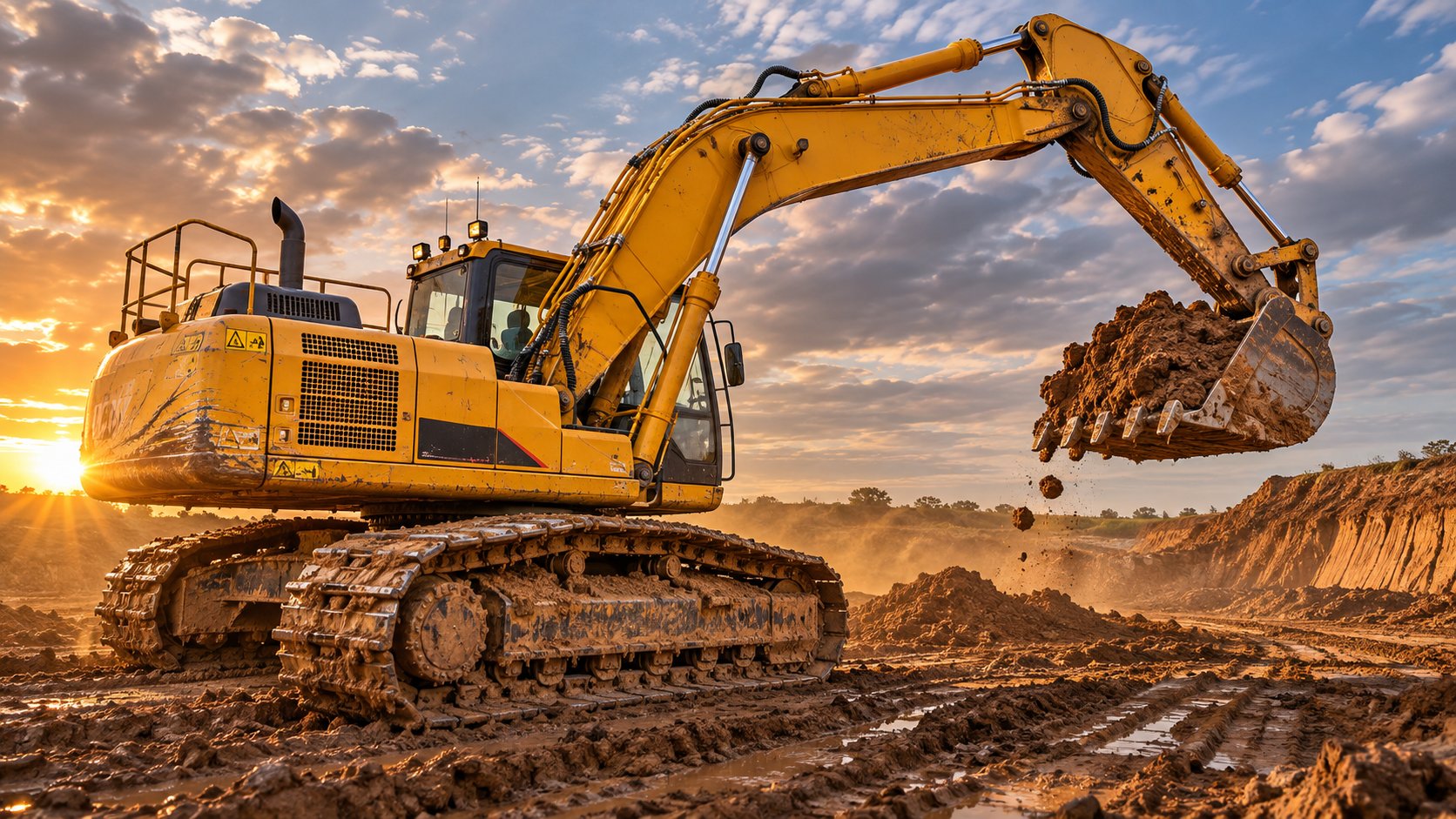
A guardrail bolted to a corroded bracket is not fall protection - it is a false promise waiting to collapse under load. The same principle applies to every piece of heavy equipment on a construction site. An excavator with a leaking hydraulic cylinder, a loader missing its rollover protective structure, a crane with frayed wire rope - each machine becomes a hazard construction crews must face the moment its condition degrades below safe operating thresholds. Equipment-related incidents do not fall neatly into a single Fatal Four category. A hydraulic hose failure can turn an excavator bucket into a struck-by hazard. A missing machine guard creates a caught-in scenario. A steering system failure on a slope produces a rollover. The machine itself becomes the common thread connecting multiple hazard types simultaneously.
How Equipment Condition Directly Impacts Jobsite Safety
Imagine a bulldozer operating on a graded slope with a hydraulic leak that has slowly reduced braking pressure over several shifts. The operator notices the machine feels sluggish but attributes it to soil conditions. Then the grade steepens slightly, the brakes cannot hold, and two tons of steel begin sliding toward a crew working below. This scenario is not hypothetical - rollover and loss-of-control incidents remain a persistent cause of construction fatalities, which is exactly why OSHA Subpart W (29 CFR 1926 Subpart W) mandates rollover protective structures (ROPS) and overhead protection on specific equipment categories. ROPS are engineered to create a survivable zone around the operator if a machine tips, but they only function when they are properly installed, structurally intact, and paired with a fastened seat belt. A ROPS with cracked welds or a missing mounting bolt is no longer a safety system - it is decorative steel.
Beyond rollovers, equipment condition influences hazard construction exposure in less obvious ways. Worn-out hydraulic hoses can burst under pressure, whipping violently and spraying hot fluid. Degraded electrical insulation on a crane can energize the boom or chassis. Exhaust system failures increase carbon monoxide exposure for operators in enclosed cabs - a direct occupational health in construction concern that often goes undetected until the operator experiences headaches, dizziness, or loses consciousness. Failed backup alarms eliminate the audible warning that keeps ground workers from stepping into a reversing machine's path. Each of these failures traces back to a single root cause: deferred or inadequate maintenance.
For UK-based readers, the Lifting Operations and Lifting Equipment Regulations 1998 (LOLER) impose specific duties on employers using lifting equipment in workplace construction environments. LOLER requires that all lifting equipment be strong and stable enough for its intended use, marked with safe working loads, installed to minimize risk, subject to periodic thorough examination by a competent person, and accompanied by reports documenting the examination findings. Cranes, hoists, telehandlers, and even vehicle-mounted lifting accessories all fall within LOLER's scope.
Pre-Operation Inspections and Operator Certification
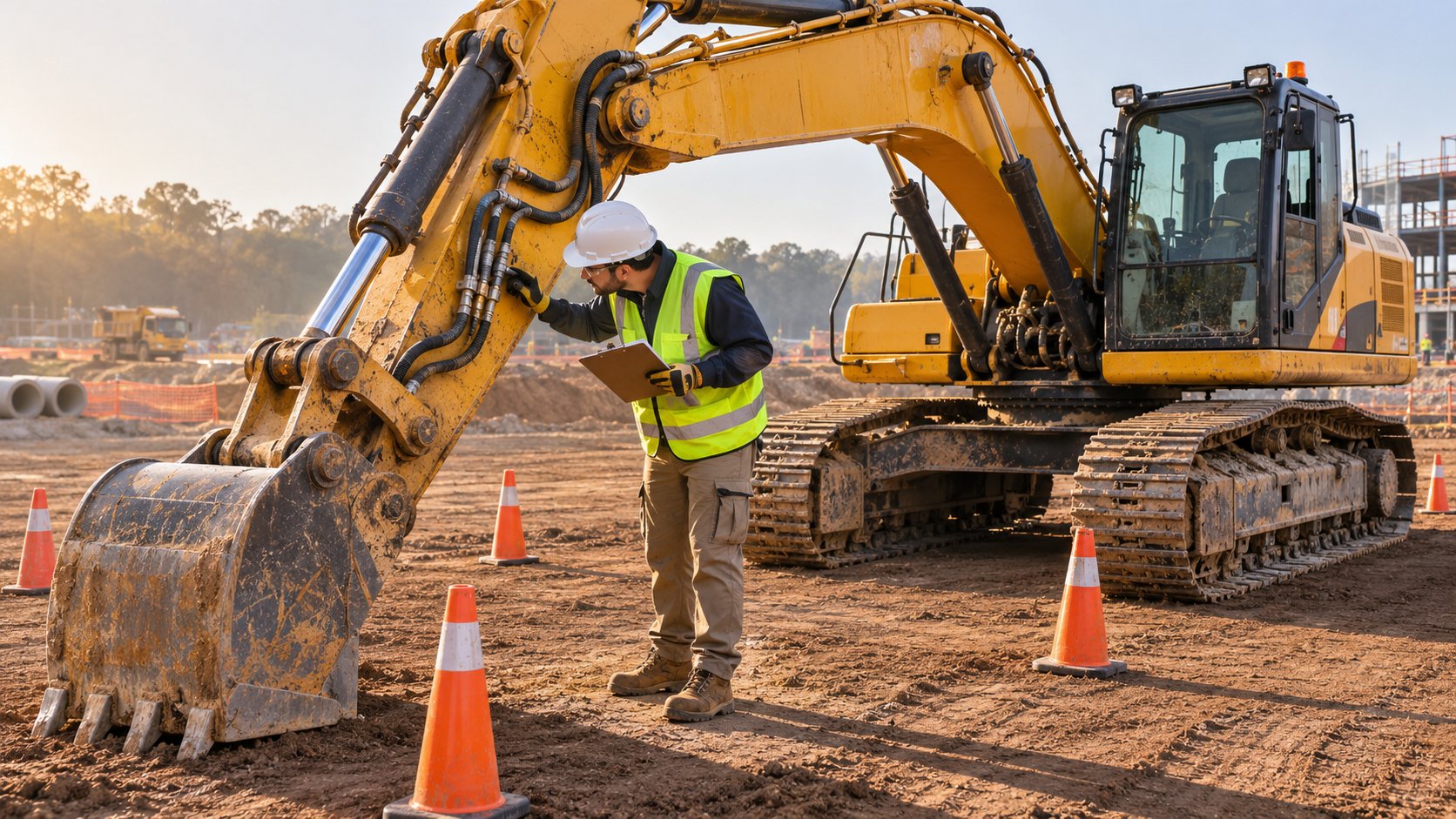
Daily pre-operation inspections are the frontline defense against equipment-related incidents. Before any machine starts its shift, the operator - or a designated competent person - should conduct a structured walkaround covering every system critical to safe operation. This is not a glance-and-go exercise. A thorough heavy equipment inspection checklist includes structural integrity checks for cracks, rust, and deformities in the frame, boom, and attachments; functional testing of hydraulic systems, steering, braking, and lifting controls; verification that all safety guards and protective devices are in place and undamaged; and confirmation that fluid levels - engine oil, hydraulic fluid, coolant, and fuel - meet specifications and show no signs of contamination.
Equally critical is the human element behind the controls. OSHA does not issue a single universal "heavy equipment operator license," but it does require that workers be trained for the specific equipment and hazards they encounter. As training guidance from OSHA-aligned providers explains, a forklift operator needs different knowledge than a crane operator, and crane operators face their own set of requirements under 29 CFR 1926.1427 - including certification through an accredited testing organization, a qualifying state license, or an audited employer program. Online courses can build foundational knowledge around hazard recognition, inspection procedures, and safe operating practices, but employers typically must still conduct hands-on evaluation and provide site-specific instruction before authorizing independent operation.
The gap between "trained" and "competent" matters enormously. An operator who passed a written exam but has never run the specific machine model on the specific terrain and soil conditions of your project is not ready to operate independently. Site-specific familiarization - covering ground conditions, traffic patterns, overhead obstructions, underground utilities, and adjacent work zones - should be a mandatory step before any operator takes the controls on a new project.
Evaluating Used Equipment for Safe Deployment
Selecting the right equipment for the task and site conditions is itself a safety decision. An undersized excavator struggling to reach trench depth forces the operator to overextend the boom, stressing hydraulic components and creating tip-over risk. An overweight machine operating near an unsupported excavation edge can collapse the trench wall. Matching equipment capacity, dimensions, and capabilities to the actual work scope prevents the kind of forced improvisation that produces incidents.
Whether purchasing new or used machinery, verifying maintenance history and current operational condition is a direct safety measure - not just a financial one. For contractors and fleet managers evaluating used equipment, JIUHONG's used construction equipment collection features excavators, loaders, bulldozers, and graders, providing a starting point to compare machinery options for upcoming projects and request purchase quotes. Regardless of the source, any used equipment acquisition should include an independent mechanical inspection and full review of maintenance records before that machine is deployed to a jobsite.
Here are the critical inspection checkpoints for any piece of heavy equipment before site deployment:
- Structural integrity: Inspect the frame, boom, arm, and attachments for cracks, excessive rust, weld repairs, and deformities that may indicate stress fractures or prior damage. Pay close attention to high-stress joints and pivot points.
- Hydraulic systems: Check all hoses, fittings, cylinders, and pumps for leaks, wear, and proper pressure. Look for fluid discoloration or contamination that signals internal component degradation.
- Safety guards and protective devices: Verify that all machine guards over rotating parts, belts, and pinch points are present, properly mounted, and undamaged. Confirm that emergency stop mechanisms function correctly.
- ROPS and FOPS: Confirm that rollover protective structures and falling object protective structures are factory-original or certified replacements, free of cracks or unauthorized modifications, and securely bolted to the frame.
- Controls and instruments: Test all operating controls for smooth, responsive function. Verify that gauges, warning lights, backup alarms, and cameras operate correctly. Malfunctioning instruments mask developing problems that lead to failures under load.
- Tires, tracks, and undercarriage: Examine for excessive wear, damage, proper inflation (for tires), and correct track tension. Undercarriage condition directly affects stability and braking performance on slopes and uneven terrain.
- Fluid levels and quality: Check engine oil, hydraulic fluid, coolant, and fuel for proper levels and clarity. Milky oil suggests coolant contamination. Dark or gritty hydraulic fluid indicates internal wear.
- Electrical systems: Inspect wiring harnesses, battery terminals, and lighting for damage, corrosion, and secure connections. Faulty electrical systems create both fire and shock hazards.
A machine that passes this inspection earns its place on the project. One that does not stays off the site until every deficiency is corrected - no exceptions, no "we'll fix it this weekend" compromises. Equipment condition is not a maintenance department problem. It is a safety problem that touches every worker within the machine's operating radius.
Investing in properly maintained equipment, thorough inspections, and qualified operators costs money upfront. Skipping those investments costs far more - in workers' compensation claims, OSHA penalties, project shutdowns, and the kind of losses that no insurance policy fully covers. That financial reality deserves its own examination, because the business case for hazard prevention is every bit as compelling as the moral one.
The Financial Impact of Construction Site Incidents
Every hazard discussed in this guide - every unguarded edge, every unshored trench, every degraded hydraulic hose - carries a price tag. Some costs hit immediately: an ambulance, an emergency room visit, a stop-work order. Others compound quietly over months and years: rising insurance premiums, lost bids, legal fees, and the slow erosion of a company's reputation in a market where safety records determine who gets the next contract. Framing hazard prevention purely as a moral obligation misses a critical audience. Project owners, CFOs, and stakeholders often make budget decisions based on financial return, and the business case for proactive safety is overwhelming - if you know how to present it.
The cost of preventing a construction incident is always lower than the cost of responding to one. Always.
Understanding the full financial landscape of building site hazards transforms safety from a line-item expense into a strategic investment. Here is what the numbers actually look like.
OSHA Penalties and the True Cost of Non-Compliance
When OSHA issues a citation, the penalty is just the opening chapter of a much longer financial story. Still, the penalties alone are enough to cripple a small contractor. According to OSHA's 2026 civil penalty schedule, the agency maintains the following penalty structure:
- Serious violations: Up to $16,550 per violation, with a minimum of $1,085 based on gravity-based penalty calculations.
- Willful violations: Between $11,823 and $165,514 per violation - reserved for employers who knowingly disregard safety requirements or show plain indifference to employee safety.
- Repeat violations: Up to $165,514 per violation, with a minimum of $4,256, triggered when a substantially similar hazard is cited again within a defined period.
- Failure to abate: Up to $16,550 per day the hazard remains unresolved beyond the abatement deadline, generally capped at 30 days.
Consider a realistic scenario. An OSHA compliance officer visits a site and documents an unprotected floor opening on the third level (serious violation), an unshored trench with workers inside (willful violation if prior training made the hazard obvious), and a missing GFCI on temporary power (serious violation). That single inspection could produce citations exceeding $200,000 before legal fees even enter the picture. Repeat the same violations on a subsequent inspection, and the per-violation maximum climbs to $165,514 each.
Penalties represent only the direct regulatory cost. The true financial damage from non-compliance fans out across multiple categories that most contractors never fully quantify:
- Direct medical costs: Emergency treatment, hospitalization, surgery, rehabilitation, and ongoing care for injured workers.
- Indirect productivity losses: Work stoppages, crew reassignment, investigation time, damaged equipment, cleanup, and the reduced output that follows any serious incident as crews process the event psychologically.
- Regulatory penalties: OSHA fines, state-level citations, and potential criminal referrals for willful violations resulting in a fatality.
- Legal fees and litigation exposure: Defense costs, settlement payments, and potential jury awards in personal injury lawsuits. Third-party claims from injured members of the public or adjacent property owners add another layer.
- Insurance premium increases: A spike in the Experience Modification Rate (EMR) directly inflates workers' compensation premiums for three or more years following the incident. An EMR that rises from 0.8 to 1.3 represents a roughly 63% increase in premium cost - applied to every dollar of payroll, every year, until the claims age out of the rating window.
OSHA itself estimates that employers who invest in safety and health programs can expect a return of $4 to $6 for every $1 spent. That ratio exists because the indirect costs of an incident typically dwarf the direct costs by a factor of two to four. A $50,000 workers' compensation claim may trigger $100,000 to $200,000 in total costs once you factor in overtime for replacement labor, project delays, administrative burden, and the supervisory hours consumed by the investigation and corrective action process.
How Prevention Programs Deliver Measurable ROI
Flip the equation, and the financial argument for hazard prevention becomes difficult to ignore. Fewer incidents translate directly into lower workers' compensation claims, which drive down your EMR - the single metric that most directly impacts your insurance costs year over year. As industry analysis from Highwire explains, an EMR of 0.75 means roughly 25% lower premiums than the industry average, while an EMR of 1.25 means 25% higher. For a contractor with $5 million in annual payroll and a workers' compensation rate of $15 per $100 of payroll, that difference between 0.75 and 1.25 represents $375,000 per year in premium costs alone.
The financial benefits extend well beyond insurance savings:
- Reduced lost workdays: Every day a skilled worker misses due to injury is a day you are paying for a replacement - often at overtime rates - while productivity drops because the substitute lacks site-specific familiarity. Prevention programs that keep experienced workers on the job protect both schedule and budget.
- Fewer project delays: A serious incident can trigger an OSHA stop-work order, a client-directed stand-down, or an internal safety pause that shuts down all or part of the site for days. Liquidated damages for missed milestones, extended general conditions costs, and the ripple effect through subcontractor schedules turn a single incident into a project-wide financial event.
- Improved worker retention and morale: Construction companies that demonstrate genuine commitment to safety experience lower turnover, higher engagement, and stronger recruitment outcomes. Workers are more willing to join - and stay with - employers whose sites feel safe. In an industry facing chronic skilled-labor shortages, retention alone justifies significant safety investment.
- Lower litigation exposure: A documented safety program with current JHAs, completed training records, regular inspections, and prompt corrective actions provides a defensible record if a claim does arise. Conversely, missing documentation and unaddressed hazards give plaintiffs' attorneys the evidence they need to argue willful negligence - which can multiply damages far beyond the base claim.
Safety managers requesting budget for controls and training can frame the conversation in language that resonates with financial decision-makers: "Our current EMR of 1.1 costs us approximately $82,500 more per year in premiums than an EMR of 0.85. A $40,000 investment in guardrail systems, updated JHA procedures, and competent-person training for our foremen would pay for itself within six months through reduced incident rates - and the premium savings compound for three years as claims age out of the rating window." That is not a safety pitch. That is a capital investment with a quantifiable return.
Safety Records and Their Impact on Contract Prequalification
For many construction firms, the most consequential financial impact of their safety record is not what they spend - it is what they never earn. Public agencies, general contractors, and commercial owners increasingly use safety metrics as hard qualification gates during the bidding process. Your Total Recordable Incident Rate (TRIR) and EMR are not just internal performance indicators - they are competitive differentiators that determine whether your proposal even gets opened.
Here is how it works in practice. A project owner issues an RFQ requiring a three-year EMR history below 1.0 and a TRIR below 3.0. Your company's EMR sits at 1.15 because of two lost-time injuries two years ago. You are mathematically disqualified before anyone evaluates your price, your schedule, or your technical approach. The work goes to a competitor whose safety investment kept their metrics below the threshold. That lost revenue - potentially millions of dollars on a single project - dwarfs any amount the company might have saved by deferring safety spending.
The prequalification landscape has grown more rigorous. Construction TRIR benchmarks from the Bureau of Labor Statistics show the industry average dropped to approximately 2.3 in 2023 - the lowest in over a decade. As the industry average improves, owner expectations tighten. A TRIR that was acceptable five years ago may now trigger automatic rejection. Companies with TRIRs significantly above their peers - above 4.0 or 5.0 when the norm hovers near 2.3 - face scrutiny that extends beyond individual bid disqualification to broader reputational damage within their market.
EMR carries similar weight. Contractors with EMRs above 1.2 are often flagged as high-risk by prequalification platforms that general contractors and owners use to screen subcontractors. An EMR of 1.5 - reflecting 50% worse loss experience than average - can effectively lock a firm out of the most desirable projects in its region. Bonding companies also factor EMR into their assessments, meaning a poor safety record can simultaneously reduce your bidding capacity and your insurability.
The reputational dimension matters just as much. In an era where sustainability and corporate responsibility attract investor and client scrutiny, a strong safety program functions as a competitive advantage that extends beyond any single bid. Clients return to contractors they trust. Workers seek out employers who protect them. Insurance underwriters reward companies that demonstrate consistent risk management. Every one of these outcomes traces back to the same foundation: a systematic, well-funded commitment to identifying and controlling the hazards in the construction industry before they produce the incidents that erode margins, destroy reputations, and end careers.
The construction site problems and solutions explored throughout this guide - from falls and struck-by incidents to invisible chemical exposures and the quiet erosion of fatigue - share a common truth. Every hazard has a control, every control has a cost, and every cost is a fraction of what the industry pays when prevention fails. The companies that internalize this equation do not just build safer job sites. They build more profitable, more resilient, and more competitive businesses.
Frequently Asked Questions About Common Construction Site Hazards
1. What are the OSHA Fatal Four hazards in construction?
The OSHA Fatal Four are falls from heights, struck-by incidents, electrocutions, and caught-in or caught-between events. Together, these four hazard categories account for roughly 65% of all construction fatalities. Falls consistently lead the list as the single largest cause of death on job sites. Each category is governed by specific OSHA standards - Subpart M for falls, Subpart K for electrical, Subpart P for excavations, and Subpart CC for cranes - and every one of these incidents is considered preventable when proper controls are implemented through the hierarchy of controls framework.
2. What is the difference between a hazard and a risk on a construction site?
A hazard is the source of potential harm - for example, an uncovered floor opening on an elevated deck. A risk measures how likely that hazard is to actually injure someone and how severe the outcome would be given current site conditions. The same floor opening protected by a compliant guardrail system and clear warning signage presents a much lower risk than one left uncovered during a busy night shift. Separating these two concepts is essential because it allows safety teams to prioritize controls based on actual danger levels rather than treating every hazard equally regardless of context.
3. How does the hierarchy of controls apply to construction safety?
The hierarchy of controls is a five-tier framework developed by NIOSH that prioritizes hazard management from most effective to least effective: elimination, substitution, engineering controls, administrative controls, and PPE. In construction, elimination might mean prefabricating assemblies at ground level to avoid work at height. Substitution could involve replacing solvent-based coatings with water-based alternatives. Engineering controls include guardrails and trench shoring. Administrative controls cover permit-to-work systems and Job Hazard Analyses. PPE, such as harnesses and respirators, should always be the last resort because it depends entirely on individual compliance and does nothing to remove the hazard itself.
4. Why is equipment condition considered a safety hazard on construction sites?
Poorly maintained or incorrectly specified heavy equipment contributes to struck-by, caught-in, rollover, and hydraulic failure incidents. A leaking hydraulic cylinder can cause a sudden loss of braking on a slope. Missing machine guards create caught-in scenarios with rotating parts. Failed backup alarms eliminate the audible warning that protects ground workers. OSHA Subpart W mandates rollover protective structures on specific equipment, and daily pre-operation inspections covering structural integrity, hydraulic systems, safety guards, ROPS, and controls are essential before any machine begins work. When sourcing used equipment from suppliers like JIUHONG at https://jiuhong-machinery.com/products/, an independent mechanical inspection and full maintenance record review should always precede deployment to a jobsite.
5. What overlooked hazards on construction sites amplify the risk of fatal incidents?
Fatigue, mental health struggles, ergonomic strain, and weather extremes are among the most underestimated hazards in construction. Research shows that over 43% of workers are sleep-deprived, and fatigue directly impairs reaction time and decision-making - the same cognitive functions needed to avoid falls and struck-by incidents. Ergonomic hazards from repetitive lifting and power tool vibration cause musculoskeletal disorders that dominate workers' compensation claims. Seasonal weather introduces heat stress, cold-induced dexterity loss, lightning risk, and wind thresholds that affect crane operations. These factors silently erode the safety margins that keep higher-profile hazards from becoming fatal events.