

What Is a Crawler Excavator and How Is It Built
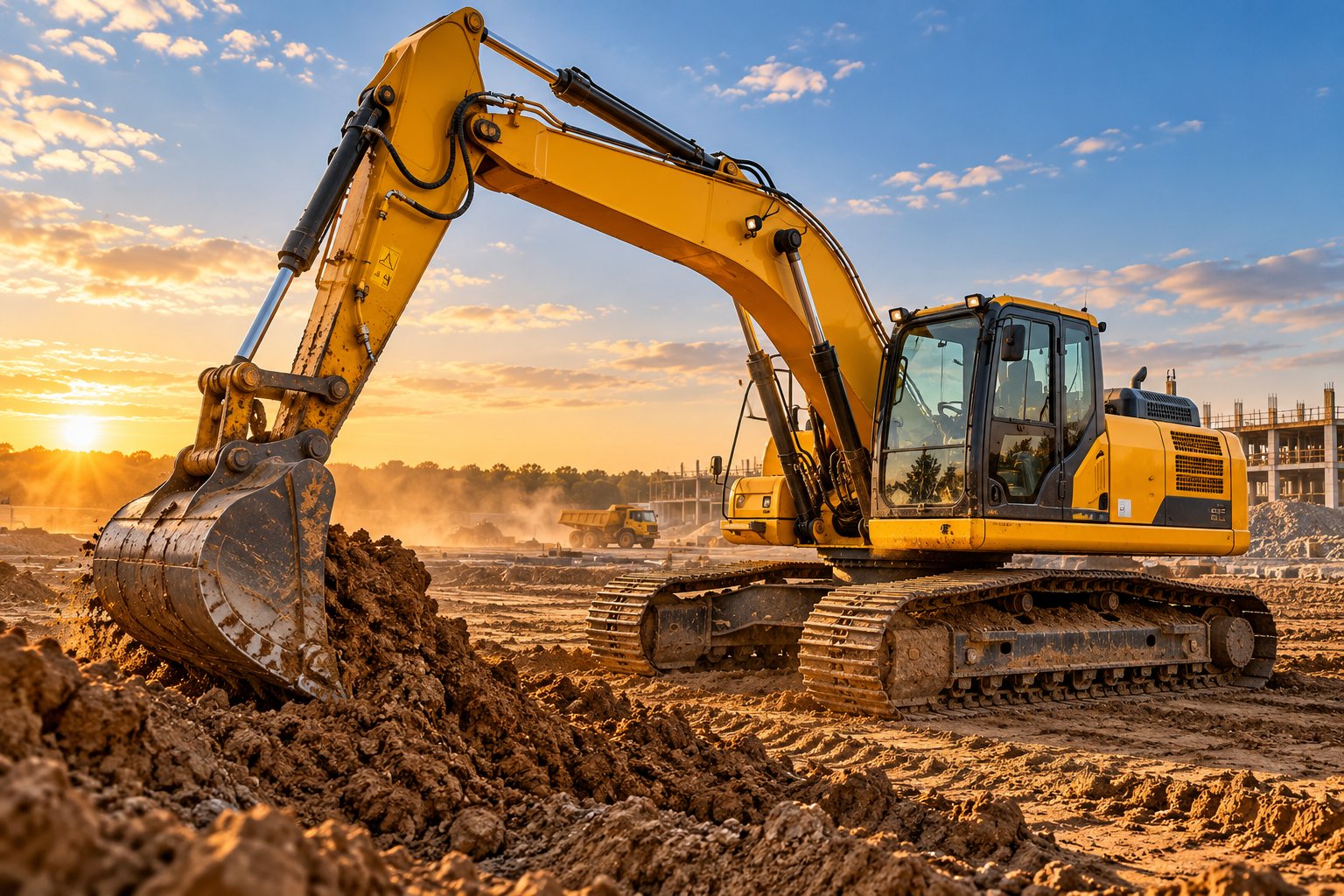
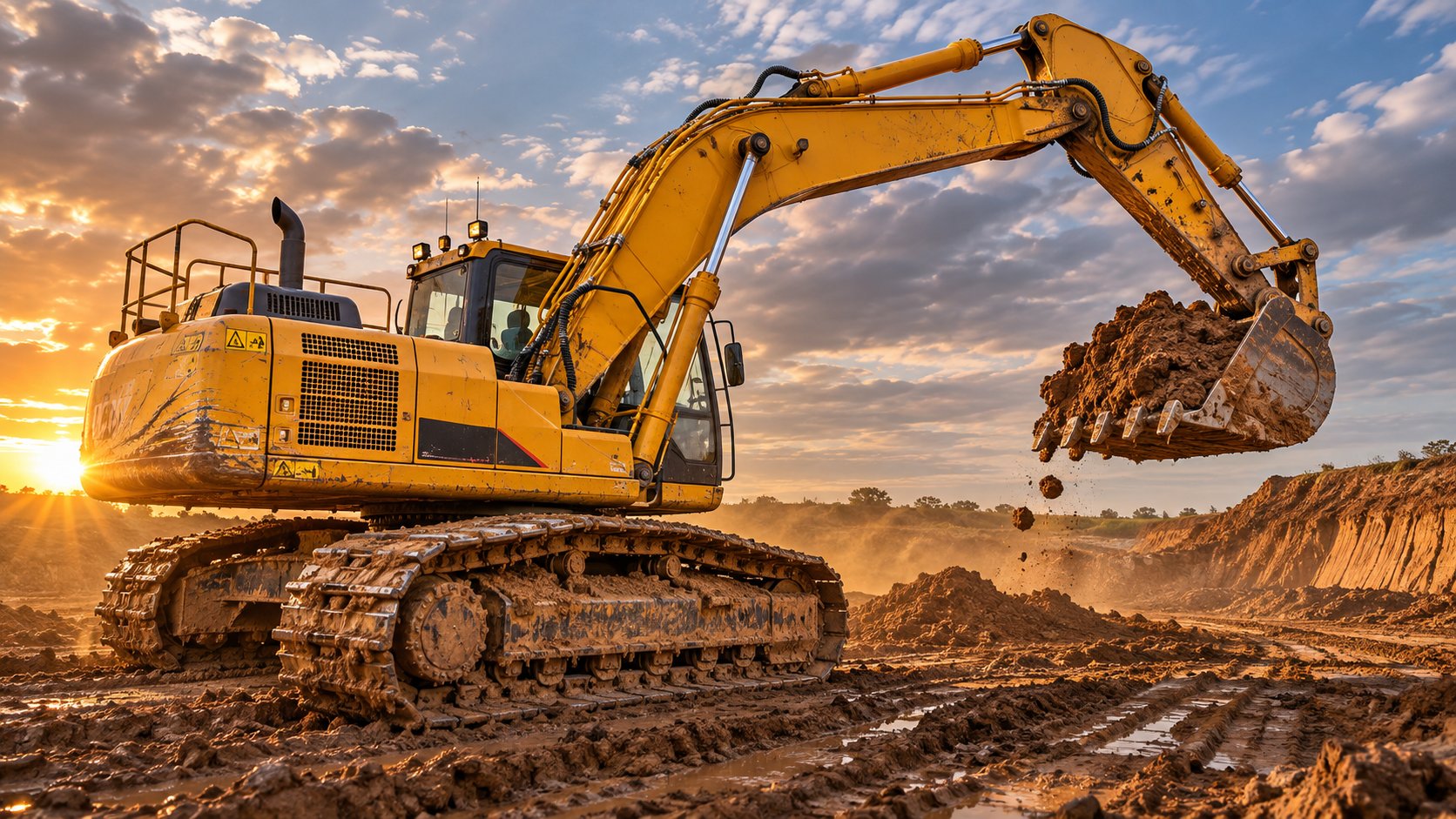
Picture a machine that can dig a basement foundation in clay, rip through rocky hillsides, and navigate muddy terrain without sinking an inch. That machine is a crawler excavator - a self-propelled, tracked hydraulic digging machine built around three core sections: a rotating upper structure (called the house), a tracked undercarriage, and a front linkage consisting of a boom, stick, and bucket. You might also hear it called a trackhoe or track hoe on jobsites across North America - both terms simply refer to an excavator riding on continuous tracks rather than wheels.
What separates this machine from a wheeled excavator, a backhoe loader, or a dragline? Configuration. A backhoe loader pairs a rear digging assembly with a front loader bucket on a wheeled chassis and offers limited swing arc. A wheeled excavator shares the rotating upper structure but trades tracks for tires, prioritizing road speed over off-road grip. A dragline uses a completely different cable-and-bucket system for large-scale earthmoving. The crawler excavator sits in its own category - purpose-built for digging, swinging, and placing material with full 360-degree rotation on a stable, low-ground-pressure platform.
Defining the Crawler Excavator
Every crawler excavator, from a one-tonne mini unit to a 200-plus-tonne mining giant, shares the same fundamental anatomy. Understanding these structural components helps you evaluate any machine on a spec sheet or a dealer lot:
- Undercarriage (crawler undercarriage): The foundation of the entire machine. It includes the track frame, steel or rubber tracks, rollers, idlers, sprockets, and hydraulic travel motors. This is the defining feature that makes a crawler machine what it is.
- Upper structure (house): Sits on a slew ring above the undercarriage and rotates a full 360 degrees. It houses the diesel engine, hydraulic pumps, control valves, fuel and hydraulic tanks, counterweight, and the operator cab.
- Boom: The large primary arm that rises from the front of the upper structure. It provides the main lifting height and reach.
- Stick (also called the arm or dipper): Connects to the end of the boom and extends the working range. Stick length directly affects digging depth and reach.
- Bucket (or attachment): Mounted at the tip of the stick via a pin connection or quick coupler. While buckets are the most common tool, this mounting point accepts dozens of other attachments.
- Hydraulic system: The circulatory system of the machine - pumps, valves, cylinders, and motors that convert engine power into precise digging, swinging, and traveling force.
When people search for "what does an excavator look like," they are almost always picturing this tracked configuration. The crawler layout is so iconic that it has become the default mental image of an excavator worldwide.
Why the Tracked Undercarriage Matters
The tracked undercarriage is more than a visual trademark - it is the engineering reason crawler machines dominate rough-terrain work. Imagine pressing your palm flat into soft sand versus poking it with a fingertip. Your palm spreads the same force across a much larger area, and it sinks far less. Continuous tracks work the same way. They distribute the machine's full operating weight over a broad contact patch, dramatically lowering ground pressure compared to tires.
This weight distribution delivers several practical advantages. On soft or saturated soil, the excavator stays on the surface instead of rutting in. On uneven or rocky ground, the long track frame maintains stability where a wheeled machine would tip or bounce. On slopes, steel track grousers bite into the terrain and hold position - critical when digging benches on a hillside or loading trucks in a gravel pit. A tracked machine spreads its weight over a larger surface area, reducing ground pressure and providing traction in conditions that would stall wheeled equipment entirely.
That stability advantage comes with a tradeoff: tracks excavators are slower on paved roads and typically require a lowboy trailer for transport between sites. Wheeled excavators can sometimes drive short distances on public roads. Yet for the vast majority of earthmoving, demolition, and construction tasks - where the machine parks in one zone and works - the tracked undercarriage's grip, stability, and low ground pressure are exactly why crawler machines remain the industry standard. The real question is not whether a tracked excavator fits your project, but which size fits it best.
A Brief History of the Crawler Excavator
Every machine on a modern jobsite carries decades of engineering DNA. The crawler excavator you see digging a foundation today traces its ancestry back to coal-fired, cable-driven contraptions that could barely turn without a full crew wrestling with levers and chains. Understanding that journey - from brute-force steam power to precision hydraulics - reveals why these machines work the way they do and where they are headed next.
From Steam Shovels to Hydraulic Power
The story begins in 1839, when William Otis patented the first steam shovel. These early machines relied on cables, pulleys, and mechanical linkages to drag a bucket through soil. Imagine operating heavy chains under steam pressure with virtually no fine control - that was the reality for excavator operators well into the twentieth century. The machines were massive, loud, and demanding, often requiring large crews just to maintain the boiler and manage cables that frequently wore out or snapped under load.
Despite their limitations, steam shovels proved their worth on landmark projects like the Panama Canal, cementing the idea that mechanized excavation was the future. Still, cable-operated systems suffered from friction losses, limited precision, and relentless maintenance demands. The industry needed something fundamentally different - a power transmission method based on fluid pressure rather than mechanical tension.
That breakthrough arrived in the mid-twentieth century with high-pressure oil hydraulics. European manufacturers, most notably Poclain in France, pioneered fully hydraulic excavators in which the boom, stick, and bucket were all driven by hydraulic cylinders instead of cables. The difference was transformative. Operators gained smooth, proportional control over every movement. Power density jumped because compact cylinders could generate enormous force without heavy cable assemblies. And 360-degree swing - already possible on steam shovels - became faster, quieter, and far more precise. By the 1960s, Japanese manufacturers such as Komatsu and Hitachi entered the market with their own hydraulic designs, accelerating global competition and pushing the technology forward at a rapid pace. If you have ever wondered "what is a trackhoe," the answer is rooted in this era - it is the common American jobsite name for these tracked, hydraulically powered excavators, sometimes also called an excavadora in Spanish-speaking markets.
The Rise of Mini Excavators and Modern Innovation
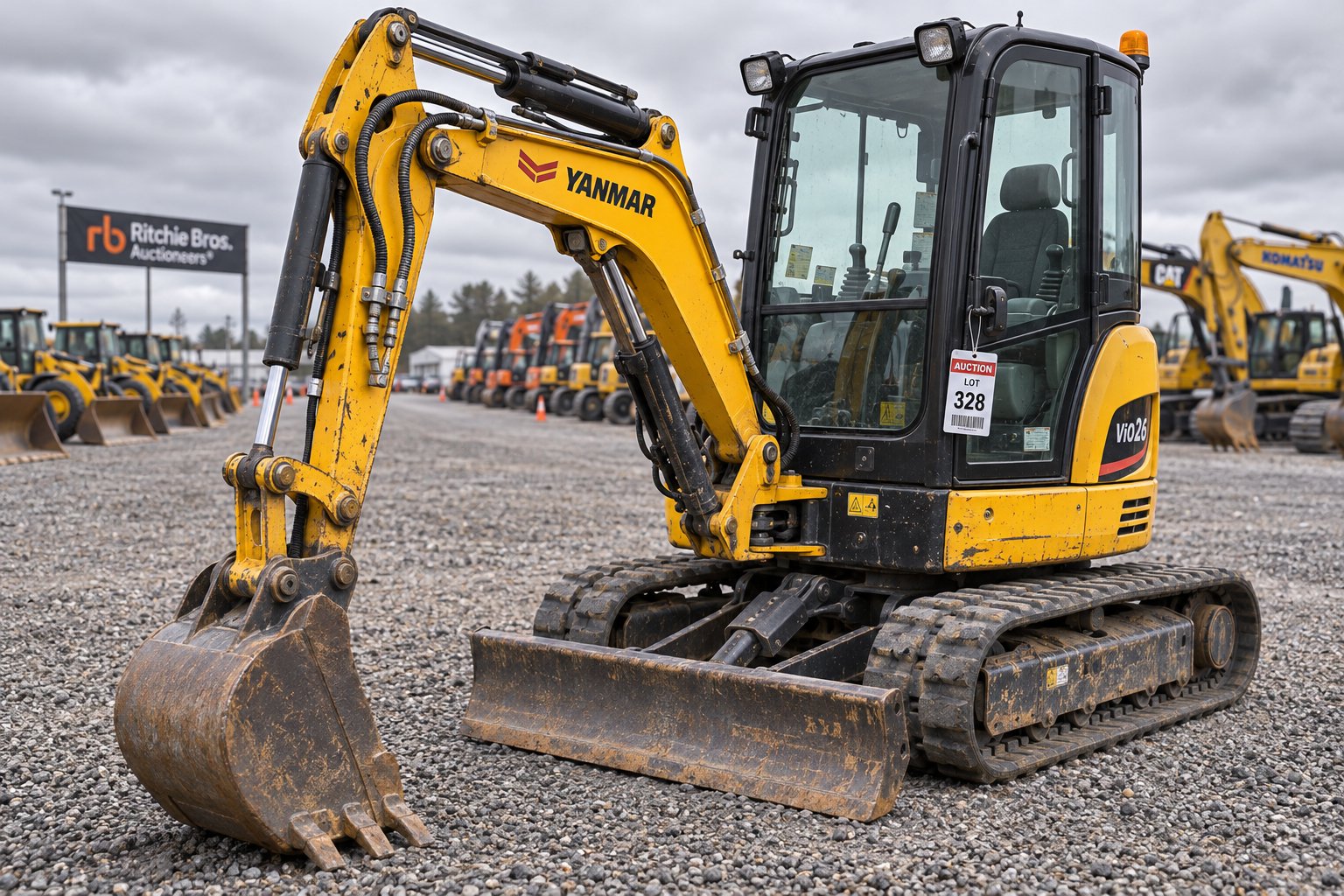
Hydraulics solved the power and precision problem, but full-size machines still could not squeeze into a residential backyard or a narrow utility trench. That gap sparked a new wave of development. In the 1960s and 1970s, manufacturers like Yanmar and Kubota in Japan began scaling down hydraulic systems into compact frames, giving birth to the mini excavator. By the 1980s, these smaller tracked machines had gained widespread popularity for urban construction, landscaping, and utility projects where full-size equipment simply could not operate.
Compact and mini crawlers opened entirely new market segments almost overnight. Residential contractors who once relied on manual labor or rented backhoes could now trench, grade, and excavate with a machine small enough to pass through a garden gate. Reduced-tail-swing and zero-tail-swing designs pushed that versatility even further, allowing operators to rotate the upper structure without striking walls, fences, or parked vehicles. Much like the Hitachi 750 excavator with grapple became a staple on large demolition and scrap-handling sites, the mini crawler became indispensable at the opposite end of the scale - proving that hydraulic excavation technology could serve virtually any project size.
In 2025, Volvo Construction Equipment launched five new hydraulic hybrid crawler excavators - from 26 to 50 tons - delivering up to 20% better fuel efficiency and a 15% reduction in CO2 emissions by capturing energy from boom-down motion and reusing it through an accumulator-driven assist motor.
That milestone reflects the broader trajectory of modern innovation. Hybrid hydraulic systems, fully electric compact excavators designed for indoor and emission-sensitive urban work, integrated GPS/GNSS grade control, and telematics platforms that stream fuel consumption, machine hours, and fault codes to a fleet manager's phone - all of these technologies are layering intelligence on top of raw hydraulic power. The crawler excavator is no longer just a digging machine; it is becoming a connected, efficiency-optimized tool.
Yet no matter how advanced the electronics or how clean the powertrain, the underlying principle remains unchanged: hydraulic cylinders converting pressurized fluid into controlled mechanical force. The real complexity lies in how those hydraulic systems, engines, undercarriages, and controls interact as a unified whole - a subject that gets far more interesting once you look under the sheet metal.
How a Crawler Excavator Works
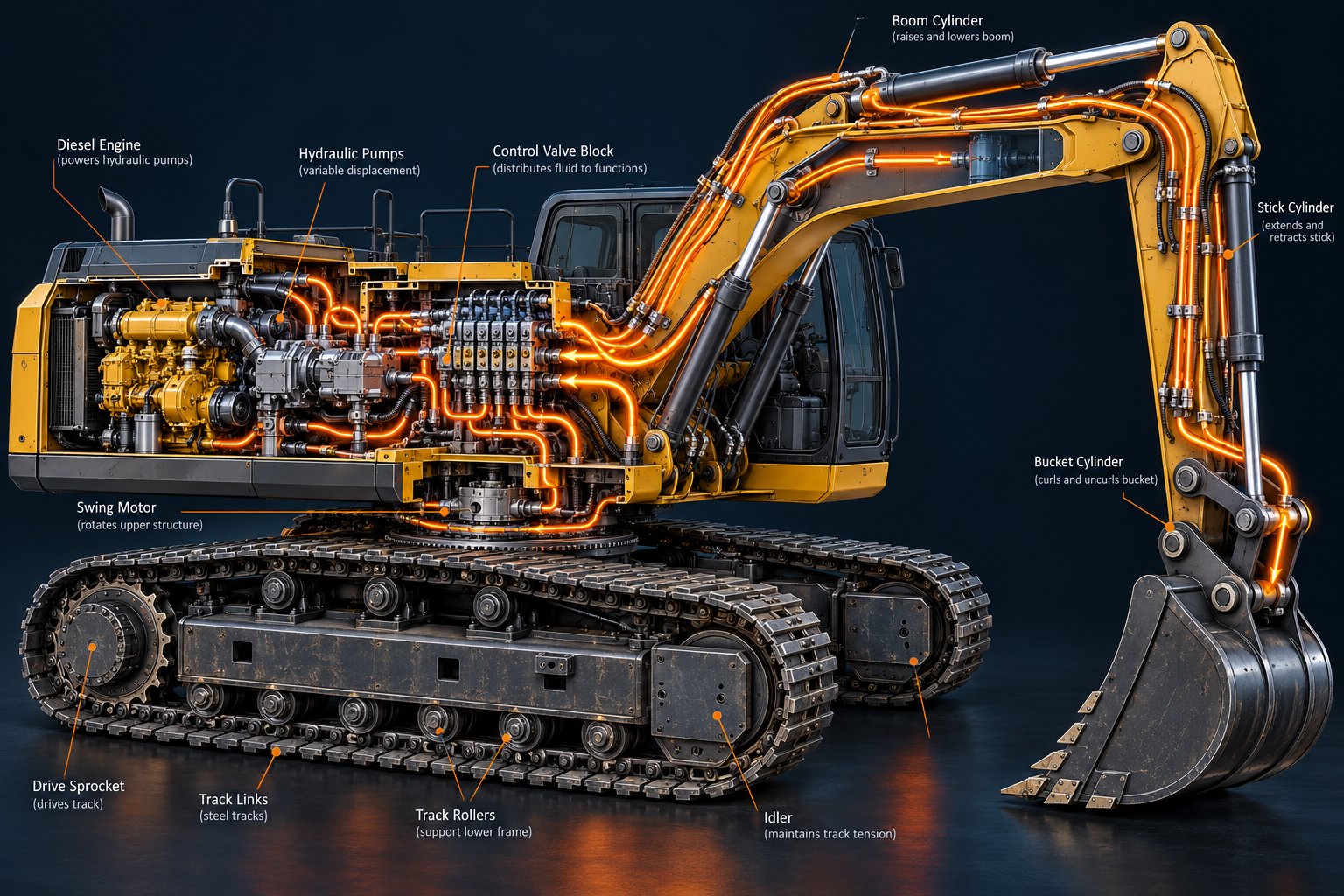
Strip away the paint and sheet metal, and every crawler excavator is really a hydraulic circuit wrapped around a diesel engine and riding on a tracked platform. These three core systems - power source, hydraulics, and undercarriage - work in constant coordination. Understanding how they interact gives you a much clearer picture of what separates a productive machine from one that struggles on the job.
The Hydraulic System Explained
Think of the hydraulic system as the machine's circulatory system. A diesel engine sits inside the upper structure and drives one or more hydraulic pumps. Those pumps draw oil from the hydraulic tank and pressurize it - sometimes to over 5,000 PSI - before sending it through a main control valve. The control valve is essentially the brain of the hydraulic circuit: it directs pressurized fluid to specific hydraulic cylinders and motors depending on what the operator demands.
When you push a joystick in the cab, you are telling the control valve to route oil to a particular cylinder. Push the right stick forward, and oil flows into the boom cylinder's rod end, lowering the boom. Pull it back, and the cylinder extends, raising the boom. The same logic applies to the stick cylinder and bucket cylinder - every movement on the front linkage is a hydraulic cylinder responding to proportional joystick input. Swing the upper structure left or right, and a hydraulic swing motor does the rotating.
You will hear operators refer to ISO and SAE control patterns. These are simply two standardized joystick configurations that determine which stick movement controls which function. The ISO pattern - sometimes called "excavator controls" - is the global default and maps boom and bucket to the right joystick, swing and stick to the left. The SAE pattern reverses some of those assignments. Most modern machines, whether a Case excavator or a Caterpillar, let operators switch between patterns through a menu setting so the controls feel familiar regardless of brand. Pressure controls how much force a cylinder produces, while flow rate controls how fast it moves. That balance between pressure and flow is what gives a skilled operator the ability to feather a bucket edge within millimeters or rip through compacted gravel - all from the same pair of joysticks.
Undercarriage and Travel Drive
Below the slew ring, the undercarriage converts hydraulic power into ground-level movement. The sequence is straightforward: a hydraulic travel motor on each side of the track frame sends rotation into a final drive gearbox. That gearbox reduces speed and multiplies torque, then turns the drive sprocket. The sprocket engages the track chain, pulling it around the undercarriage loop. Bottom rollers carry the machine's weight along the lower run of the chain, carrier rollers support the returning upper section, and the front idler guides the track while working with the track adjuster to maintain proper tension.
Each of these excavator parts plays a specific role. The track frame is the structural backbone, holding rollers, idlers, and the final drive in alignment. Track shoes bolt to the chain links and make contact with the ground - and this is where the steel-versus-rubber decision comes in. Even a case compact excavator offers a choice between the two, and picking the wrong type for your jobsite can mean premature wear, surface damage, or lost traction.
So what is the real difference? Steel tracks feature metal shoes with protruding grousers that bite into soil and rock. They handle extreme loads, resist punctures, and last longer in abrasive conditions. Rubber tracks, by contrast, use a continuous rubber belt reinforced with internal steel cables - sometimes in configurations like 750x4 sizing - that glides over pavement without gouging, runs quieter, and delivers a smoother ride.
| Criteria | Steel Tracks | Rubber Tracks |
|---|---|---|
| Durability | Excellent in rocky, abrasive, and heavy-load conditions; individual shoes are replaceable | Good for moderate conditions; vulnerable to cuts and punctures from sharp rock or debris |
| Surface Protection | Poor - steel grousers gouge asphalt, concrete, and finished landscapes | Excellent - rubber contact patch leaves pavement and turf intact |
| Noise Level | High - metal-on-ground and chain noise is significant | Low - rubber dampens vibration and ground contact sound |
| Traction on Soft Ground | Superior - grousers penetrate and grip mud, clay, and loose soil | Moderate - flat rubber surface can slip in very soft or steep conditions |
| Operator Comfort | Lower - more vibration transmitted through the frame | Higher - rubber absorbs shock and reduces whole-body vibration |
| Typical Applications | Mining, quarrying, heavy demolition, rural earthmoving, rough terrain | Residential work, urban construction, utility trenching, landscaping, paved-surface projects |
The choice between rubber and steel often depends on the complexities of the project, including the terrain and the nature of the tasks at hand. For operators who want the best of both worlds, bolt-on or clip-on rubber pads can be fitted over steel track shoes - adding surface protection for temporary paved-surface work without permanently converting the undercarriage.
Hydraulics provide the muscle. The undercarriage provides the platform. Together, these systems let a single machine dig trenches, load trucks, climb slopes, and travel across a jobsite under its own power. The real question is how much muscle and how large a platform you actually need - and that depends entirely on the weight class you choose.
Crawler Excavator Size Classes and What Each Can Do
Knowing how the hydraulic system and undercarriage work together is one thing. Knowing which size of that system fits your project is where the real money-saving decisions happen. A machine too small for the job bleeds hours; a machine too large wastes fuel, damages finished surfaces, and may not even fit through the site gate. The crawler excavator market spans an enormous range - from one-tonne micro units to 900-plus-tonne mining giants - and each weight class serves a distinct set of tasks.
To simplify the landscape, the industry generally divides tracked excavators into three broad categories: mini and compact, mid-size and standard, and large and heavy-duty. The boundaries are not always exact (manufacturers draw slightly different lines), but the practical differences are unmistakable.
Mini and Compact Crawler Excavators
Imagine needing to trench a waterline through a residential backyard, dig footings for a deck beside an existing house, or install a swimming pool in a fenced lot. A full-size machine will not fit. A mini or compact crawler excavator - generally anything under roughly 10 tonnes of operating weight - is designed precisely for these situations.
At the lightest end, micro models from brands like Kubota and Bobcat weigh around one tonne and squeeze through doorways barely wider than two and a half feet. Moving up, popular compact models in the 3-to-8-tonne range from manufacturers such as Takeuchi excavators, CASE, Caterpillar, and Yanmar deliver dig depths between roughly 8 and 13 feet, with bucket capacities typically ranging from 0.02 to 0.25 cubic yards. These machines handle residential foundations, utility installation, landscaping grading, and light demolition with ease.
A standout feature in this class is the zero-tail-swing or reduced-tail-swing configuration. When the upper structure rotates, its rear end does not extend beyond the width of the tracks - meaning operators can swing freely next to walls, fences, and parked vehicles without the risk of collision. Case diggers like the CX37C and CX60C, along with comparable models from Hitachi and John Deere, leverage this design for tight urban lots. If your project involves any kind of confined-space work, zero-tail-swing compact excavators deserve a hard look.
Every excavator accessory designed for larger machines - buckets, hydraulic breakers, augers, thumbs - is also manufactured in scaled-down versions for mini and compact units, so versatility is not sacrificed along with size.
Mid-Size and Standard Crawler Excavators
Step onto a commercial construction site, a highway expansion project, or a municipal sewer installation, and you will almost certainly see machines in the 10-to-30-tonne class. This is the workhorse segment of the market - heavy enough to handle serious earthmoving, yet compact enough to operate on most urban and suburban sites without extraordinary permitting or ground-protection headaches.
Mid-size crawlers typically offer dig depths between 15 and 25 feet, bucket capacities from about 0.5 to 2.0 cubic yards, and engine power ranging from roughly 70 to 200 horsepower. Models in this bracket - think the Caterpillar 320, Komatsu PC210, Volvo EC250E, or CASE CX250D - balance reach, breakout force, and fuel efficiency in a package that handles general excavation, road building, site grading, and material loading day after day. If you have browsed cat excavators for sale listings or scanned dealer inventories for Hyundai or Kobelco, you have likely noticed that mid-size models dominate the available stock because demand is consistently high.
Transport is straightforward, too. Most 10-to-25-tonne machines ride on a standard lowboy trailer without requiring oversize-load permits, which keeps mobilization costs predictable.
Large and Heavy-Duty Crawler Excavators
Anything above 30 tonnes enters the heavy-duty category, and the range stretches dramatically - from 35-tonne demolition machines to 900-tonne mining excavators. These are the machines you see loading haul trucks in quarries, ripping mass-excavation cuts for high-rise foundations, or tearing down reinforced-concrete structures floor by floor.
Large crawlers deliver dig depths exceeding 25 feet, bucket capacities that can surpass 5 cubic yards (and far more in mining configurations), and engine power from 250 horsepower well past 2,000 horsepower on the biggest platforms. Manufacturers like Hitachi, Komatsu, Liebherr, and Caterpillar compete aggressively in this segment. The Komatsu PC490, for example - sometimes referenced in specification databases under track sizing designations like 490 x 4 - represents the upper-mid boundary where construction-class machines begin transitioning into mining-class capability.
Operating costs climb with size, naturally. Fuel consumption, undercarriage wear, and transport logistics (oversize permits, multi-axle trailers, crane-assisted assembly for the largest units) all scale upward. The payoff is raw productivity: a 50-tonne excavator can move material volumes in a single pass that would take a mid-size machine three or four cycles to match.
| Size Class | Typical Operating Weight | Approximate Dig Depth | Common Bucket Capacity | Primary Applications |
|---|---|---|---|---|
| Mini / Compact | Under 10 tonnes (approx. 1 - 10 t) | 5 - 15 ft | 0.02 - 0.35 cu yd | Residential foundations, utility trenching, landscaping, pool installation, light demolition |
| Mid-Size / Standard | 10 - 30 tonnes | 15 - 25 ft | 0.50 - 2.00 cu yd | Commercial construction, road building, site development, sewer/water installation, material loading |
| Large / Heavy-Duty | Above 30 tonnes (30 - 900+ t) | 25 - 36+ ft | 2.00 - 55+ cu yd | Mining, quarrying, mass excavation, heavy demolition, large infrastructure projects |
This table simplifies a vast product landscape into actionable starting points. Real-world selection, of course, involves matching these ranges against your specific dig-depth requirements, site access constraints, and the type of material you are moving. A 15-tonne machine and a 28-tonne machine both fall under the "mid-size" umbrella, yet their capabilities and costs differ considerably.
Size class alone, however, only tells half the story. The other half involves understanding how a tracked excavator stacks up against wheeled alternatives - and knowing when an entirely different machine type might actually be the smarter choice.
Crawler Excavators vs. Wheeled and Other Excavator Types
Choosing the right size class is a major decision, but there is an even more fundamental question that comes first: should the machine ride on tracks at all? Wheeled excavators, long-reach configurations, draglines, and suction excavators each carve out territory where they outperform a standard tracked machine. Picking the wrong platform can cost you days of lost productivity - or thousands of dollars in unnecessary mobilization fees. Here is how the options actually compare.
Crawler Excavator vs. Wheeled Excavator
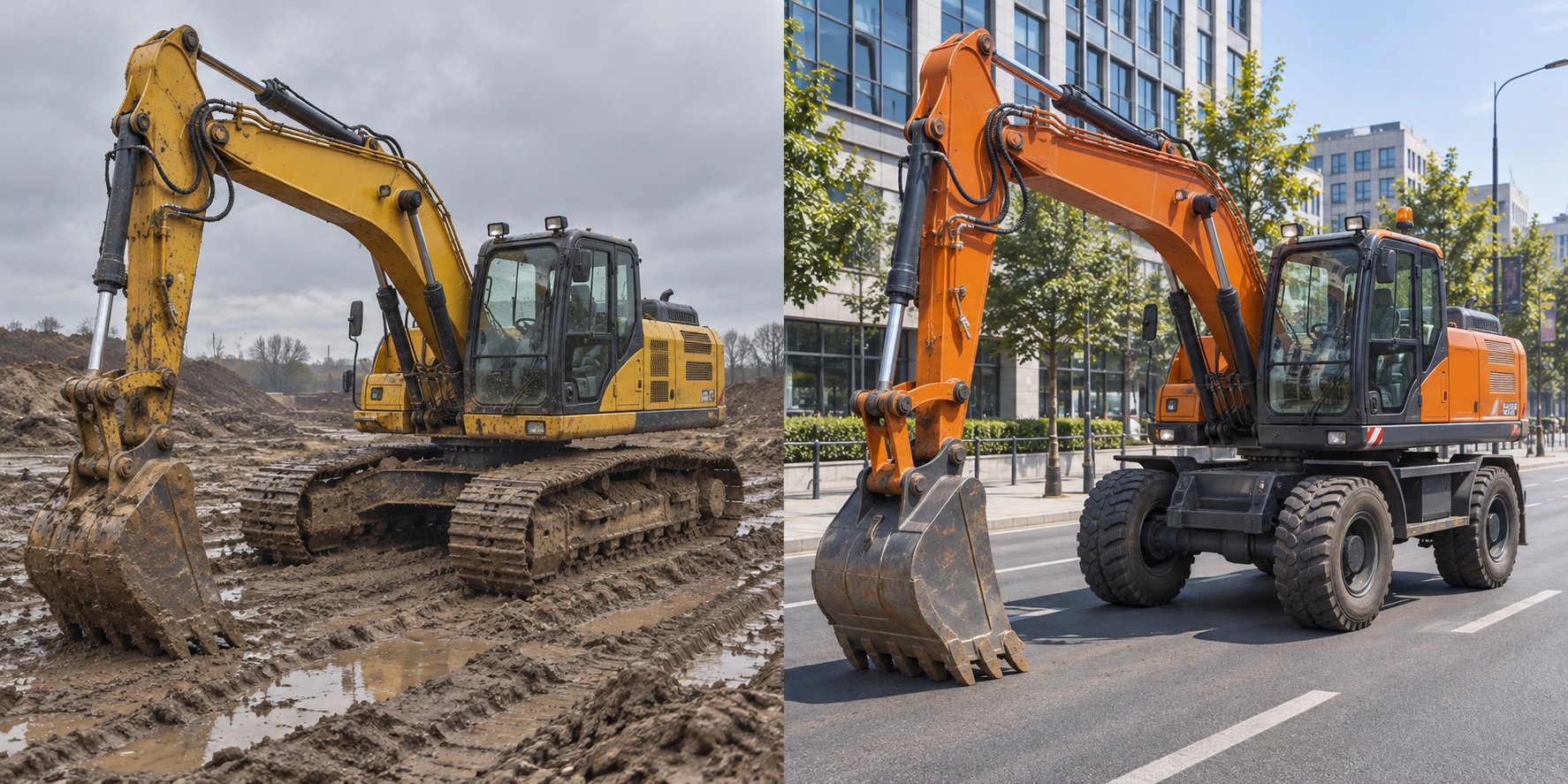
This is the matchup most contractors wrestle with, yet surprisingly few resources break it down side by side. Both machines share the same upper structure concept - rotating house, boom, stick, and bucket - so the real differences come down to what happens below the slew ring.
A crawler excavator distributes its weight across a broad track footprint, producing low ground pressure that keeps it stable on soft, muddy, or uneven terrain. That same footprint, however, means the machine travels slowly - typically 3 to 5 mph - and needs a lowboy trailer to move between jobsites. Steel tracks will chew up asphalt and finished surfaces, and even rubber tracks add mobilization complexity compared to a wheeled alternative.
Wheeled excavators flip those strengths. Rubber tires let them drive on paved roads at speeds reaching 20 to 25 mph, and many models are road-registerable, eliminating trailer costs entirely. They reposition quickly between work zones on the same site, making them ideal for utility maintenance, roadwork, and urban landscaping where the machine might move several times in a single shift. Stabilizer legs or outriggers can be deployed to boost digging stability, partially closing the gap with tracked machines. The tradeoff? Tires concentrate weight on a much smaller contact area, which means higher ground pressure and significantly less traction on slopes, mud, or loose fill. On soft ground, a wheeled excavator can sink or slide where a tracked machine works confidently.
The table below summarizes the key differences so you can match each platform to the conditions you actually face:
| Criteria | Crawler Excavator (Tracked) | Wheeled Excavator |
|---|---|---|
| Terrain Versatility | Excellent - handles mud, slopes, rocky ground, and soft soil with low ground pressure | Limited to firm, compacted, or paved surfaces; struggles on soft or steep terrain |
| Mobility Between Sites | Requires lowboy trailer transport; slow and costly to relocate | Can drive on public roads at up to 25 mph; quick, low-cost repositioning |
| Operating Stability | Superior - wide track base provides inherent stability during digging and lifting | Good with outriggers deployed; less stable without them, especially during heavy lifts |
| Ground Damage Risk | Steel tracks damage pavement and turf; rubber tracks reduce but do not eliminate surface marks | Minimal on paved surfaces; tires are gentle on asphalt, concrete, and finished landscapes |
| Best-Fit Project Types | New construction, mining, quarrying, demolition, rural earthmoving, slope work | Urban utility work, road maintenance, landscaping, projects requiring frequent relocation |
Notice the pattern: tracked machines win when the ground is unpredictable and the excavator stays put for extended periods, while wheeled machines win when the surface is solid and the job demands constant movement. Many fleet operators, whether running Caterpillar excavators, Komatsu, or Hyundai models, keep both types on their roster and dispatch whichever platform matches the day's conditions. If you are evaluating a single purchase and most of your work happens on unpaved ground or virgin sites, the crawler is almost always the safer bet.
When Other Excavator Types Make More Sense
Tracked and wheeled excavators cover the vast majority of jobsite scenarios, but they are not the only tools in the shed. Several specialized machine types fill niches where a standard crawler would be inefficient - or simply the wrong tool.
A long-reach excavator uses an extended boom and stick assembly that can reach over 100 feet horizontally. Think of dredging a canal from the bank, demolishing a multi-story structure from ground level, or clearing vegetation from the far side of a retention pond. The extended geometry sacrifices bucket breakout force, so these machines are not ideal for hard digging, but when reach matters more than brute strength, nothing else comes close.
A dragline excavator operates on an entirely different principle. Instead of hydraulic cylinders, it uses a hoist rope and drag cable to swing a large bucket across open ground. Draglines excel at massive-scale earthmoving - strip mining, overburden removal, and large dam construction - where cycle volume dwarfs anything a conventional hydraulic machine can match. They are typically assembled on site and stay there for the life of the project.
A suction excavator (also called a vacuum excavator) replaces the bucket with a high-powered suction pipe, often paired with a water jet that loosens soil before it is vacuumed up. This is the go-to solution for non-destructive digging around buried utilities - fiber optic lines, gas mains, electrical conduits - where a steel bucket could cause a catastrophic strike.
A walking excavator takes a different approach to mobility altogether. Instead of tracks or wheels, it uses articulated hydraulic legs (sometimes called a spider excavator) to position itself on steep hillsides, riverbanks, and uneven terrain that would be impossible for even a tracked machine. Forestry work, slope stabilization, and mountain road construction are its natural habitat.
When searching for equipment specifications - say you are comparing case 350 dozer specs alongside excavator data to plan a cut-and-fill operation - it helps to understand that each machine type fills a specific role. The crawler excavator is the versatile generalist, but these alternatives exist precisely because no single machine can do everything optimally. Here is a quick reference for deciding when to look beyond a standard tracked unit:
- Choose a long-reach excavator when the work area is beyond standard boom-and-stick reach - dredging, waterway maintenance, high-reach demolition, or bank shaping from a fixed position.
- Choose a dragline excavator when the project involves very large-scale earthmoving or mining operations where cycle volume and continuous production outweigh precision.
- Choose a suction excavator when digging near buried utilities, fiber optic networks, or other subsurface infrastructure where mechanical contact risks costly damage or safety hazards.
- Choose a walking excavator when the terrain is too steep, too uneven, or too confined for tracks - hillside forestry, slope reinforcement, or riverbank stabilization.
- Choose a wheeled excavator when the job demands frequent relocation on paved surfaces, minimal ground disturbance, and fast travel between work zones within an urban environment.
If you are looking at a case excavator for sale listing or browsing Caterpillar excavators online, keep these distinctions in mind. The best machine is rarely the biggest or the most versatile on paper - it is the one whose strengths align precisely with your project's terrain, scope, and timeline. Matching the platform to the work is the first step; the next is understanding just how far a single crawler excavator's capability can stretch once you start swapping attachments.
Applications and Attachments That Make a Crawler Excavator the Ultimate Jobsite Multi-Tool
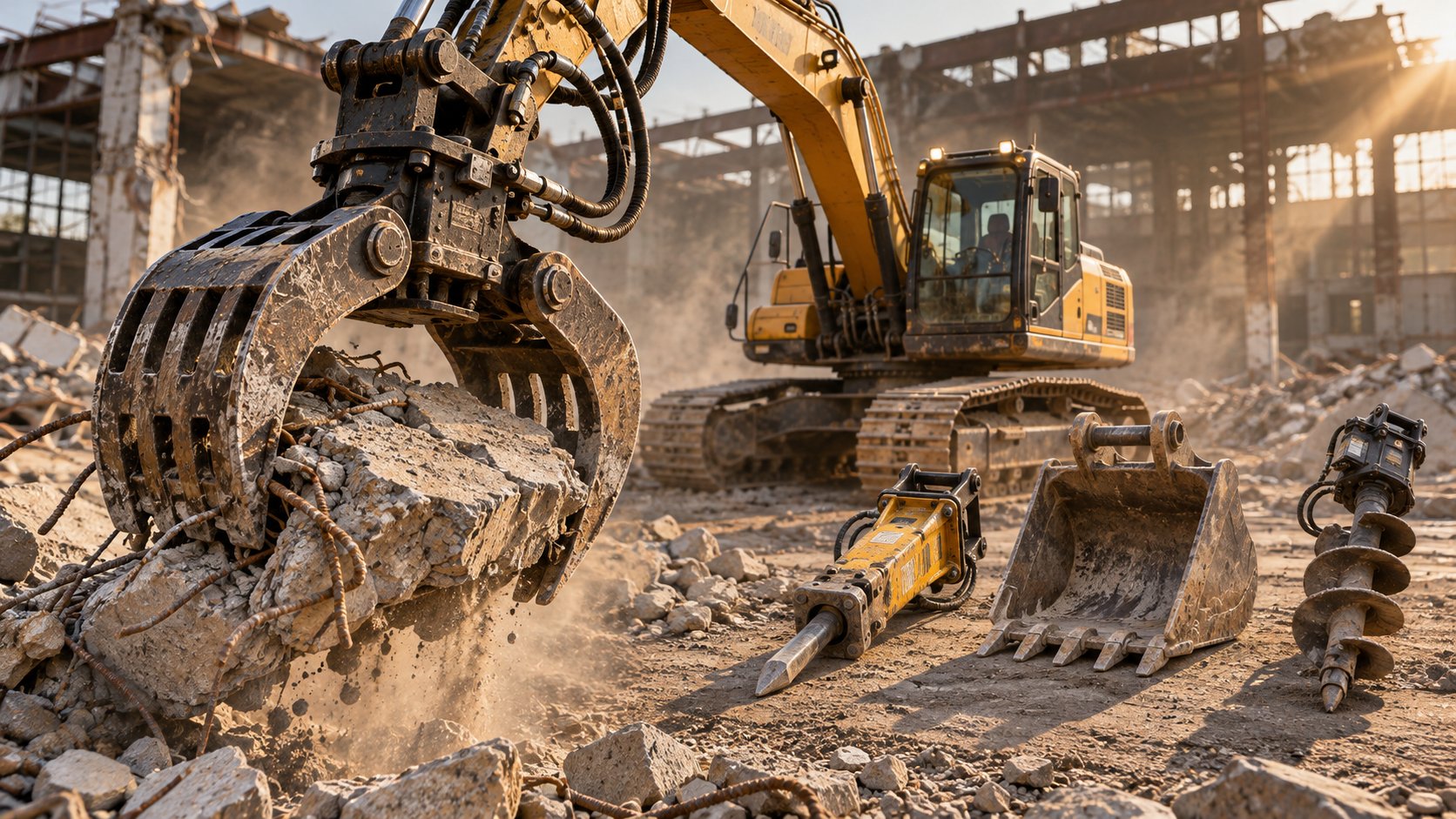
Swapping attachments is what transforms a crawler excavator from a one-trick digger into a machine that can break concrete at sunrise, auger post holes by midday, and sort demolition debris before the crew clocks out. The tracked platform itself - stable, powerful, and capable of full 360-degree rotation - provides the foundation. The attachment on the end of the stick decides what that foundation actually accomplishes. If you have ever heard someone ask "what's a trackhoe good for?" the honest answer is: almost anything, once you bolt the right tool onto it.
Primary Applications Across Industries
The reason tracked excavators dominate so many sectors comes down to two inherent advantages. First, the low-ground-pressure undercarriage keeps the machine planted on terrain that would stall wheeled equipment - mud, sand, gravel, slopes. Second, the swing bearing lets the upper structure rotate a full circle, so the operator can dig in one direction and dump in another without ever repositioning the tracks. That combination of stability and rotational freedom makes the platform adaptable to a remarkably wide range of work.
Here is where you will find these machines earning their hours:
- General construction: Trenching for footings, excavating basements, grading building pads, and backfilling foundations. This is the bread-and-butter use case for mid-size crawlers on commercial and residential sites alike.
- Road and highway building: Cutting ditches, shaping subgrade, loading haul trucks, and placing drainage pipe. Road crews rely on tracked machines because the work surface is, by definition, unfinished and often soft.
- Utility installation: Digging narrow trenches for water mains, sewer lines, fiber optic conduit, and electrical cables. Even some of the best mini excavators on the market are purpose-built for this kind of precise, shallow trenching - similar in spirit to a Case 360 trencher but with the added versatility of a fully rotating excavator platform.
- Mining and quarrying: Loading ore and overburden into haul trucks, benching pit walls, and ripping consolidated material. A large excavator in the 50-to-200-tonne range can cycle thousands of cubic yards per shift in open-pit operations.
- Demolition: Tearing down structures floor by floor using high-reach booms, crushing concrete with processor jaws, and sorting steel rebar from rubble. Grapple-equipped machines are especially common here, grabbing and segregating material for recycling.
- Forestry and land clearing: Stripping vegetation, grubbing stumps, and piling slash. The tracked undercarriage handles soft forest floor and rough terrain that would sideline a wheeled loader.
- Dredging and waterway maintenance: Removing silt from rivers, canals, and retention ponds. Long-reach booms paired with wide dredging buckets let operators work from the bank without entering the water.
Notice the thread connecting every application: the machine stays in one position, digs or handles material through its working arc, and only travels short distances to reposition. That workflow plays perfectly to the tracked platform's strengths - grip, stability, and power - while its slow travel speed becomes irrelevant.
Essential Attachments and How They Expand Capability
An excavator without attachments is like a power drill without bits. The arm delivers force and reach; the attachment at the tip defines the outcome. Modern quick couplers make switching tools a matter of minutes rather than the 20-minute manual pin-swap of older setups, meaning a single machine can cycle through multiple roles in the same shift. Some advanced hydraulic couplers even let operators complete the entire changeout from inside the cab, boosting both efficiency and safety by eliminating the need to manually insert locking pins - a process OSHA has linked to multiple serious accidents involving dropped attachments.
Below is a practical map of the most common attachment families, what each one does, and where it earns its keep. Whether you are running a two-tonne compact unit on a residential remodel or a 50-tonne machine in a quarry, versions of these tools exist across the full size spectrum.
| Attachment | Primary Function | Common Industries / Tasks |
|---|---|---|
| Digging Bucket | General-purpose soil and material excavation; available in narrow to wide profiles | Construction trenching, foundation excavation, utility installation, road building |
| Grading / Ditching Bucket | Wide, flat-bottomed bucket for shaping slopes, cleaning ditches, and finish grading | Road construction, drainage work, landscaping, site finish grading |
| Skeleton (Riddle) Bucket | Perforated bucket that sifts fine material and retains rocks, roots, or debris | Land clearing, topsoil screening, demolition debris sorting |
| Hydraulic Breaker / Hammer | Delivers high-frequency percussive blows to fracture rock, concrete, and asphalt | Demolition, quarrying, road removal, hard-ground trenching |
| Thumb | Mechanical or hydraulic clamp that opposes the bucket to grip irregular objects | Handling logs, boulders, pipe, and debris in construction and demolition |
| Grapple | Multi-tine claw for grabbing, sorting, and loading loose or bulky material | Demolition, scrap handling, forestry brush piling, recycling yards |
| Auger | Rotary drill bit that bores precise holes in soil or soft rock | Fence and sign post installation, pier footings, tree planting, solar farm foundations |
| Ripper | Single or multi-shank tooth that fractures compacted soil, soft rock, or frozen ground | Site preparation, mining bench work, agricultural land ripping |
| Compactor Plate / Wheel | Vibrating plate or rotating wheel that compacts soil or backfill in place | Trench backfill compaction, slope compaction, pipe-zone bedding |
| Quick Coupler | Mechanical or hydraulic interface that allows rapid attachment swaps without manual pinning | Any multi-task jobsite; especially valuable where several attachments are needed daily |
A few patterns stand out. Grapple-equipped machines, for instance, are workhorses in demolition and scrap-handling contexts because they let the operator pick, sort, and load material that a standard bucket would simply push around. Pair a grapple with a breaker on the same quick coupler, and one excavator replaces two dedicated machines on a teardown project.
Thumbs serve a similar grab-and-hold purpose but work with the existing bucket rather than replacing it - think of a thumb as a giant opposable finger that clamps objects against the bucket lip. This setup is especially popular in utility and pipeline work where crews need to lift and place pipe sections precisely.
Augers turn a crawler excavator into a drilling rig for shallow holes. Need 50 fence post holes across a property or a series of helical pier bores for a deck foundation? An auger attachment driven by the machine's auxiliary hydraulics completes the job far faster than a stand-alone post-hole digger - and the excavator can trench the same site before or after drilling.
Even something as simple as a bulldozer case 350-style ripper tooth, adapted to an excavator-mount format, can break up hardpan clay or frost layers that a standard bucket cannot penetrate. The ripper loosens the material; then the operator swaps back to a digging bucket to remove it. Two passes, one machine.
The takeaway is straightforward: the crawler excavator platform is a universal carrier. The attachment catalog determines its ceiling. Understanding which tools your projects demand most often - and how quickly you can swap between them with a quality coupler - directly shapes how much productive value you extract from a single machine. That value calculation, naturally, ties straight into the bigger financial question every equipment buyer faces: what does it actually cost to own and operate one of these machines, and does it make more sense to rent?
Operating Costs and the Rent vs. Buy Decision
Attachments expand what a crawler excavator can do, but every hour that machine runs - whether it is swinging a breaker or sitting idle with the engine turning over - it is burning through money. The purchase price or rental invoice is only the opening act. Fuel, excavator track and undercarriage wear, hydraulic maintenance, and insurance form the ongoing financial reality that separates a profitable machine from a cash drain. Getting honest about these costs is the only way to answer the question every contractor eventually asks: should I rent, buy new, or buy used?
Key Operating Cost Factors
Fuel is typically the single largest variable cost in day-to-day operation. A mid-size tracked excavator running an eight-hour shift at moderate load can consume 4 to 8 gallons per hour, and that number climbs fast with aggressive digging in resistant material or excessive idling. Simple operator habits - shutting down during breaks longer than 10 to 15 minutes, matching power mode to the task, and using smooth hydraulic inputs instead of jerky stick movements - can trim fuel burn meaningfully over a full month of shifts.
Right behind fuel sits undercarriage wear. Track chains, rollers, idlers, sprockets, and the shoes themselves all grind against each other and the ground every minute the machine travels or repositions. Industry professionals widely recognize the undercarriage as the single largest maintenance cost category on a tracked machine, often exceeding the combined cost of all other routine service items. Incorrect track tension - too tight or too loose - accelerates wear on every component in the system. Mud and rock packed into the track frame compounds the problem overnight. A quick tension check and a wash-down after each shift in abrasive conditions are among the cheapest insurance policies in heavy equipment ownership. Whether you are running a compact unit like the Case CX90E on a residential site or a 40-tonne machine in a quarry, the same undercarriage discipline applies.
Then come the recurring hydraulic system costs: fluid changes, filter replacements, hose inspections, and cylinder seal maintenance. Skip a scheduled hydraulic service, and you risk contaminating the entire circuit - turning a $200 filter change into a $5,000 pump rebuild. Finally, factor in insurance premiums, which scale with the machine's value, and you start to see why total cost of ownership (TCO) matters far more than the sticker price. A contractor budgeting for a fleet addition should also consider how equipment like a 350 case dozer or a case 350b dozer alongside an excavator shares certain maintenance disciplines - undercarriage care, fluid management, operator training - that can be consolidated to reduce per-machine costs across the fleet.
Renting vs. Buying vs. Buying Used
The rent-or-buy debate sounds simple, but the right answer depends almost entirely on one variable: utilization. Utilization is the percentage of available time the machine actually works. Ownership costs - depreciation, insurance, loan payments - are fixed; they accumulate whether the excavator runs or sits. Operating costs only accrue when the key turns. Rental rates, by contrast, are time-based: you pay by the day, week, or month regardless of how many hours you log.
That distinction creates a clear crossover point. When utilization is low - the machine sits idle more days than it works - rental costs per productive hour are lower because you only rent for the periods you need. When utilization is consistently high, ownership spreads those fixed costs across more working hours, driving the cost per hour below rental rates. The higher your utilization, the stronger the case for buying.
Buying used offers a middle path that appeals to many small and mid-size contractors. A quality used crawler excavator with documented service history delivers most of the productive life of a new machine at a significantly lower capital outlay. Depreciation hits hardest in the first few thousand hours; a used machine has already absorbed that initial drop, so the owner's remaining depreciation curve is flatter. The tradeoff is accepting higher maintenance risk and shorter warranty coverage - which makes thorough inspection and verified maintenance records non-negotiable.
Before committing to any path, work through these questions honestly:
- How many hours per month will this machine actually work? If utilization will consistently exceed 60 percent, ownership economics start to favor buying. Below 40 percent, renting almost always wins.
- How predictable is your project pipeline? A steady backlog of contracted work justifies a capital purchase. Sporadic or seasonal demand favors rental flexibility.
- What are your capital constraints? Can you absorb the down payment and monthly financing, or would tying up capital in a machine limit your ability to bid on new work?
- Do you have the infrastructure to maintain the machine? Owning means budgeting for scheduled service, parts inventory, and potentially a mechanic. Rental agreements often include maintenance in the rate.
- What is the resale market for the model you are considering? Machines from brands with strong dealer networks and parts availability - Caterpillar, Komatsu, Volvo, Hitachi, CASE - tend to hold resale value better, improving your exit strategy if project needs change.
There is no universal right answer. A landscaping company that needs a compact excavator for two weeks a year should rent every time. A general contractor running a 20-tonne tracked machine 1,500 hours annually is almost certainly better off owning. And a growing operation looking to build fleet equity without overextending cash flow may find that a well-inspected used machine hits the financial sweet spot.
Cost clarity is half the battle. The other half is making sure the machine you commit to - rented, new, or used - actually matches the work you need it to do. That match goes beyond size class and operating costs; it involves brand support, parts access, inspection rigor, and knowing where to source the right unit in the first place.
How to Choose the Right Crawler Excavator for Your Project
You know the size classes, you understand the cost drivers, and you have a handle on the rent-versus-buy math. The missing piece is a repeatable decision framework - a way to connect a specific project's demands to a specific machine without relying on guesswork or a salesperson's favorite model. Surprisingly, most equipment guides skip this step entirely. They describe what a crawler excavator can do but never walk you through the process of deciding which one should show up on your jobsite. Let's fix that.
Matching Machine Size to Project Requirements
Every selection decision starts with four measurable project parameters: required digging depth, working reach, lift capacity, and bucket size. These numbers live on your plans and specs. A residential waterline trench at five feet deep and a commercial storm sewer at eighteen feet deep demand fundamentally different machines - not because bigger is better, but because an undersized excavator physically cannot reach the required grade, and an oversized one wastes fuel and may damage the site.
Start by listing the maximum digging depth your project requires. Cross-reference that against the spec sheets for machines in the weight class you identified earlier. If you need 20 feet of dig depth, you are looking at the mid-size bracket - roughly 15 to 25 tonnes. Need 30 feet? You have crossed into the heavy-duty range. Simple enough so far.
Reach matters just as much. Imagine loading trucks from a bench cut where the haul road sits 30 feet from the excavation face. The machine needs enough horizontal reach to swing a loaded bucket to the truck bed without repositioning. If the spec sheet says maximum reach is 28 feet, you will spend the entire job shuffling the machine back and forth - burning hours and track life.
Lift capacity enters the equation whenever the excavator handles pipe, precast structures, jersey barriers, or heavy attachments. Every manufacturer publishes a lift chart that shows how much the machine can safely pick at various boom angles and radii. A Kobelco excavators model in the 20-tonne class, for example, will have a very different lift envelope than a 35-tonne Hitachi at the same reach. Always match the heaviest single pick your crew will attempt against the lift chart at the actual working radius - not the maximum rated capacity, which only applies at minimum reach.
Bucket sizing ties directly to cycle productivity. A bucket that is too small forces extra passes; one that is too large overloads the hydraulic system and increases cycle times. As a practical guideline from SANY's excavator sizing guide, the goal is to match core construction parameters - digging depth, working radius, lifting height, and bucket capacity - to the maximum demands of the project so the equipment never becomes the bottleneck.
Here is where site access constraints can override raw performance numbers. A 25-tonne machine may be perfect on paper, but if the only entry to the site is a 9-foot-wide gate beside an existing building, that machine is not getting in. Narrow gates, low overhead clearance from power lines or bridges, and proximity to occupied structures routinely push the decision toward compact or reduced-tail-swing models. A Hyundai mini excavators unit or a zero-tail-swing compact from CASE might sacrifice some dig depth compared to a full-size mid-range machine, yet it actually gets the work done because it fits. Always walk the site - measure the access path, check overhead clearance, and note any structures within swing radius - before you commit to a model.
Weight restrictions add another layer. Finished parking decks, bridge structures, or stabilized soils may have load limits that rule out heavier machines regardless of their digging capability. Similarly, residential neighborhoods and urban zones sometimes impose noise or vibration ordinances that favor rubber-tracked compact excavators over larger steel-tracked units. The lesson is consistent: the best machine on paper is worthless if it cannot reach the work area or comply with site constraints.
Evaluating Brands and Sourcing Options
With a target size class and configuration locked in, the next question is which brand - and where to source the machine. The crawler excavator market is served by a deep bench of manufacturers, each with distinct strengths across different size classes, regions, and application niches.
Major global brands include Caterpillar, Komatsu, Volvo, Hitachi, Liebherr, Kobelco, Hyundai, and CASE - all of which have extensive dealer networks, robust parts supply chains, and decades of field-proven reliability in North America and beyond. Caterpillar and Komatsu dominate the mid-size and large segments with broad model ranges and integrated telematics platforms. Volvo has earned a reputation for operator comfort and hybrid fuel-saving technology. Hitachi and Kobelco are highly regarded for hydraulic efficiency and durability in demanding applications. Hyundai and CASE offer competitive pricing with strong feature sets in the compact-to-mid-size range. Liebherr stands out in specialty configurations like demolition, tunneling, and super-mass excavation.
No single brand is universally "best." The right choice depends on which manufacturer has the strongest dealer presence in your region, the best parts availability for the specific model you need, and the service infrastructure to keep you running. A big excavator from a premium brand means little if the nearest dealer is 400 miles away and parts take two weeks to arrive.
For buyers considering used equipment, sourcing channels matter as much as the brand badge on the hood. Quality used crawlers are available through authorized dealer certified pre-owned programs, independent equipment brokers, online auction platforms, and international dealers. Each channel carries different levels of inspection rigor, warranty coverage, and pricing transparency.
One sourcing detail worth understanding: equipment exported from China is not necessarily manufactured by a Chinese brand. Many international listings are well-maintained used machines originally built by Japanese, Korean, or European manufacturers - Komatsu, Hitachi, Kobelco, Volvo, Hyundai - that operated in Asian or Middle Eastern markets before being refurbished and offered for resale. Platforms like JIUHONG's used excavator collection aggregate compact and larger crawler excavators from multiple premium brands in one marketplace, allowing contractors, equipment dealers, and import buyers to compare listings side by side, request model-specific quotes, and arrange individual or bulk purchases. This kind of multi-brand sourcing hub can be especially valuable for buyers in regions where domestic used inventory is limited or overpriced - similar to how a contractor might research 350 case dozer weight specifications across several dealer sites before finding the right unit at the right price through an international channel.
Regardless of where you source, the inspection and evaluation criteria remain the same. Use this checklist before committing to any machine - new, used, rented, or imported:
- Operating weight class: Confirm the machine falls within the size range your project parameters demand. Verify dig depth, reach, and lift capacity against the manufacturer's published spec sheet for that exact model and configuration.
- Brand parts availability in your region: Contact local dealers or parts distributors to confirm they stock wear items (filters, track components, bucket teeth, hydraulic hoses) for the model you are considering. Machines from recognized brands with established dealer networks let you source parts quickly and keep downtime to a minimum.
- Machine hours and maintenance records: For used equipment, request the complete service history. Match the hour meter reading against visible wear patterns on the undercarriage, bucket, and hydraulic cylinders. A machine with 5,000 documented hours and consistent service intervals is far more trustworthy than one with 3,000 hours and no records.
- Undercarriage condition: Since undercarriage wear is widely cited as the single largest maintenance cost category, inspect track chain stretch, roller and idler wear, sprocket tooth profiles, and shoe or rubber belt condition. Budget for near-term replacements if wear exceeds 50 to 60 percent.
- Hydraulic system health: Check for leaks at cylinder seals and hose fittings, test all boom, stick, bucket, and swing functions under load, and ask for recent oil-analysis reports if available. Slow cycle times or jerky movements can signal internal pump or valve wear.
- Sourcing channel reliability: Whether buying from a local dealer, an online auction, or an international marketplace, verify the seller's reputation, return policies, and inspection guarantees. A transparent seller will provide detailed photos, videos, and specification verification before you commit.
Think of this checklist as your insurance policy against regret. The upfront homework - matching specs to the project, verifying parts access, and scrutinizing the machine's history - takes hours. Skipping it can cost months of downtime and tens of thousands of dollars in unexpected repairs.
Selecting the right crawler excavator is ultimately a convergence of project scope, site constraints, budget reality, and supply chain access. Get those four variables aligned, and the machine pays for itself. Get one wrong, and you are fighting the equipment instead of the dirt. The final variable worth exploring is one that is changing rapidly: the technology inside the cab and the regulatory landscape outside it - forces that are reshaping what these machines can do and how safely they do it.
Modern Technology and Safety in Crawler Excavators
A decade ago, a trackhoe excavator was essentially an analog machine - diesel engine, hydraulic pumps, joysticks, and the operator's skill bridging the gap between plan and finished grade. That era is closing fast. Integrated GPS, telematics platforms, hybrid powertrains, and early-stage autonomy are layering digital intelligence onto the same hydraulic foundation, changing not just how efficiently these machines dig but how safely they operate. If you are buying, renting, or specifying a crawler excavator in the current market, understanding these technologies is no longer optional - it is the difference between competitive productivity and falling behind.
Telematics, GPS, and Machine Control
Imagine sitting in your office and knowing - in real time - exactly where every machine in your fleet is, how many hours each has logged, how much fuel each burned during the last shift, and whether any diagnostic fault codes are waiting to become expensive breakdowns. That is what a telematics platform delivers. A small hardware module hardwired into the machine's CAN bus reads live engine data, pairs it with GPS coordinates, and transmits everything over cellular or satellite connections to a cloud-based dashboard.
For excavator fleets specifically, telematics tracks engine hours, hydraulic system health, bucket cycle counts, and idle time. Utilization data reveals whether a machine is actively working or sitting dormant between tasks - critical information when you are deciding whether your fleet is right-sized or carrying dead weight. Fault code monitoring flags early warning signs of hydraulic pressure drops or overheating before the operator even notices a performance change, helping managers schedule repairs during planned downtime rather than suffering a mid-job failure. Geofencing adds another layer, triggering alerts if a machine moves outside an approved jobsite boundary after hours - a meaningful theft deterrent when a single piece of construction equipment can represent a six-figure asset.
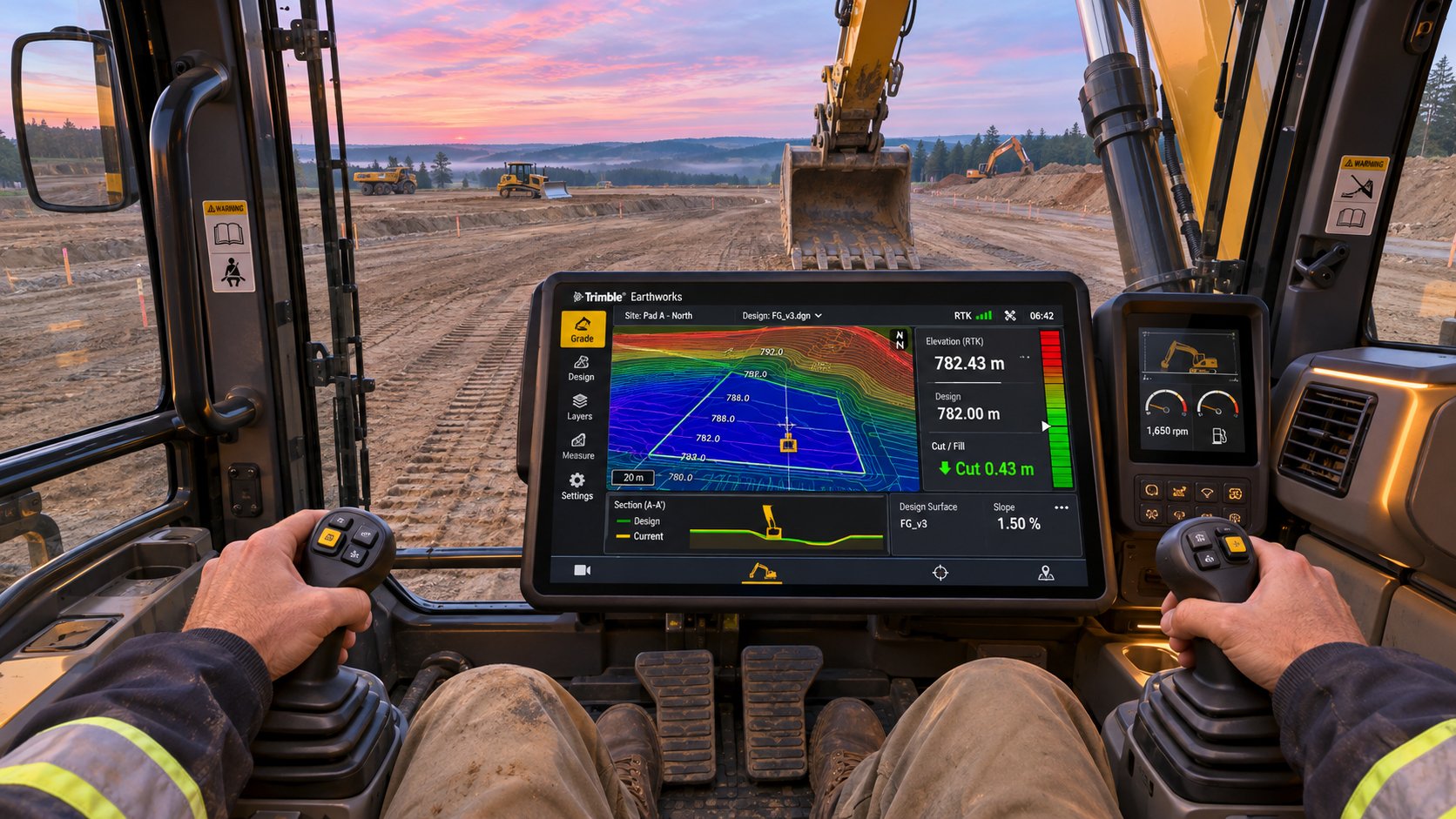
GPS and GNSS grade-control systems take location data a step further. Instead of simply tracking where the machine is, they guide where the bucket goes. An integrated grade-control display inside the cab shows the operator the design surface in real time - the target elevation, slope, and offset - overlaid on the bucket's current position. The operator digs to grade without waiting for a survey crew to set stakes or check cuts with a laser. On highway projects and large site-grading operations, this technology cuts rework dramatically. Some systems, available on models ranging from compact units like the Case CX145D to heavy-duty platforms like the Caterpillar 245 series and modern CX 300-class machines, even offer semi-automatic boom and bucket control that stops the cutting edge precisely at the design surface, reducing the skill gap between a veteran operator and a newer one.
The practical payoff is measurable. Fewer passes to reach final grade means less fuel burned and less undercarriage wear per unit of completed work. Automated hour tracking eliminates manual logbook errors. And remote diagnostics let a fleet manager dispatch a mechanic with the right parts before a breakdown sidelines the machine - a concept that aligns directly with the predictive maintenance approach that keeps total cost of ownership in check.
Hybrid, Electric, and Autonomous Trends
Fuel is the largest variable operating cost, and emissions regulations keep tightening. Those two pressures are driving the most significant powertrain changes in the crawler excavator's history.
Hybrid hydraulic systems represent the first wave. These capture kinetic energy during boom-down and swing-deceleration motions - energy that a conventional machine simply dumps as heat through hydraulic relief valves - and store it in accumulators or batteries for reuse. The result is meaningful fuel savings without altering the operator's workflow. Volvo, Komatsu, and Caterpillar all offer hybrid models in various size classes, and real-world fuel reductions of 15 to 25 percent are commonly reported depending on duty cycle.
Fully electric compact excavators are the second wave, and they are already here for lighter-duty applications. Battery-powered compact excavators have been available for some time, and advancing battery technology is steadily pushing electrification into larger machine classes. For indoor demolition, basement excavation, and urban work zones with strict noise and emissions ordinances, an electric tracked excavator eliminates exhaust fumes entirely and cuts sound levels dramatically - a practical advantage that is becoming a contractual requirement on an increasing number of municipal and commercial projects. As battery energy density improves and charging infrastructure matures - including portable and solar-powered jobsite charging solutions - expect the viable weight ceiling for electric crawlers to keep climbing.
On the regulatory side, Tier IV Final standards in North America and EU Stage V emission regulations have forced diesel engines to run cleaner through technologies like diesel particulate filters (DPF), selective catalytic reduction (SCR), and exhaust gas recirculation (EGR). These systems add maintenance complexity - DPF regeneration cycles, DEF fluid consumption, and sensor monitoring - but they have cut particulate matter and nitrogen oxide emissions to a fraction of what pre-regulation engines produced. For buyers evaluating a Case 145 excavator or any other modern diesel model, understanding the aftertreatment system's service requirements is now as important as knowing the engine horsepower rating.
Autonomous excavation sits further along the horizon but is advancing faster than most contractors realize. Several manufacturers and technology companies are testing semi-autonomous and fully autonomous digging cycles - machines that can execute repetitive tasks like trench excavation or truck loading with minimal human intervention. The early applications are focused on mining, where controlled environments and repetitive cycles make automation most practical. Construction-site autonomy faces greater complexity due to unpredictable terrain, mixed traffic, and variable soil conditions, but remote-control operation - where a single operator manages a machine from a safe distance via camera feeds and joystick controls - is already commercially available and increasingly common in hazardous environments like demolition and slope work.
Safety and Operator Best Practices
Technology improves what a crawler excavator can do, but safety still depends overwhelmingly on the person in the cab and the decisions made before the key turns. Excavation consistently ranks among the most hazardous activities in construction, and the most common incidents - struck-by events, tip-overs, trench collapses, and underground utility strikes - are almost always preventable with proper planning and discipline.
The single most important safety practice in excavation is never assuming - always verify ground conditions, underground utility locations, and slope stability before the bucket touches soil.
Ground condition assessment should be the first action on every new site. Soft spots, hidden voids, buried debris, and unstable slopes can all compromise the machine's footing. Walk the work area, probe questionable zones, and review geotechnical reports when available. If the excavator will operate on a slope, understand the machine's rated maximum gradient. As a general guideline, most compact and standard excavators can safely operate on slopes up to about 30 degrees, but this varies by model, attachment, and soil conditions. Travel with the tracks oriented uphill and downhill rather than across the slope, keep the boom low during travel to lower the center of gravity, and avoid sudden swing or travel inputs that could shift the machine's balance point.
Underground utility awareness is equally critical. Before any digging begins, contact your regional one-call service (811 in the United States) to have buried utilities marked. Even with markings in place, hand-expose within the tolerance zone. A single bucket tooth hitting a live gas main or fiber optic trunk line can trigger consequences ranging from costly repairs to life-threatening explosions.
Operator training and certification round out the safety picture. A skilled operator does not just move dirt efficiently - they recognize early signs of instability, maintain situational awareness of ground personnel, and know how to react if conditions change mid-task. Investing in formal training programs, whether manufacturer-sponsored courses or third-party certifications, pays dividends in reduced incident rates, lower insurance premiums, and longer machine life. Even the most advanced telematics platform and the most sophisticated grade-control system cannot substitute for a well-trained operator who respects the machine's limits and the ground beneath it.
The crawler excavator has evolved from a steam-powered cable shovel into an intelligent, connected, and increasingly electrified platform - yet its core purpose has not changed: move earth safely, efficiently, and profitably. Whether you are evaluating a compact unit for residential utility work or a heavy-duty machine for open-pit mining, the principles covered throughout this guide apply at every scale. Match the machine to the project, understand what it costs to operate, inspect thoroughly before you commit, and never stop investing in the operator behind the controls. Get those fundamentals right, and the crawler excavator does exactly what it was built to do - dig without regret.
Frequently Asked Questions About Crawler Excavators
1. What is the difference between a crawler excavator and a wheeled excavator?
The core difference lies beneath the slew ring. A crawler excavator rides on continuous steel or rubber tracks that spread its weight over a large surface area, producing low ground pressure ideal for soft, muddy, or uneven terrain. A wheeled excavator uses rubber tires, allowing it to travel on paved roads at up to 25 mph and reposition quickly between work zones. Tracked machines offer superior stability and traction for heavy digging on rough ground, while wheeled machines excel at urban utility work and jobs requiring frequent relocation on hard surfaces. Many fleet operators keep both types and dispatch whichever platform matches the day's site conditions.
2. What size crawler excavator do I need for my project?
Start by identifying your maximum required digging depth, working reach, lift capacity, and bucket size. Mini and compact models (under 10 tonnes) suit residential foundations, utility trenching, and landscaping. Mid-size machines (10-30 tonnes) handle commercial construction, road building, and site development. Large crawlers (above 30 tonnes) serve mining, quarrying, and mass excavation. Beyond raw specs, always factor in site access constraints such as gate width, overhead clearance, and proximity to existing structures - these practical limits often push the decision toward a smaller or reduced-tail-swing model even when a bigger machine looks better on paper.
3. Is it better to rent or buy a crawler excavator?
The answer hinges on utilization rate - the percentage of available time the machine actually works. When utilization consistently exceeds roughly 60 percent, ownership spreads fixed costs (depreciation, insurance, loan payments) across enough working hours to beat rental rates per productive hour. Below about 40 percent utilization, renting almost always wins because you only pay for the periods you need. Buying quality used equipment offers a middle path: lower capital outlay than new, with most of the productive life remaining. Evaluate your project pipeline predictability, capital constraints, and in-house maintenance capability before committing to any path.
4. What are the most common attachments for a crawler excavator?
The most widely used attachments include digging buckets for general excavation, grading buckets for finish work, hydraulic breakers for fracturing rock and concrete, thumbs and grapples for gripping irregular objects, augers for drilling post holes and pier footings, rippers for breaking compacted soil, and compactor plates for trench backfill. Modern quick couplers allow operators to swap between these tools in minutes, turning a single crawler excavator into a multi-role platform. Versions of nearly every attachment are manufactured across the full size spectrum, from one-tonne micro excavators to 200-plus-tonne mining machines.
5. How much does it cost to operate a crawler excavator?
Fuel is typically the largest variable cost, with a mid-size machine consuming 4 to 8 gallons per hour during an average shift. Undercarriage wear - track chains, rollers, idlers, sprockets, and shoes - is widely recognized as the single largest maintenance cost category, often surpassing all other routine service items combined. Regular hydraulic fluid and filter changes, hose inspections, and insurance premiums round out ongoing expenses. Proper operator habits like reducing idle time, maintaining correct track tension, and scheduling preventive hydraulic service can significantly lower total cost of ownership over the machine's lifespan.