

What a Used Excavator Supplier Actually Does for Buyers
Imagine you've found a promising excavator for sale online. The photos look clean, the price seems fair, and the listing says "low hours." You wire a deposit — and three weeks later, the machine arrives with a cracked boom, a tampered hour meter, and zero service records. What went wrong? In most cases, the answer isn't the machine itself. It's who sold it to you.
A used excavator supplier is a business that sources, inspects, and resells pre-owned excavators to contractors, fleet managers, and equipment dealers. That description sounds simple, but the role carries enormous weight. Unlike a private individual offloading a single Caterpillar mini excavator from a retired fleet, a dedicated supplier typically maintains standing inventory, performs some level of mechanical evaluation, and provides transactional support — from quoting and documentation to shipping coordination.
The distinction matters because not every entity listing excavator excavators online operates the same way. An auction house aggregates consigned machines and sells them as-is, often with no post-sale recourse. An OEM dealer offers manufacturer-backed certified units at premium prices. A private seller — say, a contractor upgrading to a new Cat mini excavator — might give you a fantastic deal, but the due-diligence burden falls entirely on your shoulders. A professional supplier sits in a different position altogether, bridging the gap between raw marketplace listings and the full-service OEM experience.
Defining the Used Excavator Supplier Landscape
The marketplace has expanded dramatically. A decade ago, most buyers sourced pre-owned machines from regional dealerships or local auction yards. Today, you'll encounter certified pre-owned programs run by major manufacturers, independent resellers operating multi-acre lots, online aggregator platforms listing thousands of units, and international export brokers who consolidate inventory from equipment-dense markets and ship globally. Each model carries a different risk-reward profile. A certified program offers structured inspections and limited warranties but commands higher prices. An export broker can unlock access to competitively priced multi-brand inventory — think Komatsu, Kobelco, Doosan, and Hyundai units alongside Caterpillar — yet introduces cross-border logistics complexity. No single supplier model suits every buyer, which is exactly why understanding the landscape is the first step toward a smart purchase.
Why Your Supplier Choice Matters as Much as the Machine
Your supplier directly shapes the quality of warranty coverage, the completeness of service documentation, and the level of post-sale support you can expect. As RDO Equipment Co. notes, eliminating "the risk of the unknown" starts with trusting the seller and getting the full picture of a machine's history. A reputable dealer's rental-fleet units come with detailed maintenance records completed by certified technicians — a level of transparency that dramatically lowers buyer risk. Meanwhile, research from Boom & Bucket shows that equipment backed by warranties consistently commands higher resale values, reinforcing how much the seller's practices influence long-term cost of ownership.
The cheapest listing price can become the most expensive purchase when the supplier cuts corners on inspection and documentation.
This article is built as a buyer-advocate resource. In the sections ahead, you'll find a structured evaluation framework for comparing suppliers, concrete red flags that signal fraud or negligence, a transparent breakdown of what actually drives pricing, and practical guidance on documentation and international logistics. Whether you're shopping for a single compact unit or sourcing a bulk fleet, the goal is the same: helping you see what many suppliers would rather keep behind the curtain.
Types of Used Excavator Suppliers and How They Differ
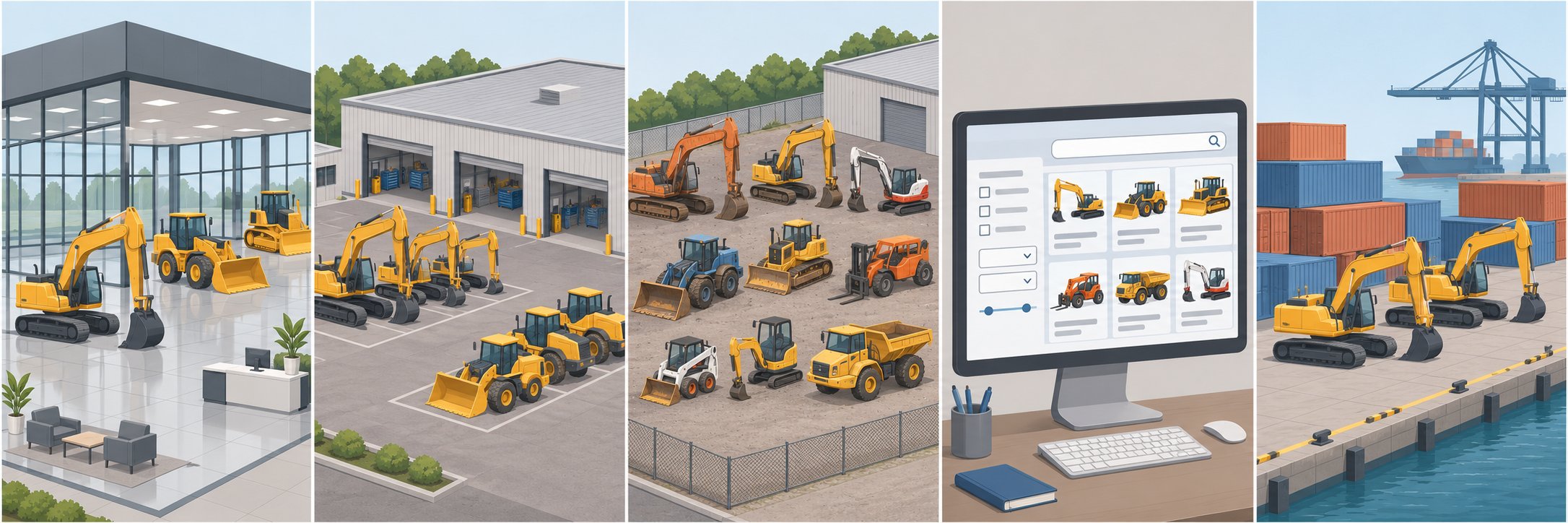
Not all suppliers operate from the same playbook. Some rebuild machines to near-factory condition and price accordingly. Others aggregate thousands of listings without ever touching a wrench. The supplier type you buy from shapes everything downstream — what inspections were performed, what documentation you'll receive, and what happens when something goes wrong after delivery. Here's a closer look at the five main categories you'll encounter, along with what each one actually brings to the table.
OEM Certified Dealers and Regional Authorized Dealers
OEM certified programs represent the premium tier of the used equipment market. Caterpillar's Cat Certified Used program is the most recognizable example. Every machine carrying that label must pass a standardized inspection where trained dealer inspectors rate each component — cab, undercarriage, cylinders, ground engaging tools, glass, hoses, and sheet metal — on a Good/Fair/Poor scale. Only machines rated "Good" across all categories earn the certified designation. Components must show no leaks, no visible damage, no mechanical or system problems, and no excessive wear. Undercarriage and tires must have at least 50% life remaining, and all replacement parts must be genuine Cat components.
That level of rigor gives buyers genuine peace of mind, but it comes at a cost. A certified Caterpillar excavator will almost always carry a higher price tag than an equivalent machine from an independent lot. You're paying for the inspection protocol, the limited warranty, and direct access to the OEM's parts network. For a contractor who needs a reliable machine with minimal downtime risk — say, a Cat excavator for sale through an authorized dealer — the premium often pays for itself in avoided repair bills and scheduling certainty.
Regional authorized dealers like MacAllister Machinery or H.O. Penn operate under the OEM umbrella but add a local service layer. They source machines from trade-ins, rental fleet retirements, and manufacturer remarketing channels. Their technicians perform inspections aligned with the brand's standards, and they can often arrange financing, extended service agreements, and on-site support. The tradeoff? Geographic reach is limited, and pricing reflects the overhead of maintaining brick-and-mortar facilities staffed with certified mechanics.
Independent Resellers and Direct-From-Owner Sales
Step outside the OEM ecosystem and you'll find a much wider pricing range — along with a much wider range of quality. Independent resellers buy machines at auction, from retiring contractors, or through fleet liquidations, then resell them with varying degrees of refurbishment. Some independents run thorough mechanical evaluations and offer short-term warranties. Others do little more than a pressure wash and a fresh coat of paint before listing a unit.
The due-diligence burden shifts significantly toward the buyer in this category. You'll need to verify hour-meter accuracy, request service records, and ideally arrange a third-party inspection before committing. That said, independent channels can deliver genuine value. Imagine a scenario where a retiring excavation contractor is selling a well-maintained Kobelco excavator with full service logs and verifiable hours. There's no dealer markup, no middleman margin — just a fair price for an honest machine. These opportunities exist, but finding them requires more legwork and sharper evaluation skills.
Direct-from-owner sales follow the same logic at an even more personal level. A landscaping company upgrading its fleet might list a used mini excavator for sale at a price that undercuts every dealer in the region. The risk? No warranty, no post-sale support, and no recourse if the machine develops problems a week after the title changes hands. The reward? Potentially the lowest acquisition cost available for a given model and hour range.
International Export Brokers and Online Marketplaces
International export brokers occupy a distinct niche that's grown rapidly as global demand for quality used equipment has outpaced local supply in many markets. These suppliers aggregate multi-brand fleets — Caterpillar, Komatsu, Kobelco, Doosan, Hyundai, and others — from equipment-dense regions where high fleet turnover creates a steady flow of used inventory. They inspect, consolidate, and ship machines to buyers across Africa, Southeast Asia, the Middle East, Latin America, and beyond.
What separates a genuine export broker from a simple listing service is operational depth. A reputable broker handles freight coordination, customs documentation, and often provides detailed condition reports with real photographs and verified hour readings. They serve equipment dealers looking to stock multi-brand inventory and import buyers in markets where finding a quality caterpillar excavator or Komatsu locally means paying inflated prices or accepting machines with unknown histories.
Online aggregator marketplaces — platforms like Machinery Trader, Equipment Trader, or Boom & Bucket — take a different approach. They connect buyers with sellers across a broad geographic area, and some offer inspection support or logistics assistance. As Ironmart Online's marketplace comparison highlights, platforms vary significantly in how much vetting they perform. Some provide inspection and logistics help, while others simply host listings and leave due diligence entirely to the buyer. Tens of thousands of daily visitors browse these sites, which means good deals surface quickly — but so do misleading listings. The platform itself is a tool, not a guarantee.
Comparing Supplier Types at a Glance
With five distinct supplier models in play, choosing the right one depends on your priorities. The table below breaks down the key differences so you can weigh each option against your specific buying situation — whether you're searching for a single used mini excavator sale or sourcing a fleet of mid-size units for an overseas operation.
| Supplier Type | Typical Inspection Standard | Pricing Range | Geographic Reach | Post-Sale Support | Best Suited For |
|---|---|---|---|---|---|
| OEM Certified Programs (e.g., Cat Certified Used) | Standardized multi-point inspection; all components rated "Good" required | Premium — highest in category | National via dealer network | Limited warranty, OEM parts access, dealer service | Contractors prioritizing reliability and minimal downtime |
| Regional Authorized Dealers | Brand-aligned inspection with local technician oversight | Above average — reflects dealer overhead | Regional, typically within one state or multi-state area | Financing, service agreements, local repair support | Buyers who want a known service partner nearby |
| Independent Resellers | Varies widely — from thorough mechanical evaluation to cosmetic cleanup only | Wide range — competitive to mid-market | Local to national, depending on reseller size | Limited or none; some offer short-term warranties | Experienced buyers comfortable with independent due diligence |
| Online Aggregator Marketplaces | Platform-dependent; some offer inspection support, others list only | Full spectrum — auction prices to retail | National to global | Varies; platform may facilitate but rarely guarantees | Buyers comparing prices across many sellers simultaneously |
| International Export Brokers | In-house inspection with photos, hour verification, and condition reports | Competitive per-unit cost; logistics add to total | Global — ships to virtually any destination | Logistics coordination, customs documentation, bulk order support | Import buyers and dealers sourcing multi-brand inventory |
Each column in that table represents a decision point. A buyer shopping for a single caterpillar excavator to run on domestic job sites faces a fundamentally different calculus than a dealer importing a container of mixed-brand compact units for resale. The inspection standard column alone should tell you where your risk exposure sits — and how much verification work you'll need to do yourself before signing anything.
That verification process, it turns out, is where most buyers either protect themselves or leave the door wide open for costly surprises. Knowing how to evaluate a supplier — regardless of which category they fall into — is the skill that separates informed purchases from expensive lessons.
How to Evaluate a Used Excavator Supplier Before You Buy
Picture two listings for the same model — say, a 308 Cat excavator for sale on two different websites. One shows six high-resolution photos taken from multiple angles, a visible serial number plate, a clearly stated hour-meter reading, and a paragraph describing the machine's work history and recent maintenance. The other shows a single stock image, lists "low hours" with no number, and describes the unit as "ready to work." Both suppliers might be perfectly legitimate, but only one is giving you the information you need to make a confident decision. The gap between those two listings is exactly what a structured evaluation framework helps you measure.
Whether you're browsing excavators for sale through an OEM certified program, negotiating with an independent reseller, or requesting quotes from an international broker, the same core criteria apply. What changes is who performs each step — and how much of the verification burden falls on you. The framework below organizes those criteria into three categories, ranked by how much each one reveals about the supplier's reliability and the machine's true condition.
- Inventory transparency and listing quality — what you can learn before ever contacting the supplier
- Inspection standards and quality assurance processes — what the supplier has actually done to evaluate the machine
- Communication responsiveness and quote process — how the supplier behaves when real money is on the table
Inventory Transparency and Listing Quality
A supplier's inventory page is their storefront. It's the first and most revealing signal of how seriously they take buyer trust. You'll want to examine several specific elements before you even pick up the phone.
Start with the photos. Are they real images of the specific machine, or generic stock photography pulled from the manufacturer's marketing library? Real listings show the unit from multiple angles — cab interior, undercarriage, boom and stick, engine compartment, and any visible wear or damage. You should be able to see the hour meter, the serial number plate, and the overall condition of paint, welds, and ground-engaging tools. A supplier who posts a single glamour shot of a freshly washed machine is either hiding something or hasn't invested the effort to document what they're selling.
Next, check for specificity in the description. A quality listing for a used excavator for sale will name the exact model year, configuration details (stick length, quick coupler type, thumb attachment), and the documented hour reading — not a vague "approximately" figure. It should describe the machine's application history when known. Was it a rental unit running utility work, or a demolition machine breaking concrete for ten years? That context changes everything about expected wear patterns.
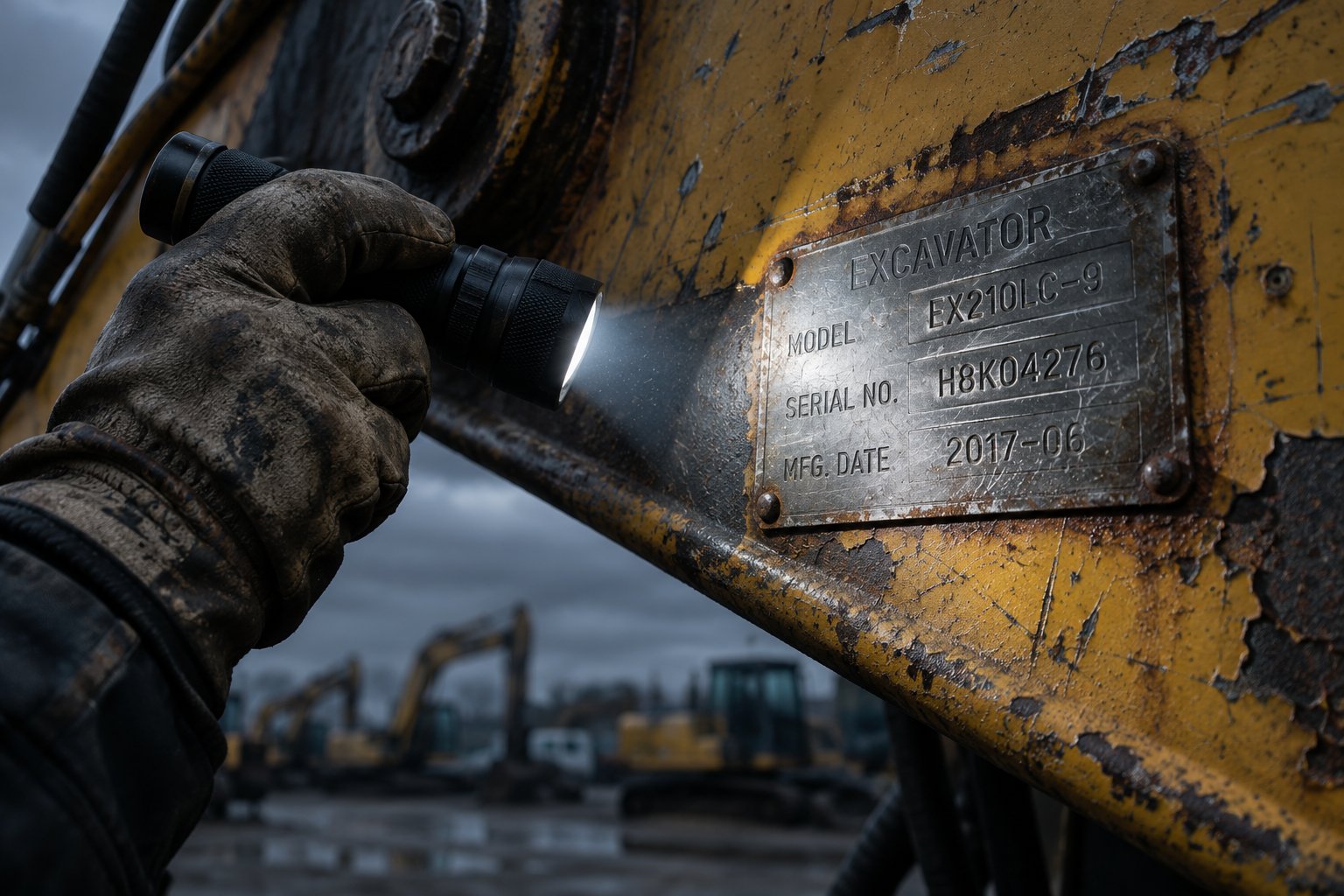
Some of the better-organized suppliers display each unit with its serial number visible in photographs, which allows savvy buyers to cross-reference that number with the manufacturer's records. Mico Equipment's inspection checklist emphasizes this as the very first item to verify: use the serial number to match the machine against its paperwork, confirming model, year, and configuration. Any mismatch is an immediate red flag. Meanwhile, suppliers who refuse to share serial numbers before a deposit is placed are forcing you to trust them blindly — a dynamic that should make any experienced buyer uncomfortable.
Also pay attention to what's missing. If a supplier lists forty machines and none of them have hour readings, that's a pattern, not an oversight. If every photo looks like it was taken in the same lighting with the same clean background, you might be looking at a staging operation rather than a working inventory yard. Contrast that with suppliers who show machines in their actual storage environment, imperfections included. Imperfection, documented honestly, is a trust signal.
Inspection Standards and Quality Assurance Processes
A polished listing gets your attention. The inspection behind it determines whether the machine deserves your money. The difference between a cosmetic cleanup and a genuine mechanical evaluation is the difference between discovering a failing hydraulic pump before you buy and discovering it the first week on the job.
So what should a reputable pre-sale inspection actually cover? Based on industry standards reflected in detailed buyer checklists, a thorough evaluation addresses at least these mechanical systems:
Undercarriage wear measurements. The undercarriage is one of the most expensive components to replace on any excavator. A proper inspection measures remaining life on track chains, rollers, idlers, and sprockets — ideally against the manufacturer's wear specifications. A supplier who says the undercarriage is "in good shape" without measurements is giving you an opinion, not data.
Hydraulic system pressure tests. Slow or weak cylinder action, leaking hoses, and scored rod surfaces all point to hydraulic issues that can cost thousands to resolve. Checking fittings, cylinder rods, and pump performance under load separates a working evaluation from a visual once-over. On a dry, clean machine, hydraulic leaks are relatively easy to spot — which is exactly why some sellers pressure-wash a unit right before showing it.
Engine condition and cold-start behavior. A cold start reveals problems that a warm engine conceals. Hard starting, excessive cranking, heavy smoke, or unusual knocking noises during a cold start are warning signs. Oil leaks, coolant leaks, and milky oil (which suggests coolant contamination) should all be documented. On newer machines, stored fault codes and emissions system status add another layer of insight.
Structural crack inspection. Welds around the boom foot, boom nose, stick tip, and cylinder mounts deserve close visual examination. Fresh paint or grinding marks over structural joints can conceal repaired cracks — a serious safety concern that's easy to miss if you're only evaluating a machine through photographs. This is one area where requesting a video walk-around or arranging a third-party inspection pays for itself many times over.
Beyond individual components, a quality inspection should also test the swing bearing for play, rattling, or grinding during full 360-degree rotation. Final drives should move the machine in a straight line without grinding or whining. Pins and bushings at every joint should be checked for clunking or excessive play. And a full operational test — boom, stick, bucket, swing, and travel working together under warm hydraulics — rounds out the picture.
The critical question for buyers isn't whether an inspection was performed. It's what standard it followed. Ask the supplier directly: What does your inspection cover? Can you provide a written condition report? Will you allow a third-party inspector before purchase? A supplier confident in their evaluation process will welcome these questions. One who deflects them is telling you something important.
Communication Responsiveness and Quote Process
You've reviewed the listings. You've asked about inspection standards. Here's where the supplier's professionalism either confirms your confidence or raises new doubts: how they handle your actual quote request.
Speed matters, but depth matters more. A supplier who responds within hours with a generic price and nothing else hasn't told you much. A supplier who takes a day but comes back with a detailed, model-specific quote is demonstrating that they've actually reviewed the machine's condition and prepared a thoughtful response. What should a proper quote include? At minimum, you should expect to see:
Machine specifications — the exact model, year, configuration, serial number, and verified hour reading. A condition summary — either a formal inspection report or at least a written description of known issues, recent repairs, and component status. Pricing with clear trade terms — especially for international buyers, the difference between an FOB and CIF price is significant. As Shunxin Construction's import guide explains, FOB (Free On Board) means the supplier covers preparation and delivery to the loading port, while the buyer arranges ocean freight separately. CIF (Cost, Insurance, and Freight) bundles the machine price with shipping to the destination port, giving the buyer a clearer picture of total landed cost — though it still excludes customs duties, import taxes, and inland transport. A supplier who quotes a single number without specifying the trade term is leaving you to guess what's included. And finally, payment terms — deposit amount, balance due timeline, accepted payment methods, and any escrow options.
Pay close attention to how the supplier handles follow-up questions. Do they provide additional photos or video when asked? Can they clarify which attachments are included? Are they willing to share previous buyer references? A used mini excavator sale involving a $20,000 machine and a multi-unit fleet purchase worth six figures both deserve the same level of professional communication. How a supplier treats your inquiry before the sale is the best preview of how they'll handle any issues after it.
Responsiveness and transparency during the quote process also reveal operational capacity. Suppliers with organized inventory systems can pull up machine details quickly. Those managing disorganized yards or listing machines they haven't physically inspected tend to stall, provide vague answers, or change details between conversations. If the specifications shift from one email to the next, that's not a communication problem — it's an inventory credibility problem.
Of course, even the most polished supplier presentation can mask deeper issues. A thorough evaluation framework helps you identify strong candidates, but it's equally important to recognize the warning signs that should send you walking away — signals that no amount of responsive communication can overcome.
Red Flags and Warning Signs of Unreliable Suppliers
A professional-looking website, a responsive sales rep, and an attractive excavator price can all exist in the same transaction — and still lead to a six-figure loss. Fraud in the used heavy equipment market isn't rare or exotic. In 2026, the Better Business Bureau investigated a fake equipment website tied to roughly $51,000 in reported losses from buyers who wired money for machines that never shipped. And outright scams represent only one end of the spectrum. Plenty of technically legitimate suppliers cut corners in ways that cost you thousands in unexpected repairs, legal headaches, or machines that aren't what they claimed to be.
The evaluation framework from the previous section helps you identify strong suppliers. This section flips the lens — here's how to recognize the ones you should avoid entirely.
Documentation Red Flags That Signal Risk
Paperwork tells the truth even when people don't. Start with the hour meter — the single most manipulated data point in the used equipment market. An hour meter can be reset, replaced, or disconnected, and the result is a machine that looks like a lightly used bargain but actually carries the wear profile of a unit with two or three times the stated hours.
How do you spot the discrepancy? Look at the physical machine. A Kobelco SK350LC listed with 4,200 hours but showing worn-out track links, hydraulic drift, and a leaking swing motor tells a very different story — one closer to 10,000-plus hours of real operation, as Makana's hour verification guide illustrates with a nearly identical example. The same principle applies to any brand. A Cat 304 for sale with suspiciously low hours should show correspondingly minimal wear on pins, bushings, bucket teeth, and the operator's seat. When the wear doesn't match the meter, the meter is lying.
On newer machines equipped with electronic control units, the ECU stores an independent record of engine run time that persists even when the physical meter is swapped. Diagnostic tools — like a CAT ET scanner for Caterpillar equipment or a Komtrax report for Komatsu — can pull this internal data and reveal mismatches. One documented case involved a Caterpillar 950M wheel loader with an hour meter showing 7,800 hours; the ECU revealed 12,300 — clear evidence of tampering. If a supplier resists ECU verification, ask yourself why.
Beyond hours, watch for these documentation warning signs:
Missing or incomplete service records. A machine with no maintenance history is either poorly maintained, recently acquired by a flipper who never serviced it, or carrying a history someone doesn't want you to see. Gaps in service logs — especially around major component intervals like engine rebuilds or hydraulic pump replacements — suggest the records were selectively curated.
Reluctance to share serial numbers. The serial number is the machine's identity. It's how you verify model, year, configuration, ownership history, and theft status. A supplier who won't provide a serial number until you've placed a deposit is asking you to commit money before you can perform basic due diligence. That sequencing benefits only one party — and it isn't you.
Vague ownership history. "We acquired it from a fleet" is not a provenance. How many owners? What applications? Was it a demolition machine, a utility excavator, or a rental unit? Each history implies a different wear profile. Suppliers who can't or won't answer these questions either don't know — meaning they bought blind — or don't want you to know.
And here's a risk many buyers overlook: stolen equipment entering the secondary market. The U.S. construction industry alone loses an estimated $300 million to $1 billion annually to equipment theft, with over 11,000 incidents reported each year. The recovery rate for a single stolen item sits below 7%. That means thousands of machines circulate with altered PIN plates and fabricated paperwork. Cross-referencing a serial number through databases like NER's IRONcheck (which searches over 20 million theft and ownership records) or the free NICB VINCheck tool can flag machines reported stolen or carrying salvage titles. If a supplier's machine can't pass a basic serial number check, the listing price is irrelevant.
Behavioral Red Flags in Supplier Communication
Documentation problems are sometimes accidental — a lost file, a previous owner who didn't keep records. Behavioral red flags are rarely accidental. They reveal intent.
Artificial urgency. "Another buyer is making an offer today" or "this price is only valid for 24 hours" — these lines are designed to short-circuit your verification process. A genuine deal can survive your questions. A fraudulent one can't, which is exactly why scammers manufacture time pressure. If you feel pushed to skip a step, treat that feeling as your answer.
Refusal to allow third-party inspections. This is arguably the single most reliable disqualifier. A legitimate supplier selling a properly represented machine has every reason to welcome an independent inspection — it closes the sale faster and eliminates disputes. A supplier who blocks inspection access, makes excuses, or suddenly becomes unavailable when an inspector is scheduled is protecting something other than your interests. As MY Equipment's scam prevention guide puts it plainly: treat a refusal as a dealbreaker.
Unconventional payment demands. Wire transfers to personal accounts, cryptocurrency payments, and money orders all share one characteristic — they're difficult or impossible to reverse. Legitimate equipment dealers maintain business accounts and standard invoicing processes. They'll accept payment methods that offer both parties a degree of protection. A supplier who insists on an irreversible payment method before you've verified the machine is structuring the transaction to eliminate your recourse.
Pricing dramatically below market value. You're browsing used mini excavators for sale and spot a unit priced at roughly half of comparable listings. That's not a deal — that's a data point demanding explanation. Stolen equipment routinely sells at 10 to 30 cents on the dollar. Even when fraud isn't involved, a deeply underpriced machine almost always carries hidden costs: undisclosed damage, imminent component failure, or liens that follow the machine to its next owner. If the seller can't credibly explain the discount, the explanation is the discount itself.
Verification Steps Every Buyer Should Take
Red flags tell you when to be cautious. Verification steps tell you whether caution is warranted. Before committing funds to any supplier — whether you're buying a single compact excavator or a container of used excavators for sale — run through this checklist:
- Verify business registration. Search the supplier's legal entity name through the relevant corporate registry in their jurisdiction. A registered business isn't a guarantee of honesty, but an unregistered one is a guarantee of zero accountability.
- Confirm a physical address. Use satellite imagery or street-view tools to verify the supplier's yard or office location actually exists. Scam operations frequently list addresses that turn out to be vacant lots, residential homes, or unrelated businesses.
- Request references from previous buyers. Ask for contact information of two or three past customers — ideally in your region or buying similar equipment. A supplier with a real track record will have references available. One that doesn't has either just started or just changed names.
- Ask for a video walk-around of the specific machine. Not a promotional clip. A live or recently recorded video showing the unit's serial number plate, a cold start, full hydraulic function test, and a 360-degree exterior view. This single request eliminates a surprising number of fraudulent listings because the machine either doesn't exist or doesn't match the description.
- Run the serial number through theft and lien databases. Use NER IRONcheck for comprehensive theft and ownership records, NICB VINCheck for free insurance theft searches, and contact the manufacturer's dealer network to verify the serial number matches the claimed model and year.
- Confirm export licensing if purchasing internationally. For cross-border transactions, verify that the supplier holds the necessary export documentation and can provide a commercial invoice, bill of lading, and certificate of origin. A supplier unfamiliar with these requirements is either inexperienced in international trade or not planning to ship anything at all.
Any supplier unwilling to accommodate reasonable verification requests is not worth the risk — regardless of how attractive the excavator price appears.
None of these steps require specialized expertise. They require patience, a willingness to ask direct questions, and the discipline to walk away when the answers don't add up. The cost of verification is measured in hours. The cost of skipping it is measured in tens of thousands of dollars — and sometimes in machines that never arrive at all.
Recognizing red flags protects you from bad suppliers. But even with a trustworthy seller on the other side of the transaction, one question still determines whether you're getting a fair deal or overpaying: what actually drives the price of a used excavator, and how much of that pricing is the supplier choosing not to explain?
What Influences Used Excavator Pricing Across Supplier Types
Here's a question most suppliers would rather you never ask: why does the same excavator model, with similar hours and condition, carry a dramatically different price tag depending on who's selling it? The answer isn't complicated, but it is layered — and those layers are where suppliers build in margins, overhead, and costs that rarely appear as line items on a quote.
Used excavator pricing isn't a single number determined by a blue book. As Ironmart Online's 2026 valuation guide puts it plainly, ask three people what a used excavator is worth and you'll get three answers — none of them wrong. A valuation depends entirely on its purpose: a lender wants a conservative figure, a buyer wants the lowest defensible one, and a seller wants the highest the market will actually pay. That range is real, and understanding what creates it gives you the leverage to negotiate from a position of knowledge rather than hope.
Pricing breaks down into three distinct categories: factors tied to the machine itself, factors introduced by the supplier type, and factors shaped by geography and market dynamics. Each one shifts the number independently, and together they explain why two seemingly identical listings can sit tens of thousands of dollars apart.
Machine-Level Factors That Drive Price
Every used excavator's value starts with five core data points: brand and model, documented operating hours, attachment package, undercarriage condition, and cosmetic or mechanical refurbishment status. Get these wrong — or let a supplier obscure them — and your pricing benchmark is built on sand.
Brand and model desirability. Not all brands hold resale value equally. Caterpillar and Komatsu consistently command stronger secondary-market pricing than less globally distributed brands, and the reason is practical, not sentimental. Both manufacturers maintain extensive global dealer networks and parts distribution systems, which means a buyer in almost any market can source replacement components without extended lead times. That parts confidence translates directly into willingness to pay. If you're comparing a Cat 308 excavator for sale against a similarly sized machine from a less established brand, the Cat will almost always carry a premium — not because it's necessarily a better machine in every application, but because the aftermarket ecosystem supporting it reduces long-term ownership risk.
Komatsu benefits from a similar dynamic. As BFC Finance's analysis of Komatsu resale value notes, dealer network strength in a given region correlates meaningfully with how well a used Komatsu holds its price — a machine in a market with deep, well-stocked dealer support tends to retain value better than the same unit in a region where parts and service require a longer wait. That principle applies across brands: resale value follows parts availability.
Documented operating hours. Hours are the most commonly cited pricing variable, but they're also the most commonly misunderstood. A 4,000-hour machine with full maintenance documentation and a recently rebuilt undercarriage can legitimately be worth more than a 2,500-hour unit with no records and visible neglect. Hours are a proxy for wear, not a measurement of it. What matters is hours relative to the machine's expected service life and how those hours were spent — light utility trenching versus hard rock demolition creates radically different wear profiles at the same hour count. The key question isn't just "how many hours?" but "what kind of hours?"
Attachment package. A standard digging bucket is expected and doesn't move the price meaningfully. A hydraulic thumb, quick coupler, or grading blade adds value — but only to a buyer who needs that specific configuration. Standard features keep the potential buyer audience wide. Specialized attachments narrow it and raise the price for the right buyer while potentially slowing the sale for everyone else. When evaluating a listing that includes premium attachments, consider whether you'll actually use them. If you won't, don't pay for them.
Undercarriage condition. The undercarriage can represent up to half of a tracked excavator's total lifetime maintenance cost, making it the single most consequential component in pricing. A Caterpillar 304 for sale with 70% remaining undercarriage life is a fundamentally different purchase than one needing new tracks, rollers, and sprockets within the next 500 hours. That replacement is a five-figure expense on a mid-size machine, and a savvy buyer should either see it reflected in a lower asking price or confirmed as unnecessary by documented wear measurements. A supplier who describes undercarriage condition as "good" without providing measurements is offering an opinion, not evidence.
Cosmetic refurbishment vs. mechanical overhaul. Fresh paint and a pressure-washed engine bay make a machine photograph well. They tell you nothing about hydraulic pressure, engine compression, or structural integrity. Some suppliers invest in genuine mechanical refurbishment — replacing worn seals, rebuilding hydraulic pumps, addressing known failure points for a specific model. Others invest in cosmetics that photograph beautifully while leaving the expensive problems untouched. When a Cat 306 for sale looks showroom-fresh but carries pricing that seems surprisingly competitive, ask what specifically was refurbished. If the answer is mostly paint and decals, the "competitive" price may just be hiding deferred maintenance.
Supplier-Level Factors That Affect What You Pay
Identical machines don't carry identical prices across supplier types because each channel introduces its own cost layers. Understanding these layers helps you compare quotes fairly — not by chasing the lowest number, but by knowing what each number actually includes.
OEM certified machines carry the highest per-unit pricing for a reason. The standardized inspection protocol, genuine replacement parts, and limited warranty that come with a certified designation all cost money. When you see a Cat excavators for sale listing through an OEM certified program priced $15,000 to $25,000 above an equivalent independent listing, that gap isn't pure margin — it's the cost of the inspection process, the warranty reserve, and the dealer infrastructure that supports post-sale service. Whether that cost is worth it depends on your risk tolerance and how much downtime costs your operation per day.
Export brokers factor in different cost layers: sourcing, consolidation, yard storage, and logistics coordination. A broker aggregating machines from fleet liquidations across equipment-dense markets can offer competitive per-unit pricing precisely because high turnover volume in those markets creates buying opportunities. But that per-unit advantage gets partially offset by logistics margins, freight coordination fees, and the operational cost of maintaining inspection and documentation processes for international buyers. The total price reflects a different value proposition — access to multi-brand inventory (Caterpillar, Komatsu, Kobelco, Doosan, Hyundai) that simply isn't available locally in many markets.
Auction houses introduce buyer premiums that range from roughly 8% to 15% of the hammer price, plus applicable taxes and fees. That premium is transparent in theory but easy to overlook in practice. A machine that hammers at what feels like a great price can end up costing more than a fixed-price listing from an independent dealer once the buyer premium, documentation fees, and removal charges are added. Auctions also sell machines as-is, with no post-sale recourse — so you're paying a premium for access to a competitive bidding environment, not for quality assurance.
Direct-from-owner sales eliminate the middleman entirely, which is why they can offer the lowest acquisition cost for a given machine. The tradeoff is transparent: no inspection infrastructure, no warranty, and no logistics support. You're buying the machine, not a service package. For an experienced buyer who can arrange their own inspection and transport, this channel can deliver exceptional value. For a first-time buyer or someone purchasing internationally, the savings on purchase price can easily be consumed by the cost of problems discovered after the sale.
Geographic and Market Dynamics
Where a supplier operates affects pricing as much as how they operate. Equipment-dense markets — parts of East Asia, North America, and Western Europe — generate high fleet turnover volumes. Rental companies retire machines on schedule, contractors upgrade regularly, and the secondary market absorbs a constant flow of quality used units. That supply volume creates competitive pricing at the source. A mid-size excavator available in these markets may carry a meaningfully lower base cost than the same model in a supply-constrained market like parts of sub-Saharan Africa, Southeast Asia, or Latin America, where local availability is limited and demand outstrips supply.
But base cost is only part of the story. An international buyer comparing quotes needs to account for the full landed cost — the total expense of getting a machine from the supplier's yard to the buyer's job site. This is where trade terms become critical, and where many buyers miscalculate.
FOB (Free On Board) means the supplier delivers the machine to the loading port, handles export customs clearance, and loads it onto the vessel. From that point forward, ocean freight, insurance, destination port charges, import duties, and inland transport are all the buyer's responsibility. An FOB quote looks lower because it covers less. As LTMG's shipping terms guide explains, first-time importers who compare only the headline FOB price against a delivered price are comparing fundamentally different scopes — and underestimating their actual total cost.
CIF (Cost, Insurance, and Freight) bundles the machine price with ocean freight and basic marine insurance to the named destination port. It gives international buyers a clearer picture of the cost to get the machine off the vessel — but it still excludes destination port charges, import customs clearance, duties, taxes, and inland delivery. The difference between a CIF quote and the true landed cost can be substantial, especially in countries with high import duty rates on heavy equipment.
A practical way to think about it: the FOB price is the machine. The CIF price is the machine on a ship heading toward you. The landed cost is the machine on your job site, legal and ready to work. Every cost between those stages — freight, insurance, customs brokerage, duty, VAT or GST, port handling, and trucking from port to site — adds to the final number. A supplier who quotes only FOB without helping you estimate the full chain is giving you an incomplete picture, whether intentionally or not.
How Total Cost Varies Across Supplier Types
The table below illustrates how the same class of machine — a mid-size tracked excavator in the 20- to 25-ton range with moderate hours — might carry different total acquisition costs depending on the supplier channel. These are descriptive ranges rather than exact figures, because actual pricing fluctuates with market conditions, specific brand and model, and negotiation. The point isn't to memorize numbers. It's to see where each channel adds cost and where it doesn't.
| Cost Component | OEM Certified Dealer | Independent Reseller | Auction Purchase | International Export Broker (CIF) | Direct-From-Owner |
|---|---|---|---|---|---|
| Base Machine Price | Highest — reflects certified inspection, warranty, and OEM parts | Moderate — varies with refurbishment level | Variable — driven by bidding competition | Competitive — sourced from high-turnover markets | Lowest — no middleman margin |
| Inspection and Warranty Cost | Included in price (standardized protocol) | Partial or none; buyer may need independent inspection | None — sold as-is | Included at supplier's standard; buyer can arrange third-party | None — buyer arranges and pays for all inspection |
| Buyer Premium / Transaction Fees | None (fixed price) | None or minimal | 8%–15% buyer premium plus applicable fees | None (fixed price, logistics included in quote) | None |
| Logistics and Shipping | Local delivery typically available | Buyer arranges or negotiates delivery | Buyer responsible for removal and transport | Ocean freight and insurance included in CIF; inland delivery extra | Buyer arranges all transport |
| Customs, Duties, and Import Taxes | N/A for domestic purchases | N/A for domestic purchases | N/A for domestic purchases | Buyer's responsibility — varies by destination country | N/A for domestic purchases |
| Post-Sale Support | Dealer service network, OEM parts access | Limited or none | None | Documentation and logistics support; parts access varies | None |
| Overall Cost Profile | Highest total cost but lowest risk | Mid-range cost with moderate buyer risk | Potentially competitive but unpredictable; hidden fees add up | Competitive per-unit cost; total depends on destination logistics | Lowest cost but highest buyer responsibility |
Notice the pattern: every channel that lowers the base price shifts risk, responsibility, or hidden cost somewhere else. The OEM dealer wraps everything into a higher sticker price — inspection, warranty, parts access, local support. The direct-from-owner sale strips all of that away and hands you the lowest number at the cost of doing everything yourself. The export broker and the auction house each sit at different points on that spectrum, with different cost components surfacing in different places.
The smartest approach isn't to fixate on any single line in this table. It's to calculate the total landed, operational-ready cost for each option — and then decide which combination of price, risk, and support aligns with your operation's actual needs. A contractor who loses $3,000 per day when a machine is down has a very different cost calculus than a dealer stocking inventory for resale.
Price, though, is only half the transparency equation. A fair number on a machine you can verify is a good deal. A fair number on a machine with no documentation to back it up is a guess — and guesses become expensive when critical paperwork is missing, incomplete, or fabricated. The records behind the machine matter just as much as the number on the quote.
Machine Documentation Every Buyer Should Demand
A used excavator is only as trustworthy as the paper trail behind it. You can inspect the hydraulics, walk the undercarriage, and cold-start the engine — but without documentation to verify what you're seeing, you're relying on the supplier's word alone. And in a market where roughly 15-20% of used equipment listings show hour readings inconsistent with available service records or ECM data, the supplier's word needs backup.
This is the gap most buyers don't realize exists until it's too late. Pricing transparency and inspection standards get discussed in sales conversations. Paperwork rarely does — unless you bring it up first. The documents outlined below aren't optional extras. They're the evidence that separates a verified machine from an expensive assumption.
Service Records and Ownership History
If you could request only one document from a used excavator supplier, make it the complete maintenance log. Nothing else reveals the machine's real story as clearly. A full service history shows every oil change, filter replacement, greasing interval, and major repair — each one dated and stamped with the corresponding hour-meter reading at the time of service. That timeline is the machine's biography, and reading it is more straightforward than you might expect.
Start with the service intervals. Most manufacturers specify routine maintenance at predictable hour increments — engine oil every 250 to 500 hours, hydraulic fluid changes at 2,000 to 5,000 hours, depending on the brand and model. A machine with records showing consistent adherence to these intervals tells you it was cared for by someone who planned ahead. Gaps — say, a 2,000-hour stretch between oil changes on a unit that should have been serviced every 500 — raise a different kind of question. Was the maintenance performed but not documented? Was the machine sitting idle? Or was it running hard with nobody bothering to maintain it? Each answer carries different implications for remaining component life.
Major component replacements deserve particular attention. Look for entries documenting engine rebuilds, hydraulic pump swaps, final drive overhauls, and swing motor replacements. These aren't red flags by themselves — every machine that runs long enough will need major work. What matters is whether the work was performed at appropriate intervals by qualified technicians using proper parts. An engine rebuild at 10,000 hours on a Caterpillar excavator is routine fleet management. The same rebuild at 4,000 hours on a machine advertised as "lightly used" is a question mark that demands explanation.
Oil analysis reports add another layer of insight when available. A series of oil samples taken at regular intervals, each showing normal wear metal levels, is one of the strongest indicators of an engine and hydraulic system in good health. Trending data — where iron or copper counts gradually increase over time — can predict component failures before they happen. If a supplier has oil analysis records and offers them freely, that's a confidence signal. If they claim the machine was well maintained but have no records of any kind, you'll want to weigh that claim against the physical evidence more carefully.
Ownership history rounds out the picture. A caterpillar excavator for sale that spent its life in one fleet, performing utility work for a municipal department, carries a very different risk profile than one that changed hands four times in six years across demolition and land-clearing operations. Each transfer and each application type implies a different pattern of stress, maintenance, and care. Suppliers who can trace ownership back through at least the most recent one or two owners demonstrate a level of sourcing diligence that benefits you directly. Those who can't — or won't — are asking you to buy a machine without a past.
Hour Meter Verification and Machine Identity
You've already seen how hour-meter tampering works and why it's financially motivated. The documentation side of this issue is where you confirm — or disprove — what the dashboard claims.
The most reliable method is cross-referencing service records with hour readings logged at each service visit. Imagine a used mini excavator with a dashboard reading of 3,200 hours. If the maintenance log shows an oil change at 2,800 hours eight months ago and the machine has been in regular use since, 3,200 hours is consistent. But if the last recorded service entry reads 5,100 hours and the dashboard now says 3,200, someone has rolled the meter backward. This kind of discrepancy is surprisingly common and trivially easy to catch — if you have the records to compare against.
On machines built after roughly 2008, electronic control modules store cumulative engine hours independently of the physical meter. As HeavyDutyYard's hour meter analysis details, manufacturers like Caterpillar, Komatsu, and Deere all log hours in the ECM, and a qualified dealer or technician can pull that reading with diagnostic software in minutes. If the dashboard shows 4,200 hours and the ECM reports 6,800, you have your answer — and a machine to walk away from. Telematics platforms like Cat Product Link, Komatsu KOMTRAX, and Deere JDLink add another verification layer, logging hours remotely over time so that gaps or resets in the data become visible.
Physical wear patterns provide a third, less precise but still useful cross-check. A machine reporting 2,500 hours shouldn't have polished-smooth pins, deeply worn bucket teeth, or a cab interior showing a decade of hard use. Worn pedals, a sagging operator's seat, and loose joysticks all tell a story that contradicts "low hours." Trust your eyes when the paperwork is thin.
Beyond hours, confirming the machine's serial number against all documentation is non-negotiable. The serial number is the machine's fingerprint — it ties together the manufacturer's records, the service history, the ownership chain, and any theft or lien flags. When you're looking at a Cat 310 for sale, the serial number on the machine's plate should match what appears on every invoice, service record, and title document. A mismatch between the plate and the paperwork — or signs of a plate being ground down, re-stamped, or replaced — suggests the machine's identity has been altered. As Mico Equipment's buying checklist emphasizes, verifying the serial number against the paperwork is the very first inspection step, before you evaluate a single mechanical component. If the identity doesn't check out, nothing else matters.
Import and Export Paperwork for Cross-Border Purchases
Domestic purchases involve a relatively straightforward paper trail: title, bill of sale, service records, and any lien releases. Cross-border transactions add an entirely different layer of documentation, and missing a single piece can mean your machine sits in a customs warehouse accumulating storage fees while you scramble to obtain the right certificate.
An important nuance international buyers should understand: equipment exported from a country like China is not necessarily manufactured by a Chinese domestic brand. Many Caterpillar excavators, Komatsu units, and machines from other global OEMs enter the secondary market through international trade hubs. A used Komatsu PC200 exported from Shanghai may have originally been manufactured in Japan and operated for years in Southeast Asia before being acquired by a broker. The country of export and the country of origin can be different — and customs authorities care about the distinction because duty rates often follow the country where the machine was manufactured, not where it was most recently stored.
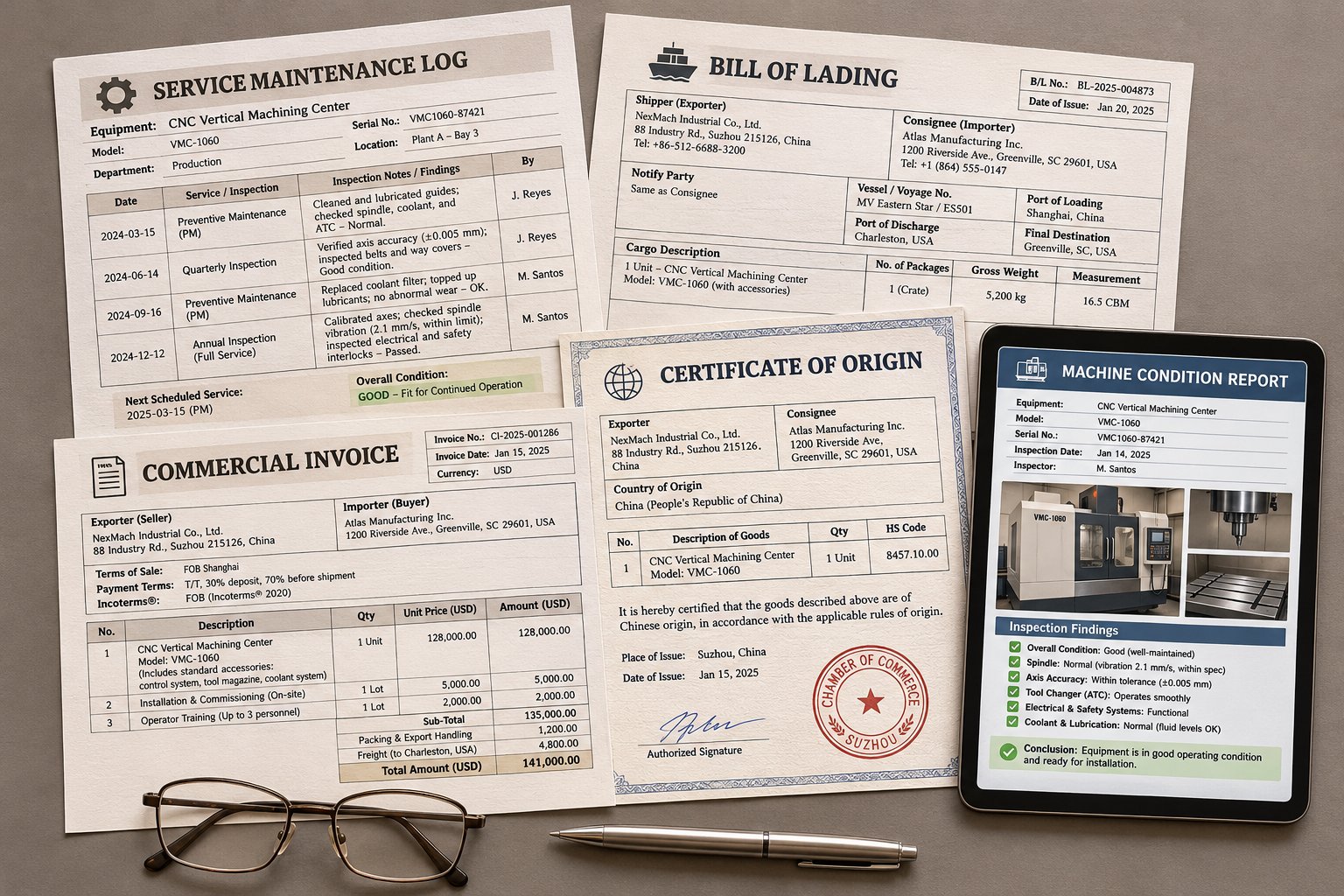
That's where the certificate of origin becomes critical. Along with the commercial invoice, packing list, and bill of lading, it forms the core document set that customs authorities review at the destination port. The commercial invoice must accurately reflect the purchase price — because duties are calculated based on declared value, and discrepancies between the invoice and the actual transaction amount can trigger audits, penalties, or seizure. The bill of lading serves as both a shipping receipt and a document of title, proving the machine was loaded and consigned to the correct buyer.
Beyond these core trade documents, destination countries frequently require additional compliance paperwork. For example, nonroad diesel equipment entering the United States must declare its emissions status on EPA Form 3520-21, and self-propelled machines add a DOT HS-7 declaration. A machine built to a foreign emissions standard can be refused entry entirely, so verifying engine compliance before the vessel sails — not after — avoids a catastrophic logistical and financial problem. Some destination countries also require pre-shipment inspection certificates, and soil on tracks or tires can draw agricultural inspection holds that delay clearance further.
Here's a practical breakdown of the documents you should request, organized by transaction type:
- For domestic transactions:
- Clear title or certificate of ownership with no outstanding liens
- Bill of sale with serial number, model, year, and agreed price
- Complete service and maintenance records
- Hour-meter verification (ECM report or telematics printout on post-2008 machines)
- Lien release documentation if the machine was previously financed
- Any existing warranty transfer paperwork
- For international (cross-border) transactions:
- Commercial invoice matching the actual transaction value
- Bill of lading (ocean) or air waybill (air freight)
- Packing list detailing machine specifications, weight, and dimensions
- Certificate of origin confirming where the machine was manufactured
- Customs declaration for the exporting country
- Emissions compliance certificate (EPA, EU Stage, or destination-country equivalent)
- Pre-shipment inspection certificate if required by the destination country
- Phytosanitary certificate or cleaning verification if the machine has been in contact with soil
- Export license or permit where applicable
- Complete service records and hour-meter verification (same as domestic)
That second list is long for a reason. Every document on it exists to prevent a specific problem — a customs hold, a duty miscalculation, an entry refusal, or a legal dispute over machine identity or value. A supplier experienced in international trade will have these documents prepared as a standard part of their workflow. One who treats cross-border paperwork as an afterthought is signaling that your shipment's smooth clearance isn't their priority.
The takeaway is straightforward: documentation protects you at every stage of a purchase, from verifying what you're buying to ensuring it arrives legally and without surprises. A machine with a complete paper trail is a machine whose risks are visible, measurable, and manageable. A machine without one is a bet — and the stakes are too high for guesswork.
Paperwork confirms what the machine is and where it's been. What it doesn't tell you is how the machine gets from the supplier's yard to your job site — and for international buyers, that journey introduces its own set of costs, decisions, and potential complications that belong in the total acquisition equation.
Shipping and Logistics When Buying from International Suppliers
You've found a competitively priced machine, verified the documentation, and confirmed the supplier's credibility. For a domestic buyer, the next step is arranging a flatbed and driving the unit to the job site. For an international buyer, a far more complex — and costly — journey begins. Ocean freight, customs clearance, and inland delivery each introduce expenses and risks that can quietly inflate the true excavator cost well beyond the quoted price. Yet most supplier listings barely mention logistics, leaving buyers to figure it out after they've already committed funds.
Containerized Shipping vs. RoRo for Excavators
Two primary ocean freight methods move excavators between countries, and the machine's size determines which one applies.
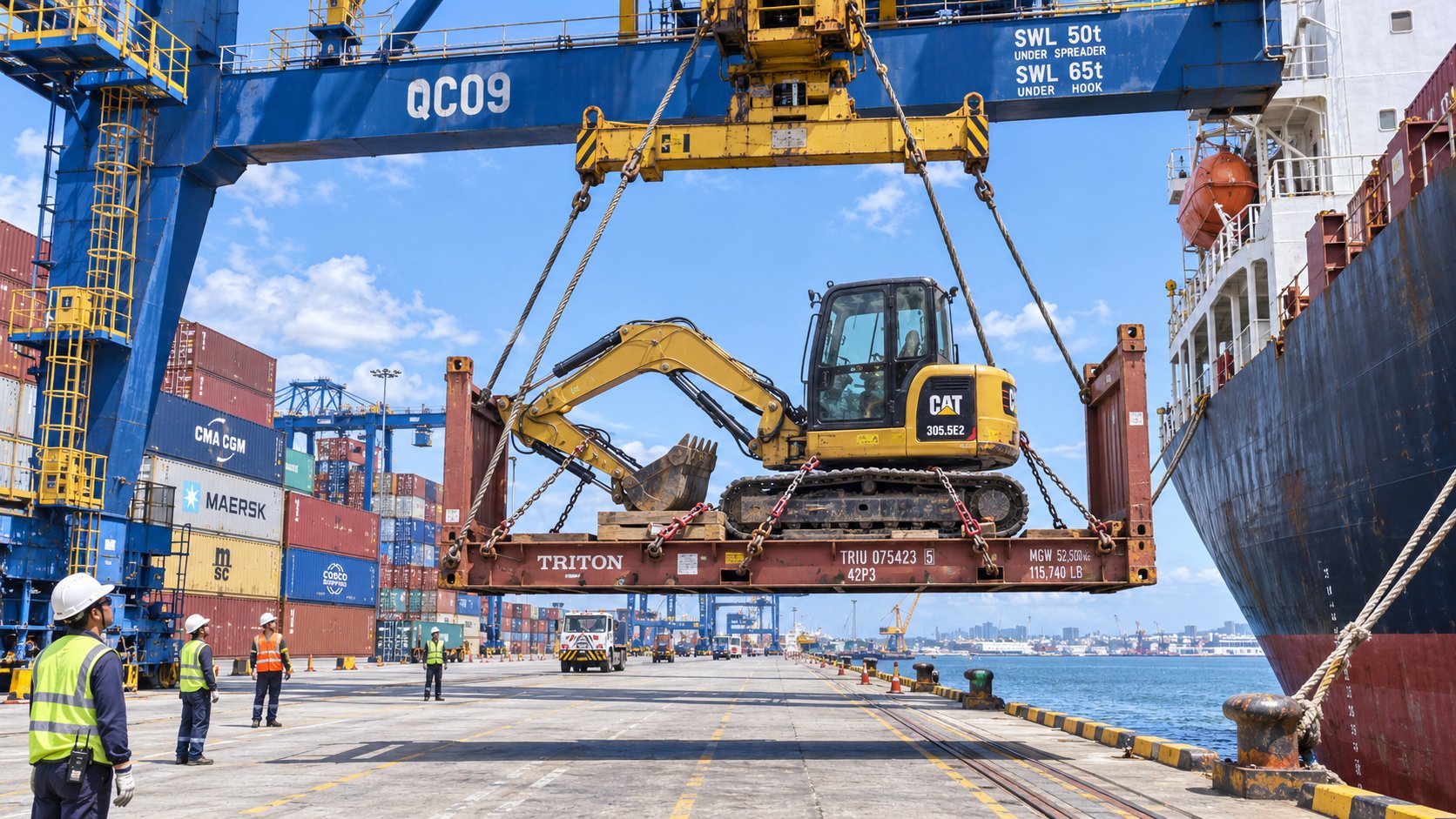
Container shipping — using standard 20-foot or 40-foot high-cube containers, or flat-rack and open-top configurations — works well for compact and mid-size excavators. A cat mini excavator for sale weighing under six tons, for instance, can typically fit inside a standard container with the boom folded into transport position. Slightly larger models, like a Cat 305.5E2 for sale, may require an open-top or flat-rack container to accommodate height, with the boom or stick removed and hydraulic lines sealed to prevent contamination during transit. As Sinotraffic's excavator shipping guide explains, the machine's transport dimensions — not just its operating weight — must fit through the container door and within the available internal space, which sometimes means partial dismantling before loading.
Containerized shipping offers strong cargo protection since the machine rides inside an enclosed steel box, but loading, securing, and any required disassembly add to the cost. For buyers sourcing multiple compact units, container shipping also allows consolidation — two or three mini excavators can share a single flat-rack, improving per-unit freight economics.
Roll-on/Roll-off (RoRo) shipping suits larger excavators that can't practically fit inside or on top of a container. The machine drives directly onto a specialized vessel via a stern ramp, eliminating the need for crane loading or dismantling. RoRo is straightforward and often faster to load, but it carries limitations: the excavator must be fully operational and safe to drive, sailings run on fixed routes with less frequent schedules than container services, and the machine rides exposed on deck rather than inside an enclosed box. For units above roughly 25 tons — or any machine too wide or tall for flat-rack dimensions — RoRo or breakbulk (piece-by-piece crane loading) becomes the only viable option.
The choice isn't always obvious. A mid-size excavator might technically fit a flat-rack but ship more cost-effectively via RoRo on certain routes. An experienced freight forwarder who regularly handles construction equipment can compare both options and recommend the method that balances cost, transit time, and cargo protection for your specific machine and destination.
Customs Clearance and Destination-Country Compliance
Getting the machine onto a vessel is the logistically visible part. Getting it off at the other end — legally and without delays — is where many international purchases stall.
Customs authorities at the destination port assess import duties based on the machine's declared value on the commercial invoice, applying the correct Harmonized Tariff Schedule (HTS) code for excavators. Misclassifying the machine — or declaring a value that doesn't align with the actual transaction price — can trigger audits, penalties, or extended holds. As Terminal49's customs delay analysis notes, valuation discrepancies and HTS code mistakes are among the most common causes of clearance delays for heavy equipment, and construction shipments are time-sensitive enough that even a few days of port storage can meaningfully impact project schedules and budgets.
Emissions standards add another compliance layer that varies dramatically by country. A used excavator built to one country's emission regulations may not meet the standards enforced in the destination market. The United States, for example, requires EPA Form 3520-21 declarations for nonroad diesel equipment. European Union countries enforce Stage V standards. Some markets in Africa and Southeast Asia apply fewer restrictions but may require pre-shipment inspection certificates instead. The critical step is confirming compliance before the vessel sails — discovering an emissions mismatch after the machine has crossed an ocean leaves you with a unit that can't legally clear customs and no good options for resolving it cheaply.
A licensed customs broker at the destination port is effectively non-negotiable for international equipment purchases. They handle tariff classification, duty payment, and the regulatory paperwork that connects your shipment to the local import framework. Trying to self-clear a high-value excavator without brokerage expertise is the logistical equivalent of skipping a pre-purchase inspection — possible in theory, risky in practice.
Delivery Timelines and Inland Transport
Buyers accustomed to domestic purchases often underestimate how long an international transaction takes from payment to operational readiness. Ocean freight transit times alone range from roughly 14 to 18 days on Asia-to-U.S. West Coast routes, 28 to 35 days for Asia-to-U.S. East Coast via Panama, and 30 to 45 days on Asia-to-Northern Europe lanes. Those are port-to-port figures — they exclude the time needed for export preparation, vessel booking, customs clearance at destination, and final delivery.
Inland transport from the discharge port to the job site adds its own timeline and cost. A tracked excavator can't drive public roads, so a low-bed or step-deck trailer handles the last leg. If the machine was partially dismantled for container shipping — boom removed, counterweight separated — reassembly at or near the port adds hours or days depending on available equipment and labor. Port storage charges begin accumulating once the free-time window expires, so having the customs broker, delivery trailer, and reassembly crew coordinated before the vessel arrives isn't just efficient — it's financially protective.
This is where a supplier's logistics experience becomes tangible. Suppliers who regularly export excavators — whether they're listing a cat 305.5E2 for sale or moving bulk orders of mixed-brand compact units — tend to maintain established relationships with freight forwarders, trucking companies, and customs brokers along their most common trade routes. That network translates into more accurate delivery estimates, smoother handoffs between transport stages, and fewer of the miscommunications that turn a routine shipment into a weeks-long delay. A supplier new to international trade, by contrast, may quote an optimistic timeline based on ocean transit alone, leaving you to discover the customs, reassembly, and inland delivery gaps on your own.
When you're evaluating an excavator for sell through an international channel, ask the supplier directly: What freight forwarder do you work with? How many shipments have you made to my destination country? Can you provide a realistic door-to-door timeline, not just port-to-port? The answers reveal whether logistics coordination is a core part of their operation or an afterthought tacked onto the sale.
Shipping cost and complexity should be factored into total acquisition cost before comparing supplier quotes — a lower machine price means nothing if freight, duties, and delivery erase the savings.
Logistics shapes the final number on every international purchase. But knowing how to ship a machine is only useful once you've decided which supplier to ship it from — and that decision looks different depending on whether you're a single-machine contractor, a multi-brand dealer, or an importer building a fleet from scratch. Matching the right supplier type to your specific buying profile is the step that ties every evaluation criterion, pricing insight, and logistics consideration together into an actionable plan.
Building a Supplier Shortlist That Fits Your Needs
Every evaluation criterion, pricing variable, and logistics consideration covered in this article points toward a single practical question: which supplier type actually fits your situation? The answer depends less on who offers the lowest headline price and more on how your buying profile — your risk tolerance, fleet strategy, geographic constraints, and operational urgency — aligns with what each supplier model delivers.
Three distinct buyer profiles account for the vast majority of used excavator purchases worldwide. Each one faces different priorities, different risks, and different tradeoffs. Matching the right supplier type to your profile is what turns a scattered search into a focused, efficient shortlist.
Matching Supplier Type to Buyer Profile
An excavation contractor shopping for a single reliable machine doesn't evaluate suppliers the same way a dealer sourcing twenty units for resale inventory does. And neither of them shares the same concerns as an import buyer in a market where local supply is scarce and overpriced. Here's how the decision framework plays out for each profile.
The excavation contractor needs one thing above all else: uptime. A machine sitting idle while waiting for a hydraulic pump replacement costs real money — often $1,500 to $3,000 per day in lost productivity on active job sites. For this buyer, the supplier's inspection rigor and post-sale support matter far more than saving a few thousand dollars on the purchase price. OEM certified programs and regional authorized dealers are the natural fit because they offer standardized inspections, limited warranties, and direct access to parts networks. If you're a contractor searching for caterpillar excavators for sale through a certified channel, the premium you pay is essentially downtime insurance. That said, experienced contractors who maintain their own shop and have trusted mechanics on staff can also find strong value through independent resellers — provided they arrange a thorough third-party inspection before committing.
The equipment dealer operates on margins and turnover speed. Stocking inventory means sourcing machines at competitive per-unit costs across multiple brands and size classes, then reselling at a markup that covers reconditioning, lot overhead, and profit. Buying one Komatsu from an OEM program, one Doosan from an auction, and one Kobelco from a private seller is operationally inefficient. Dealers benefit most from international export brokers who aggregate multi-brand fleets — Caterpillar, Komatsu, Kobelco, Doosan, Hyundai — from equipment-dense markets and can fill a container or RoRo booking with several units in a single transaction. The evaluation priority shifts toward inventory breadth, bulk pricing structure, and the supplier's ability to handle documentation and logistics for multi-unit shipments. Platforms like JIUHONG's used excavator collection, for example, let dealers browse compact and larger machines from various OEMs side by side, compare listings across size classes, and request model-specific quotes for individual or bulk purchases — the kind of consolidated access that saves weeks of sourcing effort compared to piecing together inventory from a dozen separate sellers.
The import buyer — a contractor or fleet operator in a market where quality used equipment is locally scarce or priced at a significant premium over international availability — faces a unique combination of opportunity and complexity. The potential savings on per-unit cost are real, but so are the logistics, customs, and compliance layers that domestic buyers never encounter. For this profile, the supplier's international shipping experience is as important as the machine's condition. An export broker who regularly ships to your destination country, maintains freight-forwarder relationships along your trade route, and can provide accurate CIF quotes with realistic door-to-door timelines removes the single biggest source of uncertainty from the transaction. Whether you're sourcing doosan diggers for sale for a mining operation in West Africa or compact Caterpillar units for urban infrastructure work in Southeast Asia, the supplier's logistics competence determines whether the cost advantage of buying internationally actually survives the journey from yard to job site. Multi-brand export suppliers like JIUHONG Machinery serve this profile specifically, consolidating inventory from various OEMs and coordinating the export documentation and shipping that international buyers need handled professionally.
The table below maps each buyer profile to its best-fit supplier type, top evaluation priorities, and the key risk that demands the most attention.
| Buyer Profile | Recommended Supplier Type | Top Evaluation Priorities | Key Risk to Manage |
|---|---|---|---|
| Excavation contractor (single machine, minimal downtime tolerance) | OEM certified dealer or regional authorized dealer | Inspection rigor, warranty coverage, parts access, post-sale service | Overpaying for certification premium on a machine that doesn't need it — compare certified pricing against inspected independent listings |
| Equipment dealer (bulk inventory, multi-brand sourcing) | International export broker with multi-brand inventory | Per-unit cost, inventory breadth, bulk logistics coordination, documentation completeness | Inconsistent machine quality across a multi-unit order — require individual inspection reports for every unit, not a blanket condition statement |
| Import buyer (limited local supply, international sourcing) | Export broker with proven shipping history to destination country | CIF pricing accuracy, customs and compliance documentation, freight-forwarder relationships, realistic delivery timelines | Underestimating landed cost — budget for duties, port charges, inland transport, and reassembly beyond the CIF quote |
Notice that the "Key Risk to Manage" column isn't about avoiding bad suppliers — the earlier sections of this article handle that. It's about the specific miscalculation each buyer profile is most likely to make even when working with a legitimate, competent seller. The contractor risks overpaying for overhead they don't need. The dealer risks assuming consistent quality across a bulk order. The importer risks treating the CIF price as the final number. Knowing your profile's characteristic blind spot is half the battle.
Taking the Next Step With Confidence
If there's a single thread running through every section of this article, it's this: a trustworthy used excavator supplier combines inventory transparency, documented inspections, responsive communication, and clear logistics support. No single trait is sufficient on its own. A supplier with beautiful listings but no inspection reports is selling you photographs. One with rigorous inspections but evasive communication is raising the same red flags they'd fail on a verification checklist. The combination is what matters — and comparing suppliers across all four dimensions is what separates a confident purchase from a hopeful one.
Your next step is practical, not theoretical. Request model-specific quotes from at least two or three suppliers that fit your buyer profile. Don't just compare the headline price — compare what's included. Does the quote specify trade terms? Is a condition report attached? Are the hours verified by ECM data or service records? Does the supplier outline payment terms and logistics clearly, or leave you guessing? The depth of the quote itself is a data point about the supplier's professionalism.
For buyers in markets where searching for an excavator for sale near me yields limited or overpriced options, expanding the search to international channels is no longer a niche strategy — it's a routine part of how equipment moves globally. The same applies to dealers who've exhausted local inventory and need to restock efficiently. An excavator sale near me might produce the right machine at the right time, but when it doesn't, the evaluation framework in this guide ensures you can source confidently from any channel, anywhere.
Every machine on your job site traces back to a supplier decision. The inspection standards that caught — or missed — a cracked boom. The documentation that verified — or failed to verify — real operating hours. The logistics coordination that delivered a machine on schedule — or left it sitting in a customs warehouse. Those outcomes aren't luck. They're the direct result of how carefully you chose who to buy from.
The pricing transparency most suppliers won't volunteer is now in your hands. Use it.
Frequently Asked Questions About Used Excavator Suppliers
1. How do I verify that a used excavator supplier is legitimate?
Start by confirming the supplier's business registration through the relevant corporate registry in their jurisdiction. Use satellite or street-view tools to verify their physical yard or office address actually exists. Ask for references from two or three previous buyers, ideally ones who purchased similar equipment. Request a live or recently recorded video walk-around of the specific machine showing the serial number plate, a cold start, and a full hydraulic function test. Finally, run the machine's serial number through theft databases like NER IRONcheck or NICB VINCheck to rule out stolen equipment. Any supplier who resists these basic steps should be removed from your shortlist immediately.
2. What is the difference between an OEM certified used excavator and one sold by an independent reseller?
An OEM certified machine — such as one carrying the Cat Certified Used label — has passed a standardized multi-point inspection where every component must meet a minimum quality threshold. It typically includes a limited warranty and access to genuine OEM parts through the dealer network. An independent reseller, by contrast, may perform anything from a thorough mechanical evaluation to a basic cosmetic cleanup before listing a unit. Pricing is generally lower with independents, but the buyer assumes more responsibility for arranging inspections, verifying hours, and managing post-sale issues. The right choice depends on your risk tolerance, mechanical expertise, and how much downtime would cost your operation.
3. How can I tell if a used excavator's hour meter has been tampered with?
Compare the physical wear on the machine against the stated hours. A unit listed at 3,000 hours should not have heavily worn track links, polished pins, a sagging operator seat, or significant hydraulic drift. On machines built after roughly 2008, ask a dealer or technician to pull the engine hours stored in the electronic control module (ECM) using diagnostic software — Caterpillar's CAT ET or Komatsu's KOMTRAX reports can reveal discrepancies between the dashboard meter and the independently logged ECM reading. Cross-referencing service records with the hour readings noted at each maintenance visit also exposes gaps or rollbacks. If any of these checks reveal inconsistencies, treat it as a serious red flag.
4. What documents should I request when buying a used excavator from an international supplier?
For cross-border purchases, you need the commercial invoice reflecting the actual transaction value, a bill of lading as proof of shipment, a packing list with machine specs and weight, a certificate of origin confirming where the machine was manufactured, and an export customs declaration. Destination countries may also require an emissions compliance certificate (such as EPA Form 3520-21 for U.S. imports), a pre-shipment inspection certificate, and a phytosanitary certificate if the equipment has been in contact with soil. Suppliers experienced in international trade — like JIUHONG Machinery at jiuhong-machinery.com — typically prepare these documents as standard workflow, reducing the risk of customs delays or entry refusals at the destination port.
5. What is the difference between FOB and CIF pricing when buying a used excavator internationally?
FOB (Free On Board) means the supplier covers preparation, export clearance, and loading the machine onto the vessel at the origin port. Everything after that point — ocean freight, insurance, destination port charges, import duties, and inland delivery — is the buyer's responsibility. CIF (Cost, Insurance, and Freight) bundles the machine price with ocean freight and basic marine insurance to the named destination port, giving you a clearer estimate of the cost to get the excavator off the vessel. However, CIF still excludes import duties, taxes, port handling fees, and trucking to your job site. Always calculate total landed cost — the full expense of getting the machine operational at your location — before comparing quotes across suppliers.