

What Is the Komatsu PC200LC Excavator
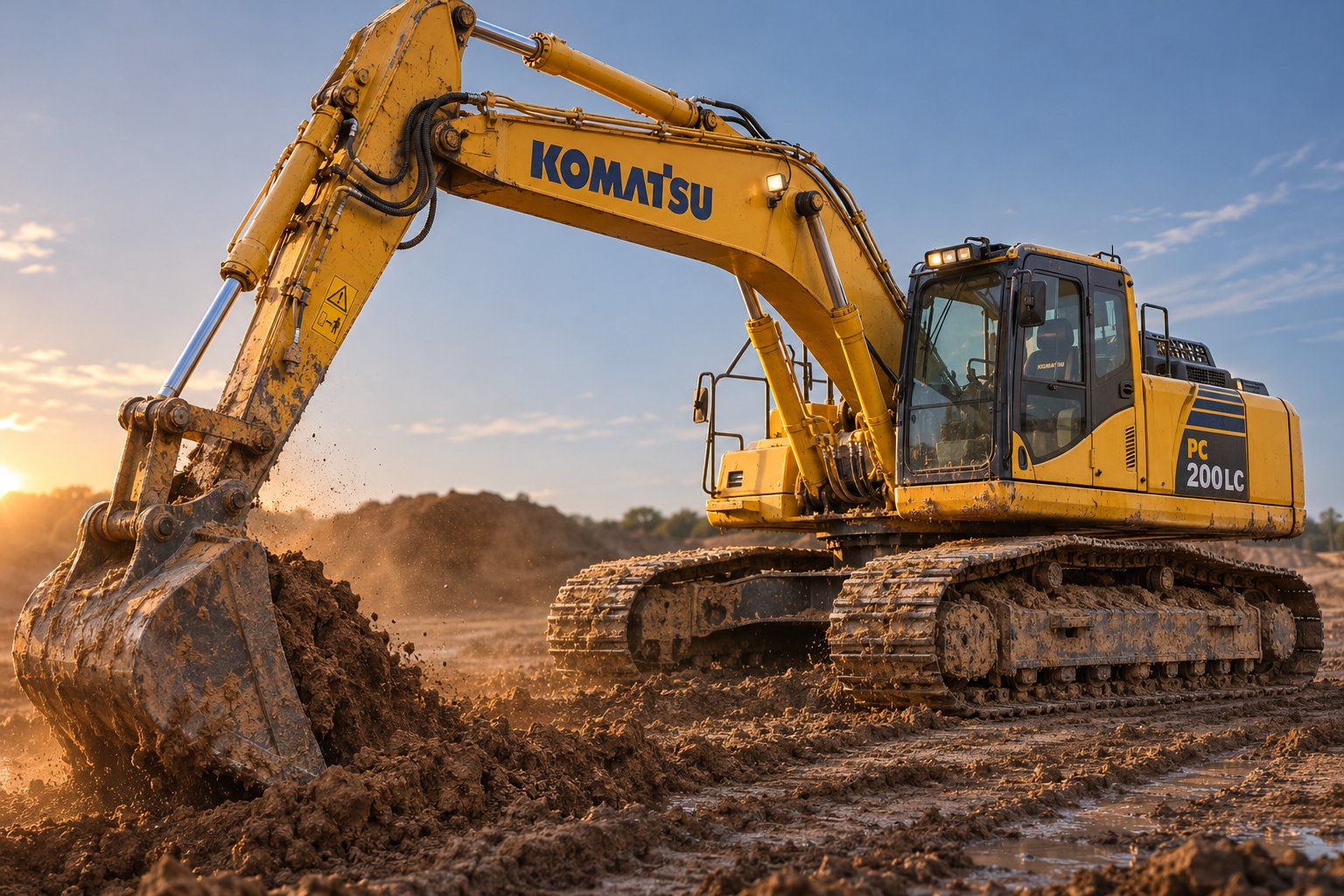
Imagine you're scanning equipment listings and you keep seeing the same model pop up on auction sites, dealer lots, and jobsite photos around the world. There's a reason for that. The Komatsu PC200LC is a 20-metric-ton class hydraulic crawler excavator equipped with a wider, longer undercarriage — the "LC" standing for "Long Carriage." That wider stance gives it improved ground-level stability compared to its standard-width sibling, making it a go-to machine for everything from general excavation and road construction to utility trenching and pipeline work.
The Komatsu PC200LC is a 20-ton class hydraulic crawler excavator featuring a Long Carriage (LC) undercarriage that delivers a wider track gauge, lower ground pressure, and greater lateral stability than the standard-width PC200.
Komatsu — the world's second-largest construction equipment manufacturer — builds this machine with vertically integrated component production. That means the engine, hydraulic pumps, and control systems are designed and manufactured in-house, giving Komatsu tight control over quality and parts availability. For buyers on the used market, that integration translates to a deep global parts supply chain and strong dealer support, even for machines that are decades old.
What Does PC200LC Actually Mean
Every letter and number in the Komatsu PC200LC name tells you something specific about the machine. Here's how the naming convention breaks down:
- PC — Stands for "Power Crawler," identifying the machine as a tracked hydraulic excavator.
- 200 — Indicates the size class. The "200" designation places this excavator squarely in the 20-metric-ton weight range, a sweet spot in the medium excavator segment.
- LC — Short for "Long Carriage." This suffix signals a wider, longer track frame compared to the standard PC200, which increases ground contact and stability.
You'll also see a generational suffix on specific units — like PC200LC-6, PC200LC-7, or PC200LC-8 — where the number after the dash identifies the design generation. A "-8" means the eighth iteration of the PC 200 platform, incorporating the latest engineering improvements available at the time of production. Understanding this shorthand helps you quickly assess any Komatsu PC200 listing without digging through spec sheets.
Who This Machine Is Built For
The Komatsu PC200LC hits a balance point that appeals to a remarkably broad audience. Contractors rely on it as a versatile workhorse that handles foundation digs in the morning and loads trucks in the afternoon. Fleet managers value its standardized parts ecosystem and predictable maintenance cycles. Owner-operators appreciate the fact that a well-maintained unit holds resale value across market cycles. And equipment dealers trade these machines constantly because global demand stays consistently strong.
Why does this particular excavator trade so heavily on the used market? Its combination of reach, digging force, and transportability covers the majority of mid-scale project requirements without pushing into the oversized permit territory that larger machines demand. At roughly 20 to 22 metric tons depending on the generation and configuration, a PC200LC fits on a standard multi-axle lowboy trailer — keeping mobilization costs manageable. That practicality, paired with Komatsu's reputation for durability, explains why units with thousands of hours still change hands regularly on platforms like Machinery Trader and Ritchie Bros.
The real question for most buyers isn't whether the PC200LC is a capable machine — it's which generation and configuration best fits their specific needs. And that starts with understanding how the LC variant differs from the standard-width model.
PC200LC vs Standard PC200 Differences Explained
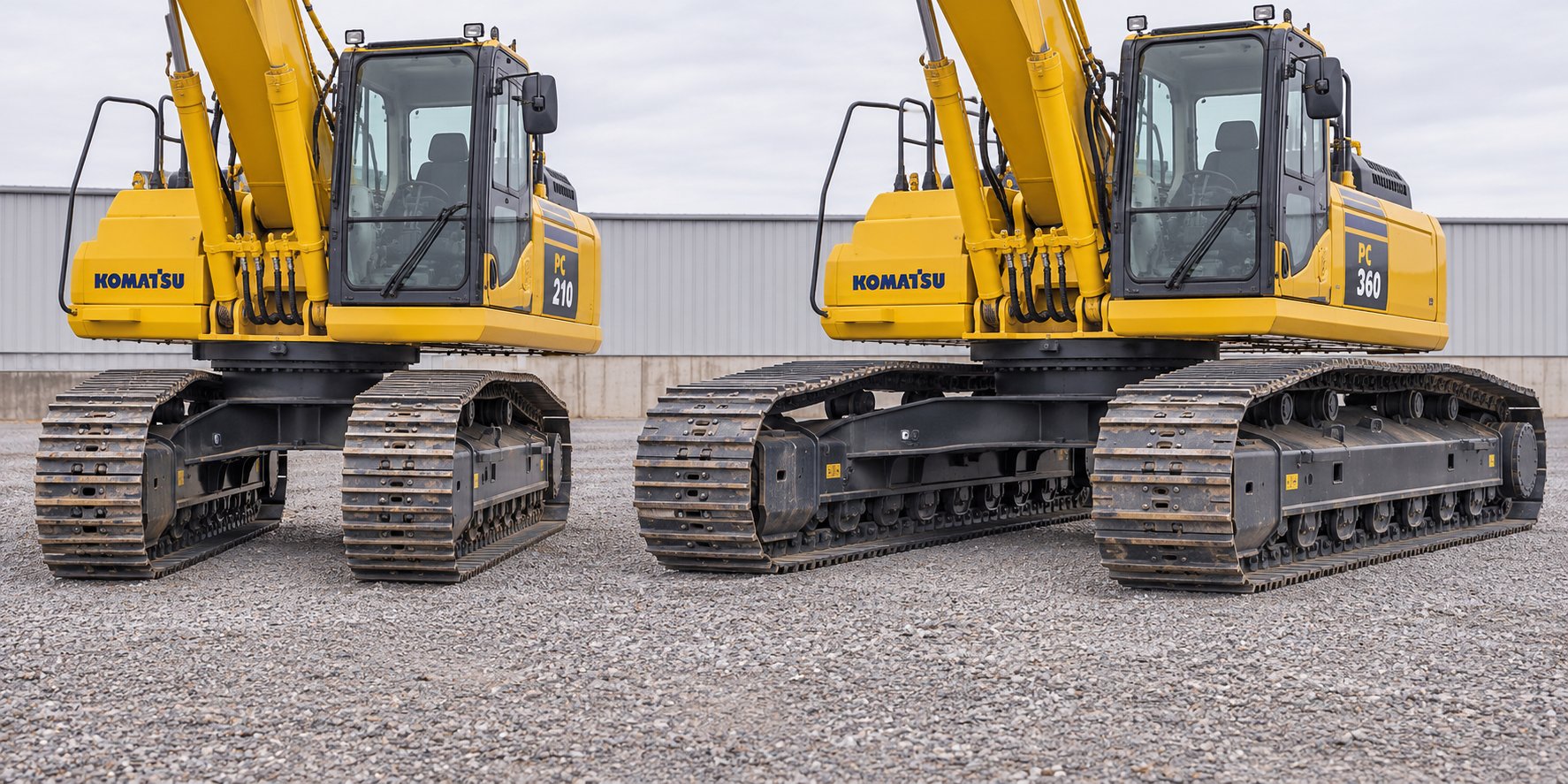
Here's where many buyers trip up. You'll find "PC200" and "PC200LC" used almost interchangeably in online listings, forum discussions, and even some dealer descriptions. They are not the same machine. The distinction centers on one major structural component — the undercarriage — and that single difference ripples outward into stability, ground pressure, transport logistics, and which job sites the excavator can realistically work on.
Komatsu's own product brochures list the PC200 and PC200LC as separate configurations with different operating weights, track frame dimensions, and overall machine widths. Treating them as interchangeable descriptions is a costly assumption — especially when you're calculating trailer loads or bidding on a machine sight unseen.
Undercarriage and Track Gauge Differences
The "LC" in Komatsu PC200 LC stands for Long Carriage, and the name is literal. The LC undercarriage features longer track frames and a wider track gauge than the standard-width PC200. That extra steel adds meaningful weight — a standard PC200-7 with 700 mm shoes comes in around 19,750 kg (43,540 lb), while a PC200LC-8 pushes up to approximately 23,503 kg (51,815 lb). The difference isn't just a rounding error; it's several thousand kilograms of additional track frame, rollers, and structural reinforcement.
What does that extra footprint actually do for you? Two things matter most:
- Lower ground pressure. A wider, longer track frame spreads the machine's weight over a larger contact area. This reduces sinking on soft, wet, or loose soils — a real advantage in pipeline corridors, wetland-adjacent sites, and any terrain that hasn't been compacted.
- Improved lateral stability. The wider stance lowers the machine's center of gravity relative to its base of support. You'll notice this when swinging loaded buckets over the side, working on slopes, or running heavier attachments like hydraulic breakers and grapples. Less rocking means more operator confidence and safer operation.
The trade-off? That wider undercarriage pushes the overall transport width closer to — or potentially beyond — standard lane limits in many jurisdictions. If your operation involves frequent moves between sites, the extra inches matter for trucking permits and lowboy loading.
When to Choose LC Over Standard Width
Think about where your machine spends most of its working hours. A standard PC200 suits tighter urban job sites where transport width constraints are strict and maneuverability between structures, fences, or traffic barriers is a daily concern. The narrower frame also simplifies mobilization because it fits within standard highway width limits more comfortably.
The LC configuration earns its keep on open-site work — pipeline trenching, large-scale earthmoving, pond construction, and any application where the machine parks in one corridor and digs for extended periods. When stability outweighs the need to squeeze through narrow access points, the wider track gauge pays for itself through safer operation and better attachment performance.
A practical way to frame the decision: if your excavator moves between sites weekly and works in constrained spaces, lean toward the standard PC200. If it stays on a site for weeks or months doing heavy digging on variable terrain, the Komatsu PC200LC is the stronger choice.
| Feature | Standard PC200 | PC200LC (Long Carriage) |
|---|---|---|
| Track frame width | Narrower gauge | Wider gauge |
| Track frame length | Shorter | Longer |
| Operating weight (example) | ~19,750 - 20,010 kg (PC200-7) | ~23,503 kg (PC200LC-8) |
| Ground pressure | Higher per unit area | Lower — better for soft soils |
| Lateral stability | Standard | Improved — wider stance |
| Transport width | Easier to stay within lane limits | May require overwidth permits |
| Best suited for | Urban sites, frequent relocation | Open sites, pipeline work, soft ground |
Keep in mind that Komatsu PC200 specs — including exact dimensions and weights — vary by generation and regional configuration. The figures above reflect documented values for the -7 and -8 series, but you should always confirm the spec sheet for any individual unit before making transport or permit decisions.
Those generation-to-generation differences aren't trivial, either. The engineering changes between a PC200LC-6 and a PC200LC-8M0 go far beyond the undercarriage — touching the engine, hydraulic system, cab design, and emissions compliance in ways that directly affect both operating cost and resale value.
Every PC200LC Generation from Earliest to Latest
Listings across auction sites and dealer inventories reference the PC200LC-6, PC200LC-7, PC200LC-8, and PC200LC-8M0 as if buyers should already know how they differ. Most sources cover one generation in isolation — a spec sheet here, a brochure there — but never connect the dots between them. That gap makes it surprisingly easy to overpay for an older platform or undervalue a newer one. Here's the full generational picture of this Komatsu 200 excavator lineup, stitched together from OEM documentation and verified market data.
Early Generations: the PC200LC-6 and PC200LC-7
The PC200LC-6 is the oldest generation you'll regularly encounter on the used market. Powered by the Komatsu S6D102E engine producing approximately 135 PS, it earned a reputation for mechanical simplicity. Fewer electronic systems mean fewer electronic failures — a real selling point for operators in regions where dealer networks are thin and field repairs are a fact of life. Work equipment greasing intervals sat at every 250 hours, and emissions compliance wasn't yet a major concern for most buyers.
The PC200LC-7 arrived in overseas markets starting in late 2001 and represented a meaningful step forward. Komatsu bumped output to 145 PS with the upgraded SAA6D102E engine and — more importantly — redesigned maintenance access. Komatsu's own technical report stated that maintenance costs dropped by roughly 30% compared to the -6, with greasing and engine oil intervals extended to 500 hours. The -7 also introduced KOMTRAX telematics as standard equipment, giving fleet managers remote visibility into machine location, hours, and basic operating data. Emissions compliance reached Tier 2 levels. For many buyers, the PC200LC-7 became — and still remains — the sweet spot between affordable acquisition and manageable upkeep.
The PC200LC-8 Series and Tier 3 Compliance
Komatsu launched the PC200LC-8 in the U.S. market in January 2006, and it marked the biggest engineering leap in the family's history. The engine platform shifted from the 6D102E series to the SAA6D107E-1, a larger-displacement unit rated at 110 kW (148 HP) net per Komatsu America's brochure. Emissions certification reached EPA Tier 3 and EU Stage 3A — a significant jump that reflected tightening global regulations.
Beyond raw power, the -8 series brought several features that changed the day-to-day ownership experience:
- Fuel economy gains. Komatsu reported approximately 10% lower fuel consumption than the PC200LC-7 in P mode at equivalent production levels.
- KOMTRAX telematics continued as standard, with expanded monitoring capabilities for fleet-level management.
- Cab comfort upgrades. A viscous cab damper mounting system reduced vibration transferred to the operator, and the overall cab layout improved ergonomics for long shifts.
- Extended service intervals. Engine oil and filter changes moved to 500-hour intervals, hydraulic oil filters to 1,000 hours, and hydraulic oil replacement stretched to 5,000 hours.
The sub-variant PC200LC-8M0 followed as an evolutionary refinement rather than a full redesign. Komatsu's -8M0 brochure highlights roughly 7% further fuel savings over the standard -8, lower operating noise, and longer replacement intervals for key maintenance items. Some regional variants of the -8M0 also moved toward higher emissions tiers, though the specific compliance level depends on the destination market. Komatsu PC200 dimensions remained largely consistent across the -8 family, keeping attachment and transport compatibility stable.
Which Generation Dominates the Used Market
If you browse Machinery Trader, Ritchie Bros., or regional dealer listings, you'll notice a pattern. The PC200LC-8 series — including both the standard -8 and the -8M0 — accounts for the largest share of active used inventory. These machines hit the resale sweet spot: modern enough to offer genuine fuel savings and electronic diagnostics, yet old enough to have depreciated well below new-machine pricing.
Earlier generations haven't disappeared, though. The -6 and -7 attract a specific buyer profile — operators who prioritize rock-bottom acquisition cost and want a machine they can maintain with basic tools and local mechanics. In markets across Southeast Asia, Africa, and parts of South America, the mechanical simplicity of these older platforms is a genuine advantage rather than a compromise.
Here's the full generational timeline at a glance:
- PC200LC-6 — Komatsu S6D102E engine, approximately 135 PS, 250-hour greasing intervals. The budget entry point on the used market, valued for mechanical simplicity and low purchase cost.
- PC200LC-7 — Upgraded SAA6D102E engine at 145 PS, Tier 2 emissions, 500-hour service intervals, KOMTRAX telematics standard. Maintenance costs roughly 30% lower than the -6. Widely considered the best balance of price and reliability.
- PC200LC-8 — SAA6D107E-1 engine rated at 148 HP net, EPA Tier 3 / EU Stage 3A, approximately 10% fuel savings over the -7, viscous cab damper mounting, expanded KOMTRAX. The most commonly listed generation on major auction platforms.
- PC200LC-8M0 — Evolutionary refinement of the -8 with approximately 7% additional fuel savings, quieter operation, and extended maintenance intervals. Regional emissions compliance varies by market.
Each generation shares the same fundamental 20-ton class architecture, but the cumulative differences in fuel economy, maintenance cost, and emissions compliance can shift total ownership cost by thousands of dollars per year.
Knowing where each generation falls on the cost-versus-complexity spectrum is essential — but generation alone doesn't tell the whole story. The specific numbers behind operating weight, dig depth, reach, and bucket force are what separate a machine that fits your project from one that merely looks like it should.
Key Specifications and What They Mean in Practice
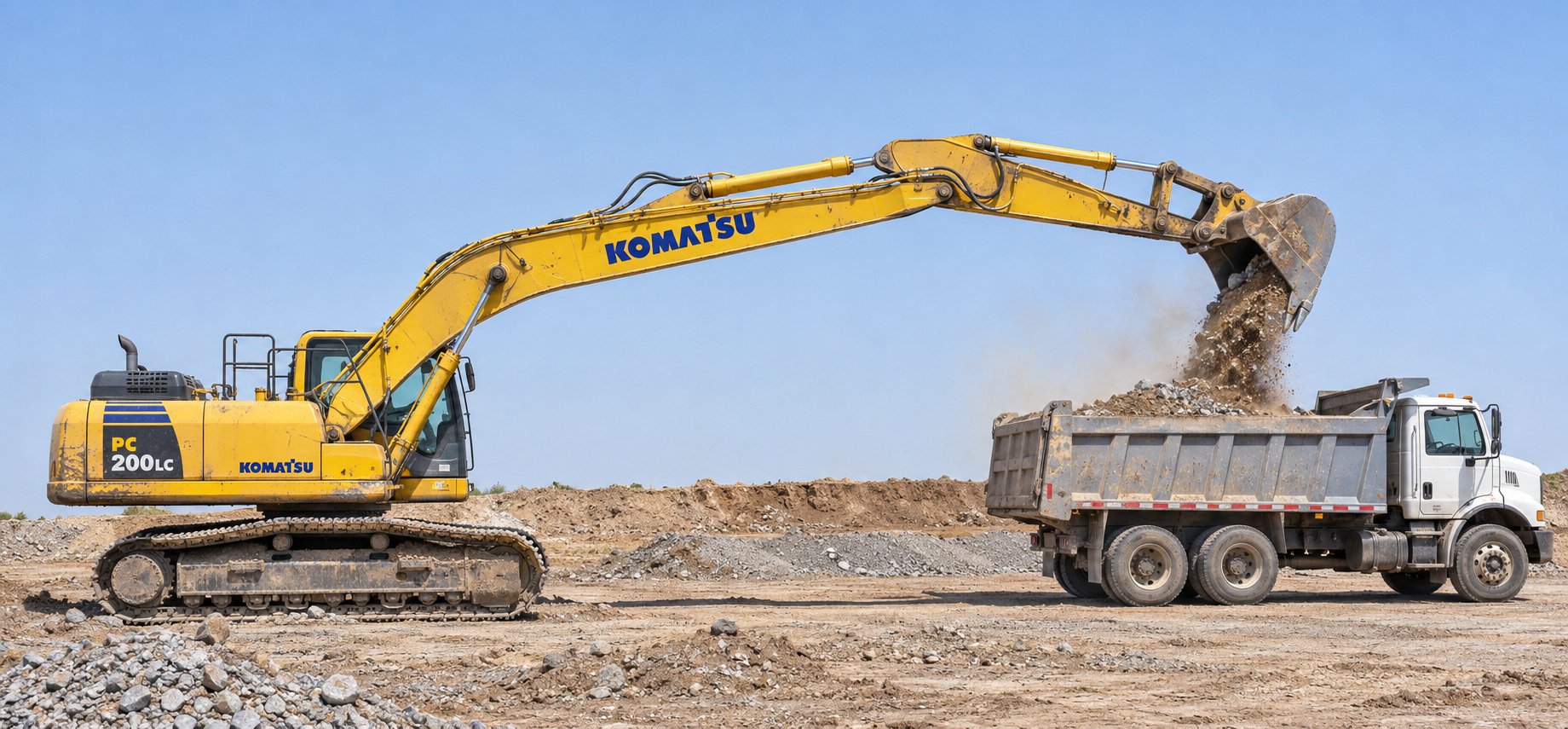
Spec sheets are everywhere for this machine — scattered across OEM brochures, auction listings, and dealer pages — but raw numbers without context don't help you decide whether a Komatsu 200 excavator actually fits your project. A dig depth of 6.6 meters sounds impressive until you realize your utility run only needs 4 meters, and a shorter stick with more breakout force would've been the smarter configuration. The goal here is to pull the most important specifications together and explain what each one means when rubber meets dirt.
Operating Weight and Transport Considerations
Across generations, the Komatsu PC200LC lands in a working weight range of approximately 20,580 kg (45,371 lb) for the PC200LC-6 to roughly 20,700 kg (45,636 lb) for the PC200LC-7, with the -8 series climbing slightly higher depending on configuration and installed attachments. That weight range places every generation comfortably within the capacity of a standard 3-axle or 4-axle lowboy trailer, which typically handles 40,000 to 80,000 lb loads.
Here's the transport math that matters. Federal regulations cap gross vehicle weight at 80,000 lb on public roads without oversize permits. A loaded lowboy trailer and tractor together weigh roughly 30,000 to 35,000 lb. Add a PC 200 at approximately 45,000 to 46,000 lb with a standard bucket and you're right around 75,000 to 81,000 lb — tight, but generally manageable without overweight permits in most configurations. Where the LC variant adds a wrinkle is width. With 700 mm track shoes, the PC200LC-6 measures 3.08 m (10 ft 1 in) overall width, while the -7 with 800 mm shoes stretches to 3.18 m (10 ft 5 in). The standard legal transport width without permits is just 8 ft 6 in (2.59 m), so overwidth permits are virtually guaranteed for any LC configuration riding on a trailer.
Weight distribution also shifts with the LC undercarriage. The longer track frame moves more mass toward the rear of the trailer deck, which affects axle loading. Always verify axle weight distribution before hauling — not just total weight — to stay compliant with federal bridge formulas.
Dimensions That Matter on the Job Site
Imagine pulling up to a site with a narrow gate, overhead power lines, and a line of dump trucks waiting to be loaded. Suddenly, three dimensions matter more than anything on the spec sheet: overall width, tail swing radius, and height to cab top.
The tail swing radius stays consistent across generations at approximately 2.75 m (9.03 ft). That's the distance from the machine's center pin to the farthest point on the counterweight. On tight urban sites, this number determines how close you can swing next to a fence, wall, or traffic lane without striking it. The PC200LC is not a reduced-tail-swing machine — you'll need to account for that full 9-foot arc when positioning near structures.
Overall length with the boom tucked for transport runs about 9.43 m (30 ft 11 in) on the -6 and 9.50 m (31 ft 2 in) on the -7. Cab height sits around 2.91 m (9 ft 6 in) for the -6 and 3.00 m (9 ft 10 in) for the -7. Loaded onto a lowboy with an 18- to 24-inch deck height, the total transport height stays well within the typical 13 ft 6 in legal limit — one less permit to worry about.
Ground clearance across all generations holds at 440 mm (1.45 ft). That's enough to navigate moderately rough terrain and shallow mud without dragging the undercarriage belly, though deep muck or rocky creek crossings will still test the machine's limits.
Digging Performance and Bucket Capacity
This is where the 200 excavator earns its keep. Digging performance numbers translate directly into how deep your trenches go, how far the operator can reach to load a truck, and how much material each bucket cycle moves.
Maximum dig depth varies by arm length. With the standard 2,925 mm arm on the PC200LC-7, published depth reaches 6,620 mm (21.72 ft) — deep enough for most municipal water, sewer, and storm drain installations without needing a long-reach configuration. Switch to the shorter 2,410 mm arm and depth drops to 6,095 mm (20 ft), but you gain higher breakout force — a worthwhile trade-off when working compacted clay or rocky substrate.
Bucket digging force on the PC200LC-7 measures 149 kN (33,497 lb) ISO with the standard arm, which is substantial enough to handle hard-packed soils and light rock without a ripper tooth setup. Arm crowd force comes in at 108 to 127 kN depending on arm length — shorter arms concentrate more force at the tip, longer arms trade force for reach.
Standard bucket capacity sits at 1.15 m3 (1.5 yd3), with the available range spanning 0.54 to 1.22 m3 (0.7 to 1.6 yd3). The right bucket size depends on your material density and target truck. Loading a tandem-axle dump truck with general fill? The standard 1.5 yd3 bucket fills it in roughly 8 to 10 cycles. Handling heavier material like wet clay or demolition debris? Downsizing to a 0.7 yd3 heavy-duty bucket keeps each pass within the machine's safe lifting capacity.
| Specification | Typical Value Range (LC Variants) | Practical Significance |
|---|---|---|
| Operating weight | 20,580 - 21,500 kg (45,371 - 47,400 lb) | Fits standard 3- or 4-axle lowboy; verify axle weight distribution for transport compliance |
| Overall width (with shoes) | 3.08 - 3.18 m (10 ft 1 in - 10 ft 5 in) | Exceeds 8 ft 6 in highway limit; overwidth permit required for transport |
| Overall length (transport) | 9.43 - 9.50 m (30 ft 11 in - 31 ft 2 in) | Standard lowboy deck accommodates this without overhang permits |
| Height to cab top | 2.91 - 3.00 m (9 ft 6 in - 9 ft 10 in) | Stays under 13 ft 6 in on a lowboy; no height permit needed |
| Tail swing radius | 2.75 m (9.03 ft) | Full swing clearance required near walls, fences, and traffic lanes |
| Ground clearance | 440 mm (1.45 ft) | Adequate for moderate terrain; insufficient for deep mud or rocky crossings |
| Max digging depth | 6,095 - 7,725 mm (20 - 25.35 ft) | Covers most municipal utility depths; arm length determines exact capability |
| Max reach at ground level | 9,190 - 10,705 mm (30.2 - 35.1 ft) | Determines truck loading distance and bank reach without repositioning |
| Bucket digging force (ISO) | 138 - 149 kN (31,024 - 33,497 lb) | Handles compacted soil and light rock; heavier material may need ripper teeth |
| Standard bucket capacity | 1.15 m3 (1.5 yd3) | Fills a tandem dump truck in approximately 8-10 cycles with general fill |
| Fuel tank capacity | 340 - 400 L (89.9 - 105.7 gal) | Supports a full working day without refueling in most applications |
Notice that digging depth and reach numbers swing significantly based on arm length, not just generation. A PC200LC-6 with a long arm can actually out-dig a PC200LC-7 with a short arm in raw depth. That's why checking the specific boom and stick configuration on any used unit matters just as much as knowing the generation — a detail that becomes even more important when you examine how the engine and hydraulic systems behind those digging numbers evolved across the model lineup.
Engine Power and Hydraulic System Breakdown
Dimensions and digging numbers grab attention, but the engine and hydraulic system underneath determine how productively a 200 Komatsu excavator actually works day after day. Surprisingly, most spec pages skip hydraulic details entirely — leaving buyers guessing whether a machine can run a breaker, power a rotating grapple, or handle a shear without starving for flow. Here's the mechanical picture that closes that gap.
Engine Specifications Across Generations
The powertrain story of the Komatsu PC200LC follows a clear trajectory: more displacement, tighter emissions compliance, and better fuel economy with each generation. Early models built around the S6D102E engine family prioritized durability and serviceability. Later platforms shifted to the SAA6D107E series, gaining displacement and meeting progressively stricter emissions standards.
The PC200LC-6 ran a Komatsu S6D102E diesel producing 110 kW (148 HP) net — a naturally aspirated or lightly turbocharged inline-six that met Tier 1 / Tier 2 emissions levels depending on the production year. No diesel exhaust fluid (DEF), no diesel particulate filter (DPF), no regeneration cycles. You changed the oil, swapped the filters, and kept working. That mechanical simplicity is exactly why the -6 still runs on job sites across developing markets decades after production ended.
The PC200LC-7 upgraded to the SAA6D102E variant, bumping output to roughly 145 PS while reaching Tier 2 compliance. The engine architecture remained similar enough that mechanics familiar with the -6 could service the -7 without a steep learning curve, yet Komatsu extended engine oil and greasing intervals to 500 hours — cutting scheduled maintenance frequency in half.
The real engineering shift came with the PC200LC-8. Komatsu moved to the SAA6D107E-1, a larger-displacement unit rated at 110 kW (148 HP) net that met EPA Tier 3 and EU Stage 3A. The -8M0 sub-variant pushed further toward Tier 4 Interim or Tier 4 Final depending on the destination market, introducing DPF and potentially DEF aftertreatment systems. For buyers evaluating a used Komatsu excavator PC200 from the -8 family, this is the critical ownership question: which emissions tier does the specific unit carry, and what does the aftertreatment system cost to maintain?
- PC200LC-6: S6D102E engine, 110 kW (148 HP), Tier 1/Tier 2, no aftertreatment systems, 250-hour greasing intervals
- PC200LC-7: SAA6D102E engine, ~145 PS, Tier 2, no aftertreatment, 500-hour service intervals
- PC200LC-8: SAA6D107E-1 engine, 110 kW (148 HP), EPA Tier 3 / EU Stage 3A, approximately 10% fuel savings over the -7
- PC200LC-8M0: SAA6D107E variant, Tier 4 Interim or Tier 4 Final (market-dependent), DPF and potential DEF requirements, additional ~7% fuel savings over the standard -8
The practical implication? A Komatsu 200 trackhoe from the -6 or -7 era costs less to acquire and maintain mechanically, but burns more fuel per hour. A -8M0 with Tier 4 Final compliance saves fuel but introduces DPF regeneration cycles — automatic burn-off events that temporarily increase idle fuel consumption and can cause downtime if the system malfunctions. Budget accordingly.
Hydraulic System and Attachment Readiness
This is where competitor spec pages go almost completely silent. The hydraulic system is arguably more important than the engine for determining what a PC-200 can actually do with attachments — and the details matter.
Every generation of this machine uses variable displacement axial piston pumps in a dual-pump configuration. The PC200LC-6 features Komatsu's HydrauMind system — a load-sensing, pressure-compensated design that adjusts pump output to match the actual demand of each working circuit. Main pump output pressure exceeds 30 MPa (4,350 psi), and total hydraulic flow on the -6 reaches 412 L/min (108.9 gal/min).
Why do those numbers matter? Because every hydraulic attachment you bolt onto the machine has minimum flow and pressure requirements:
- Hydraulic breakers/hammers typically need 100-160 L/min at 16-18 MPa — well within this machine's capacity.
- Hydraulic thumbs require a dedicated auxiliary circuit but draw relatively low flow — usually under 50 L/min.
- Rotating grapples demand a separate high-flow auxiliary line, often 80-120 L/min, plus a dedicated drain line back to tank.
- Shears and processors may need 150+ L/min and higher sustained pressure, pushing the system closer to its limits.
The -8 series refined the hydraulic control logic with improved electronic pump regulation, allowing more precise flow splitting between boom, arm, bucket, and swing functions. This translates to smoother multi-function operation — think swinging while curling the bucket simultaneously — and less energy wasted as heat in the hydraulic oil. If you're planning to run demanding attachments regularly, the -8 and -8M0 offer noticeably better responsiveness than earlier generations.
One detail buyers frequently overlook: confirm the number of auxiliary hydraulic circuits installed on any used unit. Factory configurations vary, and not every machine left the line with the auxiliary plumbing needed for a breaker or grapple. Retrofitting auxiliary lines is possible but adds cost — a cheaper machine without auxiliary circuits may not actually be cheaper once you've paid for the hydraulic hookup.
Fuel Efficiency and Tank Capacity
Fuel is one of the largest variable costs on any excavation project, and the PC200LC's tank and consumption profile directly affect how your operating budget plays out across a shift.
The PC200LC-6 carries a 340-liter (89.9 gal) fuel tank, enough for a full working day under moderate loading conditions. Later generations expanded capacity slightly — the -8 series moves to approximately 400 liters (105.7 gal) in some configurations — extending the interval between refueling stops on long shifts.
Actual fuel burn depends heavily on how the operator works. Komatsu addresses this through multiple working modes available across all generations from the -6 onward: Power mode delivers maximum hydraulic output for heavy digging, Economy mode dials back engine RPM and pump displacement to cut consumption during lighter tasks, and Lifting mode provides fine control for precision placement work. The -8 series added Auto Idle Shutdown — a feature that automatically shuts down the engine after a set period of idle time, eliminating the fuel waste that accumulates during lunch breaks, waiting periods, and shift transitions.
Komatsu's own studies using KOMTRAX telematics data found that average idle time across excavator fleets hovers near 40%. Reducing that idle percentage by even 10 points can swing annual fuel costs by thousands of dollars for a single machine. ECO Guidance — available on newer models — provides real-time operator feedback when the machine detects unproductive idling, hydraulic relief holding, or overloaded conditions, nudging behavior toward lower consumption without sacrificing meaningful productivity.
The cheapest fuel is the fuel you never burn. Economy mode, auto-idle shutdown, and operator awareness of idle time collectively deliver more savings than any single engine upgrade between generations.
Engine power and hydraulic capability define what a machine can do in theory. But the real test comes on the job site — where boom configuration, attachment selection, and ground conditions determine whether the PC200LC is the right tool or an expensive compromise for the work at hand.
Best Applications and Job-Site Scenarios for the PC200LC
A spec sheet tells you what a machine can do. A job site tells you what it should do. The Komatsu PC200LC sits in a weight class that covers an enormous range of work — but "covers" doesn't mean "excels at everything equally." Matching the right boom/stick configuration and attachment package to your specific application is what separates a productive excavator from an expensive piece of iron burning fuel between repositions. Here's where this 20-ton excavator earns its reputation, and where you might want to look at a different machine entirely.
General Excavation and Site Development
Picture a commercial site development project — stripping topsoil, cutting to grade, digging foundations, and loading haul trucks in a steady cycle. This is the PC200LC's home turf. With a maximum dig depth ranging from roughly 6 to 7.7 meters depending on arm length, the machine handles basement excavations, retention pond construction, and mass earthmoving without needing a larger — and more expensive — platform.
The LC undercarriage provides a tangible advantage here. Freshly stripped sites rarely offer firm, level ground. Loose fill, rain-saturated clay, and uneven subgrade are the norm, and that wider track gauge spreads the machine's 20-plus metric tons over more surface area. You'll notice less sinking, less rocking during loaded swing cycles, and more confidence from the operator when working near trench edges or on sloped cuts.
For general excavation, the standard 2,925 mm arm paired with a 1.15 m3 (1.5 yd3) bucket delivers the best balance of reach, cycle speed, and payload per pass. A tandem-axle dump truck fills in roughly 8 to 10 bucket cycles — fast enough to keep a steady truck queue moving without bottlenecking production. When the material gets heavier — wet clay, broken concrete, or rocky substrate — downsizing to a 0.7 to 0.8 yd3 heavy-duty bucket keeps each load within the machine's safe working capacity while protecting cylinder seals and structural pins from overloading stress.
Utility Trenching and Pipeline Work
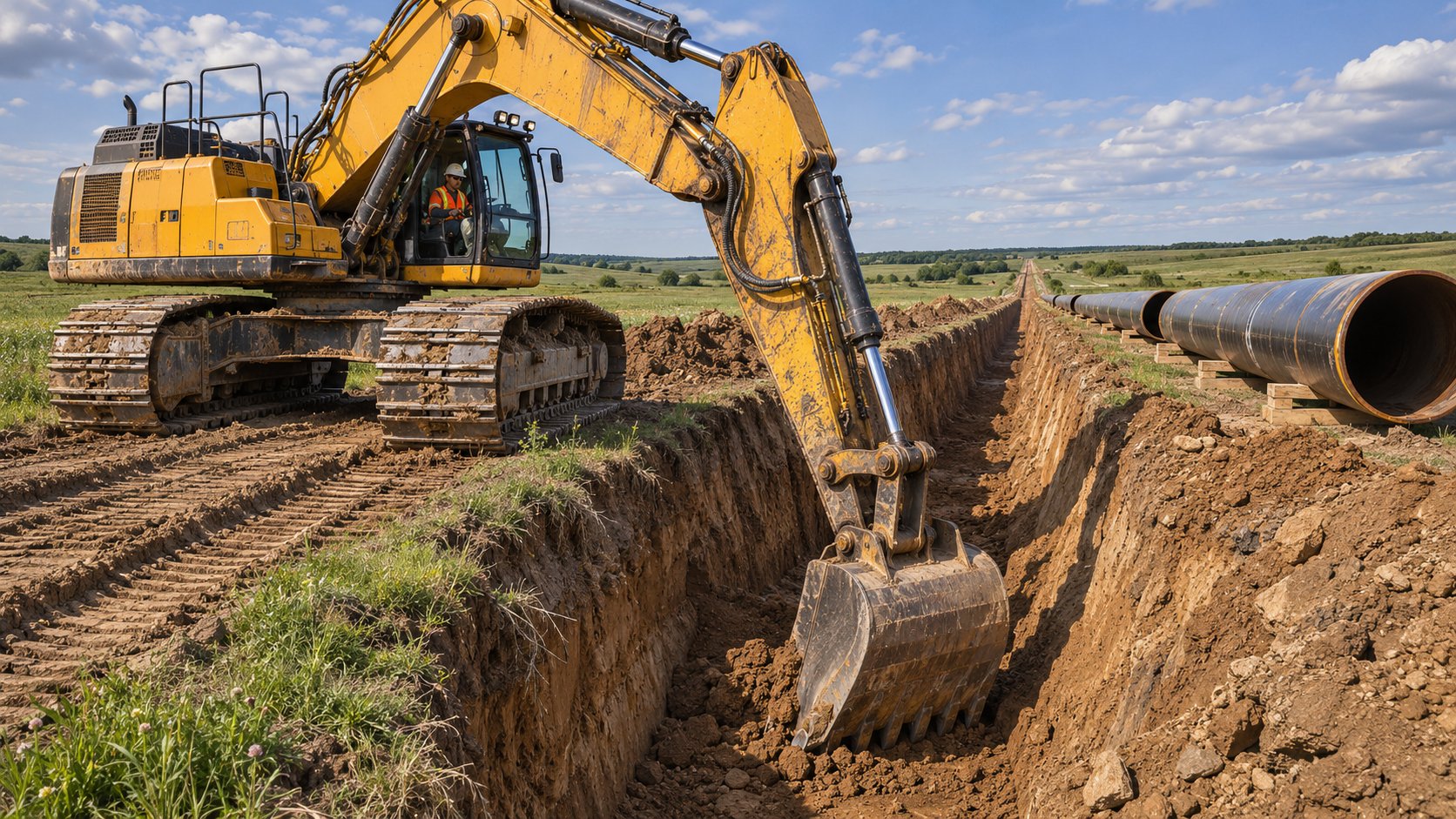
Ask any pipeline contractor which excavator class dominates their fleet, and the 20-ton excavator for pipeline work comes up almost immediately. There's a reason. Pipeline and utility corridors demand a specific combination of dig depth, stability on variable terrain, and the ability to work in a linear pattern for hours on end — precisely the scenario the Komatsu PC200LC was designed around.
Municipal water, sewer, and storm drain installations typically require trench depths between 2 and 6 meters. The standard arm configuration covers the shallower end comfortably, while a longer arm option pushes dig depth past 7 meters — deep enough for most force main and gravity sewer installations without resorting to a trench box deeper than standard inventory. Shorter arms, on the other hand, concentrate more breakout force at the bucket tip. When the trench alignment runs through compacted gravel, hardpan, or weathered rock, that extra force reduces the need for pre-ripping and keeps the dig moving.
The wider track gauge of the LC undercarriage matters especially here. Pipeline corridors often run through open fields, agricultural land, or utility easements where soil conditions change from firm to soft within the same trench run. Lower ground pressure means the machine can advance along the corridor without sinking into the spoil pile side or the undisturbed soil side — a problem that costs real money when a standard-width excavator gets stuck and needs a dozer to pull it free.
Komatsu's available boom and stick configurations — documented across multiple specification sources — give pipeline operators flexibility to tailor the machine to project requirements rather than accepting a one-size-fits-all setup. This adaptability, combined with the LC platform's inherent stability, is what makes pc200 excavator uses in pipeline work so widespread globally.
Demolition and Material Handling
Demolition work places unique demands on an excavator: heavier attachments, asymmetric loads, repetitive impact cycles, and the constant risk of tipping when pulling material from elevated structures. The LC undercarriage's wider stance directly improves stability margins for all of these scenarios.
Running a hydraulic breaker or hammer on a PC200LC is straightforward from a hydraulic capacity standpoint. The machine's dual-pump system delivers over 400 L/min of total flow, and typical breakers sized for the 20-ton class require only 100 to 160 L/min at 16 to 18 MPa — well within the available auxiliary circuit output. Add a hydraulic thumb to the bucket, and the machine transforms into a sorting and material-handling tool capable of separating recyclable metals, concrete, and wood from a demolition pile.
Komatsu pc200lc attachments commonly paired with this machine in demolition applications include:
- Hydraulic breakers/hammers — Primary demolition tool for concrete slabs, footings, and rock
- Thumb and bucket combinations — Sorting debris, loading trucks, handling irregular materials
- Shears — Cutting steel beams, rebar bundles, and structural members
- Rotating grapples — Precise placement and sorting of mixed debris; requires a high-flow auxiliary circuit plus a drain line
One critical note: always verify that the specific used unit has the auxiliary hydraulic circuits installed before purchasing it for attachment-intensive work. Not every PC200LC left the factory plumbed for breaker or grapple duty, and retrofitting adds cost that can erode the supposed "deal" on a cheaper machine.
| Application Type | Recommended Boom/Stick Configuration | Common Attachment Pairings | Why the LC Undercarriage Helps |
|---|---|---|---|
| General excavation / site development | Standard boom + 2,925 mm arm | 1.15 m3 GP bucket; heavy-duty bucket for rocky soil | Stability on uneven, freshly stripped terrain |
| Shallow utility trenching (2-4 m) | Standard boom + short arm (2,410 mm) | Narrow trench bucket (450-600 mm); compaction plate | Lower ground pressure prevents sinking along spoil-side |
| Deep pipeline work (5-7+ m) | Standard boom + long arm (3,400+ mm) | Trench bucket; trench box spreader | Lateral stability critical at maximum depth and reach |
| Demolition | Standard boom + standard arm | Hydraulic breaker; thumb + bucket combo; shear | Wider stance absorbs impact vibration and asymmetric loads |
| Material handling / sorting | Standard boom + standard or short arm | Rotating grapple; sorting grab; hydraulic thumb | Prevents tipping during elevated swing with off-center loads |
| Pond / basin construction | Standard boom + long arm | Slope bucket; ditching bucket (wide, flat profile) | Stability on soft, saturated banks and uncompacted fill |
Competing 20-Ton Excavators to Consider
No excavator exists in a vacuum, and the Komatsu PC200LC competes directly against several well-established alternatives in the 20-ton class. When comparing komatsu pc200 vs cat 320, you're evaluating two machines that share remarkably similar weight, dig depth, and bucket force specifications. The Cat 320D versus PC200-8 comparison is one of the most common matchups in the industry — both deliver strong hydraulic performance, proven durability, and deep aftermarket parts support. The Cat tends to offer a slight edge in raw engine power and hydraulic technology refinement, while the Komatsu counters with competitive fuel efficiency and a reputation for lower total maintenance cost across high-hour lifecycles.
Other machines worth evaluating alongside the PC200LC include:
- Hitachi ZX200LC — Strong hydraulic performance with fast cycle times; shares the LC undercarriage philosophy
- Volvo EC200E — Emphasis on operator comfort and fuel efficiency; Volvo's hydraulic system prioritizes smooth control
- Doosan DX225LC — Often positioned as a value alternative with competitive specs and aggressive pricing on the used market
Each of these machines has loyal operators and legitimate strengths. The right choice depends on your specific priorities — parts availability in your region, dealer proximity, attachment compatibility with your existing fleet, and whether you value mechanical simplicity or electronic sophistication. What none of these competitors change is the fundamental due diligence required before any used purchase: verifying hours, inspecting undercarriage wear, and confirming the machine's actual condition matches the listing description.
Used PC200LC Buyer's Guide and Inspection Checklist
Knowing which applications suit the machine and which competitors it faces only matters if the specific unit you're considering is actually worth buying. A surprising amount of used Komatsu PC200LC search traffic comes from buyers who already know they want a 20-ton Komatsu — they just need help figuring out whether the one they're looking at is a solid investment or a money pit wearing fresh paint. That distinction comes down to hours, physical condition, generation-specific quirks, and the maintenance history behind the machine. Here's a practical komatsu pc200lc inspection checklist built around the details that experienced buyers never skip.
Evaluating Hour Readings and Expected Lifespan
Hour readings are the first number every buyer checks — and the first number that can mislead you. A machine showing 4,000 hours sounds like a bargain, but if the pedals are worn smooth, the seat foam is compressed flat, and the joystick boots are cracked, those hours probably don't tell the real story. As Mico Equipment's inspection guide notes, a "low hour" unit with wear patterns inconsistent with its meter reading is a red flag worth investigating — not necessarily a deal breaker, but a reason to dig deeper.
So what constitutes low, moderate, and high hours for the PC200LC? General komatsu pc200 hours life expectancy benchmarks look roughly like this:
- Under 5,000 hours — Low hours for any generation. Expect minimal wear on major components if maintenance was consistent. Undercarriage, pins, and bushings should still show significant remaining life.
- 5,000 to 10,000 hours — Moderate use. Undercarriage components may be approaching mid-life. Inspect track chains, rollers, and idlers carefully. Engine and hydraulic systems should still perform well if service records confirm regular oil and filter changes.
- 10,000 to 15,000 hours — High hours. Budget for potential undercarriage rebuild or replacement, cylinder resealing, and pin-and-bushing overhauls. Engine internals may be approaching overhaul territory depending on maintenance quality.
- Above 15,000 hours — Deep into the machine's second lifecycle. Component-by-component evaluation is essential. Some well-maintained units run productively past 20,000 hours, but the risk of cascading failures rises significantly without documented rebuild history.
These thresholds apply broadly across generations, though earlier models like the -6 and -7 tend to tolerate higher hours before major failures because their mechanical simplicity means fewer electronic systems to degrade. OEM telematics platforms — particularly KOMTRAX on -7 and later units — can help verify hour readings remotely. If a seller claims the machine has KOMTRAX-equipped monitoring, request the telematics report before traveling to inspect it in person.
Critical Inspection Points for Used Buyers
A thorough pre-purchase inspection follows a logical sequence — starting with identity verification and ending with a full operational test under load. Skip any step, and you risk discovering a costly problem after the wire transfer clears. Here's the sequence experienced buyers follow when evaluating a used pc200 excavator for sale:
- Verify the serial number and model configuration. Match the serial plate to the paperwork. Confirm the generation suffix (-6, -7, -8, -8M0), stick length, bucket size, and any installed attachments like quick couplers or thumbs. Mismatches between documentation and physical configuration warrant immediate follow-up questions.
- Perform a cold-start test. Arrive before the seller has warmed the machine up. Hard starting, prolonged cranking, excessive smoke on startup, or unusual knocking sounds can indicate injector problems, low compression, or coolant intrusion. A warm machine hides these symptoms.
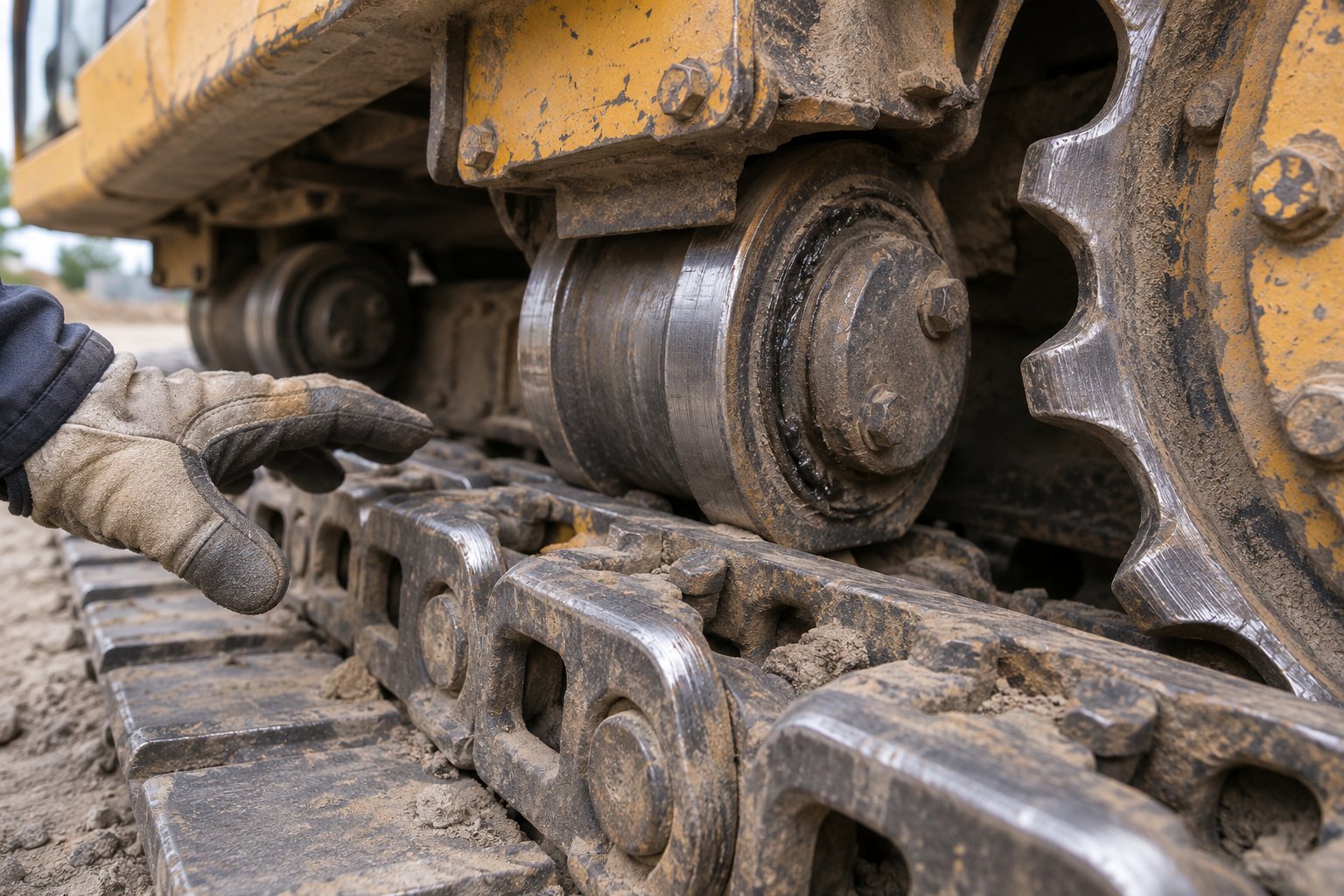
- Inspect the undercarriage systematically. Check sprocket teeth for pointed or hooked profiles. Examine rollers and idlers for oil leaks — a leaking roller seal means internal wear. Wiggle individual track links to check for stiffness or excessive play. The undercarriage is often the single most expensive component group to replace, easily reaching five figures on a 20-ton excavator.
- Test for cylinder drift. Raise the boom to full height, extend the arm, and curl the bucket — then shut down the engine and wait. Gradual settling over 5 to 10 minutes indicates internal cylinder seal bypass or control valve leakage. Some drift is normal on older machines; rapid or uneven drift signals a repair need.
- Check boom and stick pin play. With the bucket resting on the ground, push the stick in and out while watching the pin joints. Visible clunking or lateral movement at the boom foot, boom nose, or stick-to-bucket junction means worn pins and bushings. Fresh grease at these joints is a positive sign of regular maintenance — dry, corroded fittings suggest neglect.
- Examine hydraulic hoses, fittings, and cylinder rods. Look for wet spots, cracked rubber, bulging hose walls, and scoring or dents on exposed cylinder rod surfaces. A dry, clean machine makes leak detection easier — be cautious of freshly pressure-washed units with no explanation.
- Evaluate the swing bearing and motor. Rotate the upperstructure a full 360 degrees in both directions. Listen for grinding, popping, or rattling. Check for vertical play between the turntable and undercarriage by rocking the upper structure side to side with the boom extended. Swing bearing replacement is a major repair — often $10,000 or more in parts and labor.
- Test travel motors and final drives. Drive the machine forward and in reverse on level ground. It should track straight without pulling to one side. Listen for grinding or whining from the final drive housings, and check the drive motor casings for oil leaks around seals.
- Inspect cab electronics, controls, and safety equipment. Cycle every joystick function, toggle every switch, check the monitor for stored fault codes, and verify that the A/C, heater, lights, camera (if equipped), and gauges all function. Confirm seat belts, mirrors, and emergency exits are present and operational.
- Run a full operational test under load. With hydraulics warmed to operating temperature, perform realistic dig cycles — boom down, arm crowd, bucket curl, loaded swing, and dump. Watch for hesitation, loss of power during combined movements, overheating warnings, or uneven hydraulic response. This is where marginal pump wear or relief valve issues reveal themselves.
Common Issues by Generation
Each generation of the Komatsu PC200LC carries its own set of likely trouble spots — and knowing what to expect helps you budget realistically before signing anything.
The PC200LC-6 and -7 lean toward straightforward mechanical wear. Undercarriage components, pins, bushings, and hydraulic cylinder seals are the usual suspects. Electrical systems are simpler — fewer sensors, fewer modules, fewer things to malfunction. When something fails, a competent field mechanic can usually diagnose and repair it without proprietary diagnostic software. The trade-off is that these older units lack the electronic protections that prevent operators from overloading systems, so abuse history is harder to detect without visible damage.
The PC200LC-8 and -8M0 introduce a different maintenance profile. The mechanical basics still apply, but emissions system components add a layer of complexity and cost. DPF units on Tier 4-compliant machines have a typical life expectancy of 4,500 hours or more before requiring replacement or major overhaul, depending on operating conditions and operator practices. Komatsu offers remanufactured DPFs at roughly one-quarter to one-third the cost of a new unit — a meaningful savings, but still an expense that -6 and -7 buyers never encounter. DEF system maintenance, EGR valve cleaning, and sensor replacement add to the recurring cost picture on these later models.
For any -7 or later unit, request KOMTRAX telematics data if the system is active. KOMTRAX records can verify cumulative hours, track idle time percentages, flag stored diagnostic trouble codes, and provide a usage pattern history that reveals whether the machine was worked hard in heavy excavation or operated gently in light grading duty. That data is often more revealing than a visual inspection alone.
Used Pricing Factors
Used Komatsu PC200LC values don't follow a single formula. Five variables drive pricing more than anything else — and understanding how they interact prevents you from overpaying or walking away from a legitimate deal.
- Generation. A -8M0 commands a significant premium over a -6 with equivalent hours. Newer emissions technology, lower fuel consumption, and better cab amenities all contribute to higher residual value.
- Hour reading. The single biggest depreciation driver after generation. However, hours without context are misleading — 8,000 well-maintained hours on a -8 may represent a better buy than 3,000 neglected hours on the same model.
- Geographic market. Demand and pricing vary dramatically by region. North American units with documented service histories typically command premiums over export-market machines. Conversely, buyers in Southeast Asia, Africa, and South America often find better value in older generations that local mechanics can service without dealer support.
- Attachment package. A machine sold with a hydraulic thumb, quick coupler, and multiple bucket sizes carries more value than a bare unit. Verify that included attachments actually fit the machine and are in serviceable condition — worn-out attachments bundled to inflate perceived value is a common tactic.
- Maintenance records. Documented oil analysis reports, filter change logs, and rebuild receipts can add thousands to a machine's fair market value because they reduce the buyer's risk of hidden problems. Missing records don't automatically disqualify a machine, but they should lower what you're willing to pay.
The cheapest machine on the lot is rarely the cheapest machine to own. Total cost of ownership — fuel, maintenance, repairs, downtime, and eventual resale value — matters far more than acquisition price alone.
Armed with a clear inspection framework and realistic expectations for each generation, the next step is knowing where to actually find these machines — and how to compare listings efficiently across the platforms and dealers that regularly stock used Komatsu excavators.
Where to Find and Compare Used PC200LC Excavators
You've identified the right generation, you know what to inspect, and you have a realistic budget in mind. The temptation now is to jump on the first listing that looks good — but sourcing a used Komatsu PC200LC effectively means casting a wider net and comparing multiple machines side by side before committing to any single unit. The difference between a smart purchase and a regrettable one often comes down to how many options you evaluated before pulling the trigger.
How to Compare Used Komatsu Excavators Efficiently
Think about how most buyers actually shop for a used excavator. They find one listing on one platform, get excited about the price or the photos, and start making calls. That approach almost guarantees you'll overpay or miss a better machine sitting on a different lot three states away. The most effective strategy flips that process: gather five to ten candidate machines across different generations, hour ranges, and price points — then evaluate them against each other using a consistent set of criteria.
What does that look like in practice? Start by searching across multiple channels simultaneously. Auction platforms, dealer inventories, and specialized equipment marketplaces each attract different seller profiles — and different pricing dynamics. A komatsu pc200lc for sale on a dealer lot may carry a 10% to 20% premium over a comparable auction unit, but that premium often includes a warranty, recent service, and the ability to negotiate. An auction machine costs less upfront but arrives as-is, with whatever problems the previous owner decided not to fix.
The key is working with platforms and dealers that provide enough detail to make meaningful comparisons before you invest travel time and inspection costs. At minimum, you need confirmed model and generation, a verified hour reading, multiple photos covering the undercarriage, cab interior, boom and stick joints, and engine compartment — plus some indication of maintenance history or at least a willingness to share records on request. Sellers who provide only a single exterior photo and a vague description are not worth your time unless the price is low enough to justify the added risk and due diligence effort.
Starting Your Search with Trusted Sources
Several well-established channels regularly stock PC200LC units across all generations. Knowing what each channel offers — and what it doesn't — helps you allocate your search time where it delivers the most return.
Auction platforms like Machinery Trader and Ritchie Bros. list used Komatsu excavators constantly. These platforms offer high volume and competitive pricing driven by bidder demand. You'll find everything from low-hour PC200LC-8M0 units coming off lease to high-hour -6 models priced for export markets. The trade-off is transparency: while some auction houses offer independent inspection reports, the depth of available machine history varies significantly from listing to listing. If you buy used komatsu pc200 units at auction regularly, you already know the rhythm — inspect early, set a ceiling, and don't chase the bid.
Authorized Komatsu dealers represent the premium sourcing channel. Machines sold through dealer networks often come with recent service, verified KOMTRAX data, and short-term warranties or certified used programs. The komatsu pc200lc price at dealer retail reflects that added assurance — expect to pay more, but with substantially lower risk of hidden mechanical problems. For buyers who lack the mechanical expertise or local repair network to handle post-purchase surprises, the dealer channel justifies its premium.
Specialized used equipment dealers fill the space between auction risk and dealer retail pricing. These businesses typically source machines from multiple markets, perform varying levels of reconditioning, and offer model-specific expertise that generalist platforms can't match. For buyers and dealers looking to browse used Komatsu excavator inventory spanning compact and larger crawler models — including PC200-series machines — JIUHONG Machinery's used Komatsu excavator collection provides a way to compare available units and request model-specific pricing. Since inventory rotates frequently, specific LC configurations should be confirmed directly — but as a starting point for comparing what's available across the Komatsu lineup and initiating pricing conversations, it's a practical resource alongside auction and dealer channels.
Online marketplaces and classifieds — including IronPlanet, Equipment Trader, and even regional Facebook Marketplace groups — round out the search landscape. These channels occasionally surface private-party deals at below-market prices, but buyer protection is minimal and the burden of due diligence falls entirely on you. Approach private sales with your inspection checklist in hand and a willingness to walk away if documentation is thin.
What to Verify Before Contacting Any Seller
Regardless of where you find a listing, a few minutes of pre-contact verification saves hours of wasted effort. Before picking up the phone or sending an inquiry, confirm these essentials from the listing information:
- Confirmed model and generation — Verify the exact suffix (-6, -7, -8, -8M0) and whether the unit is genuinely an LC configuration, not a standard-width PC200 mislabeled in the listing title.
- Verified hour reading — Look for photos showing the hour meter. If no meter photo is provided, request one immediately. Cross-reference against KOMTRAX data if the generation supports it.
- Available maintenance records — Even partial records are better than none. Oil analysis reports, filter change receipts, and major repair documentation directly affect what the machine is worth — and what it will cost you going forward.
- Photo documentation — Demand photos of the undercarriage (track links, rollers, sprockets), boom and stick pin joints, cab interior and monitor screen, engine compartment, and hydraulic hose routing. A seller with nothing to hide provides these without hesitation.
- Transport and delivery options — Clarify whether the price includes loading, whether the seller arranges transport or the buyer handles logistics independently, and where to buy used komatsu excavator units that include delivery versus FOB pricing. Transport costs on a 20-ton machine easily run $2,000 to $5,000 depending on distance — a line item that changes the real cost comparison between two otherwise similar listings.
Taking ten minutes to verify these details before engaging a seller filters out the time-wasting listings and focuses your energy on machines that have a realistic chance of passing a full inspection. The goal isn't to find the cheapest PC200LC on the internet — it's to find the one where acquisition cost, condition, and total ownership economics align with your budget and project requirements.
With sourcing channels mapped and a clear pre-contact checklist in place, the final decision comes down to whether the PC200LC — in whatever generation and condition you've identified — is genuinely the right machine for your operation, or whether a different size class or configuration would serve you better over the long run.
Final Verdict on Choosing the Right PC200LC
Every specification, generation detail, and inspection step covered in this guide serves a single purpose — helping you answer one straightforward question: is this the right machine for the work you actually do? The Komatsu PC200LC has earned its place as one of the most traded mid-size excavators globally, but popularity alone doesn't make it the correct choice for every operation. Here's how to frame your final decision.
Matching the PC200LC to Your Project Requirements
On the strength side, the ledger is compelling. The LC undercarriage delivers genuine stability advantages on soft ground, slopes, and when running heavier attachments — advantages that the standard-width PC200 simply can't match. A versatile 20-ton class capability covers the majority of commercial excavation, utility trenching, pipeline work, and demolition scenarios without pushing into oversize permit territory for weight. Komatsu's vertically integrated parts ecosystem means components remain available across every generation, from the -6 through the -8M0. And the best 20 ton excavator value proposition holds: strong komatsu pc200lc resale value across market cycles rewards buyers who maintain their machines properly and sell at the right time.
On the consideration side, three factors deserve honest evaluation before you commit. First, transport width. Every LC configuration exceeds standard highway width limits, so factor overwidth permits and potential route restrictions into your mobilization budget — especially if the machine moves between sites frequently. Second, acquisition cost by generation. A -6 might cost half of what a -8M0 commands, but the fuel consumption difference, maintenance complexity gap, and eventual resale trajectory can flip that equation over a three- to five-year ownership window. Third, emissions system complexity. Tier 4 Final machines on the -8M0 platform deliver real fuel savings, but DPF regeneration cycles, DEF consumption, and sensor maintenance introduce costs and potential downtime that earlier generations avoid entirely. Your operating environment — dealer proximity, mechanic skill level, fuel cost per liter — determines which side of that trade-off works for you.
Key Takeaways for Contractors and Equipment Dealers
After reviewing every generation, specification, application scenario, and buying trap associated with this machine, here are the decisions that matter most:
- Best value-to-reliability ratio: The PC200LC-8 (standard -8, not the -8M0) currently offers the strongest balance. It's modern enough for meaningful fuel savings and electronic diagnostics, widely available on the used market, and avoids the Tier 4 Final aftertreatment complexity that adds cost on the -8M0. For buyers in markets with limited dealer support, the -7 remains a smart alternative thanks to its mechanical simplicity and 500-hour service intervals.
- When the LC configuration justifies its wider footprint: Choose the LC over the standard PC200 when stability on variable terrain, soft ground performance, or heavy attachment work outweighs the need for tight-space maneuverability and simple transport logistics. If most of your work happens on open sites, pipeline corridors, or large earthmoving projects, the wider track gauge pays for itself in safer operation and fewer stuck-machine incidents.
- Non-negotiable inspection steps: Cold-start testing, undercarriage wear measurement, cylinder drift evaluation, and boom/stick pin-play checks should never be skipped — regardless of how clean the machine looks or how low the hour meter reads. Request KOMTRAX data on any -7 or later unit. Walk away from any seller who resists providing photos, records, or access for a proper hands-on evaluation.
- Total cost of ownership trumps sticker price: A thorough komatsu pc200lc review of any candidate machine must account for fuel burn rate, anticipated undercarriage replacement timing, emissions system maintenance (on -8M0 units), and projected resale value — not just the number on the invoice. The cheapest machine at purchase is frequently the most expensive machine to own.
The Komatsu PC200LC's enduring presence across global used markets — from major auction houses to specialized equipment dealers on every continent — reflects its reputation as a reliable, versatile mid-size excavator that holds value across generations. Few machines in any equipment class can claim that kind of sustained demand.
Frequently Asked Questions About the Komatsu PC200LC
1. What does LC mean on a Komatsu PC200LC excavator?
LC stands for Long Carriage. It indicates a wider and longer undercarriage compared to the standard-width PC200. This wider track frame lowers the machine's ground pressure, improves lateral stability on soft or uneven terrain, and provides a safer working platform when operating heavier attachments like breakers or grapples. The trade-off is a wider overall transport width that typically requires overwidth permits when hauling on public roads.
2. How many hours can a Komatsu PC200LC last before a major overhaul?
A well-maintained PC200LC can operate productively past 15,000 to 20,000 hours before requiring major component overhauls. Units under 5,000 hours are considered low-hour machines with minimal wear expected. Between 5,000 and 10,000 hours, undercarriage components approach mid-life and should be inspected carefully. Beyond 10,000 hours, buyers should budget for potential undercarriage rebuilds, cylinder resealing, and pin-and-bushing replacements. Earlier generations like the -6 and -7 often tolerate higher hours due to their simpler mechanical designs.
3. What is the difference between a Komatsu PC200 and a PC200LC?
The primary difference is the undercarriage. The PC200LC has a longer, wider track frame that increases ground contact area, reduces ground pressure, and improves lateral stability. This makes the LC better suited for soft-ground work, pipeline corridors, and heavy attachment operation. The standard PC200 has a narrower undercarriage that fits urban job sites with tighter access and stays closer to legal highway transport width limits. Operating weight also differs — an LC variant can weigh several thousand kilograms more than its standard-width counterpart.
4. Which Komatsu PC200LC generation is the best value on the used market?
The PC200LC-8 (standard -8, not the -8M0) currently offers the strongest value-to-reliability balance for most buyers. It features modern fuel savings of roughly 10% over the -7, electronic diagnostics via KOMTRAX, and improved cab comfort, while avoiding the Tier 4 Final aftertreatment complexity found on the -8M0. For operators in regions with limited dealer support, the -7 remains an excellent alternative due to its mechanical simplicity and extended 500-hour service intervals. Buyers can compare available used Komatsu excavators — including PC200-series units — through platforms like Machinery Trader, Ritchie Bros., and JIUHONG Machinery's used Komatsu collection at jiuhong-machinery.com to request model-specific pricing.
5. What attachments can the Komatsu PC200LC run?
The PC200LC's dual-pump hydraulic system delivers over 400 L/min of total flow, supporting a wide range of attachments. Common pairings include hydraulic breakers (requiring 100-160 L/min), hydraulic thumbs for material sorting, rotating grapples for debris handling, shears for cutting steel, and various bucket sizes from 0.54 to 1.22 cubic meters. Before purchasing any used unit for attachment-intensive work, buyers should confirm that the necessary auxiliary hydraulic circuits were factory-installed, since not every machine left the production line plumbed for breaker or grapple operation. Retrofitting auxiliary lines is possible but adds significant cost.