

What Is an Equipment Trader and How Does It Work
Imagine you need a Hitachi 750 excavator with grapple for a demolition project starting in six weeks. A decade ago, finding that machine meant burning through phone calls to regional dealers, flipping through print catalogs, and hoping someone within driving distance had the right unit at the right price. Today, a single search on an equipment trader platform can surface hundreds of matching listings from sellers across the country - sometimes across the globe - in seconds.
But what exactly does the term mean, and why does it show up in so many different contexts? Let's break it down.
Defining the Equipment Trader Landscape
An equipment trader is any platform, business, or practice dedicated to connecting buyers and sellers of heavy machinery - spanning online marketplace websites, dealer storefronts, auction houses, and private-sale listings - so that construction, forestry, agricultural, and industrial equipment can change hands efficiently across geographic boundaries.
The phrase carries a dual meaning you'll encounter constantly. On one hand, it refers to branded online platforms like EquipmentTrader.com, which calls itself "the nation's leading marketplace" connecting sellers to five million monthly shoppers. On the other hand, it describes the broader ecosystem of buying, selling, and exchanging heavy machinery - an activity as old as the construction industry itself, now supercharged by digital tools.
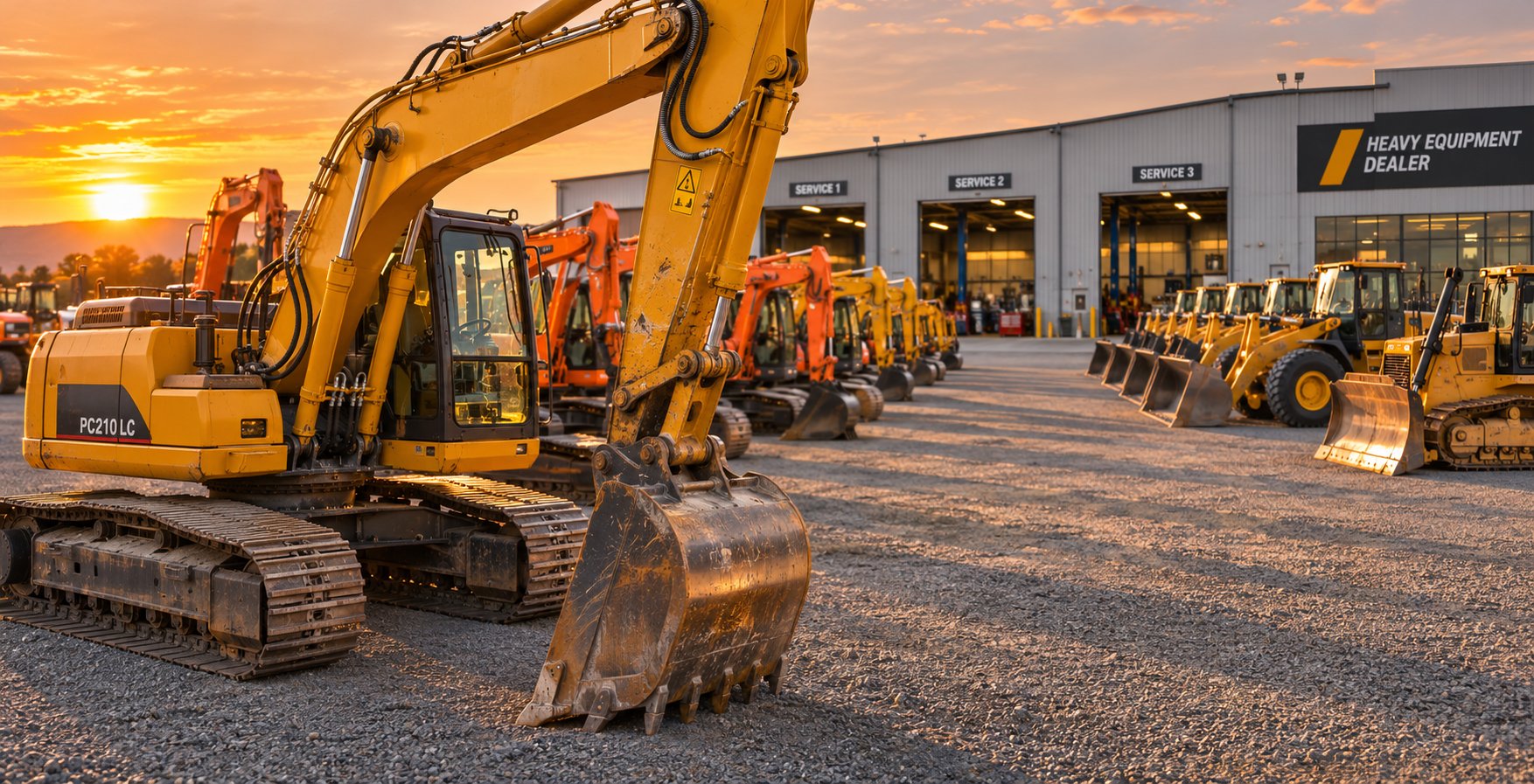
Within that ecosystem, several distinct models coexist. Multi-seller marketplaces aggregate thousands of listings from dealers and private owners into a single searchable database. Dealer-direct storefronts showcase a single company's inventory. Auction houses - both live and online - use timed or competitive bidding to establish prices. And private-sale listings, whether posted on general classifieds or industry-specific boards, let individual owners reach buyers without an intermediary.
Platforms also vary by industry focus. Sandhills Global, for example, operates more than 30 brands spanning construction, forestry, trucking, and aviation - including MachineryTrader.com, ForestryTrader.com, TruckPaper.com, and niche sites like CraneTrader and LiftsToday. Equipment listed on a niche site often cross-posts to the parent platform automatically, so a forestry bucket truck on ForestryTrader.com also appears on MachineryTrader.com and TruckPaper.com. That cross-promotion model is one reason these networks dominate search results when contractors look for equipment for trade.
Why Equipment Trader Platforms Matter for Buyers and Sellers
Here's a question most listing sites never answer: why do these marketplaces exist in the first place? The answer comes down to a supply-and-demand mismatch. The contractor who needs a specific compact track loader in Tennessee and the dealer trying to move that exact model from a yard in Ohio would never find each other without a centralized discovery channel.
These platforms solve three problems simultaneously. For buyers, they collapse a fragmented market into a single search experience - filtering by category, manufacturer, price range, location, and hours of use so you can compare options in minutes rather than weeks. For sellers, they provide exposure to a nationwide (or international) audience that no local advertising could match. And for the market as a whole, they create pricing transparency. When you can see dozens of comparable machines listed side by side, you develop a realistic sense of fair value before picking up the phone.
The selling models behind these platforms matter, too. A marketplace lets the seller control the listing, set the asking price, and negotiate directly with buyers. A broker works under a defined agreement to represent one party. A dealer purchase transfers the machine into professional inventory for resale. An auction concentrates buyer attention around a scheduled event. Each model offers a different balance of control, speed, and price discovery - and understanding those differences is the first step toward making smarter decisions on either side of the transaction.
Of course, knowing where to search is only half the equation. The real advantage comes from understanding what you're searching for - which means getting familiar with the specific machinery categories these platforms organize their listings around.
Equipment Categories Every Trader Platform Covers
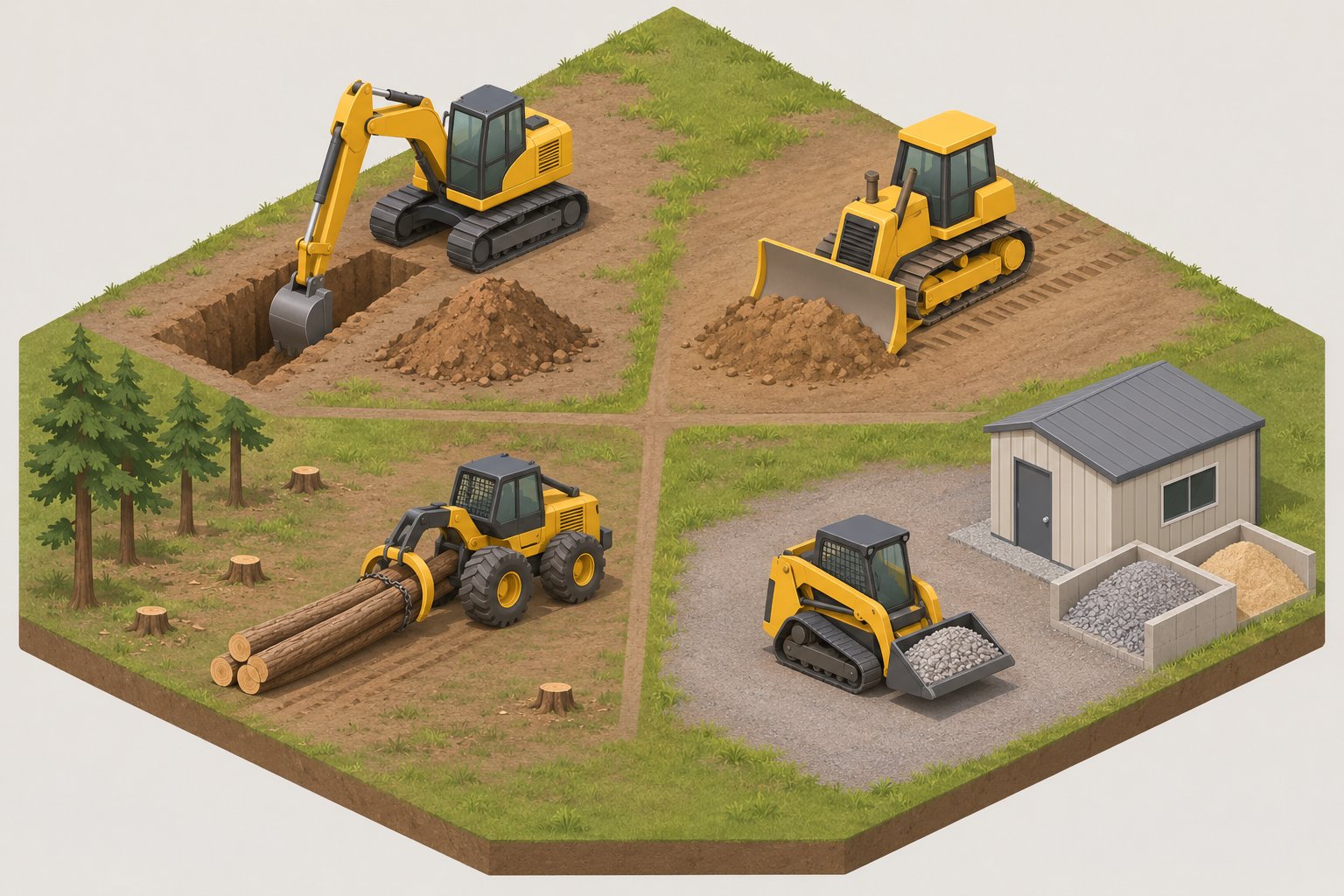
Browse any major listing site and you'll notice the same dropdown menus: Construction, Forestry, Trucks, Compact Equipment. Most platforms stop right there - a bare list of categories with no context. That leaves first-time buyers guessing and experienced operators scrolling through irrelevant results. Understanding what each category actually contains, how the machines differ, and which buyer profile each one serves will save you hours of aimless searching.
Construction and Earthmoving Machinery
Construction equipment is the broadest category on any equipment trader platform, and for good reason - the buyer pool is enormous. Earthmoving contractors, road builders, residential developers, demolition crews, municipal departments, and even individual landowners all shop from the same pool of listings. That diversity is exactly why construction machines tend to move faster on resale than equipment in narrower categories.
Four machine types anchor this category:
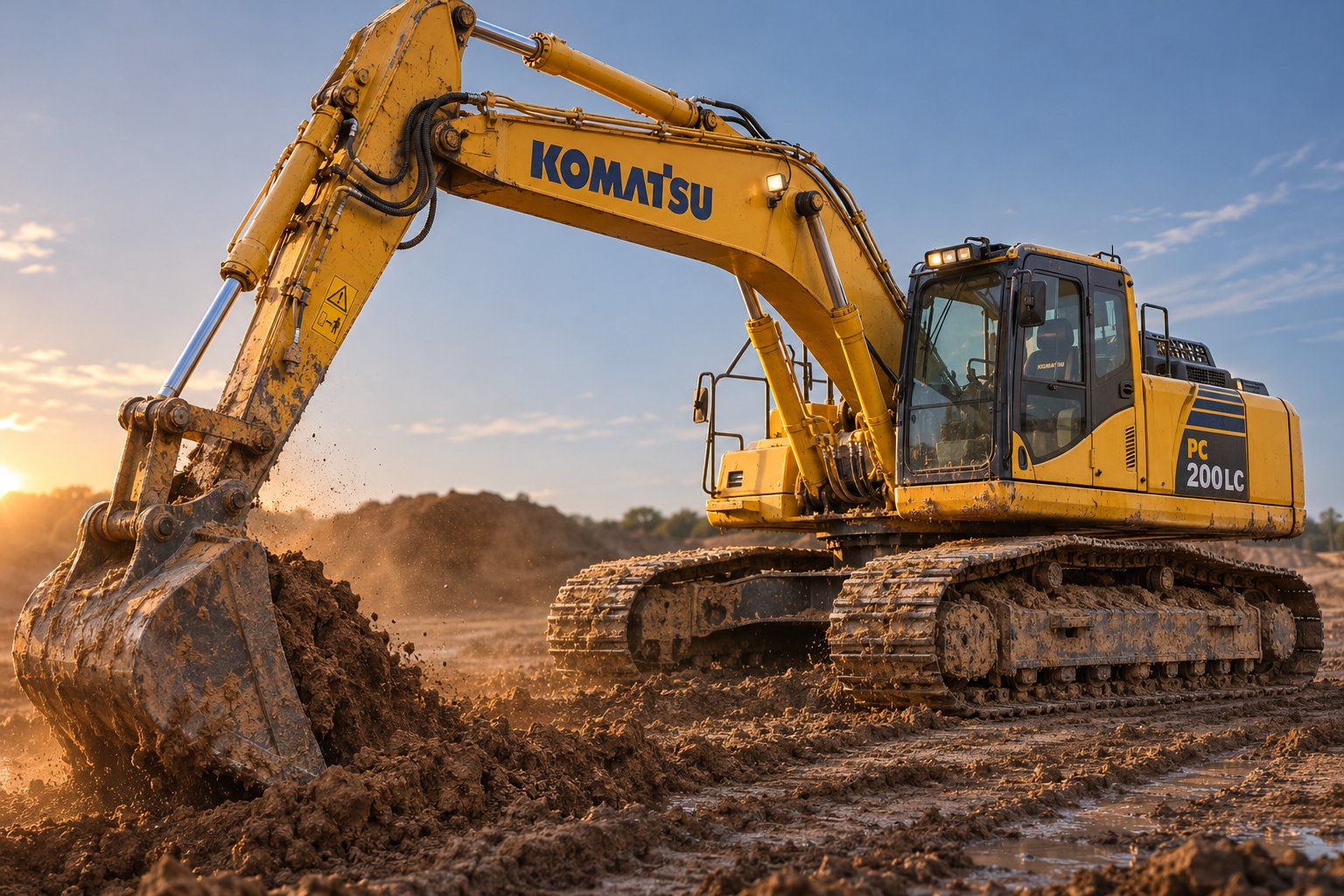
- Excavators - The workhorses of virtually every job site. An excavator features a rotating upper structure, a boom-and-stick assembly, and a bucket at the end, all mounted on a tracked or wheeled undercarriage. They handle digging, trenching, demolition, and material handling. Sizes range from mini excavators for tight residential lots to massive units designed for mining and heavy civil work.
- Wheel Loaders - Built for scooping, carrying, and loading material into trucks or hoppers. You'll recognize them by their large front bucket, articulated steering, and rubber tires. They're a staple at aggregate yards, road construction sites, and waste-handling facilities.
- Bulldozers - Identified by the wide, flat metal blade mounted at the front and a tracked undercarriage that provides stability on uneven terrain. Dozers push soil, clear land, and rough-grade surfaces. Some models include a rear-mounted ripper for breaking up compacted ground.
- Motor Graders - Characterized by a long frame and a centrally mounted, adjustable blade positioned between the front and rear axles. Graders fine-tune surface grades on roads, building pads, and drainage ditches - work that demands precision rather than brute force.
Listings for these machines on trader platforms typically include hour-meter readings, undercarriage condition, and attachment compatibility - details that become critical during evaluation. A listing for something like a 1995 Mack 200 dump truck sitting alongside a fleet of excavators might seem out of place, but trucks and haulers frequently share the construction category because they serve the same job sites.
Forestry and Logging Equipment
Forestry machinery looks similar to construction equipment from a distance - tracked undercarriages, hydraulic arms, enclosed cabs - but the similarities are mostly skin-deep. As Bright Star Auctions explains, the buyers, price drivers, and even the geography of demand for logging equipment can be quite different from the construction world. If you're searching for used logging equipment for sale, understanding those differences keeps you from overpaying or buying the wrong configuration.
Key forestry machines include:
- Feller Bunchers - Equipped with a front-mounted cutting head that grips and severs trees at their base. Cutting mechanisms vary between rotating disc blades and shear-style designs, depending on the timber size and species being harvested.
- Skidders - Heavy-duty machines with rear-mounted grapple or cable systems, built to drag felled trees from the cutting area to a landing or roadside. Tire skidders dominate in the southeastern U.S., while tracked models are preferred in the steep, wet terrain of the Pacific Northwest.
- Log Loaders (Knuckleboom Loaders) - Feature an articulated crane arm with multiple hinged sections, designed to lift, sort, and load logs onto trucks. They're the bridge between the woods and the mill.
- Forwarders - Combine a hydraulic crane with a rear-mounted log bunk, allowing them to carry processed timber out of the woods rather than dragging it. Common in cut-to-length harvesting systems.
Hours and condition are scrutinized more heavily in this category than almost anywhere else. Logging is brutally hard on machines, and buyers know it. A listing that includes service records, recent component work, and photos of the underside will command significantly more confidence - and a higher price - than one with a single exterior photo and vague descriptions. That's something to keep in mind whether you're looking for forestry equipment for sale near me or listing a machine you've run for five seasons.
Compact Equipment and Specialty Machines
Compact machines occupy a unique space on trader platforms because they appeal to the widest range of buyers. A 2019 Bobcat T740 used compact track loader, for instance, might attract a landscaping contractor, a small dairy farmer, a logging crew needing a brush-clearing platform, or a sawmill operator handling slabs in the yard. That crossover appeal often means compact equipment sells faster and holds value better than niche machines.
Two machine types dominate this space:
- Compact Track Loaders (CTLs) - Feature a rigid undercarriage with steel-embedded rubber tracks fixed directly to the frame. They deliver strong pushing power and low ground pressure, making them ideal for soft or sensitive surfaces. The key distinction from multi-terrain loaders is the track construction: CTLs use a rigid system, while multi-terrain loaders run a suspended undercarriage with independent rollers and flexible tracks.
- Skid Steer Loaders - Share the same compact frame and lift-arm design but ride on wheels instead of tracks. Their ability to turn by skidding the wheels makes them incredibly maneuverable in tight quarters, though they sacrifice traction on soft ground compared to tracked alternatives.
What truly multiplies the value of compact equipment is attachments. Buckets, grapples, augers, forestry mulcher heads, breakers, and trenching systems can transform a single base machine into several different tools. Experienced buyers search trader platforms not just for the machine itself but for listings that include high-value attachments - a skid steer bundled with a forestry head, for example, often commands a premium because the package is ready to work on day one.
| Equipment Category | Core Machine Types | Typical Use Cases | Primary Buyer Profile |
|---|---|---|---|
| Construction / Earthmoving | Excavators, wheel loaders, bulldozers, motor graders | Site prep, trenching, grading, demolition, road building | General contractors, earthmoving crews, municipal departments |
| Forestry / Logging | Feller bunchers, skidders, forwarders, knuckleboom loaders | Timber harvesting, log transport, land clearing | Logging operators, timber companies, land-clearing specialists |
| Trucks & Trailers | Dump trucks, flatbeds, lowboys, log trucks | Material hauling, equipment transport, timber delivery | Fleet managers, owner-operators, contractors |
| Compact Equipment | Compact track loaders, skid steers, mini excavators | Landscaping, utility work, material handling, site cleanup | Small contractors, farmers, property owners, rental yards |
Notice how certain machines blur the lines between categories. A wheel loader loading logs at a sawmill yard one month might be handling aggregate at a gravel pit the next. A compact track loader with a mulcher head straddles construction and forestry. These crossover machines are worth watching closely on trader platforms because they attract bidders and buyers from multiple worlds - and that broader demand often pushes resale values in directions a single-category search won't reveal.
Knowing which category fits your needs is the starting point. The next question is more practical: once you've identified the right type of machine, how do you actually navigate the platform to find it, compare options, and separate a strong listing from a questionable one?
How Equipment Trading Platforms Actually Operate
You've identified the right machine category. You know whether you need a compact track loader for landscaping or a full-size excavator for heavy civil work. The obvious next step is to start searching - but here's where most buyers lose time. They jump onto the first listing site they find, type a vague keyword into the search bar, and end up scrolling through hundreds of irrelevant results. Understanding how these platforms are actually built - the filters, listing structures, and seller models working behind the scenes - turns an overwhelming browse into a targeted, efficient search.
Navigating Search Filters and Listings
Every major platform follows a similar search architecture, though the specific filter options vary. On EquipmentTrader.com, for example, clicking "Find Equipment" at the top of the page opens an advanced search panel with filters designed to narrow results quickly. The typical user flow looks something like this:
- Select a category or segment. Most platforms let you start broad (construction, farming, industrial, lifting) or go straight to a specific machine type - excavators, scissor lifts, dump trailers, tractor attachments, and everything in between. Some sites also offer a "class" filter that groups equipment into high-level buckets like agriculture, earthmoving, trailers, and attachments.
- Narrow by manufacturer. Brand loyalty runs deep in heavy equipment. If you already know you want a Caterpillar, John Deere, or Bobcat, filtering by make eliminates hundreds of listings instantly. You can then layer on additional category filters to see every available machine type under that manufacturer.
- Set a price range. Figuring out your budget is one of the first steps when shopping for heavy equipment. Entering a minimum and maximum price keeps results within your financial comfort zone - essential when listings on a single platform can span from a few hundred dollars to well over a million.
- Filter by condition, year, and hours. You'll typically find toggles for new versus used, along with year-range sliders and hour-meter filters. Looking for a gently used machine manufactured within the last few years? You can search by year. Want something with fewer than 3,000 hours? Enter that range. On EquipmentTrader.com, the hours filter accepts values between 1,000 and 100,000 hours.
- Refine by location. Enter your zip code, then choose a search radius - anywhere from 10 to 1,000 miles on most platforms. Shopping local inventory reduces transport costs and makes in-person inspections feasible, which matters enormously for high-value purchases like a Mack RD dump truck for sale or a late-model excavator.
- Sort and contact. Once filters are set, sort results by price, recency, or relevance. Review the listing details - photos, specs, seller information - and reach out directly through the platform's contact form or phone number.
The size filter is another detail worth knowing about. While platforms like EquipmentTrader.com primarily feature large heavy equipment, they also list compact and mini machines suited for smaller jobs or tight spaces. If you're searching for something specific - say a TL10V2 telehandler or a particular compact loader model - combining the make, category, and size filters will get you there far faster than a general keyword search.
Established platforms carry enormous inventories. Competitor data from Sandhills Global properties shows over 3,400 construction listings and more than 1,800 forestry listings in a single state alone. That volume is both the strength and the challenge of online marketplaces: the machine you need almost certainly exists somewhere in the database, but without disciplined filter use, you'll drown in options before finding it.
What a Strong Listing Actually Includes
Not all listings are created equal, and experienced buyers develop an eye for the difference. A well-constructed listing typically provides several key data points:
- Hour-meter reading - The closest equivalent to mileage on a car. Hours give you a rough sense of how hard the machine has worked, though they don't tell the full story without maintenance context.
- Serial number - Critical for verifying the machine's identity, checking recall history against manufacturer databases, and confirming that the model year matches the seller's claim.
- Component condition notes - The best listings describe the state of the undercarriage (or tires), hydraulic system, engine, and major structural components. Vague phrases like "runs great" tell you far less than "new hydraulic pumps installed at 4,200 hours."
- Multiple high-quality photos - Exterior shots from all angles, close-ups of wear points, interior cab photos, and images of the undercarriage. Some listings also include walk-around videos.
- Price or pricing context - Listed as a firm asking price, a negotiable price, or "Call for Price." Auction listings display current bid status instead.
- Seller type - Whether the machine is offered by a dealership or a private owner. This distinction affects everything from warranty availability to paperwork handling.
On the seller type point, it's worth understanding a nuance that catches many first-time platform users off guard. A majority of inventory on sites like EquipmentTrader.com actually comes from dealerships, not private parties. Dealers tend to offer more documentation, handle purchase paperwork, and sometimes provide limited warranties or financing options. Private sellers, on the other hand, often list at lower prices because they carry less overhead. Both routes have trade-offs, and platforms let you filter by seller type so you can shop according to your preference.
Some platforms also integrate rental listings alongside purchase inventory. RentalYard, a sister brand to MachineryTrader within the Sandhills Global network, lets users browse daily, weekly, and monthly equipment rentals - useful if you don't need a machine long term or want to test a model before committing to a purchase.
Online Platforms vs Dealer Networks vs Auctions
The platform type you choose shapes the entire buying experience - from how prices are set to what protections you receive. Think of it as three distinct channels, each with its own logic.
Online marketplaces like EquipmentTrader.com and MachineryTrader.com function as classified listing hubs. Sellers control their pricing, descriptions, and photos. Buyers browse, compare, and contact sellers directly. The marketplace itself typically doesn't handle the transaction or guarantee the equipment - it provides the discovery layer. This model gives buyers the largest selection and the freedom to negotiate, but it also means you're responsible for your own due diligence.
Dealer networks operate differently. A dealership's own website or storefront page on a marketplace showcases only that dealer's inventory, often with more consistent listing quality, certified pre-owned programs, and in-house financing. For equipment dealerships, the best sales platforms combine online reach with tools for inventory management - allowing them to syndicate listings across multiple sites while managing leads from a single dashboard. Buyers benefit from a more curated experience, though the selection is limited to one seller's stock.
Auction platforms introduce competitive bidding. Some run unreserved sales where every item sells to the highest bidder regardless of price - BigIron, for instance, advertises unreserved auctions with no buyer fees. Others, like Purple Wave, apply a buyer premium (currently 10%) on top of the winning bid. Live auction houses such as Ritchie Bros. offer both onsite and online bidding, while simulcast platforms like Equipmentfacts let remote bidders participate in real time during a live event. Pricing transparency varies widely: some auctions publish completed sale prices, giving the market valuable benchmarks, while others keep results private.
| Dimension | Online Marketplace | Dealer Network / Storefront | Auction Platform |
|---|---|---|---|
| Listing Volume | Highest - aggregates thousands of sellers nationwide | Limited to one dealer's inventory per storefront | Varies by event; large houses may move hundreds of units per sale |
| Pricing Model | Asking price set by seller; negotiation expected | Asking price or "Call for Price"; may include financing options | Competitive bidding; final price unknown until sale closes |
| Buyer Protections | Minimal - platform facilitates discovery, not transactions | Varies; may include warranties, return policies, or CPO programs | Varies by house; some offer inspection reports, others sell "as-is" |
| Pricing Transparency | Moderate - listed prices visible, but sold prices rarely published | Moderate - consistent pricing within a dealer's inventory | Ranges from high (published results) to low (private outcomes) |
| Seller Verification | Basic - dealer vs. private seller tags; some platforms verify dealer licenses | High - you're dealing with an established business | Moderate to high - auction houses vet consignors to varying degrees |
| Best For | Buyers wanting maximum selection and negotiation flexibility | Buyers who value trust, documentation, and financing convenience | Buyers comfortable with competitive bidding and fixed timelines |
Here's something many buyers overlook: these channels aren't mutually exclusive. A single piece of equipment might appear on a dealer's own website, on a marketplace like equipmenttrader.com, and eventually at auction if it doesn't sell through the first two channels. Savvy contractors monitor all three simultaneously, using marketplace listings to establish fair-market pricing and auction results to spot when machines are moving below that benchmark.
The platform structure tells you where to look and how prices are formed. But it doesn't answer a question that trips up even experienced buyers: within the listings you're now finding, how do you decide between a low-hour used machine at a steep discount and a brand-new unit at full retail? That decision hinges on factors most listing sites completely ignore.
New vs Used Equipment and How to Choose the Right Tier
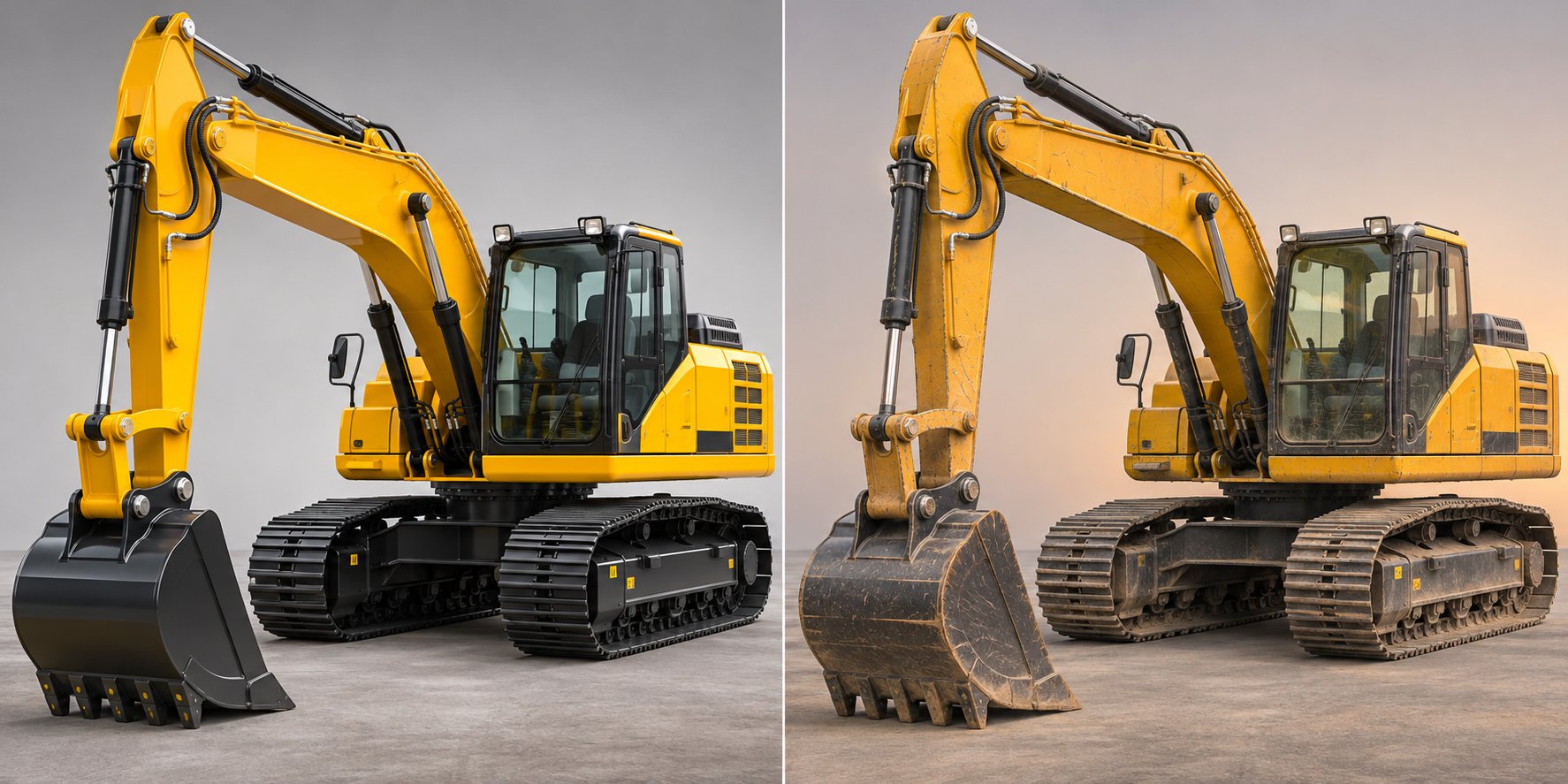
Scroll through any major listing platform and the price gaps are staggering. A single category - say, excavators - can show results ranging from a few hundred dollars for a project-worn mini excavator all the way past the three-million-dollar mark for a late-model, production-class machine. Forestry equipment spans a similar gulf, from around $1,250 for a high-hour skidder to $675,000 or more for a low-hour feller buncher. The listings sit side by side, yet nothing on the page explains which end of that spectrum actually makes sense for your situation.
That's the gap most equipment trader platforms never fill. They organize by price, but they don't help you think about value. And value - not sticker price - is what separates a smart acquisition from an expensive mistake.
When Buying Used Equipment Makes Financial Sense
The single biggest financial argument for buying used is depreciation. Like any capital asset, heavy equipment loses value fastest in its earliest years of ownership. A brand-new compact track loader driven off the dealer lot begins shedding value immediately, with the steepest decline typically occurring within the first two to three years. Buying a machine that has already absorbed that initial depreciation hit means you're paying closer to its real working value rather than subsidizing the first owner's loss.
This isn't just theory - it shapes how experienced fleet managers and contractors actually spend. Consider a few common scenarios where used equipment is the sharper financial play:
- Single-project capacity expansion. You land a six-month highway job that requires an extra dozer and two more dump trucks. Buying new machines for a temporary spike in demand ties up capital you won't recover when the project wraps. A used Peterbilt 330 dump truck with documented service history, for example, handles the hauling just as effectively at a fraction of the new-unit cost - and you can resell it afterward without eating a massive depreciation loss.
- Testing a new equipment category. Curious whether a forestry mulcher head on a skid steer could open up land-clearing revenue for your crew? Buying used lets you test the business case without a six-figure commitment. If the work materializes, you upgrade later. If it doesn't, you exit with minimal financial damage.
- Budget-conscious startups. New contractors building a fleet from scratch often stretch their capital further by acquiring quality used compact construction equipment that's still capable of handling a wide range of jobs. Even with the lower investment, reliable machines are out there - the key is knowing how to evaluate them.
- Immediate availability. New equipment orders can involve weeks or months of lead time, especially for specialized configurations. Used machines are available now. If your timeline is tight and a project deadline won't wait for a factory build, the used market gives you a faster path to production.
Low-hour, late-model used machines sit in a particularly sweet spot. A three-year-old excavator with 2,000 hours still has the vast majority of its productive life ahead, yet it may sell for substantially less than an identical new unit. Fleet managers who monitor trader platforms closely know this, which is why well-maintained, low-hour machines tend to move quickly once listed.
When New Equipment Is Worth the Premium
Used equipment isn't always the answer. Several scenarios tilt the math decisively toward buying new - and the premium often pays for itself over the machine's lifecycle.
Warranty protection is the most obvious advantage. New machinery comes with manufacturer warranties that cover the cost of unexpected repairs during the first few years of ownership. That safety net matters most on machines you plan to run hard. If you're putting 1,500 or more hours per year on an excavator, the warranty alone can offset thousands of dollars in potential out-of-pocket repair costs.
Emissions compliance is another factor that's easy to underestimate. Machines built to EPA Tier 4 Final standards feature advanced exhaust treatment systems - diesel particulate filters, selective catalytic reduction, exhaust gas recirculation - that cut NOx emissions by up to 90% and particulate matter by 95% compared to older engines. States like California enforce strict fleet-average emissions rules, and some job sites mandate equipment age limits of 10 to 15 years. Buying new ensures you meet every current regulation without worrying about costly retrofits or project-access restrictions.
Technology integrations add another layer. The latest models ship with GPS-guided grading systems, telematics dashboards, fuel-efficiency mapping, and advanced operator-assist features that simply aren't available on older units. If precision and data-driven fleet management are priorities - think grade-control on a motor grader or real-time diagnostics on a wheel loader - new equipment delivers capabilities that can't be retrofitted economically.
Fleet standardization rounds out the case. Large contractors running dozens of machines benefit from having consistent models across the fleet. Standardization simplifies parts inventory, reduces mechanic training requirements, and streamlines maintenance scheduling. When you're debating something like Bobcat vs Cat skid steer for your next ten units, buying new from a single manufacturer locks in uniform specs and dealer support across the entire group.
Financing incentives from dealerships can also soften the upfront blow. Many dealers run promotional rates, deferred-payment plans, or seasonal offers that spread the cost over time - turning a large capital expenditure into manageable monthly payments while preserving working capital for other needs.
Evaluating Condition Tiers and Price Brackets
Rather than viewing the market as a simple binary - new or used - think in terms of three condition tiers. Each one maps to a different buyer profile, risk tolerance, and project requirement.
Tier 1: Low-hour, late-model units. These are typically one to four years old with fewer hours than average for their age. They've absorbed initial depreciation but still carry most of their useful life. Many come with remaining factory warranty or dealer-backed coverage. This tier appeals to buyers who want near-new performance at a meaningful discount - fleet managers expanding a well-maintained operation, for instance, or contractors stepping up from compact to mid-size machines.
Tier 2: Mid-life machines. Five to ten years old, moderate hours, often past warranty but with plenty of productive capacity remaining. Pricing is significantly lower than Tier 1, making these machines attractive for budget-conscious operators who have in-house maintenance capability. A mid-life compact track loader - say, a Bobcat T770 with a well-documented engine and hydraulic service history - can deliver years of reliable work if the previous owner maintained it properly. The catch? You're betting on maintenance history, so documentation becomes critical.
Tier 3: High-hour, older units. These machines carry the lowest purchase prices but the highest uncertainty. They may need near-term component rebuilds - undercarriage, engine, hydraulics - that can quickly close the gap between the bargain purchase price and what you would have paid for a Tier 2 machine. High-hour units make sense for low-utilization roles (a backup dozer that runs 200 hours a year), for operators with strong in-house repair shops, or for short-duration projects where the machine only needs to survive one season.
The key insight that listing sites miss is this: total cost of ownership - not purchase price - determines whether a machine is a good deal. A cheaper unit that requires frequent repairs, burns more fuel, and sits idle waiting for parts can easily cost more over 24 months than a pricier machine that runs every day without incident.
Before committing to any tier, run through these decision factors:
- Project duration. Short-term needs favor used equipment you can resell when the job ends. Long-term fleet additions favor new or low-hour machines that will deliver years of service.
- Utilization rate. A machine running 2,000 hours per year justifies a higher investment in reliability and warranty coverage. One running 400 hours per year doesn't need to be bulletproof - it just needs to be functional.
- In-house maintenance capacity. If your shop can handle component rebuilds and routine service, mid-life and high-hour machines become viable because you're not paying dealer labor rates for every repair. If you outsource all maintenance, the cost advantage of older equipment erodes fast.
- Resale timeline. Plan to keep the machine for two years? Buy used and avoid the steepest part of the depreciation curve. Planning to run it for a decade? New equipment with full warranty and modern technology often delivers better lifetime value.
- Regulatory environment. Working in states with strict emissions rules or on job sites with equipment age restrictions? Factor compliance costs into the equation. A cheap older machine that can't access your primary job sites isn't cheap at all.
Every tier has a place in the market - and every tier has traps for the uninformed buyer. The difference between a smart purchase and a regrettable one rarely comes down to price alone. It comes down to how well you verified the machine's actual condition before signing. And that verification process - checking sellers, inspecting components, and reading between the lines of a listing - is where most buyers either protect themselves or leave money on the table.
How to Verify Sellers and Inspect Equipment Before Buying
A listing can look perfect on screen - clean photos, reasonable price, low hours - and still hide problems that cost tens of thousands of dollars after the deal closes. The gap between what a listing shows and what the machine actually delivers is where uninformed buyers get burned. Most equipment trader online platforms give you the tools to find machinery, but they leave the verification entirely in your hands. That's not a flaw - it's the nature of a marketplace. Your job is to treat every listing as a claim that needs evidence before it earns your trust.
This chapter breaks that process into three layers: confirming the seller is legitimate, physically inspecting the machine, and interpreting the hours and maintenance records that separate a solid investment from a money pit.
Verifying Seller Credibility and Reputation
Before you evaluate a single bolt on the machine, evaluate the person or company selling it. The seller's credibility sets the ceiling for how much you can trust everything else in the listing - the stated hours, the described condition, the claimed service history.
Start by identifying the seller type. Dealerships and private sellers operate under fundamentally different levels of accountability. A licensed dealer has a physical location, a business registration, and a reputation to protect. A private seller might be an honest owner offloading surplus equipment - or someone flipping a machine they picked up cheap at auction without disclosing known issues. Neither category is inherently better, but each demands a different verification approach.
For dealers, your due diligence should include:
- Business registration verification. Check the dealer's business license through your state's secretary of state database or commercial registry. A legitimate dealership will have verifiable records.
- Platform-verified badges. Many listing sites flag verified dealers with badges or icons that indicate the seller has met certain platform requirements - proof of insurance, verified business address, or a minimum listing history. These badges aren't guarantees, but they do represent a baseline screening.
- Online reviews and industry reputation. Search the dealer's name across Google, Better Business Bureau, and industry forums. Pay special attention to how they handle complaints - a negative review followed by a professional resolution tells you more than five generic five-star ratings.
- References from past buyers. Don't hesitate to ask for references. A reputable dealer will connect you with previous customers, especially on high-value transactions.
For private sellers, the bar is different but equally important. Ask why they're selling, how long they've owned the machine, and what work it's been doing. Request a copy of the title or bill of sale to confirm ownership. If the seller can't produce basic documentation or gets evasive when asked direct questions, that's a signal to walk away - no matter how attractive the price.
As MY Equipment notes, collaboration with a reputable seller decreases the chances of fraud or misrepresentation, and taking time to verify the seller builds confidence in the entire purchase. That advice holds whether you're buying a Bobcat T740 compact track loader from a regional dealer or a high-hour skidder from a retiring logger listing forestry equipment for sale.
Pre-Purchase Inspection Checklist
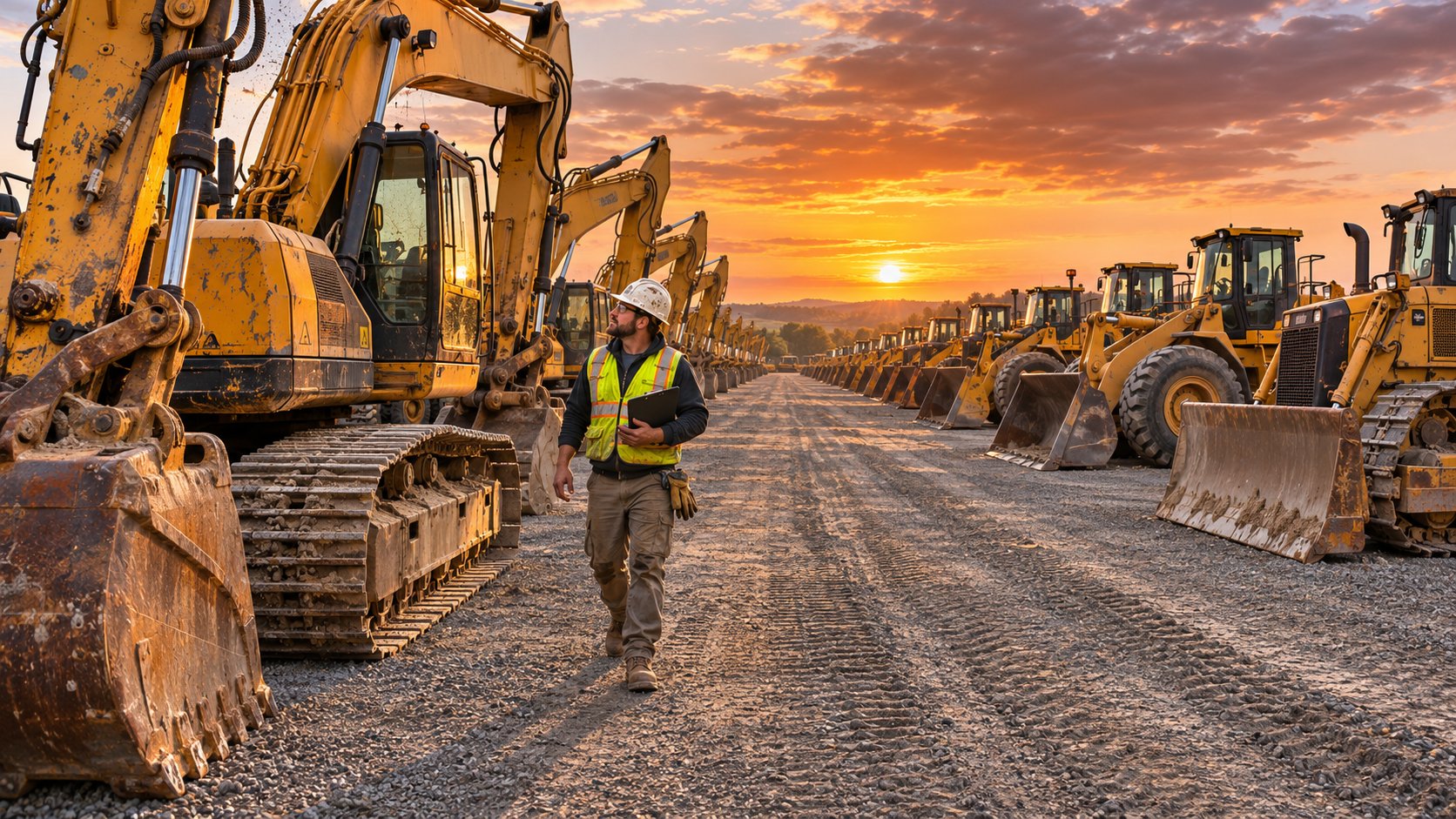
Seller checks out? Good. The machine still has to prove itself. A structured inspection - ideally performed in person or by a qualified third party - is non-negotiable for any purchase above a few thousand dollars. Here's a step-by-step checklist built from the data points that the best listings provide and the worst ones conveniently omit.
- Review documented hours and service records. Ask for the full maintenance history before you ever visit the machine. Look for evidence of regular oil changes, filter replacements, hydraulic service, and major component work. A machine with documented maintenance is often a safer investment than one with an unknown history, even if the documented machine carries higher hours. Gaps in records aren't automatic deal-breakers, but they should lower your price ceiling and raise your inspection intensity.
- Check the serial number against manufacturer databases. The serial number is the machine's fingerprint. Cross-reference it with the manufacturer's records to verify the model year, confirm the original configuration, check for open recalls, and ensure the unit isn't flagged as stolen. Most major manufacturers - Caterpillar, John Deere, Komatsu, Volvo - offer serial number lookup tools through their dealer networks.
- Inspect the undercarriage or tire condition. For tracked machines like excavators and compact track loaders, the undercarriage is one of the most expensive components to replace. Look for excessive track wear, damaged rollers, worn sprockets, and loose track tension. For wheeled equipment, check for uneven tire wear, cuts, missing tread, and sidewall damage. As Houston Heavy Machinery emphasizes, undercarriage repairs can quickly add thousands of dollars to ownership costs - catching problems here can save you from a major unexpected expense.
- Test the hydraulic systems. Operate every hydraulic function - boom, stick, bucket curl, swing, auxiliary circuits. Watch for slow movement, jerky operation, weak lifting power, or unusual noises. Walk around the machine and inspect hydraulic lines, cylinders, and fittings for leaks. Even small leaks suggest deferred maintenance and can escalate into major repairs.
- Examine structural welds and boom integrity. Inspect the boom, stick, and frame for cracks, poor weld repairs, bent components, or signs of impact damage. Structural problems may indicate the machine has been subjected to heavy abuse or operated beyond its rated capacity. Pay particular attention to pin joints and mounting points where stress concentrates - loose or worn pins compromise stability and safety.
- Verify emissions compliance. Confirm the machine's emissions tier rating (Tier 2, Tier 3, Tier 4 Interim, or Tier 4 Final) and check whether it meets the requirements for the states and job sites where you plan to operate. A machine that can't pass emissions requirements in your market has significantly reduced utility and resale value, regardless of its mechanical condition.
- Perform a cold start. Whenever possible, inspect the machine before it has been warmed up. A cold start can reveal hard starting, excessive smoke, warning lights, and unusual engine noises that disappear once the engine reaches operating temperature. If the seller has the machine running and warmed up before you arrive, ask them to shut it down and wait - or schedule a return visit.
- Request a third-party inspection for high-value purchases. For machines priced above your comfort threshold - and especially for remote purchases where you can't inspect in person - hire an independent, qualified inspector. Many inspection services specialize in heavy equipment and will provide a written report covering mechanical, structural, and cosmetic condition. The cost of an inspection is trivial compared to the cost of buying a problem.
This checklist applies whether you're evaluating an SVL 65 compact loader at a local dealer or a large excavator you found through a nationwide search. The machines change; the discipline doesn't.
Understanding Hours and Maintenance History
Hour-meter readings are the first number most buyers look at - and the most frequently misunderstood. Think of hours as a rough usage indicator, similar to mileage on a car. They tell you how long the engine has been running, but they don't reveal how hard it worked during those hours, whether it idled through half of them, or if anyone kept up with service along the way.
What counts as "high hours" varies dramatically by equipment type. An excavator logging 900 hours per quarter operates under constant hydraulic stress - digging, lifting, swinging - and wears components far faster than a generator running the same hours mostly at idle. Usage-based servicing research from Cryotos highlights this distinction: components fail based on operating stress, not simply elapsed run time, which is why an hour reading alone is a poor proxy for condition.
OEM service intervals reinforce the point. A typical excavator requires hydraulic filter and fluid checks every 250 hours, while a wheel loader's transmission service is scheduled every 500 hours. When you're reviewing a machine's history, match the documented service events against these intervals. A 5,000-hour excavator should show roughly 20 hydraulic service entries. If the records only show five, either the maintenance was deferred or the documentation is incomplete - neither of which inspires confidence.
Here's the principle experienced fleet managers rely on:
A machine with 6,000 verified, well-maintained hours is almost always a better investment than a machine with 3,000 hours and no documentation - because maintenance records are proof of care, while an hour-meter reading is just a number on a gauge.
When evaluating hours, also consider the duty cycle. A compact track loader used for landscaping - loading mulch, grading driveways, light trenching - accumulates hours under far less stress than the same model running a forestry mulcher head through hardwood stumps eight hours a day. Two machines with identical hour readings can be in vastly different condition depending on what work those hours represent. Always ask the seller what applications the machine was used in, and look for physical evidence that corroborates the answer.
Finally, be aware that hour meters can be tampered with or replaced. Cross-reference the stated hours against the physical condition of wear components - tracks, pins, bushings, seat upholstery, pedal rubber. A machine claiming 2,000 hours but showing a worn-out undercarriage and a cracked operator seat is telling two different stories. Trust the physical evidence over the gauge every time.
Verification and inspection protect you from buying the wrong machine. But even a perfectly vetted piece of equipment can become a bad deal if you buy it at the wrong time, in the wrong region, or without understanding the market forces that push prices up or pull them down throughout the year.

Regional and Seasonal Factors That Shape Equipment Pricing
You've found the right machine type, vetted the seller, and inspected the equipment down to the last hydraulic fitting. Everything checks out - so you pull the trigger. But here's a question almost no listing site prompts you to ask: is this the right time and the right place to buy? Geography and timing quietly shape equipment pricing in ways that can mean thousands of dollars saved - or overpaid - on a single transaction.
A compact track loader listed in Michigan in January and the same model listed in Texas in June don't exist in the same market, even if they appear on the same platform. Regulations, terrain demands, weather patterns, and local construction cycles all drive pricing pressure in different directions depending on where and when you're shopping. Understanding these forces gives you leverage that most buyers never realize they have.
Regional Regulations and Terrain Considerations
Imagine you find a great deal on an older excavator - low hours, solid maintenance records, fair price. Then you discover it's a Tier 2 engine, and your next three projects are in California. Suddenly that deal isn't a deal at all.
State-specific emissions regulations are one of the most impactful regional factors in the equipment market. California's CARB rules are the strictest in the country, requiring Tier 4 engines for most construction work, fleet-average emission calculations, equipment registration and reporting, and significant penalties for violations. Equipment age limits of 10 to 15 years are common on certain job sites, and some ports and airports mandate zero-emission zones during specific hours. These rules don't just affect California-based contractors - they affect anyone who buys used construction equipment near me and plans to work in or ship machines to regulated states.
The pricing impact is real and measurable. Older, non-compliant machines tend to concentrate in states with looser emissions rules, where they remain fully functional and legally operational. That geographic clustering pushes down resale values for older equipment in unregulated markets (more supply, same demand) while inflating prices for compliant machines in strict-regulation states (limited supply, strong demand). If you're shopping on an equipment trader platform and filtering by state, you're already seeing this dynamic play out - you just might not have known why the same model commands different prices in different regions.
Terrain is the other major regional variable. Equipment Trader's marketplace data shows distinct regional preferences across the United States: the Midwest favors versatile utility equipment and hauling trailers suited to flat agricultural landscapes, the Northeast demands compact machines that can navigate tight urban job sites, the South prioritizes heavy-duty machinery for large-scale infrastructure projects, and the West requires specialized equipment capable of handling diverse terrains from coastal zones to mountain grades. A Cat or Bobcat skid steer might be the go-to machine on a paved lot in New Jersey, while an E85 excavator or similar compact excavator with a narrow profile could be the preferred choice for utility work in rocky, confined Western terrain.
These terrain-driven preferences shape local inventory composition. Sandy, coastal soils call for wider tracks and lower ground pressure. Rocky mountain job sites demand reinforced undercarriages and heavy-duty buckets. Clay-heavy regions favor machines with strong digging force and reliable swing torque. When you search a specific state on a trader platform, the results reflect these realities - and so do the prices. Equipment configured for the local terrain sells faster and commands a premium, while machines that aren't optimized for local conditions may sit longer or sell at a discount, even if they're mechanically sound.
Seasonal Buying Patterns and Market Timing
Geography tells you where to look. Seasonality tells you when to act.
The equipment market follows predictable annual rhythms driven by construction activity, weather, and corporate fiscal calendars. Buyers who understand these cycles can time purchases to capitalize on soft pricing - and sellers who understand them know when their machines will attract the most competition.
Here's the general pattern. Construction activity ramps up in spring as weather improves across most of the country. Contractors start new projects, expand fleets, and restock rental yards. Demand for used equipment climbs, and prices firm up accordingly. By summer, the market hits peak activity - machines move quickly, buyer competition intensifies, and sellers hold pricing power. This is when who buys used construction equipment near me is practically everyone: general contractors scaling for summer builds, municipalities executing road programs, and rental companies replenishing inventory that's been running hard since April.
Fall begins a gradual cooldown. Projects in northern states wind down as freezing temperatures approach. Some buyers still shop aggressively - picking up machines for winter-season work like snow removal or indoor demolition - but overall demand softens. Then winter arrives, and in regions with harsh weather, construction slows dramatically. Equipment sits idle. Sellers who need to move inventory before year-end may accept lower offers. For buyers with patience and cash, winter is often the best window to find quality used machines at reduced prices.
There's a less obvious seasonal driver worth watching: end-of-fiscal-year fleet turnover. Large contractors and fleet operators often cycle equipment on a set depreciation schedule, replacing machines every three to five years regardless of condition. When these fleets turn over - typically clustered around fiscal year-end dates in Q4 or Q1 - a wave of well-maintained, mid-life machines hits the market simultaneously. That temporary supply spike can soften prices on exactly the kind of low-hour, late-model equipment that's hardest to find during peak season.
Seasonal demand analysis from Ironmart Online reinforces these patterns, noting that equipment type matters too: excavators typically see peak demand from June through August, dozers maintain steadier year-round demand, and compactors and rollers spike during paving season in spring and fall. The implication for buyers is clear - shopping slightly outside the peak window for your specific machine type can yield better pricing without sacrificing selection.
| Approximate Period | Market Condition | What's Happening | Buyer Strategy |
|---|---|---|---|
| Late Winter (Jan - Feb) | Buyer's market | Construction slows in cold regions; sellers motivated to clear inventory before spring | Negotiate aggressively; watch for fleet turnover units entering the market |
| Spring (Mar - May) | Transitioning to seller's market | Projects launch; demand rises; rental yards restock; prices begin climbing | Act early before peak competition; secure financing in advance |
| Summer (Jun - Aug) | Seller's market | Peak construction activity; highest demand and strongest pricing across most categories | Be prepared to pay premiums or wait; monitor auctions for opportunistic buys |
| Fall (Sep - Nov) | Transitioning to buyer's market | Northern projects wind down; some fleet disposals begin; demand softens gradually | Look for late-season listings from contractors finishing projects |
| Late Fall / Year-End (Nov - Dec) | Buyer's market | Fiscal year-end fleet turnover; tax-motivated sales; reduced buyer competition | Best window for quality used machines at lower prices; plan purchases for spring deployment |
Keep in mind that regional climate variations can shift these windows significantly. Year-round construction markets like Florida, Texas, and Southern California don't experience the same winter slowdown that creates buyer opportunities in the Midwest or Northeast. In those warmer markets, seasonal pricing swings are less dramatic, and demand stays relatively consistent across the calendar. Conversely, regions with short building seasons - think Minnesota or Montana - see compressed, intense demand in summer and much softer markets in winter.
The takeaway? Treat market timing as a variable you can control, not just background noise. A contractor who plans a major equipment purchase in January rather than June - buying during a buyer's market and having the machine ready when spring projects begin - gains a pricing advantage that compounds across every unit in the fleet.
Regional and seasonal awareness sharpens your sense of when and where to buy. But there's another layer of decision-making that sits just below the surface of every listing: choosing between different machine configurations. Track or wheel? Mini or full-size? The right answer depends entirely on the job - and picking wrong can cost you far more than bad timing ever would.
Comparing Equipment Types to Match Your Project Needs
Here's a scenario that plays out every week on trader platforms: a contractor searches for a loader, finds 400 results spanning compact track loaders, skid steers, and full-size wheel loaders, and has no idea which configuration actually fits the job. The listings sit side by side with no explanation of why you'd choose one over the other. Pricing overlaps. Specs blur together. And the platform offers zero guidance on which machine belongs on your particular site.
That gap is expensive. Buying a wheeled machine for soft, muddy terrain means lost productivity from day one. Choosing a full-size excavator when a mini would have handled the scope means overpaying for capacity you'll never use - plus wrestling with transport logistics that eat into your margins. The comparisons below break down the decisions that matter most: track versus wheel undercarriages, excavator size classes, and loader types.
Track vs Wheel Configurations for Different Job Sites
The undercarriage is the single most consequential feature on any piece of heavy equipment, yet it's the one detail most buyers gloss over when browsing listings. Tracks and wheels don't just look different - they perform differently in ways that ripple through every hour of operation.
When tracks outperform wheels. Tracked machines distribute weight over a much larger contact area, which translates to lower ground pressure and superior flotation on soft surfaces. According to Preferred Equipment LLC, this reduced ground pressure means less soil compaction - critical for landscaping projects, agricultural land, and environmentally sensitive sites where preserving ground integrity matters. If your job site involves mud, sand, steep grades, or freshly disturbed earth, a tracked undercarriage gives you traction that wheels simply cannot match.
Demolition and rough grading are another strong case for tracks. The lower center of gravity and wider footprint improve stability when handling heavy loads or working on uneven terrain. A compact track loader like a Bobcat T770 - popular enough that buyers regularly search for Bobcat T770 engine specs before purchasing - excels at pushing material across torn-up sites where a wheeled skid steer would struggle for grip.
When wheels win. Speed and surface preservation flip the equation. Wheel loaders travel faster between loading points, deliver shorter cycle times on firm ground, and cause no damage to paved surfaces. Bobcat's comparison guide highlights that skid steers - the wheeled counterpart to compact track loaders - excel on hard, stable ground and in tight working conditions. Road work, warehouse yards, concrete plants, and gravel operations are all environments where rubber tires outperform tracks on efficiency and operating cost.
Transport is another practical consideration. Tracked machines almost always require a trailer to move between sites, while many wheeled loaders can drive short distances on public roads - saving time and the expense of flatbed hauling. For contractors running Mack dump trucks for sale near me searches to build out a hauling fleet, pairing those trucks with wheeled loaders on paved aggregate yards makes logistical sense. Tracks belong in the field; wheels belong on the hardstand.
Maintenance cost is the final differentiator, and it's a big one. Replacing a set of rubber tracks on a compact track loader is significantly more expensive than swapping tires on a comparable skid steer. Preferred Equipment's analysis notes that the undercarriage - tracks, idlers, rollers, sprockets - is the most expensive wear component on any tracked machine, and operating on abrasive surfaces or making tight turns accelerates that wear dramatically. On the other hand, tires are susceptible to punctures on debris-heavy sites, so neither option is maintenance-free.
| Dimension | Tracked Configuration | Wheeled Configuration |
|---|---|---|
| Terrain Suitability | Soft, muddy, sandy, uneven, steep grades | Firm, compacted, paved surfaces (asphalt, concrete, gravel) |
| Ground Pressure | Low - minimal soil compaction, excellent flotation | High - concentrated weight on four contact points |
| Travel Speed | Slower; requires trailer for site-to-site moves | Faster; often roadable for short distances |
| Maneuverability | Excellent in tight spaces; many offer zero-turn capability | Good on firm ground; larger turning radius than tracked equivalents |
| Maintenance Costs | Higher - undercarriage replacement is expensive; abrasive surfaces accelerate wear | Lower overall - tire replacement cheaper than tracks; puncture risk on rough sites |
| Stability | Superior - low center of gravity, wide base | Good on flat surfaces; less stable on slopes or with heavy loads |
| Typical Project Types | Site prep, demolition, landscaping, forestry, utility trenching | Material loading, stockpile management, road work, snow removal, yard operations |
Comparing Excavator and Loader Size Classes
Picking the right undercarriage is half the equation. The other half is sizing the machine to the work. Oversizing wastes money on purchase price, fuel, and transport. Undersizing kills productivity and forces you to rent supplemental equipment mid-project. Both mistakes are avoidable once you understand how size classes map to project scopes.
Excavator size classes. Gregory Poole's excavator guide breaks the market into three primary weight classes:
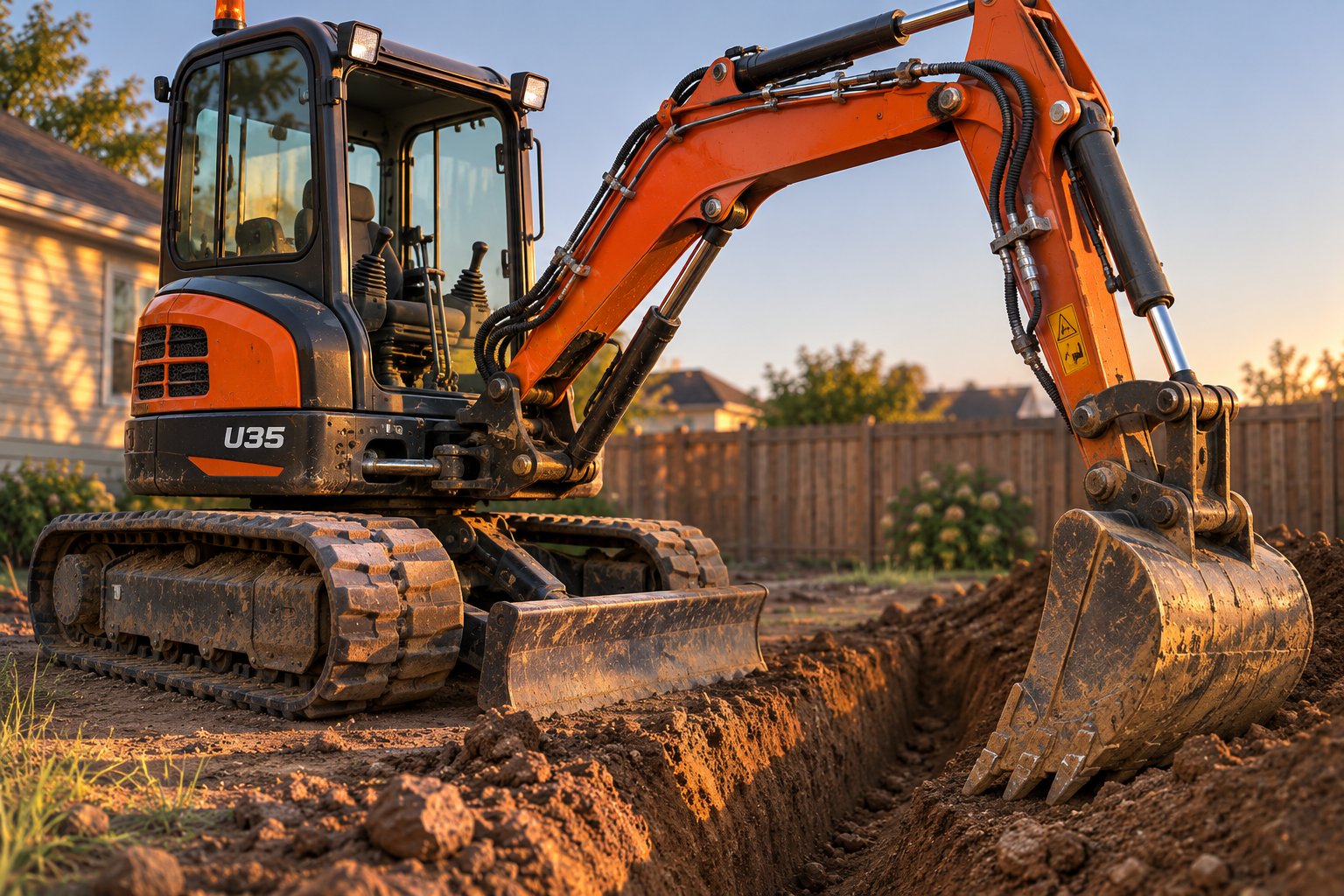
- Mini excavators (under 7 metric tons). Ideal for residential work, tight urban sites, utility installations, and landscaping. Their zero or near-zero tail swing lets them rotate safely next to walls, fences, and structures. They're easy to transport on standard trailers and cost less to operate - but they lack the digging depth, reach, and lifting capacity for heavy commercial work.
- Standard excavators (7 to 45 metric tons). The workhorses of commercial construction. They handle trenching, foundation digging, demolition, and material handling with enough power and reach for most job sites. This class is sometimes subdivided further - machines between 7 and 10 tons are considered "small" or "midi" excavators, offering a bridge between compact agility and mid-size capability. A C25C or similar mid-range unit fits comfortably in this bracket, handling utility and light commercial work without the transport headaches of a full-size machine.
- Large excavators (over 45 metric tons). Built for heavy civil construction, mining, large-scale demolition, and deep foundation work. These machines deliver serious digging force and bucket capacity but require special transport permits, large trailers, and significant storage space. They're an investment that only makes sense when project scale justifies the overhead.
The right size depends on four factors Gregory Poole emphasizes: work site layout and tail swing constraints, terrain conditions, project requirements (dig depth, reach, lift capacity, and load weight), and transportation logistics. A machine that technically has enough power for the job but can't physically fit on the site - or costs a fortune to move between locations - isn't the right machine.
Loader size classes. Loaders follow a similar logic. Compact loaders - both tracked CTLs and wheeled skid steers - typically weigh under 5 tons and serve landscaping, small contracting, agriculture, and rental fleets. They're attachment-driven machines; their value multiplies with every bucket, auger, grapple, or mulcher head you pair them with. Mid-size wheel loaders (roughly 10 to 20 tons) handle aggregate loading, road maintenance, and moderate material handling. Full-size wheel loaders above 20 tons dominate quarry operations, large stockpile management, and heavy industrial applications where bucket capacity and stacking reach are the primary metrics.
For contractors comparing specific used machinery options across these size classes and configurations, supplier websites like JIUHONG's used construction equipment collection allow you to browse excavators, loaders, bulldozers, and graders side by side and request purchase quotes - useful when you're narrowing down machine type and size before committing to a specific unit. JIUHONG is a machinery supplier, not an auction operator or multi-seller marketplace, so it functions as a direct sourcing option rather than a listing aggregator.
Whether you're weighing a mini excavator against a standard model or deciding between a compact track loader and a full-size wheel loader, the decision comes back to the same principle: match the machine to the work, not the other way around. Buying the biggest, most capable unit on the platform feels safe - until you're paying to transport, fuel, and maintain capacity you never needed.
Choosing the right type and size of equipment is fundamentally a buying decision. But what about the millions of equipment owners on the other side of the transaction - the ones who need to list, price, and sell their machines? Most trader platforms cater almost exclusively to buyers, leaving sellers to figure out the process on their own. That's a significant blind spot worth addressing.
The Seller's Guide to Listing Equipment on Trader Platforms
Every chapter so far has spoken to the buyer. But for every contractor searching for a low-hour excavator or a fleet manager browsing compact track loaders, there's someone on the other side of the screen trying to sell one. Equipment owners, dealers turning over inventory, and fleet managers cycling out aging machines all face the same challenge: how do you move a six-figure asset quickly, at a fair price, without leaving money on the table?
Surprisingly, most equipment trader platforms offer almost no guidance for sellers. They give you a listing form, maybe some photo upload slots, and wish you luck. The result? Listings that sit for months because they're poorly presented, mispriced, or posted on the wrong channel entirely. Selling heavy equipment effectively isn't just the reverse of buying - it's a distinct skill set that starts well before you type a single word into a listing description.
Preparing Equipment for Sale to Maximize Value
Think about the last time you scrolled past a listing with one blurry photo and a description that read "runs good, call for info." You probably didn't call. Neither does anyone else. First impressions drive buyer behavior on every platform, from Equipment Trader Texas listings to nationwide marketplace searches - and the work you put in before listing directly affects what you get out of the sale.
Cleaning and cosmetics. This sounds basic, but it's where many sellers lose thousands of dollars without realizing it. A pressure-washed machine with a degreased engine bay, a wiped-down cab interior, and clean glass immediately signals "this owner cared." Ritchie Bros. recommends considering refurbishing before sale - which can include cleaning, glasswork, upholstery repair, painting, and decal replacement. Typically, refurbishing is a small investment that nets big returns. You're not trying to make a 10,000-hour dozer look new. You're trying to remove the visual cues that make buyers assume neglect.
Minor repairs. Fix the easy stuff. A cracked mirror, a missing cab handle, a worn seat cover, a slow hydraulic leak at a fitting - these are inexpensive to address, but each one erodes buyer confidence during an inspection. Be strategic, though. As the JumboBee pricing guide cautions, spending $15,000 on an engine rebuild might only add $10,000 to the final sale price. Cosmetics and small mechanical fixes almost always pay for themselves; major component overhauls often don't. If the machine has a known issue that's expensive to fix, disclose it honestly and price accordingly rather than sinking money into a repair that won't return its cost.
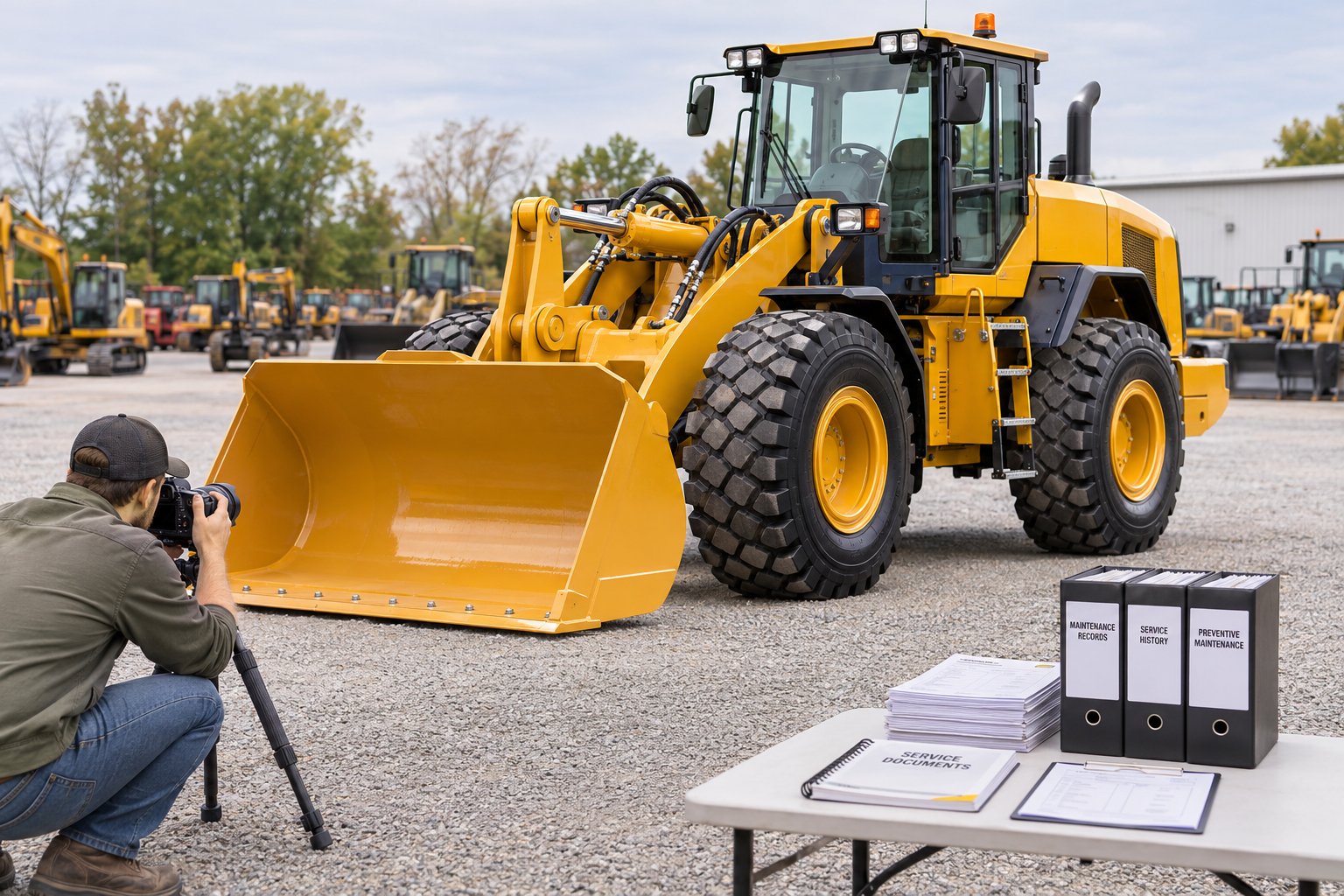
Organizing maintenance documentation. This is the single most undervalued pre-listing step. Gather every service record, oil sample report, component replacement invoice, and warranty document you have. Organize them chronologically. If you maintained the machine on a strict schedule, those records are worth real money - they're proof that the asset was cared for, and they give buyers the confidence to pay a premium rather than discounting for unknown risk. A Bobcat Caterpillar skid steer with a complete dealer service binder will outsell an identical machine with no paperwork almost every time, even if both are in the same mechanical condition.
Professional photography and video. You'll notice that the strongest listings on any platform share one trait: abundant, high-quality images. Shoot 20 to 30 photos minimum. Cover exterior angles from all four corners, close-ups of the undercarriage or tires, the engine compartment, the cab interior, the hour meter, the serial plate, and any attachments included. A walk-around video showing the machine starting cold, operating all functions, and driving under its own power is the single most powerful trust signal you can provide. Industry experts consistently emphasize that buyers appreciate convenient online access to detailed equipment information - and that transparency in photos and condition reporting accelerates the sale.
Choosing the Right Sales Channel
Where you list matters as much as how you list. Each sales channel offers a different balance of reach, control, speed, and cost. The right choice depends on your timeline, the type of equipment, its condition, and how much effort you're willing to invest in the selling process.
-
Online Marketplaces
Pros: Maximum exposure to a nationwide (or global) buyer pool. You control your asking price, listing description, and negotiation process. Platforms like EquipmentTrader.com, MachineryTrader.com, and IronPlanet host millions of monthly visitors searching for exactly the kind of machine you're selling. Listing fees are generally predictable - either a flat monthly rate or a per-listing charge.
Cons: You handle all buyer inquiries, negotiations, and deal logistics yourself. Listings can sit for weeks or months if priced incorrectly or poorly presented. There's no guarantee of sale by a specific date. Sellers listing in competitive markets - equipment trader Texas results, for instance, can return hundreds of similar machines - need sharp pricing and strong listings to stand out.
-
Consignment Dealers
Pros: A dealer sells the machine on your behalf, leveraging their showroom, sales team, and buyer network. Finning highlights that consignment offers the best of both worlds - less work, more return, and full control over pricing. You can often continue using the machine during the consignment period, which isn't possible when consigning to an auction house. Reputable dealers provide market-based valuations and guarantee the machine's condition during the consignment process.
Cons: Consignment fees reduce your net proceeds. Sale timelines are uncertain - the dealer is motivated to sell, but there's no fixed deadline. You're relying on the dealer's marketing and sales effort, which varies by dealership. Not every dealer accepts consignment for every machine type.
-
Auction Houses
Pros: Certainty of sale date. Auction companies like Ritchie Bros. concentrate large numbers of qualified buyers around scheduled events, creating competitive bidding that can drive prices above expectations. They handle marketing, buyer qualification, and transaction logistics. Unreserved auctions guarantee every item sells, eliminating the risk of a machine sitting unsold for months.
Cons: You give up price control entirely in an unreserved auction - the market decides what it's willing to pay, and that figure might be below your expectations. Buyer premiums (charged to the buyer) or seller commissions reduce net proceeds. The machine typically needs to be delivered to the auction site or made available for inspection in advance, which means it's out of service during that period. Timing is also a factor: if your auction falls during a soft market or off-season period, realized prices may disappoint.
-
Direct Private Sale
Pros: No listing fees, no commissions, no consignment charges. You negotiate directly with the buyer and keep the full sale price. If you already have a network of contacts in the industry - fellow contractors, equipment brokers, or neighboring operations - a private sale can close quickly with minimal cost.
Cons: Your buyer pool is limited to your personal network and whoever sees a social media post or word-of-mouth referral. Screening buyers is entirely your responsibility. There's no platform-level fraud protection. High-value transactions between individuals carry more legal and financial risk without proper documentation and escrow arrangements.
Many experienced sellers don't pick just one channel. They list on an online marketplace first to test pricing and gauge interest, then move to consignment or auction if the machine doesn't sell within a reasonable window. Ritchie Bros. advises researching selling methods based on your situation, the type and condition of equipment, and how quickly you need to complete the sale - because no single method is universally best.
Pricing Strategy and Market Positioning
Pricing is where most private sellers either stall out or leave money behind. Set the price too high and the listing goes stale - buyers learn to scroll past it. Set it too low and you hand a profit to whoever buys it. The sweet spot lives in the data, not in gut feeling.
Research comparable listings. Before setting your asking price, spend time on multiple trader platforms studying machines that match yours in make, model, year, hours, and condition. Look at five to ten comparable units. Note their asking prices, how long they've been listed (platforms often show listing dates), and how detailed their descriptions are. Equipment pricing research shows that listing prices are often "wishful thinking" rather than actual selling prices - so treat them as a ceiling, not a benchmark. Auction results from companies like Ritchie Bros. provide sold prices, which are more reliable indicators of what the market is actually willing to pay.
Account for condition, hours, attachments, and location. Two machines with the same year and model can differ by tens of thousands of dollars based on specifics. Consider:
- Hours relative to age. Standard usage is roughly 1,000 to 1,200 hours per year. A five-year-old machine with 3,000 hours is light-use and commands a premium. The same model with 8,000 hours has been worked hard and should be priced lower.
- Attachments and extras. A machine bundled with a quality bucket, hydraulic thumb, or specialty head is worth more than a bare unit. List attachments clearly and assign them value in your pricing rationale.
- Geographic pricing variation. The same loader may fetch a higher price in a state with strong construction demand than in an oversaturated market. If you're in a region where your machine type is common - such as a Travis Body & Trailer Inc dump body in a trucking-heavy market - you may need to price more aggressively or expand your listing reach to nationwide platforms.
- Emissions tier. Machines meeting Tier 4 Final standards sell for more in regulated states. Older-tier equipment may still hold strong value in markets without strict emissions requirements or in international export channels.
Price with negotiation room built in. List at five to ten percent above your minimum acceptable price. This gives buyers the satisfaction of negotiating a "win" while keeping you above your floor. Experienced buyers expect to negotiate, and a listing with zero flexibility signals either overconfidence or inflexibility - both of which slow down inquiries.
Transparency generates faster, stronger inquiries. This is the principle that separates listings that sell in weeks from those that linger for months. Include the hour reading, maintenance summary, known issues, and a clear price in every listing. Vague descriptions attract tire-kickers. Detailed, honest listings attract serious buyers who arrive ready to negotiate on specifics rather than wasting your time with lowball offers rooted in uncertainty. Tools like heavy equipment value trackers - including services from Rouse Services, which provides industry-standard pricing benchmarks - can help you anchor your asking price to real market data rather than guesswork.
Selling equipment well is ultimately a mirror image of buying well. The same principles that protect a buyer - thorough research, verified documentation, honest condition assessment - also serve the seller by building the trust that turns a listing into a closed deal. And whether you're buying your next machine or selling the one you've outgrown, the final step is always the same: a clear, actionable plan that turns research into results.
Smart Steps to Take Before Your Next Equipment Purchase
Research, verification, timing, configuration - every chapter in this guide points to the same underlying truth: the buyers and sellers who consistently get the best outcomes aren't luckier than everyone else. They're more methodical. They follow a repeatable process that eliminates guesswork before money changes hands. Whether you're sourcing your first compact track loader or cycling a 50-unit fleet through annual turnover, the steps below compress everything covered so far into a single, actionable framework you can apply to every transaction.
Your Pre-Purchase Action Plan
Treat this as a sequential checklist. Skipping a step might save time in the short run, but it almost always costs more in the long run - through overpaying, buying the wrong machine, or inheriting someone else's deferred maintenance. The ASA Machinery buyer's handbook reinforces this approach: the buyers who get consistently good results are not lucky - they are systematic, working through each step so that by the time they commit, there are no surprises left.
- Define your project requirements precisely. Start with the task, not the machine. What does the equipment need to do? How many hours per week will it run? What terrain, climate, and regulatory conditions apply to your job sites? A precise requirement prevents costly mismatches and keeps your search focused - a machine bought on impulse is almost always a machine bought at a premium.
- Identify the right equipment category and size class. Match the machine type to the work scope. Don't default to the biggest unit on the platform because it feels like a safer bet. A mini excavator handles residential utility work more efficiently than a standard model, and a compact track loader outperforms a full-size wheel loader on soft, confined sites. Use the category and configuration comparisons from earlier in this guide to narrow your options before you open a single listing.
- Research pricing across multiple platforms. Browse MachineryTrader, EquipmentTrader.com, auction result archives, and specialized supplier sites. Compare asking prices for machines matching your target make, model, year, and hour range. Cross-reference marketplace listings with completed auction results to understand the gap between asking prices and actual selling prices. Tools like Rouse Services benchmarks and platforms such as equipmenttraderonline.com help you anchor expectations to real market data - not wishful thinking.
- Factor in regional and seasonal timing. Check whether your state's emissions regulations limit which engine tiers you can operate. If you have flexibility on timing, consider purchasing during winter months or fiscal year-end windows when seller motivation is higher and buyer competition is thinner. A machine bought in January at a soft-market price and deployed in March gives you a head start that compounds across the project.
- Verify seller credibility thoroughly. Whether you're dealing with a dealer or a private seller, confirm business registrations, check platform-verified badges, read reviews, and request references. A transparent seller who welcomes questions is worth more than a slightly cheaper price from someone who avoids them.
- Conduct or commission a physical inspection. Walk through every item on the pre-purchase checklist: documented hours and service records, serial number verification, undercarriage or tire condition, hydraulic function testing, structural integrity, emissions compliance, and a cold start. For high-value or remote purchases, hire an independent third-party inspector. The inspection fee is trivial compared to the cost of discovering a hidden problem after the sale closes.
- Negotiate with documentation in hand. Armed with comparable pricing data, inspection findings, and a clear understanding of any deferred maintenance costs, you negotiate from a position of knowledge rather than hope. Every documented issue - worn tracks, a pending filter service, a hydraulic fitting that seeps - becomes a legitimate, data-backed negotiation point.
- Plan for post-purchase maintenance immediately. As the ASA handbook emphasizes, converting a used machine into a dependable asset starts on day one: fresh fluids and filters, a full safety check, and a maintenance log established from a known baseline. The care you put in during the first days of ownership pays off across every year that follows. Even a Kubota 65 or any other compact unit benefits from this reset - it establishes your ownership baseline and ensures no deferred service items carry over from the previous owner.
This framework applies equally whether you're browsing a machinetrader search at your desk or standing in a dealer's yard with a flashlight under the boom. The machines change. The discipline doesn't.
Building a Reliable Equipment Sourcing Network
Here's what separates first-time buyers from seasoned fleet managers: experienced operators never rely on a single platform. They build a sourcing network - a constellation of trusted channels they monitor continuously so that when a need arises, they already know where the best machines are and who's selling them.
That network typically includes several layers:
- Major marketplace sites like EquipmentTrader.com and MachineryTrader.com for broad selection and pricing visibility across thousands of listings.
- Auction platforms for competitive pricing benchmarks and opportunistic buys during off-season or fleet turnover events.
- Regional dealers who carry curated, inspected inventory and offer financing, warranties, and ongoing service relationships.
- Specialized suppliers who focus on specific machine types or serve particular buyer segments. For buyers exploring used construction machinery such as excavators, loaders, bulldozers, and graders, JIUHONG's equipment collection is one resource where contractors and equipment dealers can compare available machines and request purchase quotes alongside their research on broader trader platforms. JIUHONG is a machinery supplier and not affiliated with Equipment Trader or Machinery Trader branded platforms - it functions as a direct sourcing channel rather than a listing aggregator.
- Industry contacts and peer networks that surface private-sale opportunities before they ever reach a public listing.
Building this network takes time, but it pays dividends with every purchase. When you already know three reliable sources for the type of machine you need, you skip the weeks of cold searching that put inexperienced buyers at a disadvantage. You compare options across channels simultaneously. And you develop relationships with sellers who learn your preferences and alert you when the right machine comes available - sometimes before it hits the open market.
The same principle applies to sellers. Listing on one platform and waiting isn't a strategy - it's a gamble. The sellers covered in the previous chapter who move machines fastest are the ones working multiple channels: an online marketplace for broad exposure, a consignment dealer for hands-off convenience, and an auction as a backstop if other channels don't produce results within a set timeframe. Flexibility across channels mirrors the buyer's network approach - and both sides benefit from treating the equipment market as an ecosystem rather than a single storefront.
The contractors who consistently secure better equipment at better prices share one habit: they treat research as a non-negotiable step in every transaction, not as an optional extra when time permits. Preparation isn't overhead - it's the investment that makes every other dollar you spend on equipment work harder.
Every principle in this guide - from understanding how platforms operate and which categories fit your work, to verifying sellers, timing your purchase, choosing the right configuration, and listing equipment effectively - exists to replace uncertainty with knowledge. Apply the framework once, and you'll buy or sell with more confidence than most of your competitors. Apply it consistently, and it becomes second nature: a repeatable system that turns every equipment decision into a deliberate, informed investment in your operation.
Frequently Asked Questions About Equipment Trader Platforms
1. What is an equipment trader platform and how does it differ from an auction site?
An equipment trader platform is an online marketplace where buyers browse listings posted by dealers and private sellers at set asking prices, then contact sellers directly to negotiate. Auction sites, by contrast, use competitive bidding to determine the final price within a fixed timeframe. Marketplace platforms like EquipmentTrader.com give buyers maximum selection and negotiation flexibility, while auction houses like Ritchie Bros. offer sellers a guaranteed sale date. Many experienced contractors monitor both channels simultaneously - using marketplace listings to gauge fair-market value and auction results to spot machines selling below that benchmark.
2. How do I verify the condition of used heavy equipment before buying online?
Start by requesting full maintenance records and comparing documented service events against OEM-recommended intervals. Cross-reference the serial number with manufacturer databases to confirm the model year, recall history, and theft status. Then conduct or commission an in-person inspection covering the undercarriage or tires, hydraulic function, structural welds, boom integrity, and a cold start. For high-value or remote purchases, hiring an independent third-party inspector is strongly recommended. Physical wear on components like tracks, pins, seat upholstery, and pedal rubber should align with the stated hour-meter reading - discrepancies are a red flag.
3. When is the best time of year to buy used construction equipment?
Late winter (January through February) and the late-fall year-end window (November through December) are generally the strongest buyer's markets. Construction slows in cold-weather regions during winter, motivating sellers to clear inventory, while fiscal year-end fleet turnovers from large contractors flood the market with well-maintained, mid-life machines. Spring and summer bring peak construction demand, higher prices, and more competition among buyers. However, these seasonal patterns vary by region - year-round construction markets like Texas and Florida experience less dramatic winter discounts compared to northern states.
4. Should I buy new or used heavy equipment for my contracting business?
The decision hinges on project duration, utilization rate, maintenance capacity, and regulatory environment. Used equipment makes financial sense for single-project capacity expansion, testing a new equipment category, or budget-conscious startups, since the first owner absorbs the steepest depreciation. New equipment is worth the premium when you need manufacturer warranty protection, must meet strict emissions standards like California's CARB rules, want the latest GPS-guided and telematics technology, or plan to standardize a large fleet. Evaluating total cost of ownership - not just the sticker price - is the key to choosing the right tier.
5. How do I price my heavy equipment for sale on a trader platform?
Research five to ten comparable listings on multiple platforms matching your machine's make, model, year, hours, and condition. Cross-reference asking prices with completed auction results for more realistic sold-price data. Adjust for your machine's specific hours relative to age, included attachments, geographic demand, and emissions tier rating. List at roughly five to ten percent above your minimum acceptable price to allow negotiation room. Transparency in your listing - including the hour reading, maintenance summary, known issues, and detailed photos - attracts serious buyers and generates faster inquiries than vague descriptions. Heavy equipment value trackers from services like Rouse can help anchor your price to real market benchmarks.