

What Used Excavator Dealers Actually Do and Why Buyers Need Them
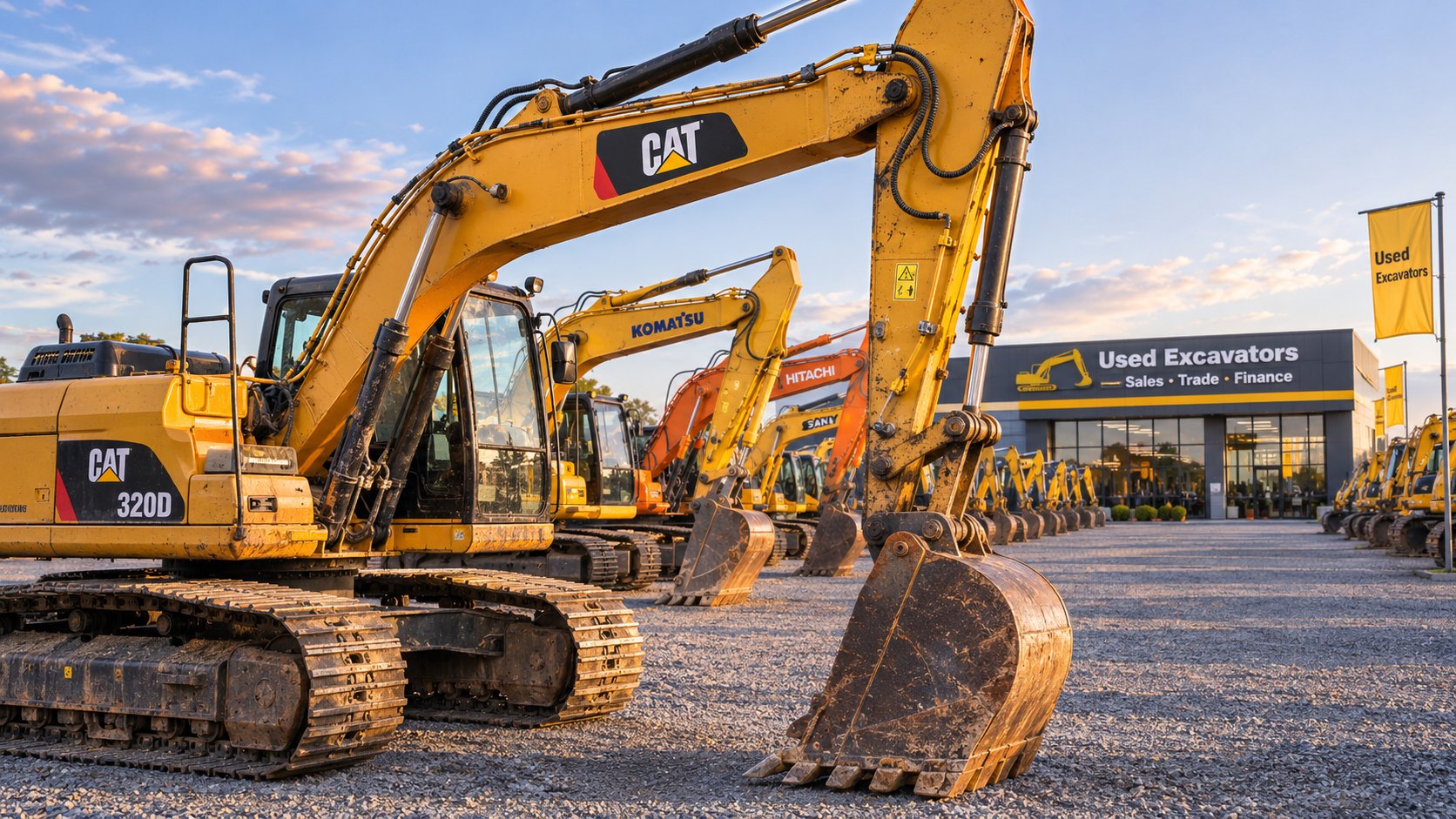
A used excavator for sale can show up in a lot of places: a buddy's equipment yard, an online auction feed, a broker's email blast, or the glossy lot of a full-service dealership. Each source carries a different level of risk, transparency, and after-sale support. Used excavator dealers occupy a specific lane in the heavy equipment market. They are businesses that acquire, inspect, and resell pre-owned machines - everything from compact mini excavators to a long reach excavator for sale on a major infrastructure project. Unlike a private seller looking to offload a single trackhoe, or an auction house that simply facilitates competitive bidding, a dealer stakes its reputation on curated inventory, some degree of mechanical vetting, potential warranty coverage, and structured transactional support.
That distinction matters more than most buyers realize. When you're spending anywhere from $30,000 to well over $200,000 on a single machine, the seller's business model directly shapes your exposure to risk. Private sellers may offer a lower price, but as Equipment World has documented, issues like undisclosed blanket liens can leave buyers losing both the machine and their money. Auction platforms give you breadth of selection, yet most units sell as-is with no post-sale support. Brokers connect buyers and sellers without ever owning the iron themselves.
The search for 'used excavator dealers' is fundamentally about trust - finding a source that reduces risk in a high-stakes purchase where a single bad decision can cost tens of thousands of dollars in hidden repairs, lien disputes, or downtime.
This guide is built entirely from the buyer's side of the table. No sales pitches, no dealer rankings - just a practical framework for navigating the market with confidence.
Why Used Excavator Dealers Exist
Brand-new excavators carry long lead times and premium price tags. The private resale market, on the other hand, is unpredictable and largely unregulated. Dealers fill the gap between those two extremes. They accept trade-ins from contractors upgrading their fleets, purchase machines coming off rental agreements, and sometimes refurbish units before listing them. The result is a centralized inventory where buyers can compare an excavator trackhoe side by side with other models, review documented service histories, and negotiate terms that include delivery, financing, or limited warranties. As RDO Equipment Co. points out, buying from a reputable dealer's rental fleet lowers risk because the maintenance has been performed by certified technicians with full records available.
Who This Guide Helps
Three types of buyers tend to search hardest for reliable sources of pre-owned excavators. First, contractors replacing aging fleet machines or expanding capacity for new projects - you need a unit that's ready to work on day one, not a money pit. Second, independent equipment dealers sourcing inventory for resale, where every dollar of hidden damage eats directly into margin. Third, international import buyers seeking specific models for overseas projects, often purchasing in bulk and shipping across borders. Whether you're comparing a single trackhoe for a local dig or evaluating a dozen units for export, the risks - misrepresented hours, hidden structural damage, unclear titles - are the same. The sections ahead break down exactly how to identify those risks, vet the sellers, and protect your investment before any money changes hands.
Five Types of Used Excavator Dealer Channels Compared
Not every seller operates the same way, and understanding the differences before you start shopping prevents costly surprises after money changes hands. The used excavator market breaks down into five distinct sourcing channels, each with its own trade-offs in pricing, transparency, buyer protections, and post-sale support. Most buyers default to whichever channel they stumble across first. Smarter buyers map the full landscape, then choose strategically.
Here is how those five channels stack up side by side:
| Channel Type | Inventory Transparency | Buyer Protections | Pricing Model | Post-Sale Support | Best For |
|---|---|---|---|---|---|
| Authorized OEM Dealers (e.g., Cat Certified Used, Komatsu Approved) | High - multi-point inspections, verified hours, detailed photos | Limited warranties, certified programs, clear title guarantees | Fixed pricing with limited negotiation; premium over market | Full parts, service, and warranty departments on-site | Buyers who prioritize peace of mind over lowest price |
| Independent Used Equipment Dealers | Varies widely - ranges from thorough documentation to minimal disclosure | May offer short mechanical warranties or inspection periods; no standardized program | Negotiable; margins typically 15-25% above private market value | Some offer in-house service; others are listing-only operations | Buyers seeking mid-range pricing with some transactional support |
| Online Auction Platforms (e.g., Ritchie Bros., IronPlanet, Marketplace-E) | Moderate - inspection reports available but vary in depth; IronPlanet offers IronClad Assurance on select units | Limited; most sales are as-is with buyer's premium of 10-15% | Competitive bidding (live or timed); prices driven by demand | Minimal to none post-sale | Experienced buyers comfortable evaluating machines independently |
| Equipment Brokers | Depends on broker quality; good brokers coordinate third-party inspections and provide transaction data | No direct warranties; protection comes from broker-facilitated inspection and negotiation | Private negotiation; broker commission (typically 5-10%) usually paid by seller | Logistics coordination; no mechanical service | Buyers seeking specific configurations, hard-to-find models, or off-market inventory |
| Direct Private-Party Sales | Low - buyer must independently verify all claims | Virtually none; sold as-is with no recourse | Fully negotiable; potential for lowest purchase price | None | Highly knowledgeable buyers with mechanical evaluation capability |
That table gives you the big picture. The details below each channel type reveal where the real advantages and pitfalls hide.
Authorized OEM Dealers and Certified Used Programs
When a dealer carries authorized status from a manufacturer like Caterpillar, Komatsu, Volvo, or Hyundai, it means the OEM has vetted their facility, technicians, and business practices to meet brand-specific standards. This is not just a marketing badge. Authorized dealers gain access to proprietary diagnostic tools, OEM parts pipelines, and - critically - certified used programs that independent sellers cannot replicate.
Take Cat Certified Used as an example. Machines entering this program undergo a multi-point inspection covering the engine, hydraulic system, undercarriage, structural components, and electronics. Units that pass receive a limited powertrain warranty and verified documentation, including confirmed hour-meter readings cross-referenced with Cat's own telematics data. Volvo's Certified Used program follows a similar model, with machines inspected and their condition formally certified before listing. Komatsu and Hitachi run comparable programs through their dealer networks.
Why does this trust signal matter? Because it shifts risk away from the buyer. You're not relying solely on your own inspection skills or a seller's verbal assurances. The OEM's reputation is tied to the machine's condition. Regional dealers like Foley Equipment leverage their authorized Cat dealer status precisely because buyers searching for excavators for sale recognize that certification reduces the unknowns. The trade-off is price - expect to pay a premium of 10-20% over comparable uncertified machines. For many buyers, especially those without in-house mechanics, that premium is cheap insurance.
Auction Platforms and Online Marketplaces
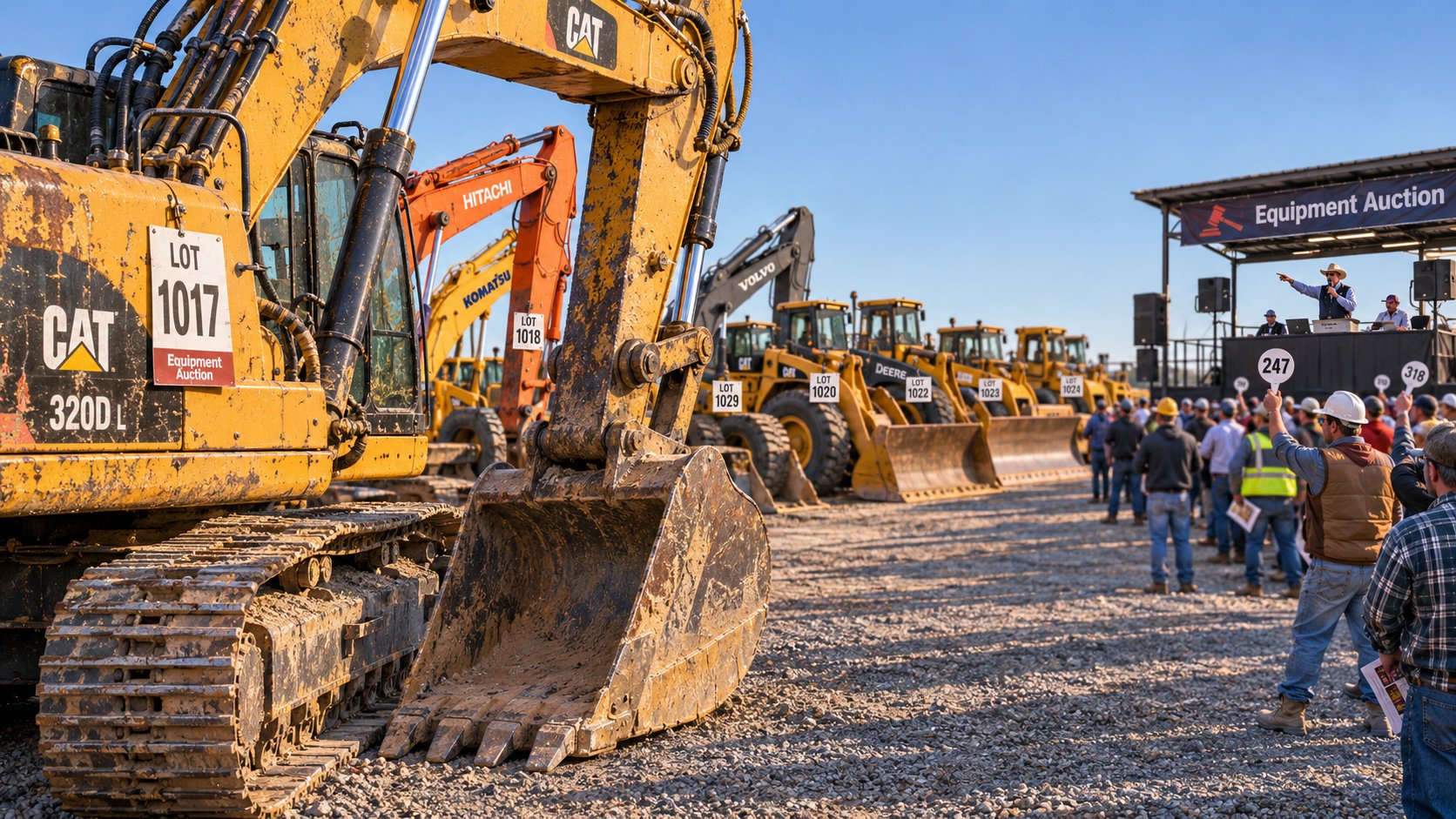
Auction-based platforms function as a distinct dealer channel, even though they don't technically "deal" in the traditional sense. Ritchie Bros. operates the largest ecosystem in this space, encompassing live on-site auctions, timed online auctions through its main platform, the IronPlanet marketplace for inspected equipment with its IronClad Assurance guarantee on qualifying units, and Marketplace-E for negotiated private-treaty sales. Each sub-platform serves a different buyer profile.
Live and timed auctions reward preparation. As Volvo CE's auction buying guide emphasizes, researching what similar makes and models have actually sold for - not just what they were listed at - is essential before setting your bidding ceiling. Ritchie Bros. provides 24 months of historical selling prices to registered users, which helps calibrate expectations. The risk? Unreserved auctions can produce genuine bargains, but bidding momentum and buyer's premiums (typically 10-15%) can push the final acquisition cost well above private-market value if you're not disciplined.
Not every buyer wants to compete in a bidding war, though. Direct-purchase alternatives let you browse a used excavator for sale at a fixed or negotiable price, request model-specific quotes, and take the time to arrange inspections before committing. This matters especially when you're sourcing a specific configuration - say, a particular size class with low hours and a hydraulic thumb - where auction availability is unpredictable.
Independent Dealers and Equipment Brokers
Independent dealers and brokers often get lumped together, but they operate on fundamentally different business models. Understanding the distinction protects you from misplaced expectations.
An independent dealer owns physical inventory. They've purchased machines outright - from trade-ins, fleet disposals, or other dealers - and carry the overhead of a yard, staff, and (sometimes) a service shop. Their margin is built into the selling price. The quality range is enormous: some independents rival authorized OEM dealers in documentation and post-sale support, while others are little more than a gravel lot with a website. The vetting process covered in the next section helps you tell the difference.
A broker, by contrast, typically doesn't own the equipment at all. As Ironmart's broker guide explains, brokers act as intermediaries who maintain networks of fleet operators, rental companies, and private sellers. They source machines matching your specifications, coordinate inspections, negotiate pricing, and manage logistics - often accessing pre-market inventory that hasn't hit public listings yet. Most brokers earn a seller-paid commission of 5-10%, meaning the buyer pays nothing directly. The value proposition is strongest when you need a specific machine quickly, you're buying outside your local market, or the transaction exceeds $75,000-$100,000 where even modest pricing improvements justify the broker's involvement.
One important nuance for buyers searching for excavators near me or browsing international listings: equipment exported from China through independent dealers is not necessarily manufactured by a Chinese brand. Many of these machines are used Japanese-brand units (Komatsu, Hitachi, Kobelco), Korean models (Hyundai, Doosan), or American machines (Caterpillar, Deere) that have been resold through export-focused dealers. The country a machine ships from and the country where it was manufactured are two entirely different data points - and confusing them can lead to incorrect assumptions about quality, parts availability, or resale value.
Each of these five channels has a legitimate place in the market. The real question isn't which channel is "best" - it's which channel matches your risk tolerance, budget, timeline, and ability to evaluate a machine independently. That evaluation skill is exactly where most buyers feel the least confident, and where the greatest financial exposure hides.
How to Vet and Choose a Reputable Used Excavator Dealer
Knowing the five sourcing channels is useful. Knowing how to separate a trustworthy seller from a risky one within any of those channels is what actually protects your money. Here is the uncomfortable truth: every competing page that ranks for "used excavators for sale" is itself a dealer or marketplace. None of them have any incentive to teach you how to scrutinize sellers - including themselves. This section does exactly that.
Think of dealer vetting as a three-layer filter. Each layer eliminates a different category of risk. Skip one, and you leave a gap that can cost you far more than the excavator price itself.
Verify Business Credentials and Brand Partnerships
Start with the basics that most buyers overlook entirely. Is the dealer a registered business entity? You can confirm this through your state's Secretary of State business registry in minutes. Look for longevity - a company that has been operating for a decade tells a different story than one incorporated six months ago. Multiple branch offices, as seen with regional dealers spanning territories like Kansas and Missouri or Pennsylvania and Ohio, suggest both scale and staying power.
Check whether the dealer holds authorized status with any OEM. As discussed earlier, authorized dealer programs from Caterpillar, Komatsu, and Volvo require meeting manufacturer standards for facilities, technicians, and business practices. That authorization is independently verifiable through the OEM's own dealer locator tools.
Membership in industry associations like the Independent Equipment Dealers Association (IEDA) also functions as a credibility marker. As Dennis Howard of RDO Equipment Co. noted, dealerships belonging to IEDA are committed to the highest ethical standards. It is not a guarantee of perfection, but it is a voluntary commitment to accountability.
Full-service dealers deserve extra attention here. When a business operates parts, service, and sales departments under one roof, they have ongoing skin in the game. A listing-only marketplace disappears from your life the moment the transaction closes. A dealer with a service bay down the hall from the sales office needs you to come back - and that incentive shapes how they treat the first sale. Whether you are sourcing a compact unit or a 20 ton excavator for a major earthmoving project, that post-sale relationship can save you thousands in parts access and warranty support alone.
Assess Inventory Transparency and Documentation Practices
How a dealer handles documentation before the sale tells you almost everything about how they will handle problems after the sale. A reputable seller should provide detailed information upfront - not as a favor, but as standard operating procedure.
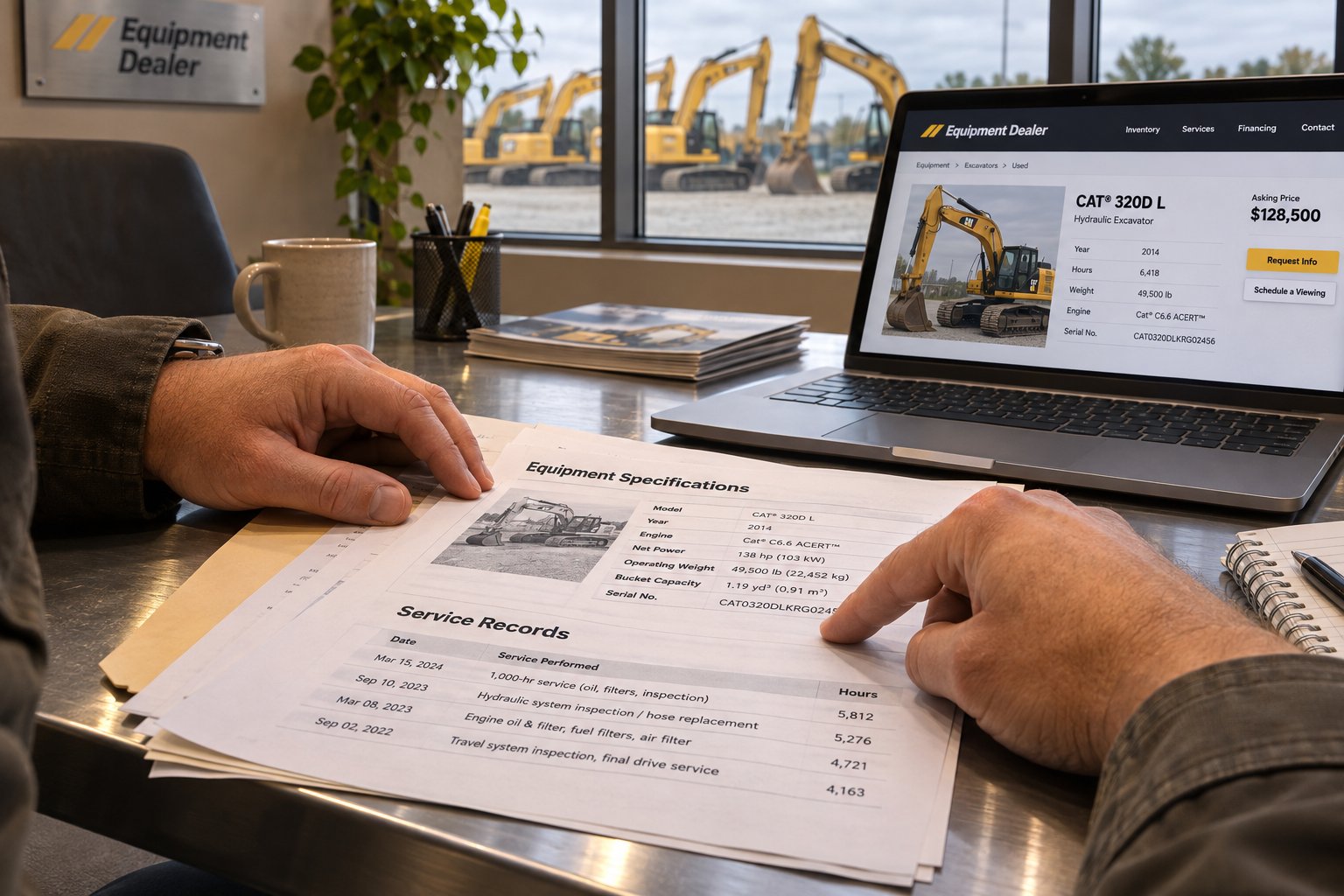
Imagine you inquire about a mid-size excavator listed on a dealer's website. Before you drive two hours to inspect it or wire a deposit, you should already have access to a meaningful documentation package. Dealers who resist sharing this information until you show up in person - or worse, until after a deposit clears - are waving a red flag.
Here is the minimum documentation you should expect from any professional dealer before committing to a site visit or deposit:
- Machine history report including previous ownership type (rental fleet, single-owner contractor, government surplus)
- Verified engine-hour readings, ideally cross-referenced with OEM telematics data where available
- Maintenance and service records showing completed intervals for oil changes, filter replacements, and hydraulic service
- Clear title documentation confirming no outstanding liens or encumbrances
- High-resolution photography from multiple angles - exterior, cab interior, undercarriage, and any visible wear areas
- Pre-sale inspection report, if one has been performed, with specific findings rather than generic "good condition" language
As industry vetting guidance emphasizes, telematics data retrieval has become an increasingly valuable verification tool. Many machines manufactured after 2018 by brands like Cat, Komatsu, and Volvo have onboard systems that log actual working hours, fault codes, and maintenance events. You can request this data directly from the manufacturer using the machine's serial number - and compare it against whatever the dealer has provided. Discrepancies between dealer-reported hours and OEM telematics records are one of the clearest indicators of misrepresentation.
Check Reputation Signals Beyond the Dealer's Own Website
Every dealer's website tells the same story: great inventory, happy customers, unbeatable service. The signals that actually matter live elsewhere.
Start by searching the dealer's name alongside terms like "complaint," "lawsuit," or "fraud" in a standard search engine. Check their standing with the Better Business Bureau. Cross-reference Google reviews with complaints filed through state consumer protection offices. A pattern of unresolved disputes matters far more than a single negative review.
Request references directly. Ask the dealer for contact information of two or three recent buyers who purchased similar equipment - a comparable size class, a similar price range. As RDO Equipment's Howard put it bluntly in a CONEXPO-CON/AGG interview, "If a seller can't give you references of other people they sold to, I would stay away."
One more step that catches more problems than you might expect: call the dealer and ask specific technical questions about a listed machine. What is the undercarriage percentage remaining? Has the hydraulic pump been tested? What attachments are included and what is the quick-coupler configuration? A knowledgeable salesperson who answers confidently and specifically signals a dealer that actually inspects and understands its inventory. Vague responses, deflections, or pressure to "just come see it" suggest the opposite.
Finally, verify that listed machines actually exist. Phantom listings - advertising units that have already sold or never existed - are used by some sellers to generate leads and then redirect buyers toward different, often less desirable, inventory. A quick phone call confirming availability, serial number, and location before you travel eliminates this waste of time entirely.
Vetting the dealer gets you to a trustworthy source. But even a reputable seller can list a machine with hidden mechanical issues that only a hands-on technical inspection will uncover - and that inspection requires knowing exactly where to look and what wear patterns actually mean for your wallet.
Pre-Purchase Inspection Essentials for Used Excavators
A dealer's reputation opens the door. What you find - or fail to find - during a hands-on mechanical inspection determines whether you walk through it or walk away. Every excavator for sale near me listing and every polished dealer photo can mask problems that only reveal themselves under closer scrutiny. This section gives you the technical framework to evaluate a used excavator the way a seasoned equipment mechanic would, focusing on the three systems where hidden damage costs the most: undercarriage, hydraulics, and engine.
Whether you're evaluating a compact unit on a local dealer's lot or flying in to inspect a machine listed halfway across the country, these checks apply universally.
Undercarriage and Track Condition Assessment
The undercarriage is the most expensive maintenance system on any track excavator. As Volvo CE's undercarriage inspection guide points out, it supports the total weight of the machine and is continuously subjected to rocks, debris, and uneven terrain during operation. Replacing a full undercarriage on a mid-size excavator can run $15,000 to $40,000 depending on the brand and size class - a cost that dramatically reshapes the economics of any purchase if you miss it during evaluation.
Start by asking the dealer for a formal undercarriage measurement report. This document records the remaining material on key wear components and expresses it as a percentage-worn figure. Here is what those percentages mean practically:
- 0-30% worn: Components are in good to excellent condition with substantial remaining service life. This is what you want to see on a machine marketed as low-usage.
- 30-50% worn: Normal mid-life wear. Factor in the cost of eventual replacement but don't expect immediate expenditure.
- 50-70% worn: Components are approaching the end of their serviceable range. Budget for near-term replacement and negotiate the purchase price accordingly.
- 70%+ worn: Replacement is imminent. At this stage, you're effectively buying a machine that needs a major undercarriage overhaul - and the price should reflect that reality dollar for dollar.
Beyond the measurement report, conduct a visual inspection one side at a time. Volvo's technicians recommend remembering that the sprocket sits at the rear and the idler at the front, so you don't confuse left-side and right-side readings. Pay close attention to these components:
- Track shoes: Look for uneven wear across the shoe width, missing or cracked grousers, and excessive thinning of the shoe plate. Machines that have spent significant time working on concrete or rock surfaces show dramatically accelerated shoe wear compared to dirt-work units.
- Rollers and idlers: Check for oil leaks around the seals, which indicate internal bearing failure. Spin the rollers by hand if possible - grinding or resistance suggests contamination or wear inside the sealed unit.
- Sprocket tooth profiles: Worn sprocket teeth develop a hooked or shark-fin profile instead of the original symmetrical shape. Severely worn sprockets accelerate track chain wear, creating a cascading replacement cycle.
- Track tension: Measure the sag between the track frame and the track chain. Over-tight tracks increase wear on every component in the system. Loose tracks risk de-tracking during operation. Correct tension specifications are listed in the operator's manual for each model.
Compare both sides of the undercarriage against each other. If one side shows noticeably more wear, it suggests the machine has been working primarily in one direction on slopes or in trench applications - not a deal-breaker, but a data point that informs future maintenance planning.
Hydraulic System and Engine Health Indicators
If the undercarriage is the most expensive wear system, the hydraulic circuit is the heart that makes everything else function. Breakout force, boom lift capacity, swing torque, and attachment performance all depend on hydraulic pressure and flow rate operating within the manufacturer's specifications. A compromised hydraulic system doesn't just reduce productivity - it signals that expensive pump, valve, or cylinder repairs are on the horizon.
Start with a hydraulic cylinder drift test. With the engine running and the machine at operating temperature, raise the boom to full height, curl the bucket in, and shut off the engine. Watch for how far the boom drops or how much the bucket uncurls over a five-minute period. Some drift is normal, but rapid or excessive drop indicates worn cylinder seals, internal valve leakage, or a failing check valve. Ask the dealer what the manufacturer's allowable drift specification is for that particular model - anything beyond it warrants further investigation.
Next, check for visible hydraulic leaks at every fitting, hose junction, cylinder rod seal, and swivel joint. As Heavy Vehicle Inspection's equipment checklist standards note, cracked hoses, weeping fittings, and scored cylinder rods are the number-one cause of equipment downtime on construction sites. A small drip under operating pressure can escalate to a catastrophic burst within minutes. Look carefully at the cylinder rods themselves - pitting, scoring, or chrome flaking means the rod is damaging the seals with every stroke and needs resurfacing or replacement.
Oil-sample analysis is the single most informative diagnostic you can request. A standard hydraulic oil analysis panel measures particle counts (reported as an ISO cleanliness code), elemental wear metals like iron, copper, and chromium, fluid viscosity compared to factory specification, water content in parts per million, and acid number indicating oxidation. Elevated iron particles point toward cylinder bore or valve body wear. Copper and bronze suggest bushing or thrust plate degradation in pumps. Rising particle counts, especially at the smaller micron sizes, often indicate developing wear in pumps or valves before any performance symptoms appear. Ask the dealer whether recent oil samples are available - a seller who proactively tests fluid health demonstrates a maintenance-first mindset.
For engine evaluation, understand the distinction between engine hours and calendar age - they tell very different stories. A machine with 5,000 hours accumulated over three years of continuous commercial use has likely been maintained on a disciplined schedule, run at consistent operating temperatures, and kept its seals lubricated. A machine with the same 5,000 hours spread over ten years may have endured long idle periods where moisture accumulated internally, seals dried and cracked, and corrosion developed in coolant passages. Low hours on an old machine are not automatically a bargain. Ask about the machine's duty cycle history and whether it sat unused for extended periods.
Here is a portable pre-purchase inspection checklist you can carry to any dealer lot or trackhoe rental return evaluation:
- Structural frame cracks: Inspect the main frame, swing frame, and blade mount points for fatigue cracks, especially at weld joints and high-stress intersections
- Pin and bushing play: Grab the bucket and rock it side to side - excessive movement indicates worn pins and bushings in the linkage, a repair that can cost several thousand dollars per joint
- Boom and stick straightness: Sight along the boom and stick from the side. Any bowing, twisting, or visible weld repairs suggests past structural overload or damage
- Bucket edge condition: Check cutting edge thickness, tooth adapter wear, and side cutter condition. A worn-out bucket isn't expensive to replace, but it tells you how hard the machine has been worked
- Cab ergonomics and controls: Operate every joystick, pedal, and switch. Test the HVAC system, check seat condition and seatbelt function, and confirm all gauges and displays respond correctly
- Electrical system function: Test all lights, backup alarm, horn, and any onboard monitoring systems. Check the battery terminals for corrosion and verify the charging system output at idle
Why Dealer-Provided Inspections Are Not Enough
Even when you're buying from a reputable, well-vetted dealer, the inspection report they hand you has an inherent limitation: the dealer is both the evaluator and the party who profits from the sale. That doesn't mean their reports are dishonest - many are thorough and accurate. It means you're relying on a single perspective from a party with a financial interest in the outcome.
Hiring an independent third-party inspector adds a layer of protection that pays for itself many times over. Independent inspectors typically charge $300 to $800 depending on machine size, location, and the depth of testing requested. For a purchase that may exceed $100,000, that investment is negligible compared to the cost of a missed hydraulic pump failure or an undetected frame crack. As industry inspection standards emphasize, fatigue cracks in booms, sticks, and main frames develop gradually and can cause sudden, catastrophic failure under load - these require close visual inspection at weld joints and high-stress areas, not just a quick glance.
If a third-party inspector isn't feasible, request specific diagnostic reports from the dealer instead of accepting a generic condition summary. Ask for hydraulic pump flow-rate test results measured against the manufacturer's specification. Request a compression test or blow-by measurement on the engine. Ask whether telematics data is available showing fault-code history. These targeted data points are far more useful than a blanket statement that the machine is in "good working condition."
One additional checkpoint applies specifically to zero-tail-swing and reduced-tail-swing configurations. These compact-footprint designs are popular for urban and confined-space work, but they pack the same hydraulic and engine components into a tighter envelope. Confirm that the swing-radius specification matches the manufacturer's original data for that model. If someone has modified the counterweight, relocated components, or altered the superstructure to change the tail swing, the machine's stability ratings and lifting capacities may no longer match the spec sheet - creating both a safety hazard and a potential liability issue.
A thorough inspection protects you from mechanical surprises. But even the healthiest machine can become a financial burden if you overpay for it - and knowing what drives pricing in the used excavator market, and when the best negotiation windows open, is the difference between a good deal and an expensive lesson.
Understanding Used Excavator Pricing and Market Timing
You've vetted the dealer. You've inspected the machine. The hydraulic drift test checked out, the undercarriage measurements came back at 25% worn, and the oil analysis looks clean. Everything points toward a solid purchase - but how do you know if the price is right? Pricing in the used excavator market is not arbitrary, yet it often feels that way to buyers seeing wildly different numbers for seemingly similar machines. The gap between a smart purchase and an overpriced one comes down to understanding what actually moves the needle on value - and when market conditions tilt in the buyer's favor.
What Drives Used Excavator Prices
Six primary variables account for the vast majority of price differences you'll encounter when browsing excavators for sale near me listings or comparing quotes from multiple dealers. Miss even one, and your sense of fair market value drifts off target.
Brand and model set the baseline. Caterpillar and Komatsu consistently command an 8-15% premium over comparable machines from Hyundai or Doosan at auction, as 2026 auction transaction data confirms. That premium reflects dealer network density, parts availability, and stronger residual values - a 2020 Cat 320 with 4,000 hours lists at $118,000-$135,000 on the dealer market, while a comparable Komatsu PC210 sits at $108,000-$122,000. The brand gap is real, persistent, and baked into every listing you'll evaluate.
Engine hours function as the primary wear metric. Sub-3,000-hour machines command a 20-35% premium over comparable units with 6,000+ hours in the same model year. But raw hours need context - what qualifies as "low usage" shifts dramatically by size class. For compact excavators under 6 tons, anything below 2,000 hours is genuinely low. For standard 20-ton machines working commercial construction, 3,000-4,000 hours represents moderate use. A large excavator over 30 tons in mining or heavy earthmoving might accumulate 2,000 hours per year as routine operation. When marketplace filters offer categories like "Low Usage," understand that those labels are often self-reported by sellers and rarely standardized across platforms.
Undercarriage condition deserves its own pricing line item. As covered in the inspection section, replacement runs $14,000-$22,000 on a standard mid-size unit and significantly more on larger machines. Dealers who know their inventory price accordingly - a machine with 60% undercarriage wear should be listed meaningfully below an otherwise identical unit at 20% wear. If it isn't, that's your negotiation lever.
Attachment packages shift value more than many buyers realize. A machine bundled with a hydraulic thumb, quick coupler, and two bucket sizes can carry $8,000-$15,000 in additional value compared to a bare unit. Conversely, a machine listed without attachments means you'll spend that money separately before the excavator is job-ready.
Geographic location still influences pricing, though the gap is narrowing. Digital auction platforms now account for a significant share of all used construction equipment transactions in the U.S., and that transparency has compressed regional price differences. A used excavator that once sold for 18% more in the Southeast than the Midwest now shows a gap under 9%, according to recent market analysis. Regional arbitrage opportunities still exist, but they're smaller and shorter-lived than they were five years ago.
Overall market supply acts as the macro lever. Post-construction boom cycles flood the secondary market with trade-ins and fleet disposals, depressing prices 10-18% over a 12-18 month window. The reverse happens during equipment shortages - when new-machine lead times stretch out, contractors pivot to used inventory, and prices climb accordingly.
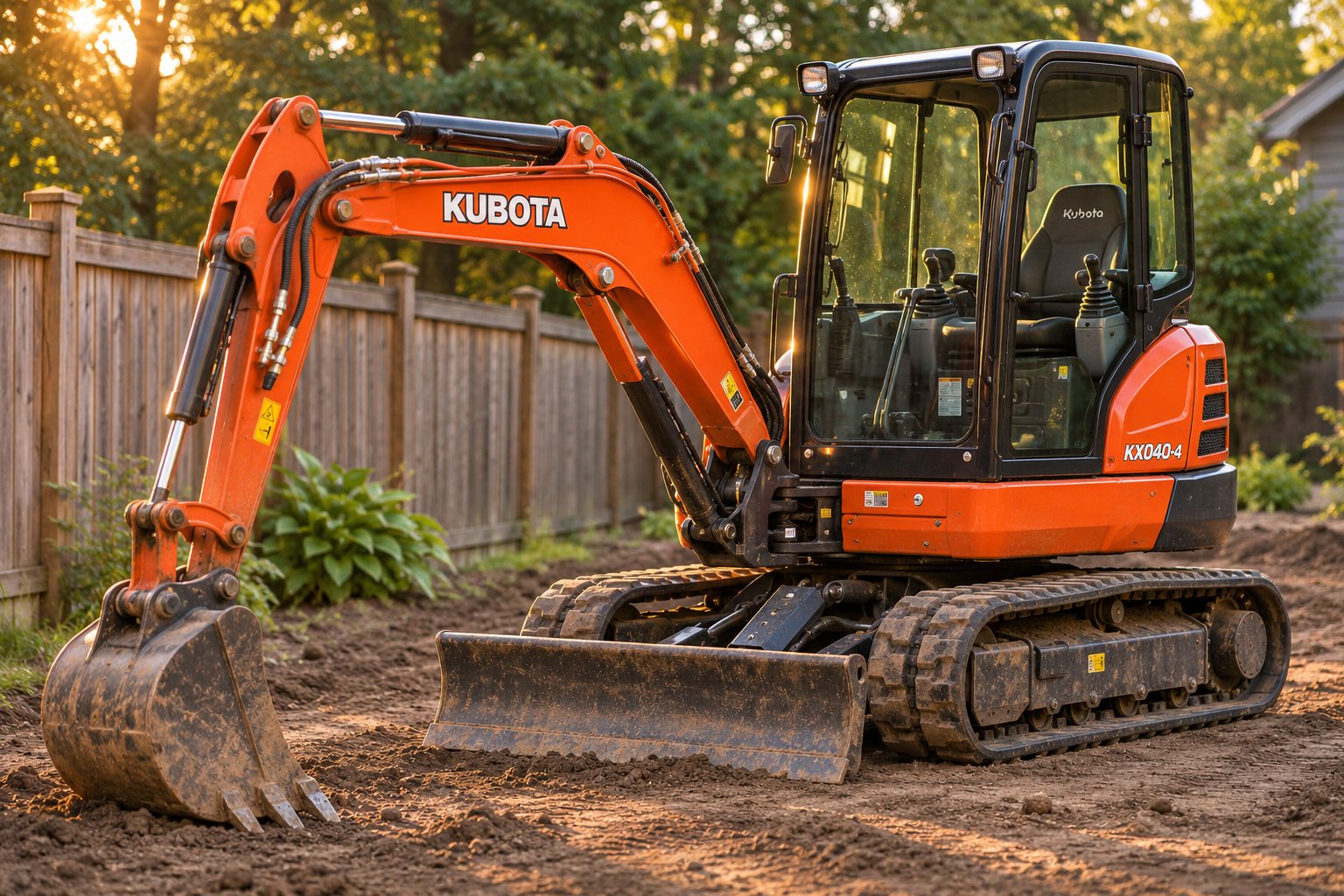
The price of an excavator varies enormously across size classes. Compact machines under 6 tons in good condition trade between $32,000 and $68,000. Step up to a mid-size unit like a 20-ton excavator and you're looking at $80,000-$150,000 for good-condition examples. Large excavators above 30 tons start at $130,000 and can exceed $260,000 for low-hour premium-brand units. Knowing which class you need - and being realistic about it - prevents the common mistake of shopping outside your actual budget range.
Seasonal Trends and Negotiation Windows
Timing a purchase well won't turn a bad deal into a good one, but it can shift the math by 5-15% on an already solid opportunity. Used excavator prices follow patterns that repeat with reasonable consistency year over year.
Prices tend to soften during late fall and winter when construction activity slows across northern climates. As Rackers Equipment Company's market timing analysis notes, prices often rise in late winter and spring when new projects ramp up, then drop again as work wraps up for the season. Buyers who can plan purchases before peak demand hits typically find better pricing and a wider selection of available machines.
Major new-model releases create a second window. When OEMs launch next-generation machines, dealers see a wave of trade-ins as fleet operators upgrade. Those trade-ins need to move, and dealer lots with swelling inventory create negotiation room that doesn't exist when shelves are bare. Watch manufacturer announcement cycles - a new Cat 320 series launch, for example, predictably pushes previous-generation units onto the secondary market within three to six months.
Broader economic slowdowns reduce equipment demand across the board. When project pipelines thin and contractors hold capital, sellers compete harder for fewer buyers. If your own business is positioned to buy during these periods - because you have capital reserves or secured financing - you'll find the most motivated sellers and the deepest discounts.
How you negotiate also depends on the dealer type. Authorized OEM dealers typically have less pricing flexibility because their margins fund certified programs, warranty coverage, and service infrastructure. Independent dealers and brokers, operating with lower overhead and without OEM pricing constraints, often have considerably more room to move. A broker working on commission, for instance, may accept a thinner margin to close a deal rather than lose it entirely.
The best negotiation leverage comes from being an informed buyer who can cite specific condition issues identified during inspection - a worn undercarriage, aging hydraulic hoses, or hours approaching a major service interval give you concrete, defensible reasons to request a price adjustment rather than simply asking for a discount.
Rental vs. Purchase Cost Comparison
Before committing to any dealer purchase, consider whether buying is actually the right move for your situation. Trackhoe rental and excavator rental prices should factor into your total cost-of-ownership math - not as an afterthought, but as a genuine alternative scenario.
The decision framework is simpler than most people make it. Cleveland Brothers' 2026 rent-vs-buy analysis identifies the utilization threshold clearly: ownership generally becomes economical when a machine works 60-70% of available days annually, roughly 150-180 days. Below that, rental usually costs less once you account for depreciation, maintenance, insurance, and storage. If your excavator would sit idle four months each winter or only run on specific project types a few times per year, rental eliminates carrying costs entirely.
For high-utilization machines - an excavator running 200+ days annually on a predictable pipeline of work - purchasing from a dealer almost always wins on a per-day cost basis. You spread fixed ownership costs across more productive hours, build equity in a depreciating but still valuable asset, and avoid the availability uncertainty that comes with relying on rental fleets during peak season. Some buyers browsing listings at sources like united rentals used equipment for sale are specifically targeting ex-rental machines because they know these units have been maintained on strict OEM intervals during their rental life - making them solid purchase candidates when the rental company cycles them out.
The hybrid approach works best for many contractors: own your core high-utilization excavator, rent specialty sizes or configurations as projects require them. You capture the cost advantage of ownership where it matters most while avoiding the capital trap of machines that spend more time parked than working.
Pricing knowledge and market timing put you in a stronger buying position, but they don't address two critical questions that arise the moment you're ready to commit: how will you pay for the machine, and what protections will the dealer provide after the check clears?
Financing Options and Buyer Protections to Expect from Dealers
How much does an excavator cost? Depending on size class, brand, and condition, the answer ranges from $30,000 for a solid compact unit to well over $250,000 for a low-hour large machine. Very few buyers - even well-capitalized contractors - write a single check for that amount without flinching. And yet, almost no dealer website and no competing guide explains how the financing actually works or what protections you should demand in writing before wiring funds. These two topics are deeply connected: the way you pay for a machine and the safeguards attached to the transaction together determine whether a good purchase stays good long after delivery day.
Dealer Financing vs. Equipment Loans vs. Lease-to-Own
Three primary financing paths exist for used excavator purchases, each with distinct trade-offs in convenience, cost, and ownership structure. Picking the cheapest monthly payment without understanding the total cost of each option is one of the most expensive mistakes buyers make.
Dealer financing is arranged directly through the seller's lending partners. You fill out a credit application at the dealership, the dealer submits it to one or more affiliated lenders, and - if approved - you sign the paperwork at the same desk where you negotiated the machine price. The convenience is real: one location, one transaction, minimal friction. The trade-off? Dealer-arranged financing may carry higher interest rates than what you could secure independently because the dealer often receives a referral fee or rate markup from the lender. Always ask the dealer to disclose their lender's base rate separately from any dealer markup.
Equipment loans through banks, credit unions, or specialized commercial equipment finance companies use the machine itself as collateral - much like an auto loan secured by the vehicle. You own the excavator from day one, build equity with each payment, and take full responsibility for maintenance, insurance, and depreciation. As Pathward's equipment financing analysis explains, equipment loans may require a down payment upfront and involve fixed monthly payments over a defined term, with the lien released once the loan is paid in full. This path typically offers the lowest total financing cost for buyers who plan to keep the machine long-term and can handle a 10-20% down payment.
Lease-to-own arrangements let you operate the machine while building equity toward eventual ownership. Lease structures vary significantly. A $1 buyout lease functions almost identically to a loan - you pay slightly higher monthly amounts but own the equipment outright after a final dollar payment. A fair market value (FMV) lease keeps monthly costs lower but requires you to either return the machine, renew the lease, or purchase it at current market value when the term expires. Pathward notes that leasing provides flexibility and lower initial costs, but if you plan to use the asset long-term, it can become the more expensive option over the machine's useful life.
How much is an excavator going to cost you in total - not just sticker price, but sticker price plus every dollar of interest, fees, and insurance premiums over the financing term? That total acquisition cost is the number that matters. A machine listed at $95,000 financed at 8.5% over 60 months costs you roughly $117,400 in total payments. The same machine financed at 6.2% through a competitive equipment lender totals approximately $110,600. That $6,800 difference buys a lot of maintenance, fuel, or even a down payment on your next piece of iron. Get quotes from at least two independent lenders before accepting dealer-arranged financing, and compare total repayment amounts rather than monthly figures alone.
Warranties, Certifications, and Return Policies
Financing determines how you pay. Buyer protections determine what happens when something goes wrong after you've paid. The gap between buying from a dealer who stands behind the machine and buying from one who disappears after the wire clears is the difference between a manageable repair and a financial catastrophe.
OEM certified used programs offer the strongest standardized protections in the market. Cat Certified Used is the most widely recognized. According to Gregory Poole Equipment Company, an authorized Cat dealer with over 70 years of experience, the Cat certified inspection involves a 140-plus-point visual and mechanical audit covering the engine, transmission, hydraulics, structural components, electrical systems, cab and controls, and undercarriage. Machines must meet strict eligibility criteria - typically no more than five years old with operating hours falling within program-defined limits. Components rated "poor" during inspection must be replaced with genuine Cat parts before the machine qualifies for certification.
What does the buyer actually get? Defined coverage on powertrain and hydraulic components, dealer-backed claims processing, covered repairs without out-of-pocket deductible expenses for parts or labor under the applicable plan, and - notably - the ability to transfer remaining coverage to a subsequent owner during the coverage period. That transferability matters because it protects your resale value if you eventually sell the machine. Komatsu, Volvo, and Hitachi run comparable certified used programs through their respective dealer networks, each with brand-specific inspection protocols and warranty terms.
Certification also unlocks practical advantages beyond warranty coverage. Gregory Poole notes that certified equipment may qualify for dealer financing options that aren't available for noncertified used machines, and certified units typically enter service with fewer deployment delays compared to auction purchases or basic used inventory. For buyers wondering whether the largest trackhoe in the world or a modest mid-size unit needs certification, the answer depends on financial exposure: the higher the machine's value and the more critical its uptime, the more certification pays for itself through the first avoided major failure.
Independent dealers who don't participate in OEM certification programs may still offer meaningful protections - you just have to ask for them explicitly and get them in writing. Common alternatives include limited mechanical warranties covering powertrain and hydraulic components for 30 to 90 days, short inspection periods (typically 3 to 7 days after delivery) during which the buyer can return the machine if undisclosed defects are found, and negotiated return windows for specific conditions documented before purchase. The scope and enforceability of these protections vary enormously from dealer to dealer. A handshake promise means nothing; a signed addendum to the purchase agreement means everything.
Before you commit to any purchase - whether from an authorized OEM dealer, an independent seller, or a broker-facilitated transaction - confirm the following items in writing as part of the purchase agreement:
- Warranty coverage scope and duration: Which components are covered, for how many hours or months, and what conditions void the warranty (e.g., unauthorized modifications, using non-OEM fluids)
- Return or exchange policy: Whether any inspection period or return window exists after delivery, including who bears return shipping costs
- Title clarity and lien status: Written confirmation that the machine carries a clear title with no outstanding liens, secured by a title search or UCC filing verification
- Delivery responsibility and risk transfer point: Who arranges and pays for transport, who carries insurance during transit, and at what specific point ownership risk transfers from the seller to you
- Post-sale parts and service availability: Whether the dealer maintains a service department capable of performing warranty repairs, and what the expected turnaround time is for covered claims
The strongest buyer protections consistently come from full-service dealers who maintain ongoing service departments. Why? Because a dealer that profits from selling you parts, performing maintenance, and supporting the machine over its working life has a financial incentive to sell you a good machine in the first place. A bad sale doesn't just cost them one customer - it costs them years of recurring service revenue. That alignment of interests between buyer and seller is the closest thing to a built-in guarantee the used equipment market offers.
Financing and protections arm you with contractual safeguards. But contracts only help when you're dealing with a legitimate seller operating in good faith - and not every entity listing excavators for sale meets that standard. The warning signs of fraud, misrepresentation, and predatory sales tactics are specific, recognizable, and avoidable if you know exactly what to watch for.
Red Flags and Warning Signs When Dealing with Used Excavator Sellers
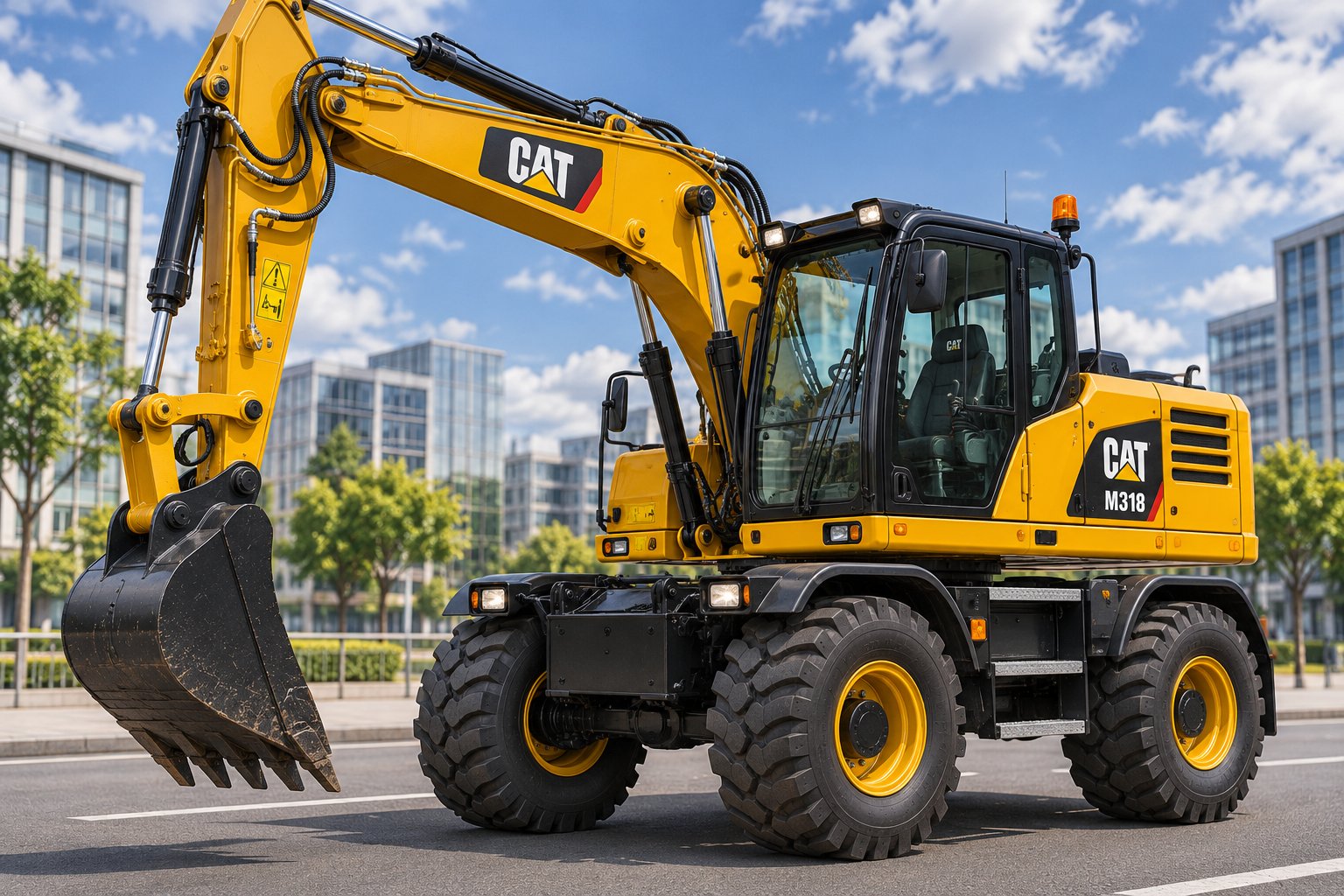
Every seller-operated website ranking for used excavator listings has the same blind spot: they will never publish a detailed guide to the scams, manipulation tactics, and fraud patterns that exist within their own market. Why would they? This section exists because buyers need it and no one selling machines will write it. Whether you're evaluating a trackhoe excavator on a dealer lot, browsing a suspiciously cheap wheeled excavator for sale online, or chasing down what looks like an incredible excavator for sale under $10,000 - the warning signs below separate legitimate opportunities from traps designed to separate you from your money.
Walking away from a suspicious deal costs nothing. Buying a misrepresented machine can cost tens of thousands in unexpected repairs, legal fees, or total loss. Learn to recognize these patterns before they recognize your wallet.
Misrepresented Hours and Falsified Records
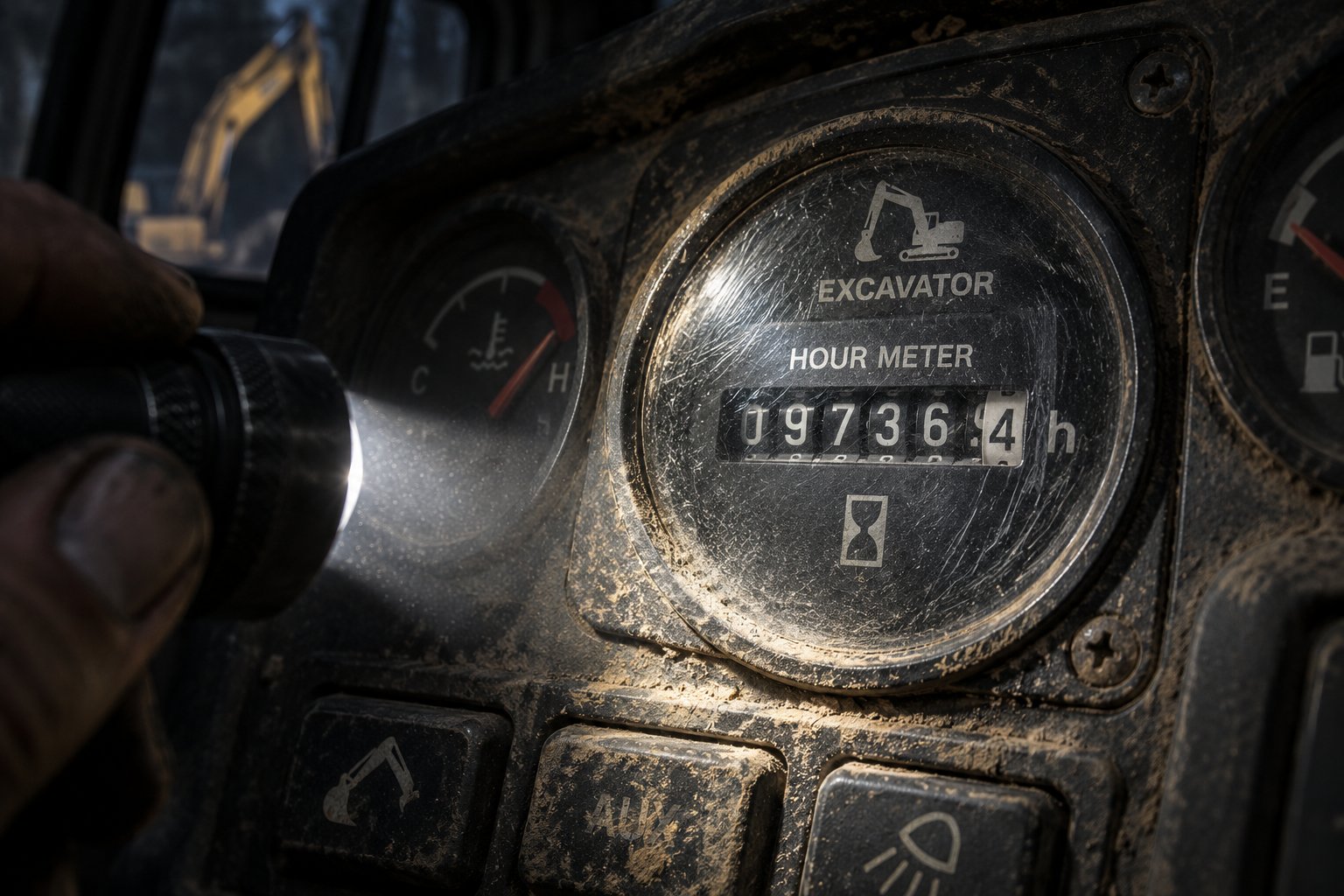
Hour-meter tampering is one of the most common forms of fraud in the used heavy equipment market. The math makes it attractive to dishonest sellers: knocking 4,000 hours off a mid-size excavator's reading can inflate the asking price by $15,000-$30,000. All it takes is a replacement meter or a few minutes with the right software - and suddenly a hard-worked machine looks like a lightly used bargain.
A concrete example illustrates the risk. As Makana's equipment verification team documented, a Komatsu PC200-8 listed with 6,500 hours showed 11,200 hours in the Komtrax telematics report pulled from the manufacturer's database - nearly double the advertised reading. That kind of discrepancy doesn't happen by accident.
Here's how to cross-reference reported hours against reality:
- Request OEM telematics data: Brands like Caterpillar (Product Link), Komatsu (Komtrax), Volvo (CareTrack), and JCB (LiveLink) maintain centralized databases that log engine run time independently of the physical hour meter. Ask the dealer to provide a printout, or contact the manufacturer directly using the machine's serial number. If a seller resists this request, treat that resistance as its own red flag.
- Access the ECU directly: Even when the dashboard meter has been swapped or reset, the Electronic Control Unit stores a separate internal hour record. Diagnostic scan tools like CAT ET or equivalent brand-specific software can extract this data. One documented case found a Cat 950M showing 7,800 hours on its meter but 12,300 hours in the ECU - clear evidence of tampering.
- Compare hours to physical wear: A machine claiming 3,000 hours should look like it has 3,000 hours. Heavily worn track links, hydraulic drift, leaking swing motors, faded paint in the cab, and polished control levers all tell a physical story. When the wear pattern says 10,000 hours but the meter says 4,000, trust the wear pattern.
- Check for meter replacement signs: Look for mismatched bezels around the hour meter, newer-looking wiring behind the gauge cluster, or a meter housing that doesn't show the same UV fading as surrounding dashboard components. A replaced meter isn't automatically dishonest - but it should be documented in service records. No documentation? That's your cue to dig deeper.
- Cross-reference maintenance intervals: Service records that show oil changes every 500 hours should produce a predictable chain of entries. If the records jump from 2,000 hours to 2,500 hours with an 18-month gap between them, either the machine sat idle for a year and a half or the records have been edited to match a rolled-back meter.
A 10-year-old excavator with 5,000 verified hours may be in far better condition than a 5-year-old unit with 15,000 hours - but only if those 5,000 hours are real. Verification is not optional; it is the single most important step in any used equipment purchase.
Title Issues and Lien Complications
You can inspect a machine perfectly, negotiate a fair price, and still lose everything if the seller doesn't actually have the legal right to sell it. Used excavators can carry outstanding liens from previous owners' financing arrangements, and unlike cars, most heavy equipment doesn't come with a state-issued title that makes lien status immediately visible.
As MachineryList's lien verification guide explains, lenders typically secure off-road equipment through contracts and Uniform Commercial Code (UCC) filings rather than vehicle titles. That means a clean-looking bill of sale is not enough by itself. A machine can have a valid lender lien with no title document in sight.
Protecting yourself requires a specific sequence of verification steps:
- Get the seller's exact legal name and state of registration. UCC filings are indexed under the debtor's legal name - not a trade name, not a marketplace username. Search the individual name exactly as it appears on identification, plus every business entity that may own the equipment.
- Record and verify the machine serial number. Photograph the serial plate clearly and cross-reference it against any documentation provided. The serial number is your primary tool for confirming that the machine exists, belongs to the seller, and isn't stolen.
- Search UCC filings through the correct state office. The National Association of Secretaries of State UCC directory links to official state filing offices where you can search for active liens. Don't stop at the search result - obtain the actual financing statement and read the collateral description carefully.
- Understand the lien type. An equipment-specific lien names the machine directly. A blanket lien covers all business assets - and even if the seller says "it's not about this machine," the lender may still claim collateral rights. A purchase-money filing means the lender financed that specific piece of equipment. Each type requires a different response, but all require written lender confirmation before you release funds.
- Require a lien release or termination before closing. If a lien exists, obtain payoff instructions directly from the lender using independently verified contact information - not from the seller's email. Send the payoff portion directly to the lender, and set a deadline for the UCC termination filing.
One critical warning for international buyers: some dealers operating primarily as exporters may not handle title transfers and lien clearance with the same rigor as domestic dealers. When a machine is being shipped overseas, the urgency to verify clean ownership is even higher because your legal recourse diminishes dramatically once the equipment crosses a border. As MachineryList notes, a UCC search may also miss filings made under another debtor name, possessory liens, tax claims, or filings in other jurisdictions - so high-value transactions justify a professional lien search and legal review.
Pressure Tactics and Deposit Traps
Legitimate dealers welcome thorough due diligence because transparency builds buyer confidence. Fraudulent or predatory sellers do the opposite - they create artificial urgency designed to short-circuit your verification process. As Ironmart's scam prevention analysis emphasizes, detection alone isn't enough; you need to recognize pressure tactics as deliberate barriers to verification, not mere inconveniences.
Watch for these specific patterns:
- Demanding non-refundable deposits before allowing inspection: A seller who requires money before you've seen the machine in person or conducted a video walkthrough is prioritizing your commitment over your confidence. Reputable dealers understand that inspection comes before deposit, not after.
- Claiming multiple competing buyers to rush your decision: "I have another buyer flying in tomorrow" is the heavy equipment version of a used-car lot countdown clock. It may occasionally be true, but when combined with other pressure signals, it's designed to make you skip verification steps out of fear of losing the deal.
- Refusing to provide documentation until after deposit: Machine history, hour verification, title status, and inspection reports should be available before you commit any money. A seller who withholds this information until your deposit clears is controlling the flow of information to prevent you from making an informed decision.
- Discouraging or refusing third-party inspections: "You don't need to bring your own mechanic - our guys already checked it" is not reassurance; it's a boundary. Any seller who actively resists independent verification has something to lose from an unbiased evaluation.
- Insisting on untraceable payment methods: Wire transfers sent directly to a personal account, cryptocurrency, or cash payments offer zero buyer recourse. As fraud prevention experts note, legitimate dealers work with secure payment methods - including escrow services - that protect both parties.
Any single item on this list deserves scrutiny. Two or more appearing in the same transaction is a pattern - and the pattern's message is clear: leave.
Structural Damage and Hidden Repairs
Hour-meter fraud and title scams are paperwork problems. Structural damage is a safety problem - and a financial one that can exceed the machine's purchase price in repair costs.
Excavator booms, sticks, and mainframes endure enormous cyclical stress during normal operation. When those components suffer catastrophic overload - dropping a load beyond rated capacity, striking an immovable object at speed, or working with a structural crack that propagates over hundreds of hours - the resulting damage often gets repaired rather than reported. The quality of that repair determines whether the machine is safe to operate or a ticking liability.
Here's what to look for:
- Weld repairs on structural members: Run your hand along the boom, stick, and main frame. Factory welds are uniform, smooth, and follow consistent bead patterns. Field repairs typically show irregular bead width, grinding marks, undercut edges, or weld spatter. Pay particular attention to the boom-to-stick pivot area, the boom foot where it connects to the house, and the stick-to-bucket linkage zone - these are the highest-stress locations.
- Mismatched or fresh paint on isolated components: A machine with faded paint everywhere except a suspiciously fresh-looking boom section is telling you something. Repainting individual components is a common method for concealing weld repairs, crack filling, or collision damage. Look for overspray on adjacent components, tape lines, or color shade differences between panels.
- Cracking at weld toes and high-stress intersections: Even without visible repairs, fatigue cracks develop at weld joints where stress concentrates. These cracks may be hairline-thin and invisible under dirt or grease. A clean rag and a flashlight at oblique angles reveal more than a casual glance ever will. On critical structural joints, magnetic particle inspection (MPI) or dye penetrant testing can detect cracks invisible to the naked eye - and the cost of that test is trivial compared to a boom failure on a jobsite.
- Bent or twisted geometry: Sight along the boom from the side and from above. Any visible bow, twist, or offset between the boom centerline and the stick centerline suggests past impact damage or sustained overloading. Check the stick for straightness the same way. A bent stick may still function, but it creates uneven pin loading that accelerates bushing wear and eventually leads to secondary failures.
Poor-quality structural repairs create genuine safety hazards. A boom that fails under load doesn't just damage the machine - it can drop multi-ton loads onto people, vehicles, or structures. No deal is worth that risk, regardless of how attractive the price looks on paper.
Remember: the seller already knows about these issues. The question is whether they've disclosed them honestly or buried them under fresh paint and optimistic language. Your job as a buyer is to make concealment more difficult than honesty - and the inspection techniques above do exactly that. When the physical evidence contradicts the sales pitch, trust the evidence every single time.
Where to Buy a Used Excavator
You know how to vet a dealer. You can spot falsified hours, title fraud, structural cover-ups, and pressure tactics from a mile away. But one decision sits upstream of all that detective work: where do you even start looking? Should you stick with the used excavator dealer twenty miles from your shop, or does casting a wider geographic net get you a better machine at a better price? The answer depends on what you're buying, how quickly you need it, and whether you have the logistics infrastructure - or budget - to move a 45,000-pound machine across state lines or international borders.
Advantages of Buying from Local Dealers
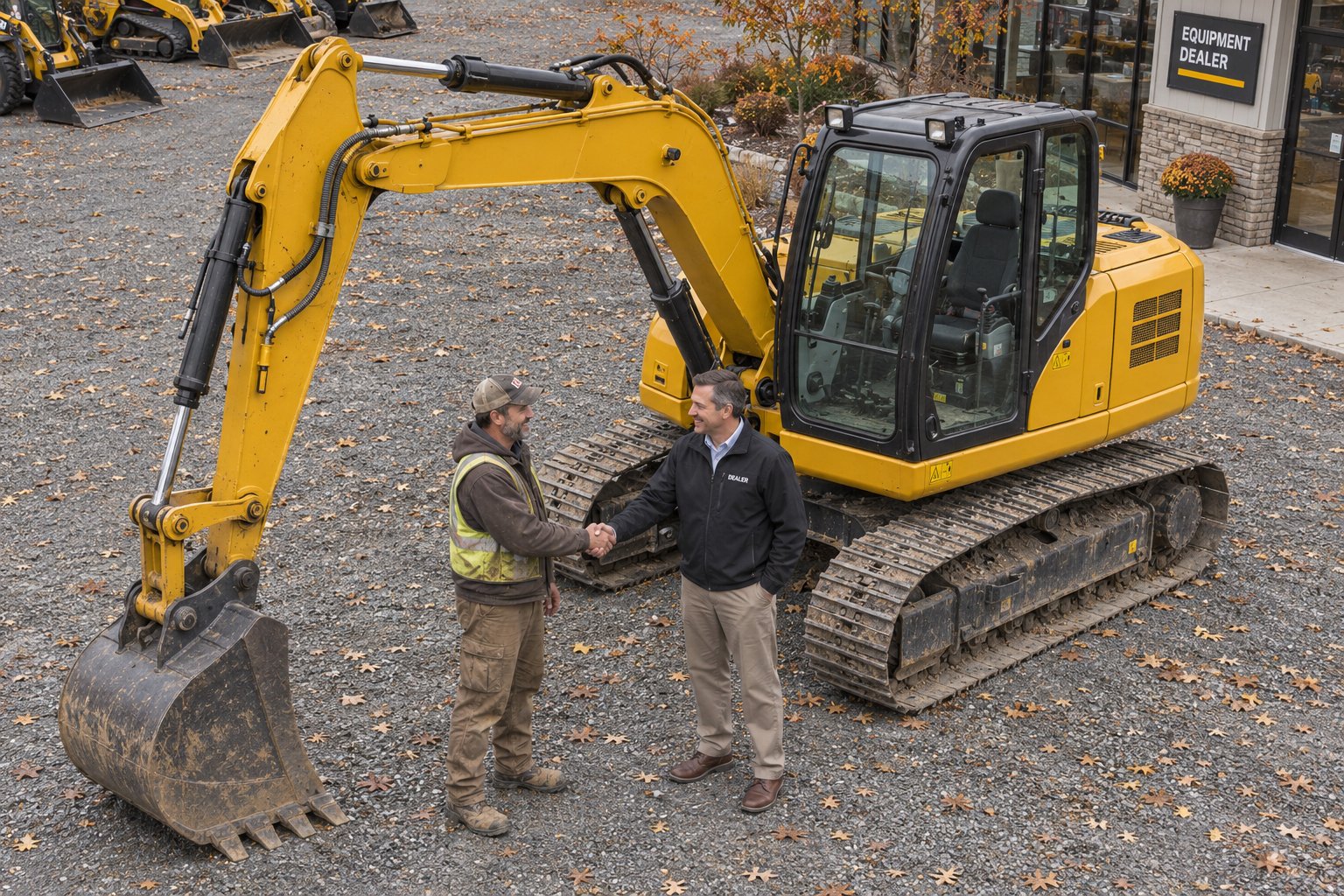
Searching for "used excavators for sale near me" is the default starting point for most buyers, and there are solid reasons for that instinct. Local dealers offer something no distant listing or online auction can replicate: the ability to walk onto a lot, climb into the cab, and put your hands on the machine before a single dollar changes hands.
That physical proximity creates three distinct advantages. First, in-person inspection becomes effortless. You can bring your mechanic, run the hydraulic drift tests covered earlier, measure undercarriage wear yourself, and watch how the machine performs under actual load - all without booking a flight or burning a full day of travel. Second, ongoing service relationships develop naturally. A regional dealer who also operates a parts and service department becomes your go-to resource for maintenance, warranty claims, and technical support long after the purchase closes. That relationship has real dollar value when you need a hydraulic pump rebuilt on a Thursday and the machine has to be back on the job Monday. Third, you eliminate transport costs entirely. Depending on distance, hauling an excavator on a lowboy trailer can add $2,000 to $15,000 to your total acquisition cost - money that stays in your pocket when you buy locally and drive the machine home on its own tracks or haul it on your own trailer.
Regional dealers also tend to stock inventory suited to local industry demands. A dealer operating across Kansas and Missouri is likely carrying machines configured for agricultural site work, pipeline trenching, and rural construction. A dealer covering Pennsylvania, Ohio, and Indiana stocks units geared toward heavy earthmoving, demolition, and utility installation. That regional alignment means the excavator second hand inventory on their lot has probably been working in conditions similar to yours - and the dealer understands the applications, soil types, and wear patterns relevant to your geography.
The limitation? Selection. When you restrict your search to what's physically nearby, you're filtering by geography first and specifications second. If you need a specific brand, model year, hour range, or attachment configuration, the local market may simply not have it. A contractor in rural Montana looking for a low-hour Komatsu PC210 with a hydraulic thumb and pattern-change valve might find three options within a 200-mile radius - or none at all.
When Buying from a Distant Dealer Makes Sense
Geographic flexibility becomes a strategic advantage in three specific scenarios. Recognizing when to expand your search radius - and how to manage the logistics that come with it - separates opportunistic buyers from those who overpay for convenience.
Sourcing a specific model or configuration unavailable locally. Imagine you need a long-reach excavator for a waterway project, or a zero-tail-swing unit for urban utility work. These specialized configurations represent a fraction of total market inventory. Limiting yourself to local dealers dramatically reduces your chances of finding the right machine at any price. National-scale dealers and export-focused suppliers maintain inventories large enough to stock niche configurations that regional operations can't justify carrying.
Finding better pricing in lower-demand regions. As covered in the pricing section, geographic price gaps still exist - they've just narrowed. A mid-size excavator sitting on a dealer lot in a slow winter market in the upper Midwest may be priced 8-12% below an identical unit in the booming Southeast. For a $120,000 machine, that gap translates to $9,600-$14,400 - more than enough to cover transport costs and still come out ahead.
Accessing larger inventories for bulk purchasing. Equipment dealers sourcing resale inventory or import buyers consolidating shipments need volume that no single local dealer can provide. Working with national or international sellers lets you compare dozens of units from one source, negotiate package pricing on multiple machines, and coordinate a single logistics event rather than arranging separate pickups from five different yards.
The price of an excavator doesn't end at the sticker. Transport logistics add real cost, and understanding those numbers before you commit prevents the unpleasant surprise of a "great deal" that evaporates once delivery charges land on top.
Typical transport costs for moving a standard excavator via flatbed or lowboy trailer within the continental U.S. follow a rough distance-based scale. According to Loyalty Logistics' heavy equipment transport guide, the total expense combines multiple components: permits running $50-$300 per state crossed, fuel costs that run 40-50% higher than standard freight on oversized loads, rigger and escort fees, and insurance premiums of 2-5% of the machine's value. A 500-mile haul can add $800-$1,500 in fuel alone on top of base carrier charges. For a realistic planning budget:
| Transport Distance | Estimated Cost Range | Key Variables |
|---|---|---|
| Under 200 miles | $1,500 - $3,500 | Single-state permits; standard flatbed or lowboy; minimal escort requirements |
| 200 - 500 miles | $3,000 - $6,000 | Multi-state permits possible; fuel surcharges increase; may require pilot car for oversized loads |
| 500 - 1,000 miles | $5,000 - $10,000 | Multi-state permits and escort fees compound; seasonal restrictions in northern states may force rerouting |
| Over 1,000 miles | $8,000 - $15,000+ | Complex permitting across multiple jurisdictions; extended transit time; higher insurance exposure |
Before finalizing any distant purchase, confirm three logistics items in the purchase agreement. Who arranges transport? Some dealers include delivery within a certain radius; others quote FOB their lot, making transport entirely your responsibility. Who carries insurance during transit? The gap between the seller's insurance ending and your coverage beginning is where claims get denied - make sure there's no gap. At what specific point does ownership risk transfer? "When it leaves our lot" and "when it arrives at yours" are very different answers, and the distinction matters if the machine is damaged in transit. As the transport guide emphasizes, documenting permits, loading plans, and insurance requirements protects you during inspections and disputes alike.
Cross-Border Purchasing Considerations
For import buyers - whether you're a contractor sourcing a specific configuration unavailable domestically or an equipment reseller building export inventory - crossing international borders adds layers of complexity that domestic purchases don't carry. Getting these details wrong doesn't just delay delivery; it can result in machines stuck at ports, unexpected duty charges that blow your budget, or equipment that's legally barred from operating in the destination country.
Export documentation and customs clearance represent the first hurdle. According to Equipment Insider's 2026 regulatory analysis, heavy equipment falls under various Harmonized Tariff Schedule classifications, each with different duty rates depending on operating weight, configuration, and country of origin. Misclassification can trigger underpayment penalties or overpayment of duties. Section 301 tariffs on Chinese-origin equipment substantially increase landed costs, while USMCA-qualifying North American content may receive preferential or zero-rate treatment. Accurate classification and valuation documentation are essential before the machine ships - not something to figure out after it arrives at the port.
Emissions compliance verification catches more import buyers off guard than any other requirement. EPA regulations require that engines in imported equipment meet applicable emission standards - Tier 4 Final for current production engines - and importers may need to provide EPA Form 3520-21 confirming compliance. Used equipment must meet the standards that were applicable at the time of original manufacture, but as Equipment Insider notes, documentation proving original certification can be difficult to obtain for older machines, and equipment lacking certification paperwork may face additional scrutiny or be denied entry. California-bound machines face the added requirement of CARB Executive Order certification. Verify compliance before purchasing - not at the port of entry.
Specification matching for destination markets is the detail that separates experienced international buyers from first-timers. A machine built for the Japanese domestic market may have different boom configurations, cab specifications, or safety equipment than the same model sold in North America or Europe. Confirm that the machine's working specifications - reach, dig depth, lift capacity, and operating weight - match the requirements of the destination country's safety standards and the project's actual needs.
One point bears repeating because it's consistently misunderstood: equipment exported from one country is not necessarily manufactured by a brand from that country. A Komatsu PC200 shipped from a dealer in Shanghai may have been originally manufactured in Japan, operated in Australia, and resold through a Chinese export dealer. The shipping origin tells you nothing about the brand, manufacturing quality, or parts compatibility. Verify the machine's actual country of manufacture, original market designation, and serial number lineage independently - that data determines parts availability, service support, and resale value far more than the port it shipped from.
Whether you buy from the dealer down the road or arrange a cross-border shipment from 6,000 miles away, the geographic decision ultimately comes back to total acquisition cost: machine price, transport, duties, compliance, and the value of the dealer relationship you're building. The final step is pulling all of these threads together - vetting, inspection, pricing, financing, protections, and logistics - into one efficient workflow that lets you compare dealers and machines side by side before committing your capital.
Building a Smart Shortlist and Comparing Dealer Listings
Vetting dealers, inspecting machines, understanding pricing dynamics, securing financing, recognizing scams, and navigating logistics - every section of this guide builds toward one practical outcome: putting yourself in the strongest possible buying position before any money leaves your account. The difference between a buyer who overpays for a questionable used excavator and one who lands a solid machine at a fair price almost always comes down to process. Not luck. Not connections. Process.
This final workflow consolidates everything into a repeatable system you can use whether you're sourcing a single hoe excavator for a local contractor fleet or comparing dozens of units across multiple dealers for a resale or import operation. Follow it step by step, and you'll walk into every negotiation with leverage that most buyers never build.
Build Your Dealer Shortlist by Channel Type
The biggest mistake buyers make? Shopping from a single source and assuming the first quote they receive reflects fair market value. It doesn't. Pricing, warranty coverage, documentation quality, and post-sale support vary enormously across dealer types - and you won't see those differences unless you deliberately source from multiple channels.
Your goal is to identify at least one vetted dealer from each relevant channel before you request a single quote. An authorized OEM dealer gives you the certified option with the strongest protections. An independent dealer offers mid-range pricing with negotiation flexibility. An online platform or multi-brand marketplace delivers breadth of selection that no single lot can match. A broker fills the gap when you need a specific configuration that isn't showing up in public listings. You don't need to buy from all of them - you need all of them competing for your business.
Here's the step-by-step shortlisting process that keeps your search organized and your comparisons meaningful:
- Define your target machine specifications. Lock in the size class (compact, mid-size, or large), acceptable brands, maximum engine hours, required attachments, and total budget range - including transport and financing costs, not just sticker price. A vague search produces vague results. Knowing you need a 20-ton class machine under 5,000 hours with a hydraulic thumb and a budget ceiling of $130,000 all-in sharpens every conversation you'll have with a seller.
- Search each dealer channel using those specs. Check authorized OEM dealer inventories through manufacturer websites and dealer locator tools. Browse independent dealer listings and multi-brand platforms that aggregate used inventory across manufacturers. Scan auction platforms for upcoming lots matching your criteria. Contact a broker if your target configuration is specialized or hard to source publicly.
- Request quotes and documentation packages from at least three sources. Ask every dealer on your shortlist for a formal quote that includes the machine price, any applicable buyer's premium or fees, available warranty terms, and delivery cost to your location. Simultaneously request the documentation package outlined earlier in this guide: verified hours, maintenance records, title status, and inspection reports. Dealers who respond promptly with complete information just passed another vetting test. Those who stall, hedge, or redirect have told you something important.
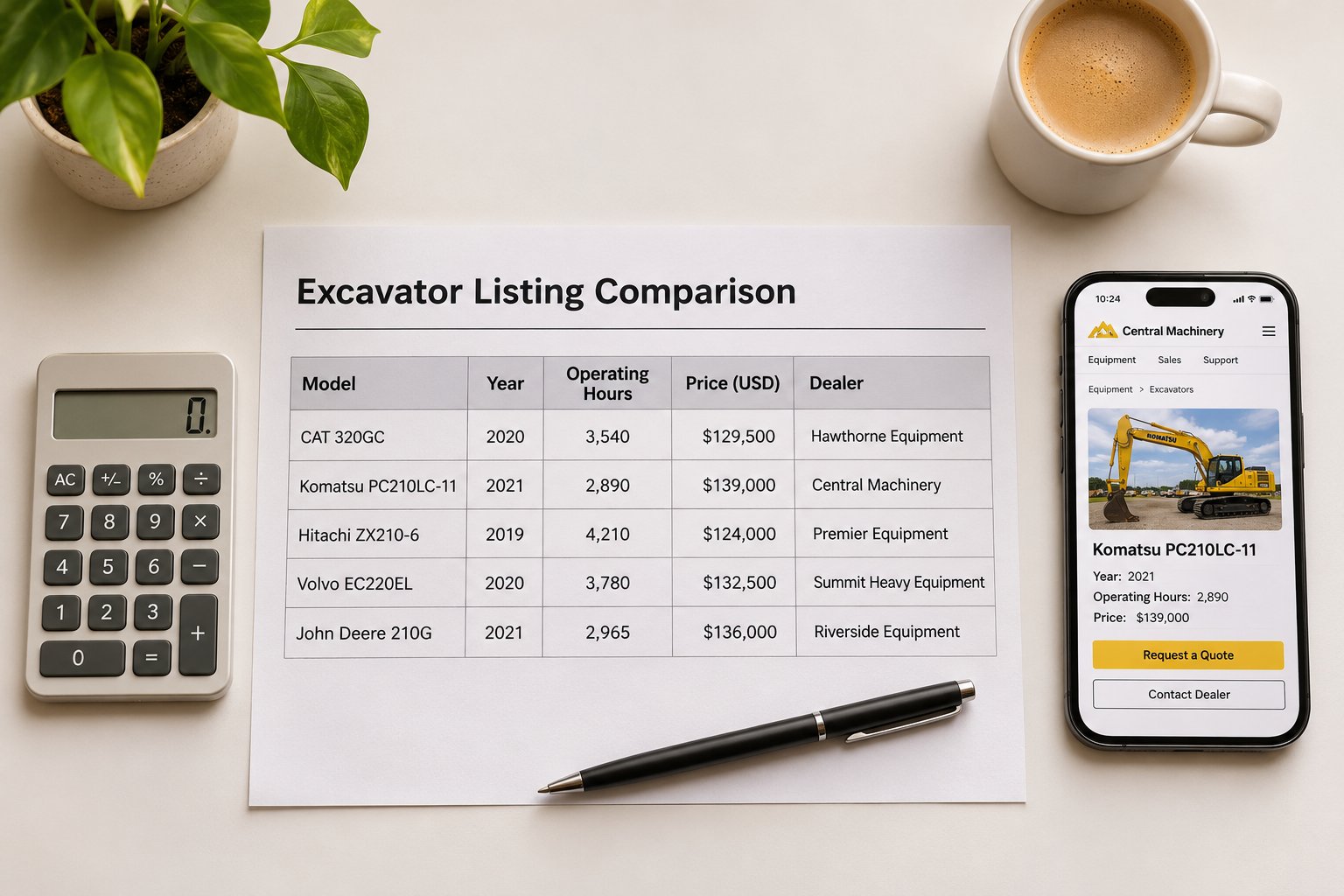
- Compare total acquisition cost - not just the listed price. Build a simple spreadsheet that captures the machine price, transport expense, financing cost over the full loan or lease term, warranty value (or the estimated cost of self-insuring if no warranty is offered), and any immediate maintenance or repair needs identified during inspection. Two machines listed at the same price can differ by $15,000 or more in total acquisition cost once you factor in a worn undercarriage on one, a 90-day powertrain warranty on the other, and a $4,000 delivery fee difference between their locations.
- Schedule inspections or request third-party inspection reports before committing. Never finalize a purchase based solely on photos, phone calls, or dealer assurances - no matter how reputable the source. For local machines, bring your mechanic or hire an independent inspector. For distant machines, engage a third-party inspection service that operates in the dealer's region and can provide a written report with photographic documentation. The $300-$800 cost of that inspection is the cheapest insurance available on a five- or six-figure purchase.
This five-step process works regardless of whether you're buying one machine or ten. Scale it up for bulk purchases by running the same workflow in parallel across multiple target units, and you'll quickly identify which dealers deliver consistent quality and transparency versus those who fall apart under scrutiny.
Comparing Listings and Requesting Model-Specific Quotes
Effective comparison shopping in the used excavator market requires more than browsing thumbnails. You need to use dealer platforms strategically - filtering by the specifications that actually matter and requesting quotes specific enough to compare apples to apples rather than guessing at the differences between two similar-looking listings.
Most dealer platforms let you filter by brand, model, size class, hour range, year of manufacture, and sometimes by attachment configuration or geographic region. Use every relevant filter. A search for excavator sales near me without any specification filters returns hundreds of results that waste your time. A filtered search for "Komatsu PC200 or Cat 320, 2018-2023, under 6,000 hours, within 500 miles" returns a manageable shortlist you can actually evaluate.
Multi-brand dealer platforms are especially valuable during the comparison phase because they let you evaluate machines from different manufacturers side by side under one roof - or one URL. Instead of jumping between a Cat dealer's website, a Komatsu dealer's inventory page, and three separate auction listings, a consolidated platform lets you see how a used Komatsu stacks up against a comparable Volvo or Hitachi at similar hours and condition. For example, JIUHONG's excavator inventory aggregates compact and larger machines across multiple brands in a single collection, allowing buyers to compare listings, filter by specifications, and request model-specific quotes for individual or bulk purchases. That consolidated format is particularly useful for equipment dealers sourcing 2nd hand excavator inventory for resale or import buyers consolidating multiple units into a single shipment - scenarios where toggling between a dozen separate dealer websites turns a focused search into an all-day scavenger hunt.
When requesting quotes, specificity is your ally. Don't just ask "what's your best price?" Instead, reference the exact listing by serial number or stock number, confirm attachment inclusions, ask about warranty options and their cost, and request a written quote that itemizes the machine price, fees, and delivery estimate separately. This level of detail accomplishes two things: it signals to the dealer that you're a serious, informed buyer who won't accept vague responses, and it gives you standardized data points to compare across sellers.
The strongest buying position comes from having multiple competing quotes from vetted dealers - not because you're trying to play sellers against each other, but because real market data replaces guesswork and gives you the confidence to commit when the right deal appears.
For buyers sourcing resale inventory or building import shipments, the quote-comparison process scales naturally. Request quotes on five or ten units from each shortlisted source, then evaluate not just individual machine pricing but the dealer's responsiveness, documentation quality, willingness to accommodate third-party inspections, and flexibility on bulk terms. The dealer who provides thorough documentation on every unit, responds within 24 hours, and offers a transparent process for multi-unit transactions is almost certainly the one you want handling your purchase - even if their per-unit pricing isn't the absolute lowest on your spreadsheet.
Every chapter of this guide has been designed to shift the information advantage from the seller's side of the table to yours. You now know how each dealer channel operates and where their incentives align - or conflict - with yours. You can vet a seller's credentials, documentation practices, and reputation using signals that go far beyond their own marketing. You understand the mechanical inspection points that separate a solid machine from a money pit, the pricing variables that determine fair market value, the financing structures that minimize total cost, the contractual protections worth demanding in writing, the fraud patterns that prey on uninformed buyers, and the logistics of buying locally or across borders. Apply this framework consistently, and the search for a reliable used excavator stops being a gamble and starts being a calculated, confident business decision.
Frequently Asked Questions About Used Excavator Dealers
1. How do I verify that a used excavator dealer is legitimate?
Start by confirming the dealer's business registration through your state's Secretary of State office and checking for longevity in the industry. Verify any claimed OEM authorized dealer status using the manufacturer's own dealer locator tool. Look for membership in organizations like the Independent Equipment Dealers Association (IEDA), check Better Business Bureau standings, and search online for complaints or lawsuits tied to the business name. Request buyer references and call them directly. Full-service dealers that operate parts, service, and sales departments under one roof tend to be more accountable because they depend on repeat business and long-term customer relationships.
2. What is the difference between an authorized OEM dealer and an independent used equipment dealer?
Authorized OEM dealers hold manufacturer-granted status from brands like Caterpillar, Komatsu, or Volvo, meaning their facilities, technicians, and practices meet brand-specific standards. They offer certified used programs with multi-point inspections, limited warranties, and verified documentation. Independent dealers purchase and resell machines without OEM affiliation, so quality and protections vary widely. Some independents provide thorough documentation and short mechanical warranties, while others operate with minimal transparency. The key trade-off is price versus assurance: OEM dealers charge a 10-20% premium, but that premium buys standardized buyer protections that most independents cannot match.
3. How can I tell if the hour meter on a used excavator has been tampered with?
Cross-reference the displayed hours against the manufacturer's telematics system - brands like Cat (Product Link), Komatsu (Komtrax), and Volvo (CareTrack) log engine run time independently of the physical meter. Request a direct OEM data printout using the machine's serial number. You can also have a technician read the Electronic Control Unit (ECU), which stores a separate internal hour record that survives meter replacement. Beyond data checks, compare physical wear patterns to claimed hours: heavily worn track links, polished control levers, and hydraulic drift on a supposedly low-hour machine all signal a discrepancy. Mismatched bezels or fresh wiring around the gauge cluster may indicate a replaced meter.
4. When is the best time to buy a used excavator to get the lowest price?
Used excavator prices typically soften during late fall and winter when construction activity slows in northern climates, creating less demand and more motivated sellers. Prices also dip after major OEM new-model releases, which push a wave of trade-ins onto dealer lots. Broader economic slowdowns further reduce equipment demand and give buyers stronger negotiation leverage. Independent dealers and brokers generally offer more pricing flexibility than authorized OEM dealers. The strongest negotiation position comes from citing specific condition findings - like undercarriage wear or aging hoses - identified during your pre-purchase inspection, giving you concrete reasons to request a price adjustment.
5. Should I buy a used excavator locally or from a dealer in another state?
Local purchases let you inspect machines in person, avoid transport costs ranging from $1,500 to over $15,000, and build ongoing service relationships with nearby dealers. However, buying from a distant dealer makes sense when you need a specific model or configuration unavailable locally, when pricing in lower-demand regions offsets shipping expenses, or when you need to source multiple units in bulk. For distant purchases, always confirm who arranges and insures transport, at what point ownership risk transfers, and budget for all logistics costs before comparing the deal against local options. Multi-brand platforms like JIUHONG's excavator collection at https://jiuhong-machinery.com/products/excavators/ can help consolidate comparisons across brands and request model-specific quotes without visiting multiple lots.