

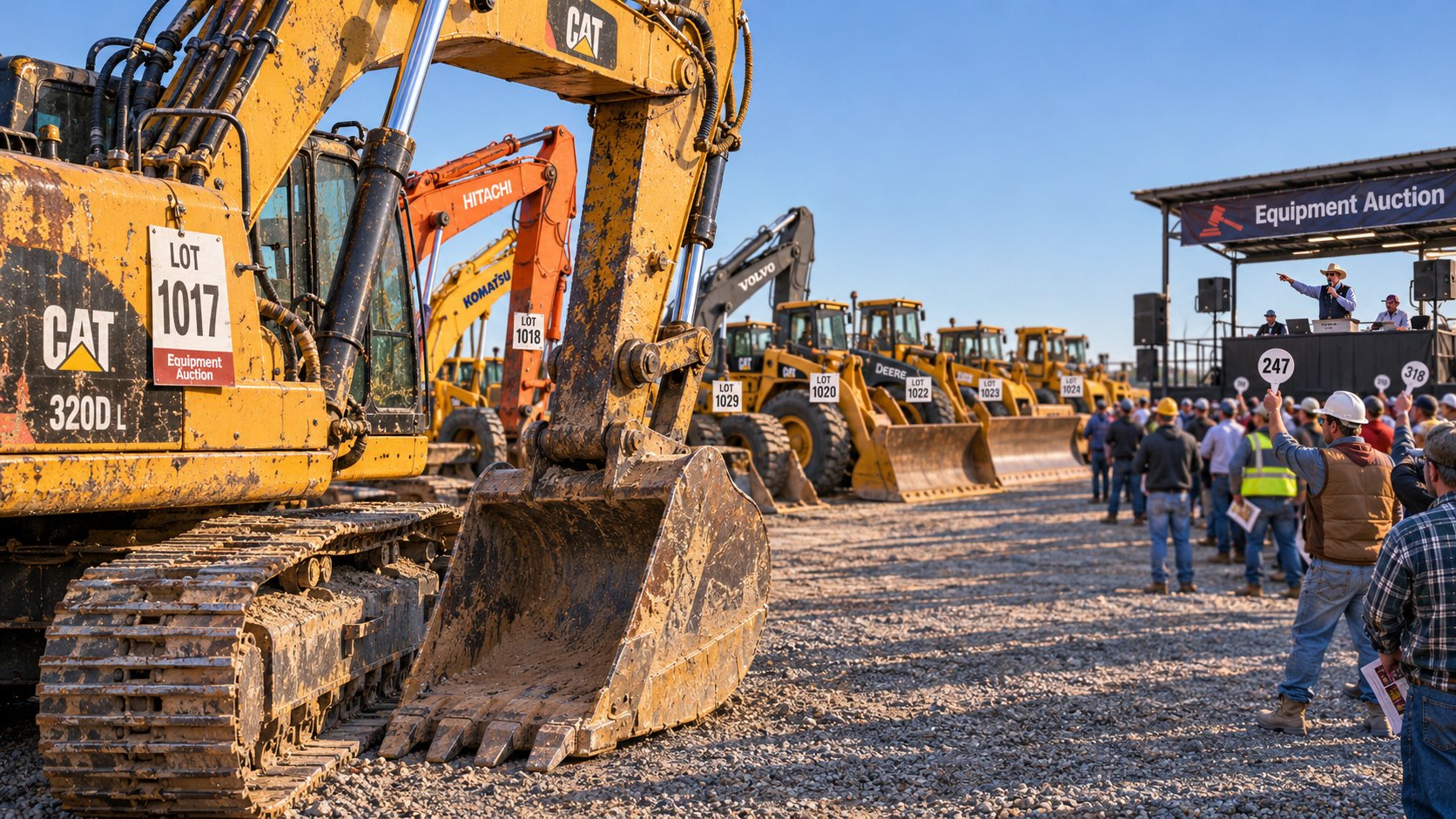
What Heavy Equipment Auctions Are and Why They Matter
Imagine finding a late-model excavator at 40% below dealer pricing — or selling off an entire fleet of dozers in a single afternoon. That is the promise heavy equipment auctions hold for thousands of buyers and sellers every year. Yet the gap between promise and reality trips up more first-timers than most people realize.
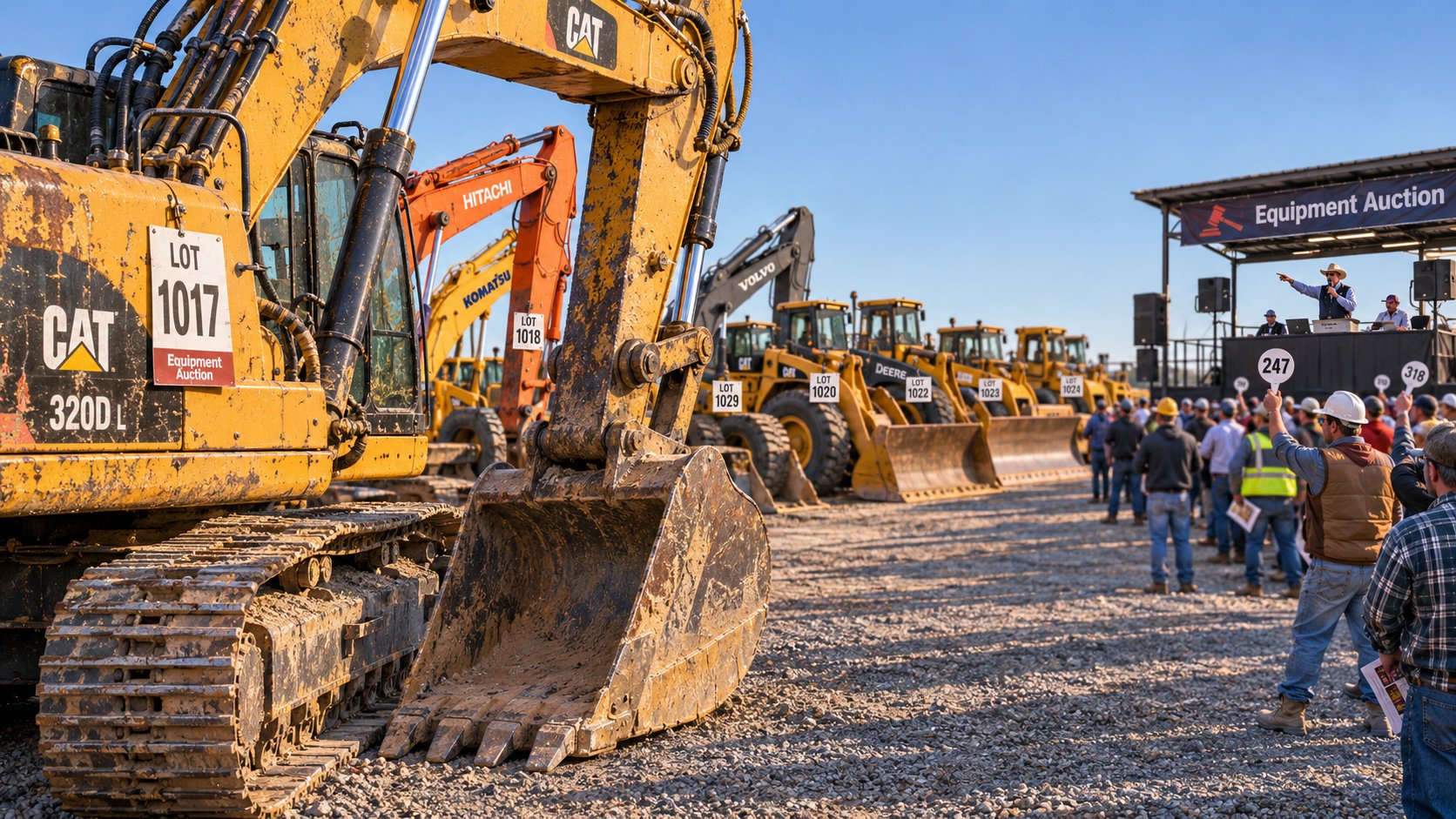
Heavy equipment auctions are organized sales events where construction machinery — excavators, wheel loaders, bulldozers, motor graders, and other industrial assets — changes hands through competitive bidding, either in person or online. Prices are set by real-time market demand rather than fixed asking prices, and transactions typically close the same day the hammer falls.
The scale of this market is staggering. The global used construction equipment sector sits at roughly $132.67 billion in 2026, and auction platforms represent the fastest-growing sales channel within it, expanding at a 7.03% CAGR. That growth reflects a fundamental shift: contractors, fleet managers, and dealers increasingly treat pre-owned machines as core operational capacity rather than a compromise. When OEM delivery timelines stretch 12 to 18 months, a well-sourced auction purchase can put a machine on a job site within days.
This guide walks you through every stage of the auction process — how bidding actually works, the differences between live and online formats, what to inspect before you raise a paddle, how to arrange financing under tight payment deadlines, and the seller's perspective that almost no one talks about. Whether you are hunting for a mini excavator for sale to handle residential dig work or listing a fleet of graders you have outgrown, the strategies here will help you avoid the costly lessons most participants learn the hard way.
What Are Heavy Equipment Auctions
At their core, these events are structured marketplaces where the final price reflects what buyers are genuinely willing to pay at that moment. That is what separates them from the three other common channels. Dealer lots set retail prices and may offer warranties, but you pay a premium for that convenience. Private sales allow direct negotiation, yet they demand significant time and effort to find the right buyer or seller. Classified listings — whether for a forestry mulcher for sale or used boring machines — cast a wide net but offer little pricing transparency and no competitive pressure to drive fair value.
Auctions solve those problems by concentrating supply and demand into a compressed timeframe. A single event can liquidate an entire contractor's fleet or move one standalone skid steer. Both sides benefit: sellers gain exposure to a broad, motivated buyer pool, and buyers get market-driven pricing shaped by real competition rather than arbitrary markups. You will find everything from a mini skid steer for sale to 80-ton crawlers on the same auction day, which is why the format appeals to such a diverse range of participants.
Who Participates and Why It Matters
Understanding who else is in the bidding crowd — and what drives their decisions — gives you a genuine strategic edge.
- Contractors expanding or refreshing fleets: They need reliable, job-ready machines and often target low-hour units with documented maintenance history. They are comparing skid steer prices and loader specs against project budgets and care deeply about total cost of ownership.
- Dealers sourcing resale inventory: They buy in volume, looking for machines they can refurbish at a margin-positive cost. They bid frequently and know residual values cold, so competing against them on common models requires discipline.
- Municipalities and government agencies: They dispose of surplus equipment — everything from used zero turn mowers for sale to heavy graders — through public auctions to meet transparency requirements. Their inventory is often well-maintained but high in hours.
- Individual buyers and farmers: They seek affordable machinery for smaller-scale operations. A skidsteer for sale at auction can open doors that new-equipment pricing would keep firmly shut.
Each group bids with different priorities, different budgets, and different tolerance for risk. Recognizing those motivations helps you anticipate bidding behavior, avoid overpaying in heated competition, and spot the lots that other buyer types are likely to overlook. The strategies that follow are built around that awareness — starting with the step-by-step mechanics of how an auction actually unfolds from registration to equipment pickup.
How a Heavy Equipment Auction Works From Start to Finish
Here is where most guides fail you. They assume you already know what to do, when to show up, and what happens after you win. The reality? Walking into your first heavy equipment auction without understanding the full lifecycle is like bidding blindfolded — you might get lucky, but you will probably overpay or miss critical deadlines that cost you money. Let's break the entire process down into clear, sequential steps so nothing catches you off guard.
- Locate an upcoming auction that matches the equipment you need.
- Register as a bidder — create an account, submit ID, and provide proof of funds or a deposit.
- Research the inventory — study lot listings, photos, specs, and condition notes.
- Inspect the equipment during preview days (in person) or via detailed online listings.
- Set your maximum all-in budget — factor in the buyer's premium, taxes, transport, and potential repairs.
- Bid on auction day — in person with a paddle, online with a click, or both in simulcast events.
- Complete payment within the stated deadline, typically 24 to 48 hours.
- Arrange transport and remove the equipment before the loadout window closes.
Every step feeds the next one, and skipping any of them — especially research and budgeting — is how buyers end up with regrets instead of reliable machines. Let's dig deeper into the two phases that trip people up most often.
Finding and Registering for an Auction
Your search starts in three places. Major auction houses publish event calendars on their websites months in advance, listing dates, locations, and broad inventory categories. Industry outlets and trade publications regularly announce large-scale fleet liquidations — particularly useful if you are tracking specialized lots like a scissor lift for sale or stump grinders for sale. Online aggregator platforms pull listings from dozens of auction companies into searchable databases filtered by equipment type, location, and date, making it easy to compare options whether you are looking for a wood chipper for sale or a full fleet of haul trucks.
Once you find an event, registration is your gateway to a bidder number. The process is straightforward but non-negotiable — you cannot bid without it. Expect to provide government-issued identification, contact information, and some form of financial verification. Some houses require a refundable deposit or a credit card on file; others ask for a bank letter confirming available funds. TAC Auction's buyer guide emphasizes a common-sense point that many newcomers overlook: do not wait until the last minute to register. Most auction companies allow pre-registration online weeks before the event, giving you time to resolve any account issues and start studying the catalog while other bidders are still scrambling to get approved.
During this phase, spend serious time reviewing lot listings. Look at every available photo, read seller-provided descriptions, check reported hours or mileage, and note any disclosed condition issues. If a particular auction features stand on mowers for sale alongside heavy earthmoving equipment, that breadth tells you the event draws a diverse buyer pool — which can mean less competition on the niche items you actually want. Preparation at this stage directly shapes your confidence and your budget on auction day.
Bidding, Winning, and Taking Delivery
Auction day itself moves fast, so knowing the rhythm keeps you from making reactive decisions. Lots are assigned numbers and sold in a published sequence. In a live yard event, an auctioneer works through lots one at a time while machines idle or run for the crowd. You bid by raising your paddle or catching the ring man's attention. In an online-only format, you click to place bids against a countdown timer, and if a bid lands in the final seconds, many platforms extend the closing window to prevent sniping — a safeguard National Auction's step-by-step guide highlights as essential for fair competition.
When the hammer falls, the lot is yours. But "winning" is really just the halfway point. Here is what follows — and where unprepared buyers stumble:
- Payment deadlines: Most auctions require full payment within 24 to 48 hours. Accepted methods vary, but expect wire transfers, certified checks, or pre-authorized credit cards. Delays can trigger penalties or forfeiture of the purchase.
- Buyer's premium: This is a percentage added on top of your winning bid — industry-wide, premiums typically range from 10% to 25%. If you win a used stump grinder for sale at a $5,000 hammer price and the premium is 18%, your pre-tax total jumps to $5,900. Forgetting to account for this is one of the most common and most expensive beginner mistakes.
- Sales tax: Applied to the combined total of the hammer price and the buyer's premium in most states. Businesses with valid exemption certificates can often submit them before the auction closes to avoid this charge.
- Equipment removal: Auction yards are not storage facilities. Loadout windows are firm — often just a few days — and missing the deadline can result in daily storage fees or, in extreme cases, forfeiture. Plan your pickup logistics before you bid, not after you win.
Transport deserves its own planning session. A batwing mower you won for a bargain price becomes far less attractive if you did not budget for the lowboy trailer and commercial hauler needed to get it home. Heavier machines — excavators, dozers, large loaders — may require specialized flatbed transport and permits for oversized loads. Get freight quotes in advance so you can roll that cost into your maximum bid calculation. The same logic applies to lighter equipment: even if you spot riding lawnmowers on sale at a regional auction, the cost of a rental trailer and fuel for a 200-mile round trip changes the math on whether that deal is truly a deal.
Your real cost at auction is never the hammer price alone. It is hammer price plus buyer's premium plus sales tax plus transport plus any repairs the machine needs once it reaches your yard.
Treat that formula as your budgeting baseline for every lot you pursue. Buyers who internalize it consistently walk away with better equipment at smarter prices — and they rarely experience the post-auction sticker shock that derails so many first-timers. The format you choose for bidding, however, introduces its own set of trade-offs that deserve a closer look.
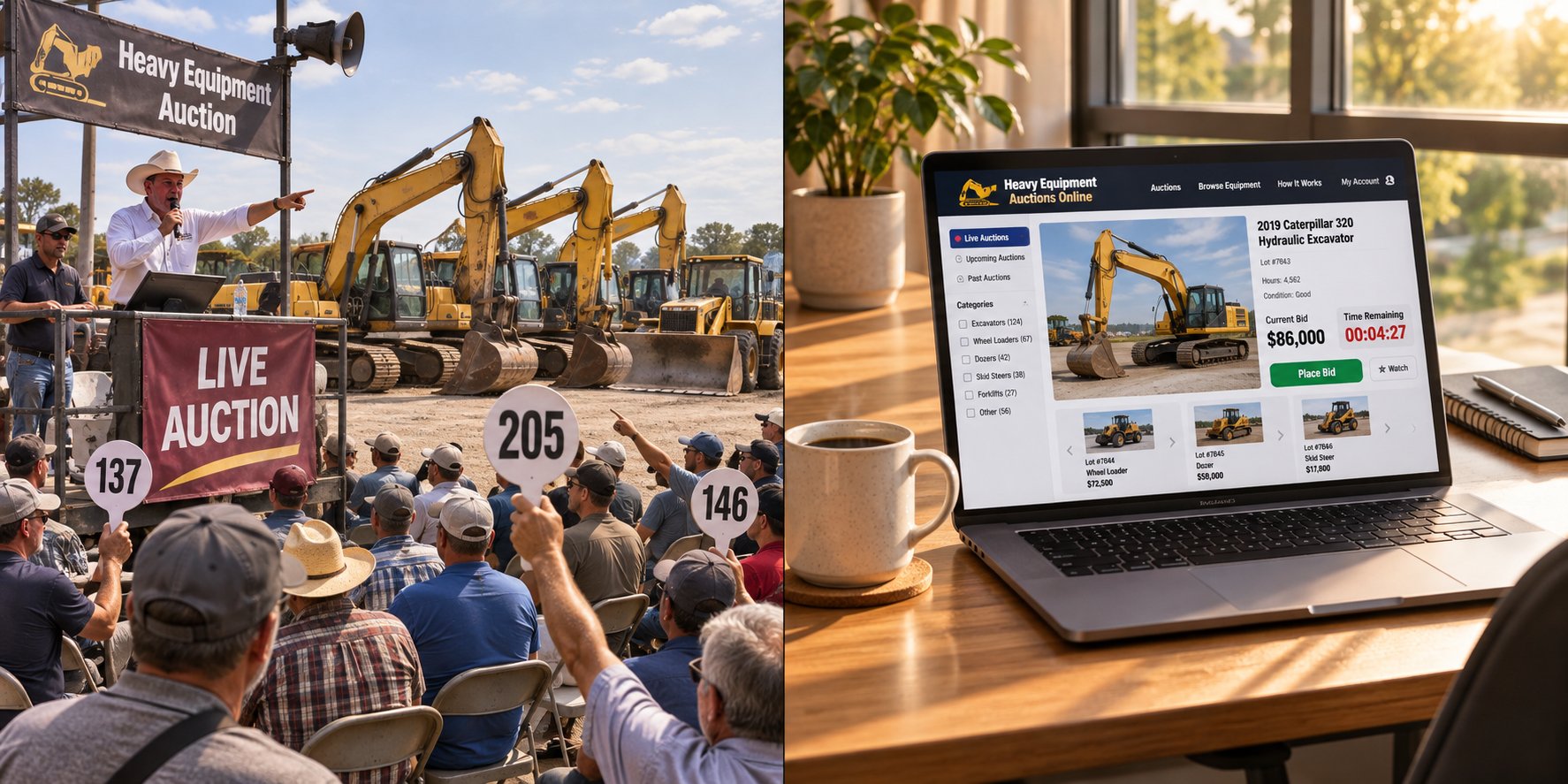
Comparing Auction Formats From Live Yards to Online Platforms
Not every heavy equipment auction runs the same way, and the format you choose shapes everything — how much due diligence you can perform, how many competitors you face, and how fast you need to make decisions. Yet most buyers pick a format by accident, defaulting to whatever event pops up first rather than matching the format to their actual risk tolerance. That is a costly oversight when used construction equipment for sale can range from a $3,000 skid steer to a $350,000 excavator.
Four primary formats dominate the market today. The table below gives you a side-by-side comparison so you can evaluate each one against the criteria that matter most before you register.
| Criteria | Live In-Person | Simulcast (Hybrid) | Online-Only | Timed Online |
|---|---|---|---|---|
| Inspection Ability | Full hands-on; start engines, check hydraulics, walk the undercarriage | Full hands-on for on-site bidders; remote bidders rely on photos and video | No physical inspection unless preview days are offered at a separate yard | No physical inspection; dependent on photos, condition reports, and seller descriptions |
| Bidding Pace | Fast — the auctioneer controls tempo, lots move in seconds to minutes | Fast with brief pauses to sync online bids; slight lag for remote participants | Moderate — bidding windows span hours or days | Moderate to slow — set closing times with possible soft-close extensions |
| Geographic Reach | Limited to bidders who can travel to the auction yard | Local and remote bidders compete simultaneously | Nationwide or international; bid from anywhere with an internet connection | Nationwide or international; no travel required |
| Competition Level | Moderate — limited by physical attendance | High — combines floor crowd with a global online audience | Moderate to high — broader pool, but casual bidders inflate numbers | Moderate — serious buyers dominate, but last-second sniping can spike competition |
| Best-Suited Buyer Type | Contractors and dealers who prioritize inspection and want to hear machines run | Experienced buyers comfortable with both environments; dealers sourcing volume | Budget-conscious buyers comfortable evaluating from photos and reports | Remote buyers with patience; individuals and farmers exploring affordable machinery |
Think of this table as your starting filter — not your final answer. Each format has strengths that reward certain buying styles and trade-offs that punish others. Let's unpack both sides.
Live In-Person and Simulcast Auctions
A traditional live-yard auction is the oldest format in the business, and for good reason: nothing replaces standing next to a machine, listening to the engine idle, checking hydraulic lines for weeping fluid, and watching the boom cycle through its full range of motion. If you are bidding on a $120,000 dozer or a skid steer mulcher for sale that you plan to work hard from day one, that hands-on evaluation can save you thousands in undiscovered repair costs.
The energy of a live event also works in subtle ways. A skilled auctioneer and ring team can push competitive tension between two motivated bidders in ways a countdown timer simply cannot replicate. AuctionMethod's format analysis puts it plainly: when the difference between a $180,000 sale and a $215,000 sale hinges on whether the auctioneer keeps two buyers engaged for one more round, the live chant earns its keep. For sellers, that translates to stronger hammer prices on high-value, hard-to-comp inventory. For buyers, it means you need sharper discipline — set your ceiling before the auctioneer starts, and do not let the room's momentum push you past it.
Simulcast auctions layer online bidding directly on top of the live floor event, creating a hybrid experience. On-site attendees still inspect equipment, raise paddles, and feel the competitive pulse of the crowd. Remote bidders log in, watch a live audio or video feed, and click to bid in real time. The auction house assigns an internet operator at the block to relay online bids so the auctioneer can weave them seamlessly into the chant.
Pros
- Full physical inspection for on-site participants — the single best risk-reduction tool available
- Ability to hear, see, and even operate machines during preview hours
- Simulcast extends the buyer pool beyond the local crowd, often generating stronger final prices
- Real-time competitive energy that can surface true market value on specialty equipment
Cons
- Travel costs add up quickly — flights, hotels, rental vehicles, and meals erode your savings if you are bidding from out of state
- Time commitment is significant: preview day plus auction day can mean two to three days away from job sites
- Geographic limitation narrows your inventory options to whatever is within practical travel distance
- Simulcast introduces latency risk — if the internet drops mid-lot or the chant outpaces the online relay, remote bidders can miss critical moments
Live and simulcast formats shine brightest for high-value purchases where the cost of a missed defect dwarfs the cost of travel. If you are buying a dumpster for sale at $2,000, flying across the country to inspect it makes no economic sense. If you are bidding on a fleet of excavators worth six figures, the plane ticket is the cheapest insurance you will ever buy.
Online-Only and Timed Auctions
Purely digital formats have reshaped how buyers source machinery, and their share of the market keeps climbing. Online-only auctions run on dedicated platforms where bidding windows can span several days, giving you time to research lots, compare specs, and place bids from your phone, your office, or your truck cab at a job site. Timed auctions add a specific closing schedule — each lot has a countdown clock, and when time expires, the highest bid wins.
Here is where the soft-close mechanism becomes important. Many platforms use it to prevent sniping — the practice of dropping a bid in the final second to steal a lot before anyone can respond. A soft close adds time when a qualifying bid arrives near a lot's scheduled ending, giving competing bidders a chance to counter. The trigger window, extension duration, and whether the rule applies to individual lots or grouped lots all vary by event. You will find these details in the auction's terms and conditions, and ignoring them is a common mistake that costs bidders lots they thought they had won.
Staggered closing is another feature worth understanding. Instead of every lot ending at the same moment, the platform spaces out closing times — Lot 101 might close at 6:00 p.m., Lot 102 at 6:02 p.m., and so on. This lets you move through the catalog and bid on multiple lots without everything expiring simultaneously. Government surplus platforms like govdeals md listings and similar regional portals frequently use timed formats with staggered closings, making them accessible entry points for individual buyers exploring used zero turn mowers sale or smaller equipment for the first time.
Pros
- Bid from anywhere — no travel costs, no time away from operations
- Broader inventory access across multiple regions, states, or even countries
- Extended bidding windows allow more thorough research and deliberate decision-making
- Ideal for sourcing common equipment types where market value is well-established
Cons
- No physical inspection unless the platform offers a separate preview window at a designated yard
- You rely entirely on photos, condition reports, hour-meter readings, and seller descriptions — all of which can be incomplete or misleading
- Soft-close extensions can draw out bidding wars, pushing final prices above your planned ceiling if you are not disciplined
- Used tool boxes for sale, attachments, and smaller items photograph well but can hide wear that only a hands-on check would reveal
The right approach is to match the format to the stakes. For lower-value, commodity-type equipment where pricing benchmarks are easy to find, online and timed auctions offer unbeatable convenience and reach. For high-value machines, specialized attachments, or anything where a hidden defect could cost more than the purchase price itself, the inability to physically inspect before bidding is a real and measurable risk.
Choose the auction format based on what you are buying and how much a wrong decision would cost you — not on which platform is most convenient.
Risk tolerance is not one-size-fits-all, either. An experienced dealer who knows residual values by heart may comfortably bid $50,000 online for a wheel loader based on photos alone. A first-time buyer making the same purchase without that pricing instinct should strongly consider a format that lets them walk the machine first. Format choice is a strategic decision, not a logistical default — and it directly feeds into the next critical step: knowing exactly what to look for once you get your hands on the equipment.
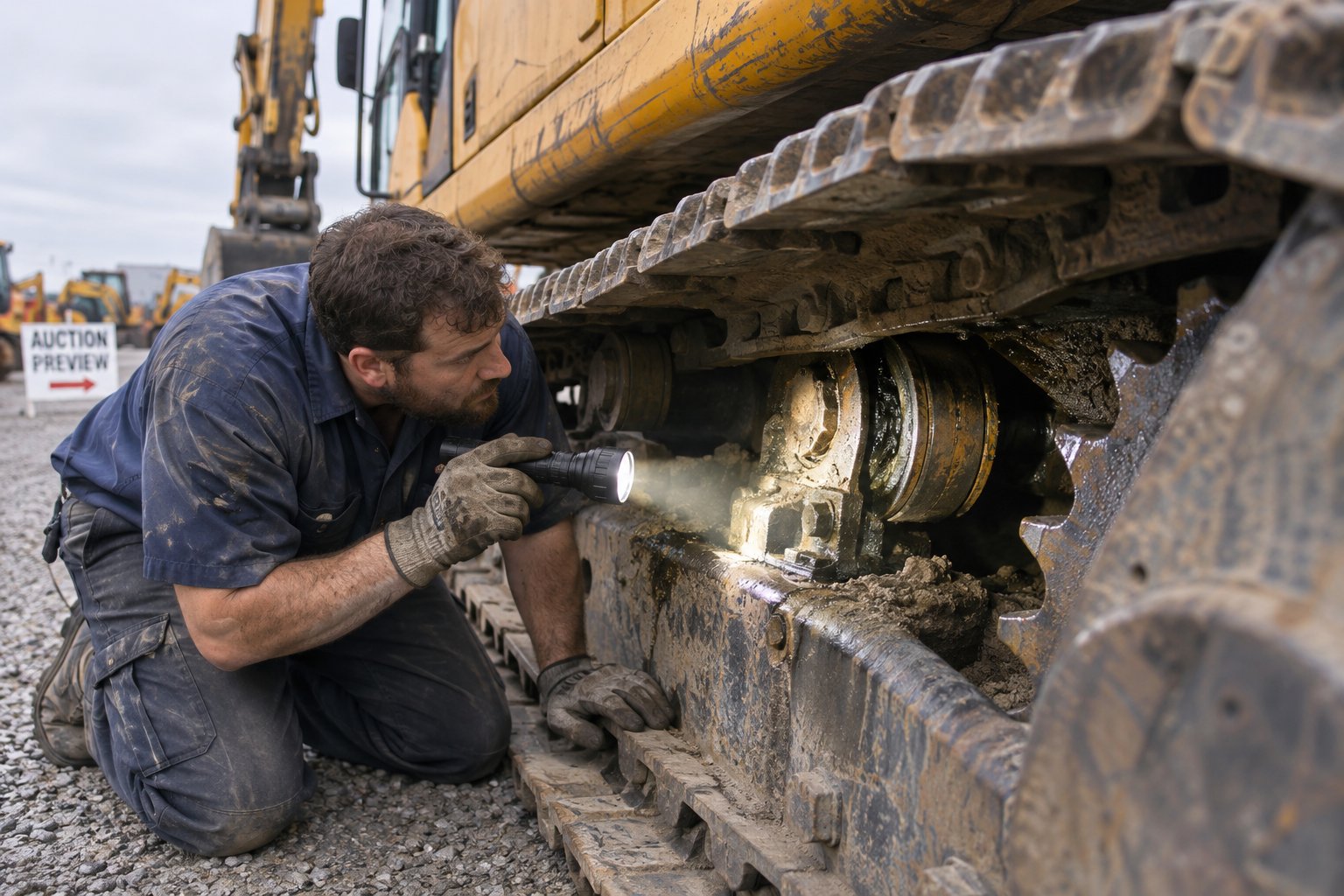
How to Inspect Heavy Equipment Before You Bid
You have picked the right auction format, registered as a bidder, and identified three lots that fit your budget. You feel ready. But here is the uncomfortable truth: the single biggest financial risk in any heavy equipment auction is not competition, not the buyer's premium, and not transport costs. It is buying a machine you did not inspect thoroughly enough. A fresh coat of paint and a clean cab can hide tens of thousands of dollars in deferred maintenance, structural fatigue, or outright fraud — and under as-is terms, every one of those hidden costs becomes yours the moment the hammer falls.
Whether you are evaluating a telehandler for sale, a compact track loader, or a 50-ton excavator, the inspection principles are the same. You are looking for evidence of how the machine was actually used versus how the seller wants it to appear. Let's walk through the checkpoints that separate informed bidders from expensive lessons.
Mechanical and Structural Checkpoints
Think of your pre-auction inspection as a layered diagnostic. You are scanning five interconnected systems, and weakness in any one of them can cascade into repair bills that dwarf the hammer price. Bring a flashlight, a rag, gloves, and — ideally — a mechanic who has turned wrenches on the type of machine you are pursuing.
- Undercarriage wear (tracked machines): This is the single most expensive component group on excavators, dozers, and track loaders. Examine track pads for worn or missing grousers, check idlers and rollers for flat spots or leaking seals, and inspect sprocket teeth for a hooked or sharpened profile that signals advanced wear. Undercarriage repairs can quickly add thousands of dollars to your ownership costs, so never treat this area as a quick glance. Measure track sag to assess tension adjustment range — if the track is already at maximum adjustment and still loose, the undercarriage is near the end of its service life.
- Hydraulic system health: Walk the entire machine and look for weeping or active leaks at every cylinder rod seal, hose fitting, and connection point. Operate the boom, stick, bucket, and any auxiliary circuits if the auction house allows it during preview hours. Listen for pump whine — a high-pitched, grinding sound that indicates cavitation or internal wear. Watch for jerky, hesitant movement or a noticeable delay when you move the joystick, both of which suggest internal bypass in the control valve or cylinders. A machine that cycles slowly under no load will struggle badly under working pressure on a job site.
- Engine condition: Request a cold start whenever possible. A cold start can reveal issues that may not be noticeable after the engine warms up — hard cranking, excessive starter strain, and warning lights that clear once oil pressure builds. Once running, watch the exhaust: white smoke at startup in cold weather is normal condensation, but persistent white smoke suggests coolant entering the combustion chamber through a head gasket or cracked head. Blue smoke means oil burn. Black smoke points to fueling problems or a restricted air intake. Pull the dipstick — the oil should be dark but not gritty, and there should be no milky residue indicating coolant contamination. Check the coolant reservoir for clarity and the absence of oily film on the surface.
- Structural frame integrity: Inspect boom pins, stick pins, and bucket linkage joints for excessive play by having someone cycle the hydraulics slowly while you watch for lateral movement at each connection point. Cracks at high-stress weld zones — particularly where the boom meets the house frame and around attachment mounting plates — are serious red flags. Look for weld repairs that appear rough, uneven, or piled on top of previous welds. On a skid steer and mulcher for sale combination, pay particular attention to the loader arm pivot points and the universal mounting plate, where vibration fatigue from mulching work concentrates stress.
- Tire or track condition: For wheeled machines like loaders, graders, and mini skid steer loaders for sale, inspect tires for sidewall cuts, chunking, uneven wear patterns, and remaining tread depth. A full set of replacement tires on a large wheel loader can easily exceed $15,000 to $20,000 — a cost that should factor directly into your maximum bid if tread is marginal. For tracked machines, check rubber tracks for cracking, missing lugs, and exposed cords. Steel tracks should be measured for remaining pad depth and checked for bent or cracked links.
Beyond these five systems, take a step back and look at the machine as a whole. Does the general appearance match the reported hours? A machine listed at 3,000 hours that shows heavy scuffing on every grab handle, a worn-through operator seat, and polished-smooth control levers probably has far more real operating time than the meter suggests. That kind of contextual mismatch is one of the most reliable early warnings of hour-meter tampering.
Documentation and History Red Flags
Physical inspection tells you what condition the machine is in right now. Documentation tells you how it got there — and whether the story you are being told holds together under scrutiny. Experienced bidders at heavy equipment auctions treat paperwork review with the same seriousness as turning wrenches.
Start by requesting every available document: maintenance logs, service invoices, title or lien-release paperwork, and any telematics data the seller can provide. Machines equipped with factory telematics or aftermarket GPS systems often store historical hour-meter readings, location data, and fault codes that paint a far more detailed picture than any seller description. If telematics data is available but the seller declines to share it, treat that reluctance as a data point in itself.
Here are the specific red flags that should make you pause — or walk away entirely:
- Missing or incomplete service records: A machine with documented, regular maintenance is statistically more likely to deliver reliable service. When records are absent, you are betting that the previous owner cared about the machine without any evidence to support that bet. As a general rule, a machine with documented maintenance is often a safer investment than one with an unknown history.
- Hour-meter inconsistencies: Rolling back hour meters is one of the most dishonest — and most common — practices in the used machinery market. Resellers can adjust electronic systems, physically tamper with the meter, or replace it entirely with a new unit showing low hours. Cross-reference the displayed hours against maintenance records (oil-change intervals should correspond to expected hour milestones), telematics history if accessible, and the machine's general cosmetic wear. A suspiciously clean meter reading on a machine with heavily worn controls, faded decals, and a sagging operator seat deserves deep skepticism.
- Mismatched or altered serial numbers: The serial number on the machine's PIN plate should match every supporting document — the bill of sale, title, maintenance records, and any manufacturer database lookup. Red flags include a missing or relocated plate, numbers that disagree across documents, and decals or stickers that do not align with the model sitting in front of you. These discrepancies can indicate stolen equipment, undisclosed liens, or a machine assembled from salvage components. A dealer for the brand in question can run the serial number to verify whether the model, year, and configuration match.
- Fresh paint in isolated areas: A full repaint on a piece of heavy equipment is not unusual — fleet managers and resellers do it for presentation. But selective repainting of one boom section, one frame rail, or one area around a pin joint is a different story. It often masks weld repairs, crack remediation, or impact damage that the seller would rather you not notice. Run your hand along repainted surfaces and feel for uneven texture or raised weld lines beneath the finish.
- Cosmetic staging that outpaces mechanical reality: Some resellers repaint and make surface-level cosmetic repairs to hide damage while leaving underlying engine problems or mechanical wear completely unaddressed. A machine that looks showroom-ready on the outside but produces abnormal smoke, leaks fluid under pressure, or hesitates through its operating cycle is telling you two different stories — and the mechanical one is always more honest.
For buyers exploring used restroom trailers for sale, compact equipment, or any asset where the purchase price feels modest enough to skip due diligence — resist that temptation. The percentage hit from a missed defect on a $4,000 machine can be just as painful as on a $200,000 one. Auction yards are full of small-ticket items that get bid up precisely because buyers assume low price equals low risk.
Also consider that many of the same inspection principles apply when you browse non-auction channels. Whether you find a used log splitter for sale through a classified ad or you spot closeout zero turn mowers at an end-of-season dealer event, the fundamentals do not change: check the hours, verify the paperwork, and never let a fresh appearance substitute for a thorough mechanical evaluation. Zero turn mower clearance deals can be genuinely excellent, but only if the machine behind the discount tag is mechanically sound.
Thorough pre-auction inspection is the single most effective risk-reduction strategy available to any buyer — more powerful than bidding tactics, financing terms, or format selection combined.
Every checkpoint above feeds into a broader calculation that most first-time bidders underestimate: the true financial exposure you accept the moment your bid wins. The as-is terms governing virtually all auction sales make that exposure absolute — and understanding exactly what those terms mean, alongside the difference between reserve and unreserved sales, is what separates strategic buyers from hopeful ones.
Understanding As-Is Terms and Reserve Versus Unreserved Sales
Every auction catalog you will ever read contains two words that carry more financial weight than any bid amount: as-is. Most buyers glance at the term, assume it means "used condition," and move on to studying lot photos. That misunderstanding is arguably the most expensive mistake in the entire heavy equipment auction process — because as-is does not simply describe condition. It defines who bears every single risk after the hammer falls.
What As-Is Where-Is Really Means for Buyers
The full phrase is "as-is, where-is," and it functions as a legal framework designed to facilitate a fast, transparent, and final sale. Let's break it into its two components so the implications are unmistakable.
- As-is (the condition): You accept the machine in its exact physical state at the moment the auctioneer says "sold." No warranties. No guarantees of functionality. No returns. If the engine throws a rod on the trailer ride home, that repair bill is yours. If a hydraulic pump you could not test during preview fails on the first job, you own the problem. The seller and the auction house disclaim all responsibility for hidden defects, undisclosed damage, and any gap between what you expected and what you received.
- Where-is (the logistics): The buyer is responsible for removing the equipment from the auction site at their own expense and risk. That includes disassembly if the machine is inside a building, professional rigging for heavy units, transport permits for oversized loads, and any crane or lowboy rental needed to get it on a trailer. The auction yard is not a storage facility — miss the removal deadline, and you face daily storage fees or, in extreme cases, forfeiture of the asset you just paid for.
Sounds harsh? It is — by design. As PESCO's guide to liquidation auctions points out, this risk transfer is exactly what drives the discounted pricing that attracts buyers in the first place. Because the seller is relieved of warranty obligations and delivery costs, the market sets prices based on pure demand rather than retail markup. You get access to machinery below dealer pricing, but you absorb every unknown that a dealer warranty would otherwise cover.
That trade-off is perfectly manageable — if you plan for it. Here are the practical risk-mitigation strategies that experienced bidders use every time they compete:
- Set a strict maximum bid that includes a repair contingency. Research the fair market value of the machine in good working condition, then subtract estimated repair costs for any issues you identified during inspection. The number you land on is your ceiling — not a starting point for negotiation with yourself once bidding heats up.
- Bring a mechanic to inspection day. Preview hours exist for exactly this reason. A qualified technician who has worked on the specific make and model can spot problems in minutes that would take a general buyer hours to identify — worn final drives on a tracked dump truck, internal bypass in a hydraulic valve, or early signs of turbo failure. The cost of a mechanic's half-day is trivial compared to a five-figure repair surprise.
- Budget a contingency margin on top of every cost estimate. Even thorough inspections miss things. A 10% to 15% contingency above your projected all-in cost — hammer price, buyer's premium, tax, transport, and known repairs — gives you a financial cushion that keeps a single surprise from derailing your entire acquisition plan.
- Factor in transport before you bid, not after you win. Get freight quotes for the specific machine dimensions and weight, including permit costs if the load is oversized. A buyer who wins small excavators for sale at a great hammer price but forgot to budget $2,500 in flatbed hauling has not actually gotten a deal — they have just hidden the cost from themselves.
Government surplus platforms like ohio govdeals listings and similar state portals apply the same as-is terms, often with even less descriptive detail than commercial auction houses. Municipalities typically provide basic specs, a handful of photos, and a general condition note — "runs and drives" or "inoperable" — and that is the extent of your pre-bid information. If you are browsing these platforms for a used porta potty for sale, a fleet vehicle, or a stand on skid steer, temper your expectations accordingly and lean even harder on the inspection strategies above.
Reserve Versus Unreserved Auctions and Pricing Dynamics
The as-is clause governs what happens after you win. The reserve structure governs whether the item sells at all — and understanding the distinction reshapes how you should bid.
In a reserve auction, the seller sets a confidential minimum price. If bidding does not reach that threshold, the item does not sell. The auctioneer may announce that the reserve has been met ("the lot is now selling") or may simply pull the item if bidding stalls. As Heritage Brokers & Auctioneers explains, being the highest bidder in a reserve auction does not always guarantee a purchase — if the hidden floor is not reached, the seller retains the right to reject the top bid or negotiate privately after the event.
In an unreserved (absolute) auction, the machine sells to the highest bidder regardless of the final price. There is no safety net for the seller and no hidden minimum. The property is guaranteed to change hands.
Each structure creates different dynamics for buyers:
| Factor | Reserve Auction | Unreserved (Absolute) Auction |
|---|---|---|
| Price Floor | Hidden minimum set by the seller | No minimum — starts at whatever the first bid offers |
| Bargain Potential | Lower — the reserve prevents deep discounts | Higher — items can sell well below market value if competition is thin |
| Competition Level | Moderate — some bidders avoid reserves due to uncertainty | Aggressive — the guarantee of a sale draws more participants |
| No-Sale Risk | Yes — if bidding falls short, the lot is pulled | None — the lot will sell |
| Buyer Strategy | Bid up to your calculated value; be prepared for no-sale outcomes | Bid disciplined — the crowd's energy can push prices past sensible limits |
Unreserved auctions are where the legendary "stole it" stories come from — a used zero turn mower for sale that closes at half its book value because only two bidders showed interest, or a set of used stump grinders for sale that slip through at pennies on the dollar during a long afternoon session when the crowd has thinned. Those bargains are real, but they attract savvy, well-capitalized buyers who know exactly what machines are worth. The competition at unreserved events tends to be sharper and more experienced, which means you need tighter homework and firmer discipline to walk away with genuine value rather than an impulse purchase driven by auction-floor adrenaline.
Reserve auctions, by contrast, tend to filter out the extreme bargain hunters. If you are comfortable paying fair market value for a machine and your primary goal is certainty of condition and type rather than rock-bottom pricing, reserve events can actually offer a calmer bidding environment. The trade-off is the possibility that you invest time researching and inspecting a lot only to watch it get pulled because bidding stalled below the seller's floor.
Regardless of which structure you encounter, the formula for calculating your true financial exposure remains the same — and it is the single most important number you will compute before raising your paddle or clicking "bid."
Total cost of ownership at auction = hammer price + buyer's premium + sales tax + transport + estimated repairs. Any bid that ignores even one of these components is not a strategy — it is a guess.
As Cleveland Brothers' ownership-cost guide reinforces, the purchase price is only the starting line. Maintenance costs, fuel expenses, financing interest, insurance, and eventual resale value all layer on top of that initial number over the machine's useful life. Buyers who calculate total cost of ownership before they bid — rather than after they have already committed — consistently make better acquisition decisions and avoid the painful surprises that turn a good deal into a financial burden.
That total-cost mindset becomes even more critical when you consider how most auction purchases are actually funded. Payment deadlines of 24 to 48 hours leave almost no room to arrange financing after the fact, which means the financial strategy has to be locked in before auction day — a challenge that varies dramatically depending on whether you are a contractor, a dealer, or an individual buyer stepping into the market for the first time.
Financing Options and Bidding Strategies by Buyer Type
Payment deadlines at equipment auctions are brutally tight — typically 24 to 48 hours after the hammer falls. That timeline is manageable when you are paying cash for a mini dumper or a set of attachments. It becomes a serious problem when you are bidding on a $90,000 bulldozer for sale and your financing is not already in place. Unlike a dealer purchase where the salesperson walks you through lending options over coffee, auction transactions assume you show up funded and ready. Buyers who miss that distinction lose machines, forfeit deposits, or scramble into unfavorable last-minute loan terms that erode every dollar they thought they saved.
Arranging Financing for Auction Purchases
Why is financing auction equipment harder than financing a new machine off a dealer lot? The answer comes down to risk. Lenders underwriting a new-equipment purchase have a manufacturer's warranty, a known maintenance baseline, and a predictable depreciation curve to work with. An as-is auction machine offers none of that. The collateral is older, the condition is less certain, and the resale value is harder to project — all of which make traditional lenders cautious or uninterested.
That does not mean financing is unavailable. It means you need to pursue the right channels and do it before you register to bid. Here are the primary options worth evaluating:
- Pre-approval through equipment-specific lenders: This is the gold standard for auction buyers. Dedicated equipment lenders understand as-is transactions and can issue a written pre-approval ceiling in as little as two to four hours, giving you a hard number to bid against. Some lenders finance older and higher-hour machines that banks would decline outright, which matters when auction inventory skews toward well-used iron. Apply days before the event — not the morning of — so your letter is ready when bidding opens.
- Auction-house financing partnerships: Some larger auction companies partner with lending institutions to offer point-of-sale financing. Availability varies by event and by lot value, so confirm the option during registration rather than assuming it will be there. An AgDirect survey of auction buyers found that many respondents passed on good deals simply because financing was not readily accessible at the time of purchase — a gap the industry is slowly closing but has not yet solved.
- SBA loans for qualifying small businesses: The Small Business Administration's 7(a) and 504 loan programs can fund equipment purchases, including used machinery. The catch is speed. SBA approvals take weeks, not hours, so this option works only if you identify the target machine well in advance and coordinate closing timelines with the auction house. Best suited for buyers who participate in timed online auctions with longer settlement windows.
- Business lines of credit: If you already maintain a revolving credit facility with your bank, drawing against it for an auction purchase gives you instant liquidity with no additional underwriting. The trade-off is that interest rates on general credit lines often run higher than rates on equipment-specific loans where the machine itself serves as collateral.
Whichever path you choose, the critical principle is the same: your financing ceiling is not your bid limit. Work backward from the approved amount. Subtract the buyer's premium, transport, tax, and a repair contingency. What remains after those deductions is your true maximum bid — the number you write on your hand, tape to your bidder paddle, or set as your online platform's auto-bid cap. Buyers who skip that math and bid to their full approval figure routinely end up short at settlement, scrambling to cover the gap between what they won and what they can actually pay.
Tailored Strategies for Contractors, Dealers, and Individual Buyers
Financing is one half of the equation. The other half is knowing how to bid — and that strategy shifts depending on who you are and why you are at the auction in the first place. A contractor replacing a downed machine for an active job site has fundamentally different priorities than a dealer building resale inventory or a farmer looking for an affordable skid steer price that fits a seasonal budget. The tips below are segmented by buyer profile so you can focus on the advice that matches your situation.
Contractors buying for their own fleet:
- Prioritize low-hour machines with verifiable maintenance history — the upfront premium you pay for documented service records almost always costs less than the surprise repairs lurking inside a mystery machine.
- Focus on total cost of ownership, not hammer price alone. A $55,000 excavator that needs $12,000 in undercarriage work is more expensive than a $63,000 unit with fresh rails and rollers.
- Target simulcast or live events where you can physically inspect and cold-start every machine on your shortlist. For a job-critical asset, hands-on evaluation is non-negotiable.
- Secure financing pre-approval sized to the most expensive machine on your target list, then use the backward-subtraction method above to set firm bid ceilings for each lot.
Dealers sourcing resale inventory:
- Target lots that can be refurbished at a margin-positive cost. A wheel loader with worn tires and a tired paint job but a solid drivetrain is a dealer's ideal auction find — cosmetic reconditioning costs a fraction of mechanical overhaul.
- Watch for volume-lot opportunities. Fleet liquidations from municipalities or large contractors sometimes bundle multiple machines into a single lot, and per-unit pricing in those bundles can drop well below individual-lot market value.
- Build relationships with auction-house reps who can alert you to upcoming consignments before the public catalog goes live. Early intelligence on inventory — whether it is skid loaders for sale, graders, or used zero turns for sale — lets you run your margins before competition even knows the lot exists.
- Track hammer-price data across multiple events to build your own comp database. Platforms and regional houses sometimes price the same model years apart within weeks. Spotting those inconsistencies is where dealer margin lives.
Individual buyers and farmers:
- Start with smaller, lower-risk purchases to build auction experience before chasing high-value machines. Winning a portable bathroom for sale, a set of attachments, or a compact utility tractor teaches you the rhythm of bidding, payment deadlines, and transport logistics without putting tens of thousands of dollars at risk.
- Use timed online auctions as your training ground. The extended bidding windows give you time to research comparable pricing — checking listings at places like ed's machinery and other regional dealers — so you can confirm whether the current bid represents genuine value or inflated competition.
- Set your absolute maximum before the auction starts, write it down, and honor it. Emotional overbidding hits first-time participants hardest because the competitive rush is unfamiliar. A predetermined ceiling eliminates the decision in the moment.
- Budget for transport and minor repairs as a fixed line item, not an afterthought. Individual buyers are the most likely to underestimate these costs because they lack the fleet-management experience that makes contractors and dealers account for them instinctively.
Regardless of your buyer profile, the common thread is preparation. Staying within predetermined limits is one of the most effective ways to maintain profitability in any auction environment. The buyers who consistently win — and win well — are the ones who walked in with their financing confirmed, their inspection notes reviewed, their maximum bids calculated, and their transport logistics booked. Everyone else is gambling with structure they have not built yet.
Financing and bidding strategy cover the buyer's side of the transaction thoroughly. But heavy equipment auctions are a two-sided market, and a surprising number of people searching for auction guidance are actually sitting on the other side of the block — trying to figure out whether consigning their own equipment is the smartest way to turn idle iron into capital.
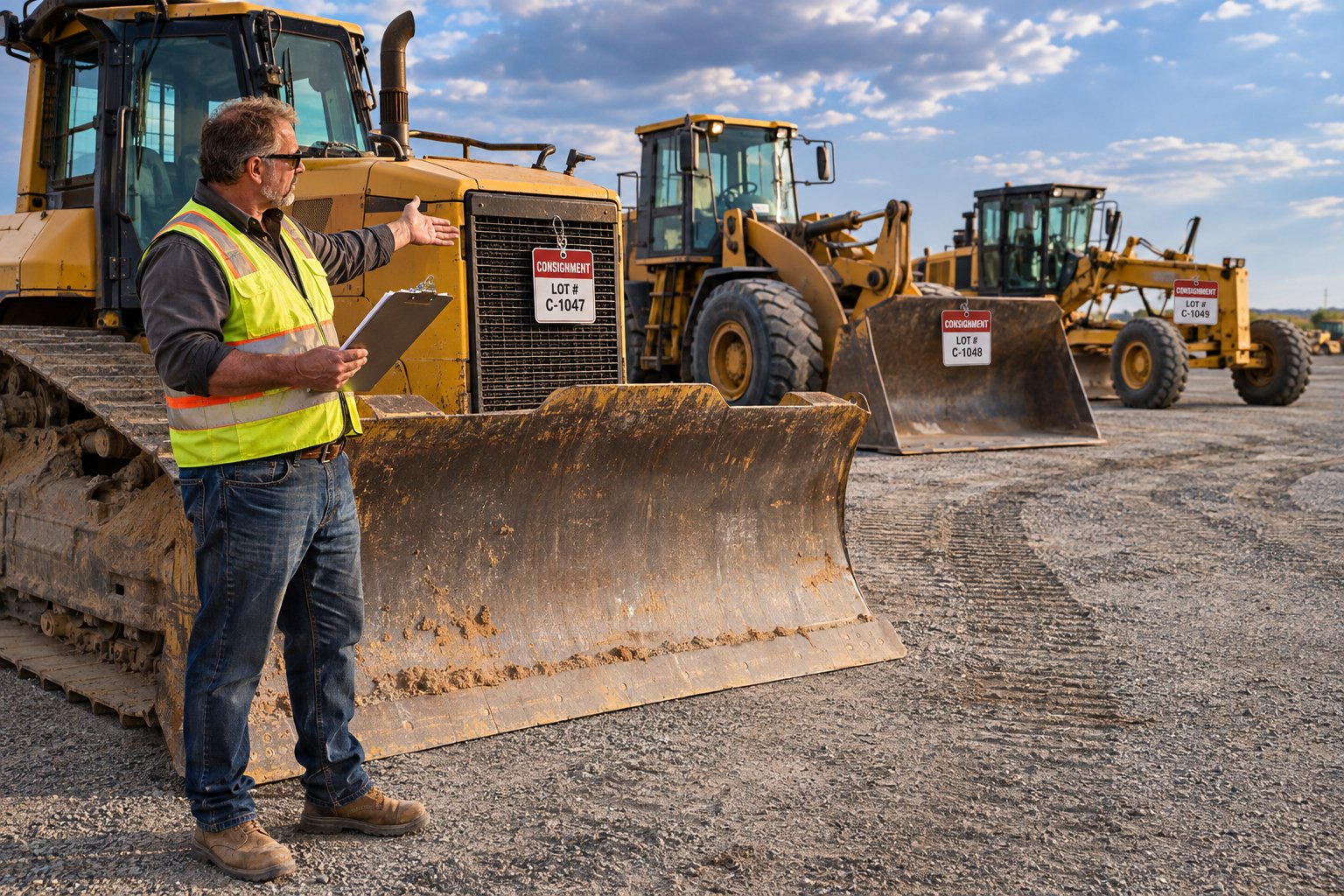
The Seller's Perspective on Consigning Equipment for Auction
Most auction guides are written entirely for buyers — how to bid, what to inspect, when to walk away. That leaves a glaring blind spot for the thousands of contractors, fleet managers, and equipment owners who land on this topic because they are sitting on idle iron and wondering how to convert it into cash. If you own a trencher for sale, a skid loader for sale, or an entire yard of machines you have outgrown, the decision is not simply "should I auction it?" The real question is which disposal channel gives you the best combination of speed, net return, and effort for your specific situation.
Deciding Whether to Auction, Trade In, or Sell Privately
Equipment owners have three primary paths to disposition, and each one involves a distinct trade-off between control and convenience. Picking the wrong channel does not just cost you money — it costs you time you cannot recover while that machine depreciates in your yard.
Auctions deliver speed and market exposure. A consignment auction connects your equipment with a concentrated pool of motivated buyers — contractors, dealers, municipalities — who are ready to purchase on a defined timeline. The typical cycle from consignment agreement to settlement runs four to eight weeks, which is dramatically faster than most private-sale timelines. The trade-off is cost: seller commissions generally range from 10% to 25% of the final sale price depending on equipment value and the services the auction house provides. And unless you set a reserve, there is no guaranteed floor on what your machine brings. A slow bidding day, thin attendance, or unfavorable market timing can push final prices below your expectations.
Dealer trade-ins offer maximum convenience and minimum effort. You drop off the old machine, sign paperwork, and the credit appears against your new purchase. For sellers replacing equipment on a tight project schedule, that simplicity has real value. The cost of convenience, however, is significant. Historical data shows auction prices run approximately 72% to 76% of dealer-advertised retail, and dealer trade-in offers typically fall below even that auction benchmark because the dealer needs to build in reconditioning costs, lot overhead, and resale margin. If maximizing net return matters more than minimizing hassle, trade-ins rarely win the math.
Private sales can yield the highest gross price because you negotiate directly with the buyer and avoid commission fees entirely. A contractor selling a well-maintained machine to another contractor in the same region — someone who can inspect it, verify its history, and haul it themselves — may net more than either auction or trade-in. The trade-off is time, effort, and risk. You handle your own marketing, field inquiries from tire-kickers, schedule inspections, vet buyer financing, and manage title transfer. For specialty items like used tree chippers for sale or a container office for sale, finding the right buyer privately can take months. And the longer equipment sits unsold, the more it depreciates, the more yard space it consumes, and the more carrying cost it generates.
So how do you choose? Match the channel to three variables: timeline (how fast you need the machine gone), volume (one unit versus a fleet), and price sensitivity (whether you need every last dollar or will accept market pricing for speed). Sellers liquidating multiple machines under time pressure — a fleet downsizing, a business closure, a seasonal equipment rotation — almost always find auctions deliver the best blend of speed and return. Sellers with a single high-value machine and no deadline may benefit from testing the private market first and falling back to auction if the listing stalls. Trade-ins make sense primarily when the convenience value of a same-day transaction outweighs the dollars you leave on the table.
Consignment Process and Choosing an Auction House
If auction is the right channel, the consignment process is your entry point — and the details of your consignment agreement will directly determine your net proceeds. Here is how the typical sequence unfolds.
You start by contacting one or more auction companies with basic information about your equipment: make, model, year, serial number, operating hours, condition, and known mechanical issues. Transparency here is not optional. Accurate information helps auction professionals evaluate your equipment and positions the lot honestly for prospective bidders. Misrepresenting condition — or omitting known defects — does not protect your price. It creates post-sale disputes that damage your reputation and can trigger legal exposure.
The auction house evaluates your equipment against their upcoming sale calendar, buyer audience, and current market demand. If accepted, you receive a consignment agreement outlining every financial term of the relationship. This document deserves the same careful reading you would give any contract worth five or six figures — because that is exactly what it is.
From there, you coordinate equipment delivery. Some auction houses arrange pickup or transport to their yard; others require the seller to deliver. Either way, the machine needs to arrive before the marketing window opens so the auction team can photograph it, write lot descriptions, and include it in catalog promotions. Marketing campaigns for consigned equipment typically run two to four weeks before the auction date and can include email blasts to buyer databases, social media promotion, paid digital advertising, and featured placement in online catalogs.
On auction day, your equipment enters the sale sequence alongside other consigned lots. Depending on the format — live, simulcast, or timed online — bidders compete until the auctioneer closes the lot. If the final bid meets your reserve (assuming you set one), the item sells. If it does not, the machine returns to your ownership, and you decide whether to relist at a future event, adjust the reserve, or pursue a different sales channel. Most reputable auction houses charge no commission on unsold items, though some apply nominal listing or administrative fees — a detail to clarify before you sign anything.
Settlement timelines vary. Expect to receive your net proceeds within 10 to 35 days after the auction closes, depending on buyer payment processing and the auction company's settlement schedule. Some houses settle faster; others follow a standard three-week cycle. Knowing that timeline in advance lets you plan cash flow around the sale rather than chasing payment status updates.
Not every auction house delivers the same results, and the differences go far beyond commission rates. Buyer network size, industry specialization, marketing reach, and geographic coverage all influence how many qualified bidders see your lot — and how aggressively they compete. Platforms like jj kane proxibid events, major national houses, and regional specialists each serve different buyer pools, and the right fit depends on what you are selling and where your likely buyers operate. A house with 35,000 construction-equipment subscribers will generate more competitive tension on an excavator than a generalist auctioneer whose database skews toward farm implements or vehicles.
Before you sign a consignment agreement with any auction company, ask these questions — and get the answers in writing:
- What is the seller commission rate, and is it negotiable based on equipment value or volume? Rates between 10% and 25% are standard, but high-value consignments or multi-unit packages can sometimes negotiate lower percentages.
- How is the buyer's premium structured, and does any portion of it flow back to the seller? Some houses split the buyer's premium with consignors; others retain it entirely. This distinction can shift your effective net return by several percentage points.
- What does the marketing plan include? Ask for specifics — email campaigns, catalog placement, social media, paid advertising, and whether your lot will be featured or buried in a 500-item catalog. Marketing exposure directly drives bidder count, and bidder count drives final price.
- What are the reserve-price policies? Confirm whether you can set a reserve, whether there is a fee for doing so, and what happens procedurally if bidding does not reach it. Some houses allow post-auction negotiation between the seller and the high bidder on unsold reserve lots — a second chance that can salvage an otherwise missed sale.
- What is the settlement timeline, and are there any deductions beyond commission? Transportation fees, storage charges, photography costs, listing fees, and insurance premiums can all appear as line-item deductions on your settlement statement. Know every number before you agree to consign.
- What is the process if the equipment does not sell? Understand whether you incur any fees for an unsold lot, how quickly you can relist, and whether the house will recommend reserve adjustments based on bidding activity.
Sellers who treat the consignment agreement as a formality end up surprised by deductions they did not expect. Sellers who negotiate informed terms — because they asked the right questions and compared multiple houses — consistently walk away with higher net proceeds and fewer post-sale headaches. The same principle applies whether you are consigning a $200,000 excavator, a porta john for sale from a completed job site, or an entire surplus fleet.
The seller's perspective rounds out the transactional picture of how heavy equipment auctions function. But knowing how to sell or buy is only part of the equation. Knowing what to look for on specific machine types — the wear patterns unique to excavators versus loaders versus dozers — is what turns general auction knowledge into category-level expertise that protects your money on every lot you evaluate.
Evaluating Excavators, Loaders, Dozers, and Graders at Auction
General inspection principles get you far, but every machine category punishes ignorance in its own way. An excavator's costliest failure point is not the same as a grader's, and the red flags on a wheel loader tell a completely different story than the ones on a dozer. Buyers who walk the auction yard with category-specific knowledge consistently avoid the five-figure surprises that generic checklists miss. The table below maps the four most commonly auctioned machine types against the evaluation criteria that matter most when money is on the line.
| Criteria | Excavators | Wheel Loaders | Bulldozers | Motor Graders |
|---|---|---|---|---|
| Primary Wear Points | Undercarriage (track pads, idlers, rollers, sprockets); boom and stick pins | Tires; loader-arm bushings; bucket cutting edge | Undercarriage; blade cutting edge; final drives | Circle and turntable shoes; moldboard slides; cutting edge |
| Typical Useful-Life Benchmark | 10,000 - 15,000 hours with proper maintenance; undercarriage may need rebuild at 4,000 - 6,000 hours | 10,000 - 20,000 hours depending on application severity; tires replaced every 3,000 - 6,000 hours | 10,000 - 15,000 hours; undercarriage rebuild interval similar to excavators | 12,000 - 20,000+ hours; circle and slide components require adjustment or replacement well before engine end-of-life |
| Critical Inspection Areas | Swing bearing play; hydraulic cylinder drift; boom-foot welds; hour-meter versus wear consistency | Transmission shift quality; center-pivot (articulation joint) tightness; hydraulic pump pressure; axle seals | Steering-clutch responsiveness; final-drive noise and seal condition; blade tilt cylinder integrity | Circle guide-shoe clearance; drawbar ball-stud wear; trunnion condition; articulation-joint play |
| Cost-Sensitivity Factors | Full undercarriage replacement can exceed 50% of a mid-life machine's auction value | A set of four loader tires can cost $15,000 - $25,000+; transmission rebuild rivals machine value on older units | Undercarriage and final-drive repairs together can approach or exceed hammer price on high-hour units | Circle rebuild and moldboard slide replacement are specialized jobs; limited aftermarket options raise parts cost |
Keep this table open on your phone during preview day. It turns a vague walkthrough into a focused, category-aware evaluation — and the specifics below will show you exactly what to look for on each machine type.
Evaluating Excavators and Loaders at Auction
Excavators consistently represent the largest share of inventory at heavy equipment auctions, from compact 3-ton units to excavator long reach models purpose-built for dredging and deep-trench work. That popularity means more options for buyers — but also more opportunities to get burned on a machine that looks solid from ten feet away and hides serious problems up close.
Excavators: Start underneath. The undercarriage is the single highest-cost wear system on any tracked excavator, and a thorough undercarriage inspection should evaluate track chains, rollers, idlers, and sprockets individually rather than relying on a general visual scan. Run your hand along the sprocket teeth — a hooked or sharpened profile signals advanced wear that is expensive to reverse. Check rollers and idlers for flat spots, cracked seals, or oil weeping from the housings. Measure track sag: if the adjuster is already at maximum extension and the track still hangs loose, you are looking at a rebuild that can easily exceed half the machine's auction value on mid-life units.
Move up to the boom and stick. Have someone cycle the hydraulics slowly while you watch each pin joint for lateral play or clunking — loose, sloppy movement at the boom pins, stick pins, or bucket linkage is direct evidence of bushing wear that worsens under load. Inspect the boom foot and boom nose welds carefully; cracks in these high-stress zones can be hidden by fresh paint or grinding marks. Check the bucket cutting edge for remaining material — a worn edge is cheap to replace, but it also tells you the machine has done real digging work, which should align with the reported hours.
The swing bearing is another critical checkpoint that many buyers skip. Rotate the upper structure a full 360 degrees and listen for grinding, popping, or rattling. Then try to rock the house side to side while the boom is extended — any perceptible movement between the turntable and the undercarriage frame indicates bearing wear that grows progressively worse and more expensive to address. On a long reach excavator configured for slope work or canal maintenance, swing-bearing health is even more consequential because the extended boom geometry amplifies side loads on every rotation.
Wheel Loaders: Shift your focus to tires and transmission. Tire condition on a wheel loader is not a cosmetic concern — it is a financial one. A full set of replacements on a mid-size loader runs $15,000 to $25,000, and the cost climbs steeply for large-frame machines. Inspect each tire individually for sidewall cuts, chunking, tread depth, and uneven wear patterns. Do not assume all four tires match: one may have been replaced after damage while the other three are near end-of-life. Note whether tires are foam-filled (common on demolition and waste-handling machines) since foam-filled tires cannot be repaired and are expensive to replace.
The transmission deserves a dynamic test. Put the machine through forward and reverse in all gears, listening for loud noises, and test how the transmission responds to abrupt direction changes — it should engage firmly with no slippage. A hesitant or slipping transmission on a wheel loader is a rebuild waiting to happen, and that rebuild can rival the machine's auction value on older units.
Check the center pivot — the articulation joint — for excessive vertical play between the top and bottom pins. This joint carries the entire front-to-rear steering load, and worn pivot bearings create a sloppy, unpredictable steering response that affects both productivity and safety. Have an inspection partner watch the pins while you operate the bucket through several load-and-dump cycles; any visible rocking at the pivot points warrants a closer look and a budget line for repair.
Loader-arm bushings and pin areas accumulate wear proportional to how aggressively the machine was used. Look at every pin area on the front half of the machine — boom pins, tilt cylinder pins, rod end pins, and boom cylinder pins — and note whether grease zerks are present, intact, and show signs of recent lubrication. Missing zerks or dry pin joints tell you the machine has been poorly maintained at the most fundamental level. These categories — excavators and loaders — dominate auction catalogs for good reason. They are the workhorses of construction, and whether you are bidding on loader equipment for sale to stock a rental fleet or chasing a compact excavator for residential site work, the checkpoints above apply universally.
Evaluating Bulldozers and Graders at Auction
Bulldozers: The undercarriage conversation repeats itself here — and with even more financial urgency. A dozer's undercarriage endures constant ground contact under immense pushing force, which accelerates wear on every component. Track shoes, links, rollers, idlers, and sprockets all degrade faster on a dozer than on an excavator performing comparable hours of work because the load distribution is relentless. Budget accordingly: on a high-hour machine, undercarriage replacement alone can approach or exceed the hammer price, turning a bargain bid into a break-even proposition.
Blade and cutting-edge condition tells you about the work the machine has done. A crowned or unevenly worn edge suggests the dozer has spent significant time on abrasive material — rock, compacted gravel, or frozen ground — which also accelerates drivetrain wear. Check blade tilt cylinders for smooth, leak-free operation and inspect the push arms and trunnion mounts for cracks or weld repairs.
Final drives are the second-highest-cost repair item behind the undercarriage. Listen for grinding or whining when the machine travels, and check final-drive seals for leaking lubricant — a wet seal on a final-drive housing is an early warning of internal bearing failure. Push the machine forward and backward, confirming it tracks straight without pulling to one side. Uneven travel indicates differential wear between the two final drives, and replacing even one unit is a substantial expense.
Steering-clutch responsiveness separates a productive dozer from a frustrating one. Cycle through turns in both directions and note whether the machine responds crisply or sluggishly. Worn steering clutches reduce the operator's ability to make precise grade corrections — a problem that compounds on finish work and slopes.
Motor Graders: Graders demand a different inspection vocabulary because their precision components have no direct equivalent on other earthmoving machines. The circle-and-turntable assembly is the heart of a grader's functionality, and tolerances must be maintained as close as possible — once wear reaches or exceeds finish-grade tolerances, it becomes extremely difficult to achieve grade productively. At auction, check the circle guide shoes and clamp shoes for visible clearance. Grab the moldboard and try to rock it — any perceptible play translates directly into grade inaccuracy on the job.
The most common wear points on a grader are the blade slide guides, circle guide shoes on the turntable, and blade lift cylinder connections. What makes this dangerous for auction buyers is a concept called tolerance stack: 1/16th of an inch of play in three or four joints adds up fast, and suddenly the whole system is loose enough to make finish grading impossible without a costly rebuild.
Moldboard condition matters more than most buyers realize. Inspect the cutting edge for crowned or uneven wear across its width — a worn center with sharper outer ends indicates heavy municipal road-dressing use and an edge that can no longer produce a flat finish. The cutting edge should always be replaced before it wears into the moldboard itself; if you see bolt heads flush with the edge surface, replacement is overdue and the moldboard may already be damaged.
Articulation-joint tightness on a grader affects both steering precision and blade control. Check for play at the articulation point by having someone cycle the steering while you observe from outside. Tandem-drive health rounds out the inspection: listen for abnormal noise from the tandem cases, check for oil leaks at the seals, and confirm that both tandems drive evenly without dragging or slipping.
Trunnions hold the blade lift cylinders and absorb the majority of shock loads during grading — worn trunnions undermine every other adjustment you make to the circle and slide. Ask whether shims are available for the ball stud and trunnion connections, as these are the quickest field adjustments for restoring lost tolerance.
Category-specific knowledge like this transforms how you evaluate lots at tool auctions, fleet liquidations, and every other event where heavy iron crosses the block. It also applies beyond the auction yard itself. Buyers who want to compare specifications and pricing for used excavators, loaders, bulldozers, and graders without the time pressure of a live bidding environment can browse JIUHONG's used construction equipment collection to review detailed machine specs and request purchase quotes at their own pace. It is a complementary sourcing channel — one that lets you evaluate options side by side, negotiate directly, and make decisions on your timeline rather than an auctioneer's.
The same discipline applies whether you are bidding on a mulcher for sale at a regional event, evaluating a used wood chipper for sale listed online, or browsing commercial lawn mowers for sale through a private seller. Know the machine category's weak points, inspect those areas first, and price your bid around repair reality rather than cosmetic appearance. That category-level awareness, paired with the inspection framework from earlier chapters, gives you a genuine edge on auction day — but it also raises a bigger strategic question: is the auction block always the best place to source your next machine, or are there situations where alternative channels deliver better outcomes?
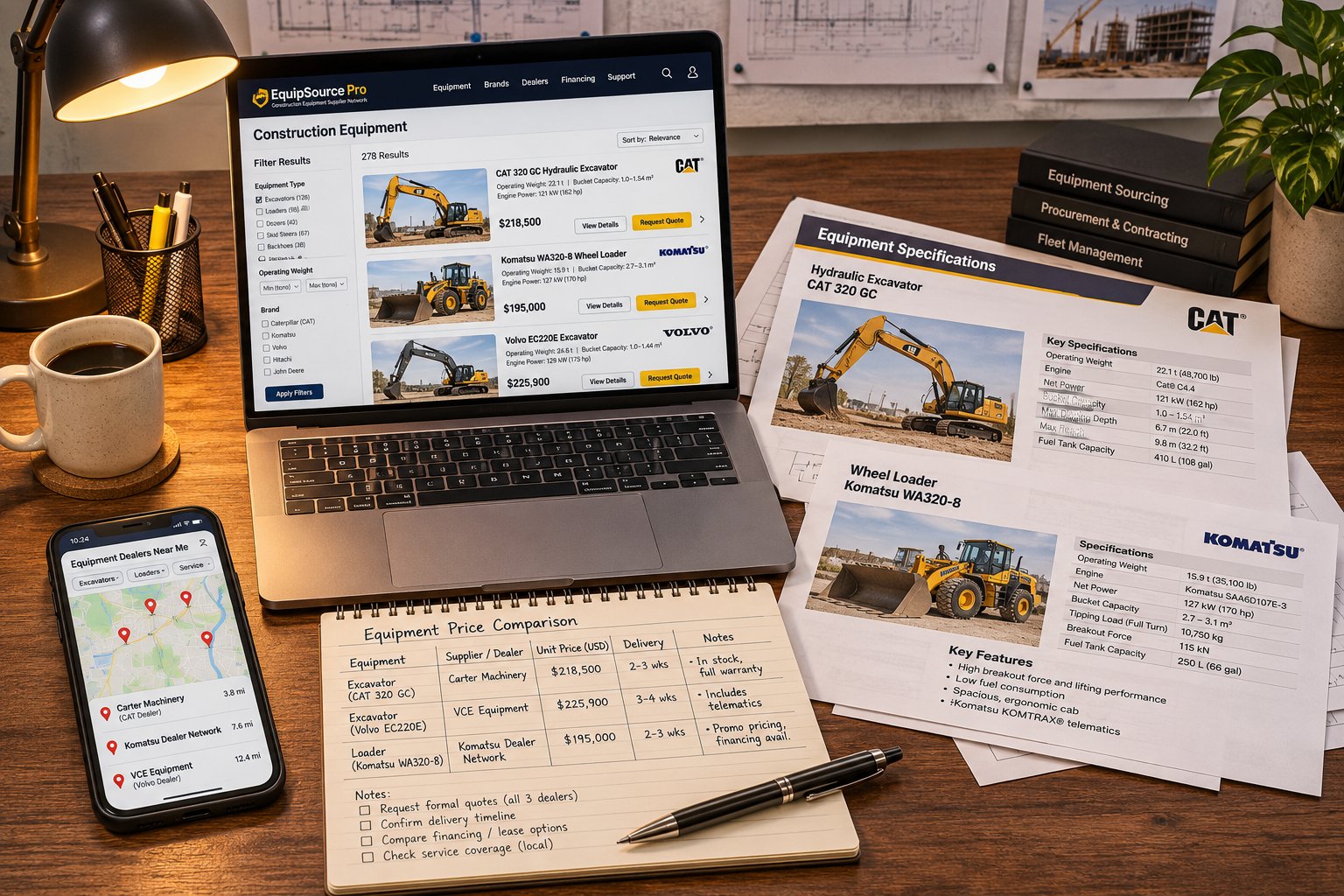
Sourcing Used Equipment Beyond the Auction Block
Heavy equipment auctions are powerful acquisition tools — but they are not the only ones in the toolbox. A contractor planning a project six months out has fundamentally different sourcing needs than a fleet manager scrambling to replace a downed excavator next week. A dealer hunting for a used mini skid steer for sale to fill a rental-fleet gap operates under different constraints than a municipality listing surplus graders on govdeals in north carolina or govdeals mo portals. The auction block rewards speed, preparation, and risk tolerance. Other sourcing channels reward patience, direct negotiation, and detailed comparison shopping. Understanding the full landscape lets you pick the right tool for each specific purchase rather than defaulting to one channel out of habit.
The table below maps five primary sourcing channels against the criteria that matter most when you are deciding where — not just what — to buy. Every channel involves trade-offs, and the best choice depends on your timeline, budget, risk appetite, and how much due diligence you are willing to perform independently.
| Criteria | Direct Supplier (e.g., JIUHONG) | Heavy Equipment Auctions | Dealer Lots | Private Sales | Online Marketplaces |
|---|---|---|---|---|---|
| Pricing Transparency | Quote-based; negotiate directly with the supplier on published inventory | Market-driven; final price set by competitive bidding | Listed retail price with room for negotiation | Asking price set by owner; negotiable | Listed price or best-offer; varies by seller |
| Inspection Opportunity | Detailed specs, photos, and video provided; on-site inspection may be arranged | Preview days at live events; photos and reports for online events | Full on-lot inspection; dealer may demo the machine | Arranged directly with owner; varies widely | Photos and descriptions only; physical inspection requires travel |
| Warranty Availability | Terms negotiated per transaction; varies by supplier | None — as-is, where-is governs virtually all sales | Often available; certified pre-owned programs on some brands | None unless privately negotiated | Rare; depends entirely on individual seller |
| Negotiation Flexibility | High — price, payment terms, and delivery logistics are all negotiable | None — you bid against the room and accept the outcome | Moderate — dealers expect negotiation but protect margin | High — direct buyer-to-seller discussion | Moderate — some sellers firm, others open to offers |
| Speed of Acquisition | Moderate — quote, negotiation, and shipping take days to weeks | Fast on auction day — but you wait for the next scheduled event | Fast — inventory is on the lot and ready | Slow — finding the right machine and closing can take weeks or months | Variable — depends on seller responsiveness and shipping logistics |
No single column wins across every row, and that is exactly the point. Your job is to read across the row that matters most to you — whether that is warranty coverage, negotiation room, or acquisition speed — and weight each channel accordingly.
Dealer Networks, Private Sales, and Online Marketplaces
Dealer lots are the default option most buyers consider first, and for good reason. Walking onto a dealer's yard means you can inspect machines in person, ask the sales team about service history, and sometimes test-operate the unit before committing. Established dealers often offer certified pre-owned programs with limited warranties, hydraulic and drivetrain inspections, and reconditioning that makes the machine closer to job-ready out of the gate. That convenience carries a price premium — auction prices typically run 72% to 76% of dealer-advertised retail — but for buyers who value certainty over savings, the trade-off can be worthwhile. If you need a front end loader for sale with documentation, a warranty, and same-week availability, a reputable dealer is hard to beat.
Private sales sit at the opposite end of the convenience spectrum. You negotiate directly with the owner, skip commission fees entirely, and sometimes access machines that never hit the public market — a neighbor's retiring fleet, a contractor downsizing after a project wraps, or a farmer selling a flail mower for sale along with a package of other implements. The upside is price flexibility and zero buyer's premiums. The downside is that every element of due diligence falls squarely on you. There is no auction house verifying title, no dealer standing behind the sale, and no platform mediating disputes. Conducting thorough research — checking maintenance records, verifying ownership, and independently assessing condition — is non-negotiable when the transaction has no institutional safety net.
Online marketplaces bridge the gap between auctions and private sales. Platforms dedicated to used heavy machinery aggregate listings from dealers, private sellers, and brokers into searchable databases filtered by make, model, location, price, and hours. These platforms have revolutionized the way buyers and sellers connect, providing a virtual trading space where buyers can browse a wide range of options from anywhere with an internet connection. Regional platforms like mnbid and national aggregators each serve slightly different audiences and inventory profiles. The convenience is real, but so is the variability in seller quality. One listing might come from a reputable dealer with detailed photos and a service binder; the next might be a bare-bones post with two blurry images and a vague "runs good" description. Treat every marketplace listing with the same inspection rigor you would apply to an auction lot — because the as-is reality of most private and marketplace transactions is functionally identical to auction terms, just without the competitive pricing pressure that sometimes works in your favor.
Direct Suppliers as a Complementary Sourcing Channel
Some purchases do not fit neatly into any of the channels above. Imagine you are a fleet manager comparing three different excavator models for an upcoming earthwork contract. You need detailed specifications side by side, the ability to ask technical questions about each unit, and the flexibility to negotiate price and delivery terms without a countdown clock ticking in the background. Or picture a dealer evaluating a bulk purchase of loaders and dozers for resale inventory — the kind of transaction where volume pricing, shipping logistics, and payment structure all need to be tailored rather than locked into an auction house's standard terms.
This is where direct-purchase suppliers add value. JIUHONG's used construction equipment collection is one example of this model in practice. Their inventory of excavators, loaders, bulldozers, and graders is published with detailed specs that contractors, fleet managers, and equipment dealers can review at their own pace. You browse the catalog, identify machines that match your project requirements, and request purchase quotes — all without the time pressure or competitive bidding dynamics of an auction environment. For buyers on longer planning horizons or those sourcing multiple units simultaneously, this quote-and-negotiate approach often delivers better alignment between what you need and what you pay.
That said, editorial honesty demands a clear-eyed acknowledgment: direct suppliers are not a universal solution any more than auctions are. You trade competitive market pricing for negotiation flexibility. You gain the ability to compare machines side by side but may lose the bargain potential that an unreserved auction floor occasionally delivers. Warranty terms, inspection access, and delivery timelines all depend on the specific supplier relationship — there is no industry standard the way there is for auction as-is terms.
The smartest equipment buyers do not commit to a single sourcing channel. They match the channel to the purchase — auctions for speed and market-driven pricing, dealers for warranty-backed certainty, private sales for negotiation leverage, and direct suppliers for specification-driven comparison shopping.
Every chapter of this guide has reinforced a single principle: preparation eliminates the most expensive surprises. Whether you are bidding on a tracked dozer at a simulcast event, negotiating a private deal on used heavy machinery from a retiring contractor, or requesting quotes from a direct supplier's catalog, the fundamentals remain constant. Know the machine's category-specific weak points. Inspect ruthlessly. Calculate total cost of ownership before you commit a dollar. And choose your sourcing channel with the same deliberation you apply to choosing the machine itself — because where you buy shapes what you pay just as much as what you buy does.
Frequently Asked Questions About Heavy Equipment Auctions
1. How do heavy equipment auctions work?
Heavy equipment auctions follow a structured lifecycle: you locate an upcoming event, register as a bidder by submitting ID and proof of funds, inspect available lots during preview days, set a maximum all-in budget (including buyer's premium, taxes, transport, and potential repairs), then bid competitively on auction day. Once the hammer falls, buyers typically must complete payment within 24 to 48 hours and remove the equipment within a firm loadout window. Formats range from live in-person yard events to timed online auctions with soft-close bidding extensions.
2. What does 'as-is, where-is' mean at an equipment auction?
The 'as-is, where-is' clause is a legal framework meaning the buyer accepts the machine in its exact current condition and location with no warranties, no returns, and no recourse for undisclosed defects. If the engine fails on the trailer ride home, that cost belongs entirely to the buyer. The 'where-is' component means you also bear full responsibility for removal logistics, including disassembly, rigging, transport permits, and hauling costs. This risk transfer is what enables auction pricing to fall well below dealer retail — but it demands thorough pre-auction inspection and a repair contingency built into every bid.
3. What is the difference between a reserve and an unreserved auction?
In a reserve auction, the seller sets a confidential minimum price; if bidding does not reach that threshold, the item is pulled and does not sell. In an unreserved (absolute) auction, the machine sells to the highest bidder regardless of the final price — no hidden floor exists. Unreserved events can produce significant bargains when competition is thin but tend to attract more aggressive, experienced bidders. Reserve auctions offer sellers price protection but may result in no-sale outcomes that cost both parties time. Buyers should adjust strategy accordingly: bid to your calculated value at reserve events, and maintain strict discipline at unreserved events where competitive energy can push prices past sensible limits.
4. How can I finance a heavy equipment auction purchase?
Financing must be arranged before auction day because most events require full payment within 24 to 48 hours. The strongest option is pre-approval through equipment-specific lenders who understand as-is transactions and can issue approval letters within hours. Other avenues include auction-house financing partnerships, SBA 7(a) or 504 loans for qualifying small businesses (though these take weeks to process), and existing business lines of credit. Critically, your financing ceiling is not your bid limit — subtract the buyer's premium, sales tax, transport costs, and a 10-15% repair contingency from your approved amount to arrive at your true maximum bid.
5. What should I inspect before bidding on heavy equipment at auction?
Focus on five core systems: undercarriage condition on tracked machines (track pads, idlers, rollers, sprockets), hydraulic health (leaks, pump whine, slow cycle times), engine condition (exhaust smoke color, oil quality, cold-start behavior), structural frame integrity (cracks at boom pins, weld repairs, bent members), and tire or track wear. Beyond mechanical checks, verify documentation — maintenance logs, title or lien-release paperwork, and telematics data. Red flags include missing service records, hour-meter readings inconsistent with cosmetic wear, mismatched serial numbers, and fresh paint in isolated areas that may conceal structural repairs. Bringing a qualified mechanic to preview day is one of the most cost-effective risk-reduction steps available.