

Understanding the Used Construction Equipment Landscape
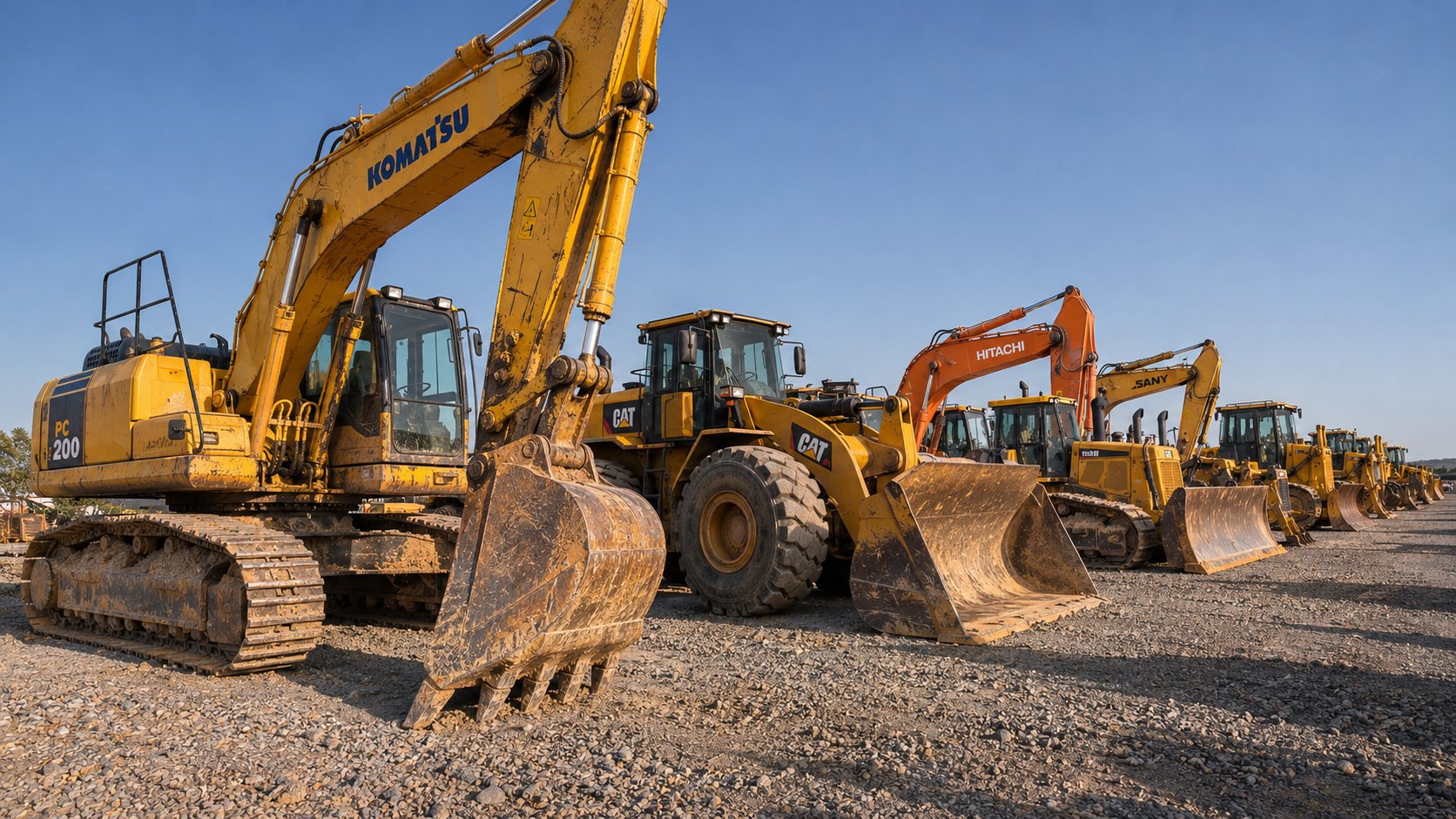
Used construction equipment refers to any previously owned earth moving equipment - excavators, loaders, bulldozers, graders, compactors, cranes, and their attachments - that re-enters the market for resale rather than heading to the scrapyard. It is a massive global industry. Mordor Intelligence estimates the secondary equipment market at roughly USD 132.67 billion in 2026, on track to reach USD 174.28 billion by 2031 at a 5.63% compound annual growth rate. Those numbers reflect a simple reality: contractors, fleet managers, and equipment dealers increasingly treat pre-owned machines as core operational capacity, not a fallback option.
Why the surge? OEM delivery times that stretch 12 to 18 months have turned immediately available machines into prized assets. Infrastructure megaprojects across Asia-Pacific, housing shortages in North America, and tightening emission mandates in European cities all pull demand in the same direction - toward equipment for trade on the secondary market. Whether you are expanding a fleet, entering a new service line, or chasing a short-term contract, understanding this landscape is the difference between a smart purchase and an expensive lesson.
What Counts as Used Construction Equipment
The category is broad, and not every pre-owned machine sits in the same condition bracket. Imagine three tiers:
- Lightly used: Machines with low engine hours, minimal cosmetic wear, and a documented maintenance history. These often come from rental fleet disposals or OEM certified pre-owned programs and command prices closest to new equipment.
- Refurbished: Equipment that has undergone a comprehensive restoration process - component replacement, hydraulic rebuilds, fresh paint, and rigorous testing - to bring it back to near-original condition. Refurbished units offer strong performance at a lower price point, though warranty coverage varies by provider.
- Salvage-grade: Machinery sold primarily for its parts or as a rebuild project. These units may have significant structural damage, high hours, or missing components. Salvage-grade equipment appeals to shops with in-house rebuild capability but carries real risk for anyone expecting a turnkey machine.
Within those tiers, you will find everything from mini excavators and skid steers to motor graders and 30-ton crawlers. Excavation sales alone represent a dominant share of the market - excavators accounted for 42.68% of global used equipment transactions in 2025, driven by their versatility across trenching, demolition, and site preparation. The sheer variety of used construction equipment for sale at any given moment can overwhelm a first-time buyer, which is exactly why a clear educational framework matters.
Why an Educational Guide Matters More Than Another Listing Page
Search for pre-owned heavy machinery online and you will land on marketplace after marketplace - platforms like MachineryTrader, GovDeals, and dozens of regional dealer sites. They do one thing well: list inventory. They show photos, hours, and a price. What they do not do is teach you how to evaluate what you are looking at.
Listing pages tell you what is available. They never tell you what is worth buying, how to inspect it, or what a fair price actually looks like - and that knowledge gap costs first-time buyers thousands of dollars every year.
This guide exists to close that gap. Every section ahead walks you through the decisions that actually determine whether a purchase pays off or becomes a liability: how to weigh new versus used, how to decode engine hours, how to inspect hydraulics and undercarriage wear, and how to navigate excavation sales channels without overpaying. Think of it as the buyer education layer that no marketplace has any incentive to provide. The goal is straightforward - give you the information you need to make a confident, well-informed decision the next time you step into the secondary equipment market.
That confidence starts with understanding the financial case for buying pre-owned in the first place - and being honest about the trade-offs that come with it.
New vs Used Heavy Machinery
Every equipment purchase is a capital allocation decision - and the sticker price is only the opening line of a much longer financial story. The real question is not "new or used?" It is "where on the depreciation curve does my money work hardest?" Understanding that curve, along with the genuine trade-offs in warranty coverage, maintenance costs, and technology, separates buyers who preserve capital from those who quietly bleed it.
The Real Cost Savings of Buying Used
Heavy equipment loses value the fastest in its earliest years. According to Heavy Vehicle Inspection's 2026 depreciation guide, a typical machine sheds 40-50% of its purchase price in the first three years alone. Picture a $325,000 excavator bought new - by year three, its market value may already sit near $160,000 to $195,000, depending on hours and maintenance. That steep initial drop is the single biggest cost difference between buying new and buying used.
Here is where the opportunity lives for budget-conscious buyers. When you purchase used heavy machinery that is three to five years old, someone else has already absorbed that brutal first wave of depreciation. The value-loss curve moderates to roughly 8-12% per year through years four to six, then often flattens further between years seven and ten. You are stepping onto a gentler slope instead of riding the cliff.
Think of it this way: a well-maintained excavator at five years old may retain 55-65% of its original value if it has a documented service history, versus just 35-45% without one. Buying in that window means you get a machine with proven reliability at a fraction of the new price - and your own depreciation exposure going forward is dramatically smaller. The capital you preserve can fund additional fleet units, cover project overhead, or simply stay in reserve for the unexpected.
Trade-Offs Every Buyer Should Weigh
Cost savings do not come without concessions. Buying used construction equipment means accepting a different risk profile than a factory-fresh machine, and you need to see those risks clearly before signing anything.
Warranty coverage is the most obvious gap. New machines ship with comprehensive factory warranties - if a major component fails early, the manufacturer covers the bill. Used equipment, particularly from private sellers or auction platforms, often sells as-is. Some reputable dealers offer certified pre-owned programs or aftermarket warranty packages, but the coverage is typically narrower and shorter than what you would get with new iron.
Repair costs are the shadow variable. An older machine is closer to major overhaul territory - engine rebuilds, transmission work, hydraulic pump replacements - and these can run into five figures fast. A machine that looks like a bargain on a heavy mart listing can become an expensive lesson if its undercarriage needs replacement or its hydraulic system is showing early signs of failure.
Technology gaps deserve attention too. Newer models often come equipped with GPS-guided grading systems, improved fuel efficiency, telematics, and emissions compliance features that older units simply lack. If your projects require Tier 4 Final emissions standards or integrated machine control, a ten-year-old unit may not qualify.
Parts availability is one more factor that first-time buyers tend to overlook. Popular makes and models from established manufacturers usually have robust parts networks. But older or less common machines - especially heavy equipment salvage units or discontinued model lines - can leave you waiting weeks for a critical component.
| Dimension | New Equipment | Used Equipment |
|---|---|---|
| Upfront Cost | Full retail price; highest capital outlay | Significantly lower; steepest depreciation already absorbed |
| Warranty | Comprehensive factory warranty included | Limited or none; CPO programs available from select dealers |
| Expected Maintenance | Minimal in early years; covered by warranty | Higher probability of near-term repairs; maintenance history is critical |
| Financing Options | Broader lender options; lower interest rates typical | Available but may carry higher rates; older units may not qualify |
| Technology & Features | Latest telematics, fuel efficiency, and emissions compliance | May lack current tech; older emissions tiers possible |
| Resale Value | Steep depreciation in years 1-3; slower decline after | Gentler depreciation curve; less capital at risk over holding period |
| Availability | May require months of lead time from manufacturer | Typically available immediately from dealer or auction inventory |
The comparison is not a matter of one column winning across the board. It is about matching the right column to your specific financial situation, project timeline, and risk tolerance.
When Used Equipment Is the Smarter Financial Play
There are specific scenarios where buying used construction equipments clearly outperforms buying new - not as a compromise, but as the strategically superior move.
- Seasonal or short-term projects: If you need a machine for a six-month highway contract or a single demolition job, tying up capital in a new unit makes little sense. A used machine at a lower acquisition cost delivers the same productivity for the project duration, and you can resell it afterward with minimal depreciation loss.
- Fleet expansion on a budget: Growing contractors often need more machines faster than their cash flow supports at new-equipment prices. Purchasing two or three reliable used units for the cost of one new machine puts more iron on more job sites simultaneously.
- Entering a new service category: Imagine you are a grading contractor considering a move into demolition. Buying a new purpose-built demolition excavator before you have proven the revenue stream is a heavy bet. A used unit lets you test the market without heavy capital commitment - if the work materializes, you can upgrade later from a position of knowledge rather than speculation.
- Immediate availability needs: As Thompson Machinery notes, new machines may take considerable time to manufacture, creating operational delays. Used equipment is typically ready to ship, which matters when a contract start date is fixed and the clock is already running.
- Backup and redundancy: A used machine parked as a backup unit costs far less than the downtime penalty of having your only excavator or loader go down mid-project with no replacement available.
The financial logic is straightforward. Every dollar you do not spend on absorbing someone else's depreciation is a dollar working somewhere else in your operation. The key is knowing how to evaluate what you are actually buying - which means understanding the equipment categories available, how they differ, and what each type is built to do.
Equipment Types Every Used Construction Equipment Buyer Should Know
Marketplace listings throw equipment categories at you like everyone already speaks the language - "crawler excavator," "CTL," "motor grader" - with zero explanation of what these machines actually do or why one might suit your project better than another. If you are shopping for a construction work machine and the terminology feels like alphabet soup, you are not alone. This section translates every major category into plain terms so you can match the right iron to the right job before you ever request a quote.
Excavators and Their Subcategories
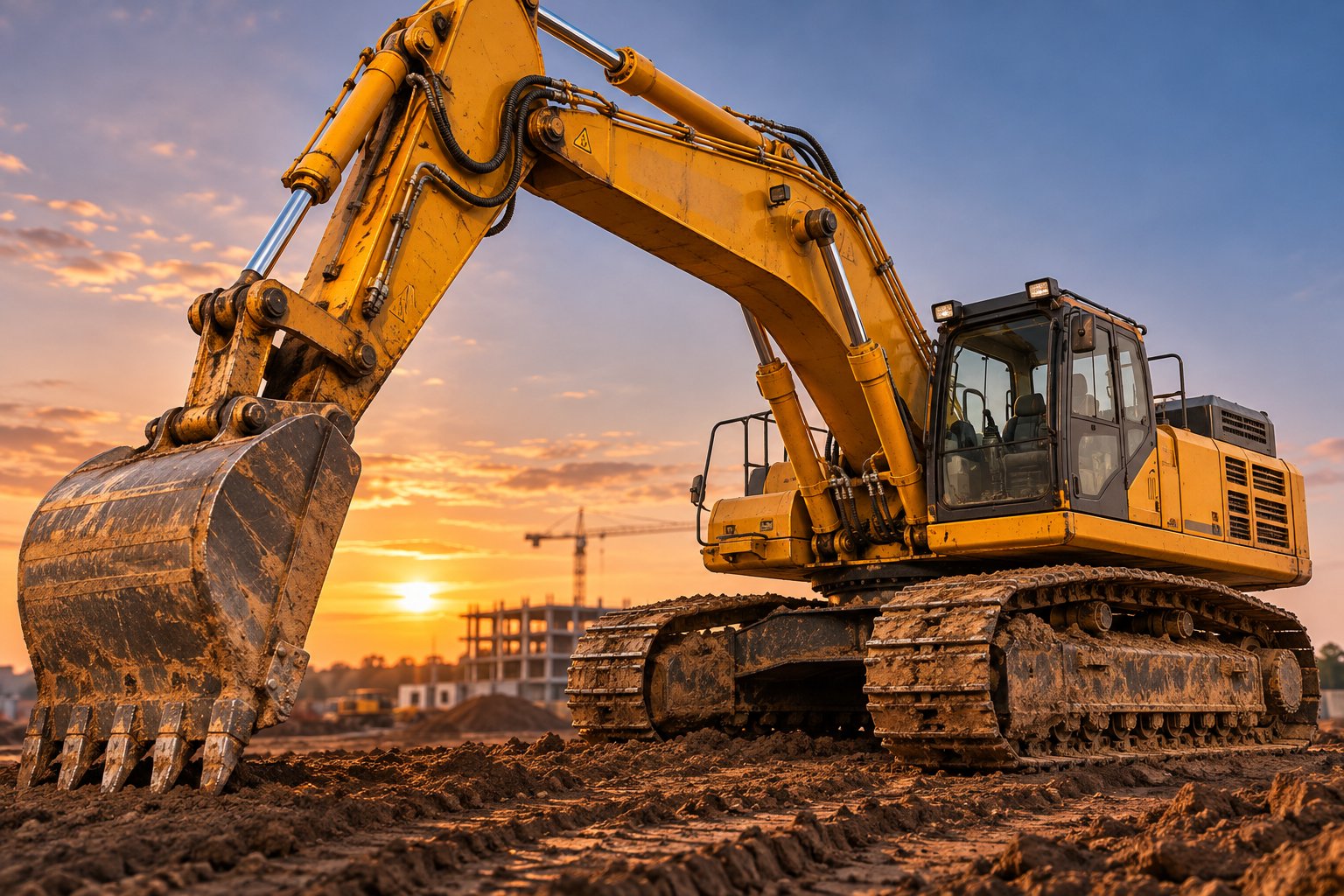
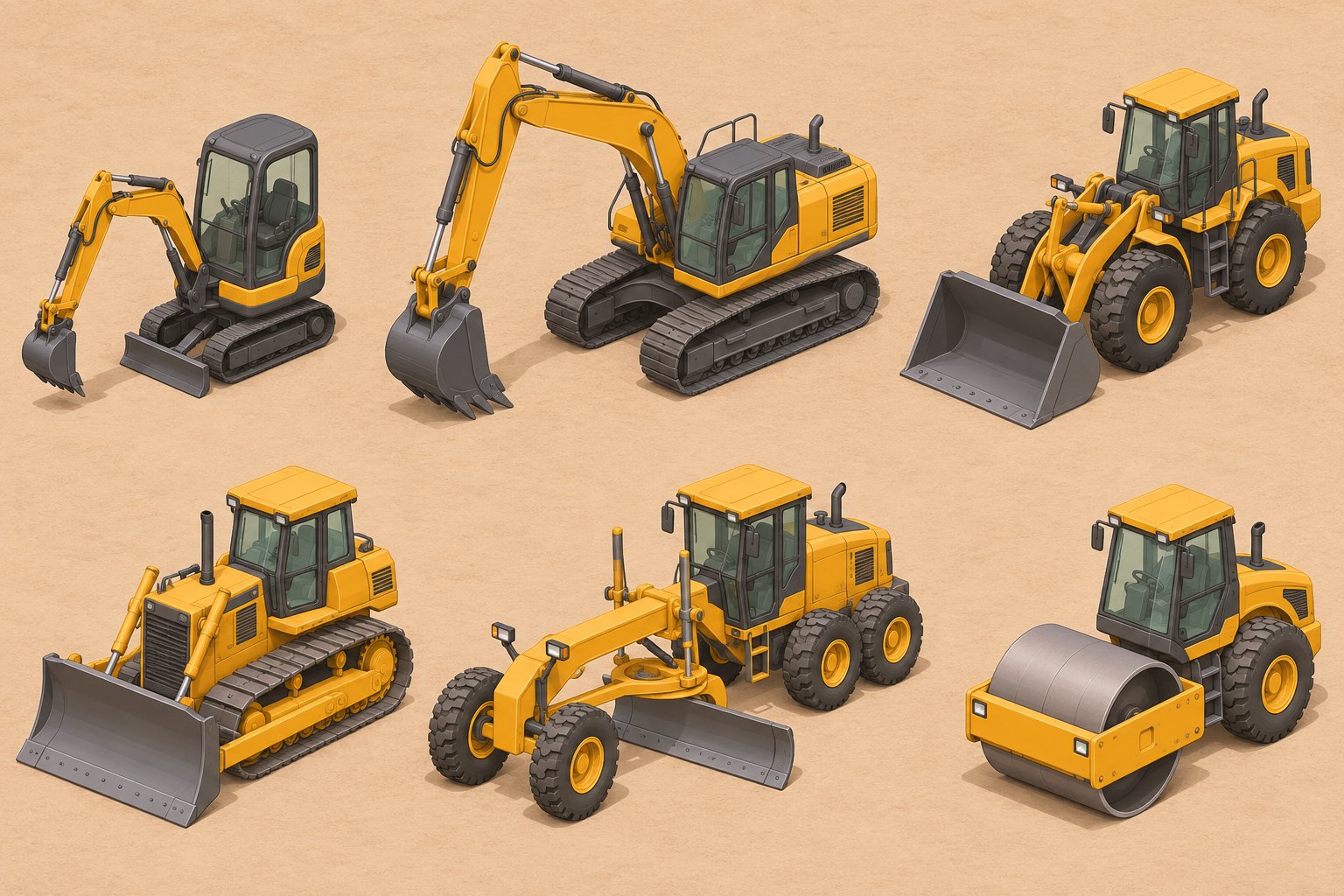
Excavators dominate the secondary market for good reason - they are the most versatile machines on a construction site. But "excavator" is a broad label covering several distinct size classes, each built for different work.
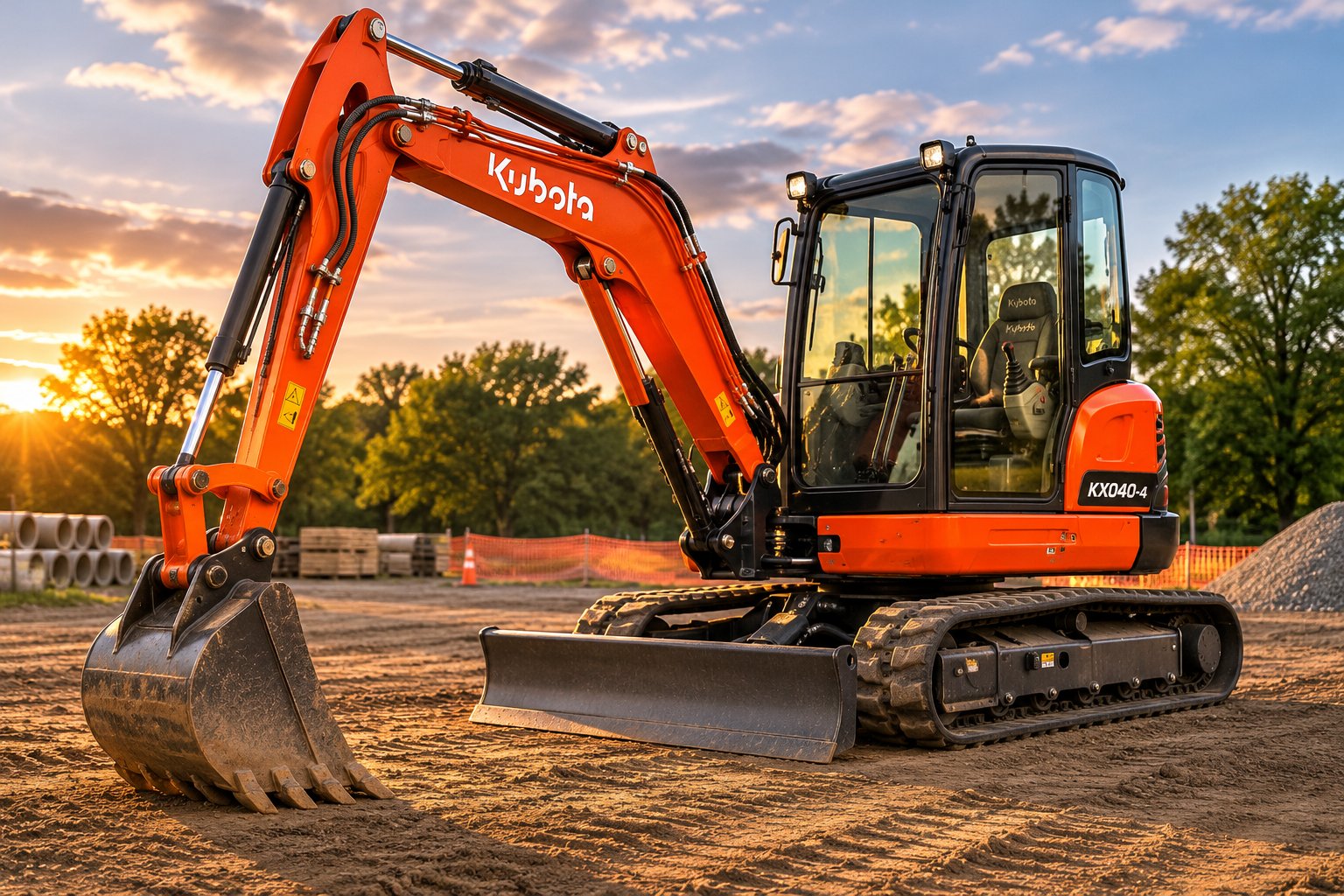
Mini excavators weigh less than 7 metric tons and are built for tight spaces. Imagine residential utility trenching, landscaping projects, or indoor demolition where a full-size machine simply cannot fit. Most mini excavators feature zero or near-zero tail swing, meaning the rear of the cab stays within the track width when it rotates - critical when you are digging next to a building wall or a fence line. Their lighter weight also means they will not tear up finished lawns or soft ground. The trade-off? Limited dig depth and bucket capacity, so they are not suited for deep foundation work or high-volume earthmoving.
Standard excavators sit in the 7- to 45-metric-ton range and handle the bulk of commercial construction. Gregory Poole's excavator guide breaks this class into small (7-10 tons) and medium segments, but the defining trait is versatility - these machines dig trenches, load trucks, demolish structures, and handle material with a single quick-attachment coupler swap. Dig depths typically range from around 12 feet on the smaller end to over 20 feet on larger models. When a listing quotes "bucket capacity," that number tells you how much material the machine scoops per cycle - a 0.5-cubic-yard bucket moves roughly half a ton of dirt per pass, while a 1.5-cubic-yard bucket triples that throughput.
Long-reach excavators extend the standard boom and stick to achieve working ranges of up to 100 feet. They are purpose-built for jobs where the machine cannot get close to the work - dredging canals, demolishing elevated structures, or slope shaping along waterways. You will see fewer of these on the secondary market, but when a project demands extended reach, no amount of creative positioning with a standard excavator will substitute.
One practical note: when browsing any machine for sale in the excavator category, pay close attention to whether the listing specifies a wheeled or tracked undercarriage. Wheeled excavators maneuver faster on hard, flat surfaces like asphalt and concrete and can often drive between job sites without a trailer. Tracked models provide superior traction and stability on slopes, mud, and uneven terrain but require transport on a flatbed.
Loaders, Bulldozers, and Graders
Wheel loaders are the workhorses of material handling. Picture a machine with a large front bucket on articulated arms, mounted on four rubber tires - it scoops aggregate from a stockpile, pivots, and dumps into a waiting truck. Rated by bucket capacity and operating weight, wheel loaders range from compact models under 10 tons to monsters exceeding 50 tons used in quarry operations. If your project involves moving bulk material - gravel, sand, topsoil, demolition debris - a wheel loader is likely the most efficient tool for the job.
Skid steer loaders and compact track loaders (CTLs) look similar at first glance, but the undercarriage makes all the difference. Skid steers ride on four wheels, steer by varying wheel speed on each side, and excel on firm, flat surfaces like concrete pads and gravel yards. CTLs replace those wheels with rubber tracks, spreading the machine's weight over a larger footprint. Bobcat's comparison guide highlights the core distinction: tracks deliver lower ground pressure and continuous traction, making CTLs the better choice for muddy, sandy, or sloped terrain. Both machines accept the same quick-attach tools - buckets, forks, augers, brush cutters - so the decision often comes down to the ground conditions where you work most.
Bulldozers push massive volumes of earth using a wide front blade mounted on a tracked chassis. They are the first big equipment to arrive on a site prep job, clearing vegetation, leveling rough terrain, and pushing soil into position for grading. Sizes range from compact dozers under 10 tons to large production units exceeding 70 tons. The blade type matters: a straight blade (S-blade) excels at fine grading, a universal blade (U-blade) moves loose material in bulk, and a semi-universal blade splits the difference.
Motor graders serve a more specialized role. Their long frame and adjustable moldboard blade sit between the front and rear axles, allowing precise control of surface grade and slope. Road construction crews depend on graders to establish crown, drainage pitch, and smooth base layers. If you do not work in road building, site grading, or maintenance of unpaved surfaces, a grader probably is not on your shopping list - but for those who need one, finding a well-maintained used unit can save a significant sum compared to the new-equipment price tag.
Specialty and Support Equipment
Beyond the primary earthmoving categories, several support machines round out a typical fleet - and they show up regularly in used inventory from any established used construction equipment dealer.
Compactors densify soil, gravel, or asphalt after material placement. Vibratory rollers handle road base and asphalt, while pad-foot (sheepsfoot) rollers compact cohesive soils in layers. Choosing the wrong compaction method can lead to settling, cracking, and costly rework down the line.
Backhoe loaders combine a rear-mounted excavator arm with a front loader bucket on a single wheeled chassis. They are the Swiss Army knife of small to mid-size job sites - digging utility trenches in one cycle, then swinging around to load spoil into a truck. Gregory Poole notes that backhoes rotate only about 200 degrees versus a full 360 on a standard excavator, but their dual-function design and road-drivable wheels make them uniquely practical for municipal and utility work.
Dump trucks - both articulated and rigid-frame - move material between dig zones and stockpiles. Articulated models handle rough terrain and tight turns; rigid-frame trucks carry heavier payloads on established haul roads.
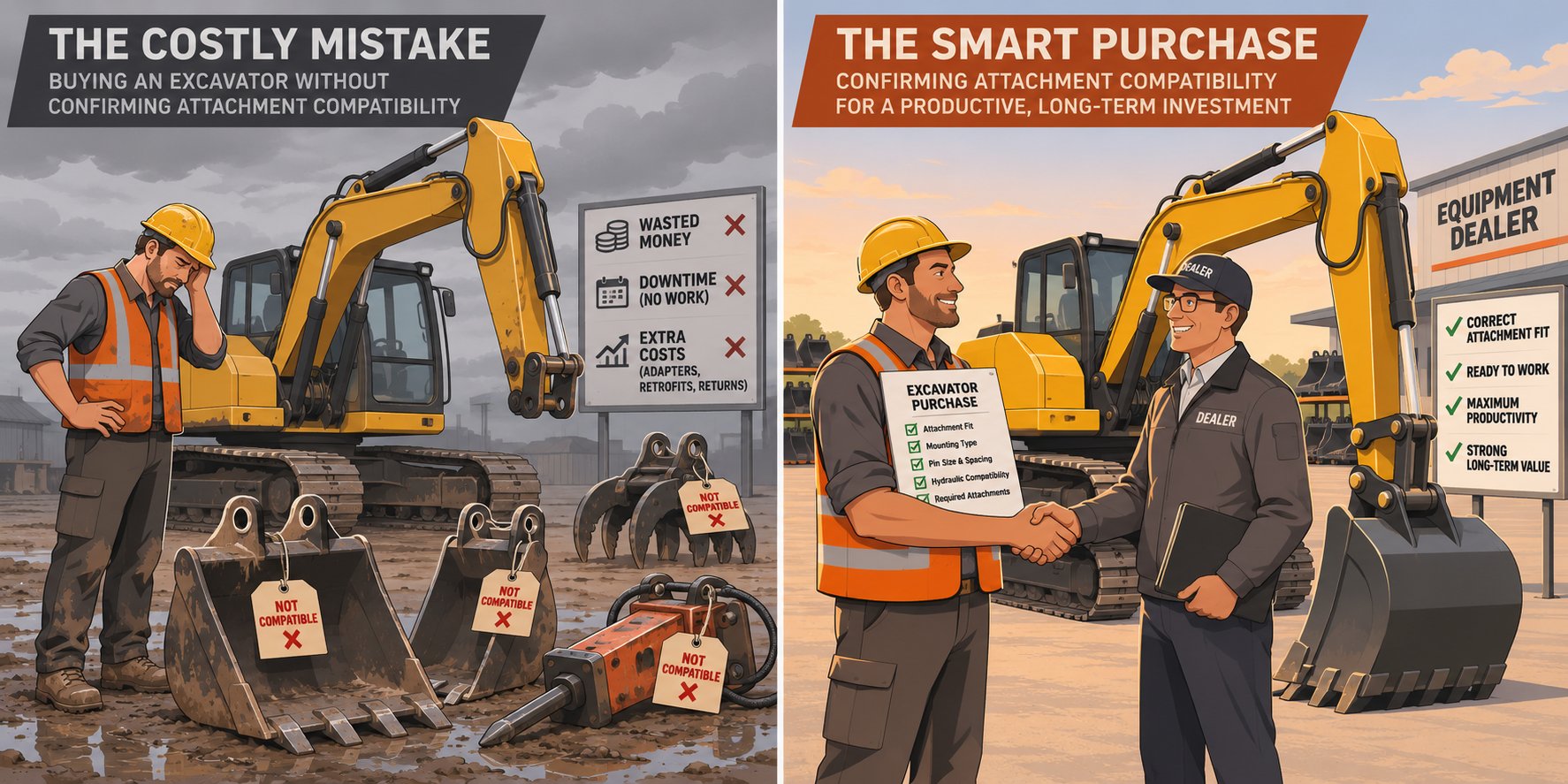
Attachments deserve special emphasis because they are the most overlooked cost variable for first-time buyers. A bucket, breaker, grapple, or auger can transform a single base machine into a multi-role tool - but only if it physically fits. Carolina Cat's attachment guide underscores that coupler type and pin spacing must match between the attachment and the carrier machine. Buying a machine without confirming that your existing attachments are compatible - or budgeting for new ones - is one of the fastest ways to blow past your planned spend.
| Equipment Category | Common Use Cases | Typical Size Classes | Key Specs Buyers Should Understand |
|---|---|---|---|
| Mini Excavator | Utility trenching, landscaping, indoor demolition | Under 7 metric tons | Dig depth, tail swing type (zero/near-zero), bucket capacity |
| Standard Excavator | General excavation, demolition, loading, material handling | 7 - 45 metric tons | Dig depth, reach, bucket capacity, coupler type |
| Long-Reach Excavator | Dredging, slope work, elevated demolition | 20+ metric tons (with extended boom) | Working range (up to ~100 ft), boom/stick length |
| Wheel Loader | Material handling, truck loading, stockpile management | Compact to 50+ metric tons | Bucket capacity, operating weight, breakout force |
| Skid Steer Loader | Grading, hauling, snow removal, material handling on hard surfaces | Compact (typically under 5 tons) | Rated operating capacity, lift type (radial/vertical), attachment coupler |
| Compact Track Loader | Same as skid steer but on soft, rough, or sloped terrain | Compact (typically under 6 tons) | Ground pressure, track width, rated operating capacity |
| Bulldozer | Site clearing, rough grading, earthmoving, push-loading | Small (under 10 t) to large (70+ t) | Blade type (S/U/SU), operating weight, drawbar pull |
| Motor Grader | Road construction, finish grading, drainage shaping | Mid to large (12 - 25+ metric tons) | Moldboard width, articulation angle, horsepower |
| Compactor / Roller | Soil compaction, asphalt rolling, base layer preparation | Walk-behind to 20+ metric tons | Drum type (smooth/padfoot), centrifugal force, operating width |
| Backhoe Loader | Utility trenching, loading, small excavation, municipal work | Mid-size (~7 - 11 metric tons) | Dig depth (rear), loader bucket capacity (front), rotation arc (~200 deg) |
| Dump Truck | Hauling material on-site or between sites | Articulated or rigid; 15 - 50+ metric tons payload | Payload capacity, body volume, articulation type |
Scan that table before your next search and you will filter listings with confidence instead of guessing. Pay particular attention to the "Key Specs" column - those are the numbers that determine whether a machine can actually perform the work you need, and they are the same figures you should verify against any listing on a heavyquip marketplace or dealer site.
Knowing what each category does, however, is only half the equation. The other half is knowing how to judge whether a specific unit is worth its asking price - and that means understanding how to inspect a machine's mechanical condition before you commit a dollar.
How to Inspect and Evaluate Used Equipment Condition
A listing photo can make a 10,000-hour excavator look showroom-fresh. The paint might gleam, the cab might sparkle - and underneath, a failing hydraulic pump could be weeks away from a $15,000 repair bill. Whether you are browsing heavy equipment online auctions from your office or standing in a dealer yard with grease on your boots, what you cannot see in a photo is exactly what determines whether a machine is a smart buy or an expensive headache. This section gives you a component-by-component inspection framework that goes far deeper than a walk-around glance.
Undercarriage and Structural Integrity Checks
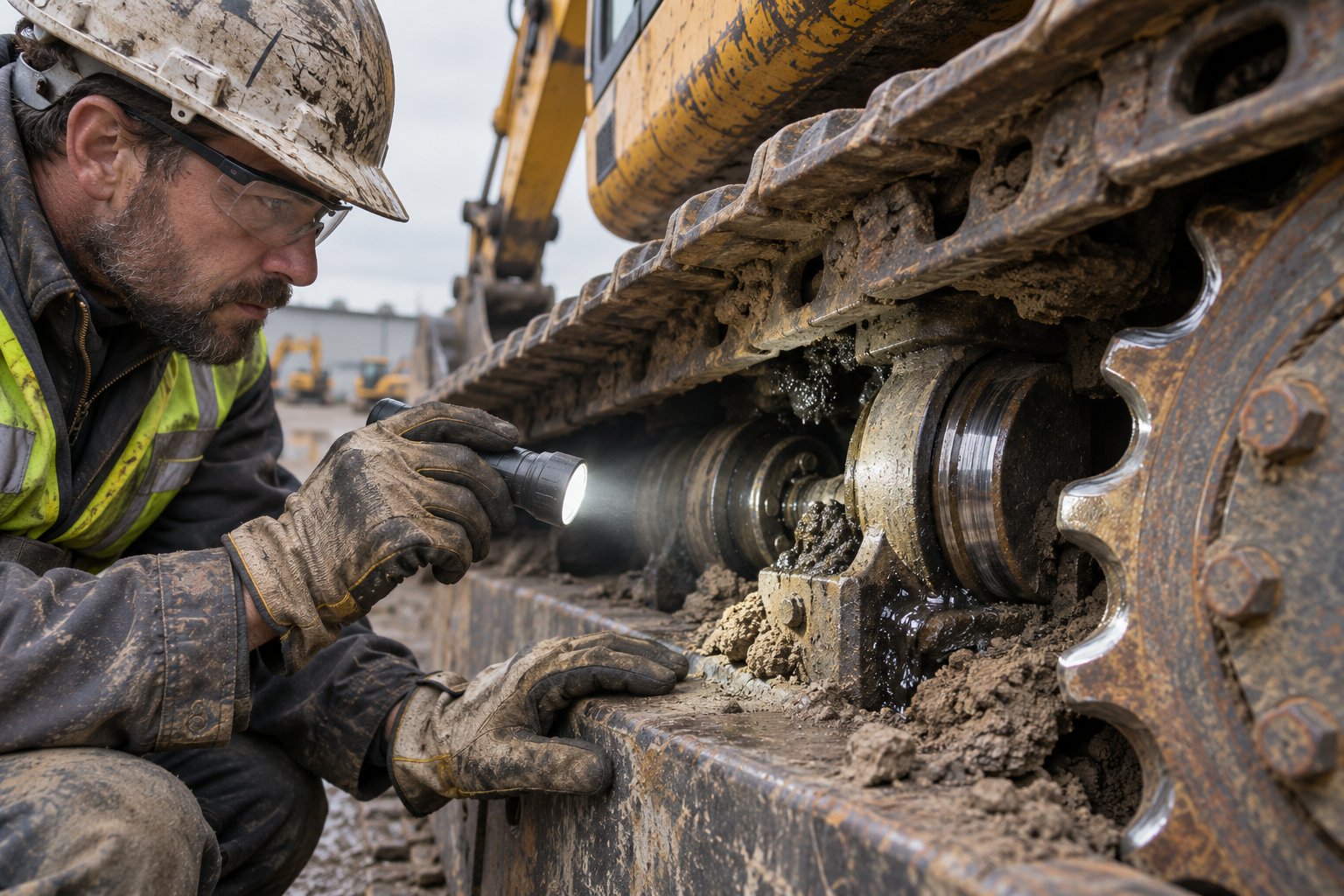
If you only have time to inspect one system, make it the undercarriage. Here is why: Heavy Vehicle Inspection estimates that the undercarriage accounts for up to 50% of a tracked machine's lifetime owning-and-operating cost. A full undercarriage replacement on a mid-size excavator or dozer can run well into five figures, and that single expense can erase every dollar you thought you saved by buying used.
Start at the tracks themselves. Look at the grousers - those raised bars on each track shoe that grip the ground. Worn-flat grousers signal high hours in abrasive conditions and mean reduced traction, which accelerates wear across every connected component. Check for bent shoes too, a telltale sign of hard-surface operation or side-loading stress.
Move to the rollers, both top carriers and bottom rollers. Spin them by hand if the machine is not running. A roller that does not spin freely - or one with visible flat spots - may be seized internally. As the reference data makes clear, a single seized roller creates a cascade effect: it drags along the track chain, grinds the link surfaces, increases friction system-wide, and shortens the life of sprockets, idlers, and pins. One $400 roller failure, left unaddressed, can take years off the entire undercarriage.
Inspect the sprocket teeth next. Healthy teeth have a rounded, symmetrical profile. Teeth that look sharp, pointed, or hooked have reached the end of their wear life. Then check the idlers at the front of the track frame for tread wear and flange damage. Finally, measure track tension - a string stretched from sprocket to idler over the grouser tips reveals sag. Too tight wears rollers and idlers prematurely; too loose causes the chain to bounce and snake.
Beyond the undercarriage, examine the machine's structural frame, boom, stick, and attachment pins. Look for cracks, especially around weld joints and high-stress pivot points. Houston Heavy Machinery's inspection guide specifically flags poor weld repairs and bent components as signs of heavy abuse. If you spot fresh paint concentrated around boom joints or frame welds - but nowhere else on the machine - that is often an attempt to conceal repaired cracks. Walk away or demand a deeper assessment.
Hydraulic System and Engine Assessment
Hydraulics are the circulatory system of every heavy machine. A sluggish cylinder, a weeping hose, or a pump losing pressure can ground a machine just as fast as an engine failure - and the repair costs rival engine work.
Begin with a visual sweep. Trace every hydraulic hose you can see, looking for cracks, bulges, abrasion wear, and fittings that show seepage. Check the cylinders on the boom, stick, and bucket for chrome pitting on the rod surface and for oil weeping past the seals. Even a minor cylinder leak worsens under load, and a re-sealed or rebuilt cylinder is not a cheap fix.
Operate the machine if at all possible. Cycle every function - boom up and down, stick in and out, bucket curl, swing left and right, and travel in both directions. You are feeling for hesitation, jerky movement, slow response, and weak lifting power. A healthy hydraulic system delivers smooth, consistent force. If the boom drifts downward when you release the lever, the main control valve or cylinder seals are likely worn.
For the engine, insist on a cold start. Starting the machine before it has warmed up exposes problems that disappear once operating temperature masks them. Watch the exhaust closely during cranking and for the first minute of idle. Blue smoke points to oil burning past worn rings or valve seals. White smoke suggests coolant entering the combustion chamber - a potential head gasket or liner issue. Black smoke in excess indicates incomplete combustion, often caused by injector problems or a clogged air intake.
Listen for unusual knocking, rattling, or excessive blow-by - pressurized gases escaping past piston rings and venting through the crankcase breather. A small amount of blow-by vapor is normal on a diesel engine with hours on it; a steady plume is a red flag.
One diagnostic step that many buyers skip - but that professionals rely on - is oil analysis. MEVAS, a global equipment inspection firm, describes how certified laboratory analysis of engine oil and hydraulic oil reveals trace elements like copper, aluminum, silicon, iron, and glycol. Elevated iron content can indicate cylinder liner wear; copper traces may point to bearing degradation; silicon suggests dirt ingress past the filtration system. An oil sample costs a fraction of what a surprise engine rebuild costs, and the results give you an objective snapshot of internal component health that no visual inspection can match. If maintenance records show recent fluid changes right before the sale, be cautious - fresh oil can mask wear indicators that an analysis would otherwise catch.
Electrical Systems and Operator Cab Evaluation
Electrical issues rarely get the same attention as engine or hydraulic problems, yet they cause some of the most frustrating downtime on a job site. Imagine tracing an intermittent fault through a corroded wiring harness on a machine heavy enough to need a crane for transport - it is the kind of problem that keeps a technician busy for days.
Turn the key to the accessory position before starting the engine. Every warning light and gauge on the instrument panel should illuminate during the self-check cycle and then clear. Gauges that do not respond, warning lights that stay lit, or a completely dead cluster may indicate wiring harness damage, a failing ECM, or corroded connectors behind the dash.
Inside the cab, look for signs of water intrusion - staining on headliner fabric, corrosion on electrical connectors beneath the seat or behind panels, musty odor, and rust on exposed metal surfaces. Water damage in the cab often means compromised seals around windows, doors, or roof-mounted HVAC units, and once moisture reaches wiring and connectors, intermittent electrical failures become a recurring headache.
Check every operator control: joysticks, switches, pedals, climate controls, and the display screen if equipped. Test the lights, horn, and backup alarm. A cab in poor condition does not just affect comfort - it signals how the previous owner treated the entire machine. As one straightforward rule of thumb: if the operator environment was neglected, the maintenance schedule probably was too.
Whether you are evaluating heavy machines at a local dealer lot or reviewing condition reports from heavy construction equipment auctions across the country, the inspection checklist below gives you a systematic reference you can take into the field.
- Undercarriage: Grouser height, roller condition (spin freely, no flat spots), sprocket tooth profile, idler tread wear, track tension/sag measurement
- Structural frame: Cracks at weld joints, bent boom or stick, pin wear at pivot points, suspicious fresh paint around stress areas
- Hydraulic system: Hose condition (cracks, bulges, leaks), cylinder rod surface and seal integrity, cycle all functions for speed and smoothness, check for boom drift
- Engine: Cold start behavior, exhaust smoke color (blue/white/black), blow-by level at crankcase breather, coolant condition (no oil contamination), belt and hose integrity
- Oil analysis: Request or take samples of engine oil, hydraulic oil, and coolant for certified laboratory analysis - check for trace metals and contaminants
- Electrical: Instrument panel self-check, all warning lights and gauges functional, wiring harness condition (visible runs), lights, horn, backup alarm
- Operator cab: Water damage signs (staining, corrosion, odor), seat condition, HVAC operation, joystick and control responsiveness, display screen functionality
- Documentation: Maintenance records, hour meter verification, ownership history, lien or title issues
One final piece of advice that applies equally whether you are a seasoned fleet manager or a first-time buyer: if your own mechanical expertise has limits, hire a certified independent mechanic to perform the inspection on your behalf. The cost of a professional pre-purchase evaluation - typically a few hundred dollars - is trivial compared to the five-figure repair bills it can help you avoid. Many inspection services, including firms that serve heavy construction equipment auctions, will travel to the machine's location, perform a multi-point assessment, pull oil samples, and deliver a written report with photos. That report becomes your negotiation tool and your insurance policy against hidden defects.
A thorough inspection tells you whether a machine is mechanically sound, but it does not tell you where that machine sits in its overall lifecycle. For that, you need to understand the single number every listing displays but almost no one explains: equipment hours.
Decoding Equipment Hours and What They Really Mean
Every listing you will ever see for used construction equipment near me - or anywhere else - displays a single number front and center: hours. It sits right next to the price, the year, and the make. Sellers treat it like a self-explanatory metric, and marketplaces never bother to define it. The assumption is that you already know what 4,500 hours on a wheel loader means versus 4,500 hours on a generator. In reality, most buyers do not - and that gap between displayed data and actual understanding is where costly purchasing mistakes happen.
What Equipment Hours Actually Measure
Engine hours - sometimes called hour meter readings or ignition hours - record the cumulative time a machine's engine has been switched on. That is it. The meter ticks whether the excavator is digging at full load or sitting at idle while the operator waits for a truck. As Tenderd's equipment productivity analysis makes clear, engine hours are a measure of exposure - how long the machine was available to wear, burn fuel, and accrue cost - not a measure of how hard it actually worked.
Think of it like the odometer on your truck. Miles tell you something, but they do not tell you whether those miles were highway cruising or stop-and-go hauling through mud. Engine hours work the same way. A dozer that sat idling with the engine running while a survey crew finished layout logged the same hours as one pushing dirt nonstop. An excavator waiting in a queue for trucks that are stuck at a gate racks up hours identical to one cycling through full bucket loads all shift.
Some newer machines and telematics systems distinguish between idle hours and working hours - where "working" means the hydraulics were actively engaged, the blade was down, or a load was being carried. If a seller or dealer can provide that breakdown, it is far more valuable than the raw hour meter reading alone. A machine showing 6,000 total engine hours but only 3,500 working hours experienced significantly less mechanical stress than one where those numbers are nearly equal. Always ask for this data when it is available, especially on higher-value heavy equipment sales where the price difference between low-utilization and hard-worked units can be substantial.
General Hour Benchmarks by Equipment Category
So what counts as "low hours" versus "high hours"? The answer depends entirely on the type of machine. An excavator with 5,000 hours is in a very different stage of its lifecycle than a generator with the same reading - because the wear patterns, duty cycles, and component stress profiles are fundamentally different across equipment types.
The benchmarks below offer general guidance based on widely accepted industry thresholds. Keep in mind that these ranges assume reasonably maintained machines from reputable manufacturers. A well-serviced John Deere construction used equipment unit at 7,000 hours may outperform a neglected machine of any brand at 3,000 hours. Condition always trumps the number on the meter.
| Equipment Category | Low Hours | Moderate Hours | High Hours |
|---|---|---|---|
| Mini Excavator | Under 2,000 | 2,000 - 5,000 | Above 5,000 |
| Standard Excavator | Under 3,000 | 3,000 - 8,000 | Above 8,000 |
| Wheel Loader | Under 3,000 | 3,000 - 10,000 | Above 10,000 |
| Bulldozer | Under 3,000 | 3,000 - 10,000 | Above 10,000 |
| Motor Grader | Under 3,000 | 3,000 - 8,000 | Above 8,000 |
| Backhoe Loader | Under 2,500 | 2,500 - 6,000 | Above 6,000 |
| Skid Steer / CTL | Under 1,500 | 1,500 - 4,000 | Above 4,000 |
| Compactor / Roller | Under 2,000 | 2,000 - 5,000 | Above 5,000 |
Use this table as a starting filter, not a verdict. When you are searching for used heavy equipment for sale near me and comparing two listings with similar hours, the machine in the "moderate" range with complete service records is almost always a safer bet than the "low-hour" machine with no documentation. Hours set the context; everything else fills in the picture.
Why Hours Alone Do Not Tell the Full Story
Here is where many buyers get tripped up. They fixate on finding the lowest-hour machine in their budget and assume fewer hours automatically means more remaining life. That logic falls apart the moment you consider three critical variables.
Maintenance history matters more than the meter. A machine serviced on schedule - oil changes, filter replacements, hydraulic fluid flushes, greasing at every interval - wears far more gracefully than one that skipped services. Two identical excavators at 6,000 hours can be in wildly different mechanical condition depending on whether the previous owner followed the manufacturer's maintenance protocol or ran the machine until something broke.
Working conditions shape wear patterns. A loader that spent its life on a clean gravel yard experienced dramatically less stress than one working in a sandy, abrasive quarry environment. Dust and fine particulates accelerate wear on seals, cylinders, and engine air intake systems. A coastal machine exposed to salt air faces corrosion risks that an inland unit never encounters. The hour meter cannot distinguish between these environments, but the machine's components absolutely can.
The type of work performed matters too. Tenderd's research highlights that what a machine was actually doing during those hours - hydraulics engaged at full load versus sitting at idle - creates vastly different wear profiles. An excavator used primarily for light grading and backfill work accumulates far less hydraulic and structural stress per hour than one running a hydraulic breaker in a demolition application. Same hours, completely different remaining useful life.
The practical takeaway? When evaluating any listing, treat the hour meter as chapter one of the story - not the entire book. Pair it with the inspection checklist from the previous section, request maintenance records and oil analysis results, and ask pointed questions about where the machine worked and what it did. That combination gives you a realistic picture of remaining service life that no single number can provide on its own.
Understanding hours and mechanical condition tells you what a machine is worth. The next challenge is figuring out where to buy it - because each purchasing channel comes with its own pricing dynamics, risk profile, and level of buyer protection.
Navigating the Marketplace Ecosystem for Used Heavy Equipment
Every platform you visit wants to be your only platform. Auction sites promote auctions. Dealer networks promote dealers. Government surplus portals promote surplus. None of them have any reason to give you the full picture - because the full picture might send you somewhere else. That is exactly why this section exists: to lay every major purchasing channel side by side so you can match the right source to your specific situation, budget, and risk tolerance.
The used heavy equipment market is not a single marketplace. It is an ecosystem of overlapping channels, each with distinct pricing structures, buyer protections, and trade-offs. Understanding those differences before you start shopping prevents the kind of mismatched expectations that turn a promising deal into a frustrating experience.
Dealer Networks and Certified Pre-Owned Programs
Manufacturer-affiliated dealer networks - think Cat, John Deere, Komatsu, Volvo, and similar brands - operate as the most structured channel for buying pre-owned earthmoving equipment. These dealers take trade-ins, source machines from rental fleet disposals, and sometimes acquire inventory at wholesale from other channels. The key advantage? You are buying from a business with a fixed location, a service department, and a reputation to protect.
Within these networks, Certified Pre-Owned (CPO) programs represent the premium tier. A CPO machine has typically passed a multi-point inspection performed by factory-trained technicians, received necessary repairs or component replacements to meet manufacturer standards, and comes backed by a limited warranty. CDK Global's analysis of CPO programs notes that certified units are priced higher than non-certified equivalents - but the premium buys peace of mind. The inspection is standardized, the warranty provides a safety net during the initial ownership period, and any required service typically must be performed at authorized outlets, keeping the machine within the brand's support ecosystem.
Is that premium worth it? For buyers who lack in-house mechanical expertise or who need a machine they can trust from day one on a critical project, CPO programs reduce risk meaningfully. For experienced buyers comfortable performing their own inspections and absorbing some repair uncertainty, the markup may not pencil out - especially on older or higher-hour units where the warranty window is relatively short.
One practical detail worth noting: dealer inventory is not limited to certified units. Most dealers also carry non-certified pre-owned machines at lower price points, sold with less formal guarantees but still with more transparency than you would typically find at auction. You can often negotiate, request additional documentation, and arrange on-site inspections before committing.
Government Surplus and Auction Platforms
Government agencies - municipalities, counties, state departments of transportation, military branches - cycle out heavy duty machinery on predetermined replacement schedules. These machines are not being sold because they failed. They are being sold because a fleet policy says it is time. That distinction matters, because it means surplus heavy equipment from government sources often has lower utilization than comparable machines from private construction fleets.
GovDeals, one of the most established government surplus platforms, connects buyers directly with selling agencies. Listings typically include photos, equipment specs, and - because public agencies are often required to maintain service records - better-than-average maintenance documentation. With over 15,000 sellers and thousands of active listings at any given time, the platform offers breadth that few individual dealers can match.
Independent auction houses operate differently. Companies like Ritchie Bros., IronPlanet, and regional auctioneers aggregate equipment from private sellers, contractors exiting the business, and fleet liquidations. The inventory can be enormous, and competitive bidding occasionally produces genuine bargains - particularly on less popular models or during periods of soft demand.
The risk profile across all auction channels, however, is consistent: most equipment sells as-is, where-is. Inspection windows may be limited to a single preview day, online-only formats may restrict you to photos and a condition report, and there is no warranty. Revelation Machinery's auction-vs-dealer analysis highlights what experienced buyers already know - the hammer price is not your total cost. Buyer premiums (often 10-15% on top of the winning bid), taxes, rigging, loading, and transportation all add up. A machine that looked like a steal at $45,000 can quickly become a $55,000 acquisition once the full cost picture comes into focus.
Midwest heavy equipment auctions, in particular, draw significant inventory from agricultural crossover fleets and municipal agencies in states with large infrastructure budgets. If you are located in or willing to travel to the central U.S., these events can surface well-maintained loaders, graders, and dozers that rarely appear on coastal marketplaces.
Direct Supplier and Regional Dealer Channels
Between the structured world of OEM dealer networks and the competitive arena of auctions sits a third channel that many buyers overlook: working directly with independent machinery suppliers and regional dealers. These businesses source, inspect, and resell equipment without the overhead of a major brand affiliation - and that independence often translates into more flexible pricing, more personalized service, and greater willingness to negotiate.
Imagine you need a specific model of excavator with particular specs for an upcoming project. A regional dealer who specializes in earthmoving equipment may carry exactly that machine, provide detailed condition information upfront, allow you to inspect it on-site or arrange a video walkthrough, and work with you on pricing without the rigid structures of a national auction or a manufacturer's CPO program. The transaction feels more like a conversation than a process.
Transparency varies by dealer, so your due diligence still matters. Look for suppliers who provide clear machine specifications, accessible photos or video, responsive communication, and willingness to share maintenance history or facilitate independent inspections. A dealer who resists questions about a machine's condition or history is telling you something - just not with words.
Regional dealers also tend to carry inventory that reflects local market demand. A dealer in the Gulf Coast region may stock more articulated dump trucks and compactors suited to soft-soil conditions, while a dealer in the Rocky Mountain states may specialize in dozers and graders common to mining and road construction work. That regional specialization can work in your favor: you are more likely to find machines that have operated in conditions similar to your own job sites.
| Dimension | OEM Dealer / CPO Program | Government Surplus / Auction | Direct Supplier / Regional Dealer |
|---|---|---|---|
| Typical Price Range | Highest; CPO carries a premium over non-certified | Lowest potential; competitive bidding can drive bargains | Mid-range; negotiable based on market conditions |
| Buyer Protection | Strongest; CPO warranty, multi-point inspection, brand backing | Weakest; typically sold as-is with no warranty | Moderate; varies by dealer, some offer limited guarantees |
| Inspection Access | Full access; on-site inspection and detailed condition reports | Limited; preview days or online photos only | Good; most allow on-site visits or video walkthroughs |
| Negotiation Flexibility | Limited on CPO pricing; more room on non-certified units | None; price set by bidding competition | Highest; direct negotiation with seller |
| Inventory Breadth | Brand-specific; limited to one manufacturer's lineup | Broadest; multiple brands, types, and conditions | Moderate; curated selection based on dealer specialization |
| Post-Sale Support | Service department, parts access, extended warranty options | None; buyer handles all post-sale needs independently | Varies; some offer transport coordination and basic support |
| Best For | Buyers prioritizing reliability, warranty, and brand support | Budget-focused buyers with technical expertise and flexibility | Buyers seeking balance of value, transparency, and personal service |
No single channel wins across every dimension. The contractor who needs a certified, warranty-backed dozer for a two-year highway project has different priorities than the startup landscaper hunting for an affordable skid steer, and both have different needs than the fleet manager sourcing five loaders at the best possible unit cost. Your job is to match the channel to the purchase - not to pick a favorite and hope it fits every situation.
Choosing the right channel narrows your options. The real test, though, is what happens when you start comparing specific machines and specific sellers - because that is where the most common and most expensive buyer mistakes tend to surface.
Critical Mistakes First-Time Buyers Must Avoid
Finding the right machine at the right price feels like the hard part. In practice, the purchases that go wrong almost never fail because the buyer picked the wrong model - they fail because something critical got skipped between finding the listing and signing the check. These mistakes are predictable, preventable, and yet repeated constantly across used construction equipment auctions, private sales, and dealer transactions alike. Each one carries a real financial consequence, and understanding them upfront costs you nothing compared to learning them the hard way.
Ignoring Attachment Compatibility and Transport Costs
Imagine finding the perfect excavator at a great price on a listing for construction equipment for sale near me - only to discover that your existing buckets, breakers, and thumbs do not physically fit the machine. This is not a hypothetical scenario. Shandong Zhongtai's compatibility research documents a Texas contractor who purchased eight aftermarket buckets for a mixed fleet of CAT, Komatsu, and Hyundai excavators and found three did not fit properly - all because pin center distances were a few millimeters off. The result was $4,200 in returns and two weeks of project delay.
The core issue is that excavator attachments are not universal. Unlike skid steers, which use a widely standardized quick-attach plate, excavators rely on brand-specific pin diameters, pin center distances, dipper gap widths, and coupler types that vary not just between manufacturers but between model years of the same brand. A CAT 320 from 2018 may have different pin geometry than a CAT 320 from 2022. Before you bid or buy, measure or confirm three numbers: pin diameter, pin center distance, and dipper gap. If you are running a quick coupler, verify whether the machine uses S-type, CW-series, or a proprietary system - because an S-45 coupler will not accept a CW-series bucket without an adapter plate.
Transport costs are the other budget killer that first-time buyers routinely underestimate. A deal on industrial equipment for sale three states away can look fantastic on paper, but specialized hauling for heavy machinery is not cheap. Oversized load permits, pilot car requirements, flatbed trailer fees, and fuel surcharges add up fast. A $3,000-$6,000 transport bill on a $40,000 machine is not uncommon for cross-country moves. If you do not get a transport quote before you finalize the purchase price, you are not actually calculating your total acquisition cost - you are guessing.
Skipping Pre-Purchase Inspections and Title Verification
Speed kills deals. When buyers rush to lock in a price - especially at auction, where competitive pressure creates urgency - they skip the two steps that protect them most: a mechanical inspection and a title verification.
On the mechanical side, McClung-Logan's buying guide puts it bluntly: the price advantage of buying used disappears quickly if you take on a machine with significant hidden issues. Hydraulic pump failures, undercarriage damage that demands a full rebuild, cracked booms concealed under fresh paint - these are not edge cases. They are the exact problems that sellers hoping to move salvage equipment for sale at used-equipment prices rely on uninspected buyers to miss. A professional pre-purchase inspection costs a few hundred dollars. An undercarriage replacement on a mid-size excavator costs tens of thousands. The math is not complicated.
Title verification is the legal equivalent of that mechanical inspection, and it is equally non-negotiable. Crest Capital's lien analysis describes a scenario every buyer should understand: you purchase an excavator, everything looks clean, and six months later the seller's bank contacts you claiming ownership through a blanket lien - a clause buried in the seller's unrelated loan that covered all of their business assets at the time. The bank can legally repossess the equipment, and you lose both the machine and the money you paid for it.
Blanket liens are especially dangerous because the seller may not even realize they exist. A UCC search is the standard method for uncovering most liens, but as the Crest Capital analysis warns, nothing guarantees a 100% clean title. Buying from an authorized dealer reduces this risk because reputable dealers typically conduct their own lien searches before acquiring inventory. When buying from a private seller, however, the burden falls entirely on you. Conduct a UCC search, request bills of sale and payoff letters, and try to trace the paper trail back to the original purchase. Incomplete documentation on salvage equipment for sale or any private-party transaction should be treated as a serious red flag.
Overpaying Due to Incomplete Market Research
The final mistake is the most common and the simplest to avoid: paying more than you need to because you only checked one source. Every marketplace, every dealer, and every auction exists within a broader pricing ecosystem. A machine listed at $65,000 on one platform might have a comparable unit - same year, similar hours, equivalent condition - available for $52,000 somewhere else. You will not know unless you look.
Before committing to any purchase, check comparable listings across at least three to four platforms. Compare machines by make, model, year, hours, and documented condition - not just price. Factor in buyer premiums at used construction equipment auctions, transport costs from the machine's location to yours, and any estimated repair needs identified during inspection. Only when you have a true apples-to-apples total cost can you determine whether a deal is genuinely competitive or simply the first one you found.
The checklist below consolidates every critical mistake and its prevention into a single scannable reference you can use before any purchase:
- Do measure pin diameter, pin center distance, and dipper gap before buying - Don't assume your existing attachments will fit a different brand or model year
- Do get a transport quote before finalizing the purchase price - Don't treat the listing price as your total acquisition cost
- Do hire an independent mechanic for a pre-purchase inspection - Don't rely solely on seller descriptions, photos, or auction condition reports
- Do insist on a cold start and operate every function during inspection - Don't accept a machine that was pre-warmed before your arrival
- Do conduct a UCC lien search on any private-party purchase - Don't skip title verification because the seller seems trustworthy
- Do request bills of sale, payoff letters, and complete ownership history - Don't buy any machine with an incomplete paper trail
- Do compare listings across multiple platforms before committing - Don't anchor on the first price you find without checking market comps
- Do calculate total cost including buyer premiums, taxes, transport, and estimated repairs - Don't evaluate deals based on hammer price or listing price alone
Every item on that list is a lesson someone else paid for with real money and real project delays. Avoiding these pitfalls puts you in a fundamentally stronger position - but knowing what not to do is only half the equation. The other half is knowing how to actively compare machines, evaluate suppliers, and negotiate effectively so that the deal you close is the right one for your operation.
How to Compare Machines and Source from Trusted Suppliers
You know what to look for in a machine. You know which mistakes drain budgets. The challenge now is practical: you are staring at a dozen listings across multiple platforms, each showing a different combination of hours, specs, condition notes, and asking prices. How do you turn that noise into a clear shortlist - and how do you determine which supplier actually deserves your money? This is where buying used construction equipment shifts from research to execution, and a disciplined comparison process separates confident buyers from overwhelmed ones.
Building a Comparison Shortlist by Project Requirements
Every smart equipment purchase starts with the job, not the listing. Before you browse a single page of used machinery for sale, write down the non-negotiable specifications the machine must meet based on the actual work it will perform. This sounds obvious, but a surprising number of buyers shop backward - falling in love with a deal and then rationalizing why it fits their project. That approach is how you end up with a machine that is too small for the dig depth you need or too heavy for the ground conditions on your site.
Start with four core specs:
- Operating weight: This determines ground pressure, transport requirements, and whether the machine can physically work on your site without sinking or requiring special matting. A 30-ton excavator on a soft residential lot creates problems no amount of operator skill can solve.
- Horsepower: Directly affects cycle times, grading speed, and the ability to power hydraulic attachments. A machine with insufficient horsepower for your application will work harder, burn more fuel, and wear faster.
- Bucket capacity or blade width: These numbers dictate how much material moves per cycle. Undersized means more cycles per hour, longer project timelines, and higher operating costs. Oversized means you paid for capacity you will never use.
- Dig depth or lift height: The specification that determines whether a machine can physically reach the work. A trench spec calling for 14 feet of depth eliminates every excavator with a 12-foot maximum, regardless of price.
Once you have defined your must-have specs, use them as a hard filter. Every listing that does not meet the minimum requirements gets eliminated immediately - no exceptions, no matter how attractive the price looks. What remains is your working shortlist. From there, layer in secondary preferences: preferred manufacturer, acceptable hour range, attachment compatibility with your existing inventory, and maximum total acquisition cost including transport.
This approach works whether you are sourcing a single backhoe for a municipal utility project or building a fleet of loaders for a gravel operation. The specifications change, but the discipline stays the same. Define the job requirements first, then find the machine that fits - not the other way around.
Evaluating Suppliers for Transparency and Support
A shortlist of machines is only as good as the suppliers behind them. Two identical excavators at the same price point can represent completely different buying experiences depending on who is selling. One supplier might provide detailed condition reports, high-resolution photos from every angle, and a responsive sales team that answers technical questions within hours. Another might offer a single grainy photo, a vague description, and radio silence when you ask about maintenance history. The machine might be the same - but your risk exposure is not.
When evaluating any supplier of bulky equipment - whether an OEM-affiliated dealer, a regional independent, or an online machinery supplier - measure them against these criteria:
- Clear machine specifications: The listing should include make, model, year, serial number, hours, and key performance specs. Vague descriptions like "runs great" with no supporting data are a warning sign, not a selling point.
- Accessible photos or video: Multiple high-resolution images showing the machine from all sides, close-ups of the undercarriage, cab interior, engine compartment, and any visible wear points. Video walkthroughs - especially showing a cold start and operational cycle - add another layer of confidence.
- Responsive communication: How quickly and thoroughly does the supplier respond to questions? A team that answers detailed technical inquiries within a business day signals professionalism. One that dodges specifics or takes a week to reply suggests disorganization at best, evasion at worst.
- Willingness to share documentation: Maintenance records, service history, ownership chain, and oil analysis results should be available on request. Suppliers who proactively offer this information demonstrate confidence in what they are selling.
- Ability to request condition reports or purchase quotes: A reliable supplier will provide a detailed quote that breaks down the machine price and any additional costs, and will facilitate independent inspections if you want a third-party assessment before committing.
- Post-sale support options: Does the supplier offer any assistance with transport coordination, export documentation, or technical guidance after the sale? This is not a requirement for every transaction, but it distinguishes serious used heavy equipment dealers from one-and-done sellers.
For contractors, fleet managers, and equipment dealers sourcing construction excavation equipment and other heavy machinery, suppliers who meet most or all of these criteria dramatically reduce buying risk. As an example, JIUHONG's used construction equipment collection allows buyers to browse excavators, loaders, bulldozers, and graders with listed specifications, compare options for upcoming projects, and request purchase quotes directly - the kind of structured, transparent supplier experience that gives buyers a concrete starting point for evaluation rather than a blind leap of faith.
The broader principle applies regardless of which supplier you choose: transparency is not a bonus feature. It is the baseline. Any seller who makes it difficult to verify what they are offering is making it easy for you to overpay or inherit someone else's problem.
Requesting Quotes and Negotiating Effectively
You have your shortlist. You have vetted the suppliers. The next step is requesting quotes - and doing it in a way that sets you up for effective comparison and negotiation rather than a disorganized back-and-forth.
When you reach out for a quote, include enough detail that the supplier can respond with precision. A vague inquiry like "how much for a used excavator?" invites a vague answer. A specific request gets specific numbers. Here is what to include:
- The exact make, model, and listing reference (serial number or stock number if available)
- Your intended use case and any critical specs the machine must meet
- Whether you need the machine delivered, and your delivery location for a transport estimate
- Your timeline - when you need the machine operational on-site
- Any additional services you want quoted: inspection, warranty options, or attachment sourcing
Request quotes from at least three suppliers for comparable machines. This is not about playing sellers against each other for sport - it is about establishing a realistic market price so you know whether a quoted number is competitive. SLS Financial's pricing guide reinforces this point: research across industry-specific resale marketplaces, auctions, and dealership listings to benchmark what similar models are actually selling for before you start negotiating.
When it comes to negotiation itself, a few principles consistently produce better outcomes for buyers of used construction equipment for sale by owner and from dealers alike:
Lead with data, not emotion. If your inspection revealed worn undercarriage components, quote the estimated repair cost and subtract it from your offer. If comparable machines on other platforms are listed lower, share the evidence. Sellers respond to documented facts far more readily than to "I think the price is too high."
Ask about value-adds before asking for a lower price. Sometimes a supplier will hold firm on the sticker price but throw in delivery, a set of replacement filters, or an extended return window. These concessions have real dollar value and can close the gap without triggering the resistance that a direct price cut often does. As SLS Financial notes, dealer sellers may offer perks like free delivery or servicing that add value beyond a lower number on the invoice.
Have financing ready before you negotiate. A buyer who can commit quickly has leverage. Sellers - particularly private parties and smaller used heavy equipment dealers - prefer a fast, certain close over a higher price that might fall through during a drawn-out financing process. Pre-approval from a lender or confirmed capital on hand turns "I'm interested" into "I'm ready to buy today," and that shift changes the dynamic of the entire conversation.
Time your purchase strategically. Demand for construction excavation equipment and other heavy machinery fluctuates with seasons and economic cycles. Sellers are often more flexible at the end of a fiscal quarter, during slower winter months, or when inventory has been sitting unsold for an extended period. Asking how long a machine has been listed - and watching for price reductions over time - gives you a read on the seller's urgency.
The goal is not to squeeze every last dollar out of the negotiation. It is to arrive at a fair price that reflects the machine's actual condition, market value, and your total acquisition cost - including transport, any needed repairs, and attachments. When you have done the comparison work honestly and negotiated with data in hand, the number you agree on should feel right for both sides.
Signing the purchase agreement, however, is not the finish line. It is the starting point of a new set of logistics - transport, compliance, initial maintenance, and operator readiness - that determine whether your new machine is productive from week one or sitting idle while you sort out the details no one warned you about.
What Happens After You Buy Second Hand Heavy Equipment
The purchase agreement is signed. The wire has cleared. And now comes the phase that every marketplace, every auction platform, and most used construction equipment dealers completely ignore - because their job ended the moment your money changed hands. Everything that follows determines whether your machine is generating revenue within days or sitting idle for weeks while you scramble through logistics you did not plan for. The gap between "purchased" and "productive" is where unprepared buyers lose time and money they thought they had saved.
Transport Logistics and Equipment Delivery
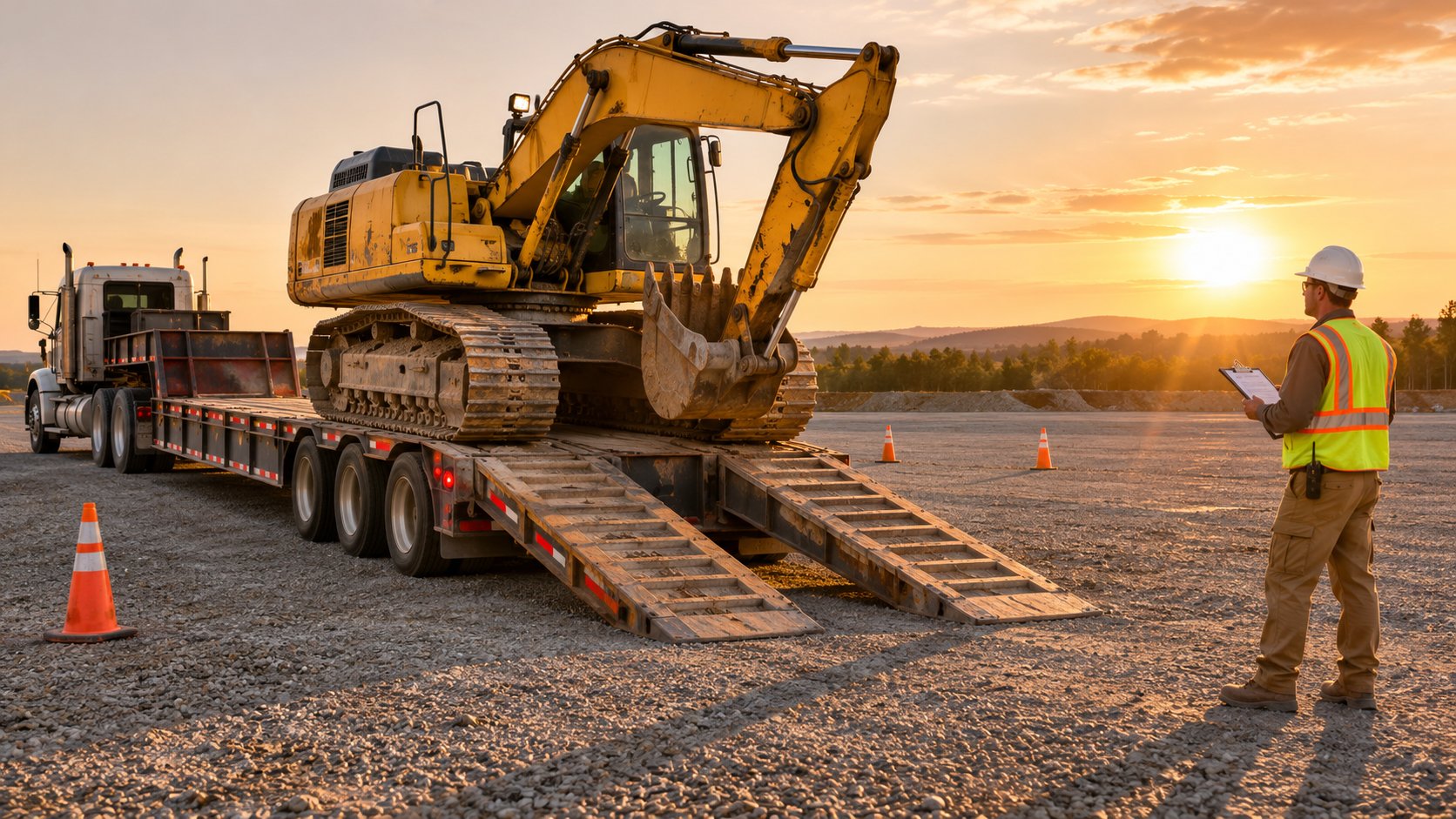
You cannot drive most heavy equipment home. A 25-ton excavator does not have license plates, turn signals, or a highway speed rating. Getting it from the seller's yard to your job site requires planning that should have started before you finalized the price - and if it did not, you are already behind.
Three primary options exist for moving your machine:
- Hiring a specialized heavy-haul carrier: This is the standard approach for mid-size and large equipment. A carrier brings the appropriate trailer - typically a lowboy with a removable gooseneck for tall or heavy loads, or a standard flatbed for smaller machinery - and handles loading, securing, and delivery. Expect to provide exact dimensions and weight so the carrier can match the right trailer and determine permit requirements.
- Using a flatbed trailer you own or rent: For compact machines like mini excavators, skid steers, and compact track loaders under roughly 10 tons, a rented flatbed trailer towed by a heavy-duty pickup or medium-duty truck can work. Confirm the trailer's rated capacity exceeds the machine's transport weight, and use properly rated chains and binders - not ratchet straps alone - to secure tracked equipment.
- Coordinating with the seller or supplier for delivery: Some dealers and suppliers offer delivery as part of the transaction or as an add-on service. This can simplify logistics, but always get the delivery cost quoted separately so you can compare it against independent carrier rates.
The permit dimension catches many first-time buyers off guard. Federal law classifies any load exceeding 80,000 pounds gross vehicle weight, or exceeding standard width (8 feet 6 inches), height (13 feet 6 inches), or length thresholds as oversized or overweight. Each state the shipment passes through requires its own permit, and processing times range from roughly three days to over ten days depending on the state and load complexity. Multi-state routes compound the paperwork and fees quickly - individual permits typically cost between $50 and $300, but a coast-to-coast move through six or seven states adds up. Some states also mandate escort vehicles for loads exceeding certain width or height thresholds, adding another $300 to $800 per state crossed.
The takeaway is simple but critical: get a detailed transport quote - including permits, escorts, and fuel surcharges - before you finalize any purchase. A machine listed as heavy equipment for sale near me might be 500 miles away, and the $4,000 transport bill you did not budget for can reshape the economics of the entire deal. Total acquisition cost is the only number that matters.
Registration, Insurance, and Compliance
Once the machine arrives, the paperwork is not over. Depending on your jurisdiction and how the equipment will be used, several administrative steps may apply.
Registration requirements vary significantly. Most tracked equipment used exclusively on private job sites does not require state vehicle registration. Wheeled machines that travel on public roads - wheel loaders, backhoe loaders, motor graders - often do, and the rules differ by state. Some states issue special "off-highway" or "construction equipment" registrations with limited road-use privileges. Check your state's Department of Motor Vehicles or equivalent agency before assuming you are exempt.
Insurance is not optional, even if no law requires it for your specific situation. Equipment insurance (sometimes called inland marine insurance) covers damage, theft, vandalism, and in some policies, mechanical breakdown. General liability insurance covers third-party injury or property damage caused by the machine during operation. If you financed the purchase, your lender almost certainly requires both. Even if you paid cash, the cost of replacing an uninsured machine that is stolen from a job site or damaged in transit dwarfs the annual premium. For preowned construction equipment especially, confirm that your policy covers the machine's actual replacement value, not a depreciated book value that would leave you short if you needed to source a comparable unit.
Emissions and environmental compliance is the requirement most likely to surprise buyers who source machines from a different region. California's CARB regulations, for example, impose strict Tier requirements on off-road diesel equipment operating within the state - a machine that is perfectly legal in Texas may not be operable in California without costly engine upgrades or the purchase of emission credits. Several other states and municipalities have adopted or are adopting similar frameworks. Before any construction machine sales transaction is finalized, verify that the machine's emissions tier meets the requirements of every jurisdiction where you plan to operate it.
Initial Maintenance and Operator Readiness
Here is where many buyers make a dangerous assumption: "The seller said it was serviced recently, so it is ready to work." Maybe it was. Maybe the seller changed the oil the day before listing to make the fluids look clean and mask wear indicators that an oil analysis would have caught. You do not know - and that uncertainty is exactly why industry maintenance specialists recommend establishing a fresh baseline under your ownership regardless of what the previous owner claims.
The logic is straightforward. A used machine arrives with an unknown recent history of fluids, filters, and developing wear. The cost of fresh fluids and a thorough check is trivial compared to the cost of an early failure caused by inherited neglect. Think of it as converting an unknown quantity into a machine whose condition you control from day one.
Operator readiness is the other half of the equation - and it gets overlooked constantly when a fleet adds an unfamiliar machine type. A loader operator does not automatically know how to run a motor grader efficiently. An excavator operator experienced on a Komatsu may need time to adjust to a CAT's control pattern (ISO versus SAE joystick configurations, for instance). Skipping operator familiarization leads to inefficient operation at best and equipment damage or safety incidents at worst. If you are adding a machine category your crew has not operated before, invest in manufacturer training resources, operator manuals, and supervised break-in time before sending the machine to a production job site.
The following post-purchase action sequence covers everything from the day your preowned construction equipment arrives through the first week of operation. Print it, save it, or bookmark it - this is your roadmap for turning a delivered machine into a productive asset:
- Inspect upon arrival: Before unloading, check for any transit damage - dents, scratches, cracked glass, hydraulic leaks that were not present at purchase. Document everything with photos and note discrepancies against the pre-purchase condition report.
- Change engine oil and filter: Establish a known baseline regardless of what the seller said about recent servicing. Take an oil sample from the drained fluid and send it to a certified lab for analysis - this becomes your reference point for future comparisons.
- Replace hydraulic filters and sample hydraulic oil: Hidden contamination or internal wear in the hydraulic system is one of the most expensive surprises on any machine. A lab analysis of the hydraulic fluid reveals trace metals and contaminants that visual inspection cannot detect.
- Check and top off coolant: Verify concentration levels and inspect for oil contamination, which can signal head gasket or liner issues.
- Replace fuel filters and drain the water separator: Protects the injection system from contamination that may have accumulated during transport or sitting idle.
- Grease every lubrication point: Follow the manufacturer's lubrication chart and grease all pivot points, pins, and bearings thoroughly. This is the single cheapest maintenance step that prevents the most expensive wear.
- Inspect belts, hoses, air filter, and undercarriage or tires: Replace anything questionable. Check cutting edges, teeth, and wear parts against the demands of the work the machine will perform first.
- Test all safety systems: Lights, horn, backup alarm, seatbelt, brakes, steering, fire extinguisher, guards, and covers. A machine that is mechanically ready but safety-deficient is not ready.
- Verify electrical systems and emissions compliance: Confirm no stored fault codes, test all gauges and displays, and ensure any DPF or SCR systems are functioning correctly.
- Set up your maintenance log: Record the serial number, current hour meter reading, every fluid change and filter replacement you just performed, and the upcoming service intervals. Good records start on day one and protect the machine's future resale value.
- Conduct operator familiarization: Walk the assigned operator through the machine's controls, safety features, any differences from equipment they have previously run, and any known quirks or limitations. Supervise the first operational shifts before assigning production work.
- Monitor closely for the first 100 hours: Check fluid levels daily, watch for new leaks, listen for unusual noises, and note anything that feels abnormal. Take a fresh oil sample after this initial period and compare it to your baseline - this early monitoring window catches latent problems before they cause damage.
That twelve-step sequence converts an unknown machine into one whose condition, maintenance history, and operational baseline you fully control. The modest investment of time and materials it requires pays for itself many times over in avoided breakdowns, extended machine life, and preserved resale value. Whether you sourced the machine from a local dealer, an online auction, or a direct supplier listing second hand heavy equipment from across the country, the preparation protocol is the same - because every used machine, regardless of where it came from, arrives with an inherited history you need to overwrite with your own documented baseline.
The buyers who get the most value from the secondary equipment market are not the ones who find the cheapest machine. They are the ones who buy with clear project requirements, inspect with discipline, negotiate with data, and then invest the effort to bring every acquisition to a known, maintained, and operator-ready state before it touches a job site. That complete lifecycle approach - from first search to first working day - is what separates a smart purchase from a lucky one.
Frequently Asked Questions About Buying Used Construction Equipment
1. How many hours is too many on used construction equipment?
The answer depends on the equipment type. A standard excavator under 3,000 hours is generally considered low-hour, while anything above 8,000 enters high-hour territory. Wheel loaders and bulldozers have slightly higher thresholds, with moderate use falling between 3,000 and 10,000 hours. However, hours alone never tell the full story. A well-maintained machine at 7,000 hours with complete service records can easily outperform a neglected unit at 3,000 hours. Always pair the hour meter reading with maintenance documentation, oil analysis results, and an assessment of the working conditions the machine operated in before drawing conclusions about remaining useful life.
2. What should I inspect before buying used heavy equipment?
Focus on five core systems in this order: undercarriage first, since replacement can cost tens of thousands of dollars alone; hydraulic system second, checking for hose cracks, cylinder leaks, and sluggish operation; engine third, insisting on a cold start and watching exhaust smoke color; electrical systems fourth, verifying instrument panel function and looking for water damage; and structural integrity throughout, examining weld joints, boom and stick condition, and pin wear. Request or collect oil samples from the engine and hydraulic system for certified laboratory analysis, which reveals internal wear that no visual inspection can detect. If your own expertise is limited, hiring an independent certified mechanic for a pre-purchase evaluation is one of the best investments you can make.
3. Is it better to buy used construction equipment from a dealer or at auction?
Each channel suits different buyers. Dealer networks and Certified Pre-Owned programs offer the strongest buyer protections, including multi-point inspections, limited warranties, and post-sale service support, but they come at a premium price. Auction platforms and government surplus sales can yield significant savings, but equipment typically sells as-is with limited inspection windows and no warranty. Direct suppliers and regional dealers often sit in the middle, offering more negotiation flexibility and transparency than auctions with less overhead than OEM dealers. Match the channel to your risk tolerance, mechanical expertise, and budget rather than defaulting to one source for every purchase.
4. How much can I save buying used construction equipment instead of new?
Heavy equipment typically loses 40-50% of its purchase price in the first three years due to steep early depreciation. Buying a machine that is three to five years old means someone else has already absorbed that initial value drop, and your own depreciation exposure going forward is considerably smaller, often around 8-12% annually through years four to six. The exact savings depend on machine type, condition, hours, and maintenance history. Beyond the purchase price, factor in potentially higher maintenance costs and limited or no warranty coverage on used units. The strongest financial case for buying used exists in scenarios like seasonal projects, fleet expansion on a tight budget, and testing a new service line without heavy capital commitment.
5. What are the biggest mistakes to avoid when buying used construction equipment?
Five costly errors surface repeatedly among first-time buyers. First, assuming existing attachments will fit a different brand or model year without verifying pin diameter, pin center distance, and coupler type. Second, failing to get a transport quote before finalizing the purchase, which can add thousands to total acquisition cost. Third, skipping a professional pre-purchase mechanical inspection, leaving hidden hydraulic failures or undercarriage damage undetected. Fourth, neglecting title verification and lien searches, which can result in a bank repossessing equipment you already paid for. Fifth, anchoring on the first price found without comparing listings across multiple platforms. Each mistake is entirely preventable with basic due diligence before committing any money.