

What Mini Excavator Wholesale Actually Means
Imagine you need five identical mini excavators on three different jobsites by next quarter. You could walk into a dealership and pay sticker price five separate times — or you could tap into a purchasing channel designed specifically for volume buyers. That channel is wholesale, and it operates under an entirely different set of rules than anything you'll encounter at a retail counter, an auction house, or a rental yard.
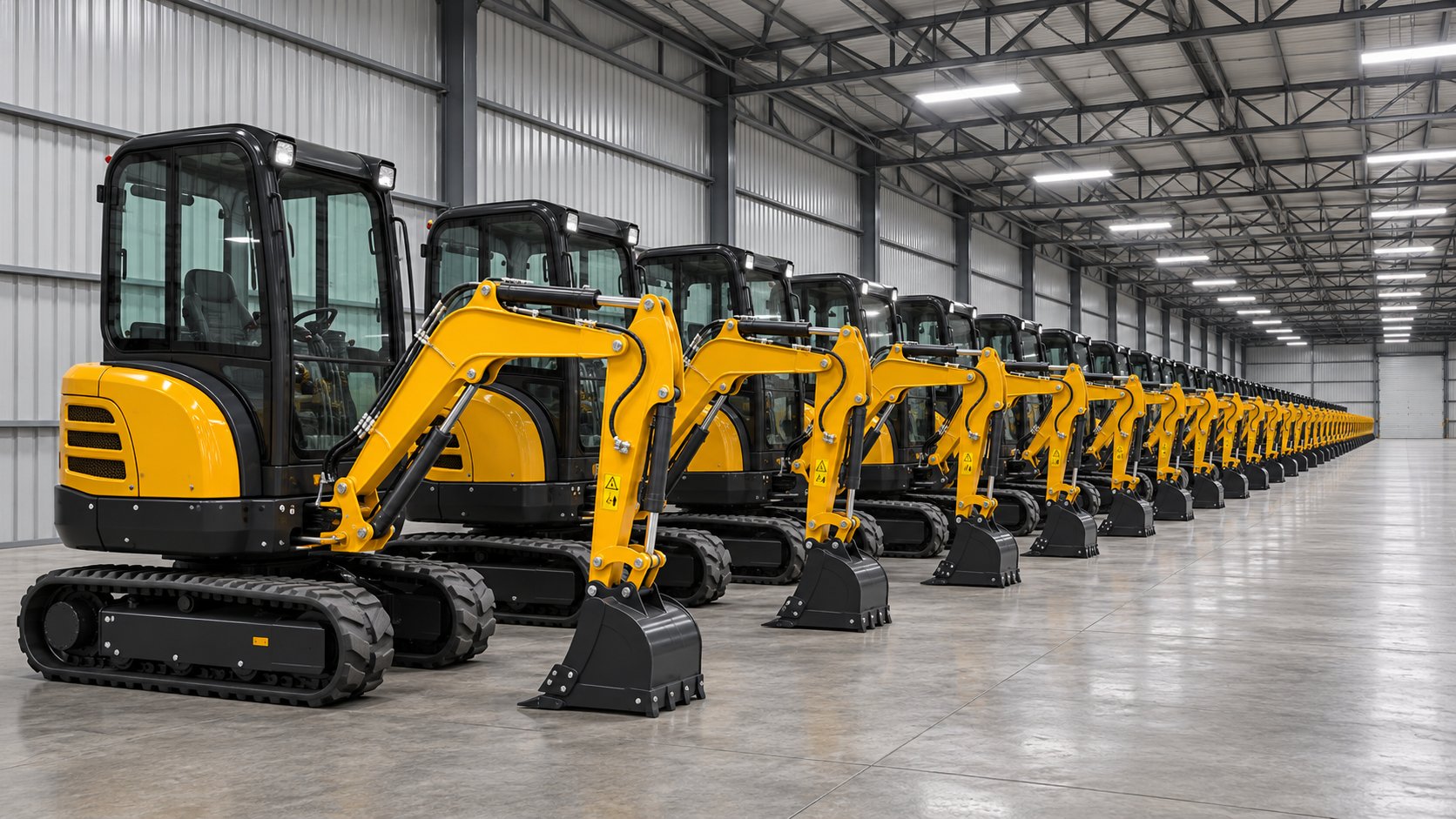
Mini excavator wholesale is the purchase of two or more compact excavator units directly from a manufacturer, factory-authorized distributor, or bulk reseller at volume-discounted pricing, typically requiring a minimum order quantity (MOQ) and structured payment terms not available in single-unit retail transactions.
The MOQ threshold varies by supplier. Smaller manufacturers and trading companies may set it as low as two units, while larger factories — especially those producing for export — often require five to ten or more machines per order. Meeting that threshold unlocks per-unit savings that industry sources estimate at 20 to 30 percent below typical retail pricing. Those savings exist because the transaction strips away dealer showroom overhead, individual sales commissions, and the convenience premium baked into single-unit purchases.
The audience for this type of buying is broader than most people assume. It includes excavation contractors scaling multi-crew fleets, independent equipment dealers stocking inventory for resale, rental companies building utilization-driven asset portfolios, municipalities replacing aging public works equipment, and international import buyers consolidating shipments for overseas markets.
Wholesale vs. Retail vs. Auction Purchasing
Each purchasing channel carries a distinct cost structure and set of buyer obligations. Retail buying gives you immediate availability and after-sales support — warranties, maintenance packages, and a local service department — but the per-unit price reflects the dealer's overhead, which can add 10 to 25 percent on top of the wholesale cost. You're paying for convenience and a safety net.
Auction purchasing, whether live or online, offers the possibility of below-market pricing on used machines. The tradeoff? Unpredictable inventory, limited inspection windows, no warranty, and the risk of bidding wars that push final prices above retail. You're essentially gambling on timing and condition.
Wholesale sits in a different category altogether. It's a negotiated, relationship-driven transaction. Buyers specify tonnage class, attachment packages, emission compliance standards, and delivery timelines — then receive structured quotations with volume breakpoints. Payment terms are flexible, often involving deposit-and-balance arrangements or letters of credit. The buyer takes on more logistical responsibility, but gains meaningful pricing leverage and the ability to standardize an entire fleet in a single order.
Who Qualifies for Wholesale Pricing
Here's a common misconception: you don't need a dealer license to buy at wholesale. Licensed dealers certainly represent a large share of the market, but they're far from the only qualified buyers. Contractors purchasing multiple mini excavator units for parallel jobsites routinely access wholesale channels. Rental fleet operators do the same, calculating ROI based on utilization rates and total cost of ownership rather than sticker price alone. Import buyers — including AGT mini excavator resellers and those sourcing compact machines like the H12R mini excavator for overseas distribution — consolidate orders specifically to unlock bulk pricing and reduce per-unit freight costs.
The qualifying factor isn't a specific license. It's volume commitment. If you can meet a supplier's MOQ and accept the associated lead times, payment structures, and logistical responsibilities, you qualify. Understanding this distinction — and knowing exactly which type of buyer you are — shapes every decision that follows, from which suppliers you approach to how you structure your excavator and attachment packages.
Who Benefits from Buying Mini Excavators in Bulk
Wholesale pricing exists because certain buyers bring enough volume to justify it — but the reasons behind that volume differ dramatically depending on who's writing the purchase order. A contractor adding machines to a growing fleet has completely different priorities than an equipment dealer stocking a showroom or a reseller consolidating an overseas shipment. Recognizing where you fit in this landscape determines how you evaluate suppliers, negotiate pricing, and structure logistics for every bulk order you place.
Contractors Scaling Multi-Crew Operations
Picture this: you're running three residential foundation crews simultaneously across two counties. One crew operates a brand-new mini excavator with intuitive controls, another uses an older model with a different hydraulic layout, and the third has a machine from a completely different manufacturer. Every operator needs separate training. Every breakdown requires a different parts order. Every maintenance schedule follows a unique interval.
Contractors who purchase identical machines in batches eliminate this chaos entirely. Fleet standardization — buying the same make and model across all crews — delivers compounding benefits that go well beyond the initial per-unit discount. Maintenance alone accounts for roughly 22% of total fleet costs, and standardizing your equipment allows technicians to service every machine using the same procedures, the same parts, and the same diagnostic approach. Repair times drop. Parts inventory shrinks because you're stocking components for one model instead of three. Operator training becomes a single program rather than a patchwork of brand-specific sessions.
The financial logic is straightforward: buying five identical 1-ton or 2-ton mini excavators wholesale doesn't just save money on the purchase — it reduces operational costs for the entire lifespan of those machines. Contractors who grasp this shift from thinking about sticker price to thinking about total fleet economics.
Equipment Dealers and Rental Fleet Operators
For independent equipment dealers, wholesale sourcing is the engine behind retail margin. A dealer purchasing individual units at near-retail cost has almost no room to mark up and still remain competitive. Buying in bulk — whether it's a batch of AGT mini excavator AGT-H12 units, a mixed order of compact machines from CFG Industries, or a container of AGT mini excavator H15R models — creates the spread between acquisition cost and selling price that keeps a dealership profitable.
Rental companies, however, approach the same wholesale channel with an entirely different calculator. Their profitability doesn't hinge on resale margin. It hinges on how often each machine generates revenue relative to what it cost to acquire. Rental fleet operators track metrics like time utilization — the percentage of available days a machine is actually out on rent — with healthy operations typically targeting rates between 65% and 75%. They also monitor financial utilization, which measures annual rental revenue against original acquisition cost, with industry benchmarks suggesting healthy rates between 30% and 50%.
This means a rental company evaluating a wholesale purchase isn't asking "what's the cheapest unit price?" They're asking: "At this acquisition cost, how many rental days does it take to break even, and what's my projected ROI over the machine's useful life?" Lower wholesale pricing shortens that breakeven window, but only if the machines are reliable enough to maintain high utilization without excessive downtime dragging down returns.
Import Buyers and Resellers
International buyers operate in a world where freight cost per unit can make or break a deal. Shipping a single mini excavator across an ocean is expensive — the container space, port handling, customs clearance, and inland trucking fees are roughly the same whether you're moving one machine or filling that container to capacity. Consolidating multiple units into a single shipment spreads those fixed logistics costs across every machine in the order, sometimes cutting per-unit freight expenses by half or more.
Resellers targeting markets in Africa, Latin America, the Middle East, and Southeast Asia — regions where demand for reliable pre-owned and new machinery continues to grow — rely on wholesale purchasing to build enough margin for profitable international distribution. They're sourcing machines not just for immediate resale, but often for ongoing supply agreements with local dealers or rental operators in those markets.
Regardless of which persona fits your situation, the core advantages of bulk purchasing stack in your favor across the same categories:
- Volume discounts: Per-unit pricing drops at defined quantity breakpoints, often with additional savings at higher tiers
- Standardized parts inventory: Ordering identical models means stocking fewer unique components, reducing warehouse costs and simplifying repairs
- Negotiating leverage: Larger orders give you room to negotiate beyond price — warranty extensions, spare parts packages, and favorable payment terms all become bargaining chips
- Streamlined logistics: Consolidating machines into fewer shipments reduces per-unit freight, simplifies customs documentation, and minimizes coordination overhead
Which of these personas sounds like you? Whether you're a contractor standardizing a growing fleet, a dealer protecting retail margins, a rental operator chasing utilization targets, or a reseller optimizing international freight — the answer shapes everything from how you evaluate machine specifications to which suppliers deserve your first inquiry. And specifications, it turns out, are exactly where most wholesale buyers either build a competitive advantage or make their most costly mistakes.
Key Specifications Every Wholesale Buyer Must Evaluate
Spec sheets are easy to find. Understanding what those numbers actually mean on a jobsite — and why they matter when you're committing to a bulk order of five, ten, or twenty machines — is a different challenge entirely. A single-unit buyer can afford a mismatch; swap it out or sell it off. A wholesale buyer who orders a container of machines with the wrong dig depth for their target market or an engine that fails US emissions compliance is sitting on an expensive problem. The specification framework below translates catalog data into practical purchasing decisions.
Operating Weight and Tonnage Classes Explained
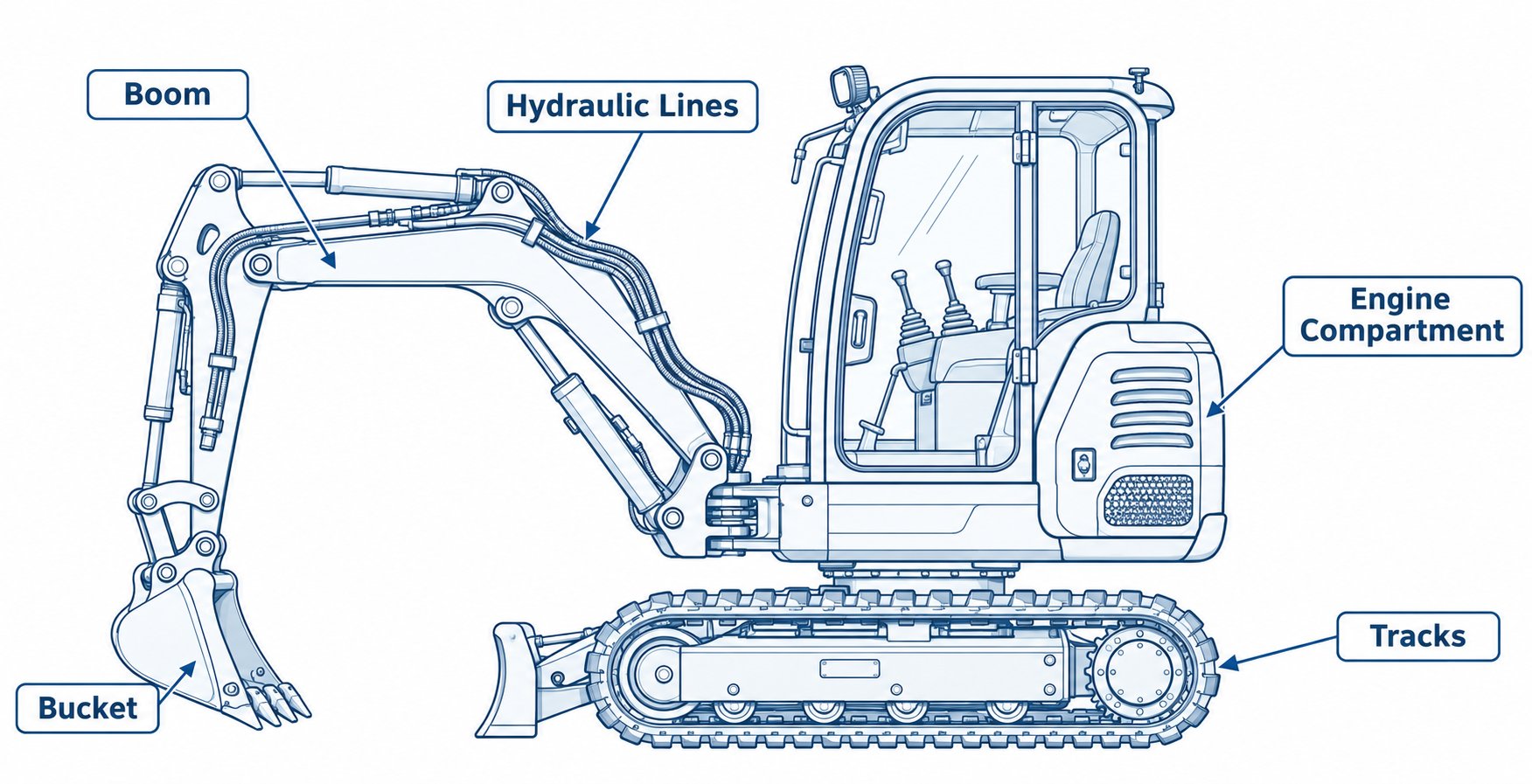
Every mini excavator falls into one of three broad weight categories, and each category carries distinct implications for transport, jobsite access, and lifting capability. Whether you're sourcing a Chinese mini excavator from an overseas factory or evaluating an AGT industrial mini excavator through a domestic distributor, these classifications apply universally:
- Micro class (under 1 ton / under 2,200 lbs): The smallest machines available — narrow enough to fit through standard residential gates and light enough to tow behind a pickup truck on a light-duty trailer. Ideal for landscaping, indoor demolition, and tight backyard work where full-size equipment simply cannot reach.
- Mini class (1–6 tons / 2,200–13,200 lbs): The broadest and most popular segment for wholesale buyers. These machines handle foundation excavation, utility trenching, pool installation, and general site prep. Operating weights across major brands range from roughly 2,000 lbs at the low end to over 13,000 lbs at the upper boundary, with dig depths spanning approximately 6 to 13 feet depending on the specific tonnage.
- Compact class (6–10 tons / 13,200–22,000 lbs): Machines in this range bridge the gap between mini and full-size crawler excavators. They deliver dig depths of 12 to 17 feet and enough breakout force for commercial site preparation, heavy trenching, and road work. Transport typically requires a dedicated lowboy trailer.
Why does this matter for wholesale purchasing specifically? Because operating weight dictates trailer requirements across your entire fleet. Ordering a batch of 3.5-ton machines means every crew can transport them on the same class of trailer with the same towing vehicle. Jump to a 5-ton class, and you may need to upgrade trailers fleet-wide — an expense that doesn't show up on any excavator quote but hits your budget hard.
Dig Depth, Bucket Capacity, and Hydraulic Flow
Three specifications determine what a machine can actually accomplish once it's on the ground, yet most buyers fixate on only one of them.
Dig depth measures the maximum vertical distance the bucket can reach below grade level. Sounds straightforward, but there's a catch: real trenching conditions typically allow you to work at roughly 85–90% of the published maximum, because boom and arm geometry limit bucket curl angle as you approach full extension. A machine rated at 10 feet of dig depth may only clean the bottom of a trench efficiently at around 8 to 9 feet. For foundation work, utility installation, or septic system excavation, selecting a machine with adequate dig depth margin prevents costly repositioning mid-job.
Bucket capacity — measured in cubic yards or cubic meters — affects cycle times. A larger bucket moves more material per scoop, which sounds universally better until you realize that oversized buckets on undersized machines reduce breakout force and slow the hydraulic cycle. The real question isn't "how big is the bucket?" — it's "how many cycles does it take to fill a dump truck, and does the machine have enough hydraulic power to maintain that pace over a full shift?"
Hydraulic flow rate, measured in gallons per minute (GPM), is the specification that separates a basic digging machine from a versatile tool platform. Main hydraulic flow governs boom and arm speed. Auxiliary hydraulic flow — the secondary circuit — determines which attachments the machine can power: breakers, augers, tilt rotators, and thumbs all require specific GPM and PSI ranges. If your fleet will run anything beyond a standard bucket, auxiliary hydraulic output matters more than raw engine horsepower.
One additional note for buyers sourcing machines destined for confined urban jobsites: confirm zero-tail-swing (ZTS) specifications. A ZTS machine keeps its counterweight within the track width during full 360-degree rotation, allowing it to work flush against walls, fences, and other structures without risk of collision. The tradeoff is slightly reduced lift capacity compared to conventional-tailswing designs of the same weight, but for tight residential or urban commercial work, that compromise is well worth it.
Engine Type and Emissions Compliance
Engine specifications go beyond horsepower — they determine where your machines can legally operate. Diesel engines dominate the mini excavator market, with power ratings typically ranging from 10 hp in micro-class machines to 65–75 hp in the upper compact class. But the critical detail for wholesale buyers isn't power output; it's emissions compliance.
For machines destined for US operation, EPA Tier 4 Final compliance is mandatory. This standard limits particulate matter and nitrogen oxide emissions from off-road diesel engines and applies to every machine operating on a US construction site. Purchasing non-compliant machines — even at a steep discount — renders them illegal to operate domestically and essentially worthless for any buyer in the American market.
For wholesale buyers planning to resell into European markets, CE marking is the parallel requirement. CE marking is a manufacturer's declaration that the machine meets EU health, safety, and environmental directives. It is not interchangeable with EPA compliance; each certification addresses different regulatory frameworks for different markets. Meanwhile, ISO 9001 certification — which you'll see mentioned on nearly every factory listing — verifies the manufacturer's quality management system, not the quality of any individual machine. It confirms that documented production processes exist, not that a specific unit passed a specific test.
The practical takeaway: always confirm which specific engine configuration and emissions tier apply to the exact units you're ordering. A supplier who answers "we are certified" without specifying which version, engine combination, and destination-market standard that certification covers is waving a red flag.
| Specification | 1-Ton Class | 2-Ton Class | 3.5-Ton Class | 5-Ton Class |
|---|---|---|---|---|
| Operating Weight | 2,000–2,600 lbs | 3,700–4,500 lbs | 7,400–8,800 lbs | 10,500–12,500 lbs |
| Typical Dig Depth | 5 ft 6 in – 6 ft 6 in | 7 ft 6 in – 8 ft 10 in | 10 ft – 11 ft 6 in | 11 ft 6 in – 13 ft |
| Bucket Capacity (Heaped) | 0.01 – 0.03 yd³ | 0.03 – 0.06 yd³ | 0.06 – 0.10 yd³ | 0.10 – 0.18 yd³ |
| Engine Power Range | 10 – 14 hp | 14 – 21 hp | 23 – 33 hp | 36 – 50 hp |
| Common Use Cases | Landscaping, indoor demo, tight residential access | Light trenching, utility work, small foundation prep | Foundation excavation, pool installation, septic systems | Commercial site prep, heavy trenching, road work |
These ranges reflect general industry data across major manufacturers — actual figures for any specific model, whether it's a mini escabeiro listing or a name-brand unit from a tier-one OEM, will vary based on arm configuration, attachment packages, and optional features like long-stick extensions that add 1 to 2 feet of reach at the expense of reduced breakout force. Always request the full spec sheet for the exact model and configuration included in your wholesale quotation, and cross-reference it against the jobsite requirements or target-market expectations your fleet needs to serve.
Specifications tell you what a machine can do. What they don't reveal is what that machine will cost you once volume discounts, freight, customs duties, and attachment packages are factored into the equation — and that pricing structure is where wholesale purchasing gets genuinely complex.
How Wholesale Pricing Works and What Drives Cost
A supplier quotes you $8,500 per unit for a 1 ton mini excavator. Another quotes $11,200 for what appears to be the same class of machine. Your instinct says take the cheaper option — but that instinct could cost you thousands more than the "expensive" quote by the time machines actually arrive at your yard. Wholesale pricing for compact earth moving machine orders is layered, variable, and often deliberately opaque. Breaking it apart into its component pieces is the only way to compare suppliers honestly.
How Wholesale Mini Excavator Pricing Is Structured
Unlike retail, where a dealer posts a sticker price that includes freight, setup, and margin, wholesale quotations are built from a stack of cost variables that shift independently of each other. Understanding which levers move the price — and by how much — gives you the ability to read a quote critically rather than reactively.
The most obvious factor is tonnage class. Heavier machines cost more to produce, period. A 5 ton excavator carries a larger engine, heavier steel undercarriage, bigger hydraulic cylinders, and more complex boom geometry than a micro-class unit. Pricing scales roughly in proportion — but not linearly. The jump from a 1-ton to a 2-ton is proportionally smaller than the jump from a 3.5-ton to a 5-ton, because upper-class machines require substantially more expensive components like Tier 4 Final engines and higher-capacity hydraulic pumps.
Brand origin is the second major variable, and it's more nuanced than most buyers realize. Japanese-branded machines (Kubota, Yanmar, Hitachi) and European brands (Volvo, JCB, Wacker Neuson) generally command the highest per-unit pricing — reflecting established dealer networks, mature warranty infrastructure, and consistently high resale values. Korean brands occupy a middle tier. Chinese-origin machines are typically priced lowest at the FOB level, sometimes 30 to 50 percent below comparable Japanese or European models.
Here's the nuance that catches people off guard: equipment exported from China is not necessarily manufactured by a Chinese brand. Several global OEMs operate production facilities in China, and many Chinese factories build machines using imported Japanese hydraulic pumps (Kawasaki, Rexroth), Yanmar or Kubota diesel engines, and European-spec control valves. A machine's country of export tells you where it was assembled — not what's inside it. Always request a component sourcing breakdown alongside the headline price.
Order volume breakpoints function like a staircase. A supplier might quote $9,800 per unit for 2–4 machines, $9,200 for 5–9 units, and $8,600 for 10 or more. These breakpoints aren't arbitrary — they reflect the manufacturer's production scheduling efficiency, raw material purchasing power at scale, and reduced per-unit sales overhead. Knowing where the next breakpoint sits gives you a concrete target for negotiation: sometimes adding one or two units to an order drops the per-unit price enough to more than cover the additional machines.
Engine specification significantly influences price as well. EPA-compliant engines (Tier 4 Final for US operation) cost manufacturers more to produce than non-compliant versions due to exhaust after-treatment systems and more sophisticated fuel injection technology. Expect a meaningful premium — often $1,000 to $3,000 per unit depending on tonnage class — for machines equipped with compliant powertrains. Non-compliant machines may look like bargains on the quote sheet, but they're legally inoperable in the US market.
Finally, attachment packages alter the bottom line. A base-configuration machine shipped with a single digging bucket costs less than one bundled with a hydraulic thumb, two additional bucket sizes, quick-coupler, and auxiliary hydraulic plumbing. Some suppliers quote attachments separately; others roll them into the unit price. If you don't clarify this before comparing quotes, you're comparing different products at different price points and drawing the wrong conclusions.
Beyond Sticker Price — Total Landed Cost
This is where most first-time wholesale buyers make their most expensive mistake. They fixate on the FOB price — the cost of the machine loaded onto a shipping vessel at the port of origin — and treat it as the final number. It isn't even close.
Total landed cost is the true purchase price: everything it takes to get a machine from a factory floor to your facility, ready to work. DHL defines landed cost as the sum of product price, freight costs, customs duties and taxes, regulatory fees, and insurance — and every one of those components adds meaningful dollars to your per-unit expense.
Here's the breakdown for a typical wholesale mini excavator import:
- FOB price: The base cost of the machine at the port of origin — your starting number, not your ending one
- Ocean freight: Container shipping cost from origin port to destination port, varying by container size, route, and seasonal demand
- Marine insurance: Typically 0.3% to 0.5% of the total shipment value — inexpensive, but not optional when you're moving a container of heavy equipment across an ocean
- Customs duties: Calculated using the Harmonized Tariff Schedule (HTS) code for the specific machine classification, applied as a percentage of the declared value
- Import taxes and regulatory fees: Port handling charges, customs broker fees, and any applicable inspection or documentation costs at the port of entry
- Inland transport: Trucking from the destination port to your yard, dealership, or customer — a cost that varies dramatically based on distance and equipment required
When you stack these components, a machine quoted at $8,500 FOB could easily land at $11,000 to $13,000 at your facility. Meanwhile, a domestic distributor quoting $12,000 delivered and ready to operate might actually represent the better deal — especially when you factor in the time, coordination, and risk embedded in a direct import. Currency exchange fluctuations add another layer of unpredictability, since most international wholesale transactions are denominated in US dollars or Chinese yuan, and rate shifts between the quotation date and final payment date can move your actual cost by several percent.
The cheapest unit price means nothing if total landed cost erases the savings. Always calculate what a machine costs at your door — not at someone else's port.
Negotiation Leverage Points for Wholesale Buyers
Pricing isn't fixed — it's a conversation. And in wholesale equipment purchasing, the buyers who walk away with the best total deals aren't necessarily the ones who hammer hardest on unit price. They're the ones who understand where suppliers have flexibility and when to apply pressure.
Market research is your foundation. Before submitting a single RFQ, study recent sales data, collect competing quotes from multiple suppliers, and understand current pricing trends for your target tonnage class. This homework transforms you from a buyer asking "what's your best price?" into one who says "I've benchmarked this class at X — here's why your pricing needs to reflect that."
Beyond preparation, these specific tactics consistently deliver results in bulk equipment negotiations:
- Time your purchase strategically: Manufacturers and distributors often face quarterly or year-end revenue targets. Approaching suppliers in the final weeks of Q4 or just before major trade shows (like CONEXPO-CON/AGG or bauma) frequently unlocks pricing concessions they wouldn't offer mid-cycle
- Negotiate the package, not just the price: Push for warranty extensions, bundled spare parts kits (filters, hydraulic hoses, track pads), and free or discounted attachment packages. These add-ons carry lower marginal cost for the supplier but deliver real savings for you over the machine's operating life
- Leverage payment terms as a bargaining chip: Offering a larger upfront deposit or faster payment timeline can unlock per-unit discounts, because manufacturers value cash flow certainty — especially on larger orders
- Consolidate tonnage classes into a single order: If you need a mix of 1-ton and 3.5-ton machines, combining them into one purchase order may push you past a volume breakpoint that neither order would reach individually
- Request a trial or sample unit: For first-time supplier relationships, asking to purchase a single machine before committing to a full container isn't just a quality check — it establishes the relationship on terms that give you inspection data and firsthand experience before you're financially exposed at scale
- Use competing quotes transparently: Presenting documented competing offers to a supplier isn't aggressive — it's expected in wholesale transactions. Suppliers want to know what market pricing looks like, and a legitimate competing quote gives them internal justification to sharpen their numbers
One last principle worth internalizing: the strongest negotiation position comes from being genuinely willing to walk away. Patience and persistence separate buyers who get acceptable deals from those who secure exceptional ones. Rushing to close — especially under jobsite schedule pressure — hands leverage directly to the seller.
Pricing structure and negotiation tactics give you the tools to evaluate quotes intelligently. But the most consequential decision most wholesale buyers face isn't about price at all — it's about where those machines come from. Importing directly from an overseas factory and purchasing through a US-based distributor are fundamentally different experiences, each carrying its own set of costs, risks, and strategic tradeoffs.
Direct China Import vs. Domestic Wholesale Distributors
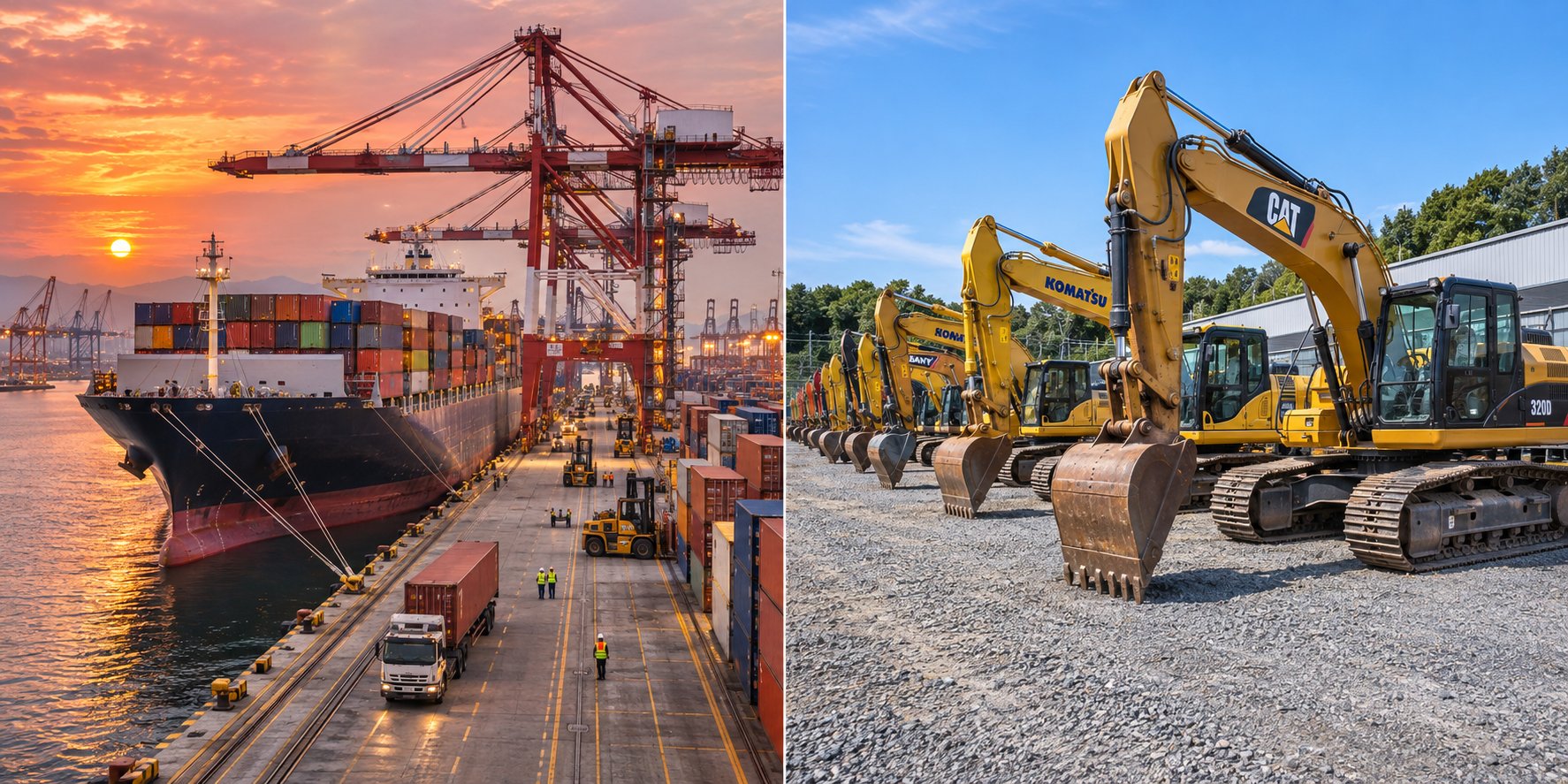
You've locked down your target specs and understand how landed cost reshapes a seemingly cheap quote. The next fork in the road is arguably the biggest one: do you source machines directly from an overseas factory, or buy through a US-based wholesale distributor who has already handled the import headaches on your behalf? Both channels deliver mini excavators to your yard — but the cost structures, timelines, risk profiles, and support ecosystems behind each option couldn't be more different.
Direct Import from Overseas Manufacturers
Platforms like Alibaba, Made-in-China, and GlobalSources have made it astonishingly easy to contact a factory in Shandong province, request a mini excavator price quote, and receive a polished PDF within 24 hours. The FOB numbers are seductive — a 4 ton excavator quoted at $15,000 to $18,000 FOB Shanghai looks like a steal compared to a domestic distributor listing similar machines in the $22,000 to $28,000 range. That apparent gap is exactly what pulls thousands of first-time import buyers into the direct-sourcing pipeline every year.
Some of them do very well. Experienced importers who understand freight logistics, customs classification, and quality verification can genuinely capture meaningful savings — particularly on straightforward commodity machines ordered in full-container volumes. The math improves further when you're buying ten or more units, because fixed costs like customs brokerage, marine insurance, and container drayage spread thinner across each machine.
The challenges, however, are real and recurring:
- Lead times stretch long: Production scheduling, factory queue position, and ocean transit typically mean 60 to 120 days from order confirmation to delivery at your door — compared to days or weeks from a domestic source
- Quality verification is difficult remotely: Photos and videos only reveal so much. Weld quality, hydraulic hose routing, component brand authenticity, and structural steel grade are nearly impossible to assess without physical inspection or a trusted third-party agency on the ground
- Communication barriers compound risk: Time zone differences, language gaps, and cultural negotiation norms can lead to specification misunderstandings that only surface when machines arrive — 8,000 miles too late for an easy fix
- Customs and tariff complexity: US entry requires correct HTS classification, Section 301 tariff assessment, EPA engine documentation, and Importer Security Filing — all coordinated through a customs broker before machines clear the port. Errors or missing paperwork trigger holds, storage fees, and potential seizure
- Limited domestic warranty support: A factory in China may offer a written warranty, but enforcing it across an ocean — shipping failed components back, waiting for replacements, absorbing downtime — is a fundamentally different experience than calling a service department two states away
None of these challenges are insurmountable. But each one carries a cost — measured in money, time, or risk — that doesn't appear on the FOB quote. First-time importers frequently underestimate the cumulative weight of these hidden burdens, and industry analysis suggests that total landed cost for small-volume direct importers can add 35 to 60 percent on top of the FOB factory price once freight, duties, compliance, and logistics coordination are fully tallied.
US-Based Wholesale Distributors and Multi-Brand Dealers
Domestic wholesale distributors sit on the opposite end of the convenience-versus-cost spectrum. They've already absorbed the import timeline, navigated customs, verified EPA compliance, and staged machines in US-based inventory. You're paying a premium for that — per-unit pricing is almost always higher than a comparable FOB quote — but you're also buying something the factory can't sell you: speed, inspectability, and a domestic legal entity standing behind the transaction.
The advantages stack up quickly for buyers who value operational certainty:
- Faster delivery: Machines in domestic inventory ship in days, not months. For contractors facing project start dates or rental companies responding to seasonal demand spikes, that timeline difference is worth real money
- Physical inspection before purchase: You or your mechanic can walk around the machine, check hydraulic fittings, test auxiliary circuits — critical when you're evaluating whether a unit supports adding auxiliary hydraulics to excavator attachments like breakers or augers — and verify condition firsthand before committing
- Established warranty infrastructure: Domestic distributors typically offer warranty service through local or regional networks, eliminating the cross-border enforcement headaches that plague direct-import warranty claims
- Simplified logistics: No customs broker, no HTS classification disputes, no marine insurance, no port demurrage charges. A domestic purchase is a trucking arrangement, not an international trade operation
Some distributors and online platforms go further, aggregating used and new machines from multiple brands into a single browsable inventory. This model lets buyers compare listings across tonnage classes, evaluate different manufacturers side by side, and request model-specific quotes for individual or bulk purchases — all without committing to a single brand or factory relationship upfront. JIUHONG's excavator collection, for example, brings together compact and larger machines from various manufacturers, giving wholesale buyers a starting point to assess available inventory across weight classes and request quotes tailored to their volume and specification requirements. Platforms like this are particularly useful during the early research phase, when you're still narrowing down whether a 1-ton, 3.5-ton, or mixed fleet best fits your operation.
The tradeoff is straightforward: you'll typically pay more per unit than a direct import, but you'll spend less time, carry less risk, and get machines working sooner. For many wholesale buyers — especially those placing their first bulk order or those without dedicated import operations staff — that tradeoff pencils out clearly in the distributor's favor.
Hybrid Sourcing Strategies
Experienced wholesale buyers rarely commit exclusively to one channel. The most effective approach is often a blended strategy that matches the sourcing method to the machine type and urgency of need.
Here's how that typically works in practice: commodity machines — standard-configuration units in popular tonnage classes where specifications are well understood and interchangeable across manufacturers — are strong candidates for direct import. The risk is manageable because the machines are straightforward, comparison is easy, and the savings at scale justify the longer timeline. A bulk order of ten identical 1-ton mini excavators for a rental fleet, for instance, is exactly the kind of transaction where direct factory sourcing delivers its best value.
Specialized machines, certified pre-owned units, or urgent fill orders, on the other hand, are better sourced through domestic distributors. When you need a specific 4 ton excavator with particular auxiliary hydraulic specs and a verified service history — or when a project deadline means you can't wait three months for ocean freight — the distributor channel delivers what the factory channel physically cannot: speed and verified condition.
The hybrid model also serves as a built-in risk management tool. Maintaining relationships with both direct suppliers and domestic distributors means a disruption in one channel — whether it's a port congestion event, a tariff policy shift, or a factory production delay — doesn't shut down your entire equipment pipeline.
| Comparison Dimension | Direct Import (Overseas Factory) | US-Based Wholesale Distributor |
|---|---|---|
| Typical Cost Savings | Potentially 20–40% lower FOB price vs. domestic wholesale; savings narrow significantly after landed-cost additions | Higher per-unit price, but total cost is transparent and predictable with fewer hidden charges |
| Lead Time | 60–120 days from order to delivery, depending on production queue and shipping route | Days to 2–3 weeks for in-stock units; custom orders may take longer |
| Warranty Support | Factory warranty exists on paper; enforcement requires international coordination and long-distance parts shipping | Domestic warranty service through established networks; faster parts access and local labor |
| Parts Availability | Dependent on factory responsiveness and international shipping timelines for replacement components | Domestic parts inventory or fast-ship arrangements through distributor supply chains |
| Quality Assurance | Requires pre-shipment inspection (self-funded or via third-party agency); limited recourse after container is loaded | In-person inspection possible before purchase; domestic legal recourse for quality disputes |
| Customs Complexity | Full import process: HTS classification, Section 301 tariffs, EPA documentation, ISF filing, customs brokerage | None — distributor has already cleared customs; buyer handles standard domestic freight only |
Neither channel is universally superior. The right choice depends on your volume, timeline, risk tolerance, and operational capacity to manage international logistics. What both channels share, though, is a common requirement: vetting the supplier on the other end of the transaction. A low price from an unverified factory is a liability, and a premium price from an unreliable distributor is a waste. The supplier verification process — and knowing exactly which red flags to watch for — separates wholesale buyers who build profitable fleets from those who learn expensive lessons.
How to Vet Wholesale Mini Excavator Suppliers
A polished website, a competitive quote, and a responsive sales rep can make any supplier look credible. But credibility on paper and reliability across a ten-unit order are two completely different things. Whether you're sourcing an XZ20R mini excavator from a factory overseas or evaluating a domestic distributor's bulk pricing, the verification process you follow before committing funds determines whether that relationship becomes a long-term asset or a costly lesson. Here's the due diligence framework that separates serious suppliers from convincing storefronts.
Verifying Manufacturer Credentials and Certifications
Every supplier claims to be certified. Fewer can prove it under scrutiny. The certifications that matter most depend on where your machines will operate and who your end customers are, but three credentials appear consistently across legitimate mini excavator wholesale transactions:
- ISO 9001 quality management certification: This confirms the manufacturer operates a documented quality management system — standardized production processes, internal audits, and corrective action procedures. It does not guarantee the quality of any individual machine. Think of it as proof that a system exists, not that every output of that system is flawless.
- EPA Tier 4 Final compliance documentation: Mandatory for any machine destined for US operation. Demand the specific engine model number and its corresponding EPA certification letter — not a generic claim of "EPA compliance" buried in a brochure.
- CE marking: Required for machines sold into European markets. CE marking is a manufacturer's self-declaration that the equipment meets EU safety, health, and environmental directives. If you're buying for resale in Europe, confirm that the Declaration of Conformity document exists and names the correct EU directive.
Here's where most buyers stop — and where problems start. Accepting a supplier's own PDF of an ISO certificate at face value is not verification. Genuine ISO certificate verification requires checking several key data points: the certificate number, the named certification body, the accreditation body's logo, the scope of certification, and the expiration date. You can cross-reference these details through the International Accreditation Forum's online search tool, which aggregates data from over 75 accreditation bodies and 1,300+ certification bodies worldwide. If the certification body on your supplier's certificate doesn't appear in that database, the certificate may be non-accredited — meaning there's no independent oversight confirming the auditor's competence or the validity of their findings.
Trade platforms sometimes add their own credibility signals — Gold Supplier status, Diamond Member badges, verified manufacturer tags. These indicate the supplier has paid for enhanced listing features and passed a platform-level identity check. Treat them as preliminary filters, not final proof. A Gold Supplier badge tells you the company exists and paid a subscription fee. It doesn't tell you whether their mini x machines meet your hydraulic specs or whether their weld quality holds up after 500 hours of operation.
Assessing Build Quality Before Committing to Bulk
Imagine committing to a full container of machines based entirely on a spec sheet and a factory tour video edited by the supplier's marketing team. That's not due diligence — that's hope dressed up as a purchasing strategy. The most effective risk mitigation tool available to wholesale buyers is disarmingly simple: order a sample unit first.
A single-unit sample order lets you physically evaluate the machine before scaling your commitment. Yes, it costs more per unit than bulk pricing. Yes, it adds time to your purchasing timeline. But it also gives you firsthand data on build consistency, component quality, and real-world performance that no spec sheet or video call can replicate. Think of it as an insurance policy — the cost of one machine is trivial compared to the exposure of a ten-unit order that arrives with substandard quality.
If travel to the factory is feasible, a self-funded inspection visit provides the most thorough assessment. When it's not — and for many overseas buyers it won't be — third-party inspection agencies can visit the production facility on your behalf, verify the machines against your quotation specifications, and provide photographic documentation of their findings. Whether you inspect personally or through an agent, focus your evaluation on these critical areas:
- Weld quality: Examine boom, arm, and chassis welds for consistency. Look for uniform bead width, full penetration at joints, and absence of porosity, undercut, or spatter. Inconsistent welding across the same production batch signals poor quality control.
- Hydraulic hose routing: Hoses should follow clean, organized paths with proper clamping and adequate clearance from hot surfaces and moving parts. Sloppy routing leads to premature wear, chafing, and eventually hydraulic leaks — problems that multiply across a fleet.
- Component brand sourcing: Verify the actual brands of key components — hydraulic pumps, control valves, diesel engines, slew motors — against what was specified in the quotation. A supplier quoting Kawasaki hydraulic pumps but installing a generic alternative is a specification substitution, and it happens more often than the industry likes to admit.
- Paint and finish consistency: While cosmetic appearance alone doesn't prove structural quality, obvious assembly defects are usually visible during a careful walk-around inspection and should not be ignored. Uneven paint coverage, visible primer bleed-through, and misaligned body panels often correlate with rushed production or lax quality standards across the entire build.
For buyers wondering how much is a mini excavator sample going to set you back compared to bulk rates — expect to pay closer to retail pricing on that first unit. The investment pays for itself the moment it reveals a quality issue that would have been replicated across every machine in a full order.
Red Flags That Signal Unreliable Suppliers
Due diligence isn't only about confirming what's right. It's about recognizing what's wrong before your money is at risk. Scammers count on urgency, excitement, and skipped checks — and the heavy equipment market, including CFG Industrial and lesser-known wholesale channels, is not immune. Watch for these warning signs during your supplier evaluation:
- Refusal to provide reference customers: A legitimate manufacturer with wholesale volume should have no difficulty connecting you with previous buyers willing to share their experience. A supplier who deflects this request or offers only unverifiable testimonials is hiding something.
- Inconsistent specification sheets: If the spec sheet sent in January doesn't match the one sent in March — different operating weights, changed engine models, altered hydraulic flow rates — the supplier either doesn't control their own documentation or is tailoring specs to tell each buyer what they want to hear.
- Pressure to skip sample orders: "Our MOQ is 10 units, no samples" sounds like a firm policy. In practice, reputable manufacturers understand that first-time buyers need to validate quality before committing to bulk. A supplier who actively discourages or refuses sample orders is prioritizing their cash flow over your confidence.
- Unusually low MOQs paired with unusually low prices: A "factory" offering single-unit pricing that undercuts actual manufacturers by 40% with no minimum order is almost certainly a trading company reselling machines they don't produce — or worse, a front with no inventory at all.
- Lack of post-sale parts support documentation: Ask for a parts catalog, exploded diagrams, and a clear process for ordering replacement components after delivery. A supplier who can't provide these documents is signaling that their relationship with you ends the moment the container leaves the port.
- Wire-only payment with no alternatives: Legitimate wholesale suppliers offer structured payment options — T/T with deposit-balance splits, Letters of Credit, or trade assurance platforms. A seller who insists exclusively on wire transfers to unfamiliar accounts removes your financial recourse entirely.
Any single red flag justifies deeper investigation. Two or more appearing together should end the conversation. The wholesale equipment market rewards patience and punishes shortcuts — a truth that becomes even more apparent once you move past supplier selection and into the structured purchasing process itself, where every stage from RFQ submission through pre-shipment inspection demands the same disciplined attention to detail.
The Wholesale Buying Process from Inquiry to Delivery
Vetting a supplier tells you who to trust. The purchasing process itself tells you how to protect that trust — and your capital — at every stage between your first email and the moment machines roll off a flatbed at your facility. Most wholesale buyers have a general sense of the sequence: send inquiry, get quote, pay deposit, wait, receive machines. But the details buried inside each stage are where deals go smoothly or unravel quietly, one overlooked clause at a time.
Whether you're importing a diesel mini excavator directly from a Chinese excavator manufacturer or placing a bulk order through a domestic distributor, the transactional mechanics follow a predictable arc. Here's that arc, broken into its component stages — each one paired with the specific actions that keep you in control of the outcome.
From RFQ Submission to Quotation Review
The Request for Quotation is the document that sets the trajectory of your entire purchase. A vague RFQ generates vague quotes. A precise one forces suppliers to commit to specific numbers against specific deliverables — and makes comparing competing responses dramatically easier.
A well-constructed RFQ opens with a clear introduction to your company and its needs, then provides a structured template that allows suppliers to express their offers in a format designed for direct comparison. Time invested in preparation saves time and frustration downstream. For mini excavator wholesale purchases specifically, your RFQ should specify — at minimum — the following:
- Tonnage class and model range: Don't just write "mini excavator." Specify the exact weight class (e.g., 1.8-ton, 3.5-ton) or provide an acceptable range. If you have a target model — say a QK16R mini excavator or equivalent — name it explicitly.
- Quantity and volume breakpoints: State your target order size and ask for pricing at multiple tiers (e.g., 3 units, 5 units, 10+ units). This reveals the supplier's discount structure in a single response.
- Attachment requirements: List every attachment you expect included — standard bucket, auxiliary hydraulic plumbing, quick coupler, thumb, additional bucket sizes — and specify whether you want pricing bundled or itemized separately.
- Emission standards: State the destination market clearly. "EPA Tier 4 Final for US operation" or "CE-marked for EU resale" eliminates ambiguity about which engine configuration you need and prevents quotes for non-compliant machines.
- Destination port or delivery address: Suppliers need this to calculate freight, recommend FOB vs. CIF pricing, and estimate transit time accurately.
- Payment terms and delivery timeline: Include your preferred payment structure and target delivery window so the supplier can confirm feasibility or propose alternatives upfront.
- Required documentation: Specify what certificates, compliance documents, warranty agreements, and parts catalogs you expect alongside the machines.
Send the same RFQ to multiple pre-vetted suppliers simultaneously. This isn't just about price comparison — it's about evaluating response quality. A supplier who returns a detailed, organized quotation addressing every line of your RFQ demonstrates operational seriousness. One who responds with a single FOB number and a generic PDF is telling you something about how they'll handle your order after the deposit clears.
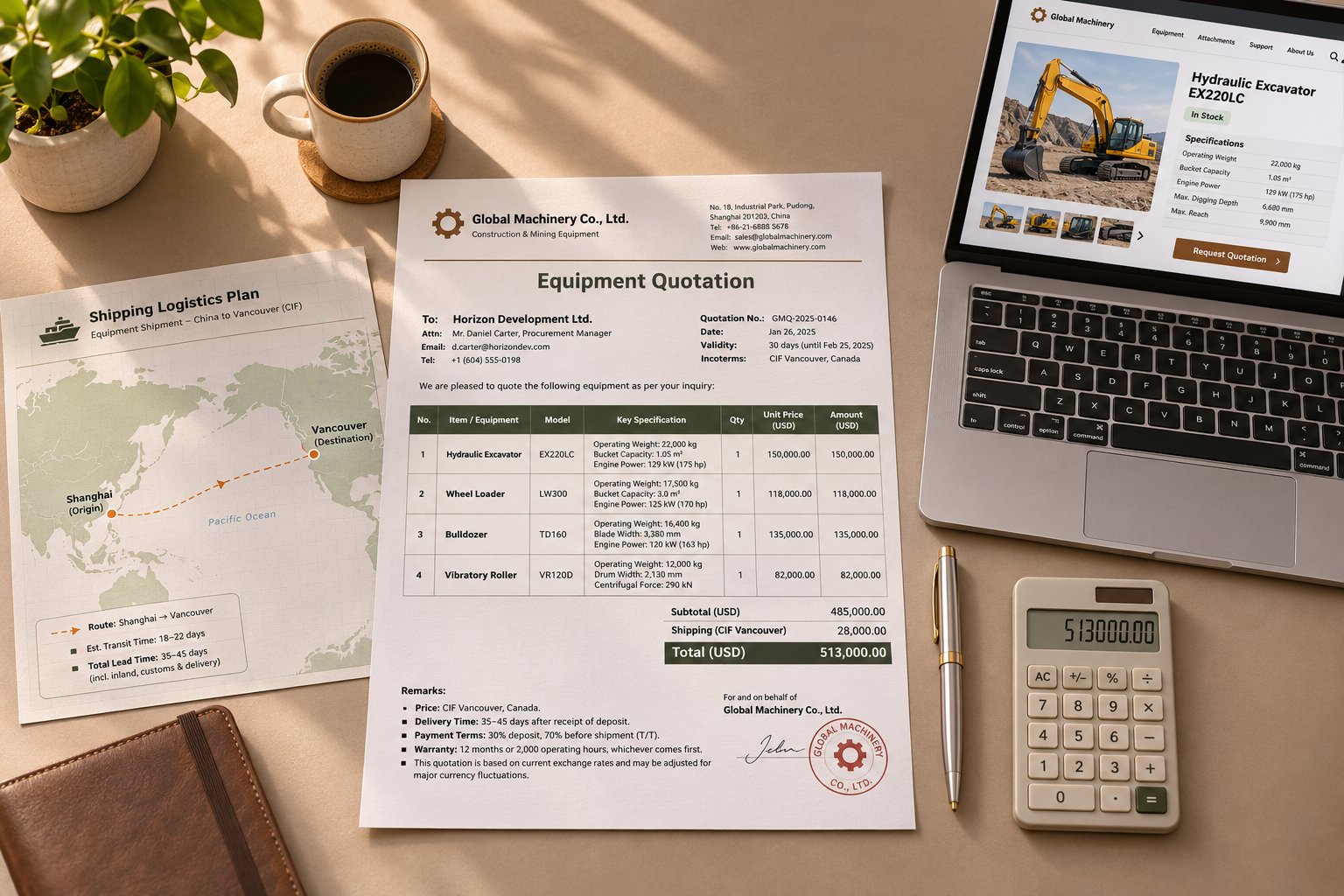
What should a complete quotation include in return? Look for unit pricing at each volume breakpoint, a clear cost breakdown separating machine base price from attachments and optional features, confirmed lead time from deposit receipt to shipment readiness, specific payment terms, warranty scope and duration, and a specification sheet matched to the exact configuration being quoted. If any of these elements are missing, request them before proceeding. A quotation that omits warranty terms or leaves lead time as "TBD" is incomplete — and incomplete quotes generate incomplete commitments.
Payment Structures and Financial Protection
Money changes hands before machines do. That fundamental asymmetry — you pay first, the supplier delivers later — is the single biggest source of financial risk in wholesale equipment transactions. How you structure that payment determines how much of that risk lands on your side of the table.
Three payment methods dominate the mini excavator wholesale landscape, each distributing risk differently between buyer and seller:
Telegraphic Transfer (T/T) with deposit-balance structure is the most common arrangement. A standard T/T transaction typically involves a 30% advance deposit to initiate production, with the remaining 70% balance released after the supplier presents proof of shipment — usually a copy of the Bill of Lading. Bank fees are low, usually between $20 and $50 per international wire. The tradeoff? T/T offers very little built-in legal protection for the buyer. Once funds reach an overseas bank account, recalling them if the factory fails to deliver is extraordinarily difficult. Experienced buyers never pay 100% upfront; the deposit-balance split is a non-negotiable safeguard.
Letters of Credit (L/C) provide the highest level of financial security for large orders. An L/C is a binding financial guarantee issued by the buyer's bank to the supplier's bank, promising payment only when the seller presents specific compliance documents — commercial invoices, packing lists, and original bills of lading that match the terms exactly. Your funds stay secure until your bank verifies that cargo was shipped as agreed. If the supplier misses the shipping deadline, the credit expires and your money returns. The cost is substantially higher than T/T — typically 0.5% to 1.5% of the total invoice value in processing, amendment, and credit line fees — and the administrative complexity adds 10 to 20 business days to the transactional timeline. For container-volume orders worth $50,000 or more, that cost is often a reasonable price for the protection it provides.
Trade assurance platforms function as a middle ground. Platforms like Alibaba's Trade Assurance hold the buyer's payment in escrow and release it to the supplier only upon confirmed delivery or satisfaction of agreed milestones. Protection is stronger than a naked T/T wire but less ironclad than a bank-backed L/C — and coverage is limited to transactions conducted entirely within the platform's ecosystem.
| Payment Method | Buyer Risk Level | Typical Cost | Processing Speed | Best For |
|---|---|---|---|---|
| T/T (30/70 split) | Moderate — deposit is at risk if supplier defaults | $20–$50 per wire transfer | 2–5 business days per transfer | Established supplier relationships; smaller to mid-size orders |
| Letter of Credit (L/C) | Low — bank verifies documents before releasing funds | 0.5%–1.5% of invoice value | Adds 10–20 days for documentation processing | High-value orders; first-time suppliers; risk-averse buyers |
| Trade Assurance / Escrow | Low to moderate — platform holds funds until milestones are met | Varies by platform; may include transaction fees | Comparable to T/T once funds are released | Platform-based transactions; buyers wanting escrow protection without L/C complexity |
A practical rule of thumb: match payment security to transaction risk. Repeat orders with proven suppliers can move efficiently on T/T terms. First-time purchases from unverified factories — especially for high-value, full-container shipments — warrant the added protection (and cost) of an L/C or platform escrow. The cheapest payment method is whichever one you never have to dispute.
Production, Quality Inspection, and Shipping
Deposit confirmed. Production begins. And for many buyers, this is where visibility goes dark — a nerve-racking gap between sending money and receiving machines that can stretch 45 to 90 days or longer. Filling that gap with structured checkpoints is how professional buyers stay in control after the wire clears.
Production scheduling typically starts within one to two weeks of deposit receipt for standard-configuration machines. Custom specifications — non-standard boom lengths, specific auxiliary hydraulic setups, or particular engine-emission configurations — may add lead time. Request a production timeline at the quotation stage and build milestone check-ins into the agreement: photos at assembly start, mid-production progress updates, and notification when the machine reaches final inspection readiness.
Pre-shipment inspection (PSI) is the single most valuable quality control step in the entire wholesale purchasing process. A heavy equipment PSI answers four essential questions: Is this the exact machine and configuration that was ordered? Does it operate as required? Are the attachments, spare parts, and documents complete? Is there enough traceable evidence to support a release, correction, or hold decision?
You can conduct a PSI in person, or hire an independent third-party inspection agency to visit the factory on your behalf. Either way, the critical step most buyers skip is defining acceptance criteria before the inspector arrives. "Check the hydraulics" is not an acceptance criterion. "Operate all agreed hydraulic functions through their normal range, record the test, and report abnormal noise, visible leakage, binding, or inability to complete the function" — that's an acceptance criterion. The inspection checklist should align directly with the specifications and configuration confirmed in your original quotation.
A thorough PSI for wholesale mini excavators should cover:
- Machine identity verification: Model, serial number, engine model, and data plates matched against the purchase order
- Engine cold start and operation: Dashboard warnings, idle stability, smoke, noise, and visible leaks
- Hydraulic function cycling: Boom, arm, bucket, swing, and auxiliary circuits tested through their full range
- Structural inspection: Weld quality, fastener integrity, cab condition, paint consistency, and any visible transport damage
- Attachments and spare parts: Every item on the order verified present, correctly specified, and documented with layout photos
- Documentation review: Invoice drafts, packing lists, compliance certificates, and warranty paperwork cross-checked against the machine and original order terms
The PSI result should connect directly to a commercial decision. A pass means you authorize the balance payment and shipment. A conditional result means correctable issues remain — hold the release until correction evidence or reinspection is accepted. A hold or fail means a critical finding blocks shipment entirely. Linking final payment to an accepted PSI gives you the strongest practical risk control available in international machinery purchasing.
Once inspection passes and the balance is released, the supplier hands the machines off to the logistics chain — container loading, port documentation, and ocean transit. This handoff marks the beginning of a separate set of challenges, from container capacity planning to customs clearance, that carry their own cost implications and failure points.
Here's the complete purchasing sequence, consolidated into a step-by-step framework you can use as a project checklist:
- Define requirements: Lock down tonnage class, quantity, attachment specifications, emission compliance standards, and target delivery timeline before contacting any supplier.
- Identify and pre-vet suppliers: Research manufacturers and distributors, verify credentials and certifications, and build a shortlist of three to five qualified candidates.
- Submit standardized RFQs: Send identical, detailed Requests for Quotation to all shortlisted suppliers simultaneously, using a structured template for easy comparison.
- Evaluate quotations: Compare responses across unit pricing, volume breakpoints, lead time, payment terms, warranty scope, and specification accuracy — not just the bottom-line number.
- Negotiate terms: Use competing quotes, timing leverage, and package bundling to sharpen pricing and secure value-adds like spare parts kits and extended warranties.
- Select supplier and finalize contract: Confirm all specifications, payment milestones, inspection rights, warranty obligations, and dispute resolution terms in a written agreement.
- Submit deposit: Release the agreed advance payment (typically 30% via T/T) or open the Letter of Credit per the contract terms.
- Monitor production: Request photo and video milestone updates at agreed intervals to verify progress and catch issues before they compound.
- Conduct pre-shipment inspection: Inspect machines in person or via third-party agency against the written acceptance criteria and quotation specifications. Issue pass, conditional, or hold decision.
- Release balance payment: Transfer the remaining balance only after PSI acceptance and receipt of shipping documentation (Bill of Lading).
- Coordinate shipping and customs: Confirm container loading, verify export documents, engage your customs broker, and track ocean transit to the destination port.
- Receive and verify delivery: Inspect machines upon arrival for transit damage, reconcile serial numbers against shipping documents, and confirm all attachments and documentation are present and accounted for.
Each step builds on the one before it, and skipping any single stage — especially the inspection and documentation milestones — exposes you to risks that become exponentially more expensive to resolve after machines leave the factory gate. The purchasing process gets your equipment ordered and inspected. Shipping logistics and landed cost calculations determine what those machines actually cost you when they finally touch your yard — and that math involves variables most first-time wholesale buyers have never considered.
Shipping Logistics and Landed Cost Calculations for Compact Mini Excavator Orders
Your pre-shipment inspection passed. The balance payment cleared. Machines are ready to leave the factory. And somewhere between that factory gate and your facility sits the cost component that trips up more first-time wholesale buyers than any pricing negotiation or specification mismatch ever does: shipping logistics. The freight charges, container configurations, customs duties, and port fees that accumulate between FOB and final delivery don't just add to your cost — they fundamentally reshape the per-unit economics of your entire order. A mini excavator sale that looked like a steal at the quoted price can quietly become an average deal, or even a losing one, depending on how efficiently you move those machines across water.
Container Loading Capacities by Tonnage Class
How many machines can you actually fit inside a steel box? The answer depends on three interlocking variables: the machine's physical dimensions (not just weight — length, width, and height with boom folded), the container's internal measurements, and whether you're shipping attachments alongside the units. There's no universal chart that works for every model, because even machines in the same tonnage class can vary significantly in footprint depending on arm configuration, cab design, and counterweight dimensions.
That said, practical loading patterns follow a general logic that helps you plan container utilization before requesting formal quotes:
- Micro and 1-ton machines are compact enough that multiple units can fit inside a single standard container. A 20ft container may accommodate some smaller models, while a 40ft or 40ft high-cube container can potentially hold two to four micro-class units depending on their exact footprint and how attachments are packed. These smaller machines weigh well under the container's maximum payload limit, so volume — not weight — is usually the binding constraint.
- 2-ton to 3-ton machines occupy significantly more floor space. Expect one or two units per 40ft container, depending on the specific model's transport dimensions with the boom retracted and blade lowered. Attachment crates and spare parts packages can often be loaded in remaining gaps around and between machines.
- 3.5-ton to 5-ton machines are a different calculus entirely. A 4 ton mini excavator or 5-ton unit typically fills a standard 40ft container on its own — and some larger compact models may exceed standard container height or width limits, requiring a flat-rack container with collapsible or fixed end walls but no sides or roof. Flat racks accommodate out-of-gauge cargo that doesn't fit standard container dimensions, though they expose the machine to ocean elements during transit and command higher freight rates.
The exact loading plan should always be confirmed by your supplier or freight forwarder based on the specific machine configuration you're ordering. Suppliers experienced in export will typically provide container loading diagrams as part of the shipping quotation — showing machine positioning, lashing points, and blocking arrangements. If a supplier can't produce this documentation, that's a logistics red flag worth noting before you commit.
One detail buyers frequently overlook: packaging method affects both loading capacity and machine protection. Some exporters ship machines naked (secured to the container floor with chains and blocking), while others use wooden crating or plastic wrapping. Crating adds dimensional overhead that may reduce how many units fit per container, but it also reduces the risk of cosmetic damage and simplifies handling at the destination port. Ask for loading photos or video from your supplier to verify that machines are properly secured and all included attachments are accounted for before the container is sealed.
FCL vs. LCL Shipping and Port Considerations
Two acronyms shape every international shipping decision: FCL (Full Container Load) and LCL (Less-than-Container Load). The distinction is straightforward, but the cost and risk implications are anything but.
FCL means you're booking the entire container exclusively for your cargo. The machine is loaded at the factory, the container is sealed, and it remains undisturbed until it reaches the destination port. FCL is typically preferred for mini excavators because it minimizes handling touchpoints — no consolidation warehouse, no sharing space with unknown cargo, no deconsolidation at the other end. For wholesale buyers shipping two or more units, FCL almost always makes more economic and logistical sense.
LCL means your shipment shares container space with other cargo headed to the same destination port. This can work for a single micro-class or 1-ton compact mini excavator when a full container isn't justified, but the tradeoffs are significant: additional handling at consolidation and deconsolidation warehouses increases the risk of damage, port charges are often higher per unit, and transit times can stretch longer due to consolidation scheduling. For heavy equipment — where even minor bumps during loading and unloading can damage hydraulic lines, control panels, or paint — the extra handling that LCL entails is a genuine concern.
A practical rule: if your order fills more than roughly half a container's usable space, FCL is almost certainly the better choice. The marginal freight cost of booking unused container space is typically less than the added fees, handling risk, and schedule uncertainty of LCL.
Port-of-entry considerations for US buyers add another layer to the planning. Major entry ports for heavy equipment imports include Los Angeles/Long Beach, Savannah, Houston, New York/Newark, and Seattle/Tacoma. Your choice of port affects inland trucking distance and cost to your final destination — a container arriving at Long Beach destined for a buyer in Georgia faces substantially higher drayage charges than one cleared through the Port of Savannah.
Regardless of which port you use, you'll need a licensed customs broker to file the entry paperwork, classify your machines under the correct Harmonized Tariff Schedule (HTS) code, and ensure all EPA compliance documentation, commercial invoices, and bills of lading are in order. HTS classification isn't trivial — the specific code assigned to your machines determines the applicable duty rate, and misclassification can trigger holds, penalties, or supplemental duty assessments. For mini excavators, the relevant HTS codes generally fall under Chapter 84 (machinery and mechanical appliances), but the exact 10-digit code depends on the machine's specifications, operating weight, and intended function. Your customs broker should confirm the correct classification before the container reaches US waters.
Calculating True Landed Cost Per Unit
Here's the framework that transforms a quoted FOB price into the number that actually matters — the total cost per machine at your facility, ready to work or ready to sell. Landed cost is not a single line item — it's a stack of charges that accumulates across every stage of the import process, some fixed by regulation, some variable by decision, and some avoidable entirely with the right planning.
Every cost component below lands on top of your FOB price. Miss any one of them in your pre-purchase modeling, and your projected margin erodes by exactly that amount:
| Cost Component | Typical Range / Description | Notes on Variability |
|---|---|---|
| FOB Price (Machine Cost) | Your negotiated per-unit price at the port of origin, including specified attachments and packaging | Varies by tonnage class, brand origin, order volume, engine spec, and attachment package — the foundation number that all other costs sit on top of |
| Ocean Freight | Varies by container size (20ft vs. 40ft vs. flat rack), shipping route, and seasonal market conditions | Rates fluctuate with fuel prices, carrier capacity, and trade lane demand; peak season surcharges, terminal handling charges (THC), and documentation fees often apply on top of the base rate |
| Marine Insurance | Typically 0.5% to 1% of total cargo value | Covers loss, damage, or destruction during ocean transit; carrier liability alone is limited and rarely adequate for full replacement value of heavy equipment |
| Customs Duties | Percentage of declared customs value, determined by HTS code classification | Rates vary by product classification and country of origin; Section 301 tariffs on China-origin goods add additional duty layers that can significantly increase this component |
| Merchandise Processing Fee (MPF) | 0.3464% of declared value; minimum $32.71 / maximum $634.62 per entry | Applies to nearly all formal entries; predictable and non-negotiable |
| Harbor Maintenance Fee (HMF) | 0.125% of cargo value on ocean shipments | Applies to all commercial cargo entering US ports by ocean; does not apply to air freight |
| Customs Brokerage Fees | Professional fees for HTS classification, entry filing, and customs clearance | Varies by broker and complexity of entry; typically a flat per-entry fee plus any additional charges for classification research or compliance review |
| Port Handling and Drayage | Terminal charges at destination port plus short-haul trucking from port to warehouse or yard | Includes chassis fees, port congestion surcharges, and potential pier pass charges at certain ports; frequently underestimated by first-time importers |
| Inland Trucking | Over-the-road freight from the port of entry to your final destination | Varies dramatically by distance; a buyer 50 miles from the port faces a fraction of the cost that a buyer 1,500 miles inland absorbs |
| Demurrage and Detention | Daily charges if the container sits at port beyond the carrier's free time (typically 3–5 days) or if you retain the container beyond the allowed unloading window | Entirely avoidable with accurate documentation and coordinated drayage; can reach hundreds of dollars per day when incurred — plan logistics to avoid this completely |
The math itself is simple addition. The discipline is in actually collecting every number before you compare quotes. A product purchased at a cost that appears competitive can become unprofitable once duties, freight, fees, and handling are fully accounted for. Conversely, a supplier whose unit price appears higher may produce a lower landed cost when freight routing, duty exposure, and logistics efficiency are modeled correctly.
Consider a practical scenario: you're evaluating a bulk order of compact mini excavators from two different sources. Supplier A quotes $9,000 FOB per unit from China. Supplier B, a US-based distributor, quotes $13,500 delivered. At first glance, Supplier A saves you $4,500 per machine. But add ocean freight allocated per unit, marine insurance, Section 301 tariff exposure on Chinese-origin goods, customs brokerage, MPF, HMF, port handling, and inland trucking from the coast to your facility — and that $4,500 gap narrows considerably. Depending on the specific duty rate, your distance from the port, and whether any documentation delays trigger demurrage charges, the gap could shrink to under $1,000 per unit — or disappear entirely.
This is precisely why experienced buyers model landed cost before selecting a supplier, not after machines are already on the water. Request freight estimates from your forwarder, get duty rate guidance from your customs broker, and map inland trucking costs from likely ports of entry. Only then does the FOB quote become a meaningful data point rather than a misleading headline number.
Two additional variables deserve attention because they catch buyers off guard with regularity. First, the Incoterm you agree to with your supplier affects your customs value — and therefore your duty calculation. Under CIF terms, freight and insurance are included in the invoice price, which means you pay duty on those charges in addition to the machine cost. Under FOB terms, freight and insurance are arranged separately and generally excluded from the dutiable value. On a high-value container shipment, this distinction can shift your duty bill by a meaningful amount.
Second, demurrage and detention charges — daily fees for leaving a container at port or holding it too long for unloading — are among the most expensive avoidable costs in the entire import chain. They accumulate quickly and exist entirely because of documentation errors or logistics coordination failures. Having your customs broker, freight forwarder, and drayage carrier aligned before the vessel arrives at port is the simplest way to keep these charges off your landed cost sheet permanently.
Shipping and landed cost calculations put hard numbers on every machine in your order. But numbers alone don't capture the full picture — there are financial, quality, legal, and logistical risks embedded in wholesale purchasing that no cost model can quantify until they actually materialize. Identifying those risks before they surface, and building mitigation strategies into your purchasing framework, is the layer of protection that separates a profitable wholesale operation from one that learns its lessons the expensive way.
Risk Assessment Framework for Wholesale Purchases
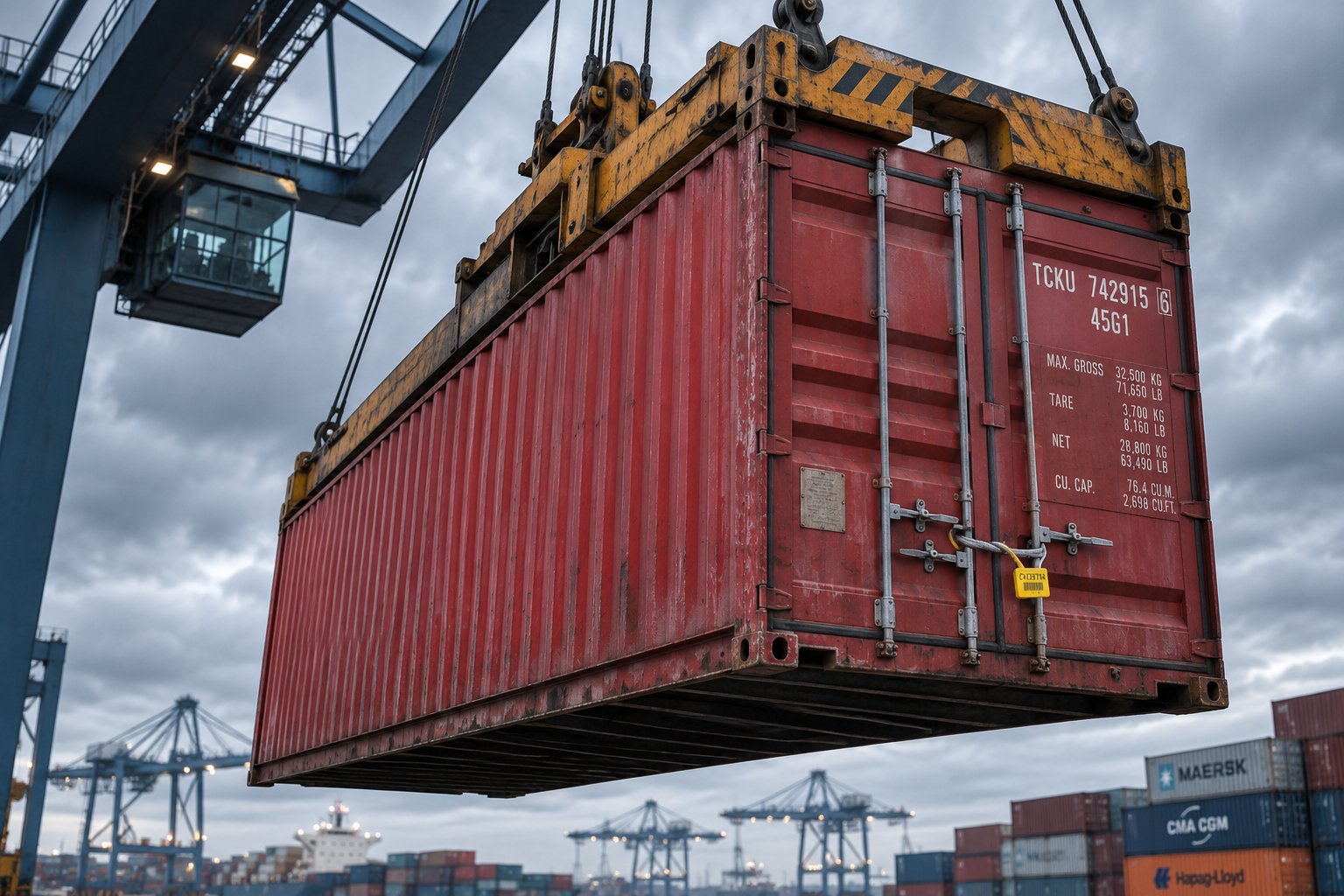
Landed cost tells you what a machine should cost. Risk assessment tells you what it could cost if something goes wrong — and in wholesale purchasing, the list of things that can go wrong spans financial fraud, component fraud, regulatory violations, ocean damage, and cross-border legal disputes that make a domestic warranty claim look effortless. Every sourcing channel carries risk. The question isn't whether you'll encounter it, but whether you've structured your purchasing framework to absorb it before it becomes a crisis.
Think of this framework as a pre-flight checklist. Pilots don't skip it because they've flown a hundred times — they run it because they understand that a single overlooked item at altitude becomes catastrophic. Wholesale equipment purchasing works the same way. The risks below are organized by category, each paired with the mitigation strategy that neutralizes it.
Financial and Fraud Risks
Money moves first. Machines move later. That gap — sometimes spanning 60 to 90 days on international orders — is where financial risk concentrates. And the threats aren't hypothetical. 76% of US organizations faced attempted or actual payments fraud in 2025, with the median occupational fraud case costing approximately $104,000. Wholesale equipment transactions, with their large wire transfers and cross-border payment flows, sit squarely in the crosshairs.
- Ghost suppliers (deposit theft): A convincing website, a responsive WeChat account, a professional-looking quote — and no factory behind any of it. You wire a 30% deposit and the "supplier" disappears. Mitigation: Never wire funds to a first-time supplier without independent verification — factory visits, third-party inspection agency confirmation, or trade assurance escrow. Verify bank account ownership matches the company name on the contract.
- Bait-and-switch after deposit: You agree on a specific engine brand, hydraulic pump model, and steel grade. After your deposit clears, the supplier substitutes cheaper components — banking on the assumption that you won't inspect closely enough or won't want to delay delivery by demanding corrections. Mitigation: Tie final balance payment to a pre-shipment inspection with written acceptance criteria. Specify component brands and model numbers in the purchase contract, not just general performance specs.
- Hidden fees that inflate landed cost: Port storage charges, documentation fees, packaging surcharges, and "inspection certificates" that weren't mentioned in the quotation suddenly appear on the final invoice. Mitigation: Require an all-inclusive cost breakdown at the quotation stage. Define in writing which party is responsible for every charge between factory floor and FOB port loading.
- Currency fluctuation exposure: A bulk order denominated in Chinese yuan or negotiated months before payment completion can shift several percent in either direction due to exchange rate movement. On a $100,000 order, a 3% adverse swing costs you $3,000 before a single machine ships. Mitigation: Lock exchange rates through forward contracts with your bank on large orders, or negotiate USD-denominated pricing to shift currency risk to the supplier.
Payment structure itself is a risk mitigation tool. A single individual — or a single process step — controlling the entire payment flow is the highest-risk configuration in any procurement operation. Segregating who initiates, approves, and releases funds — even on a small team — closes the gap that fraud exploits most frequently.
Quality and Compliance Risks
Two machines can look identical sitting side by side on a factory floor. Same paint color, same cab layout, same general silhouette. Underneath, one runs a genuine Kawasaki hydraulic pump and a Tier 4 Final-compliant Yanmar diesel. The other uses an unbranded hydraulic pump from a subcontractor and an engine that fails US emissions testing. The external appearance tells you nothing — which is exactly why quality and compliance risks are the hardest to detect and the most expensive to absorb.
- Specification misrepresentation: The quotation says "3.5-ton operating weight" but the machine actually weighs 3.1 tons because the supplier used thinner gauge steel in the undercarriage. Dig depth, breakout force, and lift capacity all fall short of what was promised. Mitigation: Include specific, measurable acceptance criteria in your contract — operating weight verified on a certified scale, dig depth measured physically during PSI, hydraulic pressure readings recorded at test points.
- Substandard component substitution: This is the most common quality risk in wholesale purchasing from unfamiliar suppliers. A factory quotes premium components to win your order, then installs cheaper alternatives during production. Hydraulic pumps, control valves, bearings, and hose fittings are the most frequently substituted items. Mitigation: Require photographic documentation of installed components during pre-shipment inspection, including legible brand markings and serial numbers matched against the agreed specification sheet.
- EPA non-compliance: A micro excavator or compact excavator for sale in the US market must meet EPA Tier 4 Final emissions standards. Machines with non-compliant engines are illegal to operate on US jobsites — full stop. Customs may flag them at port, and even if they slip through, operating a non-compliant machine exposes you to federal enforcement action and makes the unit unsaleable in the domestic market. Mitigation: Demand the specific EPA certificate number tied to the engine model before production begins. Verify that the engine label photographed during PSI matches the certified model and serial number exactly.
- Structural steel grade shortcuts: Lower-grade steel reduces manufacturing cost but compromises boom and arm integrity under load. The failure mode isn't immediate — it's progressive. Micro-cracks develop over hundreds of hours, eventually leading to catastrophic structural failure during operation. Mitigation: Request mill certificates for structural steel used in boom and arm fabrication. Reputable manufacturers provide these routinely; suppliers who can't produce them are signaling a lack of traceability in their raw material sourcing.
The recurring pattern here is straightforward: every quality risk is mitigated by the same discipline — independent verification at the component level, not just the finished-machine level. A machine that "looks right" during a superficial walkaround can still be hiding specification shortcuts that surface as failures months later, multiplied across every unit in your order.
Logistical and Legal Risks
Your machines passed inspection. They're loaded, sealed, and on the water. What could go wrong between a Chinese port and your yard? More than you'd expect — and the remedies, when seller and servicer sit in different countries, are slower and more expensive than anything you'd encounter in a domestic transaction.
- Shipping damage during ocean transit: Cargo may be exposed to rough handling during loading and unloading, moisture and water intrusion, container shifting, and weather perils that can damage hydraulic cylinders, crack glass, dent sheet metal, or corrode electrical connections. A single poorly secured machine shifting inside a container during a Pacific crossing can damage itself and every other unit in the load. Mitigation: Require marine cargo insurance covering full replacement value — not just declared invoice value. Verify loading photos showing proper blocking, bracing, and lashing before the container is sealed. Inspect immediately upon arrival and document any damage with timestamped photos before signing delivery receipts.
- Customs delays from incorrect documentation: Incomplete shipping documents, incorrect product classifications, valuation errors, and missing permits can result in customs holds, additional inspections, storage fees, and potential penalties. A Bill of Lading that doesn't match the commercial invoice, or an EPA certificate number that doesn't correspond to the actual engine installed, triggers review processes that can hold your container at port for weeks. Mitigation: Cross-check every shipping document against the purchase order and PSI report before the container ships. Engage your customs broker early — ideally before production is complete — so classification, ISF filing, and duty calculations are ready before the vessel reaches US waters.
- Warranty disputes across borders: A machine develops a hydraulic pump failure at 200 hours. Your warranty says the supplier covers it. The supplier says ship the pump back to China for evaluation. You're looking at weeks of downtime, international shipping costs for a single component, and a dispute resolution process governed by the laws of a different country. Mitigation: Negotiate warranty terms that include domestic parts sourcing or pre-positioned spare parts inventory in the US. For high-volume purchases, require the supplier to maintain a US-based warranty parts stock or designate a domestic service partner. Define the dispute resolution mechanism — arbitration venue, governing law, language — explicitly in the purchase contract before the first payment.
- Tariff and trade policy shifts: Trade restrictions, economic sanctions, and unexpected tariff changes can alter your landed cost between the time you place an order and the time your container clears customs. Section 301 tariffs on Chinese-origin goods have already demonstrated how quickly duty rates can escalate. Mitigation: Build tariff sensitivity into your landed cost model. Understand which HTS codes apply to your machines and monitor policy developments that could affect duty rates. For large orders with extended production timelines, consider contract provisions that address tariff changes occurring between order confirmation and shipment.
The cheapest wholesale source often carries the highest total risk exposure. A supplier who undercuts every competitor by 30% isn't offering you a better deal — they're transferring their cost savings from quality, compliance, and support directly into your risk column.
Risk doesn't disappear when you become aware of it — but it does become manageable. The frameworks in this section give you a structured way to evaluate exposure before it becomes expenditure. Financial risk is mitigated through payment structure. Quality risk is mitigated through independent inspection. Logistical risk is mitigated through documentation discipline and insurance. Legal risk is mitigated through contract specificity. Layer all four together, and you've built a purchasing operation that can absorb disruption without absorbing loss — which is exactly the foundation you need to move from one-time bulk orders to a sustainable, repeatable wholesale supply chain.
Building a Reliable Wholesale Supply Chain
Every framework covered so far — specification evaluation, landed cost modeling, supplier vetting, payment structuring, pre-shipment inspection, and risk mitigation — serves a purpose beyond a single transaction. The real payoff comes when you stop treating each bulk purchase as an isolated event and start building a repeatable supply chain that compounds advantages over time. Contractors sourcing diesel mini excavators for expanding fleets, dealers stocking new mini excavator for sale inventory, and import resellers optimizing container loads all benefit more from supplier relationships that deepen with every reorder than from constantly chasing the lowest quote from an unfamiliar source.
Moving from One-Time Purchase to Strategic Sourcing
A first order tests a supplier. A second order builds leverage. By the third, you're no longer just a buyer — you're a priority account. Repeat relationships with proven manufacturers unlock pricing tiers that one-time buyers never see, priority production scheduling during peak seasons, and dedicated after-sale support that transforms warranty claims from cross-border headaches into routine service calls. Companies with strong supplier relationship management programs often generate additional post-contract savings of 2–6% annually — gains that accumulate quietly but meaningfully across a multi-year equipment pipeline.
Apply the vetting criteria from your first purchase as a baseline, then raise the bar. Track actual machine performance against quoted specifications. Monitor parts availability and response times. Document every interaction that confirms — or contradicts — the supplier's reliability. This operational data becomes your negotiation foundation for every future order, grounded in evidence rather than guesswork.
Starting Your Wholesale Search with Confidence
Rather than committing to a single manufacturer immediately, begin with platforms that aggregate machines from multiple brands. Comparing listings side by side — across mini excavator weight classes, engine configurations, and attachment packages — gives you the market visibility to benchmark pricing accurately and identify which tonnage class truly fits your operation. JIUHONG's excavator collection, for instance, brings together compact and larger machines from various manufacturers in one browsable inventory, letting you evaluate options across weight classes and request quotes for individual or bulk purchases — a useful starting point whether you're narrowing down specifications or ready to commit to volume.
Here's your action checklist, distilled from every stage of this guide:
- Define your buyer persona and requirements: Lock down tonnage class, quantity, emission compliance, attachment needs, and delivery timeline before contacting any supplier.
- Research the market across multiple channels: Compare direct-import sources, domestic distributors, and multi-brand platforms to establish realistic pricing benchmarks for your target specifications.
- Vet suppliers independently: Verify ISO certifications, EPA compliance documentation, and reference customers through independent bodies — never rely solely on supplier-provided claims.
- Submit standardized RFQs to your shortlist: Use identical, detailed templates so responses are directly comparable across unit pricing, lead time, warranty scope, and payment terms.
- Model total landed cost — not just FOB price: Stack freight, duties, insurance, port fees, and inland trucking on top of every quote before ranking suppliers.
- Negotiate the total package: Push beyond unit price to secure spare parts kits, warranty extensions, and favorable payment structures that reduce lifecycle cost.
- Order a sample unit first: Validate build quality, component authenticity, and real-world performance before committing to a full container.
- Tie final payment to accepted pre-shipment inspection: Define written acceptance criteria aligned with your quotation specs and hold the balance until inspection passes.
- Invest in the relationship, not just the transaction: Track supplier performance over time and reinvest that data into stronger negotiations, better terms, and priority access on future orders.
Wholesale purchasing isn't a shortcut — it's a discipline. Every excavator in your fleet, from the first unit to the full container, reflects the rigor of the process behind it. Build that process once, refine it with every order, and the supply chain itself becomes your competitive advantage.
Mini Excavator Wholesale: Frequently Asked Questions
1. What is the minimum order quantity for wholesale mini excavators?
Minimum order quantities vary by supplier. Smaller manufacturers and trading companies may accept as few as two units, while larger export-focused factories often require five to ten or more machines per order. The MOQ you encounter depends on the supplier's production capacity, your target tonnage class, and whether you are purchasing directly from a factory or through a domestic distributor. Meeting the MOQ unlocks volume-discounted pricing that can run 20 to 30 percent below standard retail, but it also comes with structured payment terms, longer lead times, and greater logistical responsibility on the buyer's side.
2. How much does a mini excavator cost at wholesale prices?
Wholesale mini excavator pricing depends on tonnage class, brand origin, engine compliance level, order volume, and included attachments. FOB factory prices for Chinese-origin 1-ton machines can start significantly lower than comparable Japanese or European brands, but total landed cost — which stacks ocean freight, customs duties, marine insurance, port handling, and inland trucking on top of the FOB number — often narrows the gap considerably. Buyers should always model full landed cost per unit rather than comparing raw FOB quotes, because the cheapest sticker price can become the most expensive purchase once logistics and compliance costs are factored in.
3. Is it better to import mini excavators from China or buy from a US distributor?
Neither channel is universally superior. Direct China imports offer potentially lower per-unit FOB pricing, but carry longer lead times (60 to 120 days), customs complexity, limited domestic warranty support, and quality verification challenges. US-based distributors charge higher per-unit prices but deliver faster, allow physical inspection before purchase, provide domestic warranty infrastructure, and eliminate import logistics entirely. Many experienced buyers use a hybrid approach — sourcing commodity machines directly for cost savings while purchasing specialized or urgent-need units through domestic channels for speed and reliability.
4. Do you need a dealer license to buy mini excavators at wholesale?
No, a dealer license is not required to access wholesale pricing. While licensed equipment dealers represent a large share of wholesale buyers, contractors purchasing multiple units for fleet expansion, rental companies building asset portfolios, municipalities replacing aging equipment, and international import buyers all regularly access wholesale channels. The qualifying factor is volume commitment — if you can meet the supplier's minimum order quantity and accept the associated payment structures, lead times, and logistical responsibilities, you qualify regardless of whether you hold a formal dealer license.
5. How do you verify the quality of wholesale mini excavators before buying in bulk?
The most effective quality verification strategy combines sample ordering with pre-shipment inspection. Order a single unit first to physically evaluate build quality, component authenticity, and real-world performance before scaling your commitment. For the full bulk order, conduct a pre-shipment inspection — either in person or through an independent third-party agency — using written acceptance criteria tied to your quotation specifications. Focus on weld consistency, hydraulic hose routing, verified component brands, and paint finish quality. Tie your final balance payment to an accepted inspection result so you retain financial leverage until quality is confirmed.