

What Makes Kubota Mini Excavators the Industry Standard
A Kubota mini excavator is a compact, tracked digging machine — typically weighing between 2,000 and 18,000 pounds — powered by a Kubota-built diesel engine and designed to handle everything from backyard trenching to commercial site preparation. These machines combine a tight footprint with serious hydraulic digging force, making them the go-to choice for professionals and property owners who need versatility without the bulk of full-size excavators. Among all compact equipment manufacturers, Kubota holds a unique distinction: it builds its own engines in-house, creating a level of vertical integration that ensures every mini excavator rolling off the line has a powertrain perfectly matched to its chassis.
Why Kubota Dominates the Mini Excavator Market
Kubota's dominance is not accidental — it is rooted in decades of Japanese manufacturing precision. Founded in Osaka, Japan, the company has grown into the global number one manufacturer of mini excavators by volume, commanding over 23% of worldwide market share. That lead comes from a deliberate strategy: build the diesel engine, build the hydraulic system, build the machine, and control the quality at every step.
This engineering philosophy pays off across two distinct product families. The KX-Series delivers conventional tail swing excavator excavators built for maximum dig performance on open jobsites. The U-Series offers tight or zero tail swing configurations for confined urban and residential spaces. Together, they cover virtually every scenario a landscaper, plumber, small contractor, or homeowner could face. Whether you need something resembling a small backhoe for weekend drainage work or a serious 3 ton mini excavator for daily commercial trenching, the lineup has a model built for exactly that purpose.
Kubota's dealer network reinforces this market position. With over 1,100 authorized dealerships across North America, sourcing parts or scheduling service rarely involves a long drive. That infrastructure matters — a mini excavator only makes money when it is running, and downtime waiting on a water pump or hydraulic filter is downtime that kills profitability. Owners of Kubota tractors and Kubota compact tractors already know this dealer advantage firsthand, and the same support system extends across the excavator lineup.
Who Buys a Kubota Mini Excavator and Why
Imagine you are a small landscaping contractor who has been renting a mini excavator three or four times a month. Each rental runs $300 to $500 per day before delivery fees, fuel surcharges, and damage waivers stack up. At some point, the math stops making sense — and that is exactly when most buyers start searching for a Kubota mini excavator for sale.
The typical buyer falls into one of three profiles:
- Small contractors scaling up from rental: Plumbers, landscapers, and concrete crews who realize that owning a machine eliminates rental yard scheduling conflicts, slashes per-job overhead, and turns a recurring expense into a depreciable business asset.
- Landscapers investing in owned equipment: Operators who need a reliable machine parked on their trailer every morning — ready for grading, trenching, tree planting, and hardscape prep without booking a rental weeks in advance.
- Property owners tackling major projects: Homeowners and acreage managers handling drainage corrections, pond excavation, driveway grading, or fence line installation who find that a Kubota skid steer or mini excavator pays for itself faster than hiring out every job.
What ties all three buyer types together is a desire for dependability and long-term value. You'll notice that experienced equipment buyers consistently gravitate toward Kubota because the brand protects their investment on the back end — not just the front.
Kubota mini excavators consistently retain 68-72% of their original purchase price after three years, outperforming most competitors in the secondary auction market and making them one of the safest compact equipment investments a buyer can make.
That resale strength means buyers who build my Kubota purchase around the right model, the right weight class, and the right configuration are not just buying a tool — they are holding equity that can be recovered when it is time to upgrade or shift direction.
This article is built to be the single resource you need to move from curiosity to a confident purchase decision. From model comparisons and weight class matching to pricing realities and inspection checklists, every section ahead tackles a specific question that stands between you and the right machine.
Every Kubota Mini Excavator Model Compared Side by Side
Resale value and brand reputation get you interested, but choosing the right machine means knowing exactly what each model brings to the table. Kubota's excavator lineup spans two distinct product families — the KX-Series and the U-Series — and each one is engineered for a different type of jobsite. The problem? Most buyers encounter spec sheets one model at a time, bouncing between product pages without ever seeing the full picture in a single view. That changes here.
KX-Series Models at a Glance
The KX-Series is Kubota's conventional tail swing lineup, meaning the upper house extends slightly beyond the track width when the machine rotates. This design choice is intentional: it creates room for a larger engine compartment and heavier counterweight, which translates directly into stronger dig performance and greater lift capacity. If your jobsite has open clearance and you need every ounce of breakout force, the KX-Series is where you look first.
The range starts with the ultra-compact K008-5 at just 10.3 gross horsepower and climbs to the KX080-5 at 66.6 HP — a spread that covers everything from backyard planting to heavy commercial excavation. Popular mid-range models like the Kubota KX040-5 hit a sweet spot for contractors who need versatile four-ton-class digging power paired with features like an optional six-way angle blade for efficient trench backfill. The KX057-5, meanwhile, delivers 46.4 HP and a breakout force of over 10,170 pounds — serious capability for foundation work, utility trenching, and demolition.
One helpful shortcut: Kubota's model numbering roughly corresponds to the machine's weight class. A KX033 falls in the three-ton range, a KX040 in the four-ton range, a KX057 around five tons, and a KX080 in the eight-ton class. Knowing this pattern lets you quickly filter listings when browsing any kubota mini excavator marketplace.
Here is the side-by-side comparison that pulls all the key specs into one place:
| Model | Weight Class | Engine HP (Gross) | Operating Weight | Max Dig Depth | Tail Swing Type | Typical Application |
|---|---|---|---|---|---|---|
| K008-5 | Micro (~1 ton) | 10.3 HP | 2,315 lbs | 5 ft 8 in | Conventional | Tight residential, planting, small trenching |
| KX018-4 | ~1.5 ton | 15.5 HP | 3,737 lbs | 7 ft 10 in | Conventional | Residential landscaping, irrigation lines |
| KX030-4 | ~3 ton | 23.7 HP | 6,272 lbs | 9 ft 7 in | Conventional | Utility trenching, grading, site prep |
| KX033-4 | ~3.5 ton | 23.2 HP | 7,420 lbs | 10 ft 6 in | Conventional | Foundation excavation, driveway grading |
| KX040-5 | ~4 ton | 38.9 HP | 9,195 lbs | 10 ft 2 in | Conventional | Utility/plumbing trenching, commercial site work |
| KX057-5 | ~5.5 ton | 46.4 HP | 12,346 lbs | 12 ft 9 in | Conventional | Deep excavation, demolition, heavy grading |
| KX080-5 | ~8 ton | 66.6 HP | 18,280 lbs | 15 ft 1 in | Conventional | Commercial demolition, road work, deep foundations |
| U27-4 | ~2.5 ton | 20 HP | 5,688 lbs | 9 ft 5 in | Zero Tail Swing | Residential plumbing, fencing, pool installs |
| U35-4 | ~3.5 ton | 23.9 HP | 8,488 lbs | 9 ft 9 in | Minimal Tail Swing | Urban utility work, landscaping near structures |
| U48-5 | ~4.5 ton | 38.9 HP | 10,848 lbs | 10 ft 8 in | Tight Tail Swing | Confined commercial sites, alongside buildings |
| U55-5 | ~5.5 ton | 46.4 HP | 12,247 lbs | 11 ft 11 in | Tight Tail Swing | Urban excavation, utility corridors, tight demolition |
Specification data sourced from Kubota USA and BigRentz spec charts. MSRP and configuration details vary by dealer and options selected.
U-Series Models and How They Differ
If the KX-Series is built for raw digging muscle on open ground, the U-Series is Kubota's answer to the question: what happens when the jobsite has no room to swing? Every kubota compact excavator in the U-Series features either zero or minimal tail swing, meaning the upper house stays within — or barely beyond — the track width during rotation. That design lets operators trench alongside foundations, work inside fenced yards, and rotate near traffic lanes without the constant risk of slamming into a wall or a parked vehicle.
The trade-off is real but manageable. Because the house is narrower, U-Series machines use a more compact engine compartment and lighter counterweight. The result is slightly less breakout force and lift capacity compared to a KX-Series model at the same weight class. A U55-5 digging next to a building, for example, delivers 46.4 HP — identical to the KX057-5 — but its tighter frame and reduced counterweight mean you'll sacrifice some lifting reach at full extension.
For plumbing contractors running trenches between a house and a fence line, pool installers excavating in tight backyards, or landscapers navigating narrow side yards, that trade-off is well worth it. You cannot use a machine that does not fit the space, no matter how much power it has. As Mission Valley Kubota notes, the U-Series even supports narrow trenching buckets designed specifically for precision utility work in confined areas.
The same weight-class naming convention applies here: a U27 is roughly a 2.7-ton machine, a U35 sits around 3.5 tons, a U48 near 4.8 tons, and a U55 in the 5.5-ton range. When you are scanning listings for a mini excavator kubota buyers trust in tight-access applications, the U-prefix instantly tells you the machine was purpose-built for confined work — no guesswork needed.
Understanding which series fits your typical jobsite is the critical first filter. But within each series, the weight class you choose determines whether you are perfectly equipped or fighting your own machine every day. That weight-class decision carries consequences for productivity, fuel costs, and transport logistics that deserve a closer look.
How to Match Kubota Excavator Weight Class to Your Job Type
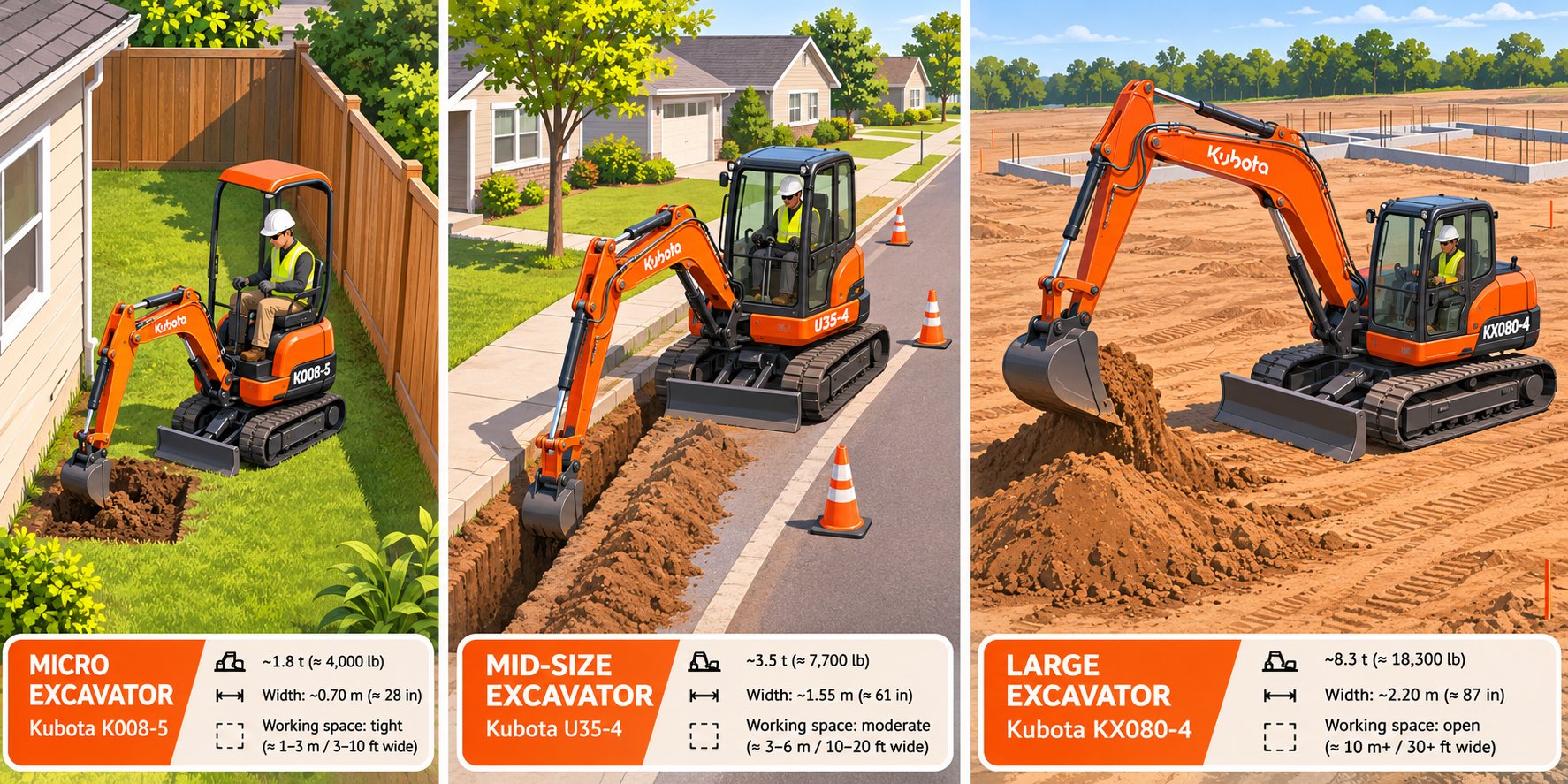
Picking between a KX-Series and a U-Series narrows your options, but it does not answer the question that matters most: how heavy should your machine be? Weight class is where buying decisions either succeed or quietly fail. A machine that is too light for the work bogs down, burns extra hours, and frustrates operators. A machine that is too heavy drains fuel, complicates transport, and tears up ground that did not need tearing. Every dollar you spend — on the purchase, on daily operation, on loading and hauling between sites — ties back to this single choice.
The practical way to approach it? Start with the jobs you actually do, then work backward to the weight class that handles them without waste.
Micro and One-Ton Class for Tight Residential Work
Imagine needing to dig a trench through a backyard with a 36-inch gate opening. A full-size excavator is out of the question. Even most 2 ton mini excavator models are too wide. This is where Kubota's micro and one-ton machines — the K008-5 and KX018-4 — earn their place.
At just 28 inches wide and roughly 2,000 pounds, the K008-5 squeezes through standard residential gates with room to spare. Its 5-foot-8-inch dig depth handles tasks that would otherwise require hours of hand digging:
- Planting large trees and balled root stock
- Trenching for irrigation lines and low-voltage landscape lighting
- Post-hole digging for deck footings and fence lines
- Small drainage corrections along foundation walls
The KX018-4 steps up to roughly 3,700 pounds and 15.5 HP, pushing dig depth to nearly 8 feet. That extra reach opens up deeper irrigation runs and residential water line connections without jumping to a significantly larger — and harder to transport — machine. For homeowners tackling a single major project or landscapers running quick residential jobs, these micro-class kubota mini excavators deliver surprisingly capable performance relative to their size. Think of them less as downsized excavators and more as motorized precision tools that replace shovels, not bulldozers.
Transport is another advantage. Machines this light ride comfortably on a single-axle utility trailer towed behind a pickup truck. No CDL required. No oversized load permits. No scheduling a flatbed delivery two days in advance. That mobility translates directly into more billable hours per week.
Two to Four-Ton Class for Landscaping and Utility Projects
This is the volume sweet spot — the weight range where most contractors looking for a kubota mini excavator for sale will land. Models like the KX030-4, KX033-4, KX040-5, U27-4, and U35-4 occupy the two-to-four-ton bracket, and they handle the broadest spectrum of everyday commercial and residential tasks.
Why? Because this class balances three things simultaneously: enough dig depth for most utility and landscaping work (typically 9 to 11 feet), enough operating weight for stability and breakout force, and a footprint that still fits on a standard equipment trailer. If you research the kubota kx121 3 weight — a popular legacy model in this range — you will find it sits right around 5,700 pounds, illustrating how Kubota has consistently designed mid-range machines to stay transport-friendly while delivering real productivity.
Here is how common job types map to this weight class:
- Residential landscaping: Grading yards, building retaining walls, excavating for patios and walkways — 2 to 3 ton models handle these efficiently
- Utility and plumbing trenching: Water lines, sewer connections, electrical conduit, and fiber optic runs — 3 to 4 ton models provide the depth and bucket force needed for consistent trenching in mixed soils
- Small commercial demolition: Interior concrete removal, small structure teardowns, and site clearing — the KX040-5 at nearly 39 HP delivers enough breakout force for light demo work
- Farm drainage: French drains, culvert installation, and waterway grading across agricultural properties — mid-range models cover the dig depth while keeping ground pressure manageable
- Road shoulder work: Ditch cleaning, culvert replacement, and shoulder grading for rural road maintenance — a 3.5 to 4 ton machine offers the reach and stability for this work without requiring a full road closure
For contractors who handle a variety of these tasks week to week, a machine in this bracket — sometimes referred to as a mini excavadora in Spanish-language markets — is the most versatile single investment. It avoids the narrow specialization of a micro-class unit while sidestepping the higher fuel and transport costs of a larger machine.
Five-Ton and Above for Commercial Applications
When dig depth exceeds 12 feet, when breakout force needs to muscle through compacted clay or fractured rock, or when daily cycle counts demand sustained hydraulic power, you are in five-ton-and-above territory. Kubota's KX057-5, U55-5, and KX080-5 live here.
The KX057-5 at 12 feet 9 inches of dig depth and 46.4 HP handles deep foundation work, heavy utility corridors, and commercial grading where a four-ton machine would spend all day struggling. The KX080-5, pushing 66.6 HP and over 15 feet of dig depth, enters the realm of large mini excavators — machines that compete with small standard excavators in raw performance while still offering the blade attachment and compact transport advantages that define the mini excavator category.
Typical applications at this level include:
- Commercial building demolition and site clearing
- Deep sewer and storm drain excavation
- Heavy grading for parking lots, retention ponds, and commercial pads
- Road construction and deep ditch work
- Loading trucks with excavated material at sustained production rates
The trade-off is cost — in every direction. Machines in this class burn more fuel per hour, require heavier trailers (often necessitating a CDL and tandem-axle equipment hauler), and carry higher purchase prices. An oversized excavator sitting idle on a residential landscaping job is burning money on diesel, insurance, and depreciation that a properly sized three-ton machine would avoid entirely.
The single best piece of advice for anyone browsing a kubota excavator for sale listing? Match the machine to the heaviest task you perform regularly — not occasionally. If 80% of your work falls in the two-to-four-ton sweet spot and you hit a deep excavation job twice a year, renting a larger unit for those outlier projects is almost always cheaper than owning one that sits underutilized the rest of the time.
Weight class determines what your machine can do. But there is another design variable — tail swing — that determines where it can do it. Understanding that distinction before you buy prevents costly surprises the first time your operator tries to rotate in a space that does not forgive overhang.
Tail Swing Types Explained and Why They Shape Your Decision
Picture this: your operator swings the boom to dump a bucket load into a wheelbarrow, and the back of the machine clips a brick retaining wall. That single rotation just created a repair bill, a frustrated client, and a delay that ripples through the rest of the week. The culprit is not operator error — it is the wrong tail swing configuration for the space. Tail swing is one of the most overlooked buying factors when shopping for a kubota mini excavator for sale, yet it directly controls where your machine can safely work.
Conventional Tail Swing and When It Works Best
A conventional tail swing excavator has an upper house — the cab, engine compartment, and counterweight assembly — that extends beyond the width of the tracks when the machine rotates. You will notice this overhang most clearly when the operator swings 90 degrees to the side: the rear counterweight arcs outward, sometimes by several inches or more past the track edge.
Why would engineers design it this way? The overhang is not a flaw — it is a deliberate performance advantage. A wider housing creates room for a larger engine bay, heavier counterweight, and more robust hydraulic components. That extra mass behind the cab acts as a balancing lever against the loaded bucket on the opposite end, boosting both lift capacity and dig stability. As Kubota's product manager Patrick Baker explained to Compact Equipment, "conventional tail swing models will lift more than a reduced or zero tail swing model" and "normally offer the greatest productivity and output."
Kubota's entire KX-Series — from the compact K008-5 up through the powerful KX080-5 — uses conventional tail swing. The popular kubota 40 excavator, the KX040-5, is a textbook example: its conventional design delivers nearly 39 HP and serious breakout force that contractors rely on for daily utility trenching and foundation work. If your jobsites consistently offer open clearance — think new subdivision grading, rural land clearing, or commercial pad preparation — conventional tail swing gives you maximum digging performance per dollar spent.
Conventional machines also handle heavy attachments more confidently. Grapples, hydraulic breakers, and rotators all generate dynamic forces that test machine stability. The extended counterweight absorbs those forces more effectively, which is why operators running attachments on slopes or uneven terrain tend to prefer this configuration. Even buyers cross-shopping a kubota wheel loader for material handling often discover that a conventional tail swing excavator with the right bucket handles similar tasks with greater dig versatility.
Zero and Minimal Tail Swing for Confined Spaces
Zero tail swing flips the design priority. Instead of maximizing counterweight and engine space, engineers package everything — engine, hydraulics, counterweight — inside a housing that stays entirely within the track width at every point of rotation. Swing the cab 360 degrees, and nothing extends past the tracks. Minimal tail swing (sometimes called reduced or tight tail swing) allows a slight overhang of just a few inches, splitting the difference between zero and conventional designs.
Kubota's U-Series is built around this concept. The U-Series product page describes it as providing "peace of mind when close-quarters working conditions require minimal rear swing clearance with no room for error." Models like the U27-4 and U35-4 feature minimal tail swing, while the U17-5 achieves true zero tail swing — the housing never crosses the track boundary, period.
When does this matter? Every time your operator works alongside a building foundation, rotates near a fence line, trenches next to a busy traffic lane, or digs between parked vehicles on a congested urban site. A Gregory Poole analysis puts it plainly: zero tail swing machines let you "position the machine tight against a fence line or property boundary and still swing the boom through a full rotation without repositioning." That eliminates constant shuffling, reduces the risk of property damage claims, and keeps the operator focused on digging instead of clearance management.
The trade-off? You sacrifice some raw performance. A tighter housing means a lighter counterweight and less room for engine components, which reduces lift capacity and can slightly limit breakout force at maximum reach. Zero tail swing models also tend to carry a price premium — the engineering required to package everything into a smaller envelope costs more to manufacture.
Here is how the two configurations compare across the factors that matter most on a real jobsite:
| Factor | Conventional Tail Swing (KX-Series) | Zero / Minimal Tail Swing (U-Series) |
|---|---|---|
| Jobsite Clearance Needed | Requires clearance beyond track width for safe rotation | Operates safely within track footprint or with minimal overhang |
| Relative Dig Performance | Higher breakout force and faster cycle times | Slightly reduced breakout force at comparable weight class |
| Relative Lift Capacity | Greater lift capacity, especially over-the-side lifts | Reduced lift capacity due to lighter counterweight |
| Attachment Stability | Better stability with heavy attachments like breakers and grapples | Adequate for most attachments when properly matched to model |
| Cost Premium | Generally lower purchase price at equivalent weight class | Higher purchase price due to compact engineering |
| Transport Width | May be wider overall; check trailer clearance | Typically narrower, easier to trailer through tight access routes |
| Best-Fit Scenarios | Open lots, rural land, commercial grading, heavy demo | Urban sites, fenced yards, roadside utility work, near structures |
A practical example brings this into focus. Suppose you are comparing the kubota kx040 price against the U48-5 — two machines in a similar weight class with nearly identical engine horsepower. The KX040-5 will outdig and outlift the U48-5 on an open commercial pad. But position both machines in a narrow alley between two commercial buildings, and the U48-5 works confidently while the KX040-5 risks swinging its counterweight into a wall on every rotation. The right choice depends entirely on where the machine spends most of its hours.
For buyers who split time between open and confined sites, Kubota's approach of offering parallel lineups — a kubota small excavator in both KX and U configurations at most weight classes — means you do not have to compromise. Some fleet operators even run one of each: a KX-Series unit for open production work and a U-Series machine dedicated to tight-access jobs. That flexibility is a major reason the brand holds its market position.
Tail swing determines where your machine fits. Weight class determines what it can handle. Together, they define the envelope of work you can take on profitably. The next question most buyers face is equally consequential but far less technical: should you buy that machine new or used, and what should you look for either way?
Buying New vs Used Kubota Mini Excavators and What to Inspect
You have settled on a weight class and a tail swing configuration. The machine you need exists — now the question is whether you should buy it with zero hours on the meter or a few thousand. This decision shapes your cash flow, your warranty coverage, and your risk exposure for the next several years. Both paths make financial sense under the right circumstances, but choosing the wrong one costs real money.
When Buying a New Kubota Mini Excavator Makes Sense
If your small excavator runs five or six days a week and generates direct revenue on every shift, buying new stacks the odds in your favor. Here is why:
- Full manufacturer warranty: New Kubota excavators ship with a comprehensive warranty that covers major components during the critical early ownership period. That protection eliminates the financial surprise of a failed hydraulic pump or an engine issue in month three.
- Latest technology features: Current-generation models include upgraded telematics, improved cab ergonomics, enhanced auxiliary hydraulic flow rates, and tighter emissions compliance. These are not luxury items — they reduce operator fatigue, improve fuel efficiency, and keep you compliant on regulated jobsites.
- Promotional financing: Kubota regularly offers aggressive terms through Kubota Credit Corporation. Their current promotion features $0 down and 0% APR financing for up to 60 months on new KX and U-Series equipment from participating dealers' in-stock inventory. At 60 monthly payments of just $16.67 per $1,000 financed, a new machine becomes surprisingly accessible for buyers with strong credit. These offers do expire — verify current terms with your dealer before committing.
- Guaranteed zero-hour machine: No guessing about previous operator habits, hidden abuse, or deferred maintenance. Everything is fresh, documented, and under your control from day one.
For contractors who ask how much is a mini excavator going to cost them in total ownership — not just sticker price — a new unit financed at 0% often beats a used purchase financed at 7-9% through a third-party lender once you factor in interest charges and early repair risk.
When a Used Kubota Is the Smarter Investment
Not every buyer needs a zero-hour machine. Seasonal operators who run equipment four or five months per year, startups watching every dollar of initial overhead, and fleet owners adding a second or third unit for overflow work all benefit from the significantly lower entry cost of a used Kubota.
The depreciation math favors used buyers heavily. Most compact equipment loses the steepest portion of its value in the first two to three years, meaning a buyer picking up a three-year-old machine with 1,500 hours avoids that initial depreciation cliff while still getting thousands of productive hours ahead. Kubota's diesel engines are engineered for longevity — top-tier brands like Kubota typically deliver 9,000 to 12,000 hours of engine life with proper maintenance — so a well-cared-for used unit still has the vast majority of its working life remaining.
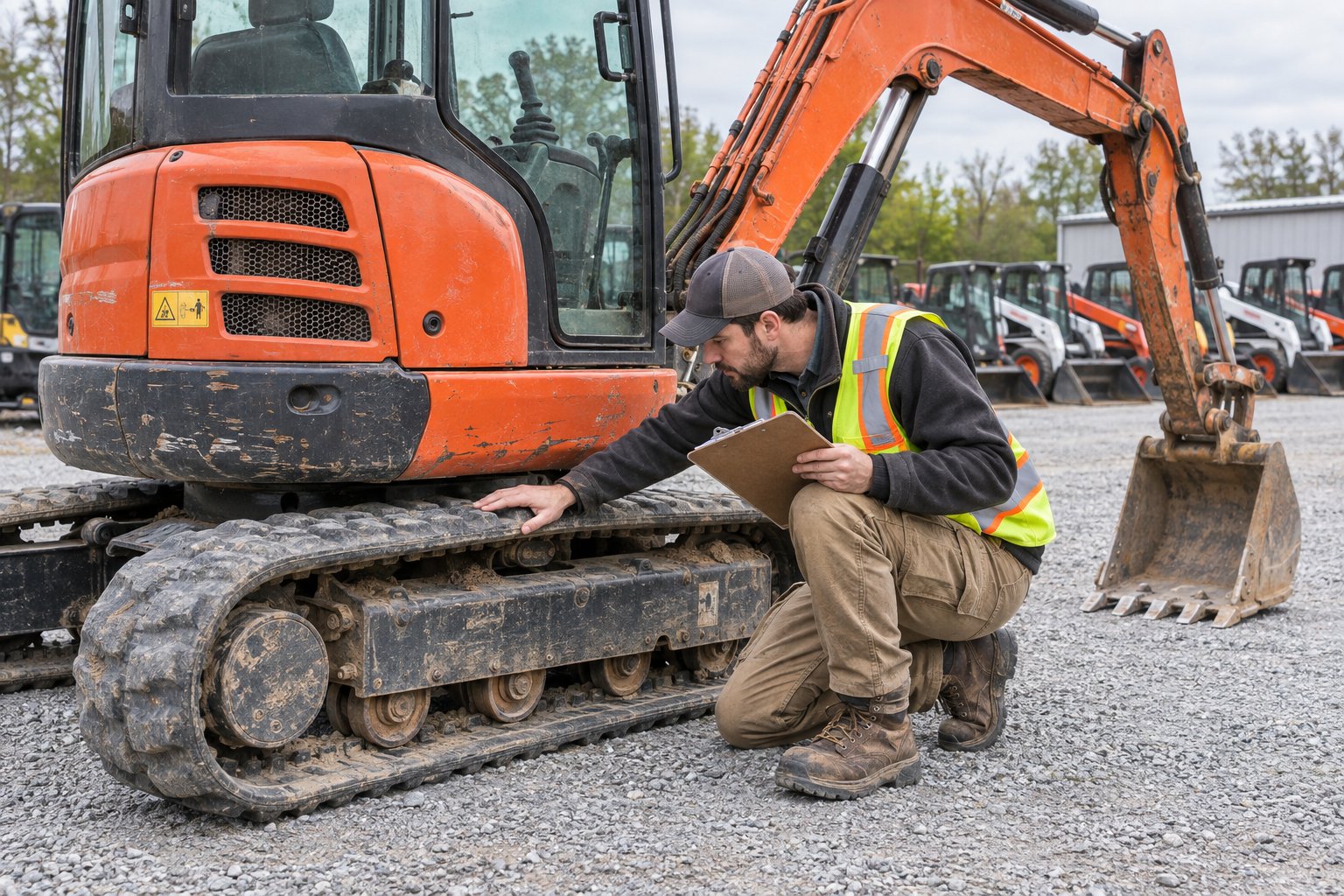
The catch? A used machine is only a deal if the previous owner did not defer critical maintenance or hide damage beneath fresh paint. That is where a disciplined inspection process separates smart purchases from expensive regrets. Based on industry best practices from experienced equipment evaluators, here is the prioritized checklist you should follow before any money changes hands:
- Verify the serial number and configuration — match the serial plate to the paperwork, and confirm the model, year, stick length, coupler type, and included attachments. Mismatches signal potential title issues or undisclosed component swaps.
- Check the hour meter against visible wear — a machine listed as "low hours" should have pedals, joystick grips, and a seat that reflect limited use. Worn controls on a supposedly 800-hour unit suggest the meter has been tampered with or replaced. OEM telematics systems can help confirm actual hours on newer models.
- Request service history and maintenance records — oil changes, filter replacements, greasing logs, and major repairs should be documented and dated. Oil analysis reports are especially valuable. Gaps in records on a high-hour machine warrant deeper investigation.
- Perform a cold-start inspection — arrive before the seller has warmed up the engine. Hard starting, excessive cranking, heavy smoke, or unusual knocking during a cold start can reveal engine problems that disappear once the machine is warm.
- Inspect the hydraulic system thoroughly — check every hose, fitting, and cylinder rod for wet spots, scoring, or dents. Slow or weak hydraulic action during operation often points to pump or valve wear that can cost thousands to repair.
- Evaluate undercarriage condition — examine track tension, sprocket teeth for pointed or worn profiles, roller and idler condition, and track link tightness. The undercarriage accounts for up to 50% of total maintenance costs on a tracked machine, making this the single most expensive area to overlook.
- Examine boom, stick, and structural welds — look for cracks, fresh grinding marks, or new welds around the boom foot, boom nose, stick tip, and cylinder mount points. Fresh paint in isolated areas can conceal structural repairs.
- Check pins, bushings, and linkage play — cycle the bucket and stick while listening for clunking or watching for sloppy movement at the joints. Worn pins and bushings degrade digging precision and eventually compromise safety.
- Test the swing bearing and swing motor — rotate the upper structure a full 360 degrees and listen for rattling, grinding, or uneven resistance. Check for play between the turntable and undercarriage frame.
- Run a full operational test — with hydraulics warmed up, cycle every function: boom, stick, bucket, swing, and travel in both directions. Watch for drift, overheating, or power loss when operating multiple functions simultaneously.
If you are not confident performing this inspection yourself, hiring an independent technician for a pre-purchase evaluation is one of the smartest investments you can make on a machine of this value.
Buyers searching for kubota excavators for sale in the used market have several sourcing options. Authorized dealers often carry certified pre-owned inventory with some level of inspection already completed. Online equipment marketplaces aggregate listings from sellers nationwide. Specialty platforms focusing on specific brands can streamline the search — for example, JIUHONG's used Kubota excavator collection features U-Series and KX-Series options where buyers can compare machine conditions and request quotes based on specific model needs. Regardless of the channel, every used machine deserves the same inspection discipline before you commit.
Understanding How Hours Affect Value
Engine hours on a mini excavator function like mileage on a truck — they are the single most referenced indicator of remaining useful life, and they directly influence resale pricing. But hours alone do not tell the full story.
A Kubota mini excavator with under 2,000 hours represents the most desirable used purchase window. Machines in this range retain maximum resale value and offer an estimated 5,000 to 8,000 hours of remaining productive life with consistent maintenance. The 2,000-to-5,000-hour range is considered the prime operating period where major components show minimal wear and repair costs stay low. Beyond 5,000 hours, buyers should expect increased attention to undercarriage components, hydraulic seals, and routine wear items — though the machine remains highly productive with proper upkeep.
Kubota diesel engines sit in the top tier for longevity, with expected lifespans of 9,000 to 12,000 hours. Some well-maintained units push past that mark. This durability is a key reason Kubota holds its resale position — a buyer searching for a used 5 ton excavator or even a kubota kx080 for sale knows the engine platform has a proven track record that many competing brands cannot match.
One critical nuance: compare hours to the machine's age. A five-year-old excavator showing 1,200 hours likely sat idle for extended periods, which raises questions about storage conditions, stale fluids, and dried seals. Conversely, a three-year-old machine with 4,000 hours was working steadily — and if the maintenance records support that usage pattern, the higher-hour unit may actually be the healthier purchase. Hours matter, but context matters more.
For buyers running kubota skid steers alongside their excavator fleet, the same hour-based valuation logic applies across Kubota's compact equipment range. The brand's reputation for durability holds consistent whether you are evaluating a small excavator, a skid steer, or a compact loader — and that consistency is exactly what makes the used market for Kubota equipment so active.
Knowing whether to buy new or used — and what to inspect if you go used — puts you in a strong negotiating position. But the price on the listing is only the starting point. What actually determines the final number you pay involves a set of cost factors that most buyers do not fully account for until they are already at the dealer's desk.
Kubota Mini Excavator Pricing and the Factors That Affect Cost
Every listing for a kubota mini excavator for sale shows a number. That number is a starting point, not a destination. The gap between the advertised price and what you actually pay to put a machine to work can be significant — and the buyers who understand what creates that gap walk into negotiations with a serious advantage over those who fixate on sticker price alone.
What Drives Kubota Mini Excavator Pricing
Kubota's published MSRP figures on the KX-Series product page represent base configurations — essentially a stripped machine with a canopy, standard bucket, and rubber tracks. The moment you start configuring a compact excavator to match real-world jobsite demands, the price moves. Here are the factors that push it:
- Cab vs. canopy: An enclosed cab with climate control, reduced noise levels, and better operator visibility adds several thousand dollars over a basic ROPS canopy. For operators working year-round or in extreme weather, the productivity gains and reduced fatigue justify the premium. For seasonal or warm-climate buyers, a canopy keeps the initial cost lower.
- Hydraulic coupler type: A manual pin-on bucket connection costs nothing extra. A hydraulic quick-coupler system — which lets operators swap attachments from the cab in under a minute — adds to the purchase price but saves meaningful time across hundreds of attachment changes per year.
- Thumb attachment package: A factory-installed hydraulic thumb for grappling debris, rocks, and brush is one of the most requested add-ons. It increases purchase cost but dramatically expands what the machine can handle without a second piece of equipment on site.
- Blade options: A standard backfill blade comes on most models. Upgrading to a six-way angle blade for grading and sloping work increases the price, but contractors doing finish grading often consider it essential.
- Rubber vs. steel tracks: Rubber tracks are standard and work well on finished surfaces, lawns, and pavement. Steel tracks with or without rubber pads suit rocky terrain and demolition sites. Track choice affects both price and long-term replacement costs.
- Dealer markup and regional pricing: Kubota machines sell through independent dealers, and pricing varies by market. A dealer in Texas — the largest state market for new mini excavator sales — may price differently than a dealer in a lower-volume rural region due to competition density, inventory levels, and local demand.
Treat the base MSRP as a floor, not a ceiling. A fully configured machine with a cab, quick-coupler, thumb, and angle blade can cost 20-30% more than the bare-bones starting price, and those additions often determine whether the machine actually performs the way you need it to on day one.
General Price Ranges by Weight Class
Exact pricing shifts with dealer promotions, regional markets, and configuration choices, but the general landscape for new compact excavators follows a predictable pattern by weight class. Industry data from Construction Equipment provides useful context: new machines can range from under $10,000 at the smallest micro end to over $140,000 for the largest and most fully equipped models. The popular 3-to-4-metric-ton class — where the KX040-5 and similar models sit — spans roughly $35,000 to $80,000 depending on options.
For buyers exploring compact excavators for sale, here is how the tiers generally stack up:
| Weight Class | Example Kubota Models | New Price Context | Market Position |
|---|---|---|---|
| Micro (under 2 tons) | K008-5, KX018-4 | Most affordable entry point | Homeowners, light residential, rental fleets |
| Light (2-3 tons) | KX030-4, U27-4 | Lower-mid range | Landscapers, small utility contractors |
| Mid-range (3-4 tons) | KX033-4, KX040-5, U35-4 | Volume sweet spot ($35K-$80K new) | Professional contractors, highest demand segment |
| Heavy-mid (4.5-5.5 tons) | KX057-5, U48-5, U55-5 | Upper-mid range | Commercial contractors, deep utility work |
| Large (8+ tons) | KX080-5 | Premium pricing | Heavy commercial, demolition, road work |
The kx057-5, for instance, sits in that heavy-mid tier where buyers get substantially more dig depth and breakout force than a four-ton model, but the price reflects the jump in capability. Understanding the kx057 5 weight — roughly 12,300 pounds — helps explain why: more steel, a larger engine, and heavier hydraulic components all cost more to manufacture and ship.
The sticker price is only part of what you will actually spend. Transport to your location, essential attachments like a thumb or trenching bucket, initial service setup, and dealer prep fees can add $3,000 to $8,000 or more to your total out-the-door cost — budget for the full picture from the start.
Buyers who compare only base prices across models often make the mistake of choosing a cheaper unit and then spending more on after-purchase essentials than they saved. A machine advertised at a lower price but lacking a quick-coupler, thumb, and proper blade configuration may end up costing more than a well-equipped competitor once you add those items separately.
Used Market Pricing Factors
Used pricing follows a different set of rules entirely. If you are browsing listings for a mini backhoe for sale or a used compact excavator, five variables drive the number you will see — and the number you should actually be willing to pay:
- Engine hours: The single most visible metric. EquipmentWatch market data shows average used mini excavator prices fluctuating in the $46,000 to $47,000 range, with average machine age sitting around 5 to 6 years. Lower-hour machines within that age bracket command the top end of the range; higher-hour units trade at a discount.
- Machine age and model generation: A current-generation KX040-5 with 1,500 hours holds its value far better than an older KX040-4 with the same hours, because the newer model carries updated hydraulics, improved cab design, and better fuel efficiency.
- Overall condition: Undercarriage wear, hydraulic health, structural integrity, and cosmetic appearance all factor in. A machine with fresh tracks and clean cylinders justifies a higher asking price than one showing deferred maintenance.
- Included attachments: A used excavator sold with a hydraulic thumb, multiple bucket sizes, and a quick-coupler represents more value than a bare machine — sometimes thousands of dollars more, since buying those attachments separately at retail prices adds up fast.
- Geographic market: Demand varies regionally. Texas, Florida, and North Carolina consistently rank as the highest-volume markets for both new and used mini excavator sales, which can mean tighter inventory and firmer pricing in those states. Buyers willing to search adjacent regions or ship from lower-demand areas sometimes find better deals.
Kubota machines tend to hold their resale value better than many competing brands — and it is not just brand loyalty driving that premium. Kubota's extensive North American dealer network means parts are readily available, service technicians are familiar with the platform, and the next buyer down the line faces the same low ownership risk. That parts availability and service infrastructure create a floor under resale pricing that lesser-known brands in the excavadora market simply cannot match.
Seasonal timing matters too. Used mini excavator prices typically soften in the fourth quarter when construction activity slows in many regions, then firm up in the first quarter ahead of spring building season. A buyer who plans ahead and purchases during the slower months can capture meaningful savings on the same machine that would cost more four months later.
Price tells you what a machine costs to acquire. But acquisition is a single event — what the machine costs to own, maintain, and eventually sell back into the market determines whether it was truly a smart investment. Those ongoing financial realities deserve the same scrutiny as the purchase price itself.
Attachments That Multiply Your Kubota Excavator's Value
A Kubota mini excavator without the right attachments is like a cordless drill without bits — the platform is capable, but the real work depends on what you connect to the end of the arm. Many buyers focus exclusively on the base machine and treat attachments as something to figure out later. That approach almost always leads to budget surprises and jobsite compromises. The smarter move? Decide which attachments you need before you finalize the model, because compatibility between machine and tool is not guaranteed across the lineup.
Must-Have Attachments for Common Jobs
Kubota excavators earn their versatility through a robust aftermarket attachment ecosystem. Whether you are clearing a demolition site or setting fence posts on a rural property, the right tool turns a half-day struggle into a two-hour task. Here are the attachments that deliver the highest return for most buyers:
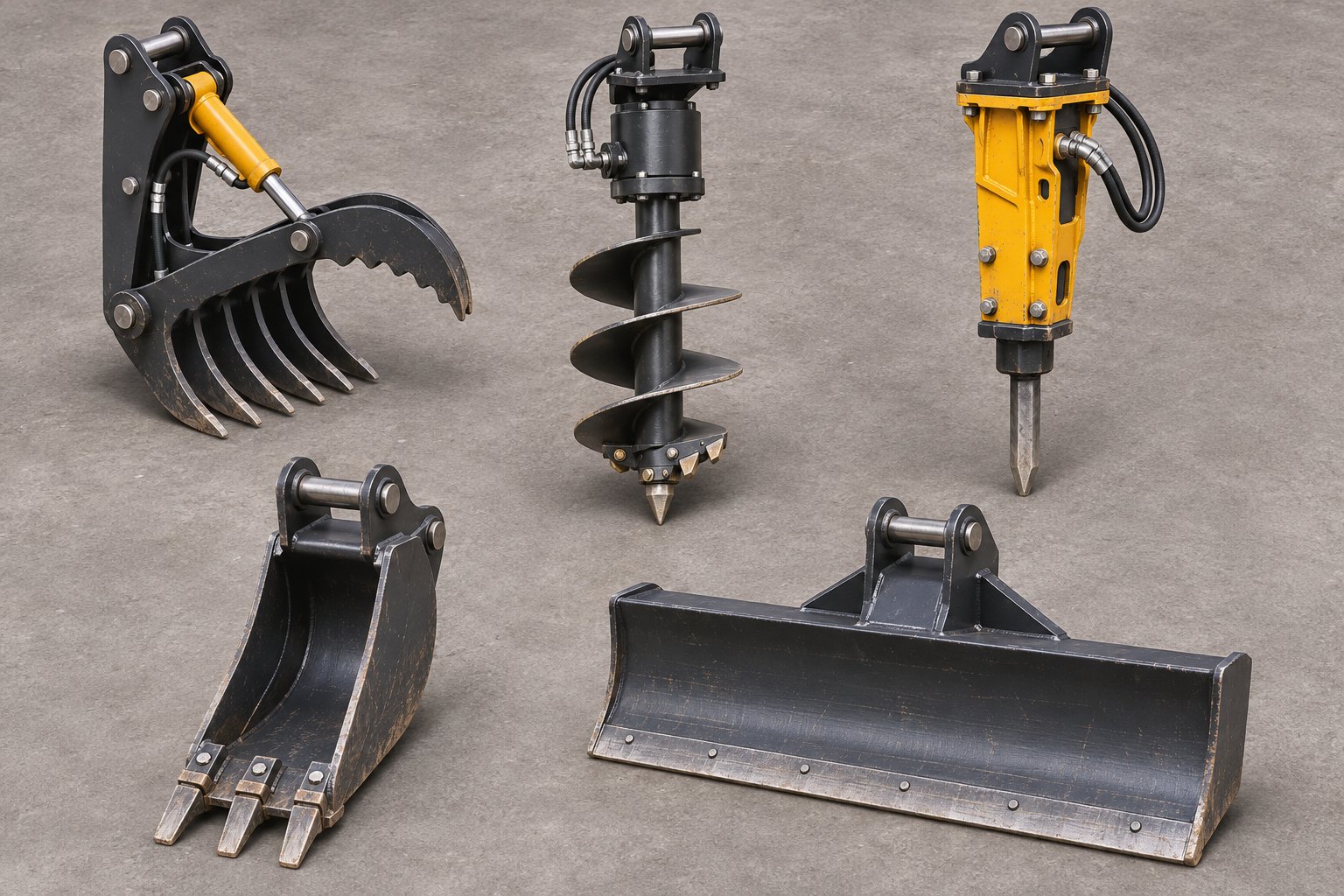
- Hydraulic thumb: Clamps against the bucket to grapple irregular objects — rocks, stumps, demolition debris, and brush piles — that a bucket alone cannot hold. Essential for cleanup, material sorting, and loading trucks with loose material.
- Auger: Drills uniform, vertical holes for fence posts, deck footings, tree planting, and sign installation. Dramatically faster and more precise than digging by hand or attempting to shape holes with a bucket.
- Hydraulic breaker: Delivers percussive force for demolishing concrete slabs, breaking boulders, and removing old foundations. A critical attachment for renovation work, road repair, and any site with hardened material that a bucket cannot penetrate.
- Trenching bucket: Narrower than a standard digging bucket, purpose-built for clean-walled trenches that accommodate utility lines, plumbing pipes, electrical conduit, and drainage tile. The go-to tool for any linear excavation.
- Grading blade: Mounted at the rear of the undercarriage, used to backfill trenches, level surfaces, and stabilize the machine during digging. An upgraded six-way angle blade — like the option available on the 2025 KX040-5R3TP configuration — adds sloping capability for finish grading work.
Each of these tools can pay for itself within a handful of jobs. The key is knowing which ones your work actually demands and budgeting for them upfront rather than discovering the need mid-project.
How Attachment Compatibility Should Influence Your Model Choice
Here is where many buyers get caught off guard: not every attachment fits every Kubota model. Three technical factors determine whether a given tool will work on your machine.
First, hydraulic flow rate. Powered attachments like breakers and augers require a minimum gallons-per-minute (GPM) output from the excavator's auxiliary hydraulic circuit to function properly. A breaker designed for 15-35 GPM will perform sluggishly — or not at all — on a micro-class machine delivering only 5-7 GPM. Buyers shopping for a kubota kx057 for sale, for example, benefit from the KX057-5's higher auxiliary flow, which comfortably drives larger breakers and high-torque auger heads. Understanding the kubota kx057 weight class and its corresponding hydraulic output helps ensure every powered attachment in your toolkit runs at full performance.
Second, pin size and bucket linkage dimensions. Attachments connect to the stick via two pins, and the pin diameter and center-to-center distance must match exactly. A thumb built for a four-ton machine will not bolt onto a two-ton stick without adapter plates — and improvised adapters compromise safety and void warranties.
Third, coupler type. If your machine uses a hydraulic quick-coupler, every attachment needs compatible lug geometry. As industry coupler specialists emphasize, the smartest approach is specifying the coupler and the full attachment lineup to a common interface at the same time, so every tool's lug geometry is guaranteed to fit before anything ships. Quick-coupler systems add upfront cost but repay it rapidly — changeovers drop from 20-45 minutes of manual pin-swapping to roughly 15-30 seconds from the cab, which translates into recovered billable hours on every multi-task jobsite.
The bottom line for anyone browsing kubota excavators with purchase plans? Add attachment costs to your total budget from the beginning. A machine priced attractively but incompatible with the breaker or auger you need is no bargain. Treat the excavator and its attachment package as a single investment — because on the jobsite, that is exactly how they perform.
Financing Options and What Kubota Ownership Really Costs
The purchase price and attachment budget give you the upfront number. But a kubota mini excavator for sale is not a one-time transaction — it is the beginning of a financial relationship that includes monthly payments, routine service, fuel, and eventually a resale event that either rewards or punishes how you managed every step in between. Buyers who evaluate only the sticker price are solving half the equation. The other half — financing terms, maintenance overhead, and residual value — determines whether the machine makes you money or quietly drains it over its working life.
Financing Programs and What Buyers Should Compare
Most buyers do not write a check for the full amount. Financing spreads the cost across months or years, but the structure of that financing can mean thousands of dollars in difference over the life of the loan. Four primary paths exist, and each one suits a different buyer profile.
Kubota Credit Corporation (KCC) manufacturer financing is the most visible option. Kubota regularly runs promotional programs through participating dealers — their current special offers page has featured terms like $0 down and 0% APR for up to 60 months on new construction equipment. These promotions cycle periodically, so verifying current availability with your local dealer before committing is essential. Outside of promotional windows, KCC's standard installment rates for new Kubota tractors and construction equipment run 6.49% APR for terms up to 48 months and 6.99% APR for 60-month terms, with standard down payments of 25% to 35% depending on payment frequency. Those rates are competitive for compact construction equipment, but they are not zero — the promotional periods are where the real savings live.
Dealer-arranged financing works through the dealership's relationships with regional banks and lending partners. Some dealers can match or beat KCC rates for buyers with strong credit, especially on used inventory that does not qualify for manufacturer promotions. The advantage here is flexibility — dealers often have access to multiple lenders and can shop your application across them.
Agricultural lenders like AgDirect serve buyers who operate in farming, ranching, or rural land management. These lenders understand equipment-secured loans, offer competitive terms for agricultural borrowers, and may provide seasonal payment structures that align with cash flow cycles — a feature standard lenders rarely offer. If your Kubota will spend its hours on farm drainage, land clearing, or rural property maintenance alongside a kubota utility tractor or kubota backhoe, an agricultural lender may structure terms that fit your income pattern better than a conventional loan.
General equipment loans through banks and credit unions round out the options. These work like any secured commercial loan — the machine serves as collateral, and terms typically range from 36 to 72 months. Interest rates vary widely based on credit profile, down payment, and the lender's familiarity with equipment valuation.
Regardless of which path you choose, compare these four variables before signing anything:
| Factor | What to Look For | Why It Matters |
|---|---|---|
| APR (Annual Percentage Rate) | Lowest available rate; watch for introductory vs. standard rates | Even a 2% difference on a $50,000 machine adds thousands over a 60-month term |
| Loan Term Length | Match to your expected ownership period — avoid paying on a machine you plan to sell | Longer terms lower monthly payments but increase total interest paid |
| Down Payment Requirement | KCC standard is 25-35%; promotional offers may waive this | A larger down payment reduces principal and total interest, but ties up working capital |
| Early Payoff Penalties | Confirm whether prepayment is allowed without fees | If a strong season generates extra cash, you want the option to pay ahead without penalty |
One detail many buyers overlook: KCC requires all financed equipment to be covered by insurance against physical damage and theft for the entire loan term. Kubota even offers an endorsed property damage insurance program through KTAC to simplify this requirement. Factor that insurance premium into your monthly ownership cost from the start — it is not optional when financing through KCC.
Maintenance Costs and Parts Availability
Financing gets the machine on your trailer. Maintenance keeps it earning. The good news for Kubota owners is that routine service on these machines is straightforward, well-documented, and supported by a parts network that most competing brands cannot match.
Kubota publishes detailed maintenance schedules covering both checkpoint inspections and lubricant intervals for every model in the lineup. The core routine items you should budget for include:
- Engine oil and filter changes: Typically every 250 to 500 hours depending on operating conditions. This is the single most important maintenance task — skipping oil changes on a diesel engine accelerates internal wear faster than almost any other form of neglect.
- Hydraulic fluid and filter service: Intervals vary by model, but hydraulic fluid changes generally fall in the 1,000 to 2,000 hour range. Contaminated hydraulic fluid degrades pump efficiency, damages valve spools, and scores cylinder walls — all expensive repairs that clean fluid prevents.
- Track tension checks: Rubber tracks stretch over time. Running tracks too loose accelerates wear on sprockets and rollers; too tight increases drive motor strain. A quick visual and manual check every 50 to 100 hours keeps tension in the correct range.
- Greasing points: Boom, stick, bucket, and swing bearing pins all require regular greasing — often daily on high-use machines. Dry pins wear bushings rapidly, and bushing replacement is far more expensive and time-consuming than a five-minute grease routine.
- Air filter and fuel filter service: Dusty jobsites clog air filters faster than clean environments. Fuel filters protect injectors from contaminants. Both are inexpensive to replace on schedule and extremely costly to ignore.
What gives Kubota a structural advantage in maintenance costs is dealer density. With over 1,100 authorized dealerships across North America — from major metro areas to regional markets like Kubota of Chattanooga and similar local operations — sourcing filters, seals, hoses, and wear parts rarely means waiting days for a shipment. Many common service items are available same-day or next-day from a dealer within reasonable driving distance. That accessibility matters because a machine sitting idle while you wait for a hydraulic hose costs far more than the hose itself.
Owners who also run kubota tractors and attachments or a kubota loader alongside their excavator benefit from parts commonality across the brand's product lines. Kubota-built engines share filtration components and service intervals across equipment categories, which simplifies inventory management for multi-machine operations.
Resale Value and Total Cost of Ownership
Here is where the full financial picture comes together. Total cost of ownership (TCO) is the real cost of buying, operating, and eventually selling a machine — not just the number on the invoice. The formula is simple in concept but powerful in practice: purchase price, plus financing interest, plus maintenance and fuel costs over your ownership period, minus the resale value you recover when you sell or trade in.
Why does this matter? Because a machine that costs more upfront but holds its value and runs reliably can be dramatically cheaper to own than a bargain-priced alternative that depreciates faster, breaks down more often, and sells for a fraction of its original price.
Consider the KX080-5 — Kubota's largest mini excavator at over 18,000 pounds and 66.6 HP. It carries premium pricing in the kx080 class. But its resale trajectory reflects the same brand-wide strength that makes Kubota compact construction equipment a preferred investment across the industry. Factors that support Kubota's resale position include:
- Brand recognition and buyer demand: Kubota is the world's top-selling mini excavator brand. Used buyers actively seek the nameplate, creating consistent secondary market demand that supports pricing.
- Parts availability: The extensive dealer network means the next owner faces low risk of parts sourcing delays — a factor that directly influences what buyers are willing to pay for a used unit.
- Documented maintenance infrastructure: Kubota's published maintenance schedules and dealer service records create a transparency trail that used buyers value. A machine with a clean service history commands a measurable premium over one with gaps.
- Engine longevity reputation: Kubota diesel engines routinely deliver 9,000 to 12,000 hours of service life, meaning used buyers are purchasing thousands of remaining productive hours — not a machine approaching the end of its useful life.
A Kubota mini excavator that costs more upfront but retains 65-70% of its value after several years of heavy use can be thousands of dollars cheaper to own over its lifecycle than a lesser-known brand purchased at a discount that loses half its value in the same period.
Fuel efficiency plays into TCO as well. Kubota's current-generation diesel engines meet stringent emissions standards while delivering competitive fuel consumption rates for their displacement class. A machine burning less fuel per hour of trenching or grading generates savings that compound across thousands of operating hours — savings that do not show up on the purchase invoice but absolutely show up on the annual profit-and-loss statement.
The practical takeaway? When you are evaluating any listing — whether a brand-new unit on a dealer lot or a used machine on an online marketplace — resist the urge to compare sticker prices in isolation. Run the ownership math: what will you pay in total (purchase plus interest plus maintenance plus fuel), and what will you recover at resale? That net number is the true cost, and it is the number that separates buyers who build wealth through equipment ownership from those who just accumulate depreciation.
Financing, maintenance, and resale value define the economics of owning a Kubota. But knowing the numbers only helps if you can find the right machine through a reliable buying channel — and not every source offers the same level of transparency, support, or after-sale protection.
Where to Find a Kubota Mini Excavator for Sale You Can Trust
You know the weight class, the tail swing configuration, the new-versus-used calculus, the attachment budget, and the true cost of ownership. That framework puts you ahead of most buyers walking onto a dealer lot or scrolling through online listings. The remaining question is deceptively simple: where should you actually look? Not every buying channel offers the same transparency, pricing, or post-purchase support — and the source you choose can influence everything from warranty coverage to how quickly you resolve a problem six months down the road.
Authorized Kubota Dealers and What They Offer
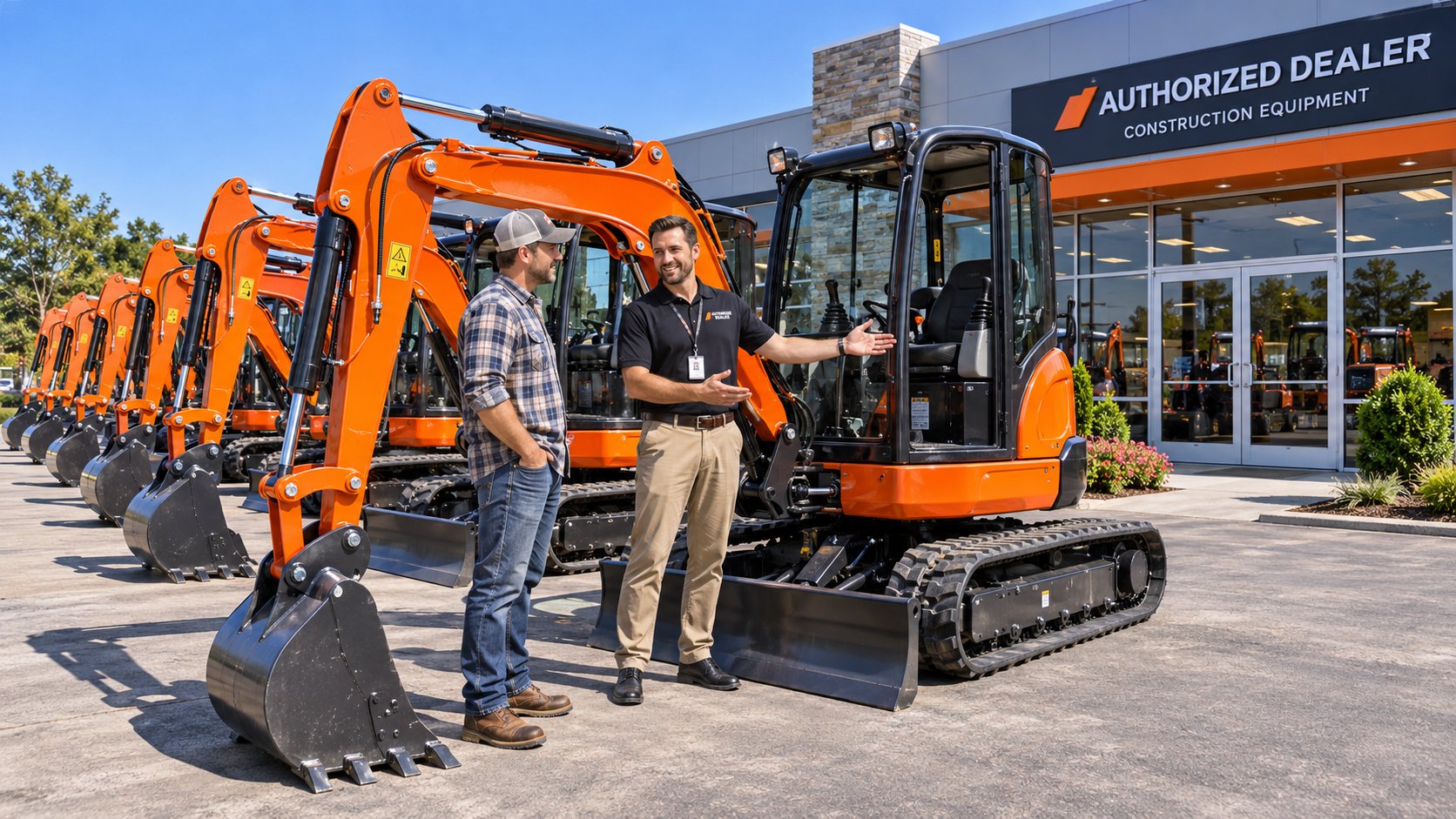
For buyers purchasing new equipment — or those who want the closest thing to a risk-free used purchase — an authorized Kubota dealer remains the gold standard. These dealerships are independently owned but operate under Kubota's franchise requirements, which means they carry genuine parts inventory, employ factory-trained technicians, and facilitate manufacturer financing through Kubota Credit Corporation.
The advantages go beyond the transaction itself. Authorized dealers handle warranty claims directly, offer certified pre-owned programs on select trade-in units, and provide scheduled maintenance services that keep your machine within Kubota's recommended intervals. Some larger dealer groups — regional operations like Johnson City Kubota and Equipment or multi-location networks spanning entire states — also maintain rental fleets, giving buyers the option to rent a specific model before committing to purchase.
Kubota's dealer locator tool maps every authorized location in your area and shows which kubota excavator models each dealer carries. If you are buying new and want access to promotional financing, the dealer network is the only channel where those manufacturer-backed offers apply. The Orange Protection Program — Kubota's extended warranty offering — is also available exclusively through authorized dealers, giving buyers the option to extend both basic and powertrain coverage beyond the original warranty term with no deductible and full transferability to a future owner.
The trade-off? Dealer pricing on used inventory tends to be higher than private-party or auction prices. You are paying for the inspection, reconditioning, and institutional accountability that a dealership provides — and for many buyers, that premium is money well spent. For others operating on tighter margins, the savings available through alternative channels justify the extra due diligence required.
Online Equipment Marketplaces and Specialty Sellers
The used kubota excavator market extends far beyond local dealer lots. Online platforms have fundamentally changed how buyers source compact equipment, making it possible to compare dozens of listings across multiple states in a single afternoon. Each channel has distinct strengths and limitations worth understanding before you commit.
- JIUHONG Machinery — Kubota excavator collection: A specialty platform featuring curated U-Series and KX-Series used Kubota inventory with detailed condition information. Buyers can browse available models, compare machine specifications, and request quotes directly based on the specific model and condition they need. JIUHONG's collection covers various kubota excavator models, though buyers seeking a particular unit like the KX040 should inquire about current availability rather than assuming specific inventory is in stock. The advantage of a brand-focused platform is narrower, higher-quality search results compared to general marketplaces that bury Kubota listings among hundreds of unrelated machines.
Pros
- Brand-specific inventory reduces search noise
- Direct quote requests streamline negotiation
- Condition details provided upfront
Cons
- Inventory varies — specific models may require an availability inquiry
- International shipping logistics may apply depending on buyer location
- Equipment Trader: One of the largest general equipment marketplaces in North America, aggregating dealer and private-party listings with robust filtering by model, year, hours, and location. Active Kubota mini excavator listings typically number in the hundreds at any given time.
Pros
- Massive listing volume and geographic coverage
- Side-by-side comparison tools
- Mix of dealer and private-party options
Cons
- Listing quality varies — some lack detailed photos or hour verification
- No platform-level inspection guarantee
- Machinery Pete: Focuses on auction results and dealer inventory with a strong data layer showing historical sale prices. Useful for buyers who want to validate whether an asking price aligns with recent market transactions.
Pros
- Auction price history provides market context
- Trusted among experienced equipment buyers
Cons
- Auction purchases often carry no warranty or return option
- Competitive bidding can push prices above private-sale levels
- Private-party sales (Craigslist, Facebook Marketplace, local classifieds): Occasionally surface well-priced machines from retiring contractors or property owners who no longer need equipment.
Pros
- Potential for lowest purchase prices
- Direct negotiation with the owner
Cons
- Highest buyer risk — no institutional accountability
- Verification of hours, title, and condition falls entirely on the buyer
- No financing facilitation
Regardless of the platform, every used machine deserves the same inspection discipline covered earlier in this guide. Kubota loaders, excavators, and compact equipment hold their value partly because buyers trust the brand — but trust in the brand does not replace verification of the individual machine sitting in front of you. Request service records, verify serial numbers, and if possible, arrange an independent inspection before finalizing any purchase.
Your Next Steps as a Prepared Buyer
You have spent the length of this article building a decision framework that most buyers never assemble. Here is how to put it to work the moment you encounter your next listing:
- Filter by weight class first. Eliminate machines that are too light for your regular workload or too heavy for your transport setup. The right weight class — matched to the jobs you perform weekly, not occasionally — is the single most important filter.
- Confirm tail swing configuration. If your jobsites include fenced yards, urban lots, or work alongside structures, insist on a U-Series or confirm the conventional tail swing model has adequate clearance for your typical conditions.
- Decide new versus used based on utilization. Daily operators benefit from warranty protection and promotional financing on new units. Seasonal or supplemental-use buyers capture better value in the used market — provided they inspect thoroughly.
- Budget for the complete package. Machine price plus attachments plus transport plus initial service equals your true acquisition cost. Never compare listings without accounting for what each one includes beyond the base machine.
- Run the ownership math. Purchase price minus eventual resale value plus total maintenance and fuel equals your real cost. A higher-priced Kubota that retains strong residual value often costs less to own than a cheaper alternative that depreciates faster.
Stay current with kubota news and promotional cycles — manufacturer financing offers rotate periodically, and timing a purchase to coincide with a 0% APR window can save thousands over the loan term. Bookmark Kubota's special offers page and check it before committing to any financing arrangement.
Whether you are a landscaper scaling up from rental, a contractor expanding your fleet, or a property owner ready to stop hiring out every excavation job, the path forward is the same: know your requirements, verify your machine, and buy with confidence. The right Kubota mini excavator is not just a tool purchase — it is a productive asset that earns its keep on every jobsite and protects your investment when it is time to move on.
Frequently Asked Questions About Buying a Kubota Mini Excavator
1. How much does a Kubota mini excavator cost new?
New Kubota mini excavator pricing varies significantly by weight class and configuration. Micro-class models like the K008-5 represent the most affordable entry point, while mid-range machines in the 3-to-4-ton class — such as the KX040-5 — generally fall between $35,000 and $80,000 depending on options like cab enclosure, hydraulic quick-coupler, thumb attachment, and blade type. Larger models like the KX080-5 command premium pricing above that range. Keep in mind that the base MSRP Kubota publishes covers a bare-bones configuration; a fully equipped machine with cab, thumb, quick-coupler, and angle blade can run 20-30% higher. Transport fees, dealer prep, and essential attachments can add another $3,000 to $8,000 to your total out-the-door cost. Kubota Credit Corporation periodically offers promotional financing at 0% APR for up to 60 months, which can make new purchases surprisingly competitive against used machines financed at standard interest rates.
2. What is the difference between Kubota KX-Series and U-Series mini excavators?
The KX-Series uses conventional tail swing, meaning the upper house extends beyond the track width during rotation. This design allows a larger engine compartment and heavier counterweight, delivering stronger breakout force, greater lift capacity, and faster cycle times — ideal for open jobsites like subdivision grading or commercial pad preparation. The U-Series features zero or minimal tail swing, keeping the housing within or barely beyond the track width at all rotation points. This lets operators work safely alongside buildings, within fenced yards, and near traffic lanes without risking property damage. The trade-off is slightly reduced lift capacity and breakout force compared to a KX model at the same weight class. If most of your work happens in confined residential or urban spaces, the U-Series is purpose-built for that environment. If you work primarily on open sites and need maximum digging performance per dollar, the KX-Series delivers more raw capability.
3. What should I inspect before buying a used Kubota mini excavator?
A thorough used excavator inspection should follow a prioritized sequence. Start by verifying the serial number matches all paperwork and confirming the model, year, and configuration. Next, assess the hour meter against visible wear — worn joystick grips and pedals on a supposedly low-hour machine suggest meter tampering. Request complete maintenance records and oil analysis reports. Perform a cold-start test before the seller warms the engine, listening for hard starting, excessive smoke, or knocking. Inspect every hydraulic hose, fitting, and cylinder rod for leaks, scoring, or damage. The undercarriage deserves special attention since it accounts for up to 50% of total maintenance costs — check track tension, sprocket teeth, roller condition, and link tightness. Examine structural welds around the boom foot, boom nose, and cylinder mounts for cracks or fresh repair signs. Finally, run a full operational test cycling every function under load. Platforms like JIUHONG's used Kubota excavator collection at jiuhong-machinery.com provide condition details upfront, but an independent pre-purchase inspection remains essential regardless of the source.
4. How many hours can a Kubota mini excavator engine last?
Kubota diesel engines are recognized as top-tier powerplants in the compact equipment industry, with expected lifespans of 9,000 to 12,000 hours when properly maintained. Some well-serviced units exceed that range. This longevity is a key reason Kubota mini excavators hold strong resale value — used buyers know they are purchasing thousands of remaining productive hours. Machines under 2,000 hours represent the most desirable used purchase window, while the 2,000-to-5,000-hour range is considered the prime operating period with minimal major component wear. Beyond 5,000 hours, expect increased attention to undercarriage parts, hydraulic seals, and routine wear items, though the machine remains highly productive. When evaluating a used unit, compare hours to the machine's age: a five-year-old excavator with only 1,200 hours may have sat idle for long stretches, raising concerns about stale fluids and dried seals, while a steadily worked machine with higher hours and documented service records can actually be the healthier purchase.
5. What size Kubota mini excavator do I need for residential landscaping?
For most residential landscaping tasks — grading yards, building retaining walls, excavating for patios, and planting large trees — a 2-to-3-ton Kubota mini excavator like the KX030-4 or U27-4 handles the work efficiently. If your projects involve tighter access through standard 36-inch backyard gates, Kubota's micro-class K008-5 at just 28 inches wide is purpose-built for that constraint. For deeper utility work like water line connections or sewer trenching alongside landscaping, stepping up to a 3-to-4-ton model like the KX033-4 or KX040-5 provides the additional dig depth (9 to 11 feet) and breakout force needed for mixed-soil conditions. The key principle is matching the machine to the heaviest task you perform regularly — not occasionally. If 80% of your work falls in the 2-to-3-ton range and you hit a deep excavation job only a few times per year, renting a larger unit for those outlier projects is almost always cheaper than owning an oversized machine that wastes fuel and complicates daily transport.