

What Heavy Equipment Means in US Construction
Walk onto any active US jobsite and you'll notice a clear divide between the hand tools a worker carries in a belt and the massive machines reshaping the ground beneath them. That divide is exactly where heavy equipment begins. But what draws the official line between a concrete saw and a 50-ton excavator? The answer lives in federal regulation and everyday industry practice.
What Counts as Heavy Equipment on a US Jobsite
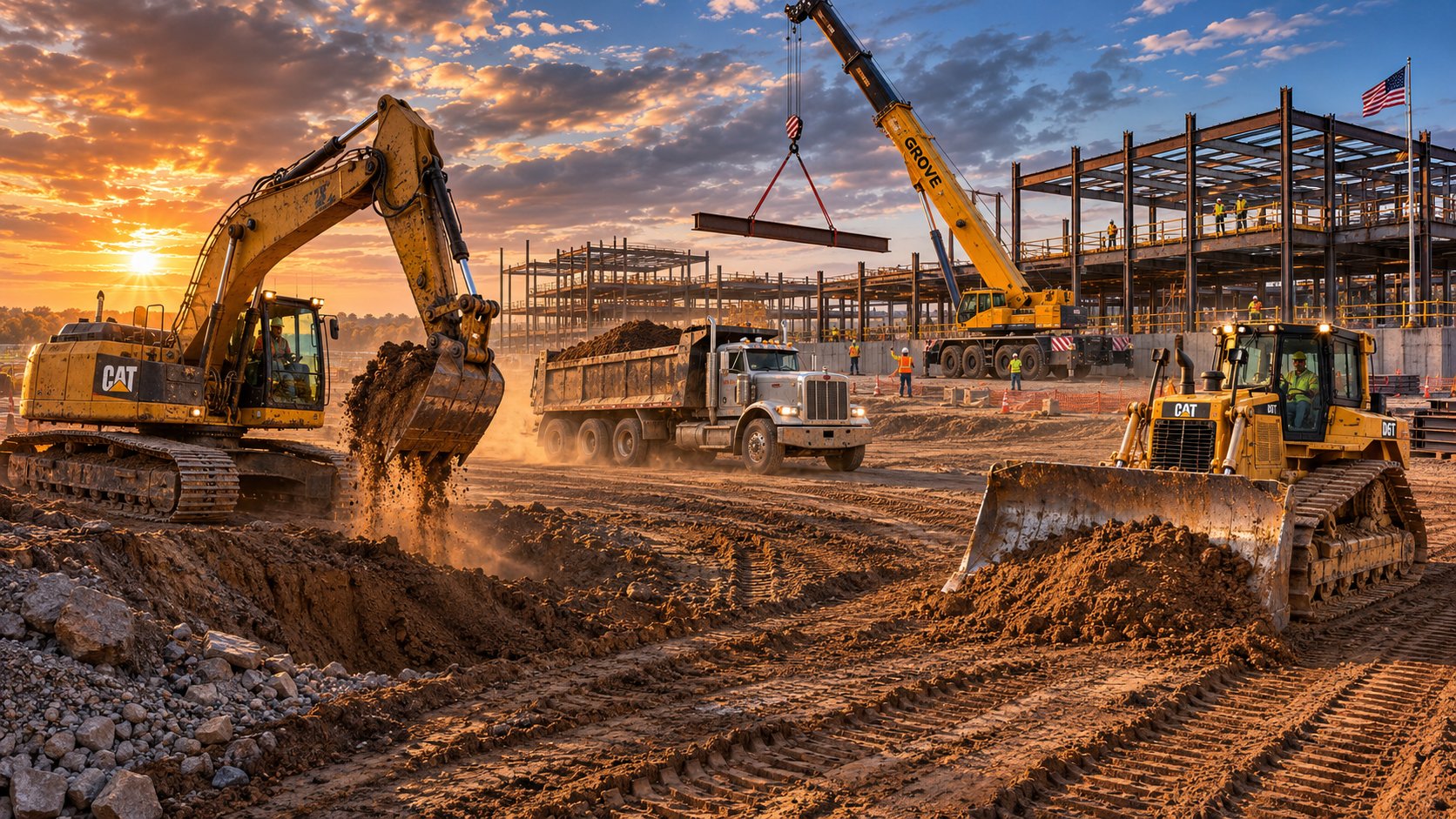
In the United States, OSHA 29 CFR 1926 Subpart O governs motor vehicles, mechanized equipment, and marine operations on construction sites. Any self-powered machine designed to excavate, lift, haul, compact, or pave falls under this regulatory umbrella. Think hydraulic excavators, crawler dozers, mobile cranes, and asphalt pavers rather than handheld drills, power saws, or portable generators.
The key distinction is simple: if the machine requires a trained operator seated or standing at dedicated controls, and it can independently move earth, materials, or structural loads, it qualifies as heavy equipment. Smaller powered items — often grouped under construction tools names like rotary hammers, cut-off saws, and plate tampers — sit in the light-duty category. Knowing this boundary matters because it determines which safety standards apply, what operator training is required, and how project budgets get allocated.
How US Construction Professionals Use This Classification
So, what are the types of construction equipment that contractors actually plan around? Rather than memorizing an alphabetical catalog, US contractors, fleet managers, and equipment dealers organize machinery into functional categories tied directly to project phases. When someone asks what equipment is used on a construction site, the answer depends entirely on where that project stands in the construction sequence — from initial clearing through final finishing.
This article follows that same workflow logic. Here are the major categories you'll find ahead:
- Earthmoving equipment — excavators, bulldozers, graders, scrapers, and trenchers
- Lifting and hoisting machines — cranes, forklifts, telehandlers, and aerial lifts
- Material hauling and transport vehicles — dump trucks, articulated haulers, and loaders
- Compaction and paving equipment — rollers, asphalt pavers, milling machines, and concrete pumps
- Road works equipment — specialized machinery for highway construction and resurfacing
- Attachments — the quick-swap tools that multiply a single machine's capabilities
Each category enters the project timeline at a specific stage, and understanding that sequence is what separates a smart equipment plan from an expensive guessing game. The machines that break ground first set the pace for everything that follows.
Earthmoving Equipment That Drives Every US Project
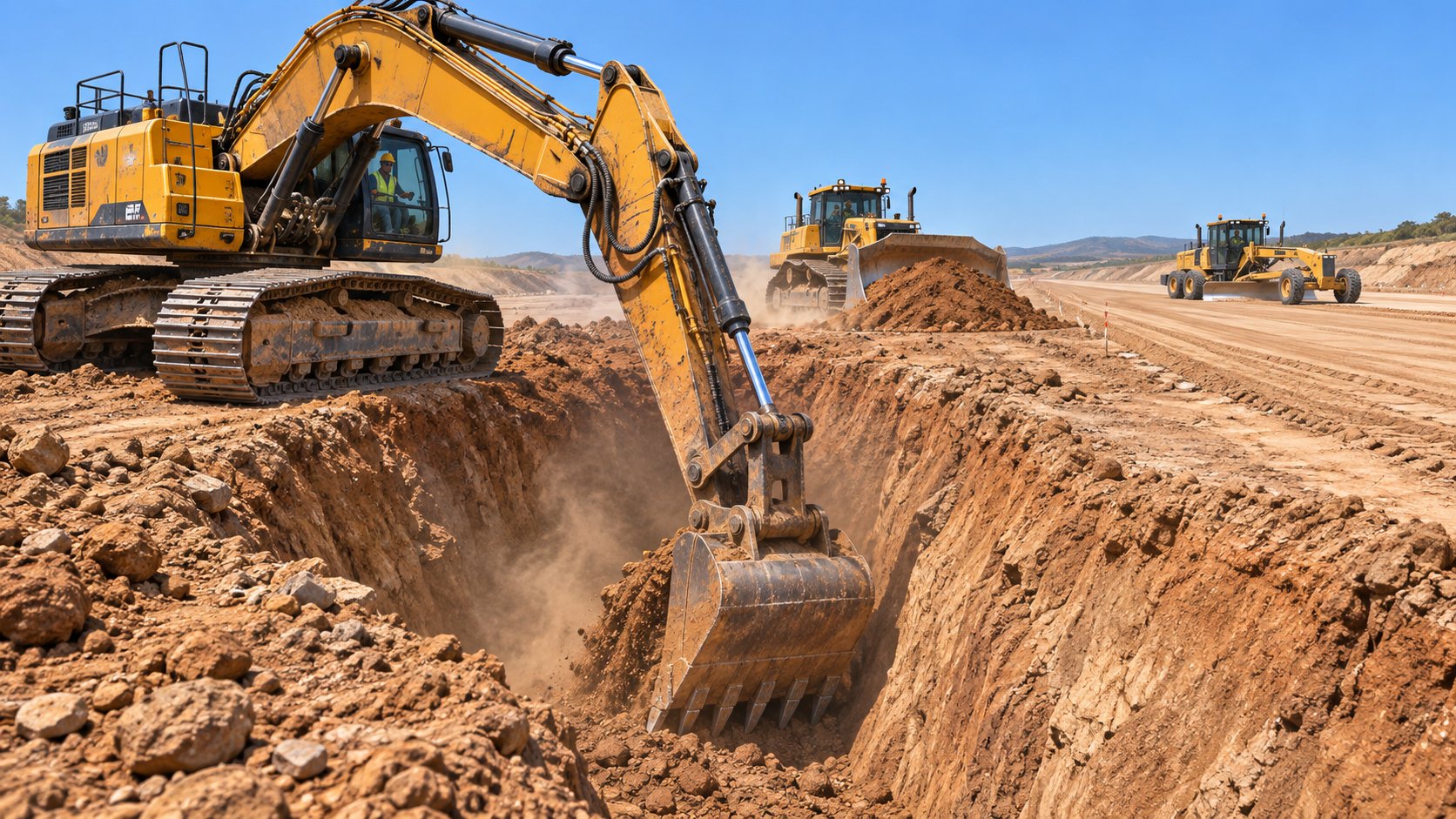
The machines that break ground literally define what follows. Earthmoving equipment represents the largest, most capital-intensive class among all heavy equipment types on a US jobsite, and for good reason — no foundation gets poured, no road gets built, and no utility gets buried until the earth is shaped to plan. When contractors ask what is considered heavy machinery, earthmovers are the first images that come to mind: excavators carving trenches, bulldozers clearing timber, and graders smoothing road beds to laser-precise tolerances.
Excavators and Their Role in Site Preparation
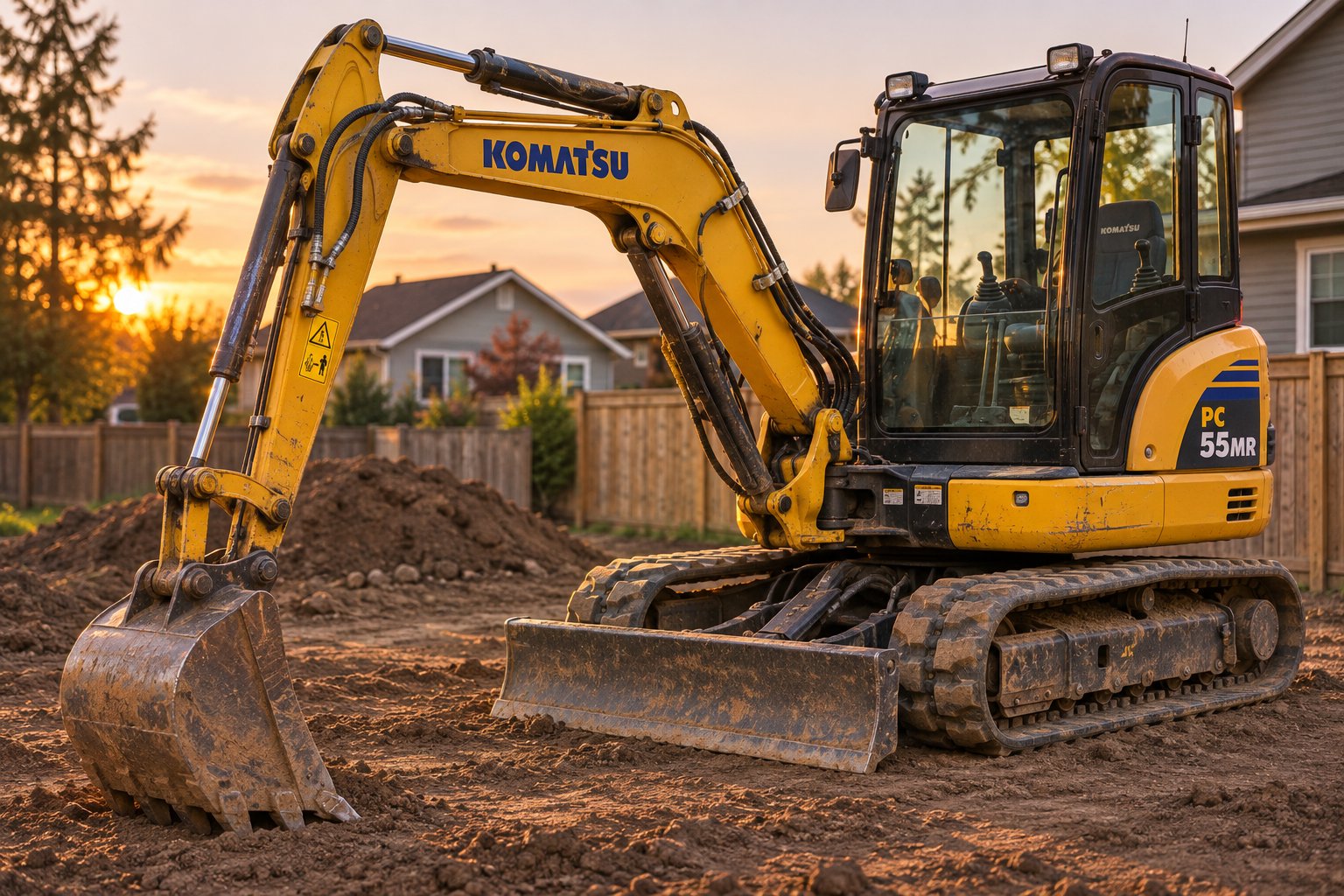
Imagine a single machine that can dig a basement, demolish a concrete slab, load trucks, and set pipe — all in the same shift. That's the hydraulic excavator, and it's the undisputed workhorse among construction equipment names in the US. Its 360-degree rotating cab, hydraulic boom-and-stick assembly, and interchangeable bucket make it adaptable to nearly every phase of site work.
Excavators are organized into three sizing tiers based on operating weight:
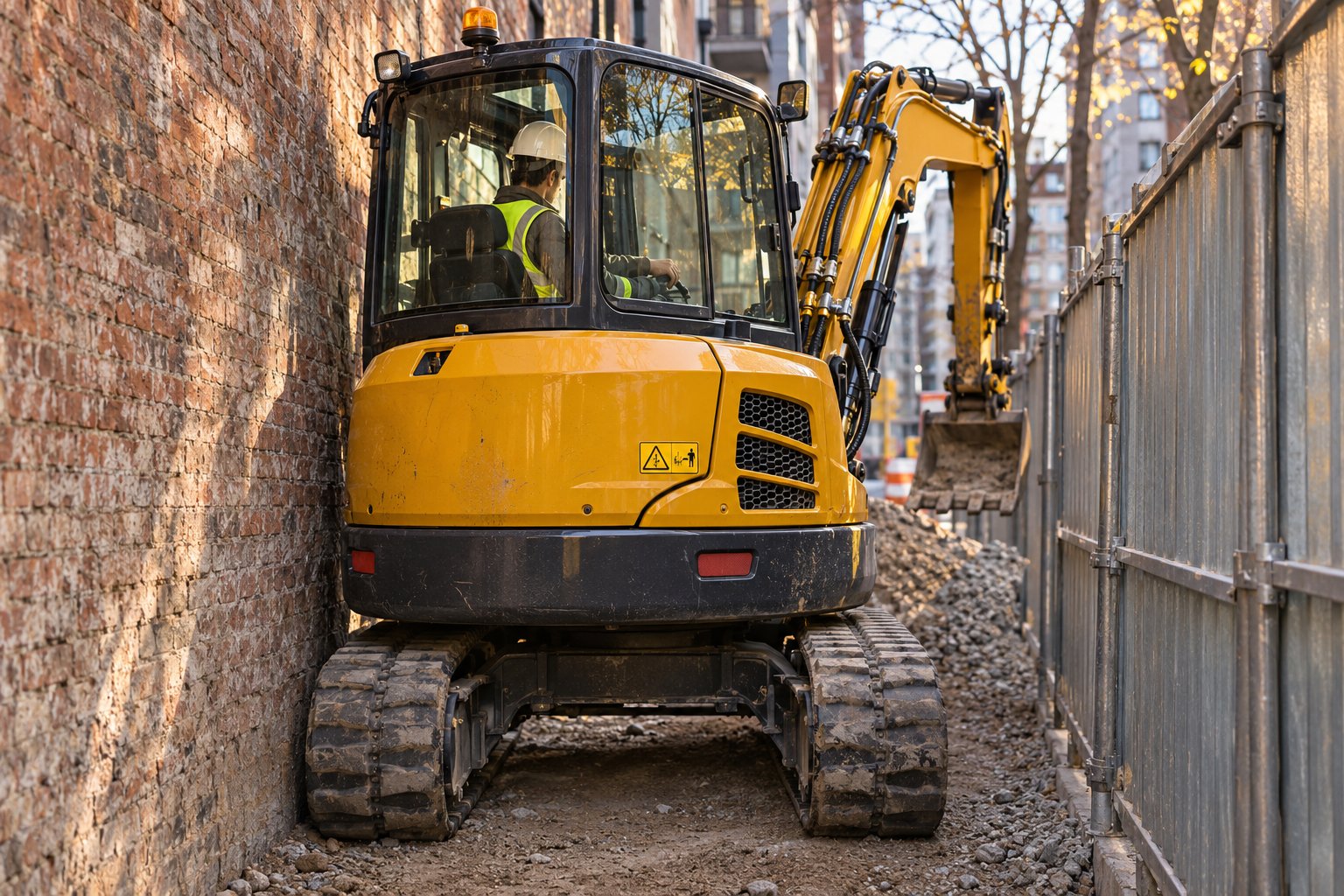
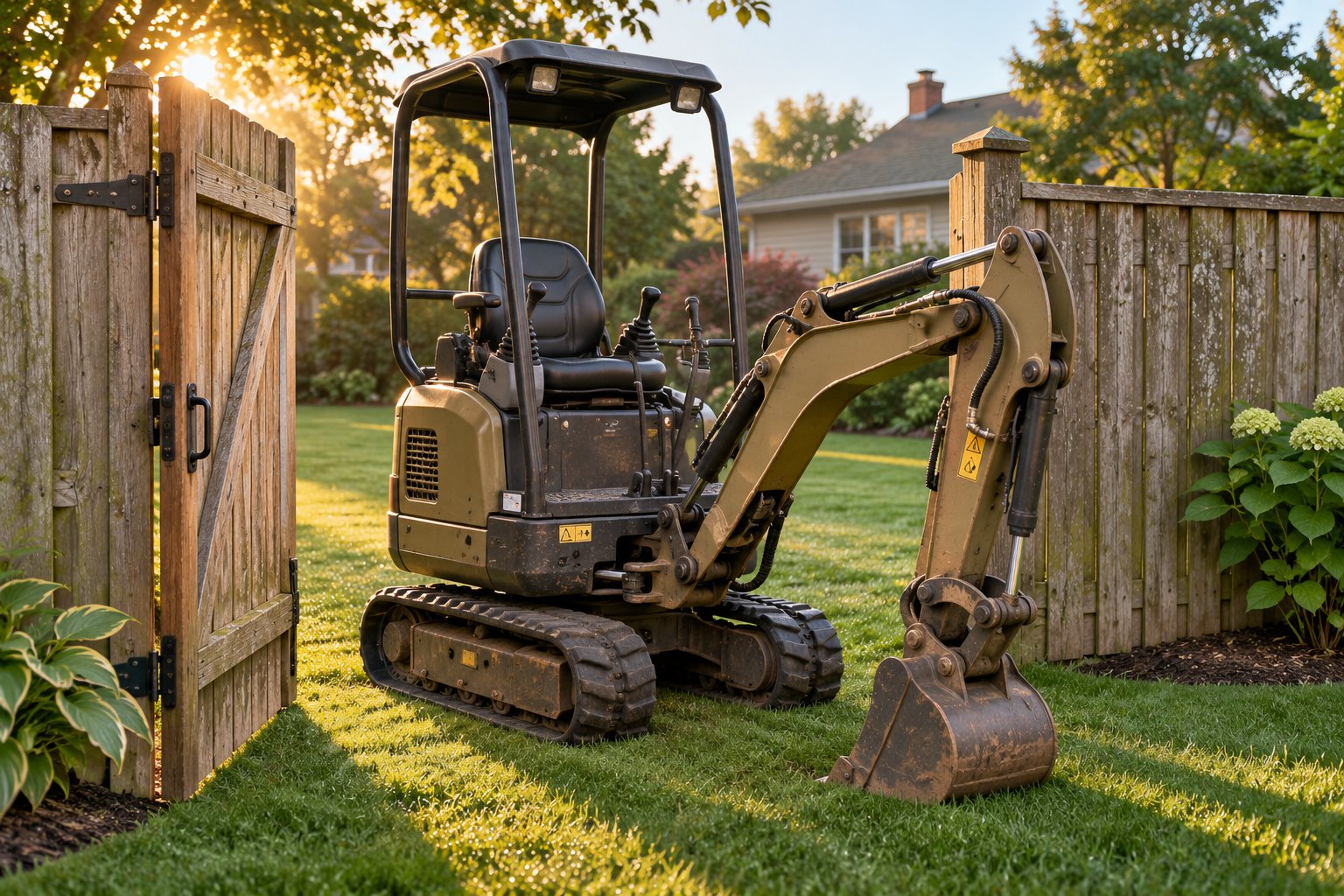
- Mini/compact excavators (under 7 metric tons) — ideal for residential projects, landscaped areas, and tight-access urban sites. Their zero or near-zero tail swing lets operators rotate safely next to walls and utilities without damage.
- Standard/mid-size excavators (7–45 metric tons) — the go-to class for commercial construction, offering the dig depth, lift capacity, and attachment compatibility that most general contractors need. Many standard models support hydraulic breakers, augers, and thumbs, making them versatile across multiple trades.
- Large excavators (over 45 metric tons) — reserved for heavy civil, infrastructure, and mining projects where deep excavation, high production rates, and serious lift demands justify the higher mobilization and operating costs.
Choosing the right tier starts with matching dig depth, reach, and load capacity to the project scope. An oversized excavator on a residential lot wastes fuel and tears up finished surfaces; an undersized one on a highway cut slows the entire schedule.
Bulldozers and Motor Graders for Earthwork
Where excavators dig and lift, bulldozers push. A crawler dozer uses its heavy front-mounted blade and low-ground-pressure tracks to clear vegetation, push massive volumes of soil, and perform rough grading across uneven or rocky terrain. You'll find them leading the charge on land-clearing operations, road embankments, and landfill projects. Wheel dozers, though less common, are preferred on firm, flat surfaces where higher travel speed matters — think large paved staging areas or port facilities.
Motor graders serve the opposite end of the precision spectrum. Equipped with a long, center-mounted moldboard that can rotate up to 360 degrees, a grader delivers the fine grading and slope control that FHWA-funded highway projects demand. While a dozer moves earth in bulk, a motor grader smooths and levels surfaces to exact grade specifications — shaping road bases, cutting drainage ditches, and maintaining haul roads. If a bulldozer is a sledgehammer, a motor grader is a sculptor's chisel.
Scrapers and Trenchers for Specialized Excavation
Some earthmoving jobs call for machines built to cut, load, haul, and dump in a single pass. Wheel tractor-scrapers fill that role on large cut-and-fill operations — highway corridors, airport runways, and mass-grading projects where earth needs to travel moderate distances without involving a fleet of dump trucks. Open-bowl scrapers require a push dozer to assist loading, while elevating scrapers use an internal conveyor to self-load, trading some payload capacity for independence.
Trenchers, on the other hand, specialize in narrow, linear excavation. Chain trenchers and wheel trenchers cut clean slots for water mains, gas lines, fiber-optic conduit, and electrical runs. They're a staple on utility installation projects where speed and trench-wall consistency matter far more than volume moved.
With so many heavy equipment names in the earthmoving category, it's easy to confuse machines that seem to overlap. The table below breaks down the core differences among the three most common types of construction vehicles in this class:
| Criteria | Hydraulic Excavator | Crawler Bulldozer | Motor Grader |
|---|---|---|---|
| Primary Function | Digging, trenching, demolition, material handling | Bulk earthmoving, land clearing, rough grading | Fine grading, road base shaping, slope control |
| Typical Project Type | Residential through heavy civil — nearly universal | Site clearing, road embankments, mining overburden | Highway construction, airfield grading, subdivision streets |
| Sizing Range | Under 7 t (mini) to 90+ t (large) | Small (70–100 HP) to large (over 900 HP) | Mid-range (120–500 HP) |
| Terrain Suitability | Tracked models handle soft/uneven ground; wheeled models suit hard, flat surfaces | Tracks excel on rough, muddy, or steep terrain | Best on semi-prepared or firm surfaces requiring precision |
Each of these machines owns a distinct lane in the earthmoving workflow. The real efficiency gains come from sequencing them correctly — dozers clear and rough-shape the site, excavators dig foundations and utilities, and graders fine-tune surfaces before the next wave of equipment rolls in. That next wave? The cranes, forklifts, and aerial lifts that shift the project's focus from horizontal earth to vertical structure.
Lifting and Hoisting Machines for Vertical Construction
Once the ground is shaped and foundations are in place, a construction project shifts from moving earth sideways to moving materials upward. Steel beams, precast panels, rooftop HVAC units, bundles of lumber — none of these reach their final position without a machine built specifically to lift, swing, and place heavy loads at height. This is where cranes, forklifts, telehandlers, and aerial lifts take over, and understanding the different types of construction vehicles in this category is essential for anyone planning a commercial, industrial, or infrastructure build.
Crane Types and When Each Is Deployed
Cranes are the highest-capacity lifting machines on any US jobsite, and choosing the wrong type can stall an entire project. The decision hinges on three factors: how much the load weighs, how far and high it needs to travel, and what the site allows in terms of ground conditions and access.
Here's a practical breakdown of the major crane families and where each fits best:
- Tower cranes — fixed in place with a vertical mast and rotating horizontal jib, these are the standard choice for high-rise and long-duration urban builds. They lift loads to significant heights within a compact footprint. Typical capacities range from about 6 to 60 tons depending on configuration.
- Crawler cranes — mounted on tracked undercarriages, crawlers handle the heaviest lifts in the mobile crane family — up to 2,535 tons in some fleet configurations. They thrive on soft or rough ground but must be transported disassembled because they are not highway-legal.
- All-terrain cranes — these multi-axle wheeled machines drive on public roads at highway speed and still manage uneven ground on site, making them ideal when serious lift capacity (88 to 818 tons) needs to move between locations.
- Rough-terrain cranes — compact and agile with large tires and all-wheel drive, rough-terrain models suit confined or sloped single-site work. They are not road-legal and are typically hauled in, with capacities running from roughly 15 to 165 tons.
- Truck-mounted cranes (hydraulic truck cranes and boom trucks) — highway-legal and quick to set up, these handle lighter to mid-range lifts and excel at "taxi-crane" work where the machine moves between multiple jobs in a single day.
- Carry deck cranes — the smallest and most maneuverable option, designed to shuttle loads within a site or work in tight indoor spaces where larger machines simply cannot operate.
Crane selection is never one-dimensional. A 200-ton crawler might have the raw capacity for a lift, but if the site sits on a narrow urban lot with no room for assembly, a luffing-jib tower crane could be the only practical option. Ground bearing pressure, nearby obstructions, and even local permit requirements all influence the final choice.
What many competitors skip entirely is the certification side. Every construction equipment operator running a crane on a US jobsite must meet strict federal requirements. OSHA 29 CFR 1926 Subpart CC mandates that crane operators be trained, certified or licensed, and evaluated before operating covered equipment. The National Commission for the Certification of Crane Operators (NCCCO) provides the most widely recognized credential, and many US states and municipalities require it by law. NCCCO certification involves passing both written exams (covering core knowledge and a crane-specific specialty) and a practical skills test, with renewal required every five years. These requirements align with ANSI/ASME B30 standards, which define the physical, medical, and operational benchmarks every crane operator must meet.
Forklifts and Telehandlers on the Construction Site
Not every vertical lift requires a crane. For moving palletized materials, framing packages, drywall bundles, and roofing supplies, forklifts and telehandlers are the faster, more cost-effective choice — and they show up on nearly every US residential and commercial project.
A standard rough-terrain forklift uses a vertical mast and rear counterweight to lift and stack loads on relatively flat ground. It's purpose-built for straightforward pick-and-place work: loading docks, material yards, and paved staging areas. Most models lift in the 10- to 20-foot range and handle dense, palletized loads efficiently.
Telehandlers — also called telescopic handlers — operate on a fundamentally different principle. Instead of a fixed mast, a telehandler uses a telescopic boom that extends forward and upward simultaneously. This lets the operator place materials onto upper floors, over walls, or across trenches without positioning the machine directly beneath the drop point. Many mainstream models exceed 40 feet of vertical lift with nearly 30 feet of forward reach, and larger construction machines names like the JCB 540-200 or the CAT TH514D push those numbers even higher.
That reach advantage has made telehandlers essential on US construction sites. Imagine framing a two-story house: a telehandler delivers lumber bundles directly to the second-floor deck in a single pass, eliminating the hand-carrying that would slow a crew for hours. With quick-attach systems, the same machine swaps forks for a bucket, a truss boom, or even a personnel platform — turning one piece of equipment into a multi-role workhorse.
Aerial Lifts for Elevated Access
Sometimes the job isn't about lifting materials — it's about lifting people. Electrical rough-in, mechanical ductwork, exterior cladding, painting, and fire-suppression installation all require workers to reach heights safely and repeatedly. That's the domain of aerial lifts, which fall into two primary types:
- Boom lifts (articulating and telescopic) — provide the greatest reach and flexibility. Articulating boom lifts use multiple jointed sections to maneuver around obstacles, while telescopic models extend in a straight line for maximum height. Working heights can exceed 180 feet on the largest models.
- Scissor lifts — elevate a broad work platform straight up using a crisscrossing support structure. They offer a larger, more stable platform than boom lifts but lack horizontal reach, making them ideal for interior work, ceiling installation, and repetitive tasks at moderate heights.
OSHA governs aerial lift use under 29 CFR 1926 Subpart L and requires that every operator receive training specific to the equipment type before independent operation. Fall protection, platform load limits, and proximity to electrical hazards are all covered — and violations carry serious penalties.
Between cranes overhead, telehandlers feeding materials upward, and aerial lifts carrying workers to elevation, the vertical phase of a US construction project is machinery-intensive. Yet none of these machines operate in isolation. Every beam a crane sets and every pallet a telehandler delivers had to arrive on site first — hauled by another category of equipment entirely.
Material Hauling and Transport Vehicles on US Jobsites
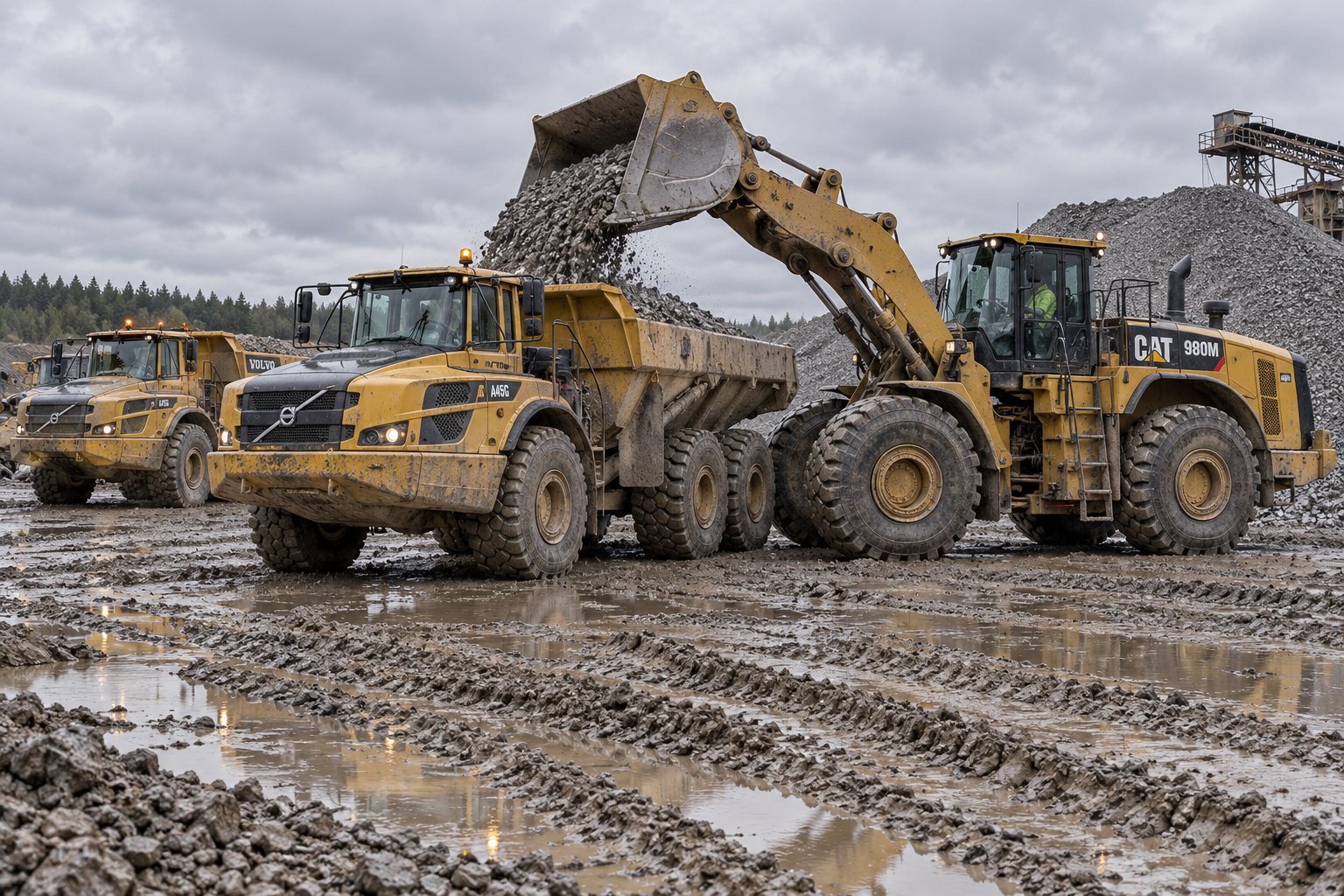
Every cubic yard of earth an excavator digs and every ton of aggregate a crusher produces has to go somewhere. Hauling and transport vehicles are the circulatory system of a US construction site — without them, material piles up, excavators sit idle, and the entire schedule bleeds time. This category spans everything from massive off-highway dump trucks moving 400 tons of overburden to compact loaders shuttling gravel across a residential lot. Understanding the types of heavy equipment in this class, and knowing which machine fits which scenario, prevents one of the most common project bottlenecks: mismatched hauling capacity.
Dump Trucks and Articulated Haulers Compared
When contractors need to move large volumes of dirt, rock, or demolition debris, two machines dominate the conversation: rigid-frame dump trucks and articulated dump trucks (ADTs). They look similar from a distance, but their construction, terrain capability, and ideal use cases are fundamentally different.
A rigid dump truck — sometimes called a mining truck or off-highway truck — builds the cab and dump body on a single, solid frame. That rigid chassis delivers exceptional structural strength, which is why these machines handle the heaviest payloads in the industry: anywhere from 40 to nearly 700 tons depending on the model. You'll find them on large-scale mining operations, open-pit quarries, and major highway projects where well-maintained haul roads have been established. Their rear-wheel drive and large turning radius, however, make them a poor fit for tight or soft-ground conditions.
An articulated dump truck takes a different engineering approach. Instead of one frame, the cab and dump body connect through a pivot joint that lets each section move independently. This six-wheel-drive, articulated design keeps all tires in constant ground contact, giving ADTs outstanding traction on muddy, wet, sloped, and uneven terrain. Payload capacities typically range between 25 and 60 tons with heaped capacities of 20 to 46 cubic yards — smaller than rigid trucks, but more than sufficient for the vast majority of earthmoving, subdivision, and infrastructure projects.
Picking between them often comes down to a straightforward question: what does the ground look like? If your site has firm, flat haul roads and you need to move enormous volumes at high speed, rigid trucks win on efficiency. If conditions are rough, access is tight, or the site hasn't been fully developed yet, an ADT navigates where a rigid truck simply cannot.
The table below puts the key differences side by side for quick reference:
| Criteria | Articulated Dump Truck (ADT) | Rigid Dump Truck (RDT) |
|---|---|---|
| Payload Capacity | 25 - 60 tons | 40 - 700 tons |
| Terrain Capability | Excels on muddy, wet, sloped, and rough ground; handles grades up to 35% | Requires well-maintained, hard-packed haul roads; rear-wheel drive limits soft-ground performance |
| Turning Radius | Tight — pivot joint allows sharp turns in confined spaces | Large — single-frame chassis needs wide roads and open areas to maneuver |
| Typical US Project Type | Residential development, commercial grading, highway earthwork, moderate quarry operations | Open-pit mining, large quarries, major highway projects with established haul roads |
| Relative Cost Tier | Moderate — average rental around $1,600/day or $12,600/month | High — rental approximately $25,000/month; haul-road construction adds further cost |
Both ADTs and modern rigid trucks now come equipped with telematics, payload monitoring, and traction-control systems that help operators maximize efficiency and track haul data in real time. The technology is converging, but the fundamental heavy equipment classification — articulated for versatility, rigid for raw volume — remains the deciding factor.
Loaders That Feed the Hauling Chain
Dump trucks don't load themselves. Behind every hauler is a loader feeding material into the bed, and US construction relies on several distinct loader types depending on project scale, terrain, and access constraints.
Wheel loaders are the primary production loaders on most jobsites. With large front-mounted buckets, articulated steering, and rubber tires built for paved or compacted surfaces, they excel at stockpile management, truck loading, and bulk material handling. A mid-size wheel loader can cycle material into a waiting dump truck in under a minute, making it the backbone of aggregate yards, recycling facilities, and active earthwork operations. Bucket sizes scale with the machine — from compact models handling 1 to 2 cubic yards up to heavy units scooping 6 or more cubic yards per pass.
Skid-steer loaders occupy the compact end of the spectrum. Their fixed undercarriage and counter-rotating wheels allow zero-radius turns, which makes them incredibly agile in tight spaces — think backyard renovations, interior demolition, or crowded urban sites where a full-size loader simply won't fit. Most skid steers use wheeled undercarriages that grip hard, dry surfaces well but can struggle in mud or on finished turf.
That's where compact track loaders (CTLs) step in. Built on essentially the same chassis as a skid steer but fitted with rubber tracks instead of wheels, CTLs distribute weight more evenly across soft, sandy, or muddy terrain. The tracks reduce ground pressure, which protects finished landscaping and gives the machine better traction on slopes. CTLs also typically offer a slight edge in lift capacity over similarly sized wheeled skid steers. If the jobsite surface is anything less than firm and dry, a compact track loader is usually the smarter choice.
Then there's the backhoe loader — arguably the most versatile single machine a small US contractor can own. With a loader bucket on the front and a hydraulic excavator arm on the rear, the backhoe handles digging, trenching, loading, and backfilling without ever swapping attachments. It's not the fastest digger or the highest-capacity loader, but that dig-and-load dual capability means one operator on one machine covers tasks that would otherwise require two. For small to mid-size utility, residential, and municipal projects, backhoe loaders remain a staple in the construction of machine fleets nationwide.
Conveyor Systems and Specialty Haulers
Not every hauling challenge is solved by a truck and a loader. On tunnel projects, large dam sites, and mining-adjacent operations, conveyor belt systems move bulk material continuously over fixed routes — eliminating the fuel cost, road maintenance, and traffic congestion that come with truck-based hauling. Conveyors are less common on typical commercial jobsites, but when the haul route is long and the volume is massive, they are far more efficient per ton-mile than any wheeled vehicle.
Equally overlooked in most heavy equipment categories discussions is the water truck. On virtually every US earthwork or grading project, dust suppression isn't optional — it's an OSHA and EPA compliance requirement. Water trucks circulate across active haul roads, exposed soil areas, and demolition zones, spraying controlled volumes of water to keep particulate matter below regulated thresholds. They may lack the drama of a 60-ton articulated hauler, but without them, work stops, fines accumulate, and neighboring communities file complaints.
Together, these hauling and transport machines form the logistics backbone that keeps every other piece of equipment productive. An excavator is only as fast as the truck it's loading. A loader is only as useful as the haul route it's feeding. Getting the hauling chain right — the right truck type, the right loader pairing, and the right support vehicles — is what separates a project that flows from one that stalls. Still, getting material to its destination is only half the battle. Once earth is placed and asphalt is delivered, another class of equipment takes over to compress, shape, and finish those surfaces into something permanent.
Compaction and Paving Equipment for Roads and Structures
Dirt in a dump truck bed is loose, unpredictable, and structurally useless. The same dirt, properly placed and compacted, becomes the stable foundation under a highway that carries 80,000-pound trucks for decades. That transformation — from loose fill to engineered surface — depends entirely on the compaction and paving machines that close out the construction vehicle sequence on virtually every road, parking lot, and building pad project in the United States. Yet among all the different types of heavy equipment, this category gets the least detailed coverage despite being the one that determines whether the finished product lasts five years or fifty.
Compaction Equipment for Soil and Asphalt
Compaction eliminates air voids trapped between soil particles or within an asphalt mat. Remove those voids, and you increase density, bearing capacity, and resistance to water infiltration. Skip it — or do it poorly — and the result is settlement, rutting, and premature pavement failure. Every construction vehicle that later drives across a finished road surface depends on the compaction work done weeks or months earlier.
The equipment used to achieve that density varies based on the material being compacted, the layer thickness, and the access constraints of the site:
Vibratory smooth-drum rollers are the most widely used compaction machines on US jobsites. A heavy steel drum — commonly 84 inches wide — vibrates at controlled frequencies while rolling over the material. The vibration forces particles into tighter arrangements far more effectively than static weight alone. Single-drum models pair one large drum in front with rubber-tire drive wheels in the rear, while double-drum versions use two drums for more uniform coverage. You'll see smooth-drum rollers finishing asphalt surfaces and compacting granular base materials where a flat, even result matters most. Their limitation? They struggle with deeply compacting very loose or cohesive soils, often requiring multiple passes or a different machine entirely.
Padfoot rollers — also called sheepsfoot or tamping rollers — solve exactly that problem. Instead of a smooth surface, their drums are studded with protruding pads that penetrate and knead cohesive materials like clay and silt. This concentrated pressure achieves deep, uniform compaction that smooth drums simply cannot replicate in sticky, fine-grained soils. Padfoot rollers are critical for road sub-bases, earth dam cores, embankments, and landfill compaction. The trade-off is a rough surface finish, which means a smooth-drum or pneumatic roller typically follows to prepare the surface for the next layer.
Pneumatic tire rollers bring a different approach. Multiple air-filled rubber tires — usually four or five — distribute pressure evenly across the surface, conforming to slight terrain variations that rigid drums would bridge over. They excel at sealing hot-mix asphalt surfaces during paving operations, pressing aggregate into the binder without crushing individual particles. The tire pressure can be adjusted to match specific compaction requirements, giving operators flexibility that steel drums lack. Pneumatic rollers are frequently the final pass in an asphalt compaction sequence — the finishing touch that seals the mat.
Plate compactors handle what full-size rollers cannot reach. These walk-behind units deliver vibratory compaction in confined areas — utility trenches, sidewalk subgrades, around manholes, and alongside building foundations. On any project that involves buried pipe or narrow footings, plate compactors are the only practical option for meeting density specifications in tight quarters.
Here's the critical takeaway: compaction quality directly governs how long a pavement or structure lasts. FHWA-funded highway projects specify minimum density requirements — typically 92% to 96% of maximum theoretical density for asphalt and 95% or higher for subgrade soils — and field technicians verify those numbers with nuclear density gauges or non-nuclear alternatives. Falling short means rework, and rework on a compaction layer means tearing out everything built on top of it.
Paving Machines and Milling Equipment
Compaction prepares the layers beneath; paving machines create the riding surface drivers actually see and feel. The types of construction trucks and machines in this subcategory are purpose-built for precision, speed, and consistency — because a highway surface paved unevenly doesn't just ride poorly, it fails prematurely.
Asphalt pavers receive hot-mix asphalt from dump trucks or material transfer vehicles, spread it across the prepared base at a controlled thickness, and deliver initial compaction through a heated screed. The screed — essentially a vibrating, heated plate trailing behind the paver — strikes off the asphalt to the specified mat thickness and begins densifying it before rollers take over. Modern tracked pavers lay widths from 8 to 24 feet and can pave at rates exceeding 200 tons per hour on major highway projects.
Concrete pavers and slipform machines perform a similar function for portland cement concrete (PCC) pavements. Slipform pavers extrude concrete through a moving mold, producing a continuous slab without fixed side forms. They're the standard building construction equipment names you'll encounter on interstate highway projects, airport runways, and any large-scale concrete paving operation where speed and dimensional consistency are non-negotiable.
Cold milling machines — also called cold planers — enter the picture before new pavement goes down. When an existing road surface needs resurfacing or rehabilitation, a cold milling machine uses a rotating drum studded with carbide-tipped teeth to grind away the damaged asphalt layer to a precise depth. The FHWA defines cold milling as the automatically controlled removal of pavement to a desired depth, restoring the surface to a specified grade and slope free of bumps, ruts, and other imperfections. Milling widths range from one meter for localized repairs to a full lane width for complete resurfacing, and the reclaimed asphalt pavement (RAP) is loaded directly into trucks for recycling — a process that has revolutionized how the US manages aging road infrastructure.
On FHWA-funded projects, compaction and paving standards aren't suggestions — they're contractual requirements tied to federal funding. Equipment selection, mat thickness tolerances, compaction temperature windows, and density verification methods are all specified in project plans, meaning the machines a contractor deploys must match the standards or the work gets rejected.
Concrete Equipment Beyond the Mixer
Paving isn't limited to roads. Commercial foundations, elevated structural slabs, bridge decks, and large industrial floors all require concrete placement equipment that goes well beyond the familiar rotating-drum mixer truck.
Concrete mixer trucks — the transit mixers you see on every highway — transport ready-mix concrete from a batch plant to the jobsite while keeping the mix agitated and workable. They typically carry 8 to 12 cubic yards per load. Getting the concrete from the truck to its final position, though, is where dedicated placement equipment takes over.
Boom pump trucks mount a multi-section articulating arm on a truck chassis. The boom unfolds and reaches over, around, and above obstacles to place concrete exactly where it's needed — upper floors of a building, deep foundation pits, or across congested site layouts. Output capacities range from 80 to 180 cubic meters per hour, and boom reaches can extend beyond 50 meters on the largest models, making them indispensable on high-rise and large commercial pours.
Line pumps (also called trailer-mounted or ground pumps) use a series of connected hoses and pipes to push concrete over distances up to 150 meters. They're the go-to choice for residential foundations, sidewalks, swimming pools, and any pour where a boom truck is either overkill or physically unable to access the site. Output is lower — typically 20 to 90 cubic meters per hour — but the setup is simpler and the cost is significantly less.
Power trowels finish the job. After concrete is placed and begins to set, these rotating-blade machines smooth and densify the surface to the specified flatness and finish. Walk-behind models handle smaller slabs, while ride-on power trowels cover large floor pours efficiently — an essential step for warehouse floors, parking structures, and industrial facilities where floor flatness tolerances are measured in fractions of an inch.
When you line up every machine in this category in the order it actually appears during a typical US highway construction project, the workflow becomes unmistakably logical:
- Cold milling machine — removes the deteriorated existing surface to a controlled depth
- Motor grader and compaction rollers — reshape and compact the exposed base layer
- Asphalt paver or slipform concrete paver — lays the new surface material at specified thickness
- Vibratory and pneumatic rollers — compact the fresh mat to required density in a specific temperature and timing sequence
- Striping trucks and marking equipment — apply lane markings, edge lines, and reflective markers to the finished surface
That sequence isn't arbitrary — it mirrors how every lane-mile of US highway gets built or rebuilt. Each machine depends on the one before it, and skipping a step or deploying the wrong equipment at the wrong stage compounds errors that show up as potholes, cracking, and premature failure within a few seasons.
Interestingly, most of these machines perform one highly specialized task and do it extraordinarily well. But there's a parallel trend reshaping how US contractors think about equipment: instead of owning a fleet of single-purpose machines, many are discovering that a single base machine fitted with the right attachments can absorb work that once required dedicated equipment — a strategy with profound implications for both project budgets and fleet management.
Attachments That Multiply Equipment Versatility
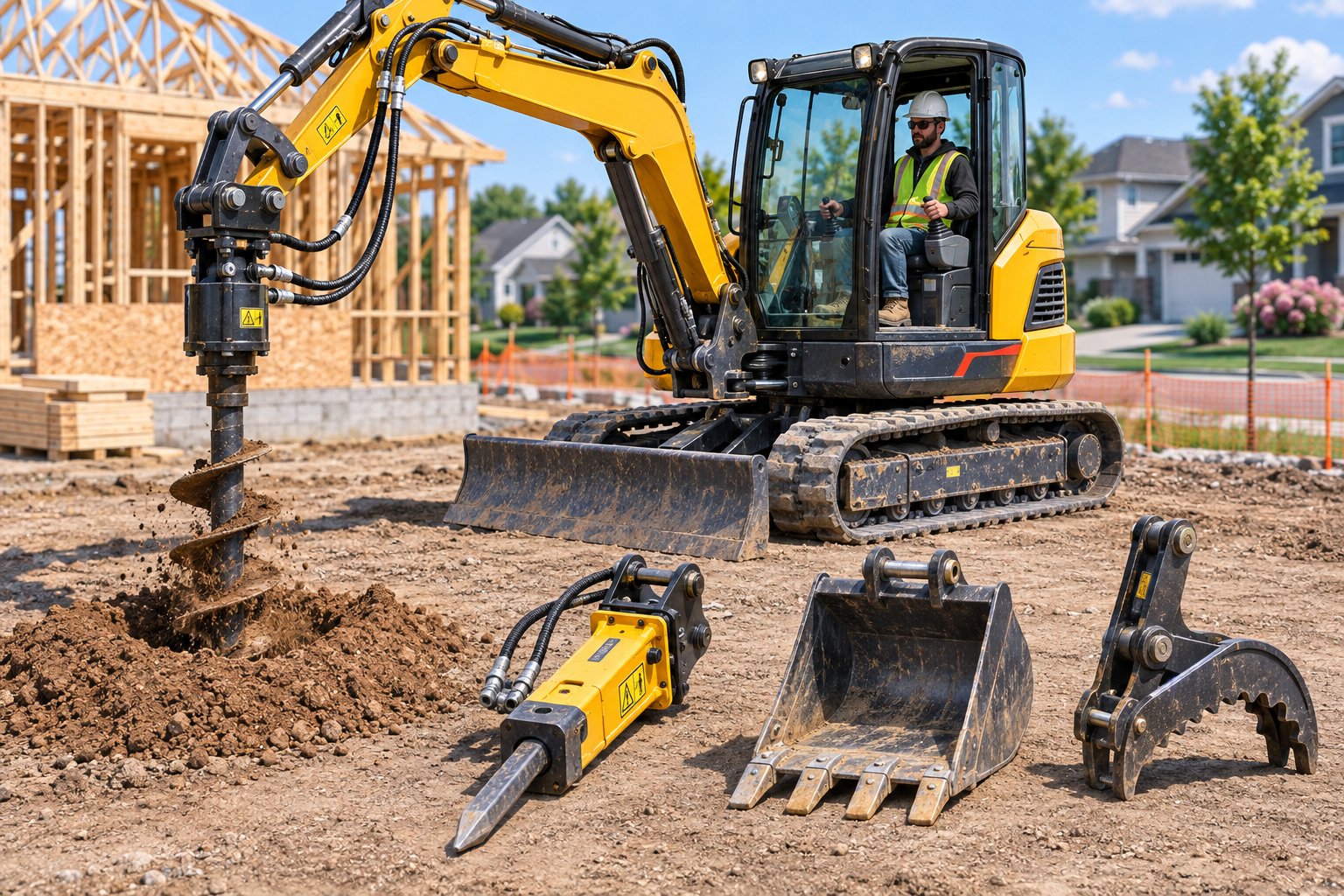
A hydraulic excavator sitting on a trailer with only a standard digging bucket is like a smartphone with no apps installed — functional, but leaving most of its value untapped. The real power of many types of construction equipment lies not in the base machine alone but in the attachments that bolt onto it. One excavator, fitted with the right tools, can trench, demolish, drill, compact, grade, and clear land — tasks that would otherwise demand five or six standalone machines, each with its own mobilization cost, trailer space, and operator. For budget-conscious US contractors, this distinction between owning machines and owning capability is where the smartest fleet decisions happen.
Excavator Attachments That Replace Standalone Machines
Think of a hydraulic excavator as a power platform. The boom, stick, and hydraulic circuits deliver force, reach, and precision. The attachment on the end determines what that force actually does. Swapping one tool for another — often in under a minute with a hydraulic quick coupler — transforms the machine's purpose entirely without ever leaving the cab.
Here are the most common excavator attachments and the dedicated machines each one replaces:
- Hydraulic breaker (hammer) — replaces a standalone demolition breaker or jackhammer crew for concrete removal, rock breaking, and frozen-ground penetration
- Auger drive with bits — replaces a dedicated drilling rig for fence posts, tree planting, deck footings, and utility pole foundations
- Hydraulic thumb — replaces manual labor for sorting demolition debris, handling boulders, placing logs, and gripping irregular materials
- Plate compactor — replaces a walk-behind compactor for trench backfill, reaching depths and geometries that hand-operated units cannot access effectively
- Grading bucket (smooth-edge, no teeth) — replaces finish grading by hand or with a separate machine, delivering level surfaces on the final pass
- Trenching bucket (narrow profile) — replaces a dedicated chain trencher for utility line installation where clean, narrow cuts are needed
- Brush cutter or drum mulcher — replaces a standalone land-clearing machine, using the excavator's boom reach to cut and grind vegetation on slopes, ditches, and confined corridors
- Screening bucket (skeleton bucket) — replaces a stationary screening plant for separating topsoil from rocks, roots, and debris during site preparation
The financial math is compelling. Renting a dedicated auger rig can run $200 to $400 per day, while purchasing an auger attachment for a compact excavator typically costs a fraction of the standalone machine — and the excavator still does everything else it was already doing. A contractor who swaps between a breaker, an auger, and a standard bucket across a single week has effectively deployed three machines from one piece of equipment and one operator.
Compatibility is the critical detail. Every attachment has hydraulic flow (GPM), pressure (PSI), and weight-class requirements that must match the host machine's specifications. A breaker sized for a 20-ton excavator will overstress a 5-ton mini, damaging boom pins and shortening machine life. Reputable suppliers publish pairing charts for every model — always verify before ordering.
Skid-Steer and Loader Attachments for Maximum Versatility
Excavators aren't the only attachment-friendly platform. Skid-steer loaders and compact track loaders are arguably even more versatile, thanks to a standardized quick-attach mounting plate that accepts dozens of tool types with minimal changeover time. A single skid steer parked on a residential jobsite can cycle through an entire day's worth of tasks — trenching a utility line in the morning, sweeping a driveway at noon, and augering fence-post holes after lunch — without a second machine ever touching the property.
The range of available skid-steer attachments for construction is remarkably broad:
- Trencher — cuts narrow channels for irrigation, conduit, and drainage pipe
- Sweeper/broom — cleans paved surfaces, parking lots, and sidewalks after construction
- Auger — drills post holes, footing holes, and planting holes
- Grapple (root, rock, or demolition) — grabs, sorts, and moves irregular materials that a bucket would drop
- Dozer blade — grades, levels, and pushes dirt or snow on a smaller scale
- Concrete mixer bucket — mixes and pours concrete on site without a dedicated mixer truck for small-volume jobs
- Hydraulic breaker — handles concrete and asphalt demolition in tight quarters
- Snow pusher or snow blade — converts the machine to winter service duty, generating off-season revenue
This is exactly why small to mid-size US contractors favor attachment-based versatility over owning a fleet of dedicated machines. A landscaping company running one skid steer with six attachments can handle grading, trenching, drilling, sweeping, material handling, and light demolition — covering nearly every task a typical residential or light commercial project demands. Buying separate machines for each function would multiply equipment costs, trailer requirements, insurance premiums, and maintenance schedules far beyond what most small firms can absorb.
How Attachments Affect Equipment Selection Decisions
Here's a question most equipment guides never ask: when you're choosing between two base machines, shouldn't the attachment ecosystem factor into the decision?
It absolutely should. Imagine a contractor debating whether to buy a dedicated trencher or an excavator that can accept a trenching attachment. If trenching represents 15% of the firm's annual workload, a dedicated trencher sits idle 85% of the time — depreciating, consuming storage space, and tying up capital. An excavator with an interchangeable trenching bucket handles that same 15% and stays productive for the remaining 85%, digging foundations, loading trucks, and demolishing concrete.
The same logic applies to light duty equipment decisions across the board. A contractor evaluating skid steers should compare not just the base machine specs but the range, quality, and cost of compatible attachments. A platform with a thriving attachment market — where buckets, breakers, augers, grapples, and specialty tools are widely available and competitively priced — delivers more long-term value than a machine with slightly better base specs but limited tooling options.
Key factors to weigh when attachments enter the equation:
- Frequency of the specialized task — daily use justifies a dedicated machine; occasional use favors an attachment
- Hydraulic compatibility — confirm flow rate, pressure, and coupler type before assuming an attachment will work
- Changeover time — a hydraulic quick coupler drops swap time to under a minute; without one, each change costs 15 to 30 minutes of crew time
- Attachment cost vs. standalone machine cost — most attachments cost 10% to 30% of the equivalent dedicated piece of equipment
- Resale and rental market — machines with broad attachment compatibility hold value better and rent more easily
Thinking about attachments as multipliers rather than accessories fundamentally changes how contractors evaluate fleet composition. The question shifts from "how many machines do I need?" to "how many capabilities can each machine deliver?" — and that shift has a direct, measurable impact on project budgets, equipment utilization rates, and ultimately, profitability.
Of course, knowing which attachments exist and which base machines to pair them with still leaves a larger strategic question unanswered: how do you match the right combination of equipment — base machines, attachments, and sizing tiers — to the specific type of construction project you're actually bidding on?
Equipment Selection Framework for US Contractors
Knowing the names of construction vehicles is one thing. Knowing which ones belong on your specific project — and why — is an entirely different skill. Most equipment guides stop at listing machines and move on, leaving contractors to figure out the selection logic on their own. That gap costs real money: an oversized crawler crane on a two-story commercial build burns budget, while an undersized compact excavator on a highway project slows the schedule to a crawl. What you need is a decision framework — a structured way to match heavy construction equipment types to the work actually in front of you.
Matching Equipment Categories to US Construction Sectors
Not every project demands the same fleet. A residential subdivision and a petrochemical plant share almost nothing in common except that both require a construction work machine of some kind. The table below segments essential equipment by the four major US construction sectors, giving contractors and fleet managers a starting point for any bid or project plan:
| Construction Sector | Core Equipment | Common Support Machines | Typical Sizing Tier |
|---|---|---|---|
| Residential | Compact excavators, skid-steer loaders, backhoe loaders | Compact track loaders, telehandlers, plate compactors | Mini to mid-size |
| Commercial | Mid-size excavators, mobile cranes, telehandlers | Boom lifts, scissor lifts, concrete pump trucks | Mid-size to standard |
| Infrastructure / Civil | Full-size excavators, motor graders, asphalt pavers, articulated dump trucks | Vibratory rollers, cold milling machines, water trucks | Standard to large |
| Industrial | Crawler cranes, pile drivers, heavy dozers | Rough-terrain forklifts, wheel loaders, conveyor systems | Large to ultra-heavy |
Notice how the types of heavy machinery scale upward as the project sector grows in complexity and physical scope. A residential contractor rarely needs anything beyond the compact tier, while an industrial or civil firm may deploy different types of construction trucks and earthmovers spanning several weight classes simultaneously. Matching sector to sizing tier before shopping prevents the most expensive mistake in fleet management: buying capability you'll never use.
Key Decision Criteria for Choosing Between Similar Machines
Even within a single sector, contractors regularly face head-to-head decisions between machines that seem to overlap. Should you rent an excavator or a backhoe? Go with a skid steer or a compact track loader? Choose a crawler dozer or a wheel dozer? The answer depends on a handful of practical factors that apply across nearly every equipment selection scenario:
- Project scope and duration — a two-week utility repair justifies different equipment than a 14-month subdivision buildout. Short-duration jobs favor rental and compact versatility; long-duration projects reward ownership of dedicated, full-size machines.
- Site terrain and access constraints — soft, muddy ground favors tracked machines; hard-packed or paved surfaces suit wheeled equipment. Narrow gate access or low-overhead clearance may eliminate larger options entirely.
- Required dig depth or lift capacity — match the machine's rated performance to the project's actual demand. An excavator delivering 18 feet of dig depth is wasted on a job requiring only 8 feet; a backhoe maxing out at 14 feet cannot safely reach a 20-foot utility trench.
- Owned vs. rented fleet strategy — firms with steady, predictable workloads benefit from ownership. Companies with seasonal or variable project types often build a lean owned fleet and rent specialized equipment as project needs shift.
- Total cost of ownership (TCO) — purchase price is only the starting point. Fuel consumption, maintenance intervals, insurance, transport costs, and eventual resale value all shape the true cost of any construction work machine over its service life.
- Attachment ecosystem — as covered in the previous section, a base machine that supports a wide range of attachments delivers more capability per dollar than one locked into a single function.
With those criteria in hand, the commonly confused machine pairs become much easier to untangle:
Excavator vs. backhoe: An excavator offers superior dig depth, faster cycle times, and 360-degree cab rotation — the clear winner for dedicated digging on medium to large projects. A backhoe trades some digging performance for dual-function versatility (loader on front, excavator on rear) and the ability to drive on roads between jobsites at higher travel speeds. For a small contractor running one machine across scattered residential and municipal jobs, the backhoe's do-everything capability often wins out. For a site-based crew digging foundations or trenching utilities all day, a dedicated excavator is faster and more productive.
Skid steer vs. compact track loader: Both accept the same attachments through a universal quick-attach plate. The difference is underfoot. Wheeled skid steers maneuver on hard, dry surfaces and cost less to maintain. Compact track loaders distribute weight across rubber tracks, dramatically reducing ground pressure on soft, wet, or finished terrain — but track replacement costs more than tires over time. If your projects regularly involve mud, slopes, or turf preservation, tracks justify the premium.
Crawler dozer vs. wheel dozer: Crawler dozers dominate rough, uneven, or steep terrain thanks to low ground pressure and high drawbar pull. Wheel dozers move faster on firm, flat surfaces — think ports, large paved yards, or coal-handling facilities — but sacrifice traction and grading capability on anything soft. Most US earthwork contractors default to crawlers; wheel dozers fill a niche.
Where to Compare and Source Equipment
Identifying the right machine is only half the equation. You also need to find it, compare pricing, and evaluate condition — especially when sourcing across the full spectrum of heavy construction equipment types available in the US market.
Contractors and fleet managers typically compare options through three primary channels:
- Manufacturer-authorized dealers — offer new and certified pre-owned equipment with warranty support, factory-trained technicians, and financing programs. Pricing reflects that support structure.
- Equipment auctions — platforms like Ritchie Bros. and IronPlanet move large volumes of used machines at competitive prices. Buyers benefit from lower acquisition costs but generally purchase equipment as-is, without warranties or dealer service backing. Auction values in early 2026 rose across multiple categories, reflecting sustained buyer demand in a market where year-over-year inventory has declined in most segments.
- Used-equipment suppliers and online marketplaces — companies specializing in pre-owned machinery let buyers browse categorized listings, compare specifications, and request pricing without attending a live auction. Suppliers like JIUHONG, for example, offer used excavators, loaders, bulldozers, and graders that contractors and equipment dealers can review and request purchase quotes for, organized by machinery category. This type of platform works well for firms that want to evaluate specific makes and models before committing.
Used equipment, regardless of the sourcing channel, can significantly reduce acquisition cost — often 40% to 60% below new-machine pricing for well-maintained units with documented service histories. For budget-conscious firms expanding into new project types or replacing aging fleet members, the secondary market is a practical middle path between renting and buying new. The key is verifying machine condition, service records, and remaining component life before finalizing any purchase, whether through a dealer, an auction house, or an online supplier.
Selecting the right equipment and sourcing it intelligently puts machines on the ground. Keeping them running safely and legally, however, requires a working knowledge of the federal and state regulations that govern every operator, every pre-shift inspection, and every lift plan on a US construction site.
US Safety Regulations and Operator Certification for Heavy Equipment
A 60-ton crawler crane and a sharp-minded operator are only half the safety equation. The other half lives in federal regulations, certification mandates, and daily inspection routines that most equipment guides never mention. Yet on a real US jobsite, a single compliance gap — an expired crane certification, a skipped pre-shift walkaround, a missing training record — can trigger OSHA citations, project shutdowns, and six-figure penalties. Every name of construction equipment covered in this article comes with a parallel set of legal obligations, and understanding them is just as important as knowing which machine to deploy.
OSHA Standards Every Equipment Operator Must Know
The Occupational Safety and Health Administration doesn't publish vague guidelines — it enforces binding standards with real consequences. Three sections of 29 CFR 1926 form the regulatory backbone for virtually all tools/equipment used for heavy equipment operator roles on US construction sites:
- Subpart O — Motor Vehicles, Mechanized Equipment, and Marine Operations — This is the broadest section, covering earthmoving machines, dump trucks, loaders, scrapers, and most self-propelled construction vehicles. It sets requirements for seat belts, rollover protective structures (ROPS), backup alarms, windshield integrity, and safe operating procedures. If a machine moves under its own power on a construction site and isn't a crane, Subpart O almost certainly applies.
- Subpart CC — Cranes and Derricks in Construction — Enacted in 2010 and fully enforced since 2014, this standard fundamentally reshaped how cranes operate on US jobsites. It mandates operator certification, detailed lift planning, ground-condition assessments, assembly and disassembly procedures, and rigorous inspection intervals. The scope covers everything from carry deck cranes to lattice boom crawlers — any equipment designed primarily for hoisting.
- Subpart L — Scaffolds and Aerial Lifts — Boom lifts, scissor lifts, and vehicle-mounted aerial platforms fall under this standard. It requires employer-provided training on each specific equipment type, fall protection measures, load-limit compliance, and safe proximity distances from electrical conductors.
What ties all three together is a single, non-negotiable principle: OSHA places the training and verification burden squarely on the employer, not the operator. A worker can claim years of experience, but the employer is legally responsible for confirming that competency through documented evaluation before handing over the controls. This applies equally whether the machine is a compact skid steer on a residential lot or a fleet of highway construction equipment reshaping an interstate corridor.
NCCCO and State-Level Certification Requirements
For cranes specifically, OSHA goes beyond general training requirements and mandates third-party certification. Under 29 CFR 1926.1427, every crane operator on a US construction site must hold a valid certification from an accredited testing organization. Three programs currently meet OSHA's accreditation standards:
- NCCCO (National Commission for the Certification of Crane Operators) — the largest and most widely recognized program, established in 1995. NCCCO certification requires passing both a written knowledge exam and a hands-on practical skills test. Certifications are category-specific — mobile crane, tower crane, overhead crane, articulating crane, and lattice boom crawler each require separate credentials. Renewal is mandatory every five years through either re-examination or continuing education.
- CIC-Crane (Construction Industry Crane Certification) — developed by the International Union of Operating Engineers as an alternative path that emphasizes apprenticeship-based training alongside formal testing.
- NCCER (National Center for Construction Education and Research) — integrates crane operator certification within broader construction education programs.
Here's where it gets complicated: federal certification is the floor, not the ceiling. States like California, New York, Nevada, and Washington have layered additional requirements on top of OSHA minimums — extra licensing steps, state-specific exams, or mandatory experience thresholds that contractors working across multiple states must track carefully. Most other states accept any OSHA-compliant certification without further demands, but regulations shift, and verifying current requirements before mobilizing to a new jurisdiction is essential.
The cost of certification is significant. Based on current program pricing, initial NCCCO certification — including study materials, written exam, practical exam, and a preparatory training course — runs between roughly $2,335 and $4,800 per operator. That investment protects both the operator's career and the employer's liability exposure, but it also means workforce planning must account for certification timelines, renewal deadlines, and budget for recertification every five years.
Employers must ensure that each operator is competent to operate the specific equipment they will be using safely before allowing independent operation — a responsibility that certification alone does not fully satisfy. Under 29 CFR 1926.1427(j), employers must additionally evaluate operators on the actual crane models and site conditions they will encounter.
That distinction between certification and qualification catches many contractors off guard. An operator holding a valid NCCCO mobile crane credential still requires an employer-specific evaluation confirming familiarity with the exact make, model, and configuration of the crane on site, plus the load charts, ground conditions, and operational hazards unique to that project. Certification proves general knowledge; employer evaluation proves job-specific readiness.
Daily Inspection and Maintenance Obligations
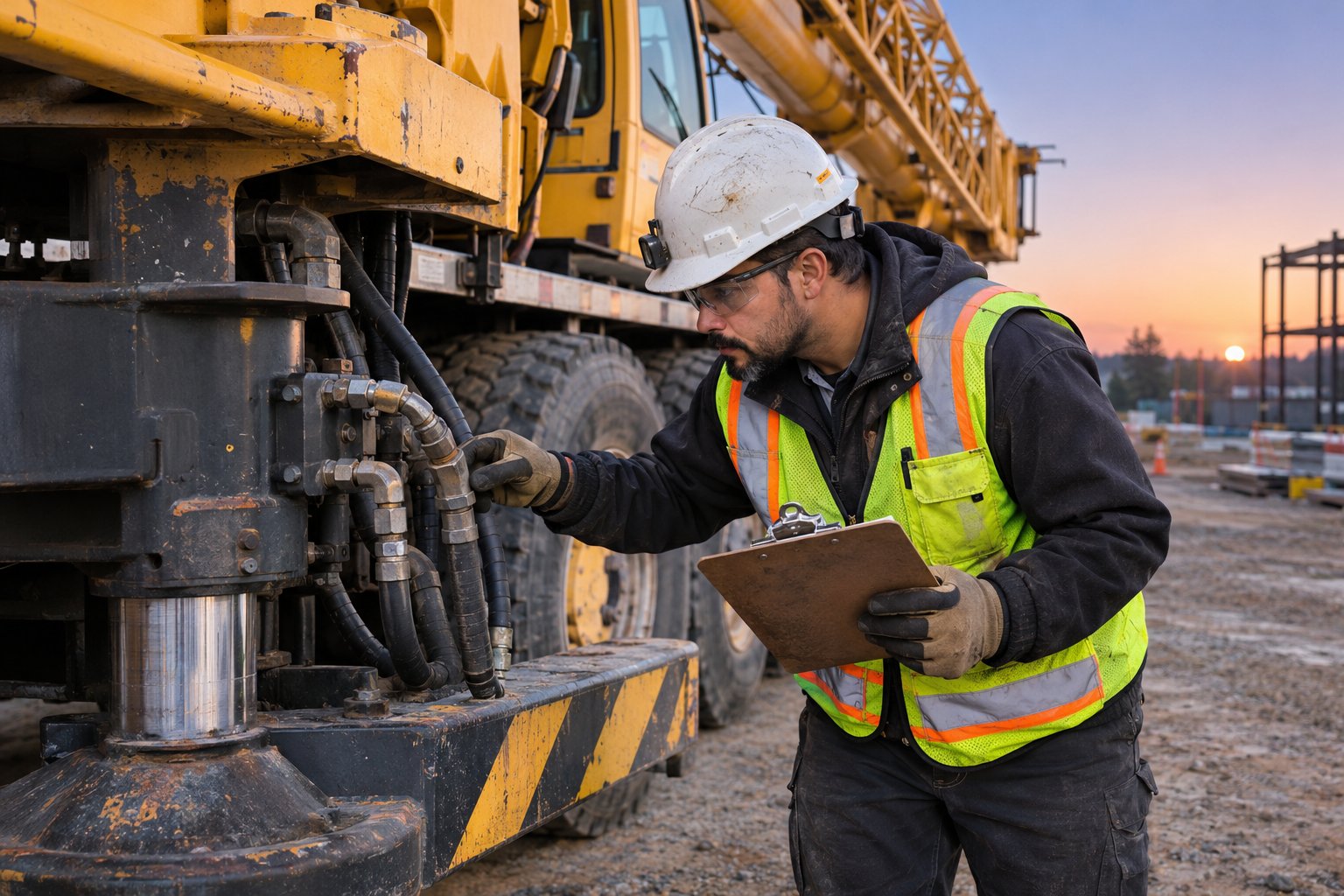
Safety regulations don't end once an operator is certified and evaluated. Every shift, before any names of machinery on a US jobsite begin productive work, federal standards require documented pre-operation inspections. For cranes, 29 CFR 1926.1412 spells out a layered inspection framework that escalates in rigor based on timing and conditions:
- Each-shift inspection — the operator or a qualified person must visually check control functions, safety devices, hydraulic and pneumatic systems, hooks, wire rope, and ground conditions before starting work. Any deficiency in safety devices or operational aids triggers mandatory corrective action before the crane can be used.
- Monthly inspection — a more thorough review covering structural components, running rope condition, and items not easily examined during daily walkarounds.
- Annual/comprehensive inspection — a detailed examination performed by a qualified person, typically documented in writing and retained as part of the machine's permanent maintenance record.
- Severe-service inspection — triggered whenever operating conditions suggest possible overloading, shock loading, or prolonged corrosive exposure. The equipment must be taken out of service until a qualified person clears it.
- Return-to-service inspection — any equipment idle for three months or more must receive a monthly-level inspection before returning to active use.
While Subpart CC prescribes the most detailed inspection tiers, Subpart O imposes similar pre-shift and periodic inspection obligations on earthmovers, dump trucks, loaders, and other motorized construction vehicles. Operators are expected to check brakes, steering, tires or tracks, lights, backup alarms, hydraulic hoses, and ROPS integrity before each use. The specifics vary by machine type, but the underlying expectation is consistent: no piece of highway construction equipment or general jobsite machinery should begin a shift without a documented once-over.
Neglecting these obligations creates a two-sided liability problem. On the safety side, uninspected equipment is statistically more likely to suffer mechanical failure — a blown hydraulic line on an excavator boom, a failed outrigger lock on a crane, a brake failure on a loaded dump truck descending a grade. On the legal side, OSHA investigators reviewing an incident will immediately request inspection and maintenance logs. Missing or incomplete records don't just suggest negligence — they virtually guarantee elevated penalties and potential willful-violation citations that can exceed $150,000 per instance.
Expected service life adds another dimension that most guides overlook. Major components like engines, hydraulic pumps, final drives, and undercarriage systems have manufacturer-recommended service intervals and projected lifespans measured in operating hours. A hydraulic excavator engine, for example, may be rated for 10,000 to 15,000 hours before a major overhaul becomes necessary. Tracking those hours — and scheduling preventive maintenance at the right intervals — directly affects both machine reliability and resale value. Firms that maintain rigorous service records consistently realize higher returns when trading or selling used equipment, while those that defer maintenance face cascading repair costs and unplanned downtime that disrupts project schedules.
The bottom line is straightforward: regulations, certifications, inspections, and maintenance aren't separate from equipment selection — they're embedded in it. The cost of operating any machine includes the cost of keeping it legal, keeping its operator qualified, and keeping its components within safe service limits. Contractors who treat compliance as overhead rather than infrastructure eventually pay far more in penalties, downtime, and liability than they ever would have spent on proactive programs. And that calculation — the true total cost of putting a machine to work — feeds directly into one of the most consequential financial decisions any construction firm faces: whether to rent that equipment, buy it new, or source it from the used market.
Buying vs. Renting and the Future of US Construction Equipment
Total cost of ownership, compliance overhead, and maintenance obligations all feed into one unavoidable question: should you rent the machine, buy it new, or find it on the used market? The answer isn't universal — it depends on how often you'll use it, how long you'll need it, and how much capital you can afford to tie up. Get this decision right and your fleet becomes a competitive advantage. Get it wrong and you're bleeding cash on machines that sit idle or scrambling for last-minute rentals at premium rates.
Rental vs. Purchase Economics for US Construction Firms
Imagine you run a mid-size earthwork company. Your excavator runs 220 days a year — that machine earns its keep, and ownership makes financial sense. But you also need a motor grader twice a year for road base finishing and a boom pump truck for occasional concrete pours. Buying those machines locks up six figures of capital in assets that sit parked eleven months out of twelve. That's where the rent-or-buy decision gets strategic.
Three variables drive this calculation more than anything else:
- Utilization rate — Equipment used fewer than 150 to 180 days per year generally costs less to rent than to own once you factor in depreciation, maintenance, insurance, and storage. Above 200 working days, ownership typically wins because fixed costs spread across enough productive hours to undercut rental rates.
- Project duration and predictability — A single 12-week bridge project favors rental for specialized road building equipment like pavers and graders. A three-year subdivision buildout with consistent excavation work justifies buying your core excavation equipment outright.
- Company size and capital position — Small contractors with variable workloads often benefit most from a hybrid approach: own the one or two high-utilization machines that run daily, and rent everything else as project demands shift. Large general contractors with predictable pipelines and in-house mechanics can justify broader ownership because they have the volume to keep machines working and the staff to maintain them.
The real ownership cost goes well beyond the purchase price. Heavy machinery typically depreciates 20% to 30% in the first year and retains only 40% to 60% of its value after five years. Annual maintenance runs 5% to 10% of the purchase price, insurance adds another 1% to 3%, and you still need somewhere to park and secure the equipment between jobs. Tack on the opportunity cost of capital — money tied up in a dozer can't fund payroll, marketing, or your next project bid — and the true annual cost of ownership is substantially higher than most contractors initially estimate.
Rental, by contrast, converts those unpredictable ownership expenses into a fixed operating cost. You pay for the days you use the machine, maintenance is typically included, and when the project wraps, the equipment goes back. For construction equipment types you only touch a few times a year — rollers, cold planers, specialty attachments — rental almost always pencils out.
Used equipment offers a middle path that's especially attractive for firms looking to expand capability without absorbing new-machine pricing. Pre-owned machines in good condition often sell for 40% to 60% below new equivalents, and auction values across multiple categories have risen in 2026, reflecting sustained demand in a market where available inventory has tightened. Contractors can evaluate used-market pricing through manufacturer-authorized dealers, auction platforms, and online suppliers. JIUHONG, for instance, lets contractors and equipment dealers browse categorized listings of used excavators, loaders, bulldozers, and graders and request purchase quotes — a useful step for benchmarking used-market pricing during your rent-vs-buy analysis. Keep in mind that JIUHONG is a machinery supplier, and quoted prices represent purchase pricing, not independent appraisals. Always verify machine condition, service records, and remaining component life before committing, regardless of the source.
Emerging Technology Reshaping US Equipment Fleets
The rent-or-buy decision doesn't exist in a vacuum. Technology is changing what these machines can do, how efficiently they do it, and how contractors manage entire fleets — which, in turn, affects which types of heavy construction machinery are worth investing in today versus waiting for the next generation.
Four technology trends are reshaping equipment selection decisions right now:
GPS machine control and 3D grading. GPS-guided systems mounted on dozers, excavators, and motor graders allow operators to grade to design specifications in real time — no survey stakes required. The machine's blade or bucket automatically adjusts based on a digital site model, reducing over-excavation, eliminating rework, and cutting project timelines. If you're evaluating a new grader or dozer purchase, factory-integrated machine control is rapidly becoming a baseline expectation rather than a premium add-on.
Telematics and intelligent fleet management. Modern construction machine names across every category — from compact excavators to articulated haulers — now ship with telematics hardware that streams location, engine hours, fuel consumption, idle time, and diagnostic fault codes to centralized dashboards. AI-powered fleet platforms are taking this further, moving beyond passive dashboards to systems that automatically flag underutilized assets, predict maintenance needs before breakdowns occur, and even notify managers when a machine has sat idle for days. One documented deployment across 50 pieces of equipment on a large infrastructure project achieved a 38% reduction in idling emissions over four months simply by surfacing real-time utilization data. For contractors managing mixed fleets across multiple jobsites, telematics has shifted from a nice-to-have to a cost-control essential.
Electric and hybrid equipment entering the US market. Battery-electric excavators, loaders, and compact machines are moving from prototype to production. The global electric construction equipment market is projected to grow from $3.81 billion in 2026 to $13.81 billion by 2033 at a 20.2% compound annual growth rate, driven by zero-emission mandates, improving battery economics, and expanding charging infrastructure. Electric models eliminate engine-related maintenance, reduce noise on urban jobsites, and lower fuel costs — but higher upfront pricing and jobsite charging logistics remain real constraints, especially for small to mid-size firms. The practical advice today: evaluate electric options for compact and repetitive-cycle machines first, where battery capacity already matches duty-cycle demands.
Semi-autonomous grading and compaction. Autonomous and semi-autonomous operation is no longer limited to mining haul trucks. GPS-guided dozers and compactors can now execute repetitive grading and compaction passes with minimal operator input, maintaining consistent coverage and density across large areas. These systems help address the skilled-operator shortage that continues to challenge the US construction labor market. They also produce machine-logged compaction data that satisfies documentation requirements on FHWA-funded projects — turning compliance from a paperwork burden into an automated byproduct of normal operations.
These trends don't make today's diesel-powered tools for construction names obsolete overnight. But they do mean that equipment purchased or leased in 2026 should be evaluated not just on current capability but on technology-readiness — does the machine support telematics integration, machine-control upgrades, and potentially hybrid or electric powertrains down the road?
Putting Your Equipment Plan Into Action
You've now walked through the full spectrum of construction equipment types organized by the workflow sequence they follow on a real US project — from earthmoving through lifting, hauling, compaction, paving, and finishing. You've seen how attachments multiply machine versatility, how sector-specific selection frameworks prevent costly mismatches, and how safety regulations and operator certification shape every deployment decision. Here's how to distill all of that into an actionable equipment plan:
- Identify your project category and scope. Residential, commercial, infrastructure, or industrial — the sector determines the weight class, machine types, and regulatory requirements you'll face. A clear project definition eliminates machines you don't need before you start shopping.
- Match functional equipment categories to the work phases. Map out which construction machine names appear at each stage: earthmoving for site prep, lifting for vertical construction, hauling for material flow, compaction and paving for finishing. Sequence matters — the wrong machine at the wrong phase creates bottlenecks downstream.
- Evaluate sizing tiers within each category. A compact excavator and a 90-ton excavator are both excavators, but deploying the wrong size wastes money in opposite directions. Match operating weight, dig depth, lift capacity, and production rates to the actual project demands — not to the biggest job you might land someday.
- Factor in attachment versatility. Before adding a dedicated machine to the fleet plan, ask whether an existing base machine with the right attachment can handle the task. Fewer machines with broader capability almost always beats a yard full of single-purpose equipment.
- Apply the rent-or-buy decision to each machine individually. Run the utilization math for every piece of equipment on the list. Own what you'll use 200+ days a year. Rent what you'll touch twice a season. Explore the used market for machines that fall in between — where lower acquisition cost makes ownership viable at moderate utilization rates.
- Verify operator certification and compliance requirements. Confirm that every operator holds the credentials required for the specific equipment and jurisdiction. Build inspection routines and maintenance schedules into your project plan from day one — not as an afterthought when an OSHA inspector arrives.
- Evaluate technology readiness. Prioritize machines that support telematics, GPS machine control, and future electrification pathways. The equipment you acquire today should still be competitive — and compliant — five years from now.
The types of heavy equipment used in US construction haven't changed in their fundamental purpose: they move earth, lift loads, haul materials, and build surfaces. What has changed is how strategically contractors deploy them. The firms that treat equipment selection as a disciplined, data-informed process — matching machines to workflows, sizing to scope, and sourcing to financial reality — consistently outperform those that buy on instinct and hope the numbers work out later. Your equipment plan is your competitive edge. Build it deliberately.
Frequently Asked Questions About Heavy Equipment in US Construction
1. What are the main categories of heavy equipment used on US construction sites?
US contractors organize heavy equipment into six functional categories that mirror the typical project workflow: earthmoving (excavators, bulldozers, graders, scrapers), lifting and hoisting (cranes, telehandlers, aerial lifts), material hauling (dump trucks, wheel loaders, skid steers), compaction (vibratory rollers, padfoot rollers, plate compactors), paving (asphalt pavers, slipform machines, cold milling equipment), and attachments that extend a single base machine's capabilities. Each category enters the construction sequence at a specific phase, from initial site clearing through final surface finishing. Knowing which machines belong to which category helps contractors allocate budgets, plan mobilization schedules, and avoid deploying oversized or undersized equipment.
2. What certifications do heavy equipment operators need in the United States?
Requirements depend on the equipment type. For cranes, OSHA 29 CFR 1926 Subpart CC mandates third-party certification from an accredited program such as NCCCO, CIC-Crane, or NCCER. NCCCO certification involves written and practical exams specific to each crane category and must be renewed every five years. States like California, New York, and Nevada impose additional licensing beyond the federal minimum. For non-crane heavy equipment such as excavators, loaders, and dozers, OSHA Subpart O requires employer-provided training and a documented competency evaluation before independent operation — though no federal third-party certification is required. Aerial lift operators must also receive equipment-specific training under Subpart L. Employers bear legal responsibility for verifying every operator's qualifications regardless of claimed experience.
3. How do contractors decide whether to rent or buy heavy construction equipment?
The decision hinges on three core variables: utilization rate, project duration, and capital availability. Equipment used fewer than 150 to 180 days per year generally costs less to rent once depreciation, maintenance, insurance, and storage are factored in. Machines running 200-plus days annually usually justify ownership because fixed costs spread across enough productive hours to beat rental rates. Used equipment offers a middle path — pre-owned machines in good condition often sell for 40% to 60% below new pricing, making ownership viable at moderate utilization. Suppliers like JIUHONG (https://jiuhong-machinery.com/products/) let contractors browse used excavators, loaders, bulldozers, and graders and request purchase quotes, which can help benchmark used-market pricing during a rent-vs-buy analysis. Regardless of the sourcing channel, always verify machine condition and service records before committing.
4. What is the difference between an articulated dump truck and a rigid dump truck?
The fundamental difference is chassis design, which dictates terrain capability and payload range. A rigid dump truck builds the cab and body on a single solid frame, delivering enormous payloads — 40 to nearly 700 tons — but requiring well-maintained, hard-packed haul roads and wide turning areas. An articulated dump truck (ADT) connects cab and body through a central pivot joint with six-wheel drive, giving it superior traction on muddy, sloped, or unfinished terrain at payloads of 25 to 60 tons. For most US subdivision, commercial grading, and highway earthwork projects where site conditions are variable, ADTs are the practical choice. Rigid trucks dominate open-pit mining and large quarry operations where haul roads are already established and maximum volume per trip is the priority.
5. How do attachments change the value of a base construction machine?
Attachments transform a single machine into a multi-tool platform, often replacing several standalone machines at a fraction of the cost. A hydraulic excavator fitted with interchangeable buckets, breakers, augers, thumbs, and plate compactors can handle trenching, demolition, drilling, material sorting, and backfill compaction — tasks that would otherwise require five or six dedicated machines, each with separate mobilization, operator, and ownership costs. Most attachments cost only 10% to 30% of the equivalent standalone machine. Skid-steer loaders benefit from a standardized quick-attach plate that accepts dozens of tool types, making them especially versatile for small to mid-size US contractors. When evaluating equipment purchases, comparing the breadth and cost of compatible attachments is just as important as comparing base machine specifications.