

What Is a Trackhoe and Why the Name Matters
Search for "trackhoe" and you'll find dozens of pages that dance around a real answer. Some mix it up with a backhoe loader, others treat it like a mysterious piece of equipment separate from anything in a manufacturer's catalog. The truth is much simpler — and once you understand it, every equipment decision that follows gets easier.
Trackhoe Defined in Plain Language
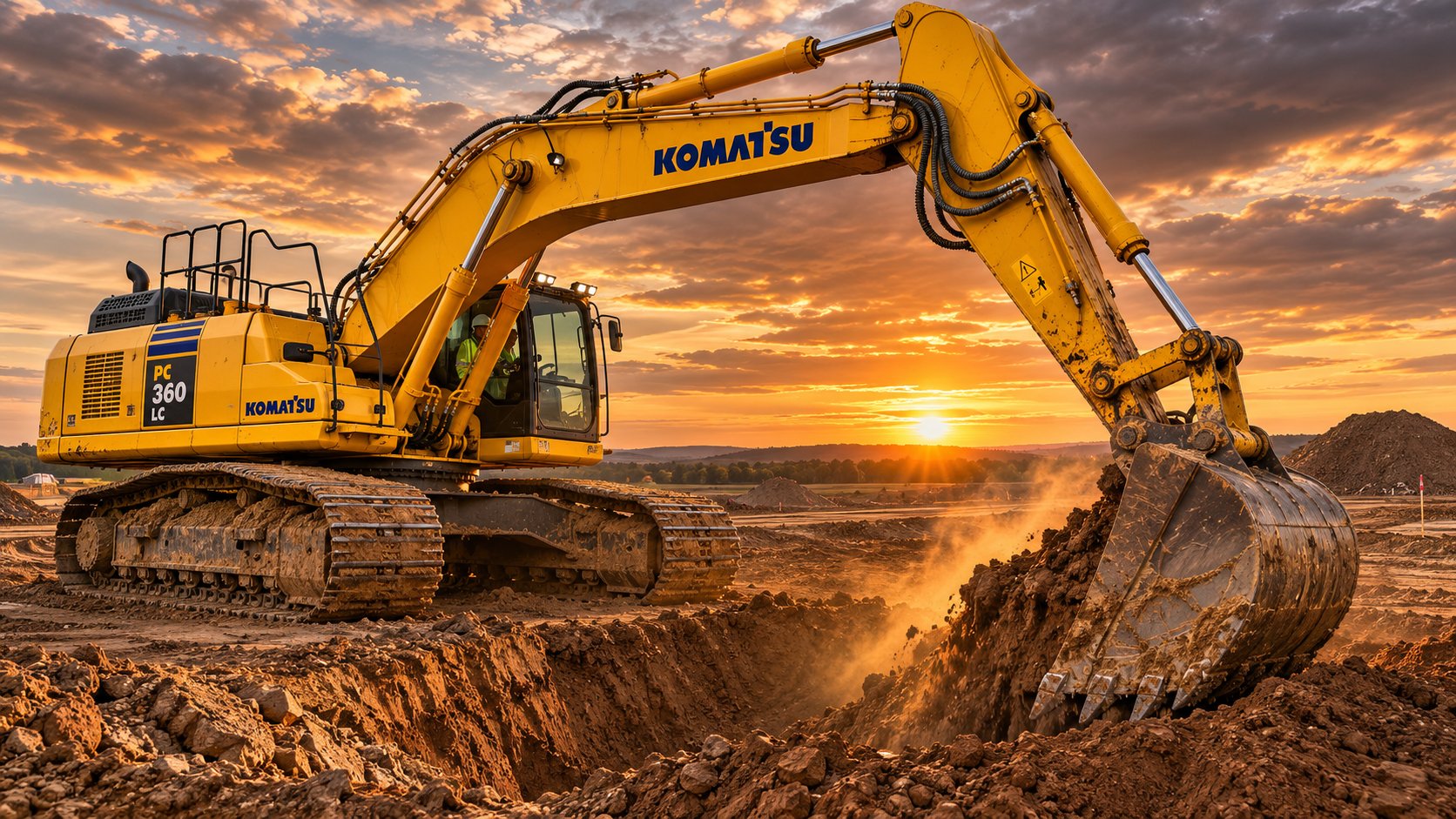
A trackhoe is a hydraulic excavator that moves on steel or rubber tracks, featuring a boom, stick, and bucket mounted on a 360-degree rotating upper structure (commonly called the house). The term is informal — popular on American jobsites — while "excavator" is the industry-standard name used in manufacturer specs and engineering documents. Both words point to the same machine.
Picture the classic construction scene: a heavy machine sitting on continuous tracks, its cab swiveling a full circle while the articulated arm digs, lifts, and swings material into a waiting truck. That is a trackhoe — or, in catalog language, a tracked excavator. The undercarriage uses interlocking track links instead of tires, spreading the machine's weight across a larger surface area. This design lowers ground pressure and delivers the traction needed for soft, muddy, or uneven terrain where wheels would simply sink or spin.
Above those tracks sits a rotating platform housing the engine, hydraulic pumps, counterweight, and operator cab. Because the upper structure spins independently of the undercarriage, an operator can dig in one direction and dump material in another without repositioning the entire machine. That full-rotation capability is one of the clearest features separating an excavator trackhoe from other earthmoving equipment.
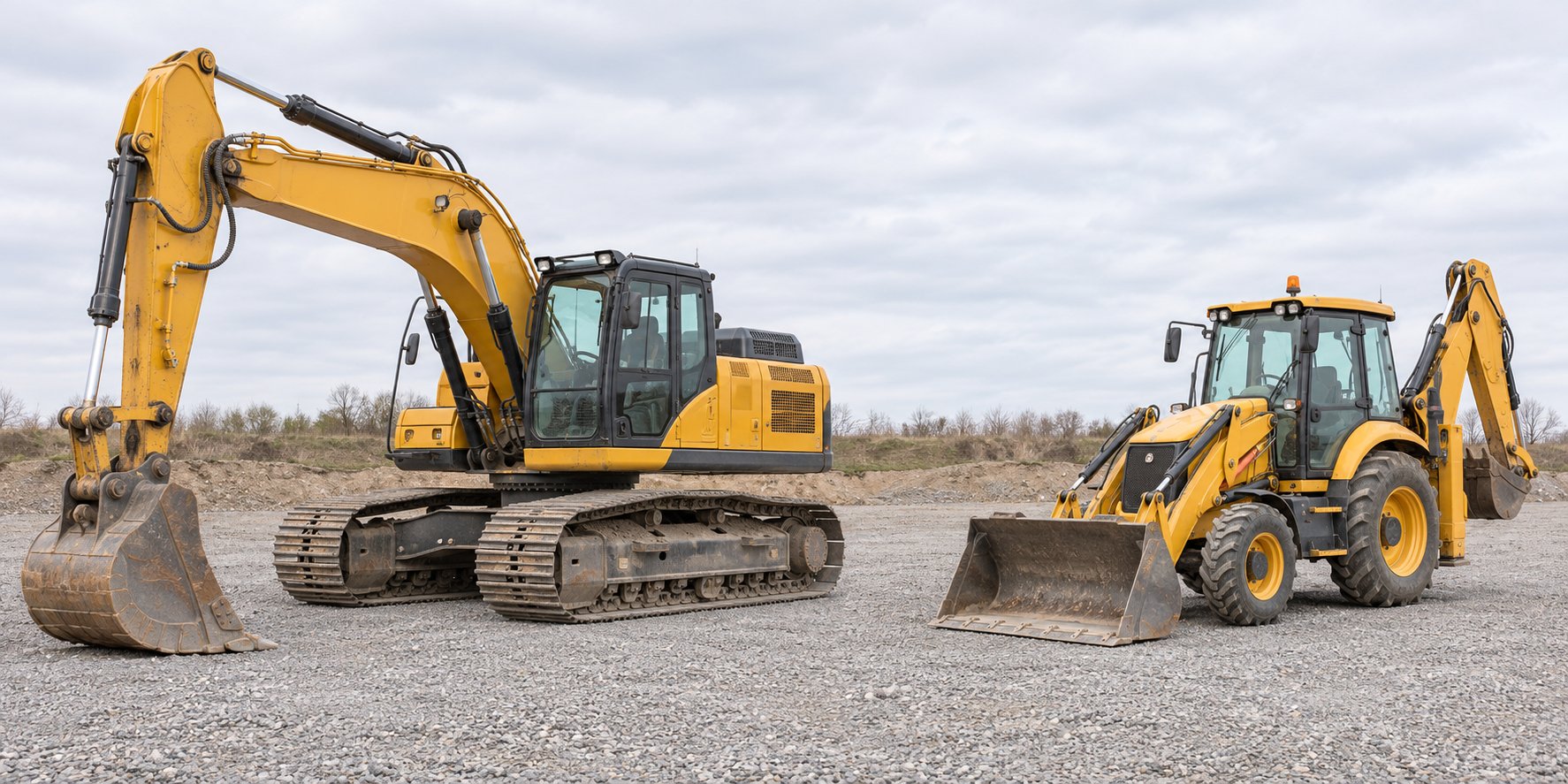
Here is an important distinction many articles blur: a track hoe is not the same thing as a backhoe loader. A backhoe loader is a wheeled machine that pairs a front loader bucket with a rear-mounted digging arm — and its digging assembly swings through a limited arc, not a continuous 360-degree rotation. Confusing the two can lead to renting or buying the wrong machine entirely, so we'll break down that comparison in detail further on.
Why This Guide Exists
Most search results stop at a surface-level definition. They'll tell you a trackhoe digs holes — helpful, right? What they rarely cover is which size class fits your project, what attachments transform the machine into a multi-tool platform, how much you should expect to pay (new, used, or rented), and how to build a practical decision framework before you spend a dollar. This guide fills that gap. In the sections ahead, you'll find terminology clarified, machine types compared side by side, size classes mapped to real-world applications, attachment ecosystems explained, cost tiers outlined, and a step-by-step selection checklist designed for contractors, equipment dealers, and import buyers alike.
The goal is straightforward: by the time you finish reading, the word "trackhoe" won't just be jobsite slang — it will be a shortcut to a clear mental model of what the machine is, what it costs, and exactly how to match one to the work at hand.
Of course, understanding the machine starts with understanding the name itself — and the story behind it reveals a lot about how American construction culture shapes the language of heavy equipment.
The Origin Story Behind the Word Trackhoe
Language on a construction site doesn't come from marketing departments — it comes from operators, laborers, and superintendents who need a fast, descriptive word for the machine rumbling ten feet away. That's exactly how "trackhoe" was born, and its etymology tells you everything about the practical mindset of the people who coined it.
How "Track" Plus "Backhoe" Became One Word
So what is a trackhoe in terms of pure word origin? It's a straightforward mash-up of two things a mid-twentieth-century construction worker could see and feel. The first half — track — describes the crawler undercarriage, the continuous steel or rubber tracks that carry the machine across rough ground. The second half — hoe — is shorthand for backhoe, referring to the digging motion where the bucket pulls material back toward the cab, the same way a garden hoe drags soil toward you.
During the decades when hydraulic systems gradually replaced cable-operated shovels, crews needed a way to distinguish the newer tracked excavators from the older rope-and-pulley machines — and from the wheeled backhoe loaders working alongside them. The solution was refreshingly literal: they combined what the machine rode on (tracks) with what it did (hoe-style digging) and started calling it a trackhoe. No committee voted on it. No manufacturer printed it on a decal. It simply spread from crew to crew, site to site, and eventually into rental catalogs and job postings across the country.
The trackhoe vs excavator distinction, then, isn't really a distinction at all. Both names point to an identical machine — a tracked, 360-degree-rotating hydraulic digger. One term grew out of American jobsite culture; the other lives in specification sheets, engineering documents, and manufacturer literature worldwide. Neither is wrong; they simply occupy different registers of the same language.
Regional Hotspots Where "Trackhoe" Rules
Geography plays a surprisingly strong role in which word you'll hear. In the Southern and Midwestern United States — think Texas, Georgia, the Carolinas, Tennessee, and the broader Gulf Coast corridor — "trackhoe" dominates everyday conversation on heavy civil, site development, and utility projects. According to placement data from Amundson Group, job postings in the South and Southwest frequently use "Trackhoe Operator" as the primary title, while the same role in the Northeast or on the West Coast more often reads "Excavator Operator" or "Heavy Equipment Operator."
Internationally, the split widens further. The UK and Ireland lean toward "digger" or "360" (short for 360-degree excavator). Australia and New Zealand also favor "digger." Manufacturer catalogs from Caterpillar, Komatsu, Hitachi, and every other major brand use "hydraulic excavator" — you won't find the word "trackhoe" in a single spec sheet. Yet on an American jobsite, calling it anything else might get you a puzzled look.
The trackhoe vs backhoe confusion often trips people up precisely because "backhoe" hides inside the word. But as we covered in the previous section, a backhoe loader is a completely different machine — wheeled, limited-swing, dual-purpose. Recognizing that the "-hoe" in trackhoe refers to the digging motion, not the backhoe loader itself, clears up that mix-up instantly.
One last practical note: plenty of people searching online don't spell it the "standard" way, and that's perfectly fine. All of the following variants lead to the same machine:
- Trackhoe — the most common single-word spelling
- Track hoe — two-word variant, equally valid
- Trac hoe — common shorthand in informal searches
- Trackho — frequent typo, same machine
- Trackhow — phonetic spelling that shows up regularly
- Tack hoe — misspelling, still means a hydraulic excavator
Every one of these points to the same piece of equipment: a tracked, full-rotation hydraulic excavator. The spelling doesn't change the specs, the capability, or the price — it only changes the search results you see.
With the name demystified and the regional picture clear, the natural next question is how this machine actually stacks up against the equipment it's most often confused with — especially the backhoe loader that shares part of its name.
Trackhoe vs Backhoe vs Excavator
Here's where most guides drop the ball. They'll list a few bullet points, toss around vague phrases like "excavators are bigger," and leave you guessing about the details that actually matter on a jobsite. The reality is more nuanced — and a structured, side-by-side comparison reveals exactly why choosing the wrong machine can cost you days and thousands of dollars.
Before diving into the table, let's clear up the single biggest source of confusion one final time. A trackhoe excavator is an excavator — specifically, one riding on a tracked undercarriage. Comparing "trackhoe vs excavator" is like comparing "pickup truck vs truck." One is a subset of the other. The comparison that actually matters pits the tracked excavator (trackhoe) against the backhoe loader — two fundamentally different machine configurations designed around different workflows. A wheeled excavator adds a useful third column because it borrows traits from both sides: excavator-style 360-degree rotation on a tire-mounted undercarriage.
Side-by-Side Comparison Table
| Feature | Trackhoe (Tracked Excavator) | Backhoe Loader | Wheeled Excavator |
|---|---|---|---|
| Undercarriage type | Steel or rubber tracks | Wheels (typically 4WD tires) | Wheels (rubber tires, often with outriggers) |
| 360-degree rotation | Yes — continuous full rotation | No — rear digging assembly swings through a limited arc | Yes — continuous full rotation |
| Typical dig depth range | ~5 ft (mini) to 30+ ft (large) | ~10–16 ft (varies by model/stick option) | ~14–22 ft (mid-range models common) |
| Travel mobility | Jobsite-bound; requires trailer for transport | Road-legal in most jurisdictions; self-transports between sites | Road-legal in many regions; faster travel than tracks |
| Attachment versatility | Very high — broad range of hydraulic attachments via quick coupler | Moderate — supports rear attachments; front loader adds loading capability | High — similar attachment range to tracked excavators |
| Operator position | Cab rotates with upper structure; operator always faces the work | Operator swivels seat or repositions between front and rear stations | Cab rotates with upper structure, same as tracked |
| Common weight classes | ~1 to 90+ metric tons | ~6–11 metric tons | ~9–23 metric tons |
| Typical cost tier | Wide range — mini units overlap backhoe pricing; larger units significantly higher | Lower entry point; generally least expensive of the three | Mid-to-upper range; premium over comparably sized tracked models |
| Best-fit use cases | Deep excavation, demolition, slope work, mass earthmoving, heavy attachments | Utility trenching, small landscaping, mixed dig-load-carry tasks, urban streets | Municipal work, paved surfaces, urban utility projects needing rotation |
Numbers in the table represent typical ranges across major manufacturers — always verify the specific model's spec sheet before committing to a rental or purchase. Dig depth, for instance, changes significantly between a standard stick and a long stick configuration on the same excavator model.
A few rows in that table deserve a closer look because they drive most real-world equipment decisions.
360-degree rotation is the single most impactful mechanical difference. On a hoe excavator — tracked or wheeled — the upper structure spins freely on a swing bearing. That means the operator digs in one direction, rotates to dump material into a truck parked at two o'clock, then swings back to the trench without ever moving the undercarriage. Cycle times shrink. Productivity climbs. A backhoe loader, by contrast, relies on a rear-mounted swing frame with a limited working arc — typically around 180 degrees. For single-trench jobs that's often enough, but for complex layouts or truck-loading operations it creates constant repositioning.
Ground contact and stability separate the tracked machines from everything on wheels. An excavator track distributes weight across dozens of contact points, lowering ground pressure and delivering traction in mud, loose fill, or on grades. Wheeled machines concentrate load through four (or sometimes more) tire contact patches. That's fine on compacted gravel or pavement, but it becomes a liability on soft or uneven terrain. Outriggers on wheeled excavators help during stationary digging, yet they add setup time and demand level ground.
Travel mobility flips the advantage. A backhoe loader drives itself to the next jobsite at road speed — no lowboy trailer, no pilot car, no permit headaches. A wheeled excavator can often do the same in many jurisdictions. A tracked machine, however, needs to be loaded and hauled every time it changes sites. For a contractor juggling five small utility jobs across town in a single week, that transport cost adds up fast.
When a Backhoe Loader Actually Wins
Dismissing the backhoe loader as "lesser" equipment misses the point entirely. In certain scenarios, it's the smarter pick — and sometimes the only practical one.
Imagine a municipal crew tasked with installing water service connections along a busy urban street. Each connection requires a relatively shallow trench, some pipe work, backfill, and then spoil removal. A backhoe loader handles every step from one seat: the rear boom digs the trench, the operator swivels forward, and the front loader scoops spoil into a dump truck or carries base material to the trench for backfill. When the connection is done, the machine drives two blocks to the next one — no trailer needed.
Backhoe loaders also shine in these situations:
- Small landscaping and residential grading where digging is intermittent and material constantly needs to be pushed, carried, or loaded.
- Farm and ranch work that mixes fence-post excavation with loader tasks like moving hay bales, feed, or gravel.
- Emergency utility repairs in congested areas — the machine arrives under its own power and sets up in minutes, with stabilizers providing steady support in tight spaces.
- Budget-sensitive operations that need one do-it-all machine rather than a dedicated excavator plus a separate wheel loader.
The trade-off is clear: you sacrifice continuous rotation, maximum dig depth, and heavy-attachment capability in exchange for road mobility, a built-in loader, and a lower price tag. For light-to-medium mixed-task work, that's often a winning deal.
When Only a Trackhoe Will Do
Some jobs don't leave room for compromise. When you encounter any of the following conditions, a tracked excavator is almost always the right call:
- Deep excavation — foundation pits, basements, or utility mains requiring dig depths beyond 16 feet push past what most backhoe loaders can reach. A mid-size trackhoe handles 20+ feet without breaking a sweat.
- Demolition — tearing down structures demands high breakout force, heavy hydraulic breaker attachments, and the stability to absorb constant impact. A tracked undercarriage keeps the machine planted; 360-degree swing lets the operator attack the structure from any angle.
- Slope and bank work — grading retention ponds, shaping roadside ditches, or cleaning drainage channels on grades where a wheeled machine would slide or tip. The low center of gravity and broad track footprint provide the necessary grip.
- Mass earthmoving — loading hundreds or thousands of cubic yards into haul trucks is an excavator's bread and butter. The continuous swing cycle — dig, rotate, dump, rotate back — becomes a rhythm that no limited-arc machine can match for sustained production.
- Heavy-duty attachments — hydraulic breakers, large grapples, compaction wheels, and rock rippers all demand the hydraulic flow, structural mounting, and counterweight that a full-size trackhoe provides. A backhoe loader's auxiliary hydraulics and frame simply aren't built for that level of force.
Think of it this way: a backhoe loader is a versatile multitasker, while a trackhoe is a dedicated production machine. When the scope of work centers on digging, swinging, and placing material in volume — or when terrain demands tracked stability — trying to save money with a backhoe loader usually costs more in lost productivity than the equipment savings are worth.
The real comparison was never trackhoe vs excavator — those are the same machine. The decision that matters is trackhoe vs backhoe loader, and the answer depends on depth requirements, rotation needs, terrain, and whether the job is dominated by digging or by a mix of digging and loading.
Settling the machine-type question is only half the equation. The other half is size — because a two-ton mini and a forty-five-ton workhorse are both trackhoes, yet they serve radically different projects and budgets.
Trackhoe Size Classes from Compact to Heavy
So what's a trackhoe in practical terms when you're standing in front of a dealer lot or scrolling through rental listings? It could be a nimble 3,500-pound machine that fits through a backyard gate — or a 200,000-pound beast that loads mining haul trucks all day. The word itself doesn't tell you the size, and size is exactly what determines whether a machine matches your project or drains your budget. Getting this wrong is one of the most expensive mistakes a contractor can make: rent too big and you're burning fuel and rental dollars you didn't need to spend; rent too small and you'll watch your schedule slip as an undersized machine struggles to keep pace.
Manufacturers and industry groups generally organize tracked excavators into four weight-based classes. The boundaries aren't razor-sharp — you'll see slight variations depending on who draws the lines — but the following breakdown reflects the ranges most dealers and equipment guides use.
| Size Class | Typical Operating Weight | Approximate Max Dig Depth | Common Applications | Example Models |
|---|---|---|---|---|
| Mini / Compact | Under ~6 metric tons (~13,200 lb) | 5–13 ft | Residential trenching, utility installs, landscaping, indoor demolition, tight-access work | Cat 305 CR, Kubota KX040-4, Bobcat E35, John Deere 30 P-Tier, Volvo EC37, CASE CX36C, Hitachi ZX50U-5N, Yanmar ViO35-7 |
| Mid-Size | ~6–20 metric tons (~13,200–44,000 lb) | 13–20 ft | General commercial excavation, municipal projects, grading, pipe work, truck loading | Cat 313, Komatsu PC138US, Kobelco SK140SRLC, Volvo EC140, John Deere 135G, CASE CX145D SR, Hitachi ZX135US |
| Standard / Full-Size | ~20–45 metric tons (~44,000–99,000 lb) | 20–24 ft | Heavy civil construction, road building, demolition, large foundation work, production truck loading | Cat 320, Cat 330, Komatsu PC210, Hitachi ZX350, Kobelco SK260, Volvo EC300, John Deere 345G, CASE CX350E |
| Large | Above ~45 metric tons (~99,000 lb+) | 24–32+ ft | Mining, quarrying, mass excavation, large infrastructure, dam and levee construction | Cat 374, Cat 395, Komatsu PC490, Hitachi EX1200, Kobelco SK500, Volvo EC480 |
Dig-depth figures in the table assume standard-length stick configurations. Swapping to a long stick or long-reach boom can add several feet — but it also reduces bucket breakout force, so there's always a trade-off between reach and raw digging power.
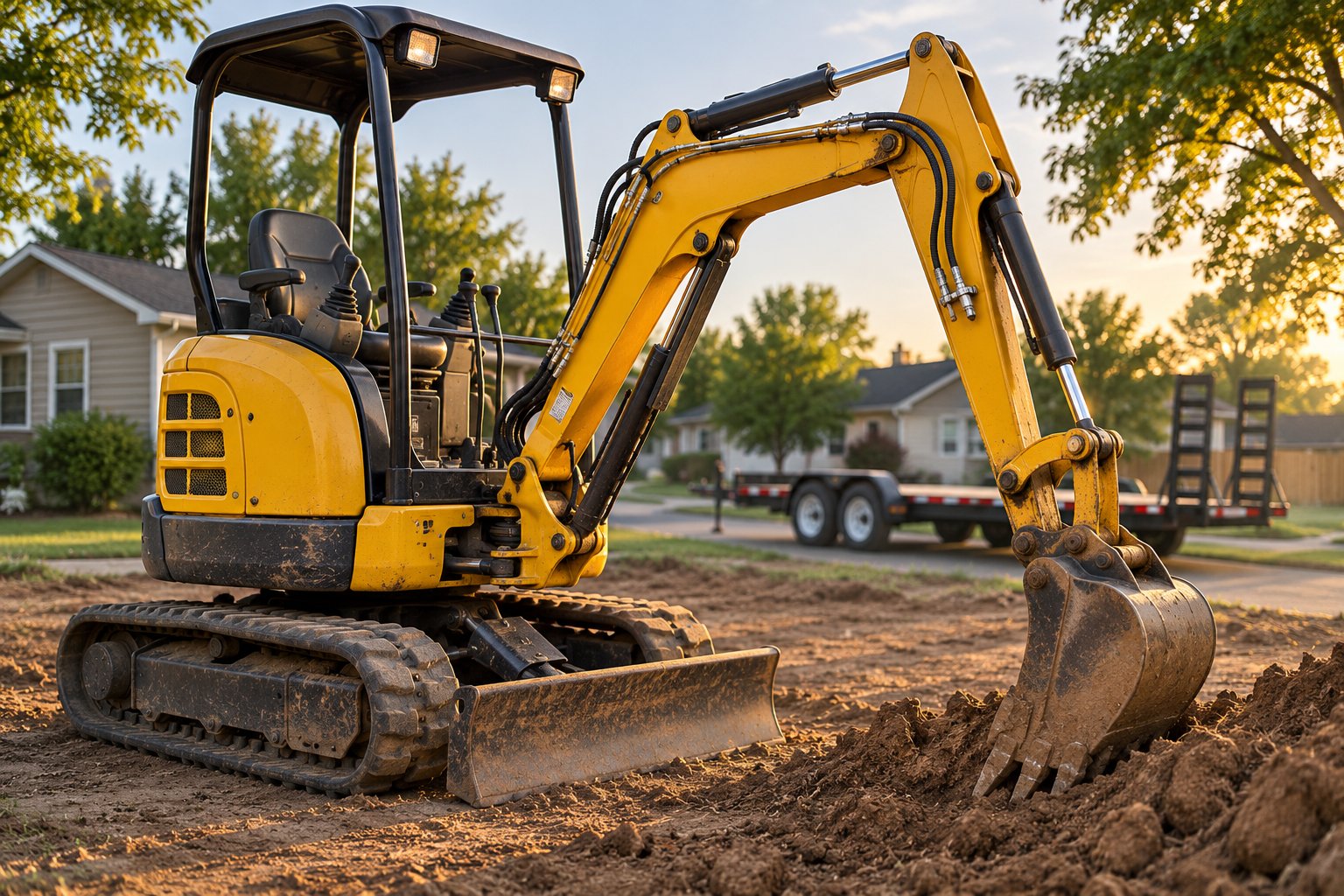
Mini and Compact Trackhoes
If you've noticed more small excavators crawling around residential neighborhoods and urban job sites over the past few years, you're not imagining it. Compact units are the second-highest-selling equipment category in the U.S. behind compact track loaders, with more than 34,500 new financed units sold in 2024 alone — a 4.5% jump over the prior year. The appeal is straightforward: these machines squeeze into spaces where a full-size trackhoe simply won't fit, yet they still deliver serious digging capability relative to their footprint.
Rubber tracks are standard on most minis, which means they roll across finished lawns, concrete driveways, and paved streets without chewing up the surface the way steel tracks would. Many models in this class also offer zero-tail-swing or reduced-tail-swing designs, meaning the counterweight and rear of the upper structure stay within the width of the tracks when the cab rotates. That's a game-changer in tight environments — imagine trenching alongside a building wall or between two houses with barely a foot of clearance on each side. A conventional tail swing would collide with the structure; a zero-tail model pivots freely without risk.
Examples of this compact engineering in action include the Cat 305 CR at roughly 12,700 pounds with a 12-foot dig depth, the Kubota KX080-5 that pushes the upper end of the class with 66.6 horsepower, and Yanmar's ViO35-7 — a zero-tail-swing unit whose redesigned hydraulic system boosted excavation efficiency by 7% over its predecessor. Cab comfort in this class has also leaped forward: heated seats, automatic climate control, color LCD monitors, and telematics platforms like Kubota's KubotaNow are increasingly standard rather than optional.
For anyone wondering about the backhoe vs trackhoe decision at this scale, a mini excavator often replaces the digging duties of a backhoe loader while occupying a smaller footprint and offering 360-degree rotation. The trade-off? You lose the front loader bucket, so you'll need a separate machine or manual labor for material-carrying tasks.
Mid-Size Through Large Trackhoes
Step beyond the compact class and you enter the weight range where most commercial contractors spend their careers. Mid-size machines — roughly 6 to 20 metric tons — hit a sweet spot of versatility. They dig deep enough for standard municipal water and sewer lines, load material into highway dump trucks at a productive pace, and still fit on a standard lowboy trailer without oversize permits in most states. Models like the Cat 313 (about 30,400 pounds, with a dig depth approaching 20 feet) and the Komatsu PC138US demonstrate why this class dominates general commercial excavation. Reduced-tail-swing variants — identified by suffixes like "SR" or "US" in model names — remain available here for urban projects where swing clearance is tight.
Standard or full-size trackhoes, spanning roughly 20 to 45 metric tons, represent the heavy lifters of everyday construction. A Cat 320 — often called the "fleet workhorse" — sits right in the middle at about 49,800 pounds, with a 22-foot max dig depth and 174 horsepower. Machines in this bracket handle road construction, deep foundations, structural demolition, and sustained production loading. Their hydraulic systems support the widest range of heavy-duty attachments, from large breakers and grapples to compaction wheels, making them genuine multi-tool platforms when paired with a quick coupler.
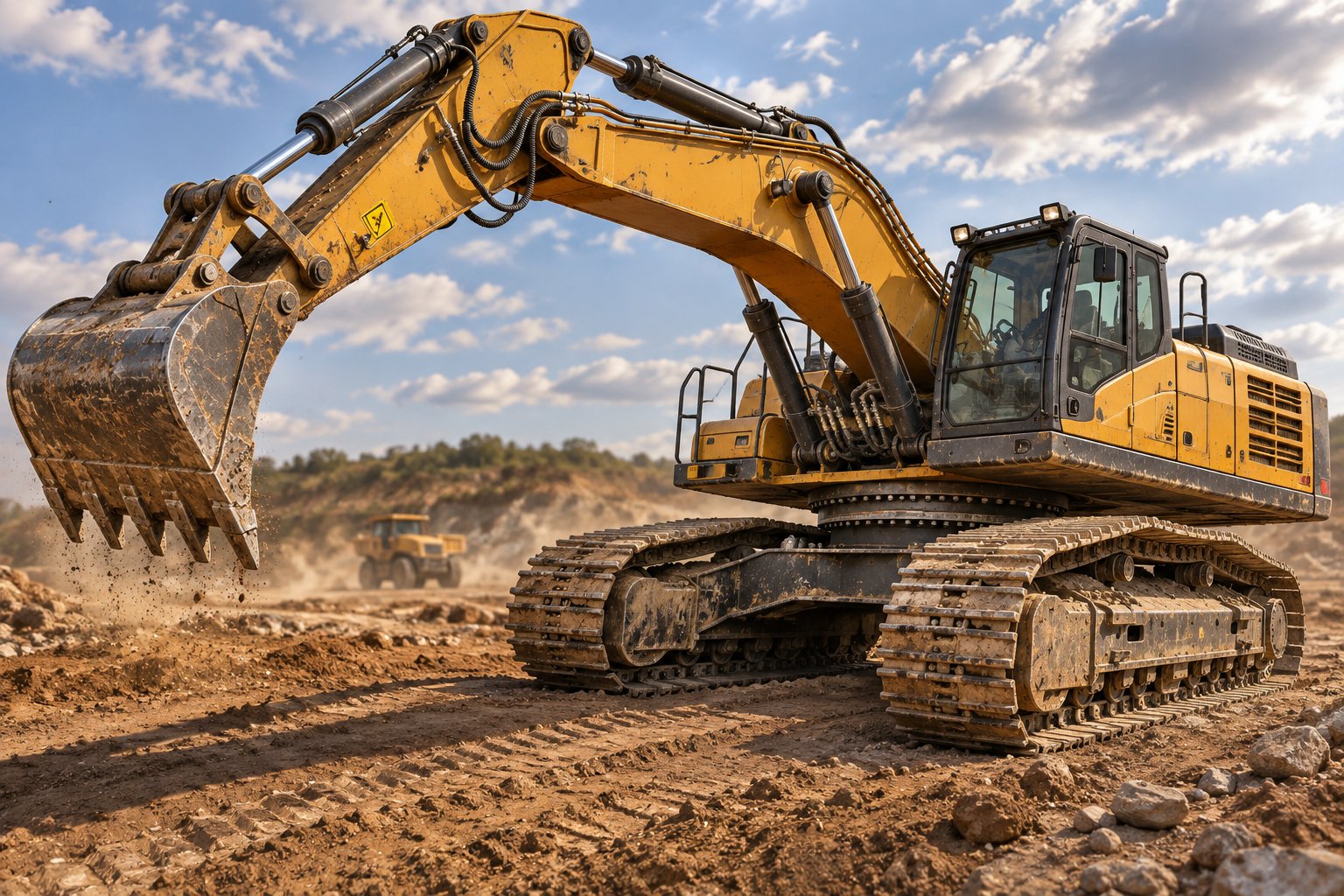
Large trackhoes push past 45 metric tons and into territory defined by raw output and scale. The excavator vs trackhoe label question disappears at this level — every manufacturer calls these machines excavators, and the operators running them rarely use any other term. A Cat 395, for instance, tips the scales at more than 207,000 pounds, produces 542 horsepower, and digs past 31 feet. These units earn their keep in mining, quarrying, and mass earthmoving where moving thousands of cubic yards per shift is the baseline expectation.
The principle connecting every class is the same: match the machine to the scope of work. A trac hoe that's one size too large wastes fuel and capital; one that's too small extends timelines and drives up labor costs. Think of the size chart not as a ladder to climb but as a menu to order from — pick the category that fits the job, then compare specific models within that class across brands to find the best balance of performance, availability, and price.
Of course, size only tells half the story of what a trackhoe can accomplish. The other half lives in the attachment ecosystem — the hydraulic breakers, thumbs, augers, and grapples that transform a single machine into an entire tool chest.
Attachments That Turn a Trackhoe Into a Multi-Tool
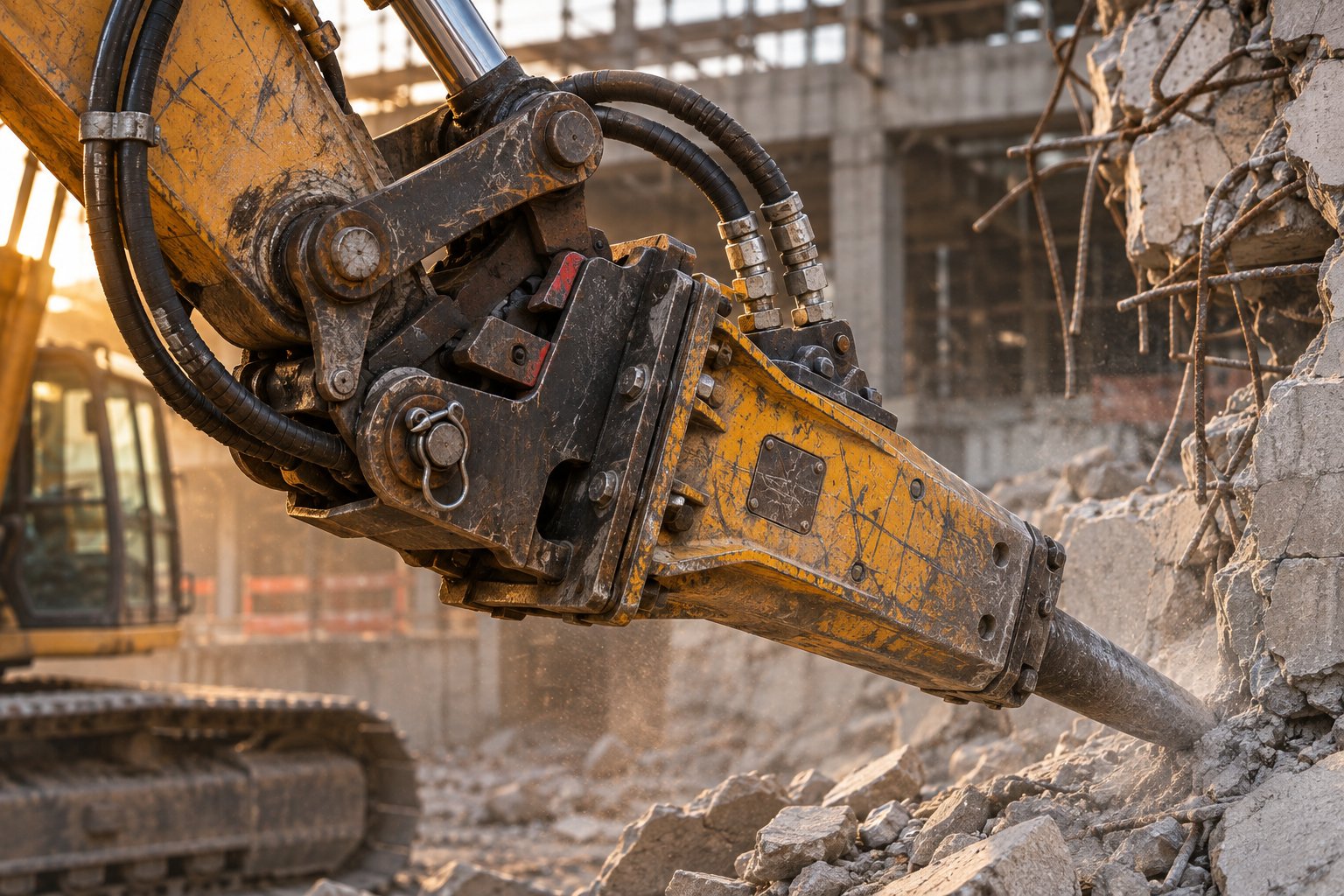
A track hoe excavator rolls off the assembly line with a standard digging bucket — and most people stop thinking about it right there. Dig a hole, load a truck, repeat. But that narrow view ignores the real reason contractors invest in these machines: with the right attachment pinned or coupled to the end of the stick, a single excavator can demolish a concrete foundation in the morning, drill pier holes after lunch, sort scrap metal before quitting time, and never leave the jobsite. The attachment ecosystem is what separates a one-trick digger from a genuine multi-tool platform, and it's a topic most equipment guides barely mention.
Here's a look at the major attachment categories available for tracked excavators, each designed to replace a standalone machine or a crew of manual laborers:
- Digging buckets — The default starting point, but far from one-size-fits-all. Standard buckets handle general-purpose excavation in soil and gravel. Heavy-duty buckets feature reinforced sidewalls and replaceable wear strips for rocky ground. Tilt buckets pivot side to side for precise grading on slopes. Clean-up buckets offer a wider, smooth-edged profile for backfilling and debris removal without the teeth that would snag material.
- Hydraulic breakers (hammers) — Built for smashing concrete, asphalt, and rock, these attachments deliver repeated high-energy impacts that can save days of manual labor on demolition and site preparation. They range from compact units for mini machines to massive hammers exceeding 10,000 foot-pounds of impact energy on large-class excavators.
- Hydraulic thumbs — A hinged steel "finger" mounted opposite the bucket that works like a mechanical hand, letting the operator grasp and hold irregularly shaped objects — logs, boulders, concrete chunks, stumps — that would otherwise roll out of a standard bucket. Paired with a digging bucket, a thumb turns any trackhoe into a capable material handler.
- Augers — Helical-bladed drilling attachments used for boring post holes, pier shafts, and utility conduit penetrations. Interchangeable bit diameters let one auger motor cover a range of hole sizes. They perform best in soil; rocky terrain may require a rock auger bit or pilot point.
- Grapples — Large hydraulic claws designed for grabbing, sorting, and placing material in demolition, recycling, and forestry work. Their high clamping force handles irregular objects — scrap steel, root balls, construction debris — that no bucket could manage cleanly.
- Rippers — Single- or multi-shank teeth that tear through frozen ground, compacted fill, or soft rock to loosen it ahead of bucket excavation. Particularly valuable in northern climates and on sites with heavily compacted subgrade.
- Compaction wheels — Vibrating or static roller wheels that attach to the stick and compact backfill material inside trenches and against structures — areas too confined for a ride-on roller to access.
- Brush cutters and mulchers — Rotary cutting heads that clear vegetation, saplings, and light timber for land-clearing, right-of-way maintenance, and fire-break construction without the need for a separate forestry machine.
That's a broad menu, and it raises an obvious question: how do you know which attachments actually fit your machine?
High-Impact Attachments Every Operator Should Know
You could spend hours browsing catalogs of niche tools, but on a typical general-construction site, five attachments account for the vast majority of track hoe versatility. If you're equipping a machine — or evaluating a used excavator's included accessories — these are the ones to prioritize.
- Standard digging bucket — It's already on the machine and handles 70–80% of daily excavation tasks. Choosing the correct width and tooth configuration for your primary soil type is the single easiest productivity win available.
- Hydraulic thumb — Adds grasping capability without removing the bucket, so you can seamlessly switch between digging and picking up debris, pipe sections, or tree stumps. Non-rotating thumbs are the most common and require only a standard auxiliary hydraulic circuit — typically 15–20 GPM.
- Hydraulic breaker — Demolition and rock removal appear on enough projects that a properly sized breaker pays for itself quickly. Mini excavators run small breakers at 10–20 GPM; machines above 20 tons may demand 40+ GPM through a dedicated high-flow circuit.
- Auger — Any project involving fence posts, sign poles, deck piers, or helical piles benefits from a hydraulic auger. A steady flow at moderate pressure — generally 15–25 GPM — keeps the bit turning smoothly, though you'll also need a case drain line to protect the motor's internal seals.
- Grapple — Sorting demolition debris, loading brush, or organizing recyclable material becomes dramatically faster with a grapple. Rotating models add a second hydraulic circuit for spin capability, so confirm your machine has the necessary auxiliary connections before ordering one.
Think of these five as the core toolkit. Everything else — rippers, compaction wheels, mulchers — builds on top of this foundation for specialized tasks.
Matching Attachments to Your Trackhoe's Hydraulic Capacity
Here's where expensive mistakes happen. An attachment that's physically the right size can still underperform — or cause real damage — if your machine's hydraulic system can't support it. Three compatibility factors deserve your attention before you buy or rent any powered tool:
- Hydraulic flow rate (GPM) — Every powered attachment has a required flow range. Run a breaker on too little flow and you get weak, sluggish impacts plus overheating. Push too much flow through an auger motor and you risk blowing seals. The attachment's spec sheet will list a minimum and maximum GPM; your machine's auxiliary circuit output must fall within that window. Crucially, don't rely solely on the published specs for older machines — hydraulic pumps lose output over time. A quick flow-meter test at operating RPM gives you the real number.
- Operating pressure (PSI) — Auxiliary circuits on most excavators deliver between 2,500 and 3,500 PSI. An attachment requiring more pressure than the machine can supply simply won't function at full capacity. Conversely, running a low-pressure attachment on an overpowered circuit can cause seal failure or catastrophic motor damage if pressure relief isn't properly set.
- Weight class matching — A general industry guideline suggests keeping attachment weight between 5% and 10% of the excavator's operating weight. Mount a breaker designed for a 20-ton machine onto a 7-ton unit and you introduce dangerous instability and hydraulic overload. Mount a tiny bucket on a 30-ton carrier and you waste fuel hauling an undersized tool through an oversized arm.
Beyond hydraulics and weight, the physical connection method matters enormously for daily productivity. A pin-on attachment mounts directly to the stick using steel pins — simple, secure, and the cheapest interface. The downside? Swapping takes a wrench, a hammer, and roughly 8 to 12 minutes with the operator outside the cab. On a single-task job that's fine. On a job requiring three tool changes per shift, those minutes add up fast.
A quick coupler changes the math entirely. Hydraulic quick couplers let the operator lock and release attachments from inside the cab in under a minute. As industry analysis from Waste Today Magazine points out, traditional manual changeouts can cost up to 20 minutes per swap — and operators who dread the hassle often avoid switching tools altogether, forcing the wrong attachment through a task it wasn't designed for. That reluctance drives unnecessary wear, slower cycle times, and sloppy results. A hydraulic coupler removes the friction, encouraging operators to grab the right tool for every phase of the job.
Safety is the other side of the coupler conversation. Improperly secured attachments have caused serious injuries and fatalities. OSHA documented 15 accidents between 1998 and 2005 involving unanticipated bucket releases from quick couplers on hydraulic excavators — eight of which were fatal. Modern hydraulic couplers address this with features like LED engagement indicators, wedge-locking mechanisms that maintain constant pin pressure, automatic safety knuckles, and time-out functions that re-engage the lock if the operator doesn't complete the detachment sequence. If your machine runs a quick coupler, invest in a current-generation unit with these safeguards — the productivity gains aren't worth much if the attachment falls off the stick.
The right attachment transforms a trackhoe from a digging machine into a demolition tool, a drilling rig, a material handler, or a land-clearing platform — but only if the hydraulic flow, pressure, weight class, and coupler interface all match.
Attachments expand what a trackhoe can do; technology changes how it does it. The latest generation of tracked excavators layers GPS grade control, telematics, and alternative powertrains onto the same platform — and those innovations are reshaping operating costs and productivity in ways that matter whether you're buying new, buying used, or renting by the week.
Modern Technology Reshaping the Trackhoe
Ten years ago, a track excavator was essentially an engine, a hydraulic pump, and a set of joysticks wrapped in a steel cab. The operator's skill determined the quality of the cut. Today? The machine itself knows where the design grade is, warns you when a person walks into the swing radius, and texts the fleet manager if the oil pressure drifts out of spec at two in the morning. The technology gap between a decade-old trackhoe and a current-production unit is enormous — and it directly affects operating costs, productivity, and resale value in ways that buyers and renters can't afford to ignore.
GPS Grade Control and Telematics
Imagine pulling a perfect slope on the first pass without a single survey stake in the ground. That's the reality of GPS/GNSS-based grade control — and it's quickly becoming the dividing line between trackhoes that earn their keep and those that don't.
Grade control systems use satellites, base-station corrections, and sensors mounted on the boom, stick, and bucket to track the cutting edge's position in three-dimensional space. An in-cab display shows the operator exactly where the bucket sits relative to the digital design surface — in real time, down to centimeter-level accuracy on advanced 3D setups. When the bucket reaches the target elevation, visual and audible alerts fire. Some systems go further: semi-automatic control takes over the boom and bucket cylinders so the operator only manages arm retraction speed, cutting grading times by up to 45 percent according to Volvo's Active Control benchmarks.
The technology comes in tiers, and matching the tier to the work matters more than buying the flashiest option:
- 2D grade indicate / guidance — Uses sensors on the machine plus a laser or benchmark reference to show depth and slope on the monitor. Ideal for straight trenches, foundations, and utility runs. Setup is minimal and costs start around $4,000 for an aftermarket upfit. Bobcat's Depth Check system, for instance, delivers real-time depth indication on compact excavators with visual and audible alerts — no GNSS signal required.
- 3D machine guidance — Adds GNSS positioning and a digital terrain model so the operator can work to complex, multi-elevation designs anywhere on the site. Retrofit solutions like Komatsu's Smart Construction 3D Machine Guidance bring this capability to excavators of virtually any brand, which is a major advantage for mixed fleets.
- 3D semi-automatic machine control — The machine actively controls boom and bucket movements to prevent over-excavation. Factory-integrated systems from Komatsu (iMC), John Deere (SmartGrade), and others enable operators of all skill levels to hit design grade consistently. These packages can exceed $50,000 fully installed, but the payoff is substantial: fewer passes, less rework, and reduced material waste.
The productivity gains aren't just anecdotal. CNH's precision sales team reports that contractors using 2D or 3D machine control see upward of 50 percent time savings through reduced rework cycles, fewer survey crew deployments, and higher first-pass accuracy. Every bucket movement guided by a digital design also generates as-built data — documentation of what was actually excavated — that project managers can use to verify quantities, track progress, and generate reports without additional field surveys.
Telematics runs alongside grade control as the second pillar of the modern trackhoe's intelligence layer. Every major manufacturer now offers a connected platform — Cat Product Link, Komatsu KOMTRAX, John Deere JDLink, Volvo ActiveCare Direct, and similar systems — that transmits machine data to a cloud dashboard accessible from any browser or smartphone. Fleet managers can monitor fuel consumption, idle-time percentages, engine hours, location history, diagnostic trouble codes, and upcoming maintenance intervals without stepping onto the jobsite. Advanced prognostics go deeper: Develon's Health Management system continuously monitors critical components like hydraulic oil condition, main pump health, and swing motor status, predicting maintenance needs before a breakdown strands the machine mid-shift.
For owners managing multiple trackhoes across scattered projects, telematics turns guesswork into data-driven decisions: which machines are underutilized, which operators burn excessive fuel at idle, and which units are approaching service intervals that could delay a project if missed.
Hybrid, Electric, and Reduced-Tail-Swing Innovations
The powertrain conversation has shifted dramatically. Komatsu's PC365-11 Hybrid — a 38-metric-ton production excavator — delivers a 15 percent productivity increase and 20 percent fuel reduction over non-hybrid equivalents by capturing swing-deceleration energy and reusing it during the next acceleration cycle. That's not a prototype in a lab; it's a machine shipping to dealers and working on real jobsites. Fully electric excavators — primarily in the mini and compact classes — are gaining traction for indoor demolition, urban projects with noise restrictions, and sites governed by zero-emission mandates. As battery density improves and charging infrastructure expands, expect electric options to creep into mid-size classes within the next few product cycles.
Reduced-tail-swing and zero-tail-swing designs represent another engineering trend visible across nearly every manufacturer's recent launches. The 2026 excavator buyer's landscape is packed with short-radius models — Case's CX145E SR, Link-Belt's 145 X4S with its five-foot tail swing, Volvo's ECR255, and Liebherr's new Generation 8 R 915 through R 920, to name just a handful. These machines squeeze the counterweight and engine compartment within or near the track width so operators can swing freely next to walls, traffic lanes, and adjacent structures without collision risk. Contractors working congested urban sites or road shoulders increasingly specify short-radius trackhoes as a non-negotiable requirement rather than a nice-to-have option.
Cab technology has evolved in parallel. Surround-view camera systems — now reaching 330 degrees on Develon's dash-9 series — stitch feeds from multiple cameras into a single bird's-eye image on the in-cab monitor, practically eliminating blind spots that once required a ground spotter. AI-powered human detection goes a step further: rather than triggering alarms for every static object, these systems distinguish between a person and a pile of dirt and can automatically stop swing and travel if someone enters the danger zone. Virtual Walls — digital boundaries programmed by the operator — prevent the boom from striking overhead power lines or swinging into restricted areas, essentially creating an electronic fence around the working envelope.
Inside the cab itself, you'll notice features borrowed from the automotive world: heated and cooled air-suspension seats, automatic climate control, wireless phone charging, Bluetooth connectivity, and even hot/cold storage compartments for food and drinks. Electro-hydraulic joystick controls — standard on most new-generation trackhoes from Caterpillar, Develon, Hyundai, John Deere, and others — let each operator customize response curves, saving individual profiles so the machine adjusts automatically when they log in. The choice between ISO and SAE joystick patterns (which lever controls boom vs. stick movement) is now software-selectable rather than a manual valve swap, accommodating operators trained on either convention without a trip to the shop.
All of this technology stacks up. A current-generation trackhoe equipped with grade control, telematics, surround-view cameras, and electro-hydraulic controls is measurably safer, faster, and more fuel-efficient than an identical-weight machine from 2015. That performance gap influences not just new-machine purchases but also the used market, rental rates, and the total cost of ownership equation — exactly the financial questions we'll unpack next.
Trackhoe Costs and the Rent vs Buy Decision
You've identified the right size class, you know which attachments the job demands, and the latest technology features are on your radar. One question remains — and it's the one that keeps contractors, fleet managers, and equipment dealers up at night: how much is this actually going to cost, and what's the smartest way to pay for it?
Most equipment guides dodge this question entirely or toss out a single dollar figure with no context. The reality is that trackhoe pricing depends on size class, brand, machine hours, included technology, and whether you're buying new, buying used, or renting by the week. Let's break it down with real pricing tiers drawn from current market data so you can plan with confidence rather than guesswork.
General Pricing Landscape by Size Class
Think of the pricing landscape as four distinct tiers that mirror the size classes covered earlier. Within each tier, the spread between new and used machines is significant — and that gap is where smart purchasing decisions live.
Mini and compact track-hoes (under ~6 metric tons) represent the most accessible entry point. New units from major brands like Caterpillar, Kubota, and Bobcat generally start around $75,000 and climb from there depending on features, cab enclosure, and auxiliary hydraulics. Used compact machines range widely — from roughly $10,000 for older, higher-hour units to $50,000 or more for late-model, low-hour examples. The sheer volume of minis in circulation keeps the used market well stocked, which works in the buyer's favor.
Mid-size machines (roughly 13–20 metric tons) occupy the general-construction sweet spot. Expect new pricing to land between $200,000 and $500,000 depending on brand and configuration — a Cat 320, Komatsu PC210LC, or John Deere 210G LC all cluster within this band. Used mid-size excavators typically trade between $50,000 and $150,000, delivering 20–40% savings over new-machine pricing while still offering thousands of productive hours remaining.
Standard and full-size units (roughly 20–45 metric tons) push into the $500,000–$800,000 range new. Models like the Hitachi ZX350LC-6 and Volvo EC380E live here. On the used side, expect $150,000 to $300,000 for well-maintained examples — a substantial investment, but a fraction of the new sticker price.
Large-class trackhoes (above ~45 metric tons) are purpose-built for mining, quarrying, and mass earthmoving. New pricing runs from $800,000 to well over $1,500,000 for machines like the Komatsu PC800LC or Caterpillar 390F L. Used units in this weight class range from roughly $300,000 to $550,000 or more, depending on hours, condition, and configuration.
A critical note on used pricing: the backhoe excavator difference in depreciation patterns matters here. Heavy equipment typically loses 20–30% of its value in the first year alone, with another 10–15% annually after that. A three-year-old trackhoe may have lost nearly 40% of its original value while retaining the vast majority of its productive life. That depreciation curve is what makes the used market so compelling — someone else absorbed the steepest part of the value drop, and you inherit a machine that still has years of work ahead of it.
Rental rates follow a parallel structure tied to machine size and rental duration. Here's what the current rental landscape looks like for tracked excavators:
| Size Class | Typical Daily Rate | Typical Weekly Rate | Typical Monthly Rate |
|---|---|---|---|
| Mini / Compact (3–6 ton) | $250–$450 | $800–$1,500 | $2,500–$4,500 |
| Mid-Size (13–20 ton) | $500–$900 | $1,600–$3,000 | $5,000–$9,000 |
| Standard / Full-Size (20–45 ton) | $800–$1,600 | $3,000–$5,000 | $8,000–$15,000 |
| Large (45+ ton) | $1,500–$3,000 | $4,500–$10,000 | $12,000–$30,000 |
Rates sourced from 2026 rental market analysis and industry pricing data. Your local numbers will shift based on geography, seasonal demand, and rental fleet availability.
Several factors push rental pricing higher than the base rate — and they're easy to overlook when budgeting:
- Delivery and pickup fees — $200 to $800 per round trip, depending on distance and machine size.
- Damage waiver — Typically 10–15% added to the base rate, covering accidental damage but not negligence.
- Attachment add-ons — Breakers, thumbs, and specialty buckets are often billed separately from the base machine rental.
- Fuel — You fill the tank; large trackhoes can consume 5–10 gallons of diesel per hour under load.
- Overtime and hour caps — Many daily rates assume an 8-hour day. Exceed that and surcharges kick in.
A practical tip that saves real money: most rental companies price weekly rates at roughly 3–4 times the daily rate, and monthly rates at about 3 times the weekly rate. If you need a machine for five or more days, always book the weekly rate. For three or more weeks, lock in the monthly. That simple adjustment can cut 30–40% off your total rental bill compared to daily billing.
Rent, Buy New, or Buy Used — A Decision Framework
Sounds like a lot of options. How do you actually decide? The answer comes down to one number: your utilization rate — the percentage of available working hours you'll actually run the machine.
Here's the formula:
Utilization Rate = (Actual Hours Used per Year / Available Hours per Year) x 100
With roughly 2,080 available working hours in a year (260 days times 8 hours), a machine running 1,200 hours sits at about 58% utilization. That single percentage shapes the entire financial picture. Industry benchmarks suggest these thresholds:
- Under 40% utilization (~830 hours/year or less) — Renting almost always wins. Ownership costs — insurance, storage, maintenance, depreciation — pile up whether the machine works or sits.
- 40–60% utilization (~830–1,250 hours/year) — The gray zone. Run detailed cost-per-hour analysis for both scenarios before committing. Buying used often tips the scale toward ownership in this range because the lower purchase price reduces the break-even threshold.
- Above 60% utilization (~1,250+ hours/year) — Ownership makes strong financial sense. At this usage level, your cost per hour drops well below cumulative rental charges, and you build equity in an asset with resale value.
To make this framework concrete, consider a mid-size excavator. Purchased new at $250,000, the total annual cost of ownership — including financing at 6–7%, insurance, preventive maintenance, major repair reserves, storage, and depreciation — can reach $52,000–$60,000 in Year 1. Run 1,500 hours and your true cost lands around $35–$40 per hour. Run only 500 hours and that same cost balloons to $104–$120 per hour — territory where a $700/day rental starts looking like a bargain.
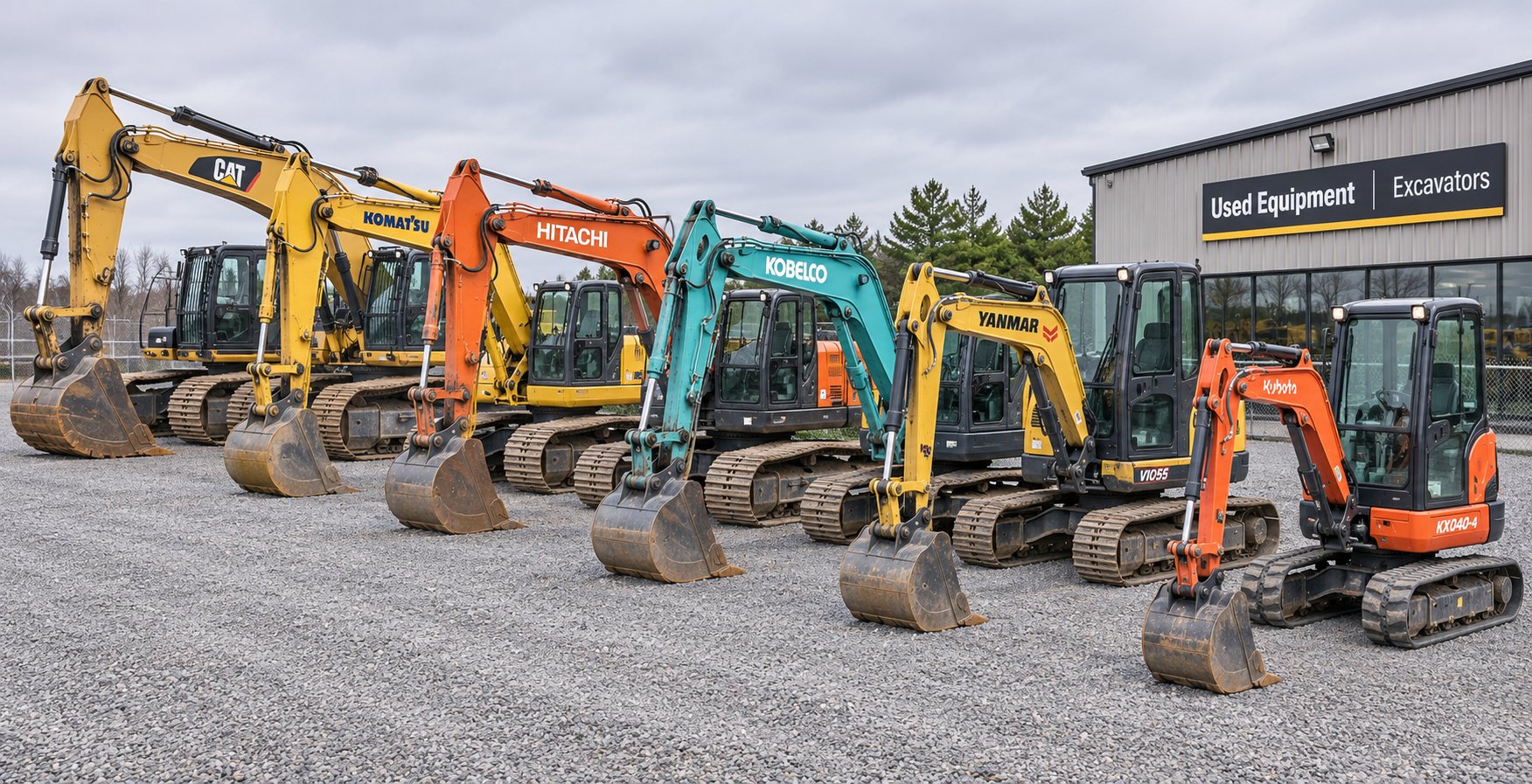
Buying used reshapes the math dramatically. A comparable three-year-old machine at $150,000 slashes the financing burden and front-loads the depreciation that's already occurred. Your annual ownership cost drops, the break-even utilization threshold falls, and you still build equity in a machine with substantial productive life remaining. For contractors and dealers comparing across manufacturers, platforms like JIUHONG's used excavator collection — which brings together compact and larger machines from multiple brands — make it practical to evaluate listings side by side and request model-specific quotes for individual or bulk purchases. Worth noting: equipment exported from China through platforms like this isn't necessarily manufactured by a Chinese brand; the inventory often includes globally recognized names like Caterpillar, Komatsu, and Hitachi.
Beyond utilization, a few additional factors deserve weight in your decision:
- Tax advantages of ownership — Section 179 allows businesses to deduct the full purchase price of qualifying equipment in the year of purchase, up to $1,220,000. For a contractor in the 24% federal bracket, buying an $85,000 compact excavator and taking Section 179 effectively saves roughly $20,400 in Year 1 taxes — a discount that can shift the break-even point by 30–50 rental days.
- Maintenance responsibility — Renters hand breakdown risk to the rental company. Owners carry that burden, but they also control the quality of care. A well-maintained owned machine often outperforms a fleet rental unit that's been run hard by a dozen different operators.
- Availability risk — During peak construction season, rental fleets thin out fast. Owning your core machines guarantees you're never sidelined because someone else booked the last available unit.
The following table summarizes the three paths in a format you can reference quickly when the decision is on the table:
| Factor | Buy Used | Buy New | Rent |
|---|---|---|---|
| Upfront cost | Moderate — 20–60% less than new | Highest — full MSRP plus tax and delivery | Lowest — no capital outlay beyond deposit and first period |
| Long-term cost | Low to moderate — reduced financing, slower depreciation from purchase date | Moderate — offset by warranty coverage and lower early maintenance | High if utilization exceeds ~40%; cumulative rental charges compound over time |
| Flexibility | Moderate — can sell or trade as needs change | Moderate — same resale flexibility but deeper depreciation hit if sold early | Highest — return the machine when the job ends, no long-term commitment |
| Equity building | Yes — asset retains resale value, especially well-maintained units | Yes — strongest initial equity position, but rapid early depreciation | None — every payment is a pure expense with no residual asset |
| Maintenance burden | Owner responsibility — higher vigilance needed on older components | Owner responsibility — mitigated by manufacturer warranty (typically 2–5 years) | Rental company's responsibility for major mechanical issues |
The cheapest trackhoe is not the one with the lowest price tag — it is the one whose total cost per hour, over its working life, delivers the best return for the jobs you actually perform.
Many successful contractors land on a hybrid strategy: own the core machines running at high utilization and rent specialty or overflow units for short-term peaks. That approach keeps capital working efficiently without leaving expensive iron parked in the yard during slow months.
Whichever path you choose, the financial picture doesn't end at the purchase or rental agreement. The ongoing costs of keeping a trackhoe productive and safe — especially undercarriage maintenance and jobsite compliance — represent the next layer of the ownership equation, and they're the expenses that catch unprepared buyers off guard.
Maintenance Essentials and Jobsite Safety for Tracked Excavators
Buying or renting a trackhoe is only the beginning of the cost story. The expenses that separate profitable machine ownership from a money pit show up after the deal closes — in daily maintenance habits, undercarriage wear, and the safety practices that keep people alive around a 40,000-pound machine swinging a bucket full of dirt. These are the ownership realities most equipment guides skip, and they're exactly the details that catch first-time buyers off guard.
Undercarriage Care — The Biggest Maintenance Cost
If you own a tracked excavator, the undercarriage is where your maintenance budget lives. Tracks, rollers, idlers, sprockets, and track shoes collectively account for up to 50% of a machine's total lifetime maintenance cost. That's not a typo — half your maintenance dollars go to the components touching the ground. Neglect them, and a stalled machine can cost $800 to $1,500 per day in lost production. Understand them, and you gain one of the clearest advantages an owner-operator can have over someone who treats an excavator with tracks like a "set it and forget it" investment.
Here's what to watch — and why each item matters:
- Track tension — Tracks stretch with use. Manufacturers generally allow 3–4% elongation from the original pin-to-pin measurement before replacement becomes necessary. Too loose and the track jumps off the sprocket during turns (a "thrown track" that can sideline a machine for hours). Too tight and you accelerate wear on every component the track contacts — rollers, idlers, and sprockets all pay the price. Check tension daily by measuring the sag between the top carrier rollers; your operator's manual specifies the allowable range, and it varies between steel and rubber track configurations.
- Rollers and idlers — Bottom rollers carry the machine's full weight. Top rollers guide the track's return path. Front idlers maintain tension. Their average service life falls between 2,000 and 4,000 hours, but working conditions heavily influence where in that range your components land. The telltale failure sign? Oil leaking from a roller seal. Once the seal goes, the roller loses lubrication, seizes, and drags — destroying both itself and the track surface beneath it. Idler flange wear is equally critical; flanges keep the track centered, and they can lose up to 2 mm per 1,000 hours on hard demolition surfaces. When flanges wear below the manufacturer's minimum, the track derails during turns — a dangerous and expensive failure.
- Sprockets — The drive sprocket engages the track links to propel the machine. Worn sprocket teeth slip against the links, creating a grinding action that chews through both components simultaneously. Replacing sprockets and tracks together is standard practice because a new track on a worn sprocket (or vice versa) accelerates wear on the new part.
- Track shoes and links — Bushings and pins act as the track chain's joints. Lateral play of more than a few millimeters between links signals critical internal wear. Some bushings can be "turned" — rotated to expose a fresh working surface — which buys additional life before full replacement. However, if the repair cost exceeds 60–65% of a new part's price, replacement is almost always the more profitable decision.
What accelerates all of this wear? Rocky terrain, excessive travel speed, sharp counter-rotations (spinning one track forward while the other goes backward), and incorrect track tension can reduce undercarriage lifespan by up to 50%. Two daily habits push back against that damage curve more effectively than any other intervention:
- End-of-day cleaning — Hardened mud, wet clay, and embedded stones act as constant abrasives, grinding against seals and creating pressure points. Five minutes with a pressure washer or shovel at the end of every shift protects components that cost thousands to replace.
- Visual inspection and measurement — Walk around the machine before start-up. Look for oil weeping from roller seals, loose hardware, cracked track shoes, and uneven wear patterns. Every 250–500 hours, use a caliper to measure flange height, roller diameter, and track stretch against factory specs. Catching a failing component early lets you schedule the replacement during planned downtime rather than losing a day mid-project.
Beyond the undercarriage, a thorough daily walkaround adds just a few more minutes and catches problems that snowball when ignored:
- Fluid levels — Engine oil, hydraulic fluid, and coolant should all hit their marks before the key turns. Low hydraulic fluid starves the pumps; low coolant invites overheating and catastrophic engine damage.
- Pin and bushing wear on the boom and stick — Excessive play in pivot points translates to sloppy bucket control and accelerated structural fatigue. A quick visual check for grease weeping from joints or abnormal movement reveals wear before it becomes a repair emergency.
- Bucket teeth condition — Worn or missing teeth force the bucket lip into direct contact with the ground, wearing through the lip edge and reducing breakout force. Replacing a $30 tooth is infinitely cheaper than welding or replacing a bucket lip.
- Hydraulic hoses — Look for bulging, cracking, chafing, or wet spots along every visible hose run. A failed hydraulic hose under pressure doesn't just leak — it sprays superheated fluid capable of causing severe burns or injection injuries.
Jobsite Safety and Operator Qualifications
A well-maintained backhoe track system and a perfectly tuned engine mean nothing if someone gets hurt. Trackhoe operations involve some of the highest-risk activities in construction — and OSHA's enforcement data reflects that reality. Understanding the regulatory landscape isn't optional; it's the baseline for every operator and every contractor running one of these machines.
Excavation and trenching standards sit under 29 CFR 1926 Subpart P, and they apply the moment a trackhoe breaks ground on any trench, foundation, or below-grade excavation. The core requirements include:
- A competent person must be on-site during all trenching operations. This is someone who can identify existing and predictable hazards in the surroundings and has the authority to take immediate corrective action — not just an experienced operator, but a specifically trained individual who understands soil classification, protective systems, and excavation inspections.
- Trenches five feet deep or more require a protective system — sloping, benching, shoring, or a trench shield — unless the excavation is in stable rock. No exceptions.
- Spoil piles, equipment, and materials must be kept at least two feet from the edge of the excavation to prevent cave-in loading.
- A safe means of egress (ladder, ramp, or stairway) must be available within 25 feet of any worker inside a trench.
Swing-radius hazard zones present a danger unique to machines with 360-degree rotation. The counterweight on a full-size tracked excavator can extend several feet beyond the tracks during swing — and that mass moves fast enough to pin or crush a ground worker who steps into the arc. Effective mitigation requires clearly defined exclusion zones around the machine, high-visibility barricading, and direct communication between the operator and every person on the ground. Many modern trackhoes now offer AI-powered human detection and automatic swing stops (covered in the technology section), but technology supplements — rather than replaces — the fundamental practice of maintaining a clear swing zone.
Underground utility location is a non-negotiable step before any digging begins. Calling 811 (or your state's equivalent call-before-you-dig service) at least a few business days before excavation triggers utility locators to mark buried gas, electric, water, sewer, and telecom lines. Underground utility strikes rank among the most common and costly excavation incidents — and they're almost entirely preventable with proper locate procedures and careful digging within the tolerance zone around marked lines.
Communication protocols round out the safety picture. Hand signals between ground workers and operators need to be established and understood before work begins — not improvised on the fly. OSHA requires that signals be clear, consistent, and known to all parties. On noisy sites, two-way radios supplement visual signals, and a designated signal person coordinates movements during critical lifts or blind-spot operations.
What about licensing? Here's where confusion runs rampant. There is no single federal "trackhoe license" or "excavator license" in the United States. OSHA requires that only trained and competent operators run heavy equipment, but the agency does not mandate a specific certification card. In practice, the path to becoming a qualified operator typically involves a combination of:
- OSHA 10-Hour or 30-Hour Construction Safety Training — Widely recognized programs covering hazard recognition, equipment safety, trenching hazards, and fall protection. Many employers require one of these before an operator steps onto a jobsite.
- Competent person training for excavation — Specialized courses covering soil classification, protective systems, excavation inspections, and regulatory requirements. Particularly valuable for foremen, superintendents, and lead operators.
- Equipment manufacturer training — Machine-specific programs covering controls, daily inspections, maintenance procedures, and advanced technology systems like grade control.
- NCCCO or equivalent certification — The National Commission for the Certification of Crane Operators is best known for crane credentials, but many general contractors and project owners request NCCCO or similar third-party certification as evidence of operator competency — especially on municipal, infrastructure, and industrial projects.
The bottom line: while no single card grants universal permission to run a tracked excavator, employers are increasingly assembling a stack of credentials — OSHA training, manufacturer programs, and third-party certifications — that collectively demonstrate an operator's competency. For operators looking to stand out in the hiring market, investing in documented training is one of the clearest competitive advantages available.
A trackhoe is only as safe and productive as the maintenance habits and safety culture surrounding it — no amount of horsepower compensates for a neglected undercarriage or an untrained person in the swing zone.
Maintenance keeps the machine running. Safety keeps people whole. Together, they form the unglamorous but essential foundation beneath every cost projection and productivity estimate. With these ownership realities in clear view, the final step is pulling everything together — size class, attachments, technology, budget, and safety requirements — into a practical decision framework that guides you from research to the right machine for the job at hand.
How to Choose the Right Trackhoe for Your Project
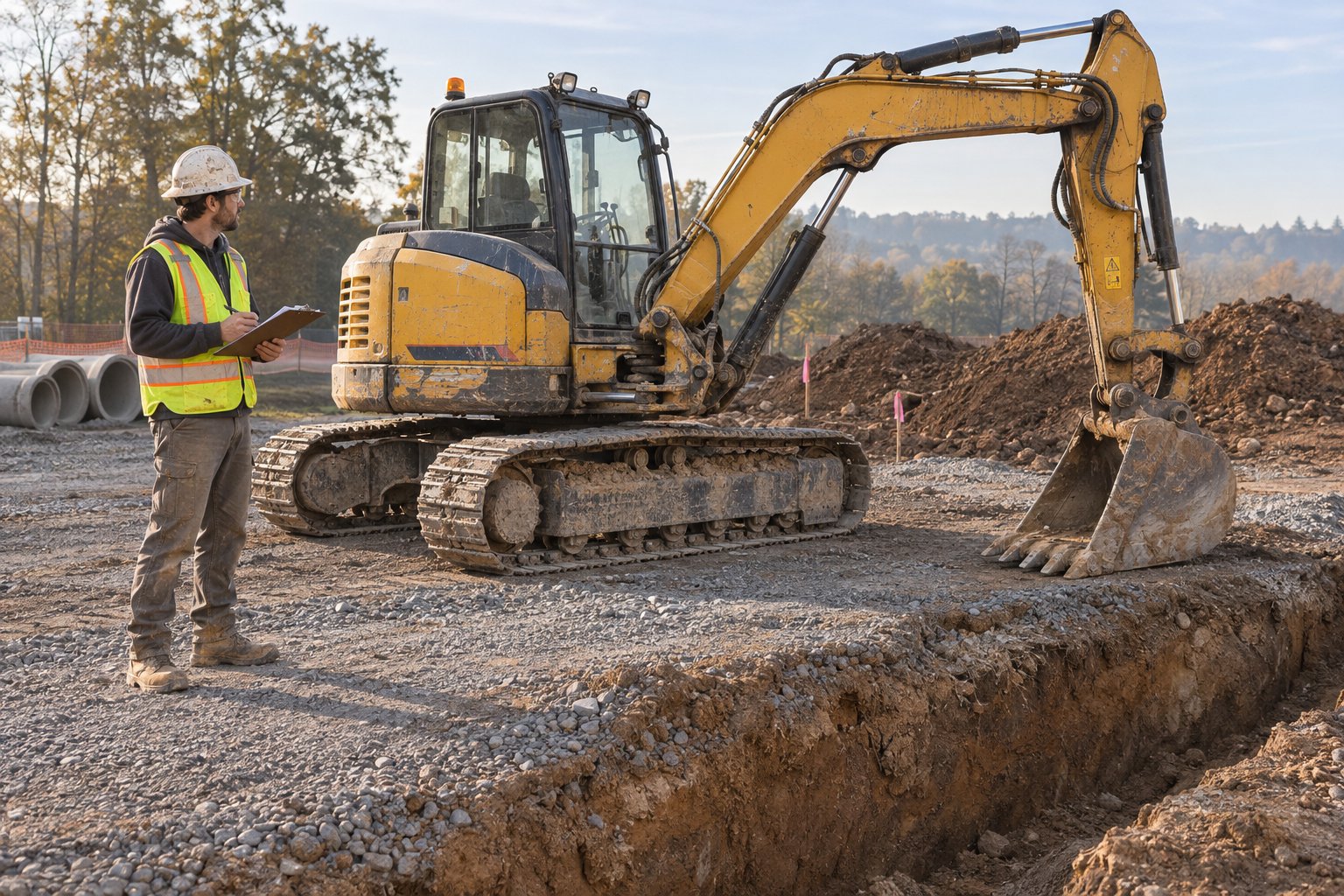
Everything covered so far — terminology, size classes, attachments, technology, costs, maintenance, safety — feeds into this single question: which machine belongs on your jobsite? Not the biggest. Not the shiniest. The one that matches the scope of work, fits the site, supports the tools you need, and lands within a budget that makes financial sense for your utilization rate. Making that call without a system leads to gut decisions and expensive regret. A structured approach takes the guesswork out.
The following six-step checklist walks you through the decision in sequence. Each step builds on the one before it, narrowing the field until you're comparing a handful of specific models rather than staring at an overwhelming catalog of options.
The Six-Step Selection Checklist
- Define the project scope. Start with the basics: how deep do you need to dig, how much material are you moving, and what's the timeline? A residential sewer lateral at eight feet of depth and 40 linear feet is a fundamentally different machine requirement than a commercial foundation pit at 20 feet deep across half an acre. Dig depth sets the minimum machine size. Material volume determines the bucket capacity and cycle time you need to hit your daily production target. Timeline pressure — say, a 10-day window before concrete trucks arrive — may push you toward a larger class that finishes faster even if a smaller unit could technically do the job given unlimited time. Write these numbers down before you browse a single listing.
- Assess site conditions. Soil type, water table depth, slope, and terrain stability all influence which undercarriage and which weight class will perform safely. Soft clay and a high water table? You need the low ground pressure of a tracked machine — and possibly a wider-track option to prevent sinking. Rocky, compacted ground? Budget for a hydraulic breaker attachment or a ripper, and choose a hoe machine with sufficient auxiliary hydraulic flow to power it. Steep grades demand the traction and stability only a crawler undercarriage provides. Flat, paved municipal sites may open the door to a wheeled excavator that self-transports between locations — but for most excavation work, tracks remain the default for good reason.
- Determine space constraints. Measure the narrowest access point your machine must pass through — a gate, an alley, a gap between buildings. Then check the working footprint: will the operator need to swing the cab next to a wall, a traffic lane, or an adjacent structure? If clearance is tight, a reduced-tail-swing or zero-tail-swing model keeps the counterweight within the track width during rotation, eliminating collision risk. For extremely confined sites — interior demolition, backyard pools, basement digs — a mini-class unit under six metric tons may be the only practical choice. Don't guess at dimensions; measure them. A machine that's six inches too wide costs you a day of re-planning.
- Identify required attachments. The standard digging bucket handles most general excavation, but many projects demand more. Will you break concrete? Add a hydraulic breaker to your requirements and confirm the machine's auxiliary flow supports it. Need to grab debris, stumps, or pipe sections? A hydraulic thumb or grapple becomes essential. Drilling pier holes? Spec an auger and verify the machine has a case drain line for the motor. As we covered earlier, attachment compatibility depends on hydraulic flow rate, pressure, weight-class matching, and coupler type. List every attachment the job requires before you select the base machine — not after — so you avoid renting a trackhoe that can't run the tools the job demands.
- Set a budget and decide rent vs. buy vs. buy used. Pull out the utilization framework from the cost section. If the machine will run under 40% of available hours this year, rental is almost certainly the smarter play. Between 40% and 60%, buying used often tips the economics toward ownership because the lower purchase price drops the break-even threshold. Above 60%, ownership — new or used — delivers the best long-term cost per hour. Factor in Section 179 tax deductions, insurance, storage, and the annual maintenance reserve before locking in your number. A budget without these line items isn't a budget — it's a wish.
- Compare available machines across brands. Here's where many contractors leave money on the table: they default to one manufacturer out of habit or loyalty and never discover that a competitor's model offers better specs, lower hours, or a significantly better price for equivalent capability. A Cat 320 is an outstanding machine — but so is a Komatsu PC210, a Kobelco SK210, or a Volvo EC220. Comparing across brands forces you to evaluate each unit on merit: dig depth, hydraulic flow, operating weight, cab technology, maintenance history, and total cost. The same principle applies whether you're shopping new, used, or rental — evaluating multiple options leads to better decisions than brand autopilot ever will.
Run through all six steps and you'll arrive at a short list — typically two to four specific models in the right size class, with the right hydraulic capacity for your attachments, at a price point your utilization rate justifies. That's a fundamentally different position than walking onto a dealer lot and asking, "What do you have available?"
The principle worth repeating is simple: an oversized trackhoe burns fuel, rental dollars, and transport costs you didn't need to spend. An undersized one drags out your schedule and drives up labor costs. The goal is precision — the right machine for the work, nothing more and nothing less.
The right trackhoe is not the biggest or newest — it is the one correctly sized, properly attached, and competitively sourced for the job at hand.
Turning Research Into Action
A checklist is only valuable if it leads to a decision. Once you've narrowed the field, the next move is sourcing — and for buyers considering the used market, the ability to compare machines across multiple brands from a single inventory saves significant time and travel.
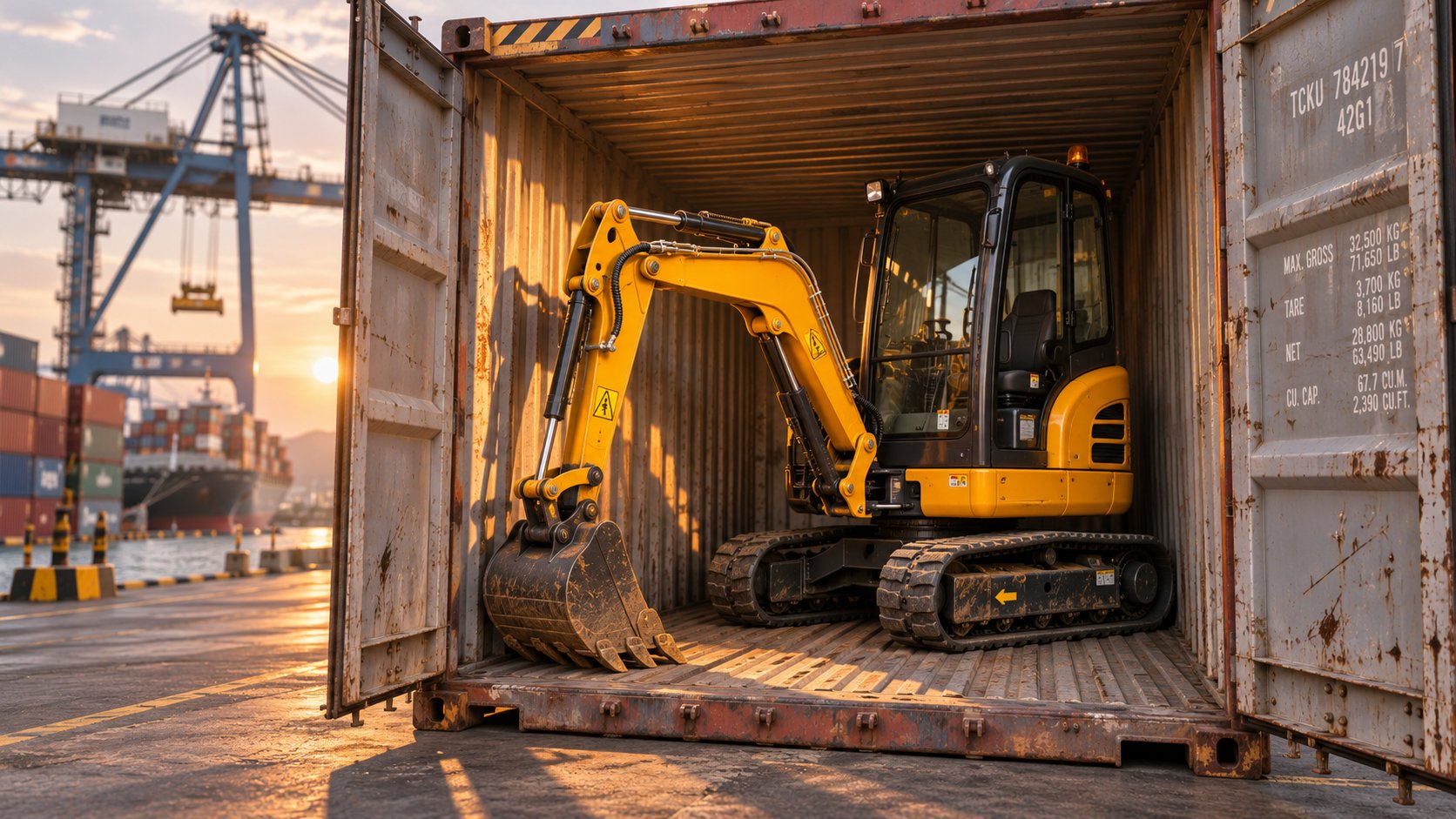
Platforms like JIUHONG's used excavator collection are built for exactly this stage of the process. The inventory spans compact through large-class machines from globally recognized manufacturers — Caterpillar, Komatsu, Hitachi, and others — so excavation contractors, equipment dealers, and import buyers can browse listings side by side rather than chasing leads across a dozen separate sources. Whether you're looking for a single unit for a specific project or requesting bulk quotes for a fleet expansion, the ability to compare model specs, hours, and pricing in one place compresses a decision that used to take weeks into days. Worth noting: equipment available through platforms exporting from China isn't limited to Chinese-manufactured brands — the inventory frequently includes the same machines you'd find on any major dealer lot worldwide.
For contractors who've worked through the six steps above, browsing a multi-brand collection becomes a focused exercise rather than an aimless scroll. You already know the weight class. You know the hydraulic capacity your attachments require. You know whether you need a reduced-tail-swing configuration. You know your budget ceiling. All that remains is finding the specific unit that checks every box — and requesting a quote to confirm the numbers work.
That's the entire trackhoe decision process, from the first definition to the final purchase or rental agreement. The word "trackhoe" might be informal, regional, and occasionally misspelled — whether someone types "trac ho," "trackhow," or any other variant — but the machine it describes is one of the most versatile, productive, and consequential investments in the construction equipment world. Choose it well, maintain it properly, operate it safely, and it will earn back every dollar many times over.
Frequently Asked Questions About Trackhoes
1. Is a trackhoe the same as an excavator?
Yes. A trackhoe is simply the informal, jobsite-popular name for a hydraulic excavator mounted on a tracked undercarriage with 360-degree rotation. Manufacturer catalogs, engineering specs, and international markets use 'excavator,' while 'trackhoe' dominates everyday conversation on construction sites across the Southern and Midwestern United States. Both terms refer to the identical machine — the difference is purely linguistic, not mechanical.
2. What is the difference between a trackhoe and a backhoe?
A trackhoe (tracked excavator) rides on steel or rubber tracks, rotates a full 360 degrees, and is built primarily for digging and material handling. A backhoe loader is a wheeled machine combining a rear-mounted digging arm with a front loader bucket; its digging assembly swings through a limited arc rather than continuous rotation. Backhoe loaders are road-legal and cheaper, making them ideal for light utility work, while trackhoes deliver deeper dig depths, superior stability on rough terrain, and support for heavy-duty hydraulic attachments.
3. How much does a trackhoe cost to buy or rent?
New mini trackhoes start around $75,000, mid-size units run $200,000 to $500,000, and large machines exceed $800,000. Used prices typically drop 20-60% below new, making them attractive for contractors seeking lower break-even thresholds. Rental rates for a compact unit average $250-$450 per day or $2,500-$4,500 per month, while full-size models range from $800-$1,600 daily. Multi-brand used platforms like JIUHONG's excavator collection let buyers compare compact through large machines from brands like Caterpillar, Komatsu, and Hitachi in one place and request model-specific or bulk quotes.
4. What size trackhoe do I need for my project?
Match the machine to your dig depth, material volume, and site access. Mini trackhoes (under 6 metric tons) suit residential trenching and tight-access work. Mid-size units (6-20 metric tons) handle general commercial excavation and municipal projects. Standard machines (20-45 metric tons) tackle heavy civil construction and demolition. Large trackhoes (45+ metric tons) serve mining and mass earthmoving. Always check access-point width and whether a reduced-tail-swing model is necessary for confined spaces before committing.
5. What attachments can you put on a trackhoe?
Tracked excavators accept a wide range of hydraulic attachments that transform them into multi-tool platforms. The most common include digging buckets (standard, heavy-duty, tilt, clean-up), hydraulic breakers for demolition, thumbs for grasping irregular objects, augers for drilling holes, grapples for sorting debris, rippers for compacted soil, compaction wheels for trench backfill, and brush cutters for land clearing. Compatibility depends on your machine's auxiliary hydraulic flow rate, operating pressure, and weight class — always verify the attachment's required GPM falls within your excavator's auxiliary circuit output before purchasing.