

Why Trust Is the Most Important Factor in Online Equipment Buying
Imagine wiring $175,000 to a seller you have never met, for a machine you have never touched, sitting in a yard three states away. That scenario plays out thousands of times every year in the heavy equipment market — and it is completely normal. Buying sight-unseen is standard practice because, as RPG Equipment puts it, the right unit is rarely in your backyard. Yet "normal" does not mean comfortable. When transactions routinely land between $50,000 and $500,000, the margin for error is razor-thin and the anxiety is very real.
That anxiety is why trust — not price, not selection, not shipping speed — should be the first filter you apply when choosing where to sell heavy equipment or where to buy it. A platform with 100,000 listings means nothing if half the sellers are unvetted and the dispute process is a dead end.
What Makes an Equipment Marketplace Trustworthy
Trust in this context is not a vague feeling. It is a measurable set of platform behaviors. When experienced contractors and fleet managers evaluate the most trusted online heavy equipment marketplaces, they are really asking five concrete questions:
- Verified sellers: Does the platform confirm that sellers actually own the equipment and operate legitimate businesses?
- Buyer protection: Are there escrow options, inspection contingencies, or money-back guarantees that protect the buyer before payment becomes irreversible?
- Fee transparency: Can you see exactly what you will pay — buyer premiums, listing fees, commissions — before you commit?
- Dispute resolution: If the machine arrives in a condition that does not match the listing, what recourse does the platform provide?
- Track record: How long has the platform operated, and what do independent review sources say about buyer satisfaction?
A marketplace that scores well across all five areas earns genuine trust. One that excels in only one or two creates gaps — and gaps are where fraud, hidden fees, and misrepresented equipment slip through.
Introducing the Marketplace Trust Tier Framework
To make this guide actionable rather than abstract, every platform discussed later in this article will be assigned a Trust Tier based on its publicly verifiable policies and protections. Here is how the tiers break down:
Tier 1 — Full buyer protection, verified seller programs, transparent fees, and a documented dispute resolution process. Tier 2 — Partial protections with notable caveats; some trust mechanisms exist, but buyers must fill gaps with their own due diligence. Tier 3 — Minimal protections; the platform primarily connects buyers and sellers, and responsibility falls almost entirely on the individual (caveat emptor).
No tier is automatically disqualifying. Plenty of experienced buyers — especially those who already have trusted mechanics and know how to run lien checks — operate confidently on Tier 3 platforms every day. The framework simply helps you match your risk tolerance to the right marketplace category. Whether you want to sell used heavy equipment through a classified site or purchase a six-figure excavator at auction, knowing where a platform falls on this scale puts you in control of the transaction from the start.
Of course, tiers only become meaningful when you understand what specific criteria sit behind them — and how to score any platform yourself before a single dollar changes hands.
A Structured Trust Evaluation Rubric for Equipment Platforms
Knowing that trust tiers exist is useful. Knowing exactly how to assign them yourself is powerful. Whether you plan to sell construction equipment through an online listing or purchase a wheel loader at auction, you need a repeatable scoring method — a rubric you can apply to any platform before a single dollar moves. Most competitor guides simply list marketplace names and features. They rarely aggregate user satisfaction data, cross-reference independent reputation signals, or give you a framework for comparing platforms on equal footing. This rubric fills that gap.
Six Dimensions of Marketplace Trust
Every platform in the heavy equipment space can be measured across six core trust dimensions. Think of each one as a load-bearing column: remove one, and the structure becomes unstable.
- Seller Verification — Does the platform vet dealers and individual sellers before they can list? Verification might include business license checks, identity confirmation, equipment ownership documentation, or dealer network membership. A platform that lets anyone post a listing with zero vetting shifts all risk onto the buyer.
- Buyer Protection — Are escrow services available? Does the platform offer money-back guarantees, inspection contingencies, or return windows? As IronMart Online's escrow guide explains, escrow agents hold buyer funds in segregated, FDIC-insured accounts and release payment only after delivery and condition verification — a critical layer for high-value machinery.
- Transaction Security — This covers secure payment processing, title verification, and lien checks. Running a UCC-1 search or checking the National Equipment Register (NER) for theft records are essential steps, and the best platforms either perform these checks or integrate tools that make them easy.
- Fee Transparency — Are buyer premiums, listing fees, seller commissions, and payment processing surcharges clearly disclosed before you commit? If you need to dig through fine print to find total costs, that opacity is itself a trust signal — a negative one.
- Reputation Signals — Independent indicators like BBB ratings, Trustpilot scores, industry association memberships, and years of operation all matter. These are harder to fake and give you a snapshot of real-world buyer and seller satisfaction over time.
- Dispute Resolution — What happens when something goes wrong? Strong platforms provide a documented complaint process, mediation support, and defined timelines for resolution. Weak platforms leave you with nothing more than an email address and a wish for good luck.
You will notice that these six dimensions map directly onto the concerns real buyers and sellers raise most often. Someone trying to sell equipment online wants transparent fees and verified buyers. Someone purchasing a $200,000 excavator wants escrow protection and a clear path to resolution if the machine does not match the listing.
How to Score a Platform Before You Transact
The table below gives you a quick-reference scoring guide. Before you sell my heavy equipment through any platform — or spend six figures buying from one — run it through these criteria. A platform that lands in the "Strong" column across most dimensions earns Tier 1 status. Mostly "Moderate" signals suggest Tier 2. And if you see "Weak" showing up repeatedly, you are looking at a Tier 3 environment where your own due diligence must compensate for what the platform does not provide.
| Trust Dimension | Strong | Moderate | Weak |
|---|---|---|---|
| Seller Verification | Mandatory identity and business checks; dealer credentials validated before listing | Optional verification badges; some sellers vetted, others self-registered | No vetting; anyone can post a listing immediately |
| Buyer Protection | Integrated escrow, inspection contingencies, and documented return or refund policies | Escrow available through third parties; limited return windows with conditions | No escrow, no guarantees; transactions are strictly between buyer and seller |
| Transaction Security | Secure payment gateway; platform-assisted title verification and lien checks | Secure payments offered but title and lien checks left to the buyer | No payment processing; buyers wire funds directly to sellers |
| Fee Transparency | All fees — premiums, commissions, processing charges — published upfront on the site | Major fees disclosed; some ancillary charges buried in terms of service | Fee structure unclear or only revealed after registration or bidding |
| Reputation Signals | Established track record (10+ years); strong BBB or Trustpilot ratings; industry recognition | Moderate history; mixed reviews with some unresolved complaints | Limited public reviews; no BBB profile; minimal independent verification |
| Dispute Resolution | Formal mediation process with defined timelines, evidence review, and fund holdback options | Basic complaint submission; resolution handled case-by-case without published protocols | No formal process; disputes are resolved privately between buyer and seller |
Here is a practical way to use this: before you list or bid, open the platform's FAQ, terms of service, and fee pages. Score each dimension as strong, moderate, or weak based on what you can actually verify — not what the platform claims in marketing copy. If the information is not publicly available, treat that absence as a data point. Trustworthy platforms do not hide their policies.
This rubric works regardless of whether you are evaluating a global auction house, a classified listing site, or a niche dealer network. The dimensions stay the same — only the scores change. And those scores shift significantly depending on the type of marketplace you are dealing with, because each category operates under fundamentally different trust models.
Understanding Marketplace Categories and Their Trust Profiles
A classified listing site and a global auction house may both appear when you search for heavy equipment online, but the trust mechanisms behind each transaction could not be more different. Lumping every platform into a single category is one of the fastest ways to misjudge your actual risk. The rubric from the previous section gives you a way to score any individual platform — yet the scores you see will shift dramatically depending on which type of marketplace you are evaluating in the first place.
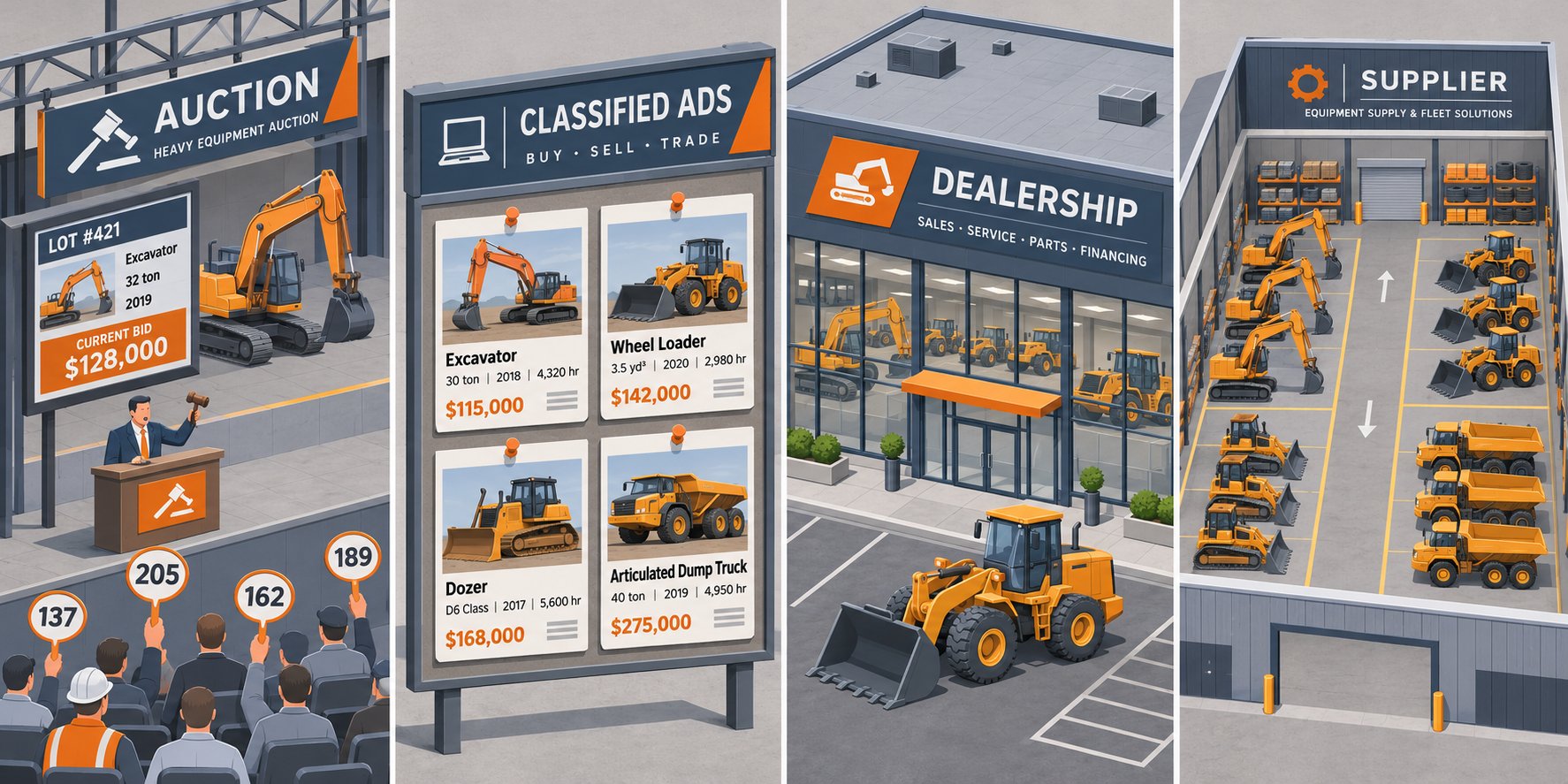
Four distinct marketplace categories dominate the online equipment landscape. Each one handles seller accountability, buyer recourse, and fee structures in its own way. Understanding these categories before you start browsing — whether you want to sell used construction equipment or purchase a dozer for your next project — keeps you from applying the wrong expectations to the wrong platform.
Classifieds vs Auctions vs Dealer Networks
Think of these four categories as different storefronts on the same street. They all display heavy equipment in the window, but the rules inside each shop vary considerably.
- Classified Listing Sites — Sellers post ads with photos, specs, and asking prices. Buyers browse listings and contact sellers directly to negotiate. The platform itself typically acts as a billboard, not a transaction manager. Trust relies almost entirely on your own due diligence: verifying serial numbers, requesting inspections, confirming ownership, and arranging secure payment independently. Sites like Equipment Trader — which hosts listings from both dealers and private owners — exemplify this model. You get broad inventory access, but the platform rarely steps in if something goes sideways.
- Auction Platforms — Competitive bidding drives the final price, and buyer premiums (often a percentage of the hammer price) add to the total cost. Trust here depends on clearly published terms of sale, defined inspection windows before bidding closes, and the platform's willingness to mediate disputes. Some auction operators, like Purple Wave, run no-reserve sales with a stated 10% buyer premium, while others such as BigIron advertise unreserved auctions with no buyer fees. Terms can vary not just between platforms but between individual auction events on the same platform — so reading lot-specific conditions is essential every time.
- Dealer Networks — These are aggregator platforms that connect buyers with established equipment dealerships. Trust is partially inherited: if a reputable John Deere or Caterpillar dealer lists a machine, the dealer's own reputation and service infrastructure back that transaction. Dealer network platforms often feature equipment with maintenance records, warranty options, and the possibility of on-site inspections at a physical dealership. For buyers searching for equipment buyers near me or browsing 4 sale heavy equipment locally, dealer networks shorten the gap between online discovery and in-person verification.
- Specialty and Direct-Sale Channels — This category includes niche suppliers who maintain their own inventories, as well as OEM certified pre-owned programs. Trust comes from direct brand accountability rather than platform-level policies. For example, the John Deere Certified Used Equipment program requires machines to pass a 100-plus-point inspection by Deere-certified technicians, comprehensive fluid analysis, and engine and hydraulic performance testing — all before earning certification. That level of factory-backed scrutiny is something no classified ad or auction listing can replicate on its own.
How Trust Mechanisms Differ by Platform Type
The real danger is not choosing one category over another — it is failing to adjust your behavior based on which category you are in. A buyer on a classified site who treats the transaction like an auction (expecting the platform to hold funds or enforce return policies) is setting up for disappointment. Conversely, a buyer at auction who ignores the inspection window because they assume dealer-level warranties apply is taking on unnecessary risk.
Consider the practical differences. Auction platforms generally offer a defined inspection period before the sale closes. If you skip that window, you typically accept the equipment as-is once your bid wins. Classified sites, on the other hand, rarely impose structured timelines — but they also provide no safety net if the seller misrepresents the machine. Dealer networks sit in between: you might get equipment warranties, certified condition reports, and even financing options, but those protections come from the individual dealer, not from the aggregator platform listing the machine.
Specialty channels like OEM certified pre-owned programs offer the strongest built-in trust signals. Machines must meet strict age, hour, and condition thresholds. They undergo factory-level inspections, and certification travels with the equipment at resale — adding residual value. The trade-off? Inventory is smaller, and prices typically reflect the added assurance.
Here is a useful mental shortcut: the more a platform inserts itself between buyer and seller — verifying equipment, holding funds, enforcing standards — the higher its natural trust floor. The less it intervenes, the more your personal expertise and diligence must compensate. Neither approach is inherently wrong, but confusing one for the other is where costly mistakes happen.
With these categories clearly mapped, the logical next question becomes unavoidable: how do the specific platforms you have actually heard of — the names that dominate search results and industry conversations — stack up when you hold them against both the trust rubric and their marketplace category?
Reviewing the Top Heavy Equipment Marketplaces for Trustworthiness
You know the trust dimensions. You understand the marketplace categories. The question every buyer and seller actually wants answered is this: where do the platforms you have heard of — the names dominating search results and industry conversations — actually land when measured against those criteria? Rather than rehashing feature lists, this section applies the trust rubric directly to the major marketplaces and assigns each one a tier based on publicly verifiable policies.
A critical note before diving in: platform policies evolve. Fee structures change, buyer protections get updated, and reputation scores fluctuate. The assessments below reflect what each platform publicly documents. Where independent trust data like BBB ratings is available, those numbers are included. Where it is not, you should verify current standings independently before committing funds.
Platform-by-Platform Trust Assessment
Ritchie Bros. / IronPlanet — This is the heavyweight in online equipment auctions. Ritchie Bros. operates both live and online auction events globally, and its affiliate IronPlanet runs timed online auctions. The standout trust feature is the IronClad Assurance inspection certification program. Equipment that carries this certification has undergone a general condition inspection with ratings, photos, and component-level commentary. If a buyer discovers the equipment is not substantially in the condition represented in the inspection report, they can file a written dispute claim within 11 business days of the sale date. A $750 deductible applies to any settlement, and Ritchie Bros. retains sole authority over dispute adjudication. The program has real teeth — but also real limitations. It does not cover latent defects, electrical systems, hydraulic leaks, or conditions that require diagnostic equipment to detect. If you plan to sell used heavy equipment through their auction channel or bid on a six-figure machine, read the full IronClad Assurance terms carefully. The structured dispute window, formal claim process, and inspection certification push this platform firmly into Tier 1 territory.
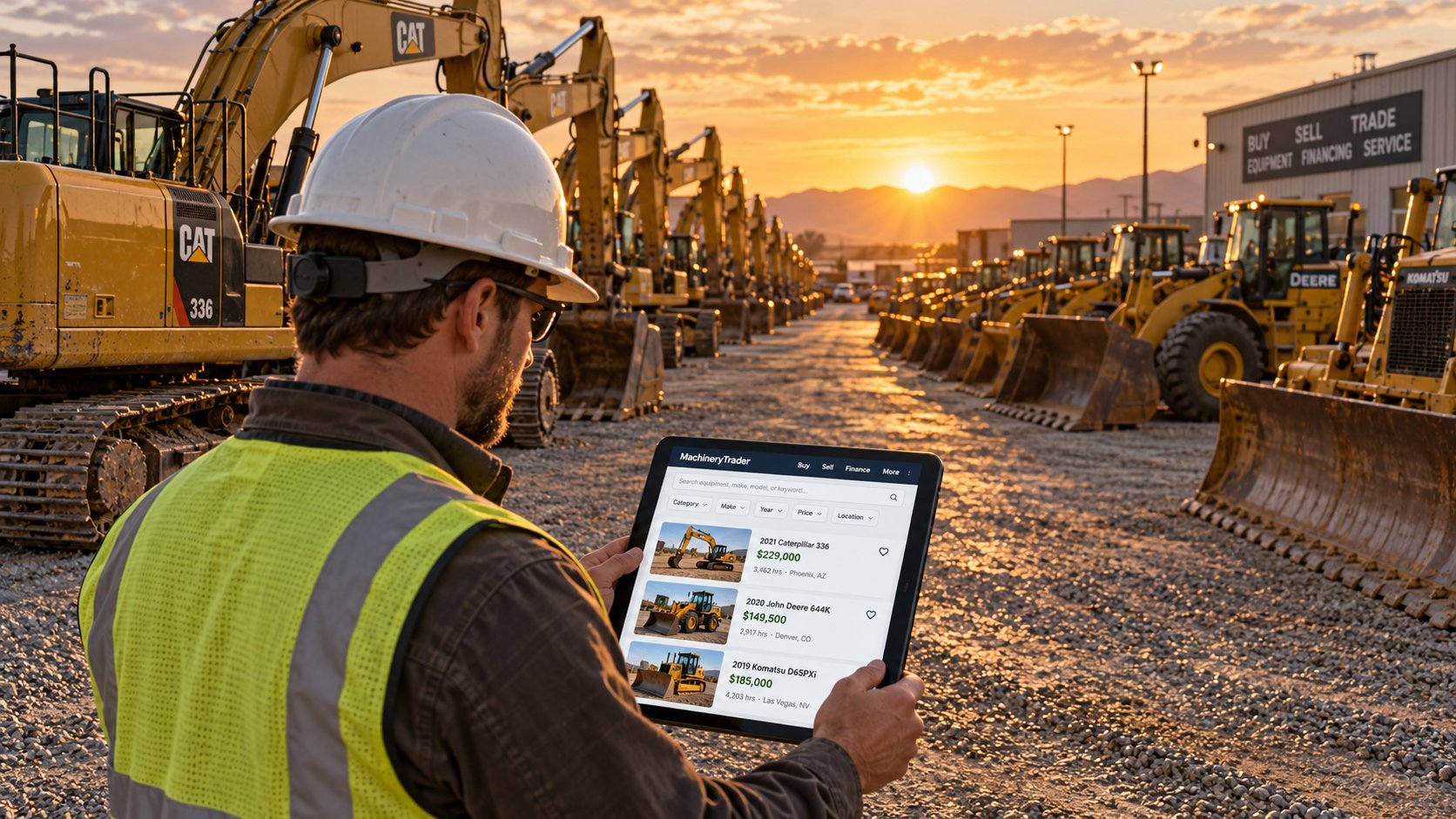
Machinery Trader — Owned by Sandhills Global and operating since 1978, Machinery Trader is a classified listing platform where dealers and private sellers post equipment for sale and buyers make direct contact. It holds BBB accreditation with an A+ rating — a strong independent reputation signal. The platform attracts tens of thousands of daily buyers searching for construction machines, making it one of the highest-traffic destinations if you want to sell construction equipment online. However, as a classified model, Machinery Trader connects parties rather than managing transactions. There is no built-in escrow, no platform-level buyer protection, and no formal dispute mediation. Trust comes from the platform's longevity, its BBB standing, and the quality of individual sellers — not from transactional safeguards. That combination places it at Tier 2: solid reputation, but buyers and sellers must handle due diligence independently.
Equipment Trader — Describing itself as the largest marketplace for private buyers and sellers, Equipment Trader hosts over 99,000 listings — a scale indicator that reflects broad dealer and private-seller participation. The platform offers quick listing tools (sellers can reportedly go live in five minutes), dealer inventory management, and buyer-side filtering by model year, category, and location. Like Machinery Trader, Equipment Trader operates primarily as a classified listing site. It facilitates discovery and contact, but the transaction itself happens between buyer and seller without platform-administered escrow or return policies. For anyone figuring out how to sell used construction equipment to the widest possible audience, the sheer listing volume and buyer traffic are genuine advantages. Independent reputation data should be checked directly, as publicly available BBB and Trustpilot scores may fluctuate. Trust tier: Tier 2 — strong reach and listing tools, but limited built-in transaction protections.
IronMart Online — IronMart Online is a web-based marketplace connecting buyers and sellers of used heavy equipment, trucks, and machinery. A notable feature is cross-platform syndication: a single listing can reach buyers across nine platforms simultaneously, expanding visibility without requiring sellers to manage multiple accounts. The platform advertises no contracts and no hidden fees, and buyers can arrange financing directly. IronMart Online also publishes educational content about escrow services for heavy equipment, signaling awareness of transaction security concerns. However, like other classified-style marketplaces, the platform primarily connects parties rather than managing the transaction end to end. Sellers who want to sell heavy equipment online with maximum exposure and minimal commitment will appreciate the syndication model. Trust tier: Tier 2 — good transparency signals and broad reach, but buyers should independently arrange escrow and inspections.
Cat Used / Cat Auction Services — Caterpillar's own used equipment channel operates as both a dealer network and an auction platform under the Ritchie Bros. umbrella. Listings from Cat dealers carry the weight of Caterpillar's brand accountability, and machines sold through Cat Auction Services may qualify for the IronClad Assurance program described above. The OEM connection means buyers can access maintenance histories, certified condition reports, and in some cases extended warranty options — trust signals that classified platforms simply cannot match. If you are sourcing Cat-branded machines, this channel offers one of the most transparent paths from listing to purchase. Trust tier: Tier 1 for certified inventory with IronClad coverage; Tier 2 for standard dealer listings without certification.
Assigning Trust Tiers to Major Marketplaces
The table below consolidates each platform's trust profile into a single reference. Use it alongside the six-dimension rubric to quickly compare where protections are strong and where your own due diligence must fill the gaps — especially critical when transactions routinely reach into six-figure territory.
| Platform Name | Category Type | Seller Verification | Buyer Protection | Fee Transparency | Trust Tier |
|---|---|---|---|---|---|
| Ritchie Bros. / IronPlanet | Auction | Consignor vetting; equipment inspected under IronClad Assurance program | IronClad Assurance dispute process; 11-business-day claim window; $750 deductible | Buyer premiums disclosed in auction terms; varies by sale event | Tier 1 |
| Machinery Trader | Classified | Dealer and private listings; no mandatory platform-level identity vetting | No built-in escrow or return policy; BBB A+ rating as independent reputation signal | Listing fees disclosed; no transaction commissions on classified sales | Tier 2 |
| Equipment Trader | Classified | Dealer and private listings; 99,000+ active listings indicate broad participation | No platform-managed escrow or dispute mediation; transactions are buyer-seller direct | Listing and advertising fees disclosed; check current rates independently | Tier 2 |
| IronMart Online | Classified | Seller self-registration; cross-platform syndication across nine sites | No platform escrow; educational resources on escrow and secure transactions published | No contracts, no hidden fees advertised; confirm current fee schedule before listing | Tier 2 |
| Cat Used / Cat Auction Services | Dealer Network / Auction | Cat dealer network participation; OEM brand accountability | IronClad Assurance available on auction inventory; dealer warranties on select units | Auction premiums follow Ritchie Bros. terms; dealer pricing negotiated directly | Tier 1 (certified) / Tier 2 (standard) |
One pattern jumps out immediately: platforms that insert themselves into the transaction — holding funds, inspecting equipment, mediating disputes — earn higher trust tiers than those that simply connect buyers and sellers. That does not make classified platforms untrustworthy. It means the burden of protection shifts to you. And that shift raises an urgent follow-up question: what specific buyer protection mechanisms should you demand, regardless of which platform you choose, and what exactly should you do when a transaction starts going wrong?
Buyer Protection and Transaction Security Deep Dive
The platform comparison table above reveals a hard truth: even on the most trusted online heavy equipment marketplaces, buyer protection is rarely automatic. Most platforms — especially classified sites — leave the security architecture entirely up to you. That is not necessarily a dealbreaker, but it means you need to understand the specific mechanisms that stand between a successful purchase and a six-figure loss. Wire fraud alone costs equipment buyers millions every year. Fidelity Bank recently reported a local customer who lost $14,000 after wiring money for a machine advertised at a fraction of its real value — and that equipment never arrived. The seller's website looked legitimate. The payment method made the funds unrecoverable.
Whether you plan to sell heavy equipment through an auction channel or buy a $300,000 excavator from a classified listing, four protection layers deserve your full attention before any money changes hands.
Escrow and Inspection Contingency Essentials
Escrow services are the single most effective safeguard for high-value equipment transactions — yet surprisingly few buyers use them. Here is how they work in practice: a neutral third-party escrow company holds the buyer's funds in a segregated, typically FDIC-insured account. The seller is notified that funds are secured, and only after the buyer confirms delivery and satisfactory condition does the escrow agent release payment. If the equipment does not meet agreed-upon terms, the funds stay protected.
As Guaranty Escrow explains, this structured process prevents premature fund release and ensures both parties meet their obligations — effectively eliminating the scenario where a buyer wires $175,000 into a void with no recourse. Escrow is especially critical on classified platforms like machinerytrader.com or Equipment Trader, where the platform itself provides zero transactional safeguards. Auction platforms such as Ritchie Bros. manage payments through their own systems, which offers a similar protective layer, but on peer-to-peer deals the responsibility falls entirely on the buyer to arrange escrow independently.
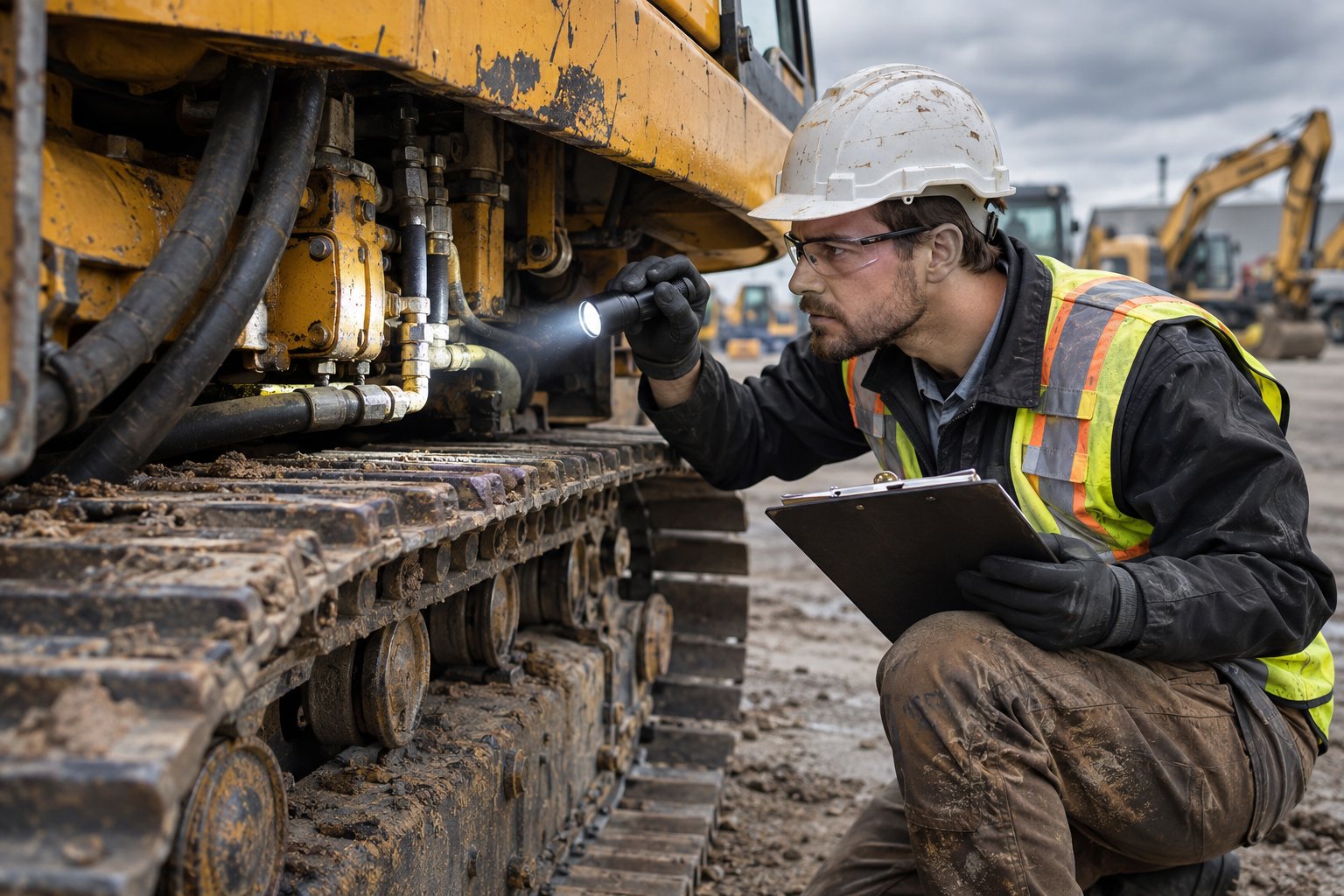
Inspection contingencies are the second pillar. Imagine purchasing a wheel loader based on 12 photos and a description that reads "runs great" — only to discover a cracked boom or a transmission that slips under load. Third-party inspection services send certified technicians to physically examine the machine before you finalize the purchase. They check hydraulics, engine compression, structural integrity, undercarriage wear, and electrical systems — everything a photo gallery cannot reveal. The critical step: build an inspection contingency into your purchase agreement in writing. This gives you a defined window (commonly 5 to 10 business days) to have the machine evaluated by an independent inspector. If the results do not match the seller's representations, you walk away with your deposit intact. Platforms like Ritchie Bros. formalize this through the IronClad Assurance inspection program, but on classified and direct-sale channels, you will need to negotiate this clause yourself.
Title verification and lien checks address a risk many first-time buyers overlook entirely. Heavy equipment — unlike cars — often does not carry a state-issued title. That means a lien on an excavator or skid steer typically exists as a UCC-1 filing with the seller's state, not as a note on a title certificate you can read at a glance. If a lender still holds a security interest in the machine, that claim generally follows the equipment after the sale — meaning you could pay in full and still have a bank show up to repossess your purchase.
How do you protect yourself? Five West Financial outlines a clear protocol: for titled trucks and trailers, read the lienholder line on the title and run the VIN through NICB VINCheck (free, up to five searches per 24 hours) plus an NMVTIS report. For untitled machines — excavators, loaders, bulldozers — run a UCC search on the seller's exact legal name in their state of organization, and check the PIN or serial number through the National Equipment Register's IRONcheck service. NER, now part of Verisk, draws on more than 20 million theft and ownership records to flag stolen machines, insurance claims, and UCC history tied to that specific unit. No single search covers everything, so running both the UCC filing search and the NER report gives you the most complete picture.
Transport insurance rounds out the protection stack. A $250,000 machine riding on a lowboy trailer across 800 miles faces real risk: shifting loads, road debris, bridge strikes, and rollover incidents during unloading. Standard carrier liability is often capped well below the replacement value of the equipment. Before the machine ships, confirm that the transport company carries cargo insurance sufficient to cover the full value of the unit, and request a certificate of insurance naming you as an additional insured. Document the machine's condition with timestamped photos and video before it leaves the seller's yard, and again upon arrival — this evidence is essential if you need to file a damage claim.
What to Do When a Transaction Goes Wrong
Even with every safeguard in place, problems happen. The machine arrives with undisclosed damage. The seller disappears after receiving a deposit. The hour meter reads 3,000 hours but internal diagnostics reveal 9,000. Knowing where to sell construction equipment or which platform to buy from is only half the equation — knowing what to do when the deal breaks down is equally critical.
Here is a step-by-step dispute resolution walkthrough you can follow regardless of which platform or channel the transaction occurred on:
- Document everything immediately. Photograph and video-record the equipment's condition upon delivery. Save all communications — emails, texts, listing screenshots, invoices, and the original advertisement. If you used a platform like machinerytrader.com, capture the listing before it can be edited or removed.
- Notify the seller in writing within 24 hours. Send a detailed written notice describing the discrepancy between what was advertised and what was delivered. Use email or a method that provides a delivery receipt. Clearly state what resolution you expect — repair, price adjustment, or full refund.
- File a platform-level complaint if applicable. On auction platforms with formal dispute programs (such as Ritchie Bros.' IronClad Assurance process), submit your written claim within the stated window — typically 11 business days of the sale date. Include your documentation and reference the specific inspection report or listing details that were misrepresented.
- Engage your escrow provider. If funds are held in escrow, notify the escrow company immediately that you are disputing the transaction. A reputable escrow agent will freeze fund disbursement until the dispute is resolved, protecting your payment while the issue is investigated.
- Initiate a chargeback if you paid by credit card. Credit card payments offer built-in dispute rights under federal law. Contact your card issuer, explain the situation, and provide documentation. Chargebacks are not available for wire transfers — one of many reasons why wiring funds without escrow is so dangerous.
- Consult legal counsel for high-value disputes. When the amount at stake exceeds your tolerance threshold — and for equipment transactions, that number arrives quickly — an attorney experienced in commercial equipment sales can assess your options, including breach-of-contract claims, fraud complaints, and UCC Article 2 remedies for nonconforming goods.
- Report fraud to law enforcement and regulatory bodies. If the transaction was outright fraudulent — phantom listings, stolen equipment, wire-fraud redirection — file reports with local police, the FBI's Internet Crime Complaint Center (IC3), and your state attorney general's consumer protection division. These reports create a paper trail and may help recover funds or prevent others from being victimized.
One theme runs through every step: never wire funds without escrow protection. Wire transfers are instant, irreversible, and virtually untraceable once the money clears. Scammers know this — which is exactly why they push buyers toward wire payments and away from escrow, credit cards, or platform-managed checkout. If a seller insists on a direct wire with no escrow, treat that demand as the red flag it is, regardless of how legitimate the listing appears.
Protection mechanisms give you a safety net. Knowing your dispute options gives you a plan when the net gets tested. But there is another layer of trust — or distrust — that even the most diligent buyers frequently miss: the actual cost of transacting. Hidden fees erode trust just as effectively as misrepresented equipment, and they deserve the same level of scrutiny.
Fee Transparency and Hidden Costs Every Buyer Should Know
A misrepresented machine can cost you a repair bill. Hidden fees, on the other hand, quietly drain margin on every single transaction — and they rarely trigger the same alarm bells. Fee transparency is one of the most overlooked trust signals in the heavy equipment marketplace landscape. Platforms that publish their complete cost structures upfront demonstrate accountability. Those that bury charges in fine print or reveal them only after you have committed to a listing or placed a bid are telling you something important about how they operate.
Whether you are among the used heavy equipment buyers sourcing a fleet of excavators or a contractor selling a single dozer, understanding exactly what you will pay — and what the other party pays — separates a confident transaction from one that leaves money on the table.
Common Fee Structures Across Platform Types
Fee models vary dramatically depending on the marketplace category. An auction platform, a classified listing site, and a dealer network each generate revenue in fundamentally different ways. Knowing which fees apply to your transaction type prevents sticker shock at the worst possible moment — after you have already won a bid or signed a listing agreement.
Buyer premiums are the signature fee of auction platforms. The auction company adds a percentage-based charge on top of your winning bid, and that charge is entirely the buyer's responsibility. At Ritchie Bros., for example, the transaction fee in the U.S. follows a tiered structure: 10% on winning bids up to $30,000 (with a $100 minimum), 5.5% on bids from $30,000 to $75,000 (with a $3,000 minimum), and a flat $4,125 on anything above $75,000. So a $20,000 hammer price actually costs you $22,000 before taxes, while a $150,000 machine totals $154,125. The flat cap on higher-value lots means the effective percentage shrinks as the price climbs — under 3% at $150,000 — but on smaller purchases, that 10% tier adds real weight to your total outlay.
Seller listing fees follow a different logic on classified platforms. Rather than taking a cut of the sale price, these sites typically charge a flat or tiered fee to place a listing. Equipment Trader, for instance, offers tiered listing packages — Basic, Enhanced, and Best — each with different photo limits, listing durations, and homepage visibility options. The key detail Equipment Trader highlights: they charge no commission on the sale itself, so whatever the buyer pays goes directly to the seller. For heavy equipment buyers evaluating where to shop, commission-free classified models mean the seller is not padding the asking price to offset platform fees the way an auction consignor might factor premiums into their reserve expectations.
Seller commissions appear most commonly on auction platforms. In addition to the buyer premium, the auction house typically charges the seller a separate commission or consignment fee for marketing the equipment, hosting the sale, and processing payment. These rates are often negotiated privately between the seller and the auction company, which means they rarely appear on a public fee schedule. If you are deciding how to sell heavy equipment through an auction channel, always request your seller commission terms in writing before signing a consignment agreement.
Promoted-listing upsells exist across nearly every platform type. Classified sites offer homepage placement, featured-listing badges, and priority positioning in search results — all for additional fees. Auction platforms may offer premium lot placement or enhanced marketing packages. These costs are optional, but on high-traffic platforms where thousands of listings compete for attention, promoted placement can meaningfully affect how quickly your machine finds a buyer.
Spotting Hidden Costs Before You Commit
The fees described above are the ones platforms want you to see. The costs below are the ones that tend to appear only on the final invoice or deep inside terms-of-service documents.
- Documentation and title transfer fees — Auction platforms frequently charge a per-item documentation fee on titled or registered equipment. Ritchie Bros. charges approximately $125 per titled item in most U.S. locations, with regional variations ($70 in California, $140 in Orlando). These fees cover title processing and paperwork handling, but they are easy to overlook when calculating your all-in budget.
- Payment processing surcharges — Some platforms pass credit card processing fees through to the buyer, adding 2-3% to the transaction total. Others absorb processing costs into their commission structure. If you plan to pay by credit card (a smart move for the chargeback protection discussed in the previous section), confirm whether a surcharge applies before you bid.
- Storage and late-pickup penalties — Win an auction and fail to pick up your machine within the specified removal window? Daily storage charges kick in. Ritchie Bros. charges $25 per day in the U.S. for items left past the deadline. Over two weeks of delayed pickup, that is $350 on top of your purchase — a completely avoidable cost if you arrange transport before you bid.
- Transport coordination markups — Several platforms offer to arrange shipping as a convenience service. Some quote transport at cost; others mark up third-party carrier rates. Always compare the platform's shipping estimate against independent quotes from heavy-haul carriers. A 15-minute phone call can save hundreds or even thousands on long-distance moves.
- Late payment interest — Overdue auction invoices accrue interest charges, and unpaid lots may be resold with a resale commission charged back to the delinquent buyer. These penalties are clearly stated in auction terms — but only if you read them before bidding.
The table below maps each fee category to the marketplace type where it most commonly appears, along with general ranges drawn from publicly documented sources. Use it as a pre-transaction checklist so nothing catches you off guard.
| Fee Category | Auction Platforms | Classified Sites | Dealer Networks |
|---|---|---|---|
| Buyer Premium | 5-15% of hammer price (tiered; flat cap on high-value lots common) | Not applicable — no bidding process | Not applicable — pricing negotiated directly |
| Seller Listing Fee | Varies; often bundled into consignment terms | Flat-rate or tiered packages (e.g., Basic / Enhanced / Best) | Dealer subscription or per-listing fee; varies by aggregator |
| Seller Commission | Negotiated privately per consignment; not publicly posted | Typically none — classified sites rarely take a cut of the sale | Varies; some aggregators charge referral fees on closed deals |
| Documentation / Title Fee | $70-$140 per titled item (varies by region) | Not applicable — handled between buyer and seller | May be included in dealer closing costs |
| Payment Processing | Often absorbed into buyer premium; surcharges may apply for credit cards | Not applicable — payments handled independently | Dealer-dependent; credit card surcharges possible |
| Promoted Listing / Advertising | Premium lot placement available for additional fee | Featured listings and homepage placement available for upgrade fees | Dealer-level advertising packages; costs vary by aggregator |
| Storage / Late Pickup | $25+/day after removal deadline | Not applicable | Not applicable — equipment stored at dealer location |
Here is the bottom line: fee transparency is not just a nice-to-have. It is a trust indicator with real financial consequences. A platform that publishes its complete fee schedule — buyer premiums, documentation fees, storage charges, payment surcharges — in plain language before you register is signaling that it has nothing to hide. A platform that reveals costs only after you have committed is banking on your sunk-cost psychology to keep you from walking away.
Before you list equipment or place a bid on any platform, request a complete, itemized fee schedule in writing. If a platform representative cannot produce one — or deflects with "it depends" without providing the variables — that response alone tells you where the platform falls on the trust spectrum. Equip seller reviews and independent buyer forums can also surface fee-related complaints that official documentation may not reflect, so check those sources alongside the platform's own disclosures.
Opaque fees erode trust incrementally. Outright fraud, however, destroys it in a single transaction — and the scams targeting heavy equipment buyers are more sophisticated than most people realize.
Fraud Risks and Scams That Target Equipment Buyers
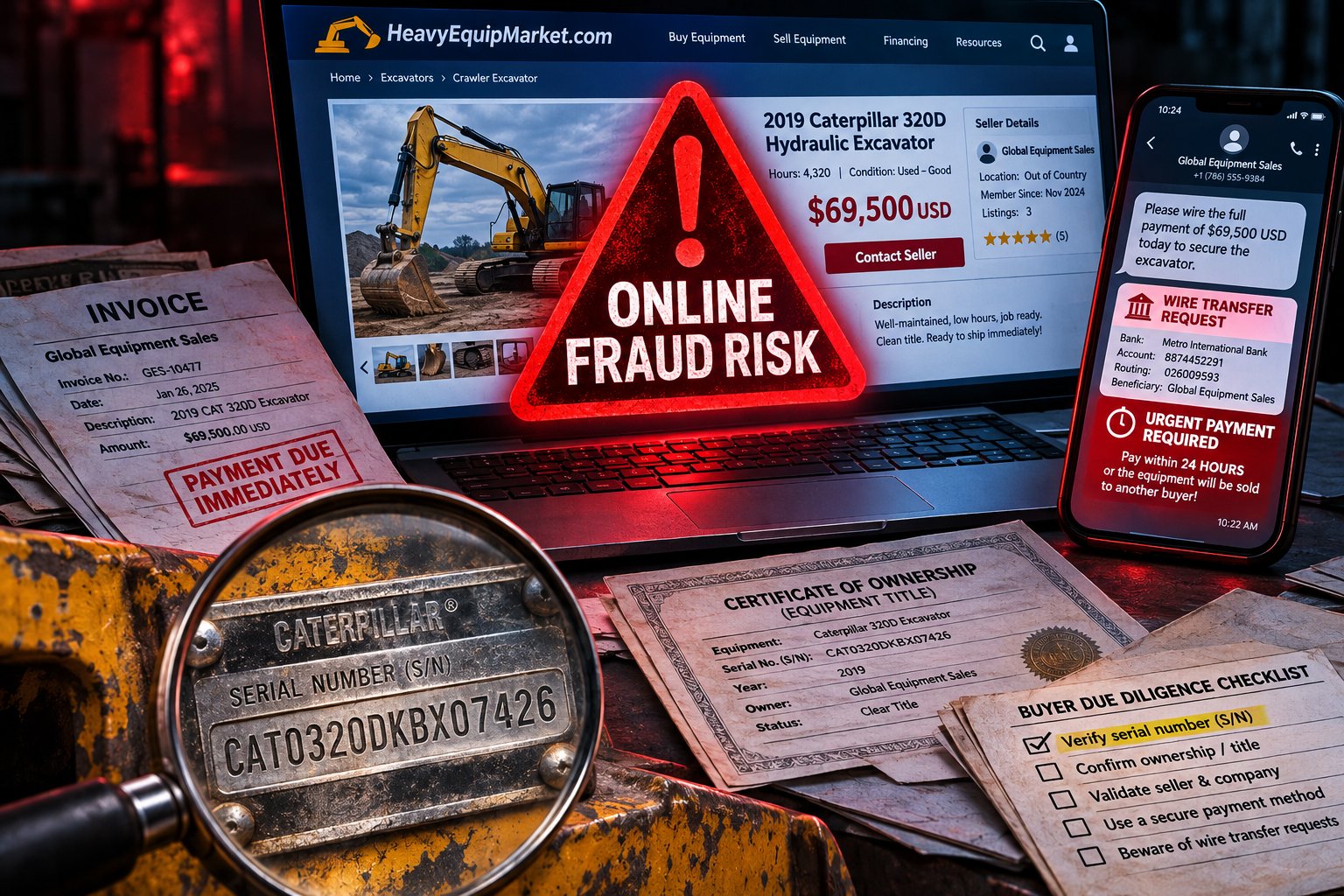
Hidden fees chip away at your budget. Fraud empties it entirely — sometimes in a single wire transfer. And the scams circulating through online equipment marketplaces are not the clumsy, typo-riddled schemes you might expect. They are targeted, polished, and increasingly difficult to distinguish from legitimate transactions. A Fidelity Bank advisory described a customer who lost $14,000 after wiring money for a machine advertised at a fraction of its real value — the seller's website appeared completely legitimate, but the equipment never existed. That is not an isolated incident. The Better Business Bureau tied roughly $51,000 in reported losses to a single fake equipment website, where multiple buyers wired money for machines that never shipped. These numbers represent only the cases people reported — actual losses are almost certainly higher.
If you are evaluating even the most trusted online heavy equipment marketplaces, understanding these scams is not optional. It is the difference between a successful purchase and an unrecoverable financial hit.
The Five Most Common Equipment Marketplace Scams
1. Wire-fraud redirection. This is the highest-dollar scam in the equipment world. A fraudster either impersonates a legitimate seller or compromises a real seller's email account. Once you are deep in negotiations and ready to pay, the scammer sends "updated" wire instructions directing funds to a fraudulent account. Because wire transfers are nearly instant and essentially irreversible, the money vanishes the moment it clears. Some scammers go further — they build entire fake dealership websites that mirror real businesses, complete with stolen inventory photos and fabricated contact details. By the time the real seller or buyer realizes what happened, the funds are gone.
How to prevent it: Never wire funds based solely on emailed instructions. Call the seller at a phone number you verified independently — not one provided in the same email — and confirm the account details verbally. Better yet, use an escrow service you selected and vetted yourself. If a seller insists on a direct wire and refuses escrow, walk away.
2. Phantom listings. The equipment looks real in the photos. The specs are detailed. The price is attractive. But the machine either does not exist, is not located where the listing claims, or is not owned by the person posting the ad. Scammers lift images from legitimate listings on other platforms, create a new ad at a lower price, and wait for a buyer eager to lock down a deal. Classified platforms with minimal seller verification are especially vulnerable to this tactic, since anyone can post a listing with zero identity checks.
How to prevent it: Run a reverse image search on listing photos — if the same images appear on multiple unrelated sites, that is a strong signal the listing is fake. Demand a live video call with the seller standing next to the machine, showing the serial number plate clearly. If they refuse or offer excuses, the equipment probably is not theirs to sell.
3. Title washing. When heavy equipment suffers catastrophic damage — flood, fire, structural failure — the resulting salvage or junk designation follows the machine through its title history. Title washing exploits inconsistencies between state regulations: a fraudster re-registers the damaged machine in a state with lenient titling rules, effectively erasing the negative history and presenting a clean title to the next buyer. The Coalition Against Insurance Fraud describes this as "the art of erasing history," noting that criminals exploit loopholes in state regulations to conceal salvage or damage records entirely. While their reporting focuses on vehicles, the same technique applies to any titled equipment — and untitled machines (common in the heavy equipment world) face an even murkier landscape because there is no centralized title record to check in the first place.
How to prevent it: Request the full ownership and title transfer chain for any machine you are considering. Check serial numbers through the National Equipment Register (NER) and run a UCC lien search on the seller's legal name. For titled equipment, pull an NMVTIS report to surface salvage or flood damage designations. If the ownership history has gaps or the machine moved through multiple states in quick succession without a clear operational reason, dig deeper before committing funds.
4. Hour-meter tampering. An excavator with 3,500 hours commands a very different price than the same model with 9,500 hours. Scammers know this. Resetting or replacing the hour meter is disturbingly simple on many machines, and the tampered reading directly inflates resale value while hiding true wear. A buyer relying on the displayed hours to gauge remaining service life ends up overpaying for a machine that is far closer to a major rebuild than the listing suggested.
How to prevent it: Never trust the hour meter alone. Request maintenance records and cross-reference logged service intervals against the displayed hours — a machine showing 3,000 hours but with service records documenting work at 5,000 and 8,000 hours is obviously tampered. A qualified third-party inspector can also pull diagnostic data from the machine's ECM (electronic control module) on newer equipment, which stores cumulative hours independently of the dash display. On older machines without ECM logging, an inspector can evaluate wear patterns on tracks, pins, bushings, and hydraulic cylinders to assess whether physical condition aligns with stated hours.
5. Bait-and-switch delivery. You bid on — or negotiate a price for — a specific machine based on detailed photos, a serial number, and a condition description. What arrives on the trailer is a different unit entirely: older, higher hours, more wear, or a different configuration than what was advertised. The seller counts on the fact that you have already paid, the machine is now at your site, and the hassle of returning a 40,000-pound excavator across state lines will discourage you from pursuing the dispute.
How to prevent it: Record the serial number from the original listing and verify it matches the machine upon delivery before signing any carrier release documents. Have your inspector confirm the serial number, model, and configuration against the purchase agreement. Build an inspection contingency into your contract that explicitly allows you to reject delivery if the equipment does not match the agreed specifications. If the machine does not match, do not accept delivery — once you sign the carrier's bill of lading, your leverage drops significantly.
Red Flags and Prevention Strategies
Each of the five scams above has a tell. Individually, any single warning sign might have an innocent explanation. But when multiple red flags stack up on the same deal, they paint a clear picture. Watch for these signals before you commit money to any transaction:
- Price significantly below market value — A machine listed at half the going rate is not a bargain; it is bait. Scammers use unrealistic prices to trigger urgency and override caution. As one industry guide puts it: a genuine seller is not giving equipment away.
- Refusal to allow third-party inspection — A legitimate seller welcomes an independent inspection because it accelerates the sale. A scammer will dodge, delay, or disappear the moment you request one. Treat any refusal as a dealbreaker.
- Pressure to wire funds immediately — "Another buyer is interested" and "this offer expires today" are manufactured urgency. A real deal can survive your due diligence. A fake one cannot — which is exactly why the scammer needs you to rush.
- Seller unwilling to video-call with the equipment visible — If the seller cannot get on a live video call, walk to the machine, and show you the serial number plate, the machine is likely not in their possession. No amount of emailed photos substitutes for a live, real-time visual confirmation.
- Mismatched serial numbers or missing documentation — When the serial number on the machine does not match the listing, or the seller cannot produce a title, bill of sale, or maintenance records, the risk of stolen equipment, lien encumbrance, or outright fabrication spikes dramatically.
- Seller selects the escrow company or shipping carrier — Fake escrow sites and fabricated shipping confirmations are established scam tools. Always choose and independently verify your own escrow provider and freight carrier rather than using one the seller recommends.
The safest rule in online equipment buying: if a seller pressures you to skip any verification step, that pressure is the verification — of a deal you should not take.
Fraud thrives in the gap between buyer excitement and buyer diligence. The scams described here exploit speed, trust, and the logistical complexity of moving heavy equipment across long distances. Knowing how to avoid equipment fraud does not require specialized training — it requires discipline: verify the seller independently, inspect the machine through a third party, protect your payment with escrow, and never let urgency override process. Those four habits neutralize the vast majority of schemes circulating through online marketplaces.
Of course, some buyers prefer to sidestep these marketplace-level risks altogether by working with a single, accountable source. That is where specialized equipment suppliers — companies that own and manage their own inventory — offer a fundamentally different trust dynamic.
Sourcing Equipment Directly from Specialized Suppliers
Marketplace-level fraud — phantom listings, wire redirection, bait-and-switch deliveries — exploits a structural reality: on most platforms, buyers and sellers are strangers connected by a listing. The platform may or may not verify the seller, hold funds, or inspect the machine. That anonymity gap is precisely what scammers weaponize. Some buyers, especially those managing large fleets or sourcing multiple machines for a single project, prefer to eliminate that gap entirely by purchasing directly from specialized equipment suppliers who own and control their own inventory.
This model works differently from auction houses, classified sites, or dealer aggregators. Instead of browsing listings posted by hundreds of unrelated sellers, you deal with a single company that has physical possession of the machines, sets its own pricing, and stands behind the sale with its own reputation. The trust dynamic shifts from "platform as intermediary" to "supplier as accountable counterparty" — and for many contractors, fleet managers, and equipment dealers, that shift makes all the difference.
Why Some Buyers Prefer Direct Equipment Suppliers
Think about it this way: when you buy heavy equipment direct from a supplier, there is no ambiguity about who owns the machine, who is responsible for its described condition, and who you call if something does not match expectations. The supplier's business depends on repeat customers and referral reputation — incentives that a one-time classified seller simply does not share.
This sourcing channel tends to attract buyers who want to compare specific machine categories side by side — excavators, loaders, bulldozers, graders — from a single inventory rather than piecing together options across five different platforms with five different sellers and five different levels of trustworthiness. It also suits buyers who value direct negotiation without buyer premiums eating into their budget or auction dynamics pushing the final price beyond their target.
Here are the core advantages the direct-supplier model offers over traditional marketplace purchasing:
- Direct accountability — You know exactly who you are buying from. The supplier owns the inventory, so there is no confusion over who is responsible for machine condition, documentation, or post-sale support.
- In-person or live video inspection — Because the equipment sits in the supplier's own yard or facility, arranging a physical walkthrough or a real-time video inspection is straightforward. No third-party coordination, no scheduling conflicts with an anonymous seller three time zones away.
- No auction premiums or intermediary fees — The price you negotiate is the price you pay. There are no buyer premiums layered on top, no consignment commissions inflating the seller's reserve, and no platform transaction fees skimming a percentage off the deal.
- Streamlined negotiation — Pricing discussions happen directly between you and the supplier. You can request detailed specs, ask about maintenance history, and negotiate terms — all within a single conversation thread rather than navigating marketplace messaging systems with response-time delays.
- Categorized inventory comparison — Specialized suppliers typically organize their stock by machine type, making it easy to compare multiple excavators or loaders against each other without jumping between unrelated listings on a classified site.
- Repeat relationship potential — Unlike a one-off auction win, purchasing from a dedicated supplier opens the door to an ongoing business relationship. Repeat buyers often receive priority access to new arrivals, better pricing, and faster turnaround on quote requests.
The trade-offs are worth noting too. Inventory at any single supplier is smaller than what you will find across a global auction platform or a classified site with 99,000 listings. Geographic reach may be narrower. And pricing, while free of premiums, reflects the supplier's own margin structure rather than competitive bidding that could occasionally land below market value. The question is whether the trust advantages — knowing the seller, seeing the machine, negotiating directly — outweigh the breadth advantages of a multi-seller marketplace. For many buyers, particularly those sourcing used construction equipment suppliers for project-critical machines, the answer is yes.
Comparing Machinery from a Specialized Inventory
One practical example of the direct-supplier model is JIUHONG's used construction equipment collection, where buyers can browse categorized inventory spanning excavators, loaders, bulldozers, and graders. An important editorial clarification: JIUHONG is a machinery supplier — not an auction operator and not a multi-seller marketplace. When you inquire about a machine listed on their site, you are dealing directly with the company, not an anonymous third party posting an ad through a platform.
For contractors scoping out an upcoming earthmoving project or fleet managers comparing specs across multiple loader models, this kind of organized, single-source inventory simplifies the evaluation process. You can review machine categories relevant to your project needs, compare specifications across units, and request purchase quotes directly — all without registering for an auction account, competing against anonymous bidders, or worrying about whether the person behind a classified listing actually owns the equipment.
Whether you choose a major auction platform, a classified site, a dealer network, or a specialized supplier like JIUHONG, the trust principles remain identical: verify ownership, inspect before paying, protect your funds, and understand the fee structure. The difference is how much of that work the sourcing channel handles for you — and how much falls on your shoulders. With the right combination of channels and a disciplined evaluation process, you can build a sourcing strategy that balances reach, cost efficiency, and trust across every equipment purchase.
How to Buy Used Heavy Equipment Safely
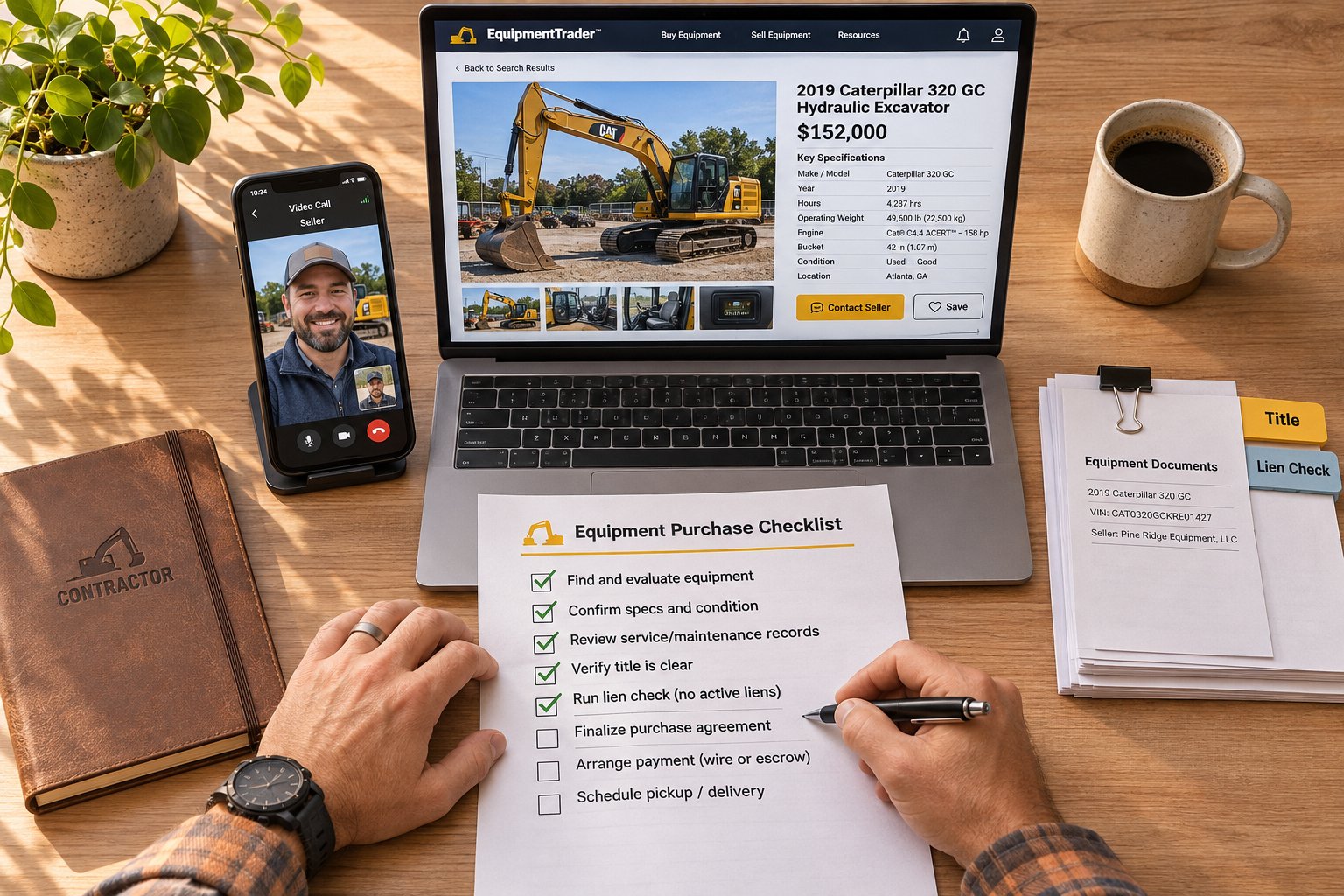
Trust dimensions, marketplace categories, platform assessments, buyer protections, fee breakdowns, fraud tactics, and direct-supplier advantages — that is a lot of ground to cover. Yet every section of this guide points toward a single practical question: what should you actually do before committing money to a machine? The answer is a disciplined, repeatable process you can run on every transaction, regardless of whether you are bidding at auction, responding to a classified listing, or requesting a quote from a specialized supplier. Consider what follows your heavy equipment buying checklist — a distillation of every trust principle discussed above into steps you can execute starting today.
Your Pre-Purchase Trust Checklist
Print this list. Save it to your phone. Share it with your purchasing team. Every step exists because real buyers have lost real money by skipping it.
- Define your trust requirements using the six-dimension rubric. Before you even open a marketplace, decide what level of seller verification, buyer protection, transaction security, fee transparency, reputation signals, and dispute resolution you require for this particular purchase. A $15,000 skid steer and a $400,000 excavator demand different thresholds. Write yours down — vague expectations lead to vague outcomes.
- Identify which marketplace category fits your buying style. Are you comfortable with the caveat-emptor nature of classified sites? Do you prefer the structured bidding and inspection windows of auction platforms? Would a dealer network's inherited reputation give you more confidence? Or does the direct accountability of a specialized supplier better match your risk tolerance? Choosing the right category before you start browsing prevents you from applying the wrong expectations to the wrong platform.
- Verify the platform's seller vetting process and buyer protections. Open the platform's terms of service, FAQ, and trust-and-safety pages. Look for specifics: How are sellers verified? Is escrow available? What does the dispute process look like, and what are the deadlines for filing a claim? If these details are missing or buried, that absence is itself an answer. Score the platform against the rubric table from Section 2 and assign it a trust tier before you engage with any listing.
- Request a complete fee schedule before listing or bidding. Ask for an itemized breakdown of every cost you will incur — buyer premiums, documentation fees, payment processing surcharges, storage penalties, and transport coordination markups. Compare the platform's fee schedule against the fee category table from Section 6. If a representative cannot produce a written fee schedule on request, treat that as a trust-tier downgrade and proceed with extreme caution.
- Run scam-detection checks on every deal. This is where your pre-purchase equipment inspection tips become non-negotiable. Verify the machine's serial number through the National Equipment Register (NER). Run a UCC lien search on the seller's legal name. Request a live video call where the seller walks to the machine and shows the identification plate in real time. Arrange a third-party pre-purchase inspection — and build an inspection contingency into your purchase agreement before any deposit becomes non-refundable. Never wire funds without escrow protection. If the seller resists any of these steps, you have your answer.
- Explore multiple sourcing channels before finalizing your purchase. The strongest trusted heavy equipment sourcing strategy is not a single-platform approach — it is a multi-channel comparison. Check auction platforms for competitive pricing on surplus inventory. Browse classified sites like Machinery Trader and Equipment Trader for breadth of selection. Evaluate dealer networks for warranty-backed, OEM-certified machines. And compare options from specialized suppliers such as JIUHONG, where you can review categorized inventory of excavators, loaders, bulldozers, and graders, compare specifications side by side, and request quotes directly from a single accountable source. Each channel has distinct strengths — and using more than one gives you pricing leverage, inventory breadth, and built-in trust benchmarks you simply cannot get from a single marketplace.
Building a Multi-Channel Sourcing Strategy
Here is a pattern that experienced equipment buyers follow repeatedly: they source candidates from two or three different channels, run the trust rubric on each platform, and let the results compete. An auction lot with IronClad Assurance coverage might offer the best price. A classified listing might surface a low-hour machine that never hit the auction circuit. A specialized supplier might deliver the most transparent transaction with zero intermediary fees. By comparing across channels, you are not just finding the right machine — you are finding the right machine on the right terms from the right source.
This approach also protects you from tunnel vision. When you are locked into a single platform, urgency builds. You start rationalizing skipped steps. You tell yourself the deal is "probably fine" because the listing looks professional. Multi-channel sourcing breaks that psychology. If one deal feels wrong, you have alternatives already in motion — and the willingness to walk away is the single most powerful negotiating tool a buyer can hold.
Whether you are a contractor replacing a critical excavator before a project deadline, a fleet manager rotating aging loaders out of service, or a dealer restocking inventory for resale, the process stays the same. Define your trust floor. Score the platform. Verify the machine. Protect your payment. Compare your options. Then — and only then — commit.
The most trusted transaction is not the one that happens on the most popular platform. It is the one where the buyer verified the seller, inspected the machine, protected the payment, understood every fee, and had the discipline to walk away from any deal that could not survive scrutiny.
Trust in the heavy equipment marketplace is not a feature you subscribe to. It is a result you build — through transparency, protections, accountability, and the kind of structured diligence that turns a high-anxiety, six-figure purchase into a decision you can defend with evidence. Use this checklist every time, on every platform, for every machine. The process works because the risks are predictable — and predictable risks are the ones you can control.
Frequently Asked Questions About Trusted Online Heavy Equipment Marketplaces
1. How do I know if an online heavy equipment marketplace is trustworthy?
Evaluate any platform across six core trust dimensions: seller verification processes, buyer protection policies (such as escrow and inspection contingencies), transaction security features (title checks, lien searches), fee transparency, independent reputation signals like BBB ratings or Trustpilot scores, and the strength of its dispute resolution process. Platforms that score strong across most of these dimensions — such as those offering verified seller programs and formal claim windows — earn the highest trust ratings. If a platform hides its policies or cannot provide a written fee schedule on request, treat that lack of transparency as a warning sign.
2. What is the biggest risk when buying heavy equipment online?
Wire fraud is widely considered the single largest financial risk in online equipment transactions. Scammers impersonate legitimate sellers or compromise real email accounts, then redirect payment to fraudulent bank accounts. Because wire transfers are nearly instant and irreversible, funds are essentially unrecoverable once sent. To mitigate this risk, never wire money based solely on emailed instructions. Always verify payment details by calling the seller at an independently confirmed phone number, and use a reputable escrow service that holds funds until delivery and condition verification are complete.
3. What buyer protections should I look for on equipment auction platforms?
Strong auction platforms offer inspection certification programs, defined dispute claim windows with documented timelines, and structured payment processing that holds funds until terms are met. For example, some auction operators provide inspection reports with component-level condition ratings and allow buyers to file written disputes within a set number of business days if the equipment does not match the report. Always check whether the platform offers escrow-style fund holding, whether buyer premiums and documentation fees are disclosed before bidding, and whether a formal mediation process exists for resolving disagreements after the sale.
4. Are there hidden fees when buying or selling heavy equipment online?
Yes, and they vary significantly by platform type. Auction platforms may charge buyer premiums (often 5-15% of the hammer price), documentation fees on titled items, storage penalties for late pickup, and payment processing surcharges for credit card transactions. Classified sites typically charge listing fees but no sale commissions, while dealer networks may include referral fees or subscription costs. Always request an itemized fee schedule in writing before committing. Compare the platform's stated costs against independent buyer reviews, since some charges — like transport coordination markups or late-payment interest — only surface in the fine print.
5. Is it safer to buy heavy equipment from a direct supplier instead of a marketplace?
Buying from a specialized supplier who owns and controls their own inventory offers distinct trust advantages: direct accountability, the ability to inspect machines firsthand or via live video, and negotiation without buyer premiums or intermediary fees. Companies like JIUHONG (https://jiuhong-machinery.com/products/) let buyers browse categorized used construction equipment — excavators, loaders, bulldozers, and graders — compare specifications, and request quotes directly. The trade-off is smaller inventory compared to global auction platforms or classified sites with tens of thousands of listings. Many experienced buyers use a multi-channel strategy, sourcing candidates from auctions, classifieds, dealer networks, and direct suppliers to maximize both trust and selection.