

What a Mini Excavator Is and Who Should Buy One
Imagine scrolling through dozens of listings for a mini excavator for sale, each one quoting a sticker price that looks reasonable — until you factor in transport, attachments, maintenance, insurance, and the undercarriage replacement lurking 800 hours away. The purchase price is only one line item in a much longer equation, and most buyers don't see the full math until after they've signed.
This article exists to change that. Think of it as a decision-making framework you can work through before you ever click on a listing. Every section ahead tackles a specific cost or choice that separates a smart purchase from an expensive lesson.
What Exactly Is a Mini Excavator
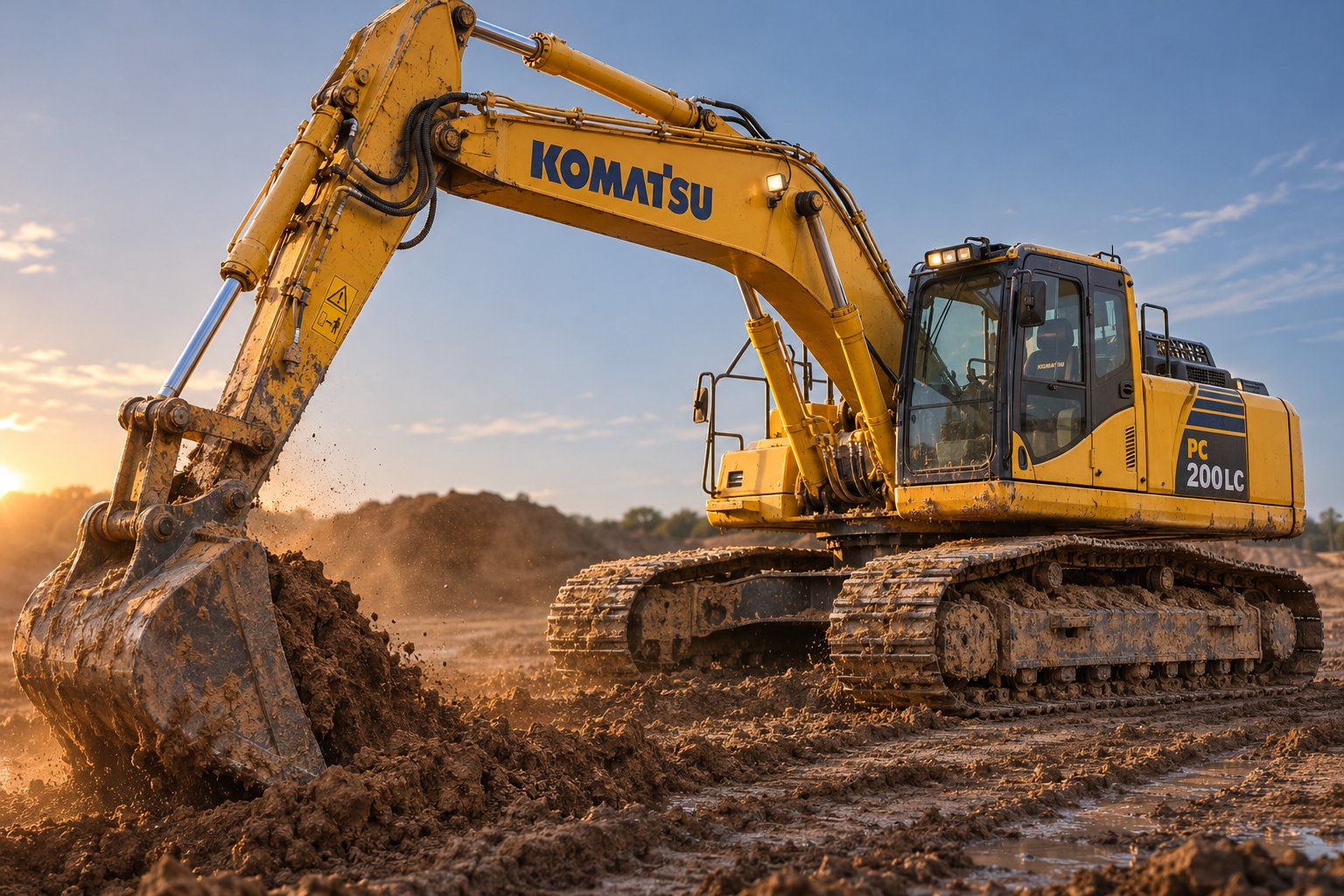
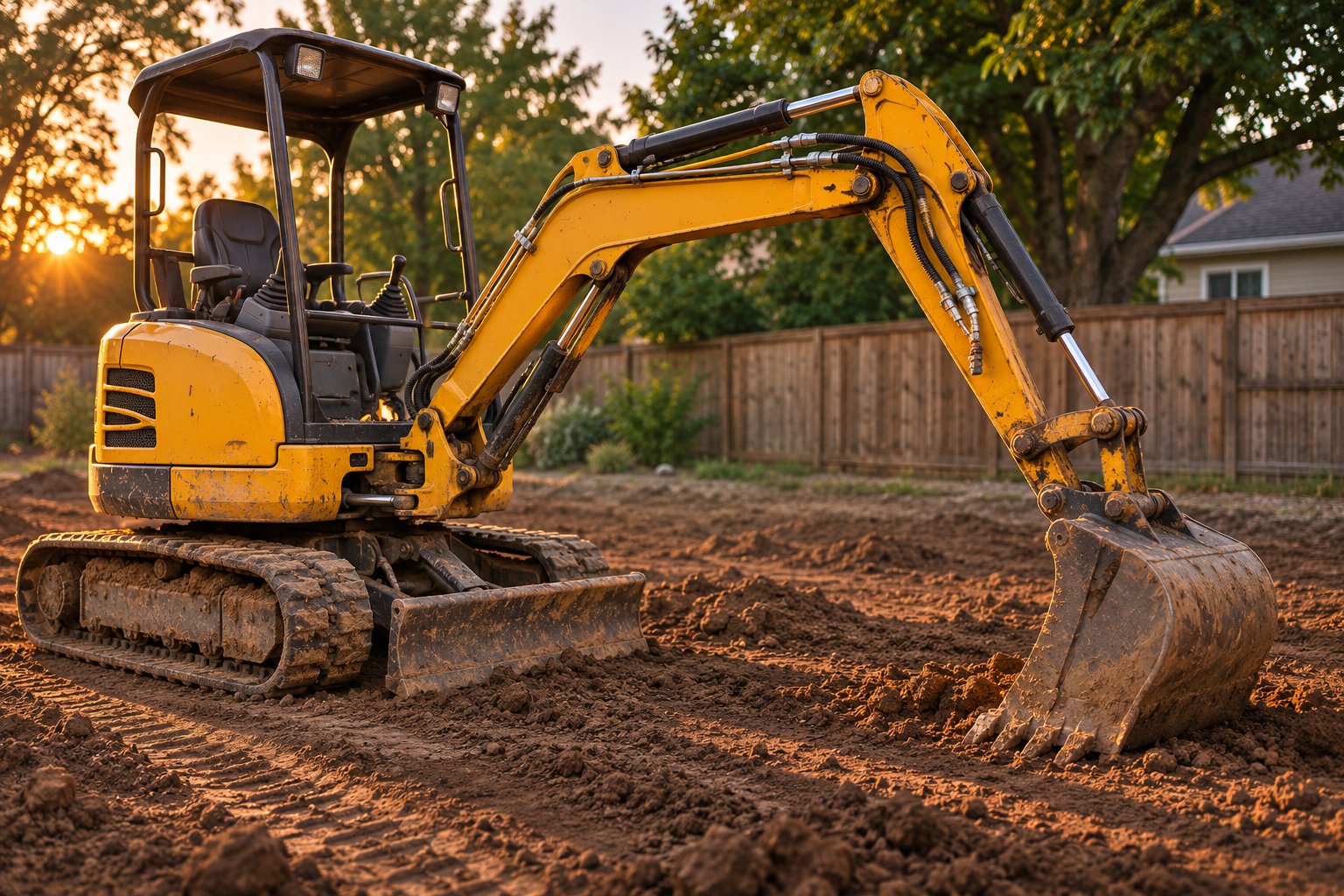
A mini excavator — sometimes called a compact excavator — is a hydraulic digging machine with an operating weight generally under 6 metric tons. Picture a boom, an arm (also called a dipper stick), a bucket, and a cab or canopy mounted on a rotating house that sits atop a tracked undercarriage. Most models also include a front blade for backfilling and light grading.
What separates these machines from their full-size cousins isn't just weight. It's accessibility. A compact excavator can squeeze through a standard backyard gate, roll across a finished lawn on rubber tracks without tearing it apart, and travel to the jobsite on an equipment trailer behind a pickup truck — no flatbed tow truck or oversize permits required in most cases. Yet even the smallest models deliver enough hydraulic force to trench utility lines, excavate footings, or snap through tree roots that would take a crew with shovels all day.
Mini excavators account for more than one-fifth of all new financed construction equipment sales in the United States, ranking second only to compact track loaders, according to EDA market data. Over 32,500 new financed units sold in the most recent twelve-month reporting period — roughly double the volume from a decade ago. Used financed sales jumped 13.1% year over year during the same window, signaling that buyer demand remains strong even as some shoppers shift from new to pre-owned machines for affordability.
Who Should Consider Buying a Mini Excavator
The buyer pool is far wider than most people assume. Excavation contractors expanding their fleets make up the largest segment, but they share the market with landscapers adding serious digging capability beyond what a skid steer or front end loader can handle. Homeowners tackling large property projects — think ponds, drainage systems, or land clearing — increasingly purchase compact machines rather than renting repeatedly. Equipment dealers source inventory for resale, and international import buyers purchase in bulk for overseas markets where demand for affordable compact machines is surging.
The right purchasing decision hinges on three variables: project scope, frequency of use, and total budget. A landscaper running a machine five days a week faces a completely different cost equation than a homeowner who needs one for a single two-week project. Similarly, someone hauling equipment alongside dump trailers for sale on Big Tex trailers has different transport considerations than a fleet buyer arranging commercial freight.
This guide walks you through every decision point that shapes that equation:
- Choosing the right size class for your actual workload
- Comparing brands by reliability, parts access, and resale value
- Understanding realistic pricing for new and used machines
- Running the buy-versus-rent math with your own numbers
- Inspecting a used mini excavator before committing money
- Calculating total cost of ownership beyond the sticker price
- Identifying the best buying channels — and the risks each one carries
Every section ahead is built around one goal: giving you the complete financial picture so the mini excavator you buy is the one that actually fits your work, your budget, and your long-term plan. The first variable to nail down is size — and the differences between classes are larger than most listings let on.
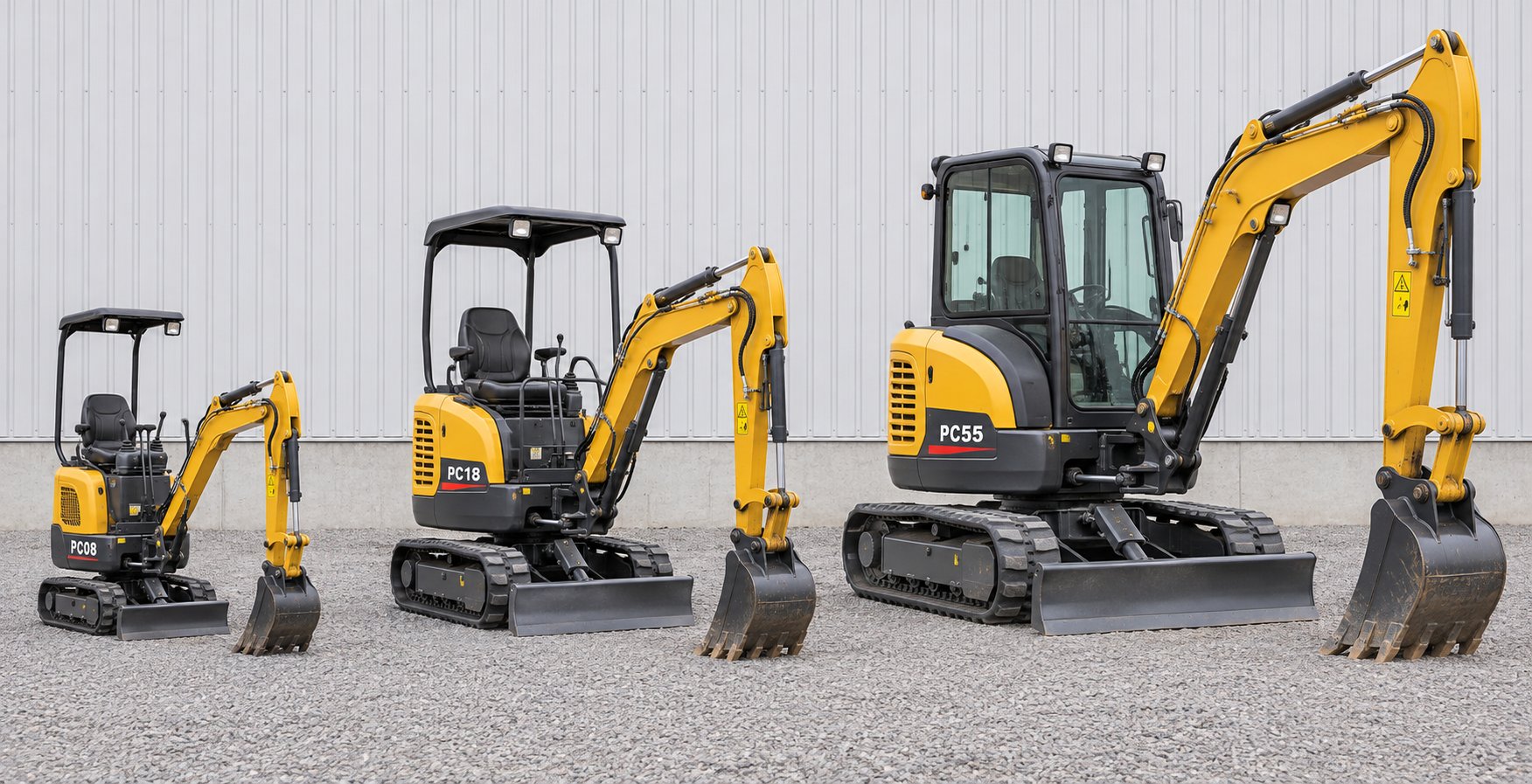
Mini Excavator Size Classes Explained
A listing for a mini excavator rarely tells you whether the machine is right for your job. Two models both labeled "mini" can differ by 10,000 pounds, eight feet of dig depth, and tens of thousands of dollars. That gap trips up first-time buyers constantly — they shop by price, not by class, and end up with a machine that's either fighting to keep up or wildly overpowered for the work at hand.
The industry generally breaks the mini excavator category into three size classes based on operating weight. Each class carries a distinct set of capabilities, limitations, and transport requirements. Understanding where your projects fall on this spectrum is the single most important filter to apply before evaluating any listing.
Micro Excavators Under One Ton
Machines under roughly 1 metric ton — sometimes marketed as micro excavators — are the specialists of the compact world. Picture a unit weighing between 2,000 and 2,500 pounds, narrow enough to roll through a standard 36-inch backyard gate, and light enough to ride on a small equipment trailer behind a half-ton pickup. Models like the Kubota K008-5 (2,025 lbs, 34 inches wide) and the CAT 300.9D (2,399 lbs, 29 inches wide) illustrate just how compact this class gets.
Typical dig depths range from about 5 to 6 feet, with bucket widths between 12 and 18 inches. That's enough reach for residential plumbing trenches, small landscaping grading, irrigation lines, and tight-access foundation repair — jobs where getting the machine to the dig zone matters more than raw digging power. Some plumbing contractors rely on a micro excavator for 60% or more of their residential service calls simply because the machine fits where nothing else can.
The trade-offs are real, though. Limited bucket force means you'll struggle in dense clay or rocky soil. Shallow reach rules out deep utility work. And production speed tops out around 3 to 5 cubic yards per hour in ideal conditions — adequate for precision tasks, but painfully slow if you need to move serious volume. Think of micro excavators as surgical tools: perfect for the right procedure, completely wrong for heavy earthmoving. A stump grinder or a man lift fills a similarly narrow niche — invaluable when you need it, unnecessary when you don't.
Compact Minis From One to Three Tons
Step into the 1-to-3-ton class and you'll find the segment that dominates the resale market. According to FieldFix's sizing data, machines in this range account for roughly 45% of the mini excavator market — and rental houses stock more 3-to-4-ton units than any other size class. There's a reason for that popularity: these machines hit multiple sweet spots at once.
Operating weights run from about 3,700 pounds at the low end up to around 10,000 pounds for the larger 3-ton-class models. Dig depths of 9 to 12 feet cover the vast majority of residential utility, foundation, and septic work. Bucket widths expand to 24-30 inches, and engine power typically falls in the 20-35 hp range — enough to handle real production digging while keeping fuel consumption manageable.
This is also where zero-tail-swing designs have become increasingly common. Brands like Bobcat, CASE, and Yanmar offer multiple zero-tail-swing models in this weight range — machines whose rear housing doesn't extend past the tracks during rotation. That feature is a game-changer on congested residential sites or when trenching alongside a structure. The Bobcat E35, for example, combines zero tail swing with up to 12 feet 10 inches of dig depth in a package that weighs under 9,000 pounds.
For owner-operators and small contractors, this class delivers the best balance of capability, transportability, and purchase price. A 3/4-ton truck and a 12,000-pound-capacity equipment trailer handle the hauling. The machines are powerful enough for swimming pool excavation, utility installation, and light demolition — yet compact enough to work a suburban backyard without demolishing the neighbor's fence.
Standard Minis From Three to Six Tons
At 3 to 6 metric tons (roughly 11,000 to 15,000+ pounds of operating weight), these machines start to rival mid-size excavators in raw capability. Dig depths push past 12 feet and can exceed 15 feet on larger models. Engine power climbs into the 35-50 hp range, and cab comfort improves significantly — enclosed ROPS/FOPS cabs with climate control become standard rather than optional.
You'll find this class on commercial site-preparation jobs, deep utility trenching, pond excavation, and demolition projects requiring serious breakout force. Bucket widths expand to 30-48 inches, and the hydraulic systems are robust enough to run heavier attachments like breakers and augers without bogging down.
Transport requirements shift meaningfully in this range. A 6-ton excavator with a standard bucket can weigh around 14,000 pounds. Add a trailer at 3,000 pounds, and you're approaching 17,000 pounds — beyond what most half-ton trucks can safely tow. A one-ton dually and an 18,000-pound-rated gooseneck or tag-along trailer become the minimum. For buyers who also haul other heavy equipment — say, someone shopping for a dump truck for sale alongside a standard mini — this is the class where transport logistics start driving real costs. In northern climates, contractors sometimes pair a standard mini with a snow plow attachment for winter revenue, taking advantage of the machine's weight and hydraulic power during the off-season.
The comparison table below puts all three classes side by side so you can match your typical project requirements to the right weight range:
| Specification | Micro (Under 1 Ton) | Compact Mini (1–3 Tons) | Standard Mini (3–6 Tons) |
|---|---|---|---|
| Operating Weight | 2,000–2,500 lbs | 3,700–10,000 lbs | 11,000–15,000+ lbs |
| Typical Dig Depth | 5–6 ft | 9–12 ft | 12–15+ ft |
| Common Use Cases | Plumbing trenches, tight residential access, small landscaping | Utility installation, foundations, pool excavation, light demolition | Commercial site prep, deep utilities, heavy landscaping, demolition |
| Transport Requirements | Half-ton truck + light equipment trailer (6,000 lb capacity) | 3/4-ton truck + 12,000 lb trailer | One-ton truck + 18,000 lb gooseneck or commercial delivery |
| Approximate Price Range (New) | $15,000–$30,000 | $30,000–$70,000 | $60,000–$100,000+ |
Notice how dig depth and transport demands scale together — and how the price jump between classes isn't linear. A compact mini at twice the weight of a micro excavator doesn't cost twice as much; it may cost three to four times as much once you factor in the heavier trailer, the larger tow vehicle, and the increased fuel consumption. That's why matching machine class to actual project needs — rather than buying the biggest unit your budget allows — protects your bottom line from the start.
Size class tells you what a machine can do. Brand tells you how reliably it does it, how easily you can find parts, and how much value the machine holds when you're ready to sell. Those variables deserve their own close look.
Top Mini Excavator Brands Compared
Two machines with identical dig depths, similar operating weights, and comparable horsepower can deliver wildly different ownership experiences over a five-year hold. The divergence isn't about specs — it's about what happens when a hydraulic pump fails on a Thursday afternoon and you need the machine running by Monday. Brand choice determines whether that repair takes three days or three weeks, and whether the part costs $800 or $2,400.
That's why a structured brand comparison matters far more than a spec-sheet shootout. When you're evaluating any mini excavator for sale, three variables separate the brands that earn their price from the ones that don't: parts availability, dealer support depth, and resale value trajectory. Here's how the major manufacturers stack up.
Established Japanese and European Brands
If you ask ten contractors which brand they'd buy with their own money, the majority will name a Japanese manufacturer. There's a reason for that loyalty — decades of field-proven reliability backed by engineering cultures that prioritize hydraulic refinement and build durability over flashy features.
Kubota sits at the top of most contractor shortlists. The KX and U-series lineups have become the benchmark other brands are measured against. Kubota builds its own engines — renowned for fuel efficiency and low emissions — and the brand's resale numbers reflect that reputation. Rubbl's 2026 brand analysis reports that well-maintained Kubota mini excavators routinely retain 60% to 70% of their original price after three years, the strongest resale curve in the compact class. The catch? Dealer parts allocations can tighten during peak construction season in some regions, and Kubota's pricing consistently runs at the top of the market.
Yanmar holds a unique position in mini excavator history: the company built the first true mini excavator back in 1968 and still manufactures engines for several competitors. The ViO zero-tail-swing series is one of the best-engineered platforms for tight residential and urban utility work, where every inch of swing radius matters. Yanmar's U.S. dealer support runs thinner than Kubota's outside the West Coast and parts of the Northeast, so buyers in other regions should confirm parts logistics before committing.
Takeuchi has earned one of the most loyal owner bases in the industry. The TB series — including the well-known TB240 in the compact class — delivers hydraulic performance that consistently punches above its tonnage rating. Operators who spend a full season in a Takeuchi rarely switch brands. Used Takeuchis hold their value aggressively because demand outpaces supply; a three-year-old TB290 in good condition often trades near what a new one cost two years prior. The trade-off is a dealer footprint that's smaller than Kubota's or Caterpillar's, particularly in the Midwest. Before you sign, verify how far you'll drive for parts and service.
Kobelco rounds out the Japanese contingent as a strong value play. The SK-series, including the SK17SR-7, delivers smooth and predictable hydraulic performance that competes with top-tier brands at a meaningful price discount. You're getting genuine engineering refinement without paying the full Kubota or Cat premium. The caveat is dealer coverage — Kobelco's footprint is among the smallest of the established brands in North America. In some regions, you're looking at a four-hour drive for parts. If your operation can absorb that logistics gap, the price-to-feature ratio is compelling. Contractors shopping for a stump grinder for sale alongside their excavator often appreciate Kobelco's value positioning for machines that won't run daily hours.
North American Market Leaders
The North American heavyweights compete less on engine heritage and more on ecosystem — dealer density, integrated financing, and attachment compatibility that simplifies fleet management.
Caterpillar wins the dealer network argument outright. Cat operates the largest construction equipment dealer footprint in North America, meaning you're rarely more than a couple of hours from a shop with parts on the shelf. The Next Gen mini excavator line introduced Stick Steer (joystick-controlled travel) and Cat Connect telematics, giving fleet managers usable data without aftermarket bolt-ons. The cabs are spacious and well-insulated for long shifts. The trade-off is weight and price — Cat machines run heavier and pricier than Kubota or Takeuchi at the same tonnage, which matters if you're paying by the pound on transport or working over soft ground.
Bobcat (Doosan) brings the largest compact equipment dealer footprint in North America alongside a heritage that makes the brand synonymous with the bobcat skid steer. The R-series mini excavators represent a meaningful upgrade from the previous generation, with stronger lift performance and improved cab ergonomics laid out for operators who jump between excavators and skid loaders throughout the day. One thing to note: older Bobcat mini excavators tend to depreciate harder on the used market than top-tier Japanese brands, though the current R-series is closing that gap.
John Deere makes the strongest case for buyers who already have a relationship with a green dealer. The G-Series features the AutoShift travel system and integrates seamlessly with Deere's financing and service ecosystem. In agriculture-heavy regions of the Midwest and Plains, Deere's dealer network rivals Kubota's in depth. The hydraulic feel is good but not exceptional — if you've spent serious hours in a Kubota or Takeuchi cab, you'll notice the difference. Resale tracks slightly behind the top tier but ahead of budget brands.
CASE and Volvo fill important niches. CASE offers solid machines with competitive pricing and a dealer network that's serviceable across most of North America, though not as dense as Cat's or Bobcat's. Volvo's ECR-series earns praise for safety engineering and cab ergonomics — among the best operator visibility and noise levels in the class — making it attractive for companies that prioritize operator retention. Both brands are capable choices when the local dealer is strong, but buyers should verify service turnaround times and parts lead times at their nearest location before committing. If you've ever browsed listings at an rb auction, you'll see CASE and Volvo compact units moving at fair prices precisely because they attract a slightly smaller bidder pool than Cat or Kubota — which can work in a savvy buyer's favor.
Budget and Emerging Brands
The fastest-growing segment of the mini excavator market comes from Chinese-manufactured machines. Brands like SANY, XCMG, and LiuGong — plus a wave of lesser-known names appearing on online marketplaces — now offer compact excavators at prices 30% to 50% below established competitors. Industry analysis from Earthworks Hub notes that China accounts for over 30% of global mini excavator exports, a figure that continues climbing year over year.
The savings are real, and they deserve an honest look rather than dismissal. Many of these machines carry engines from Kubota, Yanmar, or other established suppliers — equipment exported from China is not necessarily built entirely with Chinese components. SANY's SY-series, for example, has earned a growing contractor following for occasional-use applications where production deadlines aren't critical.
The trade-offs are equally real. Parts lead times can stretch from days to weeks. North American dealer support remains thin for most Chinese brands, though companies like SANY are expanding their service footprint. Build quality varies — not just between brands, but sometimes between production runs within the same brand. And resale value lags significantly; a three-year-old Chinese-brand excavator will sell for a far smaller fraction of its original price than a comparable Kubota or Cat.
For a contractor who needs a machine for occasional jobs — a few times a month, low annual hours, no hard production deadlines — the upfront savings can genuinely pencil out. For a daily-use workhorse on tight schedules, a single week of downtime waiting on a part erases years of upfront savings. The key is matching the brand tier to your actual usage intensity. Buyers looking for a boom lift or other specialty equipment face a similar calculation: the cheapest option isn't always the cheapest to own.
| Factor | Premium Brands (Kubota, Cat, Takeuchi) | Mid-Tier Brands (Deere, Bobcat, Volvo, CASE) | Budget / Emerging Brands (SANY, XCMG, LiuGong) |
|---|---|---|---|
| Typical Price Position | Highest — top of class pricing | 5%–15% below premium tier | 30%–50% below premium tier |
| Parts Availability | Strong — stocked at most dealers, 1–3 day lead times | Good — regional variation, occasionally longer waits | Limited — may require international shipping, 1–4 week lead times |
| Dealer Network (North America) | Dense nationwide coverage | Good to dense, varies by brand and region | Thin — expanding but still concentrated in select markets |
| Resale Value (3-Year) | 60%–70% retention typical | 50%–60% retention typical | 35%–50% retention, limited used-market demand |
| Engine Options | Proprietary (Kubota, Yanmar) or tier-one OEM | Proprietary or tier-one OEM partnerships | Mixed — some use Kubota/Yanmar engines, others use domestic Chinese engines |
The brand on the decal matters less than the dealer behind it. Always factor in long-term parts access, service turnaround time, and projected resale value — not just the sticker price. A $15,000 savings at purchase can evaporate in a single extended downtime event or at trade-in.
Brand reputation sets the floor for reliability and resale. But even the most trusted name on the market can't protect you from overpaying — and the price spread across brands, conditions, and buying seasons is far wider than most shoppers expect. That gap is exactly where the next layer of hidden cost lives.
How Much Does a Mini Excavator Cost
Here's the frustrating reality behind every mini excavator for sale: the listing price tells you almost nothing without context. A $28,000 machine and a $72,000 machine can both be 3-ton excavators from reputable brands — the gap comes down to hours, condition, configuration, and timing. Most pricing guides gloss over these variables or present ranges so wide they're useless. You deserve better numbers than that.
Pricing transparency is the single biggest information gap in the compact excavator market. Dealers know what machines are worth. Auction veterans know what they'll bring. First-time buyers? They're guessing — and guessing with five-figure stakes on the table. This section breaks pricing into the three dimensions that actually determine what you'll pay: class, condition, and calendar.
New Mini Excavator Price Ranges
New compact excavator pricing scales with operating weight, but the relationship isn't linear. You're paying for digging capability, hydraulic sophistication, operator comfort, and emissions compliance all at once — and each of those variables adds cost in ways that aren't obvious from a spec sheet.
At the entry level, micro excavators under 1 ton represent the most affordable path into ownership. Market data from early 2026 places new premium-brand micro units between $25,000 and $40,000, while value-brand alternatives start as low as $15,000. The compact 2-to-4-ton class — the segment that accounts for the majority of sales — ranges from roughly $35,000 to $80,000 depending on brand tier. Step up to the 5-to-6-ton standard minis and you're looking at $65,000 to $100,000 or more for premium-brand machines equipped with enclosed cabs and full hydraulic configurations.
Several configuration choices push pricing up or down within each class:
Engine type. Most mini excavators run diesel engines, but some micro units offer gasoline powerplants at a lower price point. Diesel delivers superior torque and fuel efficiency for production work, while gasoline models appeal to homeowners and light-duty users who value simplicity over longevity.
Cab versus canopy. An enclosed ROPS/FOPS cab with climate control, a suspension seat, and LED lighting typically adds $3,000 to $6,000 over a canopy-only configuration. Contractors logging full-day shifts justify that cost quickly; weekend users often don't.
Zero-tail-swing design. Machines engineered so the rear housing doesn't overhang the tracks during rotation carry a modest premium — usually a few thousand dollars — but that feature is essential for tight residential and urban sites where every inch of clearance matters.
Tier 4 Final emissions compliance. Every new mini excavator sold in the United States must meet EPA Tier 4 Final standards. The after-treatment systems required to hit those targets — diesel particulate filters, diesel oxidation catalysts, or selective catalytic reduction — add engineering cost that's baked into the purchase price. Machines imported without proper EPA certification face seizure and fines, so confirming emissions compliance is non-negotiable when evaluating any listing, especially from international sellers.
Used Mini Excavator Pricing by Condition
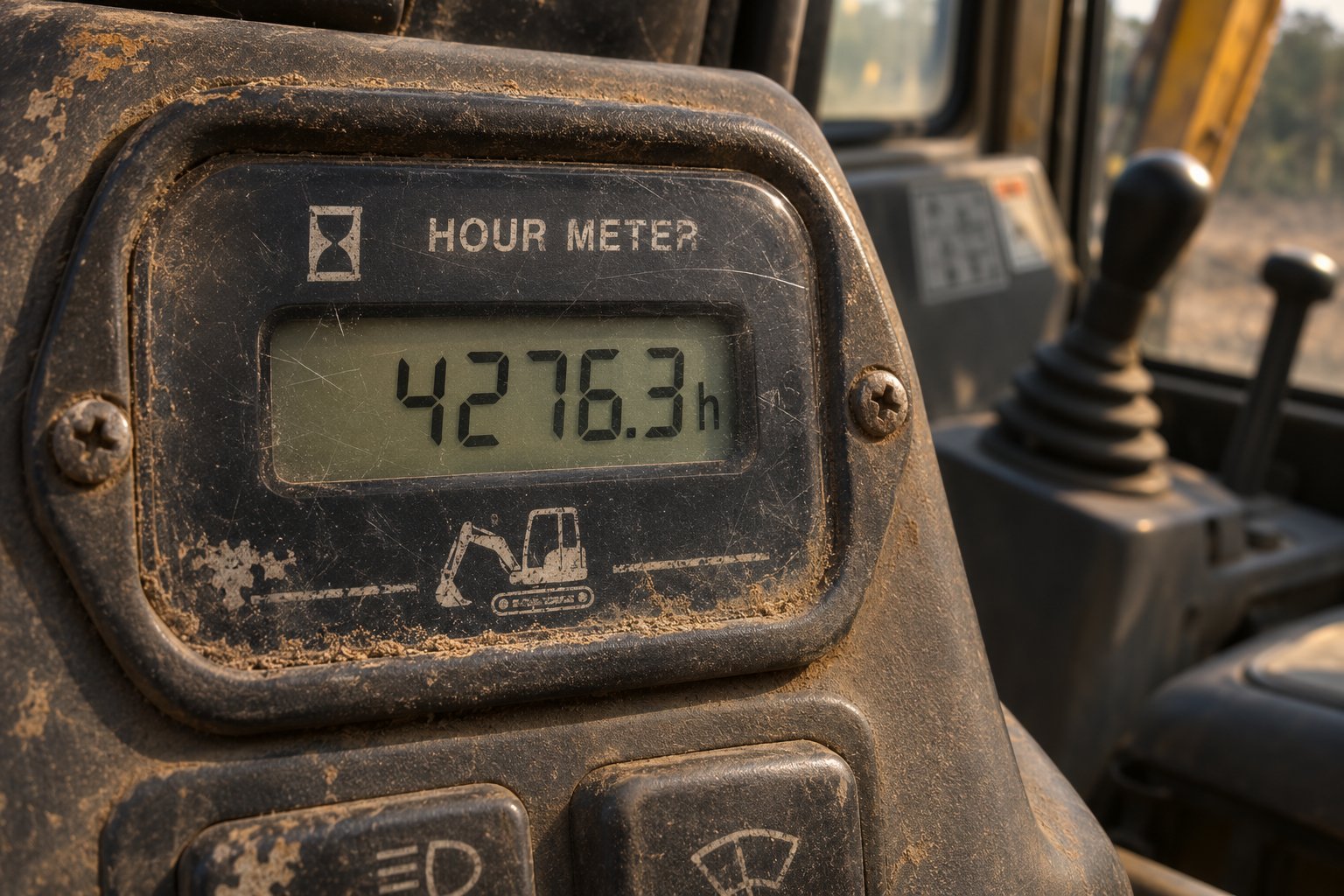
If new-machine pricing feels steep, used compact excavators offer meaningful savings — but only if you understand how the market values condition. Think of the hour meter on a mini excavator the way you'd think of an odometer on a pickup truck: it's the single most important number on the machine, and it drives pricing more than almost anything else.
The used market breaks roughly into three tiers based on accumulated operating hours:
Low-hour machines (under roughly 1,500 hours). These units are often lease returns, rental fleet retirements from well-maintained yards, or machines that sat idle more than they worked. Industry pricing benchmarks show low-hour 3-ton-class machines from premium brands trading at 20% to 30% below new retail — roughly $32,000 to $48,000. You're getting a machine with most of its mechanical life ahead of it while someone else absorbed the steepest depreciation. This is often the sweet spot for buyers who want near-new capability without the full new-machine price tag.
Mid-life machines (1,500 to 4,000 hours). This is the workhorse tier of the used market. Expect discounts of 30% to 45% below new pricing for well-maintained units — putting a 3-ton premium-brand excavator in the $22,000 to $38,000 range. Maintenance history matters enormously here. A machine with documented 250-hour oil changes and scheduled hydraulic filter replacements at this hour range is a fundamentally different proposition than one with no service records. The difference between a $25,000 bargain and a $25,000 headache lives entirely in those records.
High-hour machines (4,000+ hours). Discounts deepen to 45% to 75% off new pricing, and you'll find 3-ton units trading between $10,000 and $28,000 depending on brand and condition. The math can still work — especially for a homeowner tackling a defined project or a contractor who needs a backup unit — but you're buying into a machine that's closer to major maintenance milestones. Track replacement, hydraulic pump rebuilds, and engine overhauls all become realistic near-term expenses at this hour range. Budget accordingly, or hire a mechanic for a pre-purchase inspection.
The depreciation curve itself follows a predictable pattern. New machines lose 15% to 20% of their value the moment they leave the dealer lot — the steepest single drop in the ownership cycle. By year three, premium brands like Kubota and Caterpillar typically retain 60% to 70% of original value. Mid-tier brands hold 45% to 55%. Budget brands and Chinese imports depreciate fastest, retaining only 35% to 50% after five years. That depreciation gap means a contractor who buys a $60,000 premium machine and sells after four years might recover $36,000 to $42,000, while the same buyer with a $35,000 value-brand unit might recover only $15,000 to $19,000 — narrowing the true cost-of-ownership difference to far less than the sticker prices suggest.
Seasonal Pricing Patterns
Timing your purchase can save thousands without any negotiation skill at all. Mini excavator prices don't stay flat throughout the year — they follow construction activity cycles that create predictable windows of opportunity for patient buyers.
Seasonal demand analysis from Ironmart shows that excavator prices hold strongest from June through August, when contractors are launching projects and rental fleets are fully deployed. Demand peaks during this window, bidding competition intensifies at auction, and dealers have less incentive to negotiate. Pricing swings of 15% to 20% between peak summer and off-peak winter are common in the used compact excavator market.
Prices tend to soften in late fall and winter — particularly in northern climates where frozen ground halts excavation work. November through February typically brings the weakest demand and the softest pricing. Contractors offloading equipment before year-end for tax purposes add inventory to the market right when buyer activity drops. If you have the flexibility to shop during this window, the savings can be substantial.
Auction cycles amplify these patterns. Major equipment auctions often cluster in late winter and early spring, creating periodic inventory surges that briefly push prices down before the construction season absorbs the supply. Watching auction calendars — and understanding that a dump truck and excavator listed in the same February auction both benefit from the same seasonal softness — gives you a timing edge that pure price comparison can't replicate.
- Brand and model — premium names command premiums at every hour level
- Accumulated hours — the single strongest predictor of used pricing
- Machine age — newer machines with equivalent hours trade higher
- Attachments included — a hydraulic thumb, extra buckets, or an auger adds real value
- Undercarriage condition — replacement costs can reach $2,500 to $6,000 and directly discount the asking price
- Geographic market — pricing runs higher in construction-heavy metro areas and lower in rural or off-season markets
Knowing what a machine should cost based on its class, condition, and the time of year you're shopping gives you leverage that most buyers simply don't have. But even perfect pricing knowledge can't answer a more fundamental question: should you buy at all, or does renting make more financial sense for your situation? That calculation depends on numbers only you can plug in.
Buying vs Renting a Mini Excavator
Not every person searching for a mini excavator for sale actually needs to buy one. That might sound counterintuitive in an article about purchasing, but the honest math sometimes points the other way — and ignoring that reality leads to machines sitting idle in a yard, bleeding depreciation while earning nothing. The smarter move is running the numbers for your specific situation before you commit a dime.
When Renting Makes More Sense
Renting wins in three clear scenarios: infrequent use, one-off residential projects, and jobs requiring a machine size you rarely need. If you're digging a single drainage trench on your property or tackling a weekend landscaping overhaul, renting eliminates the long-term financial commitment entirely.
Current rental market data puts 2026 mini excavator rates at roughly $200 to $350 per day depending on weight class, with weekly rates running three to four times the daily figure and monthly rates landing around ten to twelve daily rates. A 2-to-4-ton compact mini — the most-rented size — typically costs $250 to $300 per day or $800 to $1,500 per week. Larger 4-to-6-ton units push $300 to $450 daily.
Beyond the base rate, expect delivery charges of $100 to $300 round trip (the machine has to ride on a flatbed truck or equipment trailer — it doesn't drive itself to your site) plus a damage waiver that adds 10% to 15% on top. Those extras catch first-time renters off guard but are predictable once you know they exist.
The real convenience of renting goes beyond price. The rental yard handles maintenance, insurance, and transport logistics. You pick the machine up, use it, return it, and walk away. No storage headaches, no hydraulic fluid changes, no winterization. For a homeowner who needs an excavator once every few years — or a contractor who occasionally needs a machine class outside their fleet — that simplicity has genuine value.
When Buying Delivers Better Value
Renting gets expensive fast once the work becomes recurring. Imagine renting a compact mini at $1,200 per week for a two-week job, four times a year. That's $9,600 annually in rental fees alone — before delivery charges and waivers push the total past $11,000. Within two to three years of that pattern, you've spent enough to buy a solid used machine outright.
FieldFix's 2026 cost analysis frames the crossover point clearly: if you'll use equipment more than roughly 60% of available working days — about 150 days per year — buying starts to make financial sense. Below that threshold, renting is usually cheaper when you account for all ownership costs. The break-even for a mini excavator specifically falls around 120 rental-equivalent days per year, or roughly five to six months of steady use.
Ownership also builds equity that renting never can. A well-maintained Kubota or Cat holds 60% to 70% of its value after three years, meaning you recapture a significant chunk of your investment at resale. You gain scheduling flexibility — no more waiting for the rental yard to have your preferred size available during peak season. Custom attachment setups stay dialed in rather than getting reconfigured on every rental return. And when the machine sits idle, you can generate income by renting it out yourself, turning a cost center into a revenue stream.
Financing spreads the upfront burden. Two primary structures dominate the equipment market: traditional equipment loans and lease-to-own arrangements. With an equipment loan, you make a down payment, finance the balance at a fixed rate (typically 5% to 8% in the current market), and own the machine outright once the loan is paid. With a lease-to-own structure, monthly payments are often lower, and you have the option to purchase the equipment at lease end — sometimes for as little as $1, sometimes at fair market value, depending on the lease type. Credit requirements and terms vary by lender, so shopping multiple financing sources is just as important as shopping multiple machines. A bobcat skid steer loader and a compact excavator might even sit on the same equipment loan if you're building a fleet through one lender.
Section 179 tax deductions add another ownership advantage. Eligible buyers can deduct the full purchase price of qualifying equipment in the year of purchase — potentially saving 20% or more of the machine's cost in reduced tax liability, depending on your bracket. That benefit alone can shift the break-even calculation by 30 to 50 rental days. Rental payments are also fully deductible as business expenses, but they don't build equity or generate a resale return.
A Practical Decision Framework
The buy-versus-rent decision isn't theoretical — it depends on five variables that only you can quantify. The framework below puts them side by side so you can map your situation to the right column:
| Decision Factor | Buy | Rent |
|---|---|---|
| Projected Usage Frequency | More than 120 days/year or consistent weekly use | Fewer than 60 days/year or sporadic one-off projects |
| Upfront Capital Available | Can fund a down payment or secure equipment financing | Capital is limited or better deployed elsewhere |
| Need for Customization | Requires specific attachments, hydraulic thumb, or GPS integration | Standard bucket and factory setup are sufficient |
| Storage and Transport Capability | Has secure yard space and a tow vehicle rated for the machine — whether that's a one-ton truck with a gooseneck or access to used utility trailers for sale that fit the weight class | No dedicated storage; prefers rental company to handle delivery |
| Long-Term Cost Trajectory | Builds equity, depreciates predictably, generates resale value or idle-time rental income | Predictable short-term expense with zero residual value and no maintenance liability |
The break-even point between buying and renting depends entirely on your local rental rates and the purchase price you negotiate — not on national averages. Calculate your own numbers using your actual projected days of use, the rental quotes available in your market, and the total ownership costs outlined in this article.
Most contractors land somewhere in the gray zone between 60 and 120 days of annual use — the range where the decision could go either way. If that's you, consider a hybrid approach: own the core machine you use most often and rent up when a project demands a larger class or a specialty attachment. A mid-size excavation company in the Midwest profiled in a FieldFix case study saved over $8,200 annually by selling an underutilized owned machine and renting only when needed, then reinvesting the freed capital into business growth that increased utilization on their remaining fleet. The lesson? Owning more equipment isn't always better — owning the right equipment is. The same logic applies to any capital asset, whether you're evaluating a humvee for off-road utility or a bobcat skid steer loader for material handling: utilization rate determines whether ownership is an asset or a liability.
Whichever side of the buy-or-rent line you land on, the decision to purchase a used machine introduces a second layer of risk that no spreadsheet can fully capture. The numbers might look perfect on paper — right brand, right hours, right price — but hidden mechanical problems can erase every dollar of projected savings. That's why knowing exactly what to inspect, and in what order, matters just as much as knowing what to pay.
How to Inspect a Used Mini Excavator Before Buying
A listing with the right brand, reasonable hours, and an attractive price can still hide five figures of deferred maintenance. Fresh paint covers cracked welds. A steam-cleaned undercarriage disguises leaking track motors. And an hour meter that reads 2,100 hours means nothing if the machine's wear pattern screams 5,000. The only defense against these traps is a structured, system-by-system inspection performed before any money changes hands.
The checklist below is organized by repair cost — starting with the components that hit your wallet hardest and working down. Whether you're evaluating a compact excavator at a dealer lot, previewing a unit before auction day, or meeting a private seller in a gravel yard, this sequence keeps your attention where the financial risk actually lives. It applies equally whether you're shopping compact excavators, tractors for sale, or dump trucks for sale — the principle is the same: inspect what's expensive to fix first.
Undercarriage and Track Inspection
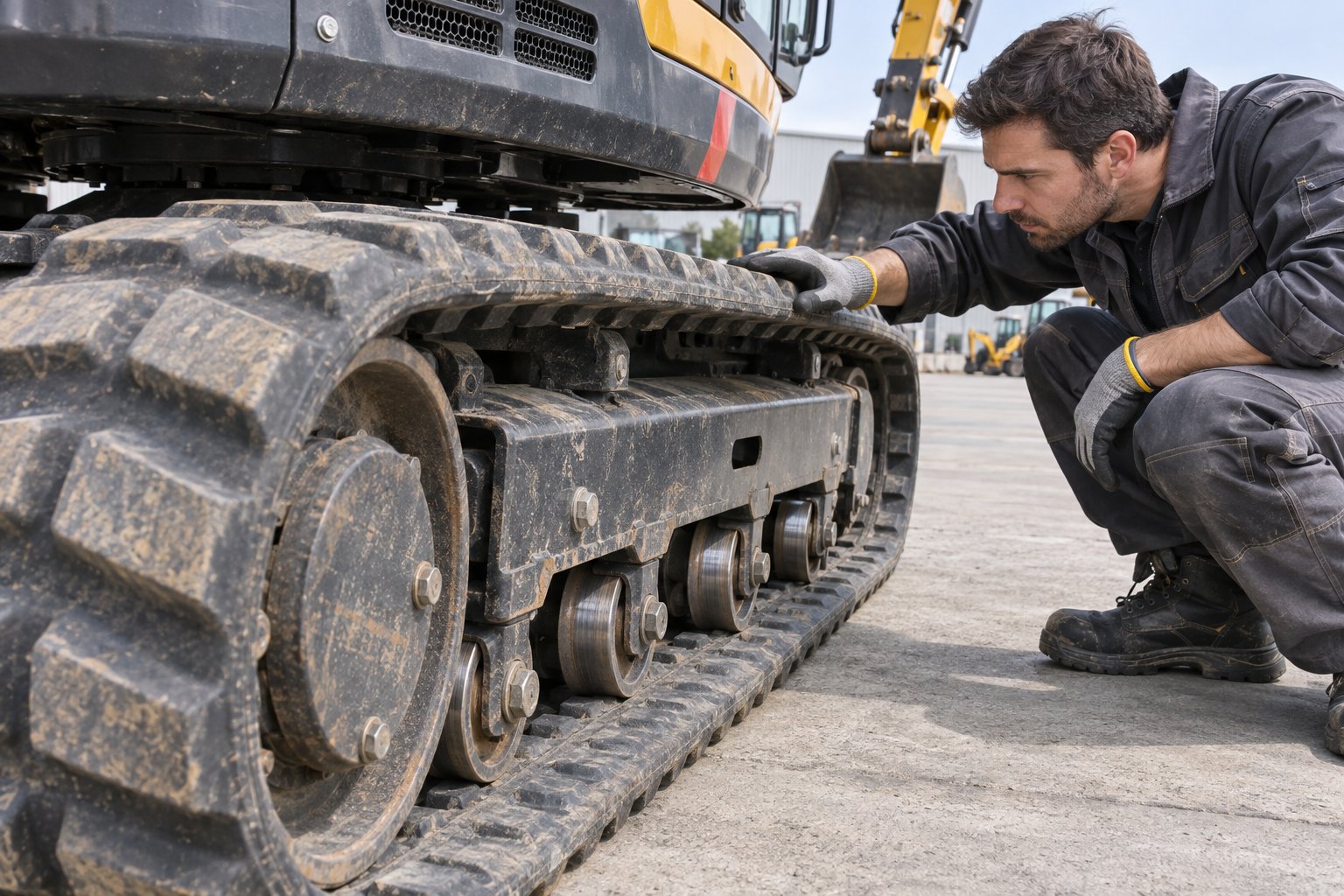
If you only have fifteen minutes with a machine, spend every one of them on the undercarriage. This single system accounts for roughly 50% of a tracked excavator's total lifetime maintenance cost. On a compact mini, a full undercarriage replacement — tracks, rollers, sprockets, idlers — can run $2,500 to $6,000 depending on weight class and whether the machine runs rubber or steel tracks. That figure can represent 15% to 25% of a used machine's entire resale value. Miss this during your inspection, and you're buying someone else's deferred expense.
Here's what to evaluate, component by component:
Track pads (rubber) or grousers (steel). On rubber-tracked minis, check the tread depth remaining on each pad. Worn pads with visible cording or cracking mean replacement is imminent. On steel-tracked machines, measure the grouser height — a depth gauge laid across the pad tells you exactly how much material is left versus the new dimension published in the service manual.
Rollers and idlers. Run your hand along the bottom and top rollers. They should spin freely without grinding, catching, or visible wobble. Look for oil weeping from the roller seals — a wet roller is a failing roller, and replacements aren't cheap when you're swapping four to six per side.
Sprocket teeth. Healthy sprocket teeth have a rounded, symmetrical profile. Worn teeth develop a hooked or pointed shape — like a shark fin leaning in the direction of travel. If the teeth are visibly pointed, the sprocket is past its halfway point and will accelerate wear on every other undercarriage component it touches.
Track tension adjustment. Every undercarriage has a grease-type or spring-loaded tensioner that takes up slack as internal components wear. If the tensioner is already at its maximum extension with the track still loose, there's no adjustment left — the entire track assembly needs attention. A related trick to watch for: some sellers remove a track link to make a worn track look tight. Count the links and compare to the manufacturer's specification. A short count is a red flag, not a shortcut.
Track motors. Inspect the area around each track motor hub for oil stains or fresh leaks. A leaking track motor typically means the internal seals are failing — and a complete track motor replacement on a 3-ton mini runs $1,500 to $3,000 per side. If you spot oil here, you've found a negotiation point worth thousands.
Hydraulic System and Cylinder Check
The hydraulic system is the nervous system of every excavator. Every movement — boom raise, arm curl, bucket dig, cab swing, and track travel — runs on hydraulic pressure. A weak hydraulic system turns a capable machine into an expensive paperweight, and hydraulic pump replacement alone can cost $3,000 to $6,000 on compact machines, scaling higher on larger units.
Start your hydraulic inspection before the engine is warm, ideally first thing in the morning. Cold-start conditions reveal leaks and weaknesses that hot oil masks.
Visual leak check. Walk the entire machine and examine every cylinder rod, hose fitting, and swivel joint. You're looking for active drips, wet spots, and fresh oil stains — not old grime. Pay special attention to the boom, arm, and bucket cylinder rods where they enter the barrel. A cylinder rod that's weeping oil at the seal means a reseal is coming, and each cylinder reseal runs roughly $500 to $2,500 depending on the component. Also check where hoses connect at the center swivel joint beneath the cab — this is a high-pressure, high-movement area where leaks love to hide.
Hose condition. Inspect every visible hydraulic hose for cracking, abrasion, bulging, or hardening. Hoses that feel stiff and brittle are past their service life, even if they aren't leaking yet. On a mini excavator with 20 to 30 hydraulic hoses, replacing a handful at $50 to $200 each adds up quickly — especially when you factor in the labor to route and bleed them.
Cylinder drift test. This is the single most revealing hydraulic test you can perform, and it takes less than five minutes. Raise the boom to full height with a load in the bucket (or with the bucket curled to hold weight). Shut the engine off. Wipe the boom cylinder rod clean and mark a reference point with tape. Wait five minutes. A small amount of settling is normal — every hydraulic system has minor internal bypass. But if the boom drops several inches, you're looking at worn cylinder packings, a bypassing control valve, or both. The OSHA construction equipment inspection standard specifically identifies "drifting due to fluid leaking past the piston" as a defect. Repeat this test on the arm and bucket cylinders as well.
Hydraulic oil color and smell. Pull the hydraulic oil dipstick or check the sight glass. Healthy hydraulic fluid is clear amber to light gold. Dark brown fluid suggests overdue filter changes and accumulated contamination. Milky or foamy fluid is a deal-killer — it indicates water contamination, often from a failed cooler or cracked reservoir, and flushing the entire system plus replacing seals and filters is a major expense. Smell the oil too: a burnt odor signals the system has been running hot, which accelerates wear on every internal seal and the pump itself.
Engine, Boom, and Structural Assessment
With the undercarriage and hydraulics evaluated, shift your focus to the engine, structural components, and swing system — the areas where abuse and neglect leave permanent scars.
Cold-start behavior. Ask to start the machine yourself, from cold. A healthy diesel engine should crank and fire within a few seconds, even in moderate weather. Excessive cranking, hard starting, or the need for ether spray suggests compression loss, glow plug failure, or fuel system issues. Once running, let it idle and observe the exhaust. A brief puff of white smoke on a cold morning is normal. Persistent white smoke points to coolant entering the combustion chamber — a potential head gasket or cracked-block issue. Blue smoke indicates oil burning past worn rings or valve seals. Black smoke signals fuel system problems: clogged injectors, a failing injection pump, or restricted air intake.
Engine blow-by. With the engine at operating temperature, remove the oil fill cap and hold your hand near the opening. Some air movement is normal, but a strong, steady blast of pressure means combustion gases are blowing past the piston rings into the crankcase. Significant blow-by is an early warning of an engine approaching rebuild territory — a repair that can cost $3,000 to $8,000 on a compact diesel. You wouldn't overlook this on any diesel-powered equipment, whether it's an excavator, a bucket truck, or a welding machine powered by an integrated engine — blow-by is blow-by.
Coolant condition. Check the radiator and overflow tank. Coolant should be the correct color for the machine's specified type (green, pink, or orange depending on the manufacturer). Oil sheen floating on top of the coolant is a serious red flag — it suggests a head gasket breach or cracked block allowing oil and coolant to cross-contaminate. This single finding can justify walking away from an otherwise clean machine.
Boom and arm pin play. This test is simple but revealing. With the engine off and the bucket resting on the ground, grab the bucket teeth and rock the entire front assembly side to side. You're feeling for excessive play — slop — in the pins and bushings that connect the boom to the house, the arm to the boom, and the bucket to the arm. A tight machine barely moves. A worn machine wobbles visibly at each joint. Replacing pins and bushings is labor-intensive work that requires pressing out hardened steel components, and the cost scales with how many joints need attention. Loose joints also indicate that the machine was under-greased throughout its working life — a maintenance shortcut that accelerates wear on every pivot point and calls the entire service history into question.
Swing bearing inspection. The swing bearing (slew ring) allows the upper house to rotate on the undercarriage. It's a large, expensive component — replacement can cost $2,000 to $5,000 on a mini and significantly more on larger machines. To check it, position the machine on level ground with the boom extended and slightly raised. Grab the edge of the upper house and push laterally while watching for movement between the house and the undercarriage. On a compact machine, you should see minimal play. Visible rocking or a grinding sensation during rotation signals a bearing approaching end of life. If you have a magnetic dial indicator, set it against the turntable and take readings at four positions — 12, 3, 6, and 9 o'clock — to quantify the wear.
Hour meter verification. Don't take the displayed hours at face value. Cross-reference the meter reading against the machine's visible wear. A unit showing 1,800 hours should have relatively fresh controls, minimal seat wear, and pedal rubber that isn't worn through. If the hour meter says low hours but the joystick grips are polished smooth, the seat foam is compressed flat, and the floor mat is worn to bare metal, something doesn't add up. Newer machines with electronic control modules (ECMs) store tamper-resistant operating data that a dealer can pull — always request an ECM hours report on any machine where the displayed reading and physical condition seem mismatched.
Trying to hold all of these inspection points in your head while standing in a dusty equipment yard is a recipe for missed details. The priority checklist below ranks the top inspection steps by financial impact — the order in which a single overlooked issue costs you the most money:
- Measure undercarriage wear — track pads, rollers, sprockets, and idlers. This is the single most expensive system to replace and the most commonly underinspected component on any used machine.
- Perform the cylinder drift test — boom, arm, and bucket. Excessive drift points to cylinder reseals or valve work that adds up fast.
- Check hydraulic oil condition — color, clarity, and smell. Milky fluid means water contamination and a potential system-wide flush.
- Inspect all hydraulic hoses, fittings, and cylinder rods for leaks — count the leak points and estimate repair costs before negotiating.
- Evaluate engine exhaust and blow-by — persistent blue, white, or black smoke and strong crankcase pressure indicate major internal wear.
- Test swing bearing play — lateral movement or grinding during rotation signals a bearing nearing replacement.
- Rock the boom and arm joints for pin and bushing slop — excessive play means labor-intensive rebuilds at every pivot point.
- Verify hour meter accuracy against physical wear indicators — and request an ECM report to confirm true operating hours.
- Check track motor hubs for oil leaks — a failing track motor can immobilize the machine entirely.
- Inspect the boom and stick for cracks or re-welding — structural repairs suggest the machine was subjected to loads beyond its design envelope, potentially reducing its value by 20% or more.
A pre-purchase inspection by an independent mechanic is worth every dollar on any used machine. Budget $250 to $500 for a qualified technician to walk the checklist with measuring tools you may not own. That fee pays for itself the moment it uncovers a single hidden issue — one worn track motor, one bypassing cylinder, or one rolled-back hour meter can erase thousands in projected savings overnight.
A thorough inspection protects you from buying someone else's deferred repairs. But even a machine that passes every test on this checklist still carries costs beyond the sale price — transport, maintenance, insurance, attachments, fuel, and storage add real dollars to every year of ownership. Those line items deserve their own math.
Total Cost of Ownership Beyond the Sticker Price
Here's a number that catches most buyers off guard: the purchase price of a mini excavator typically represents only 25% to 35% of what you'll actually spend over a five-year ownership period. A five-year TCO analysis of a typical 3-ton machine purchased new at $35,000 puts the total ownership cost at roughly $94,900 — nearly three times the sticker price — before subtracting resale value. Fuel, maintenance, insurance, transport, repairs, and attachments consume the rest. Every one of those line items is predictable if you budget for it and devastating if you don't.
The inspection checklist from the previous section tells you whether a machine is mechanically sound. This section tells you what that sound machine will cost you every month after you bring it home.
Transport and Delivery Costs
Your excavator doesn't drive itself to the jobsite. Moving it costs money every single time — and for contractors working multiple sites per month, transport can quietly become one of the largest recurring expenses in the ownership equation.
Trailer requirements scale directly with machine weight class. Micro excavators and small compact minis under about 6,000 pounds can ride on a heavy-duty flatbed trailer behind a one-ton pickup. Many landscapers and owner-operators already own or have access to suitable trailers from brands like Kaufman Trailers or similar equipment haulers, making mobilization a fuel-and-time expense rather than a capital outlay. A 10,000-pound compact mini pushes into the 12,000-to-14,000-pound GVWR trailer range — a tag-along or bumper-pull rated for the load, paired with at least a 3/4-ton tow vehicle.
Step up to the 4-to-6-ton standard minis and the logistics shift meaningfully. A machine weighing 12,000 to 15,000 pounds requires a gooseneck or deck-over trailer rated for 14,000 to 16,000 pounds GVWR minimum — and that's before adding 10% to 20% for attachments, full fuel, and field material the machine carries off the jobsite. The tow vehicle needs to be a one-ton dually at minimum. In some jurisdictions, exceeding certain combined weight thresholds triggers CDL requirements. If you don't own a suitable truck and trailer combination, commercial delivery runs $100 to $300 per move depending on distance — or you hire a boom truck or flatbed carrier to handle the haul.
Those per-move costs compound fast. A contractor working three different jobsites per month at $200 per mobilization spends $7,200 annually on transport alone. Over five years, that's $36,000 — enough to buy another machine. This is precisely why transport distance and frequency should factor into which size class you select. A lighter machine that fits on a trailer you already own eliminates a recurring cost that a heavier, more capable unit adds back with every move.
Maintenance, Insurance, and Attachments
Routine maintenance isn't optional — it's the cost of keeping a hydraulic machine alive. Skip it, and small expenses become catastrophic ones.
A compact mini excavator running 600 to 700 hours per year typically incurs $2,000 to $5,000 in annual maintenance costs, depending on brand tier and machine age. Premium brands like Kubota and Cat tend to cluster at the lower end of that range thanks to longer service intervals and more durable wear parts. Value-brand and high-hour machines push toward the upper end. Here's what makes up the bulk of that figure:
Engine oil and filters. Most manufacturers specify oil changes every 250 to 500 hours. At $80 to $150 per service including the filter, that's $400 to $800 annually for a machine running 700 hours.
Hydraulic fluid and filters. Hydraulic oil typically gets changed every 1,000 to 2,000 hours, with filter replacements every 250 to 500 hours. A full hydraulic fluid change runs $200 to $500. Neglecting this accelerates pump and seal wear — an expensive shortcut.
Grease. Every pin and bushing joint requires daily greasing. Budget $200 to $400 per year in grease alone, and factor in the 10 to 15 minutes per day it takes. Under-greasing is the number-one cause of premature pin and bushing wear, which you already know from the inspection checklist costs thousands to remedy.
Track replacement. Rubber tracks on compact minis last roughly 1,200 to 2,000 hours depending on terrain and operating conditions. A set of replacement rubber tracks costs $1,500 to $3,500 for most compact models. On a machine running 700 hours per year, you'll face this expense roughly every two to three years — a bill that often blindsides owners who didn't budget for it. Steel tracks last longer but cost more upfront and aren't appropriate for finished surfaces.
Insurance. Equipment insurance adds $600 to $1,500 per year for most compact machines. The industry-standard approach is an inland marine policy, which covers mobile equipment that isn't classified as a motor vehicle. Inland marine policies protect against theft, vandalism, fire, and certain types of accidental damage — both on the jobsite and during transport. General liability insurance doesn't cover equipment damage; you need a separate policy. Over five years, insurance adds $3,000 to $7,500 to your total cost — a fixed expense that ticks regardless of whether the machine runs one hour or one thousand.
Attachments. Very few buyers stop at the standard bucket. The attachment ecosystem for mini excavators includes buckets of various widths (12-inch trenching, 24-inch general purpose, 36-inch grading), hydraulic thumbs ($1,500 to $2,500), augers ($2,500 to $4,000), breakers ($2,000 to $5,000), and rippers ($800 to $1,500). A typical contractor accumulates $3,500 to $7,000 in attachments within the first two years of ownership — add-ons that weren't in the original purchase budget but become essential as job requirements expand. One important compatibility note: skid steer attachments use a different coupler system (the universal quick-attach plate) than excavator-specific couplers, so they are not interchangeable. Buying a hydraulic breaker designed for a billy goat-style skid steer mount won't bolt onto your excavator without an adapter, and adapters introduce their own cost and complexity.
Fuel and Storage Considerations
Fuel is the second-largest ongoing cost after maintenance, and it scales directly with engine size and operating intensity. A 1-ton micro excavator sips roughly 0.25 to 0.5 gallons per hour during typical mixed work. Compact 2-to-4-ton machines burn approximately 0.75 to 1.5 gallons per hour. Standard 5-to-6-ton minis push 1.5 to 2.5 gallons per hour under load.
At current diesel prices hovering around $3.50 to $4.50 per gallon, the hourly fuel cost for a compact mini runs $4 to $10 — seemingly modest until you annualize it. A 3-ton excavator burning one gallon per hour at 700 annual hours and $4.00 per gallon costs $2,800 in fuel per year, or $14,000 over five years. Bump that to $4.50 per gallon — common in many U.S. metro markets — and the five-year fuel bill climbs to nearly $16,000. Fuel price volatility alone can swing your TCO by thousands of dollars over a typical ownership period.
Terrain and task type also matter. Digging in loose soil keeps consumption near baseline, while rocky or compacted ground can increase fuel burn by up to 25%. Summer heat adds another 10% to 15% as the cooling system works harder. These aren't theoretical adjustments — they show up on every fuel receipt.
Storage adds one final layer. Mini excavators need a secure, level area with enough room to maneuver on and off a trailer. Ideally, the machine sits under a roof or tarp to protect the cab electronics, seat, and exposed cylinders from UV degradation and moisture. Leaving a machine outdoors year-round in northern climates accelerates rust on exposed steel components, hardens rubber seals, and invites rodent damage to wiring harnesses. If you don't have suitable yard space, commercial equipment storage runs $100 to $300 per month depending on your market — another line item that rarely appears in the initial purchase calculation.
Every dollar listed below is a dollar you'll spend beyond the machine's sale price. Budget for all of them before you sign anything:
- Transport and mobilization — trailer ownership or per-move delivery fees
- Engine oil, hydraulic fluid, and filter changes — recurring at scheduled hour intervals
- Grease and daily lubrication supplies
- Track replacement — every 1,200 to 2,000 hours depending on conditions
- Equipment insurance — inland marine policy, $600 to $1,500 per year
- Attachments — buckets, thumbs, augers, breakers, rippers
- Diesel fuel — scaled by engine size, hours, and local fuel prices
- Repairs and unplanned downtime — budget at least $1,500 to $3,000 per year
- Secure storage — yard space or commercial storage rental
- Licensing, registration, and compliance — varies by state and equipment class
Add those categories to your purchase price, subtract projected resale value, and divide by the total hours you expect to operate. The result is your true cost per hour — the number that determines whether ownership actually makes financial sense or whether the sticker price was just the beginning of the story. The next question is where to find the right machine at the right price, and each buying channel carries its own set of advantages and risks worth understanding before you start shopping.
Where to Find Mini Excavators for Sale
You've sized the machine, shortlisted the brands, calculated total ownership costs, and built an inspection checklist. Every one of those steps is useless if you shop in the wrong place. The buying channel you choose determines how thoroughly you can inspect, how aggressively you can negotiate, whether any warranty backs the sale, and — critically — how much hidden risk you absorb. Not every channel suits every buyer, and the cheapest listing isn't always the cheapest path to a running machine.
Think of it this way: a mini excavator for sale at auction, at a dealership, and on a private seller's Facebook page might carry the same sticker price. The total cost of acquiring that machine — including buyer premiums, inspection access, lien risk, and post-sale support — can differ by 20% or more depending on where you buy. Here's how each channel stacks up.
Auctions and Online Marketplaces
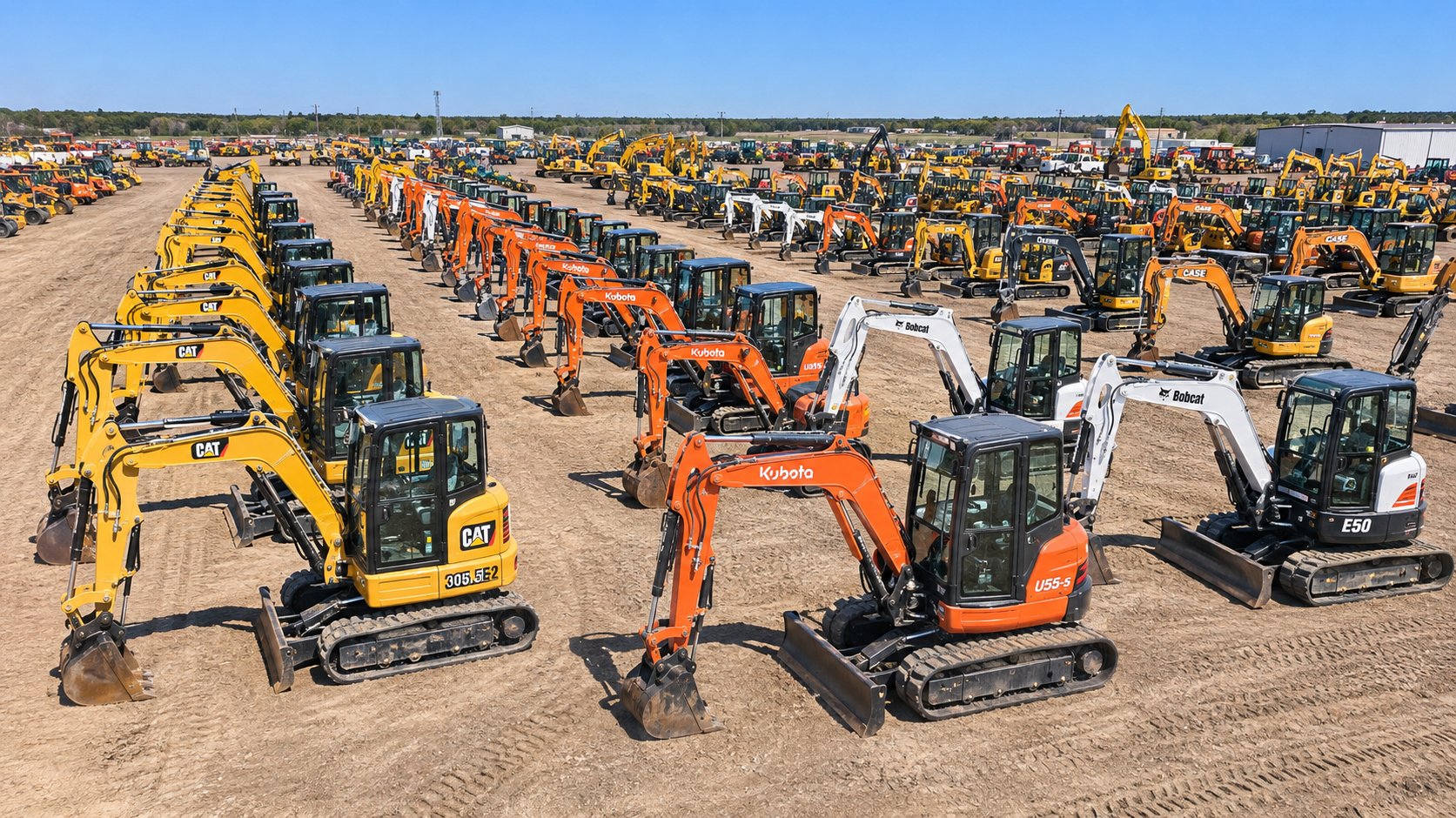
Auction platforms remain one of the most popular channels for used compact excavators, and for good reason: they aggregate large inventories, create competitive pricing, and move equipment quickly. Major platforms like Ritchie Bros. and IronPlanet specialize in heavy machinery and list thousands of excavators at any given time. Government surplus auctions, construction company liquidations, and rental fleet retirements all funnel machines into the auction pipeline.
The mechanics of auction buying are straightforward but carry specific risks that first-time buyers underestimate. You register, preview available equipment during a limited inspection window (often just a few hours or a single day before the sale), bid competitively, and pay immediately if you win. Most auction houses sell equipment "as-is, where-is" — meaning you accept the machine in its current condition with no warranty, no return window, and no recourse if you discover problems after loading it onto a car hauler trailer and driving away.
On top of the hammer price, expect a buyer's premium of 5% to 18% of the winning bid. That premium is easy to forget in the heat of bidding, but it adds $1,500 to $5,400 on a $30,000 machine. Factor in transport from the auction yard — which may be hundreds of miles from your jobsite — and the true acquisition cost climbs further. Many lots at major auctions are also non-returnable even if the machine won't start once it's on your property. One experienced mechanic noted that he has replaced more engines than he should have from auction purchases where machines arrived with inadequate oil levels or seized components after minimal runtime.
Auction buying rewards experienced buyers who know exactly what to inspect during the preview window and can estimate repair costs on the spot. If that describes you — or you're comfortable bringing a mechanic along — auctions can deliver genuine savings. If it doesn't, the "bargain" price may cost you more than a dealer purchase by the time the machine is actually job-ready.
Online listing aggregators like Machinery Trader operate differently from auction houses. They function as marketplaces where dealers and private sellers post equipment — similar to how you'd browse a skid steer for sale or a tow truck for sale on a classified platform. You contact the seller directly, negotiate price, and arrange your own inspection and logistics. The advantage is time: there's no bidding deadline, so you can schedule a thorough evaluation, hire an independent mechanic, and negotiate based on findings. The disadvantage is fragmentation — you're comparing listings across dozens of sellers with inconsistent descriptions, variable photo quality, and no standardized condition reporting.
Authorized Dealers and Private Sellers
Authorized brand dealers offer the most structured buying experience in the compact equipment market. Major manufacturers — Kubota, Caterpillar, Bobcat, John Deere, and others — operate certified pre-owned (CPO) programs through their dealer networks. These programs typically include multi-point mechanical inspections, documented service histories, and factory-backed warranties ranging from 12 to 24 months on qualifying machines. Parts support is immediate: the dealer stocks components for the brands they represent and can usually complete routine repairs within days rather than weeks.
That structure comes at a price. Dealer machines consistently trade 10% to 20% above comparable auction or private-sale listings because the dealer has invested in reconditioning, absorbed warranty risk, and maintains overhead that private sellers don't carry. For buyers who value reliability and support — particularly those operating equipment commercially where every day of downtime costs revenue — the dealer premium often pays for itself within the first warranty claim or service call. Financing is also smoother through authorized dealers, with many offering in-house programs or preferred lender relationships that simplify approval.
Private sellers sit at the opposite end of the spectrum. Buying directly from an owner — whether a contractor downsizing, a homeowner who finished a project, or a small fleet shedding underutilized machines — eliminates the dealer markup entirely. Prices are typically the lowest available for a given machine's age and condition. The trade-offs are real, though. There's no warranty, no CPO inspection, and no dealer standing behind the sale.
Due diligence becomes entirely your responsibility in a private transaction. Ritchie Bros. recommends verifying ownership by matching the seller's name to the original sales invoice, running the serial number through a lien search service, and confirming that no outstanding loans encumber the machine. Purchasing equipment with an undisclosed lien means the lender can repossess it regardless of what you paid the seller — a risk that's eliminated at reputable auction houses and authorized dealers but fully present in private transactions. A title search through a service like the National Equipment Register costs a fraction of the machine's value and provides peace of mind that no paper trail can replicate.
International and Multi-Brand Sourcing
For equipment dealers restocking inventory, fleet buyers scaling operations, and international import purchasers sourcing machines across borders, the buying process looks different from a single-unit local purchase. These buyers need to compare models across multiple manufacturers simultaneously, request volume pricing, and coordinate shipping logistics that may involve ocean freight rather than a local car hauler trailer run.
Multi-brand sourcing platforms address that need by consolidating listings from various manufacturers in one place. JIUHONG's excavator collection, for instance, aggregates compact and larger used excavators from multiple brands, allowing fleet buyers and dealers to browse available machines, compare specifications side by side, and request model-specific quotes for individual or bulk orders. Because this is a broad excavator collection rather than a dedicated mini-excavator category, buyers shopping specifically for compact machines should filter by operating weight and class to narrow results. The ability to request quotes across brands from a single platform streamlines the comparison step that would otherwise require contacting a dozen separate dealers — particularly valuable for import buyers coordinating purchases across time zones.
International sourcing introduces its own cost layer. Customs duties, import taxes, EPA and Tier 4 emissions compliance verification, and ocean or overland freight add meaningful expense on top of the machine price. Buyers importing excavators should also budget for port handling fees, inland transport from the port to their facility, and any modifications needed to meet local regulatory requirements. These logistics parallel what you'd encounter sourcing any heavy industrial asset internationally — whether it's an excavator, a waste lorry for municipal use, or a gantry crane for a shipping yard — the compliance and freight framework is similar even if the equipment differs.
The comparison table below maps each buying channel against the factors that matter most, so you can match your buyer profile to the channel that fits:
| Buying Channel | Inspection Opportunity | Price Negotiation | Warranty Availability | Best For |
|---|---|---|---|---|
| Multi-Brand Dealer / Direct Purchase | Thorough — schedule on your timeline, bring your own mechanic | Strong — direct negotiation with seller, volume discounts possible | Varies — some offer limited warranties or return periods | Fleet buyers, equipment dealers, and import purchasers comparing across brands |
| Authorized Brand Dealer (CPO) | Thorough — dealer provides inspection reports and service history | Moderate — less room than private sales, but trade-in leverage helps | Strong — factory-backed CPO warranties of 12–24 months common | Contractors needing reliability, financing, and ongoing parts support |
| Auction (Live or Online) | Limited — preview windows of hours to one day; as-is condition | None — competitive bidding sets the price; buyer premium adds 5%–18% | None — sold as-is with no returns or post-sale support | Experienced buyers who can assess condition quickly and estimate repair costs |
| Online Marketplace (Machinery Trader, IronPlanet) | Variable — depends on seller cooperation; remote listings may offer photos only | Good — direct seller contact allows back-and-forth negotiation | Rare — most listings are as-is unless from a dealer storefront | Buyers willing to travel for inspection and comfortable with independent due diligence |
| Private Seller | Full access — schedule at mutual convenience, inspect as long as needed | Strongest — motivated sellers often accept below asking price | None — requires independent lien check, title verification, and mechanical inspection | Budget-focused buyers with mechanical knowledge or access to an independent mechanic |
No single channel wins across every column. The right choice depends on your experience level, how urgently you need the machine, whether you value warranty protection, and how many units you're sourcing at once. A homeowner buying one compact mini for a backyard project has different priorities than an equipment dealer restocking ten units for resale. A contractor replacing a daily-use workhorse mid-season can't afford the gamble of an as-is auction purchase that might need a week of repairs before it's productive.
The smartest buyers don't commit to a single channel. They cross-reference listings across two or three sources — comparing a dealer's CPO price against auction estimates and private-sale asking prices for the same model, age, and hour range. That triangulation reveals whether a specific listing is priced fairly, aggressively, or optimistically. It also exposes geographic price differences: the same 3-ton Kubota might trade $4,000 higher in a construction-heavy metro market than in a rural area three hours away.
With your buying channel identified and your shortlist narrowed, the final step is converting research into action — a sequential checklist that moves you from browser to buyer without leaving money on the table or skipping a critical verification step.
Your Next Steps to Buying the Right Mini Excavator
You've seen the full math — from sticker price to five-year total cost of ownership, from undercarriage replacement bills to seasonal pricing windows that can save thousands. Every section of this guide exists to shrink the gap between what a listing shows and what ownership actually costs. The question now isn't whether you have the information. It's whether you'll use it in the right sequence.
Buying a compact excavator isn't a single decision. It's a chain of decisions, and each one either protects your investment or introduces risk. Skipping a step — or doing them out of order — is how buyers end up with the wrong machine, the wrong price, or a repair bill that erases every dollar of projected savings. The action plan below puts those decisions into a sequence that keeps you in control from first search to signed paperwork.
Your Mini Excavator Buying Action Plan
Every successful equipment purchase follows a logical progression. Rushing straight to listings before defining your requirements is like bidding at auction without knowing your ceiling — it feels productive, but it leads to expensive mistakes. Work through these steps in order:
- Define your project requirements and match them to a size class. Be specific. How deep do you need to dig? How wide is the tightest access point on your jobsite? Will you run attachments like augers, breakers, or a back hoe bucket? The answers point you toward micro, compact, or standard mini — and eliminate machines that can't do the job before you waste time evaluating them.
- Set a total budget that includes ownership costs — not just the purchase price. Add transport, insurance, maintenance, fuel, attachments, and storage to the machine cost. If you're financing, include interest. The TCO analysis in this article gives you the line items; plug in your local numbers for an honest picture.
- Decide whether to buy or rent. Use the framework from the buy-versus-rent section. If your projected usage falls below 60 days per year, renting likely wins. Above 120 days, buying almost certainly does. In the gray zone, run both calculations and compare the five-year totals before committing capital.
- Shortlist two to three brands based on local dealer support and resale value. The best brand for your operation is the one with a strong dealer within reasonable driving distance — not necessarily the one with the highest industry ranking. Confirm parts lead times and service turnaround with the dealer directly, not from marketing materials.
- Identify your buying channels. Decide whether you'll shop authorized dealers, auctions, online marketplaces, private sellers, or multi-brand sourcing platforms. Most buyers benefit from checking at least two channels to establish a fair price range for their target machine.
- Inspect thoroughly — or hire an independent mechanic who will. Follow the priority checklist from the inspection section: undercarriage first, hydraulic drift test second, engine and structural assessment third. On any machine priced above $15,000, the $250 to $500 cost of a professional inspection is the cheapest insurance you'll ever buy.
- Verify ownership, liens, and compliance. Run the serial number through a lien search service. Confirm EPA Tier 4 emissions compliance on any imported machine. Match the seller's documentation to the machine's identity — serial number, model, and hour meter reading.
- Arrange financing and transport before closing. Lock in your financing terms — equipment loan or lease-to-own — so you're not scrambling after you've committed. Confirm your trailer capacity matches the machine weight, or schedule commercial delivery. Factor in Section 179 deduction eligibility if the purchase qualifies.
Print this list. Take it to the dealer lot, the auction preview, or the private seller's yard. Checking off each step in sequence keeps emotion out of a decision that should be driven entirely by numbers.
Comparing Listings Across Multiple Sources
The single most common mistake buyers make is falling for the first machine that looks right. A listing might check every box — correct brand, reasonable hours, fair price — but you won't know whether that price is actually fair until you've compared it against at least two other sources for the same model, age range, and condition tier.
Gather quotes from a minimum of three sources before committing. That might mean pulling a dealer's CPO price, previewing a comparable unit at auction, and checking private-sale listings on an online marketplace. If you're shopping for a mini skid steer for sale alongside a compact excavator to round out a small fleet, apply the same triangulation to each machine — prices vary just as much across channels for loaders as they do for excavators.
For bulk or import buyers sourcing across brands, multi-brand collections streamline this comparison step significantly. JIUHONG's excavator listings consolidate compact and larger used excavators from various manufacturers, enabling equipment dealers and fleet buyers to browse available inventory, filter by weight class, and request model-specific quotes for individual or volume purchases — all from a single platform rather than contacting a dozen separate sellers. Because the collection spans the full excavator range, buyers focused on compact machines should filter by operating weight to isolate relevant listings.
Regardless of where you find your shortlisted machines, verify three things before signing:
- Machine specifications match the listing. Confirm operating weight, dig depth, and engine model against the manufacturer's published spec sheet. If zero-tail-swing dimensions are critical to your jobsite access, measure the actual tail swing radius — don't rely on the seller's description alone.
- Delivery logistics are accounted for. Whether you're trailering locally or coordinating ocean freight through a lipher (logistics and freight handling provider), transport costs belong in your total acquisition budget, not as an afterthought. A machine priced $3,000 below market but located 1,200 miles away may not be cheaper once you add shipping.
- Your total acquisition cost — purchase price plus buyer premium, transport, taxes, and any immediate repairs — falls within the total budget you set in Step 2. If it doesn't, walk away. Another machine will surface. They always do.
The best mini excavator for sale is the one that matches your specific project needs, your realistic budget including all ownership costs, and your long-term plan for the machine — not simply the cheapest listing or the shiniest paint job. Buy the math, not the emotion.
Frequently Asked Questions About Buying a Mini Excavator
1. How much does a new mini excavator cost in 2025-2026?
New mini excavator pricing depends heavily on size class and brand tier. Micro excavators under one ton start around $15,000 for value brands and reach $40,000 for premium names like Kubota or CAT. The popular compact 2-to-4-ton class ranges from roughly $35,000 to $80,000, while standard 5-to-6-ton models with enclosed cabs can exceed $100,000. Configuration choices such as zero-tail-swing design, cab versus canopy, and engine type (diesel vs. gasoline) shift pricing within each class by several thousand dollars. Tier 4 Final emissions compliance adds engineering cost that is already factored into every new unit sold in the United States.
2. Is it cheaper to buy or rent a mini excavator?
The answer hinges on how many days per year you will actually use the machine. Industry cost analyses place the break-even point at roughly 120 rental-equivalent days annually. Below about 60 days of use per year, renting at $250 to $350 per day for a compact mini is almost always more economical once you add insurance, maintenance, storage, and depreciation to the ownership side. Above 120 days of consistent use, buying builds equity — especially with premium brands that retain 60% to 70% of value after three years — and eliminates recurring rental fees, delivery charges, and scheduling constraints. Buyers in the gray zone between 60 and 120 days should calculate their own numbers using local rental quotes and the full total-cost-of-ownership breakdown.
3. What should I look for when inspecting a used mini excavator?
Prioritize components ranked by repair cost. Start with the undercarriage — tracks, rollers, sprockets, and idlers account for roughly 50% of lifetime maintenance expense, and a full replacement runs $2,500 to $6,000. Next, perform a cylinder drift test by raising the boom to full height, shutting the engine off, and timing how quickly it settles; excessive drift signals worn packings or bypassing valves. Check hydraulic oil for milky color (water contamination) or burnt smell (overheating). Inspect all hoses and fittings for leaks, evaluate engine exhaust smoke and crankcase blow-by, test swing bearing play, and rock the boom joints to feel for pin and bushing slop. Always cross-reference the hour meter reading against physical wear indicators like seat condition and joystick grip wear, and consider paying $250 to $500 for an independent mechanic inspection.
4. What is the best mini excavator brand for resale value?
Kubota consistently leads in resale value retention among compact excavator brands, with well-maintained units holding 60% to 70% of their original purchase price after three years. Caterpillar and Takeuchi follow closely, both benefiting from strong contractor demand on the secondary market and robust dealer networks that keep parts accessible. Mid-tier brands like John Deere and Bobcat typically retain 50% to 60% over the same period. Budget and Chinese-manufactured brands depreciate fastest, often retaining only 35% to 50% after five years due to thinner used-market demand and limited dealer support. When calculating true ownership cost, factoring in projected resale recovery can narrow the real price gap between premium and budget machines significantly.
5. Where is the best place to buy a used mini excavator?
Each buying channel offers distinct trade-offs. Authorized brand dealers provide certified pre-owned programs with factory-backed warranties and documented service histories, though prices run 10% to 20% above other channels. Auction platforms like Ritchie Bros. aggregate large inventories and can yield competitive prices, but machines sell as-is with limited preview windows and buyer premiums of 5% to 18%. Private sellers offer the lowest prices and fullest inspection access, but require independent lien checks and title verification. Online marketplaces such as Machinery Trader allow direct negotiation without bidding pressure. For fleet buyers and equipment dealers comparing across multiple brands, multi-brand sourcing platforms like JIUHONG's excavator collection consolidate listings from various manufacturers, enabling side-by-side comparison and model-specific quote requests. Shopping at least two or three channels before committing helps establish a fair market price for your target machine.