


The Kubota U17 Mini Excavator Explained
Imagine you're shopping for a compact machine that can trench a utility line in a tight backyard, dig footings beside an existing structure, and still fit through a standard fence gate. That search almost always leads to one name: the Kubota U17. Yet the moment you start researching, you hit a wall of scattered spec sheets, thin dealer listings, and manufacturer brochures that each tell only part of the story.
This guide changes that. Every specification, generation detail, and practical buying insight lives here in one place, written from a buyer-advisor perspective rather than a sales pitch.
What Is the Kubota U17 Mini Excavator
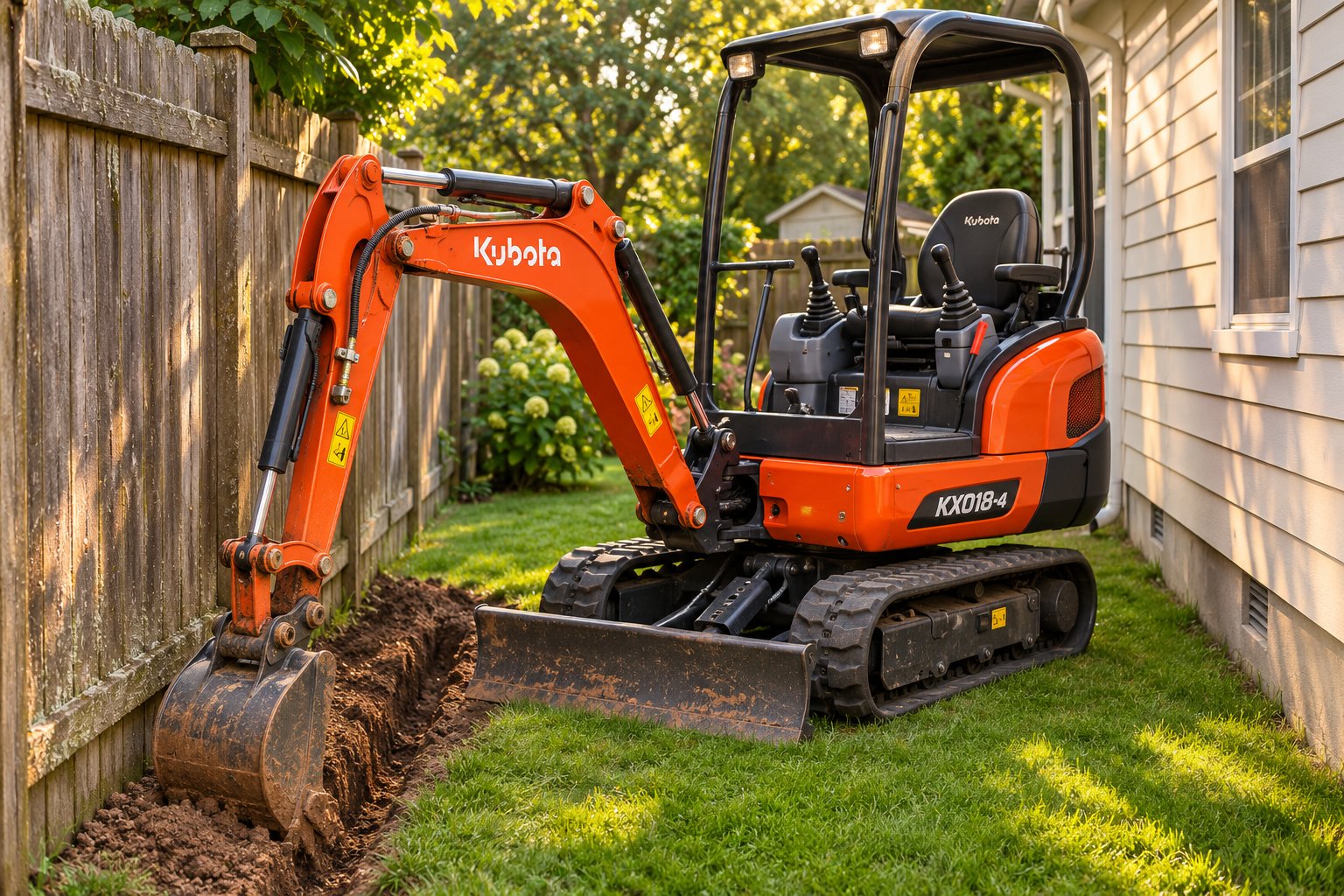
The Kubota U17 is a zero-tail-swing compact excavator in the sub-2-metric-ton class, part of Kubota's U-Series lineup of small excavators built specifically for confined-space work. "Zero-tail swing" means the machine's upper house stays within the track width during a full 360-degree rotation, so nothing swings out and strikes a nearby wall, fence, or vehicle.
Within the broader Kubota excavator family, this model sits just above the micro-class K008 and U10 machines and below mid-range options like the U25 and U35. It occupies a sweet spot: large enough to handle real digging tasks, yet light and narrow enough to access spaces that shut out bigger equipment. As Kubota's product manager Bill Holton described it, the U17 platform is a lightweight model suited to rental fleets, light construction, landscaping, and utility work.
Why a Comprehensive U17 Resource Matters
If you've already tried searching for detailed Kubota U17 information online, you'll notice the frustration quickly. Engine specs appear on one dealer page, dimensions on another, and generation differences on none of them. Contractors, landscapers, and equipment buyers evaluating this kubota mini excavator deserve better than a scavenger hunt across a dozen tabs.
The Kubota U17 is a sub-2-ton, zero-tail-swing excavator engineered for confined-space work in residential, landscape, and utility applications, offering the digging capability of a true kubota excavator in one of the most transportable packages in the lineup.
This article consolidates every confirmed detail, from model generations and full specifications to real-world applications and used-market guidance, into a single reference. Whether you're a first-time kubota small excavator buyer or a fleet manager comparing size classes, the sections ahead cover what other resources leave out.
That consolidation starts with a question most online resources ignore entirely: which Kubota U17 are you actually looking at?
Kubota U17 Model Lineage and Generations
Here's a detail that trips up buyers every day: the name "Kubota U17" doesn't point to a single machine. It spans multiple generations built over many years, each with meaningfully different specifications. Search for a used unit online, and you could be looking at an early-production model, a mid-cycle VR1 variant, or the current-production U17-5, all sharing the same core name but delivering very different performance on the job. Understanding which generation you're evaluating is the difference between a smart purchase and an expensive surprise.
U17 Original and Early Generations
The original Kubota U17 established the platform as a true micro-class workhorse. Early models were built around a smaller-displacement diesel engine producing approximately 13 HP, paired with a lighter overall operating weight that made them exceptionally easy to transport. These machines offered the same zero-tail-swing design philosophy that defines the entire U-Series, but with more modest hydraulic output and dig force compared to later versions.
The U17VR1 followed as a notable variant. The "VR" designation identified a model equipped with a variable retractable undercarriage, allowing the operator to hydraulically narrow or widen the tracks for different working conditions. This feature became a defining characteristic of the platform, letting the machine squeeze through tight access points like fence gates, then expand for added stability during digging. Among kubota diggers in this micro class, the retractable-track concept gave the U17VR1 a practical edge on confined residential sites that few competitors matched at the time.
The U17-5 Current Production Model
Kubota uses a dash-number suffix to indicate generational updates across its excavator lineup, and the "-5" on the U17-5 signals its place as the latest evolution. Kubota officially announced the U17-5 at World of Concrete 2025, confirming it as the direct replacement for the U17VR1.
The upgrades are substantial. The U17-5 is powered by a 16.1-gross-horsepower Kubota diesel engine, a meaningful step up from the earlier 13 HP powerplant. Operating weight climbs to 3,902 pounds, reflecting a more robust build with an extended rear end that adds 1.2 inches over the previous model. The retractable track system carries forward but improves: the gauge now expands to 51.2 inches (an increase of 2.4 inches over its predecessor) and narrows to 39.4 inches for passage through gates and alleys.
What do those numbers mean in practice? More horsepower and a heavier machine translate directly into stronger digging force, with a bucket breakout force of 3,547 pounds. The auxiliary hydraulic flow rate reaches 7.3 GPM, supporting a wider range of attachments than earlier generations could handle. A factory-installed thumb bracket, standard diverter valve, and joystick-integrated proportional flow control make attachment swaps faster and more intuitive. Kubota also added LED boom lights, a semi-suspension seat, and prewired KubotaNow telematics as standard equipment.
For contractors comparing kubota excavators across size classes, the U17-5 lands between Kubota's smallest micro machines and the mid-range models like the Kubota U35. It delivers enough capability for serious residential and utility work without crossing into the heavier weight territory that complicates transport and increases site impact.
How to Identify Which U17 You Are Evaluating
Shopping the used market for a mini kubota excavator under the U17 name? A few quick identifiers will tell you which generation is sitting on the trailer:
- Model plate: Check the identification plate on the machine frame. It will read "U17," "U17VR1," or "U17-5" depending on the generation. This is your most reliable indicator.
- Color scheme: The U17-5 introduced Kubota's new two-tone orange and black Dash 5 livery. Older models wear the traditional solid orange paint.
- Track expansion range: If the tracks expand to 51.2 inches, it's a U17-5. Earlier VR1 models had a narrower maximum gauge.
- Thumb bracket and diverter valve: A factory-welded thumb mount on the dipper arm and a standard diverter valve are U17-5 features. Their absence points to an earlier generation.
- Operating weight: The U17-5 weighs 3,902 pounds. Earlier generations were noticeably lighter, so a scale or listed shipping weight can confirm the model.
The table below consolidates the key differences across all three generations, giving you a side-by-side reference when evaluating kubota diggers on dealer lots or online listings.
| Specification | U17 (Original) | U17VR1 | U17-5 (Current) |
|---|---|---|---|
| Engine HP (Gross) | ~13 HP | ~13 HP | 16.1 HP |
| Operating Weight | Lighter (sub-3,000 lb range) | Lighter (sub-3,000 lb range) | 3,902 lbs |
| Retractable Tracks | No | Yes (variable retractable) | Yes (39.4" to 51.2") |
| Auxiliary Hydraulic Flow | Lower | Moderate | 7.3 GPM |
| Factory Thumb Bracket | No | No | Yes (standard) |
| Diverter Valve | No | No | Yes (standard) |
| Telematics | Not available | Not available | KubotaNow (prewired) |
| Color Scheme | Solid orange | Solid orange | Two-tone orange and black |
These generational differences matter far beyond cosmetics. A buyer paying U17-5 prices for an older U17VR1, or expecting current-generation hydraulic performance from an original U17, faces real operational and financial consequences. With the model lineage clear, the next logical question is what those specifications actually deliver when you put a bucket in the ground.
Complete Kubota U17 Specifications Consolidated
Finding every confirmed specification for this mini excavator Kubota produces in its smallest zero-tail-swing class shouldn't require opening six browser tabs. Yet that's exactly the situation most buyers face: engine data on one page, hydraulic numbers buried in a brochure PDF, and working-range figures locked inside a dealer quote request. This section pulls every verified data point into a single reference, translating raw numbers into real-world meaning so you can evaluate the machine without an engineering degree.
A quick note on search confusion: typing "U17" into a search engine often returns results ranging from excavator specs to completely unrelated topics like bảng xếp hạng u17 châu á 2026 trending in sports. If you've landed here looking for Kubota's compact excavator data, you're in the right place.
Engine and Hydraulic Performance Numbers
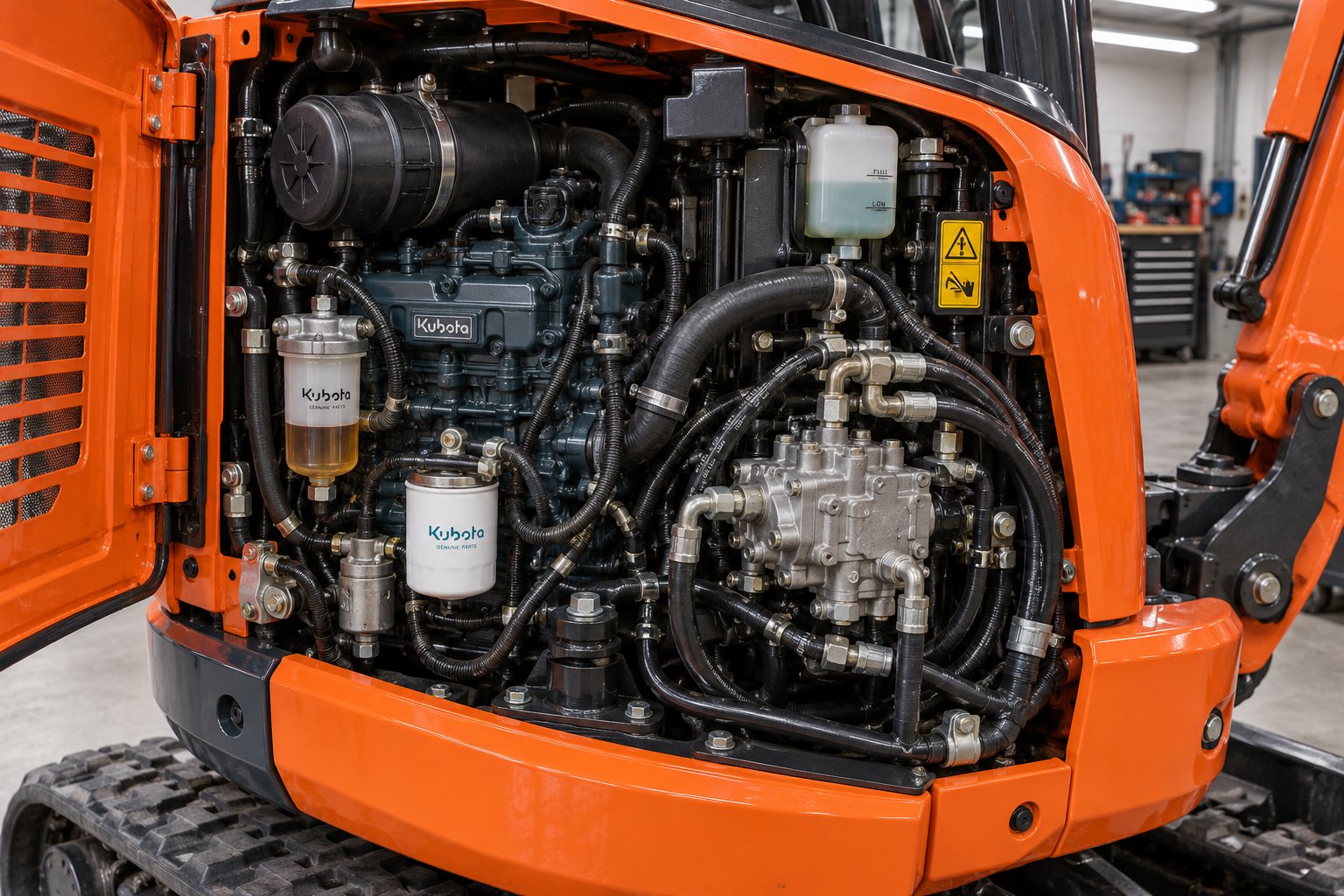
The current-production U17-5 runs a 16.1-gross-horsepower Kubota diesel engine, a significant jump from the roughly 13 HP powerplant in earlier generations. While that 3 HP gap might look small on paper, consider what it actually does on the job: horsepower directly influences how quickly the hydraulic pump can pressurize fluid and push it through the system. More horsepower means the pump can maintain higher flow rates under load, which translates into faster boom lift, quicker arm curl, and smoother multitasking when you're running two functions at once, like swinging the house while curling the bucket.
The hydraulic system is where those engine improvements become tangible. The U17-5 delivers an auxiliary hydraulic flow rate of 7.3 GPM, a meaningful step up over older U17 models that ran in the lower-flow range. Why does auxiliary flow matter? It determines what attachments you can realistically power. At 7.3 GPM, the machine comfortably drives hydraulic thumbs, small augers, and light-duty breakers. Operators who've used the previous generation will notice the difference immediately when running attachments that demand sustained flow.
The bucket breakout force, the raw pushing power the bucket exerts when curling into material, reaches 3,547 pounds. For a kubota compact excavator weighing under two tons, that's an impressive ratio of force to machine weight. It means you can bite into compacted clay, root-tangled soil, or frost-loosened ground without constantly repositioning or relying on the boom's weight to force the bucket down. Combined with the engine and hydraulic upgrades, cycle times feel noticeably quicker than what early U17 owners experienced.
Dimensions, Weight, and Working Range
Physical size and working range define where this machine can go and what it can accomplish once it gets there. The U17-5 tips the scales at 3,902 pounds operating weight, heavier than earlier generations that sat in the sub-3,000-pound range. That additional mass isn't dead weight; it reflects the extended rear end (1.2 inches longer than the U17VR1), the wider maximum track gauge, and the beefed-up hydraulic components that support higher breakout forces and flow rates.
The retractable undercarriage remains one of the platform's most distinctive features. Tracks narrow to 39.4 inches for squeezing through fence gates and narrow side yards, then expand hydraulically to 51.2 inches for maximum stability during heavy digging or attachment work. That 2.4-inch increase in maximum gauge over the previous model may sound modest, but wider track spacing lowers the machine's center of gravity during rotation, reducing tip-over risk when you're reaching across a trench or lifting near maximum capacity.
Working range is where the U17-5 proves it's more than a transport-friendly novelty. The machine digs to a maximum depth of 7 feet, 6.2 inches and dumps at a height of 8 feet, 1.2 inches. For context, a standard residential water line trench runs 3 to 5 feet deep, so the U17-5 handles that with headroom to spare. The 8-foot-plus dump height clears the sides of most single-axle dump trailers, letting you load spoil directly without a secondary stockpile step. Ground pressure sits at just 4 PSI, a figure low enough to work on finished lawns, landscaped beds, and soft soils without leaving excessive ruts. Maximum travel speed reaches 2.7 MPH, adequate for repositioning across a job site without needing to trailer the machine between work areas.
When you're comparing a mini excavator Kubota builds at this weight class against heavier equipment like a 4 ton excavator, the tradeoff is clear: you sacrifice raw dig depth and bucket volume for access, transportability, and a ground-pressure footprint that won't destroy a client's property.
The comprehensive table below consolidates every confirmed specification for the current-production U17-5 into one reference. Bookmark it, print it, or screenshot it. This is the single-source spec sheet that scattered brochures and dealer listings have never provided in one place.
| Specification | Kubota U17-5 (Current Production) |
|---|---|
| Engine | Kubota diesel, 3-cylinder |
| Gross Horsepower | 16.1 HP (SAE J1995) |
| Operating Weight | 3,902 lbs |
| Maximum Dig Depth | 7 ft 6.2 in |
| Maximum Dump Height | 8 ft 1.2 in |
| Bucket Breakout Force | 3,547 lbs |
| Auxiliary Hydraulic Flow Rate | 7.3 GPM |
| Track Gauge (Retracted) | 39.4 in (3 ft 3 in) |
| Track Gauge (Expanded) | 51.2 in (4 ft 3.2 in) |
| Maximum Travel Speed | 2.7 MPH |
| Ground Pressure | 4 PSI |
| Tail Swing | Zero-tail swing |
| Retractable Undercarriage | Yes (hydraulic) |
| Factory Thumb Bracket | Standard (pre-welded) |
| Diverter Valve | Standard |
| Operator Protection | ROPS canopy with OPG |
| Telematics | KubotaNow (prewired, standard) |
| Work Lights | LED boom lights (standard) |
| Control Pattern | Two-pattern selectable (ISO / SAE) |
| Rear Extension vs. Previous Model | +1.2 in |
These numbers tell you what the machine can do. The next question worth asking is how that zero-tail-swing design, the feature that makes those numbers usable in spaces where conventional excavators can't safely operate, actually changes the way work gets done on a real job site.
What Zero-Tail Swing Actually Means on the Job
You've seen the term "zero-tail swing" repeated throughout the U17's spec sheet and marketing materials. But what does it actually look like from the operator's seat, and why should it influence your buying decision? Surprisingly, most equipment resources treat this feature as a checkbox rather than explaining the mechanical reality behind it. If you're newer to kubota mini excavators or compact equipment in general, this concept deserves a plain-language breakdown because it fundamentally changes where and how you can work.
Zero-Tail Swing Design Principles
Picture a mini excavator from above, looking straight down. You see two parallel tracks on the bottom and the upper structure, often called the "house," sitting on top. The house contains the engine, the operator's station, the hydraulic components, and a counterweight at the rear that balances the digging forces generated by the boom and bucket up front.
On a conventional tail-swing excavator, that counterweight extends well beyond the rear edge of the tracks. Every time the operator rotates the house, the back end sweeps outward like the tail of a fish. On a larger conventional machine, this overhang can extend a foot or more past the track width, creating a moving hazard zone behind and beside the excavator during every swing cycle.
A zero-tail-swing machine like the Kubota U17 eliminates that overhang entirely. Engineers repackage the engine, hydraulics, and counterweight so the entire upper house rotates within the footprint of the tracks. Spin the house a full 360 degrees, and nothing protrudes beyond the track edges at any point in the rotation. The machine's physical boundary stays constant and predictable, regardless of which direction the operator is swinging.
This isn't just a packaging trick. As Compact Equipment reported, the shift toward zero-tail-swing designs accelerated as cities, neighborhoods, and jobsites became more confined. Engineers had to get creative, fitting everything into a smaller envelope without sacrificing the core hydraulic performance operators depend on. The U17 represents that engineering philosophy at its most refined in Kubota's sub-2-ton class.
Where Zero-Tail Swing Changes the Job
Sounds like a subtle design difference? On paper, maybe. On a real job site, it's transformative.
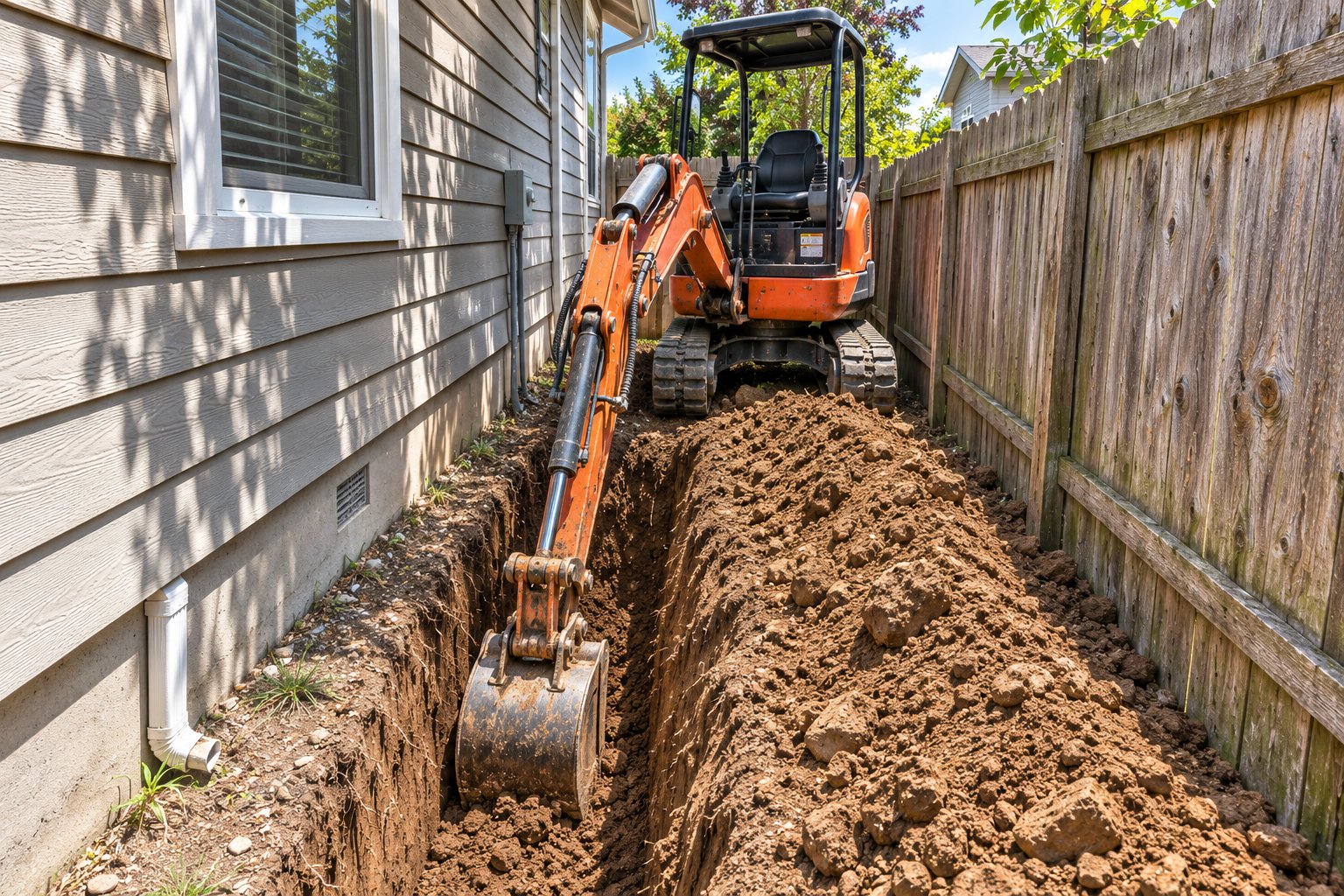
Imagine you're trenching a water line along the side of a house. The gap between the foundation wall and the property-line fence is six feet wide. With a conventional-swing machine, the counterweight tail sweeps into that gap every time you rotate to dump spoil. You're constantly checking mirrors, craning your neck, or asking a spotter to watch the back end. One moment of inattention, and the tail clips the fence, dents a downspout, or worse, catches a bystander.
With the U17's zero-tail-swing design, you position the machine in that six-foot corridor and rotate freely. The house stays inside the tracks through every degree of swing. Your attention stays where it belongs: on the trench, the bucket, and the work in front of you.
That same principle applies across dozens of real-world scenarios. Working inside a fenced backyard where the machine barely cleared the gate? Zero-tail swing means you won't punch through the fence panels during rotation. Digging beside a client's parked vehicle in a driveway? The tail never sweeps out to make contact. Operating in a narrow alleyway between commercial buildings? You swing without risk of striking walls on either side. Even on open sites, the predictable footprint reduces the mental load on the operator, which directly translates to less fatigue during a long shift.
Patrick Baker, Kubota's product manager, explained the trend clearly: as neighborhoods and jobsites become more confined, zero and reduced tail swing models give operators more versatility when working in tight spaces. For kubota excavators for sale in the micro class, the U17 is Kubota's primary answer to that demand.
Here are the practical benefits that zero-tail swing delivers on a daily basis:
- Reduced property damage risk: No counterweight overhang means no accidental contact with fences, walls, siding, or landscaping features behind the machine during rotation.
- Ability to work closer to structures: You can position the excavator inches from a foundation, retaining wall, or building corner and still swing the house a full 360 degrees without repositioning.
- Less operator fatigue: Eliminating the need to constantly monitor rear clearance reduces mental strain, especially on multi-hour residential jobs where obstacles surround the machine on all sides.
- Suitability for urban residential lots: Modern subdivision lots and older urban properties often leave minimal working space between structures. Zero-tail swing turns marginal access into a workable job site.
- Compatibility with narrow-access projects: Side yards, alleyways, interior courtyards, and gated backyards all become accessible when the machine's rotation envelope matches its track footprint.
- Improved safety around personnel: On busy sites where laborers, inspectors, or homeowners may walk near the machine, a predictable swing boundary reduces the chance of striking someone with an unseen tail overhang.
There is a tradeoff worth acknowledging honestly. Conventional tail-swing machines use that extended counterweight to provide greater stability during heavy lifts and over-the-side operations. As Gregory Poole notes, the conventional configuration delivers more leverage for heavy lifts and better performance on slopes where counterweight distribution matters. Zero-tail-swing designs sacrifice some of that lifting advantage for compactness. For the U17's target applications, residential work, landscaping, utility trenching, and light construction, that tradeoff overwhelmingly favors the zero-tail-swing layout. You're rarely hoisting heavy steel beams with a sub-2-ton excavator. You are, however, constantly working within arm's reach of things you don't want to hit.
Understanding this design advantage sets the stage for a more specific question: exactly which types of projects leverage the U17's combination of zero-tail swing, compact dimensions, and sub-4,000-pound operating weight most effectively?
Best Applications and Real-World Use Cases
A spec sheet tells you what a machine can do in theory. The job site tells you what it actually does well, and where it starts to struggle. The Kubota U17 occupies a specific performance envelope, sub-4,000 pounds, zero-tail swing, 7 feet 6 inches of dig depth, and 3,547 pounds of bucket breakout force, that makes it exceptional for certain projects and a poor fit for others. Knowing the difference before you buy or rent saves both money and frustration.
Kubota designed this platform with four primary markets in mind: rental fleets, light construction, landscaping, and utility work. Each of those markets breaks down into specific, everyday applications where the machine's compact dimensions and digging performance intersect perfectly.
Residential and Light Construction Applications
When you're working on a residential property, nearly every advantage the U17 offers comes into play simultaneously. Picture a typical home addition project: you need to excavate footings along the side of an existing house, remove spoil without destroying the neighbor's fence, and keep ground disturbance to a minimum on the client's lawn. A larger excavator might handle the digging faster, but getting it to the work area, and working safely once it arrives, is where the job falls apart.
The U17 thrives in exactly this scenario. Its retractable tracks narrow to 39.4 inches, which means it can pass through a standard fence gate that would block any mid-size machine. Once on site, the zero-tail swing lets the operator rotate freely beside the foundation wall without risk of striking the house, fencing, or landscaping features. At just 4 PSI of ground pressure, the rubber tracks cross finished lawns with minimal rutting compared to heavier equipment.
Specific residential tasks where this machine consistently earns its keep include footing excavation for room additions and garages, French drain installation along foundation perimeters, small basement or crawlspace digs where access is limited to a single entry point, concrete sidewalk and patio removal, and backfilling around newly poured foundation walls. The 3,547-pound bucket breakout force means you can bite through compacted backfill, root-bound soil, and even break up old concrete slabs without constantly repositioning or relying on a separate breaker.
For contractors who specialize in home additions, pool installations, or foundation repair, the U17 often becomes the go-to machine simply because it can reach the work. Access is the single biggest variable on residential projects, and this excavator eliminates access as a problem on the vast majority of suburban lots.
Landscaping and Hardscaping Projects
Landscapers face a unique challenge that general contractors don't: they're often working on properties where the landscape itself is the product. Ripping up a client's yard to install a retaining wall, then spending two days repairing the damage your equipment caused, destroys both your margin and your reputation.
This is where the U17's light ground pressure and compact footprint pay dividends that go beyond simple access. At 4 PSI, you can drive across semi-finished lawns, work around established plantings, and maneuver between mature trees without leaving the deep ruts that heavier machines carve into turf. The retractable tracks let you slim down to pass through gates and narrow passageways leading to backyards and courtyards, then widen out for stable digging once you reach the work area.
Common landscaping applications include pond and water feature excavation, where precise depth control matters more than raw speed. Retaining wall preparation, a task that demands consistent grade along the full length of a footing trench, benefits from the U17's smooth hydraulic controls. Tree and stump removal is manageable with a hydraulic thumb attachment powered by the 7.3 GPM auxiliary circuit. Grading for patios and outdoor living spaces, trenching for irrigation lines, and rough grading for new sod or seed beds are all well within the machine's capability range.
If you're a landscaping business owner evaluating whether to invest in your own machine versus renting, here's the practical math: a kubota u17 for sale on the new market sits around the $35,000 MSRP mark, while rental rates for comparable micro excavators typically run $250 to $400 per day depending on your region. If you're using the machine more than eight to ten days per month, ownership starts to pencil out quickly.
Utility Trenching and Plumbing Work
Utility contractors arguably get the most consistent daily value from this machine class. Water line replacements, sewer lateral repairs, electrical conduit runs, and fiber-optic cable installations share a common profile: relatively shallow trenches (typically 3 to 5 feet deep), narrow working corridors, and the need to avoid disturbing adjacent infrastructure.
The U17's 7-foot, 6-inch maximum dig depth handles the vast majority of residential utility work with depth to spare. Plumbers replacing a sewer lateral from the house to the street, electricians running conduit from a panel to a detached garage, and telecom contractors installing fiber in established neighborhoods all find the machine's size-to-capability ratio ideal.
The narrow track gauge deserves special attention here. Most residential side yards, the corridor between a house and the property-line fence, measure between 5 and 8 feet wide. With tracks retracted to 39.4 inches, the U17 navigates these passages comfortably, leaving working room on both sides for spoil placement and the operator's visibility. A contractor planning backyard access in tight suburban lots will find that the retractable undercarriage solves the single most common access problem on utility jobs: getting the machine from the street to the work area without removing fencing or damaging the property.
Municipal and roadside utility work represents another strong fit. As PowerQuip highlights, the compact size and stability allow operators to repair sidewalks, dig drainage ditches, and install underground utilities without taking up excessive lane space or disrupting traffic flow. The machine's footprint is small enough to operate within a single traffic lane closure, which simplifies permitting and reduces the impact on public roadways.
Based on the target markets Kubota identified for this platform and how those translate into daily jobsite use, here are the most common U17 applications ranked by frequency:
- Utility trenching: Water lines, sewer laterals, electrical conduit, and fiber-optic installations in residential and light commercial settings.
- Landscaping: Grading, pond excavation, retaining wall prep, irrigation trenching, and tree or stump removal on established properties.
- Residential foundation work: Footing excavation, French drains, crawlspace digs, and backfill around new foundations.
- Light demolition: Concrete removal, small structure teardown, and debris handling on confined residential sites.
- Rental fleet deployment: Equipment rental companies stock this model specifically because its size and ease of operation appeal to the widest range of weekend DIY renters and short-term commercial users.
Each of these applications pushes the U17 hard in one area while leaving headroom in others. Utility trenching demands dig depth and narrow access but rarely tests breakout force. Landscaping needs precision and light ground pressure but seldom approaches maximum depth. Rental fleet use prioritizes ease of transport and operator simplicity above raw performance. The machine's design balances all of these demands without excelling so narrowly in one area that it becomes impractical for the others.
Of course, knowing where the U17 fits is only half the equation. Matching the right attachments to these applications, and understanding how to transport a sub-4,000-pound excavator efficiently between job sites, determines whether the machine works as a practical business tool or an underutilized asset sitting on a trailer.
Kubota U17 Attachments and Transport Logistics
Owning a versatile excavator means very little if you can't equip it with the right tool for each task or get it to the job site efficiently. These two practical concerns, attachment compatibility and transport logistics, are the details that separate a productive machine from a frustrating one. Yet neither topic receives adequate coverage in typical dealer listings or brochure PDFs. For anyone evaluating a kubota u17 mini excavator for sale on the new or used market, this is the information that directly affects daily operations and total cost of ownership.
Compatible Attachments and Auxiliary Hydraulic Capacity
Every powered attachment you connect to a mini excavator runs on hydraulic fluid delivered through the machine's auxiliary circuit. The critical number here is gallons per minute, or GPM, because each attachment requires a specific flow range to function correctly. Feed it too little flow, and the tool barely moves. Push too much, and you risk damaging the attachment's hydraulic motor. The U17-5 delivers 7.3 GPM through its auxiliary circuit, a figure that defines exactly which tools you can run and which ones you should avoid.
At 7.3 GPM, the machine comfortably powers several of the most commonly used mini excavator attachments:
- Digging buckets in various widths: The standard bucket is the workhorse, but swapping between narrow trenching buckets (6 to 12 inches) and wider grading buckets (24 inches or more) lets you match the tool to the task. Buckets don't require auxiliary flow since they operate off the machine's main hydraulic circuit, but they do need to match the pin spacing on the dipper arm or quick coupler.
- Hydraulic thumbs: The U17-5 ships with a factory-welded thumb bracket and standard diverter valve, making thumb installation straightforward. A hydraulic thumb typically requires 4 to 8 GPM, well within the machine's output range. This turns the bucket into a grabbing tool for rocks, roots, brush, and demolition debris.
- Small augers: Post-hole augers sized for this machine class generally need 5 to 10 GPM to spin effectively. The U17-5 sits comfortably in that window, making fence post installation, deck footing holes, and tree planting pits practical one-machine operations. Stick with auger bits designed for mini excavators in the 1- to 2-ton range to avoid overloading the circuit.
- Light-duty hydraulic breakers: Small breakers rated for micro excavators typically require 5 to 12 GPM. The U17-5's 7.3 GPM output supports breakers on the smaller end of that spectrum, suitable for breaking up residential sidewalks, thin concrete slabs, and compacted soil or soft rock. Larger breakers that demand 10-plus GPM will be sluggish or underperforming on this machine.
Here's where honesty matters more than enthusiasm. Certain attachment categories demand flow rates that exceed what the U17's auxiliary circuit provides. Plate compactors, for example, often require 12 to 20 or more GPM to generate adequate vibration frequency. Running one on 7.3 GPM means weak compaction and wasted time. Larger rotating grapples, forestry mulchers, and heavy-duty augers designed for bigger machines will similarly underperform. If your project list regularly demands those high-flow attachments, you're looking at a larger machine, perhaps a Kubota U27-4 or U35, rather than forcing the U17 beyond its design intent.
Beyond GPM, the physical connection between the attachment and the dipper arm deserves attention. The U17-5 uses a pin-on mounting system with specific pin diameters and ear spacing. Before purchasing any aftermarket attachment, verify three measurements: the pin diameter, the distance between the mounting ears on the dipper stick, and the center-to-center distance between the two pin locations. Even a few millimeters of mismatch means the attachment won't seat correctly, creating a safety hazard and potential damage to the arm. A quick coupler can simplify swaps significantly, allowing tool changes in under a minute without manually pulling pins, but the coupler itself must match both the machine's arm dimensions and the attachments you plan to use.
The operator's manual for your specific U17 generation remains the final authority on attachment weight limits and hydraulic specifications. Used-market buyers, especially those shopping for kubota diggers for sale across multiple generations, should be aware that earlier U17 and U17VR1 models offered lower auxiliary flow rates than the current U17-5. An attachment that runs perfectly on the U17-5 may underperform significantly on an older unit with reduced hydraulic output.
Trailering, Transport Weight, and Hauling Requirements
One of the most underappreciated advantages of the U17 platform is how easy it is to move between job sites. At 3,902 pounds operating weight, this excavator stays light enough that many contractors can haul it on equipment they already own, without stepping up to a commercial-grade lowboy trailer or a CDL-class tow rig.
But "light enough" doesn't mean "load it and go." Transport safety starts with weight math, and the math is where most first-time equipment owners make mistakes. You need to add the machine's operating weight (3,902 lbs), plus the weight of any attachments riding on the trailer (a bucket, thumb, and auger can easily add 150 to 300 pounds), plus a full fuel tank. That total is the payload your trailer must carry. The trailer's Gross Vehicle Weight Rating, or GVWR, includes the trailer's own weight plus the payload it can legally carry. So a trailer with a 7,000-lb GVWR that weighs 2,000 lbs empty has 5,000 lbs of usable payload capacity, more than enough for the U17-5 and its attachments.
A standard tandem-axle utility trailer rated between 7,000 and 10,000 pounds GVWR handles the U17-5 comfortably. You don't need a tilt-deck or step-deck equipment trailer, although those designs do make loading easier by reducing the ramp angle. For contractors who move the machine frequently, the lower ramp angle of a tilt trailer reduces loading time and minimizes the risk of the tracks losing traction on steep ramps, especially in wet conditions.
What about the tow vehicle? A half-ton pickup like an F-150 or Silverado 1500 can technically tow the combined weight of a tandem-axle trailer and the U17-5 on flat terrain, since most current half-ton trucks are rated for 9,000 to 13,000 pounds of towing capacity. However, the lowest applicable rating in the chain always governs. Your truck's tow capacity, the trailer's GVWR, and the hitch or ball rating all have to exceed the combined load. If any single link is undersized, you're overloaded, regardless of what the other numbers say. A three-quarter-ton truck (F-250, Ram 2500, or Silverado 2500) provides a meaningful safety margin and handles the tongue weight more comfortably, particularly on hilly routes or in stop-and-go traffic.
Loading procedure matters as much as the equipment you use. Chock the trailer wheels and park on level ground before driving the machine onto the deck. Use the machine's slowest travel mode, keep the boom low, and hold the bucket just above the ramp surface as a counterbalance while climbing. Once the excavator is positioned with slightly more weight toward the front of the trailer than the rear, lower the boom and blade flat onto the deck, engage the parking brake, and shut down the engine before attaching any tie-downs.
Securing the machine requires a minimum of four independent tie-down points using heavy-duty transport chains and rated ratchet binders, not ratchet straps designed for lighter cargo. Route chains through the manufacturer's designated D-rings or frame tie-down points, never over hydraulic hoses, cylinders, or the tracks. Cross the chains at the front and rear in an X-pattern to prevent forward, backward, and lateral movement during transit. After the first 10 to 15 miles of travel, pull over and retighten every binder; chains settle and loosen as the load shifts during initial driving.
- Minimum trailer GVWR recommendation: 7,000 lbs for the U17-5 with standard attachments; 10,000 lbs provides a comfortable margin for heavier attachment packages.
- Tie-down points: Minimum of four, positioned at front and rear of the machine, using heavy-duty transport chains with rated ratchet binders. Attach to designated D-rings or structural frame points only.
- Recommended tow vehicle class: Three-quarter-ton pickup (F-250, Ram 2500, Silverado 2500) for consistent, safe hauling. Half-ton trucks may work on flat, short-distance hauls within their specific tow ratings.
- Ramp specifications: Minimum 12-inch width per track, rated for the machine's full operating weight, with a ramp angle shallow enough to maintain track traction. Tilt-deck trailers eliminate ramp-angle concerns entirely.
- Pre-trip essentials: Verify trailer tire pressure, test trailer brake controller at low speed before highway driving, and retighten all binders after the first segment of travel.
The transport equation also highlights a hidden advantage for contractors comparing the U17 against slightly larger models. Stepping up to a heavier excavator like the Kubota U27-4 doesn't just mean more machine; it means a heavier-rated trailer, a more capable tow vehicle, and potentially higher fuel costs per haul. For businesses that move equipment daily between residential job sites, the U17's manageable transport weight translates directly into lower overhead and faster mobilization. That daily logistical efficiency compounds over months and years into a meaningful financial advantage that raw dig-depth comparisons don't capture.
Getting the machine to the job and equipping it with the right attachments are operational concerns. Keeping it running reliably over thousands of hours demands a different kind of attention: a disciplined maintenance routine.
Maintenance Requirements and Ownership Costs
A well-chosen excavator loses its value fast if maintenance falls behind. The Kubota U17 is a durable machine built around a proven diesel engine and straightforward hydraulic architecture, but durability doesn't mean maintenance-free. Every hour on the meter adds incremental wear to filters, fluids, seals, and rubber tracks. Understanding the maintenance rhythm before you buy, rather than discovering it after a breakdown, is what separates profitable ownership from a money pit.
This is one area where online resources consistently fall short. Dealer listings mention "easy maintenance access" as a bullet point, then move on. Brochure PDFs highlight service-door locations without explaining what actually needs servicing or how often. Whether you own a current U17-5 or an older generation picked up on the used market, the maintenance principles below apply across all kubota excavator models in this micro class.
Routine Service Intervals and Maintenance Tasks
Think of maintenance in three tiers: what you do every day, what you do at regular hour-based intervals, and what you plan for over the long haul. Each tier catches a different category of wear before it escalates into a repair bill.
Daily tasks take five to ten minutes and prevent the most common failures. Walk around the machine before starting the engine. You're looking for oil or water leakage, loose bolts or pins, damage to the body, and anything that wasn't there yesterday. Check engine oil level, coolant level in the radiator and recovery tank, and fuel level. Inspect the air cleaner primary element, and clear debris from the radiator screen and cooling core. These daily checks mirror what preventive maintenance experts recommend across all excavator classes: most catastrophic failures begin as small, observable changes visible long before they become expensive.
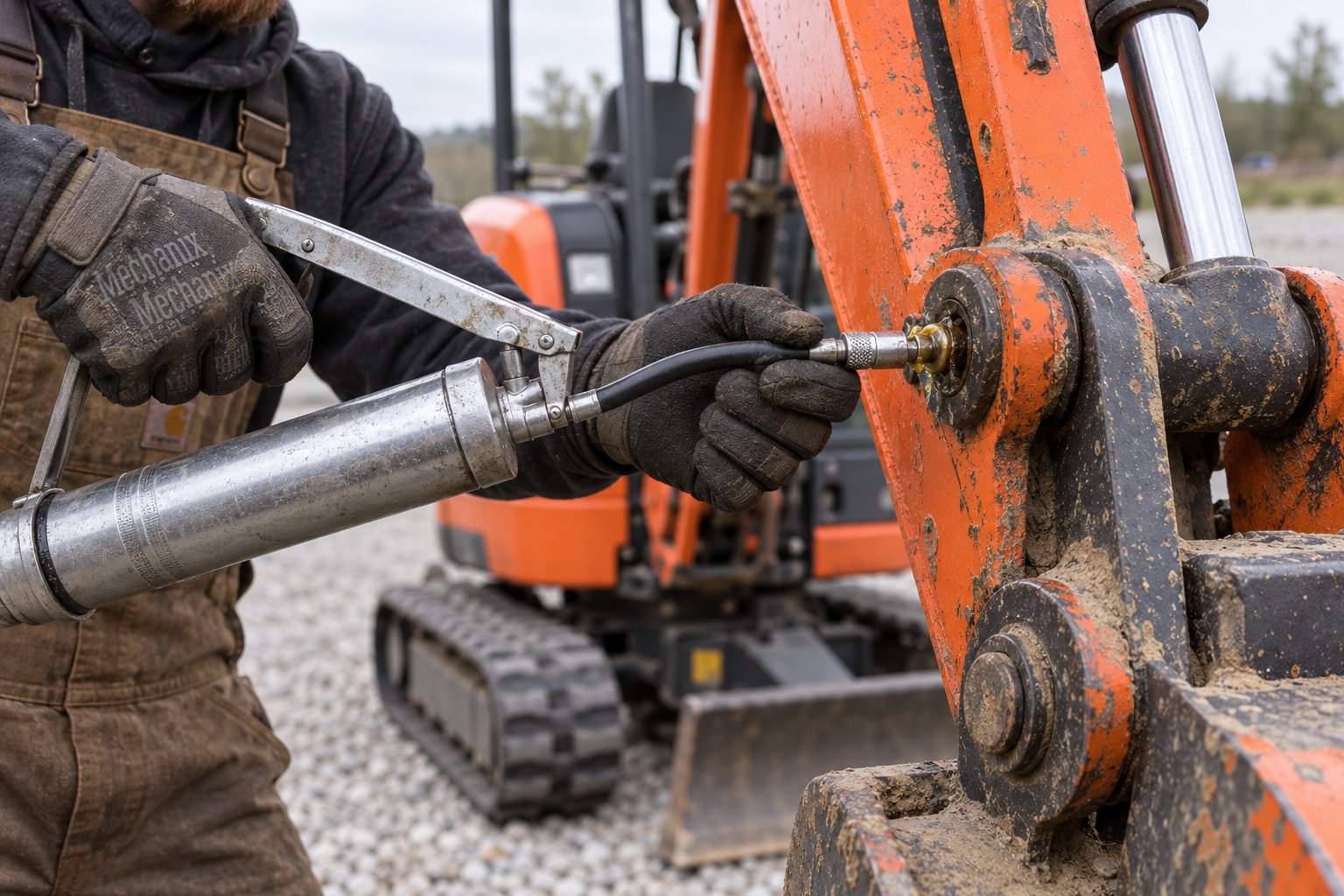
Grease every pivot point on the boom, arm, bucket, and blade linkage at the start of each working day. Under-greasing accelerates pin and bushing wear, creating sloppy joints that reduce digging precision and eventually require expensive pin replacements. Over-greasing wastes material and attracts dirt into the joint. Apply grease until you see a slight bead emerge at each fitting, then move on. The U17 has multiple grease points across the working arm and undercarriage; your operator's manual identifies each location and the recommended grease type.
Track tension deserves its own daily glance. Rubber tracks that run too loose can derail during rotation or travel on uneven ground. Tracks that run too tight increase friction on rollers and sprockets, accelerate wear, and consume more fuel. A quick visual check, looking for roughly 10 to 20 millimeters of sag between the bottom rollers and the track, takes seconds and prevents problems that cost hours.
Periodic interval tasks are driven by engine hours rather than calendar dates, though machines that sit idle for long stretches may still need attention due to fluid degradation and seal drying. General best practices for mini excavators in the U17's class follow a predictable pattern:
- Engine oil and filter change: Typically every 250 to 500 hours, depending on operating conditions. Dusty environments, extreme heat, and frequent cold starts all push toward the shorter end of that interval. Clean oil is the single most important factor in engine longevity.
- Hydraulic fluid and filter service: Hydraulic fluid generally lasts longer than engine oil, with many manufacturers specifying a 1,000- to 2,000-hour replacement interval, but the hydraulic filter should be changed more frequently, often at 500-hour intervals. Contaminated hydraulic fluid is one of the most common causes of hydraulic failures, damaging pumps, valves, and actuators long before performance problems become obvious.
- Coolant system service: Coolant condition matters as much as coolant level. Improper mixtures reduce freeze protection and heat transfer efficiency. Plan for a full coolant flush and replacement at the interval specified in your operator's manual, typically every 2,000 hours or two years, whichever comes first.
- Air filter replacement: The outer element should be cleaned or replaced based on the restriction indicator or visual inspection. The inner safety element gets replaced at longer intervals. In dusty job sites, daily cleaning of the primary element isn't overkill; it's necessity.
Exact hour intervals vary by U17 generation and engine specification. The figures above represent general industry norms for machines in this class, but always confirm against the Kubota operator's manual for the specific model and generation you own.
Long-Term Ownership Considerations and Common Wear Items
Beyond routine fluids and filters, several components have finite lifespans that every owner should plan for financially and logistically.
Rubber track replacement is the single most significant wear item on any mini excavator. Tracks degrade through a combination of abrasion, UV exposure, and the cumulative stress of turning on hard surfaces. Visible signs that replacement is approaching include cracked or missing tread blocks, exposed steel cords, torn lugs, and uneven wear patterns. Operating primarily on asphalt, concrete, or rocky ground accelerates rubber deterioration dramatically compared to soft soil or turf. A set of quality replacement rubber tracks for a machine in the U17's class typically represents a notable expense, but running worn tracks risks damaging sprockets, rollers, and idlers, turning a single wear item into a multi-component repair.
Undercarriage inspection should accompany every track tension check. Rollers, sprockets, and idler wheels develop wear patterns that signal alignment issues or improper operating habits. Packed mud, snow, and debris harden over time and act as abrasive material against undercarriage components, so regular cleaning after each shift extends the life of every part that contacts the track.
Hydraulic hose aging is a silent countdown. Hoses stiffen, crack, and blister with age and heat cycling, often failing suddenly rather than gradually. Inspect hoses for abrasion points where they rub against metal, check fittings for weeping, and pay special attention to hoses routed near hot engine surfaces. Replacing a suspect hose during a scheduled service costs a fraction of what an on-site blowout costs in cleanup, downtime, and hydraulic fluid replacement.
Cylinder seal maintenance keeps the boom, arm, bucket, and blade cylinders from leaking internally or externally. A weeping cylinder rod seal, the kind that leaves a thin oil film on the chrome rod, is an early warning. Left unaddressed, it progresses to a full leak that robs hydraulic pressure from the circuit and contaminates the work area. Seal kits are relatively inexpensive, but the labor to disassemble, clean, reseal, and reassemble a cylinder adds up if you're paying shop rates. Catching seal wear early, during daily walkaround inspections, often lets you schedule the repair at your convenience rather than dealing with a mid-job failure.
Fluids and filters quality deserves a final word. Genuine Kubota or OEM-equivalent filters and fluids maintain the tolerances the engine and hydraulic system were designed around. Bargain filters with looser micron ratings let finer particles through, accelerating internal wear on pumps and valves. The cost difference between genuine and bottom-tier aftermarket filters is negligible compared to the cost of a hydraulic pump rebuild. Use the correct specification, every time.
The table below provides a simplified maintenance schedule framework. Use it as a planning tool, then verify every interval against the Kubota operator's manual for your specific U17 generation.
| Frequency | Task | Details |
|---|---|---|
| Daily (pre-start) | Walkaround inspection | Check for leaks, loose hardware, cracked hoses, fluid levels (engine oil, coolant, fuel), and abnormal wear or damage |
| Daily (pre-start) | Grease all pivot points | Boom, arm, bucket, blade, and swing bearing fittings; apply until a slight bead emerges at each point |
| Daily (pre-start) | Track tension check | Visual inspection for proper sag (approx. 10-20 mm); adjust if too loose or too tight |
| Daily | Air cleaner and radiator screen | Clean debris from radiator core, panel screens, and air cleaner primary element |
| ~250-500 hours | Engine oil and filter change | Use manufacturer-specified oil weight; shorter intervals in dusty or high-heat conditions |
| ~500 hours | Hydraulic filter replacement | Replace filter element; inspect hydraulic fluid for discoloration or contamination |
| ~1,000-2,000 hours | Hydraulic fluid replacement | Full drain and refill with OEM-spec hydraulic fluid; clean the reservoir during service |
| ~2,000 hours or 2 years | Coolant flush and replacement | Drain, flush, and refill with correct coolant mixture; inspect hoses and clamps |
| As needed / long-term | Rubber track replacement | Replace when tread blocks crack, steel cords are exposed, or lugs are missing; avoid running on degraded tracks |
| As needed / long-term | Hydraulic hose inspection and replacement | Check for blistering, cracking, abrasion, and fitting weepage; replace proactively before failure |
| As needed / long-term | Cylinder seal service | Monitor cylinder rods for oil film; rebuild or reseal when weeping is detected |
| As needed / long-term | Undercarriage component replacement | Inspect rollers, sprockets, and idlers for uneven wear; clean packed debris regularly to slow deterioration |
A disciplined maintenance routine doesn't just prevent breakdowns. It directly protects the machine's resale value, a factor that matters enormously in the used compact excavator market where buyers scrutinize service records and visible wear before making an offer. That connection between maintenance discipline and financial return leads naturally into the question every prospective buyer eventually asks: what does the Kubota U17 actually cost, new or used, and what drives the price?
Kubota U17 Pricing
Every specification, application, and maintenance schedule covered so far eventually funnels into one unavoidable question: how much does this machine actually cost? The kubota u17 price varies dramatically depending on whether you're buying new from a dealer, picking up a late-model used unit, or hunting for an older-generation bargain on the resale market. Getting the pricing picture wrong, or comparing prices across generations without realizing the machines are fundamentally different, is one of the most expensive mistakes a buyer can make in this class.
New Kubota U17 MSRP and Dealer Pricing Context
Kubota publishes manufacturer's suggested retail prices on its U-Series equipment page, and here's a detail that catches many shoppers off guard: the company currently lists the U17 and U17-5 as separate models with distinct pricing. The older-generation U17 carries an MSRP starting at $35,072, while the current-production U17-5 starts at $37,920. That roughly $2,850 gap reflects the generational upgrades covered earlier in this article: the more powerful engine, higher auxiliary hydraulic flow, factory thumb bracket, standard diverter valve, LED boom lights, and prewired KubotaNow telematics that the U17-5 introduces.
Keep in mind that MSRP is a starting point, not a final price. Actual dealer pricing varies based on several factors. Geographic region plays a role; markets with high construction and landscaping activity, particularly in the Sun Belt and coastal metro areas, tend to hold closer to list price due to stronger demand. Attachment packages bundled at the dealer level, such as an additional bucket, hydraulic thumb, or quick coupler, add cost above the base MSRP. Dealer promotions and manufacturer incentives can work in your favor, too. Kubota periodically offers 0% APR financing for up to 60 months on excavators, a promotion that doesn't reduce the purchase price but dramatically lowers the effective cost of capital compared to standard equipment loan rates.
For perspective on where the U17 sits in the broader pricing landscape, consider the range of kubota excavator sizes within the U-Series lineup. The smallest model, the U10-5, starts at $31,045 MSRP. Step up to the U27-4, a 2.7-ton machine, and you're looking at $45,713. The U35-4, a popular choice among contractors who need more dig depth and bucket force than the micro class provides, starts at $56,147. By the time you reach Kubota's mid-range U55-5, the MSRP climbs to $82,642. That progression illustrates a useful rule of thumb: each step up in weight class adds roughly $10,000 to $20,000 in purchase price, along with corresponding increases in capability, transport complexity, and operating cost. For buyers debating between a new U17-5 at $37,920 and a u35 kubota at $56,147, the question isn't just about price. It's about whether your typical project demands the larger machine's dig depth and breakout force, or whether the U17's compact dimensions and lower total cost better match your daily workload.
You won't find the U17 anywhere near the price tag of the largest trackhoe in the world, but that's precisely the point. This machine competes on accessibility, not brute force. Its value proposition centers on doing profitable work in places where bigger, more expensive equipment simply cannot operate.
Used Market Pricing and What Affects Value
The used market for this excavator is active and surprisingly nuanced. Because the U17 label spans multiple generations, as detailed in the model lineage section above, used buyers face a challenge that doesn't exist with single-generation machines: two listings both labeled "Kubota U17" can represent very different equipment at very different fair market values.
Five primary factors drive used pricing:
- Engine hours: The most visible metric, but not always the most reliable indicator of condition. A well-maintained 1,500-hour machine with full service records can be worth more than a neglected 600-hour unit. Still, hours establish a baseline. Lower-hour machines command premium pricing because they statistically have more remaining useful life in engine, hydraulic, and undercarriage components.
- Generation and model variant: An original U17, a U17VR1, and a U17-5 are not interchangeable despite sharing a name. The U17-5's upgraded engine, hydraulics, factory thumb bracket, and telematics justify a significant price premium over earlier models. Sellers sometimes list older units at prices that blur generational lines, counting on buyers who don't know the difference. Refer back to the identification checklist in the model lineage section before agreeing to any price.
- Maintenance history: Documented service records, especially for engine oil changes, hydraulic fluid service, and track replacements, add measurable value. A machine with a complete service binder from an authorized dealer signals lower risk. A machine with no records forces the buyer to assume the worst and negotiate accordingly.
- Attachment packages: A used U17 that includes a hydraulic thumb, two or three bucket widths, and a quick coupler is worth more than a bare machine with a single bucket. Those attachments cost $1,500 to $4,000 or more to purchase separately, so their inclusion should be factored into any price comparison.
- Regional demand: Used compact excavator prices vary by geography. Markets with year-round construction seasons, like Texas, Florida, and the Carolinas, typically see stronger demand and higher prices. Northern markets with seasonal shutdowns may offer better deals during winter months when equipment utilization drops.
Aggregated 2026 transaction data from auction platforms and dealer listings paints a clearer picture of where used units actually trade. Pre-2016 Tier 3 models with 1,500 to 3,000 hours typically clear in the $10,500 to $14,500 range, though these carry emission compliance limitations in certain states. Post-2016 Tier 4 Final machines with 800 to 1,800 hours represent the value sweet spot at $15,500 to $20,000. Later-model units from 2019 to 2022 with under 1,200 hours command $19,000 to $24,000, while near-new machines under 400 hours can reach $22,000 to $28,500, often originating from rental fleet turnover or dealer demo programs.
To see what a real-world used-market listing looks like in practice, JIUHONG's Kubota U-17 listing provides a useful reference point. The machine is listed with a weight of 1,805 kg, which positions it as a near-2-metric-ton option rather than an exact 2,000 kg unit. That weight disclosure matters because it helps you cross-reference the listing against the generational specifications outlined earlier in this guide. JIUHONG's product page includes an inquiry form for pricing and availability, which is a practical first step if you're actively evaluating used options and want to request condition details, hour readings, and photos beyond the listing page.
Before committing to any used Kubota U17 purchase, verify the exact machine generation from the model plate, confirm total engine hours with supporting documentation, and request a detailed condition report covering undercarriage wear, hydraulic performance, and service history.
Used-market values fluctuate with broader economic conditions, seasonal demand cycles, and regional inventory levels, so treat any published price range as a snapshot rather than a fixed target. Check current listings across multiple platforms, including equipment auction sites, dealer certified pre-owned inventories, and independent marketplace listings, to calibrate what comparable machines are actually selling for at the time you're shopping. The strongest negotiating position comes from knowing exactly which generation you're evaluating, understanding the maintenance state of that specific unit, and having current comparable-sale data to support your offer.
Pricing, whether new or used, only tells part of the story. A machine's value also depends on how it stacks up against alternatives in its weight class and whether it's the right size for the work you actually do. That competitive context shapes the final piece of the buying decision.
Competitive Positioning and Choosing the Right Size
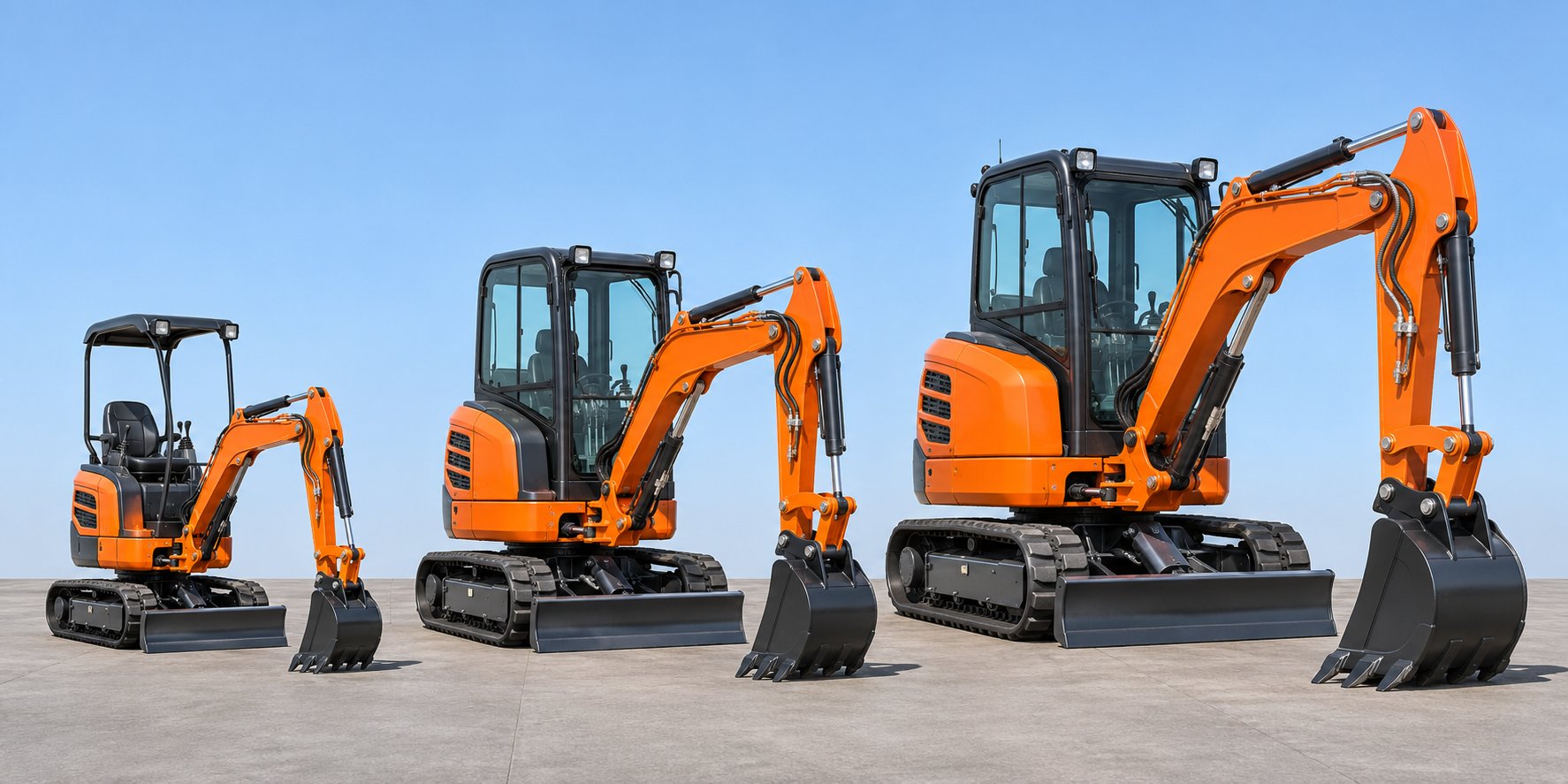
Knowing the kubota u17 specs inside and out is essential, but those numbers only become meaningful when you place them beside the alternatives. Every buyer eventually reaches the same crossroads: is this machine the right size for my work, or should I go bigger, smaller, or look at a competing brand? Answering that question honestly, even when it means pointing you away from the U17, is what separates a useful buying guide from a sales pitch.
How the U17 Stacks Up in the Sub-2-Ton Class
The 1- to 2-metric-ton mini excavator class is one of the most competitive segments in compact equipment. Machines from Kubota, Yanmar, Bobcat, Caterpillar, XCMG, Hyundai, and several other manufacturers all fight for the same buyers: small contractors, landscapers, rental fleet operators, and property owners tackling weekend projects. What separates these machines isn't a single headline spec but rather how several key attributes interact on the job.
Five differentiators matter most at this weight class:
- Engine power: Ranges from roughly 10 HP on the smallest micro machines to 21 HP on the upper boundary. The U17-5's 16.1 HP sits comfortably in the middle, offering enough power for sustained digging without the fuel consumption or mechanical complexity of the higher-output models. ReadyDig's 2026 comparison data shows the Cat 301.5 leading this class on raw horsepower at 21 HP net, but that machine uses a conventional tail swing rather than zero-tail swing, a tradeoff that matters every time you work near a wall or fence.
- Dig depth: Most 2-ton-class machines cluster between 7 feet and 8 feet 6 inches of maximum depth. The U17-5 reaches 7 feet 6 inches, essentially matching the Yanmar ViO17-1E at 7 feet 7 inches and the XCMG XE18U at 7 feet 6 inches. The Bobcat E20 stretches to 8 feet 4 inches with its long arm, giving it a clear depth advantage for buyers whose projects regularly require that extra reach. If your trenches consistently run deeper than 7 feet, that difference matters.
- Tail swing design: This is where the U17 and a handful of competitors separate themselves from the rest of the field. The U17-5, Yanmar ViO17-1E, XCMG XE18U, and Bobcat E20 all offer zero or near-zero tail swing. The Cat 301.5, despite its power advantage, swings conventionally. For residential and urban work, zero-tail swing isn't a luxury; it's an operational requirement that determines whether you can safely work in confined spaces without damaging surrounding structures.
- Auxiliary hydraulic flow: This spec dictates which attachments you can effectively run. The U17-5's 7.3 GPM auxiliary flow supports thumbs, small augers, and light breakers. Competing machines in this class offer similar or slightly varying flow rates, but the U17-5's factory-integrated thumb bracket and diverter valve reduce the time and cost of attachment setup compared to machines that require aftermarket mounting hardware.
- Build quality and dealer support: Kubota's reputation in the compact equipment market rests heavily on engine reliability and a dense North American dealer network. Parts availability and service access matter more than they appear on paper, especially for contractors whose income depends on daily machine uptime. Other established brands like Yanmar, Bobcat, and Caterpillar offer comparable support networks, which is why the decision often comes down to which dealer is closest to your shop rather than which brand has the best brochure.
Among kubota u series excavators, the U17-5 holds a distinct position as the smallest true zero-tail-swing model in the current lineup. Below it, the U10-5 serves the micro niche at 2,646 pounds and 10.3 HP, ideal for the tightest access scenarios but limited by shallower dig depth and less hydraulic capability. Above it, the Kubota U27-4 steps up to 5,688 pounds and 20.9 HP with a 9-foot, 5-inch dig depth, a meaningfully more capable machine that also requires a heavier trailer and a more robust tow vehicle.
The competitive comparison below places the U17-5 alongside its 2-ton-class rivals. Data comes from each manufacturer's published U.S. product pages and brochures:
| Model | Operating Weight | Max Dig Depth | Engine Power | Tail Swing |
|---|---|---|---|---|
| Kubota U17-5 | 3,902 lbs (incl. 165 lb operator) | 7 ft 6 in | 16.1 HP gross | Zero |
| Yanmar ViO17-1E | 4,023 lbs (rubber tracks) | 7 ft 7 in | 14.5 HP (rated) | True zero |
| XCMG XE18U | 3,968 lbs (canopy) | 7 ft 6 in | 15.8 HP | Zero |
| Bobcat E20 | 4,167 lbs (long arm, standard) | 8 ft 4 in | 15.0 HP | Zero |
| Cat 301.5 | 3,483 lbs (lightest canopy, incl. operator) | 7 ft 8 in (std) / 8 ft 4 in (long) | 21 HP net | Conventional |
No single machine dominates every column. The Cat 301.5 wins on power and offers competitive dig depth with its long arm, but its conventional tail swing limits where it can safely operate. The Bobcat E20 leads on depth while maintaining zero tail swing, making it the strongest alternative for buyers who regularly need that extra 10 inches of reach. The Yanmar ViO17-1E and XCMG XE18U trade blows with the U17-5 on nearly identical terms, with the Yanmar offering retractable tracks down to 37 inches (slightly narrower than the U17-5's 39.4-inch minimum) and the XCMG available through rental channels at a potentially lower entry cost.
What the U17-5 brings to this comparison that's harder to quantify in a table is Kubota's ecosystem advantage: the factory thumb bracket, standard diverter valve, proportional auxiliary flow control, and prewired telematics come standard. On competing machines, some of those features are optional add-ons that increase the final purchase price or require aftermarket installation. When you factor in the total cost of a job-ready configuration rather than just the base machine, the price gap between competitors often narrows or reverses.
When the U17 Is the Right Fit and When to Look Elsewhere
The U17 earns its place in a fleet or a one-machine operation when the work consistently matches its strengths: tight residential access, utility trenching under 7 feet deep, landscaping on finished properties, and light demolition where compactness and low ground pressure matter more than raw power or depth. Rental fleet operators stock it because its sub-4,000-pound weight simplifies transport for renters, and its intuitive controls reduce the learning curve for infrequent operators. Landscaping businesses gravitate toward it because the 4 PSI ground pressure means they can work on a client's lawn without creating a repair project afterward.
But honesty builds trust, and the U17 has clear limitations worth naming:
- Heavy trenching in compacted soils: If your jobs routinely involve cutting through dense clay, heavily compacted subgrade, or rocky terrain for hours at a time, the 16.1 HP engine and 3,547-pound bucket breakout force will feel underpowered compared to machines in the 3.5- to 5-ton range. You'll spend more time repositioning and taking smaller bites, which translates directly into slower production rates.
- Deeper excavation requirements: At 7 feet 6 inches of maximum dig depth, the U17 handles standard residential utility trenches with room to spare. But footings for commercial projects, deep sewer mains, or trenches in areas with deeper frost lines may demand 9 to 12 feet of reach. For those projects, look at the Kubota U27-4 (9 feet 5 inches) or U35-4 (9 feet 9 inches), or evaluate machines in the 3.5- to 5-ton class from any major manufacturer.
- Larger demolition tasks: Breaking up reinforced concrete, dismantling masonry walls, or processing heavy debris requires both higher auxiliary flow for larger breakers and more machine weight for stability. The U17's 7.3 GPM auxiliary flow is adequate for light breaker work, but heavier machines in the 4- to 6-ton class provide the flow rates, breakout forces, and stability needed for serious demolition.
- High-volume material handling: The U17's bucket capacity and dump height serve residential-scale spoil loading well, but if your daily workflow involves moving large quantities of material to elevated dump points, a bigger machine with greater dump height and bucket volume will complete the same work in fewer cycles.
For contractors whose project mix regularly includes these heavier-duty tasks, Kubota's own lineup provides the logical next steps. The kubota u27 4, at 5,688 pounds and 20.9 HP, bridges the gap between micro and mid-range with nearly 2 additional feet of dig depth. The U35-4 pushes into the 3.5-ton class with 23.9 HP and 8,488 pounds, while the U48-5 and KX040-5 move firmly into 4-ton territory with 38.9 to 40.4 HP and dig depths exceeding 10 feet. Even Kubota's larger kubota u145 model, when it was current, demonstrated how far the U-Series design philosophy scales.
The table below maps the U17-5 against its closest Kubota siblings to help you self-select the right size. If your typical job description lives in the first row, the U17 is the right call. If it regularly spills into the rows below, you're better served stepping up.
| Model | Approximate Weight Class | Operating Weight | Engine HP | Max Dig Depth | Target Application |
|---|---|---|---|---|---|
| U10-5 | Sub-1-ton | 2,646 lbs | 10.3 HP | 5 ft 11 in | Ultra-tight access, shallow trenching, micro grading |
| U17-5 | Sub-2-ton | 3,902 lbs | 16.1 HP | 7 ft 6 in | Residential utility trenching, landscaping, light construction in confined spaces |
| U27-4 | 2.5-ton | 5,688 lbs | 20.9 HP | 9 ft 5 in | Deeper residential/light commercial trenching, foundation work, larger landscape projects |
| U35-4 | 3.5-ton | 8,488 lbs | 23.9 HP | 9 ft 9 in | Mid-range construction, deeper footings, heavier grading, small commercial site prep |
| U48-5 | 4.5-ton | 10,848 lbs | 38.9 HP | 10 ft 8 in | Commercial site work, deep trenching, moderate demolition, heavy attachment use |
Notice the weight progression: each step up roughly doubles the transport complexity. The U17-5 at 3,902 pounds rides on a standard tandem-axle utility trailer behind a half-ton truck. The U27-4 at 5,688 pounds still fits most utility trailers but pushes tongue weight higher. By the time you reach the U35-4 at 8,488 pounds, you're firmly in equipment-trailer territory with a three-quarter-ton or one-ton tow vehicle. That transport escalation isn't just an inconvenience; it's a daily operating cost that compounds across every job site transition. For contractors who move equipment frequently between small residential sites, the U17's position at the lightweight end of the spectrum is itself a competitive advantage that heavier machines can't replicate.
Buyers shopping the used market for compact digging solutions should weigh these size-class distinctions carefully. A used U17 at the right price can serve a small contracting or landscaping business extremely well on the projects that match its capabilities, while a used mid-range machine might look appealing on paper but sit idle on days when the work calls for tight access rather than raw depth. For example, JIUHONG's used Kubota U-17 listing, with a listed weight of 1,805 kg (approximately 3,979 lbs), provides a reference point for small contractors evaluating compact options for smaller projects. That weight positions it squarely in the sub-2-metric-ton envelope discussed throughout this guide, a machine built for access-constrained work rather than heavy production digging.
Ultimately, choosing the right size machine isn't about finding the "best" excavator in absolute terms. It's about matching the equipment to the work you actually do, the sites you actually access, and the vehicle you actually tow with. The kubota u17 specs reviewed throughout this guide, 16.1 HP, 3,902 pounds, 7 feet 6 inches of dig depth, zero-tail swing, and 7.3 GPM auxiliary flow, define a very specific performance envelope. If your projects live inside that envelope, you'll be hard-pressed to find a better-suited machine in this class. If they regularly exceed it, the data in this article gives you exactly what you need to identify where to step up and by how much.
Frequently Asked Questions About the Kubota U17
1. How much does a new Kubota U17 cost?
The older-generation Kubota U17 carries an MSRP starting at $35,072, while the current-production U17-5 starts at $37,920. Actual dealer pricing varies by region, bundled attachments, and available promotions such as Kubota's periodic 0% APR financing for up to 60 months. Used units range from roughly $10,500 for older Tier 3 models with higher hours up to $28,500 for near-new machines under 400 hours. Buyers can also evaluate options from used equipment sellers like JIUHONG, which lists a Kubota U-17 at 1,805 kg with an inquiry form for current pricing.
2. What is the dig depth of the Kubota U17-5?
The current-production Kubota U17-5 reaches a maximum dig depth of 7 feet 6.2 inches, which comfortably handles standard residential utility trenches that typically run 3 to 5 feet deep. It also offers a maximum dump height of 8 feet 1.2 inches, tall enough to clear the sides of most single-axle dump trailers. For projects that consistently require depths beyond 7 feet, Kubota's U27-4 at 9 feet 5 inches or U35-4 at 9 feet 9 inches are better-suited alternatives.
3. What is the difference between the Kubota U17 and U17-5?
The U17 and U17-5 represent different generations of the same platform. The original U17 ran a roughly 13 HP engine with lighter operating weight and lower hydraulic output. The U17-5, announced at World of Concrete 2025, upgrades to a 16.1 HP Kubota diesel, 3,902-pound operating weight, 7.3 GPM auxiliary flow, and adds factory-standard features including a pre-welded thumb bracket, diverter valve, LED boom lights, and prewired KubotaNow telematics. Track gauge also expands to 51.2 inches maximum versus the narrower range on earlier models.
4. Can a half-ton truck tow a Kubota U17?
Most modern half-ton pickups like the F-150 or Silverado 1500 are rated between 9,000 and 13,000 pounds of towing capacity, which technically covers the combined weight of the U17-5 (3,902 lbs) plus a tandem-axle utility trailer. However, the lowest rating in the tow chain always governs, including the hitch rating, ball rating, and trailer GVWR. A three-quarter-ton truck such as an F-250 or Ram 2500 provides a safer margin, especially on hilly routes or with heavier attachment packages onboard.
5. What attachments work with the Kubota U17-5?
The U17-5 delivers 7.3 GPM of auxiliary hydraulic flow, which effectively powers hydraulic thumbs (4-8 GPM), small post-hole augers (5-10 GPM), light-duty hydraulic breakers on the smaller end of the spectrum, and various digging bucket widths. The machine ships with a factory thumb bracket and standard diverter valve for quick attachment integration. Attachments requiring higher flow, such as plate compactors (12-20+ GPM), large rotating grapples, or forestry mulchers, will underperform on this auxiliary circuit and are better matched to larger machines like the U27-4 or U35-4.