

What Makes Kubota Mini Excavators a Jobsite Staple
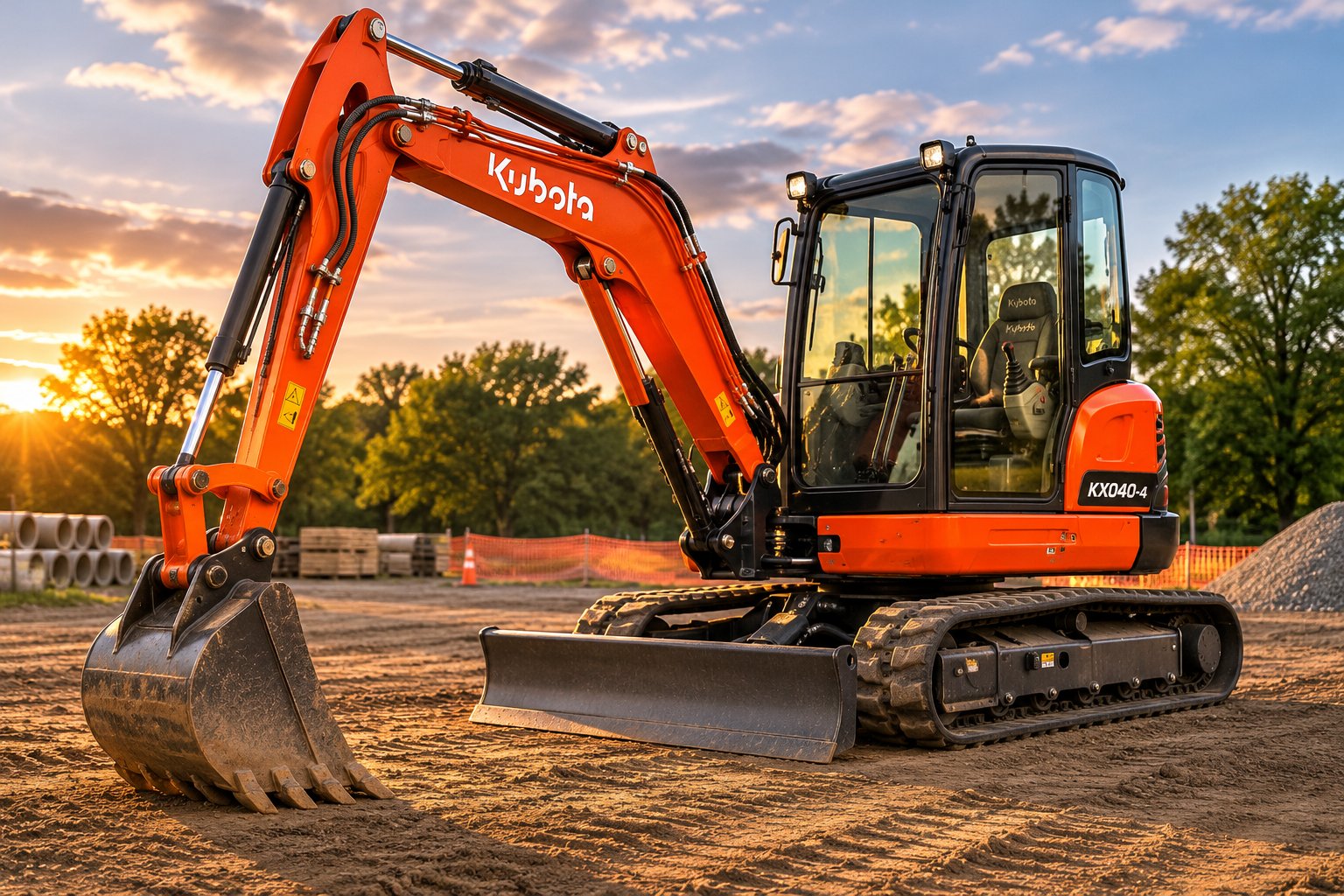
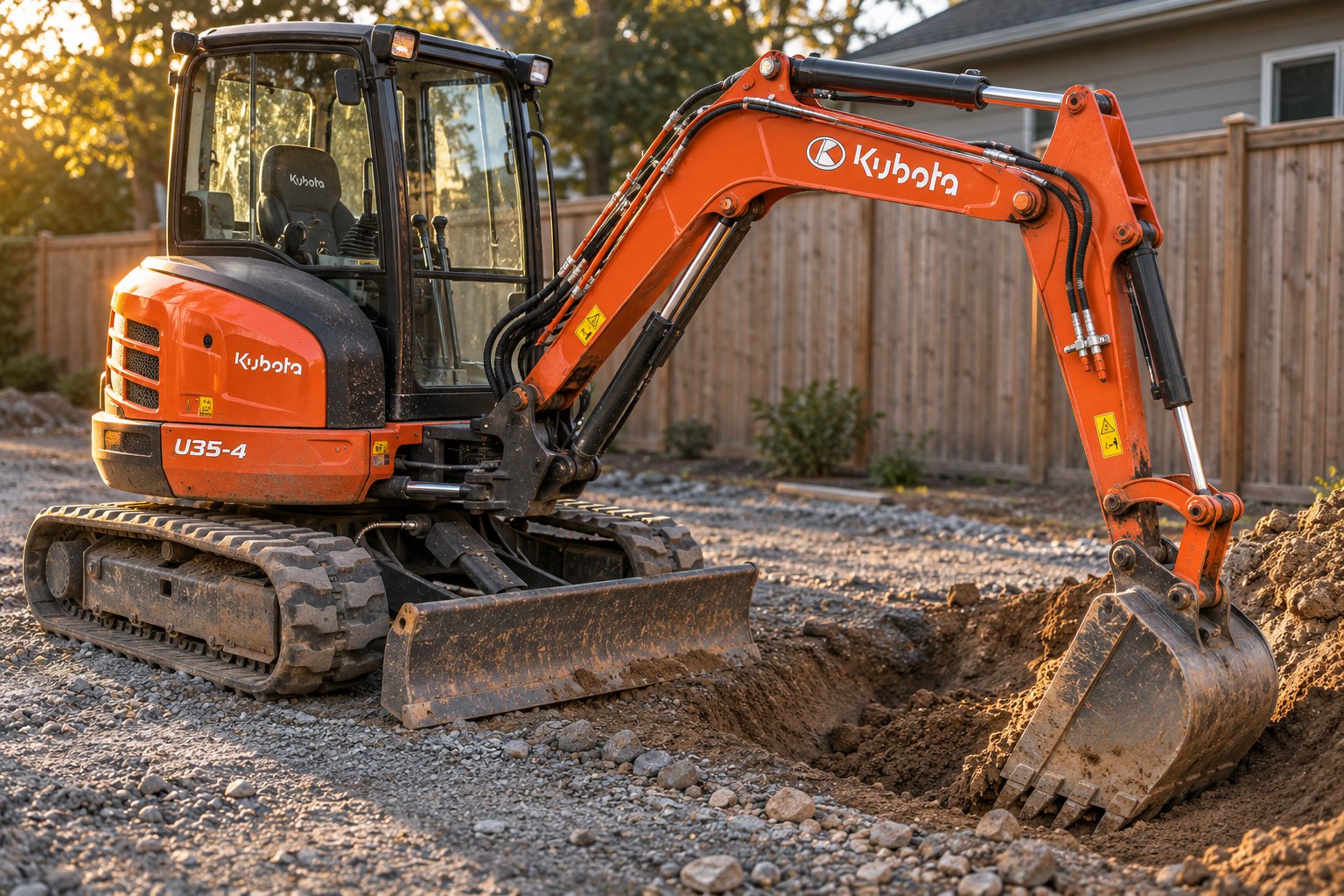
Imagine a machine compact enough to squeeze through a backyard gate yet powerful enough to dig a full-depth utility trench before lunch. That is exactly the role a Kubota mini excavator fills. These compact, diesel-powered hydraulic excavators typically weigh anywhere from under 1 ton to roughly 8 tons at operating weight, and they handle everything from digging and trenching to grading and light demolition in spaces where full-size equipment simply cannot go. Rubber-track undercarriages keep ground pressure low, protecting finished landscapes while providing stable traction on slopes and loose soil.
Mini excavators have become the most versatile machines in compact construction. Landscapers, plumbers, small general contractors, and even homeowners rely on them daily. And among every brand on the market, one name consistently leads the conversation.
What Defines a Mini Excavator
At its core, a mini excavator is a tracked hydraulic digging machine defined by its operating weight class. Models under about 2 tons are often called micro excavators, while units in the popular 3 ton mini excavator range hit a sweet spot between portability and digging performance. Heavier compact models push toward 8 tons and beyond. All of them share the same basic anatomy: a hydraulic boom and arm, a rotating house (called the upperstructure), and rubber or steel tracks that distribute weight evenly across soft ground. Hydraulic cylinders power every movement, from curling the bucket to swinging the cab, giving operators precise control even in tight quarters.
Why Kubota Dominates the Compact Excavator Segment
Kubota is far more than a brand known for kubota tractors and kubota skid steer loaders. On the excavator side, the numbers speak for themselves.
Kubota is the world's #1-selling compact excavator brand, holding that position for 20 consecutive years according to 2024 data from Off-Highway Research covering all Kubota Group brand sales.
That market leadership is backed by one of the broadest model lineups in the industry, spanning 14 models across two distinct product families: the KX Series and the U Series. Kubota's dealer network stretches across every U.S. state, and recent kubota news highlights ongoing investment in next-generation models with quieter cabs and improved hydraulics. Buyers can even use the Build My Kubota online configurator to spec machines before visiting a dealer.
EDA equipment finance data reinforces the dominance: Kubota accounted for roughly one-fourth of all new mini excavator sales in the U.S. over the most recent 12-month reporting period, with the KX040-4 and KX057-5 ranking among the top-selling models nationwide.
So what separates the KX Series from the U Series, and why does that distinction matter more than most buyers realize? The answer comes down to a single engineering decision — tail swing geometry — and it affects everything from jobsite safety to resale value.
KX Series vs U Series and Why Tail Swing Design Matters
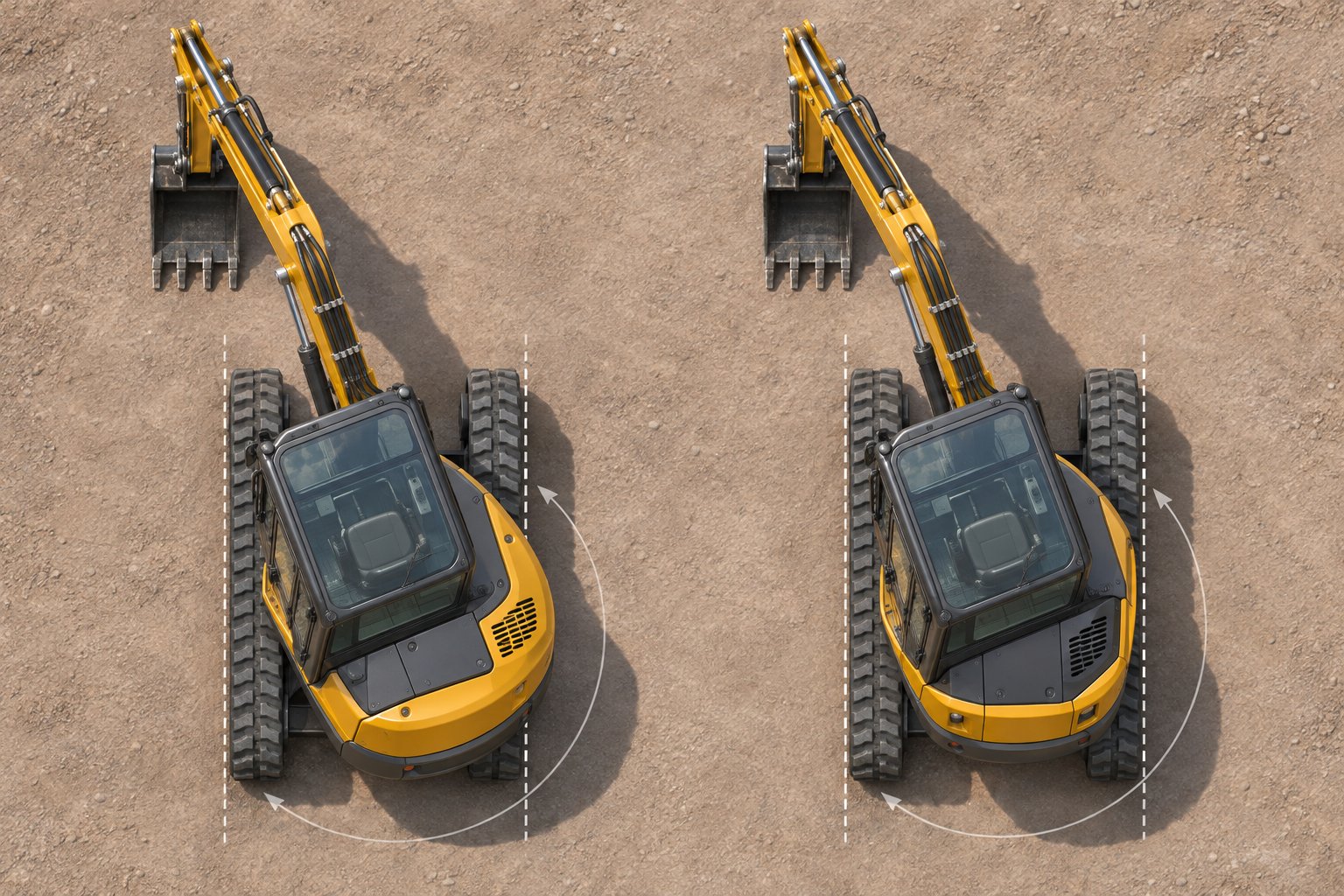
Tail swing geometry is the single most consequential engineering difference between Kubota's two mini excavator families, yet it rarely gets a clear explanation. Picture this: you are sitting in the operator's seat and swing the upperstructure to dump a bucket of spoil into a truck. As the cab rotates, the heavy counterweight at the rear traces an arc behind you. The size of that arc — how far the back of the machine sticks out past the tracks — is what the industry calls tail swing. It sounds like a minor detail until that counterweight clips a fence, a parked truck, or a building foundation. On a congested jobsite, tail swing can be the difference between a productive shift and an expensive damage claim.
Kubota splits its entire mini excavator kubota lineup along this dividing line. The KX Series uses a conventional tail swing design, while the U Series is engineered around a tight or zero tail swing philosophy. Understanding the trade-offs between the two is the fastest way to narrow your search before you ever step onto a dealer lot.
Conventional Tail Swing and the KX Series Advantage
On a KX Series machine, the counterweight extends noticeably beyond the width of the tracks whenever the operator rotates the house. That extra overhang is not a design flaw — it is a deliberate stability strategy. Pushing the counterweight farther from the machine's center of gravity creates more leverage, which translates into higher lifting capacity and stronger breakout forces at a given operating weight.
Patrick Baker, product manager at Kubota Construction Equipment, put it plainly in an industry interview: "Kubota conventional tail swing models will lift more than a reduced or zero tail swing model." That additional mass behind the cab also improves 360-degree stability, especially when running heavy attachments like hydraulic breakers or grapples on slopes and uneven terrain.
When does that matter most? Think open commercial sites, rural drainage projects, and any scenario where the machine has room to swing freely. A contractor trenching across an open field or loading trucks on a cleared lot will benefit from the KX Series' superior leverage without worrying about rear-end clearance. Kubota currently offers seven conventional tail swing models in the KX lineup — spanning from the tiny K008-3 all the way up to the KX080-4S2 — so there is a size for nearly every open-site application. If you are already familiar with Kubota's broader equipment ecosystem, including kubota compact tractors and skid steers, the KX Series follows that same philosophy of maximizing raw performance per pound of machine.
Tight Tail Swing and Zero Tail Swing in the U Series
The U Series flips the priority. Instead of chasing maximum leverage, Kubota's engineers packaged the engine, counterweight, and hydraulic components so the rear of the upperstructure stays within — or barely beyond — the track width during a full 360-degree rotation. The result is a kubota compact excavator that can spin next to a building wall, a fence line, or a row of parked cars without making contact.
Imagine digging a pool three feet from a homeowner's vinyl-sided house. A conventional tail swing model would require careful repositioning on every rotation to keep the counterweight from striking the siding. A zero tail swing U Series machine eliminates that concern entirely — the operator can focus on digging rather than constantly monitoring clearance behind the cab. The same logic applies to utility work along active roadways, where a zero tail swing excavator won't swing into adjacent traffic lanes, reducing both risk and the need for extra lane closures.
The trade-off is real, though. Fitting all that hardware inside a tighter envelope means the U Series gives up some counterweight mass and leverage compared to a KX model at the same tonnage. Lifting capacity over the side drops slightly, and operators may notice a modest reduction in stability on steep grades. For most residential and urban work, that trade-off is well worth the freedom to operate confidently in confined spaces. Kubota offers five tight or zero tail swing models in the U family, from the nimble U17 through the U55-5, covering the weight classes where space constraints are most common.
| Dimension | KX Series (Conventional Tail Swing) | U Series (Tight / Zero Tail Swing) |
|---|---|---|
| Tail Swing Radius | Extends beyond track width during rotation | Stays within or very close to track width |
| Ideal Jobsite Type | Open fields, commercial sites, rural projects | Residential backyards, urban corridors, roadside utility work |
| Model Range | K008-3, KX018-4, KX71-3, KX033-4, KX040-4, KX057-5, KX080-4S2 | U17, U27-4, U35-4, U48-5, U55-5 |
| Stability & Lift Capacity | Higher — extended counterweight adds leverage | Slightly lower — compact packaging reduces counterbalance |
| Obstacle Risk | Higher — rear overhang can contact structures or vehicles | Lower — minimal overhang reduces damage and safety risk |
| Key Trade-Off | Needs more swing clearance on tight sites | Sacrifices some lifting and digging force for maneuverability |
Choosing between these two design philosophies is not about which series is "better" — it is about which geometry matches the jobsites you work on most often. A fleet that splits time between open commercial excavation and tight residential projects may even benefit from owning one of each. The real question that follows is how individual models within each series stack up on the specs that drive daily productivity — dig depth, bucket capacity, engine power, and overall width — which is exactly where a full side-by-side comparison becomes invaluable.
Every Kubota Mini Excavator Model Compared Side by Side
Spec sheets for individual Kubota mini excavators are easy enough to find, but try comparing the entire KX and U Series lineup in a single view and you will quickly run into a wall. Dealer brochures cover one model at a time. Listing sites like RitchieSpecs present raw numbers without context. And most competitor articles cherry-pick a handful of models without showing the full picture. The table below changes that — every current kubota excavator model, both series, unified in one place so you can spot the right weight class, dig depth, and tail swing type at a glance.
Complete Kubota Mini Excavator Specification Table
The following data draws from published Kubota specification sheets and reflects standard configurations with rubber tracks and canopy unless noted otherwise. Bucket capacity varies by bucket width and type, so the values below represent the standard-equipped digging bucket. Always confirm exact specs with your dealer for the specific build you are considering.
| Model | Series | Operating Weight | Max Dig Depth | Std. Bucket Capacity | Net Engine HP | Tail Swing Type | Overall Width |
|---|---|---|---|---|---|---|---|
| K008-5 | KX | 2,315 lb | 5 ft 8 in | 0.020 yd³ | 10.3 HP | Conventional | 2 ft 10 in |
| U10-5 | U | 2,646 lb | 5 ft 11 in | 0.024 yd³ | 10.3 HP | Tight (0.6 in clearance) | 3 ft 3 in |
| U17-5 | U | 3,702 lb | 7 ft 5.9 in | 0.033 yd³ | 17.0 HP | Zero (0 in clearance) | 3 ft 3 in |
| KX018-4 | KX | 3,747 lb | 7 ft 9.7 in | 0.035 yd³ | 16.1 HP | Conventional | 4 ft 3 in |
| U27-4 | U | 5,688 lb | 9 ft 5 in | 0.049 yd³ | 20.8 HP | Tight (1.6 in clearance) | 4 ft 11 in |
| KX030-4 | KX | 6,272 lb | 9 ft 9 in | 0.056 yd³ | 23.3 HP | Conventional | 5 ft 1 in |
| KX033-4 | KX | 7,420 lb | 10 ft 6 in | 0.056 yd³ | 23.3 HP | Conventional | 5 ft 1 in |
| U35-4 | U | 8,129 lb | 9 ft 8.9 in | 0.056 yd³ | 23.9 HP | Tight (2 in clearance) | 5 ft 7 in |
| KX040-5 | KX | 9,199 lb | 11 ft 2.3 in | 0.092 yd³ | 40.3 HP | Conventional | 5 ft 7 in |
| U48-5 | U | 10,848 lb | 10 ft 8 in | 0.092 yd³ | 40.4 HP | Tight (1.2 in clearance) | 6 ft 5 in |
| KX057-5 | KX | 12,346 lb | 12 ft 9 in | 0.14 yd³ | 47.6 HP | Conventional | 6 ft 5 in |
| U55-5 | U | 12,247 lb | 11 ft 11 in | 0.14 yd³ | 47.6 HP | Tight (2.5 in clearance) | 6 ft 5 in |
| KX080-5 | KX | 18,365 lb | 15 ft 1.1 in | 0.21 yd³ | 66.6 HP | Conventional | 7 ft 3 in |
If you have been cross-shopping a komatsu mini excavator or browsing mini excavadora listings alongside Kubota, this table makes apples-to-apples comparisons much faster — just match weight class and dig depth to whatever competing models you are evaluating.
What These Specs Actually Mean on the Jobsite
Numbers on a spec sheet only matter when you know what they mean for your daily work. Here is a plain-language translation of the columns that drive real purchasing decisions.
Dig depth is the maximum vertical distance the bucket can reach below grade on flat ground. Why does that matter? A standard residential footing in many U.S. jurisdictions sits 36 to 48 inches below grade, so even the smallest K008-5 handles that easily. But a full basement excavation or a deep sewer main may call for 10 to 12 feet of reach — territory that demands a mid-range model like the Kubota KX040-5 or larger. If you frequently bid on utility trenching jobs that require 8-plus feet of depth, a machine rated at 7 feet 6 inches will leave you renting a second unit to finish the job. Always match dig depth to the deepest trench you realistically encounter, not the shallowest.
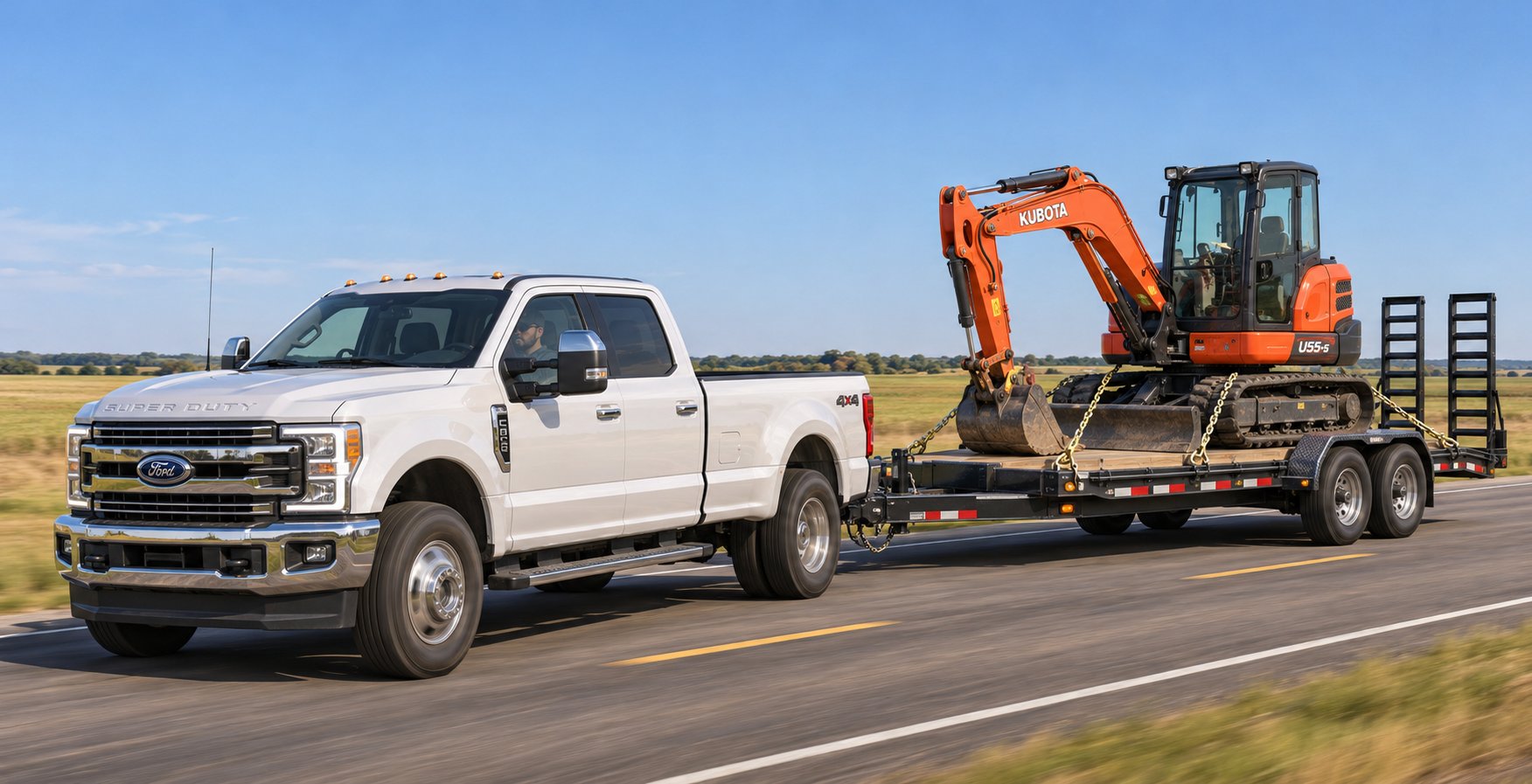
Operating weight dictates more than machine stability. It determines what trailer you need, what tow vehicle can haul it, and whether you will need a CDL to move it legally. A 2,315-pound K008-5 rides comfortably on a single-axle utility trailer behind a half-ton pickup. A 12,346-pound KX057-5 demands a heavy tandem-axle equipment trailer and a one-ton truck. Getting this wrong means either an overloaded trailer on the highway or an unexpected equipment rental just to transport your own machine.
Bucket capacity affects how many cycles it takes to fill a truck or clear a trench. Larger buckets move more material per scoop, which directly reduces cycle times on bulk excavation — think pool digs or foundation work. But on a narrow utility trench, a smaller bucket is actually more efficient because it matches the trench width and avoids over-excavating. The sweet spot depends entirely on the type of work you do most.
Net engine horsepower fuels the hydraulic system that powers every movement on the machine, from boom swing to track drive. More horsepower generally means faster cycle times and the ability to run demanding attachments like hydraulic breakers. Still, horsepower alone can be misleading. A machine with excellent hydraulic efficiency can outperform a higher-horsepower competitor that wastes energy through a less refined system. Look at horsepower alongside hydraulic flow rate (measured in gallons per minute) for a more complete picture of real-world performance.
Overall width is the gatekeeper — literally. Residential fence gates typically measure 36 to 48 inches. You will notice that the smallest kubota mini excavators, like the K008-5 at 2 feet 10 inches, slip through a standard single gate with room to spare. Mid-range models around 5 feet wide need a double gate or direct driveway access. And the largest units at over 7 feet require open entry points or temporary fence removal. If residential backyard work makes up a significant portion of your revenue, width should rank near the top of your decision criteria — sometimes even above dig depth.
Taken together, these specifications form an interconnected decision matrix rather than a list of isolated numbers. A machine with impressive dig depth but excessive width might never reach the backyards where that depth is needed. A lightweight model that fits anywhere may not dig deep enough to win the jobs that justify its purchase. The key is identifying which two or three specs are non-negotiable for your most common projects, then letting those constraints guide your model selection across the weight tiers that shape everything from transport logistics to CDL requirements.
Weight Classes and Transport Considerations You Cannot Ignore
Specs like dig depth and bucket capacity tell you what a machine can do once it is on the jobsite. But there is a question that comes before every single project: how are you getting it there? The answer depends almost entirely on operating weight, and it influences everything from the trailer sitting in your yard to the truck pulling it to whether you need a commercial driver's license just to haul your own equipment. Kubota's mini excavator lineup spans from roughly 2,300 pounds to over 18,000 pounds, and the transport logistics at each end of that range could not be more different.
Weight Tiers From Micro to Heavy Compact
Rather than thinking about individual models in isolation, it helps to group the lineup into four practical weight tiers. Each tier carries its own transport profile, access characteristics, and cost implications — whether you are shopping for a new unit, exploring mini excavator financing options, or evaluating a used kubota mini excavator on the secondary market.
- Micro Class (Under 2 Tons): Models like the K008-5 and U10-5 fall here, with operating weights between roughly 2,300 and 2,650 pounds. These are the most portable machines in the lineup. A standard single-axle utility trailer and a half-ton pickup handle them with ease. Overall widths under 40 inches mean they slip through standard backyard gates, and their light footprint barely disturbs finished lawns. The trade-off is limited dig depth and bucket capacity — these are trenching and light grading tools, not bulk excavation machines.
- Light Class (2–4 Tons): The U17-5 and KX018-4 represent this tier, weighing between roughly 3,700 and 4,000 pounds. A 2 ton mini excavator in this range still rides on a single-axle or light tandem-axle trailer behind a half-ton truck in most configurations. Dig depths push past 7 feet, making these machines capable enough for residential footings and utility trenches. Widths hover around 39 to 51 inches — tight enough for many double gates but potentially too wide for a single residential gate on the larger models.
- Mid Class (4–6 Tons): This tier includes the U27-4, KX030-4, and KX033-4, spanning roughly 5,700 to 7,400 pounds. You are now firmly in tandem-axle equipment trailer territory, and a three-quarter-ton tow vehicle is the practical minimum. Dig depths between 9 and 10.5 feet open the door to deeper utility mains, pool excavation, and light commercial foundation work. Overall widths around 5 feet rule out most residential gates entirely — plan on driveway access or temporary fence panel removal.
- Heavy Compact Class (6–8+ Tons): The KX040-5 (the popular kubota 40 excavator), U48-5, KX057-5, U55-5, and the flagship KX080-5 live here, with operating weights from roughly 9,200 to over 18,000 pounds. These machines demand heavy-duty tandem-axle or gooseneck trailers rated to 14,000 pounds GVWR and above, paired with a one-ton tow vehicle. Overall widths range from 5 feet 7 inches to over 7 feet, so residential backyard access is rarely an option. What you gain is serious production capability — dig depths past 11 feet, large bucket capacities, and the horsepower to run demanding hydraulic attachments all day.
Trailer, Tow Vehicle, and CDL Requirements
Getting the trailer wrong is one of the most expensive mistakes a buyer can make, and it happens more often than you might expect. A contractor who finds the perfect kubota mini excavator for sale, signs the paperwork, and then realizes the machine exceeds the tow rating of a half-ton pickup is facing a second unplanned purchase before the excavator ever touches dirt.
Here is the practical breakdown. Micro and light class machines under roughly 4,000 pounds of operating weight can typically ride on a utility trailer with a 7,000-pound GVWR, towed by a standard half-ton pickup like an F-150 or Silverado 1500. Keep in mind that the real transport weight of any machine is 10 to 20 percent higher than the published spec sheet number once you account for a full fuel tank, attachments, and jobsite debris clinging to the tracks and undercarriage. Always use that adjusted figure when calculating payload against your trailer's GVWR.
Mid class machines in the 5,700- to 7,400-pound range push the math into 10,000- to 12,000-pound GVWR trailer territory. A three-quarter-ton truck handles this comfortably. Heavy compact models — especially the KX057-5 at 12,346 pounds and the KX080-5 at over 18,000 pounds — call for trailers rated at 14,000 to 20,000 pounds GVWR. Deck-over and gooseneck configurations become essential at this level to accommodate both the weight and the machine's wider stance.
What about CDL requirements? This is where confusion runs rampant. According to FMCSA guidance, a commercial driver's license is not required for a combination vehicle (truck plus loaded trailer) with a gross combined weight rating (GCWR) below 26,001 pounds, provided you are not hauling hazardous materials or passengers. For most micro, light, and mid class Kubota excavators paired with an appropriately rated pickup and trailer, you will stay comfortably under that threshold. Heavy compact models paired with a one-ton dually and a gooseneck trailer can approach or exceed the 26,001-pound line, so run the exact numbers — your truck's GVWR plus your trailer's GVWR — before assuming you are in the clear.
Fitting Through Gates and Working in Tight Residential Spaces
Transport is only half the access equation. The other half plays out at the property itself, often at a 36-inch wooden fence gate that stands between your machine and the job.
A standard single residential gate typically measures 36 to 42 inches wide. Only the micro class machines — the K008-5 at 34 inches wide and the U10-5 and U17-5 at 39 inches — can reliably pass through these openings. Even at 39 inches, you are working with razor-thin clearance on a 36-inch gate, so measuring the narrowest point before the machine arrives is not optional. A double gate or wide garden gate opens the range to roughly 60 to 72 inches, which accommodates every model up through the mid class KX033-4 at 61 inches.
Heavy compact models wider than 6 feet — think the KX057-5, U55-5, or the KX080-5 — almost always require direct driveway access to the work area or temporary removal of a fence section. If residential backyard projects like landscaping, drainage, or pool excavation make up a significant share of your revenue, width is not a secondary spec. It is the filter that determines which tier of machine can actually reach the work. Many landscapers who also rely on kubota mowers for finish work intentionally keep a micro or light class excavator on the trailer alongside their mowing equipment, specifically because those smaller machines access the same properties without logistical headaches.
The interplay between weight, width, and transport logistics creates a practical ceiling for each tier that goes well beyond what any spec table reveals. A machine you cannot legally tow, or physically fit through the gate, delivers zero productivity — no matter how impressive its dig depth or horsepower numbers look on paper. With those physical constraints clearly mapped, the next logical step is flipping the perspective entirely: starting with the project itself and working backward to the machine that fits.
Matching the Right Kubota Model to Your Project Needs
Most buyers start by browsing models and hope the specs eventually point them toward the right machine. That approach works backward. The smarter path is to start with the project sitting in your pipeline and let the job dictate the excavator — not the other way around. A landscaper reshaping a backyard and a plumber burying a sewer lateral face completely different constraints, even if their budgets overlap. Matching the machine to the mission eliminates guesswork and prevents costly mismatches that eat into margins or stall production.
Below are six of the most common project types contractors and property owners encounter, each mapped to the Kubota weight tier and series that fits best. Whether you are searching for a kubota excavator for sale or just trying to narrow the field before visiting a dealer, this framework gives you a clear starting point.
Landscaping, Grading, and Residential Projects
Imagine a homeowner wants a patio leveled, a retaining wall footing dug, and a few drainage swales cut across a fenced backyard — all without destroying the lawn the neighbors spent three years admiring. This is textbook light U-Series territory. A kubota small excavator like the U17-5 weighs under 3,800 pounds, fits through a 39-inch gate, and digs just over 7 feet deep. Its zero tail swing design lets the operator rotate freely next to the house, the fence, and the patio border without the constant clearance checks a conventional model demands. Low ground pressure from the rubber tracks means minimal turf damage, and the compact width keeps the machine maneuverable on narrow side yards.
For larger grading projects on open residential lots — resloping an entire yard or prepping a building pad — stepping up to the U27-4 or KX030-4 adds dig depth past 9 feet and increases bucket capacity for faster material movement. The choice between those two comes back to tail swing: if the lot is tight, stick with the U Series; if there is room to work, the KX Series offers a slight edge in stability and digging force.
Utility Trenching and Underground Installations
Plumbers, electricians, and utility contractors live and die by dig depth. A water main running 4 feet below grade is routine, but sewer laterals, storm drains, and electrical conduit often sit 6 to 10 feet down depending on local code. That depth requirement immediately rules out micro class machines and pushes the selection into mid-range KX models.
The KX033-4 at 10 feet 6 inches of dig depth covers the majority of residential utility work, while the KX040-4 — one of the most popular models in the entire lineup — reaches past 11 feet and delivers 40 horsepower to the hydraulic system. That extra power matters when you are running a narrow trenching bucket through compacted clay or rocky subsoil for hours at a stretch. Conventional tail swing is perfectly acceptable here because most utility trenches run through open right-of-way corridors, front yards, or roadside easements where rear clearance is not a concern.
If the trench runs along a building foundation or next to a retaining wall, the U35-4 offers a tight tail swing alternative with nearly 10 feet of dig depth — a solid compromise when the jobsite is more constrained than a typical open-cut trench.
Pool Excavation, Foundations, and Heavier Earthmoving
Pool digs and full foundation excavations share a common demand: you need both depth and volume. A typical in-ground pool shell sits 6 to 8 feet below grade, but the over-dig required for plumbing, backfill access, and forming space often pushes the actual excavation past 10 feet. Foundation footings in cold climates can reach 4 feet below the frost line, and full basement excavations may call for 12 feet or more.
This is heavy compact territory. The kx040-4 and KX057-5 dominate pool and foundation work for good reason — dig depths of 11 to nearly 13 feet, bucket capacities large enough to load a 10-yard dump truck in reasonable cycle times, and sufficient breakout force to chew through hardpan subsoil. The KX057-5, at roughly 12,300 pounds and 47.6 horsepower, is essentially a production earthmoving machine in a compact package. When the dig site has open access — a driveway or a cleared lot — the KX Series' conventional tail swing provides superior lifting stability for swinging loaded buckets up to truck bed height.
For pool builds squeezed into narrow backyards where a conventional model's rear overhang creates risk, the U48-5 or U55-5 deliver comparable depth and horsepower in a tight tail swing envelope. You trade a small amount of lift capacity for the freedom to spin without clipping the house, the pool contractor's forms, or the homeowner's prized fence.
Small demolition and site clearing projects follow a similar logic but add one critical requirement: auxiliary hydraulics. Hydraulic breakers for concrete removal, grapples for debris handling, and brush cutters for land clearing all need pressurized oil flow from the machine's hydraulic circuit. Models in the heavy compact class — particularly the KX040-5 and above — typically offer auxiliary hydraulics as standard or readily available options. Verify this spec before purchasing, because a machine without auxiliary flow cannot power the attachments that make demolition and clearing work profitable.
Farm and rural drainage projects round out the picture. Open terrain, long linear runs, and minimal obstruction concerns make these jobs a natural fit for the conventional tail swing KX Series. A KX030-4 handles most ditch work and tile drainage installation, while larger operations benefit from the extended reach and bucket size of the KX057-5 or KX080-5. Stability on uneven pasture or sloped fields is a genuine safety consideration here, and the extra counterweight leverage of a conventional model provides a meaningful advantage. Even buyers who primarily run kubota wheel loader or tractor equipment for other farm tasks often find that adding a KX Series excavator to the fleet fills a gap no other machine can cover.
The table below consolidates these recommendations into a single reference you can save, print, or share with your crew. If you have been browsing a kubota tractors price list and wondering whether an excavator makes sense as your next equipment investment, cross-referencing your most common project types against this chart is the fastest way to answer that question. For those exploring kubota excavators for sale on the secondary market, the same project-to-machine logic applies — just verify that any used unit still meets the dig depth and hydraulic specifications your work demands.
| Project Type | Recommended Weight Class | Best Series | Key Spec Priorities |
|---|---|---|---|
| Residential landscaping and grading | Micro to Light (under 4 tons) | U Series | Narrow width for gate access, low ground pressure, zero tail swing |
| Utility trenching (plumbing, electrical, sewer) | Mid to Heavy Compact (4 - 6+ tons) | KX Series | Dig depth 9 - 11+ ft, strong breakout force, conventional swing OK in open corridors |
| Pool excavation | Heavy Compact (6 - 8+ tons) | KX or U Series (site-dependent) | Dig depth 10+ ft, large bucket capacity, consider tail swing if near structures |
| Foundation work and footings | Heavy Compact (6 - 8+ tons) | KX Series | Maximum dig depth 11 - 15 ft, high breakout force, dump height for truck loading |
| Small demolition and site clearing | Mid to Heavy Compact (4 - 8+ tons) | KX or U Series | Auxiliary hydraulics (standard or optional), attachment compatibility, HP for breakers |
| Farm drainage and rural earthmoving | Mid to Heavy Compact (4 - 8+ tons) | KX Series | Stability on slopes, conventional swing leverage, extended reach for ditch work |
Notice a pattern in the table: every recommendation hinges on just two or three spec priorities per project type, not the full sheet of numbers. That is the real shortcut to choosing the right machine. Identify the constraints your jobsite imposes — depth, width, tail swing clearance, or attachment demand — and the correct model practically selects itself. The piece that most buyers overlook, however, is what goes on that machine after the purchase. Attachments transform a single excavator into a multi-tool fleet, and compatibility is anything but universal.
Essential Attachments and Hydraulic Compatibility for Kubota Excavators
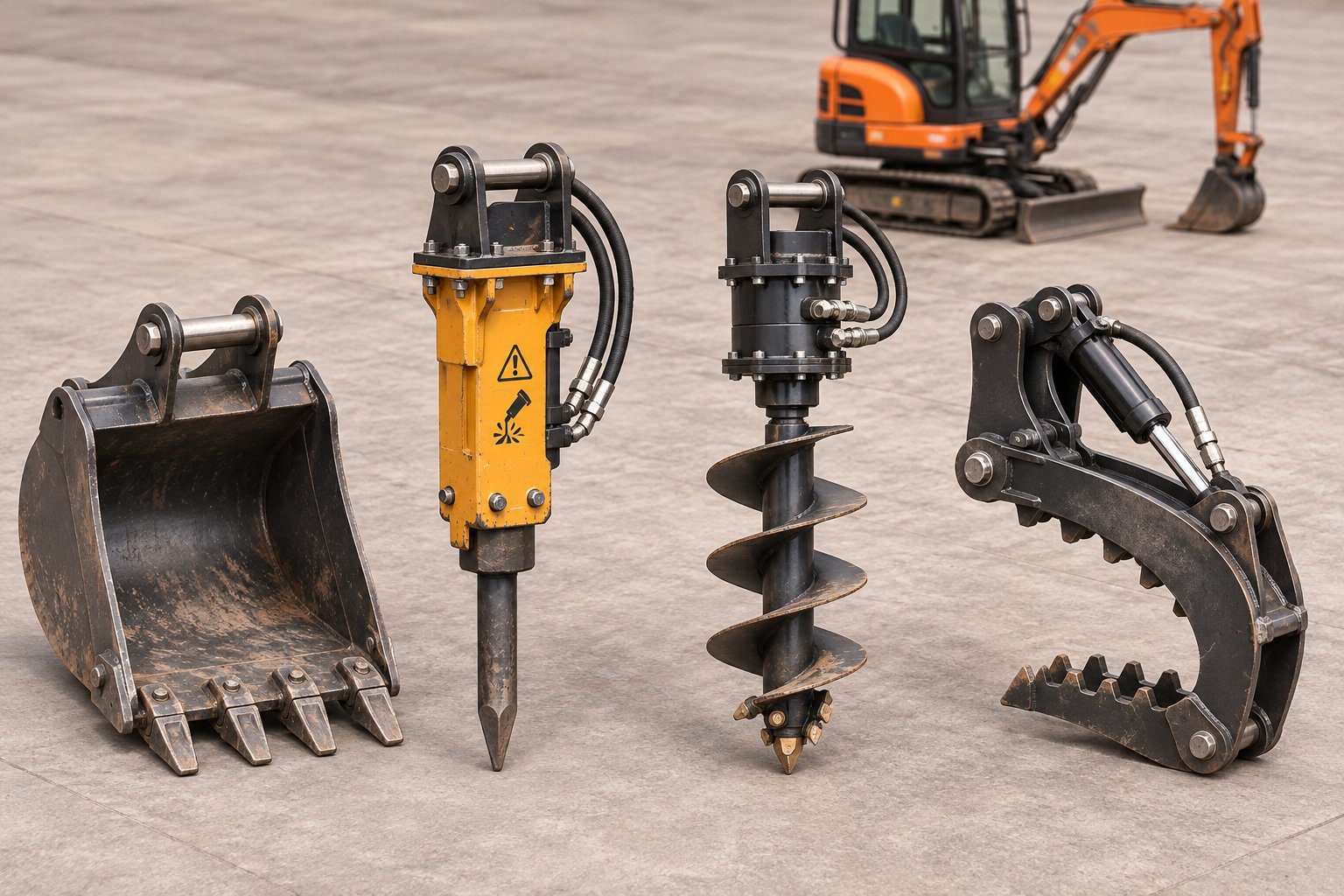
A digging bucket ships standard on every Kubota mini excavator, but the real value of these machines unfolds the moment you start swapping tools. The right attachment turns a small excavator into a drilling rig, a demolition hammer, a material handler, or a precision grading instrument — all without bringing a second piece of equipment to the site. That kind of versatility is exactly why buyers who weigh how much is a mini excavator against the cost of renting specialty machines almost always find the excavator pays for itself faster than expected. The catch is that not every attachment fits every machine, and getting that wrong can cost thousands in wasted purchases, hydraulic damage, or dangerous instability.
Must-Have Attachments for Versatile Mini Excavator Use
Six attachment categories cover the vast majority of work a compact excavator handles. Each one targets a specific task that a standard bucket simply cannot perform efficiently.
- Digging buckets (multiple widths): A 12-inch trenching bucket cuts narrow utility slots, a 24-inch general-purpose bucket handles everyday excavation, and a 36-inch or wider grading bucket smooths and levels finished surfaces. Owning two or three widths lets you match the bucket to the trench spec instead of over-excavating.
- Hydraulic thumbs: A thumb clamps against the bucket to grab rocks, stumps, logs, demolition debris, and other irregular objects. It transforms pick-and-place work from a clumsy balancing act into a controlled, one-motion operation. Landscapers and demolition crews rank it among the most practical upgrades available — similar in spirit to kubota tractor implements that extend a tractor's usefulness beyond basic tasks.
- Hydraulic breakers: Breakers deliver repeated high-energy impacts to fracture concrete, asphalt, and rock. They are indispensable for sidewalk removal, foundation demolition, and boulder breaking. A 5 ton excavator in the mid class can run a breaker sized for most residential and light commercial demolition, while heavy compact models like the KX057-5 power larger units for more aggressive work.
- Augers: Hydraulic augers drill holes for fence posts, deck pier footings, sign poles, and tree plantings. Different bit diameters and styles handle everything from soft topsoil to rocky subgrade. Contractors who install fencing or decks alongside their excavation work often consider an auger the single highest-ROI attachment they own.
- Tilt buckets: A tilt bucket pivots side to side on the arm, letting the operator grade slopes, shape ditch profiles, and finish irregular terrain without constantly repositioning the machine. For contractors doing a lot of finish work on drainage swales or landscaped berms, the time savings add up quickly.
- Rippers: A heavy-duty single-shank ripper tears through compacted soil, frozen ground, and soft rock that a standard bucket struggles to penetrate. It is a simple attachment — essentially a reinforced tooth — but it can save hours on a job where the ground refuses to cooperate.
Each of these tools broadens the scope of work a single machine can handle, reducing the need to mobilize additional equipment. Owners of kubota skid steers and loaders already understand this attachment-driven versatility; the excavator side of the equation follows the same logic, just with a different mounting interface and hydraulic demand profile.
Auxiliary Hydraulics and Quick-Coupler Compatibility
Here is where many first-time buyers stumble. A bucket mounts to the arm with two pins and needs no external hydraulic power — the machine's boom and arm cylinders do all the work. Every other attachment on the list above requires auxiliary hydraulics: a dedicated circuit that delivers pressurized oil from the machine's pump to the attachment through hoses routed along the boom and arm. Without that circuit, a breaker will not strike, an auger will not spin, and a thumb will not clamp.
Kubota's larger models — generally the KX033-4 and above, along with U Series equivalents like the U35-4 and up — offer auxiliary hydraulics as either standard equipment or a factory-installed option. Smaller micro and light class machines may not include auxiliary circuits at all, or they may offer a limited single-direction flow suitable for a thumb but insufficient for a breaker or auger. Always verify the auxiliary hydraulic flow rate, measured in gallons per minute (GPM), against the attachment manufacturer's requirements. Running a breaker rated for 15 GPM on a circuit that only delivers 8 GPM produces weak impacts, excessive heat buildup, and premature wear on both the attachment and the excavator's pump.
Attachment compatibility also depends heavily on operating weight. Industry guidance recommends that any attachment weigh no more than 5 to 10 percent of the carrier's operating weight to maintain safe stability and lifting performance. Bolting a breaker designed for a 5 ton excavator onto a 3,700-pound light class machine creates a top-heavy, unstable combination that risks tipping and voids most warranty coverage.
The other logistics question is how you physically swap attachments in the field. Pin-on attachments connect directly to the arm using two steel pins. The connection is rock-solid, but changing tools requires the operator to exit the cab, drive out the pins with a hammer, and manually align the new attachment — a process that typically takes 8 to 12 minutes and gets old fast when you are switching between a bucket and a thumb three times a day.
A quick coupler solves that problem. It is a mechanical or hydraulic bracket that locks onto the attachment's pin ears, letting the operator swap tools from the cab in under a minute. Kubota and aftermarket manufacturers offer quick couplers sized for each weight class, but coupler standards are not universal. Pin diameter, pin center distance, and the gap between the arm's mounting ears all vary by model. A coupler designed for an S-40 standard (common on 1- to 4-ton machines) will not accept an attachment built for an S-45 standard without an adapter plate. Before investing in a quick coupler, confirm that it matches both your specific Kubota model and the attachments you plan to run.
Mismatching attachments to undersized machines — or buying tools that demand hydraulic flow the carrier cannot deliver — ranks among the costliest mistakes in compact equipment ownership. The fix is straightforward: check three numbers before every attachment purchase. Verify the carrier's auxiliary GPM, confirm the attachment weight against the carrier's operating weight, and match pin geometry exactly. Those three checks take minutes and can prevent thousands of dollars in wasted spending, hydraulic repairs, or even a tipped machine on the jobsite.
Accessories and attachments define what a machine can do, but the expenses that follow the purchase — maintenance intervals, fuel burn, track replacement, and eventual resale — define what it actually costs. That total cost picture is where most buyers get blindsided, and it deserves a far closer look than the sticker price alone.
True Cost of Owning a Kubota Mini Excavator Beyond the Price Tag
The sticker price on a new or used compact excavator gets all the attention, but it represents only a fraction of what you will actually spend over the machine's working life. Industry estimates suggest the purchase price accounts for roughly 25 to 35 percent of total five-year spending once you factor in fuel, maintenance, repairs, insurance, transport, and financing interest. That means a $40,000 Kubota mini excavator could realistically cost $115,000 to $160,000 to own and operate over five years. The buyers who budget for this upfront protect their margins. The ones who only track the monthly payment often wonder why profitability stays elusive.
Before diving into each cost category, here is a scannable list of every major expense line you should account for when building your ownership budget:
- Purchase price or financed amount (including down payment, loan term, and total interest paid)
- Scheduled maintenance (engine oil and filter changes, hydraulic fluid and filter service, air and fuel filter replacement, grease intervals)
- Fuel consumption (diesel burn rate per hour, adjusted for idle time and workload intensity)
- Rubber track replacement (the single most expensive wear item, dependent on terrain and hours)
- Undercarriage wear parts (rollers, idlers, sprockets)
- Insurance (inland marine or equipment floater policy, theft and damage coverage)
- Repairs and unscheduled service (hydraulic hoses, cylinder seals, electrical components)
- Transport costs (fuel and wear on tow vehicle, or hired equipment hauling fees)
- Depreciation and eventual resale value (the offset that reduces your net cost of ownership)
Each category deserves a closer look, because the details within them are where small decisions compound into large financial outcomes.
Maintenance Intervals and Scheduled Service Costs
Kubota diesel engines are built for longevity — it is not unusual to see well-maintained units running past 5,000 hours — but that durability depends entirely on sticking to the manufacturer's maintenance schedule. Skip a hydraulic filter change or run contaminated fuel, and a $200 service interval can snowball into a $3,000 to $6,000 pump replacement.
Here is what a typical maintenance cadence looks like, based on published service interval benchmarks for mid-range machines:
| Service Item | Interval | Dealer Cost | DIY Cost |
|---|---|---|---|
| Engine oil and filter change | Every 250 hours | $150 - $250 | $50 - $80 |
| Hydraulic oil and filters | Every 1,000 hours | $400 - $700 | $200 - $350 |
| Air filter replacement | Every 500 hours | $40 - $80 | $25 - $50 |
| Fuel filter replacement | Every 500 hours | $35 - $70 | $20 - $40 |
| Full grease service (all pins and bushings) | Every 50 hours | $30 - $50 | $15 - $25 |
For a machine running 500 hours per year — a common threshold for part-time contractors — that schedule translates to roughly two oil changes, one air filter, one fuel filter, and about ten grease services annually. Dealer-performed maintenance totals approximately $1,100 to $1,900 per year. Owners comfortable performing basic service themselves can cut that range to $500 to $900, which makes a meaningful dent in annual operating costs.
The hydraulic system deserves special attention. Hydraulic fluid is the lifeblood of every function on the machine, from boom lift to track drive. Contaminated or degraded fluid accelerates wear on every pump, valve, and cylinder seal in the circuit. A single skipped hydraulic service at the 1,000-hour mark can set off a chain of failures that costs ten times what the service would have. Request the full maintenance schedule from your dealer before purchase — not after — so you can build these costs into your ownership projections from day one.
Fuel Consumption, Track Wear, and Hidden Expenses
Fuel is the largest recurring operating cost, and its impact scales directly with engine size and working intensity. A micro class Kubota like the K008-5 sips diesel at roughly 0.5 to 0.8 gallons per hour, while a heavy compact model like the KX057-5 consumes 1.5 to 2.5 gallons per hour under steady load. At $4 per gallon, that range works out to $2 to $10 per operating hour — a spread wide enough to significantly shift your job-costing math depending on which machine you run.
What many owners overlook is idle burn. A Kubota mini excavator sitting at idle — waiting for a truck, pausing between tasks, or running while the operator checks a grade stake — still burns 0.3 to 0.5 gallons per hour. If your operator idles 25 to 30 percent of the workday (a surprisingly common pattern), that wasted fuel adds $600 to $1,600 per year with zero production to show for it. Training crews to shut down during breaks and repositioning pauses is one of the simplest cost reductions available.
Rubber track replacement is the expense that blindsides first-time owners. A set of tracks for a mid-range Kubota in the 3- to 5-ton class typically costs $2,000 to $4,000 installed. Track life depends heavily on terrain: operating on dirt and grass can yield 1,500 to 2,000 hours of service life, while running on asphalt, concrete, or rocky ground accelerates wear to 800 to 1,200 hours. Beyond the tracks themselves, rollers and idlers add another $800 to $1,500 every 2,000 to 3,000 hours. If you are shopping for a mini backhoe for sale or a compact excavator and wondering why the excavator seems more expensive, undercarriage maintenance is a significant part of that equation — but the excavator's versatility typically justifies the cost for buyers who use attachments beyond a basic loader bucket.
Insurance rounds out the hidden expense category. An inland marine or equipment floater policy covering theft, fire, vandalism, and transit damage runs $600 to $2,000 per year depending on machine value, storage security, and geographic location. Machines stored in unsecured yards or left on jobsites overnight can cost 30 to 50 percent more to insure. Bundling equipment coverage with your general liability policy often saves 20 to 30 percent on the premium — ask your agent to quote both standalone and bundled options.
Resale Value and Net Cost of Ownership
Here is where the Kubota brand earns back a measurable portion of your investment. Kubota equipment — whether tractors, loaders, or excavators — consistently commands stronger resale values than most competitors. That reputation is built on several reinforcing factors: robust build quality, a massive global dealer network that ensures parts availability, and steady market demand driven by the brand's position as the world's top-selling compact excavator manufacturer.
Why does resale value matter so much? Because it directly reduces your net cost of ownership. Consider a simplified example. If you purchase a KX040-5 for $55,000 and sell it five years later for $30,000, your net depreciation is $25,000. A competing brand purchased at $48,000 that resells for only $18,000 costs you $30,000 in depreciation — $5,000 more despite a lower purchase price. The cheaper machine actually cost more to own. Buyers who evaluate kubota diggers for sale against other brands on sticker price alone miss this critical offset.
Depreciation curves also vary by model popularity and configuration. High-demand units like the 2025 KX040-5R3TP — a model package that includes a reduced tail swing variant with premium features — tend to hold value especially well because their specific configuration matches what a large pool of secondhand buyers wants. Machines with documented service histories, lower hours relative to age, and dealer-maintained records sell at a premium over undocumented private-party units. Keeping receipts for every oil change and filter swap is not just good practice — it is a financial asset when the time comes to sell.
Financing structures add another layer to the total cost picture. Kubota and its dealer network frequently offer promotional interest rates — sometimes as low as 0 percent for qualified buyers during seasonal kubota incentives campaigns. Those promotional windows can save thousands in interest over a 48- or 60-month loan term. But even at attractive rates, buyers should calculate total interest paid across the life of the loan and add it to the ownership cost tally. A 4.9 percent rate on a $45,000 financed amount over five years adds roughly $5,800 in interest — money that never shows up on a spec sheet but absolutely shows up on a profit-and-loss statement.
The real cost of owning a Kubota mini excavator is not the MSRP — it is the purchase price, plus every dollar of fuel, maintenance, insurance, and financing, minus the resale value you recover when the machine leaves your fleet.
Whether you are searching for a new unit through a dealer, browsing excavadora or compact excavator listings online, or considering certified pre-owned options, running these numbers before you commit separates a smart equipment investment from an expensive lesson. And for buyers considering the used route — where the upfront price is lower but the unknowns are higher — knowing exactly what to inspect before writing a check becomes just as important as understanding what ownership costs after.
How to Buy a Used Kubota Mini Excavator With Confidence
A lower purchase price is the obvious draw of the used market, but it only qualifies as a deal if the machine does not bury you in repair bills during its first season. Kubota excavators hold value better than most competitors, which means well-maintained units sell at a premium — and poorly maintained ones get dressed up with fresh paint and vague descriptions to close the gap. The difference between a profitable used purchase and a money pit comes down to knowing exactly what to inspect, which hour ranges and model years represent genuine value, and where to find inventory you can trust.
Critical Inspection Points for Any Used Mini Excavator
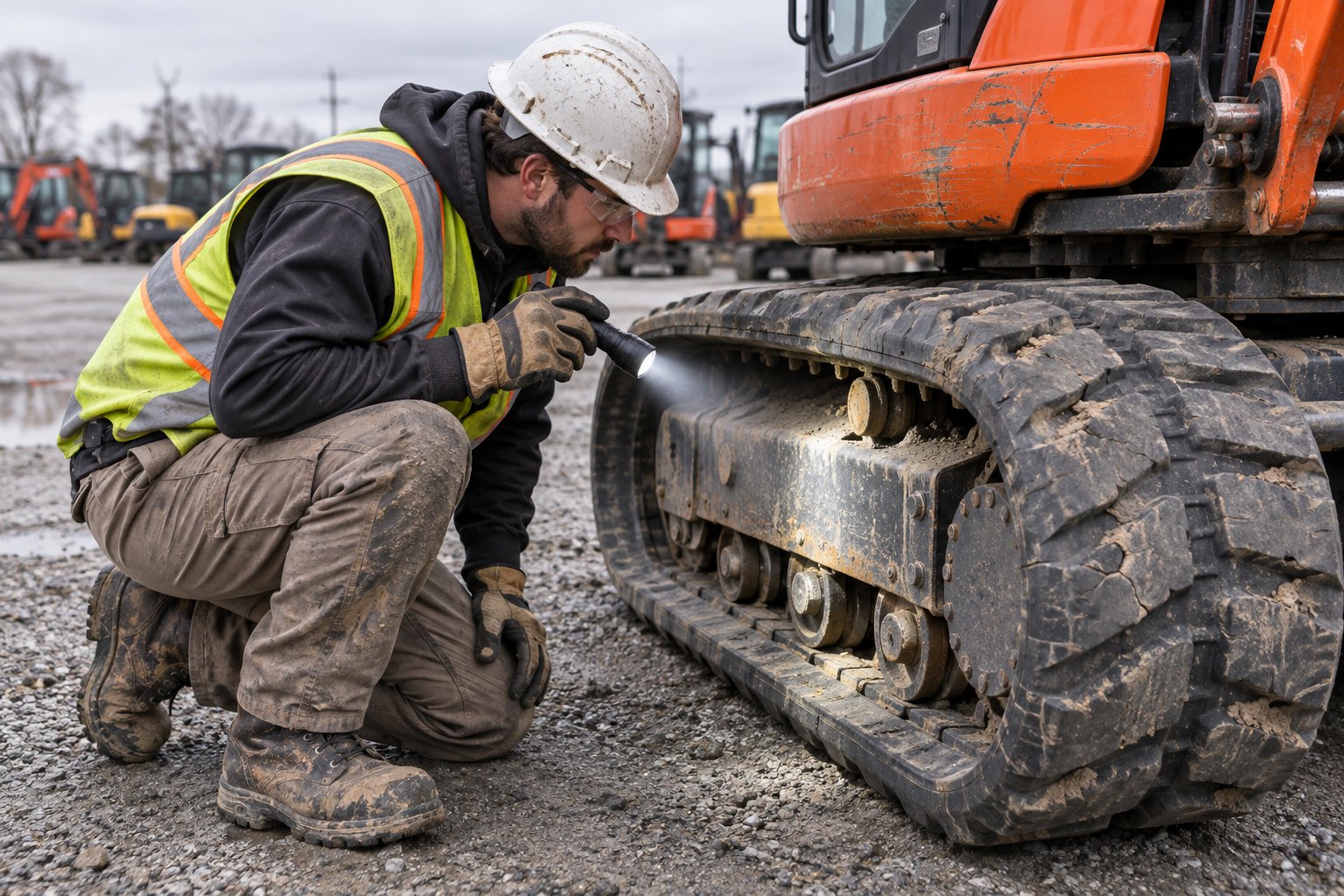
Walk onto a seller's lot or open a listing page, and the first instinct is to check the hour meter. Resist that urge for a moment. Hours matter, but only in context. A machine showing 2,500 hours with bald tracks, worn-out seat fabric, and chewed-up joystick grips is telling a different story than the meter suggests — either it was run hard in rough conditions or the meter has been rolled back. Start your inspection with the components where expensive failures hide, then circle back to hours once you have physical evidence to cross-reference against them.
The checklist below covers every high-cost system in priority order. Print it, save it to your phone, or hand it to a third-party inspector before they walk the machine. Each item targets a specific failure mode that can cost hundreds to thousands of dollars if missed.
- Undercarriage condition: Check rubber track wear depth, track tension, roller and idler condition, and sprocket tooth profile. On compact machines, the undercarriage can account for roughly half of total lifetime maintenance cost. Measure — do not eyeball. A track that looks tight could be missing a link, a trick sellers use to mask internal stretch. Count the links and compare against the factory spec.
- Hydraulic system health: Inspect every cylinder rod for oil weeping, check hoses for cracking and abrasion, and pull the hydraulic fluid dipstick. Clean fluid should be amber to light brown. Milky or foamy fluid signals water contamination — a deal-breaker on most machines. Perform a boom drift test: raise the boom under load, shut the engine off, mark the cylinder rod, and wait five minutes. Significant drift points to worn piston seals or bypassing valves, with reseal costs running $1,500 to $2,500 per cylinder.
- Engine condition: Start the machine cold and watch the exhaust. A brief puff of white smoke on startup is normal for a diesel. Persistent blue smoke means the engine is burning oil through worn rings or valve seals. Heavy black smoke indicates fuel delivery or air intake problems. Check the dipstick for excessive sludge, and feel around the oil fill cap for blow-by — pressurized gas escaping past the piston rings.
- Boom, arm, and bucket structural integrity: Walk the entire length of the boom and stick, inspecting every weld seam for cracks. Any welded-on reinforcement plates are a red flag — they indicate the structure was stressed beyond its design limit. Cracks can reduce a machine's value by roughly 20 percent and signal a history of overloading or abuse.
- Pin and bushing wear: Have someone apply and release bucket down-pressure while you watch each bushing for excessive movement. Loose pins tell you the machine lived an under-greased life, and replacing a full set of pins and bushings on even a small excavator runs $1,000 to $3,000 in parts and labor.
- Swing bearing play: The slew ring connects the upperstructure to the undercarriage and is one of the most expensive single components to replace. On a warmed-up machine, use a magnetic dial indicator at four quarter-turn positions to measure play. Visible rocking without instruments on a compact machine means wear is already significant.
- Cab, controls, and electronics: Torn seats, cracked glass, and worn joystick boots are not just cosmetic — they reflect how carefully the previous owner treated the machine overall. Check that all gauges function, lights operate, and the onboard diagnostic display shows no active fault codes.
Sounds like a lot? It is. A thorough walk-around plus test operation takes one to two hours. But consider the alternative: skipping the inspection and discovering a $4,000 undercarriage replacement or a $6,000 hydraulic pump failure three weeks after purchase. The inspection is not a formality — it is your single best negotiating tool and your only real protection against hidden costs.
Hour Ratings, Model Years, and Value Sweet Spots
With the physical inspection complete, the hour meter finally earns your attention. For kubota excavators in the mini and compact class, industry consensus places the caution zone around 5,000 hours. Lighter-duty components — rubber tracks, pins, bushings, and smaller hydraulic cylinders — wear earlier on compact machines than on full-size units, so the threshold is lower than the 8,000- to 10,000-hour range you hear quoted for standard 20-ton excavators.
That said, a 6,000-hour Kubota with a complete dealer-stamped service binder can be a far better buy than a 2,500-hour unit with zero documentation and wear patterns that do not match the meter. Service history trumps raw hours every time. When evaluating any used compact excavator, ask for the maintenance log, request an ECM (engine control module) hours pull from a dealer, and compare the electronic reading against the mechanical meter. A mismatch between the two is one of the clearest signs of a rolled-back hour meter.
Where is the value sweet spot? For many buyers, machines in the 1,500- to 3,500-hour range offer the best balance of remaining service life and depreciation savings. At this point, the steepest first-year depreciation has already passed — new compact excavators can lose 20 to 25 percent of their value in year one — while the major wear items still have substantial life left. Models from the last five to eight production years typically carry the most relevant technology, including improved cab ergonomics, updated emissions compliance, and refined hydraulic systems that older generations lack.
Specific Kubota models also carry their own secondary-market dynamics. The KX040 series, for instance, is consistently one of the highest-volume sellers in the U.S. market, which means used inventory is relatively plentiful and replacement parts are widely stocked at dealers. Similarly, U-Series models like the U35-4 and U55-5 attract strong demand from residential contractors who need tight tail swing geometry, keeping resale values firm. Conversely, Volvo excavators and other less common brands in the compact segment may offer lower purchase prices on the used market but come with thinner dealer networks and harder-to-source parts — a trade-off that affects long-term ownership cost in ways the sticker price does not reveal.
Regional dealer support also shapes the used-buying experience. Buyers near well-established Kubota dealer territories — whether a large metro dealer or a regional operation like a Kubota of Chattanooga or Johnson City Kubota and Equipment location — benefit from accessible parts counters, factory-trained technicians, and service records that can sometimes be retrieved by serial number even if the seller lost the paperwork. That parts and service infrastructure is a genuine advantage over brands with sparser dealer coverage, especially when you need a hydraulic hose or a kubota loader cylinder seal on a Friday afternoon with a Monday deadline.
Where to Find Verified Used Kubota Inventory
The sourcing channel matters almost as much as the machine itself. Used Kubota mini excavators surface through three main channels, each with distinct advantages and risks.
Authorized Kubota dealers often carry certified pre-owned inventory that has been inspected, serviced, and backed by limited warranties. You pay a premium, but you gain documentation, accountability, and a parts counter down the hall. For buyers who want the closest experience to purchasing new at a used price, dealer inventory is the safest starting point.
Online marketplaces and equipment platforms aggregate listings from dealers, rental fleet disposals, and private sellers nationwide. The selection is vast, but so is the variability in condition reporting. Platforms that provide verified machine details — photos of serial plates, documented hour readings, and condition descriptions — reduce risk substantially compared to bare-bones classified ads. JIUHONG's used Kubota excavator collection, for example, lists both U-Series and KX-Series models with condition details and allows buyers to compare options and request quotes directly. For readers who have worked through the inspection framework above, browsing a curated inventory page like this gives you a practical way to shortlist candidates and ask informed questions before committing to a site visit or deposit.
Private-party sales typically offer the lowest purchase prices but carry the highest risk. There is no institutional reputation at stake, service records may be incomplete or absent, and your only recourse after the sale is whatever contract language you negotiated upfront. If you go this route, a third-party mechanical inspection is not optional — it is essential. Budget $250 to $500 for a qualified inspector to walk the machine through the full checklist above, and make the sale contingent on the results.
Regardless of the channel, one principle holds: the more documentation a seller provides upfront, the more confidence you should have in the transaction. Sellers who welcome inspections, share service histories, and offer ECM hour pulls are signaling transparency. Sellers who resist those requests are telling you something too — just not with words.
A solid used Kubota, properly inspected and fairly priced, can deliver years of productive service at a fraction of new-equipment cost. But even the best-inspected machine becomes a poor investment if the buyer made a fundamental selection mistake before the search even started — oversizing, undersizing, ignoring tail swing, or skipping attachment planning. Those errors deserve their own hard look, because they cost just as much as a missed hydraulic leak and are far more preventable.
Common Mistakes to Avoid When Choosing a Mini Excavator
Every section of this guide has been building toward one goal: helping you pick the right machine on the first try. Yet experienced dealers will tell you that buyers — from first-timers shopping for a kubota backhoe to seasoned contractors upgrading their fleet — keep making the same handful of costly errors. These are not obscure edge cases. They are patterns that repeat across thousands of transactions every year, and each one is entirely preventable if you know what to watch for.
Here are the six most common mistakes, summarized for quick reference:
- Oversizing — Buying more machine than the work demands, wasting capital and creating transport headaches.
- Undersizing — Choosing a machine too small for required dig depth or breakout force, stalling production.
- Ignoring tail swing type — Running a conventional tail swing model on a tight residential or urban site.
- Overlooking transport weight — Purchasing a machine that exceeds towing capacity or triggers CDL requirements.
- Skipping attachment planning — Buying without auxiliary hydraulics and discovering critical attachments cannot be powered.
- Choosing on price alone — Defaulting to the lowest sticker price without factoring in resale value, parts access, and total ownership cost.
Oversizing and Undersizing Your Machine Selection
Oversizing is the mistake that feels responsible — buying a bigger machine "just in case" — but it bleeds money from day one. A heavy compact excavator hauled to a job that only needs a 4 ton mini excavator burns more fuel per hour, requires a heavier trailer and a more capable tow vehicle, and can tear up finished landscapes that a lighter machine would barely mark. You are paying premium operating costs for capacity that sits unused cycle after cycle.
Undersizing is the mirror image and equally expensive. A machine that cannot reach the required dig depth forces you to rent a second unit or turn down the job entirely. Insufficient breakout force in compacted clay or rocky subsoil slows cycle times to the point where labor costs swallow your profit margin. Contractors who split their time between landscaping and utility work sometimes try to cover both with a single micro class machine, only to discover it struggles on anything deeper than a shallow trench.
The fix is straightforward: audit your last 12 months of projects. Identify the dig depth, operating weight, and width you actually needed on your most frequent jobs — not your biggest job, and not your easiest one. The machine that covers 80 percent of your real workload is almost always the right choice. For the remaining 20 percent, renting a larger or smaller unit is far cheaper than owning the wrong size full-time. Buyers evaluating different kubota excavator models can use the project-to-machine table from earlier in this article to map their actual job mix against the lineup and avoid both extremes.
Tail Swing and Transport Mistakes That Cost Thousands
Ignoring tail swing geometry is a mistake that does not show up on any invoice — it shows up as a cracked vinyl siding panel, a dented truck fender, or a broken fence post. Selecting a conventional KX Series model for a tight residential backyard means the operator spends half the day managing rear clearance instead of digging. One swing into a structure can cost more in damage and liability than the price difference between a KX and U Series model at the same tonnage. If your bread-and-butter work happens next to buildings, fences, or parked vehicles, a zero or tight tail swing U Series machine is not optional — it is essential.
Transport weight catches buyers off guard because the problem reveals itself after the purchase. Imagine signing for a 12,000-pound excavator, then discovering your half-ton pickup and single-axle trailer are rated for a combined payload that tops out at 7,000 pounds. You are now shopping for a new trailer and potentially a new tow vehicle before the excavator earns its first dollar. Worse, if the loaded truck-and-trailer combination exceeds 26,001 pounds GCWR, you need a CDL — a licensing requirement that can take weeks to obtain and disqualifies operators who assumed they could drive the rig with a standard license. Run the combined weight math before you commit to a machine, not after. Anyone familiar with hauling kubota loaders or a kubota utility tractor on a flatbed already understands this constraint; the same discipline applies to excavators.
The Hidden Cost of Skipping Attachment and Resale Planning
Skipping attachment planning is the mistake that announces itself on the first job where you need a breaker, auger, or hydraulic thumb — and the machine has no auxiliary hydraulic circuit to power it. Retrofitting auxiliary hydraulics after purchase is possible on some models but expensive, often running $2,000 to $5,000 in parts and labor. On smaller machines, it may not be feasible at all. The smarter approach is to list every attachment you expect to run within the first two years and confirm that the machine's auxiliary flow rate and coupler system support them. A compact construction equipment purchase that accounts for attachments upfront avoids the frustration of owning a capable-looking machine that cannot actually do the work you bought it for.
Choosing on price alone is the most seductive error on this list. A machine priced $5,000 below its nearest competitor looks like a win — until you factor in weaker resale value, limited parts availability, and a thinner dealer network that turns every repair into a logistics exercise. As the ownership cost breakdown earlier in this article demonstrated, a lower purchase price can easily be offset by higher total cost of ownership when maintenance, downtime, and depreciation enter the equation. Kubota's strong resale values and expansive parts infrastructure exist precisely because the brand invested in reliability — and that investment pays buyers back at resale time.
For buyers who want to make cost-informed decisions rather than defaulting to the lowest sticker price, comparing multiple machines side by side with condition details and transparent pricing is essential. JIUHONG's used Kubota excavator collection offers one practical way to do exactly that — browse available KX-Series and U-Series models, review condition information, and request quotes so you can evaluate true value rather than reacting to a single number. Whether you are looking for a kabota skid steer alternative, a kubota loader for sale, or a specific compact excavator model, treating the purchase as a total-cost decision rather than a price decision is the single most effective way to protect your investment from day one.
Frequently Asked Questions About Kubota Mini Excavators
1. What is the difference between Kubota KX Series and U Series mini excavators?
The KX Series uses a conventional tail swing design where the counterweight extends past the track width during rotation, offering higher lift capacity and stability on open jobsites. The U Series features a tight or zero tail swing configuration that keeps the rear of the machine within the track width, making it ideal for confined residential and urban work. Choosing between them depends on whether your projects typically involve open terrain or tight spaces near structures, fences, and vehicles.
2. How much does it really cost to own a Kubota mini excavator?
The purchase price typically represents only 25 to 35 percent of total five-year ownership costs. A $40,000 Kubota mini excavator may cost $115,000 to $160,000 over five years once you factor in diesel fuel at $2 to $10 per operating hour, annual dealer maintenance of $1,100 to $1,900, rubber track replacement at $2,000 to $4,000 per set, insurance premiums of $600 to $2,000 annually, and financing interest. However, Kubota's strong resale values help offset net depreciation compared to competing brands.
3. What size Kubota mini excavator can fit through a backyard gate?
Only micro class Kubota models reliably fit through a standard 36-inch residential gate. The K008-5 at 34 inches wide passes with clearance to spare, while the U10-5 and U17-5 at 39 inches wide require at least a 40-inch opening. Mid class models around 5 feet wide need a double gate or direct driveway access, and heavy compact units over 6 feet wide typically require temporary fence removal. Always measure the narrowest access point before scheduling delivery.
4. What should I inspect before buying a used Kubota mini excavator?
Prioritize the undercarriage first — check rubber track wear depth, roller condition, and sprocket teeth since undercarriage repairs can account for roughly half of lifetime maintenance cost. Next, test hydraulic system health by checking for cylinder leaks, performing a boom drift test, and inspecting fluid color. Evaluate the engine for blow-by and abnormal exhaust smoke on cold start, inspect boom and arm welds for cracks, and test all pin and bushing points for excessive play. Request the maintenance log and compare ECM hours against the mechanical meter to detect tampering. Platforms like JIUHONG's used Kubota collection at https://jiuhong-machinery.com/products/excavators/kubota/ list U-Series and KX-Series models with condition details, giving buyers a starting point to compare options before committing to an on-site inspection.
5. Do I need a CDL to tow a Kubota mini excavator?
In most cases, no. Federal FMCSA rules do not require a commercial driver's license for combination vehicles with a gross combined weight rating below 26,001 pounds. Micro, light, and mid class Kubota excavators paired with an appropriately rated pickup and trailer stay well under that threshold. However, heavy compact models like the KX057-5 at 12,346 pounds or the KX080-5 at over 18,000 pounds paired with a one-ton dually and gooseneck trailer can approach or exceed the limit. Always add your truck's GVWR plus the trailer's GVWR to confirm before hauling.