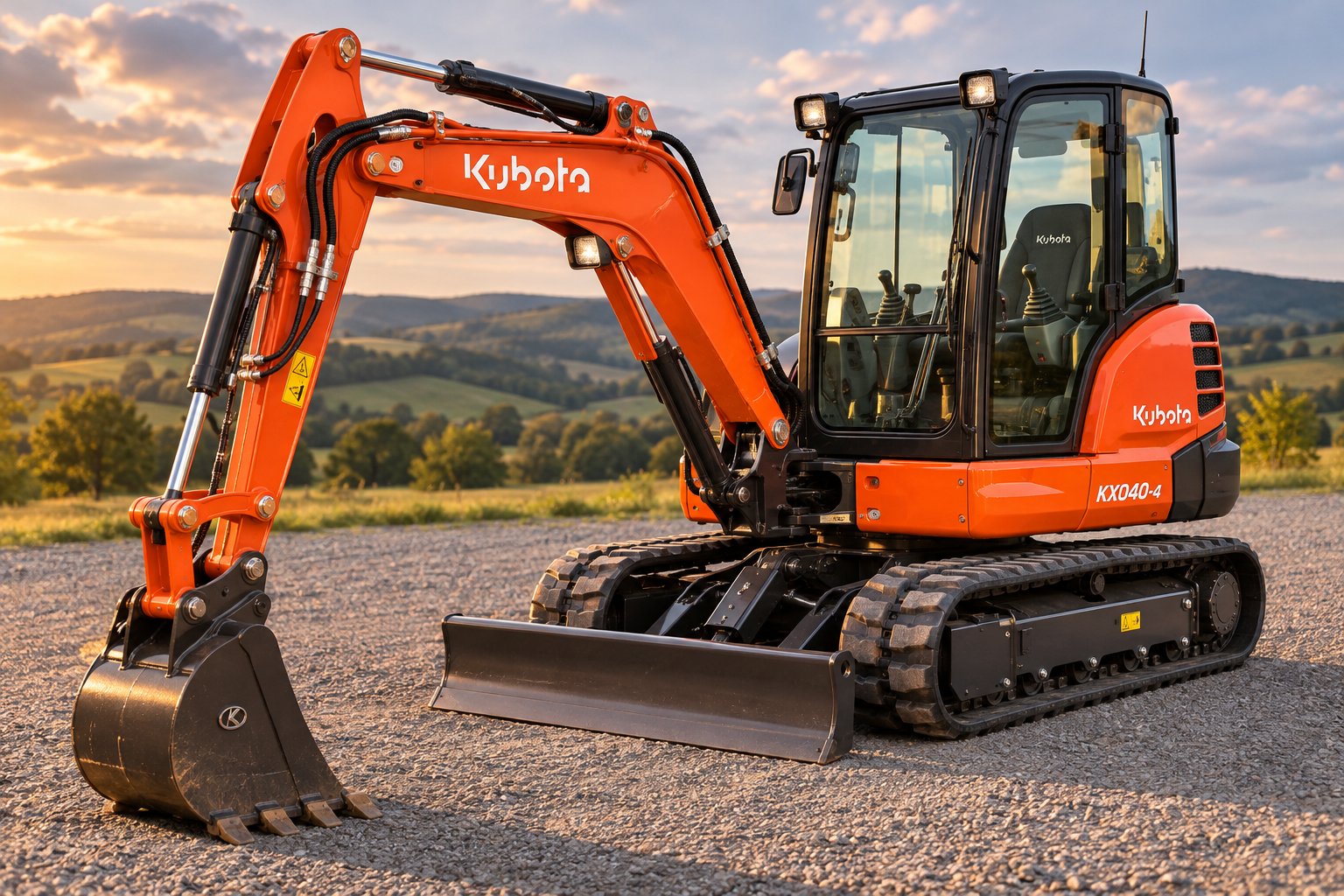


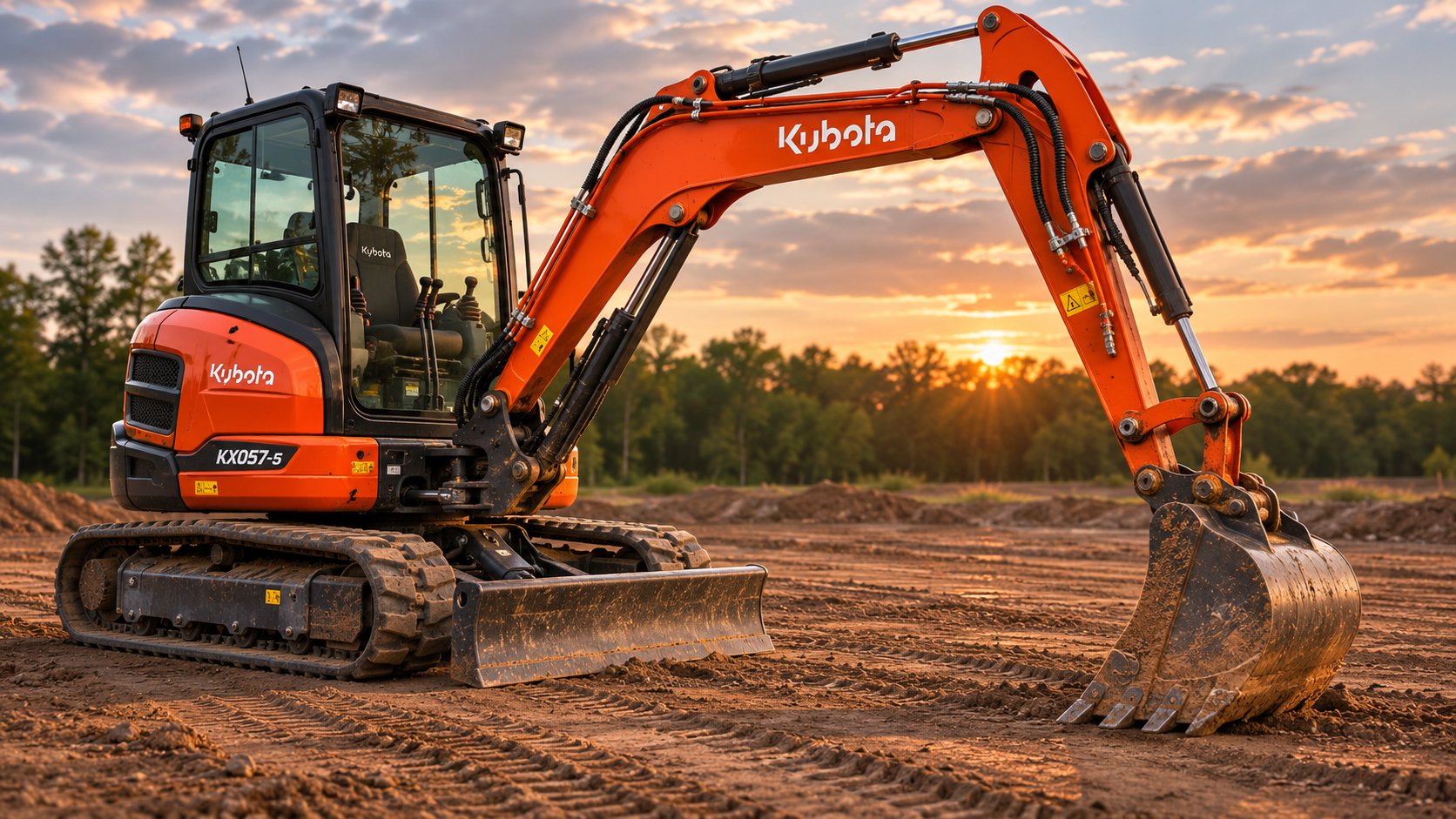
What the Kubota KX040 Really Costs and Why Prices Vary So Much
The Kubota KX040 is one of the best-selling 4-metric-ton compact excavators in North America, and for good reason. It hits a sweet spot of power, transportability, and dig depth that few competitors match. Yet if you have ever searched for a kubota kx040 price online, you already know the frustration: there is no single, clear number waiting for you.
Kubota does not publish a universal transaction price the way you might see on a truck window sticker. Instead, the number you actually pay depends on a tangle of variables — your dealer's regional markup, which configuration you choose, whether the unit is a previous-generation KX040-4 or the current KX040-5, and the gap between the listed MSRP and the real deal that gets signed at the desk. Even browsing kubota diggers for sale across multiple marketplaces reveals wildly different asking prices for what appears to be the same machine.
Why Kubota KX040 Pricing Is Hard to Pin Down
Consider the spread. A high-hour used KX040-4 might trade hands for a fraction of what a factory-fresh, fully loaded KX040-5 commands. The Kubota USA special offers page lists the KX040-5 with an MSRP starting as low as $68,768 and the older KX040-4 from $64,946 — but those are base-configuration anchors, not what most buyers walk away paying after cab upgrades, blade options, and dealer-installed attachments.
The price difference between the lowest-cost used KX040-4 and a fully equipped new KX040-5 can span tens of thousands of dollars, making context — not just a number — the most valuable thing a buyer can have.
This guide exists to provide that context. Think of it as a buyer-advisor resource that breaks down every layer of cost — from MSRP anchors and model variant codes to total ownership expenses — so you can evaluate any deal with confidence.
Who This Guide Serves
Whether you are a landscaper pricing your first Kubota excavator, a small contractor weighing a new kubota mini excavator against renting, a hobby farm owner who needs occasional trenching capability, or a first-time equipment buyer overwhelmed by the options, this breakdown is for you. Each group faces different considerations. A full-time contractor logging 1,000-plus hours a year thinks about financing and warranty coverage differently than a weekend landowner who just wants to dig a pond. A business buyer eyeing Section 179 tax deductions has a completely different net-cost equation than someone paying cash for a used unit. The common thread is that every buyer benefits from understanding exactly how the excavator and its configuration, condition, and purchasing channel shape the final price tag.
That understanding starts with what Kubota actually publishes — and how far dealer transaction prices can stray from those figures.
New Kubota KX040 MSRP and What Dealers Actually Charge
So what does a brand-new KX040 actually cost? The answer depends on which numbers you look at — and how you read them. Kubota publishes baseline MSRP figures on its official series page, while individual dealers list configured prices that can look dramatically different. Understanding the gap between these two anchors is the first step toward negotiating a fair deal.
The Kubota USA KX Series page lists the entire compact excavator lineup starting at $28,450 for the entry-level K008-5 — a micro-class machine weighing just over 2,300 pounds. The KX040-5 sits considerably higher at an MSRP as low as $68,768, while the previous-generation KX040-4 still appears at $64,946. That roughly $40,000 jump from the series entry point to the KX040 reflects a massive difference in capability: a far larger engine, nearly five times the operating weight, deeper dig reach, enclosed cab availability, and optional features like the 6-way angle blade exclusive to the KX040-5.
Published MSRP Anchors for the KX040-5
Here is where it gets interesting. The base MSRP is just one data point. A regional dealer like Kubota Center lists a configured KX040-5 at $95,694 — nearly $27,000 above that published base figure. The difference comes down to configuration: cab with climate control, premium track options, auxiliary hydraulics, blade type, and dealer-installed accessories all stack on top of the starting number.
| Model | Configuration Hint | Listed MSRP | Source |
|---|---|---|---|
| KX040-5 | Base configuration (lowest available) | $68,768 | Kubota USA |
| KX040-5 | Cab, 6-way blade, premium features | $95,694 | Kubota Center dealer listing |
| KX040-4 | Base configuration (previous gen) | $64,946 | Kubota USA |
You'll notice the kubota kx040 price swings by roughly $30,000 depending on generation and equipment level. That spread is exactly why looking at a single number without configuration context can be misleading — especially when browsing a kx040 for sale listing that does not specify trim level.
Why Dealer Transaction Prices Differ from MSRP
Even these published figures rarely match what a buyer actually pays at closing. Several forces push the real transaction price away from MSRP:
- Dealer location and overhead — a kubota small excavator sold at a rural dealership may carry lower overhead costs than one at a metro-area lot with higher operating expenses.
- Inventory levels — dealers sitting on multiple KX040-4 units they need to move before the KX040-5 fully replaces them have more incentive to discount.
- Seasonal demand — construction activity peaks in spring and summer, tightening supply and reducing negotiation room. Buying during the off-season often yields better pricing.
- Manufacturer incentives — Kubota periodically offers promotional financing like 0% APR for up to 60 months or savings up to $12,000 on excavators, which effectively lowers the total cost even if the sticker stays the same.
- Trade-in packages — rolling an existing machine into the deal can shift thousands of dollars off the out-of-pocket price, though the net savings depend on the trade's appraised value.
The practical takeaway? Request itemized quotes from at least three authorized dealers. Ask each one to break out the base machine price, installed options, freight, and any applicable incentives. Timing your purchase around end-of-quarter sales pushes — when dealers are most motivated to hit volume targets — can shave additional dollars off the final number. If you spot a kubota excavator for sale during one of these windows with favorable financing stacked on top, you are looking at the best realistic scenario for a new-unit purchase.
Pricing clarity improves even further when you understand the model suffix codes attached to every KX040 listing — cryptic letter-number combinations like R3A or R1T that quietly dictate what is and is not included on the machine you are considering.
KX040 Model Codes Explained So You Know Exactly What You're Buying
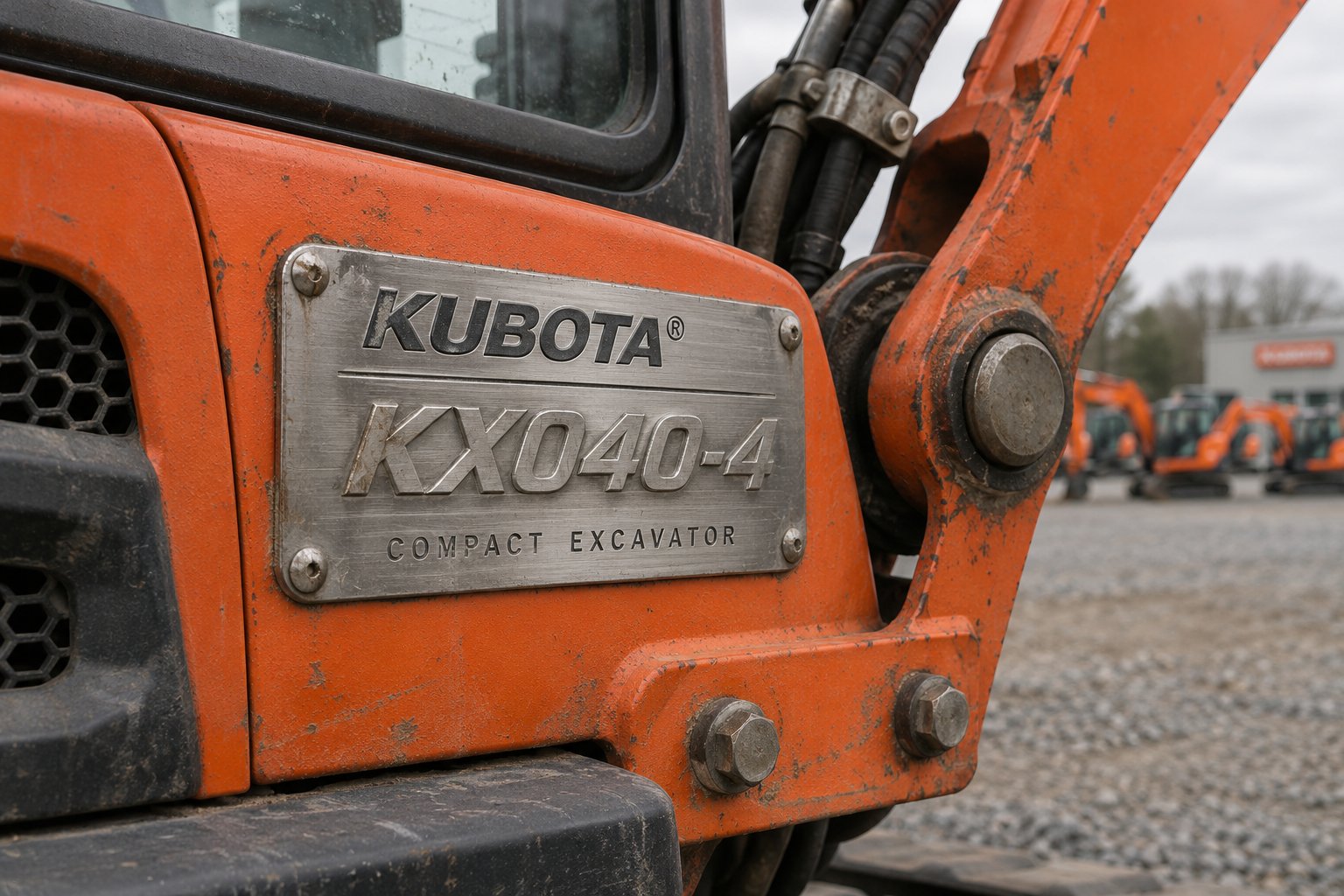
Those cryptic suffixes — R3A, R3TP, R1A, R1T — are not random. Each one tells you exactly what configuration sits on the dealer lot, and misreading even a single letter can mean comparing two very different machines at two very different price points. If you have ever tried to research a kubota kx040 4 price only to find listings with baffling alphanumeric tags and no explanation, this section is for you.
Kubota uses a compact naming logic across its excavator lineup. For the KX040-4, the suffix typically encodes three things: the operator station type, the blade configuration, and sometimes the track or hydraulic package. Here is how the most common KX040-4 codes break down.
Breaking Down KX040-4 Variant Codes
| Suffix Code | Likely Configuration Features | Estimated Price Impact |
|---|---|---|
| R1A | ROPS canopy, straight dozer blade, standard auxiliary hydraulics | Lower |
| R1T | ROPS canopy, straight dozer blade, premium track or hydraulic package | Lower to mid-range |
| R3A | ROPS canopy, angle or multi-way blade, standard auxiliary hydraulics | Mid-range |
| R3TP | ROPS canopy, angle or multi-way blade, premium track package | Mid-range to higher |
| Cab variants (e.g., C prefix codes) | Enclosed cab with climate control, varying blade and track options | Higher |
You'll notice the pattern: "R" generally signals a ROPS canopy unit, the number hints at the blade type — with "1" pointing to a standard straight blade and "3" indicating an angle or multi-directional option — and trailing letters like "A" or "TP" reflect the track or accessory tier. Cab-equipped models carry a premium because they include climate control, reduced noise levels, and enhanced operator protection. When evaluating the kubota kx040 4 price on any listing, matching the suffix to these features tells you immediately whether you are looking at a bare-bones canopy unit or a well-equipped cab machine — and whether the asking price makes sense for what is included.
KX040-5 Configuration Options
The current-generation KX040-5 simplifies the picture somewhat. Kubota offers it in either ROPS or cab configurations with three dozer blade choices — straight, angle, and 6-in-1. Standard AUX1 hydraulics come on every unit, with an optional AUX2 circuit for buyers who plan to run more demanding attachments. Because the KX040-5 is the current production model, fewer sub-variant codes circulate in the market compared to the long run of KX040-4 inventory still floating through dealer lots and resale channels.
That streamlined option sheet is actually a pricing advantage for shoppers. When browsing kubota excavators online, a KX040-5 listing with a cab and 6-in-1 blade is easy to compare apples-to-apples against another identically equipped unit across town. The older KX040-4, with its wider spread of suffix codes, demands more homework — but the payoff is significant. Buyers who decode these tags avoid the most common and costly mistake in the used-equipment market: comparing unlike machines and assuming a lower-priced unit is a better deal when it is simply a less-equipped one.
Understanding what you are buying is half the equation. The other half is knowing what changed between the KX040-4 and KX040-5 generations — and whether that upgrade justifies the price difference or points you toward a smarter value play on the outgoing model.
KX040-4 vs KX040-5 and What the Upgrade Costs You
The generational jump from the Kubota KX040-4 to the KX040-5 is not a ground-up redesign — Total Landscape Care noted that core specs are similar to the Dash-4 model it replaces — but Kubota packed in enough meaningful upgrades to justify a noticeable price gap. For buyers comparing a kubota kx040 for sale in both generations, the question is straightforward: do the improvements translate into enough real-world value to warrant spending more, or does a leftover KX040-4 deliver 90% of the capability at a significantly lower cost?
Key Spec Differences Between the KX040-4 and KX040-5
Both machines share the same DNA — a Kubota diesel engine in the 40-horsepower range, conventional tail swing geometry, and similar footprints — but the KX040-5 refines the package in areas operators feel every working day. The official Kubota announcement highlights improvements across hydraulics, cab comfort, and standard technology. Here is how the two generations compare on paper.
| Category | KX040-4 | KX040-5 |
|---|---|---|
| Engine Output | ~40.4 gross HP (Kubota diesel, Tier 4 Final) | 40.3 gross HP (Kubota diesel, Tier 4 Final) |
| Operating Weight | ~9,039 – 9,921 lbs (config. dependent) | 9,182 – 10,075 lbs (config. dependent) |
| Max Dig Depth | ~11 ft 2 in | 11 ft 2.3 in |
| Bucket Breakout Force | ~9,259 lbs | 9,397 lbs |
| Auxiliary Hydraulic Flow | ~15.9 gpm | 17.2 gpm |
| Hydraulic System | Standard load-sensing | Improved load-sensing with multifunction operation |
| Dozer Blade Options | Fixed, angle | Fixed, angle, 6-in-1 |
| Cab Features | Standard cab or ROPS canopy | Redesigned cab with expanded glass, reduced noise, 7-in LCD touchscreen, Bluetooth, keyless start |
| Telematics | Optional / dealer-installed | KubotaNOW pre-installed from factory |
The numbers look close — and they are. Raw digging performance barely shifted. Where the KX 040 in its fifth generation really earns its premium is in how it works, not just how hard it digs. The upgraded hydraulic system lets operators travel while simultaneously running an attachment like a mower or breaker, a capability the Dash-4 could not match. Auxiliary flow jumped to 17.2 gpm, and the joystick-mounted proportional control gives finer command over hydraulic attachments. Inside the cab, operators get more head and foot room, dramatically lower noise levels, and standard tech features — keyless start with up to 10 passcodes, LED work lights with a turn-off delay, and factory-installed telematics — that were either optional or unavailable on the kubota kx040 4.
Among kubota excavator models in this weight class, the KX040-5 also introduces the new black-and-orange color scheme Kubota has rolled out across its Dash-5 machines, along with an optional rearview camera and air-suspension seat. These are comfort and convenience upgrades rather than performance leaps, but they matter on eight-hour dig days.
Is a New-Old-Stock KX040-4 a Better Deal?
Here is where the math gets interesting. A dealer listing for a 2025 kx040-5r3tp configuration — cab or ROPS canopy with an angle blade and premium track package — typically lands in the mid-$80,000s to low-$90,000s depending on exact options. A remaining new-old-stock KX040-4 in a comparable configuration can often be found for thousands less, sometimes with aggressive dealer incentives stacked on top to clear aging inventory.
The value case for a leftover Dash-4 is strongest for buyers who prioritize these conditions:
- Budget ceiling matters more than tech features — if keyless start, Bluetooth, and a touchscreen display are nice-to-haves rather than necessities, the savings can be redirected toward attachments or operating reserves.
- Hydraulic multifunction is not critical — operators who primarily dig, backfill, and grade may never miss the ability to travel and boom simultaneously.
- Full manufacturer warranty still applies — a new-old-stock unit carries the same Kubota warranty as a freshly ordered KX040-5, which neutralizes one of the biggest risks of buying an outgoing model.
The counterargument is resale value. The KX040-5, as the current production model, will hold its value longer on the secondary market. A buyer who plans to trade up in three to five years may find that the higher purchase price is partially recovered at resale. Parts availability for the KX040-4 is not an immediate concern — Kubota supports previous-generation machines for years — but long-term parts sourcing will gradually tilt in the Dash-5's favor as dealer inventories shift.
A new-old-stock KX040-4 with full warranty and a meaningful discount is one of the strongest value plays in the compact excavator market right now — provided you do not need the KX040-5's hydraulic multifunction capability.
Of course, many buyers are not choosing between two new machines. They are weighing a used KX040-4 at a far lower price point — and that decision introduces an entirely different set of variables, starting with hour count and condition tier.
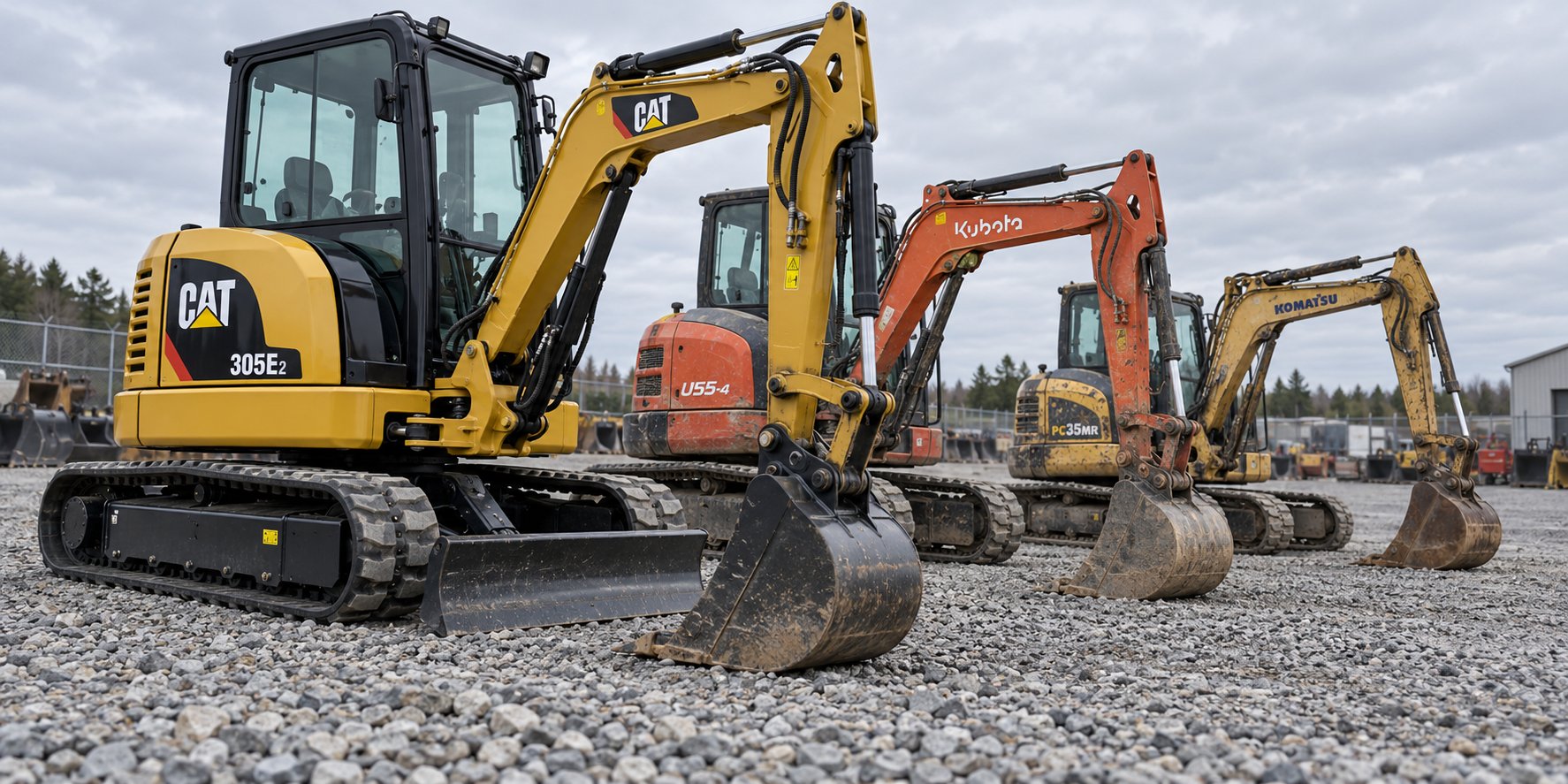
Used Kubota KX040 Prices by Condition and Hours
A brand-new KX040-5 commands upward of $68,000 at its base — and closer to $95,000 fully loaded. Not every buyer needs to spend that kind of money, and not every job demands a zero-hour machine. The used kubota kx040-4 market is where budget-conscious contractors, hobby farmers, and seasonal operators find real opportunity. The catch? Pricing transparency on the secondary market is even murkier than it is on the new side.
Browse a major listing aggregator like Machinery Pete and you will find roughly 30 KX040-4 units at any given time — but the site typically requires you to click into each individual listing to see the actual asking price. There is no at-a-glance price column, no average-price summary, and no filter that lets you sort low to high in a single view. That opacity is frustrating, yet it also creates leverage for buyers willing to do the homework. When you understand how hour count segments the used market, you can spot a fair deal — or a red flag — much faster than someone scanning listings blindly.
How Hour Count Drives Used KX040 Pricing
Think of operating hours the way you think of mileage on a truck. They are not the only measure of condition, but they are the most universal starting point. Thompson Machinery notes that buyers evaluate age and meter hours together — a newer unit does not always fetch a higher price, and an older machine with lower hours can look more attractive than a younger one that has been worked hard. For the KX040, the used market generally splits into three tiers.
| Hour-Count Tier | Typical Condition Description | General Price Range Guidance |
|---|---|---|
| Under 1,000 hours | Near-new condition. Minimal undercarriage wear, original paint largely intact, full service history common. Often dealer trade-ins or lightly used rental returns. | Highest used pricing — typically a modest discount off comparable new-unit MSRP. Strong demand keeps these units moving quickly. |
| 1,000 – 3,000 hours | Working-condition machines showing normal wear. Tracks, pins, and bushings may need inspection but are generally serviceable. Maintenance history becomes critical at this stage. | Mid-range pricing — the sweet spot for many buyers seeking a balance between cost savings and remaining machine life. |
| Above 3,000 hours | High-use machines. Undercarriage components, hydraulic seals, and cab appointments often show significant wear. May need near-term maintenance investment. | Lowest pricing tier — attractive entry point, but buyers should budget for potential repairs, especially undercarriage and hydraulic work. |
Keep in mind that hours alone do not tell the whole story. A mini kubota excavator that spent 2,500 hours on soft landscaping soil will be in far better shape than one that logged the same hours breaking rock on a demolition site. Always pair the hour reading with a close inspection of the machine's actual physical condition.
Red Flags When Shopping for a Used KX040
Every used equipment purchase carries some risk. The key is distinguishing manageable wear from problems that will blow your budget. Drawing on Mico Equipment's used excavator inspection checklist, here are the warning signs that matter most on a KX040:
- Undercarriage wear beyond 50% — sprockets, rollers, idlers, and track links are the most expensive replacement items on any compact excavator. A full undercarriage rebuild on a machine this size can run thousands of dollars. Measure wear against manufacturer specs or have a technician do it before you commit.
- Hydraulic leaks at cylinder rods, hoses, or fittings — wet spots, scorched hoses, or dented cylinder rods signal problems that range from a simple seal kit to a pump replacement. Slow or weak hydraulic action during a test is an immediate red flag.
- Loose track tension or uneven travel — if the machine pulls to one side or the tracks sag excessively, final drive or motor issues may be hiding underneath.
- Hour-meter inconsistency — a "low-hour" unit with worn pedals, a tattered seat, and loose joystick play does not add up. Some OEM telematics systems can help verify actual hours, and you should always cross-reference the meter reading with visible wear patterns.
- Missing maintenance records on a high-hour unit — gaps in documentation are not automatic deal-breakers, but they demand deeper investigation and should factor into your offer price.
- Fresh paint or pressure washing with no explanation — cosmetic cleanup can mask structural cracks, weld repairs, or fluid leaks that only show up on a dry, unwashed machine.
If possible, insist on a cold-start inspection. Starting the engine from cold reveals hard cranking, excessive smoke, or unusual knocking that disappears once the machine warms up. A seller who will not allow a cold start or an independent inspection is giving you a reason to walk away.
Where Used KX040 Listings Appear
Knowing where to shop is almost as important as knowing what to look for. Used KX040 inventory surfaces through three primary channels, each with different pricing dynamics:
- Authorized Kubota dealer trade-ins — these units often come with verified service history and may carry a limited dealer warranty. Pricing tends to be higher than private-party sales, but the risk is lower. This is also where you are most likely to find a kubota 40 excavator for sale that has been inspected and reconditioned before listing.
- Equipment auction sites — platforms like Ritchie Bros., Purple Wave, and regional auction houses offer competitive bidding that can produce bargain prices. The trade-off is that you are typically buying "as-is, where-is" with limited or no warranty protection. Auction results also provide valuable market data — even if you are not bidding, monitoring final sale prices helps you benchmark what a fair offer looks like.
- Specialty used-equipment marketplaces — online dealers and aggregators such as Machinery Pete, Equipment Trader, and others let you filter by brand, model, location, and sometimes hour range. These platforms cast the widest net and are especially useful for comparing asking prices across regions.
Regardless of channel, the same principle applies: compare at least three similar listings before making an offer. A kubota kx040 price on a used unit only makes sense when you evaluate it against machines of the same generation, configuration code, and hour range. Comparing a canopy-only R1A at 2,800 hours against a cab-equipped R3TP at 900 hours is like comparing a base-model work truck to a loaded crew cab — the sticker gap reflects real differences in equipment, not a better or worse deal.
Buyers who compare models in this class also tend to look at alternatives like the larger KX080 for heavier work or research the kubota kx057-5 price for a mid-size step up. Both are worth understanding if your project scope might outgrow a 4-ton machine — but for the majority of landscaping, utility, and light sitework, the KX040 remains the volume leader for a reason.
Finding the right used machine at the right price is only one piece of the puzzle, though. The sticker you negotiate on day one is not the number that defines whether the purchase was actually a good deal — that verdict depends on everything you spend after the keys are in your hand.
Total Cost of Owning a KX040 Beyond the Purchase Price
A great deal on day one can quietly become an expensive mistake over two or three years. Whether you paid $50,000 for a mid-hour used unit or $95,000 for a fully loaded new KX040-5, the purchase price is just the opening act. The real kubota kx040 price — the one that shows up in your profit-and-loss statement — is shaped by five ongoing cost categories that most buyers underestimate: attachments, financing, insurance, routine maintenance, and depreciation. Understanding each one turns a ballpark guess into a genuine ownership budget.
Attachment Costs That Add Up Fast
Imagine picking up a new mini excavator kubota owners rave about, only to realize the base machine does not include half the tooling your jobs require. Attachments are where the "extras" quietly rival a used-car payment. Common add-ons for a 4 ton excavator like the KX040 include:
- Hydraulic thumb — essential for grabbing stumps, rocks, and debris. Expect to budget roughly $1,500 to $3,500 depending on brand and pin-on vs. weld-on style.
- Quick coupler — lets you swap buckets and attachments without leaving the cab. Pin-grab and fully hydraulic couplers range from around $1,200 to $4,000-plus.
- Additional bucket sizes — most machines ship with a single digging bucket. Adding a trenching bucket, grading bucket, or cleanup bucket can run $500 to $1,500 each.
- Hydraulic breaker — for concrete or rock demolition, a breaker sized for the KX040's auxiliary circuit typically falls in the $3,000 to $7,000 range.
- Ripper tooth or frost tooth — a lower-cost specialty attachment, usually $300 to $800, but invaluable in cold-climate or rocky-soil conditions.
Stack a thumb, coupler, one extra bucket, and a breaker together and you are looking at $6,000 to $15,000 on top of the machine itself — a figure that can represent 10% to 20% of a new-unit purchase. Reviewing the kx040-5 specs before you buy helps you confirm which auxiliary hydraulic circuits come standard, so you know exactly what attachments the machine can run without additional plumbing.
Financing and Section 179 Tax Benefits
Most buyers do not write a single check for a kubota compact excavator. Equipment loans and lease-to-own agreements are the norm, and the interest you pay over the life of the loan is a real cost that belongs in your total ownership calculation. Typical equipment financing terms for machines in this class run 48 to 72 months. Kubota Credit Corporation periodically offers promotional rates as low as 0% APR for up to 60 months, which effectively eliminates interest expense if you qualify and time your purchase correctly. Outside of promotional windows, market rates for equipment loans generally range from 5% to 9% depending on creditworthiness and term length. On a $90,000 financed amount at 7% over 60 months, total interest alone adds roughly $17,000 to your real cost.
Business buyers have a powerful offset available. Section 179 of the IRS Tax Code allows eligible businesses to deduct the full purchase price of qualifying equipment — new or used — in the tax year it is placed into service, rather than depreciating it over multiple years. For 2026, the deduction limit sits at $1,250,000 with a phase-out threshold beginning at $3,130,000 in total equipment purchases. A small contractor buying a single 4 ton mini excavator will typically fall well within these limits. At a 24% marginal tax rate, a $90,000 KX040 purchase could yield a first-year tax reduction of roughly $21,600 — a meaningful dent in the effective net cost. Bonus depreciation under Section 168(k) can layer on top of Section 179 for businesses making larger fleet investments. Always consult a tax professional for guidance specific to your situation, as eligibility rules and annual limits adjust for inflation.
Insurance and Overhead
Equipment insurance is easy to overlook until something goes wrong. Inland marine or equipment floater policies — the standard coverage types for a machine like the KX040 — typically cost between 1% and 3% of the insured value per year. On a $90,000 machine, that translates to roughly $900 to $2,700 annually. Liability coverage, theft protection, and transport insurance add incremental cost. If you finance the purchase, your lender will almost certainly require comprehensive coverage as a loan condition, so this is not optional for most buyers.
Maintenance Intervals and Long-Term Costs
Kubota publishes detailed maintenance schedules covering both checkpoint inspections and lubricant service intervals. Staying on top of these is what separates a machine that holds its value from one that turns into a money pit. Core recurring items for the KX040 include:
- Engine oil and filter changes — typically every 250 to 500 hours, depending on operating conditions. Budget around $80 to $150 per service if you handle it yourself; dealer-performed services run higher.
- Hydraulic fluid and filter replacement — usually at 1,000-hour intervals. Hydraulic fluid alone can cost $200 to $400 for a full system change, plus the filter.
- Air filter, fuel filter, and coolant service — staggered intervals that add small but steady costs throughout the year.
- Undercarriage inspection and adjustment — track tension checks, roller and idler inspections, and eventual sprocket or track replacement. As noted earlier, undercarriage work is the single most expensive maintenance category on any compact excavator. A full track replacement on a machine this size can run $3,000 to $6,000.
- Greasing pivot points — a daily task that costs almost nothing in materials but prevents premature bushing and pin wear that leads to expensive repairs.
A reasonable annual maintenance budget for a KX040 running 500 to 800 hours per year falls in the $1,500 to $3,500 range for routine items — higher if undercarriage components are due for replacement. Gregory Poole Equipment Company emphasizes that preventive maintenance is a proactive approach: skipping routine service to save a few hundred dollars in the short term frequently leads to repair bills measured in thousands.
The cheapest machine to buy is not always the cheapest machine to own — a well-maintained KX040 with higher purchase cost often delivers lower total expense over five years than a bargain unit with deferred maintenance and looming repairs.
Depreciation and Resale Value
Every hour on the meter chips away at the machine's market value. Industry guidance on heavy equipment TCO identifies hours of use, maintenance history, and brand demand as the three biggest depreciation drivers. Kubota compact excavators have historically held resale value better than many competitors in the 4 ton excavator segment — a reputation built on reliability, dealer network density, and consistent buyer demand on the secondary market. Still, a typical KX040 will depreciate roughly 15% to 25% in the first two years, then settle into a slower decline as it ages. Keeping thorough service records, investing in timely repairs, and avoiding cosmetic neglect are the most effective ways to protect residual value.
Add it all up — attachments, interest, insurance, maintenance, and depreciation — and the true five-year cost of owning a KX040 can exceed the purchase price by 40% or more. That is not a reason to avoid buying; it is a reason to plan. And planning means knowing not just what you will spend, but how the KX040 stacks up against every other machine in its class competing for the same dollars.
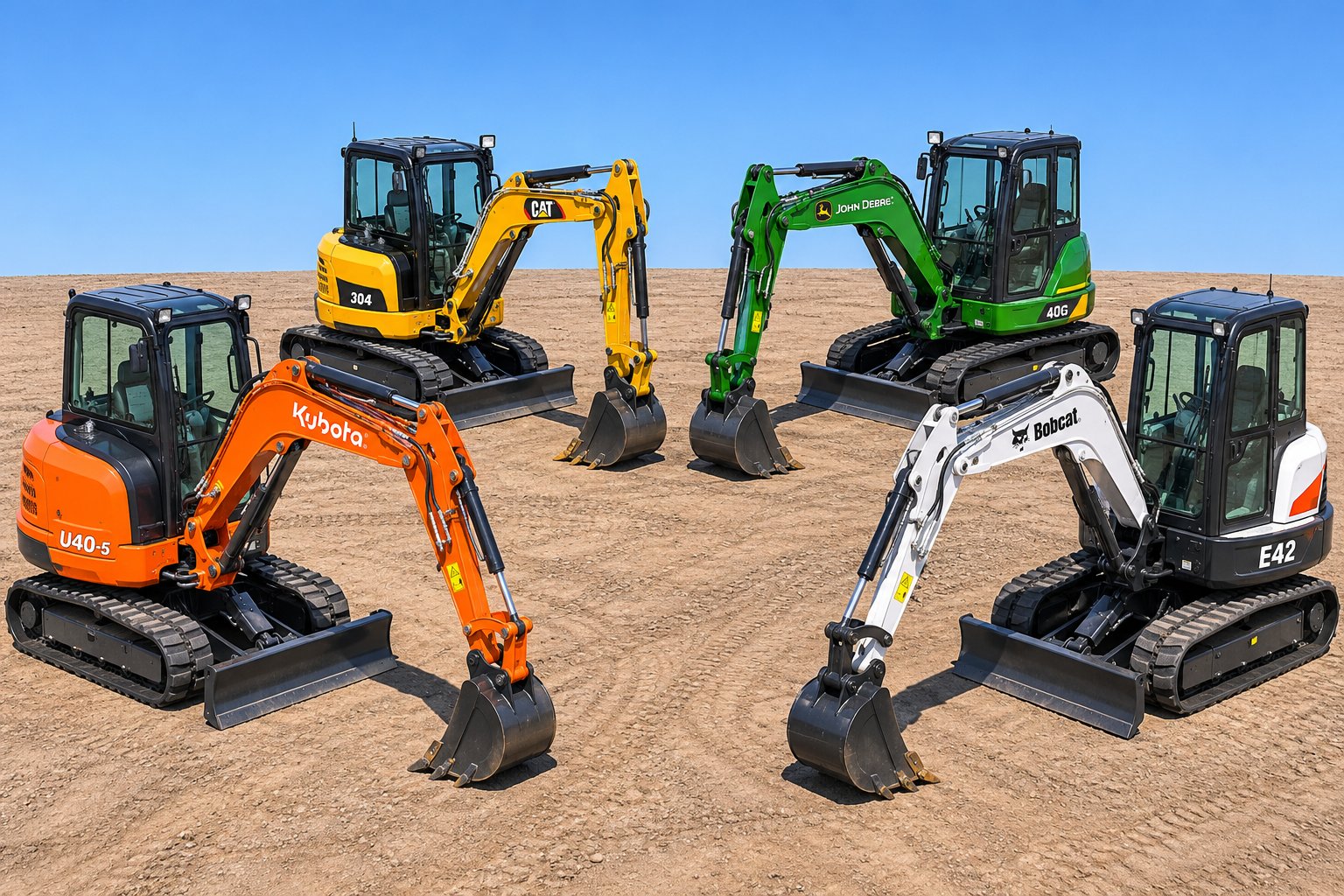
KX040 vs Competitors in the 4-Ton Excavator Class
Knowing what a kubota kx040 price looks like in isolation is useful. Knowing how it compares to every other machine fighting for the same spot on your trailer is powerful. The 4-to-5-ton compact excavator class is one of the most competitive segments in construction equipment, and the KX040-5 shares the field with formidable rivals from Caterpillar, John Deere, Bobcat, and Takeuchi. Each brings a different combination of power, features, dealer support, and pricing philosophy — and the right choice depends on which tradeoffs matter most to your operation.
Across kubota excavator sizes, the KX040 lands squarely in the middle of the lineup — larger than utility-class machines like the KX033-4 but smaller than the kubota kx057-5, which sits at 5.6 metric tons and ranks as Kubota's overall top seller. That positioning makes the kubota 40 excavator ideal for contractors who need more capability than a 3-ton unit provides but do not want the transport weight or cost of a mid-size machine. Its competitors occupy the same middle ground — and each one prices its value proposition differently.
How the KX040 Stacks Up on Price and Value
The table below compares the KX040-5 against four direct rivals across the dimensions that matter most to price-conscious buyers. Spec data is drawn from published manufacturer specifications and Equipment World's 2026 mini excavator buyer's guide.
| Model | Engine Power | Operating Weight | Max Dig Depth | Standard Features of Note | Key Value Differentiator |
|---|---|---|---|---|---|
| Kubota KX040-5 | 40.3 HP | 9,182 – 10,075 lbs | 11 ft 2.3 in | Load-sensing hydraulics, multifunction operation, 7-in LCD touchscreen, KubotaNOW telematics | Strong resale value, extensive dealer network, fuel efficiency |
| Cat 305 CR | 45 HP | ~12,688 lbs | 11 ft 3 in | Reduced tail swing, E-Fence collision avoidance, grade indicate software | Top-selling mini excavator in the U.S.; advanced tech ecosystem |
| John Deere 50 P-Tier | ~38 HP | ~10,800 lbs | ~11 ft 4 in | Load-sensing hydraulics, dual auxiliary hydraulic option, JDLink telematics | Strong dealer network; familiar brand for ag-crossover buyers |
| Takeuchi TB240 | 35.8 HP | ~8,570 lbs | 11 ft 4 in | High-performance hydraulic system, reinforced structure, rough-terrain tracks | Lightest in class for easier transport; heavy-duty durability reputation |
| Bobcat E42 | 42.7 HP | ~9,830 lbs | 10 ft 6 in | Zero tail swing, advanced hydraulics, broad attachment compatibility | Unmatched attachment versatility; zero tail swing for tight spaces |
A few patterns jump out. The Cat 305 CR is the heaviest machine on this list by a wide margin — nearly 2,600 pounds more than the Takeuchi TB240. That extra mass translates to greater stability and lifting capacity, but it also means higher transport costs and a heavier trailer requirement. It carries a purchase price premium that reflects both the technology package and the Caterpillar brand. The Bobcat E42 sacrifices about 8 inches of dig depth compared to the KX040-5 but compensates with true zero tail swing, making it the go-to pick for operators who spend most of their time against walls and fences. The Takeuchi TB240 is the lightest option, attractive for contractors who move frequently between sites and want to stay under CDL thresholds.
Where does the KX040-5 win? It threads the needle. You get competitive dig depth, modern hydraulics with multifunction capability, and a weight that balances stability with transportability — all at a base MSRP that typically undercuts the Cat 305 CR while offering more standard technology than the Takeuchi or a comparably priced John Deere. Among kubota mini excavators, the KX040-5 has already climbed to No. 4 on the EDA new-financed sales list — a testament to market demand that also feeds directly into its strongest hidden advantage: resale value.
Resale Value and Brand Reputation
A machine's real cost is not just what you pay going in — it is what you lose between buying and selling. And this is where Kubota consistently outperforms most of the field. Ritchie Bros. auction data ranks Kubota and Bobcat as the two strongest brands for resale value in the sub-10,000-pound compact excavator class, with Caterpillar close behind. The reasoning is straightforward: Kubota dominates rental fleets and dealer inventories across North America, which keeps used buyers familiar with the brand and confident about parts and service availability. That familiarity creates steady secondary-market demand.
The numbers bear this out. A well-maintained mini excavator that is three to four years old with under 1,500 hours commonly retains 55% to 70% of its original value — a significantly better depreciation curve than most compact equipment categories. For a kubota kx040 price in the $85,000 to $95,000 range, that retention means the machine could still be worth $47,000 to $66,000 at resale under favorable conditions. The effective net ownership cost drops dramatically when you factor in that equity recovery.
Caterpillar holds value well too, but its higher purchase price narrows the resale-percentage advantage. John Deere and Takeuchi both outperform generic or lesser-known imports at auction, though neither matches the top-tier retention of Kubota and Bobcat in this weight class. For buyers who plan to trade up to a larger unit — perhaps stepping into the kubota kx057-5 after a few years — strong residual value on the outgoing KX040 effectively subsidizes the upgrade.
Competitive specs and strong resale are compelling on paper. But the most important comparison is not machine against machine — it is buying strategy against buying strategy. The question that separates a savvy equipment investment from an expensive regret is not which excavator to choose, but whether buying new, buying used, or renting makes the most financial sense for how you actually plan to use the machine.
Should You Buy New or Used or Rent a KX040
Specs, resale curves, and competitive pricing all matter — but they only matter in the context of how you actually plan to use the machine. A landscaper running a KX040 six days a week, 50 weeks a year faces a completely different cost equation than a hobby farmer who needs to dig two ponds and trench a waterline. The best kubota kx040 price is not the lowest number on a listing — it is the number that delivers the lowest cost per productive hour for your specific workload.
Four criteria separate a smart purchase from an expensive misstep: annual usage hours, project duration and frequency, your tax and cash-flow position, and your long-term equipment strategy. Run your situation through each one, and the right path — new, used, or rental — usually becomes obvious.
When Buying New Makes Sense
A factory-fresh KX040-5 is the right call when the machine will be a daily revenue generator, not an occasional tool. The profile of a buyer who benefits most from going new typically looks like this:
- Consistent annual usage above 800 to 1,000 hours — at this utilization level, the cost per hour drops low enough that ownership decisively beats renting. FieldFix's cost analysis pegs the ownership sweet spot at roughly 60% or greater utilization of available working days, which translates to about 150-plus days of active use per year for a compact excavator.
- Desire for full manufacturer warranty and zero deferred maintenance risk — a new KX040-5 ships with Kubota's standard warranty covering major components, and factory-installed KubotaNOW telematics let you monitor machine health remotely from day one. There is no guessing about what the previous owner did or did not maintain.
- Ability to leverage Section 179 — business buyers who can deduct the full purchase price in year one effectively slash the net cost by their marginal tax rate. On a $90,000 machine at a 24% bracket, that is roughly $21,600 back in your pocket the first tax season. Combined with Kubota's periodic 0% APR promotions, the effective financing cost of a new unit can be surprisingly competitive.
- Plans to keep the machine three to five years or longer — the longer you hold a new unit, the more you amortize that upfront premium across productive hours. Buyers who churn equipment every 12 to 18 months rarely recoup enough resale value to justify new pricing.
If your operation mirrors that profile — year-round work, high utilization, and the financial structure to capture tax benefits — a new KX040-5 often delivers the lowest lifetime cost per hour despite the highest sticker price. Buyers shopping kubota excavators for sale through authorized dealers should still negotiate aggressively, request itemized option breakdowns, and time their purchase around end-of-quarter incentive windows as discussed earlier.
When a Used KX040 Is the Smarter Move
Not every operation needs a zero-hour machine, and not every budget can absorb one. A used KX040-4 — or even a low-hour KX040-5 that has already taken its initial depreciation hit — is often the sharper financial play for buyers whose work patterns look like this:
- Seasonal or project-based usage under 600 to 800 hours per year — at lower utilization rates, the per-hour cost of a new machine stays stubbornly high. A used unit purchased at 40% to 60% of new-equivalent pricing brings that per-hour figure down to a level the workload can support.
- Firm budget constraints — if your ceiling is $50,000 to $65,000, the used market is where quality KX040-4 units live. That budget can land you a mid-hour machine in solid working condition with enough left over to add a hydraulic thumb or extra bucket.
- Willingness and ability to evaluate machine condition — used buying rewards the informed. If you or a trusted mechanic can inspect undercarriage wear, check hydraulic integrity, verify hour-meter accuracy, and assess kubota kx040-4 tracks for remaining life, you dramatically reduce the risk of a costly surprise.
- Comfort with potential near-term maintenance — a machine at 2,000 hours may need track adjustments, filter services, or minor hydraulic attention within the first year of your ownership. Budget for it, and the total cost still often undercuts new-unit math at your utilization level.
The sweet spot in the used market tends to be machines in the 1,000-to-2,000-hour range with documented service history. You avoid the steep first-year depreciation curve — industry data suggests heavy equipment can lose 20% to 30% of its value in year one — while still inheriting a machine with thousands of productive hours remaining. Cascade Trader emphasizes that matching the machine to your frequency of use is the most important factor: commercial operators who need daily reliability lean new, while lighter or less frequent use makes a quality used unit the stronger financial decision.
When Renting Beats Buying
Imagine you need a 4-ton excavator for a single residential foundation, a weekend pond dig, or a two-week drainage project — and then the machine sits idle for months. In that scenario, neither new nor used ownership pencils out. Renting does.
Current rental rates for mini excavators in the 4-to-6-ton class — the bracket the KX040 falls into — generally run approximately $300 to $350 per day, $800 to $1,500 per week, or $2,500 to $4,500 per month. Add delivery charges of $100 to $300 per round trip and a damage waiver at 10% to 15% of the base rate, and a two-week rental typically lands in the range of $2,500 to $4,500 all-in. That is real money — but it is a fraction of even the most aggressively priced used KX040.
Renting makes the most financial sense when:
- You will use the machine fewer than 100 to 120 days per year — below the break-even threshold where ownership starts to win.
- The project is a one-off or a type of work you do not expect to repeat regularly.
- You are testing whether a compact excavator fits your operation before committing capital — essentially using the rental period as a paid trial.
- Cash flow is tight and you prefer a predictable, fully tax-deductible operating expense over a multi-year loan obligation.
For context, a buyer weighing a mini bobcat excavator rental against a Kubota KX040 rental will often find similar daily rates in this weight class. The brand on the boom matters less than the machine size when it comes to rental pricing — what matters is whether you are renting often enough that the cumulative cost starts creeping toward ownership territory.
When your annual rental spending approaches 30% to 40% of what it would cost to own the machine outright, the math is telling you to stop renting and start buying.
That break-even principle is the single most important number in the rent-versus-buy decision. Track your rental invoices over a full year. If you rented a 4-ton excavator for a combined 90 to 120 days and spent $25,000 to $35,000 in total rental costs, you have already covered a significant chunk of what a quality used KX040-4 would cost — and you own nothing at the end of it. Buyers in adjacent size classes face the same calculation; anyone considering a kubota kx057 or stepping up to the kubota kx080 for heavier work should run identical utilization math before committing to a purchase or extending a rental agreement.
The decision framework boils down to a simple sequence: estimate your realistic annual hours, price out the rental alternative, calculate total ownership cost using the categories from the previous section, and compare. The answer is almost always clear once the numbers are on paper. What remains is finding the best deal — and knowing exactly where to look, what to verify, and which sourcing channels give you the most leverage as a buyer.

Where to Find the Best Kubota KX040 Deals Right Now
You have the pricing framework, the spec comparisons, the total-cost-of-ownership math, and the rent-versus-buy logic. The final piece is knowing exactly where to shop, how to request quotes that give you real leverage, and what to verify before you sign anything. The difference between a good kubota kx040 price and a great one often comes down to sourcing strategy — casting a wide net, comparing across channels, and walking into every negotiation armed with data instead of hope.
Think of the KX040 market as three distinct tiers, each with its own pricing dynamics, risk profile, and negotiation playbook.
Getting Quotes from Authorized Kubota Dealers
For new KX040-5 units — and occasionally certified pre-owned inventory or remaining new-old-stock KX040-4 machines — authorized Kubota dealers are the starting point. Kubota's dealer network is one of the densest in the compact equipment industry, and that competition works in your favor. A buyer in most metro areas can reach three or more dealerships within a reasonable drive, which means three or more quotes to compare.
Here is how to maximize that advantage:
- Request itemized quotes, not lump-sum numbers. Ask each dealer to break out the base machine price, every installed option (cab, blade type, auxiliary hydraulics, track package), freight and delivery charges, and any applicable manufacturer incentives or promotional financing. A single bottom-line figure hides where the margin sits — and margin is where negotiation happens.
- Compare beyond price. Two dealers might quote identical numbers, but one includes a hydraulic thumb and coupler while the other does not. One might offer 0% financing through Kubota Credit Corporation while the other pushes a third-party lender at 6.9%. Delivery timelines matter too — a dealer with the exact configuration in stock saves you weeks compared to one placing a factory order.
- Ask about trade-in value separately. If you have equipment to trade — even a smaller machine like a kubota kx033 or a kx033-4 you have outgrown — get the trade appraisal as a standalone number before folding it into the deal. Bundling trade value into the purchase price makes it harder to tell whether you got a fair deal on either side of the transaction.
- Time your approach. End-of-quarter and end-of-year windows remain the most productive times to negotiate. Dealers chasing volume targets are more flexible on price, more willing to throw in attachments, and more likely to escalate your deal to a sales manager who can approve deeper discounts.
Dealer purchases carry the lowest risk of any channel — you get full manufacturer warranty, verified configuration, and a service relationship that matters when something needs attention at 500 hours. The tradeoff is that you will rarely find the absolute lowest price here. That is what the secondary market is for.
Exploring Used Kubota Inventory Online
The broadest selection of used KX040 units lives online. Equipment marketplaces, auction platforms, and specialty dealers aggregate inventory from across the country, letting you compare a kx040-4 for sale in Texas against one in Ohio without leaving your desk. The key platforms include:
- Auction sites — Ritchie Bros., Purple Wave, and regional auction houses offer competitive bidding that can produce below-market prices. The risk is the "as-is, where-is" nature of most auction purchases. You are buying condition sight-unseen unless you arrange a pre-auction inspection. Auction results also serve as excellent market-price benchmarks even if you are not actively bidding.
- Listing aggregators — Machinery Pete, Equipment Trader, and similar platforms let you filter by brand, model, year, and sometimes hour range. These sites cast the widest net and are especially useful for tracking how long units sit on the market — a listing that lingers for 60-plus days signals a seller who may be ready to negotiate.
- Specialty used-equipment dealers — some online dealers carry inspected inventory from established brands and allow buyers to browse by manufacturer, filter by condition, and request quotes remotely. For example, JIUHONG's used Kubota excavator collection features various Kubota models across the KX-series and U-series lineup. While specific KX040 availability is not guaranteed at any given time, buyers can submit inquiries to check current stock and compare options against other 4-ton compact excavators in the inventory. It is one of several resources worth checking alongside domestic dealer networks and auction platforms.
Regardless of which platform you use, the same discipline applies: never evaluate a single listing in isolation. A used kubota kx040 price only means something when stacked against comparable machines — same generation, same configuration code, similar hour count — from at least two or three other sources. Online marketplaces make that comparison faster than it has ever been, but only if you resist the temptation to jump on the first listing that looks like a deal.
Buyers exploring adjacent models — perhaps a larger kx057-5 for heavier sitework or even a completely different brand — should apply the same multi-source approach. Whether you are pricing a trackhoe rental for a short-term project or evaluating a machine as different as a cat 352 excavator for large-scale earthmoving, the principle holds: more data points produce better decisions.
Your Price Research Checklist Before Making an Offer
You have done the research. You have identified a machine that fits your budget, your workload, and your configuration needs. Before any money changes hands, run through this final verification checklist — it distills everything covered in this guide into a single pre-offer protocol.
- Verify the exact model and variant code. Confirm whether you are looking at a KX040-4 or KX040-5, and decode the suffix (R1A, R3TP, cab variant, etc.) to understand exactly what equipment is included. As covered earlier, comparing unlike configurations is the most common — and most expensive — mistake buyers make.
- Confirm the hour count and cross-reference it with visible wear. Check the hour meter, then compare it against seat condition, pedal wear, joystick tightness, and undercarriage state. If the numbers do not match the wear, dig deeper or walk away. OEM telematics data can help verify hours on newer units.
- Request complete maintenance records. Oil changes, filter replacements, hydraulic services, and any major repairs should be documented and dated. Mico Equipment's inspection guide notes that gaps in documentation are not automatic deal-breakers — but they are reasons to investigate further and adjust your offer downward.
- Compare against at least three similar listings. Match generation, configuration, and hour range. Use auction results, dealer asking prices, and marketplace listings to triangulate a fair market value before you name a number.
- Factor in attachment needs. If the machine does not include a thumb, coupler, or additional buckets your work requires, add those costs to the purchase price for a true apples-to-apples comparison against a more fully equipped competitor listing.
- Calculate total cost of ownership. Use the framework from earlier sections: purchase price plus attachments, financing interest, insurance, annual maintenance, and projected depreciation. The machine with the lowest sticker is not always the machine with the lowest five-year cost — and that five-year number is the one your business actually feels.
- Arrange an independent inspection for any high-value used purchase. A few hundred dollars spent on a qualified technician's assessment can save you thousands in undisclosed repairs. Pay special attention to undercarriage remaining life, hydraulic system integrity, and structural welds on the boom and stick.
This checklist is not about slowing you down — it is about making sure the deal you close is the deal you think it is. The kubota kx040 price you negotiate on paper only becomes a good investment when every variable behind that number checks out. Do the homework, run the math, verify the machine, and you will walk away with one of the most capable compact excavators on the market at a price your operation can sustain for years to come.
Frequently Asked Questions About Kubota KX040 Pricing
1. How much does a new Kubota KX040-5 cost?
A new Kubota KX040-5 starts at an MSRP of approximately $68,768 for a base configuration. However, a fully equipped model with an enclosed cab, 6-way blade, premium track package, and auxiliary hydraulics can reach $95,694 or more depending on dealer-installed accessories. Transaction prices vary by region, dealer inventory, seasonal demand, and any active manufacturer promotions such as 0% APR financing or cash-back incentives. Requesting itemized quotes from at least three authorized Kubota dealers is the most reliable way to determine the real purchase price in your area.
2. What is the difference between the Kubota KX040-4 and KX040-5?
Both generations share a Kubota diesel engine producing roughly 40 horsepower and offer similar dig depth around 11 feet 2 inches. The KX040-5 upgrades the experience with improved load-sensing hydraulics that support multifunction operation, higher auxiliary flow at 17.2 gpm versus 15.9 gpm, a redesigned cab with a 7-inch LCD touchscreen, Bluetooth connectivity, keyless start, and factory-installed KubotaNOW telematics. The KX040-5 also adds a 6-in-1 dozer blade option not available on the Dash-4. While raw digging specs are close, the operator comfort and hydraulic versatility improvements justify a price premium for high-utilization buyers.
3. Are used Kubota KX040 excavators a good value?
Used KX040-4 units can offer excellent value, particularly machines in the 1,000-to-2,000-hour range with documented maintenance history. These mid-hour units avoid the steepest first-year depreciation while retaining thousands of productive hours of remaining life. Kubota compact excavators hold resale value better than most competitors, so even a used purchase tends to retain reasonable equity. The key is matching the hour count and condition to your budget, inspecting undercarriage wear carefully, verifying actual hours against visible wear patterns, and comparing at least three similar listings before making an offer. Specialty online dealers like JIUHONG's used Kubota excavator collection at jiuhong-machinery.com also let buyers browse available KX-series and U-series inventory and inquire about specific models.
4. What do Kubota KX040 model suffix codes like R3A or R1T mean?
Kubota uses suffix codes to indicate configuration details on each KX040 unit. Generally, 'R' signals a ROPS canopy rather than an enclosed cab, the number indicates blade type — '1' for a standard straight blade and '3' for an angle or multi-directional blade — and trailing letters like 'A' or 'TP' refer to the track or accessory tier. Cab-equipped models carry a higher price due to climate control and enhanced operator protection. Understanding these codes is critical when comparing listings, because a canopy-only R1A and a cab-equipped unit with an angle blade are vastly different machines at vastly different price points, even though both carry the KX040 name.
5. Is it better to rent or buy a Kubota KX040?
The decision hinges on annual utilization. Renting a 4-ton mini excavator typically costs $300 to $350 per day or $2,500 to $4,500 per month. If you use the machine fewer than 100 to 120 days per year, renting usually costs less than ownership. Once annual rental spending approaches 30% to 40% of what outright ownership would cost — or you exceed roughly 150 active working days per year — buying becomes the stronger financial move. Business buyers can further tip the math toward purchasing by leveraging Section 179 tax deductions and promotional financing offers, which effectively reduce the net acquisition cost in the year of purchase.