

What Kubota Construction Equipment Is and Why It Leads the Market
Kubota construction equipment refers to the lineup of compact and mid-size machines — including mini excavators, skid steers, track loaders, and wheel loaders — manufactured by the Kubota Corporation, a Japanese industrial giant founded in 1890 in Osaka, Japan. While many buyers associate the brand with Kubota tractors or mowers, the company has spent more than four decades engineering purpose-built construction machinery. That focused investment has paid off: Kubota holds the global market-leadership position in mini excavator sales, a claim supported by Off-Highway Research data cited on the company's global site.
For contractors, landscapers, and municipal buyers, that market leadership is not just a corporate talking point. It translates into tangible, day-to-day advantages that directly affect profitability and uptime.
What Is Kubota Construction Equipment
At its core, Kubota specializes in compact and mid-size machines designed for jobs where full-size heavy equipment is either overkill or physically unable to access the work area. Imagine squeezing a mini excavator through a backyard gate to dig a pool, maneuvering a Kubota skid steer inside a partially framed building, or using a compact wheel loader to clear snow from a municipal parking lot. These are the scenarios the brand engineers for.
The primary applications include landscaping, utility trenching, residential construction, road maintenance, and site preparation. If you've ever wondered where is Kubota made or searched recent kubota news, you'll notice the brand's name surfaces constantly in discussions about compact jobsite productivity — and for good reason. Kubota's engineering roots trace back to cast-iron water pipe production and kerosene engine development in the early 1900s, meaning precision manufacturing has been in its DNA for well over a century.
Why Kubota Dominates the Compact Equipment Segment
Plenty of manufacturers sell compact machines. What sets Kubota apart is the depth of its commitment to this specific category. Full-line OEMs spread their engineering budgets across dozers, haul trucks, heavy excavators, and compact equipment simultaneously. Kubota concentrates its R&D squarely on the compact and mid-size segment, which means every hydraulic system, cab layout, and engine calibration is purpose-built rather than scaled down from a larger platform.
Kubota is the global market leader in mini excavators — a position earned through decades of focused engineering in compact construction machinery, not by treating it as a secondary product line.
What does that leadership mean in practical terms for someone ready to build my Kubota fleet or purchase a first machine?
- Parts availability: High production volumes mean replacement components are stocked widely across dealer networks, reducing wait times when a machine goes down.
- Higher resale value: Ritchie Bros. resale data ranks Kubota among the strongest brands for value retention in the sub-10,000-pound mini excavator class, with well-maintained units commonly holding 55-70% of original value after three to four years.
- Denser dealer networks: More service locations mean faster warranty claims, easier access to rentals, and local expertise when you need help spec'ing the right machine.
- Industry-wide trust: Kubota dominates rental fleet inventories across North America, which keeps buyers familiar with the controls, maintenance patterns, and reliability expectations.
That combination of engineering focus, aftermarket support, and proven resale strength is precisely why competitors already spec Kubota machines into their fleets — and why understanding the full lineup gives you a strategic edge before your next equipment decision.
Where Kubota Is Made and What That Means for Buyers
Strategic advantages like parts availability and resale value don't appear out of thin air — they're rooted in where and how machines are built. For buyers weighing lead times, sourcing logistics, and even "Buy American" procurement requirements, Kubota's manufacturing footprint deserves a closer look.
Kubota Manufacturing in Japan and the United States
Kubota Corporation is headquartered in Osaka, Japan, where the company has operated since 1890. Its main manufacturing plant in Sakai, Osaka, produces a significant share of the brand's equipment, including engines, Kubota compact tractors, and the excavator lines — both mini excavator and mid-size models — that ship to markets worldwide. Additional Japanese facilities in Tsukuba and Hirakata handle specialized engine production and component fabrication.
On the North American side, Kubota Manufacturing of America (KMA) in Gainesville, Georgia, has been building machines since 1988. Employing over 3,500 workers, this facility originally focused on kubota implements such as backhoes and front loaders. It has since expanded dramatically, adding lawn tractor assembly, utility vehicles, and the BX-series subcompact tractor line. A second campus in Jefferson, Georgia, handles L-series tractor assembly along with the SSV65 and SSV75 skid steer product lines. Additional logistics capacity at Kubota's Edgerton, Kansas, facility supports faster distribution across the country.
So which products are made domestically? Generally, many tractor series, select skid steers, utility vehicles, and kubota implements like the small backhoe and front loader attachments are assembled in the U.S. The Kubota mini excavator lineup and most compact excavators, however, are primarily manufactured in Japan — meaning buyers should factor import timelines into purchasing decisions, especially during periods of high demand.
How Kubota's Global Supply Chain Benefits Equipment Buyers
This dual-hemisphere strategy is more than a corporate logistics decision. It creates real advantages you'll notice at the dealership and on the jobsite. Centralized engineering in Japan ensures that every machine — whether a U-series micro excavator or an SVL track loader — meets the same design and quality standards. Regional assembly in Georgia then shortens delivery windows for domestically produced equipment and reduces freight costs passed along to buyers.
Perhaps the most underappreciated element is Kubota's vertical integration of diesel engines. The company doesn't just power its own machines — it supplies engines to dozens of other equipment manufacturers, including competitors in the construction and agricultural sectors. That dual role as both an OEM and an engine supplier means Kubota's powertrains are engineered to extraordinarily high durability standards, stress-tested across far more applications than a captive engine program would encounter. For the buyer, this translates to proven reliability, readily available engine parts, and lower long-term maintenance costs across the entire lineup of excavator and loader products.
The manufacturing story matters because it directly shapes what happens after you sign the purchase order — how quickly you receive the machine, how easily you source replacement parts, and how confidently you can count on consistent build quality. Those operational details become even more meaningful when you explore the breadth of equipment Kubota actually offers.
The Complete Kubota Construction Equipment Lineup Explained
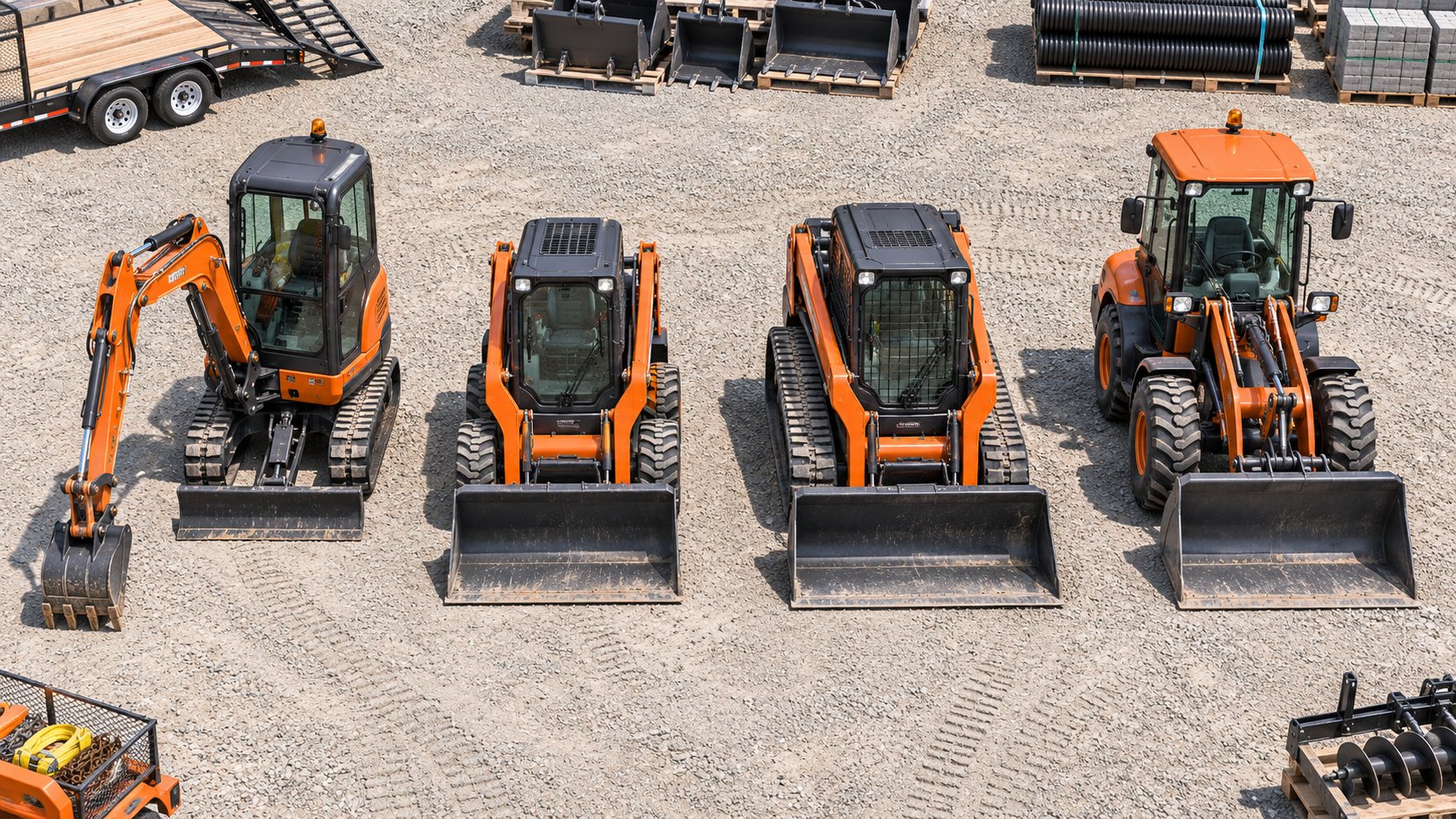
Knowing where machines are built gives you confidence in quality. Knowing which machines exist gives you a competitive edge in fleet planning. Kubota's construction catalog is broader than most buyers realize, spanning everything from sub-one-ton micro excavators to nearly 20,000-pound compact models — plus skid steers, track loaders, wheel loaders, and telehandlers. Here's a structured breakdown you won't find organized this clearly anywhere else.
Kubota Mini and Compact Excavators
The Kubota excavator lineup splits into two distinct series, each engineered for different jobsite priorities. The U-series focuses on ultra-compact dimensions and tight or zero tail swing configurations, making it the go-to choice when you're digging next to walls, fences, or property lines. The KX-series, by contrast, delivers conventional tail swing with higher digging performance, prioritizing raw productivity over envelope restrictions.
Weight classes span an impressive range. At the lightest end, models like the K008-5 and U10-5 weigh in under 2,700 pounds with dig depths between roughly 5 feet 8 inches and 5 feet 11 inches — ideal for shallow trenching, small demolition, and work inside buildings. Step up to the 2-to-4-ton class and you'll find the U27-4, KX030-4, and KX033-4 offering dig depths around 9 to 10 feet, enough for utility trenching and foundation work on residential sites.
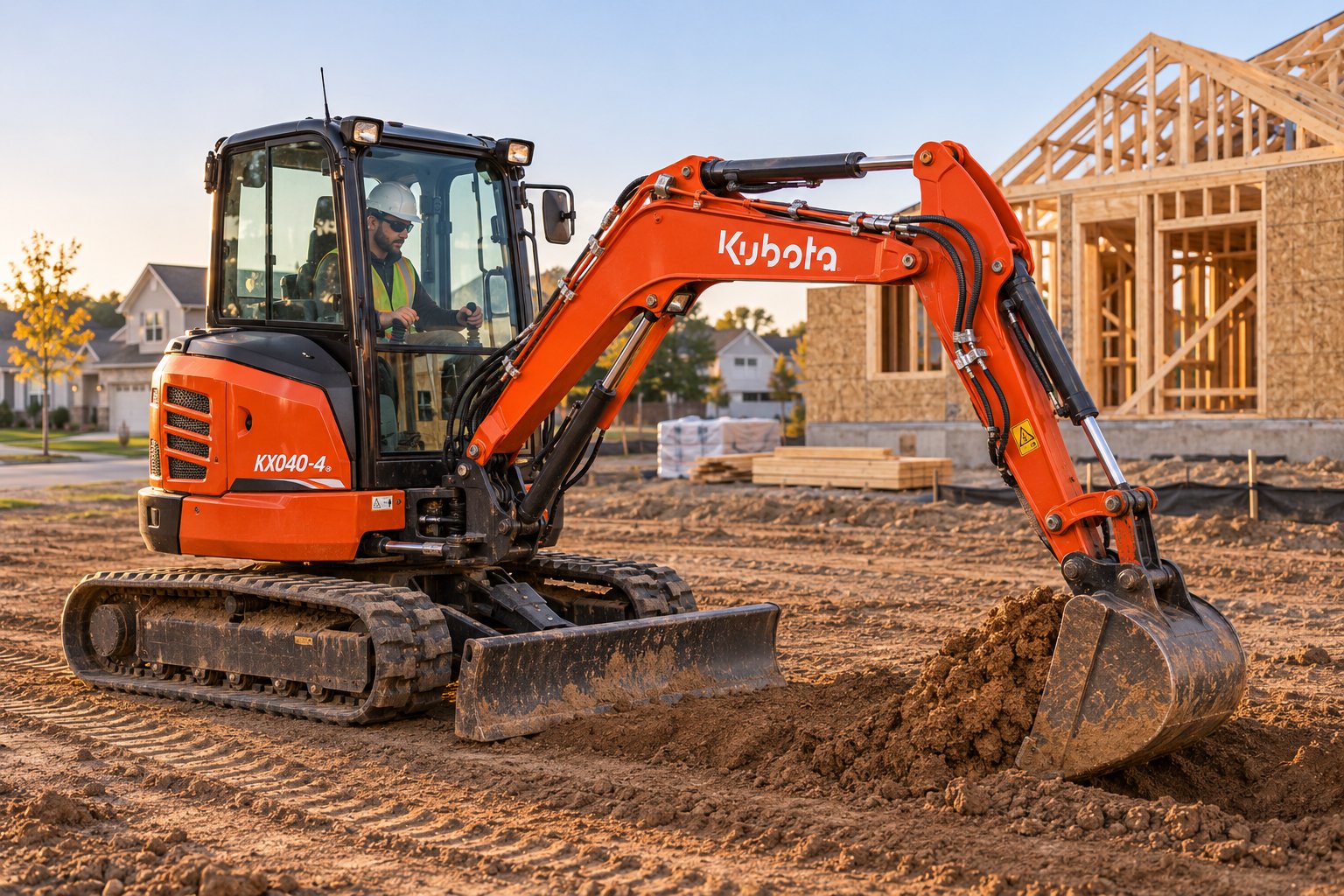
The mid-range sweet spot is where the Kubota KX040-4 lives. With 38.9 horsepower, an operating weight around 9,195 pounds, and compatibility with quick couplers and auxiliary hydraulics, the KX040 has become one of the most popular compact excavators in North America. It hits a balance between transportability — it still fits on a standard equipment trailer — and the digging authority needed for general contracting tasks. For buyers searching for a mini excavator Kubota that handles everyday contracting without feeling underpowered, this is the model dealers recommend most often.
At the top of the range, the KX080-4S2 pushes into the 8-plus-ton class at roughly 18,600 pounds, delivering 62.3 horsepower and a dig depth exceeding 15 feet. Every model across both series is powered by Kubota's own diesel engines, ensuring tight integration between the powertrain and hydraulic systems. It's worth noting that while competitors like the Komatsu mini excavator lineup draw on heavy-equipment engineering heritage, Kubota's excavators are designed from the ground up as compact-first machines — a distinction that shows in cab ergonomics and transport-friendly dimensions.
Kubota Skid Steers and Track Loaders
If excavators are built for digging, Kubota's loader families are built for everything else. The brand splits its loader offerings into two series that often confuse first-time buyers: the SSV skid steers and the SVL compact track loaders.
The SSV skid steer series — including the SSV65 at 64 horsepower and the SSV75 at 74.3 horsepower — rides on wheels and excels on paved or hard-packed surfaces. Bucket breakout forces range from 4,839 to 5,884 pounds, and the compact footprint makes these machines easy to trailer between residential and light commercial sites. Think landscaping, property maintenance, pallet handling, and parking lot work.
The SVL compact track loader series steps up in both capability and terrain versatility. Models range from the SVL65-2 at 68.3 horsepower to the SVL97-3 at 96.4 horsepower, with bucket forces reaching as high as 7,650 pounds. Rubber tracks distribute weight more evenly than wheels, which means better stability and traction on soft, muddy, or uneven ground. SVL loaders also offer higher hydraulic flow rates, making them the better choice when running demanding attachments like mulchers, brush cutters, and cold planers.
Both series feature pressurized cabs, suspension seating, and ergonomic controls designed for long operating hours — details that matter when your crew is running a Kubota skid steer or track loader eight to ten hours a day.
Kubota Wheel Loaders and Utility Vehicles
Kubota's R-series wheel loaders fill a role that excavators and skid steers can't: high-volume material handling with articulated steering and purpose-built loading geometry. The lineup includes three models — the R430, R540, and R640 — all designed with compact dimensions that work in crowded construction yards, busy agricultural operations, and municipal sites where space is tight but workloads are heavy.
Every R-series loader comes standard with an SSQA (skid steer quick attach) coupler, maximizing compatibility with buckets, pallet forks, and other front attachments. The popular R540 delivers 51 horsepower with a base weight of 10,250 pounds, providing the stability needed for serious loading and carrying work. Optional features include a hydraulic quick coupler, a one-yard multipurpose bucket, and front and rear work lights for low-visibility conditions.
Rounding out Kubota's construction versatility are its telehandler offerings, which combine the reach of a crane-style boom with the ground-level maneuverability of a compact loader. These machines handle elevated material placement — think roofing supply staging, second-story framing support, and stockyard management — that neither an excavator nor a skid steer can efficiently address.
Seeing all these categories side by side reveals just how broad a kubota compact excavator and loader ecosystem actually is. The table below organizes the key product families so you can quickly identify which series aligns with your primary applications.
| Category | Popular Series | Typical Weight Class | Primary Applications |
|---|---|---|---|
| Micro/Ultra-Compact Excavators | K008-5, U10-5, U17 | Under 2 tons (2,300 - 3,700 lb) | Shallow trenching, indoor demolition, tight-access residential |
| Mini Excavators | U27-4, KX030-4, KX033-4, U35-4 | 2 - 4 tons (5,600 - 8,800 lb) | Utility trenching, foundation digging, grading, site prep |
| Compact Excavators | KX040-4, U48-5, KX057-5, U55-5 | 4 - 6 tons (9,100 - 12,800 lb) | General contracting, commercial site work, material handling |
| Mid-Size Excavators | KX080-4S2 | 8+ tons (18,500 - 19,500 lb) | Deep trenching, backfilling, demolition, heavy site prep |
| Skid Steer Loaders | SSV65, SSV75 | 6,600 - 8,200 lb | Landscaping, pallet handling, light grading, paved-surface work |
| Compact Track Loaders | SVL65-2, SVL75-3, SVL97-3 | 8,800 - 11,700 lb | Heavy grading, land clearing, soft-ground construction, attachment-intensive work |
| Wheel Loaders | R430, R540, R640 | 7,700 - 12,100 lb | Material loading, truck feeding, snow removal, yard management |
| Telehandlers | TL Series | Varies by model | Elevated material placement, framing support, stockyard operations |
This structured view makes one thing clear: Kubota's construction equipment catalog isn't a handful of machines sharing borrowed components. It's a purpose-built ecosystem where each series targets a specific job type and weight class. The real question isn't whether the right machine exists in the lineup — it almost certainly does. The question is what engineering and technology advantages are built into these machines that justify choosing them over alternatives from other brands.
Engineering and Technology That Set Kubota Machines Apart
Competitor brochures love phrases like "superior performance" and "best-in-class technology." They rarely explain what's actually happening inside the machine. Kubota's engineering advantages aren't marketing abstractions — they're specific hydraulic, cab, and maintenance design decisions that show up in daily productivity, operator retention, and long-term ownership costs. Here's what those vague competitor claims are actually hiding from you.
Hydraulic Systems and Digging Performance
Every construction machine lives or dies by its hydraulic system. You can have the most powerful diesel engine in the class, but if the hydraulics can't distribute that power smoothly and efficiently, operators fight the machine instead of the dirt. This is where Kubota's engineering depth becomes tangible.
Across its excavator lineup — from a compact 2 ton mini excavator to the mid-size KX080 — Kubota uses load-sensing hydraulic systems that automatically adjust oil flow and pressure based on what the operator is doing at any given moment. Swing the boom while simultaneously curling the bucket? The system reads both demands and allocates flow proportionally, eliminating the sluggish, one-function-at-a-time feel common in less sophisticated setups. The result is smoother multi-function operation that experienced operators notice immediately.
The recently launched KX040-5 illustrates this well. Its redesigned hydraulic system utilizes the 40.3-horsepower Kubota diesel engine to its fullest extent, increasing flow rate so operators can run a hydraulic attachment and simultaneously operate other boom functions without sacrificing cycle speed. Proportional auxiliary hydraulics — controlled via a thumb-operated switch on the joystick — let you dial in precise flow for attachments like augers or breakers, while a forefinger-operated on/off switch handles constant-flow applications. That level of fingertip control means less repositioning, fewer wasted movements, and faster cycle times across an entire shift.
Variable-flow pumps across the Kubota mini excavators range further reduce fuel waste by matching hydraulic output to actual demand. When you're idling between tasks, the system isn't pushing oil through circuits at full pressure. When you need maximum breakout force — 9,397 pounds in the KX040-5's case — it's there instantly. It's a fuel-efficiency and performance balancing act that competitors with fixed-displacement pumps simply can't replicate.
Operator Comfort and Productivity Features
Here's a reality most equipment spec sheets ignore: your operator's comfort directly determines your jobsite output. Fatigue sets in around hour five of a ten-hour shift, and when it does, cycle times stretch, precision drops, and safety incidents climb. Kubota treats operator comfort as a productivity investment, not a luxury add-on.
Start with the cab environment. Kubota's enclosed cabs are sealed and pressurized with HVAC systems designed to keep dust and debris out — a meaningful difference on demolition sites or dusty grading jobs where air quality degrades quickly. The SVL75-3 compact track loader takes this further with a one-piece sealed cab that significantly reduces interior noise levels, so operators aren't fighting engine drone and track rumble all day.
Visibility is another area where subtle engineering pays dividends. The KX040-5's cab features an expanded glass area with removed roof window slash bars, giving operators unobstructed sightlines to the bucket during loading and dumping — precisely when you need the clearest view. A repositioned 7-inch LCD monitor and redesigned backlit keypad reduce the time operators spend glancing away from the work zone. An optional rearview camera provides 176 degrees of rearward visibility on select models, adding confidence on congested jobsites where ground crews, trucks, and other equipment share tight quarters.
Seating matters more than most buyers appreciate until they're the one spending ten hours in the cab. Kubota offers suspension seats that absorb the vibration and shock transmitted through the undercarriage on rough terrain. The KX040-5 adds an optional air suspension seat for even greater isolation during extended workdays. Combined with expanded head and foot space, intuitive joystick patterns, and ergonomically positioned controls, these details reduce physical strain enough that operators stay sharper — and more productive — deep into the afternoon hours.
Easy Maintenance by Design
Impressive hydraulics and a comfortable cab mean nothing if the machine spends too many hours in the shop. Kubota engineers maintenance accessibility into the structural design of every model, and the specifics go well beyond the generic "easy service access" claims you'll find on competitor websites.
On compact excavators, tilt-up cabs provide full, unobstructed access to the engine compartment, hydraulic pumps, and filters — no contorting into awkward positions or removing panels just to check fluid levels. Side-opening hoods on skid steers and track loaders similarly expose the engine bay at wide angles, so technicians can perform daily inspections and fluid top-offs in minutes rather than wrestling with narrow access points. Ground-level service points for the air filter, engine oil dipstick, coolant reservoir, battery, and hydraulic filters mean routine checks happen quickly and consistently, even in the field.
These grouped maintenance access points aren't cosmetic — they're calculated to reduce downtime and lower total cost of ownership. When daily maintenance takes five minutes instead of twenty, it actually gets done. That consistency extends component life, catches small issues before they become expensive failures, and keeps machines on the jobsite instead of on a service bay lift. If you're browsing a kubota mini excavator for sale, whether new or used, check the hour meter against the service history — a well-maintained Kubota with accessible service points typically shows far fewer deferred-maintenance problems than competitors with buried filters and cramped engine bays.
On the technology front, fleet management capabilities are expanding across the lineup. The KX040-5 comes with KubotaNOW telematics pre-installed, allowing owners and fleet managers to monitor accumulated hours, fuel level, and machine location directly from a mobile app. Standard keyless start with up to 10 unique operator passwords adds security and accountability — you'll know who operated the machine and when. LED work lights with a turn-off delay let operators leave the jobsite safely under illumination. While telematics and GPS integration continue evolving across the compact equipment industry, Kubota's decision to make these features standard rather than optional on key models signals where the brand is heading.
All of this engineering — the hydraulics, the cab design, the maintenance architecture — solves a problem that spec sheets alone can't answer. Specifications tell you what a machine can do in ideal conditions. Engineering quality determines what it actually does, day after day, across thousands of operating hours. That distinction becomes especially important when you're choosing between machine categories and matching the right Kubota model to your specific projects and budget.
How to Choose the Right Kubota Machine for Your Project
Knowing what's under the hood is one thing. Knowing which machine belongs on your trailer tomorrow morning is another. The right choice depends less on specifications and more on how you actually work — the types of jobs you bid, the sites you access, and the crew you run. A landscaping sole proprietor, a mid-size general contractor, and a municipal utility crew all benefit from Kubota construction equipment, but they need very different machines to get the most from their investment.
Let's walk through the decision the way it actually happens in the real world: starting with the dirt you need to move and working backward to the machine that moves it best.
Matching Kubota Excavator Size to Your Jobsite Needs
Excavator sizing isn't about buying the biggest machine you can afford. It's about matching operating weight, dig depth, and transportability to the work you perform most often. Get this wrong, and you're either paying for capacity you never use or constantly wishing you had more reach.
Under 1 ton — Micro excavators for tight residential access. The Kubota K008-5 (2,025 lb) and U10-5 (2,646 lb) fit through standard backyard gates, roll across finished lawns with minimal damage, and even work inside structures during renovation projects. Dig depths top out around 5 feet 8 inches to 5 feet 11 inches — enough for shallow utility trenching, planting large trees, and breaking up concrete patios. If you're a small landscaping contractor who regularly works in fenced residential yards, these kubota small excavator models eliminate the "access problem" that forces competitors to hand-dig.
2-ton class — The landscaping and utility trenching workhorse. Models like the U27-4 (5,688 lb) and KX030-4 (6,272 lb) hit dig depths between 9 feet 5 inches and 9 feet 7 inches, which covers water line installation, irrigation main trenching, and residential foundation footings. These machines still fit on a single-axle equipment trailer, keeping transport costs and licensing requirements manageable for one- or two-person crews. Municipal utility buyers often spec this size class for sidewalk repair, fire hydrant installation, and storm drain maintenance — jobs where the machine needs to dig meaningfully deep but can't shut down an entire street to operate.
3-to-4-ton class — General contracting's sweet spot. This is where the popular KX040-4 lives, at 9,195 pounds with a dig depth of 11 feet 3 inches and 40.4 horsepower. The KX040-4 handles residential basement excavation, commercial utility runs, septic system installation, and light demolition without feeling underpowered. For a mid-size general contractor running three or four crews, this weight class offers the best balance between capability and fleet flexibility — one machine covers the majority of everyday dig work while still fitting on a tandem-axle trailer. Buyers searching for a kubota excavator for sale in this range will find it's the most actively traded size class on the used market, which speaks to both its popularity and its strong resale value.
5-to-8+ tons — Commercial site work and deep excavation. The KX057-5 (12,346 lb) and KX080-5 (18,760 lb) deliver dig depths from 12 feet 9 inches to over 15 feet, with the horsepower and bucket force to handle heavy clay, rock-laced soil, and demolition debris. These models require a dedicated equipment trailer and a truck with appropriate towing capacity, so they're best suited for contractors who bid on projects large enough to justify keeping the machine on site for days or weeks at a time. Municipal buyers use this class for deep sewer main installation and major stormwater infrastructure projects.
The transportability factor deserves special attention because it's the hidden cost most first-time buyers overlook. A machine under 10,000 pounds typically rides on a standard tandem-axle trailer towed by a one-ton pickup — equipment many contractors already own. Step above that threshold and you may need a dedicated lowboy trailer and a CDL-rated tow vehicle, which adds thousands in annual operating costs. Match the excavator to your most common job, not your biggest theoretical project.
Skid Steer or Excavator — Choosing the Right Tool
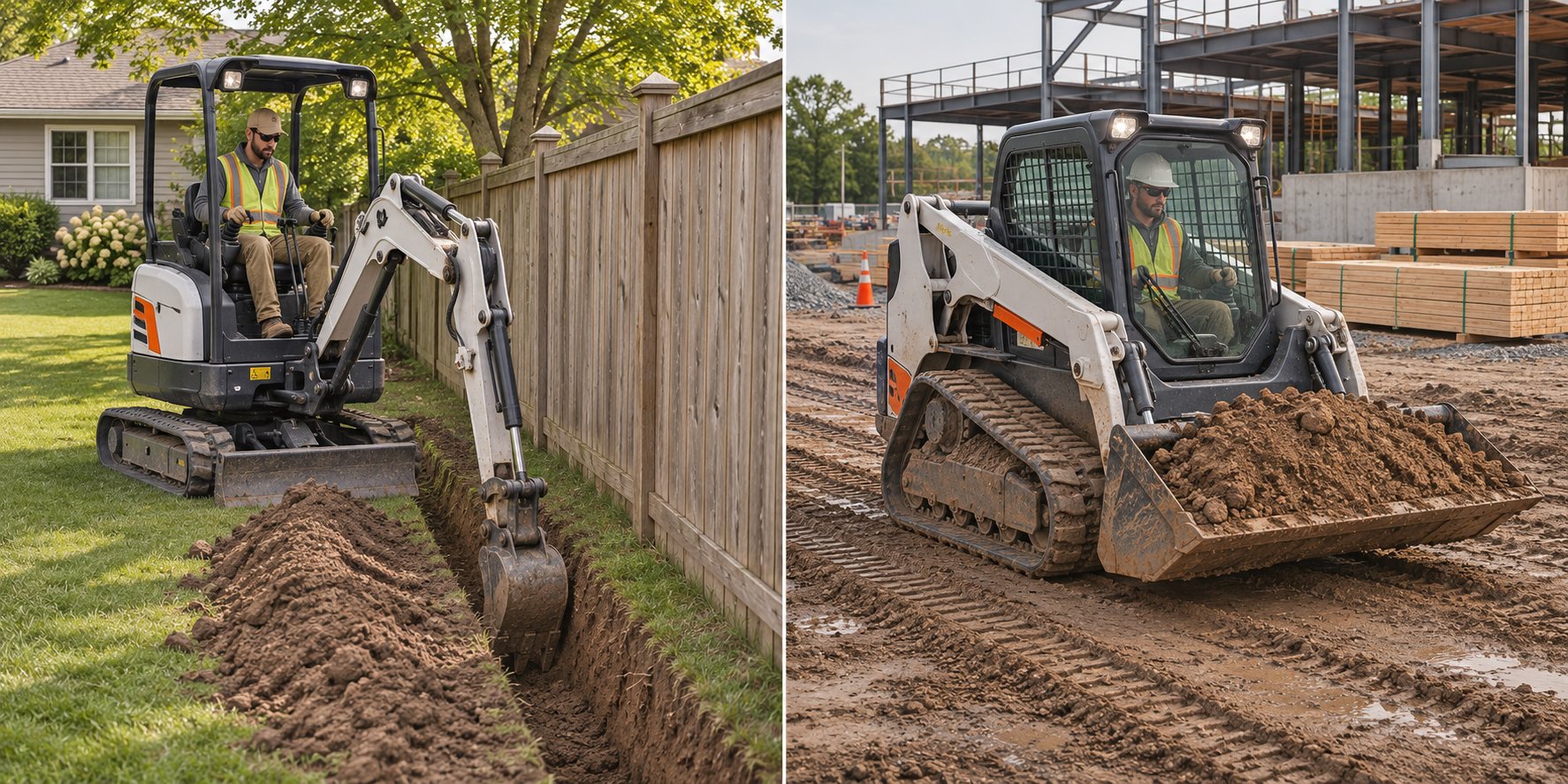
This is the question that stalls more purchasing decisions than any financing application. Should you buy a Kubota skid steer — or a compact track loader — versus a compact excavator? The honest answer is that these machines solve fundamentally different problems, and industry guidance consistently confirms that the choice comes down to how and where you work, not which machine is "better."
Excavators excel at digging below grade. Trenching, foundation work, precise grading, stump removal, and any task that requires controlled downward force and reach — that's excavator territory. The 360-degree cab rotation lets operators dig, swing, and dump without repositioning the machine, which saves enormous time on trenching runs.
Skid steers and track loaders dominate above-grade work. Material handling, finish grading, snow removal, pallet transport, and high-volume earthmoving across a site are where these machines shine. Their attachment versatility is unmatched — a single SSV75 or SVL75-3 can run buckets, forks, brush cutters, trenchers, augers, and sweepers over the course of a week, effectively replacing multiple single-purpose machines. For contractors who also use a kubota wheel loader or are considering consolidating fleet roles, a track loader with the right attachments can absorb several tasks that would otherwise require separate equipment.
Many experienced contractors eventually run both — an excavator for digging and a loader for everything else. But if you're choosing just one machine to start, use this decision checklist to clarify which tool earns the first spot on your trailer:
- Primary task type: If more than 60% of your work involves digging, trenching, or below-grade excavation, start with an excavator. If your work centers on loading, grading, carrying, and attachment-driven tasks, a skid steer or track loader is the smarter first purchase.
- Site access constraints: Working in tight residential lots with soft turf? A mini excavator's tracks distribute weight gently. Operating on paved commercial sites? A wheeled skid steer moves faster and won't damage asphalt.
- Attachment needs: Count how many different attachments you'd realistically run in a typical month. If the answer is four or more, a skid steer's universal quick-attach system and higher hydraulic flow rates give you more flexibility.
- Transport logistics: Both machine types in the compact class fit standard trailers, but verify the operating weight against your tow vehicle's rating. A loaded SVL97-3 at nearly 11,700 pounds demands more towing capacity than a U27-4 at 5,688 pounds.
- Budget range: Compact excavators in the 2-to-4-ton class and entry-level skid steers occupy similar price bands. If you're comparing kubota excavators for sale against loader options, factor in attachment costs — a skid steer's versatility advantage disappears if you can't afford the attachments that unlock it.
What size Kubota excavator do you actually need? For most landscaping contractors, a U27-4 or KX030-4 handles 80% of daily work. General contractors bidding residential and light commercial projects gravitate toward the KX040-4 — the model Kubota dealers recommend most frequently for its balance of dig depth, power, and trailer-friendly weight. Municipal and utility crews often maintain a mixed fleet: a micro excavator for sidewalk and curb work, a mid-range unit like the KX040-4 for standard utility trenching, and a larger KX080-5 for deep infrastructure projects.
If you're still weighing options and want to compare pricing across the lineup, requesting a kubota tractors price list from your local dealer — one that includes excavators and loaders alongside tractors — gives you a single reference point for budgeting across equipment categories. Dealers are typically willing to build these comparison sheets, especially when you're evaluating multiple machine types for a growing fleet.
Choosing the right machine category and size class is the foundation of a smart equipment investment. But even the perfect base machine only reaches its full potential when paired with the attachments that transform it from a single-purpose tool into a multi-role jobsite asset.
Kubota Attachments That Multiply Your Machine's Value
A Kubota excavator or track loader sitting on your trailer with a single bucket is like a smartphone with only one app installed — functional, but nowhere near its full potential. The real return on your equipment investment doesn't come from the base machine alone. It comes from the attachments that let one power unit tackle five, ten, or even fifteen different job types across a single season. This is the part of Kubota construction equipment ownership that competitors rarely discuss in detail, yet it's the factor that most dramatically affects your cost-per-job and annual revenue capacity.
Essential Kubota Excavator Attachments
Compact and mini excavators are built around hydraulic circuits specifically designed to power a rotating roster of tools. Swapping a standard digging bucket for a specialized attachment turns your small excavator into an entirely different machine — often in under a minute with the right coupler system.
Here's where the versatility gets practical. A narrow trenching bucket digs precise utility runs for water, gas, or electrical lines. Swap to a wider cleanup bucket and you're grading a building pad or backfilling a foundation. Hydraulic breakers — mounted directly to the excavator's boom — deliver focused demolition force for breaking concrete, asphalt, and rock without bringing a separate piece of equipment to the site. Auger attachments drill post holes, pier footings, and tree-planting pockets at a fraction of the time hand tools require. Grapples clamp around irregularly shaped debris — stumps, brush piles, demolished framing lumber, boulders — and place them precisely where you need them. And thumb kits, which mount opposite the bucket, give operators a "grip" function that transforms a standard bucket into a crude but effective claw for handling logs, pipes, and demolition material that would otherwise roll off the bucket during a swing.
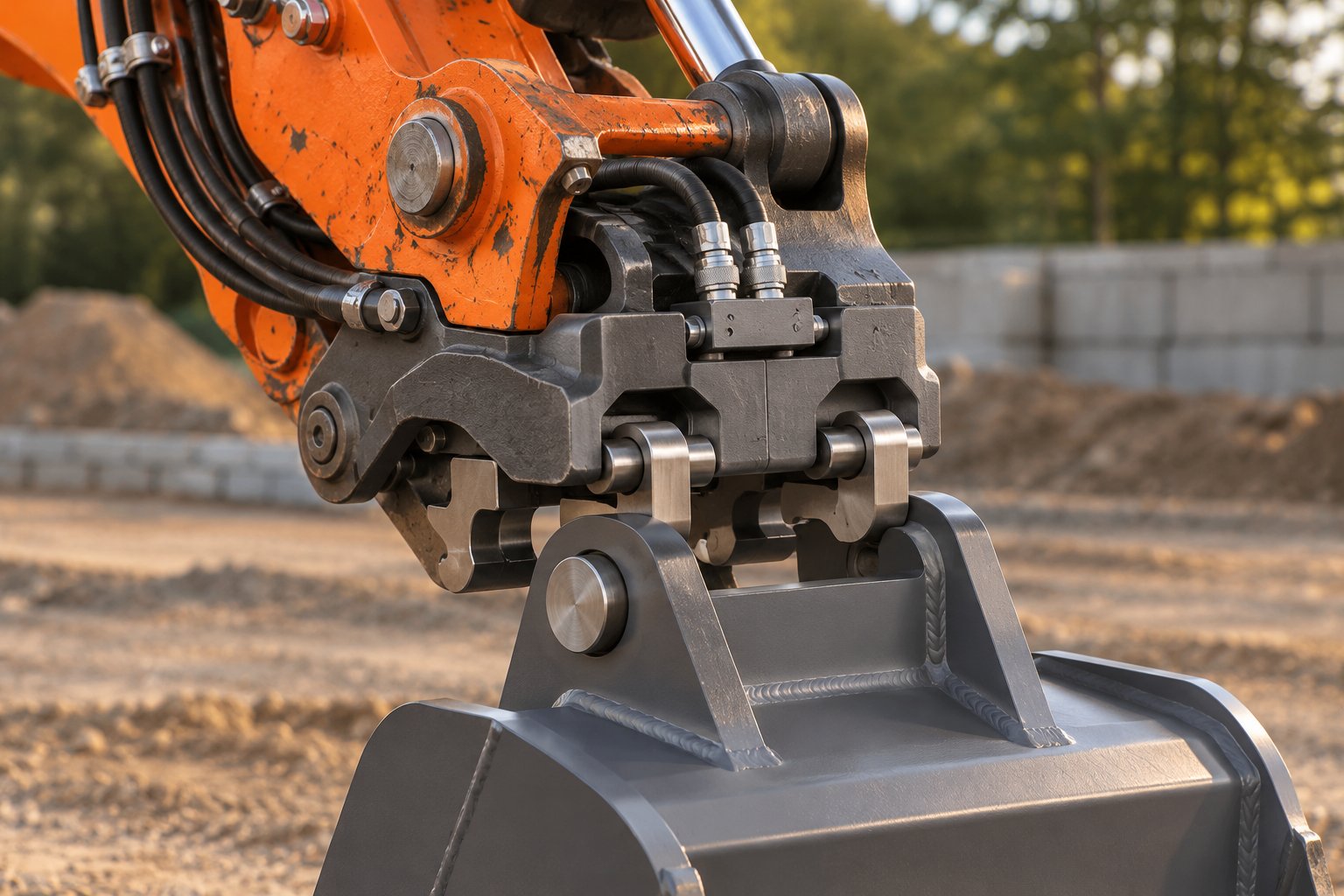
The key enabler behind all of this versatility is the quick-coupler system. Rather than manually pinning each attachment with a hammer and drift pins — a process that can eat fifteen to twenty minutes per swap — a hydraulic quick coupler lets the operator connect and disconnect attachments from inside the cab in under sixty seconds. On a busy jobsite where you're trenching in the morning, breaking concrete at midday, and cleaning up debris by afternoon, that time savings compounds dramatically. Most Kubota compact excavators from the KX030-4 upward support quick-coupler integration, though buyers should confirm compatibility for their specific model and preferred coupler brand through their dealer.
Skid Steer and Track Loader Attachment Versatility
If excavator attachments are impressive, the skid steer and track loader attachment universe is genuinely staggering. Kubota skid steers and SVL track loaders use a universal skid steer quick-attach mounting plate — the same interface standard used across most of the industry — which means the pool of compatible attachments extends well beyond Kubota-branded options into hundreds of aftermarket and specialty tools.
Imagine this scenario: on Monday, your SVL75-3 runs a general-purpose bucket for site grading. Tuesday, you bolt on pallet forks and spend the day unloading lumber deliveries and staging materials across a commercial project. Wednesday brings a land-clearing job, so the brush cutter goes on. Thursday, you're trenching irrigation lines with a dedicated trencher attachment. Friday, the crew sweeps a finished parking lot with a rotary broom before the client's final walkthrough. One machine. Five entirely different revenue-generating tasks. For a small contractor watching every dollar, that kind of flexibility can eliminate the need to own — or rent — three or four single-purpose machines.
The most common attachment categories for Kubota skid steers and track loaders, along with their primary applications, include:
- General-purpose buckets: Everyday earthmoving, gravel handling, mulch spreading, and site cleanup — the attachment that spends the most hours on most machines.
- Pallet forks: Material handling for lumber, fencing supplies, palletized goods, and equipment staging — essential for any contractor who receives deliveries on site.
- Grapples: Land clearing, storm debris removal, log handling, and demolition cleanup — grab, clamp, carry, and place irregular materials that buckets can't secure.
- Augers: Fence post installation, sign posts, deck footings, pier drilling, and tree planting — replace hours of manual digging with minutes of hydraulic boring.
- Brush cutters and mulching heads: Overgrown lot clearing, trail maintenance, fence line cleanup, and vegetation management on rural or undeveloped properties.
- Trenchers: Shallow utility trenching for drainage, irrigation, electrical conduit, and water lines — a faster alternative to excavator trenching on smaller-scale runs.
- Snow blowers and pushers: Commercial parking lots, municipal streets, farm yards, and large residential driveways — turn your construction machine into a winter revenue source.
- Sweepers and brooms: Post-construction cleanup, parking lot maintenance, warehouse floor clearing, and municipal street sweeping.
- Grading and leveling attachments: Fine grading for lawns, driveways, building pads, and landscape preparation — precision finishing that a standard bucket can't achieve.
One critical detail that often gets overlooked: not every attachment performs optimally on every machine. Hydraulic compatibility matters significantly. Attachments are rated for specific flow ranges and operating pressures. A mulching head designed for high-flow hydraulics won't perform well — and could even sustain damage — if paired with a machine that only provides standard-flow output. Kubota's SSV skid steers typically operate in the standard-flow range suitable for buckets, forks, grapples, augers, and light-duty hydraulic tools. The SVL track loaders, particularly the SVL75-3 and SVL97-3, offer higher flow rates that unlock compatibility with more demanding attachments like cold planers, large brush cutters, and snow blowers.
Before purchasing any attachment, verify three things with your dealer: the attachment's required hydraulic flow rate in gallons per minute, the machine's auxiliary hydraulic output, and whether the mounting interface matches your coupler system. This quick compatibility check prevents the frustration of buying an attachment your machine can physically accept but can't hydraulically power to its rated performance.
The broader principle here applies equally to buyers considering kubota tractor implements for their agricultural Kubota machines and to those building out a construction fleet. Whether you're spec'ing a Kubota front end loader bucket for a wheel loader or choosing a breaker for a KX040, the attachment ecosystem is where your per-machine ROI either multiplies or stalls. Smart buyers plan their attachment strategy at the same time they select their base machine — not as an afterthought six months later.
This attachment-driven versatility also reshapes how Kubota stacks up against its biggest competitors. A brand's value isn't just about the machines it builds — it's about the ecosystem of tools, support, and compatibility surrounding those machines.
Kubota vs. Caterpillar, Bobcat, John Deere, and Komatsu
Attachment ecosystems don't exist in a vacuum — they're part of a broader brand ecosystem that includes dealer support, engineering heritage, and resale market depth. Yet when buyers compare Kubota excavators against competing brands, most online resources offer little more than spec-sheet shootouts. The more valuable comparison looks at what each brand is built to do best and where its focus actually lies.
Kubota vs. Caterpillar and John Deere in Compact Equipment
Caterpillar and John Deere are manufacturing giants with product lines stretching from 400-ton mining trucks to compact excavators. That breadth is a genuine strength — Cat runs the largest construction equipment dealer footprint in North America, and Deere's integrated financing through its agricultural dealer network is hard to match if you already own green iron. Recent Equipment World market data shows Caterpillar narrowly overtook Kubota in new financed U.S. mini excavator sales, capturing 23.3% versus Kubota's 22.4% — evidence that both brands compete fiercely at the top of the market.
The difference is strategic focus. Cat and Deere spread engineering resources across heavy equipment, agriculture, and compact lines simultaneously. Their compact excavators are excellent machines, but compact is one division among many. Kubota channels the majority of its construction R&D into the compact and mid-size segment exclusively. That concentrated investment produces purpose-built designs — hydraulic systems, cab dimensions, transport weights, and maintenance access points engineered specifically for tight-space, compact-class work rather than scaled-down versions of heavier platforms.
For a buyer shopping kubota tractors and attachments alongside construction machines, this focus shows up in practical ways: cab ergonomics sized for compact frames rather than shrunk from full-size cabs, undercarriage geometry optimized for residential trailer loading, and engine-to-hydraulic integration that reflects decades of iteration within the same weight classes.
Kubota vs. Bobcat and Komatsu for Mini Excavators
Bobcat built its reputation on the skid steer loader — a legacy so strong the brand name is practically synonymous with the machine category. Its compact excavator line has improved significantly with the current R-series generation, and Bobcat holds a solid third-place position in the U.S. at 17.1% of new financed sales. If your crew already runs Bobcat loaders and you value cross-platform operator familiarity, the excavator lineup deserves serious consideration. That said, industry reviews consistently note that Bobcat's mini excavator heritage doesn't yet match the depth of its loader pedigree — older used Bobcat excavators tend to depreciate harder than top-tier competitors.
Komatsu brings a different angle entirely. As a heavy-equipment powerhouse, Komatsu applies its large-excavator engineering philosophy to a smaller compact excavator range — currently around six models in North America. The machines are well-built and fuel-efficient, but the lineup is narrower, and dealer density for compact-specific service runs thinner than Kubota's or Cat's in many markets. If you're already operating Komatsu heavy iron on commercial sites, the brand continuity and parts commonality make a compelling case. For buyers whose primary work is residential or light commercial — the typical contractor searching for a mini backhoe for sale to handle trenching and utility work — Kubota's deeper model selection and broader compact-focused dealer network typically provide a better fit.
Ultimately, the "right" brand depends less on marketing claims and more on three local realities: how strong the nearest dealer is, how well the available models match your primary use case, and how the attachment ecosystem (covered in the previous section) aligns with the work you actually bid. The table below maps each brand's core strengths to help you weigh those factors objectively.
| Factor | Kubota | Caterpillar | Bobcat | John Deere | Komatsu |
|---|---|---|---|---|---|
| Compact Equipment Focus | Primary business — R&D concentrated on compact/mid-size | One division among many (mining, heavy, compact) | Strong in loaders; growing in excavators | Split across agriculture, heavy, and compact | Primarily heavy equipment; compact is a secondary line |
| Dealer Network Scale (North America) | Extensive — one of the densest compact-equipment networks | Largest overall dealer footprint in construction | Very strong in compact equipment markets | Deep in agricultural regions; growing in construction | Strong for heavy iron; thinner for compact-only service |
| Mini Excavator Heritage | 40+ years; global market-share leader | Decades of experience; top U.S. financed sales | Newer entrant; R-series up to current standards | G-Series competitive; not a historic specialty | Respected engineering; narrower model range in compact |
| Attachment Ecosystem | Broad — OEM and aftermarket; quick-coupler support across lineup | Extensive — deep Cat-branded and aftermarket options | Industry-leading for loaders; solid for excavators | Good compatibility; benefits from ag-implement crossover | Adequate; smaller aftermarket pool in compact class |
| Resale Value (Compact Class) | Among the strongest — 60-70% retention at 3 years | Strong — commands premium at auction | Moderate — older excavators discount more than loaders | Solid — slightly behind top tier in excavator class | Good for heavy; less used-market depth in compact |
No single column "wins" across every row — and that's the honest takeaway. Kubota's advantage is its relentless compact-segment focus and the resale strength that follows from it. Cat's advantage is sheer dealer scale and service speed. Bobcat dominates loader attachment versatility. Deere leverages agricultural relationships. And Komatsu offers heavy-equipment engineering credibility in a smaller package. Your job mix, your geography, and your dealer relationship will tip the decision more than any brand comparison chart ever could.
The brand you choose sets the stage. The financial strategy behind the purchase — new versus used, OEM financing versus third-party lending, and the total cost of ownership over your planned hold period — determines whether that choice pays off.
Buying New vs. Used Kubota Equipment and Managing Costs
Brand selection and competitive positioning give you strategic clarity. Financial strategy gives you operational survival. Yet across nearly every piece of competitor content about Kubota construction equipment, cost guidance is either absent entirely or buried behind a vague "contact your dealer" redirect. That silence leaves buyers — especially first-time owners and small contractors — guessing at numbers that directly determine whether a machine becomes a profit center or a cash drain.
Whether you're pricing a kubota loader for your landscaping fleet, evaluating a kubota utility tractor for municipal work, or shopping for your first compact excavator, the financial decision breaks down into the same core variables: acquisition cost, operating expenses, financing structure, and the new-versus-used tradeoff. Let's put real numbers behind each one.
Understanding Kubota Equipment Costs and Financing
Purchase price gets all the attention, but it's only one line on the ownership ledger. Total cost of ownership — what you actually spend over the life of the machine — includes fuel, maintenance intervals, insurance, depreciation, and the cost of capital tied up in the asset. Smart buyers evaluate all five before signing anything.
Acquisition pricing. Kubota USA's current promotions list MSRP starting points that frame the range clearly. A K008-5 micro excavator starts at $28,450, while a mid-range KX040-5 sits around $68,768 and the larger KX080-5 reaches $138,273. Skid steers, track loaders, and wheel loaders occupy different bands, and kubota sub compact tractor models intended for light construction support tasks add yet another tier. These are manufacturer-suggested prices — actual transaction prices at dealerships like kubota of chattanooga or johnson city kubota and equipment will vary based on configuration, local demand, and trade-in credits.
Fuel efficiency. Kubota's proprietary diesel engines are engineered for low fuel consumption relative to their output. Variable-flow hydraulic pumps — discussed in the engineering section above — reduce parasitic fuel draw during idle and light-load cycles. For a machine like the KX040-5 running 600 to 800 hours annually, fuel costs typically range from $3,000 to $5,500 per year depending on diesel pricing and workload intensity. Track your consumption by operating hour, not by calendar day, to get an accurate picture.
Maintenance intervals and costs. Kubota's grouped-access maintenance architecture keeps routine service costs lower than competitors with buried filters and cramped engine bays. Annual maintenance on a well-kept compact excavator generally runs $2,800 to $4,500, covering oil and filter changes every 250 to 500 hours, track and undercarriage inspections, and hydraulic system servicing. Under factory warranty, those costs drop to roughly $1,200 to $2,000 per year — a gap that factors heavily into the new-versus-used equation.
Resale value. This is where Kubota's market leadership pays dividends long after the purchase. High production volumes, dense parts availability, and brand familiarity across rental fleets create persistent demand on the secondary market. Well-maintained Kubota compact excavators commonly retain 55 to 70 percent of their original value at the three-to-four-year mark — a depreciation curve that's meaningfully shallower than most competitors in the same weight class.
Financing structures. Kubota USA regularly offers OEM financing promotions, and the current program is compelling: 0% APR for up to 60 months with $0 down across the excavator lineup. That means a $68,768 KX040-5 financed through Kubota Credit costs exactly $68,768 over five years — no interest charges inflating the total. Compare that to a third-party commercial equipment loan at 7 to 9 percent APR, which would add $12,000 to $18,000 in interest on the same machine over the same term. When evaluating dealer financing against bank or credit union alternatives, always compare the total repayment amount, not just the monthly payment. A lower monthly figure with a longer term or balloon payment can easily cost more in the aggregate.
Why Buying a Used Kubota Excavator Makes Financial Sense
Here's the math most new-equipment buyers don't calculate until it's too late: a brand-new compact excavator loses roughly 20 to 25 percent of its value in the first year alone. On a $70,000 machine, that's $14,000 to $17,500 in depreciation before the first anniversary. A comparable used unit with 1,500 hours, purchased at $36,000 to $40,000, has already absorbed that steep initial curve. Over a five-year hold, total depreciation on the used unit typically runs $12,000 to $16,000 versus $30,000 to $38,000 on the new equivalent.
Three factors make used Kubota machines particularly attractive compared to used equipment from other brands:
- Proven reliability track record: Kubota diesel engines and hydraulic components are engineered for durability across thousands of operating hours. A machine with 2,000 hours of documented service history often has 3,000 to 5,000 productive hours remaining — plenty of working life for a contractor running 600 to 800 hours per year.
- Parts support for older models: Because Kubota has led the mini excavator market for decades, replacement parts for even older KX-series and U-series models remain readily available through the dealer network and aftermarket suppliers. You won't find yourself waiting weeks for a discontinued component the way you might with a lower-volume brand.
- Lower financing and insurance costs: Used equipment loans carry lower principal amounts, which means smaller monthly obligations even at slightly higher interest rates. Insurance premiums on used machines typically run 15 to 25 percent lower than on new units of equivalent capability, further reducing the annual ownership burden.
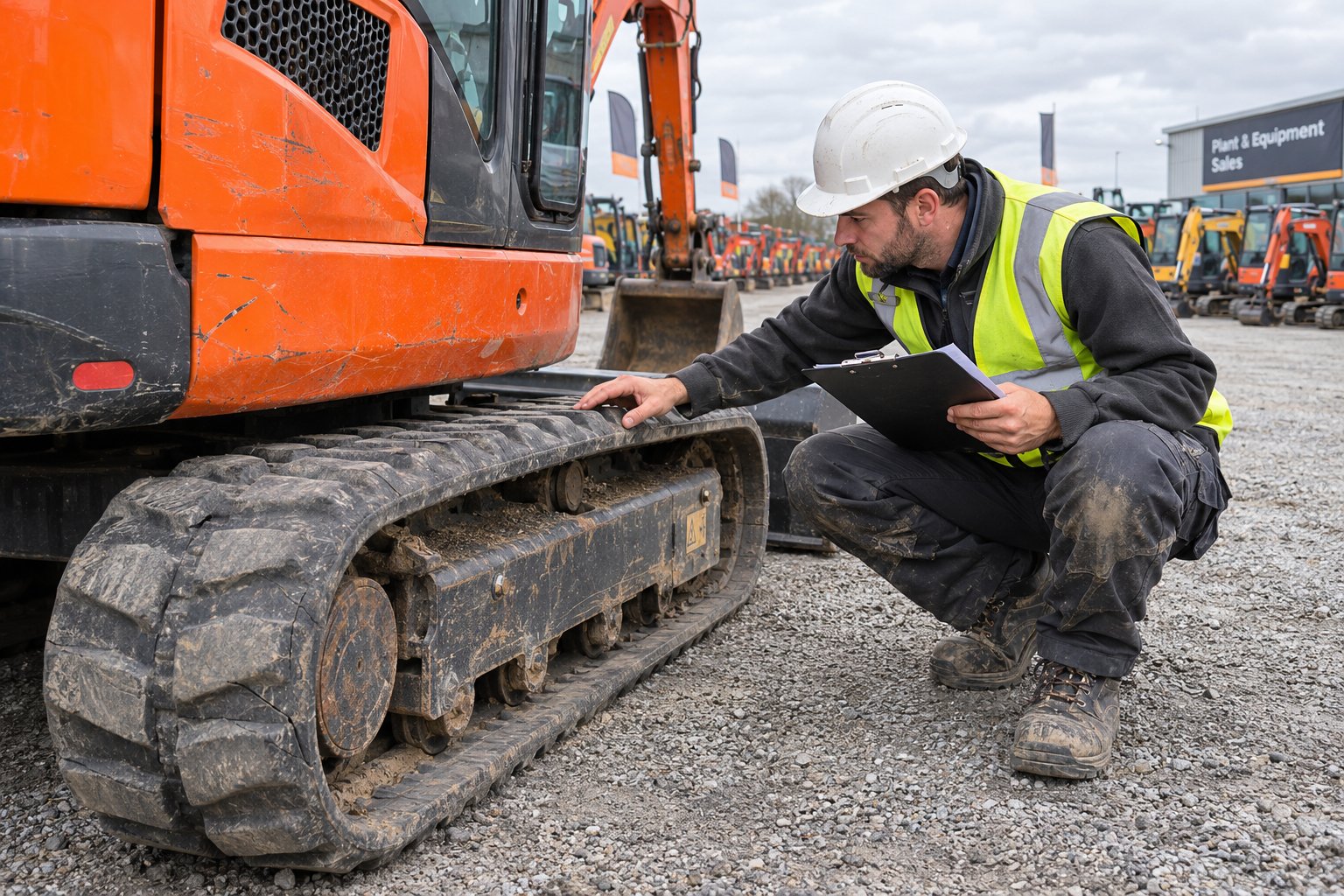
The critical caveat? A used machine is only a smart buy if you inspect it properly. The difference between a $35,000 excavator that delivers four more years of reliable service and one that needs a $7,000 final drive rebuild within the first month comes down to a 45- to 60-minute pre-purchase evaluation. Here are the inspection points that separate informed buyers from expensive mistakes:
- Hour meter readings: Under 2,000 hours with documented service history is low risk. Between 2,000 and 4,000 hours, budget for near-term service items and get an independent inspection. Above 4,000 hours, only proceed if overhaul records exist or the price reflects potential drivetrain rebuild costs of $5,000 to $10,000.
- Undercarriage condition: This is the most expensive repair on a compact track machine. Check rubber track pad thickness — anything under 15mm of remaining lug depth warrants price negotiation. Inspect the front idler and sprocket teeth for hooked or shark-finned wear patterns. Press each carrier roller for lateral play; significant movement signals bearing failure.
- Hydraulic system integrity: Cycle every function — boom, arm, bucket, swing, travel — and watch for hesitation, drift under load, or abnormal noise from the main control valve. Check all visible hoses for cracking, chafing, or bulging near crimp fittings. Pull or request the final drive drain plug and examine the oil for metallic particles or a milky appearance — either condition signals imminent failure.
- Engine cold-start behavior: Start the machine cold. Excessive white smoke beyond 90 seconds suggests head gasket wear or injector issues. Blue smoke during operation indicates oil burn. Pull the engine oil dipstick and check for fuel dilution (oil that smells like diesel) or a creamy, frothy texture pointing to coolant intrusion.
- Service history verification: Ask for maintenance records, dealer service receipts, or fleet management printouts. A machine with meticulous records from a landscaping company or municipality is almost always a safer purchase than a low-hour unit from an unknown private owner with no documentation.
- DPF and emissions system status: On Tier 4 Final engines (2013 and newer Kubota models), check the DPF soot load percentage from the machine's diagnostic display if accessible. Readings above 80 percent indicate a forced regeneration or DPF service is overdue — a potential cost you'll want factored into negotiations.
Buyers exploring used Kubota compact excavators have several sourcing channels. Authorized dealers offer certified pre-owned inventory with inspection reports and sometimes limited warranties — the safest option for buyers without deep mechanical expertise. Auction platforms like Ritchie Bros. and IronPlanet provide transparent market pricing with broad selection, though condition certainty varies. Private fleet dispersal sales from landscaping companies or municipal agencies often yield the cleanest machines, since these organizations typically follow scheduled maintenance protocols.
Another practical starting point is JIUHONG's used Kubota excavator collection, where buyers can browse available U-series and KX-series models, compare condition details and specifications, and submit quote requests directly. It's a useful resource for getting a sense of what's available on the global secondary market and benchmarking pricing alongside domestic options. Keep in mind that specific model availability — such as the KX040 — varies with inventory turnover, so inquire directly for current stock if you're targeting a particular machine.
Regardless of where you source, the inspection checklist above applies universally. A $300 to $500 independent mechanic's evaluation before purchase is the cheapest insurance available on a $25,000 to $50,000 transaction. Skipping it is, as one veteran dealer put it, the most expensive free decision a contractor can make.
The financial case for Kubota — whether new with 0% financing or used with reduced depreciation exposure — is strong on paper. But paper advantages only materialize when the dealer and support infrastructure behind the brand can keep your machine running, get parts to your shop fast, and solve problems before they escalate into lost job days.
Kubota's Dealer Support and Your Next Steps
Financing terms and depreciation curves look great on a spreadsheet. They fall apart the moment a hydraulic hose blows on a Tuesday morning and you can't get a replacement until Friday. The gap between a profitable week and a devastating one often comes down to a single factor that never appears on a spec sheet: how fast your dealer can get you back to work. For Kubota construction equipment buyers, this is where the brand's infrastructure advantage becomes most tangible — and most underestimated.
Kubota's Dealer Network as a Competitive Advantage
Kubota operates a network of over 1,100 dealerships across North America — locally owned, staffed by certified technicians, and stocked with genuine parts engineered to match original factory standards. That density matters far more than most first-time buyers realize. When your compact excavator goes down mid-job, the question isn't whether the right part exists somewhere in the supply chain. The question is whether it's sitting on a shelf 20 miles away or stuck in a distribution center 400 miles away. A denser dealer network closes that distance, cutting parts delivery from days to hours and getting your crew back to digging before the client starts calling competitors.
Shorter service wait times follow naturally from that density. With more locations handling warranty claims, routine maintenance, and emergency repairs, no single dealership is overwhelmed with a backlog that pushes your machine to the back of the line. Local expertise matters too — a technician who has rebuilt forty KX040 hydraulic systems knows where to look first and what to check second. That familiarity shaves diagnostic time and prevents the expensive trial-and-error troubleshooting you sometimes encounter with less commonly serviced brands.
Beyond parts and service, Kubota dealerships offer access to rental and loaner programs that reduce purchasing risk in two important ways. First, rental lets you operate the exact machine you're considering before committing capital — you'll know whether the cab fits your tallest operator, whether the hydraulic response matches your expectations, and whether the transport weight works with your trailer setup. Kubota Rental positions this as a deliberate advantage: reliable equipment, capital preservation, and proactive dealer maintenance that keeps rented units in peak condition throughout your project. Second, loaner programs during warranty service ensure that a machine in the shop doesn't become a crew sitting idle. For contractors who bid jobs weeks in advance and can't afford schedule slippage, that loaner availability is worth more than any line item on a feature comparison chart.
This dealer infrastructure is frequently cited as the deciding factor when buyers are choosing between comparable compact construction equipment from competing brands. You might find a slightly lower sticker price on another machine — but if the nearest dealer qualified to service it is 90 miles away and backordered on filters, that savings evaporates during your first breakdown. Kubota's network density, combined with its parts availability advantage from decades of market-leading production volume, creates a support ecosystem that competitors with thinner dealer footprints simply can't replicate in most U.S. markets.
Where is Kubota manufactured? As covered earlier, primarily in Osaka, Japan, and Gainesville, Georgia — but where it's supported is across 1,100-plus dealer locations that stock genuine parts, employ trained technicians, and maintain rental fleets. That support map is ultimately what turns a well-engineered machine into a reliable business asset.
Next Steps for Choosing Your Kubota Construction Equipment
You've covered a lot of ground in this guide — from Kubota's engineering heritage and manufacturing strategy to the full range of kubota excavator models, kubota loaders, skid steers, and attachments. You've seen how to match machine size to jobsite demands, weighed the new-versus-used tradeoff, and compared Kubota's positioning against every major competitor. The question now is simple: what do you do with all of it?
Here's the action plan that turns research into a purchase decision you won't second-guess six months from now:
- Define your primary application. List the three job types that account for 80% of your annual revenue. If most of your work involves digging, trenching, or below-grade excavation, start your search with compact excavators. If material handling, grading, and attachment-driven versatility dominate your workflow, prioritize a skid steer or track loader. Municipal and utility buyers should map their most common service call types — sewer repair, curb replacement, storm drain maintenance — to the weight class and dig-depth data in the lineup table above.
- Match the right category and size class. Use the weight-class breakdown from the buying guide section to narrow your search. A landscaper running residential jobs probably needs a U27-4 or KX030-4. A general contractor handling mixed residential and light commercial work should evaluate the KX040-4 or KX040-5. Municipal fleets often benefit from a mixed approach — a micro excavator for tight-access work plus a mid-range unit for standard utility trenching, supplemented by a kubota backhoe or wheel loader for material handling tasks.
- Decide new versus used — and run the real numbers. Don't compare sticker prices in isolation. Calculate total five-year cost of ownership including depreciation, financing charges, maintenance, and fuel. New machines with Kubota's current 0% APR financing eliminate interest costs entirely; used machines eliminate the steepest depreciation window. Your ideal choice depends on annual usage hours, maintenance capability, and cash flow preferences.
- Research available inventory across multiple channels. Check your local Kubota dealer for new stock, certified pre-owned options, and any current promotional pricing. Browse auction platforms for used market benchmarking. For buyers exploring used Kubota compact excavators — particularly U-series and KX-series models — reviewing available inventory at JIUHONG's Kubota excavator collection provides a practical way to compare condition details, specifications, and pricing across multiple units. Submit quote requests for any models that fit your criteria, then use those data points alongside local dealer quotes to negotiate from an informed position.
- Schedule a dealer demo before committing. No amount of online research replaces an hour in the cab. Contact your nearest Kubota dealership, request a demonstration on the specific model you're considering, and bring the operator who'll actually run the machine. Test hydraulic responsiveness, cab comfort, visibility, and noise levels under real working conditions. If you're not ready to commit to a demo, start with a short-term rental to evaluate the machine on an actual job.
- Negotiate with total cost in mind. When you sit down with the dealer, negotiate on total cost of ownership — not just the purchase price. Ask about extended warranty packages, prepaid maintenance plans, attachment bundle pricing, and trade-in credit for your existing equipment. Dealers have more flexibility on these line items than on the base machine price, and bundling them into the deal often delivers better net value than hammering on sticker price alone.
- Verify support infrastructure before you sign. Confirm the dealer's parts stocking depth for your chosen model, typical service appointment lead times, and loaner or rental availability during warranty repairs. These logistics details don't feel urgent on purchase day — but they become critical the first time your machine goes down mid-project.
Your competitor already knows what Kubota brings to the table — the engineering depth, the resale strength, the dealer network, and the attachment versatility that makes one machine cover multiple revenue streams. The information gap that once gave them an advantage has closed. What happens next depends entirely on whether you act on what you now know or let it sit in a browser tab while someone else puts it to work.
Frequently Asked Questions About Kubota Construction Equipment
1. What types of construction equipment does Kubota make?
Kubota manufactures a wide range of compact and mid-size construction machines. The lineup includes mini and compact excavators (U-series and KX-series from under 1 ton to 8+ tons), SSV skid steer loaders, SVL compact track loaders, R-series wheel loaders, and telehandlers. Each series targets specific applications such as trenching, grading, material handling, demolition, and site preparation. Kubota also produces its own diesel engines, which power the entire construction equipment range and are supplied to other manufacturers as well.
2. Where is Kubota construction equipment manufactured?
Kubota Corporation is headquartered in Osaka, Japan, where core manufacturing — including most compact and mini excavators — takes place at facilities in Sakai, Tsukuba, and Hirakata. In North America, Kubota Manufacturing of America (KMA) in Gainesville, Georgia, produces select tractors, skid steers, utility vehicles, and implements. A second assembly campus in Jefferson, Georgia, handles additional tractor and skid steer lines. Many excavator models are imported from Japan, so buyers should account for potential lead-time differences compared to domestically assembled products.
3. How much does a Kubota mini excavator cost?
Kubota mini excavator pricing varies significantly by model and size class. A micro excavator like the K008-5 starts around $28,450 MSRP, while the popular mid-range KX040-5 sits near $68,768 and the larger KX080-5 reaches approximately $138,273. Actual dealer transaction prices depend on configuration, regional demand, and trade-in credits. Kubota USA frequently offers 0% APR financing for up to 60 months, which can save buyers $12,000 to $18,000 in interest compared to third-party loans. Used Kubota excavators — available through dealers, auctions, and online marketplaces like JIUHONG's Kubota collection — typically cost 30-50% less than new equivalents.
4. What should I inspect when buying a used Kubota excavator?
A thorough pre-purchase inspection should cover six key areas: hour meter readings (under 2,000 hours is low risk; above 4,000 requires overhaul documentation), undercarriage condition (check rubber track lug depth, idler wear, and roller play), hydraulic system integrity (cycle all functions and look for drift, hesitation, or hose damage), engine cold-start behavior (watch for prolonged white or blue smoke), service history verification (dealer receipts or fleet management printouts), and DPF status on Tier 4 Final engines. Spending $300 to $500 on an independent mechanic's evaluation before purchase is strongly recommended for any transaction in the $25,000 to $50,000 range.
5. How does Kubota compare to Caterpillar and Bobcat for compact equipment?
Each brand brings distinct strengths to the compact equipment market. Kubota concentrates its R&D almost exclusively on compact and mid-size machinery, producing purpose-built designs with strong resale values (55-70% retention at 3-4 years) and one of the densest dealer networks in North America. Caterpillar offers the largest overall dealer footprint and recently matched Kubota in U.S. mini excavator sales at roughly 23% market share, but spreads engineering resources across heavy and compact divisions. Bobcat leads in skid steer heritage and loader attachment versatility, though its excavator line is newer. The best choice often depends on local dealer quality, specific model fit, and attachment ecosystem needs.