

What Makes the Komatsu PC 500 a Top-Tier Excavator Investment
Imagine you are ready to scale your fleet into the 50-ton excavator class. You have the projects lined up, the financing conversations started, and one machine keeps surfacing at the top of every shortlist: the Komatsu PC 500. Trusted across mining pits, limestone quarries, and billion-dollar highway corridors, this crawler excavator has earned a reputation for durability, fuel efficiency, and raw digging power that few rivals match pound for pound.
Yet the moment you search for a straightforward Komatsu PC 500 price, you hit a wall. No clean retail figure. No universal MSRP. Just a maze of "contact dealer for pricing" pages and wildly inconsistent estimates scattered across forums and listing sites. You are not alone in that frustration, and the opacity is not accidental.
This guide exists to decode every layer of that cost puzzle, from base machine pricing and regional tax structures to hidden fees that never appear in a brochure. Whether you are comparing the Komatsu PC 500 excavator specs against competitors or simply trying to build an accurate capital expenditure forecast, every section ahead is designed to sharpen your buying decision.
Why Komatsu PC 500 Pricing Is So Hard to Pin Down
Heavy equipment pricing operates nothing like a consumer market. OEM manufacturers like Komatsu sell through authorized dealer networks, and each dealer sets margins influenced by local demand, inventory levels, and regional incentives. Layer on variable import duties, fluctuating freight costs, emissions-compliance requirements that differ by country, and a wide menu of bucket, undercarriage, and technology configurations, and the final delivered cost for two identical-looking machines can diverge by tens of thousands of dollars depending on where and how they are purchased.
There is no centralized "sticker price" because, frankly, no single number could be accurate across all those variables. Dealers rely on inquiry-based quoting precisely because each transaction is unique.
Who This Guide Is For
This article serves two distinct audiences. The first is fleet owners and procurement teams inside mining or infrastructure companies who are evaluating capital expenditure at scale — you need defensible cost data to present in budget reviews. The second is independent contractors stepping up from a 30- or 40-ton machine and facing the financial leap into the Komatsu PC 500 class for the first time; the jump in acquisition cost, operating expense, and logistical complexity can be significant.
The gap between an advertised estimate for a heavy excavator and the actual landed cost — including freight, duties, commissioning, and first-year support — can easily reach 15 to 25 percent of the base machine price. Budget for the delivered reality, not the headline number.
Understanding that gap is the difference between a sound investment and a budget overrun. The sections ahead break down exactly where every dollar goes, starting with the price range itself and the specific cost drivers that shape it across major global markets.
Komatsu PC 500 Price Range and the True Cost Breakdown
So what does an excavator Komatsu PC 500 actually cost? The short answer: it depends on where you buy it, how you configure it, and what your dealer includes in the quote. The longer, more useful answer requires pulling the price apart into its individual components so you can see exactly where your money goes and where surprises tend to hide.
For the current-generation PC500LC-10R, ex-showroom base pricing generally falls between USD 350,000 and USD 550,000 across most global markets. That spread is not a typo. Regional taxes, import duties, dealer margins, attachment packages, and emissions-compliance engineering all push the final delivered cost in different directions depending on where the machine will operate. An ex-showroom estimate reflects the base machine before freight, registration, insurance, or jobsite commissioning, so treat it as a starting line rather than a finish line.
Estimated New Komatsu PC 500 Price Range by Market
The table below provides editorially researched ballpark ranges compiled from publicly available industry data, auction records, and dealer listing trends. These are not confirmed dealer quotes, and actual transaction prices will vary based on configuration, negotiation, and current market conditions. Always verify with an authorized Komatsu dealer in your region before budgeting.
| Market / Region | Estimated Price Range (USD) | Key Regional Cost Drivers |
|---|---|---|
| India | $320,000 - $420,000 | CEV Stage IV compliance costs, GST, regional road permits for transport, local assembly advantages reducing import duties |
| Southeast Asia | $350,000 - $480,000 | Import duties (varies by country), shipping costs from Japan, currency fluctuation against JPY, dealer network density |
| Middle East | $370,000 - $500,000 | Low or zero import duty in free-trade zones, higher freight from assembly plants, climate-spec cooling packages, extended warranty add-ons |
| North America | $420,000 - $550,000 | Tier 4 Final emissions engineering, dealer margin structures, transportation within continent, advanced telematics standard inclusion |
| Disclaimer: All figures are approximate editorial estimates based on publicly available industry data and listing trends. They do not represent confirmed dealer quotes. Contact your local authorized Komatsu dealer for accurate, current pricing. | ||
Notice the pattern? Markets where the machine is locally assembled or benefits from favorable trade agreements tend to sit at the lower end. Regions requiring full import logistics and stricter emissions hardware push the ceiling higher. Bucket type and size also shift the number — upgrading from a standard earthmoving bucket to a heavy-duty rock bucket with wear-resistant steel can add several thousand dollars to the package.
Hidden Costs Beyond the Sticker Price
Even after you negotiate a machine price, several line items tend to surface that were never part of the original conversation. Think of these as the gap between a quote and a fully operational excavator on your jobsite:
- Commissioning and pre-delivery inspection: Setting up the machine, calibrating hydraulics, and running system checks before handover. Some dealers bundle this; others charge separately.
- Operator training: A machine with this level of hydraulic sophistication — including Komatsu PC 500 specs like CLSS hydraulic control, multiple power modes, and KOMTRAX telematics — requires trained operators. Professional certification courses for heavy excavators can range from several hundred to over a thousand dollars per operator, depending on experience level and program duration.
- First-service and extended warranty packages: Initial service intervals (250- and 500-hour services) and extended powertrain warranties represent real costs that protect your investment but add to the upfront outlay.
- Insurance: Insuring a 50-ton excavator against damage, theft, and third-party liability is a non-trivial annual expense, especially for machines operating in remote mining or quarry environments.
- Freight to jobsite: Moving a machine of this size often requires specialized lowbed trailers, oversized-load permits, and potentially pilot vehicles. Industry data from the Australian market suggests that long-distance heavy equipment transport can cost thousands of dollars per move, with permit and escort fees stacking on top.
When you total these items, the delivered, ready-to-dig cost of an escavadeira Komatsu PC 500 can exceed the ex-showroom quote by 10 to 20 percent — a reality that aligns closely with the 15-to-25-percent gap highlighted earlier for heavy excavators.
How Emission Norms Affect Pricing
One cost driver that deserves its own spotlight is emissions compliance. The current PC500LC-10R must meet Tier 4 Final standards in North America and equivalent regulations like CEV Stage IV in India or EU Stage V in European markets. Meeting these standards is not a simple software update — it demands physical hardware including diesel particulate filters (DPF), selective catalytic reduction (SCR) systems, and advanced engine management electronics.
Research from the International Council on Clean Transportation quantifies these costs across engine power categories. For non-road diesel engines in the 224-447 kW range — the power class that encompasses the Komatsu PC 500's engine platform — the incremental emission control technology cost to reach U.S. Tier 4 Final from an earlier baseline is estimated at approximately $2,845 per engine. European Stage V compliance pushes that figure to roughly $4,250. These are direct material and manufacturing costs; when factored through the OEM supply chain and dealer margins, the impact on sticker price is amplified further.
This explains a pricing reality that catches many buyers off guard: a current-generation machine costs meaningfully more than an equivalent older model not because of inflation alone, but because it carries substantially more emissions-reduction engineering under the hood. The upside is lower particulate and NOx output, improved fuel metering, and in many regions, regulatory permission to operate on jobsites where older-tier machines are increasingly restricted.
With the full cost picture in view — from regional pricing dynamics to hidden fees and emissions engineering — the logical next question becomes what exactly those dollars buy in terms of raw performance. The specifications behind the PC 500 reveal why this machine commands the price it does on the global market.
Komatsu PC 500 Excavator Specs That Drive Productivity
A price tag means very little until you understand what it buys. Every dollar in the Komatsu PC 500 price reflects a deliberate engineering choice — from the engine platform and hydraulic architecture to the undercarriage steel and bucket geometry. Unpacking these specifications is not just a technical exercise; it is the fastest way to judge whether this machine will earn back its acquisition cost on your particular jobsite.
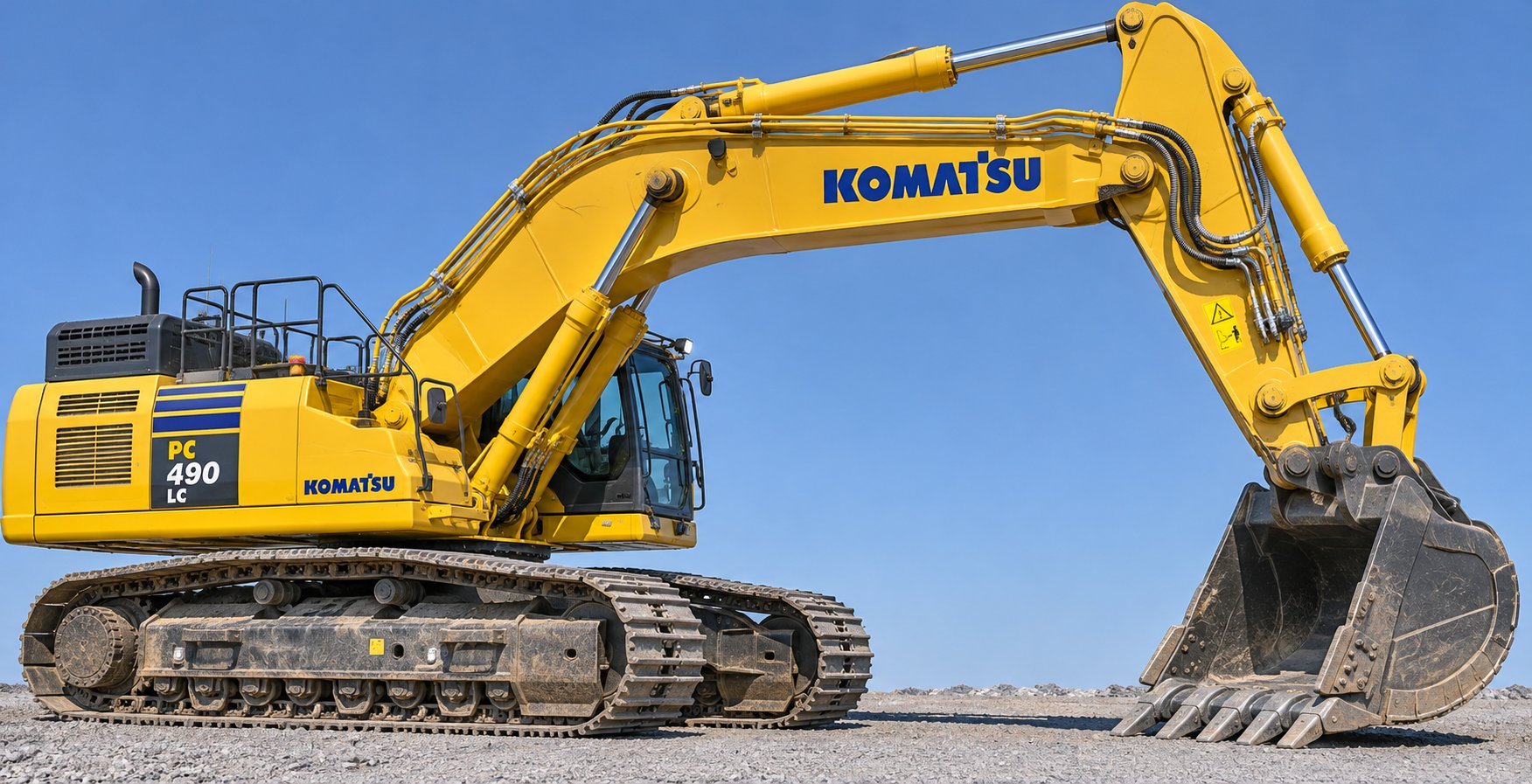
The Komatsu PC 500 LC sits firmly in the 50-ton operating weight class, placing it among the heaviest standard-production crawler excavators before you step into dedicated mining machines. That mass is not dead weight. It translates directly into stability under load, stronger breakout forces at the bucket tip, and the ability to handle oversized attachments without sacrificing cycle speed. For fleet managers comparing the komatsu excavator pc 500 against lighter 40-ton alternatives, the productivity gap in hard-rock quarrying or deep trench work is immediately apparent.
Engine and Hydraulic Performance
At the heart of the current-generation PC500LC-10R is the Komatsu SAA6D140E diesel engine, a proven inline-six platform engineered specifically for heavy-duty excavator duty. While exact horsepower and torque figures should be confirmed against the official spec sheet for your specific market variant, this engine class delivers output in the range that competitors need 12- or 13-liter blocks to match — a testament to Komatsu's combustion efficiency tuning.
What makes this power plant especially relevant to operating costs is its improved engine management system, which accounts for an 11% fuel saving compared to the previous generation. That is not a laboratory figure buried in fine print — it represents real money on a machine burning dozens of gallons per shift.
Komatsu pairs that engine with their Closed-Center Load-Sensing (CLSS) hydraulic system. Imagine a hydraulic circuit that only delivers the exact oil flow and pressure each function demands at any given moment, rather than constantly pumping at full volume and wasting energy through relief valves. That is what CLSS does, and it is the reason operators notice smoother, more precise boom and arm movements compared to open-center systems common in older machines.
The PC500LC-10R offers four selectable working modes — including Economy, Power, and Super Power settings — plus an auto idling stop function and eco gauge that give operators real-time feedback on fuel burn. In practice, you will run Economy mode during light dozing or tramming between cut faces, then switch to Super Power when loading haul trucks against a hard bench. The flexibility means fuel consumption scales with actual demand rather than running at peak burn regardless of task.
Dimensions, Weight, and Undercarriage Details
Size matters when you are planning transport logistics, evaluating jobsite access, or ensuring the machine fits within permit dimensions on a lowbed trailer. The table below captures the key dimensional parameters for the Komatsu PC 500 LC class. Because exact values can shift slightly between regional variants and optional track shoe widths, always cross-reference these against the official Komatsu specification sheet for the precise model you are quoting.
| Specification | Approximate Value | Notes |
|---|---|---|
| Operating Weight | ~49,000 - 52,000 kg (108,000 - 114,600 lb) | Varies with bucket, counterweight, and track shoe configuration |
| Overall Length (boom forward) | ~12,500 - 13,000 mm | Depends on arm length option selected |
| Overall Width | ~3,500 - 3,740 mm | Determined by track shoe width (600 mm, 700 mm, or 800 mm options typical) |
| Tail Swing Radius | ~3,700 - 3,800 mm | Critical for confined bench operations |
| Ground Clearance | ~560 - 600 mm | Affects rough-terrain mobility |
| Maximum Dig Depth | ~7,400 - 7,600 mm | Standard arm; varies with arm length option |
| Maximum Reach at Ground Level | ~12,000 - 12,400 mm | Influences truck-loading radius and trench work flexibility |
| Transport Weight (without bucket) | ~46,000 - 48,000 kg | Verify against local oversize load regulations |
| Disclaimer: Values are approximate and based on published industry data for the PC500LC-10R class. Confirm exact specifications with Komatsu or your authorized dealer for the specific variant and market. | ||
A couple of numbers deserve extra attention. The tail swing radius of roughly 3,700 to 3,800 mm means this machine is not a reduced-tail-swing design — it needs room to rotate. On tight benches or near traffic, that swing arc dictates operating setbacks and safety zones. Meanwhile, the transport weight hovering near 48 tonnes without a bucket puts you firmly into heavy-haul permit territory in most jurisdictions, so factor mobilization logistics into your total project cost.
Bucket Capacity and Digging Forces
Here is where the kapasitas bucket PC 500 Komatsu conversation directly connects back to price. The machine is typically offered with bucket capacities ranging from approximately 2.1 m³ to 3.2 m³, depending on bucket type. Standard earthmoving buckets sit at the larger end of that range — maximizing volume per pass in loose or medium-density material. Heavy-duty and rock buckets trade some capacity for thicker wear plates, reinforced side cutters, and replaceable lip shrouds designed to survive abrasive stone.
Choosing the right bucket is not a minor accessory decision. A large-capacity bucket paired with the PC500's superior digging force and faster cycle times can move significantly more material per hour than a smaller bucket on the same chassis. Conversely, selecting an oversized bucket in hard rock conditions leads to stalling, higher hydraulic pressure spikes, and accelerated wear — all of which increase hourly operating cost and shorten component life.
Breakout force at the bucket tip and arm crowd force are the two numbers that quantify raw digging muscle. For the PC 500 class, bucket breakout force typically falls in the range of 260 to 290 kN, with arm crowd force in a similar bracket. These forces determine whether the machine can rip consolidated material directly or needs a ripper or blasting preparation, which in turn affects your cost-per-cubic-meter calculation at the planning stage.
Think of it this way: the specification sheet is really a productivity promise. Engine power and hydraulic flow set the ceiling on cycle speed. Operating weight and digging forces dictate what materials you can excavate without auxiliary equipment. Bucket capacity determines how much you move per pass. Together, they define the revenue-earning potential of every hour the machine runs — and that potential is what ultimately justifies the investment.
Specifications, however, do not exist in a vacuum. The current PC500LC-10R represents decades of iterative improvement over earlier Dash-7 and Dash-8 variants, and each generational leap brought not only better performance but also a higher price point. Tracing that evolution reveals exactly how today's machine — and today's pricing — arrived where it is.
Komatsu PC 500 Model Variants and How They Evolved
Every generation of the PC 500 Komatsu lineup has raised the bar on performance, technology, and — inevitably — price. Understanding that progression is more than a history lesson. It shapes how you evaluate new-machine premiums, used-market bargains, and the real capability gap between a well-maintained older unit and the latest model rolling off the line.
From PC500LC-7 to PC500LC-10R — A Generational Overview
Komatsu has refined the 50-ton platform through several major generational cycles. Each "Dash" revision introduced meaningful upgrades in engine technology, emissions compliance, electronic monitoring, and hydraulic efficiency. The table below summarizes the key differences across the most commonly encountered variants.
| Feature | PC500LC-7 | Komatsu PC 500-8 / PC500LC-8 | PC500LC-10R (Current) |
|---|---|---|---|
| Approximate Production Era | Early-to-mid 2000s | Late 2000s through mid 2010s | Mid 2010s onward |
| Engine Platform | SAA6D140E (earlier tune) | SAA6D140E-5 (revised) | SAA6D140E (Tier 4 Final / equivalent) |
| Emissions Tier | Tier 2 / equivalent | Tier 3 / interim Tier 4 | Tier 4 Final / CEV Stage IV / EU Stage V |
| KOMTRAX Telematics | Not standard on early units | Standard from factory | Advanced KOMTRAX with remote diagnostics |
| Key Technology Additions | Basic auto-idle, pilot-operated controls | Improved CLSS hydraulics, economy mode, enhanced cab comfort | Auto idling stop, eco gauge, 11% fuel savings vs. Dash-8, enhanced engine management |
| Relative Pricing Trend | Lowest (no longer in production) | Mid-range; strong secondary market presence | Premium — highest new-machine cost in the lineup |
| Disclaimer: Production eras and technology details are approximate and based on publicly available industry information. Exact specifications, production years, and pricing should be verified with Komatsu or an authorized dealer for your region. | |||
Notice how each jump introduces not just more power but more intelligence. The Dash-7 was a workhorse built around mechanical reliability and straightforward hydraulics. The PC500LC-10R layers in optimized fuel management, real-time operator feedback, and factory-standard telematics that let fleet managers monitor every unit remotely. That escalating sophistication directly explains why each generation commands a higher komatsu pc 500 price at the dealer level.
The introduction of KOMTRAX deserves special mention. Launched in 2006, this wireless tracking system lets owners monitor machine location, operating hours, fuel consumption, maintenance alerts, and even potential operator misuse from a computer or mobile phone. Early Dash-7 units were typically delivered without it; by the Dash-8 era it had become standard equipment. On the current Dash-10R, KOMTRAX feeds advanced diagnostic data that can flag emerging problems before they become catastrophic failures — a feature that directly protects resale value and reduces unplanned downtime costs.
How Older Variants Affect the Used Market
Here is where the generational picture gets financially interesting. Older models like the Komatsu PC 500-8 remain enormously popular on the secondary market. Why? They deliver 80 to 90 percent of the raw digging capability of a brand-new Dash-10R at a fraction of the acquisition cost. For contractors whose projects do not require the latest emissions certification or fleet-level telematics integration, a well-maintained Dash-8 with moderate hours can represent exceptional value.
Buyer preference often splits along a clear line. Operators in emissions-regulated regions — think North American Tier 4 Final zones or European Stage V jurisdictions — effectively have no choice but to buy current-generation machines or face jobsite access restrictions. Operators in markets with less stringent regulations, however, can take advantage of exactly that dynamic: as stricter markets push older machines out, those units flow into secondary markets where they remain fully legal and highly productive.
Some fleet managers also prefer the mechanical simplicity of Dash-7 and Dash-8 models. Fewer electronic sensors, no DPF regeneration cycles, and a more straightforward wiring harness mean lower diagnostic complexity and easier field repairs in remote locations. Others see the Dash-10R's fuel savings and monitoring capabilities as non-negotiable advantages that pay for themselves over a 10,000-hour service life.
That tension between proven older capability and cutting-edge efficiency is exactly the calculation that defines the new-versus-used buying decision — a choice that goes far deeper than the sticker on either machine.
How the Komatsu PC 500 Compares to Rival 50-Ton Excavators
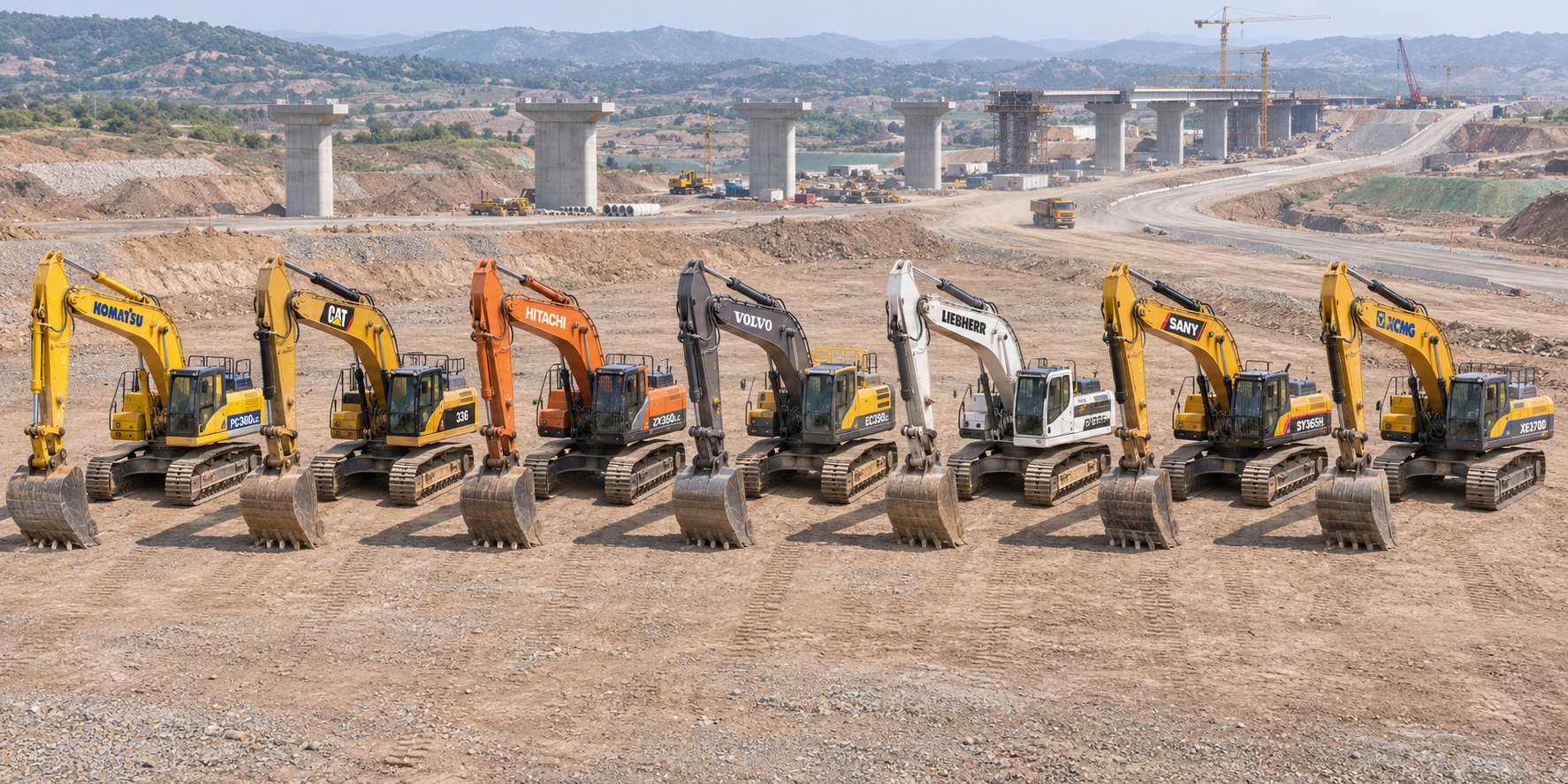
Specifications and generational improvements tell you what a machine can do. A competitor comparison tells you whether you are paying the right price for it. The Komatsu PC 500 does not exist in isolation — it competes head-to-head against established 45- to 55-ton excavators from Caterpillar, Volvo, Hitachi, Liebherr, and Hyundai. Each rival brings its own balance of power, technology, dealer support, and pricing philosophy. A thorough 50 ton excavator comparison is the only honest way to determine if the komatsu pc 500 price is justified or if a competing platform delivers better long-term value for your specific operation.
Head-to-Head Spec and Price Positioning
The table below benchmarks the Komatsu PC500LC against its most direct competitors in the heavy crawler excavator class. Spec data is drawn from publicly available manufacturer information and industry spec aggregators. Because the PC500LC sits slightly above some models in this range and slightly below others in operating weight, think of this as a competitive neighborhood rather than a perfectly weight-matched lineup.
| Model | Operating Weight Class | Engine Power Class | Bucket Capacity Range | Key Differentiating Technology | Relative Market Price Positioning |
|---|---|---|---|---|---|
| Komatsu PC500LC-10R | ~49-52 tons | ~350-370 hp | 2.1 - 3.2 m³ | CLSS hydraulics, KOMTRAX telematics, auto idling stop, eco gauge, 4 power modes | Premium |
| Caterpillar 349 | ~52.6 tons | ~424 hp | Up to 4.03 cu yd (~3.1 m³) | Cat Payload, Cat Grade, Product Link telematics, high horsepower-to-weight ratio | Premium |
| Caterpillar 352 | ~55.3 tons | ~424 hp | Up to 3.27 cu yd (~2.5 m³) | Heavy-lift configuration, long-reach variant available, Cat electronics suite | Premium |
| Volvo EC480E | ~50.2 tons | ~373 hp | 2.03 - 4.32 cu yd (~1.6 - 3.3 m³) | Industry-leading bucket capacity range, hybrid variant available, low-vibration cab | Mid-Range to Premium |
| Hitachi ZX490LCH-6 | ~54.9 tons | ~362 hp | Varies by configuration | ConSite remote monitoring, ECO/Power/High Power modes, 270-degree camera system | Mid-Range to Premium |
| Liebherr R 946 | ~50.6 tons | ~295 hp | Up to 3.92 cu yd (~3.0 m³) | European engineering, Liebherr-proprietary engine on some variants, strong demolition/specialty heritage | Premium |
| Hyundai HX480A L | ~58.0 tons | ~395 hp | Up to 2.88 cu yd (~2.2 m³) | Precision swing control, short cycle times, 8-inch touchscreen, competitive acquisition cost | Value to Mid-Range |
| Disclaimer: Specifications and price positioning are based on publicly available data and editorial analysis. Exact pricing, configurations, and specifications should be confirmed with each manufacturer's authorized dealer network. Price tiers (Premium, Mid-Range, Value) reflect general market perception, not exact dollar figures. | |||||
A few patterns jump out immediately. The Komatsu PC 500 vs Cat 349 debate is one of the most common in procurement meetings. Caterpillar's 349 brings noticeably higher horsepower — roughly 424 hp versus the PC500LC's ~360 hp class — yet Komatsu's CLSS hydraulic efficiency means that raw engine power does not automatically translate into faster cycle times or lower fuel burn. The Cat 349's muscle shines in high-resistance material where brute force matters; the Komatsu counters with sophisticated load-sensing that minimizes wasted energy during lighter phases of the digging cycle.
The Komatsu PC 500 vs Hitachi ZX490 comparison draws similar interest. Both are Japanese-engineered machines with overlapping weight classes and comparable power output. Hitachi's ZX490LCH-6 tends to command a slightly lower acquisition price in some markets, though dealer network density and parts pricing can shift the equation depending on your region. Volvo's EC480E stands out for its exceptionally wide bucket capacity range, stretching up to 4.32 cu yd — a potential advantage in loose-material loading where volume per pass matters most.
Hyundai's HX480A L occupies the value end of the spectrum. Its acquisition cost is typically lower than the Komatsu or Caterpillar equivalents, and the machine delivers solid performance specs. For buyers laser-focused on upfront capital savings, the Hyundai deserves serious consideration.
Value Beyond the Price Tag
Here is where the komatsu pc 500 total cost of ownership conversation gets critical. The cheapest machine on a purchase order is not necessarily the cheapest machine to own over a 10,000-hour lifecycle. Several factors beyond sticker price determine whether your investment actually pays off.
- Parts availability and cost: Komatsu's global manufacturing footprint and extensive dealer network mean that replacement parts — hydraulic pumps, undercarriage components, engine filters — are generally available without extended back-order delays. Maintenance and repair expenses are a core part of heavy equipment total cost of ownership, and a brand with faster parts supply directly reduces costly machine downtime.
- Dealer service network density: A machine is only as good as the nearest technician who can service it. Caterpillar and Komatsu both maintain exceptionally dense dealer networks across North America, the Middle East, and Southeast Asia. Liebherr and Hyundai, while growing, may have thinner coverage in certain secondary markets. When your excavator is down on a remote mine site, a two-day wait for a service truck versus a two-week wait is not a trivial difference.
- Fuel efficiency under load: The PC500LC-10R's 11% fuel savings over the prior generation translates into real dollars per shift. Over 10,000 operating hours at 30-plus gallons burned daily, even a modest efficiency advantage compounds into five- or six-figure savings.
- Resale value retention: Komatsu machines have historically maintained strong secondary-market values, supported by global demand and parts availability. This residual value directly offsets your net ownership cost when you eventually trade or sell the unit.
- Technology ecosystem: KOMTRAX integrates with fleet management platforms, enabling centralized monitoring across an entire Komatsu fleet. If your operation already runs multiple Komatsu units, the data synergy — consolidated fuel reports, predictive maintenance alerts, utilization dashboards — adds value that is difficult to quantify on a spec sheet but very real in daily operations.
As industry experts note, understanding total cost of ownership helps you avoid financial surprises, supports better budgeting and fleet planning, and forces you to consider everything from routine maintenance to final resale value. A machine that costs 10% more upfront but burns less fuel, holds its value better, and suffers fewer unplanned repair events can easily become the most economical choice over its productive life.
When Competitors Might Be the Better Choice
Editorial honesty demands acknowledging scenarios where a rival machine makes more financial sense than the PC 500, regardless of its individual merits.
Imagine your fleet already runs twelve Caterpillar excavators across three project sites. Your mechanics are CAT-trained. Your parts warehouse stocks CAT components. Your telematics dashboard is built around Cat Product Link. Introducing a single Komatsu into that ecosystem means separate training, separate parts inventory, and a second telematics platform. In this case, the brand familiarity and fleet standardization benefits of staying with Caterpillar may outweigh any spec advantage the Komatsu offers. The same logic applies to Hitachi-standardized operations in markets where Hitachi dominates, such as parts of Southeast Asia and Oceania.
Budget-constrained buyers who prioritize the lowest acquisition cost and operate in regions with thinner Komatsu dealer coverage should genuinely evaluate the Hyundai HX480A L or even a Develon (formerly Doosan) DX530LC-7 — machines that deliver competitive digging performance at a lower entry point, especially when servicing infrastructure is locally strong for those brands.
And for operations in European markets where Liebherr's dealer and service presence is deeply embedded, the R 946's European-engineered components and local support ecosystem can tip the balance, particularly on projects where emissions compliance, noise regulations, and local-content requirements favor a European OEM.
The takeaway? No single machine wins in every scenario. The best purchase decision accounts for your existing fleet composition, your regional dealer landscape, your operator skill base, and your projected lifecycle costs — not just the numbers on a spec sheet. That kind of holistic evaluation becomes even more important when you weigh the other major fork in the road every buyer faces: purchasing new versus buying used.
New vs. Used Komatsu PC 500 and What to Expect
That fork in the road — new or used — is where many procurement decisions stall. A brand-new PC500LC-10R delivers factory-fresh components, full warranty coverage, and the latest emissions-compliant technology. A pre-owned Komatsu PC 500 excavator, on the other hand, offers the same fundamental digging capability at a substantially lower capital outlay. Neither path is universally right. The smarter question is: which path matches your project timeline, budget constraints, and appetite for mechanical risk?
Typical Used Komatsu PC 500 Price Ranges by Age and Hours
Used heavy equipment generally costs 25 to 50 percent less than comparable new models, and excavators in the 50-ton class follow that pattern closely. The komatsu pc 500 used price you will encounter depends heavily on three variables: operating hours, generational model, and overall condition.
Think of the used market in three broad tiers:
- Low-hour, late-model units (under 5,000 hours): These machines — typically Dash-10R or late Dash-8 variants — sit closest to new-machine pricing. Expect discounts in the range of 20 to 35 percent off current new pricing. Machines in this bracket have already absorbed the steepest depreciation hit, making them attractive for buyers who want near-new capability without the full capital outlay. Three-year-old excavators with around 3,000 hours can deliver identical capability to new units at roughly half the investment.
- Mid-life machines (5,000 - 10,000 hours): This is the sweet spot for value-oriented buyers. Engines and hydraulic pumps in this range typically have significant productive life remaining if maintenance was consistent. Pricing falls roughly 40 to 60 percent below new, though wide variation exists depending on service records and undercarriage condition.
- High-hour units (10,000+ hours): These machines trade at the deepest discounts but carry the highest mechanical risk. Industry benchmarks suggest that hydraulic pumps and cylinders typically need major servicing after 8,000 to 12,000 hours under normal conditions, and most heavy equipment engines are designed for 10,000 to 20,000 hours with proper maintenance. A high-hour PC 500 can still be a sound buy — but only if documented overhauls confirm that major components have been refreshed.
One critical caution: hours alone tell a dangerously incomplete story. A well-maintained 8,000-hour machine that spent its life loading loose overburden can genuinely outlast an abused 4,000-hour unit that hammered rock daily with deferred maintenance. Always evaluate hours in context — the type of work performed, the maintenance discipline applied, and the physical evidence visible on the machine itself.
Inspection Red Flags for Pre-Owned PC 500 Machines
Before committing capital to any used komatsu pc 500 for sale, a systematic physical inspection is non-negotiable. Think of this as your komatsu pc 500 inspection checklist — the items that separate a profitable purchase from a costly mistake:
- Undercarriage wear percentage: The undercarriage can account for up to 50 percent of a tracked excavator's total maintenance costs. Measure track link, roller, idler, and sprocket wear against manufacturer tolerances. Significant undercarriage wear paired with suspiciously low recorded hours is a red flag for possible hour meter tampering.
- Hydraulic cylinder condition: Inspect the chrome piston rods on boom, arm, and bucket cylinders. Rust, scoring, or deep scratches damage seals and cause progressive leaks. Perform a drift test — raise the boom and hold it for several minutes. If it drifts downward without operator input, internal seal leakage is likely.
- Boom and arm crack inspection: Look carefully at weld seams and high-stress transition points on the boom and stick. Cracks in structural steel are not cosmetic — they indicate fatigue from overloading or sustained high-impact applications. Fresh paint in isolated areas sometimes conceals repaired fractures, so ask specifically about any weld history.
- Engine oil analysis results: Request laboratory oil sample reports. Elevated metal particle counts (iron, copper, chromium) reveal internal wear patterns that visual inspection cannot detect. A cold-start test is equally valuable — blue smoke signals oil burning, black smoke indicates fuel system issues, and white smoke suggests coolant problems.
- KOMTRAX history verification: If the machine is a Dash-8 or newer, request the KOMTRAX data log. This telematics record shows cumulative hours, operating modes, idle time ratios, fault code history, and geographic usage — data that is extremely difficult to falsify and far more reliable than a standalone hour meter.
- Structural weld integrity: Beyond the boom and arm, inspect the main frame, counterweight mounting points, and swing frame for cracking, distortion, or unauthorized field repairs. Structural failures at these points compromise the entire machine's safety envelope.
- Swing bearing play: The slew ring transfers every rotational load between upper structure and undercarriage. Excessive play, knocking, or hesitation during slow slewing movements can indicate advanced wear — and slew ring replacement is one of the most expensive single repairs on any excavator.
- Pin and bushing wear: Check all connection points at the bucket, arm, and boom joints. Oval-shaped pin holes, excessive play between components, and dry joints with no grease residue are silent truth-tellers that reveal how hard the machine has actually worked — regardless of what the hour meter says.
Sounds like a lot of work? It is. But investing one to two hours in a thorough walkaround can save you from a six-figure mistake. If you lack the in-house expertise, hiring an independent heavy equipment inspector is money well spent.
Where to Source and Compare Used Komatsu Excavators
Finding a pre-owned Komatsu PC 500 excavator requires casting a wide net across multiple sourcing channels, because no single marketplace holds all available inventory at any given time.
- Authorized Komatsu dealers: Many dealers operate certified pre-owned programs where machines undergo multi-point inspections and come with limited warranties. You will typically pay a premium over private-party sales, but the risk mitigation is tangible.
- Equipment auctions: Platforms like Ritchie Bros. and Euro Auctions regularly list 50-ton class excavators. Auctions can deliver competitive pricing, especially for fleet disposal units, though buyer protections are generally limited to what you can verify during preview days.
- Specialized online marketplaces: Aggregator platforms compile dealer and private inventory into searchable databases, letting you compare multiple used Komatsu crawler excavators across regions from a single screen. For example, JIUHONG's used Komatsu excavator collection allows contractors and equipment dealers to browse available used Komatsu models, compare configurations, and request model-specific pricing inquiries. It is worth noting editorially that specific PC500 listings may not always be in stock — the collection serves as a broader inquiry destination for various Komatsu models, so buyers should confirm exact availability and machine condition directly before proceeding.
Whichever channel you explore, the principle stays the same: gather multiple quotes, cross-reference KOMTRAX or serial number data with Komatsu's records, and never finalize a purchase without a physical or thoroughly documented remote inspection. The buyers who compare across channels — dealer lots, auction results, and online aggregators — consistently land better deals than those who commit to the first listing they find.
Of course, the buy-in price is only half the financial equation. What a Komatsu PC 500 is worth when you eventually sell or trade it determines your true net cost of ownership — and that depreciation trajectory deserves its own hard look.
Resale Value and Depreciation Trajectory for the PC 500
You have seen what a Komatsu PC 500 costs to buy. You have walked through the specs that justify that cost and compared the machine against every major rival. But here is a question most buyers forget to ask until it is too late: what will this excavator be worth when you are done with it? The answer — your Komatsu PC 500 resale value — determines whether the machine was a profitable tool or an expensive liability sitting on your balance sheet.
Depreciation is not a line item most equipment buyers get excited about. Yet on a machine with an acquisition cost pushing half a million dollars, the komatsu pc 500 depreciation rate quietly becomes one of the largest single cost factors over the asset's productive life. Getting this math right separates operators who build wealth through their fleets from those who simply burn capital.
How the Komatsu PC 500 Holds Its Value Over Time
Heavy excavators in the 50-ton class follow a well-documented depreciation curve. The steepest value drop happens in the first 2,000 to 3,000 operating hours — roughly the first one to two years for a machine running full shifts. Industry data from equipment lifecycle analysts shows that heavy equipment typically loses 40 to 50 percent of its purchase price within the first three years, then settles into a more gradual decline of 8 to 12 percent annually through years four to six before flattening further in years seven through ten.
Imagine buying a new PC500LC-10R and putting it to work on a highway corridor project. By the time you have logged 3,000 hours, the machine has already absorbed the majority of its lifetime depreciation hit. That is painful if you sell early — but it is actually useful information if you plan to hold the machine through its productive sweet spot, because the remaining value loss per hour of operation becomes progressively smaller.
Komatsu's brand strength plays a measurable role here. Industry auctioneers and equipment brokers consistently rank brand and model as roughly 18 percent of the resale value equation, and Komatsu sits near the top of the retention curve alongside Caterpillar. The reasons are structural rather than sentimental: a dense global dealer network ensures parts availability, KOMTRAX telematics provide verifiable machine history that builds buyer confidence, and strong demand across developing markets creates a natural floor under used pricing. A well-maintained PC 500 with clean documentation tends to find a buyer faster — and at a better price — than comparable machines from brands with thinner aftermarket support.
Factors That Accelerate or Protect Resale Value
Not every PC 500 depreciates at the same rate. Two machines with identical hour meters can sell tens of thousands of dollars apart on the same auction day. The difference comes down to controllable factors — things you can influence starting from the first hour of ownership.
Factors that protect the komatsu pc 500 residual value:
- Low hours relative to age: Operating hours account for roughly 25 percent of resale value determination — the single largest individual factor. A machine at 4,000 hours versus 8,000 hours at the same calendar age retains 40 to 50 percent more value.
- Complete service records: Maintenance documentation carries approximately 22 percent of the appraisal weighting. Machines with photo-verified service histories, technician sign-offs, and genuine parts receipts consistently sell for 15 to 20 percent more than identical units backed only by paper receipts or verbal assurances.
- KOMTRAX data history: A clean telematics record showing consistent utilization, no recurring fault codes, and reasonable idle-time percentages is a genuine resale advantage that prospective buyers and lenders both value.
- Undercarriage condition: Because undercarriage replacement is one of the most expensive maintenance events on any crawler excavator, a unit with documented track, roller, and sprocket condition retaining more than 50 percent of original wear life commands a meaningful premium.
- Single-owner history: Machines that have stayed in one fleet tend to sell better than those that have passed through multiple hands. Single ownership implies consistent maintenance practices and known operating conditions.
- Attachments included: Selling with a matched bucket set, quick coupler, or specialized attachment adds tangible value because the next buyer avoids a separate procurement cycle.
Factors that erode value:
- High hours relative to age: A machine showing 12,000 hours in five years signals heavy utilization that accelerates component wear beyond what the calendar age suggests.
- Missing maintenance records: No documentation forces every buyer to assume the worst — and price accordingly. The resale penalty for absent records is one of the most avoidable losses in fleet management.
- Aftermarket modifications: Non-OEM hydraulic lines, off-brand filters, or unauthorized structural modifications raise questions about reliability and void certain warranty or support provisions.
- Structural repairs: Documented weld repairs on the boom, arm, or main frame — even professionally done — signal that the machine endured stresses beyond its design envelope, and buyers discount heavily for that history.
- Outdated emissions tier: As regulatory requirements tighten globally, machines that cannot meet current emissions standards face shrinking pools of eligible jobsites, which directly compresses demand and resale pricing in regulated markets.
The critical insight? Factors one, two, and three — hours, documentation, and physical condition — together account for roughly 67 percent of the resale outcome and are all directly within the operator's control. Brand choice and market timing, which represent the remaining third, are largely fixed at the point of purchase or driven by external forces. Fleet managers who invest in disciplined documentation and proactive maintenance are not just keeping machines running — they are actively protecting six-figure residual values.
Thinking Like an Investor When Buying Heavy Equipment
Here is where the entire pricing conversation comes full circle. The real metric is not what you pay for the machine — it is the heavy excavator cost per hour ownership across the machine's productive life. That single number captures everything: acquisition price, fuel, maintenance, insurance, and the money you recover at disposal.
The formula is conceptually straightforward:
Hourly Ownership Cost = (Acquisition Price + Total Operating Costs - Residual Value at Disposal) / Total Productive Hours
Walk through it step by step. Start with the acquisition price — say, your delivered cost for a new PC500LC-10R including all the hidden costs discussed earlier. Add projected operating expenses over the planned hold period: fuel, scheduled maintenance, anticipated repairs, insurance premiums, and financing interest if applicable. Then subtract your estimated komatsu pc 500 residual value at the hour count where you plan to sell or trade the unit. Divide that net figure by the total productive hours you expect to extract.
The resulting hourly rate is your true ownership cost — and it is the only number that allows an apples-to-apples comparison between buying new at a premium versus buying used at a discount, or between the Komatsu and a competing machine with a different sticker price but different fuel burn, maintenance profile, and resale trajectory.
Consider a practical scenario. A new PC500LC-10R purchased at $480,000 and operated for 10,000 hours with $200,000 in cumulative operating costs, then sold for $160,000, yields a net ownership cost of $520,000 — or $52 per hour. A used Dash-8 purchased at $220,000 with slightly higher fuel and maintenance costs of $250,000 over 8,000 remaining productive hours, then sold for $60,000, nets $410,000 — or roughly $51 per hour. The numbers are illustrative, not prescriptive, but they demonstrate why a machine that costs less upfront does not automatically deliver a lower hourly rate, and vice versa.
This investor's lens also highlights why resale value protection is not optional. Every dollar you preserve at disposal directly reduces your hourly ownership cost. A $30,000 improvement in sale price — achievable through documented maintenance and disciplined hour management — spread across 10,000 operating hours lowers your cost by $3 per hour. Multiply that across an entire fleet of heavy excavators and the cumulative impact is substantial.
Depreciation, then, is not just an accounting concept buried in spreadsheets. It is a living financial force that rewards operators who plan for it and punishes those who ignore it. And the best time to start managing it is before you sign the purchase agreement — which is exactly why understanding the right machine size for your operation matters just as much as understanding the price.
Real-World Applications That Justify the PC 500 Investment
Depreciation math and resale projections are powerful tools — but they only matter if the machine earns enough during its working life to make those numbers worthwhile. A Komatsu PC 500 sitting on a jobsite too small for its capabilities burns capital every idle hour. Conversely, cramming a 35-ton excavator into a role that demands 50-ton muscle bleeds money through sluggish cycle times and missed production targets. The real question behind any komatsu pc 500 price evaluation is not just "can I afford it?" but "does my operation actually need it?"
Getting the size class right is arguably the highest-leverage decision in the entire purchase process. An industry analysis published by Highways.Today illustrates the point vividly: a larger excavator costing roughly 29 percent more per operating hour can still deliver a direct machine cost per cubic meter approximately 29 percent lower than a smaller alternative — provided the larger machine sustains its production rate without creating bottlenecks elsewhere in the system. The economics flip entirely when conditions prevent the bigger machine from working efficiently.
Projects and Industries Where the 50-Ton Class Excels
The Komatsu PC 500 was engineered for applications where sustained high-volume material movement is the core revenue driver. When you picture the ideal deployment scenario for this machine, you are looking at operations where bucket capacity, breakout force, and extended reach all converge to create a productivity advantage no smaller machine can replicate.
Here are the applications where a komatsu pc 500 mining application or heavy construction role delivers its strongest return:
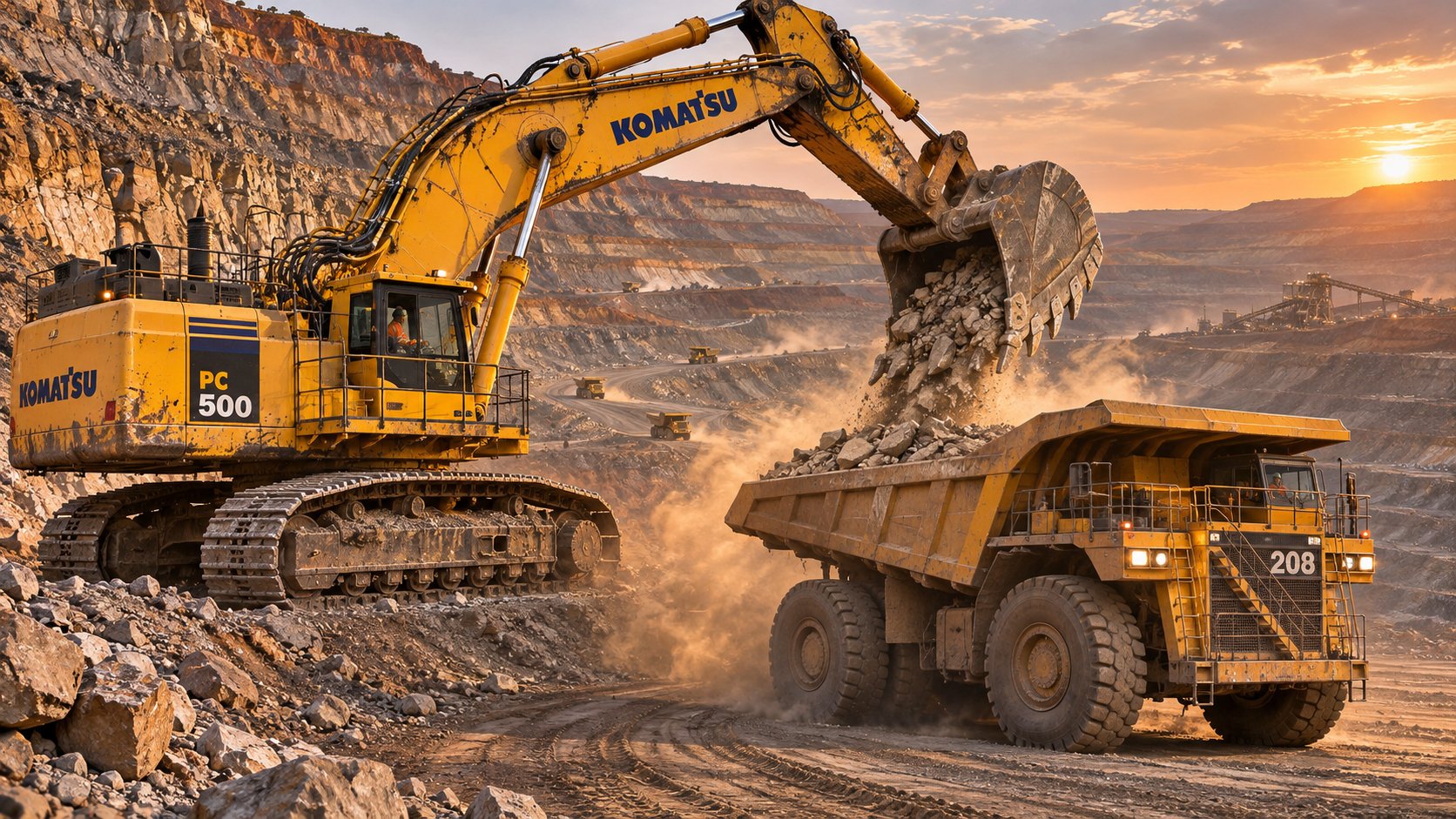
- Mining bench loading: Loading 40- to 60-ton haul trucks from prepared benches is the PC 500's signature task. Its bucket capacity range of 2.1 to 3.2 m³ allows three- to five-pass loading of articulated dump trucks, keeping truck cycle times tight and excavator utilization high. In open-pit coal, copper, or iron ore operations, that loading rhythm translates directly into tonnes-per-shift revenue.
- Quarry operations: A komatsu pc 500 quarry excavator excels at primary face loading in limestone, granite, and aggregate pits. The machine's breakout force in the 260 to 290 kN range handles blasted rock efficiently, while the robust undercarriage platform absorbs the vibration and impact that would accelerate wear on lighter machines.
- Large-scale highway and dam construction: Infrastructure megaprojects — think four-lane expressway corridors, reservoir embankments, or canal excavations — require moving hundreds of thousands of cubic meters on schedule. A 50 ton excavator for construction projects of this scale hits a sweet spot: powerful enough to maintain aggressive daily production targets, yet compact enough relative to true mining-class machines to reposition between cut sections without excessive mobilization overhead.
- Deep foundation and pipeline work: With a maximum dig depth approaching 7,400 to 7,600 mm on the standard arm, the PC 500 handles deep-trench pipeline corridors and cofferdam excavations that push smaller machines to their geometric limits. The additional reach at ground level — roughly 12,000 to 12,400 mm — means the excavator can work from a stable bench position while reaching material that a shorter-boom machine would need to climb down to access.
- Mass earthmoving: Bulk cut-and-fill operations, land reclamation, and large-scale site preparation all benefit from the sheer volume a 50-ton excavator can move per shift. The komatsu pc 500 productivity per hour in favorable loading conditions — well-matched truck fleet, consistent material, short swing angles — can reach several hundred loose cubic meters, a throughput level that would require significantly longer shifts or additional units from a 35-ton platform.
The common thread across all these scenarios? Continuous, high-intensity digging and loading where the machine spends the overwhelming majority of its shift in productive cycles rather than repositioning, traveling, or waiting. The PC 500 earns its premium when it stays in the cut and keeps trucks moving.
When to Size Down or Size Up Instead
Not every project fits the 50-ton mold. Industry sizing guides emphasize that choosing the wrong size excavator does not just affect efficiency — it escalates costs, introduces safety risks, and can jeopardize project schedules. An oversized machine wastes fuel and capital on tasks that a smaller unit handles just as well. An undersized machine loses money through insufficient cycle-by-cycle production, excessive wear from overloading, and the inevitable need for supplementary equipment to compensate for the shortfall.
| Machine Class | Ideal Application Type | Typical Productivity Range | Relative Cost of Ownership |
|---|---|---|---|
| 35-40 ton (e.g., PC350, PC390) | Urban infrastructure, medium earthmoving, road widening, utility trenching, mid-sized demolition | Moderate — suited to mixed-duty cycles with frequent repositioning and varied material types | Lower acquisition, fuel, and transport costs; easier permitting for mobilization; economical for projects under 100,000 m³ |
| 50-ton (Komatsu PC 500) | Mining bench loading, quarry primary face, large highway/dam earthworks, deep foundation, mass cut-and-fill | High — optimized for sustained loading cycles with matched truck fleets and consistent material | Mid-to-high acquisition cost; fuel burn justified by volume throughput; strong resale value supports lifecycle economics |
| 60+ ton (e.g., PC600, PC700) | Large-scale open-pit mining, ultra-deep excavation, heavy rock loading for 80-100+ ton trucks | Very high — maximum bucket capacity and digging force for the largest production environments | Highest acquisition, operating, and transport costs; requires high utilization hours to justify capital; narrower resale market |
Imagine you are bidding on a municipal road-widening project involving 50,000 cubic meters of mixed soil. A 50-ton PC 500 could finish the excavation faster — but the jobsite involves tight urban setbacks, frequent utility crossings, and truck access limited to single-lane residential streets. A 35-ton machine maneuvers those constraints without the logistical headaches, and its lower hourly operating cost actually delivers a cheaper cost per cubic meter under those specific conditions. The PC 500's raw power becomes a liability you are paying for but cannot fully deploy.
Flip the scenario. You are loading 60-ton rigid-frame haul trucks on a copper mine bench running 12-hour shifts, six days a week. A 35-ton machine would need six or seven passes per truck instead of four, stretching truck cycle times and starving your haulage fleet. Stepping up to the 50-ton class cuts passes, shortens loading time, and lets fewer trucks move the same daily tonnage — a net cost reduction despite the higher machine price. Whether you need to go further to a 60-ton-plus platform depends on the scale of your haul trucks and daily tonnage targets; for most mid-tier mining operations, the PC 500 hits the optimal intersection of capability and capital efficiency.
Cost-Per-Ton-Moved Value Framework
Here is a practical methodology you can apply before committing to any machine class. It does not require fancy software — just realistic project data and basic arithmetic.
Start with your project's daily material movement requirement. How many cubic meters or tonnes must leave the excavation face every shift to keep the project on schedule? This number should come from your project plan, not from optimistic assumptions.
Work backward from that target:
- Estimate achievable production per hour for each machine class under consideration. Account for realistic fill factors — industry data shows that bucket fill varies dramatically by material, with moist loam achieving 100 to 110 percent fill while poorly blasted rock may drop to 40 to 50 percent. Apply a job efficiency factor of 75 to 83 percent to account for non-productive time within each operating hour.
- Calculate how many productive hours each machine class needs per shift to meet the daily target. If a 35-ton machine requires 10 hours to move 2,000 cubic meters but a 50-ton machine achieves it in 7 hours, the surplus capacity matters — it builds schedule buffer, reduces overtime costs, or frees the machine for secondary tasks.
- Assign a fully loaded hourly cost to each machine class. Include ownership cost per hour (using the depreciation framework from the previous section), fuel, operator wages, and a maintenance reserve. A larger machine will have a higher hourly rate, but it may require fewer total hours to accomplish the same work.
- Divide the total daily machine cost by the total daily material moved to arrive at cost per cubic meter or cost per tonne for each option. The machine class that delivers the lowest cost per unit of material — while meeting daily production requirements within available shift hours — is your economically optimal choice.
A critical nuance: this framework must include the haulage side of the equation, not just the excavator. Production economics research demonstrates that a mismatch between excavator output and truck fleet capacity can erode 16 to 20 percent of theoretical production. A powerful excavator loading at maximum speed is worthless if trucks arrive irregularly or haul-road conditions inflate cycle times. The cost-per-ton-moved calculation only holds when the entire loading-hauling system is balanced.
This framework will not give you a perfect answer — too many site-specific variables exist for any formula to capture every scenario. But it forces a structured comparison that prevents the two most common mistakes: buying a machine because it is impressive rather than appropriate, or buying a cheaper machine that fails to generate the production your project demands. Either error costs far more over the life of a contract than the analytical effort required to avoid it.
Armed with clarity on whether the PC 500 is the right size class and a realistic picture of what it costs to own and operate, the final piece of the puzzle is turning that knowledge into action — navigating the actual purchase process from first quote request to machine delivery.
Your Complete Roadmap to Purchasing a Komatsu PC 500
Knowledge without action is just expensive daydreaming. You now understand the komatsu pc 500 price landscape inside and out — regional cost drivers, hidden fees, depreciation curves, spec benchmarks, and the new-versus-used tradeoff. The remaining challenge is converting all of that intelligence into an actual signed deal at the right number. This heavy equipment purchase guide for 50 ton excavator acquisitions walks you through every step, from the first budget meeting to the moment the machine rolls off the lowbed at your jobsite.
Step-by-Step Purchase Roadmap
Buying a machine at this price point is not a single decision — it is a sequence of smaller decisions, each building on the last. Skip a step and you invite exactly the kind of budget surprise this entire article was designed to prevent. Here is how to buy a Komatsu PC 500 excavator methodically:
- Define project requirements and validate the machine size class. Use the cost-per-ton-moved framework from the previous section. Confirm that your daily material targets, haul truck fleet, and site conditions genuinely demand a 50-ton excavator rather than a 35-ton or 60-ton alternative. This single validation step prevents the most expensive mistake in equipment procurement: buying the wrong size.
- Establish a total budget including hidden costs. Start with the estimated base machine price for your region, then layer on freight, commissioning, insurance, operator training, first-service packages, and extended warranty premiums. Build in a contingency of 10 to 15 percent above that total — the gap between quoted and delivered cost is real, and the buyers who plan for it avoid cash-flow disruptions.
- Request quotes from multiple authorized dealers and used equipment sources. Never negotiate from a single quote. Contact at least two or three authorized Komatsu dealers in your market, and simultaneously gather pricing on comparable used units through auctions, certified pre-owned programs, and online aggregators. The spread between quotes on the same machine class can be surprisingly wide, and having competitive data in hand strengthens every subsequent conversation.
- Evaluate financing options. Before committing to a payment structure, understand every available avenue — bank equipment loans, manufacturer financing, independent lenders, and lease arrangements. More on this below.
- Negotiate with leverage. Dealers expect negotiation. Your strongest leverage points include competing quotes from rival dealers, end-of-quarter or fiscal-year timing when dealerships are motivated to hit sales targets, willingness to bundle service packages or attachments into the deal, and flexibility on delivery timing. Equipment negotiation experts consistently advise doing thorough market research before entering any price discussion, being prepared to walk away if the terms do not meet your budget, and remaining flexible — you may accept a slightly higher machine price in exchange for a favorable extended warranty or free first-year service package. Building a genuine relationship with the salesperson also matters; the more the seller understands your operation and long-term fleet plans, the more motivated they become to offer terms that keep you coming back.
- Conduct a pre-delivery inspection. Whether buying new or used, verify the machine before it ships. On a new unit, confirm that the configuration matches your order — bucket type, track shoe width, optional equipment, software settings. On a used unit, run the full inspection checklist outlined earlier in this guide. Do not skip this step simply because the paperwork looks clean.
- Plan for commissioning, operator training, and first-year maintenance scheduling. Have your maintenance calendar mapped before the machine arrives. Schedule the 250-hour and 500-hour services in advance, enroll operators in any required certification courses, and confirm that your dealer has the necessary filters, fluids, and wear parts stocked locally. A machine that arrives without a support plan in place loses productive hours from day one.
Financing Options for Heavy Equipment at This Price Point
Few buyers pay cash outright for a half-million-dollar excavator. Understanding your komatsu pc 500 financing options before you negotiate gives you the ability to compare total cost of capital — not just monthly payment amounts — across different structures.
- Traditional bank equipment loans: Commercial banks and credit unions offer secured equipment loans where the machine itself serves as collateral. Down payment expectations for heavy construction equipment typically range from 10 to 25 percent, with loan tenures of three to seven years depending on the lender and the borrower's creditworthiness. Interest rates for equipment loans generally differ from standard commercial lending rates because the collateral is a depreciating physical asset — expect rates that reflect that risk profile. As industry purchasing guides note, calculating total cost of ownership — including financing interest — is essential to understanding whether a machine will actually generate a positive return.
- Komatsu Financial: Komatsu's own financing arm offers both purchase and lease options with competitive rates that can undercut traditional lenders in certain markets. Because Komatsu Financial understands the equipment's residual value better than a generalist bank, they can sometimes structure more favorable terms — including below-market promotional rates on specific models, seasonal or skip-payment plans, and bundled financing for parts and service alongside the machine itself. Availability varies by region, so confirm with your local Komatsu distributor whether these programs apply to your market and model.
- Independent equipment financing companies: Specialized heavy equipment lenders operate outside both the banking system and the manufacturer ecosystem. They often serve buyers whose credit profile or business structure does not fit neatly into traditional bank lending criteria. Terms and rates vary widely, so compare at least two independent lender offers against your bank and Komatsu Financial quotes.
- Lease structures: Leasing can make strategic sense when you need the machine for a defined project duration rather than permanent fleet addition, or when preserving working capital and maintaining balance-sheet flexibility are priorities. Komatsu Financial's leasing portfolio includes options designed for fleet management and balance-sheet optimization. Lease-to-own arrangements let you build equity toward eventual ownership while spreading payments, though the total cost over the lease term typically exceeds an outright purchase price.
Whichever route you pursue, run the numbers through the hourly ownership cost formula discussed in the depreciation section. A financing structure with a lower monthly payment but a longer term and higher total interest cost can quietly inflate your cost-per-hour metric — the one number that actually determines whether the machine earns its keep.
Start Comparing Machines and Requesting Quotes
The single most effective thing you can do right now is stop researching in isolation and start generating real-world price data. Every concept in this guide — from regional pricing tiers to komatsu pc 500 dealer quote negotiation tactics — becomes exponentially more useful when you hold actual numbers from actual sellers.
Here is a practical starting point:
- Contact two or three authorized Komatsu dealers in your region and request formal quotes for a new PC500LC-10R configured to your specifications. Ask each dealer to itemize base machine cost, attachment pricing, delivery charges, and available warranty or service packages separately — this transparency makes comparison straightforward.
- Simultaneously research used options. Check certified pre-owned programs at your local Komatsu dealer, browse upcoming lots at auction houses like Ritchie Bros. or Euro Auctions, and explore online aggregators that compile used Komatsu crawler excavator inventory across multiple sellers. JIUHONG's used Komatsu excavator collection, for instance, lets contractors and equipment dealers browse available models, compare configurations, and submit model-specific pricing inquiries from a single platform. Editorially, it is worth noting that specific PC500 units may not always appear in inventory — the collection functions as a broader inquiry destination spanning various Komatsu excavator models, so confirm exact availability and machine condition directly before advancing any discussion.
- Request financing pre-approval from at least two sources before you finalize a machine selection. Knowing your approved budget ceiling and interest rate in advance gives you negotiating clarity that a buyer still waiting on financing approval simply cannot match.
Informed buyers who compare across multiple channels — new dealer quotes, used marketplace listings, auction records, and financing offers — consistently secure better value than those who accept the first number presented. The komatsu pc 500 price is never truly fixed. It is shaped by how thoroughly you prepare, how many options you put on the table, and how confidently you negotiate from a position of knowledge rather than urgency.
The best deal on a Komatsu PC 500 does not go to the buyer who haggles hardest — it goes to the buyer who shows up with competing quotes, verified market data, and a clear understanding of total cost of ownership.
That is the difference between sticker shock and a smart buy.
Frequently Asked Questions About the Komatsu PC 500 Price
1. How much does a new Komatsu PC 500 cost?
A new Komatsu PC500LC-10R generally falls between USD 350,000 and USD 550,000 depending on region, configuration, and dealer. Markets with local assembly like India tend toward the lower end ($320,000-$420,000), while North America sits higher ($420,000-$550,000) due to Tier 4 Final emissions hardware, dealer margins, and included telematics packages. These are ex-showroom estimates — the delivered cost including freight, commissioning, insurance, and operator training typically adds another 10 to 25 percent on top. Always request itemized quotes from at least two authorized dealers to get an accurate figure for your specific market and configuration.
2. What is the price of a used Komatsu PC 500 excavator?
Used Komatsu PC 500 prices vary widely based on operating hours, model generation, and overall condition. Low-hour late-model units under 5,000 hours typically sell at 20 to 35 percent below new pricing, mid-life machines between 5,000 and 10,000 hours trade at roughly 40 to 60 percent discounts, and high-hour units above 10,000 hours carry the deepest discounts but the highest mechanical risk. Older generations like the PC500-8 remain popular because they deliver most of the raw capability at a fraction of new-machine cost. Buyers can compare used listings through authorized dealer certified pre-owned programs, equipment auctions, and online aggregators such as JIUHONG's used Komatsu excavator collection at jiuhong-machinery.com, though specific PC500 availability should always be confirmed directly.
3. What are the main specs of the Komatsu PC 500 excavator?
The Komatsu PC500LC-10R operates in the 49,000 to 52,000 kg weight class and is powered by a Komatsu SAA6D140E diesel engine delivering output in the 350-370 hp range. It features a Closed-Center Load-Sensing (CLSS) hydraulic system with four selectable power modes, bucket capacities from 2.1 to 3.2 cubic meters, maximum dig depth of approximately 7,400-7,600 mm, and ground-level reach of roughly 12,000-12,400 mm. Bucket breakout force falls in the 260-290 kN bracket. The current generation also boasts an 11 percent fuel saving over its predecessor, factory-standard KOMTRAX telematics, and an auto idling stop function — all specs that translate into measurable productivity and cost-efficiency advantages on the jobsite.
4. How does the Komatsu PC 500 compare to the Caterpillar 349 and Hitachi ZX490?
The Komatsu PC500LC sits in the premium tier alongside the Cat 349 and Hitachi ZX490LCH-6. Caterpillar's 349 offers higher raw horsepower (approximately 424 hp vs. Komatsu's 360 hp class), which benefits high-resistance digging, but Komatsu's CLSS hydraulic efficiency counters with lower fuel waste during lighter cycle phases. The Hitachi ZX490 shares a similar Japanese-engineered DNA with comparable power output and sometimes commands a slightly lower acquisition price depending on the market. Total cost of ownership — factoring in parts availability, dealer network density, fuel burn, and resale value retention — often matters more than the sticker price. Buyers with existing Caterpillar or Hitachi fleets may benefit from brand standardization savings that outweigh the Komatsu's individual machine advantages.
5. What hidden costs should I budget for when buying a Komatsu PC 500?
Beyond the ex-showroom machine price, buyers should budget for several commonly overlooked expenses: freight and lowbed transport to the jobsite (which may require oversized-load permits and pilot vehicles), commissioning and pre-delivery calibration, professional operator training programs, first-service packages at 250 and 500 hours, extended powertrain warranty premiums, and heavy equipment insurance covering damage, theft, and liability. Emissions compliance hardware on the current PC500LC-10R (DPF, SCR systems) also contributes to a higher base price compared to older generations. Together, these items can push the total delivered and operational cost 15 to 25 percent above the headline quote, so always request fully itemized pricing before finalizing your budget.