

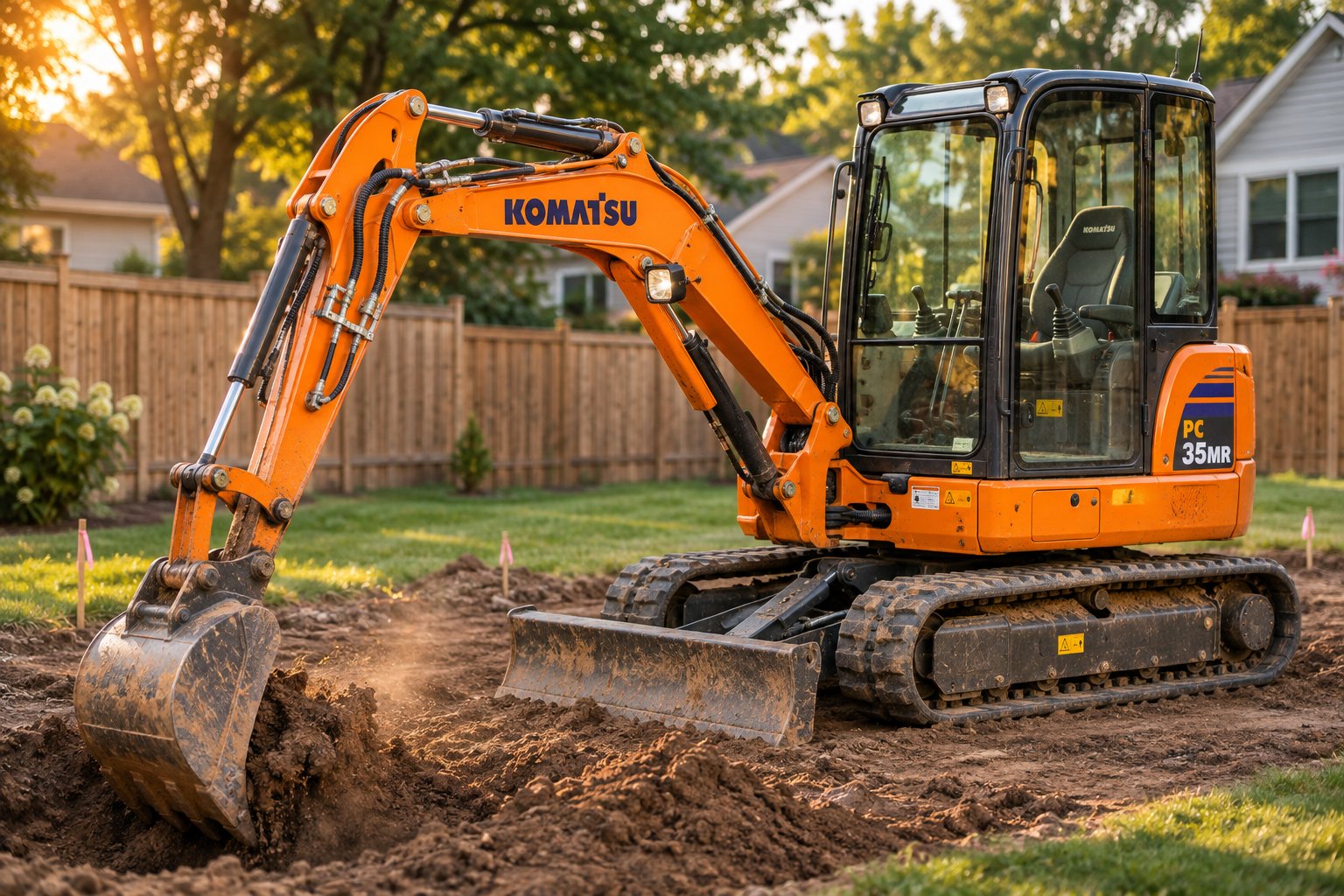
What Makes Komatsu Mini Excavators a Contractor Favorite
Imagine pulling up to a tight residential lot where a full-size excavator trackhoe would chew up the client's lawn, clip the neighbor's fence, and require a permit just to get there. That scenario is exactly why compact hydraulic excavators exist — and why Komatsu's lineup has earned a loyal following among professionals who work in confined spaces every day.
A Komatsu mini excavator is a compact, rubber-tracked hydraulic machine with an operating weight under approximately 8 metric tons, engineered for digging, trenching, grading, and material handling on space-constrained jobsites where full-size excavators cannot safely or efficiently operate.
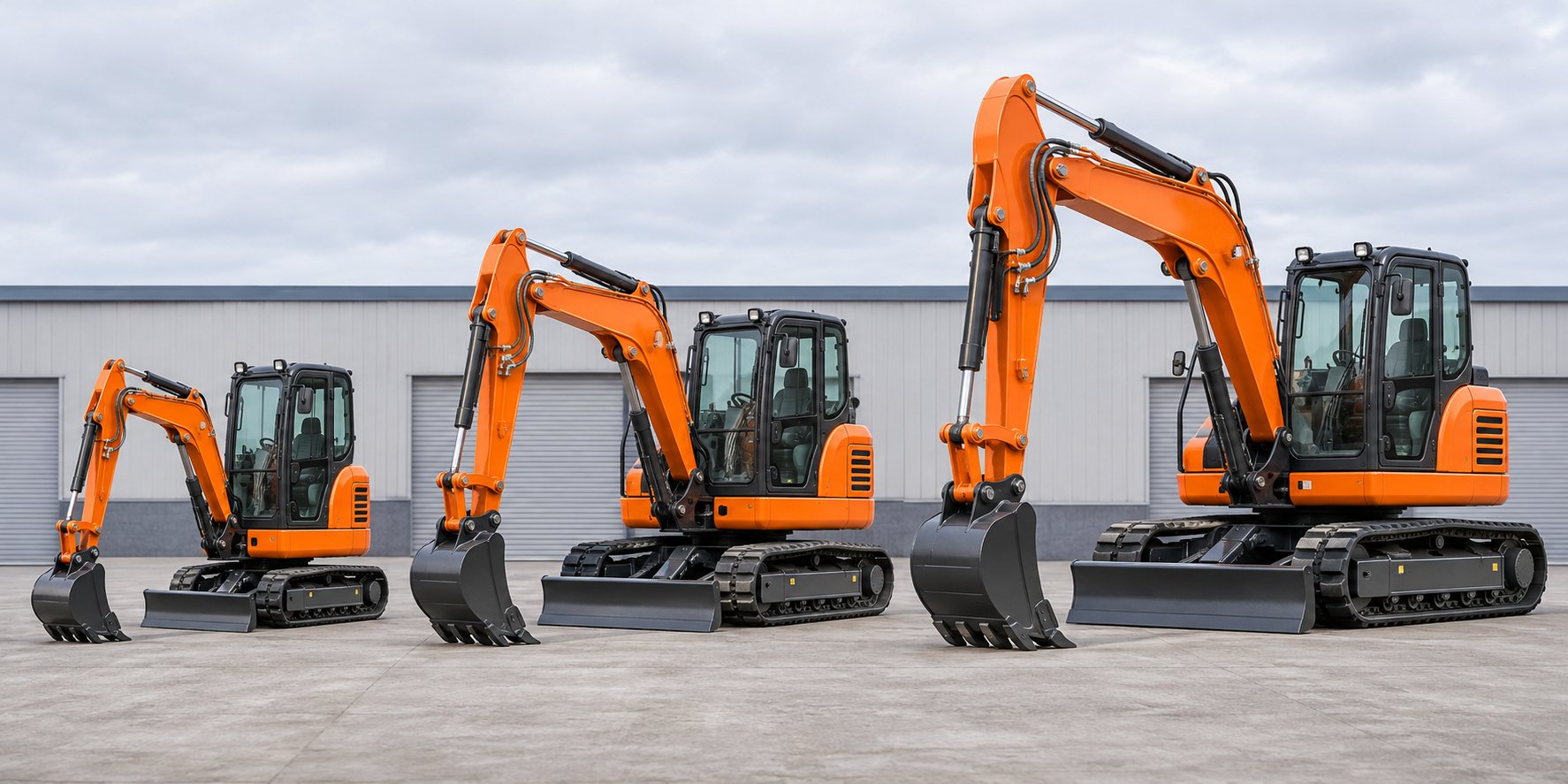
These machines typically weigh between roughly 1 and 8 tons, and the industry broadly groups them into three classes. Micro excavators sit at the lightest end, usually under about 2 tons, and are small enough for backyard work or even indoor demolition. Mini excavators occupy the middle ground — around 2 to 5 tons — covering the bulk of residential construction and utility tasks. Heavy compact models push from 5 tons up to roughly 8 or 9 tons, bridging the gap between nimble minis and the brute force of mid-size machines. Across these classes, typical maximum digging depths range from about 6 feet on the smallest units to over 15 feet on the largest compacts.
Defining the Komatsu Mini Excavator Class
What separates a Komatsu excavator in the compact range from its mid-size and large siblings comes down to operating weight and the presence of a front blade. As a general industry standard, if the machine has a dozer blade and falls under roughly 8 to 10 metric tons, it qualifies as a compact or mini excavator. Mid-size Komatsu models — think the PC130 through PC210 range — start around 13 tons and are purpose-built for heavier earthmoving where space is less of a constraint. Large excavators, including the massive machines Komatsu builds for mining operations, occupy an entirely different universe in both scale and budget. The compact class, by contrast, is designed to deliver meaningful digging performance in places those bigger machines simply cannot reach.
Why Contractors Choose Compact Komatsu Machines
Several practical advantages drive the demand you'll see across landscaping crews, utility contractors, and residential builders:
- Tight-access capability: Rubber tracks and narrow profiles let these machines pass through standard fence gates, navigate between structures, and work on finished surfaces with minimal damage.
- Lower transport costs: Lighter operating weights mean smaller trailers, lighter tow vehicles, and fewer regulatory headaches compared to hauling a 20-ton excavator across town.
- Fuel economy: Smaller diesel engines burn significantly less fuel per hour, keeping daily operating costs in check — an advantage that compounds quickly over a season of steady work.
- Attachment versatility: Auxiliary hydraulic circuits allow operators to swap between buckets, breakers, augers, and thumbs, effectively turning one machine into a multi-tool for the jobsite.
- Japanese engineering heritage: Komatsu Limited — headquartered in Tokyo and ranked as the world's second-largest construction equipment manufacturer — brings over a century of heavy equipment expertise to even its smallest machines. That pedigree translates into refined hydraulics, durable undercarriages, and strong resale values.
For contractors evaluating their next equipment investment, the question is rarely whether a compact Komatsu machine can handle the job. The real question is which model — and which configuration — lines up best with the specific tasks, site conditions, and budget at hand. That decision starts with understanding the full model lineup and how each size class maps to real-world work.
The Complete Komatsu Mini Excavator Model Lineup
Komatsu builds everything from the biggest digger in the world for mining operations down to a machine light enough for one person to transport on a small trailer. That range is exactly what makes the brand's compact catalog worth studying in detail. Whether you need a nimble unit for a backyard patio project or a heavy compact for commercial foundation prep, there is a Komatsu model engineered for that weight class.
One quick note before diving in: model availability varies by region. The North American lineup currently emphasizes the mid-to-upper compact range, while the European and Asian catalogs include additional micro and light compact options. The overview below covers the full global spectrum so you can identify the right class regardless of your market.
Micro Class — The PC09 Through PC18MR
At the ultra-compact end, Komatsu offers a true micro excavator lineup designed for spaces where even a standard mini would feel oversized. The PC09-1 tips the scales at roughly 0.88 to 1.08 metric tons and produces just 9.1 HP — enough to dig down about 1.47 meters for small planting beds, narrow utility trenches, or tight indoor demolition tasks.
Step up to the PC16R-3 and you get a machine in the 1.6 to 1.9-ton range with 15.6 HP and a max dig depth of around 2.41 meters. The PC16 class is a popular choice for contractors who need genuine digging capability through a standard garden gate. Sitting just above it, the PC17R-5 and PC18MR-5 round out this bracket at approximately 1.8 to 1.9 tons with 15.8 HP each. The PC18MR introduces Komatsu's tight tail swing configuration at this weight, giving operators more confidence working against walls and fences.
Light Compact Class — The PC20R Through PC38MR
This is the segment where residential construction crews, landscapers, and light grading contractors find their workhorses. The PC20R-5 and PC24MR-5 serve as the entry points, weighing roughly 2.0 to 2.6 tons with engine output climbing to 21.2 HP. These are practical, everyday machines that still fit on common tandem-axle trailers without pushing tow vehicle limits.
The real sweet spot for many Komatsu excavators buyers in this bracket is the PC26MR-5 through PC38MR-5 range. The PC26MR-5 weighs approximately 2.6 to 2.9 tons and delivers 21.2 HP, while the PC33MR-5 bumps up to about 3.3 tons with 24.4 HP and a max dig depth of 3.13 meters. The PC38MR-5 pushes to 3.7 tons with the same 24.4 HP engine and a slightly deeper 3.46-meter reach. For contractors who need more digging force without exceeding typical trailer weight limits, the PC30MR-5 and PC35MR-5 — available in the North American market at around 3.2 and 3.9 tons respectively — fill a similar role with reduced tail swing for tight residential lots.
Heavy Compact Class — The PC50MR Through PC88MR
Here is where compact convenience meets mid-size capability. The PC50MR-5 and PC55MR-5 weigh approximately 4.9 and 5.3 tons, both producing 39 HP. Their dig depths — 3.7 meters and 4.1 meters respectively — are deep enough for utility trenching, basement excavation, and loading trucks with material. The PC58MR-5 extends the European lineup at 5.6 tons with the same 39 HP powerplant and 4.1-meter dig depth, offering more machine stability for heavier bucket loads.
At the top of the compact range, the PC78US-11 and PC88MR-11 deliver serious excavation power. These models weigh roughly 8.2 and 8.7 tons with 68 HP engines and dig depths exceeding 4.5 meters. They bridge directly into mid-size territory while retaining the reduced tail swing and rubber-track agility that define the compact class.
Understanding Komatsu's Model Naming Convention
You'll notice a pattern in the model numbers. The digits following "PC" roughly correspond to the machine's tonnage class — a PC55 sits in the 5.5-ton range, a PC88 in the 8.8-ton neighborhood. The suffix letters tell you about the configuration:
- MR — Minimum Radius (tight or reduced tail swing), meaning the rear of the upper structure stays very close to — or within — the track width during rotation.
- US — Ultra Short tail swing, similar in concept to MR but used on certain larger models.
- R — Reduced swing radius on smaller micro excavator models.
- E — Electric-powered variant (such as the PC20E-6 and PC26E-6).
The trailing number (e.g., "-5" or "-11") indicates the generation or series revision. Higher numbers represent newer iterations with updated engines, hydraulics, or cab designs.
The table below compares representative models across all three weight classes. Specifications are drawn from Komatsu's published data and industry spec references; always confirm final figures with your regional dealer before purchasing.
| Model | Approx. Operating Weight | Max Dig Depth | Engine Output | Tail Swing Type |
|---|---|---|---|---|
| PC09-1 | 0.88 - 1.08 t (1,940 - 2,381 lbs) | 1.47 m (4' 10") | 9.1 HP (6.8 kW) | Conventional |
| PC16R-3 | 1.57 - 1.92 t (3,461 - 4,233 lbs) | 2.41 m (7' 11") | 15.6 HP (11.6 kW) | Reduced |
| PC18MR-5 | 1.9 t (4,189 lbs) | ~2.4 m (7' 10") | 15.8 HP (11.8 kW) | Minimum Radius |
| PC26MR-5 | 2.6 - 2.9 t (5,732 - 6,393 lbs) | ~2.7 m (8' 10") | 21.2 HP (15.8 kW) | Minimum Radius |
| PC33MR-5 | 3.29 t (7,253 lbs) | 3.13 m (10' 3") | 24.4 HP (18.2 kW) | Minimum Radius |
| PC38MR-5 | 3.73 t (8,223 lbs) | 3.46 m (11' 4") | 24.4 HP (18.2 kW) | Minimum Radius |
| PC50MR-5 | 4.93 t (10,868 lbs) | 3.71 m (12' 2") | 39 HP (29.1 kW) | Minimum Radius |
| PC55MR-5 | 5.26 t (11,596 lbs) | 4.13 m (13' 6") | 39 HP (29.1 kW) | Minimum Radius |
| PC78US-11 | 8.25 t (18,188 lbs) | 4.65 m (15' 3") | 68 HP (50.7 kW) | Ultra Short |
| PC88MR-11 | 8.72 t (19,224 lbs) | 4.57 m (15' 0") | 68 HP (50.7 kW) | Minimum Radius |
Scanning this table, a clear pattern emerges: horsepower and dig depth scale in step with operating weight, but the jumps are not always proportional. The leap from the PC38MR to the PC50MR, for example, adds over a ton of machine weight and nearly 15 HP — a significant capability increase that matters when you shift from light landscaping to serious utility trenching. Understanding where those performance thresholds fall is critical to choosing the right machine, and it starts with the engine under the hood.
Engine Performance and Fuel Efficiency Across the Range
Every model in Komatsu's compact excavator lineup runs on diesel — with one fascinating exception. That consistency in fuel type simplifies fleet management, but the engines themselves vary dramatically in output, consumption, and emissions compliance as you move from the lightest micro class to the heaviest compacts. Understanding those differences helps you avoid a common mistake: overspending on horsepower you'll never use, or worse, showing up to a jobsite with a machine that lacks the muscle to get the work done on schedule.
Horsepower Ranges and Fuel Systems by Model Size
Engine output across the Komatsu compact range scales roughly in step with operating weight, but the relationship is not perfectly linear. Here is how it breaks down:
At the micro end, models like the PC09-1 produce just 9.1 HP from a small single-cylinder or two-cylinder diesel. The PC16R and PC18MR bump output to approximately 15.6 to 15.8 HP — enough for trenching, light grading, and planting work, but nothing you would call aggressive. These engines are deliberately modest. A compact excavator in this class spends most of its time at partial throttle, and a smaller powerplant translates directly into lower fuel burn per hour. For a landscaping crew running a machine five or six hours a day, that fuel savings compounds fast over a season.
In the light compact class — the PC26MR through PC38MR range — horsepower climbs to roughly 21 to 24 HP. These engines are typically three-cylinder diesels with enough torque to handle residential foundation prep, drainage trenching, and moderate material handling. Fuel consumption in this bracket generally falls in the range of 1 to 2 gallons per hour under normal working conditions, though actual figures depend heavily on digging intensity, attachment load, and whether the operator uses Komatsu's built-in economy mode.
Step into the heavy compact class and the picture changes. The PC50MR and PC55MR share a 39 HP engine capable of sustained digging in compacted soils and rock, while the PC78US-11 and PC88MR-11 jump to a 2.4-liter, 68 HP diesel that pushes these machines into genuinely aggressive excavation territory. Fuel consumption at this level is higher — expect roughly 2 to 3.5 gallons per hour under load — but the productivity gains per gallon often justify the increase when you are digging foundations or loading trucks all day.
The takeaway? Match power to task intensity rather than always choosing the most powerful option on the lot. A PC26MR running at 21 HP can trench a residential water line just as effectively as a PC55MR, and it will do so for significantly less fuel cost per foot of trench. Oversizing the engine for the job wastes money twice — once at the pump and again on the purchase price.
Emissions Standards and the Komatsu PC01E Electric Option
Emissions compliance is one of those topics contractors tend to ignore until it causes a problem. Here is the short version: Tier 4 Final is the current EPA standard for off-road diesel engines, and it requires significant reductions in particulate matter and nitrogen oxide (NOx) emissions compared to earlier tiers. Larger compact models like the PC55MR, PC78US, and PC88MR all meet Tier 4 Final requirements.
What makes Komatsu's approach noteworthy is how they achieve compliance. All six of the current North American compact excavators meet Tier 4 Final without using selective catalytic reduction (SCR) and without requiring diesel exhaust fluid (DEF). That is a meaningful practical advantage. No DEF means one fewer fluid to monitor, one fewer system to maintain, and no risk of a machine shutting down because the DEF tank ran dry mid-dig.
Smaller engines in the micro and light compact classes often fall below the EPA's 24 HP threshold for Tier 4 regulation entirely. That means machines like the PC09 and PC16R are exempt from the most complex emissions aftertreatment requirements, which simplifies maintenance and reduces the number of components that can fail. For a single-machine owner or a small rental fleet, that simplicity translates into real cost savings over the life of the equipment.
Then there is the outlier that signals where Komatsu is headed. The PC01E-1 is Komatsu's first electric micro excavator, developed jointly with Honda and powered by swappable Honda Mobile Power Pack e: batteries. Weighing just 340 kg with a 2.5 kW electric motor, the PC01E produces zero exhaust emissions, virtually no noise, and eliminates all engine-related maintenance — no filters, no oil changes, no fueling stops. Operators who tested the machine during Komatsu's proof-of-concept trials reported that it actually felt more powerful than the conventional PC01 at low revolutions, thanks to the electric motor's flat torque curve.
For contractors working indoors, in emission-regulated urban zones, or on noise-sensitive residential sites, a zero-emission compact excavator is not a novelty — it is a practical tool that opens up jobs diesel machines simply cannot access. The PC01E launched initially as a rental model in Japan, and Komatsu has since introduced electric options in the PC20E and PC26E classes for the European market, suggesting this technology will continue expanding across their compact lineup.
Before choosing any model, you'll want to evaluate these engine-related factors and weigh them against your typical working conditions:
- Rated horsepower — Does the engine provide enough power for your most demanding tasks, or are you paying for output you will rarely use?
- Fuel tank capacity — Smaller tanks mean more frequent refueling; confirm the tank size supports a full shift of work at your expected consumption rate.
- Estimated fuel burn per hour — Ask the dealer for representative consumption figures under typical load conditions, not just the theoretical minimums listed on spec sheets.
- Emissions tier — Verify whether the model requires DEF or aftertreatment systems that add maintenance complexity, and check local regulations if you work in strict air-quality zones.
- Noise levels — Urban and residential jobsites often have enforceable noise ordinances; lower-horsepower models and electric variants give you more flexibility in sensitive environments.
Engine specs set the boundaries of what a machine can do, but they do not tell the whole story. Komatsu layers proprietary technologies — from telematics to hydraulic system design — on top of those powerplants, and those features often make a bigger difference in daily productivity than raw horsepower alone.
Komatsu Technology and Engineering Advantages
Raw horsepower gets the bucket into the ground, but what happens between the engine and the operator's hands determines how efficiently that power translates into productive work. Komatsu layers several proprietary systems across its compact excavator range — some visible, some invisible — that directly affect uptime, operating cost, and the operator's ability to work safely in tight quarters. These are the engineering decisions that separate one brand from another long after the spec sheet comparisons are done.
KOMTRAX Telematics and Fleet Management
Imagine knowing exactly where every machine in your fleet is, how many hours each one ran last week, and which unit is overdue for a filter change — all without making a single phone call. That is essentially what KOMTRAX, Komatsu's proprietary GPS-based telematics system, delivers.
KOMTRAX comes factory-installed on Komatsu mini excavators and transmits real-time data to a web-based dashboard accessible from any PC, smartphone, or tablet. The system tracks a wide range of operational metrics:
- Machine location — GPS coordinates updated regularly, with geofencing alerts if the unit moves outside a defined area.
- Operating hours and idle time — See exactly how many hours the machine spent working versus sitting idle, which helps identify underutilized equipment.
- Fuel consumption — Daily, weekly, monthly, or lifetime fuel data lets you benchmark efficiency and spot operators or conditions that burn fuel excessively.
- Maintenance alerts — Automated notifications for scheduled service intervals, fluid changes, and filter replacements help prevent missed maintenance from turning into expensive repairs.
- Error codes and abnormality warnings — Email or text alerts when the system detects a machine abnormality, giving you a head start on diagnosing issues before they cause downtime.
- Theft monitoring — Location tracking and remote engine lock functionality provide a layer of security for machines parked on open jobsites overnight.
For a single-machine owner, KOMTRAX serves as a digital maintenance reminder that keeps the excavator on schedule. For a multi-unit fleet manager, the value multiplies. Komatsu's My Komatsu platform aggregates telematics data from every KOMTRAX-equipped unit — and even non-Komatsu machines using the ISO 15143-3 (AEMP 2.0) standard — onto a single dashboard. Maps, tables, and performance charts eliminate the need to log into multiple systems or pay for third-party fleet management software.
GPS telematics on excavators has rapidly shifted from a premium add-on to an industry baseline. Brands like Caterpillar and Kubota offer their own telematics suites, and rental companies increasingly expect telemetry data from every unit in their yards. What sets KOMTRAX apart is its depth of data and the fact that it ships standard — you are not paying extra to activate it, and you are not locked into a subscription just to see your own machine's hours.
Zero Tail Swing and Tight Tail Swing Explained
If you have ever watched an operator nervously check mirrors while rotating an excavator's upper structure next to a brick wall or parked car, you understand why tail swing configuration matters. This is one of the most practical — and most misunderstood — selection factors in the compact class.
Here is the distinction in plain terms. A zero tail swing design means the rear of the upper structure stays entirely within the width of the tracks during a full 360-degree rotation. Nothing sticks out. The operator can spin the cab and boom assembly without worrying about clipping a fence, striking a pedestrian standing behind the machine, or denting a vehicle parked alongside the trench. A tight tail swing (also called reduced or minimum radius) allows only a few inches of overhang beyond the tracks — not zero, but close enough that most confined-space work is still manageable with reasonable operator awareness.
For contractors working on residential lots, alongside active roadways, or in congested urban environments, zero or tight tail swing is not a luxury — it is a critical safety and productivity factor that should rank alongside dig depth and horsepower in every purchase decision.
Komatsu's MR (Minimum Radius) designation, found across models from the PC18MR up through the PC88MR, indicates a tight tail swing configuration. The US (Ultra Short) designation on the PC78US signals a similar compact rear profile. In practical terms, nearly every Komatsu mini excavator currently in production favors a reduced-radius design, reflecting the reality that these machines spend most of their lives in exactly the kind of spaces where conventional tail swing creates problems.
There is a trade-off worth noting. Conventional tail swing models typically offer greater lifting capacity and more stability when working over the side or using heavy attachments like hydraulic breakers and grapples. The additional counterweight at the rear boosts performance in those scenarios. But as industry experts and competing manufacturers have acknowledged, the demand for compact-radius designs has outweighed the lifting advantage for most contractors in the mini class. The confined spaces that justify buying a compact excavator in the first place are the same spaces where a protruding tail swing creates risk. Komatsu's lineup reflects that market reality — the MR and US models dominate the current catalog for good reason.
Hydraulic System Design and Operator Comfort
You'll feel the difference in a Komatsu's hydraulic system before you understand the engineering behind it. Move the joystick a fraction of an inch, and the bucket responds proportionally — no lurching, no lag, no hunting for the right position. That smoothness traces back to a specific design choice: a closed-center, load-sensing hydraulic system.
What does that mean in practical terms? In an open-center system — common on older or less expensive excavators — the hydraulic pump runs at constant output and dumps excess oil back to the tank whenever the controls are in neutral. That wastes energy and generates heat. In Komatsu's closed-center load-sensing design, the pump adjusts its output to match the actual demand from the joystick inputs. When you are not moving any function, the pump de-strokes to minimum flow, reducing fuel consumption and hydraulic heat buildup. When you feather the controls for fine grading, the system delivers exactly the oil volume your inputs request — no more, no less.
The result is a machine that feels more precise during delicate work like finish grading or positioning pipe, and more responsive during aggressive digging when you need full hydraulic flow. Komatsu achieves this through variable-displacement piston pumps regulated by torque control valves and servo mechanisms that continuously balance pump output against load pressure. For the operator, the technical details are invisible. What is visible is a machine that does what you tell it to do, exactly when you tell it, without fighting the controls.
Operator comfort rounds out the package. Across the compact range, Komatsu equips its cabs with pressurized ROPS/FOPS (Roll-Over Protective Structure / Falling Object Protective Structure) enclosures that keep dust and debris out while meeting safety certification standards. Adjustable suspension seats, proportional joystick controls with intuitive ISO or SAE pattern switching, and clear sightlines to the bucket and tracks reduce fatigue during long shifts. On larger models like the PC55MR and PC88MR, you will also find features like air conditioning, Bluetooth radio integration, and a color LCD monitor displaying KOMTRAX data, fuel levels, and hydraulic system status in real time.
These comfort and control features may sound like nice-to-haves, but consider the math. An operator who is less fatigued, more confident in the machine's responsiveness, and better informed about its status will dig more accurately, damage fewer utilities, and keep the machine running longer between service intervals. Technology and ergonomics do not just make the work easier — they make the work more profitable. And profitability ultimately depends on matching all of these capabilities to the specific job at hand.
Matching the Right Komatsu Model to Your Job Site
Spec sheets are useful, but they do not dig trenches or grade driveways. The real decision is not about which Komatsu mini excavator has the most horsepower or the deepest reach — it is about which machine fits the work you actually do five days a week. A contractor who starts with the job and works backward to the model almost always ends up with a better match than someone who picks a machine based on specs alone and then looks for tasks to justify the purchase.
Think of it this way: an oversized excavator on a small residential lot wastes fuel, risks damaging finished surfaces, and sits idle during tasks that only need a fraction of its capability. An undersized machine on a commercial site repositions constantly, slows cycle times, and turns a two-day job into a full week. The goal is to land in the sweet spot where the machine's capability aligns tightly with the demands of the task.
Landscaping and Backyard Projects
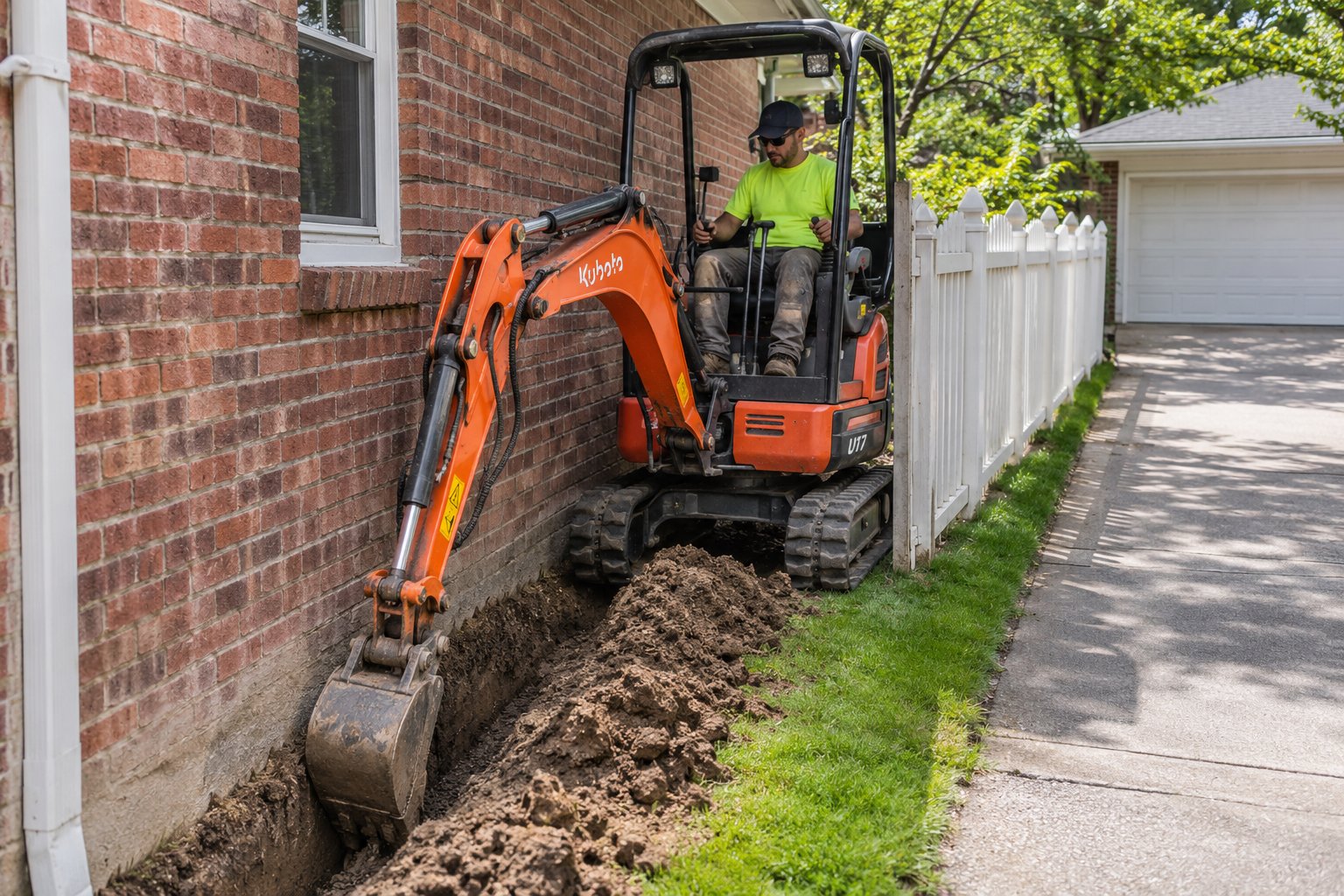
When the jobsite is someone's backyard — complete with a manicured lawn, a fence gate that barely fits a wheelbarrow, and a neighbor watching from the porch — the lightest Komatsu models earn their keep. The PC09 through PC26MR range, spanning roughly 1 to 3 tons, delivers exactly what residential landscaping demands without the collateral damage larger machines bring.
Rubber tracks on these compact units distribute weight over a wider footprint than tires, which means significantly less turf damage when crossing finished lawns. A machine like the PC18MR or PC20R, at roughly 1.9 to 2.0 tons, can pass through a standard 36-inch fence gate — a practical detail that eliminates the need to tear out and rebuild fence sections just to access the work area. That alone can save a landscaping crew hours of labor and hundreds of dollars in materials on a single job.
Digging capability in this class covers the tasks landscapers encounter most often:
- Planting beds and tree installations — Dig depths of 1.5 to 2.7 meters handle even large root ball excavations.
- Grading and leveling — Smooth hydraulic response lets operators shape terrain for patios, walkways, and retaining wall foundations with precision.
- Drainage work — French drains, downspout extensions, and shallow stormwater trenches fall well within the reach and bucket force of a PC20R or PC26MR.
- Small demolition — Removing old concrete walkways, breaking up compacted fill, or clearing brush with a thumb attachment turns one machine into a multi-task tool.
The key advantage here is proportionality. You are not burning 3 gallons of diesel per hour to dig a 2-foot-deep planting bed. A machine in the 15 to 21 HP range sips fuel, keeps noise levels manageable for residential neighborhoods, and provides enough finesse for work where precision matters more than raw power.
Utility Trenching and Urban Infrastructure
Utility contractors live in a different world than landscapers. The work is linear — miles of narrow trenches for water mains, gas lines, fiber optic cables, and electrical conduit — and it happens in some of the most constrained environments imaginable: active roadways, sidewalk corridors, between buildings, and alongside buried infrastructure that absolutely cannot be struck.
The PC30MR through PC55MR range, weighing roughly 3 to 5.5 tons, is purpose-built for this reality. These models offer dig depths between approximately 3.1 and 4.1 meters, which covers the vast majority of utility burial depth requirements. A Komatsu PC50 class machine, for example, reaches deep enough for most municipal water and sewer laterals while maintaining a compact enough profile to operate within a standard lane-closure width on urban streets.
Zero and tight tail swing configurations — standard across Komatsu's MR-designated models — become critical advantages in utility work. When the machine is rotating next to a live traffic lane, a row of parked cars, or a building foundation, every inch of tail overhang represents a collision risk. The MR design keeps the upper structure within the track width during full rotation, allowing the operator to focus on the trench rather than constantly checking clearances behind the cab.
Additional factors that make this weight class ideal for utility contractors include:
- Narrow bucket compatibility — 12-inch and 18-inch trenching buckets fit these machines perfectly for pipe and conduit trenches, minimizing material removal and backfill volume.
- Auxiliary hydraulic flow — Adequate hydraulic output to run a compaction plate attachment for trench backfill, eliminating the need for a separate compactor on site.
- Trailer-friendly weight — A 5-ton machine on a tandem-axle equipment trailer stays well within common towing capacities, so crews can mobilize between multiple trenching jobs in a single day without specialized transport.
Residential Foundation and Commercial Site Prep
Foundation excavation and commercial grading push the demands beyond what light compact machines can handle efficiently. The soil is often compacted, rocky, or a mix of both. Trenches are deeper. Bucket loads are heavier. And there is usually a dump truck waiting to be filled — which means cycle time and bucket capacity matter as much as dig depth.
The PC55MR through PC88MR range, spanning roughly 5.3 to 8.7 tons, bridges into this heavier territory while retaining the compact-class advantages contractors depend on. With 39 to 68 HP and dig depths reaching 4.1 to 4.6 meters, these machines deliver enough bucket breakout force to cut through compacted clay, fractured rock, and dense gravel without constantly repositioning or stalling out.
A machine like the PC78US-11 or PC88MR-11 — sitting in the 8+ ton range — can load a standard dump truck in a reasonable number of cycles, handle rebar-reinforced concrete with a breaker attachment, and dig a residential basement to full depth in most soil conditions. Yet it still rolls on rubber tracks, fits through most residential site access points, and transports on commonly available equipment trailers. That combination of capability and portability is exactly what makes the heavy compact class so popular among contractors who split their time between residential and light commercial work.
For commercial site preparation — grading building pads, excavating parking lot sub-bases, or stripping topsoil — the upper compact models provide enough machine weight to anchor against hard material and enough hydraulic flow to run productivity-boosting attachments like tilt buckets and grading beams. Contractors who need to move larger volumes of material will eventually step up to a mid-size excavator, but for projects under roughly an acre, a Komatsu mini excavator in the 5- to 9-ton class often completes the work without the higher fuel costs, transport complexity, and site damage that come with bigger iron.
The table below maps common job types to the Komatsu model ranges best suited for each application, along with the key specification that drives the match. Use it as a starting point, then refine your selection based on specific site conditions and access constraints.
| Job Type | Recommended Komatsu Model Range | Key Specification Driving the Match |
|---|---|---|
| Landscaping and backyard grading | PC09 through PC26MR | Narrow width and low ground pressure for turf preservation and gate access |
| Utility trenching (water, gas, fiber, electrical) | PC30MR through PC55MR | Dig depth (3.1–4.1 m) matching common utility burial requirements |
| Residential foundation excavation | PC55MR through PC88MR | Bucket breakout force sufficient for compacted and rocky soils |
| Commercial site prep and grading | PC55MR through PC88MR | Operating weight (5–9 t) providing stability for sustained heavy digging |
| Demolition (residential and light commercial) | PC45MR through PC88MR | Auxiliary hydraulic flow to power breaker and grapple attachments |
| Agricultural drainage | PC30MR through PC55MR | Rubber tracks minimizing field damage; dig depth for drainage tile installation |
Notice a pattern in the table: most contractors do not need a single machine that does everything. They need the right machine for the jobs that fill their schedule most weeks. A landscaping company running 80 percent backyard projects and 20 percent drainage work will get far more value from a PC26MR than from a PC55MR that sits oversized on four out of five jobs. Conversely, a foundation contractor regularly hitting compacted clay at 12 feet needs the breakout force and dig depth of the heavy compact class — no amount of operator skill will make a 2.5-ton machine productive in that scenario.
Choosing the correct model is half the equation. The other half is expanding that machine's capability through attachments — the tools that transform a single excavator from a dedicated digger into a genuinely versatile jobsite platform.
Attachments That Multiply Your Machine's Versatility
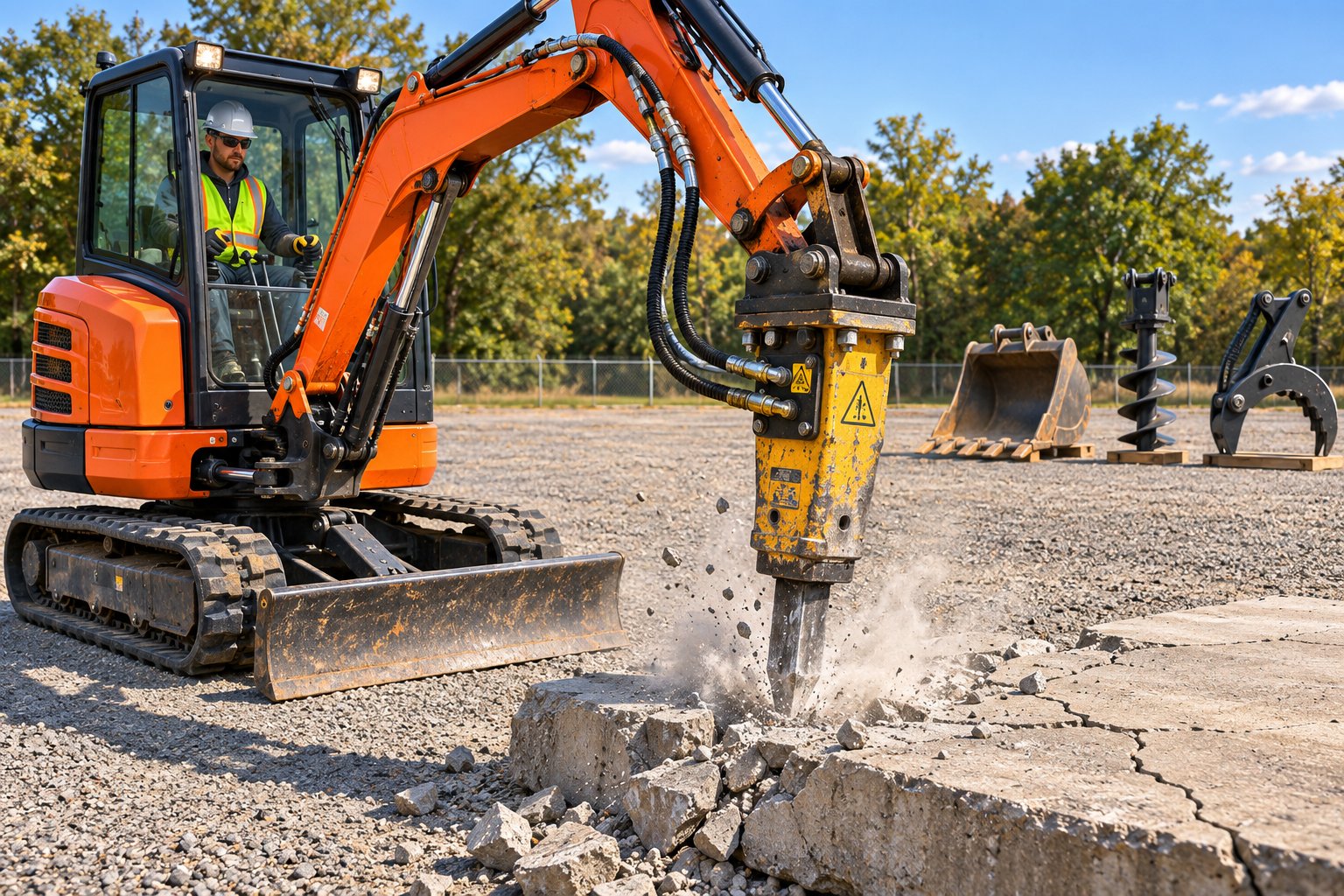
A Komatsu mini excavator with a standard digging bucket is already a capable machine. Add the right attachment, and it becomes an entirely different tool — one that demolishes concrete, drills fence post holes, clears brush, or grades a slope with surgical precision. The real return on investment for most contractors is not locked inside the base machine. It lives in the attachment ecosystem that turns a single purchase into a multi-purpose platform capable of replacing two or three separate pieces of equipment on a jobsite.
That versatility hinges on one critical feature: auxiliary hydraulic circuits. Every Komatsu compact excavator from the PC20R up through the PC88MR provides auxiliary hydraulic flow through dedicated lines at the end of the arm. These circuits deliver pressurized oil to power hydraulic attachments — breakers, augers, mulchers, thumbs — directly from the machine's pump. The flow rate and pressure available depend on the model size, which is why matching attachment demand to the excavator's hydraulic output matters just as much as matching attachment weight to the machine's rated capacity.
Essential Attachments for Komatsu Mini Excavators
The attachment market for compact excavators is enormous, but a handful of tools account for the vast majority of real-world use. Here are the highest-value options and what they enable:
- Hydraulic breaker / hammer — Turns the excavator into a precision demolition tool for breaking concrete slabs, cracking rock ledge in trenches, and removing old footings. Komatsu's own G- and H-Series breakers are available for compact models starting at 4 metric tons, with the H-Series eliminating nitrogen recharge requirements for simpler field maintenance. For machines in the 2- to 6-ton class, breakers in the 350 to 900 lb range typically pair well — always verify service weight compatibility with the dealer.
- Auger — Converts the excavator into a drilling machine for fence posts, deck footings, sign foundations, and tree planting holes. Soil type dictates the bit selection: carbide-tipped teeth for clay and hardpan, standard teeth for sandy or loamy ground, and dedicated rock auger bits for ledge. Using the wrong bit in the wrong soil destroys teeth in minutes.
- Hydraulic thumb — Arguably the most cost-effective upgrade for any compact excavator. The thumb clamps against the bucket to grab, hold, and place irregular objects — boulders, brush piles, demolition debris, logs — that a bare bucket would simply push around. It dramatically reduces hand labor during sorting and cleanup tasks.
- Tilt bucket — Allows the bucket to angle side to side independently of the arm, enabling precision grading on slopes, swale contouring, and ditch shaping without constantly repositioning the machine. On fine grading and landscaping work, a tilt bucket saves significant time compared to a fixed bucket.
- Ripper tooth — A single-point ripper attachment mounts in place of the bucket and fractures frozen ground, compacted fill, or thin rock layers that a standard bucket cannot penetrate. Invaluable for winter work and rocky soil conditions where a breaker would be overkill.
- Grapple bucket — Purpose-built for bulk material handling, a grapple opens wide and clamps around piles of brush, concrete chunks, or mixed debris for loading into trucks or dumpsters. Rotating grapple models let the operator spin material 360 degrees from the cab, which is especially useful on demolition and land-clearing sites.
Each of these attachments addresses a specific task that would otherwise require a dedicated machine or manual labor crew. A contractor running a PC55MR with a breaker, thumb, and two bucket sizes can handle demolition, trenching, material handling, and grading in a single day — all from one seat.
How Quick Couplers Maximize Jobsite Efficiency
Owning multiple attachments only pays off if you can swap between them quickly. That is where quick-coupler systems earn their place in the equation.
Two main types exist. Mechanical (manual) couplers require the operator to exit the cab and manually engage or release locking pins to change attachments. The process is straightforward and the hardware is less expensive, making manual couplers a practical choice for smaller machines or jobs where attachment changes are infrequent. Many micro and light compact Komatsu models — from the PC09 through the PC26MR — use manual pin-on or manual coupler setups due to the lighter attachment weights involved.
Hydraulic quick couplers automate the process entirely. The operator presses a switch from inside the cab, hydraulic pins retract, the old attachment releases, and the new one locks into place — all without stepping off the machine. On a jobsite where you might switch between a digging bucket, breaker, and thumb multiple times per day, the time savings are substantial. Less downtime per swap means more billable work per hour, which directly improves the machine's return on investment.
There is an important compatibility note to keep in mind. Pin-on attachments are designed for a specific pin spacing and diameter that matches the excavator's stick. A coupler adds an adapter plate between the stick and the attachment, which changes the geometry slightly and adds weight to the tool end. That additional weight reduces the excavator's effective lifting and digging capacity at full reach. Always verify that the combined weight of the coupler plus attachment stays within the machine's rated capacity chart — especially on lighter models where the margin is smaller.
The cost-savings argument is simple math. A single Komatsu mini excavator equipped with a quick coupler and three or four attachments can replace the need to mobilize separate machines for separate tasks. On smaller residential or utility jobsites, that consolidation eliminates extra trailer trips, extra fuel burn, and extra rental fees. It also reduces the physical footprint of equipment on site — a practical benefit when working in tight spaces where every square foot of staging area counts.
Attachments define what the machine can do. The next question most contractors face is how to acquire the machine itself — and that decision involves weighing new purchase pricing, used market value, rental flexibility, and lease terms against each other.
Buying New, Used, or Renting a Komatsu Mini Excavator
Picking the right model and the right attachments only matters if the acquisition path makes financial sense for your business. A machine that perfectly matches your workload can still hurt your bottom line if you overpay, overcommit, or choose the wrong ownership structure for your utilization rate. The good news? Contractors have more options than ever — new purchase, used purchase, rental, and lease — each with distinct financial profiles and trade-offs worth understanding before signing anything.
New Komatsu Mini Excavator Pricing Factors
How much should you expect to spend? A new mini excavator typically costs between $30,000 and $100,000 depending on the size, brand, features, and dealer. Komatsu's compact models fall squarely within that range — a light compact like the PC26MR sits at the lower end, while a heavy compact PC88MR pushes toward the upper boundary.
Several factors drive the final number beyond the base machine price:
- Model size and weight class — This is the single biggest price driver. A 2-ton machine and an 8-ton machine live in completely different cost brackets, and the gap is not linear. The jump from a PC33MR to a PC55MR adds more to the invoice than the jump from a PC18MR to a PC26MR.
- Attachment packages — Ordering a machine with a hydraulic thumb, quick coupler, and additional bucket sizes at the time of purchase often costs less than buying those attachments separately after delivery. Ask the dealer for a bundled package quote.
- Extended warranty options — Komatsu offers extended warranty and maintenance plans through its dealer network. These add upfront cost but can reduce financial uncertainty — especially for contractors buying their first compact excavator who want predictable service expenses during the first few years.
- Financing terms — Komatsu Financial provides manufacturer-backed financing programs that often include promotional rates, deferred payment structures, or seasonal payment plans tailored to contractors whose income fluctuates throughout the year. Financing terms through Komatsu Financial typically range from 24 to 84 months, with structures that match equipment life.
- Regional dealer markups — Pricing varies by geography. Dealers in high-demand urban markets may hold closer to list price, while dealers in less competitive regions sometimes offer more aggressive discounts or bundled service agreements. Always request quotes from at least two authorized dealers before committing.
One important reality check: published pricing for new construction equipment is notoriously opaque. Unlike buying a pickup truck, there is no MSRP sticker on the window. Every transaction is negotiated. Treat any price range you read online — including the figures above — as a budgeting reference, not a firm quote. The only accurate number is the one on a dealer's written proposal for the specific machine and configuration you need.
Buying Used — What to Inspect and Where to Shop
The used market for Japanese Komatsu compact excavators is robust, and for good reason. These machines hold their value well thanks to durable construction and strong global demand, but they also depreciate enough in the first few years to create genuine savings for the second owner. Used mini excavators generally range from about $18,000 to $90,000, with pricing driven by age, operating hours, condition, and included attachments.
The savings are real, but so are the risks. A used excavator that looks clean on the outside can hide expensive problems under fresh paint. Before any money changes hands, a thorough pre-purchase inspection should cover these critical checkpoints:
- Hour meter readings and consistency — Verify that the displayed hours match the visible wear on pedals, joysticks, seats, and control surfaces. A machine listed as "low hours" with heavily worn operator controls does not add up. OEM telematics like KOMTRAX can help confirm actual usage history — ask the seller if KOMTRAX data is available, and request a history report from a Komatsu dealer.
- Hydraulic leak checks — Examine every hose, fitting, and cylinder rod for signs of active or dried hydraulic fluid leaks. Slow or weak hydraulic response during operation can indicate pump or valve problems that are expensive to repair. Hydraulic system issues are far easier to spot on a clean, dry machine than one that has been freshly pressure-washed without explanation.
- Undercarriage wear — The track chains, rollers, idlers, and sprockets on the undercarriage absorb constant punishment and represent one of the costliest replacement items on any excavator. Check for pointed sprocket teeth, leaking rollers, cracked idlers, and stiff or loose track links. A dealer or qualified technician can measure remaining life against manufacturer specs.
- Boom, arm, and pin play — Move the bucket and stick through their full range while watching and listening for clunking, excessive play, or sloppy joint movement. Worn pins and bushings indicate heavy use and add up to a significant repair bill if multiple joints need attention simultaneously.
- Maintenance record availability — Request documentation of oil changes, filter replacements, greasing schedules, and any major repairs. Oil analysis reports are particularly valuable because they reveal internal engine and hydraulic component wear that visual inspection cannot detect. Gaps in documentation are not automatic deal-breakers, but they should prompt deeper investigation and a more conservative offer price.
- Structural welds and repairs — Inspect the boom foot, boom nose, stick tip, and cylinder mounts for signs of cracking, grinding marks, or fresh weld repairs that could indicate previous structural damage.
Where you shop matters as much as what you inspect. Authorized Komatsu dealers offer certified pre-owned programs with documented service histories and limited warranties. Independent equipment dealers provide broader selection and sometimes lower prices, but inspection responsibility shifts more heavily to the buyer. Reputable used equipment dealers specializing in Japanese-manufactured machines often provide inspected, work-ready units with detailed condition reports — for example, JIUHONG Machinery lists a used Komatsu PC55 excavator as a 5.5-ton compact option suited for landscaping and excavation contractors seeking a specific model at a lower entry cost than buying new. Online auction platforms offer the widest selection but carry the highest risk, since many listings sell as-is with limited or no opportunity for in-person inspection before bidding.
Regardless of where you buy, consider having an independent technician inspect the machine before closing the deal. For a purchase of this size, the cost of a professional inspection is a small price to pay for peace of mind.
Rental and Lease Considerations
Not every contractor needs to own. If you use a compact excavator for a handful of projects per year, seasonal work, or a single large job, rental may deliver better financial outcomes than tying up capital in a machine that sits idle most of the time.
The utilization math is straightforward. Industry financial advisors recommend purchasing when you expect annual time utilization of 60 percent or more — roughly 13 or more working days per month. Below 40 percent utilization, renting is almost always the more cost-effective choice. Between 40 and 60 percent, the decision depends on how confident you are that your project backlog will hold steady.
Pros of Renting
- No long-term financial commitment — return the machine when the project ends.
- Maintenance and breakdowns are the rental company's responsibility, not yours.
- Access to newer models with the latest technology without committing to a purchase.
- Rental payments are fully deductible as a cost of doing business — no depreciation scheduling needed.
- Flexibility to rent a different size class for each job, matching the machine to the task every time.
Pros of Leasing
- Fixed monthly payments over 12 to 36 months create predictable budgeting.
- Lower upfront capital outlay compared to purchasing.
- Many lease agreements include a purchase option at the end of the term, letting you test the machine before committing to ownership.
- Allows equipment rotation on planned replacement cycles, reducing long-term maintenance exposure.
The downside of leasing compared to renting is commitment. If a project gets canceled or your workload shifts, you are still on the hook for the remaining lease payments. And unlike ownership, lease payments do not build equity — unless you exercise a purchase option at the end of the term.
Rental is also an excellent way to test a specific Komatsu model before committing to a purchase. Spending a week operating a PC35MR on an actual jobsite tells you more about whether that machine fits your workflow than any spec sheet or dealer demonstration ever could. Many contractors rent first, confirm the fit, and then move to a purchase or lease with confidence.
As a general benchmark, long-term monthly rentals for compact excavators typically run about 4 to 5 percent of the machine's purchase price per month. That means renting a machine valued at $50,000 would cost roughly $2,000 to $2,500 monthly. Compare that to a purchase loan payment on the same machine — often in the $800 to $1,000 range over 60 months — and you can see how quickly rental costs exceed purchase costs when utilization is high. The table below compares all four acquisition paths side by side:
| Acquisition Path | Upfront Cost | Long-Term Cost | Ownership Equity | Flexibility | Best-Fit Scenario |
|---|---|---|---|---|---|
| New Purchase | High (full price or financed down payment) | Moderate (loan payments + maintenance) | Yes — full ownership and resale value | Low — committed to one model and size class | High utilization (60%+), long-term ownership, strong project backlog |
| Used Purchase | Moderate (30–60% less than new) | Moderate to High (maintenance costs may increase with age) | Yes — ownership with lower initial depreciation hit | Low to Moderate — resale market provides exit path | Budget-conscious buyers, proven models, contractors adding a second machine |
| Rental | Low (daily, weekly, or monthly rate only) | High if used frequently over time | None — payments build no equity | High — return anytime, switch sizes per job | Seasonal work, single projects, testing a model before buying |
| Lease | Low to Moderate (first payment + fees) | Moderate (fixed payments, possible purchase option) | Limited — only if purchase option is exercised | Moderate — locked in for the lease term | Consistent mid-range utilization, cash flow preservation, planned equipment rotation |
There is no universally correct answer. A contractor running a large excavator fleet with dozens of units and steady year-round utilization will almost always favor purchasing — the per-hour cost of ownership drops well below rental rates at high utilization. A solo operator taking on a one-time foundation project is better off renting and returning the machine when the job wraps. The contractors who fall in between — consistent work, moderate utilization, limited capital — often find leasing or buying a quality used machine strikes the best balance between cost and flexibility.
Whichever path you choose, do not overlook one detail that catches many first-time compact excavator buyers off guard: the cost of getting the machine to and from the jobsite. Transport logistics — trailer type, tow vehicle requirements, and weight-based regulations — add a layer of planning and expense that belongs in every acquisition budget.
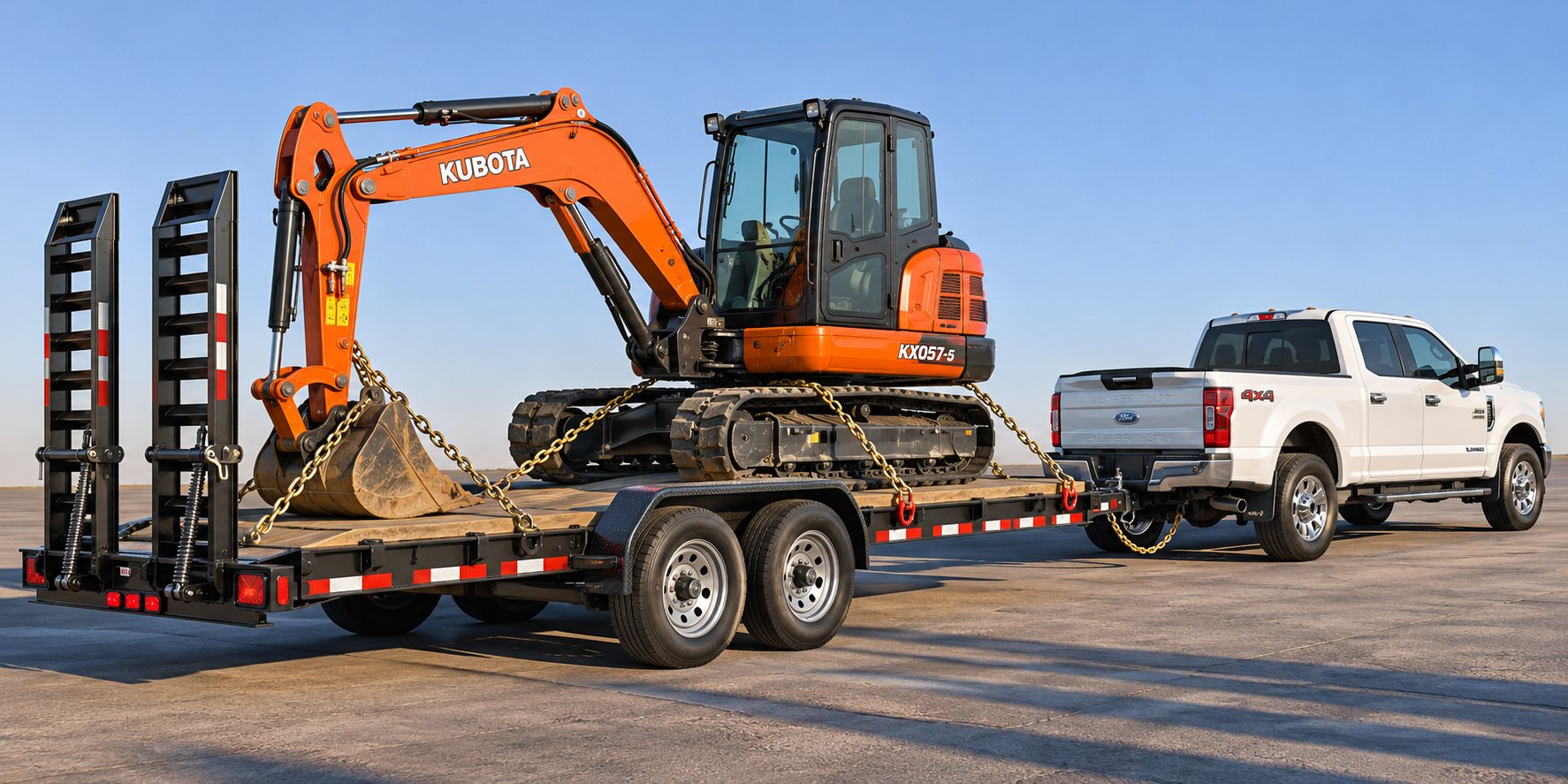
Transport and Trailer Requirements by Weight Class
You have picked the perfect Komatsu model, settled on an acquisition path, and maybe even ordered a set of attachments. There is one more cost and logistical variable that deserves just as much planning — and it is the one that trips up more first-time buyers than any spec sheet misread: getting the machine to the jobsite and back, legally and safely, without overloading a trailer, exceeding a tow vehicle's capacity, or accidentally crossing a regulatory threshold that triggers a fine or a license requirement you do not hold.
The math is not complicated, but skipping it is expensive. A machine that sits in the yard because the contractor's trailer cannot legally carry it, or a DOT stop that ends in citations because the combined weight exceeds limits — these are preventable problems. The key is matching your Komatsu mini excavator's actual transport weight to three things: the trailer's usable payload, the tow vehicle's rated capacity, and the regulations governing the combined weight in your jurisdiction.
Trailer Types by Komatsu Mini Excavator Weight Class
Not every excavator needs a heavy-duty lowboy. And not every utility trailer can safely carry a compact excavator — even one that "looks small enough." The right trailer depends entirely on the machine's configured transport weight, which includes the base operating weight plus any attached bucket, thumb, coupler, blade, and a full fuel tank. As trailer specification experts emphasize, the number on the excavator's decal describes a broad equipment class, not a dependable transport weight. Attachments, fuel, track type, and counterweight options all shift the real figure, sometimes by hundreds of pounds.
Here is how each Komatsu weight class maps to trailer requirements:
Micro class (under 2 tons) — Heavy-duty utility trailers. Models like the Komatsu PC01, PC09, and PC16R weigh roughly 300 kg to 1.9 tons, depending on the configuration. At these weights, a quality single-axle or light tandem-axle utility trailer with a GVWR of 3,500 to 5,000 lbs handles the load comfortably. The machine is light enough that loading ramp angles are forgiving, tie-down forces are manageable, and the whole combination fits behind a half-ton pickup in most cases. These are the machines you can mobilize between three or four backyard landscaping jobs in a single day without any specialized transport equipment.
Light compact class (2 to 4 tons) — Tandem-axle equipment trailers. The PC20R through PC38MR range, weighing approximately 2.0 to 3.9 tons (roughly 4,400 to 8,600 lbs), requires a meaningful step up in trailer capacity. A tandem-axle equipment trailer rated between 7,000 and 12,000 lbs GVWR is the standard choice here. Remember that usable payload is GVWR minus the trailer's own empty weight — a trailer rated at 10,000 lbs GVWR with a 2,500 lb curb weight only provides 7,500 lbs of actual carrying capacity. A PC35MR at roughly 8,200 lbs configured with a bucket and full fuel tank leaves a thin margin on that trailer, and thin margins invite problems. Always calculate with real numbers, not estimates.
Heavy compact class (4 to 9 tons) — Dedicated equipment trailers or tag-along lowboys. Machines from the PC50MR through the PC88MR weigh between approximately 4.9 and 8.7 tons (10,800 to 19,200 lbs). These require serious trailer capacity: think 14,000 to 24,000 lb GVWR equipment trailers with appropriately rated axles, brakes on every axle, and loading systems designed for tracked machinery. A PC55MR at roughly 11,600 lbs needs a trailer that still leaves room for the machine plus chains, binders, spare buckets, and fuel cans without brushing the GVWR ceiling. The PC78US and PC88MR, pushing 18,000 to 19,000+ lbs, typically demand trailers in the 20,000 lb GVWR range or higher — and that moves the entire transport combination into a different class for both the trailer and the vehicle pulling it.
Ramp angle is another detail worth planning. A compact excavator with limited ground clearance and a short wheelbase can high-center on steep ramps — the belly scrapes the transition point where the ramp meets the trailer deck, potentially damaging hydraulic lines or the undercarriage. As a practical rule, loading in the slowest travel mode with the boom held low reduces the risk, but a longer ramp or a lower-profile trailer deck reduces it further by decreasing the approach angle. Tilt-deck trailers solve this problem entirely for lighter machines by eliminating the ramp altogether — the deck tilts to ground level, and the machine drives straight on.
Proper tie-down points matter at every weight class. Four-point chain securement — heavy-duty transport chains run from the machine's frame to the trailer's D-rings in a pattern that blocks forward, rearward, and lateral movement — is standard practice. Route chains through the manufacturer's designated attachment points on the excavator's lower frame, never over hydraulic cylinders or hoses where tension can crush lines and damage seals.
Tow Vehicle Requirements and Transport Regulations
The trailer is only half the equation. The vehicle pulling it must be rated to control the combined weight under braking, on grades, and in crosswinds — and the legal thresholds for that combination vary more than most contractors realize.
Matching the tow vehicle starts with one number: the truck's Gross Combined Weight Rating (GCWR). This is the maximum allowable weight of the truck, passengers, cargo, trailer, and everything on the trailer, all added together. If the total exceeds the GCWR, the truck is overloaded regardless of what the trailer can carry. For Komatsu's micro and light compact models on appropriately sized trailers, a heavy-duty half-ton or three-quarter-ton pickup (think Ford F-250 or RAM 2500 class) typically handles the job. Heavy compact models on dedicated equipment trailers almost always require a one-ton dually or commercial-class truck with towing capacity in the 20,000 lb range or higher.
Here is where regulations enter the picture. Federal CDL (Commercial Driver's License) requirements, administered through the FMCSA, are triggered by specific weight thresholds:
- Class A CDL required — When the total GCWR of the truck and trailer exceeds 26,001 lbs and the trailer's GVWR exceeds 10,000 lbs.
- Class B CDL required — When the total GCWR exceeds 26,001 lbs but the trailer's GVWR stays below 10,000 lbs.
- No CDL typically required — When the total combination stays under 26,001 lbs GCWR, or when the transport is genuinely for personal (non-commercial) use — though this distinction is notoriously murky in practice.
A 5.5-ton machine like the PC55MR illustrates why these thresholds matter. The excavator weighs roughly 11,600 lbs. Place it on a 14,000 lb GVWR equipment trailer that weighs 3,500 lbs empty. The trailer alone — loaded with the machine — sits right at or slightly over the 10,000 lb GVWR mark depending on the specific trailer model. Add the truck's own weight, and the total GCWR can easily approach or exceed 26,001 lbs. That combination potentially triggers a Class A CDL requirement for the driver — and many contractors running two- or three-person crews simply do not have a CDL holder available for every equipment move.
State-level regulations add another layer. Some states set their own CDL thresholds for intrastate (within the state) transport that differ from federal rules. Others impose additional requirements for DOT-compliant trailer lighting, electric brake systems, breakaway switches, and safety chain ratings that apply to any trailer above a certain GVWR — often 3,000 to 5,000 lbs depending on the state. Before buying a machine or a trailer, verify the specific requirements in every state where you plan to haul.
| Weight Class | Example Komatsu Models | Recommended Trailer Type | Minimum Tow Vehicle Class | Transport Regulation Notes |
|---|---|---|---|---|
| Micro (under 2 t) | PC01, PC09, PC16R, PC18MR | Single-axle or light tandem utility trailer (3,500–5,000 lb GVWR) | Half-ton pickup (F-150 / RAM 1500 class) | Typically stays well under CDL thresholds; verify state trailer brake and lighting rules |
| Light Compact (2–4 t) | PC20R, PC26MR, PC33MR, PC35MR, PC38MR | Tandem-axle equipment trailer (7,000–12,000 lb GVWR) | Three-quarter-ton pickup (F-250 / RAM 2500 class) | Combination weight approaches CDL thresholds on upper end; confirm GCWR against truck rating |
| Heavy Compact (4–9 t) | PC50MR, PC55MR, PC78US, PC88MR | Dedicated equipment trailer or tag-along lowboy (14,000–24,000 lb GVWR) | One-ton dually or commercial truck (F-350 / RAM 3500 class or higher) | May require Class A CDL when trailer GVWR exceeds 10,000 lbs and total GCWR exceeds 26,001 lbs; DOT brake and lighting compliance mandatory |
The practical lesson here is straightforward: factor transport logistics into the purchase decision, not after it. A contractor choosing between a PC38MR (roughly 3.7 tons) and a PC50MR (roughly 4.9 tons) is not just choosing between two dig depths — that choice may also determine whether the existing trailer and truck combination still works, whether a driver needs a CDL, and whether the daily cost of getting to the jobsite stays the same or jumps significantly. Those hidden costs can shift the total cost of ownership enough to change which machine actually delivers the best value for the money.
Transport is the last logistical variable. With model selection, attachments, acquisition path, and hauling requirements all mapped out, the final question is how Komatsu's compact lineup stacks up against the other brands competing for the same contractors — and how to pull everything together into a confident buying decision.
How Komatsu Stacks Up Against Competing Brands
Komatsu builds everything from the PC 20 class micro machines covered earlier in this guide all the way up to the Komatsu PC8000 — widely recognized as one of the world's biggest excavator platforms, a 800-ton mining shovel that moves entire hillsides. That engineering depth matters even when you are shopping for a 3- or 5-ton compact model, because the hydraulic design philosophy, manufacturing standards, and dealer infrastructure supporting a PC35MR trace back to the same Tokyo-headquartered organization producing those massive mining machines. But brand pedigree alone does not win a purchase decision. Contractors need to weigh Komatsu's real-world strengths and trade-offs against the other names competing for the same trailer spot.
Komatsu vs. Kubota and Caterpillar in the Compact Class
Three brands dominate most compact excavator shortlists in North America: Komatsu, Kubota, and Caterpillar. Bobcat and Takeuchi round out the top five. Each earns its reputation differently, and understanding those differences helps you spend wisely rather than defaulting to the most familiar logo.
Komatsu's core advantages center on KOMTRAX telematics shipping as a standard, factory-installed feature across the lineup — no activation fees, no subscription required. The closed-center load-sensing hydraulic system delivers smoother, more fuel-efficient operation than the open-center designs still found on some competitors in this class. Japanese build quality, refined through decades of heavy equipment manufacturing, translates into strong resale values and long service life when the machine is properly maintained. Komatsu's compact range also achieves Tier 4 Final compliance without DEF on its North American models, which reduces maintenance complexity.
Kubota counters with arguably the deepest compact excavator dealer network in North America and the broadest mini excavator model range — 13 models spanning the KX and U-series. Resale data from Ritchie Bros. consistently ranks Kubota at the top for value retention, with well-maintained units routinely holding 60 to 70 percent of original price after three years. Kubota's pricing also tends to be competitive in the micro and light compact brackets, making them a strong option for contractors entering the market. The trade-off? Dealer parts allocations can get tight during peak season in some regions, and Kubota's telematics system is less mature than KOMTRAX in terms of data depth and fleet-level integration.
Caterpillar brings the largest construction equipment dealer footprint on the continent. When a hydraulic pump fails at 7 a.m. on a Monday, being two hours from a Cat dealer with parts on the shelf — rather than two days from a regional warehouse — can save a contract. The Next Gen mini excavator line introduced Stick Steer joystick-controlled travel and Cat Connect telematics, both strong features. Cat machines, however, tend to run heavier and pricier at the same tonnage compared to Komatsu or Kubota. That extra weight affects transport costs and soft-ground performance, and the higher purchase price narrows the resale-percentage advantage even though absolute resale dollars remain strong.
Bobcat and Takeuchi deserve mention as well. Contractor surveys and marketplace data highlight Bobcat's massive compact equipment dealer network and the improved R2-Series excavators, though older Bobcat mini excavators historically depreciated faster than top-tier competitors. Takeuchi, meanwhile, earns fierce loyalty for hydraulic performance that consistently punches above its tonnage — the TB series is a favorite among operators who prioritize feel and responsiveness. Takeuchi's dealer footprint, however, runs thinner than Kubota's or Cat's in certain regions, which can slow parts logistics.
| Decision Factor | Komatsu | Kubota | Caterpillar | Bobcat | Takeuchi |
|---|---|---|---|---|---|
| Dealer Network Density (North America) | Strong | Very strong | Largest | Very strong (compact segment) | Moderate (regional gaps) |
| Standard Telematics | KOMTRAX (factory-standard, no subscription) | Available, less mature | Cat Connect (standard on Next Gen) | Machine IQ (available) | Takeuchi Fleet Management (available) |
| Hydraulic System Type | Closed-center load-sensing | Varies by model (load-sensing on larger units) | Closed-center load-sensing (Next Gen) | Load-sensing on R2-Series | Load-sensing (known for exceptional feel) |
| Typical Resale Value Retention (3-year) | Strong (55-65%) | Strongest (60-70%) | Strong (55-65%) | Moderate to Strong (improving with R2-Series) | Above Average (high demand, limited supply) |
| Compact Model Range Breadth | 6 models (North America); broader globally | 13+ models | 24 models | 24 models | 28 models |
| DEF Required (Tier 4 Final models) | No (NA compact lineup) | Varies by model | Varies by model | Varies by model | Varies by model |
A few patterns stand out. Komatsu's North American compact lineup is narrower than competitors — six models versus Caterpillar's or Takeuchi's two dozen — which means fewer size options but also a more focused engineering effort on the models they do offer. If one of Komatsu's available weight classes matches your workload, the combination of KOMTRAX, DEF-free emissions compliance, and refined hydraulics is hard to beat. If you need a very specific tonnage that falls between Komatsu's current offerings, Kubota or Cat may fill that gap more precisely.
Making Your Final Selection with Confidence
Every chapter of this guide has built toward a single decision framework. Here is the summary, condensed into the sequence that produces the best outcomes for contractors who follow it:
- Start with the job, not the machine. Identify the tasks that fill your schedule most weeks — landscaping, utility trenching, foundation work, demolition — and use the application table from earlier to narrow the weight class.
- Match features to site conditions. Tight residential lots demand zero or minimum-radius tail swing. Indoor or noise-sensitive work may justify exploring electric options. High-utilization fleets benefit from KOMTRAX telematics for maintenance scheduling and fuel tracking.
- Choose the acquisition path that fits your utilization rate. High utilization favors purchasing. Seasonal or project-based use favors rental. Mid-range utilization makes leasing or a quality used machine the best balance of cost and flexibility.
- Confirm transport logistics before you commit. Verify that your trailer, tow vehicle, and licensing situation can handle the machine's configured transport weight. A half-ton difference in operating weight can push a combination across a CDL threshold or exceed a trailer's GVWR.
- Request multiple quotes. Whether buying new from a Komatsu dealer, exploring the used market, or pricing rentals, comparing at least two or three sources protects against overpaying. Authorized dealers, independent equipment sellers, and specialized used-equipment companies all serve different segments of the market.
The used market deserves special emphasis here. Proven Komatsu compact models hold their value precisely because they perform reliably across thousands of operating hours, which means a well-maintained used unit can deliver years of productive service at a significantly lower entry cost than buying new. Contractors seeking a specific compact option like the Komatsu PC55 — a 5.5-ton machine that hits the sweet spot for landscaping and mid-range excavation — can explore verified used listings through specialized dealers such as JIUHONG Machinery to compare pricing against new and rental alternatives before requesting a quote. That kind of cross-comparison — new versus used versus rental, across multiple sources — is how contractors avoid overpaying and find the acquisition path that actually fits their financial reality.
Here is the honest closing thought. The right komatsu mini excavator is not the largest model, the newest model, or the one with the most impressive spec sheet. It is the one matched to the operator's actual workload — the tasks that generate revenue week after week, on the specific sites where the machine will spend its hours. A PC26MR that works every day on residential landscaping jobs earns more than a PC88MR that sits idle three days a week because the projects do not justify the size. Every decision in this guide — model selection, engine class, attachments, acquisition path, transport planning, and brand comparison — points back to that principle. Match the machine to the work, and the investment takes care of itself.
Frequently Asked Questions About Komatsu Mini Excavators
1. What is the weight range of Komatsu mini excavators?
Komatsu mini excavators span roughly 0.88 metric tons (about 1,940 lbs) for the PC09-1 micro model up to approximately 8.72 metric tons (around 19,224 lbs) for the PC88MR-11 heavy compact model. The lineup is grouped into three classes: micro (under 2 tons), light compact (2 to 4 tons), and heavy compact (4 to 9 tons). Each class targets different jobsite demands, from backyard landscaping to commercial foundation excavation, so choosing the right weight class depends on your most common tasks and site access constraints.
2. How much does a Komatsu mini excavator cost new or used?
New Komatsu mini excavators typically fall between $30,000 and $100,000, depending on model size, attachment packages, and dealer pricing. Used units generally range from $18,000 to $90,000, with price influenced by operating hours, condition, and included accessories. For example, a used Komatsu PC55 — a popular 5.5-ton compact model — can be found through specialized dealers like JIUHONG Machinery at a lower entry cost than buying new. Always request written quotes from multiple sources, including authorized Komatsu dealers and reputable used equipment sellers, to ensure competitive pricing.
3. What does MR mean in Komatsu excavator model names?
MR stands for Minimum Radius, indicating a tight or reduced tail swing design. On MR-designated models, the rear of the upper structure stays very close to or within the width of the tracks during a full 360-degree rotation. This design is critical for safe operation near walls, fences, parked vehicles, and active traffic lanes. Nearly every current Komatsu compact excavator carries the MR designation, reflecting contractor demand for machines that work confidently in confined residential and urban spaces without risking collateral damage.
4. Do Komatsu mini excavators require DEF (diesel exhaust fluid)?
No, Komatsu's current North American compact excavator lineup achieves Tier 4 Final emissions compliance without selective catalytic reduction and without requiring diesel exhaust fluid. This is a notable maintenance advantage over some competing brands that do require DEF on certain models. Eliminating DEF means one fewer fluid to monitor, no risk of engine shutdown from an empty DEF tank, and reduced long-term maintenance complexity. Smaller micro-class models may fall below EPA horsepower thresholds for Tier 4 regulation entirely, further simplifying upkeep.
5. What trailer do I need to haul a Komatsu mini excavator?
Trailer requirements depend on the excavator's configured transport weight. Micro models under 2 tons fit on heavy-duty utility trailers rated at 3,500 to 5,000 lbs GVWR, towable by a half-ton pickup. Light compact models between 2 and 4 tons need tandem-axle equipment trailers rated at 7,000 to 12,000 lbs GVWR and at least a three-quarter-ton truck. Heavy compact models from 4 to 9 tons require dedicated equipment trailers rated at 14,000 to 24,000 lbs GVWR with a one-ton dually or commercial truck. Verify that the combined weight does not exceed CDL thresholds — typically 26,001 lbs GCWR — to avoid unexpected licensing requirements.