

What Exactly Is a Full Size Excavator
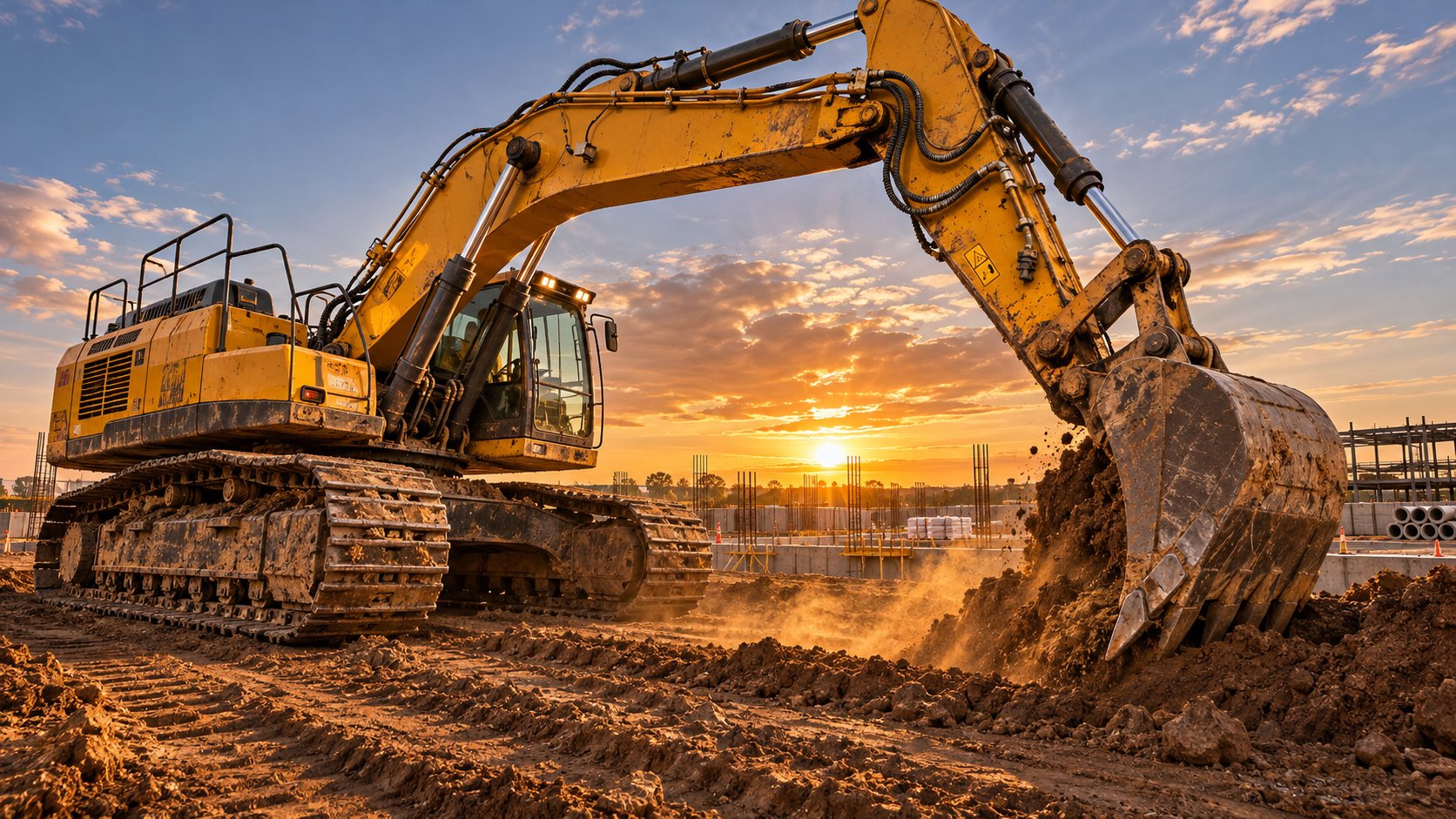
Walk onto any commercial earthmoving site and you will almost certainly spot one — a crawler excavator heavy enough to rip through compacted clay, yet compact enough to roll off a lowboy trailer without a multi-state permit headache. That machine is a full size excavator, and it sits at the center of how modern contractors move dirt, break rock, and build infrastructure.
What Counts as a Full Size Excavator
A full size excavator is a hydraulic crawler excavator generally weighing between 20 and 45 metric tons, equipped with a standard or long-reach boom, and designed for medium-to-heavy commercial excavation tasks.
Three measurable boundaries separate this class from everything else in the excavator lineup. First, operating weight — machines below roughly 7 metric tons fall into the mini or compact category, while anything above 45 metric tons enters large or mining-class territory. Second, engine output — full size models typically deliver between 120 and 300-plus horsepower, giving them the hydraulic muscle to drive larger buckets, breakers, and grapples. Third, dig depth — where even the best mini excavators top out around 10 to 12 feet, a full size machine regularly reaches 20 feet or deeper in a single pass.
If you have ever searched for the big excavator in the world or the worlds largest trackhoe, you were likely looking at mining-class giants — machines like the Hitachi excavator models used in open-pit operations or the caterpillar biggest offerings built for quarry-scale production. Those behemoths are impressive, but they serve a fundamentally different purpose than the 20-to-45-ton workhorse most contractors actually need.
Why the Full Size Class Matters for Contractors
Think of this weight class as a productivity sweet spot. Digging force, reach, and transportability all converge in a single platform. A full size excavator handles utility trenching on Monday, road construction on Wednesday, and foundation excavation the following week — all without the mobilization costs and oversize-load permits that come with heavier equipment. Even a big cat excavator in the 30-ton range can ship on a standard heavy-haul trailer in most jurisdictions.
That versatility explains why standard excavators remain the most common size on commercial job sites. They tackle demolition, large-diameter pipe installation, retention pond work, and mass grading — jobs where a compact machine simply cannot keep pace.
This article takes a brand-neutral, head-to-head approach to help you compare models, decode spec sheets, and match the right machine to your next project. No single manufacturer gets the spotlight; every major OEM earns a seat at the table.
Where Full Size Excavators Fit in the Equipment Hierarchy
Every excavator class exists for a reason, and picking the wrong one costs you either productivity or money — sometimes both. Before zeroing in on a specific full size excavator, it helps to see the entire weight spectrum laid out so you can pinpoint exactly where this class begins, where it ends, and why those boundaries matter on the job.
Equipment Size Classes at a Glance
The table below maps five commonly referenced size classes against their typical operating weight, well-known model families, and the applications each class handles best. Manufacturer classifications vary slightly by brand, so treat these ranges as practical guideposts rather than rigid cutoffs.
| Size Class | Typical Operating Weight | Common Models | Best-Suited Applications |
|---|---|---|---|
| Mini / Compact | Under 6 metric tons | Cat 301-305, Kubota U27-U55, Bobcat E35-E50 | Landscaping, residential trenching, backyard utilities, indoor demolition |
| Small | 6 - 10 metric tons | Cat 306-309, Komatsu PC78-PC88, Hitachi ZX85 | Light commercial work, urban utility installs, small municipal projects |
| Medium | 10 - 20 metric tons | Cat 313-317, Komatsu PC130-PC170, Hitachi ZX130-ZX200 | Road maintenance, mid-depth trenching, general site preparation |
| Full Size | 20 - 45 metric tons | Cat 320-340, Komatsu PC200-PC400, Hitachi ZX210-ZX350 | Deep foundations, heavy rock breaking, mass excavation, large-diameter pipe |
| Large / Mining | Over 45 metric tons | Cat 350-395, Komatsu PC490-PC800, Hitachi EX1200+ | Open-pit mining, quarry production, major infrastructure earthmoving |
Notice the naming pattern: Caterpillar construction equipment labels generally climb with operating weight — a 320 is lighter than a 340, which is lighter than a 395. Komatsu follows a similar logic with its PC-prefix numbering, and Hitachi does the same with the ZX series. Once you crack that code, you can compare models across brands at a glance — a Cat 320 competes in roughly the same arena as a Komatsu PC210 or a Hitachi ZX210.
If you have ever wondered what the biggest excavator in the world looks like, it belongs firmly in the mining tier — machines that weigh hundreds of tons, demand specialized oversize permits, and live on quarry floors year-round. The world's biggest excavator is a far cry from the versatile 20-to-45-ton machines most commercial contractors actually run.
When a Mid Size Machine Is Enough and When It Is Not
Imagine a shallow utility trench on a tight residential lot. A medium excavator in the 13-to-17-ton range can handle the dig depth, maneuver around property lines, and load onto a standard flatbed without drama. For that scope, stepping up to a full size machine just inflates your fuel bill.
Flip the scenario: you are excavating a 20-foot basement, breaking through compacted rock layers, or installing 48-inch storm pipe. A medium excavator lacks the bucket breakout force and reach to keep cycle times competitive. In those conditions, a full size excavator — say, a machine in the Cat 340 class or a Komatsu PC350 — delivers the hydraulic power and dig depth the project demands. Contractors shopping for a cat 340 excavator for sale are usually chasing exactly that kind of heavy-duty capability.
A practical rule of thumb: if your typical trench depth stays under 15 feet and bucket loads stay light, a medium machine probably earns its keep. The moment projects consistently push past 18 feet deep, involve rock breaking, or require sustained truck-loading productivity, you are in full size territory. Choosing between the two is less about prestige and more about matching digging force to the material sitting in the ground.
Even the largest trackhoe in the world is just the wrong tool for a parking lot storm drain — proof that right-sizing always beats up-sizing. The real question is which specific models within the full size class offer the best combination of power, efficiency, and dealer support for your operation.
Major Brands and Model Lineups Compared
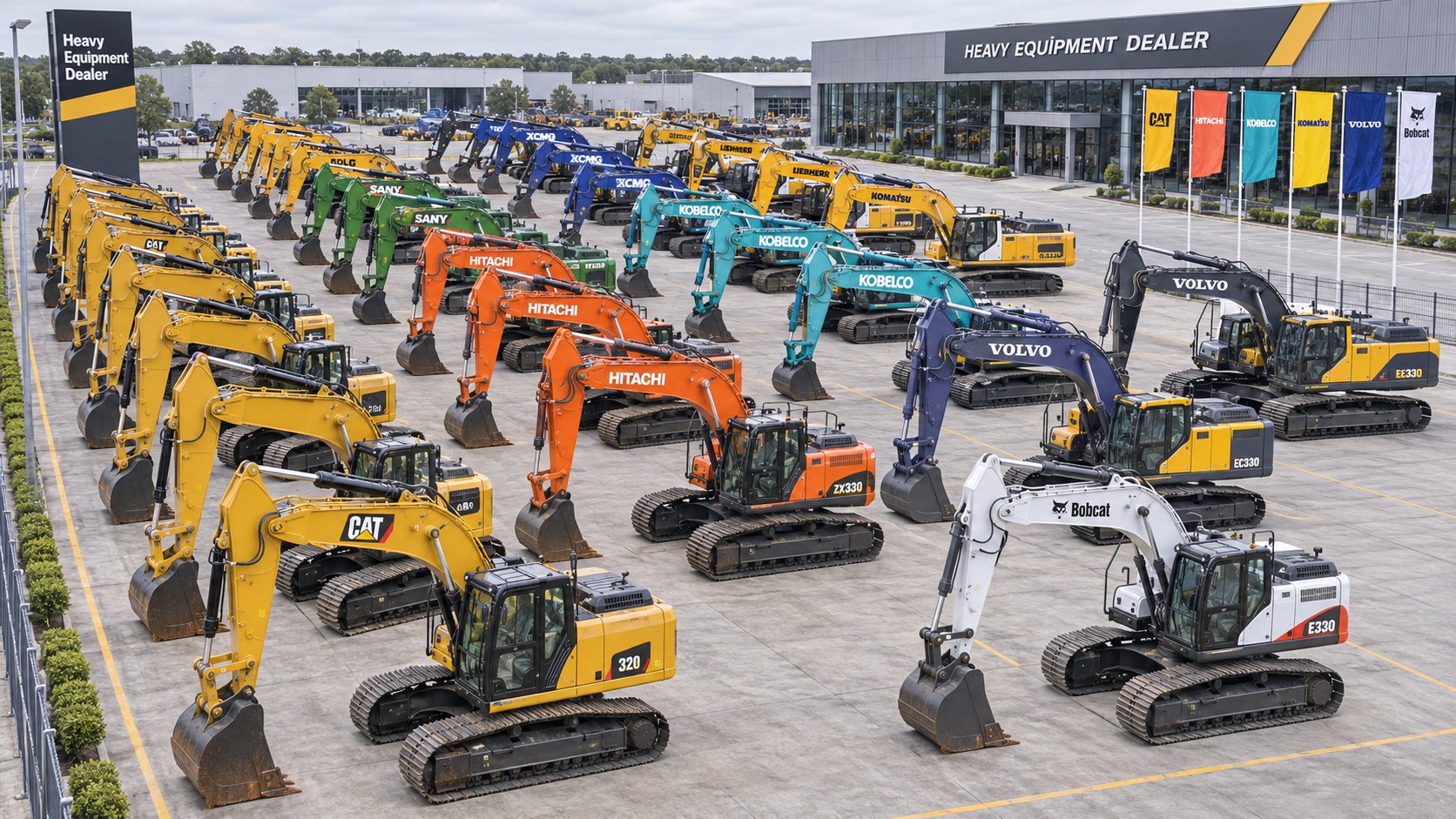
Dealers naturally steer conversations toward the brands they carry. That is not dishonesty — it is just the reality of distribution agreements. The downside? You rarely get a single, honest overview of every manufacturer competing in the full size excavator space. This section fills that gap by lining up every major OEM side by side so you can evaluate the entire market before walking into a showroom.
Global OEM Landscape for Full Size Excavators
More than a dozen manufacturers currently build crawler excavators in the 20-to-45-metric-ton range for the North American and global markets. The table below captures the key players, their primary full size model families, and the reputation each brand has earned among contractors and fleet managers. Keep in mind that lineups evolve — new dash-series models launch regularly — so treat this as a navigational map rather than a frozen snapshot.
| Manufacturer | Key Full Size Models | Notable Strengths | Primary Markets |
|---|---|---|---|
| Caterpillar | 320, 323, 325, 326, 330, 335, 336, 340 | Largest dealer network in North America; deep technology integration (Cat Grade, Payload); strong resale values | Global — dominant in N. America |
| Komatsu | PC210, PC220, PC240, PC290, PC360, PC390 | Intelligent Machine Control (iMC) factory-installed on select models; hybrid powertrain options; KOMTRAX telematics | Global — strong in N. America, Asia |
| Hitachi (transitioning to Landcros) | ZX210, ZX245, ZX300, ZX350 | TRIAS III hydraulic efficiency; Isuzu engines with no DPF on newer models; competitive breakout forces | Global — expanding N. America presence |
| Volvo CE | EC220E, ECR255, EC300E, ECR355, EC350E, EC380E | Industry-leading bucket capacity range; hybrid models; redesigned next-gen cabs with reduced noise | Global — strong in Europe, growing in N. America |
| John Deere | 210 P-Tier, 230 P-Tier, 260 P-Tier, 300G, 345 P-Tier, 350 P-Tier | Standard integrated 2D machine control on next-gen models; electro-hydraulic controls; extensive rural dealer network | N. America — ranked No. 2 in U.S. excavator sales |
| Kobelco | SK210LC, SK230SRLC, SK260LC, SK300LC, SK350LC, SK380SRLC | Excavator-only specialist; iNDr noise-reduction system; strong short-radius (SR) lineup for confined work | Global — niche strength in N. America, Japan |
| Develon (formerly Doosan) | DX230LC-9, DX260LC-9, DX300LC-9, DX360LC-9, DX400LC-9 | Next-gen dash-9 cabs with 12-inch displays; AI-powered human detection; competitive pricing | Global — growing N. America share |
| Hyundai | HX210L, HX230L, HX260L, HX300L, HX360L, HX400L | 22% productivity boost on new HX Series; fully electrohydraulic controls; 330-degree camera system | Global — expanding in N. America |
| CASE CE | CX210D, CX220E, CX250D, CX260E, CX300E, CX350D, CX365E SR | E Series hydraulic improvements; competitive horsepower in-class; strong short-radius models | N. America, Europe, Latin America |
| Liebherr | R 922, R 924, R 928, R 930, R 934, R 938, R 945 | Generation 8 platform with standard Leica 2D machine control; European build quality; wide boom/arm configurations | Global — strongest in Europe, expanding N. America |
| Kubota Excavators | KX080-4 (upper compact range only) | Renowned reliability in compact equipment; limited full size offerings — primarily serves the lighter end | N. America, Japan, Europe |
| Link-Belt | 220 X4S, 245 X4S, 250 X4, 300 X4S, 355 X4S, 350 X4 | Spin Ace short-tailswing series; Isuzu engines without DPF; Spool Stroke Control (SSC) hydraulics | Primarily N. America |
| Sany | SY235H, SY265C, SY335C, SY365C | Aggressive pricing; Cummins engines; next-gen cabs with eight-tool selection modes | Global — rapidly growing in N. America |
| XCMG | XE225U, XE250U, XE300U, XE355UCR, XE360U | Intelligent electronic control system; Cummins powertrains; competitive entry-level pricing | Global — emerging in N. America |
A few things stand out immediately. Caterpillar, Komatsu, and John Deere dominate U.S. sales volume — Fusable's EDA finance data ranks Cat as the No. 1 seller, with Deere at No. 2 and Komatsu at No. 3. Hitachi holds the No. 4 spot and Volvo rounds out the top five. Yet brands like Develon, Hyundai, Sany, and XCMG are pushing aggressively into the market with competitively priced machines and modern technology packages. Even smaller-volume players like Kobelco and Link-Belt earn loyal followings thanks to specialized features — Kobelco's SR short-radius models and Link-Belt's SSC hydraulic technology, for example.
Worth noting: while kubota excavators are a powerhouse in the compact and small classes, the brand does not currently field a true full size lineup in the 20-to-45-ton range. If your projects demand a big excavator with deep-dig capability, you will be shopping outside Kubota's catalog — though their smaller machines pair nicely as support equipment on the same site. Similarly, some buyers look for an excavator with wheels for road work or urban utility jobs. Caterpillar, Volvo, Hyundai, and Develon all manufacture wheeled models, but those are a separate product category from the tracked crawlers covered here. And if your needs lean toward the compact end — say, a 1 ton mini excavator rental for a weekend landscaping job — every brand on this list also manufactures minis that fill that role.
Understanding Model Naming Conventions
Manufacturer part numbers can feel like alphabet soup. Here is the shortcut: most OEMs embed the approximate operating weight right into the model name. Once you learn the pattern, cross-brand comparison becomes almost instant.
- Caterpillar uses a three-digit number. The first two digits loosely indicate the weight class in metric tons. A Cat 320 sits around 24 metric tons; a Cat 340 lands near 41 metric tons. Suffix letters like "GC" (lower cost of ownership) or "CR" (compact radius) flag configuration variants.
- Komatsu prefixes every excavator with "PC" followed by a number that approximates operating weight. A PC210 weighs roughly 26 metric tons, and a PC360 comes in around 39 metric tons. The dash number after the suffix (e.g., PC210LC-11, PC220LC-12) indicates the generation — higher is newer.
- Hitachi uses a "ZX" prefix with the same weight-based logic. A ZX210 weighs about 25 metric tons; a ZX350 lands near 40 metric tons. The "-7" or "-6" suffix denotes the generation series.
- Volvo labels conventional machines with "EC" (e.g., EC220E, EC350E) and short-tailswing models with "ECR" (e.g., ECR255, ECR355). The trailing letter — currently "E" on most current models — marks the generation.
- John Deere keeps it simple with a weight-class number and a tier label. The 210 P-Tier and 350 P-Tier tell you the approximate class and generation at a glance.
- Develon applies a "DX" prefix followed by a weight-class number and a generation dash (e.g., DX230LC-9). The "LC" means long crawler undercarriage — a standard configuration for most full size models.
- Hyundai uses "HX" plus a weight number (e.g., HX230L, HX360L), where the trailing "L" again signals a long-undercarriage build.
Imagine you are browsing a used-equipment listing and see a Komatsu PC360-11 next to a Cat 336 and a Hitachi ZX350-7. All three names telegraph roughly the same thing: a machine in the 36-to-41-metric-ton full size class. That instant cross-reference saves hours when you are scanning dozens of listings at once.
One important caveat for international buyers: equipment circulating in the global used-equipment market may have been manufactured for any region. Emission tiers, auxiliary hydraulic configurations, and cab specifications can differ by market of origin. Always evaluate a used full size excavator on its individual condition, documented service history, and actual specification sheet — not just the badge on the counterweight.
With the brand landscape and naming conventions mapped out, the next logical step is understanding what the numbers on those spec sheets actually mean for your productivity on the ground.
Key Specifications Explained in Plain Language
Spec sheets are dense, jargon-heavy documents that seem designed for engineers rather than the contractors who actually buy the machines. Every OEM publishes glossy PDF catalogs packed with numbers, yet few bother explaining what those numbers mean when steel meets dirt. You already know the brands and model names from the previous section — here is how to decode the performance data sitting behind each one.
Specifications That Drive Productivity
Seven core specifications determine how a full size excavator performs on any given project. Each one answers a specific jobsite question, and together they paint a complete picture of what a machine can — and cannot — do.
- Operating weight (metric tons): This is the total weight of the machine ready to work — fuel, hydraulic oil, standard bucket, and operator included. It directly affects ground bearing pressure, transport trailer requirements, and overall stability during lifting. A heavier machine resists tipping better but costs more to mobilize.
- Gross engine power (HP or kW): Think of horsepower as the machine's total energy budget. It fuels the hydraulic pumps that drive every moving component. More power does not automatically mean faster digging — hydraulic flow and system pressure determine actual attachment speed and force. A well-designed hydraulic system on a 210 excavator can outperform a higher-horsepower competitor with less efficient pump architecture.
- Maximum dig depth (feet or meters): This tells you the deepest trench or basement you can excavate in a single pass with the arm fully extended on flat ground. If your project calls for a 20-foot foundation cut, the machine must be rated at or above that depth — ideally with margin to spare, since real-world conditions rarely match the ideal geometry assumed in catalog specs.
- Maximum reach at ground level (feet or meters): Reach defines how far the bucket can extend horizontally from the machine's centerline while sitting on level ground. It matters when you are loading trucks parked at a distance, grading a wide slope, or cleaning a retention basin without repositioning the tracks.
- Bucket breakout force (lbf or kN): Breakout force measures the raw power the bucket cylinder generates when curling the bucket to penetrate material. It dictates how effectively the machine handles compacted clay, dense gravel, or fractured rock. Higher breakout force means fewer passes through tough ground — and fewer passes means faster cycle times.
- Arm crowd force (lbf or kN): Often called arm digging force, this is the power generated by pulling the arm (stick) back toward the cab. During a standard dig cycle, it is the arm crowd that does the heavy dragging through material. While breakout force gets the bucket into the ground, arm crowd force keeps it moving through the cut.
- Swing torque (ft-lbf or kN-m): Swing torque governs how quickly and forcefully the upper house rotates on the undercarriage. When you are loading trucks, every degree of swing is a time cost. Higher swing torque shortens cycle times, especially under load — imagine swinging a full bucket of wet clay 90 degrees to dump into a waiting hauler. Sluggish swing torque turns that motion into a bottleneck.
Each of these specs interacts with the others. A machine with outstanding dig depth but weak breakout force struggles in hard material at full extension. A unit with massive swing torque but limited reach forces constant track repositioning. The goal is not to chase the highest number in any single category — it is to find the combination that matches your most common work conditions.
How to Read and Compare Spec Sheets Across Brands
Here is where things get tricky. Not every manufacturer measures the same spec the same way, and that inconsistency can skew a head-to-head comparison if you are not careful.
SAE versus ISO standards. North American OEMs typically publish specs measured under SAE (Society of Automotive Engineers) standards, while European and some Asian manufacturers lean on ISO (International Organization for Standardization) protocols. The underlying physics are identical, but testing conditions — ambient temperature, altitude, auxiliary loads included or excluded — can shift published numbers by a few percentage points. When comparing a Komatsu PC210 against a Volvo EC220E, confirm both spec sheets reference the same standard before concluding one machine outperforms the other.
Arm configuration differences. Most full size excavators offer multiple arm lengths — a standard arm and a heavy-duty or long arm. Spec sheets sometimes list performance for one arm length on the summary page and bury the alternate configuration deeper in the manual. A machine rated to 22 feet of dig depth on the long arm may only reach 19 feet with the standard arm. Always verify which arm the published numbers reference, and match that to the arm configuration you actually intend to run. Older models and niche units — think a Hitachi EX45-1 engine model or a Bobcat digger in the compact class — may only ship with a single arm option, but every mainstream full size machine offers at least two.
Counterweight options. Some brands publish operating weight and lift capacity with a standard counterweight, then offer a heavier optional counterweight that improves stability and over-side lifting. If you are comparing two machines and one lists specs with the heavy counterweight while the other uses the standard configuration, the numbers are not apples to apples. Check the footnotes.
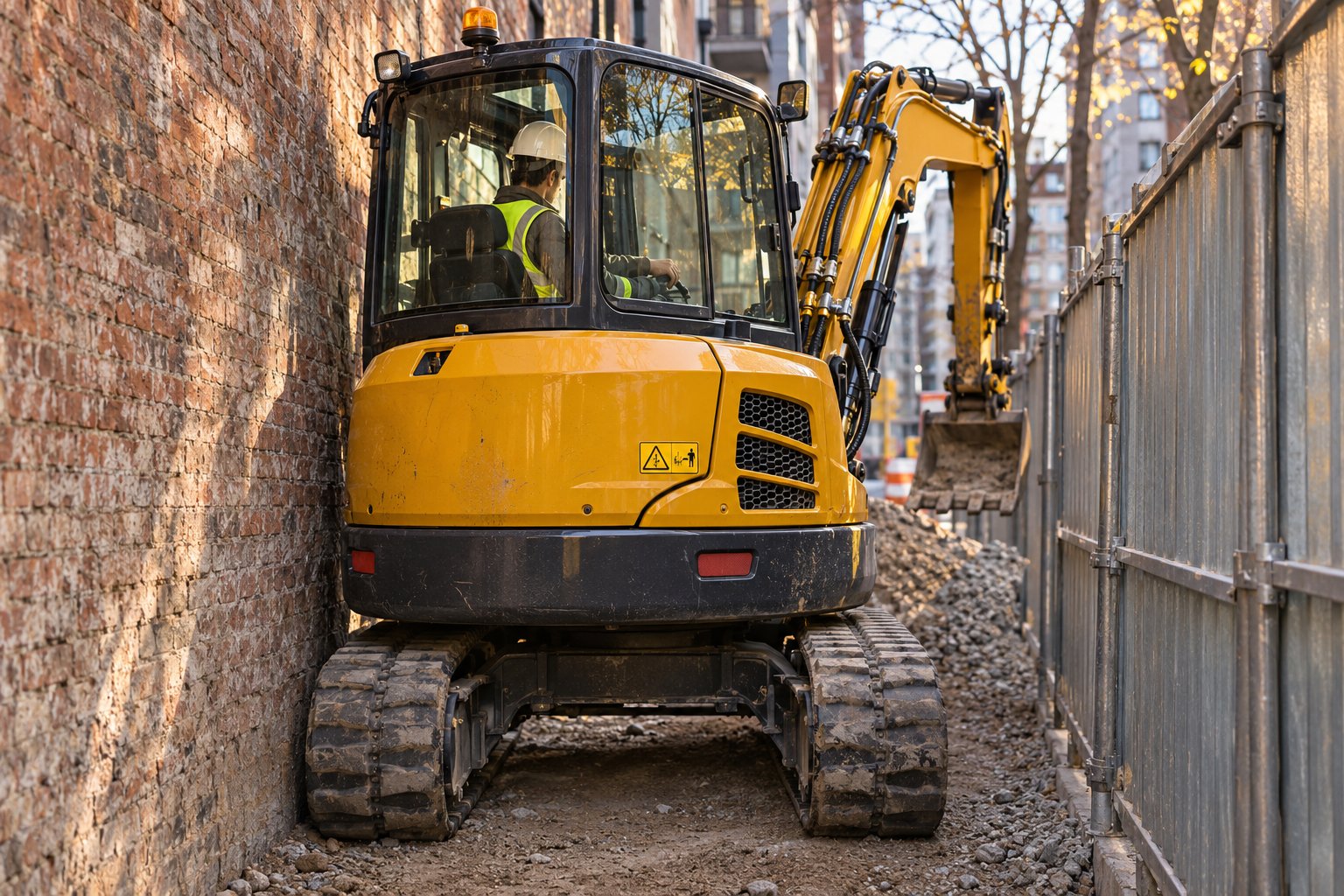
Reduced-tail-swing and zero-tail-swing variants. This is a critical specification detail that directly affects both where you can work and how much counterweight the machine carries. A zero-tail-swing (ZTS) excavator keeps the counterweight within the track width during full 360-degree rotation, letting operators swing freely in trenches, against walls, or alongside traffic without risking contact. The trade-off is real: ZTS and reduced-tail-swing models sacrifice some counterweight mass to stay compact, which can slightly reduce maximum lifting capacity and affect stability on slopes compared to conventional-tail machines of the same weight class.
Kobelco's SR lineup and CASE's SR-badged models, for instance, are specifically engineered as short-radius machines. Caterpillar designates its compact-radius excavators with a "CR" suffix. Bobcat excavators and other compact-focused brands have popularized zero-tail-swing at smaller sizes, and the concept has migrated upward into the full size class as urban job sites grow tighter. If confined-space work defines your typical project — utility corridors along active roads, building demolition in dense neighborhoods — confirming exact tail-swing dimensions for any specific machine under consideration is non-negotiable before you sign a purchase order or rental agreement.
Even something as subtle as tire or track shoe width can shift published ground pressure figures. A machine listed with 600 mm track shoes produces different ground pressure numbers than the same machine wearing 700 mm shoes. The 190x4 track pitch on some legacy undercarriage configurations, for example, differs from the 210 mm pitch common on current-generation full size crawlers — and that dimensional change alters both ground pressure and ride characteristics.
The takeaway? Treat any single spec number as a starting point for comparison, not a final answer. Pair it with the testing standard, the arm and counterweight configuration, and the tail-swing variant to get an accurate picture. Only then can you place two machines from different manufacturers on genuinely equal footing — which is exactly what the next section does, model by model, in the weight classes contractors care about most.
Head-to-Head Model Comparisons Across Brands
Knowing how to read a spec sheet is valuable. Placing five competing spec sheets next to each other and drawing real conclusions from the data? That is where most buyers get stuck — and where most dealer conversations conveniently steer toward a single brand. The tables below do the side-by-side work for you, starting at the entry point of full size excavator territory and working up into the heavy end of the class.
Cross-Brand Comparison in the 20-to-25-Ton Class
The 20-to-25-ton segment is the gateway into full size productivity. These machines handle the widest variety of commercial earthmoving — utility installation, road construction, foundation excavation — while still fitting on a standard lowboy trailer in most jurisdictions. If you are stepping up from a medium excavator like a cat 312 trackhoe or a 145 excavator in the 14-to-17-ton range (think Link-Belt 145 X4 or Bobcat E145), this is the weight class where digging force and cycle speed make a noticeable leap.
The table below draws from published OEM specifications across five of the most commonly compared model families. Values represent standard arm configurations with standard counterweights unless noted otherwise. Always verify against current manufacturer data before making a purchasing decision.
| Model Family | Approx. Operating Weight | Engine Power | Max Dig Depth | Max Reach (Ground Level) | Bucket Capacity |
|---|---|---|---|---|---|
| Caterpillar 320 | 24.8 tons (54,600 lbs) | ~172 hp | 22' 1" | 32' 4" | 1.56 cu yd |
| Komatsu PC210 | 26.6 tons (58,600 lbs) | ~165 hp | 20' 11" | 31' 10" | 1.57 cu yd |
| Hitachi ZX210 | 25.1 tons (55,300 lbs) | ~164 hp | 21' 11" | 32' 7" | Varies by bucket |
| Volvo EC220E | 22.7 tons (50,000 lbs) | ~173 hp | 22' 1" | 32' 7" | 0.63 - 1.88 cu yd |
| John Deere 210G LC | 26.0 tons (57,300 lbs) | ~159 hp | 21' 11" | 32' 0" | Varies by bucket |
| Kobelco SK210LC-11 | 25.0 tons (55,100 lbs) | ~160 hp | 22' 0" | 32' 6" | 1.05 cu yd |
| Develon DX225LC-7 | 26.0 tons (57,300 lbs) | ~162 hp | 21' 7" | 31' 9" | 1.20 cu yd |
| Hyundai HX210A L | 25.2 tons (55,500 lbs) | ~170 hp | 21' 9" | 32' 2" | 1.20 cu yd |
A few patterns emerge. Engine power clusters tightly between 159 and 173 hp — a remarkably narrow band for eight different manufacturers. The Cat 320 and Volvo EC220E sit at the top of that range, while the John Deere 210G and Kobelco SK210LC anchor the lower end. In practice, a 14-horsepower gap matters far less than hydraulic system efficiency. Side-by-side comparisons of the Cat 320 and Komatsu PC210 reveal that Komatsu's intelligent power management delivers fuel savings that offset its slightly lower horsepower, while Cat's integrated Grade with 2D system gives it a technology edge on precision grading tasks.
Dig depth tells a similar story of convergence: every model in the table reaches between roughly 21 and 22 feet. The real differentiators at this weight class are technology integration, operator comfort, dealer proximity, and the availability of each excavator accessory you plan to run — hydraulic thumbs, tilt buckets, breakers. Those factors rarely show up on a spec sheet but heavily influence daily productivity.
Volvo deserves a specific callout for bucket capacity flexibility. Its EC220E supports buckets ranging from 0.63 to 1.88 cubic yards, giving it one of the widest attachment envelopes in the class. For contractors who switch between precision trenching and bulk loading within the same week, that versatility is a tangible advantage.
Cross-Brand Comparison in the 30-to-40-Ton Class
Step up into the 30-to-40-ton segment and the work profile shifts. These machines target mass excavation, quarry production, heavy demolition, and deep infrastructure — projects where a 20-ton unit simply cannot keep pace with truck-loading demands. Each model below represents a giant excavator in its own right, yet every one of them still falls within the transportable full size class rather than crossing into mining-scale territory.
| Model Family | Approx. Operating Weight | Engine Power | Max Dig Depth | Max Reach (Ground Level) | Bucket Capacity |
|---|---|---|---|---|---|
| Caterpillar 336 | 40.6 tons (89,500 lbs) | ~310 hp | 26' 11" | 38' 7" | 2.77 cu yd |
| Caterpillar 340 | 41.4 tons (91,300 lbs) | ~346 hp | 26' 11" | 38' 7" | 3.08 cu yd |
| Komatsu PC360 | 39.7 tons (87,500 lbs) | ~257 hp | 23' 7" | 35' 10" | 2.56 cu yd |
| Komatsu PC390 | 44.5 tons (98,100 lbs) | ~257 hp | 23' 3" | 35' 8" | 2.91 cu yd |
| Hitachi ZX350 | 40.0 tons (88,200 lbs) | ~271 hp | 26' 9" | 38' 10" | Varies by bucket |
| Kobelco SK350LC-11 | 42.1 tons (92,800 lbs) | ~265 hp | 24' 1" | 36' 11" | 2.09 cu yd |
| Volvo EC350E | 39.3 tons (86,600 lbs) | ~303 hp | 24' 11" | 36' 10" | 1.10 - 2.50 cu yd |
| Hyundai HX380A L | 44.0 tons (97,000 lbs) | ~359 hp | 24' 8" | 36' 7" | 2.12 cu yd |
| John Deere 350 P-Tier | 40.5 tons (89,300 lbs) | ~271 hp | 26' 10" | 35' 9" | Varies by bucket |
| Develon DX350LC-7 | 41.2 tons (90,800 lbs) | ~280 hp | 24' 8" | 35' 11" | 1.95 cu yd |
The performance spread widens considerably in this class. Caterpillar high-output models like the 340 push past 346 hp, while Komatsu takes a different path — the PC360 and PC390 both run at 257 hp yet rely on advanced hydraulic efficiency and hybrid-ready architecture to maintain competitive cycle times. Hyundai's HX380A L leads the horsepower chart at 359 hp, making it one of the most powerful options in its weight bracket.
Dig depth diverges sharply here too. The Cat 336, Cat 340, Hitachi ZX350, and John Deere 350 P-Tier all reach between 26 and 27 feet — ideal for deep basement cuts and large storm-sewer installations. The Komatsu PC360 and Volvo EC350E settle closer to 23 to 25 feet, which still covers most commercial requirements but may fall short on the deepest infrastructure projects.
Buyers eyeing the absolute top of the full size range sometimes ask about the cat 390 excavator. At roughly 44.5 metric tons, the Komatsu PC390 sits right at that boundary as well, and it competes for the same deep-excavation, high-production roles. Above this weight class you cross into 45-ton-plus territory — machines like the Cat 349 and Komatsu PC490 — where mobilization costs jump and permit requirements tighten.
Choosing the Right Weight Class for Your Scope
So which class should you investigate further? A practical framework helps narrow the decision:
- Routine commercial excavation, utility installation, and standard foundation work: The 20-to-25-ton class delivers the best balance of capability and transport simplicity. Most contractors start here.
- Mass excavation, quarry loading, heavy demolition, and deep infrastructure: The 30-to-40-ton class provides the bucket capacity and breakout force to keep haul trucks moving without downtime.
- Mixed fleets handling varied project sizes: Some contractors run one machine from each class — a 210-series for everyday jobs and a 350-series for the heavy work — to cover the full spectrum without over-speccing or under-speccing on any single project.
Specifications tell you what a machine can do. The next question is what it should do — matching those numbers to the specific demands of each job type, from utility trenching to structural demolition.
Matching the Right Machine to Every Job Type
A spec sheet tells you a machine's potential. The job site tells you what that potential actually needs to accomplish. Matching the two is where many contractors either waste money on an oversized rig or lose productivity by bringing the wrong tool to the fight. Every application — from a shallow utility trench to a full-scale building teardown — places a unique set of demands on operating weight, dig depth, breakout force, and attachment compatibility. Rather than forcing you to reverse-engineer those demands from raw catalog numbers, the table below maps the five most common commercial applications directly to the specifications that matter most.
Matching Machine Specs to Job Types
| Application Type | Minimum Dig Depth Needed | Recommended Operating Weight | Key Attachment Compatibility | Typical Daily Production |
|---|---|---|---|---|
| Commercial Site Excavation | 15 - 22 ft | 20 - 30 metric tons | Standard digging bucket, hydraulic thumb, GPS grade control | High-volume bulk earthmoving; hundreds of truck loads per day on large pads |
| Road and Highway Construction | 8 - 18 ft | 22 - 35 metric tons | Ditching bucket, ripper, tilt bucket, compaction plate | Steady linear production; measured in trench-feet or lane-miles per shift |
| Utility and Pipeline Installation | 6 - 25 ft (varies by pipe depth) | 20 - 30 metric tons | Trench bucket, hydraulic thumb, compaction plate, tilt bucket | Moderate; precision and grade accuracy outweigh raw speed |
| Structural Demolition | Reach height matters more than dig depth | 30 - 45 metric tons | Hydraulic breaker, sorting grapple, concrete pulverizer, reinforced boom | Variable; dictated by structural complexity and material separation requirements |
| Pond and Retention Basin Work | 12 - 20 ft | 25 - 40 metric tons | Wide grading bucket, long-reach boom option, GPS grade control | Large material volumes; long reach minimizes repositioning and maximizes cycle efficiency |
The reasoning behind each match deserves a closer look. Utility and pipeline installation, for instance, demands precise dig depth control because pipe grades are specified to fractions of an inch — over-excavating by even a few inches means added bedding material, added labor, and blown budgets. A crawler excavator in the 20-to-25-ton class with integrated 2D or 3D grade control handles this work efficiently without the overkill of a heavier machine.
Structural demolition flips the priority entirely. Here, high breakout force and a reinforced boom designed to absorb the repeated shock loading of a hydraulic breaker matter far more than millimeter-grade accuracy. A 40 ton excavator with a heavy-duty front end and high-flow auxiliary hydraulics can run a large breaker or pulverizer all day without stressing the boom pins. Bring a lighter machine to a concrete-framed building and you will either burn through undersized attachments or stall the hydraulic system under load.
Retention basin work introduces a third dynamic: reach. Basins are wide and shallow relative to their volume, so the machine spends most of its cycle pulling material laterally rather than digging straight down. Long-reach boom and arm configurations let operators grade a broader swath from each setup position, slashing the time lost to walking the tracks. Some of the biggest excavator projects in the commercial space — regional stormwater detention facilities, reservoir construction — live in this exact workflow, and contractors who spec a long-reach option from the start avoid costly boom swaps later.
Road and highway construction sits in the middle ground. Ditch cuts rarely exceed 18 feet, but the machine needs to keep pace with paving crews that cannot afford to wait. Rippers break up existing road base, tilt buckets shape precise ditch profiles, and compaction plates finish backfill — all in the same shift. That multi-tool rotation is where attachments start earning their keep.
Attachments That Extend Full Size Versatility
An excavator's base machine handles digging. The right attachment turns it into a demolition tool, a compactor, a material sorter, or a precision grading platform. For a full size excavator, attachment versatility is arguably the strongest economic argument for the class — one machine with properly configured auxiliary hydraulics can replace two or three single-purpose units on the same project, cutting fleet costs and mobilization expenses.
Here are the attachments that contractors rely on most:
- Hydraulic breakers (hammers): Deliver repeated high-force impact to fracture concrete, asphalt, and rock. Breaker sizing must match the carrier's weight class closely — an oversized breaker on a lighter machine risks damaging the arm and hydraulic system from excessive reactive force, while an undersized breaker wastes the carrier's potential.
- Hydraulic thumbs: Work in tandem with the bucket to grip irregular objects — boulders, tree stumps, demolition debris — that a bucket alone cannot secure. Indispensable for site clearing and material sorting, a thumb lets the operator place objects precisely rather than just scooping and dumping.
- Rippers: Single-shank or multi-shank teeth mounted to the arm for breaking compacted soil, frost layers, or soft rock without switching to a breaker. Ideal for road subgrade preparation where you need to loosen material before loading it.
- Tilt buckets: Rotate up to 45 degrees left or right, allowing operators to cut angled ditch profiles or grade slopes without repositioning the machine. They save significant time on road shoulder and drainage work.
- Compaction plates: Mount to the arm and compact trench backfill in lifts directly from the cab, eliminating the need for a separate walk-behind compactor and a second crew member. Especially productive on utility trench work where backfill compaction must keep pace with the dig.
- Sorting grapples: Jaw-style attachments that open, close, and rotate to separate mixed demolition debris — concrete from rebar, wood from metal. Essential on demolition sites where material separation drives recycling revenue and landfill savings.
Attachment compatibility hinges on one often-overlooked detail: hydraulic flow and pressure. Every powered attachment — breakers, compaction plates, tilt rotators — requires a specific range of hydraulic flow (measured in gallons per minute) and system pressure (measured in psi) to operate correctly. Running a high-flow attachment on a standard-flow circuit starves it of oil and kills performance. Forcing a low-flow attachment onto a high-pressure circuit can overspeed internal components and cause premature failure.
Most full size excavators ship with at least one auxiliary hydraulic circuit, and many offer a factory-configurable high-flow option. Before purchasing any attachment, confirm three things: the attachment's required flow range in GPM, its maximum operating pressure in psi, and the coupler type. A quick coupler system — which lets operators swap attachments from the cab in seconds — dramatically reduces tool-change downtime on mixed-task job sites. Contractors running a Develon DX225LC or a Hitachi ZX210-7 on a varied workload will find that a quick coupler pays for itself within weeks by collapsing attachment swap times from 20 minutes to under 60 seconds.
Consider a practical scenario. You are running a 30-ton machine on a commercial site development. Monday morning starts with bulk excavation using a standard digging bucket. By afternoon, the crew hits a concrete foundation from a previous structure — swap to the hydraulic breaker. Tuesday brings utility trenching that requires precise grade and compacted backfill — switch to a narrow trench bucket, then finish with the compaction plate. A single full size excavator with a quick coupler and three attachments just handled work that would have otherwise demanded multiple machines, multiple operators, and multiple mobilization trips.
That multi-role flexibility is precisely what separates the biggest excavator in world-class fleet operations from a machine that simply digs holes. Attachments like the Bobcat E165's compatible thumb and breaker packages — or equivalent options across every OEM — transform a capital-intensive purchase into a versatile production platform. The broader your attachment lineup, the more project types a single crawler excavator can absorb without calling in reinforcements.
Of course, every attachment adds weight, increases hydraulic demand, and introduces its own wear points. Breaker pins, grapple cylinders, and thumb bushings all require inspection cycles separate from the base machine's maintenance schedule. Overlooking attachment-specific upkeep is one of the most common mistakes contractors make — and it quietly erodes both machine value and jobsite uptime.
Versatility and technology go hand in hand. The same auxiliary hydraulic circuits powering today's attachments also enable the grade control systems, telematics platforms, and hybrid powertrains that are reshaping how full size excavators operate on every front.
Modern Technology Reshaping Full Size Excavators
Hydraulic muscle and raw digging force got excavators this far. Technology is what separates the machines earning money in 2026 from the ones burning it. Grade control, telematics, selectable work modes, and hybrid powertrains have moved from luxury add-ons to core productivity tools — yet most brand comparisons barely scratch the surface of what these systems actually do on a job site. If you have ever wondered whether a $30,000 technology package is worth the investment, this section breaks down exactly where the payoff lives.
Grade Control and Machine Guidance Systems
Imagine handing a less experienced operator the controls and watching them hit finished grade on the first pass — no stakes in the ground, no grade checker standing in the trench, no rework. That is the promise of modern grade control, and the technology has matured enough to deliver on it consistently.
Grade control systems fall into two broad tiers, and understanding the difference saves you from either overspending or under-investing:
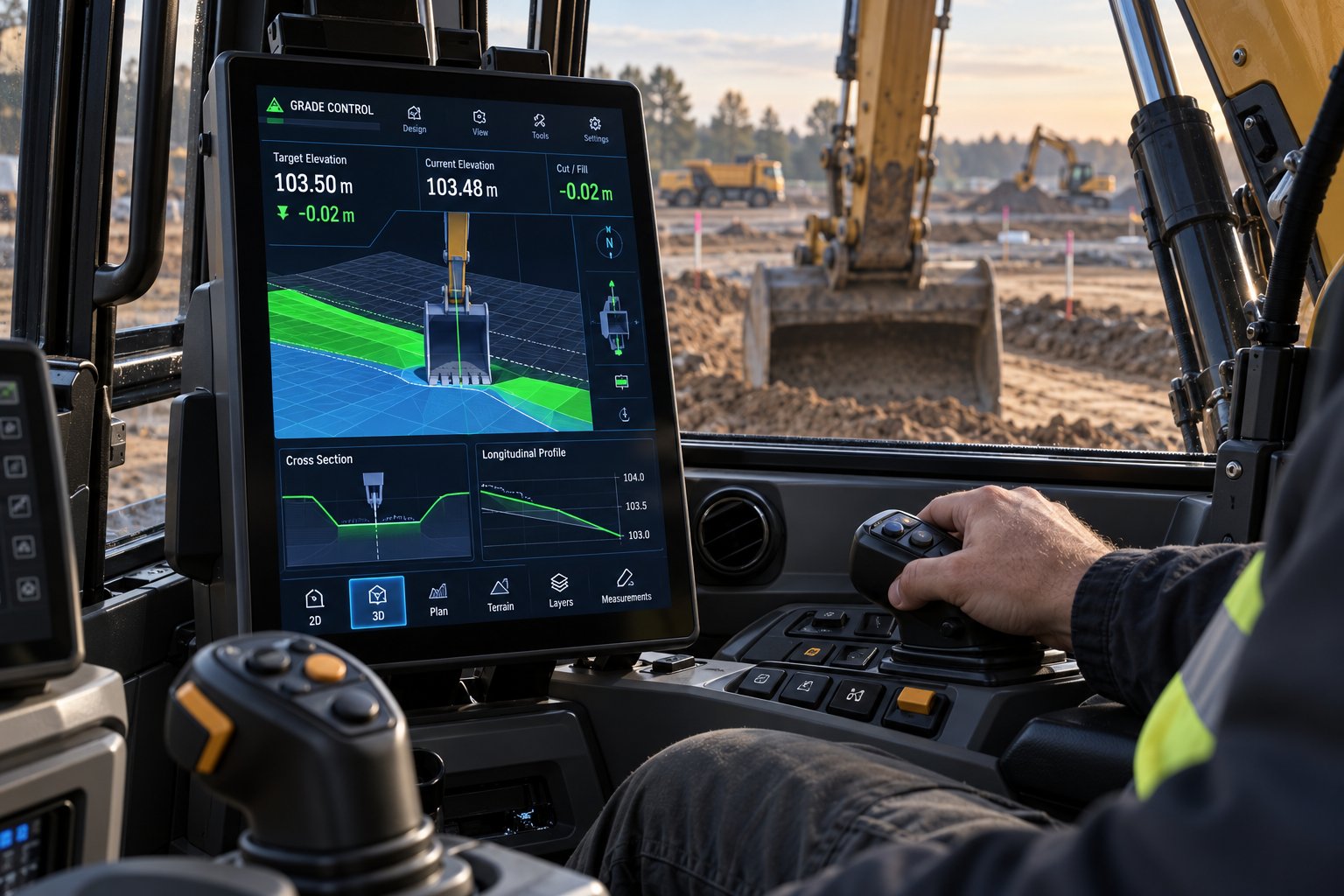
- 2D grade indicate and guidance: These sensor-based systems use IMUs (inertial measurement units) mounted on the boom, arm, and bucket to track the bucket's position relative to a set benchmark or laser reference. The operator sees real-time depth and slope data on an in-cab display and receives visual and audible alerts as the bucket approaches, hits, or exceeds target grade. Setup is minimal — no GNSS signal, no digital terrain model, no survey crew required. As Bobcat's product team notes, 2D systems deliver the greatest value in repetitive tasks where depth and slope accuracy are critical — utility trenching, drainage installation, residential foundations — without the complexity and cost of full 3D machine control.
- 3D machine control: These systems layer GNSS/GPS positioning and digital site models on top of the sensor array, allowing the excavator to work from complex engineering designs across an entire site. The machine knows exactly where it sits in three-dimensional space and guides — or in some cases semi-automates — the bucket along intricate contours, multiple elevations, and survey-driven workflows. Highway ramps, commercial site grading, and large retention basins are prime candidates. CNH's precision sales team reports that contractors using 3D machine control can realize upward of 50 percent time savings on qualifying projects by eliminating stakes, reducing surveying costs, and completing work in fewer passes.
Most major OEMs now offer factory-integrated or dealer-installed grade control. Caterpillar excavators ship with Cat Grade with 2D as a standard or optional feature across the 320 through 340 lineup. Komatsu's intelligent Machine Control (iMC) comes factory-integrated on select models like the PC210LCi and PC360LCi, providing semi-automatic bucket control that physically prevents over-excavation. Liebherr's Generation 8 platform includes standard Leica 2D grade control on every machine, with upgrade paths to full Leica 3D and semi-automatic functionality. John Deere's P-Tier excavators feature integrated 2D control with an auto laser catch feature, and Volvo's Active Control system automates the boom and bucket during grading — the operator only manages the arm's retraction speed.
Develon excavators deserve a specific mention. The new -9 Series heavy machines launched with factory-integrated 2D machine guidance and machine control built directly into the excavator's architecture. Real-time bucket positioning and automated grade assistance eliminate guesswork on every pass, and the system is designed to reduce reliance on manual grade checkers — a meaningful advantage given persistent labor shortages across the industry.
A practical piece of buying advice from fleet managers who have deployed these systems across mixed brands: do not automatically chase the most advanced option. A $4,000 to $8,000 2D guidance upfit pays for itself quickly on repetitive trench work. A $40,000-plus 3D automated system earns its keep on large-scale earthmoving with complex contours. Calculate which system your most common projects can actually pay for, and confirm that displays, receivers, or other components can move between machines in your fleet before committing.
Telematics, Work Modes, and Hybrid Power
Grade control improves what happens at the bucket. Telematics improves what happens everywhere else — in the office, at the fuel pump, and inside the maintenance shop.
Every major manufacturer now embeds a telematics platform into its full size excavators. Komatsu's KOMTRAX, Caterpillar's Product Link and VisionLink, John Deere's JDLink, Hitachi's Global e-Service, and Hyundai's Hi-MATE all transmit machine health data, GPS location, operating hours, fuel consumption, and fault codes to fleet managers in real time. The practical payoff is straightforward: you spot a rising hydraulic temperature trend on a Thursday afternoon telematics alert and schedule a filter change over the weekend — rather than discovering a failed pump on Monday morning with a truck line idling behind the machine. Reduced unplanned downtime is the single biggest cost saver telematics delivers, and it compounds across every machine in a fleet.
Selectable work modes give operators a second lever for controlling costs. Most current-generation machines offer at least three modes — typically labeled something like economy (or eco), standard, and power (sometimes power-plus or heavy). Here is the practical difference:
- Economy mode throttles engine RPM and hydraulic flow to prioritize fuel savings. Ideal for light grading, finish work, or any task where cycle speed is secondary to precision.
- Standard mode balances fuel consumption against hydraulic response for general-purpose digging — the default setting most operators run 60 to 70 percent of the time.
- Power / power-plus mode unlocks maximum engine output and hydraulic flow for high-demand tasks — loading trucks in hard material, running a large hydraulic breaker, or trenching through compacted rock. Fuel burn jumps noticeably, but so does production.
The ability to shift between modes means a single machine adapts its fuel appetite to the task at hand rather than running at maximum output all day. Operators who actively manage mode selection across a shift can noticeably reduce fuel costs without sacrificing production on the tasks that demand peak performance.
Hybrid and electric-hybrid powertrains are the newest entrant into the full size class. Komatsu pioneered the concept with its HB Series hybrid excavators, and other manufacturers are following with their own electrified architectures. These systems capture energy during swing deceleration — the moment the upper house slows its rotation — and store it in capacitors or batteries for reuse during the next acceleration cycle. The result is measurable fuel savings and reduced emissions, though the exact savings percentage depends heavily on application severity and operator technique. Contractors working in municipalities with strict emissions regulations or noise ordinances increasingly evaluate hybrid options not just for fuel economics but for regulatory compliance and bid qualification on green-spec projects.
Reduced-tail-swing and zero-tail-swing technology rounds out the innovation picture. While compact excavators pioneered ZTS design — and if you are curious about specific compact dimensions, checking bobcat excavator dimensions or equivalent spec sheets for any brand illustrates how tightly these smaller machines package their counterweights — the concept has migrated upward into the full size class. Kobelco's SR series, CASE's SR-badged models, and several others now offer short-radius configurations in the 25-to-38-ton range. These machines deliver full size digging performance in confined work environments: urban utility corridors, bridge abutment work, and demolition sites flanked by active traffic. The engineering trade-off remains the same as discussed in the spec-sheet section — reduced counterweight mass to keep the tail inside the track width, which can modestly affect lifting capacity and slope stability. Buyers should always confirm exact tail-swing dimensions for any individual machine rather than assuming all models within a brand share the same envelope.
Even wheeled configurations, like the cat wheeled excavator lineup or Volvo's EW-series, bring technology-driven advantages to road work and urban jobsites where rubber-tired mobility eliminates the need for a trailer between locations. These machines share the same telematics, grade control, and work-mode platforms as their tracked counterparts — the only difference is the undercarriage beneath them.
Technology stacks compound. A full size excavator running 3D grade control in economy mode, monitored by telematics, and configured with a reduced-tail-swing chassis represents a fundamentally different productivity equation than the same weight class offered ten years ago. The hardware costs money upfront, but the downstream savings — fewer passes, less fuel, less rework, less unplanned downtime — determine whether that investment pays back in months or years. And payback calculations lead directly to the broader question every contractor faces: what does it truly cost to own and operate one of these machines over its working life?
Total Cost of Ownership and the Buy Versus Rent Decision
Payback calculations only work when you know what you are paying back. The sticker price on a full size excavator — whether it is a 24-ton entry-level machine or the biggest cat excavator in the 40-ton class — represents just the opening chapter of a much longer financial story. Fuel, filters, track shoes, insurance premiums, and eventual resale value all write subsequent chapters, and skipping any one of them distorts the entire plot. Contractors who budget only for acquisition cost routinely underestimate true ownership expenses by 30 percent or more, turning a seemingly profitable equipment decision into a slow cash drain.
Understanding Total Cost of Ownership
Total cost of ownership, or TCO, captures every dollar a machine absorbs from the day you sign the purchase agreement to the day it leaves your fleet. Gregory Poole Equipment Company frames it simply: TCO is the complete financial picture, and understanding it prevents surprises that wreck budgets and project margins. For a large excavator in the 20-to-45-ton class, the major cost categories break down as follows:
- Acquisition or financing cost: The purchase price or the sum of all lease and loan payments, including interest. Financing a full size machine over 36 to 72 months at current equipment loan rates adds a meaningful layer of expense above the cash price.
- Fuel: One of the single largest recurring expenses. Fuel consumption varies significantly based on application severity, work mode selection, and operator technique. A machine running in power mode while loading trucks in hard clay burns considerably more diesel per hour than the same unit grading a flat pad in economy mode. Even small behavioral changes — reducing unnecessary idling, matching mode to task — compound into thousands of dollars in annual savings.
- Preventive maintenance: Engine oil and filter changes, hydraulic fluid replacement, coolant system service, air filter inspections, and greasing intervals form the baseline. Skipping or stretching these intervals to save short-term dollars often triggers costly repairs that dwarf the price of routine service. Track and roller inspections, fuel system water separator drains, and swing bearing grease checks fall into this same preventive category.
- Undercarriage wear: Here is the number that catches first-time owners off guard. The undercarriage — tracks, rollers, idlers, sprockets, and track links — represents up to 50 percent of total lifetime maintenance costs on a crawler excavator. A full undercarriage replacement on a 30-ton machine can run $15,000 to $40,000 depending on brand, configuration, and whether you opt for OEM or aftermarket components. Operating on abrasive surfaces like crushed rock or demolition rubble accelerates wear dramatically compared to running on clean dirt.
- Insurance: Equipment insurance covers theft, fire, vandalism, and sometimes accidental damage. Premiums scale with machine value, location, and your claims history. A newer or higher-value unit costs more to insure, but self-insuring — carrying the risk yourself — exposes your balance sheet to a catastrophic single-event loss.
- Transport and mobilization: Every time the machine moves between projects, you absorb loading, hauling, and unloading costs. Frequent mobilization eats into per-project profitability, especially for contractors running machines on short-duration jobs spread across a wide geography.
Taken together, these components determine the true hourly operating cost of your machine. Calculating cost per hour — total annual ownership costs divided by annual operating hours — gives you a single metric to compare against rental rates, bid against project budgets, and benchmark between machines in your fleet. A diesel mini excavator in the compact class might run $30 to $50 per hour all-in, while a full size 35-ton crawler with a heavy attachment rotation can push well past $100 per hour when every TCO component is included. Knowing that number before you commit to a purchase — or a rental — changes the entire decision calculus.
Depreciation deserves special attention because it is invisible until you sell. Heavy equipment typically loses 20 to 30 percent of its value in the first year and 10 to 15 percent annually thereafter. A $200,000 machine could shed $48,000 to $60,000 in value over its first 24 months. Top-tier brands like Caterpillar tend to retain the strongest resale values — 65 to 70 percent over five years — while less established brands may drop faster. Maintaining thorough service records, investing in timely repairs, and keeping the machine cosmetically presentable all slow the depreciation curve and protect your exit value.
Buy Versus Rent and the Used Equipment Option
Should you own the machine or let someone else own it? The answer hinges on one metric above all others: annual utilization.
Renting suits contractors whose equipment needs are short-duration, seasonal, or project-specific. You pay a daily, weekly, or monthly rate, and the rental company absorbs maintenance, insurance, and depreciation risk. According to IronMart's 2026 cost analysis, the break-even point where owning a mid-size excavator costs the same as renting falls at approximately 130 to 160 rental days per year — roughly six to seven months of continuous use. Below that threshold, renting typically wins. Above it, ownership becomes economically rational.
Purchasing — whether new or used — makes sense for contractors with a consistent, predictable project pipeline that keeps the machine working 150 or more days annually across multiple years. Ownership builds equity, locks in your equipment cost against rising rental rates, and gives you full control over maintenance quality and scheduling. Financing spreads the cash outlay over 36 to 72 months, preserving working capital for payroll and materials, though interest adds to the total acquisition cost.
A practical decision framework boils down to three questions:
- Will you operate this machine more than 150 days per year for at least two consecutive years? If yes, ownership — new or used — likely costs less than renting over that period.
- Is your project pipeline unpredictable, with significant month-to-month variance in equipment needs? If yes, renting provides flexibility to scale up or down without carrying idle iron.
- Do you lack the in-house maintenance capability or prefer to avoid repair risk entirely? Renting offloads that burden to the rental house.
Used equipment opens a compelling middle path. Used excavators typically sell at 30 to 50 percent less than new models, dramatically shortening the payback period while still delivering ownership benefits — equity building, schedule control, and freedom from escalating rental rates. A well-maintained used machine with documented service history and verified hours can run reliably for thousands of additional hours. The biggest bobcat compact units and every full size brand covered in this article circulate actively in the global used-equipment market, giving buyers a broad selection across manufacturers, weight classes, and price points.
The key risk with used equipment is hidden condition issues. Undercarriage wear, deferred hydraulic maintenance, and undocumented hour-meter discrepancies can turn a bargain price into an expensive headache. Professional pre-purchase inspection — typically $500 to $1,500 — is non-negotiable. Budget 15 to 20 percent of the purchase price annually for maintenance and repairs on a used machine, and factor undercarriage condition heavily into your offer price.
Where you source used equipment matters as much as what you buy. Auctions offer competitive pricing but sell as-is with limited inspection windows. Certified dealer programs provide warranties and reconditioning at a premium. Online platforms like JIUHONG's multi-brand used excavator marketplace offer a different model — buyers can browse full size excavator listings across manufacturers, request model-specific quotes, and evaluate both individual and bulk purchase options with direct pricing transparency. For import buyers especially, the ability to compare machines from Caterpillar, Komatsu, Hitachi, and other OEMs in a single sourcing channel simplifies what would otherwise require scouring fragmented listings across multiple auction houses and regional dealers. Cat remote control excavator features, telematics history readouts, and other technology-era details are increasingly available in listing data, helping remote buyers assess machines more confidently before committing to a purchase.
Regardless of the sourcing channel, the TCO framework applies equally to new and used acquisitions. A $70,000 used excavator that demands $25,000 in deferred maintenance is really a $95,000 machine — and that adjusted number is the one that belongs in your break-even analysis. Discipline with the math, not just the purchase price, separates contractors who build fleet equity from those who chase discounts and inherit someone else's deferred problems.
Ownership costs and sourcing decisions shape the financial side of the equation. The physical side — actually getting a 25-ton or 40-ton machine from the seller's yard to your job site — introduces a completely separate set of logistics, permits, and mobilization costs that deserve their own planning framework.
Transport Logistics and Getting Your Excavator on Site
You have settled on the right machine, negotiated a price, and signed the paperwork. The next reality check arrives when you try to move 25 or 40 metric tons of steel, hydraulics, and track assemblies from the seller's yard to your project. Transport logistics for a full size excavator are not an afterthought — they are a budget line item that can quietly erode project margins if you underestimate trailer requirements, permit fees, and scheduling constraints.
Transport Requirements and Permitting Basics
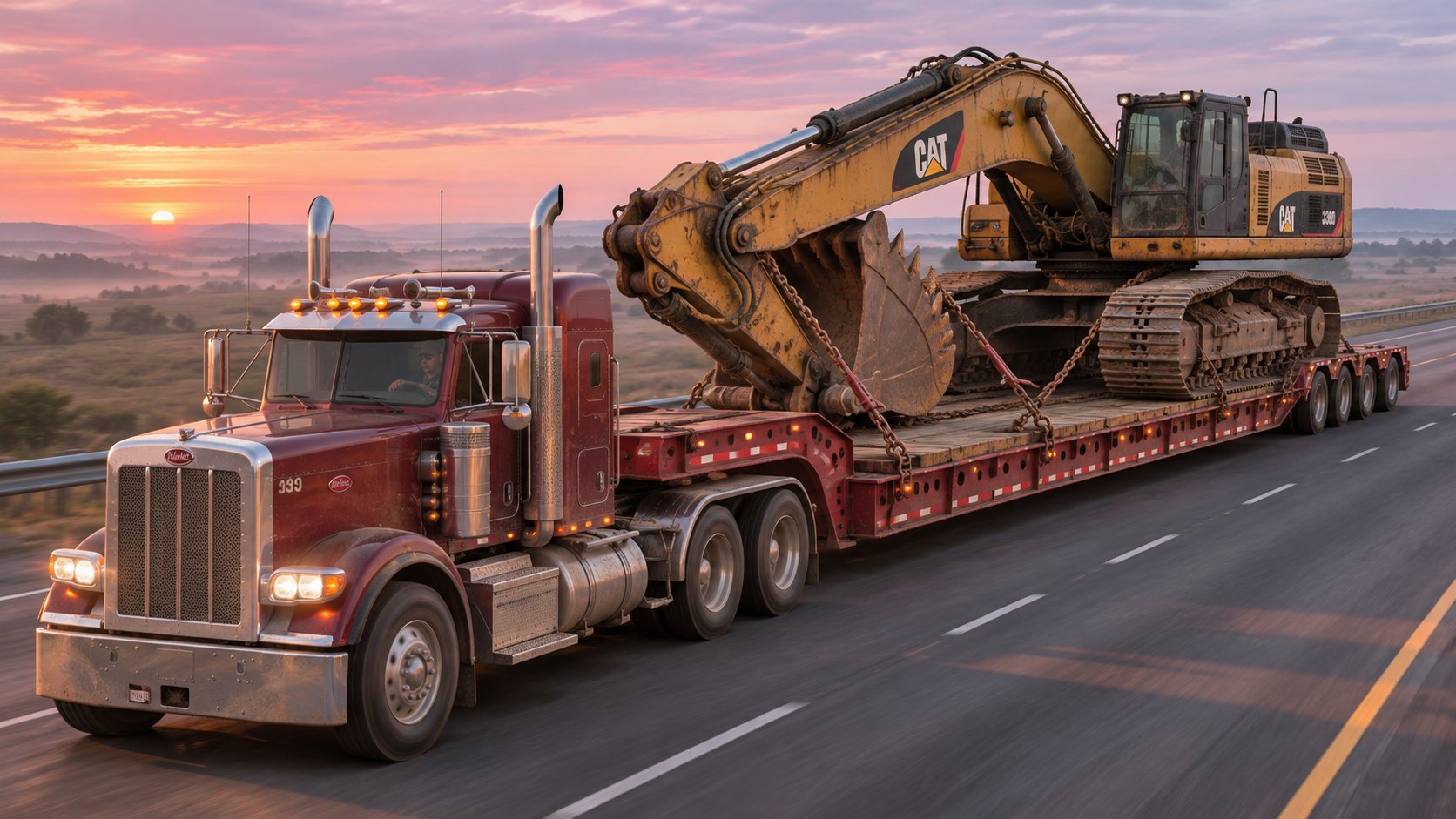
Every full size excavator requires a lowboy or RGN (removable gooseneck) trailer rated for the machine's transport weight. A standard flatbed works fine for compact units, but once operating weight climbs past 20 metric tons — roughly 44,000 pounds — a low-deck trailer becomes mandatory to keep the loaded height within the standard 13-foot-6-inch interstate clearance limit. RGN trailers add front-loading capability through a detachable gooseneck, which speeds loading and unloading considerably on machines that are difficult to back up ramps safely.
Here is where permitting enters the picture. The combined gross vehicle weight of tractor, trailer, and loaded machine cannot exceed 80,000 pounds on U.S. public roads without an oversize or overweight permit. A Doosan excavator in the 30-ton class — say, a Develon DX300LC — pushes combined weight past that threshold on most trailer configurations. Width adds another trigger: most full size crawlers exceed the 8-foot-6-inch maximum legal width, making oversize permits virtually mandatory on every haul regardless of weight.
Permits are issued at the state level, not federally. A cross-state haul demands separate permits from every jurisdiction on the route, and the requirements rarely align. Some states process permits electronically within hours; others take several business days. If the load also exceeds height limits — which can happen when boom and arm positioning is not optimized for transport — additional height permits and even pilot car escorts come into play.
Practical preparation matters just as much as paperwork. Before scheduling any move, confirm three machine-specific dimensions:
- Transport height: With the boom lowered, arm retracted, and bucket curled flat against the deck, will the loaded profile clear every bridge and overpass on your route? Even a few inches of miscalculation can force rerouting or costly height permits.
- Track width relative to trailer deck width: Full size crawlers with 700 mm or 800 mm track shoes can push close to trailer edge limits. Verify that the tracks sit fully within the deck with adequate clearance for chain tie-downs on both sides.
- Attachment configuration: A hydraulic breaker or bucket left attached adds height, width, and weight. Removing heavy attachments and hauling them separately can drop the load into a simpler — and cheaper — permit category.
The world's largest excavator — a mining-class giant weighing hundreds of tons — ships in pieces on multiple specialized trailers with police escorts and weeks of route planning. Your full size machine is far more manageable, but it still demands the same disciplined approach to dimensional verification. Even cat heavy machinery in the upper 30-to-40-ton range ships routinely on a properly rated lowboy as long as the operator confirms every measurement before the machine rolls onto the deck.
You will also encounter the caterpillar biggest excavator models — the 390 and 395 class — sitting right at the boundary where permit complexity escalates sharply. Machines in that weight bracket often require multi-axle trailer configurations and escort vehicles to comply with the Federal Bridge Formula, which distributes allowable weight across axles based on their spacing. If your project scope is pushing you toward these heavier units, factor the added trailer and escort costs into your equipment selection decision before committing — not after the purchase order is signed.
Mobilization Planning and Choosing Your Next Machine
Mobilization costs — loading, hauling, unloading, and the return trip — represent a significant per-project expense that belongs in every bid. Tenna's analysis of construction job costing emphasizes that mobilization is not a one-time charge: on-site repositioning, forgotten attachments requiring separate trips, and incomplete delivery instructions all generate repeat transport expenses that erode margins throughout a project's lifecycle.
A few best practices keep those costs under control:
- Schedule moves during off-peak hours. Many states restrict oversize loads during rush hours and holidays. Planning hauls for early morning or late evening windows avoids traffic delays and aligns with permit travel restrictions — reducing both fuel burn and driver hours.
- Combine mobilization with equipment servicing. If a machine is due for undercarriage inspection or hydraulic fluid replacement, perform the service while the excavator is loaded at the shop rather than making a separate trip later. The consolidation saves an entire round-trip transport cycle.
- Consider machines already positioned near project sites. When evaluating equipment purchases or rentals, proximity to your next job matters. A comparable unit located 50 miles away may cost less to mobilize than a slightly better-priced machine 300 miles out — especially once permit fees, escort costs, and driver time are tallied.
- Track mobilization costs per project, not as overhead. Allocating transport expenses directly to each project — rather than burying them in general overhead — gives you accurate job costing data and sharpens future estimates. GPS and telematics platforms can automate site arrival and departure tracking, creating defensible records that prevent disputes over which project absorbed which transport charge.
Brands like Takeuchi excavators, Komatsu, and Caterpillar all embed telematics that log location history automatically — data you can feed directly into your mobilization cost tracking. Machines equipped with Komatsu's KOMTRAX or Cat's Product Link record every site transfer with timestamps and GPS coordinates, giving fleet managers a clear audit trail of where equipment moved and how long each transit took.
For contractors sourcing machines domestically, mobilization planning is relatively straightforward: pick a trailer, pull permits, and schedule the haul. International sourcing adds layers of complexity. Buyers importing full size excavators — whether a Komatsu PC490 (the 490 x 4 generation, for example) or a used Hitachi ZX350 — must factor ocean freight, port terminal handling charges, customs clearance timelines, and inland transport from the destination port to the job site into their total mobilization budget. Hidden logistics costs including demurrage fees for delayed port pickup, escort vehicle charges for oversized inland hauls, and even partial dismantling for shipping can push the total landed cost 30 to 50 percent above the initial freight quote if not anticipated early.
Platforms like JIUHONG's multi-brand used excavator listings help international buyers manage this complexity by enabling model-specific quote requests before committing to a purchase. Knowing the exact make, model, operating weight, and transport dimensions upfront — rather than discovering them after payment — allows you to calculate accurate landed costs, book the correct trailer and shipping method, and build realistic mobilization budgets. Whether you are importing a single 25-ton unit for a specific project or evaluating bulk purchases across multiple brands for a dealer inventory, that pricing transparency turns a risky international transaction into a calculable logistics exercise.
The largest excavator purchases are not always the most complex to transport — sometimes a mid-range machine shipping halfway around the world involves more planning than moving the biggest unit across town. What matters is treating mobilization as a first-class budget category rather than a footnote, because every dollar spent moving iron is a dollar that is not moving dirt.
Frequently Asked Questions About Full Size Excavators
1. What is considered a full size excavator?
A full size excavator is a hydraulic crawler excavator with an operating weight between 20 and 45 metric tons, equipped with a standard or long-reach boom for medium-to-heavy commercial work. These machines typically deliver 120 to 300-plus horsepower and achieve dig depths of 20 feet or more in a single pass. They sit above compact and medium excavators in the equipment hierarchy and below mining-class machines that exceed 45 metric tons. Common full size model families include the Caterpillar 320-340 series, Komatsu PC200-PC400 series, and Hitachi ZX210-ZX350 series.
2. How much does a full size excavator cost to own and operate?
Total cost of ownership for a full size excavator extends well beyond the purchase price. Major cost components include acquisition or financing, fuel, preventive maintenance, undercarriage wear (which can account for up to 50 percent of lifetime maintenance costs), insurance, and transport mobilization. Hourly operating costs for a 35-ton machine with attachments can exceed $100 when all TCO factors are included. Used excavators typically sell at 30 to 50 percent less than new models, significantly shortening the payback period. Platforms like JIUHONG's multi-brand used excavator marketplace at jiuhong-machinery.com allow buyers to compare listings, request model-specific quotes, and evaluate landed costs before committing.
3. What is the difference between a full size excavator and a mini excavator?
The primary differences are operating weight, engine output, and dig depth. Mini excavators weigh under 6 metric tons and typically reach maximum dig depths of 10 to 12 feet, making them ideal for landscaping, residential trenching, and indoor demolition. Full size excavators weigh 20 to 45 metric tons, produce 120 to 300-plus horsepower, and routinely dig 20 feet or deeper. Full size machines handle heavy commercial work like deep foundations, rock breaking, large-diameter pipe installation, and mass excavation that compact units cannot perform efficiently. However, full size machines require lowboy trailers for transport and cost significantly more to operate per hour.
4. What trailer do you need to transport a full size excavator?
Full size excavators require a lowboy or RGN (removable gooseneck) trailer rated for the machine's transport weight. Once operating weight exceeds 20 metric tons (approximately 44,000 pounds), combined gross vehicle weight typically surpasses the 80,000-pound U.S. highway limit, requiring oversize or overweight permits. Most full size crawlers also exceed the 8-foot-6-inch maximum legal width, making width-related oversize permits virtually mandatory. Before scheduling any move, verify transport height with boom lowered, track width relative to trailer deck, and whether removing heavy attachments could simplify permitting. Cross-state hauls require separate permits from each jurisdiction on the route.
5. Should I buy or rent a full size excavator?
The decision depends primarily on annual utilization. Industry analysis suggests the break-even point where owning costs the same as renting falls at approximately 130 to 160 rental days per year. If your project pipeline consistently keeps a machine working 150-plus days annually across multiple years, purchasing (new or used) typically costs less and builds equity. Renting suits short-duration, seasonal, or unpredictable workloads by eliminating maintenance risk and depreciation exposure. Used equipment offers a middle path, cutting acquisition cost by 30 to 50 percent while retaining ownership benefits. Always factor in a professional pre-purchase inspection and budget 15 to 20 percent of the used purchase price annually for maintenance.