

What Buying an Excavator Second Hand Really Means
You find a listing for an excavator at half the price of new. The photos look clean, the hours seem reasonable, and the seller says it runs great. So what could go wrong? Plenty — if you don't understand exactly what "second hand" means in the heavy equipment world and how it differs from other categories you'll encounter while shopping.
A second-hand excavator is a previously owned machine sold in its current working condition, without mandatory reconditioning or manufacturer-backed certification. It ranges from lightly used dealer trade-ins with low hours to high-hour units from fleet liquidations, and it is sold based on its as-is state rather than a guaranteed rebuild standard.
That definition matters because the label covers an enormous spectrum. A three-year-old Caterpillar mini excavator traded in by a landscaper sits in the same "second hand" category as a 12,000-hour track hoe pulled from a demolition fleet. Both are pre-owned, but the risk profile and remaining useful life couldn't be more different. Meanwhile, terms like "refurbished" and "certified pre-owned" describe machines that have undergone specific reconditioning processes — rebuilt components, documented inspections, and sometimes limited warranties. A "salvage" excavator, on the other hand, is typically designated for parts recovery or requires major structural repair before it can return to productive work. Confusing these classifications is one of the fastest ways to overpay or end up with a machine that can't perform.
What Does Excavator Second Hand Actually Mean
When you see an excavator listed for sell on a marketplace or auction site, the default assumption should be that it's offered in whatever condition the previous owner left it. There's no industry-wide requirement for the seller to repair, recondition, or certify anything. Some sellers provide detailed maintenance logs and fluid analysis reports; others offer little more than a few photographs and a claimed hour-meter reading. The buyer's job is to bridge that information gap — and that's precisely where most purchasing mistakes begin.
The spectrum runs wide. On one end, you'll find a lightly used excavator and attachments package from a rental fleet that followed strict OEM service intervals. On the other end, a high-hour trackhoe from a quarry operation might have significant undercarriage wear and hydraulic fatigue that photos simply cannot reveal. Understanding where a specific machine falls on this spectrum is the single most important skill for any second-hand buyer to develop.
Why the Used Excavator Market Keeps Growing
Several economic forces are pulling more buyers toward pre-owned machines. New excavator prices have continued to climb, and OEM delivery lead times that stretch 12 to 18 months have turned used assets into immediate-deployment solutions that frequently become permanent fleet additions. The global used construction equipment market reached an estimated USD 132.67 billion in 2026 and is projected to grow at a 5.63% CAGR through 2031 — with excavators alone accounting for roughly 42.68% of all used equipment transactions.
Improved manufacturing quality is another driver. Modern hydraulic systems, reinforced undercarriages, and better metallurgy mean today's machines can push well past hour thresholds that would have sidelined earlier generations. A well-maintained mid-size excavator can deliver productive work deep into its second decade, making pre-owned units genuinely viable for contractors who understand what to inspect. Global sourcing has expanded the playing field too — buyers now access inventory far beyond their local region through online platforms and cross-border dealers. One important distinction for import buyers: equipment exported from a given country is not necessarily manufactured by a brand from that country. Always verify the actual brand, model, and country of manufacture independently.
Whether you're researching a cat mini excavator for sale or comparing full-size crawlers across multiple listings, the knowledge gap between what marketplace ads tell you and what you actually need to know remains wide. This guide closes that gap — covering size selection, the critical hours-age-condition triangle most buyers miss, system-by-system inspection checklists, buying channels, brand considerations, pricing realities, and the costly mistakes that turn a smart purchase into an expensive lesson.
Excavator Types and Sizes Matched to Your Project
Knowing that the used market is massive doesn't help much if you're staring at listings spanning 1-ton micro units to 80-ton mining machines. The real starting point is matching a size class and configuration to the work you actually need done. Get this wrong and you'll either overspend on capacity you never use or — worse — buy a machine that's physically undersized for your jobs. The table below breaks down the major excavator categories you'll encounter when browsing any excavator for sale listing, along with practical guidance on where each one fits.
| Excavator Type | Typical Operating Weight | Common Applications | Pros in the Used Market | Typical Availability |
|---|---|---|---|---|
| Mini / Compact | 1–6 tons | Residential foundations, landscaping, utility trenching | High supply, lower excavator cost, easy to transport | Very High |
| Midi | 6–15 tons | General site work, small commercial, road shoulders | Versatile size; strong resale demand keeps quality units available | High |
| Standard | 15–45 tons | Road construction, mass excavation, structural demolition | Widest brand and model selection; parts readily available | High |
| Large | 45+ tons | Mining, quarry, large-scale earthmoving | Significant savings versus new; often sold from managed fleets with full records | Moderate |
| Wheeled | 10–25 tons | Urban roadwork, utility corridors, municipal maintenance | Niche demand keeps prices competitive for informed buyers | Low–Moderate |
| Long Reach | 20–45 tons | Dredging, canal work, deep trenching, slope shaping | Specialized; lower competition among buyers at auction | Low |
Mini and Compact Excavators for Tight Access Work
If you've ever wondered how much is a mini excavator, the answer depends heavily on configuration — and that starts with understanding what this sub-6-ton class actually offers. Mini and compact excavator excavators are the most frequently traded machines in the used market, driven by enormous demand from landscapers, plumbers, and small general contractors. Their compact footprint lets them squeeze through backyard gates, operate alongside occupied buildings, and work on finished surfaces without tearing up turf.
A key feature to look for — especially in the used market — is zero-tail-swing design. As Compact Equipment reports, zero-tail-swing models keep the housing within the track width during rotation, making them ideal for congested residential or urban sites. However, not all compact models offer this feature, and conventional tail-swing units in the same weight class typically deliver stronger lifting capacity and better stability with heavy attachments. Always confirm the specific tail-swing specification on the listing rather than assuming every compact machine is zero-tail.
Popular brands in this segment include Kubota, which offers both conventional and reduced-tail-swing models, and Caterpillar, whose CR-series compact excavators — like the 304 and 305 — appear frequently in used inventory. A cat mini excavator from a well-maintained rental fleet can be an excellent entry point for owner-operators scaling up from manual labor to mechanized work. Mini excavators also burn less fuel and are easier to trailer, which keeps total operating costs manageable even on tight-margin residential projects.
Midi, Standard, and Large Excavators for Production Earthmoving
Step above the compact class and you enter the productivity tiers where machines earn their keep on commercial sites. The 6-to-15-ton midi range bridges the gap between compact agility and real digging power. These machines handle general site prep, small commercial foundations, and road shoulder work without demanding the transport logistics of a full-size crawler. Midi excavators are increasingly popular in the used market because contractors often trade up once projects grow, releasing well-maintained units at reasonable prices.
Standard excavators — the 15-to-45-ton workhorses — dominate commercial construction. Road building, structural demolition, deep utility installation, and mass cut-and-fill operations all live in this weight class. Because this is the most widely manufactured segment, buyers shopping for caterpillar excavators for sale, Komatsu, or Volvo units in this range benefit from the broadest selection and the most competitive pricing. Gregory Poole notes that standard excavators are the most common size for commercial projects, offering enough power and hauling capacity for tough jobs while supporting a wide variety of work-tool attachments.
Large excavators, weighing north of 45 tons, serve mining, quarry, and major civil earthmoving operations. These machines represent a serious capital commitment, even on the used market — but the savings compared to new can be substantial. Because many large excavators come from managed fleets with disciplined maintenance programs, buyers who verify service records can find units with predictable remaining life. The trade-off is transportation: moving a 50-plus-ton machine requires specialized lowboys, permits, and often route planning, so factor logistics into your budget before you commit.
Wheeled and Specialty Configurations
Not every job calls for tracks. Wheeled excavators mount the familiar 360-degree upper structure on a tire-based undercarriage, enabling road-legal travel speeds up to roughly 24 mph — no trailer needed for local moves. That mobility makes them a favorite among utility crews, municipal maintenance teams, and road-and-bridge contractors who bounce between nearby sites throughout the day. According to Construction Equipment, rubber tires also prevent the turf gouging and asphalt scarring caused by steel tracks, cutting post-job surface repair costs.
Wheeled models do sacrifice some stability compared to crawlers — though outriggers, dozer blades, and axle locks largely close that gap during digging. In the used market, availability is more limited because wheeled excavators represent a smaller share of total production. That niche status can work in a buyer's favor: lower demand often means less bidding competition at auction.
Long reach excavator for sale listings are even more specialized. These machines extend the standard boom and stick to working ranges that can approach 100 feet, making them essential for dredging, canal maintenance, deep trenching, and slope shaping where a conventional arm simply cannot reach. Their niche application means fewer units circulate in the secondary market, so patience and broader geographic searches are usually required to find the right match.
Regardless of which type or size class fits your projects, every used machine shares one universal reality: the listing price means nothing until you understand the relationship between hours, age, and actual condition. That triangle — not brand, not size, not even price — is what separates a smart purchase from a costly mistake.
The Machine Hours, Age, and Condition Triangle
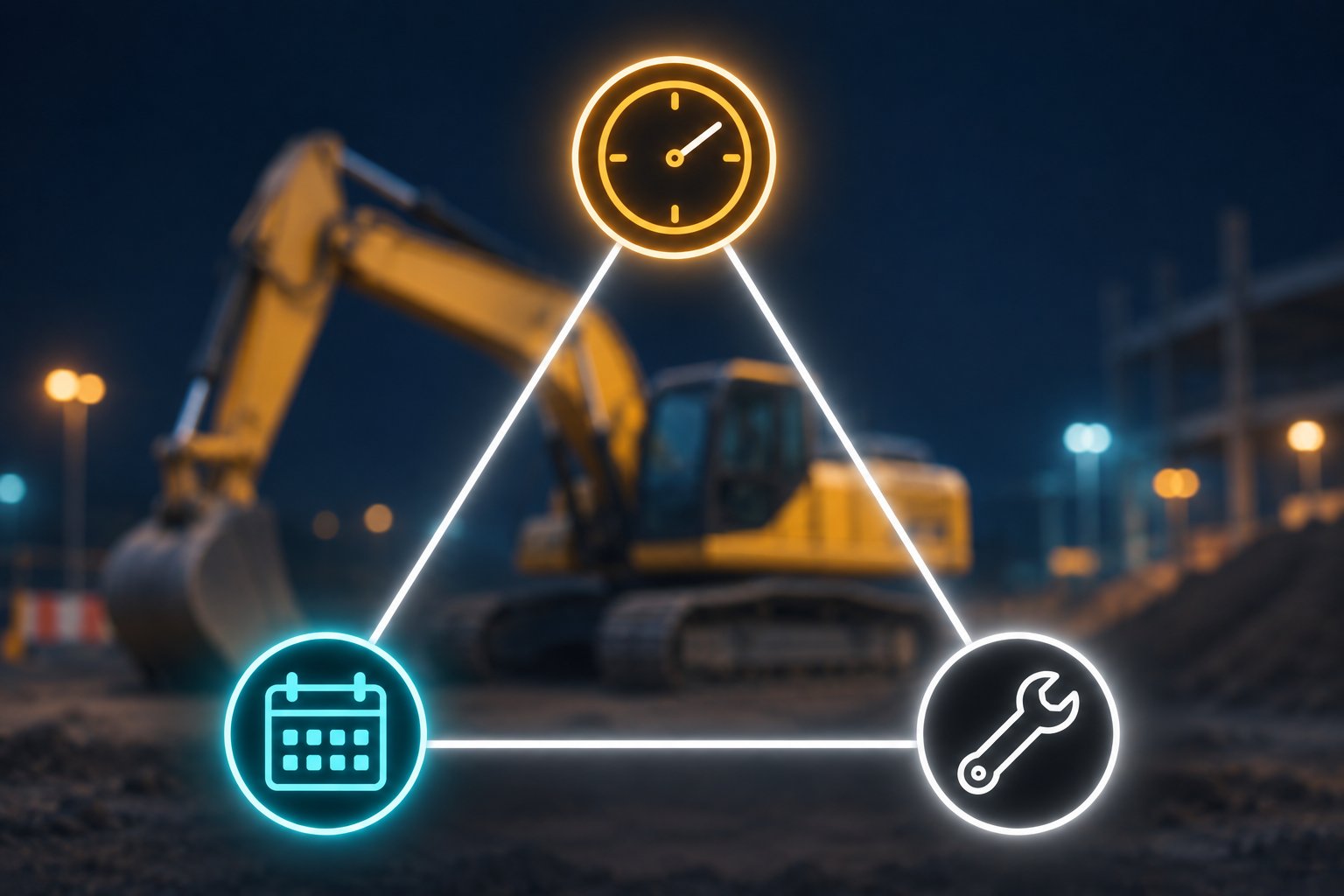
Imagine two used mini excavators for sale side by side. One is a 2020 model showing 5,000 hours. The other is a 2016 Caterpillar excavator reading 10,000 hours. Which is the better buy? Most people grab the newer, lower-hour machine without a second thought — and that instinct is exactly where expensive mistakes begin. The real answer depends on a three-sided evaluation framework that most buyers never consider: the relationship between machine hours, calendar age, and verified physical condition.
A 5,000-hour excavator in poor condition with no service records can be a far worse investment than a 10,000-hour machine backed by full maintenance documentation and proactive component replacements. Hours are a starting point, not a verdict.
Each side of this triangle tells part of the story. Together, they reveal the whole picture — and skipping any one of them leaves you guessing with your wallet open.
What Machine Hours Actually Tell You
Think of the hour meter as the heavy-equipment equivalent of your car's odometer. It records cumulative engine operating time, and it's the first number every buyer checks. EquipmentWatch lifecycle data shows that construction excavators in commercial service average 800 to 1,300 operating hours per year. That benchmark gives you a quick sanity check: a five-year-old machine showing 2,000 total hours either sat idle for long stretches or had its meter tampered with. Both scenarios demand follow-up questions.
General hour-range benchmarks help frame what you're looking at:
- Under 3,000 hours — Lightly used with substantial life remaining. Commands a price premium.
- 3,000 to 6,000 hours — The sweet spot for many buyers. The machine is broken in but far from worn, offering the best balance of price and remaining productivity.
- 6,000 to 10,000 hours — Condition and documentation matter more than ever. Inspect closely and price accordingly.
- Over 10,000 hours — High-hour territory where major component work may be imminent. Only buy with strong, verifiable service records.
For a mini excavator for sale near me search, you'll commonly see sellers emphasize low hours as a primary selling point. And while under 6,000 to 8,000 hours on a compact machine can still represent a solid buy, the number alone doesn't tell you how those hours were spent — or whether the meter is even honest.
That honesty question is real. An Iron Solutions industry survey found that roughly 15 to 20 percent of used equipment listings show hour readings inconsistent with available service records or engine control module (ECM) data. Mechanical hour meters — still common on pre-2010 machines — drift 10 to 15 percent over their service life and can be physically disconnected, replaced, or rolled back. Even electronic meters on newer machines aren't immune, though ECM-stored hours provide a built-in cross-check. Always ask a dealer or qualified technician to pull the ECM reading and compare it to the dashboard display. If those two numbers don't match, walk away.
Cross-referencing hours with maintenance logs adds another verification layer. Service invoices stamped at specific hour intervals should tell a consistent, upward story. Oil analysis records offer independent confirmation too — metal content in an engine oil sample taken "at 3,200 hours" that reflects wear patterns consistent with 6,000-plus hours exposes the discrepancy immediately. The cost of a lab report is trivial compared to the cost of an engine rebuild you didn't see coming.
Why Calendar Age Can Be Misleading
Year of manufacture is the second number buyers fixate on, and it can be just as deceptive as hours when viewed in isolation. Here's why: a 2022 machine that spent three years in heavy demolition — pounding concrete, processing rebar, absorbing constant shock loads — may carry far more mechanical fatigue than a 2015 unit that spent its life trenching clean residential dirt at moderate pace. Same brand, similar size class, radically different internal condition.
Application severity is only part of the story. Climate and storage conditions quietly accelerate or slow deterioration in ways the year stamp can't capture. A machine that worked coastal projects absorbs salt-laden moisture that corrodes wiring harnesses, eats at exposed hydraulic fittings, and pits cylinder rods. One that spent winters outdoors in a freeze-thaw region without proper fluid maintenance risks cracked coolant passages and dried-out seals. Meanwhile, the same model stored in a covered yard in a temperate climate between jobs ages far more gracefully.
Then there's the sitting problem. A ten-year-old machine with only 1,500 hours might sound like a dream find for someone browsing excavator for sale near me listings, but extreme low usage on an older unit raises a different set of concerns. Hydraulic seals dry out and crack without regular cycling. Fuel degrades in the tank. Batteries sulfate. Rubber components harden. Very low hours on an old machine aren't automatically better — they require a different set of inspection questions focused on deterioration from neglect rather than deterioration from work.
One more calendar-age factor that catches import buyers off guard: emissions tier compliance. A pre-Tier 4 machine — generally manufactured before 2012 — may face job-site restrictions on government contracts, port work, and projects in regions with strict air quality rules. In those markets, a low-hour older machine can actually sell for less than a higher-hour Tier 4 Final unit simply because the older excavator can't legally access the same work. Calendar age, in this case, imposes regulatory limitations that no amount of good maintenance can overcome.
Assessing True Machine Condition
Hours give you usage context. Age gives you a timeline. But physical condition is the final leg of the triangle — the one that actually determines whether a second-hand excavator is worth buying at any price. Two machines with identical hours and the same model year can carry vastly different remaining value based on how they were maintained, operated, and inspected throughout their working lives.
Three diagnostic tools tie the triangle together and expose what neither the hour meter nor the date plate can reveal:
- Fluid analysis results — Laboratory oil sampling reads suspended metals — iron, copper, lead, aluminum — in engine and hydraulic fluid, pointing to internal component wear invisible during any walk-around. A single sample is a snapshot, but a sequence of samples across the machine's life creates a trend line that shows whether wear is stable or accelerating. If the seller has prior reports, review the progression. If not, pull your own samples before committing. As Centex Excavation notes, the cost of a lab report is trivial next to an engine rebuild.
- Undercarriage wear measurements — On any tracked excavator, the undercarriage can represent up to half of lifetime owning and operating cost. OEM wear charts express component condition as a percentage from new to fully consumed. Assess sprockets, idlers, rollers, the track chain, and shoes as a system — uneven wear across those five components tells a different story than even degradation. A five-minute walk-around that skips undercarriage measurement is how a used excavator sale near me turns into a five-figure surprise.
- Hydraulic cycle-time tests — Operate every function: boom, stick, bucket, swing, and travel. Smooth, responsive movement at consistent speed indicates healthy pumps and valves. Hesitation, jerkiness, slow cycle times, or drift when the boom is held raised all point to internal leakage or pump wear — problems that are expensive to remedy and easy to miss in a static photo listing.
When you layer verified hours, honest age context, and documented physical condition together, the true value of any excavator second hand becomes clear. A higher-hour machine with a full binder of service records, clean fluid analysis trends, and measured undercarriage life remaining is often a safer — and ultimately cheaper — purchase than a low-hour unit with an unknown past. In used equipment, no news is rarely good news.
This framework tells you what to evaluate. The next critical skill is knowing exactly where to look and what specific wear indicators to check on every major system — from tracks and hydraulics to engine internals and structural weld points.
System-by-System Pre-Purchase Inspection Checklist
Understanding the hours-age-condition triangle gives you a framework for evaluating any used machine. But frameworks are theoretical — and excavators are brutally physical. The question every buyer faces standing in front of an actual machine is concrete: what exactly do I check, and in what order? Whether you're evaluating a mini used excavator for a landscaping crew or a 30-ton crawler for commercial earthmoving, the inspection sequence below works across every brand, every size class, and every buying channel. Print it, save it to your phone, and work through it methodically. Skipping even one system is how a fair-priced machine turns into a money pit.
Undercarriage and Track System Inspection
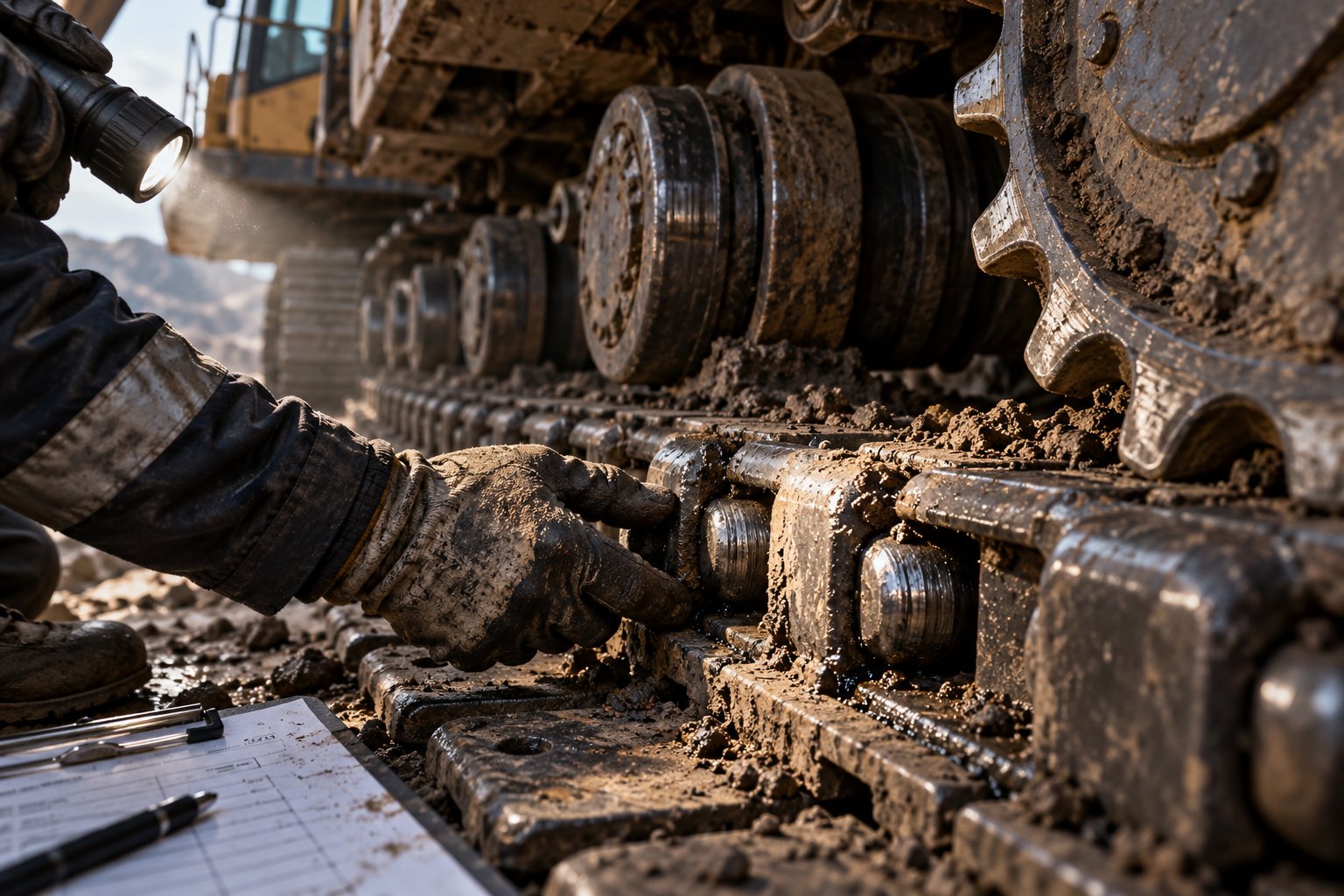
Start here — always. The undercarriage is the most expensive wear system on any tracked excavator, accounting for up to 50% of a machine's lifetime owning-and-operating cost. A complete undercarriage replacement on a mid-size unit can rival the purchase price of the machine itself, so this single system has the power to flip a deal from bargain to disaster.
- Track pad (grouser) height — Measure the raised bar on each track shoe that bites into the ground. As grousers wear down, traction drops and the machine slips, accelerating wear everywhere else. Compare your measurement against the OEM's new and end-of-life dimensions to calculate remaining percentage of wear life.
- Sprocket tooth profile — Healthy sprocket teeth are rounded and symmetrical. Sharp, hooked, or pointed tips indicate a sprocket nearing replacement. A worn sprocket chews through the track chain faster, triggering expensive cascade damage.
- Idler and roller condition — Check the idler tread surface for flat spots and the guide flanges for sidewear. Inspect bottom rollers for oil leaks — a failed seal lets a roller seize, and that single seized roller drags against the chain, damaging every linked component. Look for flat spots on rollers, which signal a roller that already stopped spinning at some point.
- Track tension (sag test) — Stretch a string line from the top of the front idler to the top of the rear sprocket. Measure the gap at the midpoint between the string and the track shoe. Too tight accelerates roller and idler wear; too loose causes bounce and chain snaking. Compare the sag measurement to the manufacturer's specification for that model.
- Pin-and-bushing wear (pitch elongation) — This is the most telling internal chain measurement. Using a tape or caliper, measure the span across four pins. As pins and bushings wear internally, each link lengthens. When pitch elongation exceeds the OEM threshold and the idler adjustment is maxed forward, the chain is at end of life.
Think of these five components as an interconnected system, not isolated parts. One neglected component accelerates wear on everything it touches — a $400 roller failure, left unchecked, can take years off the entire undercarriage. If you spot one component significantly more worn than the rest, ask why. Uneven wear often points to operational abuse, poor maintenance, or deferred repairs the seller hasn't mentioned.
Hydraulic System and Cylinder Checks
Hydraulics are the excavator's muscle. Every swing of the boom, every curl of the bucket, and every rotation of the house runs on hydraulic power. A machine with a tired hydraulic system may still start and move, but it won't produce — and restoring hydraulic performance is rarely cheap. Here's what to examine:
- Cylinder rod condition — Walk around the machine and visually inspect every exposed rod on the boom, stick, and bucket cylinders. Bent, scored, or pitted rods compromise seal integrity and allow contaminants into the cylinder, accelerating wear. Even minor imperfections lead to rapid failure once seals start leaking past the damage.
- Hose condition and leak points — Check every visible hose for cracking, bulging, abrasion wear-through, and dampness at fittings. Hydraulic leaks reduce system efficiency and signal neglected maintenance. Pay close attention to hoses routed near heat sources — hardened, cracked rubber is a blowout waiting to happen.
- Hydraulic oil color and contamination — Pull the hydraulic tank dipstick or sight glass. Clean hydraulic oil is translucent amber. Dark, murky, or milky fluid suggests contamination — water intrusion in the case of milky oil, and thermal breakdown or heavy particulate in the case of dark oil. Contaminated fluid erodes every internal surface it contacts.
- Pump response and cycle times — With the machine warmed to operating temperature, cycle every function: boom up and down, stick in and out, bucket curl and dump, full left and right swing. Time each movement. Reduced power, sluggish speed, or jerky response often point to worn main pumps or control valve issues — repairs that can easily run into five figures.
- Cylinder drift test — Raise the boom to full height, tuck the stick, and shut down the controls. Watch for drift. A boom that slowly sinks indicates internal leakage past piston seals — a condition known as "creep" that signals degraded seals or scored cylinder barrels.
Many listings for excavators for sale — especially online — show photos of a clean machine with the boom tucked neatly. Photos can't capture slow cycle times, cylinder drift, or the whine of a failing pump. This is exactly why a running, operational inspection is non-negotiable for any serious purchase. If a seller won't let you operate the machine, treat that refusal as the most important piece of information they've given you.
Engine, Cooling, and Electrical Systems
A solid undercarriage and healthy hydraulics mean nothing if the engine can't reliably power them. Engine evaluation on a used excavator demands a cold-start observation — arrive before the seller has warmed the machine, because cold starts reveal problems that disappear once everything reaches operating temperature.
- Exhaust smoke color at cold start — Blue smoke indicates oil burning past worn rings or valve seals. White smoke that persists beyond the first minute suggests coolant entering combustion chambers — a potential head gasket or cracked-block issue. Black smoke points to fuel system problems: dirty injectors, a failing turbo, or incorrect timing. A brief puff of white on a cold morning is normal; sustained colored exhaust is not.
- Blow-by check — Remove the oil filler cap while the engine idles. Excessive pressure or visible vapor blowing from the opening indicates worn piston rings or cylinder liners. Moderate blow-by is expected on a high-hour diesel; heavy blow-by that lifts the cap or pushes oil mist out demands further investigation.
- Coolant condition — Open the radiator cap (engine cold) and inspect the coolant. Clean coolant is a consistent color matching the specified type — typically green, pink, or blue. Brown, rusty, or oily coolant signals internal contamination that could point to corrosion, a degraded water pump, or worse, a head gasket leak allowing oil and coolant to mix.
- Turbocharger sound — Listen for high-pitched whining or grinding during acceleration. A healthy turbo spools smoothly. Metallic scraping suggests bearing failure, and a failed turbo can shower metal debris into the intake, damaging the engine from the inside out.
- Electrical system and monitor panel — Turn the key to the "on" position before cranking. All dashboard warning lights should illuminate briefly during the self-test, then extinguish. Any warning light that stays on — or, suspiciously, any warning light that never illuminates at all — warrants investigation. Check the monitor display for stored fault codes. Test all lights, wipers, horn, and climate controls. Inspect the wiring harness in the engine bay and under the cab for rodent damage, corroded connectors, and jury-rigged repairs wrapped in electrical tape.
For anyone evaluating a caterpillar mini excavator for sale or any other brand, these engine and electrical checks remain identical. Diesel powertrains share common failure modes regardless of the badge on the hood, and cutting corners on engine inspection is how buyers discover — too late — how much does an excavator cost when it needs a complete overhaul.
Boom, Stick, Bucket, and Pin Wear
The front-end working group takes the most direct abuse on any excavator. Every dig cycle, every pry, every heavy lift sends force through the boom, stick, bucket, and the pins and bushings connecting them. Wear here affects digging precision, lifting capacity, and operator confidence — and structural failures at weld points can sideline a machine entirely.
- Pin-to-bushing play at each joint — This is the definitive test for front-end wear. Have an assistant operate the boom and stick slowly while you stand to the side and watch each pivot point. Excessive movement — visible rocking or clunking — between the pin and bushing means the joint is worn beyond tolerance. For a more precise check, use a pry bar at each connection point to lever the components apart. When clearance between the pin and bushing exceeds manufacturer tolerances, you'll feel the bucket go loose during operation, often accompanied by a metallic knocking sound.
- Structural cracks at weld points — Inspect the boom and stick surfaces carefully, especially at the welds where plates join. Look for hairline cracks radiating from weld toes, rust staining that traces a crack path, and any evidence of previous field-welded repairs. A structural crack on a boom or stick isn't just a parts cost — it's a safety risk.
- Bucket tooth and cutting-edge wear — Examine the teeth and the bottom cutting edge of the bucket. Worn-down teeth reduce digging efficiency and can be replaced, but a cutting edge ground nearly to the bucket floor signals a bucket approaching the end of its useful life. If you're also planning to reuse used digger buckets from the purchase, inspect each attachment with the same rigor you'd apply to the base machine.
- Bushing material condition — Low-quality or aging bushings can show surface spalling, edge chipping, or visible deformation of the inner bore. If lubrication has been neglected, you'll often see deep scratches scored into both the bushing surface and the mating pin — damage that compounds quickly once it begins.
A cat excavator for sale — or any brand, for that matter — with tight pin joints, intact welds, and serviceable bucket components tells you the previous owner cared about the working end of the machine, not just the cosmetic appearance. Conversely, sloppy joints, cracked welds, and chewed-up cutting edges on an otherwise clean-looking excavadora should immediately recalibrate your price expectations downward — or send you to the next listing entirely.
Completing this four-system inspection doesn't guarantee a perfect machine. But it systematically eliminates the hidden cost bombs that turn a used mini excavator sale into a regret. What it won't tell you, however, is whether you paid a fair price — or whether the channel you bought through gave you the best combination of assurance, selection, and value. That's a different evaluation entirely, and the differences between auction floors, dealer lots, private sellers, and direct online platforms are bigger than most buyers realize.
Buying Channels Compared from Auctions to Direct Sellers
You've inspected the undercarriage, tested the hydraulics, and verified the hour meter against the ECM data. The machine checks out. But here's a question that changes everything about what you'll actually pay and what protections you'll have afterward: where did you find that machine? The buying channel shapes pricing, warranty coverage, inspection access, and your overall risk exposure in ways that rival the mechanical condition of the excavator itself. A great machine purchased through the wrong channel — or without understanding the trade-offs — can still become a frustrating experience.
The table below maps out the four primary channels where used excavators for sale change hands, giving you a side-by-side view of what each one delivers and what it demands from you as a buyer.
| Buying Channel | Typical Pricing Level | Inspection Opportunity | Warranty / Return Policy | Buyer Risk Level | Best Suited For |
|---|---|---|---|---|---|
| Direct Online Platforms (multi-brand suppliers) | Moderate — negotiable per unit or bulk | Extended; can request detailed photos, videos, and specs before committing | Varies by platform; some offer negotiated terms | Moderate (due diligence required, but less time pressure) | Import buyers, fleet purchasers, dealers sourcing inventory |
| Auction Houses | Variable — competitive bidding can drive prices up or down | Limited pre-sale windows; as-is condition | None — sold as-is, where-is | High (no recourse post-sale) | Experienced buyers comfortable with fast decisions |
| Authorized Dealers / Certified Pre-Owned | Higher — reflects inspection, reconditioning, and warranty | Full access; dealer inspection reports provided | Limited warranty on certified units; varies by program | Low to Moderate | Risk-averse buyers prioritizing reliability over price |
| Private Sellers / Fleet Operators | Often lowest — motivated sellers, no middleman markup | Depends entirely on seller cooperation | None — buyer assumes all responsibility | High (trust-dependent; no institutional backing) | Buyers with strong inspection skills and industry contacts |
Auction Houses and What They Offer
Auction platforms like Ritchie Bros. aggregate massive inventories of used equipment — excavators, dozers, trucks, attachments — into scheduled events where buyers compete in real-time bidding. The sheer volume is the primary advantage: you can browse hundreds of used excavators for sale across multiple size classes and brands in a single event, often including models like a 308 Cat excavator for sale or a Komatsu PC200 that would take weeks to locate through private channels.
Pricing at auction can be genuinely competitive. Because every lot sells unreserved — meaning there's no hidden minimum price — buyers occasionally land machines well below retail. However, that dynamic cuts both ways. Hot models attract aggressive bidding, and the final hammer price doesn't include the buyer's premium — typically ranging from 10% to 15% on top of the winning bid — which significantly affects total cost. If you're wondering how much is an excavator bought at auction, add that premium before comparing to any dealer or private-sale quote.
The biggest trade-off is inspection access. Most auction houses offer pre-sale inspection windows, but they're limited in duration. Ritchie Bros. recommends visiting the auction site to test and inspect equipment — or sending a trusted representative — before bidding. That's sound advice, but the reality is that many buyers bid online without ever touching the machine, relying on photos and published hour readings. Machines sell as-is, where-is, with no warranty or return option. For an experienced buyer who knows what to look for, that's acceptable risk. For someone still learning, it's a gamble.
Auction results data does offer one genuinely useful tool: benchmarking fair market value. Even if you never plan to bid at auction, reviewing historical sale prices for comparable models at similar hour ranges gives you a defensible negotiating baseline when buying through any other channel.
For buyers who want the variety of an auction without the time pressure, direct purchasing from equipment suppliers represents a practical alternative. These platforms let you request model-specific information, negotiate pricing on your timeline, and arrange extended inspections — none of which are possible once an auctioneer starts calling bids.
Authorized Dealers and Certified Pre-Owned Programs
Brand-authorized dealers occupy the opposite end of the risk spectrum. When you buy a used excavator from a Caterpillar, Komatsu, or John Deere dealer, you're typically getting a machine that has been through some level of evaluation — and in some cases, a formal certification process that comes with limited warranty coverage.
Cat's Certified Used program is one of the more structured examples. Gregory Poole, an authorized Cat dealer, describes the process as a 140-plus-point visual and mechanical audit covering engine, transmission, hydraulics, structural components, electrical systems, cab controls, and undercarriage. Machines that pass receive a condition rating — Good, Fair, or Poor — for each inspected system. Components rated "Poor" must be replaced with genuine Cat parts before the machine qualifies for certification. Eligible machines are generally no more than five years old and must have at least 50% remaining life on undercarriage components.
That's real assurance — but it comes at a price. Certified pre-owned machines carry higher sticker prices precisely because the dealer has invested in inspection, repair, and documentation. For risk-averse buyers, especially those deploying a machine directly to a revenue-generating job, the premium often pays for itself by avoiding the downtime and repair costs that uncertified purchases can trigger.
Still, it's worth understanding what certification actually guarantees versus what buyers sometimes assume. Coverage typically applies to specific powertrain and hydraulic components as defined in an Equipment Protection Plan — not a blanket warranty on every part of the machine. Warranty coverage applies only when the equipment meets inspection and enrollment requirements, including age limits, hour thresholds, and use of approved parts. Read the terms carefully rather than treating "certified" as a synonym for "worry-free."
Private Sellers and Online Direct Platforms
Private sellers — individual owner-operators, small fleet owners, and companies liquidating surplus equipment — often offer the lowest acquisition prices because there's no dealer margin, no auction premium, and no certification overhead baked into the number. If you've been searching for a crawler excavator for sale or even an excavator for sale under $10,000, private listings are typically where those entry-level price points appear.
The trade-off is entirely predictable: the due-diligence burden falls squarely on you. RDO Equipment notes that a private seller's ultimate goal is simply to sell, and they typically aren't concerned about whether the machine fits the buyer's long-term operational needs. Some private sellers are transparent and forthcoming with service records; others are motivated to move a problem machine before the next repair bill arrives. The difference between those two scenarios is impossible to determine from a listing photo.
This is where online direct platforms have carved out a valuable middle ground. Unlike auction houses that impose rigid timelines and as-is terms, and unlike individual private sellers who may lack documentation infrastructure, direct platforms that aggregate multi-brand used inventories from various origins allow buyers to compare specifications across dozens of machines, request detailed quotes, and negotiate terms for individual or bulk purchases — all without auction-day pressure.
JIUHONG's used excavator collection, for example, brings together compact and larger machines from multiple brands in a single browsable catalog. Excavation contractors searching for a specific Cat 304 for sale can compare it against equivalent Komatsu or Kobelco models on the same platform, request model-specific quotes, and arrange inspections before committing. For equipment dealers and import buyers sourcing in volume, the ability to consolidate purchases through one supplier simplifies shipping logistics, documentation, and negotiation — advantages that compound when buying multiple units across different size classes.
No single channel is universally "best." Auctions reward speed and experience. Dealers reward risk aversion with documented assurance. Private sellers reward sharp inspectors willing to do their own homework. And direct online platforms reward buyers — particularly those sourcing across borders — who value comparison flexibility and the ability to negotiate on their own schedule. The smartest approach is often to use multiple channels simultaneously: benchmark pricing with auction data, compare options on aggregation platforms, and only then decide where to commit your capital.
Whichever channel you choose, one factor quietly shapes the total cost of ownership long after the purchase is complete — and that factor has nothing to do with where you bought the machine. It has everything to do with which brand name is stamped on the boom.
Brand Reliability and Parts Availability in the Used Market
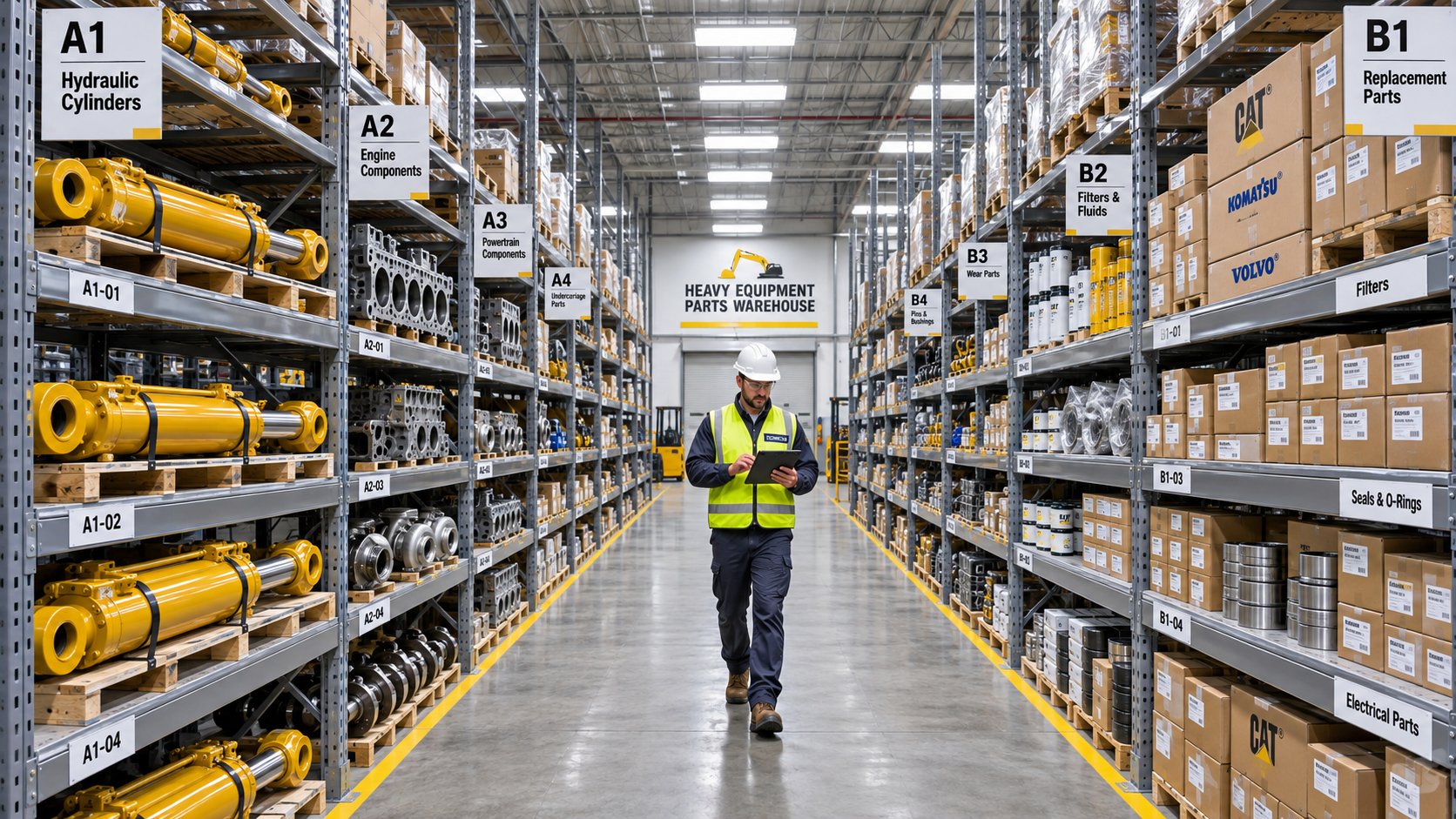
The brand stamped on an excavator's boom does more than signal where the machine was built. It determines how quickly you can get replacement parts, how close the nearest qualified technician operates, and how much of your original investment you'll recover when it's time to sell. Two identical-looking 20-ton machines at the same excavator price can deliver wildly different ownership experiences depending on whose nameplate they carry — and that gap widens dramatically in the used market, where manufacturer warranty support has long since expired and you're relying entirely on the aftermarket ecosystem.
The table below maps the eight brands you'll encounter most frequently across used equipment listings, giving you a practical snapshot of what each one brings — and what it doesn't — once the machine is yours.
| Brand | Parts Availability | Dealer Network Density (U.S.) | Typical 5-Year Resale Retention | Known Considerations in the Used Market |
|---|---|---|---|---|
| Caterpillar | Excellent — widest OEM and aftermarket supply globally | ~2,470 locations | 65–70% | Highest acquisition cost; premium parts pricing; strong demand keeps used inventory moving fast |
| Komatsu | Excellent — strong OEM network; robust aftermarket | ~404 locations | 60–65% | KOMTRAX telematics aids hour verification; coverage gaps in some rural areas |
| Volvo | Good — solid in metro markets; thinner in rural regions | ~200 locations | 55–60% | Superior cab comfort; higher parts costs; smaller used selection in North America |
| Hitachi | Good — adequate in most markets; strong hydraulic component supply | ~150+ locations | 60–65% | Lower used prices than Cat/Volvo equivalents; brand recognition lower among some buyers |
| John Deere | Good — extensive agricultural dealer network crosses over | Broad (shared ag/construction network) | 55–65% | Strong in mid-size class; dealer crossover from agriculture can slow specialized excavator support |
| Kobelco | Moderate — improving but thinner than top-tier brands | Limited; concentrated in select regions | 50–60% | Competitive used pricing; fuel-efficient designs; parts sourcing may take longer outside major metros |
| Hyundai | Moderate — growing network; aftermarket gaining depth | Expanding; still below Cat/Komatsu density | 45–55% | Attractive entry price; warranty and dealer support vary significantly by region |
| Kubota | Good — strong in compact class; limited above 8 tons | Extensive for compact; thin for larger units | 55–65% (compact class) | Dominates the mini excavator segment; parts readily available for sub-6-ton models |
Established Brands with Deep Parts Networks
Caterpillar and Komatsu occupy a tier of their own when it comes to global dealer infrastructure and parts availability. Caterpillar's roughly 2,470 U.S. dealer locations mean a parts counter or field technician is rarely far from any job site — a practical advantage that translates directly into less downtime when something breaks at 6 a.m. on a Monday. Cat excavators also retain 65 to 70% of their value over five years, the highest in the industry. So when you spot a cat 308 excavator for sale or browse a caterpillar 304 for sale listing, you're looking at a machine that holds its resale floor better than almost any competitor — which matters whether you plan to keep it for a decade or flip it in three years.
Komatsu, with approximately 404 U.S. locations, offers narrower geographic coverage but compensates with integrated engineering advantages. Because Komatsu manufactures its own engines, pumps, and valves in-house, the hydraulic systems feel cohesive and components are designed to work as a matched set. KOMTRAX telematics — standard on Komatsu machines since 2002 — also gives used buyers something uniquely valuable: trackable equipment history that helps verify reported hours and maintenance intervals before you commit. Over a 10,000-hour machine life, Komatsu's lower purchase price and fuel efficiency often deliver a lower total cost of ownership than Cat, even though Cat commands stronger resale numbers at disposition.
One important nuance: extensive parts availability doesn't automatically mean lowest parts cost. Caterpillar OEM components, for instance, carry a premium that reflects the brand's market position. Aftermarket alternatives exist for both Cat and Komatsu — and industry parts specialists describe aftermarket availability as a virtual tie between the two brands — but budgeting for genuine parts on critical systems like pumps and electronics is still advisable, especially if warranty compliance matters to your operation.
Value-Oriented Brands and Emerging Options
Below the Cat-Komatsu duopoly, a tier of brands offers meaningfully lower acquisition prices that attract budget-conscious buyers — particularly in the second-hand market, where that initial price gap compounds. Hyundai and Kobelco excavators, for example, frequently appear in used listings at 15 to 25% less than comparable Cat or Komatsu models at similar hours. For a contractor whose primary concern is getting a functional bucket excavator on-site without a six-figure outlay, those savings are hard to ignore.
The catch is support infrastructure. Kobelco's dealer network, while growing, remains concentrated in select regions. Finding a local technician familiar with the brand — or sourcing a hydraulic pump on short notice — may take considerably longer than it would for a Cat or Komatsu of the same class. Hyundai faces a similar dynamic: the network is expanding, but coverage density still trails the established leaders in many areas. That doesn't make these machines bad purchases — it makes them location-dependent purchases. A Kobelco in a metro area with a responsive dealer nearby can be an outstanding value. The same machine deployed to a remote site three hours from the nearest parts counter becomes a liability every time it needs a seal kit.
Kubota deserves separate mention because its dominance is class-specific. In the compact segment — sub-6-ton minis — Kubota's parts ecosystem rivals anyone's, and caterpillar mini excavators compete directly with Kubota in this space. Buyers shopping for a mini excavator Caterpillar or a Kubota KX will find robust parts availability for either brand. Above 8 tons, however, Kubota's presence thins rapidly, and buyers stepping into midi or standard classes should evaluate parts access as carefully as they evaluate the machine itself.
One critical distinction for import buyers sourcing used equipment internationally: equipment exported from a given country is not necessarily manufactured by a brand from that country. A machine shipped from Japan might carry a Caterpillar badge. A unit leaving South Korea could be a Volvo. Always verify the actual brand, model, and country of manufacture independently — don't assume origin based on shipping port alone.
How Brand Affects Your Total Cost of Ownership
Here's where many buyers miscalculate. They compare sticker prices across brands, pick the lowest number, and assume they got the best deal. But acquisition cost is just the opening chapter of the ownership story. The rest of that story — parts expenses, mechanic accessibility, fuel consumption, and eventual resale recovery — is written by the brand you chose.
Consider a straightforward scenario. You find a cat 304 mini excavator for sale listed at $48,000 and a comparable Hyundai compact at $36,000. The Hyundai saves $12,000 upfront. But if the nearest Hyundai dealer is two hours away and overnight parts shipping is your only option for anything beyond filters, every repair event carries a time penalty that the Caterpillar — with a parts counter 20 minutes down the road — simply doesn't face. Multiply that penalty across a few years of ownership, and the cheaper machine quietly becomes the more expensive one.
RPG Equipment's 2026 total cost of ownership analysis illustrates the principle at a larger scale: Komatsu edges out Caterpillar on lifetime cost in the 20-ton class primarily through lower fuel consumption and lower purchase price — despite Cat's stronger resale numbers. That finding holds when both machines have comparable dealer proximity. Swap the dealer distances and the math shifts again. The brand-versus-brand debate, in other words, is always filtered through your specific geography and operational profile.
The practical takeaway is simple. Before you commit to any brand in the used market, make two phone calls: one to the nearest dealer for that brand and one to an aftermarket parts supplier. Ask about inventory for the specific model you're considering, typical lead times for common wear items, and field service response windows. Those answers will tell you more about your real cost of ownership than any spec sheet comparison ever could. A used excavator second hand is only as reliable as the support network behind it — and that network looks different for every buyer depending on where they work.
Brand selection sets the stage for long-term costs, but it doesn't answer the question buyers ask first: what will I actually pay to get this machine on my site? That answer depends on a set of price drivers that interact in ways most listings never explain.
What a Second-Hand Excavator Actually Costs
Every buyer starts with the same question: how much will I spend? And every listing answers with a single number — the asking price. The problem is that single number hides a stack of variables that can shift your actual out-of-pocket cost by tens of thousands of dollars in either direction. Two seemingly identical machines listed at the same price can deliver very different total acquisition costs once you account for what's driving each listing and what isn't included in the sticker. Rather than fabricating price tables, let's break down the factors that create real-world price variation so you can build a budget grounded in how used earth moving equipment is actually priced.
Here are the primary cost drivers that determine what you'll pay for any excavator second hand:
- Size class (operating weight) — The single biggest price determinant. Each step up in weight class represents a significant cost jump.
- Brand — Premium brands with strong resale retention command higher used prices than value-oriented manufacturers at equivalent hours.
- Machine hours — Lower hours mean higher prices, but the relationship isn't linear. The steepest depreciation occurs early.
- Calendar age and emissions tier — Newer machines with current emissions compliance carry a premium, especially in regulated markets.
- Attachments included — A machine bundled with buckets, a hydraulic thumb, or a breaker saves the buyer separate procurement costs and commands a higher listing price.
- Geographic location — Regional supply-demand imbalances, transport distances, and import duties create meaningful price differences for the same model.
- Buying channel — Auction houses, dealers, private sellers, and direct platforms each layer different costs — premiums, markups, or certification fees — onto the base machine value.
What Drives Second-Hand Excavator Pricing
Operating weight class is where pricing conversations should begin. A compact excavator under 6 tons occupies a fundamentally different price band than a 30-ton standard crawler, which in turn sits far below a 50-ton production machine. If you're searching for a compact excavator for sale near me, you're shopping in a different financial universe than someone sourcing a large excavator for quarry work — and understanding that class-driven price structure keeps expectations realistic from the start.
Within any given size class, machine hours interact with price along a depreciation curve that isn't evenly distributed. Thompson Machinery explains that the steepest value drop occurs in the earliest period of ownership, then gradually flattens as the machine ages. Using a units-of-production depreciation method — which ties value loss to actual operating hours rather than calendar years — gives buyers a more accurate picture of where a specific machine sits on its depreciation curve. For example, a machine expected to deliver 10,000 total hours depreciates roughly $6 per hour on a $60,000 depreciable base. A unit at 4,000 hours has consumed roughly 40% of its useful life by that measure, helping you gauge whether the asking price reflects real remaining value.
Geographic factors add another pricing layer that surprises first-time buyers. The same Komatsu PC200 can carry a noticeably different price tag depending on whether it's listed in a high-demand metro market or a region with surplus inventory. EquipmentWatch data reported by ENR shows an 18.22% drop in construction equipment auction values in August 2026 compared to the same period in 2024, alongside a 6.97% rise in average equipment age at auction — suggesting that older machines are cycling into the market and moderating prices overall. Regional demand imbalances, import duties for cross-border purchases, and inland transport costs all stack on top of whatever the listing says. A machine priced attractively in one country may lose that advantage entirely once shipping, customs, and compliance fees are factored into the landed cost.
For buyers browsing cat excavators for sale or comparing listings across brands like a Cat 306 for sale versus a Kobelco equivalent, these geographic and channel-driven price differences mean that the cheapest listing isn't always the cheapest machine. The excavator excavator buyers most often regret buying is the one where they compared sticker prices without normalizing for location, condition, and total cost.
Setting a Realistic Budget Beyond the Sticker Price
Here's where most budgets fall apart. A buyer finds what looks like a great deal, commits to the purchase price, and then discovers a cascade of additional costs that were always inevitable but never planned for. Treating the listing price as your total budget is like booking a flight and forgetting about hotels, meals, and ground transport — the ticket gets you there, but you're far from done spending.
Build your realistic budget around these layers:
- Machine purchase price — The base number. Negotiate using auction comparables and competing listings as leverage, not emotion.
- Transport or shipping costs — Local moves on a flatbed may run a few hundred dollars. Cross-border ocean freight is a different story entirely. Tide Power's import guide notes that some procurement teams underestimate shipping costs by as much as 40% because they fail to account for inland transport, port handling, and documentation fees on top of the ocean freight charge. Container shipping, RoRo, and air freight each carry different cost profiles — and the choice depends on machine size, urgency, and your tolerance for transit risk.
- Repairs identified during inspection — If your pre-purchase checklist flagged a worn undercarriage, aging hydraulic hoses, or blow-by on the engine, price those repairs before you sign. A $35,000 machine that needs $8,000 in undercarriage work is really a $43,000 machine — and should be negotiated as one.
- Attachment purchases — Many used machines sell with a single general-purpose bucket. If your work requires additional buckets, a hydraulic thumb, a breaker, or a tilt coupler, budget for those separately. Attachment costs can add 10 to 20% on top of the base machine price depending on what you need.
- Import duties and regulatory compliance — For cross-border buyers, customs duties vary by destination and equipment classification. Emissions compliance verification, pre-shipment inspections, and certification fees are real line items that don't appear in any marketplace listing.
- Insurance and registration — Equipment insurance premiums depend on machine value, usage type, and your claims history. Factor this ongoing cost into your first-year ownership projection, not as an afterthought six months in.
Buyers searching for used mini excavators for sale near me sometimes fixate on finding the absolute lowest purchase price, assuming that savings on acquisition translate directly to savings on ownership. They rarely do. A machine priced $5,000 below market that needs immediate hydraulic pump work, a set of tracks, and $2,500 in shipping wipes out that perceived savings — and likely exceeds it. The smarter approach is calculating total landed cost: purchase price plus transport plus immediate repairs plus attachments plus compliance. Compare that total across your shortlisted machines, and the real best deal often isn't the one with the lowest sticker.
Pricing tells you what you'll spend. But spending wisely also means managing how you buy — the documentation you demand, the logistics you plan for, and the negotiation sequence that protects your investment from the moment you commit to the moment the machine rolls onto your site.
Sourcing, Documentation, and Logistics for Used Excavator Purchases
Knowing what a machine is worth and where to buy it still leaves you standing at the starting line. The actual purchasing process — from initial search to a machine rolling off a transport trailer onto your site — involves a sequence of steps where skipping even one can cost you money, time, or legal headaches. Whether you're sourcing a used mini excavator for a local landscaping fleet or negotiating a bulk purchase of Caterpillar excavators for an international dealership, the workflow below keeps every critical task in the right order.
- Define your requirements — Lock in the size class, brand preferences, maximum hours, emissions tier, and must-have attachments before you browse a single listing. Vague criteria lead to impulse decisions.
- Search multiple platforms simultaneously — Check auction archives, dealer inventories, private listings, and direct online suppliers. Casting a wide net reveals price patterns that a single-channel search misses entirely.
- Shortlist machines — Narrow to three to five candidates that match your specs and budget. Rank them by total estimated cost, not sticker price alone.
- Request documentation — Ask every seller for maintenance logs, fluid analysis history, repair invoices, title or ownership proof, and lien-release confirmation before scheduling a site visit.
- Arrange inspection — Inspect in person or hire a third-party inspector. Run the full system-by-system checklist covered earlier in this guide.
- Negotiate with data — Use auction comparables, competing quotes, and any deficiencies found during inspection as leverage. Negotiate the price down to reflect documented repair needs, not gut feeling.
- Finalize purchase — Secure transport, confirm title transfer paperwork, verify insurance coverage, and release payment only after all documentation is in order.
That sequence looks straightforward on paper. In practice, two steps trip up buyers more often than all the others combined: documentation verification and transport logistics. Both deserve closer attention.
Documentation and Service History Verification
Imagine finding the perfect caterpillar excavator for sale — right size class, reasonable hours, solid inspection results — and then discovering after purchase that the machine has an outstanding lien from a previous financing agreement. You've paid, but you don't legally own it free and clear. This scenario is more common than most buyers realize, and it's entirely preventable with proper paperwork diligence before you hand over any money.
Here's what to request — and what each document actually tells you:
- Maintenance logs and service invoices — These are the machine's medical records. Consecutive entries showing scheduled oil changes, filter replacements, and component inspections at predictable hour intervals indicate disciplined ownership. Gaps in the record — especially long stretches with no documented service — raise the same red flag as a resume with unexplained employment gaps. Something happened during that silence, and it's rarely good news.
- Fluid analysis reports — Oil sampling records showing metal content trends over time are the single most objective proof of internal condition. A seller who invested in periodic fluid analysis is a seller who managed the machine proactively. If multiple sequential reports exist, review the trend lines for iron, copper, and lead — stable or declining levels suggest healthy internals, while rising trends point to accelerating wear.
- Repair invoices — Major component replacements — pumps, final drives, turbochargers, undercarriage overhauls — reset the clock on those specific systems. A machine that received a new hydraulic pump at 7,000 hours is in a fundamentally different position than one running the original pump at the same hour mark. Repair invoices prove that the work was actually done rather than just claimed.
- Title or ownership documentation — Confirm that the seller is the legal owner and has the right to transfer. In the United States, equipment title laws vary by state, but verifying serial number registration and checking for UCC filings against the machine's serial number protects you from buying a unit that's still collateral on someone else's loan.
- Lien checks — Industry experts stress that verifying the legal status of the machine is a non-negotiable final step before any financial transfer. A lien search through UCC databases or equivalent registries in your jurisdiction confirms the machine is free of encumbrances. Skip this, and you risk paying for an asset a bank still technically owns.
A seller who is unable or unwilling to provide service history is sending you a message — and that message is worth more than any caterpillar excavator price discount they might offer to compensate for the missing paperwork. Transparent sellers welcome documentation requests because clean records make their machines easier to sell at fair prices. Evasive responses to basic paperwork questions should end the conversation, regardless of how attractive the listing appears.
Transport, Import Logistics, and Final Purchase Steps
Here's a mistake that catches even experienced buyers: falling in love with a machine, agreeing on a price, and only then discovering that transport costs erase the savings that made the deal appealing in the first place. Always obtain transport quotes before finalizing any purchase, not after. This is especially critical for cross-border transactions where the logistics stack is deeper and more expensive than domestic moves.
For buyers sourcing internationally — whether looking at a demolition excavator for sale from Europe or a compact unit from East Asia — the logistics checklist expands significantly. U.S. import regulations require compliance with multiple agencies: CBP for customs clearance, EPA for emissions standards, and DOT for safety requirements. Required documentation typically includes a commercial invoice, bill of lading, packing list, EPA Form 3520-21 for engines subject to air pollution regulations, and a DOT Form HS-7 declaring conformity with safety standards. Missing or inaccurate paperwork doesn't just cause delays — it triggers penalties and potential cargo holds at port.
Import duties add another layer. Earthmoving machinery like excavators falls under Harmonized System heading 8429, but the exact duty rate depends on the destination country, any applicable trade agreements, and the equipment's classification details. Under USMCA, qualifying machinery moving between the U.S., Canada, and Mexico may enter duty-free — but origin rules must be met, and trade policy shifts can alter eligibility. For equipment sourced from outside North America, standard duty rates apply, and buyers should consult a customs broker or compliance tool to estimate the landed cost accurately before committing.
Transport method selection depends on machine size, urgency, and distance. ZT Supply Chain's procurement guide outlines the primary options: truck freight for overland moves (factoring in oversize permits for larger machines), ocean freight via container or RoRo for international shipments, and rail for bulk or long-distance domestic transport. Each method carries different cost profiles, transit times, and risk exposures — and the choice should be finalized before the purchase agreement is signed, not scrambled together afterward.
For import buyers sourcing caterpillar mini excavators for sale or multi-brand units from international markets, the logistical friction of dealing with multiple private sellers across different countries compounds quickly. Each seller means separate negotiations, separate shipping arrangements, separate documentation packages, and separate quality verification processes. This is precisely where consolidated sourcing through a single platform pays practical dividends. JIUHONG's used excavator collection, for example, aggregates compact and larger machines from multiple brands into one catalog — allowing import buyers and equipment dealers to compare specifications, request model-specific quotes, and arrange bulk purchases through a single point of contact. That consolidation simplifies shipping coordination, streamlines documentation, and reduces the negotiation overhead that multiplies when you're piecing together purchases from scattered sellers across different regions.
Regardless of whether you source domestically or internationally, verify one final detail before signing: does the machine's emissions tier and safety configuration meet the regulations where you'll actually operate it? A pre-Tier 4 machine purchased cheaply overseas becomes worthless if local job-site rules prohibit its use. Compliance standards are non-negotiable — EPA Tier 4 Final for the United States, CE marking and Stage V for the European Union, and local homologation for countries with their own import rules. Confirm compliance before the machine ships, not after it arrives at your yard with no legal path onto a work site.
Sourcing, documentation, and logistics are the mechanical steps of buying well. But even buyers who execute every step correctly can still lose money if they fall into the behavioral traps that plague the used equipment market — mistakes driven not by ignorance of process, but by urgency, overconfidence, or simple math errors that compound after the handshake.
Costly Mistakes to Avoid When Buying a Used Excavator
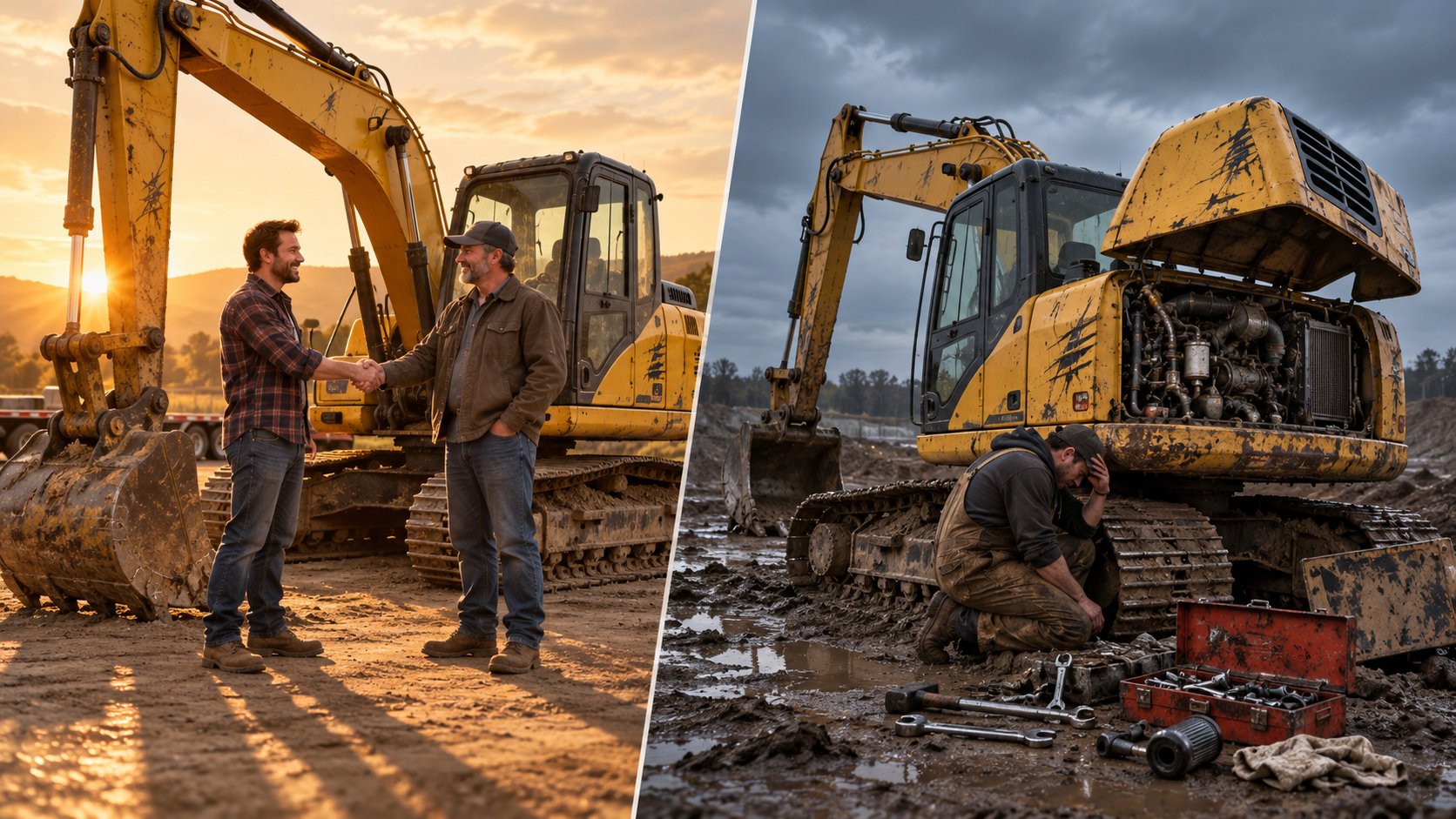
You can study every inspection checklist, compare every brand, and master every logistics detail — and still lose thousands of dollars on a single behavioral misstep. The mistakes that hurt most aren't mechanical. They're decisional: shortcuts driven by urgency, overconfidence, or incomplete math that seemed reasonable at the time and only revealed their true cost weeks or months later. Below are the errors that consistently turn a smart excavator second hand purchase into an expensive regret — and each one is entirely preventable.
Overpaying by Ignoring Market Comparables
- Buying the first machine you find without benchmarking. Excitement is the most expensive emotion in the used equipment market. You spot a used small excavator for sale that ticks every box — right size, decent hours, clean photos — and you pull the trigger before checking whether three nearly identical machines are listed elsewhere at lower prices. Auction platforms alone move thousands of excavators annually, generating a deep well of historical sale data that tells you exactly what comparable models at similar hour ranges have actually sold for — not what sellers wished they'd sold for. Without that benchmark, you're negotiating blind. Review completed auction results, cross-reference dealer listings, and check direct online platforms for the same model. The 30 minutes you spend comparing could easily save you $5,000 to $15,000 on a single purchase.
- Confusing asking price with market value. Sellers set listing prices based on what they want, not necessarily what the market supports. A wheeled excavator for sale listed at $75,000 doesn't mean $75,000 is fair — it means that's where the negotiation starts. True market value sits at the intersection of recent comparable sales, current supply levels, and the specific condition of the unit in front of you. Build your offer around data, not around the seller's number.
Skipping Inspection and Trusting Photos Alone
- Relying on listing photos to assess condition. Online photos are marketing tools, not diagnostic instruments. A well-angled photograph hides undercarriage wear, conceals hydraulic leaks pooling beneath the machine, and makes faded paint look fresh. Professional inspections typically cost $500 to $1,500 — a fraction of the $15,000-plus undercarriage replacement or the $95,000 hydraulic system overhaul that photos simply cannot reveal. Always arrange an in-person evaluation or hire a qualified third-party inspector, especially for higher-value machines and cross-border purchases where return logistics are impractical. If the seller resists inspection access, that resistance tells you everything the photos didn't.
- Skipping documentation review because the machine "looks good." A clean exterior means someone pressure-washed it before listing day. It tells you nothing about whether oil changes happened on schedule, whether the hydraulic pump was replaced at the right interval, or whether a cracked boom was field-welded and painted over. Experienced dealers emphasize that choosing a machine — or a seller — without verifying maintenance history is one of the most common and costly errors buyers make. Demand the paperwork. No records, no deal.
Underestimating Total Landed Cost
- Treating the purchase price as the total cost. This is the mistake that ambushes even careful buyers. You negotiate a strong price of an excavator, sign the deal, and then the invoices start arriving: transport fees, import duties, port handling charges, immediate repairs flagged during inspection but "budgeted for later," attachment purchases, insurance premiums, and regulatory compliance costs. Industry data suggests budgeting 15 to 20% of the purchase price annually for maintenance and repairs alone — and that's on top of one-time acquisition costs. A $50,000 machine that needs $30,000 in deferred maintenance is really an $80,000 machine, potentially more expensive than a better-maintained $70,000 unit that's ready to work on day one.
- Fixating on the lowest sticker price without calculating landed cost. Bargain hunters searching through mini excavator auction listings or scanning wheeled diggers on classified sites often grab the cheapest option available. But "cheapest to buy" and "cheapest to own" are rarely the same machine. A cat 310 for sale priced $4,000 below competing listings might be priced low because it needs track replacement, a turbo rebuild, or sits 1,200 miles from your yard with no included transport. Calculate every dollar between the listing price and the moment the machine makes its first productive dig on your site. That total — not the number in the ad — is what you're actually paying.
- Forgetting regulatory compliance until after the purchase. Import buyers face this trap most often. A pre-Tier 4 machine purchased at a compelling price overseas becomes a stranded asset if local emissions regulations prohibit it from operating on your job sites. Government contracts, port work, and projects in air-quality-regulated regions increasingly mandate Tier 4 Final or equivalent compliance. Verify that the machine's emissions tier and safety configuration meet every regulation in your operating jurisdiction before you commit — not after the shipping container arrives at your yard.
Every one of these mistakes shares a common root: the gap between what a buyer sees at the moment of purchase and what they experience over the months that follow. Closing that gap is what this entire guide has been about — from understanding what "second hand" actually means, through matching size class to your work, applying the hours-age-condition triangle, running a system-by-system inspection, choosing the right buying channel, evaluating brand support networks, building an honest budget, and managing sourcing logistics with discipline. The smartest excavator second hand purchase isn't the one with the lowest price tag. It's the one where total cost of acquisition and first-year ownership were calculated, verified, and accepted before anyone signed a single document.
Frequently Asked Questions About Buying an Excavator Second Hand
1. How many hours is too many on a used excavator?
There is no single cutoff, because hours must be evaluated alongside maintenance history and physical condition. Machines under 3,000 hours are considered lightly used, while 3,000 to 6,000 hours is often the sweet spot balancing price and remaining life. Units above 10,000 hours enter high-hour territory where major component work — such as hydraulic pump rebuilds or engine overhauls — may be imminent. However, a 10,000-hour excavator backed by complete fluid analysis records and proactive component replacements can actually outlast a 5,000-hour machine with no documented service history. Always cross-reference the hour meter with ECM data and maintenance logs, since industry surveys suggest 15 to 20 percent of used listings show inconsistent hour readings.
2. What is the difference between a second-hand excavator and a certified pre-owned excavator?
A second-hand excavator is sold in its current as-is condition without any mandatory reconditioning or manufacturer-backed warranty. It can range from a lightly used dealer trade-in to a high-hour fleet liquidation unit. A certified pre-owned excavator, by contrast, has passed a structured inspection process — such as Caterpillar's 140-plus-point audit — and typically includes limited warranty coverage on specific powertrain and hydraulic components. Certified machines carry higher prices because the dealer has invested in evaluation, genuine-parts repairs, and documentation. Buyers should read warranty terms carefully, since certification covers defined components rather than offering a blanket guarantee on the entire machine.
3. What should I inspect before buying a used excavator?
A thorough pre-purchase inspection covers four major systems. Start with the undercarriage — measure track pad height, sprocket tooth profiles, roller condition, track sag, and pin-and-bushing wear, since undercarriage replacement can represent up to 50 percent of lifetime operating cost. Next, check hydraulics by examining cylinder rods for scoring, testing cycle times on every function, and inspecting oil color for contamination. For the engine, observe exhaust smoke at cold start, perform a blow-by test, and listen for turbo abnormalities. Finally, assess the boom, stick, and bucket by checking pin-to-bushing play at every joint and looking for structural cracks at weld points. Hiring a qualified third-party inspector is strongly recommended for any machine valued above a few thousand dollars.
4. Is it better to buy a used excavator at auction or from a dealer?
Each channel involves distinct trade-offs. Auctions like Ritchie Bros. offer broad inventory and competitive pricing, but machines sell as-is with no warranty and limited inspection windows — plus a buyer's premium of 10 to 15 percent on top of the hammer price. Authorized dealers provide inspection reports and sometimes limited warranties through certified pre-owned programs, but at higher sticker prices. Private sellers often list the lowest prices yet place the full due-diligence burden on the buyer. Direct online platforms that aggregate multi-brand inventories — such as JIUHONG's used excavator collection — offer a middle ground, letting buyers compare specifications, request quotes, and negotiate without auction-day time pressure. Many experienced buyers use multiple channels simultaneously, benchmarking auction data against dealer and platform quotes before committing.
5. How do I calculate the total cost of buying a second-hand excavator?
Total landed cost goes well beyond the listing price. Add transport or international shipping fees — which can be underestimated by up to 40 percent if port handling and inland freight are overlooked — plus any immediate repairs identified during inspection, attachment purchases if the machine ships with only a standard bucket, import duties and customs clearance for cross-border transactions, insurance premiums, and regulatory compliance costs such as emissions-tier verification. Industry guidance suggests budgeting 15 to 20 percent of the purchase price annually for ongoing maintenance alone. Comparing total landed cost across shortlisted machines, rather than sticker prices, reveals which deal is genuinely the most economical.