

What Every Excavator Buyer Should Know Before Browsing Listings
Type "excavator for sale" into any search engine and you'll get page after page of listings — auction inventories, dealer catalogs, classified ads. What you won't find is a single resource that helps you figure out which machine you actually need, what a fair price looks like, or how to spot a deal that's too good to be true. That gap costs buyers thousands of dollars every year in mismatched purchases, hidden mechanical problems, and overlooked ownership expenses.
The phrase itself represents a surprisingly diverse crowd. A first-time landscaper shopping for a compact trackhoe is searching alongside a fleet manager replacing aging iron and an international import buyer sourcing dozens of units for overseas infrastructure projects. Their budgets, technical knowledge, and risk tolerance couldn't be more different — yet they're all funneled into the same transactional listings with zero advisory content.
This guide is the informational layer those listings are missing. Before you compare prices or contact a single seller, the sections ahead will walk you through machine types, condition assessment, red flags, sourcing channels, and total cost of ownership so your capital goes toward the right excavator and not toward an expensive lesson.
Why Excavator Shopping Starts with Education, Not Listings
Consider how broad the market really is. Compact units under two tons — popular for residential utility work and tight urban sites — can start below $20,000 on the used market, while heavy machines above 45 tons regularly exceed $300,000. Wondering how much is an excavator? The honest answer depends entirely on size class, condition, brand, and your intended application. Jumping into listings without understanding these variables is like walking onto a car lot without knowing whether you need a pickup truck or a sedan.
An excavator and its attachments represent one of the largest capital commitments a contractor or dealer will make. A machine that's too large for your typical workload bleeds money through excess fuel, transport permits, and accelerated depreciation. One that's too small grinds through tasks inefficiently and wears out faster. Education before transaction is the only reliable shortcut to a sound purchase.
Who This Guide Helps
This resource is built for anyone evaluating an excavator purchase, whether it's your first machine or your fiftieth. Specifically, it's designed for:
- Excavation contractors evaluating fleet additions or replacements and weighing used versus new options
- Landscapers and small operators considering their first compact machine for trenching, grading, or pool excavation
- Equipment dealers scouting wholesale inventory across multiple brands and size classes
- Import buyers sourcing machines for overseas construction or mining projects, where parts availability and shipping logistics add layers of complexity
Each of these buyers faces distinct challenges, but they share a common need: reliable information that sits between marketing copy and a mechanic's inspection report. The chapters ahead deliver exactly that — starting with a complete breakdown of excavator types and size classes so you can narrow your search before a single dollar changes hands.
Excavator Types and Size Classes Explained
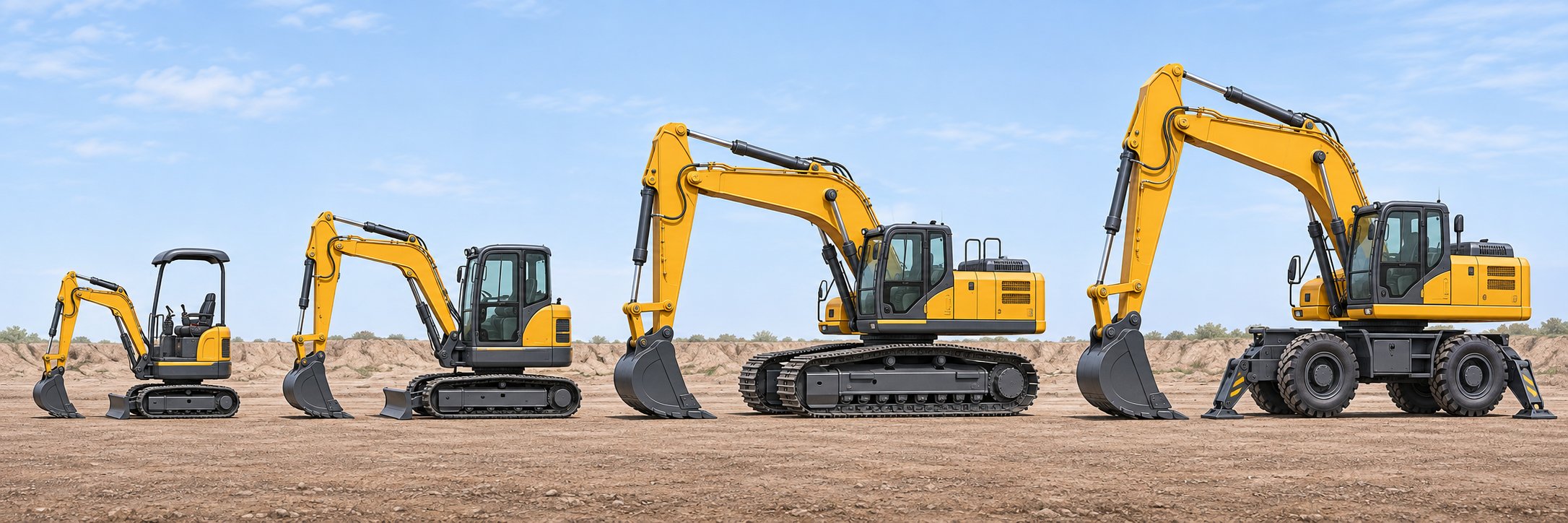
Imagine walking into a hardware store and asking for "a drill" without specifying whether you need a cordless driver for cabinet screws or a hammer drill for concrete anchors. The excavator market works the same way. Listings labeled "excavator for sale" can mean anything from a 1.7-ton rubber-tracked micro unit to an 80-ton quarry machine — and the price, transport requirements, and maintenance burden of each couldn't be more different. A clear understanding of size classes eliminates confusion before you ever pick up the phone.
Micro and Mini Excavators Under 6 Tons
Compact machines in this class are the workhorses of residential landscaping, utility trenching, and tight-access urban sites. Picture a backyard pool dig where the only way in is through a standard 36-inch gate — a full-size track hoe simply can't get there, but a 1.7-ton micro excavator rolls through with room to spare.
Mini excavators typically weigh between 2,000 and 13,000 pounds and produce anywhere from roughly 10 to 65 horsepower. Digging depths range from about 6 feet on the smallest models up to 12 or 13 feet on units approaching the 6-ton mark. Zero-tail-swing configurations are especially popular in this class because they allow the cab and counterweight to rotate within the track width, reducing the risk of striking walls, fences, or parked vehicles on cramped job sites.
Brands like Kubota, Bobcat, Caterpillar, Yanmar, Takeuchi, and SANY all compete aggressively here. Specifications vary significantly even within the same weight bracket, so always confirm dig depth, bucket capacity, and hydraulic flow rates for the specific machine under consideration rather than relying on generalized class averages.
Mid-Size Excavators from 6 to 25 Tons
Step up from a mini and you enter the most versatile segment of the market. Mid-size excavators handle commercial site preparation, road shoulder grading, medium demolition, and municipal utility installation with a balance of reach, power, and transportability that larger machines can't match on mixed-use projects.
Operating weights here span roughly 13,000 to 55,000 pounds, with horsepower ratings climbing from around 70 hp on entry-level units to 170 hp or more on the upper end. Digging depths typically range between 15 and 22 feet. When you see a crawler excavator for sale in this bracket, you'll notice models from nearly every major manufacturer — Caterpillar, Komatsu, Hitachi, John Deere, Volvo, Hyundai, Kobelco, CASE, and Develon (formerly Doosan) all field strong lineups. The sheer variety means buyers can often find competitive pricing, but it also means spec-sheet comparisons are essential. A comprehensive excavator spec guide can help you compare dig depth, dump height, and reach across dozens of models before narrowing your shortlist.
For many contractors, a 20-ton class machine is the sweet spot: powerful enough for most commercial earthmoving, yet light enough to haul on a standard lowboy trailer without oversize-load permits in most states.
Standard and Large Excavators Over 25 Tons
Heavy earthmoving, quarry loading, large-scale demolition, and deep foundation work demand machines that start at 25 tons and can exceed 100 tons. These units deliver dig depths of 22 to 36 feet or more, dump heights above 23 feet, and engine power ranging from roughly 170 hp all the way past 500 hp on production-class models.
Komatsu, Hitachi, Liebherr, and Caterpillar dominate this space, with some manufacturers offering mining-class excavators that push well beyond 500 tons for open-pit operations. At these sizes, every specification decision carries outsized financial consequences — fuel consumption, undercarriage wear rates, and transport logistics all scale dramatically. A 50-ton machine, for example, may require escort vehicles and route permits that a 35-ton unit avoids entirely.
Buyers shopping for a crawler excavator for sale in the large class should also pay close attention to bucket capacity. Volvo, for instance, is known for industry-leading bucket volumes at comparable operating weights, which can translate directly into faster cycle times and higher daily production.
Specialty Configurations — Wheeled, Long-Reach, and Spider
Not every excavation job fits neatly into the standard tracked-machine template. Three specialty configurations expand what's possible:
- Wheeled excavators — Mounted on rubber tires instead of steel tracks, these machines travel safely on finished pavement and reposition quickly between urban work zones. They sacrifice some stability on rough terrain but eliminate surface damage on roads and bridges. Brands like Caterpillar, Volvo, Hyundai, and Liebherr offer wheeled models in the 14-to-26-ton range.
- Long-reach excavators — Equipped with extended booms and sticks, these variants reach 40 to 60+ feet for dredging, slope grading, and deep canal work. If you spot a long reach excavator for sale, expect to see models from Link-Belt, SANY, Hyundai, and CAT, among others. The SANY SY265C Long Reach, for example, achieves a dig depth exceeding 43 feet while the CAT 352 Long Reach stretches past 64 feet of maximum reach at ground level.
- Spider excavators — These machines use independently adjustable legs to "walk" across steep slopes, unstable riverbanks, and terrain where tracks or wheels would simply slide. Typically weighing 10 to 15 tons, they fill a niche in forestry, disaster response, and mountainside construction that no other configuration can match.
Excavator Size Class Reference Table
The table below maps each category to its key characteristics. Use it as a quick-reference guide when filtering listings or discussing requirements with a dealer.
| Size Class | Typical Operating Weight | Common Applications | General Used Price Bracket | Example Brands |
|---|---|---|---|---|
| Micro / Mini (Under 6 Tons) | 2,000 - 13,000 lbs | Residential landscaping, utility trenching, pool excavation, tight-access urban sites | Budget-friendly to mid-range | Kubota, Bobcat, CAT, Yanmar, Takeuchi, SANY, JCB |
| Mid-Size (6 - 25 Tons) | 13,000 - 55,000 lbs | Commercial site prep, road shoulders, medium demolition, municipal utilities | Mid-range | CAT, Komatsu, Hitachi, John Deere, Volvo, Hyundai, Kobelco, CASE, Develon |
| Standard / Large (Over 25 Tons) | 55,000 - 200,000+ lbs | Heavy earthmoving, quarry work, deep foundations, large-scale demolition | Mid-range to premium | Komatsu, Hitachi, CAT, Liebherr, Volvo, John Deere, Link-Belt |
| Wheeled | 28,000 - 57,000 lbs | Road construction, urban utility work, bridge maintenance | Mid-range to premium | CAT, Volvo, Hyundai, Liebherr |
| Long Reach | 50,000 - 130,000 lbs | Dredging, slope grading, deep canal excavation, shoreline work | Premium | Link-Belt, SANY, Hyundai, CAT, Kobelco |
| Spider | 20,000 - 33,000 lbs | Steep-slope construction, forestry, disaster response, riverbank reinforcement | Premium (specialty) | Menzi Muck, Kaiser, Euromach |
With size classes and specialty options mapped out, the real challenge shifts from "what exists" to "what fits my work." Choosing the wrong class — even by a single weight bracket — can quietly drain thousands in excess fuel, unnecessary transport costs, or lost productivity over the life of the machine.
How to Match the Right Excavator to Your Job Type
Knowing every size class on the market is one thing. Picking the one that actually earns its keep on your job sites is something else entirely. Most buyers browse listings filtered by price or brand, yet the smarter filter — the one that protects your margins for years — is the work itself. What are you digging, how deep, how often, and where? Answer those questions honestly, and the right machine practically selects itself.
Residential and Light Commercial Work
Compact excavators dominate landscaping, pool excavation, utility installations, and small-lot grading for a handful of practical reasons that go beyond raw digging power. Think about a typical residential utility trench: you need to get behind an existing structure, navigate around landscaping, and avoid damaging a finished driveway. A 3.5-ton mini excavator trackhoe handles that comfortably. A 20-ton machine can't even reach the work zone without tearing up the yard.
Here's why contractors doing residential and light commercial work gravitate toward machines under 6 tons:
- Lower transport costs — Most compact excavators ride on a standard equipment trailer towed by a pickup truck or single-axle hauler, eliminating the need for a dedicated lowboy and CDL driver.
- Reduced ground disturbance — Lighter machines exert less ground pressure, meaning fewer turf repairs and less damage to finished surfaces on client properties.
- Tight-access capability — Models with retracted track widths under 30 inches pass through standard gates and narrow openings that larger machines simply cannot enter.
- Versatile attachment use — Even small machines accept buckets, augers, hydraulic thumbs, and light breakers, covering the full scope of typical residential tasks.
If you've been searching for a used mini excavator for sale near me, you'll notice these compact units hold their resale value well precisely because demand stays consistently high among landscapers, plumbers, and small general contractors who rely on them daily.
Infrastructure and Heavy Commercial Projects
Scale up the job — road construction, deep foundation excavation, municipal sewer and water line installation, commercial demolition — and the requirements shift dramatically. Mid-size excavators in the 10-to-25-ton range serve as the backbone of most infrastructure work because they balance reach, breakout force, and cycle speed in a package that's still transportable on a standard lowboy trailer.
Road shoulder grading, for instance, demands a machine with enough reach to work from the road surface down to ditch grade without constant repositioning. A 20-ton excavator with a standard arm delivers roughly 19 to 22 feet of dig depth and enough bucket force to cut through compacted subgrade and fractured rock. Pair it with a hydraulic breaker for utility crossings or a compaction wheel for trench backfill, and one machine covers multiple phases of a linear infrastructure project.
Large-scale demolition and deep excavation push the requirement further — into the 25-to-50-ton class and beyond. Here, lifting capacity and dump height matter as much as dig depth because you're loading trucks all day. Cycle time shaves seconds off every bucket load, and over hundreds of loads per shift, those seconds translate directly into production tonnage and revenue.
Avoiding the Oversizing and Undersizing Trap
This is where the most expensive buyer mistakes happen, and neither extreme is forgiving. Industry experts consistently flag oversizing and undersizing as top-tier profit killers for contractors.
Buying too large means you're hauling a machine that costs more to transport, burns more fuel on light-duty tasks, and may not even access the majority of your job sites. A full-size excavator sitting idle because it can't fit behind a commercial building doesn't earn a dime — it just depreciates.
Buying too small creates a different kind of pain. Running a compact machine beyond its intended capacity leads to slower cycle times, increased component wear, and operator fatigue. You might save money on the purchase, but you'll give it all back through productivity losses and premature repairs. As one equipment dealer puts it, the cheapest machine upfront often becomes the most expensive machine over time.
The practical fix? Match the machine to the work you do most — not the single largest project you occasionally take on. Here are the decision factors worth evaluating before you commit:
- Average trench depth required — Verify that the machine's maximum dig depth exceeds your typical requirement by a comfortable margin, not just barely meets it.
- Typical material density — Clay, rock, and saturated soil demand significantly more breakout force than loose sand or topsoil.
- Site access constraints — Measure gate widths, overhead clearances, and surface conditions at your most common work locations.
- Trailer and transport availability — If you only own a pickup and tag-along trailer, a machine exceeding 10,000 pounds creates an immediate logistical problem.
- Attachment needs — Buckets, hydraulic breakers, thumbs, augers, and grapples each have specific hydraulic flow and mounting requirements that vary by machine class.
That last point deserves extra emphasis. Attachment compatibility isn't something to figure out after the purchase — it should drive the purchase. A single excavator paired with the right set of attachments can replace multiple pieces of specialty equipment, dramatically improving ROI. But as compatibility research shows, excavator attachments are far from universal. Pin dimensions, hydraulic flow rates, and coupler standards vary not just between brands but between models of the same brand. Buying a machine without confirming it can run the breaker, auger, or used digger buckets you already own — or plan to buy — is a recipe for costly returns and project delays.
Contractors searching for a used mini excavator for sale near me should pay particular attention to hydraulic auxiliary flow ratings. A compact machine rated at 15 GPM cannot effectively power an attachment designed for 25 GPM, regardless of what the listing says about "versatility." Verify the numbers before you buy.
The right excavator isn't the biggest or the cheapest — it's the one that matches the work you do 80% of the time while accepting the attachments that cover the other 20%.
Getting the size and application match right is the foundation. The next layer of the decision — whether to buy new or used, and what that choice really costs over the life of the machine — carries its own set of financial traps that deserve equally careful analysis.
Used vs New Excavators and the Real Cost of Ownership
Sticker price is the number every buyer sees first — and it's the number that misleads the most. A brand-new 20-ton excavator might list for $250,000 while a comparable three-year-old unit with moderate hours sits at $170,000. The $80,000 gap looks like a clear win for the used machine, but the real financial picture depends on what happens over the next five to ten years of ownership. Fuel bills, maintenance intervals, undercarriage wear, warranty coverage, and eventual resale value all stack up behind that initial price tag. Ignore them, and the "deal" you found in the used excavators market could quietly cost more than buying new.
Depreciation and Total Cost of Ownership
Excavators follow a depreciation curve that's steepest in the earliest stage of their working life — and that curve is precisely what makes lightly used machines such a compelling value proposition. Industry depreciation data shows that crawler excavators lose roughly 15-20% of their original value in year one alone, followed by another 8-10% annually through years two to five. By the end of year three, a machine purchased new has shed approximately 25-35% of its original value. In dollar terms, a $250,000 excavator drops to a market value near $165,000-$190,000 before its fourth birthday — even if it's been well maintained.
Here's where the math favors used buyers. Someone purchasing that same machine at the three-year mark inherits a unit that has already absorbed its most dramatic value loss. From year four onward, depreciation flattens to roughly 4-6% per year, meaning the second owner's annual paper loss is a fraction of what the first owner absorbed. For contractors and dealers scanning excavators for sale listings, this depreciation sweet spot — machines between three and six years old with documented maintenance — represents the strongest intersection of remaining useful life and capital efficiency.
Depreciation, however, is only one slice of total cost of ownership (TCO). TCO captures the complete financial footprint from acquisition day to disposal day, and it includes several ongoing expenses that buyers routinely underestimate:
- Fuel consumption — Engine size, operating conditions, and operator habits all influence burn rates. A mid-size excavator running eight hours daily at high throttle consumes significantly more diesel than the same model performing light grading. Newer Tier 4 Final engines tend to deliver better fuel efficiency, which narrows the operating-cost gap between new and used machines over high-utilization schedules.
- Scheduled maintenance intervals — Oil and filter changes, hydraulic fluid service, coolant replacement, and greasing intervals are non-negotiable. Skipping or stretching them accelerates component wear and erodes resale value. Budget for these as fixed recurring costs, not discretionary spending.
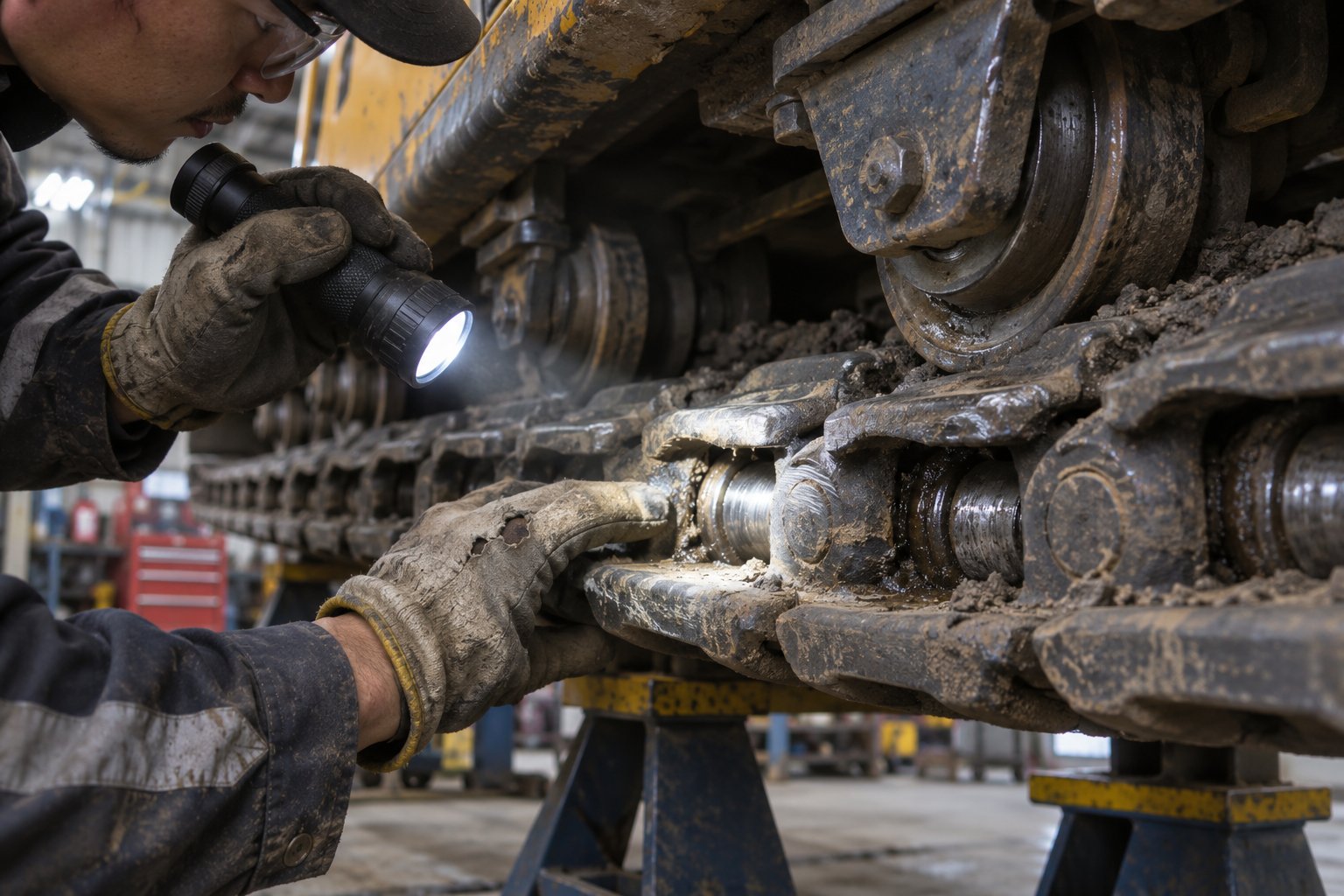
- Undercarriage replacement — On tracked machines, the undercarriage (tracks, rollers, idlers, sprockets) represents one of the single largest maintenance expenses over the machine's life. Depending on material conditions and hours, a full undercarriage rebuild on a mid-size excavator can run well into five figures.
- Resale value at disposition — The amount you recover when selling or trading in the machine offsets your total ownership cost. Well-maintained units with complete service records and moderate hours — particularly from brands like Caterpillar and Komatsu — hold 10-15% more value at disposal than comparable machines with spotty documentation.
Thinking of TCO as one number rather than a series of isolated expenses changes purchasing behavior. A used excavator for sale at a bargain price but carrying deferred maintenance, worn undercarriage components, and no service records could easily cost more over a five-year ownership cycle than a higher-priced unit — whether new or used — that arrives in verified condition with documented care. The excavadora that looks cheapest on day one isn't always cheapest on day 1,825.
Warranty and Support Differences
Buy new and you'll typically receive a manufacturer warranty covering major components — engine, hydraulics, powertrain — for a defined period or hour threshold. Dealer support programs often bundle scheduled maintenance packages, priority service scheduling, telematics monitoring, and discounted parts pricing during the warranty window. For fleet managers running multiple machines on tight project timelines, that safety net translates directly into predictable uptime and budgetable repair costs.
Used equipment tells a different story. Machines sold through private sellers or auctions almost always change hands as-is, with no warranty protection whatsoever. Some authorized dealers offer limited certified pre-owned warranties on inspected trade-ins, but coverage tends to be shorter and narrower than new-machine programs. The practical effect? Inspection responsibility shifts squarely onto the buyer. Every component that a new-machine warranty would cover — hydraulic pumps, final drives, engine internals — becomes your financial exposure the moment you sign the bill of sale.
This doesn't make used equipment a bad choice. It makes thorough pre-purchase inspection a requirement, not a suggestion. Buyers who treat inspection costs as part of the acquisition budget — rather than an optional expense — consistently avoid the five-figure repair surprises that turn a "good deal" into a regret.
When New Makes More Financial Sense
Despite the depreciation advantage of buying used, several real-world scenarios tilt the decision toward new iron:
- High-utilization fleets needing predictable uptime — When a machine runs 1,500 to 2,000+ hours annually on revenue-generating projects, unplanned downtime is devastatingly expensive. A new excavator backed by full warranty and dealer support minimizes that risk during the highest-utilization years.
- Telematics and technology requirements — Modern job sites increasingly demand integrated GPS machine control, remote monitoring, and automated grading systems. Retrofitting older machines is possible but often costly and limited compared to factory-integrated solutions.
- Emissions compliance — Tier 4 Final (or Stage V in international markets) emissions standards govern where machines can legally operate. Older units manufactured before these standards may face restrictions in certain regions or be ineligible for government-funded infrastructure contracts.
- Favorable financing terms — Manufacturers and dealers frequently offer promotional interest rates, extended repayment periods, or bundled service packages on new equipment. Financing research confirms that new-machine loans generally qualify for lower rates and longer terms compared to used-equipment financing, where lenders perceive higher risk and may require independent appraisals before approval.
- Full customization — Ordering new lets you specify boom length, auxiliary hydraulic circuits, cab configuration, and attachment packages from the factory. Used machines come as-configured, and post-purchase modifications add cost and complexity.
New vs Used Excavators — Side-by-Side Comparison
| Dimension | New Excavator | Used Excavator |
|---|---|---|
| Upfront Cost | Higher — full manufacturer list price plus dealer markup and optional packages | Lower — typically 25-50% below equivalent new pricing depending on age, hours, and condition |
| Depreciation Rate | Steepest in years 1-3 (15-20% in year one, 8-10% annually through year five) | Flatter curve — most dramatic depreciation already absorbed by previous owner |
| Warranty Coverage | Full manufacturer warranty; dealer support programs and priority service common | Limited or none; certified pre-owned programs available through select dealers |
| Financing Availability | Broader options — OEM promotional rates, longer terms, bundled service packages | Available but often at higher interest rates and shorter repayment periods |
| Customization Options | Factory-configured to buyer specifications (boom, hydraulics, cab, attachments) | As-configured; modifications possible but add cost and may void remaining coverage |
| Technology / Emissions | Latest telematics, GPS, fuel-efficient engines, and current emissions compliance | Varies by model year; older units may lack telematics or fall below current emission standards |
| Inspection Burden | Minimal — manufacturer quality assurance and warranty backstop | High — buyer responsible for verifying mechanical condition, hours, and service history |
Neither column wins across the board, and that's exactly the point. The right choice depends on your utilization rate, project pipeline, cash position, and appetite for inspection risk. A landscaper running a compact machine 600 hours a year on residential jobs may find a well-maintained three-year-old unit with service records to be the smartest dollar-for-dollar investment. A heavy civil contractor logging 2,000 hours annually on DOT-funded highway projects may need the warranty coverage, emissions compliance, and financing advantages that only new iron provides.
Whichever direction the math points you, one thing remains constant: the condition of a used machine determines whether you captured a smart depreciation discount or inherited someone else's deferred maintenance bill. Knowing how to assess that condition — starting with what hour-meter readings actually mean — separates buyers who save thousands from those who lose them.
Understanding Excavator Hours and Condition Assessment
You've narrowed down the size class. You've decided whether new or used fits your budget and utilization plan. The listing looks promising — the excavator price seems reasonable, the photos are clean, and the seller sounds confident. But here's the question that separates a smart acquisition from a five-figure mistake: what kind of shape is this machine actually in? Hours and condition assessment are the two pillars of used equipment evaluation, and getting them wrong is how buyers lose thousands on machines that looked like bargains on screen.
What Hour Meter Readings Actually Tell You
Think of an hour meter like an odometer on a truck — it gives you a starting point, not a verdict. The number on the display tells you how long the engine has run, but it says nothing about how hard the machine worked, what materials it dug through, or whether anyone bothered with oil changes along the way.
That said, hour ranges do establish useful baselines. Industry benchmarks break used excavator hours into general tiers:
| Hour Range | General Condition Indicator | Typical Price Impact |
|---|---|---|
| Under 3,000 | Lightly used — substantial life remaining | Commands a premium |
| 3,000 - 6,000 | Broken in but far from worn — often the value sweet spot | Best balance of price and remaining life |
| 6,000 - 10,000 | Higher hours — condition matters more than the number itself | Priced lower; thorough inspection essential |
| Over 10,000 | High-hour machine — major component work likely needed or already done | Buy only with strong service records |
For used mini excavators for sale, the industry commonly treats 6,000 to 8,000 hours as the high end of the comfort zone. Compact machines run smaller engines and lighter-duty hydraulic systems, which means major component replacements — hydraulic pumps, final drives, engine overhauls — tend to surface earlier in the hour count than they would on heavier iron. A mini excavator approaching 8,000 hours without documented pump or track motor service deserves serious scrutiny before you commit.
Larger machines are engineered differently. A 30-ton excavator built for quarry loading carries heavier-duty components designed to absorb more punishment over more hours. Units in this class routinely operate past 10,000 or even 15,000 hours before requiring major rebuilds — but when those rebuilds arrive, the price tag scales with the machine. An engine overhaul on a 45-ton excavator can easily cost several times what the same work runs on a compact unit. Higher hour tolerance doesn't mean lower financial risk; it means the risk shifts from frequency to magnitude.
Here's the critical caution: hour meters can be tampered with, replaced, or simply misread. A meter housing that looks newer than the rest of the dash, shows adhesive residue around its edges, or has mismatched screws may have been swapped. Replacement isn't always fraudulent — meters do fail legitimately — but a replaced meter means the displayed hours no longer reflect the machine's full history. Cross-referencing the reading against service stickers, oil change records, and decal dates is the only reliable way to verify accuracy. If a maintenance log from 18 months ago shows 4,200 hours and the current meter reads 3,800, that's not a discount — that's a red flag.
On newer machines equipped with electronic engine control modules, a dealer or qualified technician can pull stored operating data directly from the engine's memory, independent of the dash-mounted meter. This data is significantly harder to manipulate and provides a trustworthy second opinion on true accumulated hours. For any machine where the excavator price justifies the cost — and on units above the compact class, it almost always does — requesting an electronic hour verification before purchase is a straightforward way to protect yourself.
Undercarriage, Hydraulics, and Structural Inspection Points
The meter gives you a number. Your eyes and hands give you the truth. Even a verified low-hour machine can carry hidden damage from abrasive ground conditions, deferred maintenance, or hard use. Walk through this inspection sequence before signing anything:
- Undercarriage wear — tracks, rollers, idlers, and sprockets. This is the single most expensive wear item on any tracked excavator. Heavily worn track pads, cracked rollers, or sprockets with hooked teeth signal thousands of dollars in deferred replacement costs. A measurement of undercarriage wear percentage — which many inspectors can provide — offers an independent usage estimate you can compare against the hour meter. Significant undercarriage wear on a machine reporting low hours warrants immediate skepticism.
- Hydraulic cylinder condition and hose integrity. Extend and retract every cylinder — boom, stick, and bucket — fully and slowly. Movements should feel smooth, powerful, and consistent. Jerky motion, whining sounds, slow response, or weak digging force can point to failing pumps, worn valve spools, or internal cylinder leaks. Inspect all visible hoses for cracking, abrasion, bulging, or weeping fittings. Even minor hydraulic leaks become major bills when left unaddressed.
- Boom and stick pin and bushing play. Grab the bucket with the machine's arm fully extended and try to move it laterally. Excessive play — any visible slop in the linkage — indicates worn pins and bushings from extended digging hours. This wear correlates fairly predictably with actual use, so a machine reading 2,000 hours should not have heavily worn boom pins or polished-smooth pivot points.
- Swing bearing smoothness. Swing the upper structure slowly through a full rotation. Listen for grinding, popping, or uneven resistance. A failing swing bearing is one of the most expensive single components to replace on an excavator, and early symptoms are easy to detect if you know to check.
- Engine oil analysis results, if available. An oil sample tells you what's happening inside the engine at a microscopic level — elevated metal particles, coolant contamination, or fuel dilution all reveal problems before they become catastrophic failures. If the seller can provide a recent oil analysis report, review it carefully. If they can't, consider commissioning one yourself before finalizing the purchase.
- Cabin controls and electronics function. Start the machine cold if possible — a healthy diesel should crank quickly, settle into a smooth idle, and produce minimal smoke. Test every joystick function, verify that gauges and warning lights respond correctly, check the HVAC system, and confirm that any installed telematics or GPS modules are operational. Electrical gremlins are time-consuming and expensive to chase down after the sale.
Browsing used excavators for sale and found a listing priced well below market? That bargain could be genuine — a motivated seller, an estate liquidation, an aging fleet unit cycling out. Or it could be a machine with one or more of these issues buried beneath a fresh coat of paint. The inspection sequence above takes less than an hour and costs nothing but your attention. Skipping it to save time is the most expensive shortcut in heavy equipment purchasing.
For buyers hunting an excavator for sale under $10,000, this discipline is even more critical. Machines at that price point are typically high-hour compact units or older mid-size models where deferred maintenance is common. A thorough hands-on inspection — not just photos and a phone call — is the only thing standing between a working tool and an expensive lawn ornament.
Maintenance Records as a Deal Maker or Breaker
Two machines can sit at identical hours with entirely different futures ahead of them. The difference? Documentation. An 8,000-hour excavator backed by a full binder of service records — regular oil changes, hydraulic fluid service, filter replacements, and component rebuild receipts — is often a safer buy than a 4,000-hour unit with no maintenance history at all. Documented care proves someone invested in the machine's longevity. A blank history proves nothing, and in the used equipment world, silence is rarely reassuring.
Here's what to look for in a complete service record:
- Consistent oil and filter change intervals aligned with the manufacturer's recommended schedule
- Hydraulic fluid service documentation showing fluid type, quantity, and frequency
- Undercarriage inspection notes with wear measurements at regular intervals
- Major component work — pump rebuilds, track motor replacements, final drive service — with parts receipts and shop details
- Warranty claim records that indicate whether the machine experienced issues during its coverage period
Missing records don't automatically mean the machine was neglected — some owners simply don't keep paperwork. But absence of documentation should trigger deeper mechanical scrutiny and, at minimum, a price adjustment that accounts for the unknown risk you're absorbing. If a seller resists providing records or can't explain basic maintenance history, treat that reluctance as information in itself.
Rental fleet machines deserve a special mention here. Well-managed rental companies typically cycle excavators out at 1,500 to 3,000 hours — not because the equipment is worn out, but to refresh inventory and protect resale value. These units often come with complete, dealer-documented service records and represent some of the best values on the used market. Low hours alone don't guarantee quality, so inspect rental units the same way you'd inspect any other machine, but don't write them off automatically based on their origin.
A verifiable maintenance history is worth more than a low hour meter reading. Records prove care; hours only prove time.
Condition assessment gives you the mechanical picture. But mechanical soundness is only half the equation — the other half involves spotting the warning signs that indicate a seller may be hiding problems you haven't found yet. That's where red flags come in, and the next section covers every one worth watching for.
Red Flags When Buying a Used Excavator
A solid inspection tells you what's wrong with a machine. Red flags tell you what someone doesn't want you to find. The difference matters because mechanical wear is negotiable — deception is not. Whether you're evaluating small excavators for sale on a local classifieds page or reviewing a fleet of track hoes for sale through an online marketplace, these warning signs should stop you from reaching for your checkbook until every question has a satisfactory answer.
Warning Signs That Should Stop a Purchase
Some red flags are subtle. Others practically shout. Either way, each one on this list has cost real buyers real money — often tens of thousands of dollars on a single piece of earth moving equipment that looked like a bargain right up until it didn't.
- Freshly painted machines with no clear explanation. A new coat of paint on a working excavator should raise your antenna immediately. Paint hides cracks, corrosion, weld repairs, and structural fatigue marks that would otherwise be visible during a walkaround. Legitimate sellers repaint machines occasionally, but they can explain when and why. A seller who can't — or deflects with vague answers — may be concealing damage that would kill the deal under honest lighting.
- Hour meters that don't match wear patterns. You read the meter and it says 2,500 hours. Then you look at the pedal rubber — worn smooth. The seat foam is compressed flat. The joystick grips are polished shiny from thousands of hours of use. These physical clues accumulate predictably over a machine's working life, and they're far harder to fake than a meter display. When the number on the screen contradicts the wear you can see and touch, trust the wear.
- Missing or incomplete maintenance logs. As covered in the previous section, documentation is a powerful trust signal. Its absence is an equally powerful warning. A bucket excavator that's been properly cared for has paperwork to prove it — or at minimum, a seller who can walk you through the maintenance timeline from memory and point to the shops that performed the work.
- Unusual undercarriage wear patterns. Tracks, rollers, and sprockets wear differently depending on the material the machine has worked in. Machines that spent years in sand, coral, salt marshes, or demolition debris show accelerated and uneven wear that looks distinctly different from normal soil excavation. Heavily cupped rollers, prematurely worn sprocket teeth, or pitted track links suggest the machine lived in abrasive or corrosive conditions — conditions that affect far more than just the undercarriage.
- Hydraulic leaks visible after a warm-up cycle. Cold machines can hide marginal hydraulic seals. Run the excavator through a full warm-up — cycle every function, swing the house, travel forward and back — then shut it down and look underneath. Fresh puddles or wet streaks on cylinders, hoses, or fittings reveal problems that static photos and cold-start demonstrations conveniently omit.
- Reluctance to allow an independent inspection. This is the single biggest red flag on the list. A seller with nothing to hide welcomes third-party scrutiny because it closes deals faster. A seller who resists, deflects, or creates urgency to skip the inspection is protecting something — and it isn't your interests. As fraud prevention experts emphasize, treating an inspection refusal as an automatic dealbreaker eliminates the majority of bad purchases before they happen.
How to Verify Authenticity and Ownership
Mechanical red flags are one category of risk. Ownership and identity fraud are another — and they can leave you holding a machine you don't legally own, with no recourse to recover your money.
Start with the serial number plate, sometimes called the PIN (Product Identification Number). Every excavator carries a manufacturer-stamped plate — typically on the frame or boom — that encodes the machine's make, model, production details, and unique serial number. Check this plate carefully. Red flags include plates that appear repositioned, show fresh rivets or adhesive, carry stamping inconsistencies, or display numbers that don't match the decals or component markings elsewhere on the machine. A dealer for the brand in question can verify whether the serial number corresponds to the model sitting in front of you.
Beyond the plate, verify ownership and financial encumbrances:
- Title or bill of sale. Confirm the seller's name matches the ownership documents. A machine titled to a different person or business entity should trigger immediate questions about authorization to sell.
- Lien-free status. Excavators and other untitled equipment can carry UCC liens filed by lenders against the seller's name. A UCC search in the seller's state of organization reveals active financing statements. Under the Uniform Commercial Code, a lender's security interest generally follows the equipment after a private sale unless the lien has been formally released — meaning you could pay in full and still face a lender's claim on your machine.
- Theft databases. The National Equipment Register (NER), now part of Verisk, offers an IRONcheck report that searches more than 20 million theft and ownership records using the machine's PIN. For any purchase above a nominal dollar threshold, this search is a small expense relative to the risk it mitigates.
International buyers face an additional layer of complexity. Equipment exported from one country is not necessarily manufactured by a brand headquartered there. A machine shipped from Japan might carry a European or American brand, or vice versa. Before committing capital, confirm the original manufacturer, exact model specifications, and — critically — parts and service availability in the region where the machine will operate. Buying a premium-brand excavator means little if replacement components take months to arrive at your job site.
A thorough pre-purchase inspection costs a fraction of a major repair bill. Never skip it, regardless of how good the deal appears.
Knowing what to look for protects you. Knowing where to look — which purchasing channels offer the strongest safeguards and which ones leave you exposed — determines how much protection the process itself provides before your own due diligence even begins.
Where to Buy an Excavator
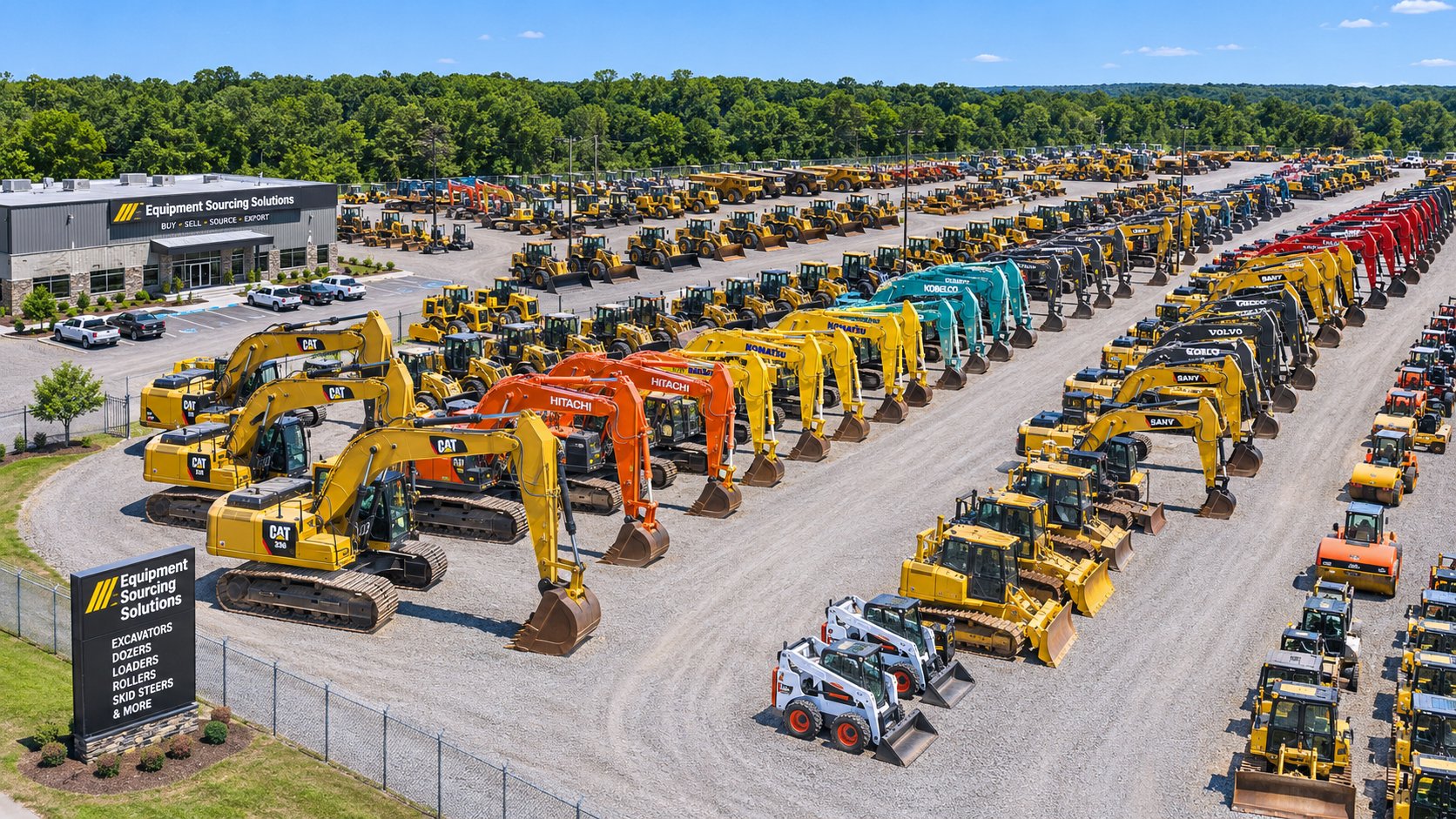
You've identified the right size class, settled the new-versus-used question, learned how to read hours and condition, and memorized the red flags that expose bad deals. All that preparation funnels into one practical decision: where do you actually buy the machine? The sourcing channel you choose affects price, inspection access, warranty coverage, financing flexibility, and after-sale support — sometimes dramatically. Yet most buyers default to whatever marketplace they stumble across first, without understanding how each channel's structure shapes their risk.
Five primary channels serve the excavator market today. Each one favors a different buyer profile, and none is universally superior. Here's how they compare.
Equipment Auctions and Online Marketplaces
Live and online auctions remain one of the most popular routes for buyers chasing competitive pricing. Platforms like Ritchie Bros., IronPlanet, and BigIron Auctions aggregate hundreds of machines — everything from compact units to full-size track hoes — into single-event catalogs where bidding drives the final price. The appeal is straightforward: auction dynamics can push prices below private-market averages, especially for machines that attract fewer bidders due to location, configuration, or cosmetic condition.
The tradeoff is equally straightforward. Most auction sales are as-is, where-is, with no warranty and limited inspection windows. You might get 30 minutes to walk around a machine before bidding opens, or you might bid remotely based on photos and a condition report you can't independently verify. Industry analysis consistently highlights the core auction risk: a machine priced 30% below dealer quotes can quietly become the most expensive purchase you've ever made if it hides a failing swing bearing or a tampered hour meter. The money you saved at hammer-drop evaporates the first time the machine sits idle waiting for parts.
Auctions work best for experienced buyers who can inspect confidently under time pressure, have transport logistics ready, and maintain enough cash reserves to absorb an unexpected repair. For first-time buyers or anyone without in-house mechanical expertise, the as-is model introduces risk that often outweighs the price advantage.
Authorized Dealers vs Private Sellers
Stepping away from the auction floor, the two traditional purchasing paths — authorized equipment dealers and private sellers — present a classic convenience-versus-cost tradeoff.
Authorized dealers occupy the lower-risk end of the spectrum. A reputable dealer typically inspects incoming trade-ins and rental returns, performs necessary repairs, and provides documented machine histories. According to RDO Equipment Co., buying from a dealer's rental fleet is one of the strongest ways to eliminate unknowns because certified technicians service those machines on strict schedules, and every oil change and component replacement lands in a verifiable record. Beyond history transparency, dealers often facilitate equipment financing, offer limited warranties on certified pre-owned units, and provide after-sale support — parts sourcing, field service, and even trade-in programs when you're ready to upgrade.
The cost of those services shows up in the price. Dealer listings for a comparable machine will typically run higher than what you'd find through a private seller or auction. Whether that premium is worthwhile depends on how much you value risk reduction and post-purchase support relative to upfront savings.
Private sellers flip the equation. A contractor liquidating a machine, a retiring operator selling off equipment, or a small fleet cycling out older iron — these sellers often price aggressively because they want fast cash, not a long sales process. You might find a track hoe for sale from a private owner at 15-20% below dealer pricing for the same model and hour range.
The catch? You inherit all due diligence responsibility. Private sellers rarely provide warranties, financing options, or detailed service records — and their ultimate goal, as one industry expert puts it, is simply to sell. A private seller isn't concerned about whether the machine fits your operation, your financial situation, or your long-term fleet plans. If you know the seller personally and trust their account of the machine's history, private sales can deliver outstanding value. If you don't, you're betting your purchase on a stranger's honesty — and the previous chapter's red flags exist precisely because that bet doesn't always pay off.
Online Sourcing for Bulk and International Buyers
For equipment dealers scouting wholesale inventory, import buyers sourcing machines for overseas projects, or contractors purchasing multiple units at once, online platforms that aggregate inventory across brands and size classes have become essential. These platforms function differently from auction sites — instead of bidding against other buyers, you browse curated listings, request detailed specifications, and negotiate directly with the seller on price and terms before committing.
This model suits bulk and international purchasers particularly well. Imagine you're an equipment dealer in Southeast Asia looking for five mid-size excavators and three compact units across multiple brands. Visiting individual dealerships or attending scattered auctions across different countries would burn weeks and thousands in travel costs. An online aggregator lets you compare machines side by side, request model-specific quotes, and coordinate shipping logistics from a single interface. Platforms like JIUHONG's used excavator collection bring together compact and larger machines from multiple manufacturers, enabling contractors, dealers, and import buyers to evaluate options, compare excavator cost across models, and request quotes for individual or bulk purchases — all without leaving the office.
The broader shift toward online sourcing also benefits domestic buyers searching for a specific configuration. If you're looking for wheeled diggers or a particular long-reach model that local dealers don't stock, online marketplaces expand your reach beyond regional boundaries. The ability to compare pricing across sellers in different markets often reveals meaningful price differences for the same machine — differences that justify the added transport cost and still leave you ahead financially.
One practical note for anyone searching "excavator for sell" online: always confirm that the platform you're using verifies seller identities and provides clear communication channels. The convenience of remote purchasing introduces its own risks — misrepresented photos, inflated specifications, or outright fraud. Legitimate platforms address these concerns through seller verification processes, detailed listing requirements, and buyer-support systems that mediate disputes.
Purchasing Channel Comparison
The table below maps each sourcing channel against the factors that matter most to buyers. Use it as a decision filter based on your priorities — whether that's the lowest possible price, the strongest post-sale support, or the ability to purchase multiple machines in a single transaction.
| Channel | Price Competitiveness | Inspection Access | Warranty Likelihood | Financing Options | Bulk-Purchase Suitability |
|---|---|---|---|---|---|
| JIUHONG (Direct Online Source) | Competitive — direct pricing without auction markups; quote-based negotiation for volume orders | Detailed specs and photos provided per listing; buyers can request additional documentation before purchase | Varies by machine; discuss terms directly with the seller before committing | Facilitated for qualified buyers; terms negotiable on bulk orders | Strong — multi-brand inventory across size classes designed for fleet and import buyers |
| Equipment Auctions (Live & Online) | Potentially lowest prices, but bidding wars can push costs above market value on popular models | Limited — short preview windows at live events; remote auctions rely on third-party condition reports | None — virtually all sales are as-is with no warranty | Some platforms offer buyer financing; most require payment within days of purchase | Moderate — large catalogs available, but winning multiple lots requires significant bidding capital |
| Authorized Dealers | Higher upfront pricing reflects inspection, reconditioning, and support services included in the sale | Full — on-lot walkarounds, dealer-provided history, and certified inspection reports commonly available | Highest — certified pre-owned warranties and extended coverage plans often available | Strong — OEM-backed financing programs, lease-to-own, and bundled service packages | Limited — inventory tied to trade-ins and rental returns; specific models may not be available in quantity |
| Private Sellers | Often 15-20% below dealer pricing for comparable machines | Depends entirely on the seller's willingness; some welcome inspection, others resist | None — all sales final with no warranty or after-sale support | Minimal — buyer typically arranges third-party financing independently | Poor — private sellers rarely have multiple units available; each purchase is a separate negotiation |
| Online Marketplaces (Aggregators) | Varies by seller — marketplace competition can drive pricing down, but quality varies widely | Remote only in most cases — photos, descriptions, and third-party inspection reports where available | Rare — most listings are private or small-dealer inventory sold as-is | Some platforms integrate financing tools; availability depends on the specific marketplace | Moderate to strong — broad inventory pools, but coordination across multiple sellers adds complexity |
No single channel wins across every column, which is exactly why experienced buyers often work more than one simultaneously. A contractor might browse dealer inventory for a primary production machine — valuing warranty and service support — while scanning auction listings or online sources for a backup unit where a lower price justifies the added inspection responsibility. Equipment dealers building wholesale inventory might negotiate bulk quotes through a platform like JIUHONG while monitoring regional auctions for opportunistic additions.
The key takeaway isn't which channel is "best." It's understanding what each one gives you and what it asks you to accept in return. A track hoe for sale through a reputable dealer at a 20% premium might cost less over five years than the same machine won at auction with no service records and a mystery undercarriage. Conversely, a knowledgeable buyer who inspects thoroughly and negotiates well can extract tremendous value from private sales and online platforms that would overwhelm someone without that skill set.
Choosing the right channel gets the machine to your yard. But for buyers still weighing whether purchasing makes financial sense at all — versus renting for specific projects — the math involves a different set of variables entirely, ones that hinge on utilization hours, project timelines, and ownership costs that extend well beyond the purchase price.
Rent vs Buy
Here's a question many buyers quietly ask themselves while browsing every excavator for sale near me listing they can find: should I even be buying at all? It's a fair question — and skipping it has drained more contractor bank accounts than any single mechanical failure. The rent-versus-buy decision isn't a philosophical debate. It's a math problem, and the answer lives in one number: your projected annual utilization.
When Renting Beats Buying
Imagine you need a hydraulic excavator for a six-week drainage project, then nothing for three months, then maybe a two-week pool dig. That's roughly 400 to 500 hours of work spread unevenly across the year. Buying a machine for that usage pattern means paying insurance, storage, maintenance, and depreciation on an asset that sits idle more often than it earns. The ownership costs don't pause when the machine does.
Cost analysis from FieldFix illustrates the point sharply: a mid-size excavator purchased at $120,000 carries an estimated first-year ownership cost of $52,000 to $60,000 when you factor in loan payments, insurance, maintenance reserves, storage, and depreciation. Run that machine only 500 hours and you're looking at $104 to $120 per operating hour — a figure that makes weekly rental rates look modest by comparison. Typical 2026 rental rates for a mid-size excavator (12 to 20 tons) range from $500 to $900 per day, $1,600 to $3,000 per week, and $5,000 to $9,000 per month. If you're wondering how much is a mini excavator to rent, compact units (3 to 6 tons) run considerably less — roughly $250 to $450 daily or $2,500 to $4,500 monthly.
Renting also transfers component-failure risk to the rental house, preserves working capital for labor and materials, and avoids the disposal headache when you no longer need the machine. For new businesses without enough project history to predict utilization, Cleveland Brothers recommends renting during the first one to two years until consistent demand is proven.
When Purchasing Is the Clear Winner
Flip the utilization dial past a certain threshold and the economics reverse completely. A contractor running an excavator 1,000 hours per year drops that same $120,000 machine's true cost to roughly $52 to $60 per hour. Push utilization to 1,500 hours and the figure falls to $35 to $40 per hour — well below cumulative rental costs for the same usage. Multi-year project pipelines, steady weekly utilization, and the ability to generate rental income from your own equipment during idle windows all strengthen the case for ownership.
Published break-even thresholds from CMiC and industry dealers cluster between 60 and 70 percent of available working hours — roughly 150 to 180 working days or 800 to 1,250 hours annually. Above that band, ownership economics generally hold. Below it, you're subsidizing a parked asset.
Before committing, run through this simple decision framework:
- Estimate annual utilization hours — base the projection on signed contracts and historical backlog, not optimistic forecasts. Most operators overestimate future use.
- Calculate cumulative rental cost over your expected project horizon, including delivery fees, damage waivers, and fuel (typically 10 to 15 percent on top of base rates).
- Calculate total ownership cost for the same period — purchase price or financing payments, insurance ($1,200 to $4,000 per year), maintenance (5 to 10 percent of purchase price annually), storage, and depreciation.
- Compare cost per operating hour for both scenarios. If ownership delivers a meaningfully lower hourly rate at your realistic utilization level, buying wins.
- Factor in resale value at the end of your planned ownership period. Well-maintained machines from strong brands recover a meaningful portion of their original cost, further reducing net ownership expense.
- Account for tax advantages — Section 179 deductions allow qualifying businesses to deduct the full purchase price (up to $1,220,000) in the year of acquisition. For a contractor in the 24 percent federal bracket, that deduction on an $85,000 machine saves roughly $20,400 in year-one taxes — a meaningful shift in the break-even calculation.
Buyers scanning excavators for sale near me listings with a clear utilization picture in hand are already ahead of those who buy on impulse and discover the carrying costs later.
The Hybrid Approach
Most successful contractors don't commit entirely to one strategy. They own a core fleet of machines that run daily — often an excavator and a skid steer — and rent specialty equipment on a project basis. A CMiC analysis of civil contractor fleets reinforces this model: own the production core where utilization justifies it, rent or finance the variable band, and rerun the ratio annually against signed backlog and trailing utilization data.
Long-reach excavators, spider configurations, and oversized machines needed for a single project phase are prime rental candidates because their utilization rarely justifies full-time ownership for a general excavation contractor. A Midwest excavation company profiled by FieldFix discovered that one of its three owned excavators ran only 650 hours per year — translating to $71 per hour in true ownership cost. Selling that unit, renting as needed, and reinvesting the freed capital saved the company over $8,000 annually while eliminating idle-asset drag on their balance sheet.
Rent-to-own programs offer yet another middle path. Many rental companies credit a percentage of your payments toward the purchase price if you decide to convert. This lets you build real utilization data before committing long-term capital — essentially test-driving the economics before signing a five-year loan.
Whether you rent, buy, or blend the two, the decision only holds up if the logistics behind it — financing terms, transport planning, and a disciplined pre-purchase workflow — are locked down before the machine arrives. Those final steps are where the entire buying process either comes together or quietly falls apart.
Financing, Transport, and Your Complete Buying Checklist
You've done the hard work — matched the right size class to your jobs, weighed new against used, learned how to read hours and spot red flags, compared sourcing channels, and run the rent-versus-buy math. All of that preparation collapses into nothing if the final logistics — how you pay for the machine and how you physically get it to your yard — aren't handled with the same discipline. These last-mile details are where buyers who did everything else right still manage to lose thousands in avoidable costs, delays, and financing missteps.
Financing and Payment Options
How much does an excavator cost in total? The honest answer includes not just the sticker price but also the financing structure wrapped around it. The wrong loan terms can quietly add five figures to your final expenditure over the life of the machine.
Three primary financing paths cover the vast majority of used heavy equipment and new machine purchases:
- Equipment loans. The most straightforward option. A lender provides capital to purchase the machine, and the excavator itself serves as collateral until the loan is repaid. J.P. Morgan notes that equipment loans typically extend up to seven years depending on asset value, and once repaid, the lender removes the lien and you own the machine outright. Down payments vary but are common, especially for used equipment where lenders perceive higher risk. Interest rates depend on creditworthiness, loan term, and the age of the machine — newer units generally qualify for lower rates.
- Lease-to-own arrangements. Under a lease, the financing company retains ownership while you make scheduled payments and operate the machine. At the end of the lease term, you typically have the option to purchase the equipment at a predetermined residual value, return it, or extend the lease. This structure works well for buyers who want to preserve working capital upfront or who aren't certain they'll need the machine beyond the lease horizon. As equipment financing specialists point out, leasing is particularly attractive when the asset may become outdated before the term ends — though that's more relevant to technology-driven equipment than to a hydraulic digger built to move dirt for decades.
- Cash purchase. Paying outright eliminates interest expense entirely and gives you maximum negotiating leverage, but it locks up working capital that could otherwise fund payroll, materials, or additional fleet assets. For smaller purchases — say, a compact excavator under $30,000 — cash makes straightforward sense if reserves allow it. For six-figure machines, most buyers find that the opportunity cost of tying up that much capital outweighs the interest savings.
One critical variable buyers often overlook: financing availability changes dramatically depending on the purchasing channel. Authorized dealers and established online platforms typically facilitate lending through OEM-backed programs or lending partners, with streamlined applications and pre-negotiated rate structures. Private sellers offer none of that infrastructure — you'll need to arrange third-party financing independently, which means additional appraisals, longer approval timelines, and potentially higher rates because the lender can't lean on a dealer relationship for risk comfort.
Credit history plays the predictable role here. Strong business credit and a track record of equipment loan repayment unlock the best terms. Newer businesses or buyers with limited credit history may face higher down-payment requirements or need to provide personal guarantees. If your credit profile is still developing, leasing often provides a more accessible entry point than a traditional loan because the lessor retains ownership as built-in security.
Transport Planning
Transport is the expense that blindsides buyers more often than any mechanical surprise. You find the perfect machine — great hours, clean records, fair price — and then discover that getting it from the seller's lot to your job site costs $3,000 to $8,000 or more, depending on distance and machine size. Suddenly that carefully calculated total cost of ownership has a line item you never budgeted for.
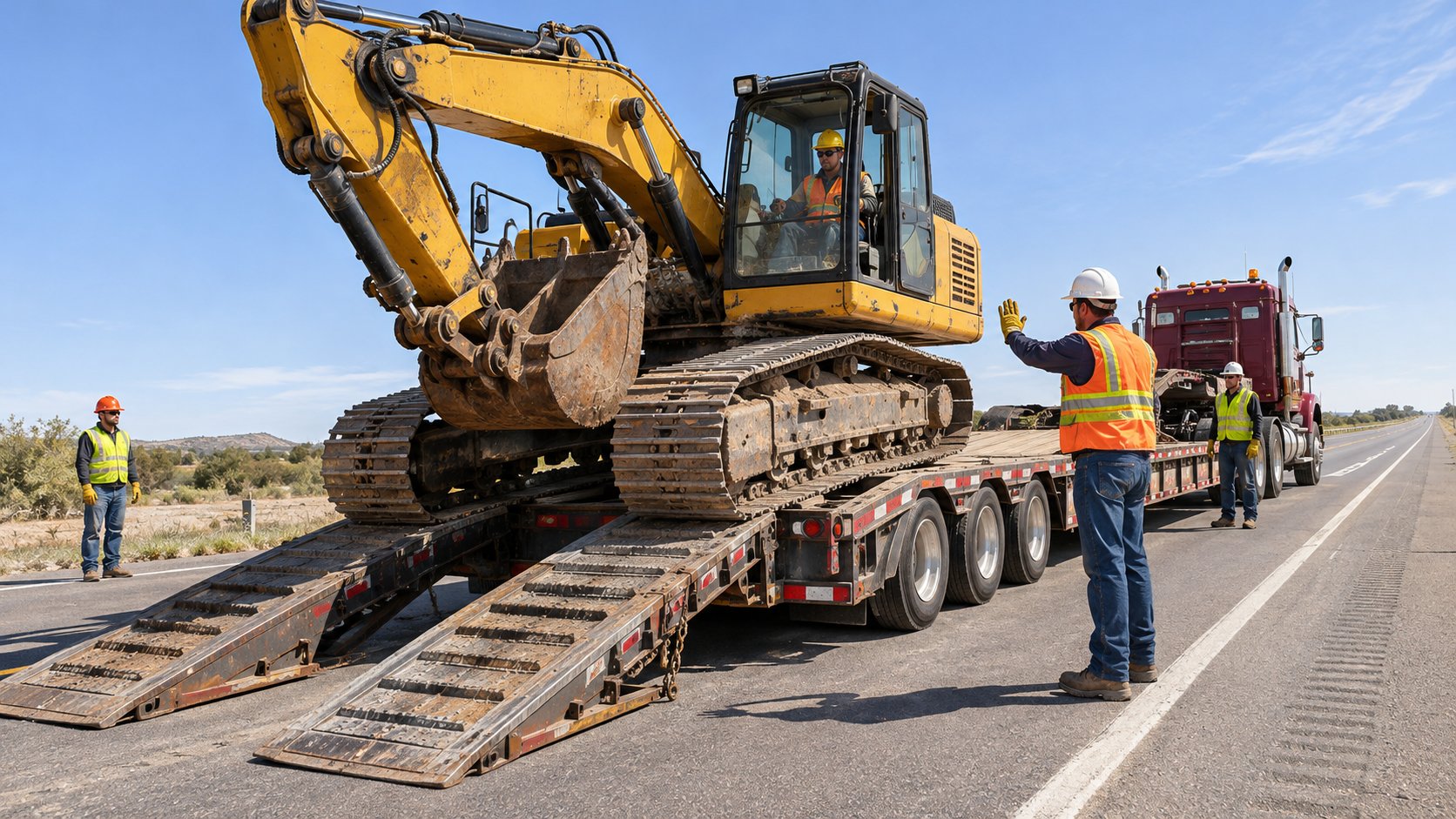
The variables that drive transport cost scale directly with machine weight and dimensions. According to transport specialists, a compact excavator weighing 6,000 to 10,000 pounds can ride on a standard flatbed trailer pulled by a capable pickup — an inexpensive, owner-managed move. Step up to a mid-size machine in the 20-ton range and you need a lowboy trailer with an 18-to-24-inch deck height to stay within the standard 13-foot-6-inch interstate height limit. Large excavators pushing 50,000 to 100,000 pounds require multi-axle RGN (removable gooseneck) trailers to comply with federal bridge weight formulas.
Beyond the trailer itself, three additional cost layers apply to larger machines:
- Oversize load permits. Any load exceeding 80,000 pounds gross vehicle weight, 8 feet 6 inches in width, or 13 feet 6 inches in height requires state-issued oversize permits. Permits are issued at the state level — a multi-state haul requires separate permits from every state along the route, and requirements don't necessarily align across borders. Fees range from a few hundred dollars for a single-state move to several thousand for long-distance, multi-state hauls.
- Escort vehicles. Loads wider than 12 feet generally require at least one pilot car; loads exceeding 14 feet typically need two — one leading, one following. Police escorts may also be required through urban corridors or across major bridges. These costs add up quickly and must be built into the project budget and timeline.
- Scheduling restrictions. Most states prohibit oversize loads from traveling at night, during peak traffic hours, or on holiday weekends. A haul that looks like a one-day trip on paper can stretch to two or three days once permit windows, escort coordination, and travel-hour restrictions are factored in.
For anyone searching excavator sale near me, proximity carries genuine financial weight. A machine located 50 miles away on a flatbed trailer costs a fraction of what the same model costs to ship 800 miles on a lowboy with escort requirements. When comparing two otherwise similar listings, always add the delivered cost — not just the purchase price — to your comparison spreadsheet. The cheaper machine three states away may not be cheaper at all once transport closes the gap.
Your Pre-Purchase Action Checklist
Every section of this guide distills into a single workflow. Whether you're buying your first compact unit or adding the fifth machine to a growing fleet, this checklist keeps the process disciplined and prevents the kind of shortcuts that cost buyers thousands. Treat it as a sequential gate — each step should be completed before advancing to the next.
- Define job requirements and select the appropriate size class. Base the decision on the work you perform most frequently, not the largest project you might occasionally take on. Confirm dig depth, material type, site access constraints, and attachment needs before filtering any listing.
- Decide used versus new based on budget and utilization. High-utilization operations with multi-year project pipelines may justify new iron for warranty and financing advantages. Moderate-utilization buyers typically find the strongest value in lightly used machines that have already absorbed peak depreciation.
- Research market pricing for the target model. How much does an excavator cost for the specific make, model, year, and hour range you're targeting? Check multiple sources — dealer listings, auction results, and online platforms — to establish a realistic price band before entering any negotiation.
- Identify sourcing channels and compare listings. Work more than one channel simultaneously. Browse dealer inventories for warranty-backed options, monitor auctions for opportunistic pricing, and evaluate online platforms that aggregate multi-brand inventory. For buyers evaluating bulk or import purchases, JIUHONG's excavator collection provides a practical starting point for comparing used listings across compact and larger size classes, requesting model-specific quotes, and coordinating volume orders from a single source.
- Conduct or commission a thorough inspection. Walk through the full inspection sequence — undercarriage, hydraulics, structural pins and bushings, swing bearing, engine oil analysis, and cabin electronics. If you lack the expertise, hire a qualified third-party inspector. The cost is trivial relative to the risk it eliminates.
- Verify ownership and serial numbers. Check the serial number plate against manufacturer records, confirm clear title or lien-free status through a UCC search, and run the machine's PIN through a theft database like IRONcheck. Skip this step and you risk paying for a machine you may never legally own.
- Negotiate price using inspection findings. Every deficiency found during inspection — worn undercarriage, missing service records, hydraulic seepage, mismatched hour readings — is a documented reason to adjust the asking price downward. Sellers expect negotiation; buyers who show up with specific findings negotiate from a position of strength.
- Arrange financing and confirm transport logistics. Lock in loan or lease terms before finalizing the purchase, and get a transport quote — including permits and escorts if applicable — so the total delivered cost is clear before you sign. Financing through the same channel that sells the machine often streamlines the process, but compare rates against independent lenders to ensure competitiveness.
- Schedule initial maintenance and fluid analysis upon delivery. Even on a machine that inspected well, the first thing you should do after taking possession is change all fluids, replace filters, and commission an oil analysis baseline. This establishes your ownership starting point and catches anything the pre-purchase inspection may have missed at a superficial level. From this moment forward, every maintenance event goes into your own records — building the documentation trail that protects resale value years down the line.
Buying an excavator — whether it's a single compact hydraulic digger for a landscaping startup or a fleet of mid-size machines for an infrastructure contractor — is one of the highest-stakes equipment decisions most operators will make. The market for used heavy equipment rewards buyers who approach it with preparation, patience, and a clear-eyed understanding of what every machine, every channel, and every financing structure actually costs over the full ownership cycle. Rush the process, skip the inspection, or ignore transport logistics, and you'll join the long list of buyers who learned those lessons the expensive way.
The best deal on an excavator isn't the lowest price — it's the lowest total cost of ownership, delivered to your site, verified by your inspection, and backed by documentation you can trust.
Excavator after excavator lands on listing pages every day. The buyers who come out ahead aren't the ones who click fastest — they're the ones who followed a checklist like this one before they clicked at all.
Frequently Asked Questions About Buying an Excavator
1. How much does a used excavator cost?
Used excavator pricing depends on size class, brand, age, hours, and condition. Compact mini excavators under 6 tons can start below $20,000 on the resale market, while mid-size units (6-25 tons) typically fall in the mid-range bracket, and large machines over 25 tons can exceed $300,000. Lightly used machines between three and six years old with documented maintenance often represent the best value because they have already absorbed their steepest depreciation — roughly 25-35% of the original price — while retaining years of productive life. Always compare delivered cost, not just sticker price, since transport fees for larger machines can add thousands to the final number.
2. How many hours is too many on a used excavator?
There is no single cutoff, but general industry benchmarks help frame the decision. For mini excavators, 6,000 to 8,000 hours is considered the upper comfort zone before major hydraulic pump or final drive work becomes likely. Larger machines with heavier-duty components can operate past 10,000 or even 15,000 hours before major rebuilds, though those rebuilds carry significantly higher price tags. The hour reading alone is not enough — cross-reference it with maintenance records, undercarriage wear, and physical wear patterns on pedals, seats, and joystick grips. A well-documented 8,000-hour machine can be a safer purchase than an undocumented unit showing 4,000 hours.
3. Should I buy a new or used excavator?
The answer hinges on your annual utilization, project pipeline, and risk tolerance. Used machines offer a strong value proposition because they have already absorbed peak depreciation — often 15-20% in year one alone — letting the second owner benefit from a flatter depreciation curve. However, new excavators provide full manufacturer warranties, current emissions compliance, factory-integrated telematics, and more favorable financing terms. High-utilization fleets logging 1,500+ hours per year often justify new iron for predictable uptime, while moderate-use operators running 600-1,000 hours annually typically find the best return in a well-maintained used unit with verified service records.
4. What should I inspect before buying a used excavator?
A thorough pre-purchase inspection covers six critical areas in sequence: undercarriage wear on tracks, rollers, idlers, and sprockets; hydraulic cylinder condition and hose integrity during full extension and retraction; boom and stick pin and bushing play checked by attempting lateral movement at full reach; swing bearing smoothness through a complete rotation while listening for grinding or popping; engine oil analysis results to detect internal wear particles or contamination; and cabin controls, electronics, gauges, and HVAC function during a cold start. Also verify that the hour meter reading matches physical wear patterns and that the serial number plate has not been tampered with. Platforms like JIUHONG (jiuhong-machinery.com/products/excavators/) provide detailed specs and photos per listing, but an on-site or third-party inspection remains essential before finalizing any purchase.
5. Is it better to rent or buy an excavator?
The break-even point typically falls between 60-70% of available working hours — roughly 800 to 1,250 hours annually. Below that threshold, renting avoids insurance, storage, maintenance, and depreciation costs on an underutilized asset. Above it, ownership drives your per-hour cost well below cumulative rental rates and lets you build equity in a depreciating but still valuable asset. Many successful contractors use a hybrid approach: owning core machines that run daily while renting specialty configurations like long-reach or spider excavators on a project basis. Running a simple comparison of cumulative rental cost versus total ownership cost over your expected project horizon — including resale value — gives the clearest answer for your specific situation.