

What Earthmoving Equipment Really Means for Modern Construction
Earthmoving equipment is the broad category of heavy machinery engineered to excavate, load, haul, grade, and compact large volumes of soil, rock, and other materials on a construction site. Think of it as the backbone of any project that reshapes the ground beneath it—whether that project is a suburban housing development or a multi-lane highway.
Defining Earthmoving Equipment in the Construction Industry
The formal classification of these machines falls under ISO 6165, an international standard that identifies basic earth-moving machinery types by function and design configuration. Under this framework, equipment is grouped into categories covering excavation, loading, transportation, drilling, spreading, compaction, and trenching of earth and rock. The scope is wide: everything from a compact earth moving machine used on a tight residential lot to the biggest cat excavator working a mine pit qualifies.
This breadth is exactly why the category matters. Virtually every construction project—residential foundations, commercial site work, road infrastructure, dam construction—begins with earthmoving. Until the ground is shaped, nothing else can proceed.
Why Understanding Earthmoving Machinery Matters for Your Projects
Choosing the wrong machine does more than slow you down. It burns budget on excess fuel, creates safety hazards when operators push undersized units beyond their limits, and triggers cascading schedule delays. As industry research highlights, having the wrong equipment on site typically traces back to incomplete planning during a project's early stages—and it remains one of the most preventable causes of costly delays.
Earthmoving equipment selection directly impacts project cost, schedule, and safety outcomes. Getting it right is not optional—it is foundational.
That principle shapes this entire guide. Instead of handing you a catalog of machines to memorize, you'll learn a project-first approach: match equipment to tasks, size it to your site, and make smarter procurement decisions—whether you're evaluating cat construction equipment for purchase, exploring a skid steer rental for a short-term job, or sourcing a rock crusher rental for specialty work.
The starting point? Knowing exactly which machine types exist and what each one actually does on the ground.
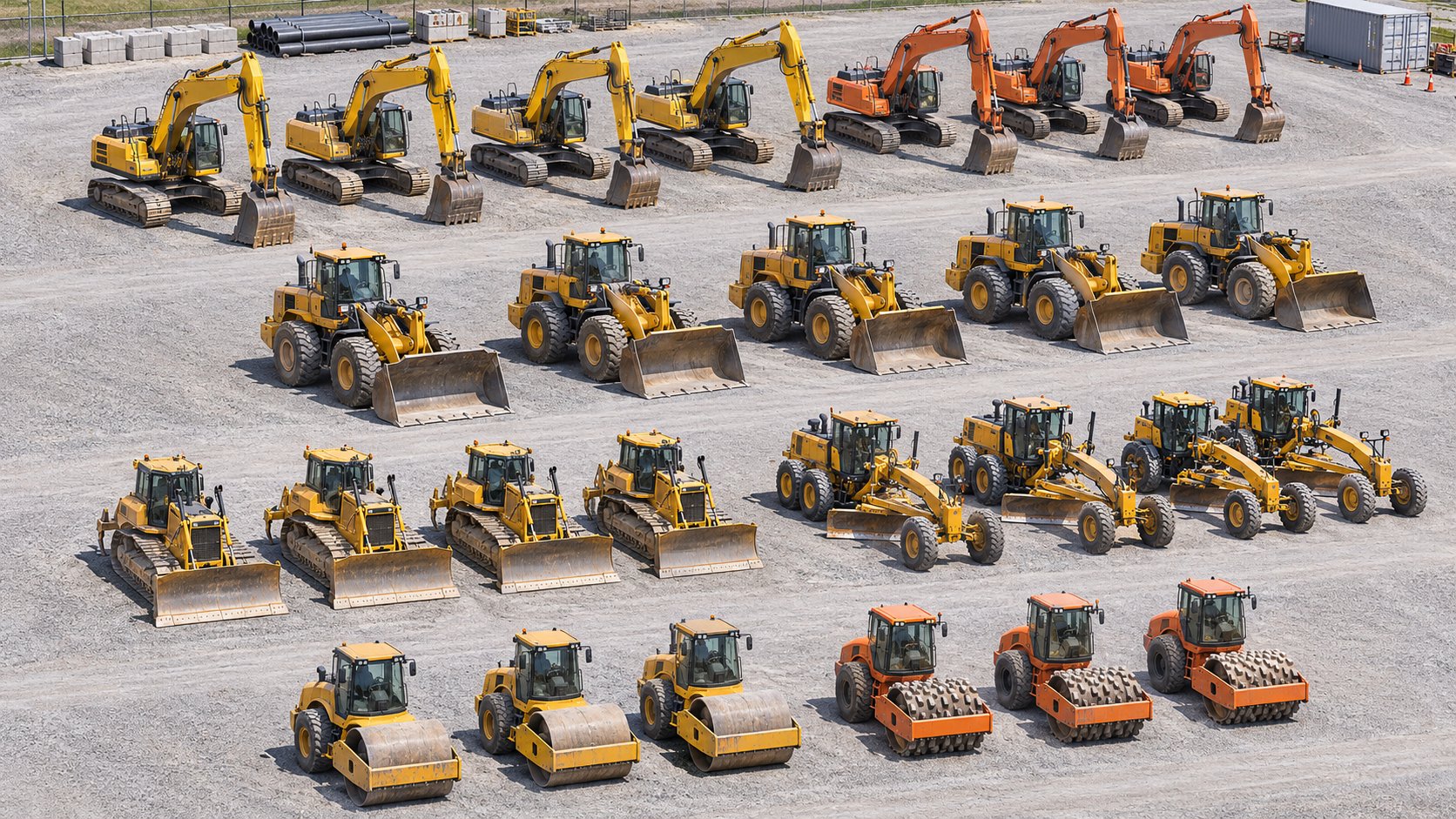
Every Type of Earthmoving Equipment Mapped by Function
Listing machines alphabetically tells you nothing about when or why to use them. A far more practical approach is to organize earthmoving equipment by what it actually does on a job site. Every machine falls into one of three functional groups: excavation, loading and hauling, or grading and compaction. Understanding these groups makes it easier to build the right fleet for any project—whether you're pricing an excavator rental for a utility trench or evaluating a full spread of heavy iron for highway work.
Excavation Machines Including Excavators and Backhoes
Excavation is where most projects begin, and the machines in this group are purpose-built to break ground and remove material with precision.
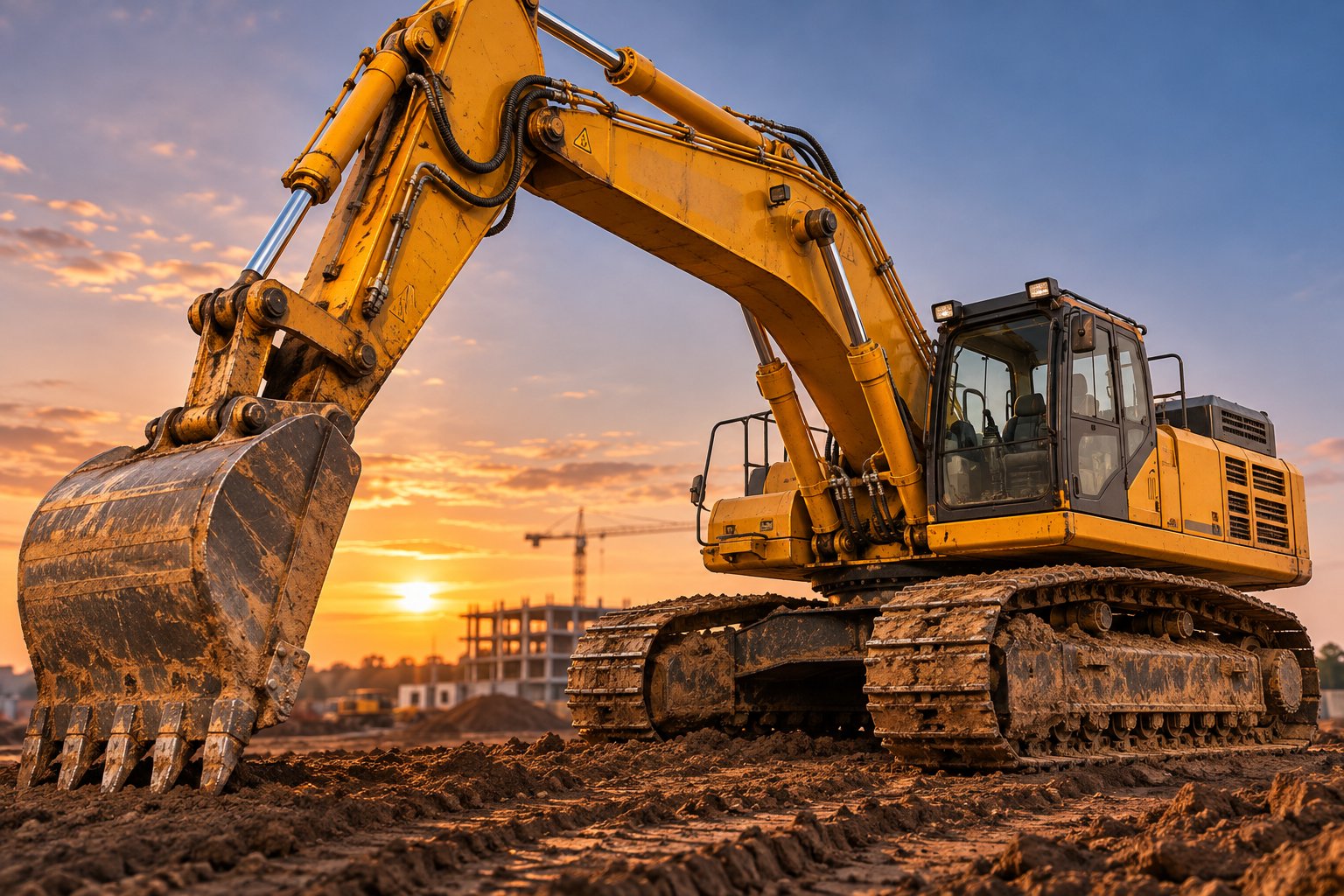
Standard excavators combine a rotating upper structure, a hydraulic boom and arm, and a bucket mounted on a tracked or wheeled undercarriage. Their versatility is unmatched—they dig foundations, cut trenches, handle demolition debris, and accept dozens of attachments from hydraulic breakers to grapples. Operating weights range from roughly 7 tons for compact models to well over 80 tons for machines used in mining and heavy infrastructure. If you've ever searched for excavators rental options, you've likely noticed that size classes vary dramatically because the work itself varies dramatically.
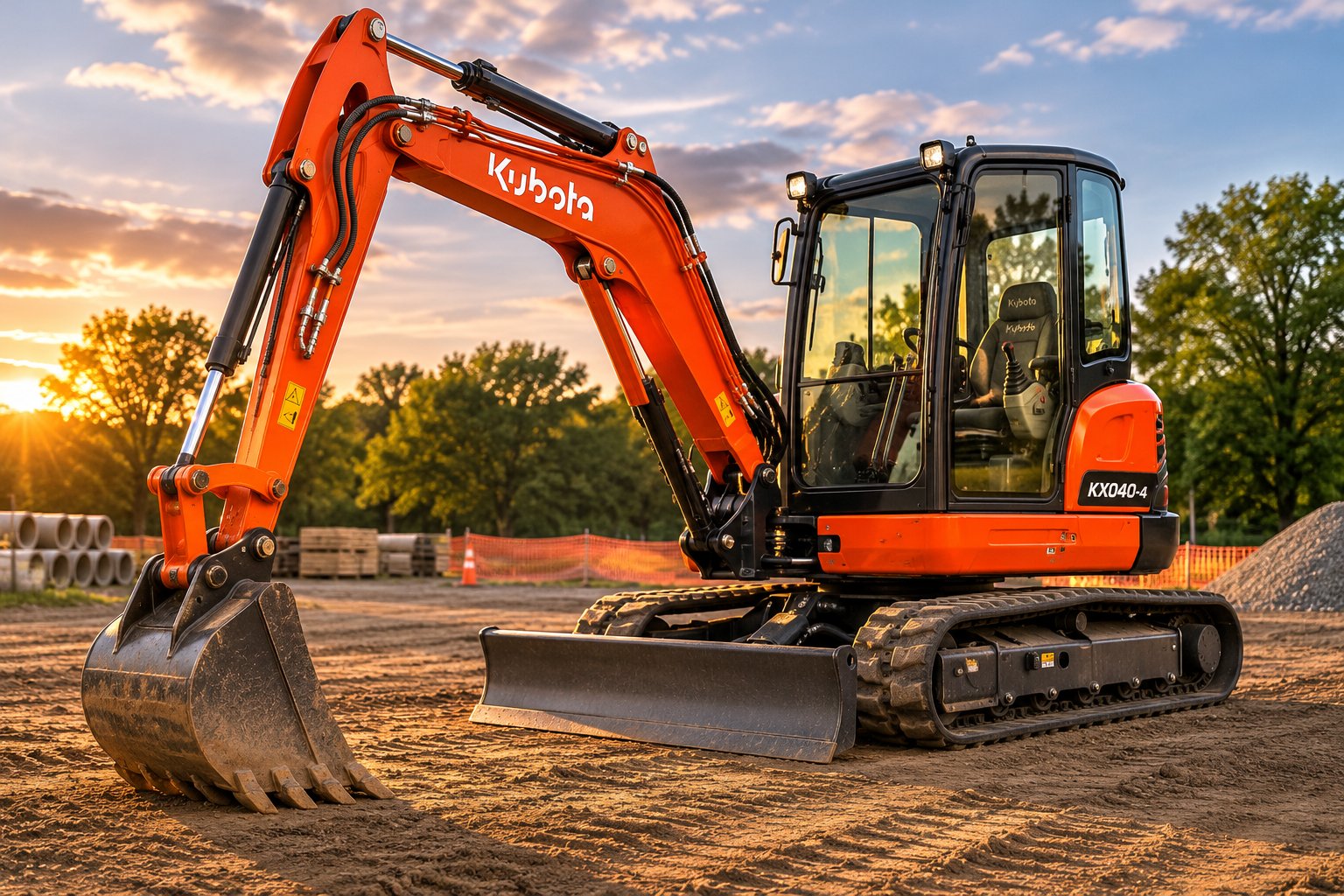
Mini excavators, typically under 6 tons, are the go-to choice for confined residential lots, interior demolition, and landscape grading. A mini excavator rental is one of the most common entry points for smaller contractors precisely because these machines fit through gates and work next to existing structures without damaging them.
Backhoe loaders pair a rear-mounted digging arm with a front loader bucket, creating a two-in-one caterpillar machine that handles both excavation and light material loading. They're ideal for utility installation, small commercial sites, and municipal maintenance—any scenario where a single versatile unit beats mobilizing two dedicated machines. A backhoe rental often makes sense for short-duration mixed tasks that don't justify a full-size excavator.
Trenchers round out the excavation group. Available in chain, wheel, and walk-behind configurations, they cut narrow, uniform trenches for pipelines, drainage, and cable installation far faster than a general-purpose excavator can for the same linear footage.
Loading and Hauling Equipment From Wheel Loaders to Dump Trucks
Once material is excavated, it needs to move—sometimes across the site, sometimes to a disposal facility miles away. Loading and hauling machines exist to keep that material flowing efficiently.
Wheel loaders use a large front bucket to scoop, carry, and dump loose material into trucks or hoppers. Their strength is cycle speed: on a stockpile, a well-matched loader and truck team can move enormous volumes per hour. Operating weights typically range from 10 to 25 tons, with payloads spanning 3 to 7 tons depending on the model class.
Skid steer loaders deliver loading power in a far smaller footprint. Their ability to turn within their own length and accept attachments—buckets, forks, augers, sweepers—makes them indispensable on tight urban sites and landscaping projects. You can drive caterpillar-tracked or wheeled variants depending on ground conditions; tracked models offer better traction on soft or muddy terrain.
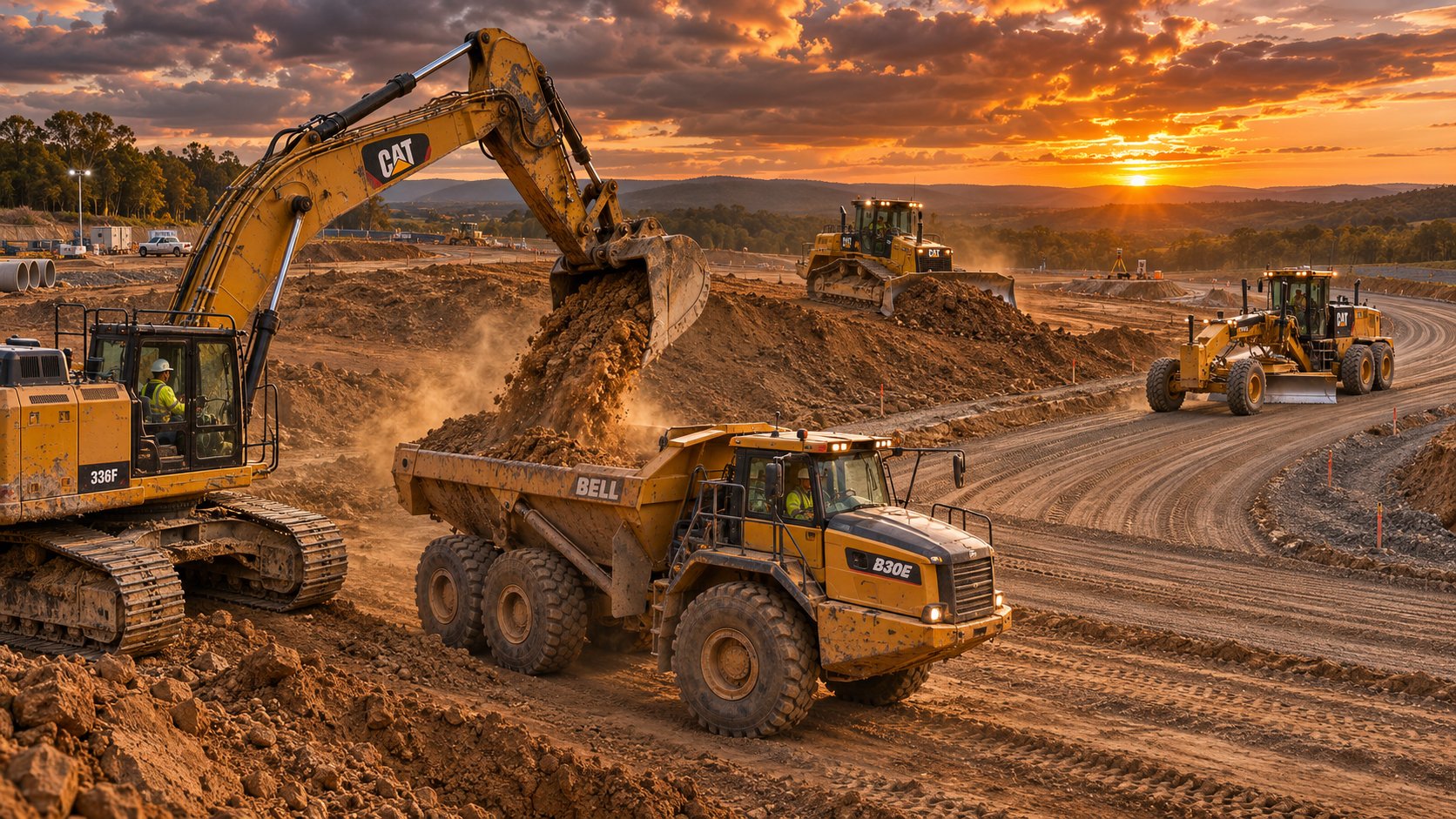
Articulated dump trucks handle high-volume, off-road hauling across rough or changing terrain. An articulation joint between the cab and dump body lets the truck navigate steep grades and uneven haul roads that would challenge a conventional tipper. Payloads in the 25-to-45-ton range are common on infrastructure and mining projects.
Scrapers deserve special attention because many equipment guides skip them entirely. A motor scraper cuts, loads, hauls, and spreads soil in a single pass—a single operator can move up to 72 cubic yards of material per cycle. On large, open earthwork sites with moderate haul distances, scrapers outperform excavator-and-truck combinations in both speed and cost per cubic yard.
Grading and Compaction Equipment for Finishing Work
Excavation and hauling reshape the ground. Grading and compaction machines refine it to specification.
Motor graders are finishing machines equipped with a long, adjustable moldboard that redistributes material with far greater precision than a dozer blade. Road subgrade preparation, drainage ditch shaping, and final surface leveling are their primary domains. Checking caterpillar weights and blade widths against your project's required tolerances is critical—an undersized grader cannot maintain the pass width or down-pressure needed for efficient subgrade finishing.
Bulldozers push large volumes of material over short distances using a wide front blade. Crawler dozers provide exceptional traction on loose or uneven ground, making them the default choice for initial site clearing, rough grading, and access road construction. Blade configurations matter: straight blades suit fine grading and short pushes, while curved blades carry more material per pass. Some models also mount a rear ripper to break compacted or rocky ground before excavation begins.
Compactors and rollers achieve the soil density required before any structure, pavement, or utility can be placed. Vibratory smooth-drum rollers work well on granular soils, padfoot rollers knead cohesive clay, and pneumatic-tire rollers seal the surface. Choosing the correct type depends on material composition and the compaction depth your specification demands.
Two additional machine types that rarely appear in competitor guides also warrant mention. Draglines—massive cable-operated excavators—remain essential in large-scale mining and dredging, where their extreme reach and bucket capacity justify their size. And forestry caterpillar machines, essentially bulldozers fitted with specialized clearing rakes and protective guarding, handle land-clearing operations in heavily wooded terrain far more safely than standard dozers.
| Equipment Type | Primary Function | Ideal Project Type | Typical Operating Weight | Mobility Type | Relative Cost Tier |
|---|---|---|---|---|---|
| Standard Excavator | Digging, trenching, demolition | Infrastructure, commercial, mining | 7 - 80+ tons | Tracked (wheeled available) | Medium - High |
| Mini Excavator | Compact digging, grading | Residential, landscaping, utilities | 1 - 6 tons | Tracked | Low - Medium |
| Backhoe Loader | Digging + loading (dual-purpose) | Utilities, small commercial sites | 6 - 11 tons | Wheeled | Low - Medium |
| Trencher | Narrow trench excavation | Pipeline, cable, drainage installation | 1 - 20 tons | Tracked or wheeled | Low - Medium |
| Wheel Loader | Loading bulk material | Quarries, stockpiles, truck loading | 10 - 25 tons | Wheeled | Medium - High |
| Skid Steer Loader | Compact loading, attachments | Urban sites, landscaping, demolition | 2 - 5 tons | Wheeled or tracked | Low |
| Articulated Dump Truck | Off-road hauling | Earthworks, quarries, infrastructure | 25 - 45 tons (payload) | Wheeled (articulated) | High |
| Scraper | Cut, haul, and spread soil | Large open earthworks, road building | 20 - 45 tons | Wheeled | High |
| Motor Grader | Precision grading and leveling | Roads, haul roads, site finishing | 12 - 25 tons | Wheeled | Medium - High |
| Bulldozer | Pushing, clearing, rough grading | Site clearing, road building, mining | 8 - 70+ tons | Tracked | Medium - High |
| Compactor / Roller | Soil and asphalt compaction | Roads, foundations, embankments | 3 - 20 tons | Wheeled or drum | Low - Medium |
| Dragline | Large-scale excavation and dredging | Mining, major civil works | 100+ tons | Walking / tracked | Very High |
Having a clear picture of what each machine does is the essential first step. The real challenge, however, is knowing which combination of these machines belongs on your specific job site—and that depends entirely on the construction scenario you're facing.
Matching Earthmoving Machines to Real Construction Scenarios
A catalog of machines only becomes useful when you can see each one inside an actual project workflow. Imagine standing on an undeveloped parcel: trees cover the slope, the soil hasn't been tested yet, and the grading plan calls for a finished pad 12 feet below the existing hilltop. Which machines show up first? Which ones follow? And which ones never need to appear at all? The answers change with every project type, so let's walk through the most common scenarios and map the equipment sequence for each.
Site Clearing and Demolition Equipment Needs
Before any precision work begins, the site has to be stripped down to workable ground. On a wooded lot or a demolition site, bulldozers lead the way. A crawler dozer fitted with a clearing rake pushes trees, brush, and surface debris into windrows for removal. On demolition projects, the dozer handles initial structure knockdown for low-rise buildings, while larger structures call for excavators fitted with hydraulic shears or concrete crushers.
Excavators take over once the rough clearing is done. Their rotating upper structure lets operators sort demolition debris—concrete in one pile, rebar in another, wood waste in a third—without repositioning the machine. That sorting step matters: mixed loads slow disposal and drive up landfill costs. Meanwhile, wheel loaders or skid steers work behind the excavator, scooping sorted materials into dump trucks for transport off-site. On projects where you need to rent an excavator for a short demolition phase, pairing it with a skid steer on the loading side keeps the cycle tight and the excavator focused on breakout work rather than double-handling material.
One advantage Caterpillar and other major OEMs have built into modern dozers is integrated GPS blade control, which lets operators strip topsoil to an exact depth during clearing—preserving it for later site restoration while avoiding over-excavation. That precision matters less on pure demolition jobs but becomes critical on projects with environmental topsoil-preservation requirements.
Road Building and Infrastructure Earthmoving Sequences
Road construction is where detailed earthwork scheduling becomes non-negotiable. Research on road construction planning reveals that earthworks alone account for roughly 20% of total project expenditure, and scheduling those activities at too coarse a level leads to costly rework and timeline overruns on site. The equipment deployment follows a phased, linear sequence that mirrors the road alignment itself.
Scrapers open the mass-earthmoving phase. On long, open corridors with moderate haul distances, a fleet of motor scrapers cuts material from high points and fills low points in a single operation—no separate loading step required. When haul distances stretch beyond a scraper's efficient range, or when the material is too rocky for self-loading, excavators paired with articulated dump trucks take over the cut-and-haul role.
Excavators handle the drainage and utility trenching that runs alongside or beneath the road alignment. Trenchers may supplement them for narrower pipe and cable runs. On larger infrastructure jobs, you might see a cat loader staging pipe sections and aggregate near the trench line to keep the excavator's cycle time as short as possible.
Motor graders step in once bulk earthmoving is complete. Their long wheelbase and adjustable moldboard shape the subgrade to design profile—typically within a tolerance of just a few centimeters. This precision determines how well the pavement layers perform for decades to come.
Compactors follow immediately behind the grader. Vibratory rollers densify granular subgrade materials in controlled lifts, while padfoot rollers knead cohesive fills. Compaction testing at each lift confirms that density meets specification before the next layer is placed. Skip a lift test, and you risk settlement that cracks the finished pavement months later.
This phased choreography—scraper, excavator, grader, compactor—is not merely a best practice. It reflects the physical dependencies of road construction: you cannot grade material that hasn't been placed, and you cannot compact a surface that hasn't been graded. Every machine in the sequence depends on the one before it finishing correctly.
Residential and Commercial Site Preparation
Smaller-scale projects rarely need the heavy iron deployed on highway jobs. Instead, they rely on compact earthmoving machines that deliver enough power for the task without tearing up neighboring properties or overwhelming narrow access roads.
A typical residential or light commercial site preparation follows a recognizable pattern. Mini excavators handle foundation and utility excavation in tight quarters, skid steers with grading buckets handle finish work, and small vibratory rollers compact backfill around foundations and in trenches. Caterpillar wheels and tracks both appear on these sites—wheeled skid steers move faster on hard surfaces between tasks, while tracked compact loaders provide better flotation on soft or freshly graded ground.
The site preparation process itself follows a standardized sequence regardless of project scale. Here is the typical five-phase equipment deployment order:
- Clearing: Bulldozers or skid steers with mulching attachments remove vegetation, debris, and any existing surface structures.
- Excavation: Excavators or backhoe loaders dig foundations, trenches, and detention basins to design depth.
- Grading: Motor graders or skid steers with laser-guided grading boxes shape the subgrade to planned elevations and drainage slopes.
- Compaction: Rollers and plate compactors densify the soil to the specified bearing capacity before any concrete or asphalt is placed.
- Final prep: Fine grading and surface stabilization bring the pad to its finished elevation, ready to receive foundations, pavement, or landscaping.
Each phase depends on the previous one being completed properly. Rushing excavation before clearing is finished leaves buried debris that shifts under foundations. Pouring a slab before compaction is verified invites cracking. The machines change with project scale, but the sequence stays remarkably consistent—from a single-family home pad to a 200,000-square-foot warehouse site.
What this project-first view reveals is something a simple equipment list never can: the machines themselves are only half the equation. The ground they work on—its composition, moisture content, slope, and bearing characteristics—shapes equipment choices just as powerfully as the project type does.
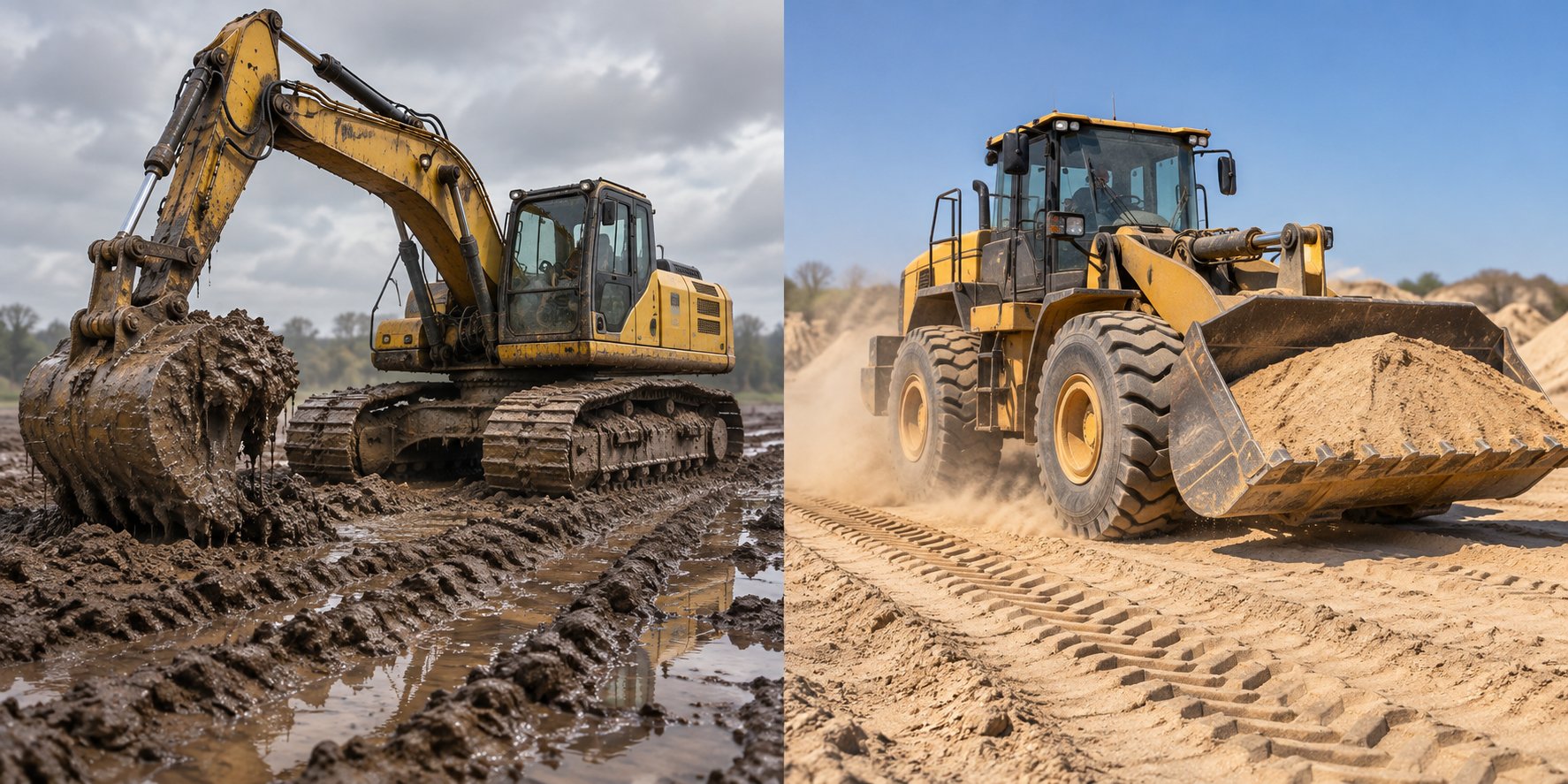
How Soil Conditions and Terrain Shape Equipment Choices
Two contractors can run the exact same project type—say, a 5-acre commercial pad—and need completely different machine configurations. The difference is what's under their feet. Soil composition, moisture levels, and terrain slope influence everything from undercarriage selection to attachment requirements, yet this factor rarely gets the attention it deserves during fleet planning.
How Clay, Sand, Rock, and Wet Soil Change Your Equipment Needs
Clay soils are dense, cohesive, and stubborn. They cling to buckets, resist penetration, and become slippery when wet. Working in clay demands tracked machines with high breakout force—think mid-size to caterpillar large excavators in the 20-to-35-ton class, where the hydraulic system delivers enough pressure to shear through stiff, plastic material. Excavator selection guides emphasize that clay-heavy sites also benefit from reinforced structural components, since the constant resistance accelerates wear on standard pins and bushings.
Sandy soils present the opposite challenge. They're loose, free-draining, and prone to collapse in trenches. Wheeled loaders and cat loaders thrive here because the firm, granular surface supports tires and allows faster cycle speeds than tracks can achieve. However, sandy trench walls need shoring or trench boxes—excavator operators can't count on the sidewalls holding shape the way clay does.
Rocky terrain may demand hydraulic breaker attachments on excavators to fracture bedrock before standard buckets can remove material. If you're searching for an excavator rental near me for a rock-heavy site, confirm that the rental unit's hydraulic circuit supports breaker flow rates—not every machine is plumbed for it. Rock also punishes undercarriages, so heavy-duty track shoes and reinforced roller guards become essential rather than optional.
Saturated ground changes the equation entirely. Wet, soft soils can swallow conventional machines. As Construction Equipment Guide explains, lower ground pressure improves flotation on unstable surfaces by distributing machine weight over a larger contact area. Wide-track configurations, marsh-style undercarriages, and compact track loaders with rubber tracks all reduce ground pressure and keep operations moving when standard machines would sink and churn the site into mud.
Reading Your Job Site Before Choosing Machines
You wouldn't pour a foundation without knowing what it sits on. The same logic applies to the machines working above that foundation. A basic site assessment covers four elements:
- Soil testing: Geotechnical borings reveal soil classification, bearing capacity, and moisture content at depth. Even a basic geotechnical investigation—typically costing $2,000 to $5,000 on residential and light commercial sites—tells you whether you're dealing with stable gravel, expansive clay, or soft organics that need removal.
- Slope analysis: Steep grades limit which machines can operate safely and may require tracked units over wheeled ones for traction and stability.
- Water table evaluation: Groundwater observations during borings show whether you'll need dewatering during excavation—and whether low-ground-pressure machines are necessary to avoid churning saturated subgrade.
- Access road width: The route onto your site determines maximum machine dimensions. A 35-ton excavator is useless if it can't fit through a 10-foot-wide residential gate. In those cases, searching for a mini excavator rental near me is the practical move.
Selecting earthmoving equipment without a site assessment is the most common and costly mistake contractors make—turning a preventable soil problem into an expensive mid-project change order.
Cats Caterpillar and other major OEMs publish ground-pressure specifications for every model, which makes it straightforward to cross-reference machine data against your site assessment findings. The table below maps four common soil types to the equipment configurations and operational considerations that matter most:
| Soil Type | Recommended Equipment Configuration | Track vs. Wheel Preference | Key Operational Considerations |
|---|---|---|---|
| Clay (cohesive, plastic) | Mid-to-large excavators with high breakout force; padfoot compactors | Tracked preferred | Material sticks to buckets—use clean-out holes; monitor moisture to avoid slip hazards on slopes |
| Sand (granular, loose) | Wheeled loaders for fast cycle times; trench boxes for excavation safety | Wheeled preferred | Trench walls collapse easily—never enter unshored trenches; compaction requires moisture control |
| Rock (hard, fractured) | Excavators with hydraulic breakers; heavy-duty undercarriage packages | Tracked required | Verify hydraulic flow for breaker compatibility; budget for accelerated undercarriage wear |
| Saturated / Wet Soil | Wide-track or marsh-configured machines; compact track loaders | Wide tracks required | Minimize ground pressure to prevent rutting; plan dewatering before excavation begins |
Matching machines to ground conditions isn't a one-time decision, either. Conditions can shift across a single site—gravel on the east pad, soft clay near a drainage channel on the west side. Experienced fleet managers walk the full footprint and review boring logs at every location before committing to a final equipment spread. That discipline separates projects that run on schedule from those that burn through contingency budgets replacing stuck or undersized machines mid-job.
Ground conditions tell you what to deploy. The next critical variable is how big those machines need to be—because oversizing your fleet wastes just as much money as picking the wrong type altogether.
Right-Sizing Earthmoving Machines for Maximum Efficiency
Picture this: a contractor mobilizes a 45-ton excavator to dig utility trenches on a half-acre commercial lot. The machine barely fits through the site entrance, its tracks chew up the freshly graded parking area next door, and the lowboy transport alone costs more than a week's rental on the right-sized unit. Oversizing is expensive. But so is the opposite—sending a compact machine to do a full-size job grinds timelines to a halt and burns through components at an alarming rate. Getting the size right is just as important as getting the type right, yet it's one of the most overlooked decisions in earth moving equipment planning.
Why Bigger Is Not Always Better in Earthmoving
There's a persistent instinct on job sites: bring the biggest machine available and power through the work. In practice, oversized earthmoving equipment creates a cascade of problems that erode both budget and schedule.
Fuel consumption scales steeply with machine size. A caterpillar excavator in the 30-ton class can burn 4 to 6 gallons of diesel per hour under load, while a 50-ton-plus unit may consume 8 to 12 gallons in the same timeframe. If your project volume doesn't demand that extra bucket capacity, every hour of operation wastes fuel without a proportional increase in production.
Ground damage becomes a real liability. Heavier machines exert greater ground pressure, and on soft or freshly prepared subgrade, that pressure ruts surfaces, destroys compaction work, and forces expensive regrading. A caterpillar tracked dozer built for highway embankments will wreck a residential building pad in a single pass if the soil is anything less than perfectly dry and compacted.
Access constraints kill productivity. Oversized units may not physically fit through site entrances, between existing structures, or under overhead utilities. When a machine can't reach the work zone, crews waste hours rigging alternative access—or worse, mobilize a second, appropriately sized machine at additional cost.
Transport costs multiply. Moving caterpillar trucks and heavy equipment between sites requires lowboy trailers, permits for oversize loads, and sometimes pilot cars. A machine that could have traveled on a standard trailer at half the cost simply because it was one size class smaller represents a direct, avoidable expense—especially for contractors who move frequently between projects.
The flip side is equally damaging. Undersized machines work harder and longer to move the same volume of material, which extends project timelines and accelerates mechanical wear. Hydraulic systems run at higher pressures, undercarriages absorb more stress per cycle, and operators push components beyond their designed duty cycle. The result is more frequent breakdowns, shorter component life, and higher maintenance bills—costs that quietly erode any savings from choosing a cheaper, smaller unit.
A Practical Equipment Sizing Framework by Project Scale
So how do you land on the right machine class? The answer starts with your project's actual volume requirements and site constraints—not a manufacturer's brochure or whatever happens to be available in the yard.
As a general framework, consider three tiers of project scale:
Compact class suits projects involving fewer than roughly 500 cubic yards of material movement—residential foundations, landscaping, small utility installations. Mini excavators under 6 tons, skid steers, and compact track loaders handle these volumes efficiently without overburdening narrow access roads. If you're searching for a bulldozer rental near me for a small clearing job, a compact dozer in the 6-to-10-ton range is almost always sufficient.
Mid-size class covers standard commercial work—parking structures, retail pads, mid-rise foundations—where material volumes range from 500 to 10,000 cubic yards. Excavators in the 15-to-30-ton range, mid-size wheel loaders, and standard motor graders provide the production rates these projects demand without the transport headaches of full-size iron.
Full-size and heavy class is reserved for infrastructure-scale jobs: highway construction, dam embankments, large industrial sites, and mining operations where material volumes exceed 10,000 cubic yards. Machines in this tier—including caterpillar high-capacity dozers, 40-ton-plus excavators, and motor scrapers—justify their fuel burn and transport costs because the sheer volume of work absorbs those expenses across thousands of productive hours.
Within each tier, several site-specific factors refine your selection further:
- Estimated material volume: The total cubic yards to be excavated, hauled, or graded determines minimum production-rate requirements.
- Maximum dig depth required: Deeper excavations demand longer boom-and-arm combinations, which generally means a larger machine class.
- Site access width: Measure the narrowest point between the staging area and the work zone—your machine's transport width must clear it.
- Transport distance on site: Longer on-site haul distances favor larger trucks or scrapers; short distances may let loaders dump directly into the fill area.
- Required cycle time: If a tight schedule compresses available working days, you may need a larger machine—or multiple units—to hit daily production targets.
Fleet managers frequently face a classic balancing act: deploy fewer large machines or spread the work across multiple smaller units. The answer depends on site logistics. A single large excavator loading two articulated trucks may produce more cubic yards per hour than two smaller excavators doing the same work—but only if the site has room for the larger machine to swing freely and the haul road supports the heavier trucks. On congested sites with multiple work fronts, several compact units operating simultaneously often outperform one large machine that can only serve one zone at a time. Fleet management research reinforces this point: the biggest utilization gains typically come from reallocating underused machinery across work zones rather than simply adding larger equipment to the spread.
The sizing decision also carries financial weight well beyond the project at hand. Oversized machines that sit idle between jobs tie up capital and depreciate whether they're working or not. Undersized machines that run at full throttle every shift accumulate maintenance costs that chip away at their resale value. Finding the sweet spot—where machine capacity matches actual demand—is what separates a profitable fleet from one that bleeds money between projects.
That financial dimension raises an even bigger question most contractors face before a single machine arrives on site: should you own these machines at all, or does renting make more sense for your operation?
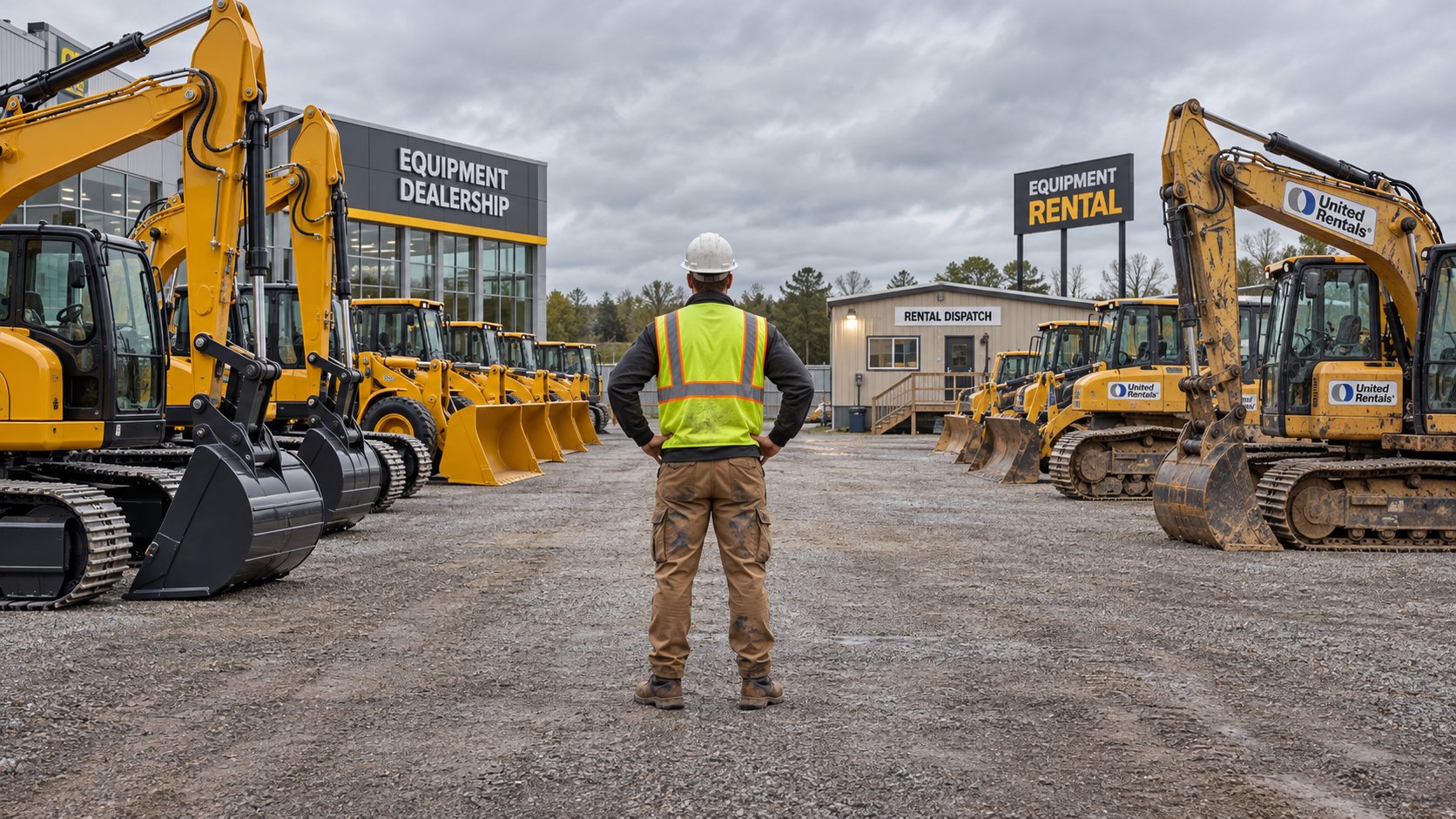
Buy vs. Rent Decision Framework for Earthmoving Fleets
Every contractor hits this crossroads eventually. You've identified the right machine type, confirmed the size class, assessed the soil conditions—and then comes the question that actually keeps you up at night: do you write a rental check, or do you commit capital to ownership? The answer isn't universal. It depends on how often the machine runs, how long your project pipeline stretches, and whether your operation has the infrastructure to maintain what it owns. Get this decision wrong and you either bleed cash on underutilized iron or hemorrhage rental fees that could have built equity in your fleet.
When Renting Earthmoving Equipment Makes Financial Sense
Renting wins in more situations than most contractors expect—especially for operations that are growing, seasonal, or diversifying into unfamiliar project types. The core logic is straightforward: if a machine sits idle more than it works, ownership costs pile up whether the engine is running or not.
Short-duration and seasonal projects are the clearest case for construction machinery rental. A three-week drainage job doesn't justify a five-year loan. Neither does a land clearing equipment rental need that only surfaces twice a year. When utilization falls below roughly 60% of available working days—about 150 days annually—cost analysis consistently shows that renting is cheaper once you account for depreciation, maintenance, insurance, and storage on an owned unit.
Specialty equipment almost always favors rental. Motor graders, concrete crushers, piling rigs, and large compactors see limited use for general contractors. Buying a cat machine you'll deploy on two projects a year ties up capital that could fund labor, materials, or marketing—resources that generate revenue far more consistently.
Testing before committing is an underappreciated benefit. If you're considering adding a new equipment category to your fleet—say, a compact track loader or a mid-size excavator class you haven't operated before—a few weeks of real-world rental use reveals more about fit than any spec sheet ever could. You learn how operators adapt, how the machine handles your typical soil conditions, and whether production rates match your bid assumptions.
Cash flow preservation matters especially during uncertain periods. Rental converts six-figure capital expenditures into predictable operating expenses, keeping credit lines open and working capital available for payroll, bonding, and emergency reserves. As Cleveland Brothers notes, the old "buy everything and build equity" approach is less practical than it once was—shorter project timelines, fluctuating interest rates, and more varied equipment needs have shifted the calculus.
Rental rate structures typically follow a tiered model: daily rates run highest per-unit-of-time, weekly rates drop to roughly three to four times the daily rate, and monthly rates settle at about three times the weekly rate. Industry benchmarks for 2026 put mid-size excavator rentals in the range of $500 to $900 per day, skid steers at $250 to $450 per day, and small-to-mid dozers at $500 to $1,000 per day—though local market conditions, seasonal demand, and machine availability can push rates in either direction. Always factor in delivery and pickup fees, damage waivers, and fuel when comparing rental costs to ownership.
When Buying or Sourcing Used Equipment Delivers Better Value
Ownership isn't obsolete—it just needs to be earned by the numbers. When utilization is high, the project pipeline is steady, and your team can handle maintenance in-house, buying builds equity and drives your cost per operating hour well below rental rates.
High-utilization earth movers justify purchase quickly. An excavator running 1,000-plus hours per year can drop its true cost per hour to the $35 to $40 range, compared to $80 or more per hour at equivalent rental rates. That gap compounds across years of steady work. If a machine runs 200-plus days annually, the math overwhelmingly favors ownership—provided you've accounted for all carrying costs, not just the loan payment.
Recurring project types amplify the case. A contractor who builds retail pads month after month knows exactly which machines are needed, how many hours they'll log, and what maintenance cycles to expect. That predictability eliminates the biggest risk of ownership: uncertain utilization. Multi-year contracts offer the same advantage, locking in enough guaranteed hours to justify even large capital outlays.
Sourcing quality used earthmoving equipment can dramatically improve the buy-side equation. Heavy machinery typically depreciates 20 to 30% in the first year and retains only 40 to 60% of its value after five years. That steep initial drop means a well-maintained three- to five-year-old machine often delivers comparable performance at a significantly lower acquisition cost. The key is due diligence: verify maintenance records, inspect undercarriage and hydraulic systems, and confirm that the construction of machine components—frame welds, boom pins, swing bearings—shows no signs of deferred maintenance or structural fatigue. Industry guidance on evaluating used equipment emphasizes that purchase price alone is misleading; a slightly higher-priced unit with complete service history and lower component wear can be the far better investment over its remaining life.
For contractors and fleet managers evaluating the used-equipment route, suppliers like JIUHONG offer used excavators, loaders, bulldozers, and graders that allow buyers to compare specifications and request purchase quotes as part of their sourcing process. Having access to a dedicated equipment collection streamlines the comparison step—especially when you're evaluating multiple machine classes simultaneously for a fleet build-out.
Building business equity is the long-game argument for ownership. Owned machines appear on your balance sheet as assets, serve as collateral for future financing, and increase the overall value of your company at sale. A cat tractor or excavator with documented maintenance history holds resale value far better than a neglected unit, turning disciplined ownership into a genuine financial strategy rather than just an operational one.
A Decision Checklist: Rent or Buy?
Before committing in either direction, run through these factors for every machine under consideration:
- Projected annual utilization hours: Below 800 hours strongly favors rental; above 1,200 hours strongly favors buying. The 800-to-1,200-hour range is a gray zone that demands a full cost comparison.
- Maintenance team capability: Owning equipment means maintaining it. If you lack in-house mechanics or a reliable service partner, rental shifts maintenance responsibility—and risk—to the rental provider.
- Capital availability: Down payments and loan obligations tie up cash. When liquidity is tight or interest rates are high, rental preserves working capital for revenue-generating activities.
- Equipment resale market conditions: Some machine types hold value exceptionally well; others depreciate steeply. Research resale trends for the specific model and age you're considering before committing to purchase.
- Project pipeline consistency: A steady backlog of similar work justifies ownership. An unpredictable or shifting project mix favors the flexibility of rental.
Pros of Renting
- No depreciation risk—you pay only for the hours you use
- Maintenance and major repairs are typically the rental company's responsibility
- Access to newer machines with the latest technology and emissions compliance
- Rental payments are fully deductible as operating expenses in the year incurred
Pros of Buying
- Lower cost per hour at high utilization rates
- Guaranteed availability—no scrambling for rentals during peak season
- Operator familiarity with a specific machine improves productivity by 10 to 15%
- Section 179 deductions can offset a significant portion of the purchase price in Year 1
Many successful contractors land on a hybrid strategy: own the core, high-utilization machines—perhaps an excavator and a skid steer that run daily—and rent everything else. This approach captures ownership economics where they're strongest while using rental flexibility to handle seasonal surges, specialty tasks, and geographic expansion without overcommitting capital. The discipline is in tracking utilization honestly. Real-world case studies show that contractors who audit fleet utilization and sell underperforming owned units in favor of as-needed rental can free up tens of thousands of dollars in capital annually—money that gets reinvested into marketing, labor, or higher-utilization equipment.
Whether you rent, buy new, or source used machines, the financial picture doesn't end at the acquisition decision. The costs that accumulate after that decision—fuel, wear parts, preventive maintenance, insurance—often dwarf the original price tag and ultimately determine whether your fleet is a profit engine or a capital drain.
Technology Transforming Modern Earthmoving Operations
Fuel, wear parts, and maintenance schedules all shape the cost of running heavy machines—but the technology built into those machines increasingly determines how efficiently every dollar gets spent. A caterpillar tractor pushing dirt without grade control wastes passes, burns extra fuel, and relies entirely on an operator's eye to hit design elevation. The same machine equipped with GPS guidance hits grade in fewer passes, logs less idle time, and generates data that feeds smarter fleet decisions. Technology doesn't replace the fundamentals of earthmoving—it sharpens them.
GPS Machine Control and Automated Grading Systems
GPS-guided machine control has moved from a competitive edge to an operational expectation. On modern job sites, it's rare to see a dozer working without some form of grade technology, and the shift to mastless machine control is nearly complete. Legacy mast-mounted GNSS receivers are giving way to integrated inertial measurement units (IMUs) and compact antenna systems that sit flush with the machine body—eliminating exposed hardware that once broke off in tight working conditions.
Two levels of control dominate the market. 2D systems manage slope and depth using laser or sonic references, making them well-suited for simpler grading tasks like leveling building lots. 3D systems combine GNSS positioning with digital design models so the blade or bucket tracks its exact location relative to the engineered surface—automatically adjusting to maintain design grade without manual staking. Komatsu's Proactive Dozing technology takes this further, learning terrain as it works so operators can engage machine control from the very first pass rather than switching it on only near finish grade.
The payoff is measurable. GPS-guided grading reduces the need for on-site survey crews, cuts rework caused by over-excavation, and compresses project timelines. One documented OEM comparison showed roughly 23% faster task completion with grade technology in place. Perhaps just as valuable, GNSS-equipped machines now generate as-built documentation automatically—logging material moved, number of passes, and deviation from design—which satisfies the compliance requirements that government-funded projects increasingly demand.
For contractors who rent mini excavator units or smaller dozers on a per-project basis, subscription-based machine control offerings are emerging. Rather than a large upfront hardware investment, these models let you activate 2D or 3D guidance only when a project justifies it—bringing precision technology within reach even for single-project deployments.
Telematics, Fleet Management, and Hybrid Powertrains
If machine control optimizes what happens at the blade tip, telematics optimizes everything behind it—fuel consumption, idle time, maintenance scheduling, and asset location across scattered job sites. A telematics system pairs a hardware device hardwired into the machine's controller area network (CAN bus) with a cloud-based platform that streams data to fleet managers in real time.
What does that data actually reveal? Imagine managing 30 machines across four active sites. Without telematics, you're relying on phone calls to site supervisors and manual hour-meter readings to understand utilization. With it, you see which earth mover is actively digging, which one has been idling for two hours, and which excavator just triggered a hydraulic pressure fault code that—if ignored—will become a $15,000 repair. Idle heavy equipment alone can cost a construction fleet an estimated 25% of its annual operating budget, making idle-time visibility one of the fastest paths to measurable savings.
Fleet management platforms like Geotab and John Deere Operations Center go beyond basic tracking. They log engine hours per machine for accurate maintenance triggers, correlate fuel burn with productive work cycles to flag waste, and enable geofencing alerts that notify managers when a machine moves outside an authorized boundary—a critical theft-prevention feature when a single construction equipment theft averages around $6,000.
On the powertrain side, hybrid and fully electric options are gaining traction—particularly in the compact equipment segment. Electric mini excavators have moved from prototype to production, offering zero local emissions, significantly lower noise levels, and reduced maintenance demands since there's no diesel engine, turbocharger, or DPF to service. They're especially practical on urban sites, indoor demolition projects, and jobs with strict environmental constraints. Challenges remain—battery life limits continuous run time, and charging infrastructure on remote sites is still sparse—but for contractors who handle primarily urban or suburban work, electric compact machines are already cost-competitive over a machine's full lifecycle when lower fuel and maintenance expenses are factored in. Hybrid powertrains on mid-size machines bridge the gap, using electric assist to reduce fuel consumption during low-load phases like repositioning and idle, while maintaining full diesel power for peak digging and pushing demands.
How Automation Is Changing Operator Requirements
Fully autonomous earthmoving machines exist—but almost exclusively in mining, where haul trucks follow fixed routes in controlled environments with no public access. Construction sites are far less predictable: workers, utilities, changing grades, and weather create variables that current autonomy can't reliably navigate without human oversight.
What's transforming construction right now is semi-autonomous assistance. Grade-assist systems stop a bucket or blade at the correct depth automatically. Intelligent swing control prevents boom collisions with nearby structures. Automatic bucket leveling maintains a flat cut without constant joystick correction. These features don't replace skilled operators—they amplify them, reducing fatigue on repetitive tasks and closing the gap between a veteran operator and someone with less experience. John Deere's SmartGrade system, for example, displays 2D and 3D information simultaneously and offers remote display access so a technology specialist can see—and even control—the in-cab monitor from off-site, providing real-time support without a truck roll.
Even long arm excavator rental units are increasingly arriving with basic machine control pre-installed, reflecting how deeply this technology has penetrated the rental fleet. The practical implication for contractors is clear: operators who understand digital grade systems, telematics dashboards, and semi-automated features are becoming more valuable than those who rely on manual skill alone.
When evaluating modern earthmoving equipment—whether for purchase, fleet upgrade, or rental—prioritize these technology features:
- Machine control compatibility: Can the unit accept 2D or 3D GNSS systems, either factory-installed or aftermarket? Is mastless hardware supported?
- Telematics platform: Does the machine transmit engine hours, fault codes, fuel data, and location to a centralized dashboard? Is the platform compatible with your existing fleet software via API integration?
- Fuel efficiency monitoring: Can you track real-time fuel consumption and idle time per machine to identify waste and benchmark operator performance?
- Automated compaction measurement: For rollers and compactors, does the system log pass counts, vibration frequency, and material stiffness to verify density without stopping for nuclear gauge tests?
Technology adds upfront cost, but the machines that generate the richest operational data also tend to deliver the lowest total cost of ownership over their working lives—a connection that becomes especially clear when you examine what it actually costs to keep earthmoving equipment running year after year.
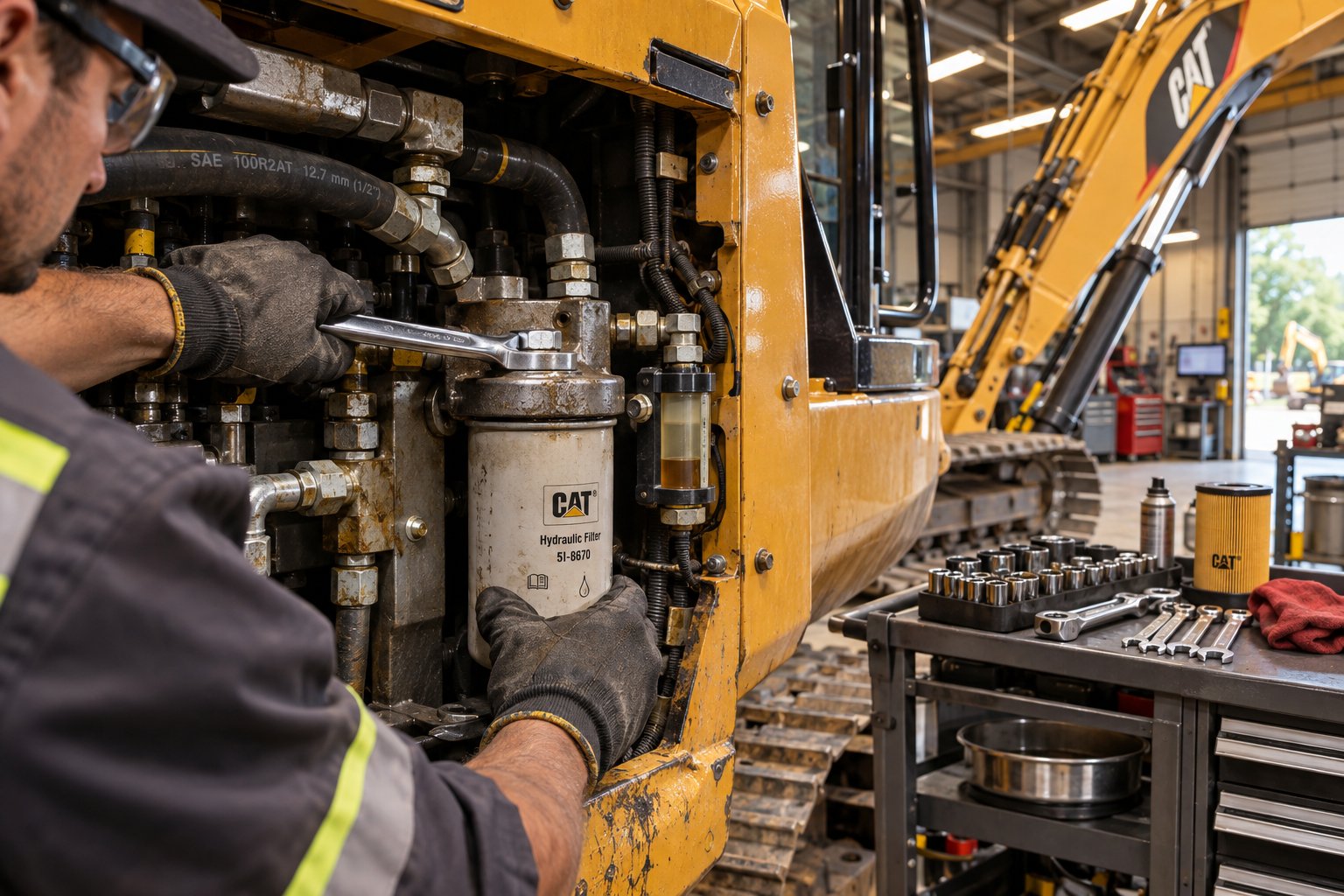
Maintenance and Total Cost of Ownership Essentials
Technology may sharpen the blade, but maintenance keeps it cutting. Every sensor, telematics dashboard, and GPS module in the world can't save a machine from a seized hydraulic pump caused by a skipped oil change. The purchase price of earthmoving equipment—whether you paid full retail or found a deal on a quality used unit—typically represents only 20 to 30% of what that machine will cost over its working life. The remaining 70 to 80% accumulates quietly, one fuel fill, one filter change, and one undercarriage rebuild at a time. Understanding those ongoing costs is what separates contractors who build profitable fleets from those who wonder where all the money went.
Understanding the True Cost Beyond the Purchase Price
Imagine you've just acquired a mid-size excavator for $250,000. Feels like a big number—and it is. But as Gregory Poole Equipment Company explains, the purchase price is just one piece of the total cost of ownership (TCO) equation. Fuel, maintenance, depreciation, and resale value all play major roles in determining a machine's long-term financial impact. Here's where the real money goes:
Fuel and energy are the single largest recurring expense for most earthmoving operations. A standard 30-ton excavator running eight hours a day at moderate load burns roughly 4 to 6 gallons of diesel per hour. Over a 1,500-hour annual work schedule, that's 6,000 to 9,000 gallons—a five-figure fuel bill before you've turned a single wrench. Dozers running at high throttle for extended pushes consume even more. Operator habits matter here too: excessive idling, unnecessarily high RPMs, and poor technique can inflate fuel costs by 15 to 25% compared to a trained, disciplined operator doing the same work.
Preventive maintenance and repairs form the second-largest cost category. Industry guidance from Warren CAT suggests budgeting 2 to 6% of total replacement asset value annually for routine maintenance, with harsher operating conditions pushing that percentage toward the upper end. Skipping scheduled services doesn't save money—it shifts costs from predictable $500 to $2,000 planned maintenance intervals to unpredictable emergency repairs that can run $15,000 to $125,000 when a contaminated hydraulic system takes out pumps, valves, and cylinders all at once.
Wear parts and undercarriage replacement deserve their own line item—especially for tracked machines. Undercarriage components (track chains, rollers, idlers, sprockets, and shoes) can account for up to 50% of a dozer's or excavator's lifetime maintenance cost. On rocky terrain, accelerated wear can cut component life in half compared to working in clean fill. Bucket teeth, cutting edges, and ripper tips are consumables that need replacement on a schedule driven by material hardness and operating hours.
Insurance, operator labor, and transport round out the picture. Insurance premiums scale with machine value and risk profile. Operator wages—including benefits and training—represent a fixed cost per operating hour that doesn't shrink just because the machine is sitting idle. And mobilizing heavy equipment between job sites on lowboy trailers adds cost every time a machine relocates, a factor that's easy to underestimate when projects are spread across a region. If you've ever searched for a dozer rental near me to avoid a transport bill on a short job, you already understand how mobilization costs influence fleet decisions.
Preventive Maintenance Schedules That Protect Your Investment
Maintenance discipline is what converts a depreciating asset into a reliable revenue generator. The framework isn't complicated, but it demands consistency. Most major OEMs structure their preventive maintenance programs around a four-tier, hour-based system: service intervals at 250, 500, 1,000, and 2,000 engine hours. Each tier is cumulative—the 500-hour service includes everything from the 250-hour interval plus additional tasks, and so on up the chain.
Daily pre-operation checks form the foundation. Before every shift, operators should complete a walk-around inspection that takes roughly 10 to 15 minutes and prevents an estimated 80% of common failures. This includes checking engine oil and hydraulic fluid levels, inspecting tracks or tires for damage, verifying that all lights, alarms, and safety systems function, and scanning for fluid leaks underneath the machine. These checks cost almost nothing in time but catch small problems—a loose hose clamp, a cracked belt, a slow hydraulic leak—before they cascade into shift-stopping breakdowns.
Fluid and filter intervals drive the tier structure. Engine oil and filter changes anchor every 250-hour service. Fuel filters and hydraulic return filters are typically replaced at 500 hours. By 1,000 hours, hydraulic oil sampling and final drive oil service enter the schedule. At 2,000 hours, full hydraulic oil changes, coolant flushes, and transmission services come due. Skipping any of these has documented consequences: a missed oil change at 250 hours can lead to engine rebuild costs of $45,000 to $125,000, while a skipped coolant flush at 2,000 hours risks internal corrosion and head gasket failure exceeding $75,000 in repairs.
Undercarriage tension checks apply to every tracked machine in your fleet—excavators, dozers, and compact track loaders. Improper track tension accelerates wear on pins, bushings, and sprockets. Too tight, and you grind through components prematurely. Too loose, and the track throws or de-rails under load. Visual checks happen daily, but actual measurements using a track sag gauge should occur at every 500-hour service, or sooner if the machine works in rocky or abrasive conditions.
Hydraulic system monitoring goes beyond simply checking fluid levels. Scheduled oil sampling—often called S.O.S. (Scheduled Oil Sampling) fluid analysis—sends samples to a lab where technicians check for wear metals, particle counts, water contamination, and viscosity changes. Think of it as bloodwork for your machine: the sample reveals internal wear patterns long before a component fails visibly. Integrating fluid analysis into your 1,000- and 2,000-hour services transforms maintenance from reactive to predictive.
The table below presents a simplified maintenance schedule framework covering the most common earthmoving equipment categories. Use it as a starting baseline—always consult your specific Operation and Maintenance Manual for model-exact requirements, and adjust intervals downward for severe environments like dusty quarries, wet conditions, or high-impact rock work.
| Maintenance Task | Excavators | Wheel Loaders | Bulldozers |
|---|---|---|---|
| Daily (every shift) | Walk-around inspection; check engine oil, hydraulic fluid, coolant; inspect tracks and pins; test controls and safety systems | Walk-around inspection; check engine oil, hydraulic fluid, coolant; inspect tires and inflation; test brakes and steering | Walk-around inspection; check engine oil, hydraulic fluid, coolant; inspect tracks, cutting edges, and ripper tips; test controls |
| Every 250 hours (PM1) | Engine oil and filter change; grease boom, stick, bucket, and swing points; drain fuel water separator; inspect belts and hoses | Engine oil and filter change; grease bucket, Z-bar, steering, and axle pivot points; drain fuel water separator; check tire condition | Engine oil and filter change; grease blade, push arms, ripper, and pivot points; drain fuel water separator; check cutting edge bolts |
| Every 500 hours (PM2) | All PM1 tasks + replace fuel filter and hydraulic return filter; battery load test; detailed undercarriage inspection; coolant test | All PM1 tasks + replace fuel filter and hydraulic return filter; replace transmission filter; brake pad inspection; coolant test | All PM1 tasks + replace fuel filter and hydraulic return filter; battery load test; detailed undercarriage inspection; coolant test |
| Every 1,000 hours (PM3) | All PM1+PM2 + hydraulic oil sample analysis; final drive oil service; swing drive oil check; undercarriage wear measurement; structural weld inspection | All PM1+PM2 + hydraulic oil sample analysis; transmission oil sample and filter; axle oil sample; articulation joint play measurement; brake wear measurement | All PM1+PM2 + hydraulic oil sample analysis; transmission and torque converter oil sample; final drive oil change; undercarriage wear measurement; ROPS bolt torque |
| Every 2,000 hours (PM4) | All PM1-PM3 + full hydraulic oil change; coolant flush and replace; comprehensive structural inspection; major component evaluation | All PM1-PM3 + full hydraulic oil change; coolant flush; transmission oil change; differential oil change; comprehensive brake overhaul | All PM1-PM3 + full hydraulic oil change; coolant flush; transmission oil change; final drive oil change; comprehensive structural and turbo inspection |
Maintenance discipline directly determines residual value. A well-documented service history—complete with fluid analysis reports, parts receipts, and timestamped inspection logs—can add thousands of dollars to a machine's resale price. Buyers of used earthmoving equipment pay a premium for verified maintenance records because those records predict future reliability far better than a visual inspection alone. Whether you plan to run a machine for 10,000 hours and sell it, or work it until rebuild, every documented service interval protects your investment. And if you're evaluating rentals excavator options rather than owning, know that reputable rental companies follow these same interval-based schedules—ask for documentation to confirm.
Keeping machines running efficiently and holding their value is only part of the ownership equation. The people who operate them, the regulations that govern their use, and the environmental standards they must meet carry their own costs—and their own consequences when overlooked.
Safety, Environmental Compliance, and Your Next Steps
A machine that runs perfectly and costs exactly what you budgeted still represents a liability if it injures someone on site or triggers an environmental violation. Maintenance protects your investment. Safety and compliance protect your people, your license to operate, and your reputation. These aren't afterthoughts bolted onto the end of a planning process—they're woven into every equipment decision from the moment you spec your first machine.
Operator Certification and OSHA Compliance for Earthmoving
Who sits in the cab matters just as much as what's under the hood. OSHA mandates that only trained and competent operators run earthmoving equipment on construction sites. Under 29 CFR 1926.602, the agency applies specific requirements to scrapers, loaders, crawler and wheel tractors, bulldozers, off-highway trucks, graders, and similar machines. Those requirements extend beyond basic operating skill to include seat belt usage, functional braking systems, audible alarms on bidirectional machines, and rollover protective structures (ROPS) on applicable equipment. Additionally, 1926.602(d) references powered industrial truck operator training standards that mirror the requirements in 29 CFR 1910.178(l)—meaning formal, documented training isn't optional; it's a regulatory obligation.
Compliance doesn't stop at the operator's seat. Every site where earthmoving machines operate should have a site-specific safety plan that addresses the hazards unique to that project. Three areas demand particular attention:
- Underground utility marking: Before any bucket breaks ground, all buried utilities—gas, electric, water, fiber, sewer—must be located and marked. In most states, a one-call system (like 811) initiates the locate process at no cost. Striking an unmarked gas line or fiber conduit doesn't just cause damage—it creates life-threatening hazards and exposes the contractor to significant liability.
- Trench protection: Excavations deeper than five feet in most soil conditions require protective systems—sloping, shoring, or trench boxes. Operators and ground crews working near trenches need to understand soil classification and cave-in risk before the excavator starts digging.
- Swing-radius exclusion zones: Excavators, backhoes, and cranes create hazardous swing zones behind and beside the machine. Workers on foot must stay outside the swing radius unless the operator has confirmed visibility and the machine is stationary. High-visibility barriers or spotter systems help enforce these boundaries—especially on congested sites where multiple crews work in close proximity.
Beyond federal rules, many municipalities add their own requirements—noise curfews, permitted operating hours, mandatory flaggers near public roads. If you're bringing a track hoe rental onto an urban site, check local ordinances before the lowboy arrives. A violation discovered at 7 a.m. on a Monday doesn't just cost a fine; it costs a day of production while you wait for a resolution.
Environmental Standards and Low-Impact Earthmoving Practices
Environmental compliance for earthmoving equipment operates on two fronts: what comes out of the machine and what happens to the ground it works on.
Emissions standards have tightened dramatically over the past two decades. In the United States, the EPA's Tier 4 Final standards govern nonroad diesel engines used in excavators, dozers, loaders, and other construction machines. These regulations—codified under 40 CFR Part 1039—require advanced emission control technologies including diesel particulate filters (DPFs) and selective catalytic reduction (SCR) systems, coupled with Ultra Low Sulfur Diesel fuel at a maximum of 15 parts per million sulfur content. In Europe, the equivalent Stage V standards impose similar limits. Any machine you buy, rent, or bring onto a federally funded project must meet the applicable tier for its manufacture date. Older pre-Tier 4 machines may face restrictions or outright bans on certain job sites, particularly in low-emission zones within major metropolitan areas.
Noise regulations matter most in urban and suburban environments. Residential neighbors, hospitals, and schools within earshot of a construction site can trigger local noise ordinances that restrict equipment operation to specific daytime windows. Compact electric mini excavators—now available for rent as a mini excavator for rent option from several major rental fleets—produce dramatically lower noise levels than their diesel counterparts, making them a practical compliance tool on noise-sensitive projects rather than just an environmental talking point.
Erosion and sediment control is the third pillar. Under the Clean Water Act, any construction activity disturbing more than one acre of land requires a National Pollutant Discharge Elimination System (NPDES) permit and a Stormwater Pollution Prevention Plan (SWPPP). That plan must identify potential sources of sediment runoff, describe best management practices—silt fences, sediment basins, erosion control blankets—and detail inspection and maintenance procedures throughout the project. Earthmoving operations are the primary sediment generators on any construction site, so how you sequence equipment deployment, manage stockpiles, and protect exposed soil directly determines your compliance posture.
Modern equipment selection supports environmental compliance in ways that go beyond engine emissions. Properly sized machines reduce unnecessary ground disturbance. GPS-guided grading minimizes over-excavation, which means less exposed soil and fewer truck trips to haul excess material. Even the decision to use a curbing machine rental for precise concrete edging rather than hand-forming curbs reduces site disturbance and speeds stabilization of finished areas.
Building Your Earthmoving Equipment Strategy
You've covered a lot of ground—literally. From understanding what caterpillar construction equipment and other heavy machines actually do, through soil assessment, sizing logic, buy-vs-rent economics, technology integration, and total cost of ownership, every section of this guide points toward a single discipline: making deliberate, informed equipment decisions rather than defaulting to whatever's available.
Here's the framework distilled into five actionable steps:
- Assess your site. Conduct soil testing, slope analysis, water table evaluation, and access measurement before selecting a single machine. The ground dictates the equipment—not the other way around.
- Match equipment to tasks. Use the functional categories—excavation, loading and hauling, grading and compaction—to identify exactly which machine types your project phases require. Avoid the temptation to rent or buy "just in case" units that sit idle.
- Right-size every machine. Compare your material volumes, dig depths, and access constraints against machine class capabilities. An oversized fleet wastes fuel and damages sites. An undersized fleet wastes time and destroys components.
- Evaluate buy-vs-rent economics honestly. Track utilization hours, maintenance capacity, and pipeline consistency. Own what you use constantly; rent what you need occasionally. Revisit the decision annually as your project mix evolves.
- Source from reputable suppliers. Whether buying new, sourcing used, or renting, verify maintenance documentation, emissions compliance, and safety system functionality before a machine arrives on your site. Contractors and equipment dealers beginning their sourcing process can explore collections like JIUHONG's used construction equipment inventory—featuring excavators, loaders, bulldozers, and graders—to compare machinery specifications, evaluate condition, and request purchase quotes for upcoming projects.
If you're still early in the planning phase—maybe you're wondering how much does it cost to rent an excavator for a two-week utility job, or whether finding a top caterpillar dozer on the used market beats leasing new—the answers always trace back to the same fundamentals covered in this guide. Define the work. Understand the ground. Size the machine. Run the numbers. Then execute with confidence.
Successful earthmoving starts with smart equipment selection, not just machine availability. The contractor who plans the fleet wins the project before the first bucket hits dirt.
Whether you're pricing an excavator for rent near me for next month's foundation dig or building a multi-machine fleet for a highway contract, the principles are identical. The machines are tools. The strategy is what makes them profitable.
Frequently Asked Questions About Earthmoving Equipment
1. What are the main types of earthmoving equipment used in construction?
Earthmoving equipment is grouped into three functional categories. Excavation machines include standard excavators, mini excavators, backhoe loaders, and trenchers. Loading and hauling equipment covers wheel loaders, skid steers, articulated dump trucks, and scrapers. Grading and compaction machines include motor graders, bulldozers, and various roller types. Choosing the right combination depends on your project phase, soil conditions, and site access constraints rather than defaulting to a single versatile machine.
2. How do I choose the right size earthmoving machine for my project?
Start by estimating your total material volume, maximum dig depth, and site access width. Projects under 500 cubic yards typically suit compact machines like mini excavators and skid steers. Standard commercial work between 500 and 10,000 cubic yards calls for mid-size excavators and loaders. Infrastructure-scale jobs exceeding 10,000 cubic yards justify full-size heavy equipment. Always measure your narrowest site access point, because even the perfect machine is useless if it cannot physically reach the work zone.
3. Is it better to rent or buy earthmoving equipment?
The decision hinges on annual utilization hours. Machines running below 800 hours per year generally cost less to rent, while those exceeding 1,200 hours favor ownership. Between 800 and 1,200 hours, run a full cost comparison factoring in depreciation, maintenance, insurance, and storage. Many contractors adopt a hybrid strategy: owning high-utilization core machines and renting specialty or seasonal units. Sourcing quality used equipment from suppliers like JIUHONG can also lower the buy-side entry cost significantly compared to purchasing new.
4. How do soil conditions affect earthmoving equipment selection?
Soil type changes nearly every aspect of machine configuration. Clay soils demand tracked machines with high breakout force and padfoot compactors. Sandy ground favors wheeled loaders for faster cycle speeds but requires trench shoring for excavation safety. Rocky terrain often needs hydraulic breaker attachments and heavy-duty undercarriage packages. Saturated or wet soils call for wide-track or marsh-configured machines that distribute weight and prevent sinking. A basic geotechnical investigation before mobilization prevents costly mid-project equipment swaps.
5. What does preventive maintenance for earthmoving equipment typically involve?
Preventive maintenance follows an hour-based tier system. Daily checks include walk-around inspections of fluids, tracks, and safety systems. At every 250 engine hours, machines need oil and filter changes plus greasing of pivot points. The 500-hour service adds fuel and hydraulic filter replacements. By 1,000 hours, hydraulic oil sampling and final drive servicing are required. Full hydraulic oil changes and coolant flushes occur at 2,000 hours. Skipping intervals can escalate repair costs dramatically, with missed oil changes potentially leading to engine rebuilds costing $45,000 or more.