

What Construction Site Safety Really Means
Imagine stepping onto a jobsite where cranes swing overhead, trenches carve through unstable soil, and live electrical lines run just feet from your work zone. Every task carries risk. Every shift demands attention. That is precisely why construction site safety exists - not as a bureaucratic exercise, but as the difference between a worker going home at the end of the day or not.
Defining Construction Site Safety in Plain Language
Construction site safety is the integrated combination of policies, procedures, equipment standards, and training programs designed to prevent injuries, illnesses, and fatalities on active construction projects. It spans hazard identification, regulatory compliance, protective equipment, and the ongoing management of site conditions from groundbreaking to project closeout.
That definition sounds straightforward, yet executing it across a dynamic jobsite - where conditions shift daily and dozens of trades overlap - is anything but simple. Effective site safety requires more than handing out hard hats and posting a few warning signs. It demands a systematic framework rooted in federal standards, backed by competent leadership, and embraced by every person on site.
Why Construction Ranks Among the Most Dangerous Industries
The construction industry consistently lands among the top three sectors for fatal workplace injuries in the United States. Bureau of Labor Statistics data reported 5,190 fatal work injuries in 2021, with nearly 20% occurring in construction alone. Over 169,000 workers suffered injuries requiring medical attention that same year, and roughly 40% of those incidents resulted in lost workdays.
Why so dangerous? The risk profile is inherent to the work itself. Heavy machinery operates alongside foot traffic. Workers perform tasks on elevated surfaces - rooftops, scaffolding, ladders - where a single misstep can be fatal. Electrical exposure from overhead power lines and damaged cords creates invisible threats. Excavation work introduces cave-in hazards that can bury a worker in seconds. Unlike a controlled office environment, a construction site is an evolving landscape of overlapping hazards. Even training programs unrelated to construction - like a utah hunter safety course - teach the same foundational principle: awareness of your surroundings can save your life.
People sometimes ask, "what is health science, and how does it connect to construction?" The answer is more direct than you might expect. Health science encompasses the study of how environments, exposures, and physical demands affect human well-being - and few environments test those boundaries like an active jobsite. Safety mats placed beneath elevated work areas, respiratory protections against silica dust, and heat illness prevention protocols all reflect health science principles applied in the field.
This article breaks down the critical pillars of keeping workers safe on construction projects. You will learn about OSHA's Fatal Four hazards that cause the majority of fatalities, the regulatory standards every contractor must follow, what it takes to be a competent person under federal rules, how to select the right personal protective equipment, and why the hierarchy of controls should guide every safety decision. From there, we cover weather hazards and emergency planning, how equipment condition directly impacts safety outcomes, and - most importantly - how to build a safety culture that turns compliance into conviction. Every section ahead is designed to move you from checking boxes to genuinely saving lives.
OSHA's Fatal Four Hazards Every Worker Must Know
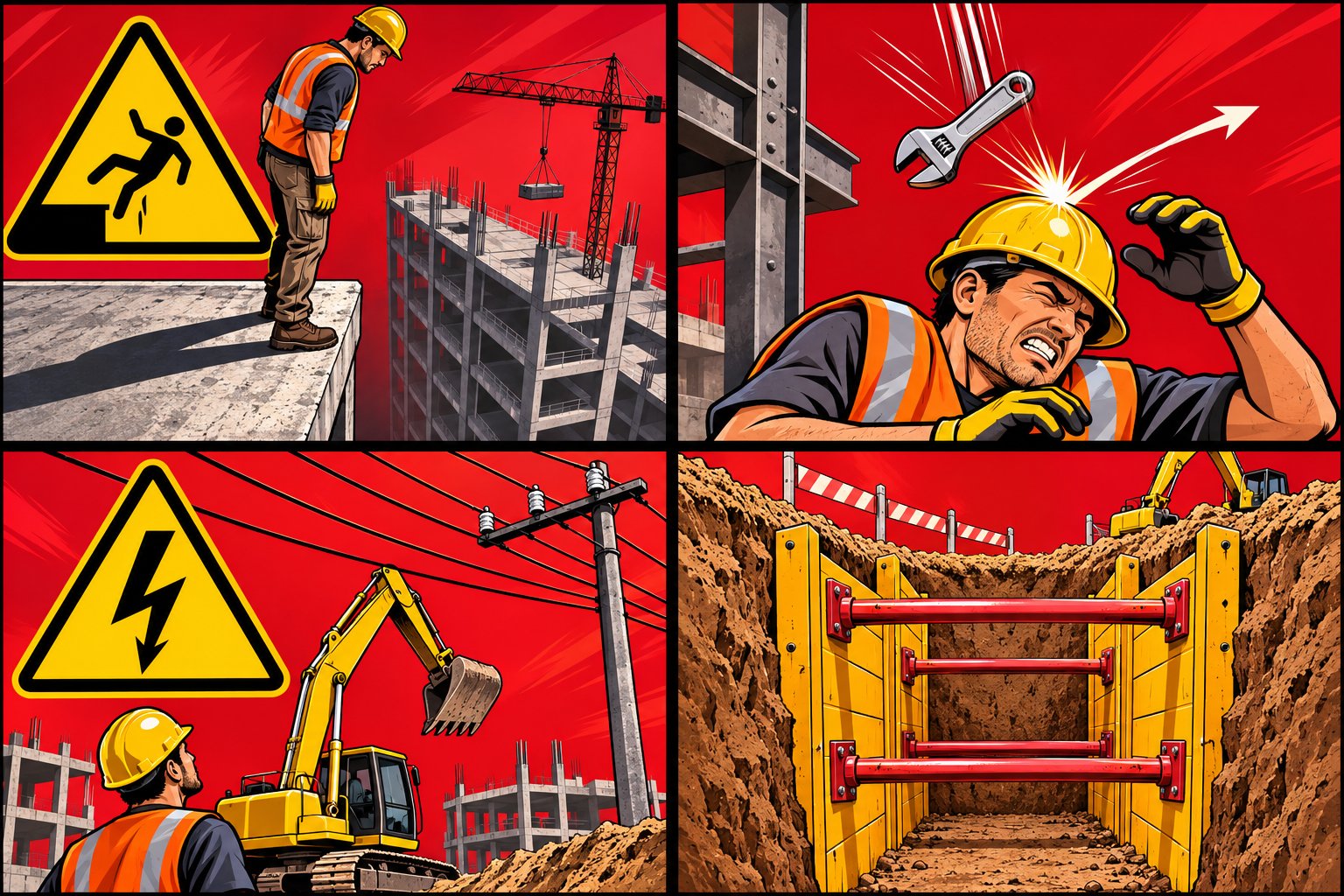
Six out of every ten construction deaths in the United States trace back to four causes. Not forty. Not fifteen. Four. OSHA calls them the Fatal Four - falls, struck-by incidents, electrocutions, and caught-in or caught-between accidents - and they form the backbone of every OSHA 10 and OSHA 30 construction course taught across the country. Bureau of Labor Statistics data published in 2026 confirmed that these four hazard categories together caused 644 of the 1,034 deaths in private U.S. construction in 2024. Understanding each one is not optional knowledge - it is survival literacy for anyone who steps onto a jobsite. Whether you hold a safety coordinator job or you are a first-year apprentice, this framework applies to you.
Falls From Elevation and How They Happen
Falls kill more construction workers than any other single cause. In 2024, falls to a lower level claimed 373 lives - more than a third of all construction fatalities. Picture a roofer stepping backward toward an unguarded edge. A scaffold plank that shifts underfoot. A ladder propped against soft ground that kicks out at the base. These are not freak accidents. They are predictable failures with preventable causes.
Roughly three out of four fatal falls in construction involve roofs, ladders, and scaffolds, according to CPWR research. The scenarios repeat themselves across jobsites nationwide: unprotected roof and floor edges, skylights left uncovered, scaffolding missing guardrails, and workers climbing ladders without maintaining three points of contact.
OSHA's fall protection standard for construction - 29 CFR 1926.501, part of Subpart M - sets a clear threshold. Any time a construction worker operates six feet or more above a lower level, the employer must provide fall protection. Three primary systems satisfy this requirement:
- Guardrail systems - Physical barriers installed along unprotected sides and edges to block falls before they start. Top rails must stand 42 inches above the walking surface, plus or minus 3 inches.
- Safety net systems - Nets installed below elevated work surfaces to catch falling workers. They must be positioned as close as practicable under the work area and never more than 30 feet below.
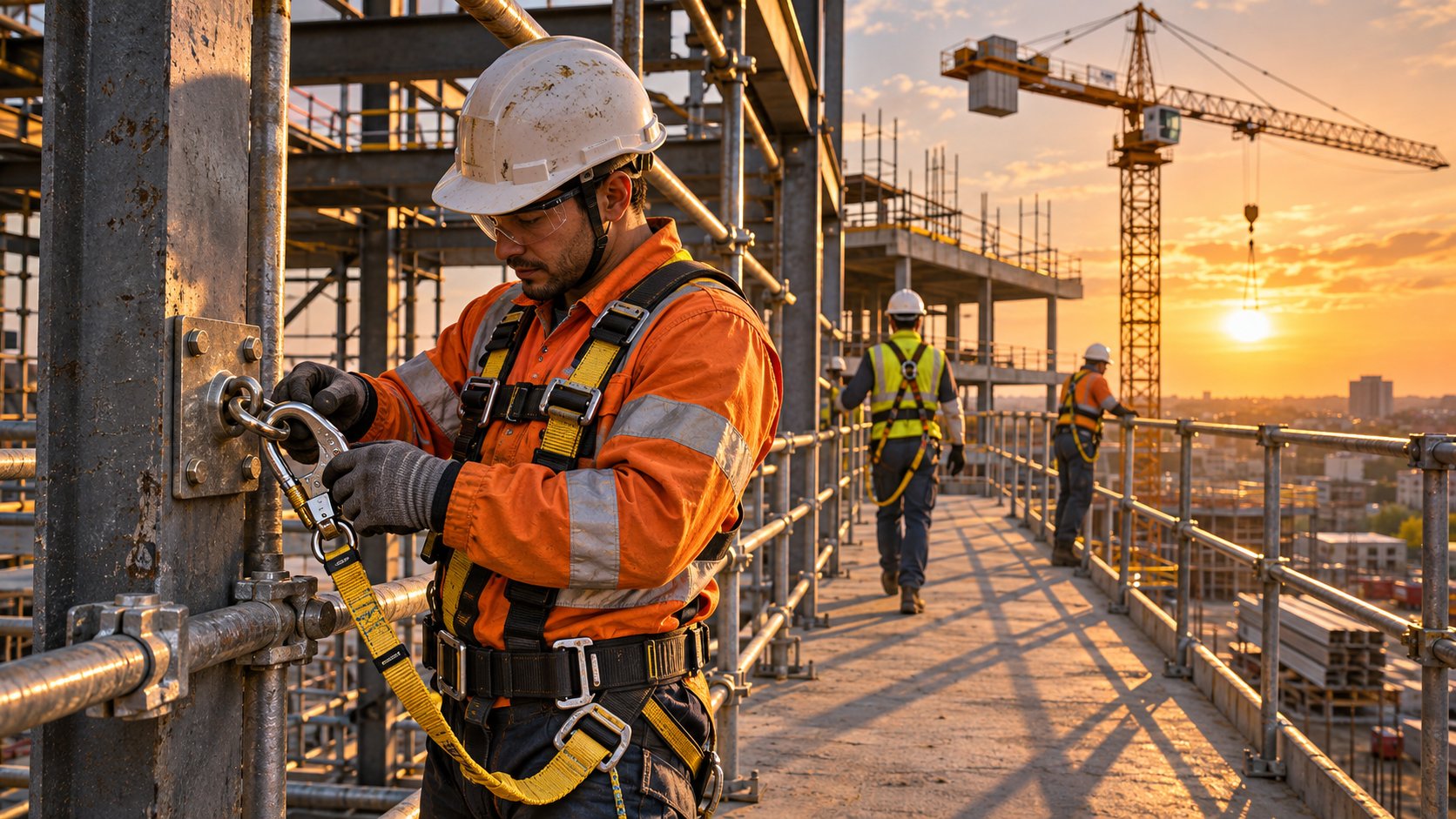
- Personal fall arrest systems - A full-body harness connected to an anchorage point through a lanyard or self-retracting lifeline, designed to stop a fall already in progress and limit the forces on the worker's body.
Missing fall protection remains the most frequently cited OSHA violation year after year. That statistic alone tells you the gap between what the standard requires and what actually happens on jobsites is enormous. A homeschool science curriculum teaches students to observe patterns and draw conclusions - this pattern is hard to miss.
Struck-By, Electrocution, and Caught-In-Between Hazards
Falls dominate the fatality numbers, but the remaining three of the Fatal Four are equally violent and equally preventable.
Struck-by hazards killed 163 construction workers in 2024. These incidents involve any object - flying, falling, swinging, or rolling - that impacts a worker with enough force to cause serious injury or death. Imagine a dump truck reversing without a functioning backup alarm, its operator blind to the worker crouched behind. Think about a wrench dropped from the eighth floor of a steel frame, accelerating to lethal velocity before it reaches ground level. Crane loads swinging in unexpected arcs, nail guns firing fragments, and loose materials sliding off elevated platforms all fall into this category. In 67 of those 163 fatalities, a vehicle struck a person on foot - and nearly half of those vehicle strikes happened in road work zones.
Prevention centers on separation: keeping workers on foot away from equipment operating zones, requiring spotters or functional reverse alarms on every vehicle with an obstructed rear view, securing tools with lanyards when working at height, and establishing controlled access zones around active crane operations. Hard hats, while essential, only reduce the severity - they do not eliminate the hazard itself.
Electrocution hazards caused 52 construction deaths in 2024. The scenarios are deceptively mundane. A crane boom drifts too close to an overhead power line. A worker plugs a power tool into a damaged extension cord on wet ground. Someone opens an energized electrical panel assuming the circuit was already de-energized. About three in four construction electrocutions between 2011 and 2015 involved either power line contact or live wiring in buildings, per CPWR findings. OSHA mandates that if any part of a crane or its load could come within 20 feet of a power line, the employer must either have the utility de-energize and ground the line, maintain at least a 20-foot clearance, or determine the exact voltage and maintain the specific minimum distance OSHA requires for that voltage class. For lines up to 50 kilovolts, that minimum is 10 feet. For lines over 350 kilovolts, the safe distance jumps to 50 feet.
Ground-fault circuit interrupters, double-insulated tools, proper grounding procedures, and lockout/tagout protocols form the core defense. Workers also need to treat every wire as live until proven otherwise - a mindset shift that prevents the assumption-based mistakes behind most electrical fatalities.
Caught-in or caught-between hazards accounted for 56 construction deaths in 2024, including 13 from trench and excavation collapses. These incidents happen when a worker is squeezed, crushed, or pinned between two objects - a collapsing trench wall, an unguarded rotating gear, a piece of heavy equipment pressing a person against a fixed structure. The distinction from struck-by matters: if a backing truck hits you, that is struck-by. If that same truck pins you against a concrete wall, that is caught-between.
Prevention requires trench protective systems - sloping, shoring, or shielding - for any excavation five feet or deeper, machine guarding on every exposed moving part, lockout/tagout before anyone services or clears equipment, and strict protocols that keep workers out of the space between mobile equipment and fixed objects. Science fiction tv shows dramatize workers trapped in collapsing structures for entertainment - on a real jobsite, there is nothing dramatic about it. It is fast, silent, and fatal.
Here is a quick-reference summary of all four hazards and their primary prevention measures:
- Falls - Workers drop to a lower level from unprotected edges, roofs, scaffolds, or ladders. Primary prevention: Install guardrails, safety nets, or personal fall arrest systems before work begins at six feet or above.
- Struck-by - Workers are hit by falling objects, swinging loads, or moving vehicles. Primary prevention: Separate foot traffic from equipment zones, secure tools at height, and require spotters or backup alarms on vehicles.
- Electrocution - Workers contact overhead power lines, exposed wiring, or damaged cords. Primary prevention: Maintain safe clearance distances from power lines, use GFCIs, and follow lockout/tagout procedures for all electrical work.
- Caught-in/between - Workers are crushed between objects, buried by trench collapses, or pulled into unguarded machinery. Primary prevention: Use trench protective systems, guard all moving machine parts, and enforce lockout/tagout before equipment service.
Every one of these 644 deaths in 2024 followed a known pattern. The hazards are documented. The prevention measures exist. The standards are written. Yet workers keep dying because the distance between knowing the rules and applying them consistently on every shift, at every elevation, around every piece of equipment, remains dangerously wide. Closing that distance starts with translating OSHA's regulatory language into plain, actionable guidance that supervisors, laborers, and contractors can put to work the moment they arrive on site.
Understanding OSHA Construction Regulations in Practice
Knowing that falls, struck-by incidents, electrocutions, and caught-in hazards kill hundreds of workers each year raises an immediate question: where are the rules that are supposed to prevent this? They exist - stacked inside 29 CFR 1926, OSHA's dedicated construction standard. The problem is not a lack of regulation. It is that the regulations read like they were written for attorneys, not for the site supervisor standing in a muddy excavation at 6:30 a.m. trying to figure out whether the trench needs shoring.
This section strips the legal language down to field-ready guidance. Think of it as translating social science research into everyday practice - taking complex institutional knowledge and making it usable for the people who actually need it most.
Key OSHA 1926 Subparts in Plain Language
The 29 CFR 1926 standard is organized into lettered subparts, each covering a specific hazard category or operational area. You do not need to memorize all of them - but you absolutely need to know the ones that apply to your daily work. The table below breaks down eight of the most critical subparts into plain language, along with who on the jobsite they apply to.
| Subpart | Topic | Core Requirement Summary | Who It Applies To |
|---|---|---|---|
| Subpart C | General Safety & Health Provisions | Employers must designate a competent person to conduct frequent jobsite inspections, ensure first aid is available, and provide saftey training for all employees exposed to hazards. | All employers and employees on construction sites |
| Subpart E | Personal Protective & Life Saving Equipment | Employers must provide and pay for all required PPE - hard hats, eye protection, fall harnesses, hearing protection - and ensure workers know how to use each item properly. | Every worker on site; employers bear the cost |
| Subpart K | Electrical Safety | All electrical installations and equipment must be grounded or double-insulated. GFCIs are required on temporary wiring. Safe clearance distances from overhead power lines must be maintained at all times. | Electricians, equipment operators, any worker near electrical sources |
| Subpart L | Scaffolding | Scaffolds must support at least four times their maximum intended load. A competent person must inspect scaffolding before every work shift and after any event that could affect structural integrity. | Scaffold erectors, workers on scaffolds, site supervisors |
| Subpart M | Fall Protection | Fall protection is mandatory when workers are exposed to a fall of six feet or more. Employers must choose guardrails, safety nets, or personal fall arrest systems based on the specific work situation. | Roofers, ironworkers, carpenters, anyone working at elevation |
| Subpart P | Excavations | Trenches five feet deep or more require a protective system - sloping, benching, shoring, or shielding - unless dug entirely in stable rock. A competent person must inspect excavations daily and after rain events. | Excavation crews, utility workers, site supervisors |
| Subpart CC | Cranes & Derricks | Operators must be certified. Ground conditions must support the crane's full load. A qualified rigger must attach loads, and a signal person must direct lifts when the operator cannot see the load throughout the operation. | Crane operators, riggers, signal persons, site managers |
| Subpart Z | Toxic & Hazardous Substances | Employers must control worker exposure to substances like silica dust, lead, asbestos, and cadmium through engineering controls, monitoring, medical surveillance, and respiratory protection programs. | Workers in demolition, abatement, concrete cutting, painting |
Notice a pattern? Nearly every subpart requires a competent person, demands employer-funded protections, and shifts the burden of hazard control upstream - away from the individual worker and toward the systems and leadership responsible for the site. That design is intentional. OSHA's framework recognizes that no amount of individual caution can compensate for a missing guardrail or an unshored trench wall.
Supervisors who use this table as a starting point can quickly identify which subparts govern their active work scopes each day. Pair it with daily toolbox talks or phone-based safety games that quiz crews on which protections apply to the day's tasks, and the standards start becoming second nature rather than dusty bookshelf references.
Employer Obligations and Worker Rights Under OSHA
Regulations only matter if someone is responsible for following them - and if someone else has the power to speak up when they are not. OSHA draws a sharp line between what employers must do and what workers are entitled to demand. Understanding both sides of that line is essential to define safe working conditions in practice, not just on paper.
What employers are required to do:
- Provide a hazard-free workplace. Under the General Duty Clause, every employer must keep the worksite free from recognized serious hazards - even those not yet covered by a specific OSHA standard.
- Conduct regular inspections. Employers must examine jobsite conditions to verify they conform to applicable OSHA standards. This is not a one-time walkthrough at project kickoff - it is an ongoing obligation that intensifies as conditions change.
- Maintain injury and illness records. Most construction employers with more than ten employees must log recordable injuries using OSHA Forms 300, 300A, and 301. These logs are not just administrative paperwork - they are the data set that reveals patterns, repeat hazards, and emerging risks across your projects.
- Train workers in a language they understand. This requirement goes beyond translating a handout into Spanish. If your crew includes workers who speak Mandarin, Haitian Creole, or any other language, safety training must be delivered in vocabulary and formats those workers can genuinely comprehend. Much like what is the science of reading teaches about literacy - decoding symbols means nothing if comprehension does not follow.
- Provide and pay for PPE. Hard hats, safety glasses, fall harnesses, gloves, hearing protection - OSHA mandates that employers supply all required protective equipment at no cost to workers.
- Report fatalities and severe injuries. A workplace death must be reported to OSHA within eight hours. Any in-patient hospitalization, amputation, or loss of an eye must be reported within twenty-four hours. Missing these deadlines can trigger additional citations and penalties.
OSHA's Safe and Sound initiative encourages employers to go further - implementing formal safety and health programs built on management leadership, worker participation, and a systematic approach to finding and fixing hazards before someone gets hurt.
What workers have the right to do:
Federal law does not just protect workers through employer obligations. It gives workers direct power to act. Every person on a construction site should know these rights exist:
- Request an OSHA inspection. Any worker can file a confidential complaint if they believe conditions are unsafe. Written, signed complaints submitted to an OSHA area office are more likely to trigger an on-site inspection.
- Access injury and exposure records. Workers have the legal right to review their employer's OSHA 300 logs and any records of their personal exposure to toxic substances or harmful physical agents.
- Refuse imminent-danger work. If a condition presents an immediate risk of death or serious physical harm and there is not enough time for OSHA to inspect, a worker may have the legal right to refuse the task - provided they have brought the concern to the employer's attention first.
- Protection from retaliation. It is illegal for an employer to fire, demote, transfer, or otherwise punish a worker for reporting safety concerns, filing a complaint, or participating in an OSHA inspection. Workers who experience retaliation can file a whistleblower complaint within 30 days.
- Participate in inspections. When an OSHA inspector arrives on site, workers and their representatives have the right to speak privately with the inspector before and after the inspection. A worker representative can accompany the inspector during the walkthrough.
Here is the critical takeaway that too many contractors overlook: these rights are not suggestions. They are federally enforceable protections. A worker who reports an unshored trench or a missing guardrail is not being difficult - they are exercising a legal right designed to keep everyone on that site alive. Supervisors who view worker complaints as adversarial rather than informational are building a culture of silence, and silence on a construction site is where fatalities hide.
Regulations and rights create the structural framework, but translating standards into daily practice requires someone on every jobsite with the knowledge to spot hazards and the authority to stop work immediately. That responsibility falls to a specific role OSHA defines in precise terms - and it carries far more weight than most people realize.
The Competent Person Role That OSHA Requires on Every Site
You have seen the phrase appear in nearly every subpart discussed so far - fall protection, scaffolding, excavations, cranes. OSHA does not just recommend that someone knowledgeable oversee hazardous work. It requires a specific role, defined in precise legal terms, on every construction site where workers face serious risks. Yet most people on a jobsite could not tell you exactly what that role demands. The true meaning for safety on any project hinges on whether this position is filled by the right person with the right power.
What Makes Someone a Competent Person Under OSHA
This is not rocket science in the abstract sense - but it is rigorous, and the consequences of getting it wrong are deadly. OSHA's definition, codified in 29 CFR 1926.32(f), spells out two non-negotiable requirements that must both be present in a single individual:
A competent person is one who is capable of identifying existing and predictable hazards in the surroundings or working conditions which are unsanitary, hazardous, or dangerous to employees, and who has authorization to take prompt corrective measures to eliminate them.
Read that definition carefully. It contains a two-part test, and failing either half disqualifies the person entirely:
- Technical knowledge. The individual must be able to recognize hazards - not just obvious ones, but predictable ones that a trained eye would catch before they materialize. This knowledge comes through formal training, field experience, or both. As OSHA's competent person guidance clarifies, the person must be "knowledgeable of applicable standards" and "capable of identifying workplace hazards relating to the specific operation."
- Managerial authority. Knowledge alone is not enough. The competent person must have the organizational power to take immediate corrective action - pulling workers off a scaffold, halting an excavation, shutting down a crane lift. If someone can spot a hazard but has to wait for a supervisor three levels up to approve a work stoppage, they do not meet OSHA's definition.
This distinction matters more than most contractors realize. A foreman who understands soil classification but cannot authorize trench evacuation is not a competent person for excavation work. A saf t ey-conscious laborer who flags hazards daily but lacks stop-work authority does not qualify either. Both halves must exist in the same individual, at the same time, for the same operation.
Competent Person Duties Across Different Construction Tasks
OSHA does not assign the competent person role as a blanket site title. The designation is task-specific and operation-specific. Someone competent for scaffolding inspection may not be competent for crane rigging evaluation - the knowledge domains are different, much like how materials science and structural engineering overlap but demand distinct expertise. Here are the core responsibilities a competent person carries across the most common high-hazard construction operations:
- Inspect scaffolding before each work shift and after any event - a rainstorm, a vehicle impact, a windstorm - that could compromise structural integrity. The competent person decides whether a scaffold is safe for workers to board.
- Evaluate excavation and trench soil conditions using visual and manual tests to classify soil type and determine the appropriate protective system - sloping, shoring, or shielding.
- Check crane rigging and load attachments before each lift, verifying that slings, shackles, and hardware are rated for the load and free of damage.
- Oversee fall protection systems by ensuring guardrails are installed at proper heights, anchorage points meet strength requirements, and personal fall arrest equipment is inspected and worn correctly.
- Monitor confined space entry conditions including atmospheric testing, ventilation, and rescue equipment availability.
- Stop work immediately when any condition presents an imminent danger to employees - no waiting for approval, no second-guessing, no compromise.
Each of these responsibilities must be documented. Written inspection records, daily checklists signed and dated by the competent person, and corrective action logs all serve as evidence that the designation is real and active - not just a name on a form. If OSHA investigates an incident, the first question will be: "Who was the competent person, and what did they document?"
It is also critical to distinguish this role from two others that sound similar but carry different weight. A qualified person, as defined in the same section of 29 CFR 1926.32, is someone who has demonstrated the ability to solve problems related to a specific subject through a recognized degree, certificate, professional standing, or extensive knowledge and experience. Think of an engineer who designs a crane lift plan or a professional who specializes in material science and certifies a scaffolding system's load capacity. The qualified person brings deep technical expertise but does not necessarily carry on-site authority to halt operations. A safety manager, meanwhile, typically oversees the broader safety program across an entire project or company - developing policies, conducting audits, managing training - but may not be present at the specific operation where a hazard emerges at 7:15 on a Tuesday morning.
The competent person fills the gap between design-level expertise and program-level oversight. They are the boots-on-the-ground decision-maker. If you are a site supervisor directing scaffold erection, evaluating a trench before your crew enters, or overseeing steel erection at height, you are likely acting as the competent person whether you realize it or not. Owning that designation means accepting that you carry both the technical duty to identify every hazard in your operation and the absolute authority to stop the work until it is corrected. No hill science diet of incremental half-measures satisfies this standard - either the hazard is eliminated or the work does not proceed.
Identifying hazards and stopping unsafe work are essential, but the competent person also needs to know exactly what protective equipment workers require for each task. That decision starts with understanding the full spectrum of PPE standards - and why selecting the wrong glove, hard hat, or harness can be just as dangerous as wearing nothing at all.
Personal Protective Equipment Essentials for Construction Crews
Selecting the wrong hard hat class for an electrical task or grabbing a pair of general-purpose gloves before handling caustic adhesive are mistakes that happen every day on jobsites across the country - and both can send a worker to the emergency room. The competent person may identify the hazard and stop the work, but the next step is making sure every crew member is wearing precisely the right gear for the specific threat in front of them. That means understanding PPE not as a single checklist item, but as a layered system organized by body region, hazard type, and the standard that governs each piece of equipment.
Head, Eye, and Hearing Protection Standards
Your head is the most vulnerable target on a construction site. Objects fall. Beams protrude. Electrical lines arc. That is why hard hats remain mandatory across virtually every active work zone - and why choosing the right one involves more than grabbing whatever is sitting on the truck dashboard.
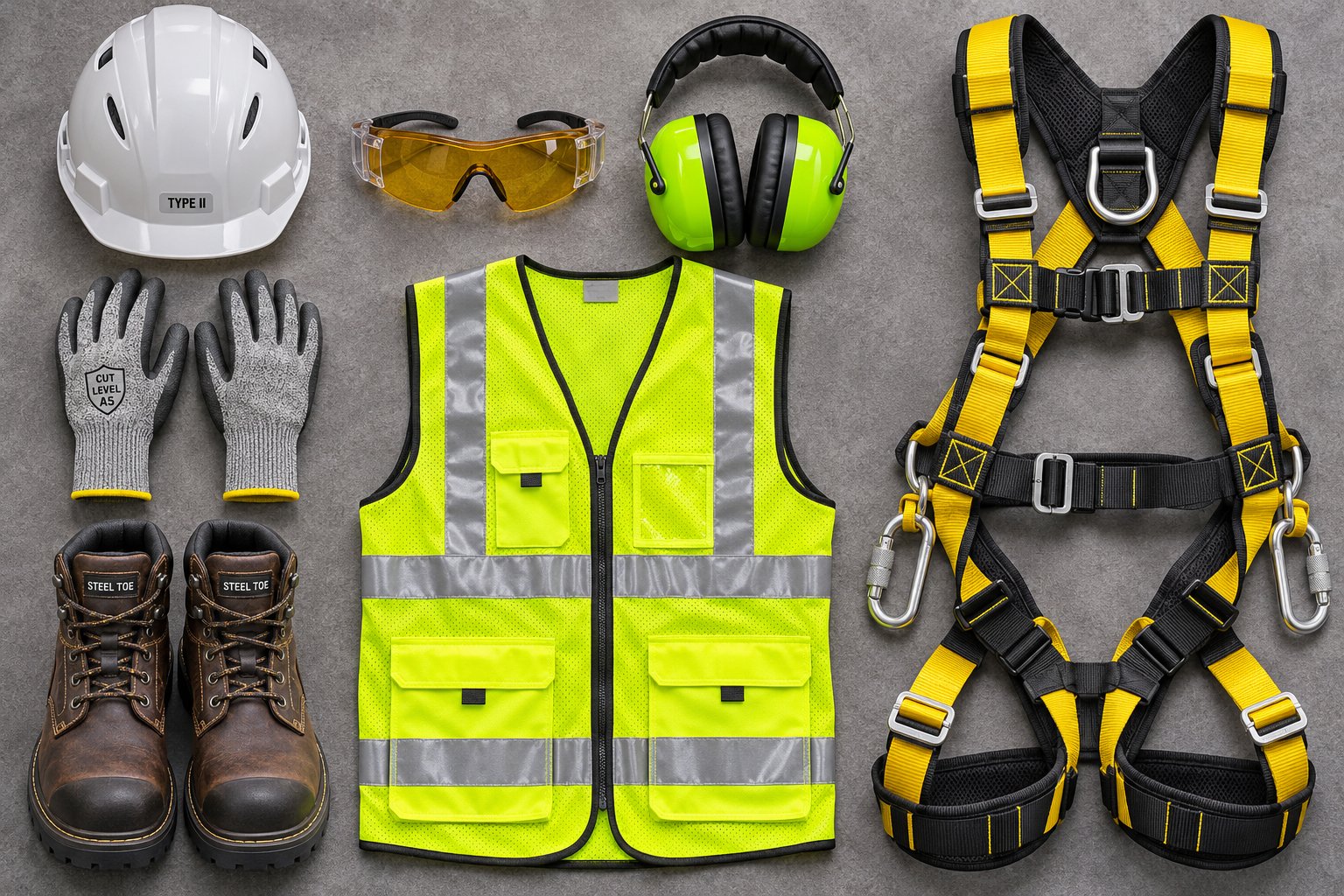
ANSI Z89.1 classifies hard hats along two axes: Type (impact coverage area) and Class (electrical protection level). Type I hard hats protect the top of the head, while Type II models extend protection to the sides as well - a critical upgrade for workers in tight mechanical rooms or congested steel erection zones where lateral impacts are common. On the electrical side, Class G (General) hard hats are rated for 2,200 volts, Class E (Electrical) for 20,000 volts, and Class C (Conductive) offers zero electrical protection. If your crew works anywhere near energized systems, Class C is never acceptable.
When are bump caps sufficient? Almost never on a construction site. Bump caps protect against minor scrapes and bumps in low-clearance areas but are not designed to withstand the impact forces or penetration hazards present in construction environments. OSHA's 29 CFR 1926.100 requires head protection that meets ANSI Z89.1 - and bump caps do not carry that certification.
Replacement schedules matter just as much as initial selection. A generally accepted industry practice is to replace the suspension system every twelve months and the shell itself every five years, though harsh chemical exposure, UV degradation, or any visible cracking, denting, or penetration triggers immediate replacement. If you squeeze the shell and hear creaking, it is already past its useful life.
Eye protection on construction sites must meet ANSI Z87.1 standards for high-impact resistance. Standard prescription eyeglasses do not qualify. Workers need safety glasses with side shields for general debris hazards, sealed goggles for dust-intensive tasks like concrete cutting, and face shields layered over goggles for chemical splash or grinding operations. Workers who need corrective lenses should look into prescription safety glasses Z87-rated - these combine vision correction with impact protection in a single frame, eliminating the temptation to skip eye protection because goggles do not fit over regular glasses.
Hearing protection enters the equation the moment jobsite noise reaches 85 decibels averaged over an eight-hour shift - roughly the volume of a circular saw running at arm's length. OSHA's construction noise standard, 29 CFR 1926.52, sets permissible exposure limits and requires employers to provide earplugs, earmuffs, or both when engineering controls cannot bring noise levels below the threshold. Jackhammers, pile drivers, and powder-actuated tools can exceed 100 decibels - at those levels, unprotected exposure causes permanent hearing damage in under fifteen minutes.
Hand, Foot, and Body Protection on the Jobsite
Hands are involved in virtually every construction task, which is why hand injuries account for a disproportionate share of recordable incidents. Glove selection is not one-size-fits-all. Cut-resistant gloves rated under ANSI/ISEA 105 protect workers handling sheet metal, rebar, and glass. Chemical-resistant gloves - nitrile, neoprene, or butyl rubber depending on the substance - are essential for anyone working with solvents, epoxies, or concrete admixtures. Impact-resistant gloves with dorsal padding shield the back of the hand from struck-by hazards in demolition and material handling. The key principle? Match the glove to the hazard, not the task title. A framing carpenter and a concrete finisher face entirely different hand risks even though both work on the same project.
Foot protection follows a similar logic of specificity. ASTM F2413 is the current U.S. performance standard for safety footwear, covering impact resistance (I), compression resistance (C), electrical hazard protection (EH), puncture resistance (PR), metatarsal protection (Mt), and - as of the 2024 revision - slip resistance (SR/SRO). Safety-toe options include steel, composite, and alloy, each carrying the same impact and compression rating under the current standard but differing in weight, thermal conductivity, and metal-detector compatibility. Composite toes are lighter and do not conduct cold, making them popular for outdoor winter work. Steel toes remain the most affordable and widely available option. Metatarsal guards become necessary when workers face crush or impact risks across the top of the foot - common in heavy material handling and steel erection.
OSHA finalized a rule effective January 13, 2025, amending 29 CFR 1926.95(c) to explicitly require that construction PPE, including footwear, "properly fits" each worker. A boot carrying the correct ASTM rating but worn in the wrong size does not satisfy the standard. Fit is now a compliance issue, not just a comfort preference.
High-visibility clothing follows ANSI/ISEA 107, which defines three performance classes based on the amount of background and retroreflective material. Class 1 provides minimum visibility for low-traffic environments. Class 2 adds more fluorescent material for workers near roadways or equipment traffic. Class 3 - full torso and limb coverage - is required for workers operating in high-speed traffic zones or low-light conditions. Dirty or faded vests lose their retroreflective performance, so regular replacement is not optional.
Fall protection harnesses were covered under Subpart M in earlier sections, but the PPE angle deserves emphasis: a harness that does not fit properly can cause suspension trauma in a post-fall scenario, cutting off blood flow to the legs within minutes. Annual inspection by a competent person, correct adjustment to the individual wearer, and compatible connectors rated for the worker's weight (including tools) are all non-negotiable.
Respiratory protection rounds out the body protection picture. Silica dust from concrete cutting, lead particles from demolition, paint fumes from coating applications, and oxygen-deficient atmospheres in confined spaces all demand specific respirator types. OSHA's respiratory protection standard, 29 CFR 1910.134, requires employers to establish a written respiratory protection program that includes medical evaluations, fit testing for tight-fitting respirators, proper cartridge selection, and training. Science ts - technical specifications - printed on respirator cartridges indicate which contaminants the filter is rated to handle. Using the wrong cartridge against the wrong substance offers zero protection while giving the wearer a dangerous false sense of security.
The table below organizes PPE requirements by body region for quick reference on the jobsite:
| Body Region | Hazard Type | Required PPE | Applicable Standard |
|---|---|---|---|
| Head | Falling objects, overhead impact, electrical contact | Hard hat (Type I or II; Class G, E, or C based on electrical exposure) | ANSI Z89.1 / OSHA 29 CFR 1926.100 |
| Eyes & Face | Flying debris, dust, chemical splash, radiant energy | Safety glasses, goggles, or face shields (impact-rated) | ANSI Z87.1 / OSHA 29 CFR 1926.102 |
| Ears | Noise exposure at or above 85 dB TWA | Earplugs, earmuffs, or dual protection | OSHA 29 CFR 1926.52 & 1926.101 |
| Hands | Cuts, punctures, chemical burns, impact | Cut-resistant, chemical-resistant, or impact-resistant gloves | ANSI/ISEA 105 / OSHA 29 CFR 1926.95 |
| Feet | Crushing, puncture, electrical hazard, slips | Safety-toe boots (steel, composite, or alloy) with EH and PR as needed | ASTM F2413 / OSHA 29 CFR 1926.96 |
| Body (visibility) | Struck-by from vehicles and mobile equipment | High-visibility vest or clothing (Class 1, 2, or 3) | ANSI/ISEA 107 |
| Body (falls) | Falls from elevation of six feet or more | Full-body harness with lanyard or self-retracting lifeline | OSHA 29 CFR 1926 Subpart M |
| Lungs | Silica dust, lead, paint fumes, oxygen-deficient atmospheres | Filtering facepiece, half-mask, or supplied-air respirator | OSHA 29 CFR 1910.134 |
Every item in this table addresses a specific, documented hazard - and every item sits at the bottom of the hierarchy of controls. That positioning is deliberate. PPE does not remove the danger. It only places a barrier between the worker and the hazard, and that barrier is only as reliable as the selection process, the fit, and the discipline to wear it consistently. Crafting science-based safety decisions means asking a harder question first: can the hazard be eliminated or engineered away before PPE even enters the conversation? Understanding how to apply that hierarchy on an active construction site - with real constraints, real budgets, and real deadlines - is where science definition speed meets practical field execution.
Applying the Hierarchy of Controls to Construction Hazards
The PPE table in the previous section covered every body region a worker needs to protect - but here is the uncomfortable truth that table does not tell you: if PPE is your primary defense strategy, your safety program is already working from the weakest position possible. A hard hat can reduce the severity of a struck-by impact. It cannot prevent the wrench from falling in the first place. That distinction is the entire foundation of the hierarchy of controls, and understanding how to apply it on an active construction site separates programs that react to injuries from programs that prevent them.
The hierarchy ranks hazard controls from most effective to least effective. The Canadian Centre for Occupational Health and Safety describes it as a step-by-step approach where you always start at the top and work down, applying as many layers as needed. Picture an inverted pyramid - the widest, strongest protection sits at the top, narrowing as you descend toward controls that depend increasingly on human behavior. Every credible safety framework in applied science and occupational health follows this same structure.
Elimination, Substitution, and Engineering Controls on Site
The top three tiers share a common advantage: they reduce or remove the hazard before it ever reaches a worker. No discipline required. No equipment to forget. The danger itself is addressed at its source.
Elimination means physically removing the hazard from the work environment. On a construction site, this looks like prefabricating roof trusses, wall panels, or mechanical assemblies at ground level instead of building them at height. If workers never climb to the roof edge, the fall hazard ceases to exist. Another example: designing a project so that no crane lift passes over occupied work areas. The safe definition of elimination is simple - if the hazard is gone, nobody can be hurt by it.
Substitution replaces a dangerous material or process with a less hazardous alternative. Imagine swapping solvent-based adhesives for water-based formulations that produce fewer toxic vapors. Or using synthetic grinding wheels instead of sandstone wheels that generate respirable silica dust. The CCOHS hierarchy guidance cautions that care must be taken to verify the substitute is genuinely less hazardous - replacing one danger with another equally harmful one defeats the purpose entirely.
Engineering controls isolate the worker from the hazard through physical means built into the work environment. These are the guardrail systems along open edges, the local exhaust ventilation hoods that capture silica dust at the saw blade before it reaches a worker's breathing zone, and the ground-fault circuit interrupters (GFCIs) installed on every temporary power outlet to cut the circuit in milliseconds if current leaks to ground. A GFCI functions as a safety switch that detects imbalances as small as 4 to 6 milliamps between the hot and neutral conductors - far below the threshold that causes electrocution - and interrupts the power supply before a lethal shock can occur. Unlike PPE, engineering controls work continuously without depending on whether someone remembered to put them on that morning.
Administrative Controls and Why PPE Is the Last Line of Defense
When elimination, substitution, and engineering solutions cannot fully address a hazard, administrative controls change how people interact with the remaining risk. These measures include:
- Job rotation to limit the duration any single worker is exposed to high-noise equipment, repetitive motions, or vibration-intensive tools.
- Safety signage and barricading to mark hazardous zones, overhead lift paths, and energized electrical panels.
- Toolbox talks - brief daily or task-specific safety briefings that keep crews aware of the day's highest-priority hazards.
- Lockout/tagout (LOTO) procedures for every task involving electrical, hydraulic, pneumatic, or mechanical energy sources.
Lockout/tagout deserves special emphasis because it bridges the gap between administrative protocols and life-or-death outcomes. OSHA's hazardous energy guidance is blunt: the unexpected startup or release of stored energy during maintenance can result in serious injury or death. Workers servicing equipment must de-energize the system, apply a physical lock to the energy isolation device, and attach a tag identifying who locked it out and why. No one removes that lock except the person who placed it. On construction sites, OSHA's Subpart K electrical standards reinforce these requirements - especially around temporary wiring, panel work, and any task that brings workers near energized circuits. Electricians, machine operators, and laborers performing maintenance all face these risks, making LOTO training essential across trades.
Electrical hazards extend beyond equipment service. Overhead power line clearance is a persistent danger for crane operators, concrete pump operators, and anyone maneuvering tall equipment or materials near transmission lines. As covered in the Fatal Four section, OSHA mandates a minimum 10-foot clearance from lines carrying up to 50 kilovolts, with greater distances required for higher voltages. Ground-fault protection through GFCIs or an assured equipment grounding conductor program is required on all 120-volt, single-phase, 15- and 20-ampere temporary receptacles on construction sites. These are not recommendations - they are enforceable standards under Subpart K.
Administrative controls are ranked lower in the hierarchy because they depend on consistent human execution. A posted sign only works if someone reads it. A LOTO procedure only protects if every step is followed every time. That reliance on behavior is exactly why these controls should supplement engineering solutions, not replace them.
PPE sits at the bottom of the pyramid for the same reason, amplified. A pair of goggles in science labs and on construction sites alike only protects the wearer if the goggles are the correct type for the hazard, properly fitted, and actually worn. Remove any one of those conditions and the protection vanishes. PPE does not make a jobsite is safe - it makes a worker slightly less vulnerable to hazards the site still contains. Research indexed across platforms like Web of Science consistently confirms that workplaces relying primarily on PPE experience higher injury rates than those investing in upstream controls.
Here is the full hierarchy applied to construction, from most effective to least effective:
- Elimination (Most Effective) - Prefabricate assemblies on the ground to remove the need for work at dangerous heights. If the hazard does not exist, no one gets hurt.
- Substitution - Replace solvent-based coatings with water-based alternatives to reduce toxic vapor exposure. Use electric-powered equipment instead of diesel to eliminate exhaust fumes in enclosed areas.
- Engineering Controls - Install permanent guardrails along open edges, deploy GFCIs on all temporary power circuits, and set up local exhaust ventilation at concrete cutting stations to capture silica at the source.
- Administrative Controls - Conduct daily toolbox talks, enforce lockout/tagout procedures before all equipment service, rotate workers off high-noise tasks to limit exposure duration, and post clear signage around electrical panels and crane swing zones.
- PPE (Least Effective) - Issue hard hats, safety glasses, hearing protection, fall harnesses, and respirators as the final protective layer - never as the first or only response to a hazard.
No single tier solves everything. The strongest construction site safety programs layer multiple controls together - engineering a guardrail system, posting warning signage around the remaining open areas, and requiring fall harnesses for tasks that the guardrail cannot fully protect. Think of it less like choosing one answer and more like building redundancy into every operation. The best science kits for kids teach the same principle: stack your protections so that if one fails, the next catches the risk.
Controlling known hazards through this hierarchy is essential, but construction sites face threats that no guardrail or lockout procedure can fully address. Lightning does not respect barricades. Extreme heat does not read warning signs. And when those uncontrollable forces arrive, the difference between a close call and a catastrophe depends entirely on whether the site has a tested emergency response plan ready to deploy.
Weather Hazards and Emergency Response Planning on Site
A guardrail stops a fall. A GFCI kills a faulty circuit. But what stops a heat index of 115 degrees from putting three workers into cardiac distress before lunch? What engineering control prevents a lightning bolt from striking a crane boom at 200 million volts? Some hazards cannot be eliminated, substituted, or engineered away - they arrive with the weather forecast, and the only viable response is preparation, recognition, and rapid action. Yet weather-related dangers and emergency planning remain two of the most neglected areas on active construction projects, rarely receiving the same attention as fall protection or electrical safety despite their capacity to kill just as quickly.
Heat Illness, Cold Stress, Lightning, and Wind Hazards
Heat-related illness kills more construction workers than most people realize. The body's core temperature rises, sweat production overwhelms hydration, and without intervention, heat exhaustion escalates to heat stroke - a life-threatening medical emergency where the body's internal thermostat fails entirely. OSHA's heat illness prevention guidance centers on three non-negotiable elements: water, rest, and shade. Employers must provide access to fresh, suitably cool drinking water free of charge, positioned as close to work areas as practicable. Cool-down rest areas - shaded or climate-controlled spaces maintained below 82 degrees Fahrenheit - must be available so workers can sit without being crowded. New employees and anyone returning after an absence face heightened risk during their first 14 days on the job, a period known as acclimatization, when the body has not yet adapted to sustained heat exposure. Supervisors must closely observe these workers and encourage preventative cool-down breaks rather than waiting for symptoms to appear.
When temperatures climb to 95 degrees Fahrenheit or higher, high-heat procedures kick in. These include mandatory buddy systems so no worker is left unmonitored, increased communication checks, and active reminders to drink water and take rest breaks. The definition of a safety program that truly protects workers in extreme heat is one that intervenes before symptoms begin - not after someone collapses on a concrete slab.
Cold weather brings its own set of dangers. Hypothermia sets in when the body loses heat faster than it can generate it, and the early warning signs - shivering, confusion, slurred speech, drowsiness - are easy to dismiss as minor discomfort. Frostbite attacks exposed skin, particularly fingers, toes, ears, and the nose, causing permanent tissue damage. Trench foot develops when feet remain wet and cold for extended periods inside waterlogged boots - a condition that sounds archaic but still sends construction workers to emergency rooms every winter. Wind chill amplifies all of these risks by accelerating heat loss from exposed skin.
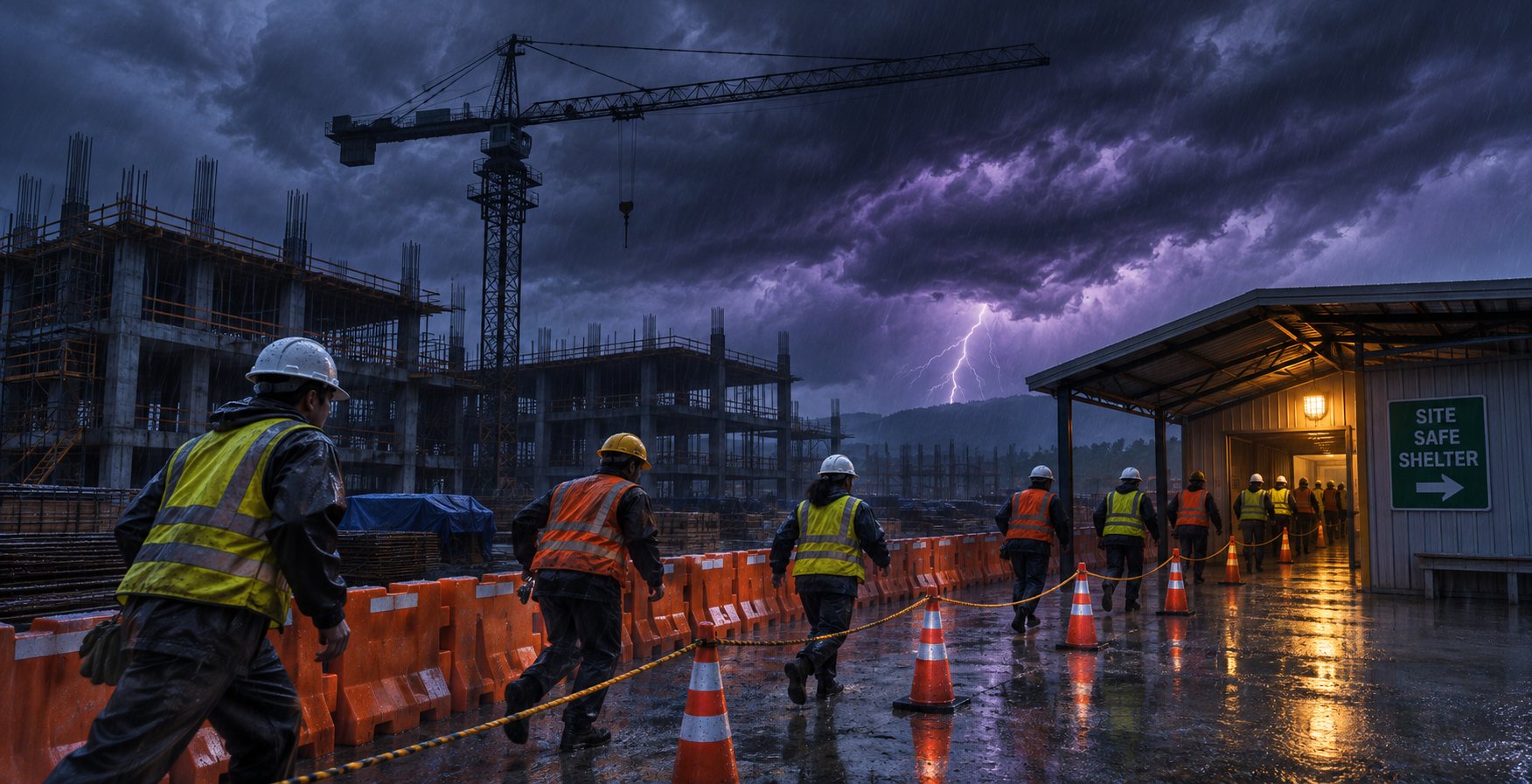
Lightning presents a sudden, violent hazard with almost no margin for error. The 30/30 rule provides a field-ready protocol: if the time between seeing a lightning flash and hearing thunder is 30 seconds or less, workers must immediately move to a substantial building or hard-topped vehicle. Outdoor work should not resume until 30 minutes after the last observed flash or thunder. Metal scaffolding, crane booms, safety railing systems, and steel structures all act as lightning attractors, making construction sites uniquely dangerous during electrical storms.
Wind speed thresholds govern whether certain operations can safely continue. Most crane manufacturers specify maximum operating wind speeds in their load charts - commonly 20 to 30 miles per hour, depending on the crane type, boom configuration, and load characteristics. OSHA does not set a single universal wind speed limit for cranes but requires operators to account for wind in every lift plan. For scaffolding, wind-driven debris becomes a struck-by hazard, and scaffold planks can be dislodged in sustained gusts. Safety barriers such as debris nets, toe boards, and windscreens reduce exposure but do not eliminate the need to suspend scaffold work when conditions deteriorate beyond safe thresholds.
Here are the critical weather warning signs every crew should recognize - and the required responses:
- Heat cramps or heavy sweating with dizziness - Move the worker to shade immediately, provide cool water, and monitor for worsening symptoms. Do not allow the person to return to work until fully recovered.
- Confusion, hot dry skin, or loss of consciousness (heat stroke) - Call 911 immediately. Cool the worker aggressively with water, ice, or wet towels. This is a medical emergency with a narrow survival window.
- Uncontrollable shivering, fumbling hands, or slurred speech (hypothermia) - Move the worker to a warm, dry area. Remove wet clothing, wrap in blankets, and provide warm (not hot) beverages. Seek medical attention if symptoms do not improve rapidly.
- White or grayish-yellow skin patches with numbness (frostbite) - Get the worker indoors. Do not rub affected areas or apply direct heat. Immerse in warm water (100-105 degrees Fahrenheit) and transport to medical care.
- Thunder heard within 30 seconds of a lightning flash - Halt all outdoor work immediately. Move all personnel away from metal structures, scaffolding, cranes, and open areas. Do not resume for 30 minutes after the last observed lightning or thunder.
- Sustained winds exceeding crane or scaffold operational limits - Suspend lifting operations and secure all loose materials. Workers on scaffolds must descend. Resume only after a competent person evaluates conditions and confirms it is safe.
The science of scaling a safety program to handle weather threats requires the same discipline as managing any other high-hazard operation: clear triggers, defined responses, and zero ambiguity about who makes the call to stop work. A site that shuts down a crane lift for lightning in the same decisive way it would halt an excavation for a cracked shoring brace is a site where weather hazards are treated with the seriousness they demand.
Emergency Action Plans and Incident Reporting Protocols
Weather events can trigger emergencies, but so can equipment failures, structural collapses, chemical releases, and medical crises. Every construction site needs a written emergency action plan that workers can execute under pressure - not a binder collecting dust inside a safety cabinet in the site trailer, but a living document that crews have rehearsed and can recall when adrenaline is running high.
OSHA's 29 CFR 1926.35 establishes the minimum elements every construction emergency action plan must include. The standard requires the plan to be in writing and to cover the designated actions employers and employees must take to ensure safety from fire and other emergencies. At minimum, the plan must address:
- Evacuation routes and assembly points - Clearly marked paths from every active work area to designated muster locations. Routes must account for the site's changing layout as construction progresses - a path that worked during foundation work may be blocked once framing begins.
- Alarm systems - The employer must establish an employee alarm system compliant with 29 CFR 1926.159. Air horns, sirens, or other audible signals must be distinct enough to be heard over heavy equipment noise across the entire site.
- Emergency contact lists - Posted at multiple visible locations and distributed to all supervisors. Include local fire, EMS, and hospital numbers, utility emergency contacts for gas and electrical shutoffs, the project safety manager, and the nearest OSHA area office.
- First aid provisions - At least one person trained in first aid and CPR must be present on site during all work hours. First aid kits must be accessible, stocked, and positioned relative to the hazards present - not locked in a trailer 500 feet from the work zone.
- Fire extinguisher placement - Extinguishers must be located within travel distances specified by OSHA based on the type of fire risk. Hot work operations like welding and cutting require a dedicated fire watch with an extinguisher within immediate reach.
- Medical emergency procedures - Step-by-step protocols for responding to traumatic injuries, cardiac events, chemical exposures, and falls from height. On remote sites, the plan must address extended EMS response times and identify the nearest trauma center capable of handling construction injuries.
Training is the mechanism that transforms a written plan into an executable response. OSHA requires employers to review the emergency action plan with every covered employee when the plan is first developed, whenever the employee's responsibilities under the plan change, and whenever the plan itself is modified. A plan that exists only on paper - never walked through, never drilled - is not a plan. It is a liability.
Beyond emergency response, incident reporting carries its own set of hard deadlines that no contractor can afford to miss. OSHA's reporting requirements apply to all employers under federal jurisdiction, including those normally exempt from routine recordkeeping due to company size or industry classification. The timelines are unforgiving:
Report any worker fatality to OSHA within 8 hours. Report any in-patient hospitalization, amputation, or loss of an eye within 24 hours. These deadlines run from the moment the employer learns of the event - not from the time of the incident itself.
Reports can be filed by calling the nearest OSHA area office during business hours, using the national hotline at 1-800-321-6742, or submitting an online Serious Event Reporting form. If the area office is closed, leaving a voicemail or sending an email does not satisfy the requirement - employers must use the 800 number or the online form. Failure to report within these windows can trigger additional citations and penalties on top of any violations related to the incident itself.
One nuance that trips up many contractors: OSHA defines in-patient hospitalization as formal admission to a hospital's in-patient service, not simply an emergency room visit. A worker treated and released from an ER does not trigger the 24-hour reporting obligation, but one admitted overnight for observation or surgery does. Similarly, a fatality that occurs within 30 days of a work-related incident is reportable, and a hospitalization, amputation, or eye loss occurring within 24 hours of the incident must be reported - even if the injury initially appeared minor.
Near-miss reporting sits outside OSHA's mandatory framework but represents one of the most powerful proactive tools available. A near-miss is any unplanned event that did not result in injury but had the potential to do so - a wrench that falls from scaffolding and lands inches from a worker's head, a trench wall that bulges visibly before anyone enters. Science pictures of accident scenes often reveal that the conditions present during a near-miss were identical to those present during a fatal incident; the only difference was timing or position. Organizations that track and investigate near-misses systematically - treating each one as the early warning signal it is - catch hazard patterns before those patterns produce casualties. Much like how computer science and engineering vs computer engineering debates focus on where theoretical knowledge meets applied problem-solving, near-miss analysis bridges the gap between what could happen and what your site actively prevents.
An emergency plan that your crew has rehearsed, weather protocols with clear stop-work triggers, and a reporting system that captures both incidents and near-misses create a safety net that no single piece of equipment can replicate. But the equipment itself still matters enormously. A crane with faulty brakes, an excavator with a cracked boom, or a loader missing its rollover protective structure can turn a routine operation into exactly the kind of emergency your plan was built to handle - which raises a critical question about how equipment condition directly shapes every safety outcome on your project.
Selecting and Maintaining Safe Heavy Equipment for Your Project
A crane with responsive brakes, a functioning backup alarm, and an intact rollover protective structure is a tool. The same crane with worn brake pads, a silent alarm, and a cracked ROPS frame is a weapon - one aimed at every worker within its operating radius. Equipment condition is not a maintenance issue that lives in a separate conversation from safety. It is a safety issue, full stop. Poorly maintained machinery is the direct mechanism behind struck-by fatalities, caught-in-between crushing injuries, and rollover deaths that show up in OSHA investigation reports year after year.
How Equipment Condition Impacts Jobsite Safety Outcomes
Think about the chain of failure. A hydraulic hose on a loader develops a slow leak over several shifts. Nobody documents it. The leak worsens until the boom drops unexpectedly while carrying a loaded bucket over a crew working below. That is a struck-by incident caused not by operator error but by deferred maintenance. Or picture a bulldozer with a faulty parking brake rolling backward on a grade - pinning a worker against a concrete barrier in a caught-between scenario that takes seconds to unfold and cannot be reversed.
The specific failure points that create the highest safety risks include:
- Worn brakes - Longer stopping distances, inability to hold position on grades, and complete brake failure under load. Brake condition on heavy equipment is not something you monitor casually - it is a daily inspection item with life-or-death consequences.
- Faulty hydraulics - Leaking hoses, degraded seals, and contaminated fluid cause unpredictable boom drops, bucket failures, and loss of steering control. Hydraulic problems rank among the most frequently reported findings across heavy equipment inspections industrywide.
- Cracked booms and structural defects - Stress fractures in boom arms, stick assemblies, and frame components can lead to catastrophic structural failure during lifting or digging operations.
- Missing or damaged guards - Exposed belts, gears, and rotating shafts create caught-in hazards for anyone working near the machine during service or operation.
- Inoperative backup alarms and cameras - A non-functional reverse alarm on a site with active foot traffic is not a minor inconvenience. It is the exact condition present in dozens of fatal struck-by incidents every year.
OSHA 29 CFR 1926.602 requires that earthmoving equipment be inspected at intervals established by the manufacturer and that all defects affecting safety be corrected before the equipment returns to service. This is not a suggestion buried in fine print - it is an enforceable standard. OSHA compliance for construction equipment means maintaining documented inspection records that show brakes, tires, hydraulics, lights, warning signals, and safety devices were checked and verified functional before every shift.
Pre-operation inspection checklists serve as the frontline defense. A structured walkthrough before each shift should cover fluid levels and visible leaks, tire or track condition, all lights and warning signals, brake responsiveness, hydraulic function across the full range of motion, and emergency stop controls. Operational safety checks must also verify that rollover protective structures (ROPS) are intact and that seat belts and safety harnesses function properly.
ROPS deserve particular attention because they represent the last barrier between an operator and a fatal rollover. A roll-over protective structure is a roll bar or cage frame designed to form a zone of protection around the operator during a tip-over event. Without a functioning ROPS, a rollover that might have been survivable becomes fatal - the operator is crushed beneath the machine's full weight. Falling object protective structures (FOPS) serve a parallel function, shielding the cab from debris, rocks, and materials that fall from above during loading or demolition operations. Any visible structural damage to ROPS or FOPS - cracks, bends, missing bolts, weld failures - requires immediate removal of the equipment from service. There is no definition for constant in science that better illustrates an unchanging rule than this one: compromised rollover protection means the machine does not operate. Period.
Evaluating Used Heavy Equipment Before It Reaches Your Site
Budget realities push many contractors toward used excavators, loaders, bulldozers, and graders - and there is nothing inherently wrong with that decision. Well-maintained used equipment can deliver thousands of productive hours at a fraction of new-equipment cost. The safety risk enters when buyers skip the evaluation steps that separate a sound machine from a liability on tracks.
Before any used piece of heavy equipment reaches your jobsite, verify the following:
- Structural integrity - Inspect the frame, boom, stick, and bucket for cracks, excessive wear, and previous weld repairs. Ask for ultrasonic or magnetic particle testing results on critical structural components if available.
- Safety device functionality - Test every safety system: ROPS and FOPS condition, backup alarms, horn, emergency stop, seat belt latches, lighting, and any installed camera systems. If a backup camera exists but produces a blurry or non-functional image, treat it as inoperative.
- Maintenance records - Request the machine's full service history. Consistent oil changes, filter replacements, hydraulic fluid analysis, and documented repairs indicate an owner who invested in upkeep. Gaps or missing records are red flags - not proof of neglect, but reason for deeper inspection. Just as you would review an hcl safety data sheet before allowing a chemical on your site, you need to review an equipment's documented history before allowing it into your fleet.
- Compliance with current standards - Verify the machine meets applicable OSHA 29 CFR 1926 and ANSI requirements. Older equipment may lack features now considered standard - ROPS, FOPS, or backup alarms that were not factory-installed on earlier model years. Retrofitting these safety systems is possible but adds cost and must be verified by a qualified technician.
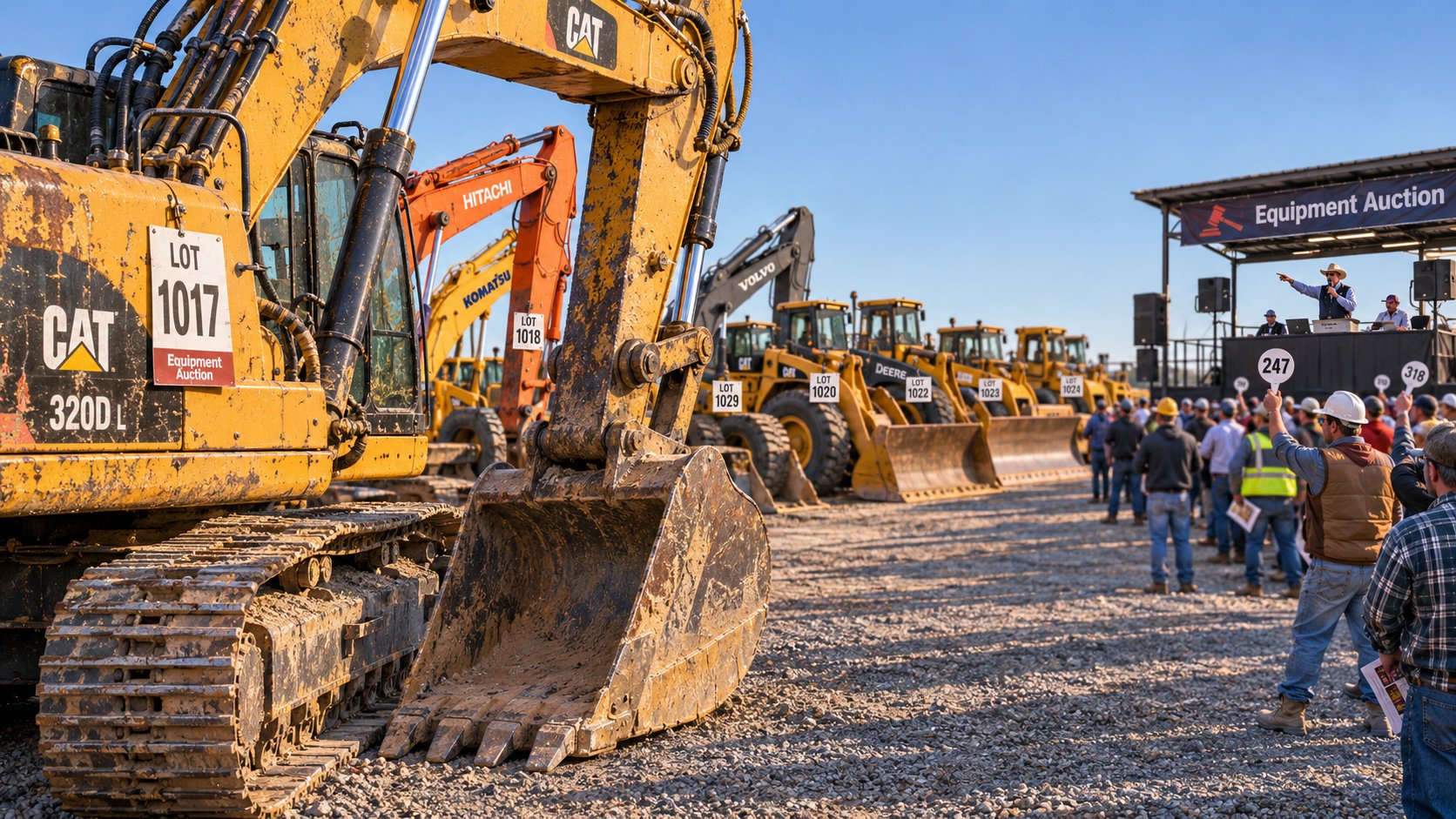
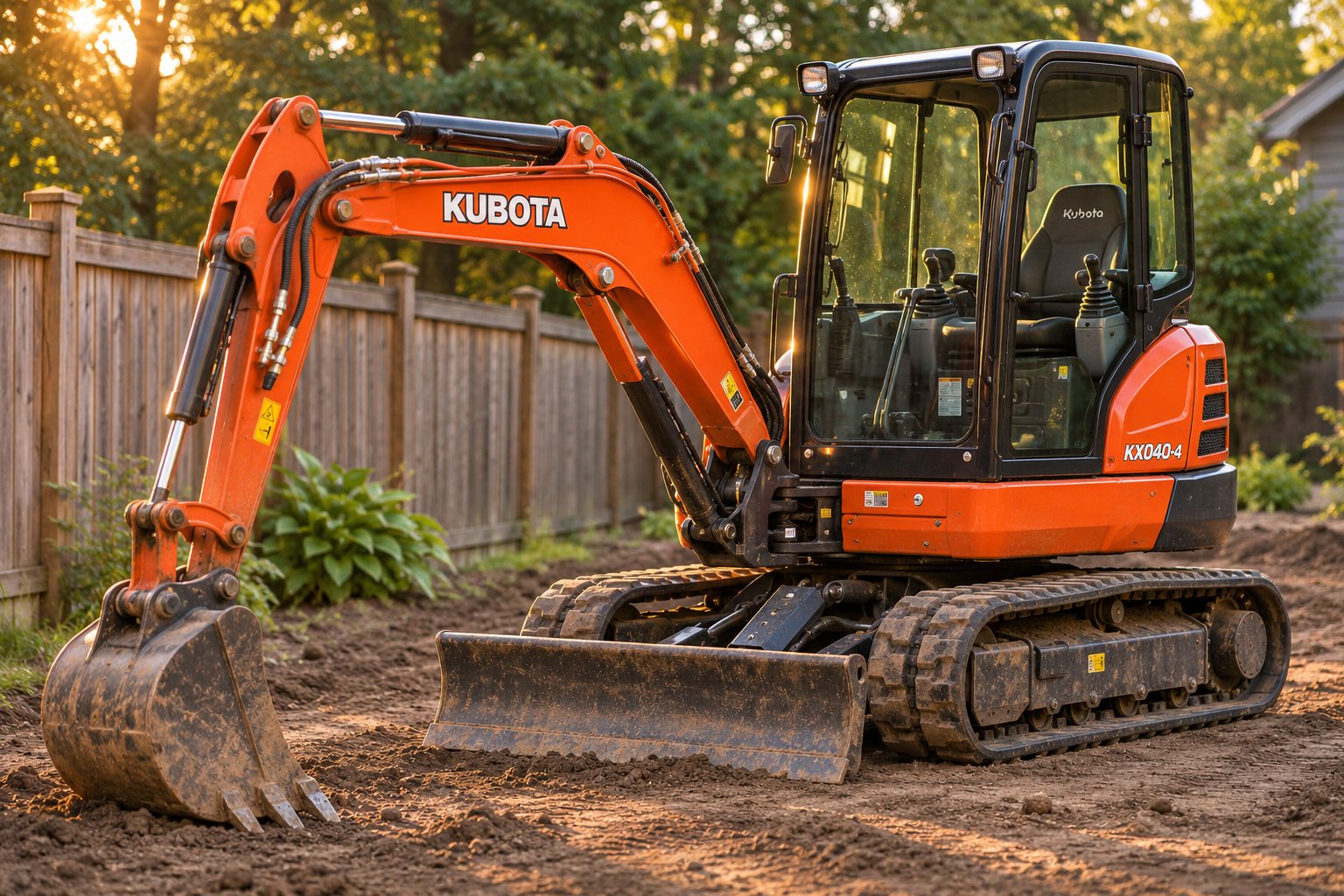
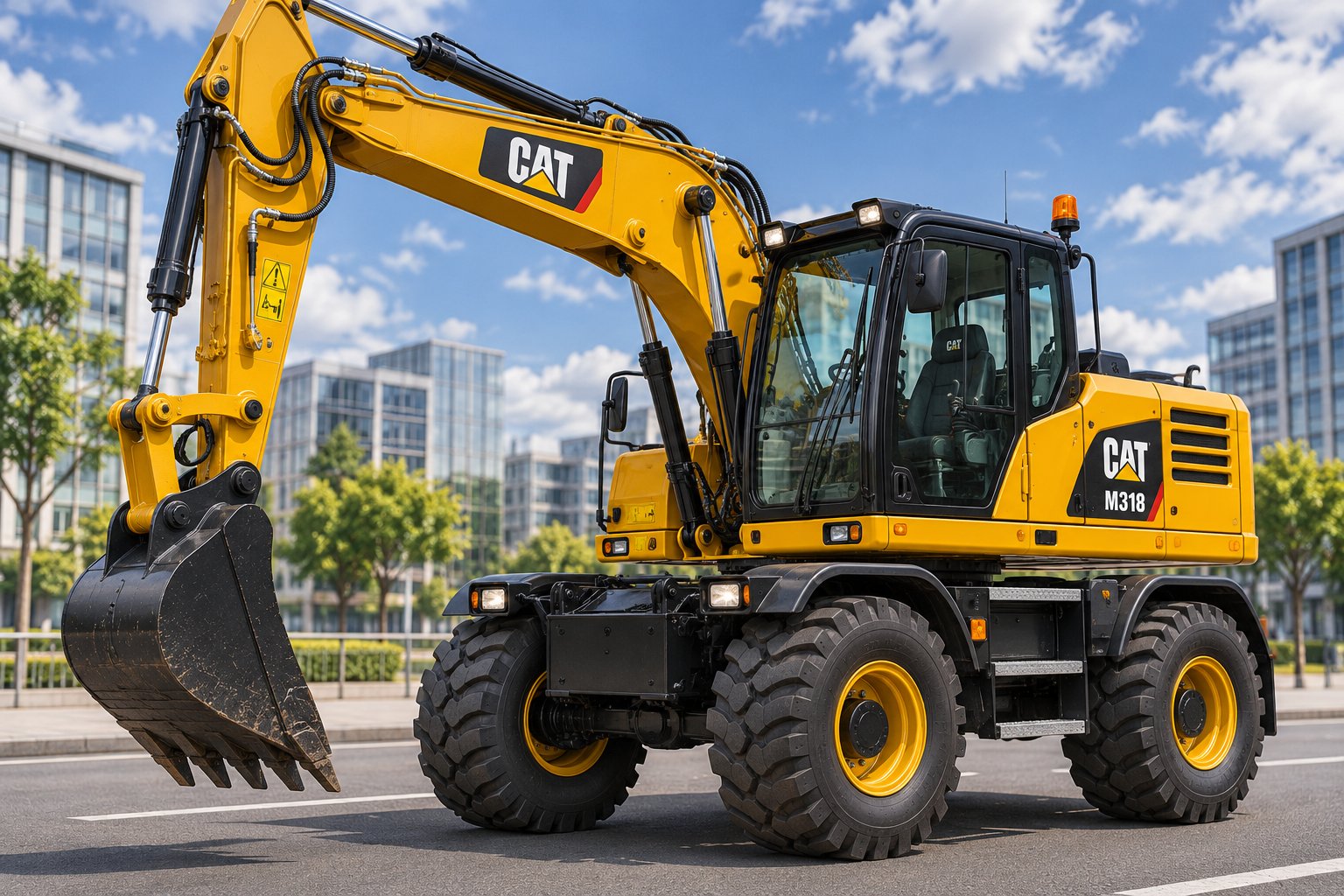
Suppliers who specialize in used construction machinery can streamline the comparison process. JIUHONG's used construction equipment collection, for example, allows contractors, fleet managers, and equipment dealers to compare excavators, loaders, bulldozers, and graders for upcoming projects and request purchase quotes - giving buyers a centralized starting point for evaluating available inventory. Regardless of where you source equipment, however, the critical safety synonym here is independence: every used machine should undergo an independent safety inspection by a qualified third party before it enters active service on your site. No supplier replaces your obligation to verify that the equipment meets your project's safety requirements firsthand.
Operators also play a role that extends beyond the purchase decision. A machine that passed inspection on delivery day can develop problems within weeks if operators skip daily checks or ignore early warning signs. Encourage a reporting culture where flagging a slow hydraulic leak or a sticky brake pedal is treated as valuable information - not as a complaint that takes equipment offline. Much like a solar powered oven science fair project teaches students that small design flaws compound into system failures under real conditions, a minor equipment defect left unreported compounds into a major safety hazard under the stress of daily construction operations.
Think of equipment safety as a chain with three links: proper evaluation before acquisition, rigorous daily inspection during operation, and immediate corrective action when defects surface. Remove any single link and the chain fails. Large safety pins hold fabric together under tension - these three practices hold your equipment safety program together under the daily pressure of production schedules and budget constraints. Skip the evaluation, rush the inspection, or defer the repair, and you are one hydraulic failure away from exactly the kind of emergency your action plan was built to handle.
Equipment in good condition and hazard controls properly layered still leave one variable that no checklist, standard, or inspection protocol can fully govern: the human element. Whether a worker reports that sticky brake pedal - or stays silent because speaking up feels like slowing down the crew - depends entirely on the culture a site's leadership has built around safety. And culture, unlike a hard hat or a guardrail, cannot be purchased, installed, or mandated into existence.
Building a Safety Culture That Goes Beyond Compliance
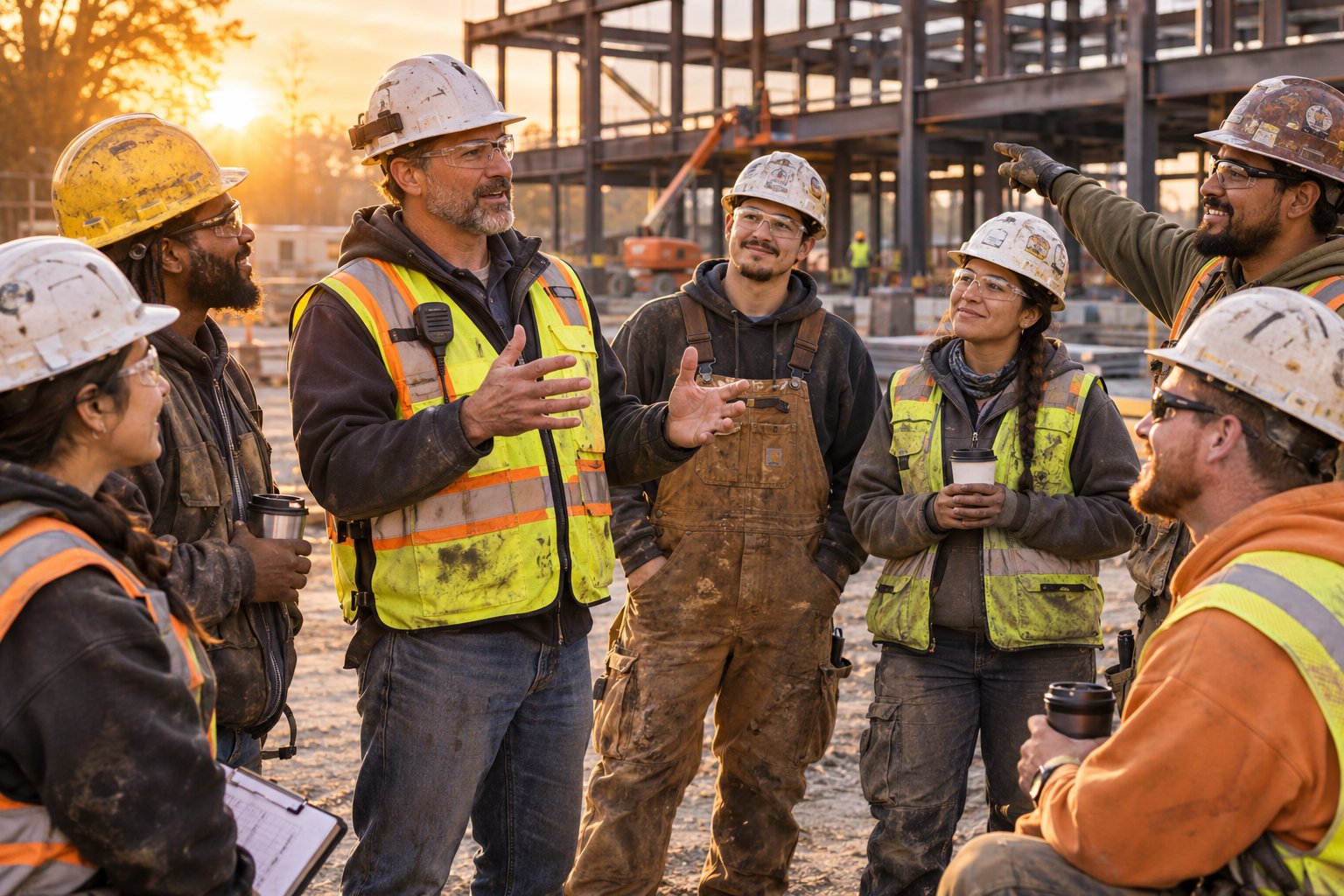
Culture is not a poster on the trailer wall. It is not a signed acknowledgment form in a binder. It is what your crew does at 6:45 a.m. when the superintendent is still in the parking lot and a loose guardrail is standing between a worker and a 30-foot drop. Does someone fix it? Report it? Walk past it? That answer - repeated across hundreds of small decisions every shift - reveals whether your jobsite has a safety culture or just a safety program. Every section of this article, from the Fatal Four to PPE selection to equipment evaluation, describes tools and standards that exist on paper. None of them deliver results unless the people holding those tools believe that safety is their personal responsibility.
Management Commitment as the Foundation of Safety Culture
Safety culture starts at the top. When project owners and site managers visibly prioritize worker protection through resource allocation, personal participation in safety walks, and zero-tolerance enforcement for violations, crews internalize safety as a core value rather than a bureaucratic burden. ABC Carolinas research puts it plainly: organizations that embed safety into their DNA - rather than treating it as a checkbox - create environments where workers go home safe and projects run more predictably.
What does visible commitment actually look like in practice? It looks like a project manager delaying a concrete pour until a fall protection gap is corrected - even when the ready-mix trucks are already on site. It looks like an executive reviewing safety metrics alongside revenue figures in the same quarterly meeting, with the same level of scrutiny. It looks like funding quality edge protection systems, modern harnesses, and sufficient safety staffing instead of stretching one coordinator across four projects. Workers observe these decisions constantly. When leadership invests time, money, and personal attention, the message is unmistakable. When leadership only talks about safety during audits, that message is equally clear.
Measuring whether your culture is actually improving - or just getting lucky - requires tracking the right data. Most contractors fixate on lagging indicators: Total Recordable Incident Rate (TRIR), Lost Time Incident Rate (LTIR), and Experience Modification Rate (EMR). These metrics matter, but they only tell you what already went wrong. A quarter with zero injuries might reflect excellent safety practices - or it might reflect favorable luck on a low-risk project phase. Safety performance research consistently shows that relying exclusively on lagging indicators creates a false sense of security.
Leading indicators predict future performance and give you the opportunity to intervene before someone gets hurt. These include near-miss report volume, training completion rates, safety observation submissions, corrective action closure speed, and pre-task plan quality scores. A spike in near-miss reports is not a sign of a dangerous site - it is a sign of a workforce that trusts the system enough to speak up. That trust is the clearest indicator of a healthy culture. Think of it this way: in ecology, what is a consumer in science? It is an organism that depends on other organisms for energy. In safety culture, every worker is a consumer of the environment leadership creates. Feed that environment with accountability and trust, and safety behaviors flourish. Starve it with indifference, and hazards multiply unchecked.
Empowering Workers to Own Safety on Every Shift
Management commitment sets the ceiling. Worker engagement determines whether the organization ever reaches it. Behavior-based safety recognition programs correlate with 20 to 50 percent reductions in recordable incident rates and a doubling of near-miss reporting - but only when the recognition targets proactive behaviors rather than simply rewarding low injury counts. Rewarding "no accidents" alone can actually suppress reporting, as workers hide minor injuries to preserve incentive eligibility. The goal is recognizing the everyday choices that make zero incidents possible: submitting a near-miss card that leads to a corrective action, conducting a thorough pre-lift meeting, or mentoring a new hire through their first lockout/tagout procedure.
Practical engagement goes beyond recognition programs. Daily toolbox talks tied to the shift's actual tasks - not recycled generic topics - keep hazard awareness fresh. Stop-work authority extended to every employee, including first-year apprentices, ensures that the person closest to the hazard has the power to halt the operation without waiting for a chain of approvals. Anonymous hazard reporting systems capture concerns that workers might hesitate to voice publicly, especially on sites where subcontractors fear losing their contract for raising issues. And mentorship pairing between experienced workers and new hires addresses the statistical reality that the first 90 days of employment represent a disproportionately high-risk period for injuries.
Much like how science for 5th graders projects teach students to observe, hypothesize, and test before drawing conclusions, a strong safety culture teaches every worker to observe conditions, assess risks, and act before an incident occurs. The parallel is not accidental - both require curiosity, a willingness to question assumptions, and an environment where asking "why" is encouraged rather than punished.
If you are a site supervisor ready to start shifting culture this week - not next quarter, not after the next incident - here are concrete steps you can implement immediately:
- Lead the first toolbox talk yourself. Do not delegate every session to the safety coordinator. When the superintendent personally runs a focused, task-specific safety briefing, it signals that safety is a leadership priority, not a staff function.
- Publicly reinforce stop-work decisions. The next time someone halts an operation for a safety concern, thank them in front of the crew. One visible moment of support does more for culture than a month of policy memos.
- Launch a simple near-miss reporting system. A stack of index cards in the break area, a shared text thread, or a basic digital form - the format matters less than the commitment to read every submission and respond within 48 hours.
- Pair every new hire with a safety-minded mentor. Choose mentors not for seniority alone, but for demonstrated safe work habits. Make the pairing formal, with a defined 90-day duration and check-in milestones.
- Track one leading indicator starting today. Pick near-miss report volume, toolbox talk participation, or corrective action closure rate. Review it weekly. Share trends with your crew so they see their input driving change.
- Walk the site with fresh eyes every morning. Before production starts, walk your work zones looking for hazards the way an OSHA inspector would - not the way someone who walks the same route every day does. Check that traffic safety cones are positioned correctly around vehicle paths, guardrails are secure, and signage is visible and current.
- Ask one open-ended safety question per day. "What is the biggest risk in your task today?" or "What would make this operation safer?" These questions cost nothing, take seconds, and communicate that you value the worker's perspective.
None of these steps require a budget increase, a new software platform, or executive approval. They require one thing: the decision to treat safety as something you do, not something you document. Every section of this article - the Fatal Four, OSHA regulations, the competent person role, PPE standards, the hierarchy of controls, weather preparedness, equipment evaluation - delivers its full value only when embedded within a culture where every person on site believes that going home safe is not negotiable, not optional, and not someone else's job. Stop checking boxes. Start building the kind of jobsite where no one has to wonder whether speaking up about a hazard will be welcomed or punished. That is the culture that saves lives.
Frequently Asked Questions About Construction Site Safety
1. What are OSHA's Fatal Four hazards in construction?
OSHA's Fatal Four are falls from elevation, struck-by incidents, electrocutions, and caught-in or caught-between accidents. Together, these four hazard categories accounted for 644 of the 1,034 deaths in private U.S. construction in 2024. Falls alone claimed 373 lives that year, making them the single deadliest hazard. Employers can address each one through specific measures: guardrails and fall arrest systems for falls, equipment separation zones and spotters for struck-by risks, GFCIs and lockout/tagout for electrocution prevention, and trench protective systems for caught-in/between hazards.
2. What is a competent person on a construction site?
Under OSHA's 29 CFR 1926.32(f), a competent person is an individual who can identify existing and predictable hazards in the work environment and who holds the authority to take prompt corrective action to eliminate them. This role requires both technical knowledge of applicable safety standards and the managerial power to stop work immediately when unsafe conditions arise. The designation is task-specific, meaning someone competent for scaffold inspection may not be competent for excavation soil classification. Proper documentation of inspections and corrective actions is essential to demonstrate that the role is actively fulfilled.
3. What PPE is required on a construction site?
Required PPE varies by hazard but typically includes ANSI Z89.1-rated hard hats for head protection, ANSI Z87.1-rated safety glasses or goggles for eye protection, hearing protection when noise exceeds 85 decibels over an eight-hour average, cut-resistant or chemical-resistant gloves matched to the specific hand hazard, ASTM F2413-rated safety-toe boots, high-visibility clothing per ANSI/ISEA 107, full-body harnesses for work at six feet or above, and appropriate respirators for dust or chemical exposure. Employers must provide and pay for all required PPE, and as of January 2025, OSHA explicitly requires that PPE properly fits each worker.
4. How does the hierarchy of controls apply to construction safety?
The hierarchy of controls ranks hazard mitigation strategies from most to least effective: elimination, substitution, engineering controls, administrative controls, and PPE. On construction sites, elimination might mean prefabricating assemblies at ground level to avoid work at height. Substitution could involve replacing solvent-based adhesives with less toxic water-based alternatives. Engineering controls include installing guardrails and GFCIs. Administrative controls cover toolbox talks, lockout/tagout procedures, and job rotation. PPE is always the last line of defense because it depends on correct selection, fit, and consistent use rather than removing the hazard itself.
5. What should a construction site emergency action plan include?
OSHA's 29 CFR 1926.35 requires every construction emergency action plan to include clearly marked evacuation routes and assembly points, an audible alarm system that can be heard over equipment noise, posted emergency contact lists for fire, EMS, and utilities, accessible first aid kits with at least one trained responder on site, properly placed fire extinguishers, and step-by-step medical emergency procedures. Employers must also report fatalities to OSHA within 8 hours and any hospitalization, amputation, or eye loss within 24 hours. Regularly rehearsing the plan with crews transforms it from a paper document into an executable response.