

What Are Cat Excavators and Who Relies on Them
Cat excavators are hydraulic digging machines manufactured by Caterpillar Inc., spanning a lineup from sub-2-ton mini models built for backyard landscaping all the way up to 100-ton mining-class giants designed for open-pit extraction. Caterpillar, headquartered in Irving, Texas, ranks among the world's largest heavy equipment manufacturers, backed by a global dealer network that reaches virtually every market where dirt gets moved.
So what actually makes an excavator an excavator? Picture three connected arms — a boom, a stick, and a bucket — mounted on a rotating platform called the house. That house sits on a tracked or wheeled undercarriage, giving the operator 360-degree swing capability from a single position. This fundamental design, sometimes called a trackhoe in everyday jobsite language, is what separates an excavator from other digging equipment and makes it one of the most versatile machines in construction. Caterpillar introduced its first customer-ready hydraulic excavator — the 225 — back in 1972, and the platform has evolved dramatically in the decades since.
This guide will decode Caterpillar's model numbering system, walk through every cat excavator size class from the smallest caterpillar mini excavator to the largest mining unit, translate spec-sheet jargon into plain English, compare Cat to competing brands, and help you match the right machine to your specific job. Whether you're pricing your first compact excavator and weighing models like the Cat 317 or evaluating a fleet addition in the 30-ton class, every section is designed to move you closer to a confident decision.
What Makes Cat Excavators Different From Other Heavy Equipment
One of the most common points of confusion — especially for first-time buyers — is the difference between an excavator and a backhoe loader. They look similar at a glance, but they serve different roles. A backhoe loader combines a loader bucket on the front with a smaller digging arm on the rear, and it travels on rubber tires. An excavator, by contrast, is a dedicated digging platform with a full-size boom and stick, a rotating upper structure, and typically a tracked undercarriage built for stability and reach. The excavator delivers greater dig depth, heavier lift capacity, and far more attachment versatility than a backhoe loader for focused excavation work.
You'll also hear excavators grouped alongside dozers, wheel loaders, and skid steers — but none of those machines offer the combination of deep digging capability, 360-degree rotation, and precision placement that defines an excavator. That's exactly why it remains the backbone machine on most construction sites.
Who Uses Cat Excavators and Why It Matters
The range of people who depend on these machines is remarkably broad. Owner-operators running single-machine businesses use compact models for residential trenching and landscaping. General contractors rely on mid-size units for commercial site prep and foundation excavation. Utility companies spec machines with auxiliary hydraulics for hydro-hammer and auger work. Municipal governments purchase fleets for storm drainage, road maintenance, and public works. Mining operations deploy the largest models for continuous loading cycles, and demolition crews outfit them with shears, processors, and grapples to dismantle structures safely.
Cat excavators cover more than 50 models across every weight class — from compact units that fit through a backyard gate to mining machines that load 100-ton haul trucks — making Caterpillar's excavator lineup one of the widest and most application-diverse in the heavy equipment industry.
Understanding which segment of that lineup matches your work is the real challenge — and it starts with learning how Caterpillar's model numbers actually work.
How to Read Cat Excavator Model Numbers
Every Cat excavator carries a model designation stamped on the side of the machine — a short string of numbers and letters that packs a surprising amount of information. The problem? Most buyers treat it like a random product code. A listing for a "320D" sits next to a "320GC," and both appear alongside a plain "320." Same base number, very different machines. If you're shopping for a cat mini excavator or a 40-ton workhorse, misreading the model designation can mean thousands of dollars in mismatched expectations.
Caterpillar's naming system follows a logic that, once you see it, becomes difficult to unsee. Here's how the caterpillar skeleton of every excavator model number breaks down.
Breaking Down the Cat Excavator Number System
Think of a Cat excavator model number as three distinct layers stacked together: a series prefix, size digits, and a generation or configuration suffix. Each layer tells you something different about the machine.
The first digit — "3" on almost every hydraulic excavator Caterpillar builds — identifies the product family. In Caterpillar's system, the 300 series is reserved for excavators, just as the "D" prefix marks dozers and the 900 series covers wheel loaders. The remaining digits within that series indicate relative size. A 308 is smaller than a 320, which is smaller than a 336. The higher the number climbs, the heavier and more powerful the machine. So when you see a Cat 309, you immediately know it sits near the compact end of the excavator lineup, while a 352 belongs in the large-machine class.
Letters and additional characters appended after the number reveal generation or special configuration details. For decades, Caterpillar used alphabetical suffixes — B, C, D, E — to mark successive generations. A 320B was the second generation, a 320C the third, and a 320D the fourth. According to Caterpillar's own product identity team, the company eventually moved away from series letters because some product lines were simply running out of alphabet after nearly a century of updates.
| Model Number Component | What It Indicates | Example |
|---|---|---|
| Series prefix (first digit) | Product family — "3" designates hydraulic excavators | 320, 336, 395 |
| Size digits (remaining numbers) | Relative size within the family — higher numbers mean larger, heavier machines | 308 (compact) vs. 336 (large) vs. 395 (mining-class) |
| Generation suffix (letter) | Older generations used B, C, D, E, F to denote iteration | 320D, 330F, 308E2 |
| No letter suffix | Current Next Gen models dropped the generation letter entirely | 320, 336, 395 |
| Configuration codes | Special designations — CR (Compact Radius), GC (value-focused), XE (premium efficiency) | 305CR, 320GC, 336XE |
The "GC" and "XE" designations deserve extra attention. Caterpillar describes GC models as focused-value offerings with reliability, low operating costs, and straightforward technology. XE models, by contrast, represent premium machines featuring the highest levels of technology, productivity, and fuel efficiency. Imagine trim levels on a truck — same platform, different equipment packages. The "CR" tag signals a compact radius design, meaning the tail of the excavator stays within or very close to the track width, which matters enormously on tight jobsites.
Why Model Generations Matter for Buyers
Here's where buyers most often stumble: assuming that two machines sharing the same base number are interchangeable. They aren't. A 308E2 and a 308B may both be "308" excavators, but they come from entirely different engineering eras. The E2 features updated hydraulics, a more efficient engine meeting stricter emissions standards, and a redesigned cab. The B-series machine predates most of those advances by over a decade. Similarly, a 305.5E2 is a meaningfully different excavator from a 305D — different operating weight, different dig performance, different technology.
Generational leaps between excavator models affect several factors that directly hit your wallet and productivity:
- Fuel efficiency — The Next Gen platform, first introduced on the 320 in 2017, delivered up to 30% reduction in CO2 emissions compared to the prior 320D, largely through a redesigned electro-hydraulic system and lower engine RPM.
- Cab technology — Newer generations introduced larger touchscreen monitors, integrated grade control readiness, and improved visibility, changing the operator experience entirely.
- Emissions compliance — Older B and C series machines pre-date Tier 4 emissions standards. D and E series machines introduced aftertreatment systems like diesel particulate filters. Some regions restrict the use of non-compliant machines, which can limit where an older model legally operates.
- Resale value — Next Gen units typically command a premium on the used market over older D or E series equivalents because of their technology and efficiency gains.
The takeaway is straightforward: never assume equivalence based on the base number alone. Whether you're comparing a caterpillar backhoe listing that turns out to be a backhoe loader versus an actual excavator, or sorting through three different "320" machines at different price points, the exact model designation — every digit, every letter — is what separates a smart purchase from an expensive lesson.
The numbering system gives you a roadmap, but the real question most buyers face next is more practical: which size class fits my actual work? That answer starts at the compact end of Caterpillar's lineup, where machines small enough to pass through a garden gate still pack serious digging capability.
Cat Mini Excavators for Compact Jobsites
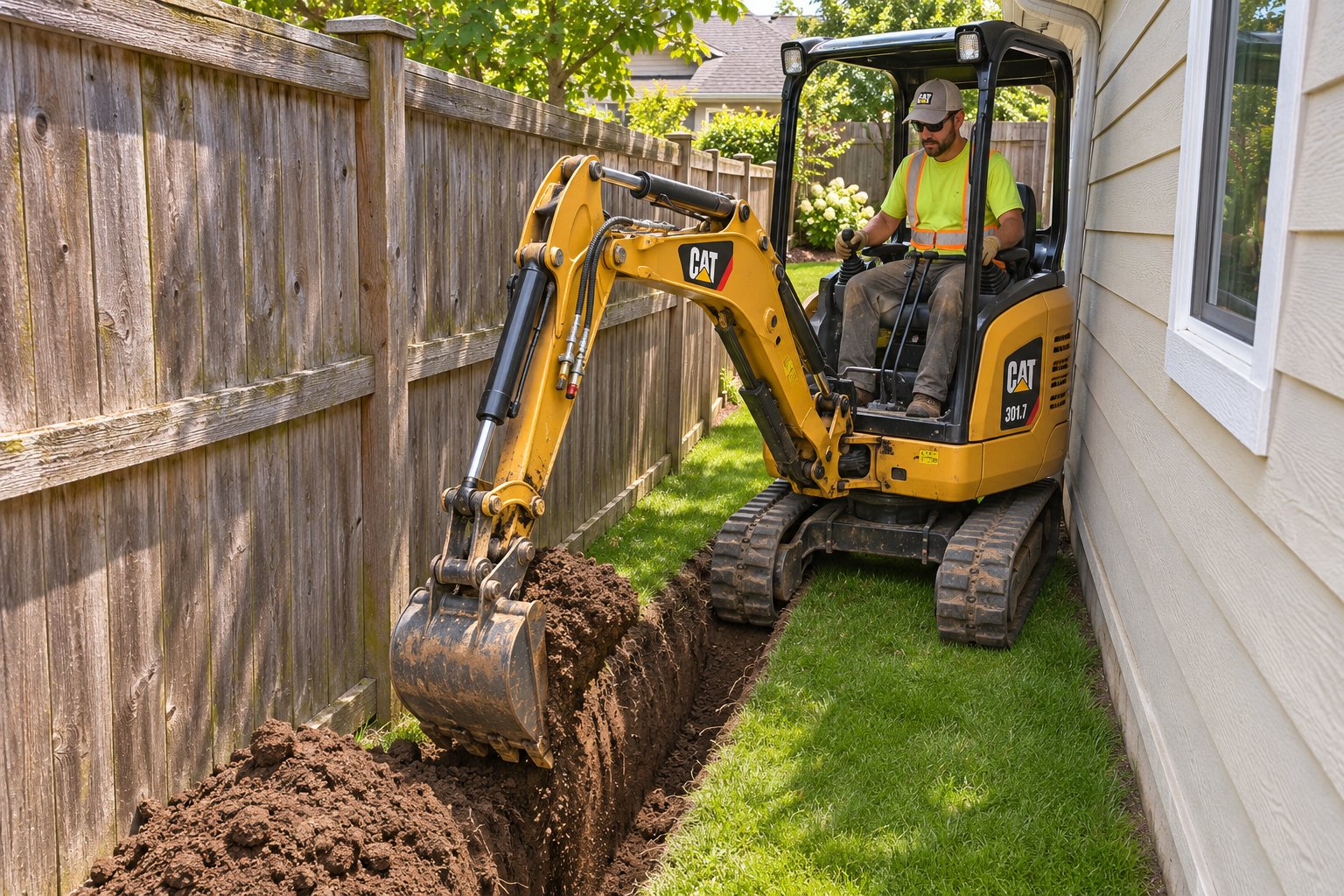
A backyard pool dig, a utility trench running two feet from a property fence, a foundation repair accessible only through a 36-inch gate — these are the jobs driving one of the fastest-growing segments in the heavy equipment market. Caterpillar's compact and mini excavator lineup, spanning roughly 2 to 10 metric tons of operating weight, has become the entry point for owner-operators and a daily workhorse for utility contractors and landscapers who need serious digging power in spaces where larger machines simply can't fit.
Several forces explain the surge. Urban infill construction keeps pushing projects onto tighter lots. Municipalities increasingly require trenchless or narrow-cut utility installations that minimize surface disruption. Landscaping has evolved from a wheelbarrow trade into a mechanized industry where a compact cat excavator pays for itself in weeks of hardscape and grading work. And for owner-operators, a mini excavator is often the most accessible first machine purchase — lower acquisition cost, towable on a standard equipment trailer, and versatile enough to handle multiple revenue streams from a single unit.
What separates machines within this compact class, beyond raw size, is how the upper house behaves when it rotates — and that distinction can make or break productivity on a confined site.
Understanding Tail Swing Configurations
Imagine swinging a Cat mini excavator's cab and counterweight through a full 360-degree rotation next to a block wall. On a conventional tail swing machine, the counterweight extends well beyond the width of the tracks during rotation, meaning the rear of the machine can strike anything within that arc — fences, parked vehicles, adjacent structures. On a zero tail swing design, the counterweight stays within the track footprint throughout the entire swing cycle, eliminating that collision risk. Compact radius (CR) models fall between these extremes, keeping the tail very close to or just within track width while retaining more counterweight mass than a true zero-swing unit.
The trade-off? Conventional machines generally deliver better stability on slopes and higher maximum lifting capacity because that extended counterweight provides greater leverage. Zero tail swing and CR models sacrifice some of that counterbalance for maneuverability. If your work regularly puts you alongside buildings, traffic lanes, or property lines, the CR or zero-swing configuration pays dividends in speed and safety. If you're operating on open terrain and need maximum dig depth and lift performance, conventional tail swing gives you the counterweight advantage.
Popular Cat Mini Excavator Models and Their Roles
Caterpillar's compact excavator lineup covers a wide band of capability. The table below maps the most common model series to their general weight class and typical applications.
| Model Series | Approximate Weight Class | Typical Applications | Notable Features |
|---|---|---|---|
| Cat 302 / 302.7 | ~5,500 – 6,100 lbs | Landscaping, small utility trenching, indoor demolition | Ultra-compact footprint; some models offer retractable undercarriage for narrow access |
| Cat 304 | ~8,650 – 9,870 lbs | Residential foundations, utility installation, light site work | Available in CR configuration; balances compactness with mid-range digging capability |
| Cat 305 / 305 CR | ~11,000 – 12,690 lbs | Pool excavation, commercial landscaping, sewer and water line trenching | E-Fence and Indicate grade software options; CR model keeps tail within track width |
| Cat 308 / 308 CR | ~18,000 – 18,500 lbs | Urban site prep, deep utility work, road shoulder excavation | New Cat C2.8 engine with maintenance-free aftertreatment; optional angle blade for backfilling |
| Cat 309 CR / 310 | ~21,000 – 23,000 lbs | Commercial construction, heavy utility, municipal projects | Standard rearview camera; third auxiliary hydraulic option for complex attachments |
A critical detail worth repeating: specific model variants within each series carry different specs, and the differences are not cosmetic. The Cat 305 CR produces 45 horsepower from a Cat C1.7 Turbo engine and weighs 12,688 pounds, while the Cat 308 CR jumps to 69.5 horsepower with the new Cat C2.8 engine at 18,493 pounds. A 305.5E2 from the prior generation is yet another machine entirely. Always verify the exact variant designation — every digit and suffix matters, as covered in the model number section above.
What Mini Excavator Weight and Dimensions Mean for Your Project
Caterpillar weights on compact excavators aren't just spec-sheet trivia — they dictate real logistical decisions that affect your budget before the machine ever breaks ground. Here's where those numbers connect to your daily operations.
Consider transport. A Cat 304, ranging from roughly 8,655 to 9,867 pounds depending on configuration, can typically ride on a standard bumper-pull equipment trailer rated at 15,500 lbs GVWR — the kind many contractors already own. Step up to the Cat 305 weight class at around 11,000 to 12,688 pounds, and you're pushing toward trailers rated at 20,000 lbs GVWR or higher once you factor in the trailer's own weight, a bucket, and attachments. The Cat 308 weight range near 18,500 pounds demands a heavy-duty equipment trailer and a tow vehicle rated to match. These aren't minor differences — they can mean the difference between using your existing pickup and trailer or needing a dedicated transport rig.
Ground pressure matters, too. A lighter machine like the 302 series can work on finished lawns, paver surfaces, and soft residential lots with minimal damage. Heavier compact models in the 308 and 309 range exert significantly more ground pressure, which may require plywood mats or ground protection on sensitive surfaces.
Then there's simple access. Can the machine physically fit through the opening? A zero tail swing or CR model that stays within its track width can operate inches from a fence line — something a conventional tail swing machine cannot safely do. Gate width, overhead clearance, and the ability to navigate between structures all become deciding factors on residential and urban utility jobs.
Before settling on a model, cross-reference these practical factors against your typical jobsite conditions:
- Transport weight — Confirm the machine's actual configured weight (including bucket, thumb, and any added counterweight) against your trailer's usable payload — not just its GVWR
- Tail swing radius — Determine whether your typical work environment demands CR, zero tail swing, or if conventional clearance is acceptable
- Dig depth — Match maximum dig depth to your most common task — residential basements, utility trenches, and foundation footings each have different depth requirements
- Auxiliary hydraulic flow — If you plan to run attachments like breakers, augers, or compactors, verify the machine offers adequate auxiliary flow and pressure, and check whether a second or third auxiliary circuit is available
- Blade configuration — An angle blade, now available on the 308 CR, adds backfilling capability that can eliminate a second machine on certain jobs
The compact end of Caterpillar's lineup proves that smaller machines carry big decisions. But the considerations shift substantially as you move into the mid-size and standard classes — machines like the Cat 320 and the cat 330 trackhoe range — where the jobs get larger, the transport logistics get heavier, and the production expectations jump dramatically. Even the cat 395 at the top of the lineup started as an engineering response to the same fundamental question these minis answer: how do you match machine capability precisely to the work at hand?
Mid-Size and Standard Cat Excavators That Drive Construction
Compact machines handle the tight spaces, and the largest excavators dominate quarries and mines — but the 13- to 40-ton range is where most commercial construction actually happens. Road cuts, commercial foundations, storm sewer installation, mass grading for subdivisions — these projects depend on mid-size and standard caterpillar excavator models that balance digging power, reach, and transportability in a single platform. This is also where Caterpillar's lineup is most densely packed with models, and for good reason: it reflects the sheer volume and variety of work that falls squarely within this weight band.
You'll notice that nearly every large-fleet contractor, highway builder, and site-development company runs at least one caterpillar tracked excavator in this class. Many run dozens. The combination of deep dig capability, attachment versatility, and enough mass to handle structural loads — without requiring oversize transport permits in most states — makes this segment the backbone of earthmoving worldwide.
The Cat 313 Through 326 Range — Versatile Mid-Size Machines
The mid-size band starts at the Cat 313 and climbs through the 315, 317, 320, 323, 325, and 326. Each step up adds operating weight, engine output, and usually a bit more dig depth and reach — but the jumps aren't always uniform, and the differences between adjacent models can be more nuanced than you'd expect.
The Cat 313 and Cat 315 slot into the lighter end of this range, typically serving utility-focused contractors and smaller commercial projects where the machine needs enough authority for trenching and foundation work but still travels on a standard lowboy trailer without special permits. The cat 315 weight — roughly 33,000 to 36,000 pounds depending on configuration — keeps it within a size that a single operator-driver setup can mobilize efficiently across multiple job sites in a single day.
Step up to the Cat 317, and you gain more bucket force and a heavier counterweight that improves lifting stability, making it a popular choice for pipe-laying crews and material-handling applications where precision placement matters. The Cat 320, however, occupies a category all its own. Ask any veteran equipment manager to name the most recognized caterpillar excavator model on the planet, and the 320 is almost certainly the answer. It serves as the industry benchmark — the machine other manufacturers design against and the one rental fleets stock in the highest numbers.
Caterpillar's Next Gen 320, introduced in 2017, marked a generational leap that reshaped what mid-size excavators could deliver. The redesigned electro-hydraulic system lowered engine speed while increasing pump displacement, cutting fuel consumption dramatically compared to the prior 320D. Standard integrated Cat Connect Technology — including 2D Grade, Payload on-the-go weighing, and E-Fence — moved features that used to be aftermarket add-ons into the factory cab. The result, according to Caterpillar, was up to a 30% reduction in CO2 emissions over the previous D-series generation.
The Cat 323, 325, and 326 round out this mid-size band with progressively more mass, engine power, and reach. The 326, for example, bridges the gap between a traditional 20-ton-class machine and the heavier 30-ton segment, giving contractors a single platform that handles commercial site prep, deep utility installation, and medium-scale demolition without jumping to a significantly larger — and more expensive to transport — machine.
Here's how these models compare across the mid-size band, using published specification data:
| Model | Approximate Operating Weight | General Dig Depth | Primary Use Cases |
|---|---|---|---|
| Cat 313 | ~30,400 lbs (13.8 metric tons) | ~18 ft | Utility trenching, light commercial site work, residential foundations |
| Cat 315 | ~33,200 – 36,200 lbs (15 – 16.4 t) | ~19 ft | Municipal projects, pipe installation, road shoulder work |
| Cat 317 | ~39,900 lbs (18.1 t) | ~19 ft 6 in | Heavier utility, material handling, commercial grading |
| Cat 320 / 320 GC | ~49,200 – 49,600 lbs (22.3 – 22.5 t) | ~21 ft 9 in | General construction benchmark, road building, commercial excavation |
| Cat 323 | ~54,900 lbs (24.9 t) | ~21 ft 9 in | Mid-scale commercial, structural foundations, mass grading |
| Cat 325 | ~62,800 lbs (28.5 t) | ~22 ft | Heavy commercial, bridge and highway substructure, deep utility |
| Cat 326 | ~57,900 lbs (26.3 t) | ~22 ft 5 in | Versatile commercial site prep, medium demolition, storm drainage |
A quick note on the 325 and 326: the 325 actually outweighs the 326, which can surprise buyers scanning spec sheets for the first time. The 325 carries a heavier counterweight and boom configuration optimized for lift capacity and stability, while the 326 prioritizes a longer front-end and deeper dig depth with a slightly lighter overall package. Choosing between them depends on whether your work demands maximum lifting authority or greater reach and versatility — not simply which number is higher.
The Cat 330 Through 340 Range — Heavy-Duty Standard Excavators
Cross the 30-ton threshold, and the character of these machines shifts. The Cat 330, 335, 336, and 340 occupy the upper end of the standard excavator class — machines that deliver large-excavator digging force and production rates while still falling within the general dimensions that most heavy-haul trailers can accommodate. This is the range contractors turn to for mass excavation, heavy utility installation, large commercial site preparation, and highway construction where cycle times and bucket payloads directly drive profitability.
The Cat 330 arrives in two tiers — the 330 GC and the standard 330. Following the same naming logic discussed earlier, the GC variant focuses on low cost-per-hour operation with 201 horsepower and a simplified technology package, while the standard 330 jumps to 273 horsepower and integrates the full Cat Connect suite. At roughly 67,900 to 69,200 pounds, both versions deliver approximately 23 feet 9 inches to 23 feet 10 inches of dig depth, making them staple machines on highway interchange projects and deep storm-water installations.
The Cat 335 pushes operating weight to approximately 77,000 pounds with the same 273-horsepower engine as the standard 330, but adds a longer, heavier undercarriage and more counterweight for improved stability during heavy lifting and slope work. The Cat 336 steps further still — at roughly 81,200 pounds with 300 horsepower — and this is where the lineup begins to feel genuinely powerful. The Next Gen 336 consumes up to 15% less fuel than previous models thanks to an intuitive Smart Mode feature that matches engine and hydraulic output to actual dig conditions, reducing engine speed when hydraulic demand drops. Maintenance costs drop by an estimated 15% as well, with extended and synchronized service intervals, doubled air filter dust-holding capacity, and an additional 1,000 hours on hydraulic return filter life.
At the top of this standard band, the Cat 340 delivers 346 horsepower and approximately 83,100 pounds of operating weight in its standard configuration, with specialized variants — including a straight boom, long reach, and ultra-high-demolition (UHD) configuration — pushing well past 88,000 to nearly 121,000 pounds. The 340's reinforced frame and wide undercarriage give it the structural rigidity needed for continuous heavy-duty loading cycles, making it a common pairing with articulated dump trucks on large earthmoving projects.
Transport logistics become a real planning factor at these weights. A Cat 336 at 81,200 pounds is pushing into the range where some states require overweight permits for highway transport. The Cat 340 in its heavier configurations almost certainly does. That means factoring permit lead times, route restrictions, and escort vehicle requirements into every mobilization — costs that directly affect your project budget and scheduling flexibility.
The generational differences in this range matter just as much as they do in the mid-size band. Older D-series machines like the 330D and 336D used a traditional pilot-operated hydraulic system. The Next Gen replacements introduced an electrohydraulic main control valve that eliminates pilot lines, reduces oil consumption, and enables electronic features like grade assist, payload monitoring, and E-Fence that simply weren't possible on the prior architecture. If you're evaluating cat excavators for sale in this class on the used market, a Next Gen 336 and a 336D may carry the same base number, but they're fundamentally different machines in hydraulic efficiency, technology capability, and long-term operating cost.
The cat 352 picks up right where the 340 range leaves off, bridging into the large-excavator class — a segment where machine scale, transport complexity, and production expectations escalate dramatically. That transition from standard to large is more than a weight jump; it's a shift into an entirely different operational philosophy.
Large and Mining-Class Cat Excavators
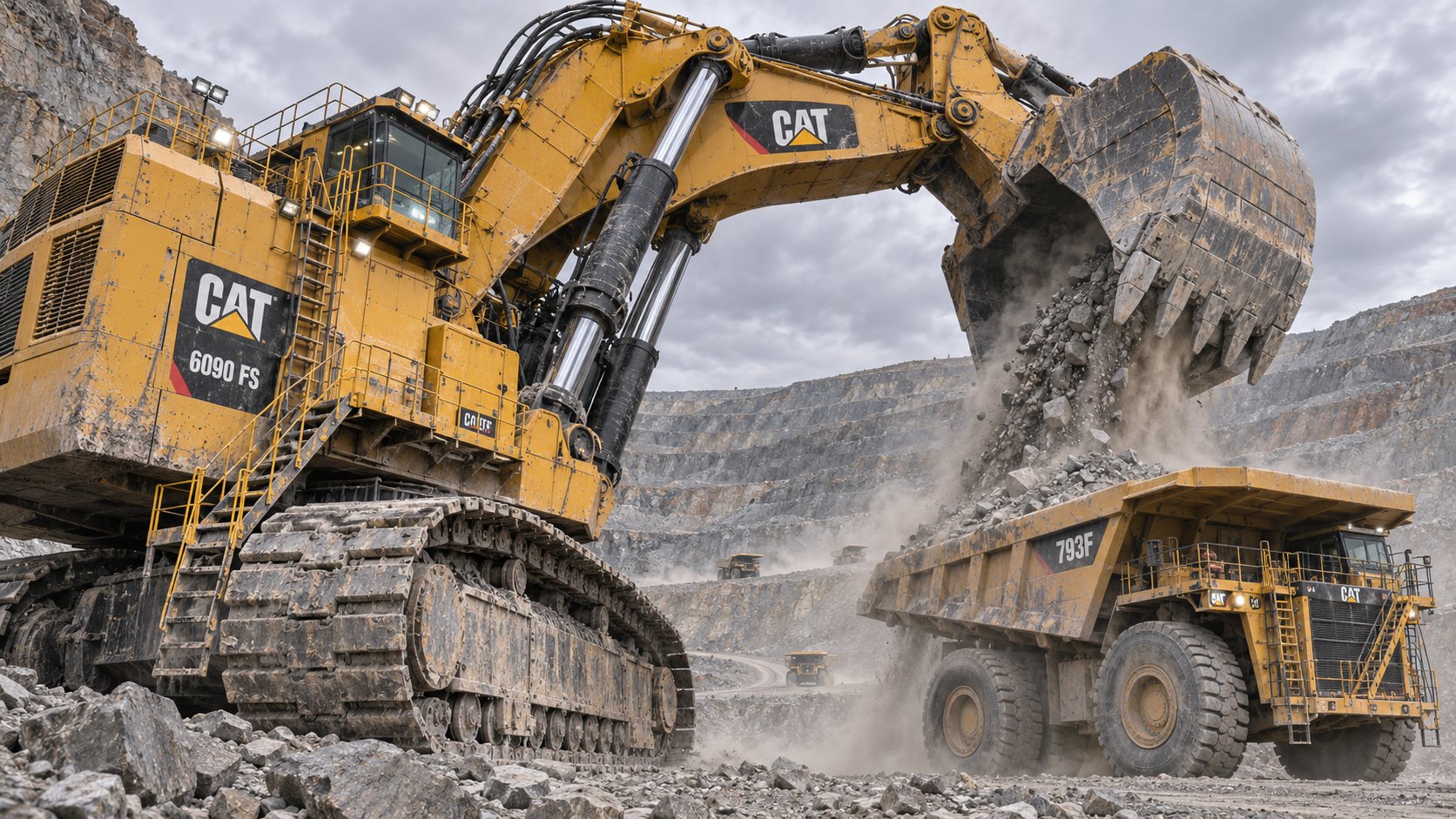
A Cat 340 at 83,000 pounds already demands overweight permits in many states. Scale that up to 100,000 pounds, then 160,000, then over 200,000 — and you're not just dealing with a bigger machine. You're operating in a fundamentally different world. Caterpillar large excavators, ranging from roughly 45 tons to well over 90 tons, serve markets where daily production is measured in thousands of tons of material moved, where haul trucks line up in rotation, and where the cost of a single hour of downtime can exceed what a mid-size machine earns in a week.
These aren't the machines you see on a commercial building pad or a residential subdivision. Open-pit mining, large-scale quarry operations, major highway and dam construction, deep foundation work for skyscrapers, and heavy structural demolition — that's the territory. The operators who run them are specialists. The support infrastructure — fuel trucks, service rigs, dedicated mechanics — travels with the machine. And the purchasing decisions behind them involve production modeling, fleet integration analysis, and total cost calculations that go far beyond comparing a spec sheet.
If you've followed the progression from the compact end of Caterpillar's lineup through the mid-size band — from a cat 315 trackhoe trenching utility lines to a 336 loading trucks on a highway cut — you've already seen how each size jump brings new logistical considerations. The large-excavator class amplifies every one of those considerations by an order of magnitude.
Large Cat Excavators From the 349 to the 395
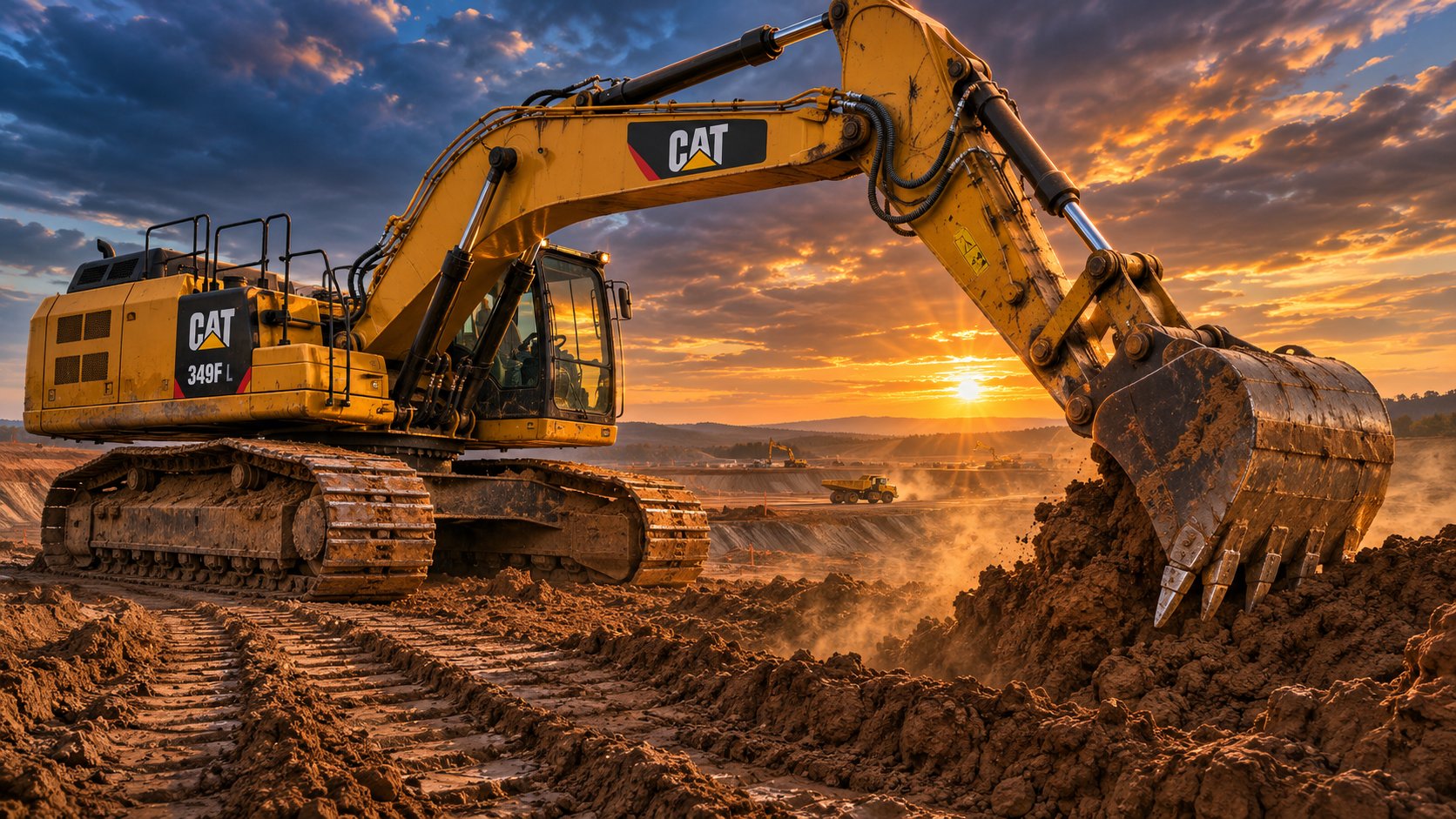
Caterpillar's large excavator lineup currently spans several models that cover a dramatic range of capability. The Cat 349 and Cat 350 anchor the entry point of this class, offering the step up from standard machines for contractors who need more bucket payload and deeper reach without jumping to a true mining-scale unit. The cat 349 delivers roughly 105,000 pounds of operating weight — heavy enough for sustained mass excavation but still within the range that experienced heavy-haul operators can mobilize regionally.
The Cat 352, 374, and 395 represent Caterpillar's Next Generation large excavators, launched with Stage 5 engines and reinforced structures designed to handle increased machine performance across heavy-duty cycles. The Cat 352 weighs in at approximately 50.1 metric tons (around 107,800 pounds) and runs a 425-horsepower Cat C13 engine, delivering a maximum dig depth of about 23 feet and a reach at ground level of roughly 37 feet with its standard boom and stick configuration. The Cat 374 jumps to 71.7 metric tons (approximately 162,900 pounds) powered by a 485-horsepower Cat C15 engine, pushing dig depth past 28 feet and ground-level reach beyond 43 feet. And the Cat 395 excavator sits at the very top of the standard hydraulic excavator lineup — 94 metric tons (around 207,400 pounds) of operating weight driven by a 543-horsepower Cat C18 engine, capable of digging nearly 32 feet deep and reaching almost 48 feet at ground level.
The scale progression across these models tells the story clearly:
| Model | Approximate Operating Weight | Engine Power | Primary Application |
|---|---|---|---|
| Cat 349 | ~105,100 lbs (47.7 metric tons) | ~400 hp | Heavy commercial earthmoving, infrastructure foundations |
| Cat 350 | ~105,100 lbs (47.7 t) | 413 hp | Bulk earthmoving, large utility, heavy truck loading |
| Cat 352 | ~107,800 lbs (50.1 t) | 425 hp (Cat C13) | High-production excavation, quarry work, heavy tool carrier |
| Cat 374 | ~162,900 lbs (71.7 t) | 485 hp (Cat C15) | Large-scale bulk excavation, mining support, major infrastructure |
| Cat 395 | ~207,400 lbs (94 t) | 543 hp (Cat C18) | Open-pit mining, quarry primary loading, mass earthmoving at scale |
Machines at this scale require planning that goes well beyond choosing a model number. Specialized transport rigs — often multi-axle lowboys rated at 100 tons or more — are mandatory. Many of these machines must be partially disassembled for highway transport, with counterweights, buckets, and sometimes even boom sections removed and hauled separately. Dedicated operators with specific large-machine certifications run them. And on-site support infrastructure — including fuel delivery, lubrication systems, and trained service technicians — is not optional; it's a production requirement.
What Sets Large Cat Excavators Apart in Heavy Applications
Imagine the difference between a pickup truck pulling a landscaping trailer and a Class 8 semi hauling 80,000 pounds of aggregate. The engines, drivetrains, and structural engineering serve the same basic function — moving material — but the design philosophy is entirely different. The same distinction applies to caterpillar large excavators versus their mid-size counterparts.
Reinforced booms and sticks on machines like the 374 and 395 use thicker plate steel, additional internal baffling, and heavier pin-and-bushing assemblies engineered to absorb the repetitive high-stress loading cycles that would fatigue a mid-size machine's front end in a fraction of the time. High-horsepower engines paired with oversized hydraulic pumps deliver the flow and pressure needed to power buckets that can move 4 to 8 cubic yards of material per pass — volumes that dwarf what a Cat 336 handles, even though the cat 336 weight of roughly 81,000 pounds already qualifies it as a heavy machine in any other context.
At this scale, the performance metrics that matter shift dramatically. Fuel consumption, measured in gallons per hour, becomes one of the largest variable costs on a project — a Cat 395 running continuous loading cycles can consume 20 or more gallons per hour, making fuel efficiency engineering a direct profitability lever. Swing torque — the rotational force that determines how quickly and forcefully the upper house can rotate a loaded bucket toward a waiting truck — directly impacts cycle times, which in turn determine how many tons per hour the machine produces. And bucket payload, measured against target truck weights, is where Caterpillar's integrated Cat Payload technology becomes essential. This on-the-go weighing system uses hydraulic pressure and bucket position sensors to display real-time load weights on the in-cab touchscreen, eliminating guesswork and preventing both overloading and underloading of haul trucks.
Standard equipment across the Next Gen large excavators reinforces this production-focused design philosophy. Cat Grade with 2D visual guidance, Lift Assist for monitoring machine stability, E-Fence to prevent boom movement outside operator-defined boundaries, Smart Mode that matches engine and hydraulic power to actual workload — these features come factory-installed, not as aftermarket options. The result is a machine that helps even less experienced operators maintain consistent production while reducing fuel waste during lighter-load portions of the work cycle.
Yet here's the insight that experienced fleet managers and production engineers emphasize repeatedly: bigger is not automatically better, even in the large-excavator class. A Cat 395 loading 40-ton articulated dump trucks will spend significant time waiting between cycles if the truck fleet is undersized — wasting fuel and operator hours while the machine sits idle between loads. Conversely, deploying a 374 where a 395's bucket capacity could fill trucks in fewer passes means the truck fleet waits on the excavator, and overall site production suffers. The right machine is the one calibrated to your haul fleet, material density, and target production rate.
The most productive large excavator on any jobsite is not the biggest machine available — it is the one precisely matched to the truck fleet capacity and material density so that neither the excavator nor the haul trucks sit idle between cycles.
This principle of right-sizing — matching machine capability to the actual demands of the work rather than defaulting to maximum available power — applies across every class. It's also why understanding specs in practical, real-world terms matters so much more than simply comparing raw numbers on a brochure. Translating those spec-sheet figures into decisions you can act on is exactly where the conversation needs to go next.
Cat Excavator Specs Explained in Plain Language
Spec sheets exist on every manufacturer's website, every dealer brochure, and every used equipment listing. They present operating weight, dig depth, reach, bucket capacity, and a dozen other figures in neat columns. The problem? Those numbers mean almost nothing to a buyer who can't translate them into jobsite reality. Knowing a Cat 320 weighs approximately 49,600 pounds doesn't help unless you understand what that number means for the trailer you'll haul it on, the ground it'll sit on, and the loads it can safely lift. Knowing a Cat 335 reaches 22 feet 11 inches of dig depth doesn't help unless you know whether your project actually needs that depth — or only half of it.
This section bridges that gap. Every metric below connects a spec-sheet number to a practical decision — transport logistics, project feasibility, or equipment selection — so you can read any listing for caterpillar construction equipment and immediately know what matters and what doesn't.
Operating Weight and What It Actually Tells You
Operating weight is the single number that cascades into more real-world decisions than any other spec. It's defined as the total weight of the machine in working condition — including the operator, a full fuel tank, hydraulic fluid, coolant, and the standard bucket. Some listings show "shipping weight" or "base weight" instead, which excludes some of those elements, so always confirm which figure you're reading.
Why does it matter so much? Four reasons, each tied to a cost or constraint you'll face before and during every project.
Transport requirements. Every excavator needs to get to the jobsite, and in most cases that means riding on a trailer. A mini excavator under 10 tons can travel on a standard equipment trailer behind a heavy-duty pickup. A mid-size machine between 13 and 25 tons requires a dedicated lowboy or step-deck trailer and a semi-tractor — and in many states, you'll need to verify that the combined gross vehicle weight stays under legal limits without an overweight permit. Standard machines between 25 and 40 tons push into territory where permit requirements vary by state and route. Large excavators above 40 tons almost always require overweight and sometimes oversize permits, route surveys, and in some cases escort vehicles.
Ground pressure. A heavier machine exerts more force per square inch on the surface beneath its tracks. On a compacted gravel pad, that's irrelevant. On a finished residential lawn, a freshly paved parking lot, or rain-softened clay, it determines whether the machine works efficiently or sinks, ruts, and causes damage that costs more to repair than the excavation itself.
Stability. Operating weight — and specifically how that weight is distributed between the undercarriage, counterweight, and front-end attachments — directly affects how safely the machine can lift, swing, and place loads. A heavier machine with a well-positioned counterweight can handle greater side loads and steeper slopes without tipping risk.
Lifting capacity. Rated lift capacity charts are published at specific radii and heights relative to the machine's operating weight. A lighter machine in the same model family (say, a 320 GC versus a standard 320) may have a slightly different rated lift capacity because of differences in counterweight configuration and overall mass.
The table below maps Caterpillar's weight classes to the practical logistics and project scale they serve, referencing specific Cat model weights that buyers frequently search for:
| Weight Class | Approximate Range | Example Cat Models | Typical Transport Method | Typical Project Scale |
|---|---|---|---|---|
| Mini / Compact | Under 10 metric tons (~22,000 lbs) | Cat 302, 304, 305, 308 | Equipment trailer behind heavy-duty pickup or medium-duty truck; Cat 308 weight (~18,500 lbs) may require a heavier-rated trailer | Residential, landscaping, urban utility, small commercial |
| Mid-Size | 13 – 25 metric tons (~28,600 – 55,100 lbs) | Cat 313, 315, 317, 320, 323 | Lowboy or step-deck trailer with semi-tractor; Cat 315 weight (~33,000 – 36,000 lbs) generally under legal weight limits; Cat 320 weight (~49,600 lbs) requires attention to combined GVW | Commercial construction, road building, municipal infrastructure |
| Standard / Heavy | 25 – 40 metric tons (~55,100 – 88,200 lbs) | Cat 325, 330, 335, Cat 336 | Heavy lowboy trailer; Cat 336 weight (~81,200 lbs) often triggers overweight permit requirements depending on state and trailer weight | Mass excavation, highway construction, large commercial site prep |
| Large / Mining | 40+ metric tons (~88,200+ lbs) | Cat 349, 352, 374, 395 | Multi-axle specialized lowboy; partial disassembly often required for transport; overweight and oversize permits standard; cat 349 weight (~105,100 lbs) and above nearly always requires permit planning | Open-pit mining, quarry primary loading, major infrastructure, heavy demolition |
A quick real-world example: imagine you've lined up a week of residential pool excavation jobs across town. You own a 25,000-lb GVWR gooseneck trailer and a one-ton dually pickup. A Cat 305 CR at roughly 12,700 pounds fits comfortably — you can load the machine, add a spare bucket, and stay well within legal limits. A Cat 308 CR at approximately 18,500 pounds would leave you almost no margin after accounting for the trailer's own weight, fuel, and any attachments. That single spec-sheet number — operating weight — just determined which machine you can actually run profitably with your existing transport setup.
Dig Depth, Reach, and Bucket Capacity Demystified
When you read "maximum dig depth: 22 feet 1 inch" on a Cat 320 spec sheet, what does that actually mean for your project? It means the machine can physically extend its boom, stick, and bucket straight down to reach 22 feet below ground level — under ideal conditions. Those ideal conditions assume flat, stable ground at track level, a standard boom-and-stick configuration, and the bucket cutting edge at the lowest possible point. Real jobsites rarely cooperate so neatly.
Slopes, uneven terrain, or the need to maintain a safe working bench reduce effective dig depth. A utility trench at 6 feet is well within a Cat 308's capability. A residential basement at 8 to 10 feet sits comfortably inside a Cat 315's range. A deep commercial foundation at 16 to 20 feet requires a machine in the Cat 320 to Cat 330 class. And major infrastructure — deep stormwater retention, bridge pier shafts, or mass excavation benches — can push into the 25-foot-plus territory served by models like the Cat 336 and Cat 340. At the extreme end, a cat 374 excavator delivers over 28 feet of dig depth for large-scale earthmoving, while a long-reach configuration on a Cat 340 or 352 can exceed 42 feet for specialized dredging and slope work.
Reach — listed as "maximum reach at ground level" — tells you how far the bucket can extend horizontally while sitting at ground height. This matters when the machine can't get close to the dig area: working from the edge of a road to excavate a ditch below the shoulder, reaching across a waterway from a stabilized bank, or digging next to a structure where the tracks must stay a safe distance back. A Cat 320 reaches roughly 32 feet 4 inches at ground level. A Cat 349 stretches to approximately 38 feet 5 inches. That difference of six feet can mean the difference between completing a task from one setup position or needing to reposition the machine — costing time and fuel on every cycle.
Bucket capacity is where many buyers get tripped up. A spec sheet might list a Cat 336 with a 2.77-cubic-yard bucket. Sounds straightforward — until you realize that cubic-yard rating assumes a heaped capacity of loose material with a standard material density. Topsoil, which is relatively light and fluffy, fills a bucket easily and stays heaped. Wet clay is far heavier per cubic yard, meaning the machine hits its maximum payload weight long before the bucket is visually full. Blasted rock packs unevenly, leaving voids that reduce effective volume. So a 2.77-cubic-yard bucket doesn't always move 2.77 cubic yards of material per pass — it depends entirely on what you're digging.
Experienced operators and fleet managers think in terms of payload per pass, not just bucket volume. Caterpillar's integrated Payload system, available on Next Gen models, addresses this by weighing the actual load hydraulically during each dig cycle and displaying real-time tonnage on the in-cab monitor. That data eliminates guesswork and prevents both under-filling (wasting cycles) and overloading (stressing the machine and potentially overloading haul trucks beyond legal limits).
Tail Swing, Track Gauge, and Jobsite Constraints
You've seen dig depth and bucket capacity on every spec sheet. But two specs that often go overlooked — tail swing radius and track gauge width — can quietly make or break productivity on constrained jobsites.
Tail swing radius measures how far the rear of the upper house extends beyond the track footprint during rotation. On a conventional excavator, that overhang can be substantial — several feet on mid-size and larger machines. Swing the upper house on a conventional Cat 320 while positioned two feet from a retaining wall, and the counterweight will strike the wall. Zero tail swing and compact radius (CR) machines solve this by keeping the counterweight within or at the edge of the track width throughout the full 360-degree swing cycle. Models like the Cat 305 CR and Cat 308 CR are designed specifically for this purpose, enabling operators to work alongside structures, in traffic corridors, and against property boundaries without the constant risk of collision.
Track gauge width — the distance between the outer edges of the left and right tracks — affects two things simultaneously, and they pull in opposite directions. A wider track gauge increases stability, particularly during heavy lifting and swing operations, by broadening the machine's base of support. But a wider gauge also makes the machine physically wider, which limits access through narrow openings like residential gates, alley entrances, or bridge approaches. Some compact models offer retractable or adjustable undercarriages that allow the tracks to narrow for transport and access, then widen for working stability — a feature worth investigating if your work regularly moves between tight-access and open-site conditions.
A cat backhoe loader, by contrast, runs on rubber tires with a fixed axle width, which gives it excellent road mobility but far less stability for deep digging or heavy side-loading compared to a tracked excavator. That fundamental difference in undercarriage design — and the stability it provides — is one of the core reasons excavators dominate over backhoes on dedicated digging tasks, even when the backhoe's versatility seems appealing on paper.
Before selecting a specific model, cross-reference these physical constraint specs against the conditions you actually encounter on your typical jobsites. Even machines like cat trucks and trailers used for transport have dimensional limits that interact with your excavator's footprint. Use the checklist below as a starting point:
- Maximum tail swing radius vs. minimum clearance on your typical jobsite — Measure the tightest swing clearance you regularly encounter (fence lines, building walls, traffic barriers) and compare it to the machine's published tail swing overhang
- Track gauge width vs. narrowest access point — Confirm the machine can physically pass through every gate, alley, or opening it needs to reach the work area
- Transport height and width vs. route restrictions — Verify that the machine on its trailer clears overhead bridges, lane width limits, and any local transport regulations
- Maximum dig depth vs. actual project depth requirements — Match spec-sheet depth to real-world need, remembering that ideal-condition ratings are maximums, not guaranteed working depths
- Bucket capacity vs. material type and haul truck payload target — Size the bucket to the material density you'll be digging, not just the volume number on the brochure
- Auxiliary hydraulic flow and pressure vs. planned attachment use — If you intend to run hammers, compactors, or processors, confirm the machine delivers enough auxiliary flow and that second or third circuits are available
- Ground pressure vs. surface sensitivity — Evaluate whether your machine's weight-per-square-inch risks damaging the surfaces you'll work on, and plan ground protection accordingly
Specs tell you what a machine can do. Matching those specs to what your project actually needs is what separates a productive equipment decision from an expensive mismatch. That matching process, though, doesn't happen in isolation — it inevitably involves comparing Caterpillar's offerings against the alternatives, weighing strengths and trade-offs across the brands that compete for the same spot on your jobsite.
How Cat Excavators Compare to Competing Brands
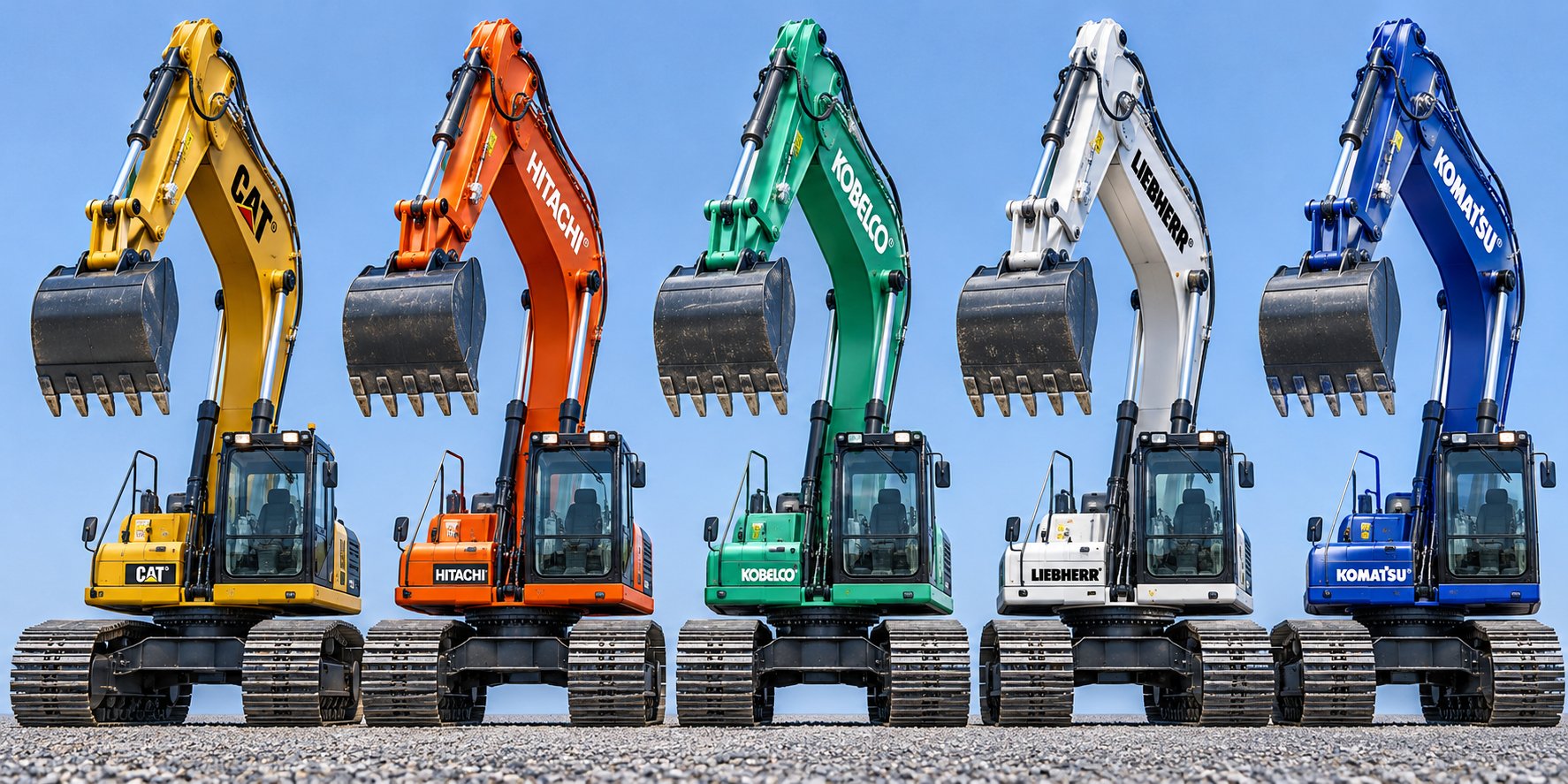
Choosing an excavator cat buyers will keep for five, ten, or even fifteen years is never just about horsepower and dig depth. The brand behind the machine determines parts availability in your market, the resale value you'll recover when the machine leaves your fleet, the fuel bill that hits every month, and how quickly a technician can reach you when something breaks at 2 p.m. on a Friday. Caterpillar competes against several strong manufacturers — each with distinct engineering philosophies and market strengths — and understanding those differences is the only way to make an informed purchase rather than a brand-loyalty gamble.
Cat vs. Komatsu, Volvo, John Deere, and Kubota
No single brand wins every category. Caterpillar's most frequently cited advantages center on three pillars: the largest dealer and parts network in the industry, consistently strong resale value, and a deep integrated technology ecosystem — Cat Connect, Grade Control, Payload, and Product Link telematics — that ties the machine into fleet-wide productivity monitoring. Whether you're running a Caterpillar 305 on a residential lot or a Cat 374 in a quarry, the same digital infrastructure scales across the lineup. That breadth is difficult for smaller competitors to match.
Komatsu, the world's second-largest construction equipment manufacturer, earns its reputation on a different front. Its closed-center load-sensing hydraulic system delivers what operators consistently describe as the smoothest, most proportional control feel in the industry — a quality that matters for fine grading, precision truck loading, and demolition work. Komatsu machines also tend to be lighter than their Cat counterparts at similar size classes (a PC200 weighs roughly 20 metric tons versus roughly 22.3 metric tons for a Cat 320), contributing to fuel economy that typically runs 10 to 15 percent better in side-by-side comparisons.
Volvo Construction Equipment occupies a narrower but devoted segment. The Swedish manufacturer's Care Cab design is widely regarded as the most comfortable operator environment in the industry — low interior noise levels (often below 74 dB), excellent visibility, and ergonomic controls that reduce operator fatigue during long shifts. Volvo excavators also run efficiently, with an ECO mode that optimizes engine RPM and hydraulic flow to cut fuel consumption without meaningful productivity loss.
John Deere appeals strongly to buyers already invested in the Deere ecosystem — agricultural operations, land-clearing contractors, and rural utility crews who value commonality across their equipment fleet for parts inventory and technician familiarity. And Kubota dominates the ultra-compact mini excavator segment, where machines under 4 metric tons are its specialty. If you're comparing something in the Cat 307.5 weight class against a Kubota offering, you'll likely find the Kubota competitive on price in that compact band — but its lineup thins considerably above 10 tons, where cats Caterpillar and Komatsu own the market.
| Brand | Notable Strengths | Common Segments | Consideration |
|---|---|---|---|
| Caterpillar | Largest global dealer/parts network; strong resale value; deep technology ecosystem (Cat Connect, Grade Control, Product Link) | All classes — mini through mining (cat construction equipment across 50+ models) | Higher OEM parts cost (typically 20–40% above Komatsu); higher fuel consumption versus some competitors |
| Komatsu | Industry-leading hydraulic control feel; best-in-class fuel efficiency; strong resale in emerging markets | Full range — dominant in 20-ton class (PC200) | Thinner dealer network in parts of Africa and Central Asia; cab comfort lags on older models |
| Volvo | Superior cab comfort and low noise; excellent fuel economy; ECO mode standard | Mid-size and large (EC210 through EC950) | Smaller dealer and parts footprint outside Europe; lower resale liquidity in some markets |
| John Deere | Ecosystem integration for agricultural crossover buyers; competitive financing programs | Mini through mid-size (17G through 870G) | Narrower model range in large-excavator class; less global presence outside North America |
| Kubota | Dominates ultra-compact mini segment; competitive pricing; strong reliability under 6 tons | Mini and compact (under 10 metric tons) | Limited lineup above 10 tons; smaller dealer network for construction-scale service |
Editorial honesty matters here: none of these brands builds a bad excavator. The differences show up in where you operate, what support infrastructure exists in your market, and how long you plan to own the machine. A Komatsu PC200 in Southeast Asia benefits from a parts ecosystem nearly as deep as Caterpillar's. A Volvo EC220 in Scandinavia has dealer support rivaling anything Cat offers in North America. Context determines which brand's strengths align with your reality.
Why Dealer Network and Parts Availability Influence Long-Term Value
Imagine two machines sitting side by side — identical class, identical hours, one priced five thousand dollars less than the other. The cheaper machine looks like the obvious choice. But what happens when a hydraulic pump fails at 4,000 hours? If the lower-priced brand's nearest parts depot is a continent away, you're looking at two to four weeks of downtime waiting for a critical component — and every idle day costs you revenue, crew wages, and potentially project penalties. The five thousand dollars you saved at purchase evaporates before the replacement pump even ships.
This is where total cost of ownership reshapes the calculation. TCO includes the purchase price, fuel costs over the machine's working life, maintenance and repair expenses, parts lead times and their impact on uptime, and the resale value you recover when the machine leaves your fleet. Caterpillar's global dealer infrastructure — with parts depots on every continent and dealer inventories in most major markets — directly compresses parts lead times and technician response windows. That density isn't a marketing talking point; it's a measurable factor in uptime percentage and, ultimately, in revenue per operating hour.
Resale data reinforces this. A well-maintained five-year-old Cat 320 typically retains 40 to 50 percent of its original new price, while a comparable Volvo EC210 retains 35 to 45 percent and takes longer to sell due to a smaller buyer pool. Komatsu matches or slightly edges Caterpillar in residual value in many emerging markets, largely because the PC200's massive installed base creates consistent demand. These percentages may seem abstract until you calculate them against a $250,000 purchase — a 10-percentage-point difference in residual value is $25,000 returned or lost at trade-in.
The real cost of owning an excavator is never the sticker price — it is the purchase price plus every dollar spent on fuel, parts, maintenance, and downtime, minus the resale value recovered at the end of the ownership cycle.
Genuine Cat parts carry a premium — roughly 20 to 40 percent higher than equivalent Komatsu OEM components — but their availability is unmatched. Over 1.4 million new and used Cat parts are accessible through dealer networks and online ordering platforms, with warranty coverage that extends 12 months on new, used, and remanufactured components. That combination of availability, warranty backing, and ordering convenience — including same-day shipping from regional depots — means repairs happen faster and machines return to production sooner. For a fleet running multiple units across scattered jobsites, that difference in turnaround time compounds into a significant annual productivity advantage.
Brand comparisons sharpen your perspective, but the most practical question isn't which manufacturer builds the best excavator in the abstract — it's which specific machine fits the work you actually do. Matching excavator class to job type, industry, and project scale is where research turns into a purchase decision.
Matching Cat Excavators to Real-World Job Types
You've seen the model numbers, the weight classes, and how Cat stacks up against competitors. But here's the question that actually drives a purchase: which machine fits the work sitting on your schedule right now? Flipping through a lineup organized by tonnage is useful, but most contractors don't think in metric tons — they think in project types. A pool builder needs a machine that fits through a backyard gate and digs 8 feet deep. A highway contractor needs a platform that loads 30-ton trucks in four passes. A quarry operator needs a machine that runs 18-hour shifts without flinching. Same brand, completely different animals.
This section reorganizes Caterpillar's excavator lineup around the work itself — matching machine class to the industries and project types where each performs best.
Residential, Landscaping, and Utility Applications
Picture a suburban lot with a finished driveway on one side, a neighbor's fence 30 inches from the property line, and a 36-inch gate leading to the backyard. That's the world compact and mini excavators were built for. The Cat 302 through 310 range — roughly 5,500 to 23,000 pounds — serves residential foundation repair, landscaping grading, pool excavation, utility trenching, and small-structure demolition in environments where every inch of clearance matters.
A cat 305 excavator in CR configuration keeps its tail within the track width during full rotation, letting an operator swing confidently next to a block wall or parked vehicle. The cat 304 weight of roughly 8,650 to 9,870 pounds allows transport on a standard bumper-pull trailer — critical for owner-operators who mobilize across multiple residential jobs in a single day. For even tighter spaces, the Cat 302.7 offers a retractable undercarriage that narrows the track gauge for gate access and widens again for working stability.
Compact radius and zero tail swing designs aren't luxury features in these environments — they're operational necessities. Swinging a conventional tail through a homeowner's landscaping generates damage claims, delays, and lost clients. CR and zero-swing configurations eliminate that risk entirely.
Worth noting: if your residential or utility work demands frequent repositioning across paved surfaces — moving between dig locations along a street, for example — wheeled excavators offer an alternative. Caterpillar's wheeled models can travel between positions on rubber tires without tearing up pavement, avoiding the surface damage tracked machines cause on asphalt and concrete. In markets where mini excavator Kubota models dominate the ultra-compact segment, Cat's compact lineup competes by offering deeper integration with attachments and a broader technology package that scales as a contractor's fleet grows.
Commercial Construction and Road Building
Step onto a commercial building pad, a highway interchange project, or a subdivision mass-grading site, and the equipment profile changes dramatically. Mid-size machines in the Cat 313 through 336 range handle the bulk of this work — commercial site preparation, road cut and fill, storm drainage installation, structural demolition, and foundation excavation for multi-story buildings.
The Cat 320 remains the default benchmark here — the excavadora that rental fleets stock in higher numbers than any other single model worldwide, versatile enough for general excavation yet powerful enough to run a hydraulic hammer through a concrete slab. The Cat 340, at the upper boundary of this class, anchors large commercial earthmoving projects where bucket payloads need to fill articulated dump trucks efficiently without jumping to a true mining-class machine.
What truly expands a mid-size excavator's value on a commercial jobsite, though, is attachment versatility. A single Cat 320 or 326 equipped with a quick coupler can cycle between tasks that would otherwise require three or four separate machines. The most common attachment categories for mid-size excavators include:
- Digging buckets — Standard, heavy-duty, and ditch-cleaning widths for general excavation, trenching, and finish grading (supported across all mid-size and larger classes)
- Hydraulic hammers / breakers — Concrete and rock demolition; requires adequate auxiliary hydraulic flow, typically available from the Cat 313 upward
- Hydraulic thumbs — Material handling, brush clearing, demolition debris sorting; compatible from compact models through the largest machines
- Grapples and processors — Demolition sorting, scrap handling, and structural dismantling; mid-size machines in the 320–336 range handle most commercial demolition grapple work
- Augers — Pier drilling, fence-post boring, and sign installation; supported on machines with second or third auxiliary hydraulic circuits, typically from the Cat 308 and above
- Compactors — Trench compaction between lifts, reducing the need for a separate compactor machine; effective on models from the Cat 313 upward
- Tilt-rotator couplers — Full 360-degree bucket rotation and tilt capability, enabling grading, ditching, and shaping without repositioning the machine; increasingly popular in the Cat 315 through 330 range
Each attachment category transforms the excavator from a dedicated digging tool into a multi-role platform — and the mid-size sweet spot between the Cat 313 and 336 supports the widest range of these tools. Contractors who spec a machine with the right auxiliary hydraulic circuits from the start avoid costly retrofits later and maximize the revenue potential of a single unit.
Mining, Quarry, and Heavy Infrastructure
When the conversation shifts to open-pit mining, quarry primary loading, deep foundation work for bridges and high-rise structures, or large-scale demolition of industrial facilities, the machine requirements shift with it. Cat excavators in the 349 through 395 range — along with long-reach and ultra-high-demolition configurations — serve these demanding applications where cycle-time efficiency, payload consistency, and integration with haul truck fleets determine project profitability by the hour.
A quarry loading operation, for example, depends on a tight choreography between the excavator and a fleet of rigid or articulated haul trucks. The excavator needs to fill each truck in a predictable number of passes — typically three to five — without underloading (which wastes truck cycles) or overloading (which violates legal weight limits and accelerates truck wear). Caterpillar's integrated Payload system on the Cat 374 and Cat 395 provides real-time load weighing on every pass, giving operators precise tonnage data on the in-cab screen. That data turns guesswork into repeatability, and repeatability drives production targets.
Deep foundation projects — secant pile walls, slurry trench excavation, and bridge caisson shafts — demand machines with extended reach and the structural rigidity to handle repetitive heavy loads at maximum stick extension. Long-reach boom configurations on the Cat 340 and Cat 352 can extend working reach past 60 feet, enabling excavation from stabilized platforms above waterways, retaining walls, or steep embankments where the machine itself cannot get close to the dig face.
Large-scale demolition of industrial structures — power plants, refineries, manufacturing facilities — requires a different front-end setup entirely. Ultra-high-demolition (UHD) boom configurations elevate the working height to reach multi-story structures from ground level, while specialized attachments like concrete processors, shears, and sorting grapples break down materials systematically. These projects demand machines with the hydraulic power, structural mass, and cycle endurance that only the largest excavators provide — and they also demand operators with specialized training and certification for high-reach work.
Across all three application categories — residential, commercial, and heavy — the same principle holds: the right machine is defined by the job, not the other way around. Identifying the application first, then working backward to the correct size class, model, and configuration saves money, increases productivity, and avoids the expensive mistake of owning a machine that's either overbuilt for the work or outmatched by it. That logic applies equally whether you're buying new or shopping the used market — where a different set of evaluation skills comes into play.
Buying Used Cat Excavators
A brand-new Cat 336 excavator carries a price tag that puts it out of reach for many contractors — especially owner-operators, growing fleets, and businesses bidding on projects where equipment cost directly determines whether the numbers work. That reality pushes buyers toward the used market, where a well-maintained caterpillar machine with documented service history can deliver years of productive life at a fraction of the new-equipment cost. Most depreciation hits hardest in the first three to four years, meaning a five-year-old Cat 336 or a used cat 315 excavator can represent genuine value — if you know what to look for and what to avoid.
The catch? A used excavator that looks clean on the outside can hide expensive problems underneath. Fresh paint covers cracked welds. Pressure washing erases the oil stains that signal hydraulic leaks. Low-hour claims don't always match the wear patterns visible on pedals, joystick grips, and track components. Buying used without a structured inspection process is how contractors turn a cost-saving decision into a five-figure repair bill within the first sixty days.
What to Inspect When Buying a Used Cat Excavator
Whether you're evaluating an excavator cat 320c from the early 2000s or a Next Gen Cat 336 with 4,000 hours, the inspection priorities follow the same hierarchy. Start with the components that cost the most to repair and work outward. The checklist below, informed by industry inspection standards, organizes the critical checkpoints from highest financial risk to lowest:
- Verify the serial number, model designation, and configuration. Match the serial plate to all paperwork. Confirm the exact model variant — remember, a 308E2 is not a 308B, and a 305.5E2 is not a 305D. Check stick length, quick coupler type, bucket, and thumb configuration against what the seller claims.
- Confirm operating hours and cross-check against visible wear. A machine listed at 3,000 hours should have pedals, joystick boots, and seat fabric that look consistent with light use. Worn controls on a "low-hour" unit are a red flag. Caterpillar machines equipped with Cat Product Link or similar telematics may have verifiable hour logs accessible through dealer systems — ask for this data.
- Request complete service and maintenance records. Oil change intervals, filter replacements, greasing schedules, and any major component repairs should be documented and dated. Oil analysis reports, if available, can reveal internal engine and hydraulic contamination that isn't visible externally. Gaps in documentation aren't always disqualifying, but they are reasons to dig deeper.
- Perform a cold-start engine inspection. Arrive before the seller has warmed the machine. A cold start reveals hard cranking, excessive smoke, unusual knocking, and slow oil pressure buildup that a pre-warmed engine can mask. Check for oil, coolant, and fuel leaks around the engine compartment. On Tier 4 machines, ask about any emissions system fault codes or aftertreatment problems.
- Evaluate the hydraulic system thoroughly. Inspect every cylinder rod for scoring, dents, and chrome flaking. Check hoses and fittings for wet spots, bulging, or surface cracking that indicates age. Operate all functions — boom, stick, bucket, swing, and travel — and note any sluggish response, drift when holding a load, or cavitation noise from the pumps. Hydraulic system leak issues are easiest to spot on a clean, dry machine, so be wary if the machine has been recently pressure-washed without explanation.
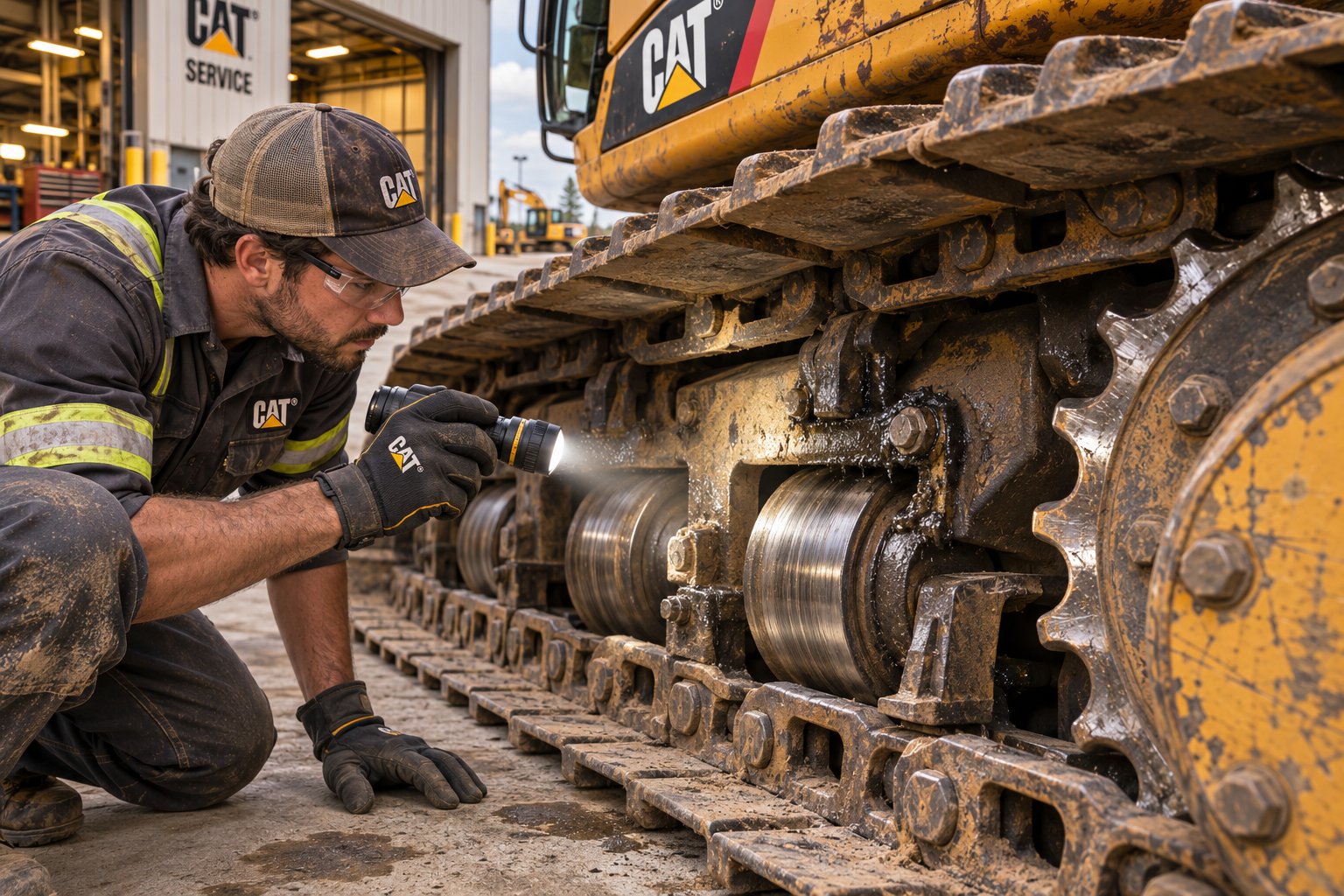
- Measure undercarriage wear. This is one of the single most expensive systems to replace on any tracked excavator. Inspect track links for tightness and pin wear, check sprocket teeth for pointed or hooked profiles, examine rollers and idlers for oil leaks and flat spots, and assess track shoe condition. A dealer or qualified technician can measure wear against the manufacturer's specifications and estimate remaining undercarriage life — a number that directly affects your negotiating position.
- Inspect boom, stick, and structural welds. Look for cracks at the boom foot, boom nose, stick tip, and all cylinder mounting points. Fresh paint, grinding marks, or new weld beads at structural joints can indicate prior damage that was repaired — not necessarily a deal-breaker, but something that requires professional evaluation of the repair quality.
- Check pins, bushings, and linkage play. Cycle the stick and bucket slowly while a second person watches each joint for visible movement or clunking. Excessive play at pin joints means worn bushings, and replacing them requires pulling the machine apart — labor-intensive and costly.
- Test the swing bearing and swing motor. Rotate the upper house a full 360 degrees in both directions. Listen for grinding, popping, or rattling. Check for any play or rocking between the upper structure and the undercarriage frame. A failing swing bearing on a mid-size or large excavator is a five-figure repair.
- Test final drives and travel motors. Drive the machine forward and in reverse on level ground. It should track straight without pulling to one side. Listen for grinding or whining from either final drive. Check final drive covers and seals for oil leaks.
- Evaluate the cab, controls, electronics, and safety equipment. Test every switch, gauge, camera, climate control function, and monitor screen. Check for stored fault codes. Confirm the presence and condition of seat belts, mirrors, falling-object guards, and emergency exits.
- Run a complete operational test under load. With warm hydraulics, perform a full work cycle — dig, swing, dump, and travel — for at least 15 to 20 minutes. Watch for overheating, loss of power, hydraulic drift, and any inconsistency between left and right travel. Confirm exactly which attachments are included and document any repairs still needed.
A few warning signs deserve extra caution: a seller who refuses a cold-start inspection, hours that don't align with visible wear, structural welds that weren't disclosed upfront, and missing records on a high-hour unit. None of these automatically eliminate a machine from consideration, but each one shifts more risk onto the buyer and should be factored into both your offer price and your post-purchase repair budget.
Understanding Used Cat Excavator Pricing and Value Retention
Several factors converge to determine what a used Cat excavator actually sells for in the open market. Model year, accumulated hours, completeness of maintenance documentation, the geographic market where the sale occurs, included attachment packages, and — critically — the model generation all influence the final number. A Next Gen cat 336 excavator with 3,000 hours and full dealer service records will command a meaningful premium over a 336D with identical hours, because the Next Gen platform offers lower fuel consumption, integrated technology, and a longer projected useful life before major component overhauls.
Caterpillar equipment is broadly recognized for relatively strong resale value across the industry. Market analysis projects that Cat excavators retain approximately 70 to 75 percent of their original value over a five-year ownership period — a caterpillar high mark that outperforms most competing brands. By comparison, Komatsu units typically retain 65 to 70 percent, while Chinese manufacturers like Sany fall in the 50 to 60 percent range. That value retention is driven by Cat's brand recognition, the density of its global dealer network ensuring parts availability, and consistent buyer demand for used Caterpillar equipment at every size class.
That said, specific values depend heavily on condition, market timing, and regional demand. A cat 336 in excellent condition in the U.S. Southeast — where infrastructure spending and commercial construction drive consistent demand — will fetch a different price than the same machine in a region experiencing a construction slowdown. Avoid relying on generalized "price guides" for specific purchasing decisions; instead, reference current market listings across multiple platforms to establish realistic value ranges for the exact model and condition you're evaluating.
Where you search matters as much as what you search for. Local Cat dealer used-equipment inventories, regional and national auction platforms, and online marketplaces specializing in pre-owned heavy equipment each offer different advantages. Dealer inventories often come with inspection reports and limited warranties but carry higher asking prices. Auction platforms offer competitive pricing but typically sell machines as-is. Online platforms specializing in used Caterpillar equipment — such as JIUHONG's used Cat excavator collection — allow contractors and fleet buyers to browse compact and larger Cat models listed for sale, compare available configurations, and contact the sales team to discuss specific model, budget, and project requirements. Inventory on any platform varies, so confirm exact model designations and specifications with the seller before committing — particularly since similar-sounding model numbers can represent meaningfully different machines, as covered throughout this guide.
Regardless of where you source a used caterpillar machine, the same discipline applies: inspect thoroughly, verify documentation, and calculate total cost of ownership — not just sticker price — before signing. A used excavator purchased at the right price with the right service history is one of the smartest investments a contractor can make. A machine purchased on appearance alone, without the inspection rigor outlined above, can just as easily become the most expensive mistake on your balance sheet.
With a clear picture of how to evaluate used equipment and where to find it, the final step is pulling all of these threads together — size class, specs, application match, and acquisition strategy — into a single decision framework that moves you from research to a confident purchase.
Choosing the Right Cat Excavator for Your Next Project
You've seen how model numbers decode, how specs translate into jobsite reality, and what separates a smart used purchase from a costly gamble. The challenge now is simpler than it seems — distill everything into a repeatable decision process you can apply whether you're evaluating a Cat 313 for utility trenching, a 336 cat excavator for highway mass grading, or a Cat 349E for quarry loading.
Building Your Cat Excavator Selection Checklist
Every successful equipment decision follows a logical sequence. Skip a step, and you risk owning a machine that's either overbuilt for your work or outmatched by it. Follow these five stages in order:
- Define your primary application and jobsite constraints. What are you digging, how deep, and how tight is the access? A residential pool contractor working through backyard gates faces entirely different constraints than a highway builder operating on open right-of-way. Start here — everything else flows from the job itself.
- Identify the appropriate size class. Match your application to the weight band that serves it best. A Cat 305 handles most residential work. A Cat 320 anchors commercial construction. A Cat 374 or 395 drives mining and heavy infrastructure production. The cat 312 excavator weight class — around 26,000 to 28,000 pounds — bridges compact and mid-size roles for contractors who need more authority than a mini but lighter transport than a full 20-ton machine.
- Evaluate specific model features and generation. Within each size class, generational differences in fuel efficiency, cab technology, and hydraulic design create meaningful cost and productivity gaps. A Next Gen model versus an older D-series equivalent isn't a cosmetic upgrade — it's a different operating cost structure. Verify the exact model variant, including suffix codes like GC, CR, or XE.
- Determine your acquisition method. New, used, or rental — each suits different circumstances. Caterpillar's own guidance suggests that if your estimated usage falls below 40% of available days over a six-month period, renting is typically the lowest-cost option. Between 40% and 65%, weigh other factors. Above 65%, ownership — new or used — usually makes more financial sense.
- Assess total cost of ownership. Purchase price is just the entry point. Factor in transport costs (especially critical when cat 320 weight at ~49,600 lbs or cat 323 weight at ~54,900 lbs pushes trailer and permit requirements), fuel consumption, scheduled maintenance, attachment needs, and projected resale value. A thorough TCO calculation protects your bottom line far better than chasing the lowest sticker price.
The table below consolidates the key decision variables across every size class into a single reference:
| Size Class | Typical Weight Range | Common Applications | Acquisition Considerations |
|---|---|---|---|
| Mini / Compact | Under 10 metric tons | Residential, landscaping, urban utility, pool excavation | Lowest entry cost new or used; towable with standard trailer; high demand keeps used values strong |
| Mid-Size | 13 – 25 metric tons | Commercial site prep, municipal infrastructure, road building | Largest rental market; strong used inventory; verify generation — Next Gen vs. D/E series pricing gap is significant |
| Standard / Heavy | 25 – 40 metric tons | Mass excavation, highway construction, heavy utility, structural demolition | Transport permits likely above 35 tons; maintenance costs rise; attachment investment adds to TCO |
| Large / Mining | 40+ metric tons | Open-pit mining, quarry loading, deep foundations, heavy demolition | Specialized transport required; dedicated operator and support infrastructure; highest production ROI when matched to haul fleet |
Where to Start Your Search
For new machines, your local Cat dealer is the starting point — they carry current inventory, handle financing through Cat Financial, and can configure a machine to your exact specification. For the rent-versus-buy decision, consider project duration honestly: a three-month drainage project favors rental, while a contractor running excavation work year-round almost always benefits from ownership.
For used equipment, cast a wider net. Local dealer pre-owned inventories often include inspection reports and limited warranties. Auction platforms deliver competitive pricing but sell machines as-is, placing full inspection responsibility on you. Online platforms specializing in pre-owned Caterpillar equipment — such as JIUHONG's used Cat excavator listings — let buyers compare models across compact and larger classes, review available configurations, and reach out to discuss project-specific needs and budget before committing. Regardless of the sourcing channel, apply the inspection checklist from the previous section and confirm every model designation down to the last digit and suffix.
The right Cat excavator is the one matched to your project requirements, jobsite constraints, and ownership economics — not simply the biggest or newest model available.
Frequently Asked Questions About Cat Excavators
1. What do Cat excavator model numbers mean?
Cat excavator model numbers follow a structured naming system. The first digit (typically '3') identifies the product family as hydraulic excavators. The remaining digits indicate relative size — a 308 is smaller than a 320, which is smaller than a 336. Letter suffixes denote generation (B, C, D, E for older models) or configuration (CR for compact radius, GC for value-focused, XE for premium efficiency). Current Next Gen models dropped the letter suffix entirely. Always verify the full model designation because machines sharing the same base number — like a 320D versus a 320GC — differ significantly in technology, fuel efficiency, and resale value.
2. How much does a Cat 320 excavator weigh?
A Cat 320 weighs approximately 49,200 to 49,600 pounds (roughly 22.3 to 22.5 metric tons) depending on configuration. This operating weight includes the operator, full fuel tank, hydraulic fluid, and standard bucket. At this weight, transport typically requires a lowboy or step-deck trailer with a semi-tractor, and buyers should verify that the combined gross vehicle weight stays within legal highway limits for their state. The Cat 320 GC variant may differ slightly in weight due to counterweight and configuration differences.
3. What size Cat excavator do I need for my project?
Choosing the right size depends on your primary application and jobsite constraints. Mini excavators (Cat 302-310, under 10 metric tons) suit residential work, landscaping, and urban utility trenching where tight access matters. Mid-size models (Cat 313-326, 13-25 metric tons) handle commercial site prep, road building, and municipal infrastructure. Standard machines (Cat 330-340, 25-40 metric tons) drive mass excavation and highway construction. Large excavators (Cat 349-395, 40+ metric tons) serve mining, quarry loading, and major infrastructure. Start by defining your dig depth, access width, and transport capacity, then match those constraints to the appropriate weight class.
4. Are Cat excavators worth the price compared to Komatsu or Volvo?
Cat excavators typically carry higher purchase prices and OEM parts costs (roughly 20-40% above Komatsu), but they offset this through the industry's largest dealer and parts network, strong resale retention of approximately 70-75% over five years, and an integrated technology ecosystem. Komatsu often leads in fuel efficiency and hydraulic control smoothness, while Volvo excels in cab comfort. The best value depends on your market — dealer proximity, parts availability, and how long you plan to own the machine all factor into total cost of ownership. Platforms like JIUHONG's used Caterpillar excavator collection at jiuhong-machinery.com can help buyers compare used Cat models and pricing across multiple size classes.
5. What should I check before buying a used Cat excavator?
Prioritize inspection by repair cost risk. First, verify the serial number and exact model variant match all paperwork. Cross-check listed hours against visible wear on pedals, joystick grips, and seats. Request full maintenance records and oil analysis reports. Perform a cold-start engine test to catch hard cranking or excessive smoke. Inspect hydraulic cylinders for rod scoring and hose deterioration. Measure undercarriage wear on tracks, rollers, and sprockets — this is one of the costliest systems to replace. Check boom and stick welds for cracks, and test swing bearing and final drives under load. Machines with Cat Product Link telematics may have verifiable service history through dealer systems.