

There Is No Cat 750 Excavator and That Changes Everything
If you've been searching for a cat 750 excavator price, here's the critical detail most websites won't tell you upfront: Caterpillar does not make a model called the "Cat 750." It has never existed in their excavator lineup. That single fact reshapes your entire buying process, because you can't get accurate pricing on a machine that isn't real.
So what are you actually looking for? The answer almost always falls into one of three scenarios, and identifying yours is the first step toward getting a legitimate quote.
What People Mean When They Search Cat 750 Excavator
The confusion typically stems from three directions:
- A Cat excavator in the 75-ton weight class. Caterpillar's naming convention doesn't use "750." Their large excavators in this range include the Cat 374 (approximately 74 tons) and the Cat 395 (around 94 tons). These are the machines you're likely cross-shopping if you need the caterpillar biggest production-class excavators.
- Cross-brand name confusion. Volvo and Komatsu do use the "750" designation — think the Volvo EC750D or Komatsu PC750. Buyers familiar with those brands naturally assume Cat follows the same logic. It doesn't.
- A general search for the largest Cat excavators. Some buyers simply want to know what Cat offers when they need a big excavator in the world of heavy construction and mining — and "750" feels like it should represent something massive.
Each scenario points to a different set of real machines at very different price points. Whether you're pricing a cat mini excavator like the 303 for a small project or scoping out a 90-ton production unit, knowing the correct model number is non-negotiable.
Why This Disambiguation Matters Before You Shop
Imagine contacting a Cat dealer and asking for a quote on a "750 excavator." You'll either get a blank stare or be redirected through a series of clarifying questions that wastes everyone's time. Worse, if you budget based on pricing for a machine that doesn't exist under that name, your numbers will be wildly off — potentially by hundreds of thousands of dollars.
Searching for a machine that doesn't exist by that exact name is the number-one reason buyers get confused about pricing in the 75-ton excavator class.
This matters whether you're asking how much is a mini excavator for a residential job or pricing a flagship production unit for a quarry. The model name drives everything — from the quote a dealer generates to the cat 303 specs sheet you'll review or the financing terms you'll negotiate. Getting it right from the start isn't optional; it's what separates informed buyers from frustrated ones.
The real question, then, isn't what a Cat 750 costs. It's understanding how Caterpillar names its machines differently from competitors — and which actual models deliver the performance you need.
How Cat Names Large Excavators Compared to Volvo and Komatsu
Every caterpillar excavator carries a three-digit model number, and that number isn't random. It loosely correlates to the machine's operating weight in metric tons. A Cat 374 sits in the 74-metric-ton range. A Cat 395 weighs roughly 95 metric tons. The pattern holds across the entire lineup — and understanding it instantly explains why you'll never find a "Cat 750" on any dealer lot.
How Caterpillar Numbers Its Excavator Lineup
Caterpillar's product naming system follows a straightforward principle: as machine size increases, so does the model number. Tom Zilla, a product identity consultant at Caterpillar, confirmed this in the company's own nomenclature breakdown — "generally, the smaller the number, the smaller the machine."
You'll notice this logic playing out across every weight class:
- Mini excavators (Cat 301 to Cat 310 range): These are compact machines under roughly 10 metric tons, popular for residential work and tight jobsites. If you're browsing a caterpillar mini excavator for sale, you're shopping in this tier — models like the cat 303 excavator fall here.
- Midsize excavators (Cat 313 to Cat 340 range): Spanning approximately 13 to 45 metric tons, this is the workhorse category for general construction, road building, and utility projects.
- Large excavators (Cat 349 to Cat 395 range): These production-class machines weigh between 50 and 104 metric tons. The Cat 374 at 79.1 tons and the Cat 395 at approximately 104 tons represent the upper boundary of Cat's standard excavator lineup.
Notice something? Cat's numbering tops out at 395 for standard excavators. There's simply no room in this system for a "750" — that number would imply a 750-metric-ton machine, which falls into mining shovel territory rather than the hydraulic cat excavator class most buyers are researching.
Why Other Brands Use 750 and Cat Does Not
Volvo and Komatsu take a different approach. Their model numbers reference the machine's weight class using larger figures that can include zeros as multipliers rather than direct ton approximations. The Volvo EC750D, for example, carries an operating weight of 72,700 to 74,700 kg — placing it squarely in the 75-ton class despite the "750" in its name. Komatsu's PC750 follows similar logic.
This naming mismatch is precisely why "cat 750 excavator price" appears as a search query. Buyers who have operated a Volvo EC750 or priced a Komatsu PC750 naturally assume Caterpillar has an equivalent model with matching numbers. Here's how those machines actually map against Cat's lineup:
- Volvo EC750D/EC750E (approximately 72-81 metric tons) ≈ Cat 374 (79.1 metric tons)
- Komatsu PC750 (approximately 75-ton class) ≈ Cat 374 / Cat 390
- CASE CX750D (79.2 tons) ≈ Cat 374
- Sany SY750H (75-ton class) ≈ Cat 374 / Cat 390
These are approximate mappings, not exact equivalencies — bucket capacity, engine output, and hydraulic configurations vary between brands. But the competitive positioning is clear. When someone references the worlds largest trackhoe models with "750" in the name, they're shopping in the same weight class as the Cat 374 and Cat 390.
The practical takeaway? Every time you see "750" from a competing brand, mentally translate it to Cat's 374 or 390 before requesting a quote. That simple mental conversion prevents the budgeting confusion that derails so many equipment purchases — and it brings you one step closer to understanding what these machines actually cost.
The Cat Models That Actually Compete in the 75-Ton Class
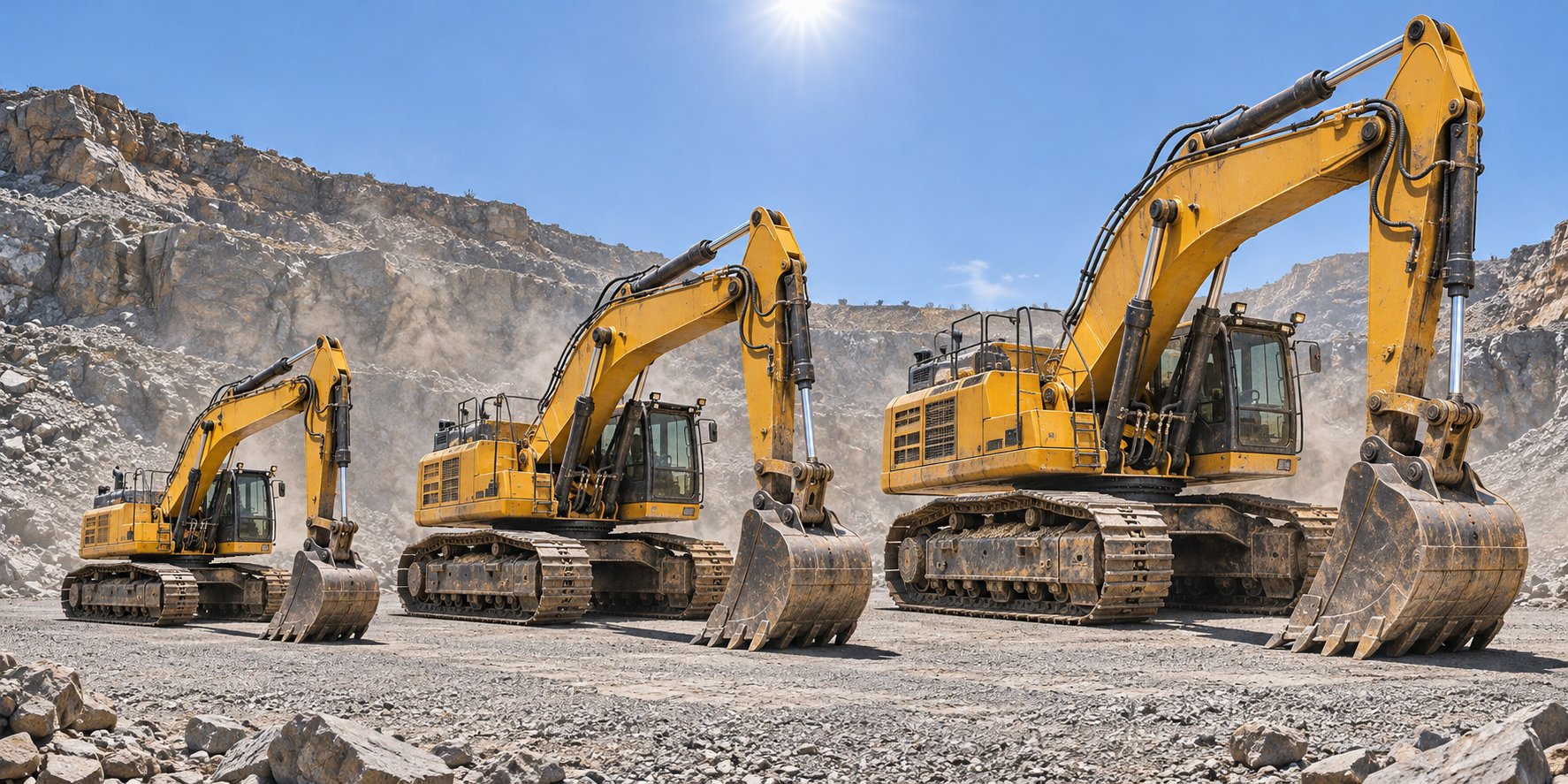
Three Caterpillar models anchor the conversation when buyers are shopping in and around the 75-ton weight class: the Cat 374, the Cat 390, and the Cat 395. Each occupies a distinct performance tier, and choosing between them depends entirely on the scale, intensity, and duration of your project. Rather than treating them as interchangeable, think of these machines as a ladder — the 374 gets you onto the large excavator stage, the 390 historically served as the mid-range production workhorse, and the 395 delivers maximum output with the deepest technology integration in Caterpillar's standard excavator lineup.
Worth noting: the Cat 395 was introduced as the next generation replacement for the 390F, so if you're evaluating a "Cat 390," you're likely looking at either a used 390F or the current-production 395 that succeeded it. Both remain relevant depending on whether you're buying new or used.
Cat 374 as the Gateway to the 75-Ton Class
The Cat 374 is where Caterpillar's large excavator class truly begins for most contractors. Powered by a Cat C15 engine producing 484 hp (361 kW) of net power, this machine carries an operating weight of approximately 74,700 kg (164,700 lb) in a typical mass boom configuration. That puts it directly in the crosshairs of buyers who would otherwise search for a Volvo EC750 or Komatsu PC750 — it's the exact Cat equivalent they couldn't find under the "750" name.
You'll find the 374 earning its keep across several demanding applications:
- Heavy construction — large commercial foundations, highway interchanges, and dam projects where sustained digging power matters
- Quarrying — loading haul trucks with rock and aggregate at high cycle rates
- Demolition — equipped with hydraulic hammers, multi-processors, and shears through Cat's extensive attachment ecosystem
The 374's spec sheet reveals serious capability. Maximum digging depth reaches 8,570 mm (28 ft 1 in) with the reach boom configuration, and maximum reach at ground line extends to 13,160 mm (43 ft 2 in). Bucket capacity scales up to 5.0 m3 (6.54 yd3) with general duty buckets, giving it the volume to load Cat 730 through Cat 745 articulated trucks in four to six passes depending on material density. Standard features include Cat Grade technology, Product Link telematics, SmartBoom for regeneration efficiency, and three selectable operating modes — Power, Smart, and Eco — that let operators balance productivity against fuel burn.
For caterpillar construction equipment buyers stepping up from a midsize machine like a Cat 336 or Cat 340, the 374 represents a significant leap in production capacity without jumping straight to the 90-plus-ton flagship.
Cat 390 and Cat 395 for Maximum Production
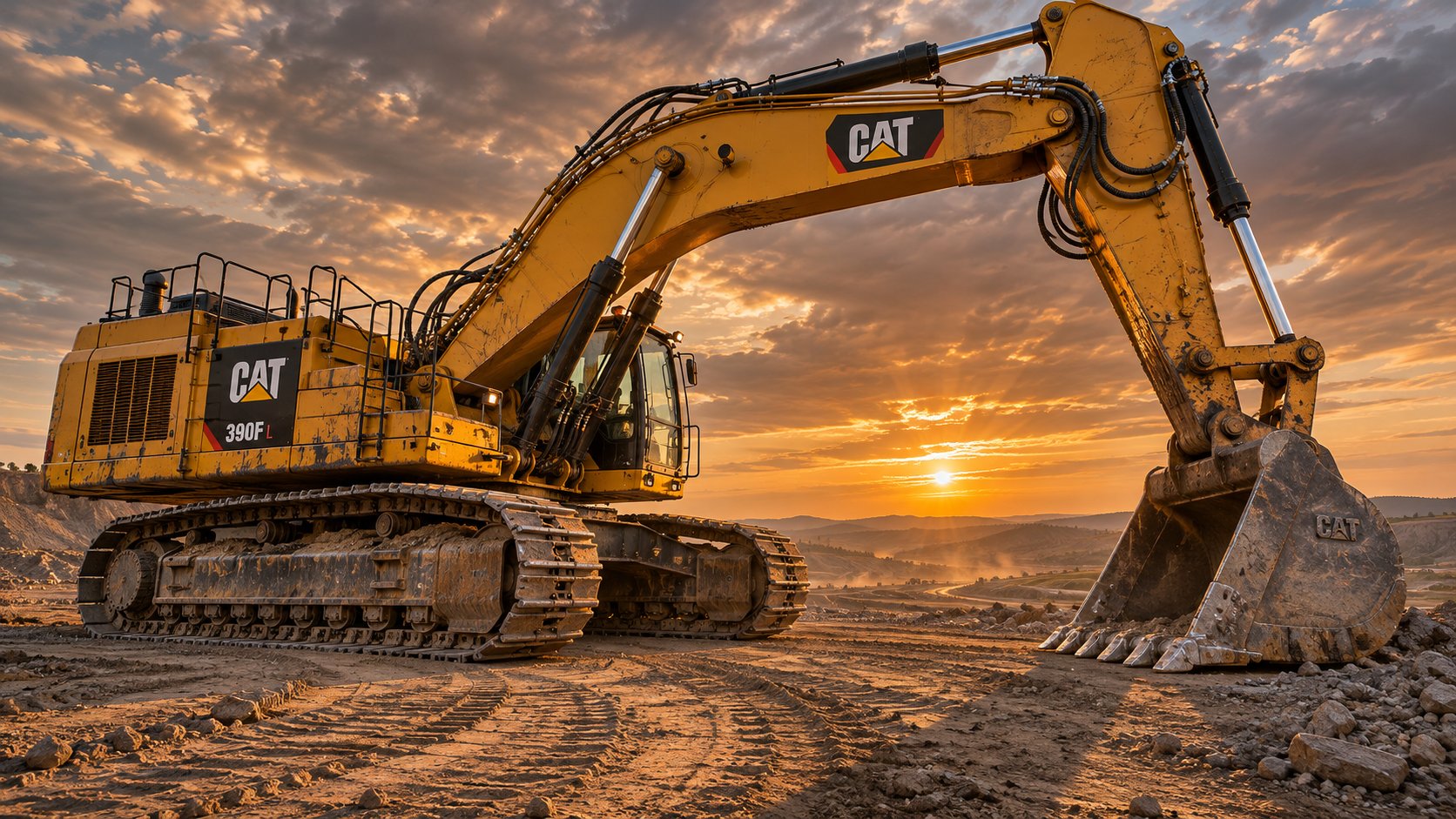
The Cat 390F served for years as the go-to workhorse above the 374 — a roughly 88-to-90-metric-ton machine trusted in mass excavation and large infrastructure. Caterpillar eventually replaced it with the Cat 395, which the company describes as delivering up to 10 percent more production, twice the structural durability, and up to 20 percent lower maintenance costs compared to the 390F it superseded.
What makes the 395 the largest excavator in Cat's standard hydraulic lineup? Start with the numbers. Its Cat C18 engine generates 543 hp (405 kW), and operating weight climbs to 94,000 kg (207,300 lb). Maximum digging depth hits 9,670 mm (31 ft 8 in), and horizontal reach at ground level stretches to 14,710 mm (48 ft 3 in). These are figures that place it well beyond the 374 in raw earthmoving capability.
The technology gap widens at this tier too. A dedicated hydrostatic swing circuit — a feature borrowed from Cat's mining shovels like the 6015B — enables the 395 to regenerate swing brake energy and independently manage cylinder oil flow. The result is smoother multitasking, more predictable cycle times, and greater fuel efficiency under heavy loading conditions. Standard technology packages include Cat Payload for on-the-go truck weighing, Cat Grade with 2D (upgradable to 3D), Lift Assist to prevent tipping during crane-style work, and 2D E-Fence to keep the machine within operator-defined boundaries. Even remote control capability is available through Cat Command, which is worth considering alongside other advanced options like remote control excavators for adults operating in hazardous demolition or confined environments.
If you're exploring what qualifies as the world's largest excavator in Cat's standard production lineup, the 395 holds that position. Anything larger from Caterpillar — the 6015B or 6020B, for instance — crosses into the dedicated mining shovel category with entirely different pricing structures and support requirements.
Side-by-Side Comparison: Cat 374 vs. Cat 390F vs. Cat 395
The following table consolidates the key differentiators across these three models. Note that the Cat 390F is included as a reference because it remains widely available on the used market, even though the 395 has replaced it in new production.
| Specification | Cat 374 | Cat 390F (Predecessor) | Cat 395 (Current Production) |
|---|---|---|---|
| Engine | Cat C15 | Cat C18 | Cat C18 |
| Net Power | 484 hp (361 kW) | ~523 hp (390 kW) | 543 hp (405 kW) |
| Approx. Operating Weight | 74,700 kg (164,700 lb) | ~88,000 kg (194,000 lb) | 94,000 kg (207,300 lb) |
| Max Digging Depth | 8,570 mm (28'1") | ~9,100 mm (29'10") | 9,670 mm (31'8") |
| Max Reach at Ground Level | 13,160 mm (43'2") | ~14,000 mm (45'11") | 14,710 mm (48'3") |
| Typical Applications | Heavy construction, quarrying, demolition | Mass excavation, large infrastructure | Mining support, mass excavation, major infrastructure |
| Technology Tier | Cat Grade, Product Link, SmartBoom, 3 operating modes | Previous-gen Cat technology suite | Dedicated hydrostatic swing, Cat Payload, Cat Grade w/ 2D/3D, Lift Assist, E-Fence, Cat Command ready |
| Market Availability | New and used | Used only | New and used |
Cat 390F values in the table above are approximate historical figures, as the model is no longer in active production. Always verify exact specifications against the serial-number-specific configuration when evaluating a used unit.
Matching the right model to your application is only half the equation. The other half — and the reason most people searched for a cat 750 excavator price in the first place — is understanding what these machines actually cost, and why published price tags barely scratch the surface of that answer.
New Cat 75-Ton Excavator Pricing and Key Cost Drivers
Here's the reality that frustrates most buyers: Caterpillar does not publish fixed retail prices for its large excavators. Visit the Cat 374 product page, and where you'd expect a dollar figure, you'll find "Pricing Varies" followed by a "Request A Price" button. That's not a glitch — it's how every big cat excavator in the 75-ton class and above is sold. The final number depends on a web of variables that make each transaction genuinely unique.
Unlike shopping for a cat 304 excavator or a Cat 302 where some dealers list starting MSRPs for smaller machines, the 75-ton class operates on an entirely different purchasing model. You're not picking a configuration off a shelf. You're building one.
What Drives the Price Tag on a New Cat Large Excavator
Five primary factors determine what you'll actually pay. Understanding each one gives you leverage before you ever sit down with a dealer.
- Base machine configuration vs. fully optioned. A Cat 374 with a standard reach boom, base cab, and minimal electronics packages costs significantly less than one equipped with mass excavation booms, a premium cab with heated and cooled seats, and the full Cat Command remote-control system. The gap between a stripped-down unit and a fully loaded one can represent a substantial percentage of the base price. Across all cat excavator sizes, the spread between minimum and maximum configuration follows this same pattern — it just hits harder when the base price is already in the hundreds of thousands.
- Bucket and attachment packages. A standard-duty 3.3 m3 bucket is one thing. Adding severe-duty rock buckets, hydraulic hammers, multi-processors, or clamshell grapples — all of which Cat engineers specifically for the 374 and 395 — pushes the total investment higher. Industry data suggests attachments alone can add $5,000 to $25,000 or more depending on type and size class.
- Technology packages. Cat Grade with 2D comes standard on the 374 and 395, but upgrading to Grade with 3D, adding Advanced Payload, or integrating Cat Command for remote operation all carry incremental costs. GPS grading systems and advanced telematics can add $15,000 to $30,000 to a new machine across the industry, and Cat's integrated ecosystem sits at the higher end of that range.
- Geographic location and dealer pricing structure. Cat's dealer network is independently owned. A dealer in Houston may price the same configured machine differently than one in Toronto or Sydney. Regional demand, local competition from brands like Volvo and Komatsu, and even shipping logistics to remote jobsites all influence the final quote. If you're working near the biggest excavator in the world class of projects — think large-scale mining or major infrastructure — your dealer's proximity to those jobsites matters.
- Current market demand and lead times. When construction activity surges, lead times on new Cat large excavators stretch from weeks to months. High demand tightens dealer flexibility on discounting. Conversely, softer market conditions can open the door to more aggressive negotiation. Timing your purchase strategically — many buyers find Q4 offers the best deals as dealers work toward annual sales targets — can meaningfully reduce your out-of-pocket cost.
What to Expect When You Contact a Cat Dealer
Buying a machine at this scale isn't like purchasing cat mini excavators or a compact earth moving machine where online pricing gives you a reasonable starting point. Large excavator transactions are consultative. You'll work directly with a dealer sales representative who walks through your application — what material you're moving, how many hours per day, what trucks you're loading, what site conditions look like — and configures the machine around those requirements.
Expect the process to include a formal quote with line-item pricing for the base unit, selected boom and stick configuration, bucket package, technology add-ons, and any dealer-installed options. Many dealers also present Cat Financial leasing and financing terms alongside the cash purchase price, giving you multiple paths to structure the acquisition.
The sticker price on a new Cat large excavator is just the starting point. Configuration choices, attachment packages, and dealer negotiation can swing the final cost by tens of thousands of dollars in either direction.
One practical tip: always request quotes from at least two Cat dealers if your geography allows it. Dealer pricing isn't standardized, and competition between dealerships — even within the same brand — works in the buyer's favor. Pair that competitive dynamic with a clear understanding of exactly which model and configuration you need, and you'll enter the negotiation in a far stronger position than someone who walked in asking about a machine that doesn't exist.
Of course, not every buyer is shopping new. The used market for Cat 75-ton class excavators tells a very different pricing story — one where machine hours, maintenance history, and undercarriage condition matter far more than dealer negotiation tactics.
Used Cat 75-Ton Excavator Pricing and What to Watch For
Most buyers researching a cat 750 excavator price aren't actually shopping for a brand-new machine. They're looking at the used market — and for good reason. Used Cat 374, 390F, and 395 excavators represent the most realistic entry point for contractors, fleet operators, and mining companies that need 75-ton class production power without committing to a new-unit price tag that can stretch well past half a million dollars.
The challenge? Used pricing in this class isn't a single number. It's a spectrum. A late-model Cat 374 with low hours and a complete service binder occupies an entirely different universe than a high-hour 390F that's been running double shifts in a quarry for a decade. Understanding where a specific machine falls on that spectrum — and why — is what separates a smart acquisition from an expensive mistake.
How Machine Hours and Condition Grade Affect Pricing
Think of machine hours the way you'd think of mileage on a truck, except the stakes are higher. Every hour on a 75-ton excavator represents intense hydraulic cycling, engine load, undercarriage wear, and structural stress. The hour meter is the single most referenced data point in any used excavator transaction, but it only tells part of the story. What the machine was doing during those hours matters just as much.
A useful framework for evaluating used Cat large excavators is condition grading — a tiered system that correlates machine hours, maintenance history, and overall state to relative market positioning. Here's how the tiers typically break down:
| Condition Grade | Approximate Hours | Typical Condition Description | Relative Price Positioning |
|---|---|---|---|
| Excellent | Under 5,000 | Recent model year, full dealer service records, minimal undercarriage wear, all technology systems functional, cosmetically clean | Premium — highest resale values, often 65-80% of new price |
| Good | 5,000 - 10,000 | Well-maintained with documented service intervals, moderate undercarriage wear consistent with hours, may need minor repairs or component refresh | Mid-market — the sweet spot for most buyers balancing cost and remaining service life |
| Fair | 10,000 - 15,000 | Operational but showing age, likely needs undercarriage work, hydraulic seal replacements, or cosmetic attention; service records may be incomplete | Value — priced to reflect deferred maintenance and near-term capital needs |
| Project / Rebuild | 15,000+ | High hours, significant wear across major systems, purchased with the expectation of rebuild or component replacement before full production use | Project pricing — lowest acquisition cost, highest post-purchase investment required |
To put this range into real-world dollars, consider the broader 75-ton excavator market across all brands. Industry pricing data for comparable 750-class machines shows used units ranging from roughly $200,000 to $450,000 depending on age, hours, and condition — with premium late-model units climbing even higher. Marketplace listings for similar-class machines like the Volvo EC750 have shown spreads from approximately $149,000 to $710,000, illustrating just how dramatically condition and configuration affect value. Cat machines in this class follow similar patterns, with Caterpillar's stronger resale reputation often pushing pricing toward the higher end at equivalent hour counts.
For context, auction platforms like Purple Wave regularly list used Cat excavators across multiple model years and conditions. A 2021 Cat 374 with 7,963 hours and a 2020 Cat 395 with 9,679 hours have both appeared in recent auction cycles — machines that fall squarely into the "good" and upper-"fair" condition grades, respectively. Their pricing reflects the hour count, engine platform (C15 on the 374, C18 on the 395), and whether features like auto-lube systems, removable counterweights, and backup cameras are equipped.
Whether you're evaluating the world's biggest excavator models or something far smaller, the principle stays the same: hours tell you how much life was consumed, but condition grading tells you how much is left.
Red Flags and Due Diligence for Used Large Excavators
Buying a used 75-ton Cat excavator demands the same scrutiny you'd apply to any six-figure asset — arguably more, because hidden problems at this scale translate to five-figure repair bills. The inspection framework used by professional equipment brokers highlights several critical areas where problems hide in plain sight.
Before signing anything, systematically check for these red flags:
- Inconsistent hour meter readings. Compare the meter reading against physical wear patterns. A machine showing 3,000 hours should have a clean seat, tight controls, and minimal undercarriage wear. If the seat is torn and the tracks are visibly degraded, the actual hours are almost certainly higher. On older mechanical meters, misaligned digits suggest the meter has been opened and reset.
- Missing or incomplete service records. A well-maintained Cat 374 or 395 should have documented oil changes every 250 to 500 hours, along with records of hydraulic fluid service, filter replacements, and major component work. Sellers who claim records were "lost" or "not kept" are waving a red flag. Cross-reference service dates against hour meter readings — if 100 hours accumulated over two months at one service interval and 100 hours accumulated over six months at the next, the usage pattern may be legitimate seasonal variation, or it may signal fabricated records.
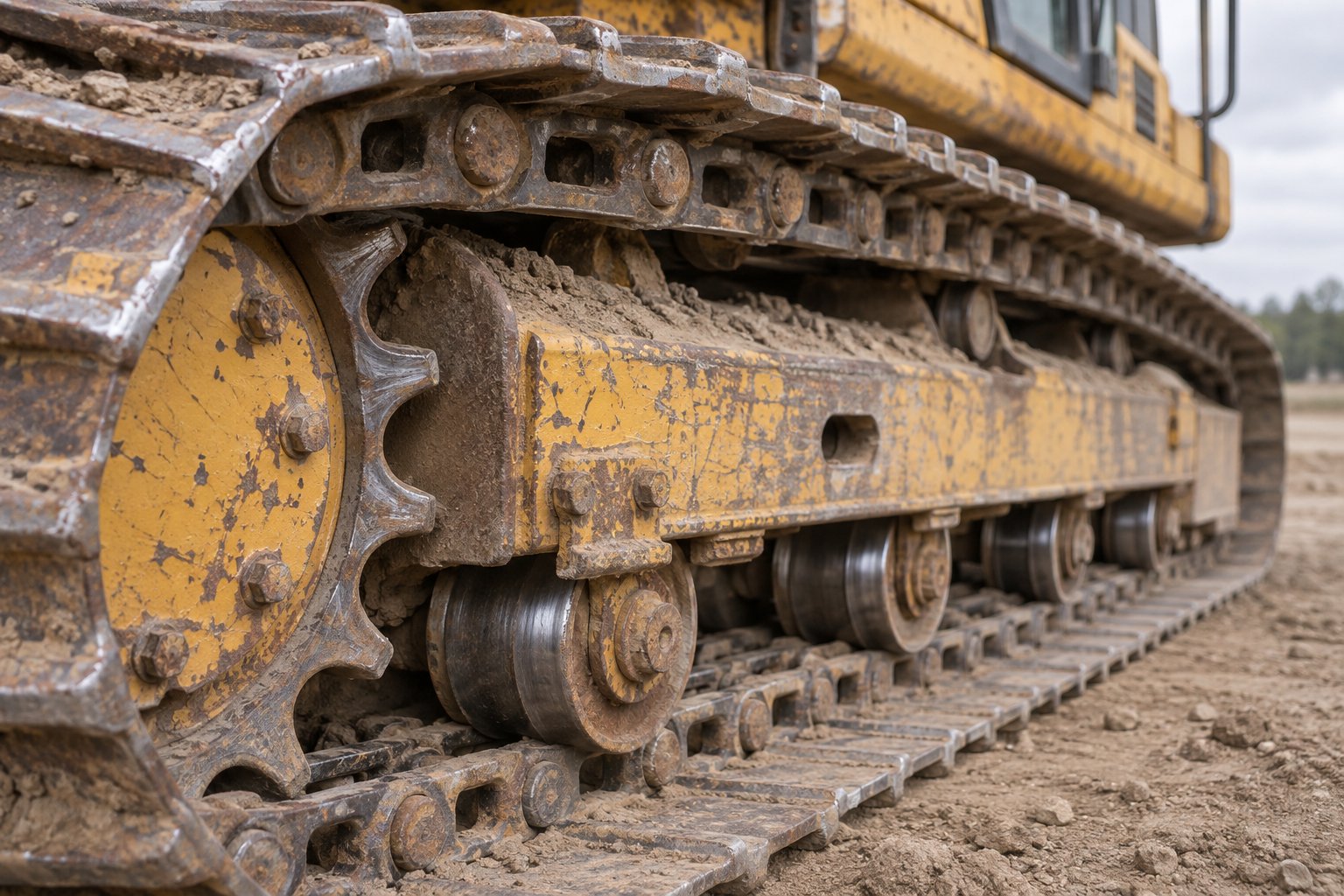
- Excessive undercarriage wear relative to reported hours. The undercarriage is the most expensive wear component on any tracked excavator. Inspect track links, rollers, idlers, and sprocket teeth for advanced wear that doesn't match the stated hour count. Uneven track wear across the width suggests misalignment or operation on consistently uneven terrain. A compact mini excavator might survive undercarriage neglect for a while — a 75-ton machine operating on worn tracks risks catastrophic and costly failure.
- Hydraulic system condition. Check every visible hose, cylinder, and fitting for leaks, scoring, or damage. Dark brown or black hydraulic fluid indicates overheating or contamination. Milky fluid means water intrusion — a serious problem requiring complete system flushing. Test every function individually: boom raise and lower, stick extend and retract, bucket curl and dump, house rotation, and track travel. Sluggish or jerky response points to pump wear or internal leakage.
- Structural repairs and re-welding. Run your hand along the boom and stick surfaces to feel for ripples or distortion. Fresh welds with different paint or visible patch plates tell you the machine experienced significant structural stress. This isn't automatically disqualifying, but it demands deeper investigation into what caused the damage and whether the repair was performed to OEM standards.
- Geographic origin and operational history. A machine that spent its life in general construction wears differently than one that worked in an abrasive mining or quarry environment. Salt exposure, coastal operations, or flood history can cause hidden corrosion inside sealed components that won't show up until months after purchase. Ask directly about the machine's application history and verify it against the physical evidence.
- Serial number verification. Confirm the serial number on the machine matches every document — title, registration, manufacturer's plate, and any warranty paperwork. Mismatches indicate a stolen machine, a salvage title, or fraudulent documentation. Caterpillar maintains serial number registries that can confirm original specifications and ownership history.
If you're exploring caterpillar 304 specs or any smaller model, these same inspection principles apply at a proportionally smaller scale. But when you're committing capital to a 75-ton machine, every unchecked box represents exponentially higher risk.
Where to Source Used Cat Large Excavators
Sourcing a used Cat 374, 390F, or 395 means casting a wide net. Auction platforms, dealer trade-ins, and specialized equipment marketplaces each offer different advantages. Auction sites like Purple Wave and Ritchie Bros provide competitive bidding environments with real-time market pricing. Certified pre-owned programs through Cat dealers offer machines with warranty backing but at premium price points.
For contractors and fleet buyers who want to browse available used Cat models, compare configurations, and discuss specific needs around model availability and budget, JIUHONG's used Caterpillar excavator collection provides another practical sourcing channel. Their inventory spans compact and larger Cat models, and their sales team can walk you through what's currently available in the weight class you need — whether that's a caterpillar 304 for sale at the smaller end or a production-class unit in the 75-ton range.
Regardless of where you source the machine, the inspection checklist above isn't optional. The purchase price is only your entry ticket. What the machine actually costs to own and operate over its remaining service life — fuel, maintenance, undercarriage, insurance, and financing — adds a second layer of financial reality that many first-time large excavator buyers underestimate.
Total Cost of Ownership Beyond the Purchase Price
You've identified the right model, evaluated new versus used, and negotiated a purchase price. But here's the uncomfortable truth that catches many buyers off guard: the amount you pay to acquire a 75-ton Cat excavator is just the opening line of a much longer financial story. What the machine costs to own and operate over its working life frequently dwarfs the original transaction — and ignoring those costs is how profitable projects turn into money pits.
Total cost of ownership (TCO) captures the complete financial picture, from acquisition day to the day you sell or scrap the machine. For large Cat excavators like the 374 and 395, five categories define that picture:
- Fuel consumption — the single largest recurring expense at this machine scale
- Planned maintenance — oil changes, filter replacements, hydraulic fluid service on manufacturer-recommended intervals
- Undercarriage wear and replacement — the most expensive wear component on any tracked excavator
- Insurance — specialized equipment coverage for assets valued in the hundreds of thousands
- Financing costs — interest rates, lease payments, and the opportunity cost of capital
Each category demands its own analysis. Skipping even one leads to budgets that look great on paper and collapse on the jobsite.
Fuel and Daily Operating Costs at This Scale
Imagine running a Cat C15 or C18 diesel engine at high load for ten hours straight. That's a typical production shift for a 75-ton excavator in mass excavation or quarry loading — and the fuel burn is substantial. Engine size, duty cycle, and operator behavior all converge to determine hourly consumption. A machine running at full throttle under constant digging load burns significantly more fuel per hour than one cycling between digging and repositioning.
The financial impact compounds quickly. On heavy-duty shifts, fuel cost alone can rival or exceed a monthly equipment payment — a reality that surprises buyers who focused exclusively on the acquisition price. Industry maintenance data confirms that well-maintained equipment uses 10 to 15 percent less fuel than neglected machines, which means your maintenance discipline directly affects your fuel line item. Operators trained to manage throttle and cycle efficiency can shave meaningful percentages off daily fuel spend without sacrificing production — a lever that smaller machines like a micro excavator or an excavator with wheels simply don't offer at the same dollar-per-hour scale.
Maintenance, Undercarriage, and Long-Term Capital Costs
Planned maintenance on a 75-ton Cat excavator follows manufacturer-specified intervals: engine oil and filter changes, hydraulic fluid sampling and replacement, coolant system service, and air filter inspection. These aren't optional — they're the baseline that keeps warranty coverage intact and prevents minor wear from escalating into catastrophic failure. For context, construction fleet studies show that preventive maintenance programs reduce total ownership costs by up to 25 percent and extend equipment life by 30 percent compared to reactive repair approaches.
Then there's the undercarriage — and this is where many buyers get blindsided. On tracked excavators in this weight class, undercarriage components can represent up to 50 percent of total maintenance expenses over the machine's lifetime. Track links, rollers, idlers, and sprocket teeth endure constant ground contact under enormous weight. Abrasive materials like crushed rock or sandy soil accelerate wear dramatically, and a full undercarriage replacement on a 75-ton machine runs into five-figure territory. Daily cleaning and regular tension adjustments can extend track life by up to 25 percent — a simple discipline that pays outsized dividends.
Reactive repairs, by contrast, carry a brutal premium. Emergency breakdowns on machines this size can cost upward of $2,500 per day in downtime alone, before parts and labor even enter the equation. Whether you're managing a fleet of cat excavators for sale or running a single production unit on a deadline-driven project, unplanned downtime is the cost category that kills margins fastest.
Insurance adds another layer. Specialized equipment policies for machines valued at several hundred thousand dollars carry correspondingly higher premiums. Coverage typically includes physical damage, theft, liability during operation, and transport protection. Premiums vary by machine value, operator experience, geographic risk, and claim history — but budgeting for this line item from day one prevents unwelcome surprises.
Financing and Lease Structures for Large Cat Excavators
How you pay for the machine shapes your TCO just as much as what you pay. Two primary paths exist: financing (you own the equipment after the final payment) and leasing (you use the equipment for a defined term and return it, extend, or purchase at lease end).
Cat Financial offers both options directly through the dealer network, often with competitive rates and flexible structures that third-party lenders may not match. Financing spreads the total cost across months or years, building equity with every payment and preserving the option to resell the machine later — a meaningful advantage given Cat's historically strong resale values. Leasing, on the other hand, typically delivers lower monthly payments and keeps capital free for other investments. It's particularly attractive for contractors who need a machine for a defined project duration rather than permanent fleet expansion.
The decision framework is straightforward. If you'll use the machine daily across multiple years and want to build long-term asset value, financing generally makes more sense. If you need the machine for a specific contract, prefer lower monthly obligations, or want the flexibility to upgrade to newer technology at lease end, leasing offers a lighter financial footprint. Either way, factor the total interest or lease cost into your TCO calculation — not just the monthly payment amount.
When evaluating mini excavator price points or browsing a cat 304 mini excavator for sale, the TCO math is simpler because the numbers are smaller. At the 75-ton level, every category — fuel, maintenance, undercarriage, insurance, and financing — scales up proportionally, and the margin for budgeting error shrinks. Getting the TCO right is what separates buyers who profit from their equipment from those who simply survive the payments.
Price and cost of ownership tell you what a machine demands from your bank account. What they don't tell you is how that investment stacks up against what Volvo, Komatsu, or Sany would charge for equivalent capability — and whether Caterpillar's premium actually earns its keep over the long haul.
Cat vs Volvo vs Komatsu vs Sany in the 75-Ton Class
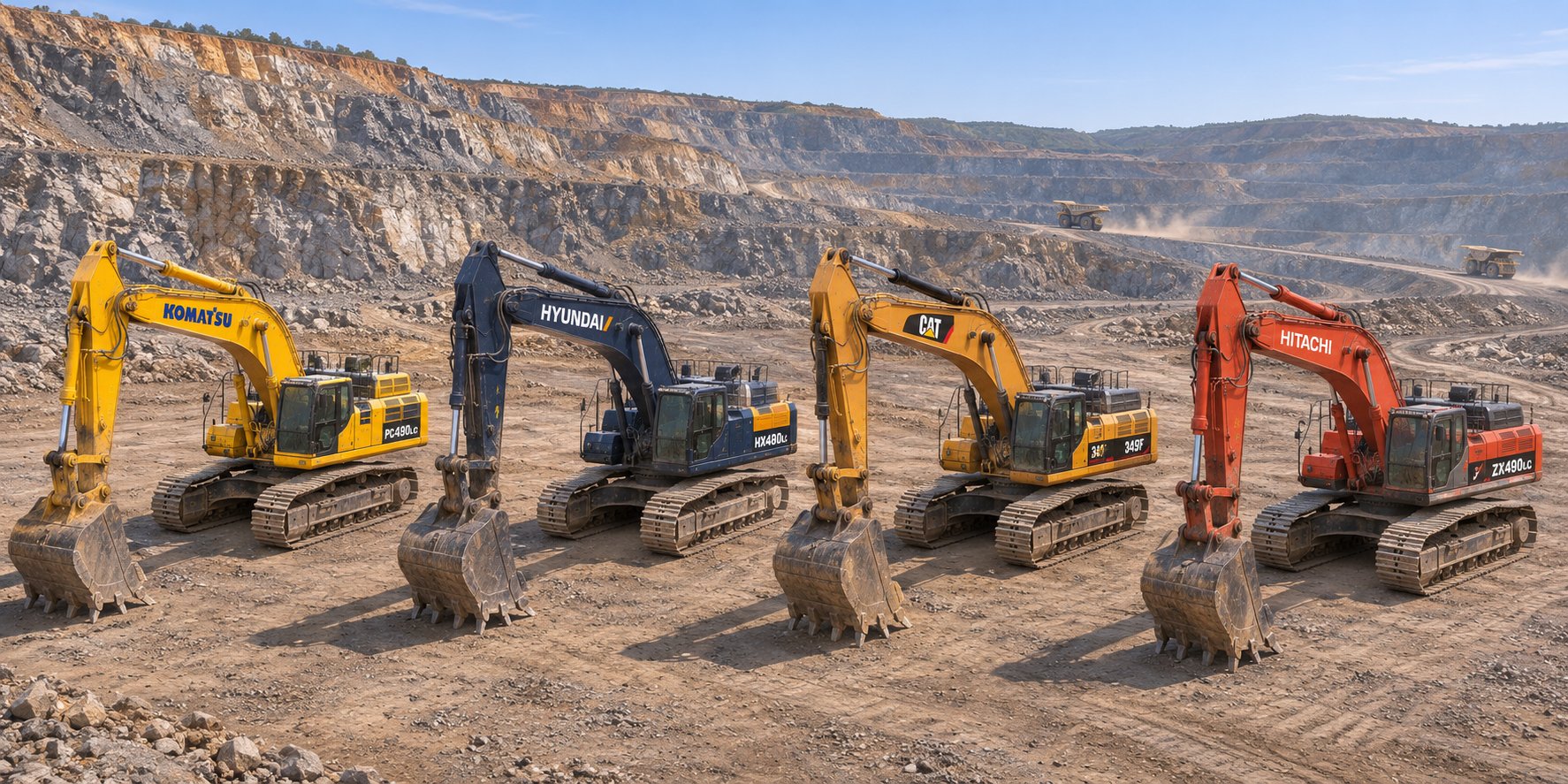
Caterpillar charges more than its competitors in the 75-ton excavator class. That's not a secret — it's a deliberate market position backed by tangible advantages that extend far beyond the machine itself. But "more expensive" doesn't automatically mean "better value," and buyers who arrived here searching for a cat 750 excavator price may discover that a Volvo EC750D, Komatsu PC750, or Sany SY750H delivers a stronger return for their specific operation. The only way to know is to compare what each brand actually brings to the table — honestly and without brand loyalty clouding the math.
Why Cat Large Excavators Cost More Than Competitors
Caterpillar's premium pricing isn't arbitrary. It reflects a set of ownership advantages that compound over years of service, particularly in remote or demanding environments. When you pay more for a Cat 374 or Cat 395 versus a competing big excavator in the same weight class, you're paying for:
- The largest dealer network in the industry. Caterpillar's independently owned dealer system spans every continent, with parts depots and service technicians in markets where other brands simply don't have a presence. Industry analysis confirms that if you're working in a remote location — a mine in the Sahara, a road project in Papua New Guinea, a port in West Africa — the probability that a Cat dealer or knowledgeable mechanic is within reach exceeds any other brand. That accessibility translates directly to less downtime when something breaks.
- Unmatched parts availability. Genuine Cat parts are the most expensive in the industry — typically 20 to 40 percent more than equivalent Komatsu OEM parts. But they're also the most readily available worldwide. When a hydraulic pump fails on a Friday afternoon, parts availability matters more than parts cost. An extensive Chinese aftermarket for Cat components helps offset that premium for buyers who source strategically.
- Strong resale value retention. Cat large excavators generally command the highest resale values in the used equipment market, driven by massive buyer trust and widespread demand. A five-year-old Cat in the 20-ton class typically retains 40 to 50 percent of its new price — and that residual advantage scales into the 75-ton class as well. Higher resale effectively lowers your net cost of ownership over the machine's life.
- Integrated technology ecosystem. Cat Grade, Product Link telematics, Cat Payload, Cat Command remote operation, and dealer-level diagnostic integration form a connected platform that competing brands are still working to match in depth. For fleet operators managing multiple pieces of caterpillar construction equipment, this ecosystem creates operational efficiencies that standalone machines from other brands can't replicate as seamlessly.
Those four pillars explain why Cat sits at the premium end of the pricing spectrum. Whether they justify the premium for your operation depends entirely on how heavily you lean on dealer support, how long you plan to own the machine, and where in the world you're running it.
How Volvo, Komatsu, and Sany Compare on Price and Value
Each competitor in this weight class brings distinct strengths that may outweigh Cat's advantages depending on your priorities. Volvo's EC750D is consistently rated as the most fuel-efficient and operator-friendly machine in its class — the Care Cab design delivers interior noise levels typically below 74 dB, and ECO mode optimizes fuel burn without meaningful production loss. For operations running 10-plus-hour shifts where operator fatigue affects safety and productivity, Volvo earns its keep in ways that don't show up on a spec sheet.
Komatsu's PC750 leans into hydraulic precision and fuel economy. Its variable-displacement piston pump with closed-center load-sensing technology delivers what operators consistently describe as the smoothest control feel in the industry. Fuel consumption typically runs 10 to 15 percent lower than equivalent Cat models in side-by-side comparisons — a gap that, at the hourly burn rates of a 75-ton machine, can save tens of thousands of dollars annually. Komatsu's five-year residual values in the 20-ton class reach 45 to 55 percent — actually exceeding Cat in many emerging markets.
Sany's SY750H takes a fundamentally different approach. Positioned as the value-focused alternative, Sany machines are generally priced lower at purchase while delivering competitive lifting and digging performance with modern operator features. Many contractors report that Sany equipment delivers significantly higher fuel efficiency than comparable units from established Western brands. The trade-off? A younger track record in North American and European markets, a still-expanding dealer network, and lower resale values when it's time to sell. For buyers who plan to run a machine until it's worn out rather than reselling at the midpoint of its life, that resale disadvantage matters less.
The following table maps these four brands against the considerations that matter most when cross-shopping in this class. Think of it as a quick-reference tool — not a definitive ranking, because the "best" brand depends entirely on your operational context.
| Buyer Consideration | Caterpillar (374 / 395) | Volvo (EC750D) | Komatsu (PC750) | Sany (SY750H) |
|---|---|---|---|---|
| Price Positioning | Premium | Mid-to-Premium | Mid | Value |
| Dealer Network Strength | Excellent — largest global footprint | Good — strongest in Europe, growing elsewhere | Strong — especially in Asia, Middle East | Expanding — regional focus, growing rapidly |
| Parts Availability | Excellent — most accessible worldwide | Fair to Good — can lag in remote markets | Good — strong OEM and aftermarket supply | Growing — increasing regional distribution |
| Resale Value Retention | Best — highest demand in used market | Moderate — smaller buyer pool extends selling time | Strong — rivals or exceeds Cat in some markets | Lower — younger brand history limits demand |
| Fuel Efficiency | Good — improved in Next Gen models | Excellent — class-leading with ECO mode | Excellent — 10-15% better than Cat typically | Good to Excellent — competitive fuel economy reported |
| Operator Comfort | Good | Best — industry-leading cab design | Good | Good — modern features, straightforward design |
| Technology Integration | Most advanced — fully integrated ecosystem | Strong — CareTrack telematics, smart controls | Strong — KOMTRAX, intelligent machine control | Developing — modern but less integrated |
| Best Suited For | Global fleets, remote locations, maximum resale focus | High-utilization ops prioritizing comfort and fuel savings | Fuel-sensitive operations, markets with strong Komatsu presence | Budget-conscious buyers, run-to-retirement strategies |
A few patterns emerge from this comparison. If you're operating across multiple geographies or in remote areas where downtime kills profitability, Cat's dealer and parts infrastructure earns its premium. If you're fuel-sensitive and running long daily shifts, Komatsu and Volvo both offer operating cost advantages that erode Cat's edge over a five-year ownership cycle. And if your priority is minimizing capital outlay while still getting modern capability — especially for a defined project rather than a permanent fleet addition — Sany's aggressive pricing deserves serious consideration.
Notice that none of these brands is universally "best." A mini excavator caterpillar model might dominate its weight class in one market while a 309 Cat fits better than a Komatsu equivalent in another. The same dynamic plays out at the 75-ton level. Your application, geography, ownership timeline, and resale strategy collectively determine which brand's price-to-value equation works hardest for you.
Knowing how these brands stack up is essential context — but context alone doesn't close a deal. Translating this comparison into a concrete buying decision requires a structured framework that moves you from research mode into action, matching the right machine to your project and securing it at the right price.
A Step-by-Step Buyer Framework for 75-Ton Cat Excavators
Research without a decision framework is just browsing. You've seen the real models behind the "cat 750 excavator price" search, compared Caterpillar against Volvo, Komatsu, and Sany, and mapped out the true cost of ownership beyond the purchase price. The remaining question is practical: how do you turn all of that into a signed deal on the right machine at the right number?
The following five-step framework distills everything covered in this article into a repeatable buying process. Whether you're acquiring your first 75-ton excavator or adding to an established fleet, these steps keep you focused on decisions that actually move the needle — and help you avoid the circular confusion that traps buyers who never clarify which machine they're really after.
Matching the Right Cat Model to Your Project
Application drives everything. A Cat 374 and a cat 390 excavator share the same brand badge and occupy the same general weight class, but they serve different production tiers and project profiles. Choosing between them — or deciding whether either one is right at all — starts with three honest questions about your work:
- What material are you moving, and how much per shift? Heavy construction and quarry loading at moderate volumes fit the Cat 374's capability perfectly. If you're feeding a fleet of haul trucks in mass excavation or supporting mining operations where cycle time shaves directly off project cost, the Cat 395's additional horsepower, reach, and bucket capacity earn their premium.
- What's the project duration? A single infrastructure contract lasting 12 to 18 months may not justify a brand-new flagship. A multi-year mining operation almost certainly does. Duration affects whether you buy or lease, new or used, and which technology packages deliver a return before the machine leaves your fleet.
- What's the jobsite environment? Demolition applications may favor the 374 configured with a multi-processor or shear. Deep basement excavation in urban settings may require the 395's maximum digging depth of 31 feet 8 inches. Remote locations where dealer access is limited favor Cat over competitors simply because of parts and service reach — the biggest excavator advantage Caterpillar holds isn't horsepower, it's infrastructure.
If your project scope doesn't clearly demand a 75-ton machine, don't force it. Caterpillar's midsize lineup — the 336 and 340 — handles a surprising range of heavy work at significantly lower acquisition and operating costs. And for entirely different job types, compact excavators like the caterpillar 304 excavator serve residential, utility, and light commercial applications where a large machine would be overkill. Right-sizing saves more money than any negotiation tactic.
Your Next Steps to Securing the Right Machine at the Right Price
With the model confirmed, follow this sequence to move from shortlist to signed purchase order:
- Confirm the actual model you need. You've done the research. Lock in whether you need a Cat 374, a Cat 395, or a used 390F based on the application-matching exercise above. Write down the specific configuration: boom type (reach vs. mass excavation), bucket size, and technology packages. Walking into a dealer conversation — or browsing a used marketplace — with a defined spec sheet prevents scope creep and keeps quotes comparable across sources.
- Decide new versus used. This isn't purely a budget question. New machines come with full warranty coverage, the latest technology, and zero deferred maintenance risk — but they also carry the steepest depreciation hit in year one (typically 20 to 30 percent of purchase price). Used machines absorb that depreciation before you buy, but they shift maintenance risk onto your balance sheet. Weigh your project timeline against your tolerance for unplanned repair costs. If you need the machine operational next week with zero risk, new or certified pre-owned makes sense. If you have the mechanical expertise to evaluate condition and the patience to source carefully, used delivers substantially more machine per dollar.
- Evaluate total cost, not just sticker price. Apply the TCO framework from earlier in this article. Estimate fuel burn based on expected duty cycle and hours per day. Budget 15 to 20 percent of the purchase price annually for maintenance and repairs. Factor in undercarriage replacement cycles based on your ground conditions. Add insurance premiums and financing costs. A machine that looks $80,000 cheaper at purchase but burns more fuel and needs undercarriage work sooner may cost more over a five-year ownership period. Run the numbers before you commit, not after.
- Source from multiple channels. Never rely on a single quote. For new machines, request configured pricing from at least two Cat dealers — remember, dealer pricing isn't standardized, and competition between dealerships works in your favor. For used equipment, cast a wider net. Check auction platforms like Ritchie Bros and Purple Wave for current market pricing and available inventory. Browse established online marketplaces where used Cat large excavators are listed with photos, hour counts, and configuration details. JIUHONG's used Caterpillar excavator collection is one practical option for contractors and fleet buyers who want to compare available Cat models side by side and contact a sales team to discuss specific needs around model availability, configuration, and budget. Explore Cat dealer certified pre-owned programs as well — the 5 to 10 percent price premium over auction buys often includes warranty coverage and reconditioning that reduces your post-purchase risk. The more data points you gather, the better your negotiating position becomes regardless of which channel you ultimately transact through.
- Inspect before committing. For used machines, this step is non-negotiable. Commission a professional third-party inspection — budget $500 to $1,500 — or conduct your own systematic evaluation using the red-flag checklist from earlier in this article. Verify hour meter accuracy against physical wear. Inspect undercarriage components for wear that doesn't match reported hours. Test every hydraulic function under load. Review complete service records and cross-reference dates against hour intervals. Confirm the serial number matches all documentation. Skipping inspection to "save time" on a six-figure machine is how buyers inherit five-figure problems. Even for the volvo 750 excavator price comparisons you may be running in parallel, the same inspection rigor applies — brand name alone doesn't guarantee condition.
This framework works whether you're acquiring a Cat 395 for a multi-year mining contract or evaluating a used Cat 374 for a highway expansion project. It works for a cat 307 on a utility job or a caterpillar 304 excavator on a residential site. The scale changes; the discipline doesn't.
You started this article searching for a machine that doesn't exist. You're leaving it with a clear understanding of which machines do exist, what they actually cost — both upfront and over time — and a structured path to securing the right one. The cat 750 excavator price was never real, but the Cat 374, 390F, and 395 absolutely are. Match the model to your work, source from multiple channels, inspect thoroughly, and negotiate with data. That's how informed buyers operate in this class — and it's how you avoid paying a premium for confusion.
Frequently Asked Questions About Cat 750 Excavator Pricing
1. Why can't I find a Cat 750 excavator for sale anywhere?
Caterpillar has never manufactured a model called the Cat 750. Their naming system uses three-digit numbers that roughly correspond to metric-ton operating weight, topping out at the Cat 395 for standard hydraulic excavators. The '750' designation belongs to competitors like Volvo (EC750D), Komatsu (PC750), and Sany (SY750H). The Cat equivalents in the 75-ton weight class are the Cat 374 and Cat 395, so directing your search toward those models will connect you with accurate pricing and real dealer quotes.
2. How much does a new Cat 374 or Cat 395 excavator cost?
Caterpillar does not publish fixed retail prices for large excavators. Final cost depends on base configuration, boom and stick selection, bucket packages, technology add-ons like Cat Grade 3D or Cat Command, dealer region, and current market demand. Buyers should request configured quotes from at least two Cat dealers, as pricing varies between dealerships. Attachments alone can add $5,000 to $25,000 or more, while GPS and advanced telematics packages may add $15,000 to $30,000 on top of the base unit price.
3. What is the price range for a used Cat 75-ton excavator?
Used Cat 374, 390F, and 395 pricing spans a wide spectrum based on machine hours, model year, condition, and maintenance history. Comparable 75-ton class excavators across all brands typically range from roughly $149,000 to over $710,000 on used equipment marketplaces. Low-hour, late-model Cat units in excellent condition command premium resale values, often retaining 65 to 80 percent of the new price. Platforms like JIUHONG's used Caterpillar excavator collection at jiuhong-machinery.com allow buyers to browse and compare available inventory while discussing specific budget and configuration needs with the sales team.
4. Is a Cat 374 the same as a Volvo EC750 or Komatsu PC750?
They are not identical machines, but they compete in the same approximate weight class. The Cat 374 operates at roughly 74,700 kg, while the Volvo EC750D ranges from 72,700 to 74,700 kg and the Komatsu PC750 sits in a similar 75-ton bracket. Bucket capacity, engine output, hydraulic system design, and technology suites differ between brands. Cat typically commands premium pricing offset by the industry's largest dealer network and strongest resale values, while Volvo leads in fuel efficiency and operator comfort, and Komatsu excels in hydraulic precision.
5. What should I inspect before buying a used Cat large excavator?
Critical inspection areas include hour meter accuracy compared to physical wear, complete service record documentation, undercarriage condition relative to reported hours, hydraulic system integrity including fluid color and function response, structural welds for signs of repair or damage, and serial number verification against all paperwork. Undercarriage components alone can represent up to 50 percent of total lifetime maintenance costs on a 75-ton tracked excavator. Budgeting $500 to $1,500 for a professional third-party inspection before committing to a six-figure purchase is strongly recommended to avoid inheriting costly hidden problems.